Preterm Labor: An Update
Mahmoud Zakherah
Prof Obstetrics and Gynecology
Assiut University ,Egypt
Mszakhera@gmail.com 2019
Magnitude of the Problem
•Preterm birth is the leading cause of perinatal and
neonatal morbidity and mortality.
•Preterm birth, defined as spontaneous or
iatrogenic delivery before 37 weeks gestation.
•preterm labor is a multifactorial and complex
syndrome.
• incidence 12.5%
Definitions
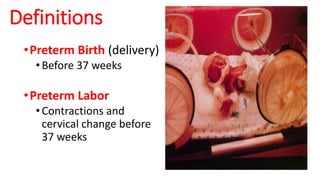
•Preterm Birth (delivery)
•Before 37 weeks
•Preterm Labor
•Contractions and
cervical change before
37 weeks
Definition
•Preterm labor is the presence of
contractions of sufficient strength and
frequency to effect progressive
effacement and dilation of the cervix
between 28 and 37 weeks' gestation
• Preterm (or premature) infant
• Before 37 completed weeks of gestation
• Late preterm infant (a recently identified category)
• between 34 and 36 weeks gestation
• Moderately preterm infant
• between 32 and 36 completed weeks of gestation
• Very preterm infant
• before 32 completed weeks of gestation
Definitions
Definitions
•Low birthweight (LBW)
• infant who weighs less than 2,500 grams at delivery
•Very low birthweight (VLBW)
• infant who weighs less than 1,500 grams at delivery
•Extremely low birthweight (ELBW)
• infant who weighs less than 1,000 grams at delivery
Source: Iams JD, Creasy RK. Preterm labor and delivery, Chapter 34. In:
Maternal-Fetal Medicine: Principles and Practice, 5th ed., 2004.
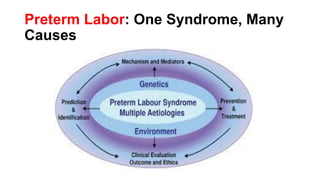
Preterm Labor: One Syndrome, Many
Causes
Pathophysiology
•Myometrial contractility
•Cervical ripening dilatation
•Decidual membrane activation
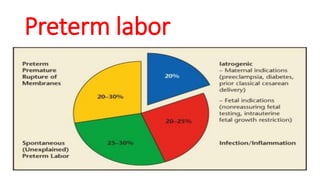
Preterm labor
1- spontaneous intact membranes
50%
2-Preterm ROM 30%
3-Iatrogenic Clinically indicated
fetal or maternal 20%
Preterm labor
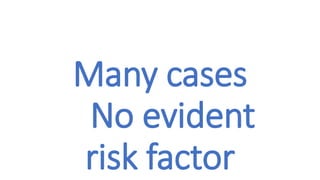
Many cases
No evident
risk factor
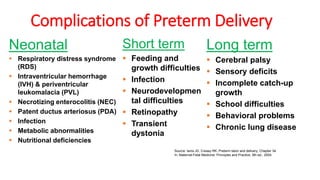
Complications of Preterm Delivery
Neonatal
▪ Respiratory distress syndrome
(RDS)
▪ Intraventricular hemorrhage
(IVH) & periventricular
leukomalacia (PVL)
▪ Necrotizing enterocolitis (NEC)
▪ Patent ductus arteriosus (PDA)
▪ Infection
▪ Metabolic abnormalities
▪ Nutritional deficiencies
Long term
▪ Cerebral palsy
▪ Sensory deficits
▪ Incomplete catch-up
growth
▪ School difficulties
▪ Behavioral problems
▪ Chronic lung disease
Short term
▪ Feeding and
growth difficulties
▪ Infection
▪ Neurodevelopmen
tal difficulties
▪ Retinopathy
▪ Transient
dystonia
Source: Iams JD, Creasy RK. Preterm labor and delivery, Chapter 34.
In: Maternal-Fetal Medicine: Principles and Practice, 5th ed., 2004.
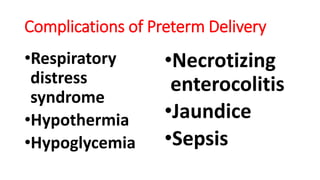
Complications of Preterm Delivery
•Respiratory
distress
syndrome
•Hypothermia
•Hypoglycemia
•Necrotizing
enterocolitis
•Jaundice
•Sepsis
Prediction
Prediction
❑Assessment of risk factors
❑Vaginal examination to assess the cervical
status
❑Ultrasound visualization of cervical length
❑Detection of fetal fibronectin in
cervicovaginal secretions
Prediction
❑CRH Elevated CRH is implicated in preterm labor
associated with stress, infection and hemorrhage.
❑AFP and HCG
❑AMH
Risk Factors
Risk Factors for Spontaneous Preterm Birth
Nonmodifiable Risk Factors
• Prior preterm birth
• Cervical injury or anomaly
• Uterine anomaly
• Age < 18 years or> 40 years
• Excessive uterine activity (?)
• Poor nutrition
• Low prepregnancy weight
• Low socioeconomic status
•Overdistended uterus
(twins, polyhydramnios)
•Poor prenatal care
•Vaginal bleeding
Potentially Modifiable Risk Factors
•Cigarette smoking
• lower genital tract
infections
• (including bacterial
vaginosis, Neisseria
Chlamydia trachomatis,
Group B Streptococcus and
Trichomonas vaginalis)
• Illicit drug use
• Anemia
• A Bacteriuria/UTI
• Gingival disease
• High personal stress (?)
• Strenuous work/work
• Environment (?)
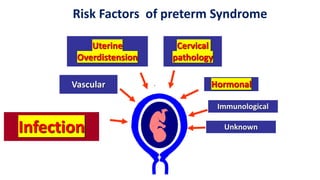
Risk Factors of preterm Syndrome
Uterine
Overdistension
Vascular
Infection
Cervical
pathology
Hormonal
Immunological
© VR RR MM
Unknown
Risk factors
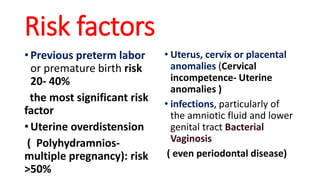
• Previous preterm labor
or premature birth risk
20- 40%
the most significant risk
factor
• Uterine overdistension
( Polyhydramnios-
multiple pregnancy): risk
>50%
• Uterus, cervix or placental
anomalies (Cervical
incompetence- Uterine
anomalies )
• infections, particularly of
the amniotic fluid and lower
genital tract Bacterial
Vaginosis
( even periodontal disease)
Risk factors
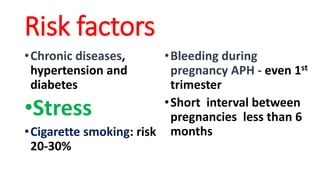
•Chronic diseases,
hypertension and
diabetes
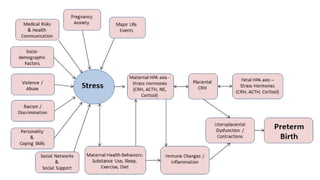
•Stress
•Cigarette smoking: risk
20-30%
•Bleeding during
pregnancy APH - even 1st
trimester
•Short interval between
pregnancies less than 6
months
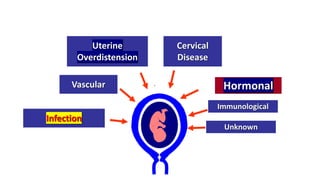
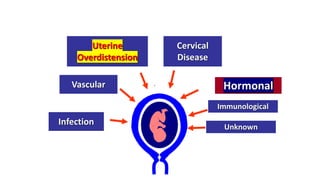
The Preterm Parturition Syndrome
Uterine
Overdistension
Vascular
Infection
Cervical
Disease
Hormonal
Immunological
© VR RR MM
Unknown
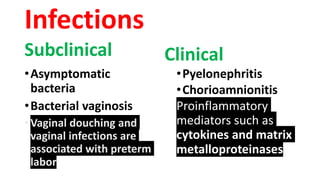
Infections
Subclinical
•Asymptomatic
bacteria
•Bacterial vaginosis
•Vaginal douching and
vaginal infections are
associated with preterm
labor
Clinical
•Pyelonephritis
•Chorioamnionitis
Proinflammatory
mediators such as
cytokines and matrix
metalloproteinases
The Preterm Parturition Syndrome
Uterine
Overdistension
Vascular
Infection
Cervical
Disease
Hormonal
Immunological
© VR RR MM
Unknown
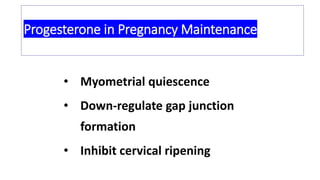
Progesterone in Pregnancy Maintenance
• Myometrial quiescence
• Down-regulate gap junction
formation
• Inhibit cervical ripening
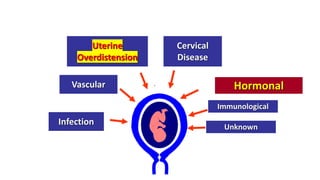
The Preterm Parturition Syndrome
Uterine
Overdistension
Vascular
Infection
Cervical
Disease
Hormonal
Immunological
© VR RR MM
Unknown
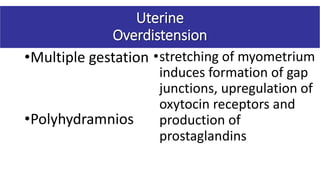
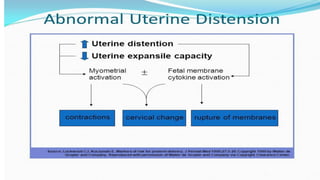
•Multiple gestation
•Polyhydramnios
•stretching of myometrium
induces formation of gap
junctions, upregulation of
oxytocin receptors and
production of
prostaglandins
Uterine
Overdistension
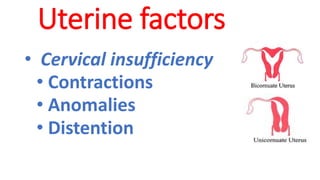
Uterine factors
• Cervical insufficiency
• Contractions
• Anomalies
• Distention
Prevention
Prevention
•Primary prevention Identify High risk
groups PROG
•Secondary prevention
Tocolysis steroids antibiotics
▪Tertiary preventions
Minimize complications IU transfer
Prevention
•Regular prenatal care
•Life style Eat a healthy diet-stress reduction PUFA
•Rest pelvic –body ???
•Pregnancy spacing.
•Be cautious when using assisted reproductive
technology (ART). . Multiple pregnancies carry
a higher risk of preterm labor.
Prevention
Bedrest Effects
•Muscle atrophy
•Bone loss occurs
•Pulmonary
•Cardiovascular changes
•Financial
Prevention
•Cervix ultrasound cerclage
•Myometrial contractions
Monitoring tocolysis
•Membrane decidual activation
Fibronectin antibiotics
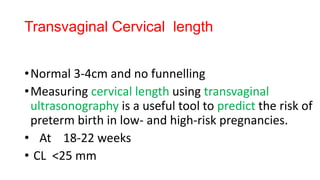
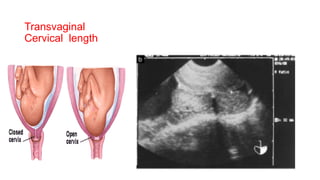
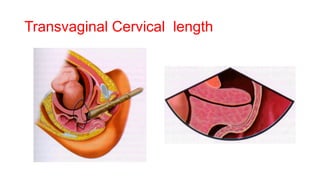
Transvaginal Cervical length
•Normal 3-4cm and no funnelling
•Measuring cervical length using transvaginal
ultrasonography is a useful tool to predict the risk of
preterm birth in low- and high-risk pregnancies.
• At 18-22 weeks
• CL <25 mm
Transvaginal
Cervical length
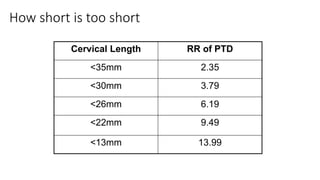
How short is too short
Cervical Length RR of PTD
<35mm 2.35
<30mm 3.79
<26mm 6.19
<22mm 9.49
<13mm 13.99
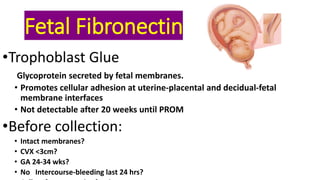
Fetal Fibronectin
•Trophoblast Glue
Glycoprotein secreted by fetal membranes.
• Promotes cellular adhesion at uterine-placental and decidual-fetal
membrane interfaces
• Not detectable after 20 weeks until PROM
•Before collection:
• Intact membranes?
• CVX <3cm?
• GA 24-34 wks?
• No Intercourse-bleeding last 24 hrs?
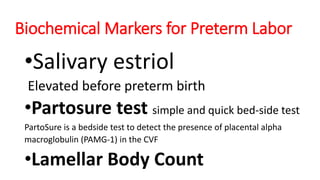
Biochemical Markers for Preterm Labor
•Salivary estriol
Elevated before preterm birth
•Partosure test simple and quick bed-side test
PartoSure is a bedside test to detect the presence of placental alpha
macroglobulin (PAMG-1) in the CVF
•Lamellar Body Count
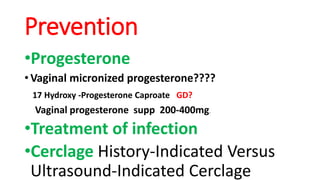
Prevention
•Progesterone
• Vaginal micronized progesterone????
17 Hydroxy -Progesterone Caproate GD?
Vaginal progesterone supp 200-400mg.
•Treatment of infection
•Cerclage History-Indicated Versus
Ultrasound-Indicated Cerclage
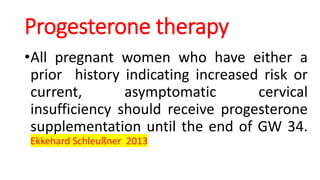
Progesterone therapy
•All pregnant women who have either a
prior history indicating increased risk or
current, asymptomatic cervical
insufficiency should receive progesterone
supplementation until the end of GW 34.
Ekkehard Schleußner 2013
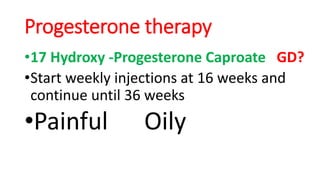
Progesterone therapy
•17 Hydroxy -Progesterone Caproate GD?
•Start weekly injections at 16 weeks and
continue until 36 weeks
•Painful Oily
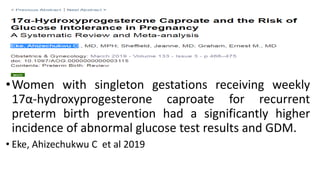
•Women with singleton gestations receiving weekly
17α-hydroxyprogesterone caproate for recurrent
preterm birth prevention had a significantly higher
incidence of abnormal glucose test results and GDM.
• Eke, Ahizechukwu C et al 2019
Progesterone therapy
Vaginal progesterone
•Direct effect
•Convenient
• 200mg 400 mg
•16-36 ws
Progesterone therapy
•At best, progesterone supplementation prevents
only one-third of recurrent preterm births, and
the long-term benefits of progesterone
supplementation are not yet clear.
•The potential clinical benefits of progesterone
supplementation appear large, whereas the risks
seem small (Errol R Norwitz et all,2011)
Progesterone therapy
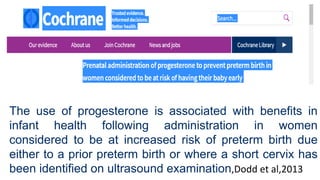
•Cochrane review of prenatal
administration of progesterone for
preventing preterm birth in women
considered to be at risk of preterm birth
Dodd et al, Cochrane Database of Systematic Reviews 2013, Issue 7
The use of progesterone is associated with benefits in
infant health following administration in women
considered to be at increased risk of preterm birth due
either to a prior preterm birth or where a short cervix has
been identified on ultrasound examination,Dodd et al,2013
Antibiotics
•Ampicillin
• Clindamycin
• Erythromycin
• LAP
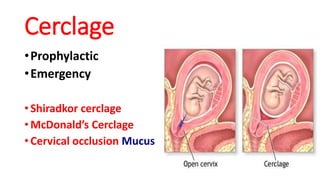
Cerclage
•Prophylactic
•Emergency
• Shiradkor cerclage
• McDonald’s Cerclage
• Cervical occlusion Mucus
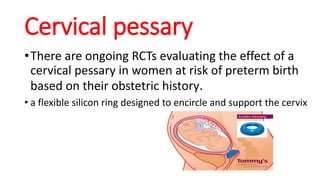
Cervical pessary
•There are ongoing RCTs evaluating the effect of a
cervical pessary in women at risk of preterm birth
based on their obstetric history.
• a flexible silicon ring designed to encircle and support the cervix
Diagnosis
Preterm Labor Home Care Instructions
WARNING SIGNS OF
PRETERM LABOR
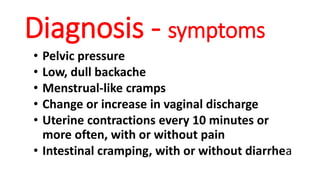
Diagnosis - symptoms
• Pelvic pressure
• Low, dull backache
• Menstrual-like cramps
• Change or increase in vaginal discharge
• Uterine contractions every 10 minutes or
more often, with or without pain
• Intestinal cramping, with or without diarrhea
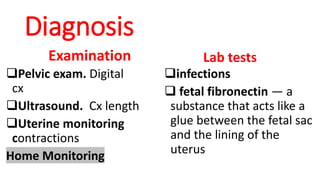
Diagnosis
Examination
❑Pelvic exam. Digital
cx
❑Ultrasound. Cx length
❑Uterine monitoring
contractions
Home Monitoring
Lab tests
❑infections
❑ fetal fibronectin — a
substance that acts like a
glue between the fetal sac
and the lining of the
uterus
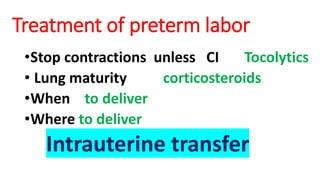
Treatment of preterm labor
•Stop contractions unless CI Tocolytics
• Lung maturity corticosteroids
•When to deliver
•Where to deliver
Intrauterine transfer
Tocolytics
•Short term delay
• IU transfer required
• or need to give steroids
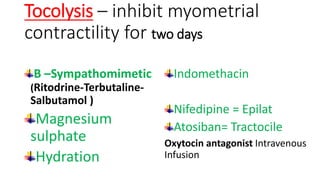
Tocolysis – inhibit myometrial
contractility for two days
B –Sympathomimetic
(Ritodrine-Terbutaline-
Salbutamol )
Magnesium
sulphate
Hydration
Indomethacin
Nifedipine = Epilat
Atosiban= Tractocile
Oxytocin antagonist Intravenous
Infusion
Magnesium sulfate
•Neuroprotective
• Reduce the risk cerebral palsy)
for babies born before 32 weeks
of gestation
•Maintain levels of 5.5-7 mg/dl
INDOMETHACIN
•Powerful Anti-inflammatory
• Inhibits prostaglandin synthesis
• Readily crosses the placenta
• Often used in conjunction with other tocolytic
therapy (e.g., magnesium)
• Effective in prolonging pregnancy 48-72 hours
• Oligohydramnios Premature closure of DA
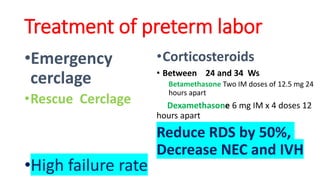
•Emergency
cerclage
•Rescue Cerclage
•High failure rate
•Corticosteroids
• Between 24 and 34 Ws
Betamethasone Two IM doses of 12.5 mg 24
hours apart
Dexamethasone 6 mg IM x 4 doses 12
hours apart
Reduce RDS by 50%,
Decrease NEC and IVH
Treatment of preterm labor
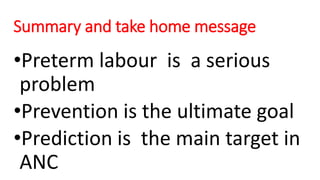
Summary and take home message
•Preterm labour is a serious
problem
•Prevention is the ultimate goal
•Prediction is the main target in
ANC
Summary and take home message
•Preterm Labor Patient Education
•Warning Signs of Preterm Labor
•CALL YOUR DOCTOR
Summary and take home message
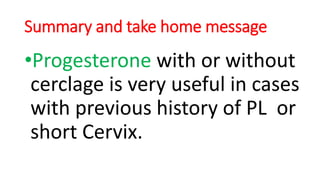
•Progesterone with or without
cerclage is very useful in cases
with previous history of PL or
short Cervix.
Summary and take home message
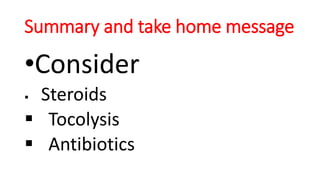
•Consider
▪ Steroids
▪ Tocolysis
▪ Antibiotics
Summary and take home message
Special care baby unit
is essential at delivery
Summary and take home message
•The inferior physician waits until the
disease is full blown before treating.
•The mediocre physician treats the disease
once it has become clinically manifest.
•The superior physician prevents the
disease.
Preterm labor an update

Preterm labor an update

  • 2.
    Preterm Labor: AnUpdate Mahmoud Zakherah Prof Obstetrics and Gynecology Assiut University ,Egypt Mszakhera@gmail.com 2019
  • 3.
    Magnitude of theProblem •Preterm birth is the leading cause of perinatal and neonatal morbidity and mortality. •Preterm birth, defined as spontaneous or iatrogenic delivery before 37 weeks gestation. •preterm labor is a multifactorial and complex syndrome. • incidence 12.5%
  • 4.
    Definitions •Preterm Birth (delivery) •Before37 weeks •Preterm Labor •Contractions and cervical change before 37 weeks
  • 5.
    Definition •Preterm labor isthe presence of contractions of sufficient strength and frequency to effect progressive effacement and dilation of the cervix between 28 and 37 weeks' gestation
  • 6.
    • Preterm (orpremature) infant • Before 37 completed weeks of gestation • Late preterm infant (a recently identified category) • between 34 and 36 weeks gestation • Moderately preterm infant • between 32 and 36 completed weeks of gestation • Very preterm infant • before 32 completed weeks of gestation Definitions
  • 7.
    Definitions •Low birthweight (LBW) •infant who weighs less than 2,500 grams at delivery •Very low birthweight (VLBW) • infant who weighs less than 1,500 grams at delivery •Extremely low birthweight (ELBW) • infant who weighs less than 1,000 grams at delivery Source: Iams JD, Creasy RK. Preterm labor and delivery, Chapter 34. In: Maternal-Fetal Medicine: Principles and Practice, 5th ed., 2004.
  • 8.
    Preterm Labor: OneSyndrome, Many Causes
  • 9.
    Pathophysiology •Myometrial contractility •Cervical ripeningdilatation •Decidual membrane activation
  • 10.
    Preterm labor 1- spontaneousintact membranes 50% 2-Preterm ROM 30% 3-Iatrogenic Clinically indicated fetal or maternal 20%
  • 11.
  • 12.
  • 13.
    Complications of PretermDelivery Neonatal ▪ Respiratory distress syndrome (RDS) ▪ Intraventricular hemorrhage (IVH) & periventricular leukomalacia (PVL) ▪ Necrotizing enterocolitis (NEC) ▪ Patent ductus arteriosus (PDA) ▪ Infection ▪ Metabolic abnormalities ▪ Nutritional deficiencies Long term ▪ Cerebral palsy ▪ Sensory deficits ▪ Incomplete catch-up growth ▪ School difficulties ▪ Behavioral problems ▪ Chronic lung disease Short term ▪ Feeding and growth difficulties ▪ Infection ▪ Neurodevelopmen tal difficulties ▪ Retinopathy ▪ Transient dystonia Source: Iams JD, Creasy RK. Preterm labor and delivery, Chapter 34. In: Maternal-Fetal Medicine: Principles and Practice, 5th ed., 2004.
  • 14.
    Complications of PretermDelivery •Respiratory distress syndrome •Hypothermia •Hypoglycemia •Necrotizing enterocolitis •Jaundice •Sepsis
  • 15.
  • 16.
    Prediction ❑Assessment of riskfactors ❑Vaginal examination to assess the cervical status ❑Ultrasound visualization of cervical length ❑Detection of fetal fibronectin in cervicovaginal secretions
  • 17.
    Prediction ❑CRH Elevated CRHis implicated in preterm labor associated with stress, infection and hemorrhage. ❑AFP and HCG ❑AMH
  • 18.
    Risk Factors Risk Factorsfor Spontaneous Preterm Birth
  • 19.
    Nonmodifiable Risk Factors •Prior preterm birth • Cervical injury or anomaly • Uterine anomaly • Age < 18 years or> 40 years • Excessive uterine activity (?) • Poor nutrition • Low prepregnancy weight • Low socioeconomic status •Overdistended uterus (twins, polyhydramnios) •Poor prenatal care •Vaginal bleeding
  • 20.
    Potentially Modifiable RiskFactors •Cigarette smoking • lower genital tract infections • (including bacterial vaginosis, Neisseria Chlamydia trachomatis, Group B Streptococcus and Trichomonas vaginalis) • Illicit drug use • Anemia • A Bacteriuria/UTI • Gingival disease • High personal stress (?) • Strenuous work/work • Environment (?)
  • 21.
    Risk Factors ofpreterm Syndrome Uterine Overdistension Vascular Infection Cervical pathology Hormonal Immunological © VR RR MM Unknown
  • 22.
    Risk factors • Previouspreterm labor or premature birth risk 20- 40% the most significant risk factor • Uterine overdistension ( Polyhydramnios- multiple pregnancy): risk >50% • Uterus, cervix or placental anomalies (Cervical incompetence- Uterine anomalies ) • infections, particularly of the amniotic fluid and lower genital tract Bacterial Vaginosis ( even periodontal disease)
  • 23.
    Risk factors •Chronic diseases, hypertensionand diabetes •Stress •Cigarette smoking: risk 20-30% •Bleeding during pregnancy APH - even 1st trimester •Short interval between pregnancies less than 6 months
  • 25.
    The Preterm ParturitionSyndrome Uterine Overdistension Vascular Infection Cervical Disease Hormonal Immunological © VR RR MM Unknown
  • 26.
    Infections Subclinical •Asymptomatic bacteria •Bacterial vaginosis •Vaginal douchingand vaginal infections are associated with preterm labor Clinical •Pyelonephritis •Chorioamnionitis Proinflammatory mediators such as cytokines and matrix metalloproteinases
  • 27.
    The Preterm ParturitionSyndrome Uterine Overdistension Vascular Infection Cervical Disease Hormonal Immunological © VR RR MM Unknown
  • 28.
    Progesterone in PregnancyMaintenance • Myometrial quiescence • Down-regulate gap junction formation • Inhibit cervical ripening
  • 29.
    The Preterm ParturitionSyndrome Uterine Overdistension Vascular Infection Cervical Disease Hormonal Immunological © VR RR MM Unknown
  • 30.
    •Multiple gestation •Polyhydramnios •stretching ofmyometrium induces formation of gap junctions, upregulation of oxytocin receptors and production of prostaglandins Uterine Overdistension
  • 31.
    Uterine factors • Cervicalinsufficiency • Contractions • Anomalies • Distention
  • 33.
  • 34.
    Prevention •Primary prevention IdentifyHigh risk groups PROG •Secondary prevention Tocolysis steroids antibiotics ▪Tertiary preventions Minimize complications IU transfer
  • 35.
    Prevention •Regular prenatal care •Lifestyle Eat a healthy diet-stress reduction PUFA •Rest pelvic –body ??? •Pregnancy spacing. •Be cautious when using assisted reproductive technology (ART). . Multiple pregnancies carry a higher risk of preterm labor.
  • 36.
    Prevention Bedrest Effects •Muscle atrophy •Boneloss occurs •Pulmonary •Cardiovascular changes •Financial
  • 37.
    Prevention •Cervix ultrasound cerclage •Myometrialcontractions Monitoring tocolysis •Membrane decidual activation Fibronectin antibiotics
  • 38.
  • 39.
    Transvaginal Cervical length •Normal3-4cm and no funnelling •Measuring cervical length using transvaginal ultrasonography is a useful tool to predict the risk of preterm birth in low- and high-risk pregnancies. • At 18-22 weeks • CL <25 mm
  • 40.
  • 41.
    How short istoo short Cervical Length RR of PTD <35mm 2.35 <30mm 3.79 <26mm 6.19 <22mm 9.49 <13mm 13.99
  • 42.
    Fetal Fibronectin •Trophoblast Glue Glycoproteinsecreted by fetal membranes. • Promotes cellular adhesion at uterine-placental and decidual-fetal membrane interfaces • Not detectable after 20 weeks until PROM •Before collection: • Intact membranes? • CVX <3cm? • GA 24-34 wks? • No Intercourse-bleeding last 24 hrs?
  • 43.
    Biochemical Markers forPreterm Labor •Salivary estriol Elevated before preterm birth •Partosure test simple and quick bed-side test PartoSure is a bedside test to detect the presence of placental alpha macroglobulin (PAMG-1) in the CVF •Lamellar Body Count
  • 44.
    Prevention •Progesterone • Vaginal micronizedprogesterone???? 17 Hydroxy -Progesterone Caproate GD? Vaginal progesterone supp 200-400mg. •Treatment of infection •Cerclage History-Indicated Versus Ultrasound-Indicated Cerclage
  • 45.
    Progesterone therapy •All pregnantwomen who have either a prior history indicating increased risk or current, asymptomatic cervical insufficiency should receive progesterone supplementation until the end of GW 34. Ekkehard Schleußner 2013
  • 46.
    Progesterone therapy •17 Hydroxy-Progesterone Caproate GD? •Start weekly injections at 16 weeks and continue until 36 weeks •Painful Oily
  • 47.
    •Women with singletongestations receiving weekly 17α-hydroxyprogesterone caproate for recurrent preterm birth prevention had a significantly higher incidence of abnormal glucose test results and GDM. • Eke, Ahizechukwu C et al 2019
  • 48.
    Progesterone therapy Vaginal progesterone •Directeffect •Convenient • 200mg 400 mg •16-36 ws
  • 49.
    Progesterone therapy •At best,progesterone supplementation prevents only one-third of recurrent preterm births, and the long-term benefits of progesterone supplementation are not yet clear. •The potential clinical benefits of progesterone supplementation appear large, whereas the risks seem small (Errol R Norwitz et all,2011)
  • 50.
    Progesterone therapy •Cochrane reviewof prenatal administration of progesterone for preventing preterm birth in women considered to be at risk of preterm birth Dodd et al, Cochrane Database of Systematic Reviews 2013, Issue 7
  • 51.
    The use ofprogesterone is associated with benefits in infant health following administration in women considered to be at increased risk of preterm birth due either to a prior preterm birth or where a short cervix has been identified on ultrasound examination,Dodd et al,2013
  • 52.
  • 53.
    Cerclage •Prophylactic •Emergency • Shiradkor cerclage •McDonald’s Cerclage • Cervical occlusion Mucus
  • 54.
    Cervical pessary •There areongoing RCTs evaluating the effect of a cervical pessary in women at risk of preterm birth based on their obstetric history. • a flexible silicon ring designed to encircle and support the cervix
  • 55.
  • 56.
    Preterm Labor HomeCare Instructions WARNING SIGNS OF PRETERM LABOR
  • 57.
    Diagnosis - symptoms •Pelvic pressure • Low, dull backache • Menstrual-like cramps • Change or increase in vaginal discharge • Uterine contractions every 10 minutes or more often, with or without pain • Intestinal cramping, with or without diarrhea
  • 58.
    Diagnosis Examination ❑Pelvic exam. Digital cx ❑Ultrasound.Cx length ❑Uterine monitoring contractions Home Monitoring Lab tests ❑infections ❑ fetal fibronectin — a substance that acts like a glue between the fetal sac and the lining of the uterus
  • 59.
  • 60.
    Treatment of pretermlabor •Stop contractions unless CI Tocolytics • Lung maturity corticosteroids •When to deliver •Where to deliver Intrauterine transfer
  • 61.
    Tocolytics •Short term delay •IU transfer required • or need to give steroids
  • 62.
    Tocolysis – inhibitmyometrial contractility for two days B –Sympathomimetic (Ritodrine-Terbutaline- Salbutamol ) Magnesium sulphate Hydration Indomethacin Nifedipine = Epilat Atosiban= Tractocile Oxytocin antagonist Intravenous Infusion
  • 63.
    Magnesium sulfate •Neuroprotective • Reducethe risk cerebral palsy) for babies born before 32 weeks of gestation •Maintain levels of 5.5-7 mg/dl
  • 64.
    INDOMETHACIN •Powerful Anti-inflammatory • Inhibitsprostaglandin synthesis • Readily crosses the placenta • Often used in conjunction with other tocolytic therapy (e.g., magnesium) • Effective in prolonging pregnancy 48-72 hours • Oligohydramnios Premature closure of DA
  • 65.
    •Emergency cerclage •Rescue Cerclage •High failurerate •Corticosteroids • Between 24 and 34 Ws Betamethasone Two IM doses of 12.5 mg 24 hours apart Dexamethasone 6 mg IM x 4 doses 12 hours apart Reduce RDS by 50%, Decrease NEC and IVH Treatment of preterm labor
  • 66.
    Summary and takehome message •Preterm labour is a serious problem •Prevention is the ultimate goal •Prediction is the main target in ANC
  • 67.
    Summary and takehome message •Preterm Labor Patient Education •Warning Signs of Preterm Labor •CALL YOUR DOCTOR
  • 68.
    Summary and takehome message •Progesterone with or without cerclage is very useful in cases with previous history of PL or short Cervix.
  • 69.
    Summary and takehome message •Consider ▪ Steroids ▪ Tocolysis ▪ Antibiotics
  • 70.
    Summary and takehome message Special care baby unit is essential at delivery
  • 71.
    Summary and takehome message •The inferior physician waits until the disease is full blown before treating. •The mediocre physician treats the disease once it has become clinically manifest. •The superior physician prevents the disease.