Dr. Kirtan Vyas
Assistant Professor
PDUMC, Rajkot
1
Gujarat Uni. First-Gold medallist
Gujarat Public Service Commission(GPSC) first
Fellow in Gynec Endoscopy(Mumbai)
Fellow in Ultrasonography(FOGSI)
Publications in various International Journals
Presented Scientific Papers and Chaired Sessions at State and National
conferences.
Faculty at State and National Conferences
Local Joint Secretary of SOGOG-Gujarat State Org of Ob Gy
 Organizing Secretary for the First Rajkot Obstetrics and Gynec
Society Annual Conference 2015 and Committee Member at State and
National conferences
Organizing secretary for the West Zone Yuva Fogsi 2016,Rajkot
At present working as an Assistant Professor at P.D. U. Medical
College and Hospital, Rajkot
 Define PTL and describe their significance
 List risk factors associated with PTL
 Outline initial evaluation of PTL
 Describe management of PTL
 Neonatal complications 3
 The timing of human birth is carefully regulated
event that takes place normally between 37 and 40
weeks
 Birth outside this timeframe has immense
consequences both for the mother and the baby
 Still today, Prematurity is the leading cause of
neonatal death*
*Liu et al. 2012
4
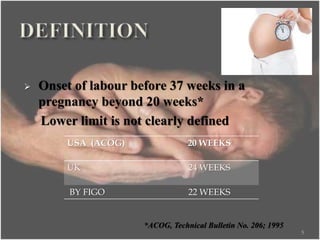
 Onset of labour before 37 weeks in a
pregnancy beyond 20 weeks*
Lower limit is not clearly defined
5
USA (ACOG) 20 WEEKS
UK 24 WEEKS
BY FIGO 22 WEEKS
*ACOG, Technical Bulletin No. 206; 1995
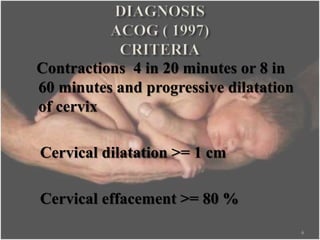
Contractions 4 in 20 minutes or 8 in
60 minutes and progressive dilatation
of cervix
Cervical dilatation >= 1 cm
Cervical effacement >= 80 %
6
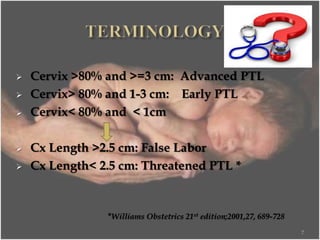
 Cervix >80% and >=3 cm: Advanced PTL
 Cervix> 80% and 1-3 cm: Early PTL
 Cervix< 80% and < 1cm
 Cx Length >2.5 cm: False Labor
 Cx Length< 2.5 cm: Threatened PTL *
*Williams Obstetrics 21st edition;2001,27, 689-728
7
 Mildly preterm birth 32 - 36 weeks
 Very preterm birth 28 - 31 weeks
 Extremely preterm birth 24 - 27 weeks
8
 Accounts for 85% of all perinatal mortality and
morbidity
 8-12% of all deliveries are preterm
 71.2% 34-36 weeks
 13% 32-33 weeks
 10% 28-31 weeks
 6% <28 weeks
9
10
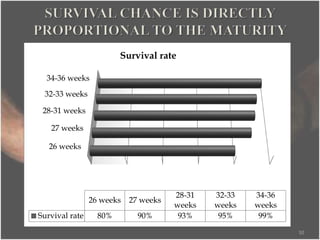
26 weeks
27 weeks
28-31 weeks
32-33 weeks
34-36 weeks
26 weeks 27 weeks
28-31
weeks
32-33
weeks
34-36
weeks
Survival rate 80% 90% 93% 95% 99%
Survival rate
 In spite of considerable advances in obstetrical
care, all over the world the rate of preterm birth
is increasing*
 Although the survival rates have increased, the
morbidity remains unaltered ($)
 Focus of research is now shifted on prevention of
preterm labour in last few years (#)
*Sykes et al. 2011, Blencowe et al. 201
$ Fanaroff et al. 2003
# Howson et al. 2012
11
12
13
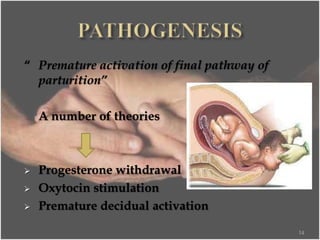
“ Premature activation of final pathway of
parturition”
A number of theories
 Progesterone withdrawal
 Oxytocin stimulation
 Premature decidual activation
14
aaaaa
aaaaa
aaaa
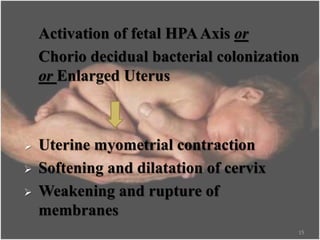
Activation of fetal HPAAxis or
Chorio decidual bacterial colonization
or Enlarged Uterus
 Uterine myometrial contraction
 Softening and dilatation of cervix
 Weakening and rupture of
membranes
15
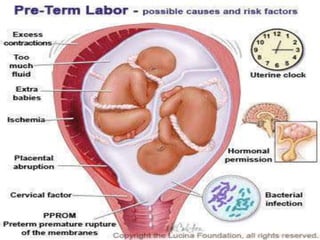
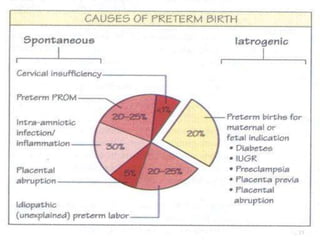
 2.5 times increased incidence of SPL in women with
a history of 1 abortion
 Assessment of risk factors
 Vaginal examination to assess the cervical status
 Ultrasound visualization of cervical length and
dilatation
 Detection of fetal fibronectin in cervical vaginal
secretions
Spontaneous Preterm Birth is highly multi
factorial so it’s unlikely that a single test is sufficient
to predict the same
16
warning signals
Though not very specific , should not be overlooked
 menstrual like cramps (pains )
 low dull backache
 abdominal cramps
 feeling of pressure or heaviness in vagina
 increase or change in vaginal discharge- bloody fluid
leaking per vagina
 uterine contractions less than 10 minutes apart ,even if
painless
 vaginal infections 17
Risk scoring system
• Socioeconomic factors
• Previous medical history
• Daily habits
• Condition in present pregnancy
•
Not found very useful
Half of the preterm deliveries occur in low risk patients also
18
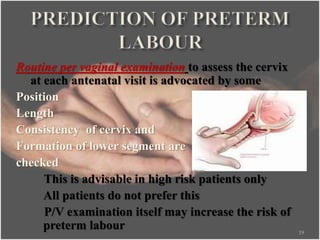
Routine per vaginal examination to assess the cervix
at each antenatal visit is advocated by some
Position
Length
Consistency of cervix and
Formation of lower segment are
checked
This is advisable in high risk patients only
All patients do not prefer this
P/V examination itself may increase the risk of
preterm labour 19
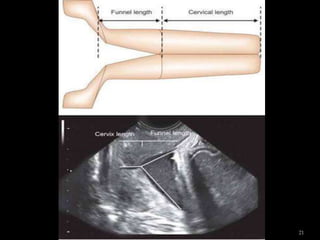
Transvaginal sonography
 Cervical Insufficiency:
 Cervical changes in absence of uterine contractions
 Funneling( Internal Os diameter >5 mm)
80-100% of women who deliver early have cervix <25 mm
50% delivery rate within one week have cervix < 15 mm
Infections
 If CRP >1.6 mg/dl Amniocentesis
 If amniocentesis suggests infection-Deliver ASAP
 If amniocentesis is negative-Expectant Mx
 If CRP <0.8 Expectant Mx
 If CRP 0.8-1.6 Repeat in 24 hours
Amniocentesis itself can cause PTL?! 20
21
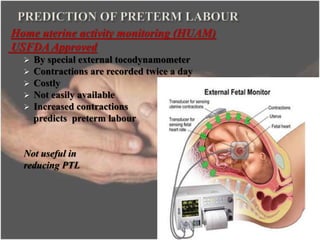
Home uterine activity monitoring (HUAM)
USFDA Approved
 By special external tocodynamometer
 Contractions are recorded twice a day
 Costly
 Not easily available
 Increased contractions
predicts preterm labour
Not useful in
reducing PTL
22
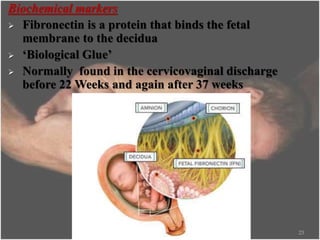
Biochemical markers
 Fibronectin is a protein that binds the fetal
membrane to the decidua
 ‘Biological Glue’
 Normally found in the cervicovaginal discharge
before 22 Weeks and again after 37 weeks
23
Presence of fetal fibronectin in cervicovaginal secretions prior
to rupture of membranes is a specific predictor
> 50 ng /ml is positive & Chances of PTL are 35% higher
Owing to high negative predictive value of fFN, a negative fFN
value is helpful in reducing unnecessary patient intervention
and management protocols*
 Increased salivary estriol
 High levels of Non esterified fatty acids(NEFA) in serum at 9-20
weeks have higher chances of PTL before 34 weeks ($)
 Elevated albumin and Vitamin D levels in cervicovaginal
secretions
 FETAL BREATHING MOVEMENTS
Absence of fetal breathing movements detected on real rime
USG suggest that patients are likely to go in preterm labour
within 48 hours
*Foster C, Biomark Med. April2014
$ Catov JM Am J Epidermol, May 201424
Combined measurements
Positive fFN and Cx length < 1.5 cm before
32 weeks
90% chances of PTL *
* Vidaeff AC et al, Am J of Perinatol 2006;Jan
25
In short , a number of factors in combination which
can predict PTL positively are
 Symptoms of preterm labour
 H/O prior preterm birth
 Uterine contractions >/= 4 per hour
 Cervical length </= 2.5 cms
 Cervical dilatation > 1 cm and effacement >80 %
 Vaginal bleeding
 Presence of fibronectin in cervicovaginal
discharge between 24 and 34 weeks
26
 Primary Prevention: Eliminate high risk factors
e.g. Infections, abstinence, bed rest
 Secondary Prevention: Screening tests for early
detection and Prophylactic Rx
e.g. fFN, Cx Length, Tocolytics
 Tertiary Prevention: Decreasing Perinatal
morbidity and mortality
e.g. Steroids
27
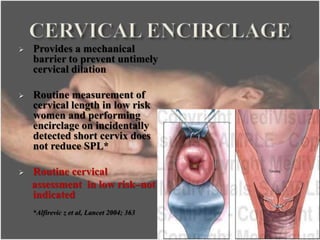
 Provides a mechanical
barrier to prevent untimely
cervical dilation
 Routine measurement of
cervical length in low risk
women and performing
encirclage on incidentally
detected short cervix does
not reduce SPL*
 Routine cervical
assessment in low risk–not
indicated
*Alfirevic z et al, Lancet 2004; 363
28
 The main challenge lies in the fact the
majority of the causes are heterogeneous
and so need to develop a single strategy
that prevents activation of pathway for
preterm labour or cervical remodeling or
PROM *
*Villar et al. 2012
29
30
Is the patient in labor?
 Are the membranes ruptured?
 Is the fetus preterm?
 What risk factors are present?
31
 Maternal vitals: signs of infection
 General physical exam
 No digitals cervical exam if membrane rupture
suspected
 Sterile Speculum exam
 GBS culture
32
 CBC, Urinalysis
 Amniocentesis
 Ultrasound
 Cervicovaginal swab for fetal fibronectin
ANTIBIOTICS
1. Cover sub-clinical and clinical infections
2. Prevent ascending infections
3. Delays clinical chorio amnionitis in PROM
Overall effect is prolongation of pregnancy 33
SINGLE DOSE STEROIDS
Between 24 and 34 weeks – for RDS, IVH, NEC,
Sepsis
Stimulates type II pneumocyctes to produce
surfactant & Structural development of lungs
 Accelerated maturation of fetal intestines
(Prevent NEC)
 Effect on myocardium (Prevent IVH)*
 *Morgan A ; Arch Dis Child Fetal Neonatal Ed 2014
34
 Reasonable not to use, as there is no clear
evidence that they improve outcome
 Consider if the few days gained for completing a
course of corticosteroids or in utero transfer
 No single agent has a clear therapeutic advantage
 Maintenance tocolysis beyond 48 hours is not
recommended
 Not recommend at or after 34 weeks
 No consensus on a lower gestational age
35
 No contraindications to drug
 Fetus currently healthy
 Clear diagnosis of preterm labor
 Cervix < 4cm dilatation
 Gestational age between 24 and 34 weeks
36
 Severe pregnancy induced hypertension
 Uncontrolled diabetes mellitus
 Placental abruption
 Cardio-pulmonary diseases
 Maternal hyperthyroidism
 Rhesus iso-immunisation
 Sickle cell disease
 Severe anaemia
37
Tocolytic agents
 Betamimetics –( beta adrenergic agonists )
Isoxsuprine , Ritodrine ,Terbutaline , Salbutamol
 Magnesium sulfate
 Calcium channel blockers- Nifedipine
 PG synthatase inhibitors – Indomethacine
Mefenamic acid
 Nitric oxide donors- Nitroglycerine patch
 Ethanol – not used today for its toxic effects
 Progesterone – weak tocolytic agent
 Newer drugs under trial
a. Atosiban – oxytocin antagonist
b. Aprikalim , Pinacidil-Potassium channel openers
38
1. BETAMIMETICS
 There are two types of Beta adrenergic receptors
 Beta 1 are mainly found in heart , intestines and
adipose tissues
 Beta 2 are present in myometrium , blood vessels and
bronchioles
Mechanism of action
 These drugs bind to B2 receptors on uterine
smooth muscle activating the enzyme adenyl
cyclase which leads to increase in CAMP
39
RITODRINE
 Started i v in 5% glucose drip 0.05 mg /min dose
 Dose is increased 0.05 mg every 10 -15 minutes until uterine
contractions have ceased or side effects appear
 Do not exceed dose > 0.35 mg/min
 I.V. therapy is continued for 12- 48 hours after contractions stop
 Oral therapy is then started by 1 tab (10mg) every 2 hourly for the
first day starting 20 minutes before iv infusion is stopped
 Thereafter 1-2 tab. are given 4-6 hourly till 37 weeks
40
RITODRINE SIDE EFFECTS
 Usually well tolerated
 Side effects are due to its effects on extra uterine beta
receptors
 Tachycardia, palpitations, nausea, vomitting, headache,
tremor, restlessness, anxiety, hypotension, hyperglycemia,
and hypokalemia
 Cardiac arrhythmia , myocardial ischaemia, pulmonary
edema , and death
 Pulmonary edema occurs when the mother is anemic,
severe tachycardia is there and IV fluid is administered
in excess along with concomittent steroids
administration
41
ISOXUSPRINE
 Maximally used drug in our country
 Nonselective betamimetic
 Dose
 I.V. in drip 5% glucose /R.L
 Starting dose is 0.2 mg / min
 increased slowly to maximum 0.8 mg /min for 24 hours
 followed by IM 10 mg 6 hourly for 24 - 48 hours
 then orally 10 mg 6- 8 hourly up to 37 weeks
42
 TERBUTALINE
 I V - 5 mg / min in increasing by 5 mg every 10
min till contractions cease or a dose of 30 n g /
min is reached
 ORAL - initially 5 mg every 4 hourly for 24
hours then 2.5 to 5 mg every 4-6 hourly
 S.C. – 0.25 mg repeated hourly till adequate
tocolysis occurs
43
MAGNESIUM SULFATE
 Used in PIH, Diabetes and Hyperthyroidism
cases where betamimetics are contraindicated
 Success rate varies 65- 90 %
 Serum levels of magnesium 5- 8 ng/ml is needed
for myometrial inhibition
 The BEAM trial-Beneficial Effects of Antenatal
MgSO4*
*Institute of Ob/Gy and Royal College of Ireland-2015
44
NIFEDIPINE(Preferable)
 Works by blocking the influx of Ca into the cell
 Dose – 30 mg orally , followed by 20 mg four times a
day
 May cause severe hypotension and fetal death*
NITRIC OXIDE DONOR
 It is smooth muscle relaxant
 It also inhibits placental CRH ( corticotrophin
releasing hormone ) secretion
 10- 20 mg patch is applied over abdominal skin
every 24 hours
*Elvira OG; BMC Pregnancy Childbirth,2014
45
INDOMETHACINE
 PG synthatase inhibitor
 Loading dose is 100- 200 mg rectally or 50 -100 mg
orally ,followed by 250 mg 4 to 6 hourly
 Contraindicated in hepatic disease , renal disease ,
peptic ulcer and coagulation disorder .
 Useful for polyhydramnios - decreases liquor
 Drawback –Premature closure of DA, NEC
 Given for < 48 hours < 32 weeks gestation, 200
mg/day
 Can be used as a second-line agent
46
OTHERS
ATOSIBAN
 it is oxytocin antagonist
 used as 300 mg /min iv infusion
 under trial
Dosage and administration- a three-step procedure
The initial bolus dose is 6.75 mg over one minute,
followed by an infusion of 18 mg/hour for three
hours and then 6 mg/hour for up to 45 hours
Duration of treatment should not exceed 48 hours
and the total dose given during a full course should
preferably not exceed 330 mg of Atosiban*
Cost is very high
*Cochrane 2014 Jun
47
POTASSIUM CHANNEL OPENERS
Under research
PROGESTERONE
 Weak tocolytic agent
 Not effective in active PTL
 Large dose may required, Costly
 USFDA approves weekly progesterone in PTL
ARABIN CERVICAL PASSARY
Cheap, easy to insert in conjunction with
intravaginal progesterone*
*Zimmerman AL ,2014 Feb
48
GENERAL PREVENTION
 Improvement of socio-economic condition
 Patient education – pre pregnancy counseling in HRP
 Identification and correction of risk factors
 Proper assessment of fetal maturity before induction to
avoid iatrogenic prematurity
 Treatment of vaginal and cervical infections and
asymptomatic bacteriuria
 Avoidance of coitus in in late pregnancy
 Role of LSCS - Controversial
 By expelling the fluid from chest during delivery and
facilitating lung expansion*
*Jones HA et al, 1997
49
MANAGEMENT OF PROGRESSIVE PTL
FIRST STAGE
1. rest in bed to preserve membrane
2. electronic fetal monitoring if available
3. avoid strong sedatives – mild
4. epidural analgesia is best if can provide
5. minimum P/V examinations
6. adequate hydration should be maintained
7. prophylactic oxygen is advised
50
SECOND STAGE
1. liberal episiotomy traditionally ( No evidence)*
2. no instrumentation as far as possible
3. forceps application if fetal distress develops
4. immediate clamping of cord – to prevent blood overload
THIRD STAGE
1. More chances of delay in separation and delivery of placenta
in preterm delivery
2. Wait and watch
3. Do not pull cord – thin and fragile
4. IV methargin only after placental delivery
Expert neonatologist should be present for immediate
resuscitation of preterm neonates at time of delivery
*ACOG, April 2006
51
 Asymptomatic bacteriuria - antibiotics
 Screen for GBS colonization- antibiotics
 Historical factors - cervical Circlage improves
outcomes only in women with three or more PTL
 Tocolytics- Not much useful
 Steroids- Useful
52
53
54
Preterm labor

Preterm labor

  • 1.
    Dr. Kirtan Vyas AssistantProfessor PDUMC, Rajkot 1
  • 2.
    Gujarat Uni. First-Goldmedallist Gujarat Public Service Commission(GPSC) first Fellow in Gynec Endoscopy(Mumbai) Fellow in Ultrasonography(FOGSI) Publications in various International Journals Presented Scientific Papers and Chaired Sessions at State and National conferences. Faculty at State and National Conferences Local Joint Secretary of SOGOG-Gujarat State Org of Ob Gy  Organizing Secretary for the First Rajkot Obstetrics and Gynec Society Annual Conference 2015 and Committee Member at State and National conferences Organizing secretary for the West Zone Yuva Fogsi 2016,Rajkot At present working as an Assistant Professor at P.D. U. Medical College and Hospital, Rajkot
  • 3.
     Define PTLand describe their significance  List risk factors associated with PTL  Outline initial evaluation of PTL  Describe management of PTL  Neonatal complications 3
  • 4.
     The timingof human birth is carefully regulated event that takes place normally between 37 and 40 weeks  Birth outside this timeframe has immense consequences both for the mother and the baby  Still today, Prematurity is the leading cause of neonatal death* *Liu et al. 2012 4
  • 5.
     Onset oflabour before 37 weeks in a pregnancy beyond 20 weeks* Lower limit is not clearly defined 5 USA (ACOG) 20 WEEKS UK 24 WEEKS BY FIGO 22 WEEKS *ACOG, Technical Bulletin No. 206; 1995
  • 6.
    Contractions 4 in20 minutes or 8 in 60 minutes and progressive dilatation of cervix Cervical dilatation >= 1 cm Cervical effacement >= 80 % 6
  • 7.
     Cervix >80%and >=3 cm: Advanced PTL  Cervix> 80% and 1-3 cm: Early PTL  Cervix< 80% and < 1cm  Cx Length >2.5 cm: False Labor  Cx Length< 2.5 cm: Threatened PTL * *Williams Obstetrics 21st edition;2001,27, 689-728 7
  • 8.
     Mildly pretermbirth 32 - 36 weeks  Very preterm birth 28 - 31 weeks  Extremely preterm birth 24 - 27 weeks 8
  • 9.
     Accounts for85% of all perinatal mortality and morbidity  8-12% of all deliveries are preterm  71.2% 34-36 weeks  13% 32-33 weeks  10% 28-31 weeks  6% <28 weeks 9
  • 10.
    10 26 weeks 27 weeks 28-31weeks 32-33 weeks 34-36 weeks 26 weeks 27 weeks 28-31 weeks 32-33 weeks 34-36 weeks Survival rate 80% 90% 93% 95% 99% Survival rate
  • 11.
     In spiteof considerable advances in obstetrical care, all over the world the rate of preterm birth is increasing*  Although the survival rates have increased, the morbidity remains unaltered ($)  Focus of research is now shifted on prevention of preterm labour in last few years (#) *Sykes et al. 2011, Blencowe et al. 201 $ Fanaroff et al. 2003 # Howson et al. 2012 11
  • 12.
  • 13.
  • 14.
    “ Premature activationof final pathway of parturition” A number of theories  Progesterone withdrawal  Oxytocin stimulation  Premature decidual activation 14 aaaaa aaaaa aaaa
  • 15.
    Activation of fetalHPAAxis or Chorio decidual bacterial colonization or Enlarged Uterus  Uterine myometrial contraction  Softening and dilatation of cervix  Weakening and rupture of membranes 15
  • 16.
     2.5 timesincreased incidence of SPL in women with a history of 1 abortion  Assessment of risk factors  Vaginal examination to assess the cervical status  Ultrasound visualization of cervical length and dilatation  Detection of fetal fibronectin in cervical vaginal secretions Spontaneous Preterm Birth is highly multi factorial so it’s unlikely that a single test is sufficient to predict the same 16
  • 17.
    warning signals Though notvery specific , should not be overlooked  menstrual like cramps (pains )  low dull backache  abdominal cramps  feeling of pressure or heaviness in vagina  increase or change in vaginal discharge- bloody fluid leaking per vagina  uterine contractions less than 10 minutes apart ,even if painless  vaginal infections 17
  • 18.
    Risk scoring system •Socioeconomic factors • Previous medical history • Daily habits • Condition in present pregnancy • Not found very useful Half of the preterm deliveries occur in low risk patients also 18
  • 19.
    Routine per vaginalexamination to assess the cervix at each antenatal visit is advocated by some Position Length Consistency of cervix and Formation of lower segment are checked This is advisable in high risk patients only All patients do not prefer this P/V examination itself may increase the risk of preterm labour 19
  • 20.
    Transvaginal sonography  CervicalInsufficiency:  Cervical changes in absence of uterine contractions  Funneling( Internal Os diameter >5 mm) 80-100% of women who deliver early have cervix <25 mm 50% delivery rate within one week have cervix < 15 mm Infections  If CRP >1.6 mg/dl Amniocentesis  If amniocentesis suggests infection-Deliver ASAP  If amniocentesis is negative-Expectant Mx  If CRP <0.8 Expectant Mx  If CRP 0.8-1.6 Repeat in 24 hours Amniocentesis itself can cause PTL?! 20
  • 21.
  • 22.
    Home uterine activitymonitoring (HUAM) USFDA Approved  By special external tocodynamometer  Contractions are recorded twice a day  Costly  Not easily available  Increased contractions predicts preterm labour Not useful in reducing PTL 22
  • 23.
    Biochemical markers  Fibronectinis a protein that binds the fetal membrane to the decidua  ‘Biological Glue’  Normally found in the cervicovaginal discharge before 22 Weeks and again after 37 weeks 23
  • 24.
    Presence of fetalfibronectin in cervicovaginal secretions prior to rupture of membranes is a specific predictor > 50 ng /ml is positive & Chances of PTL are 35% higher Owing to high negative predictive value of fFN, a negative fFN value is helpful in reducing unnecessary patient intervention and management protocols*  Increased salivary estriol  High levels of Non esterified fatty acids(NEFA) in serum at 9-20 weeks have higher chances of PTL before 34 weeks ($)  Elevated albumin and Vitamin D levels in cervicovaginal secretions  FETAL BREATHING MOVEMENTS Absence of fetal breathing movements detected on real rime USG suggest that patients are likely to go in preterm labour within 48 hours *Foster C, Biomark Med. April2014 $ Catov JM Am J Epidermol, May 201424
  • 25.
    Combined measurements Positive fFNand Cx length < 1.5 cm before 32 weeks 90% chances of PTL * * Vidaeff AC et al, Am J of Perinatol 2006;Jan 25
  • 26.
    In short ,a number of factors in combination which can predict PTL positively are  Symptoms of preterm labour  H/O prior preterm birth  Uterine contractions >/= 4 per hour  Cervical length </= 2.5 cms  Cervical dilatation > 1 cm and effacement >80 %  Vaginal bleeding  Presence of fibronectin in cervicovaginal discharge between 24 and 34 weeks 26
  • 27.
     Primary Prevention:Eliminate high risk factors e.g. Infections, abstinence, bed rest  Secondary Prevention: Screening tests for early detection and Prophylactic Rx e.g. fFN, Cx Length, Tocolytics  Tertiary Prevention: Decreasing Perinatal morbidity and mortality e.g. Steroids 27
  • 28.
     Provides amechanical barrier to prevent untimely cervical dilation  Routine measurement of cervical length in low risk women and performing encirclage on incidentally detected short cervix does not reduce SPL*  Routine cervical assessment in low risk–not indicated *Alfirevic z et al, Lancet 2004; 363 28
  • 29.
     The mainchallenge lies in the fact the majority of the causes are heterogeneous and so need to develop a single strategy that prevents activation of pathway for preterm labour or cervical remodeling or PROM * *Villar et al. 2012 29
  • 30.
  • 31.
    Is the patientin labor?  Are the membranes ruptured?  Is the fetus preterm?  What risk factors are present? 31
  • 32.
     Maternal vitals:signs of infection  General physical exam  No digitals cervical exam if membrane rupture suspected  Sterile Speculum exam  GBS culture 32
  • 33.
     CBC, Urinalysis Amniocentesis  Ultrasound  Cervicovaginal swab for fetal fibronectin ANTIBIOTICS 1. Cover sub-clinical and clinical infections 2. Prevent ascending infections 3. Delays clinical chorio amnionitis in PROM Overall effect is prolongation of pregnancy 33
  • 34.
    SINGLE DOSE STEROIDS Between24 and 34 weeks – for RDS, IVH, NEC, Sepsis Stimulates type II pneumocyctes to produce surfactant & Structural development of lungs  Accelerated maturation of fetal intestines (Prevent NEC)  Effect on myocardium (Prevent IVH)*  *Morgan A ; Arch Dis Child Fetal Neonatal Ed 2014 34
  • 35.
     Reasonable notto use, as there is no clear evidence that they improve outcome  Consider if the few days gained for completing a course of corticosteroids or in utero transfer  No single agent has a clear therapeutic advantage  Maintenance tocolysis beyond 48 hours is not recommended  Not recommend at or after 34 weeks  No consensus on a lower gestational age 35
  • 36.
     No contraindicationsto drug  Fetus currently healthy  Clear diagnosis of preterm labor  Cervix < 4cm dilatation  Gestational age between 24 and 34 weeks 36
  • 37.
     Severe pregnancyinduced hypertension  Uncontrolled diabetes mellitus  Placental abruption  Cardio-pulmonary diseases  Maternal hyperthyroidism  Rhesus iso-immunisation  Sickle cell disease  Severe anaemia 37
  • 38.
    Tocolytic agents  Betamimetics–( beta adrenergic agonists ) Isoxsuprine , Ritodrine ,Terbutaline , Salbutamol  Magnesium sulfate  Calcium channel blockers- Nifedipine  PG synthatase inhibitors – Indomethacine Mefenamic acid  Nitric oxide donors- Nitroglycerine patch  Ethanol – not used today for its toxic effects  Progesterone – weak tocolytic agent  Newer drugs under trial a. Atosiban – oxytocin antagonist b. Aprikalim , Pinacidil-Potassium channel openers 38
  • 39.
    1. BETAMIMETICS  Thereare two types of Beta adrenergic receptors  Beta 1 are mainly found in heart , intestines and adipose tissues  Beta 2 are present in myometrium , blood vessels and bronchioles Mechanism of action  These drugs bind to B2 receptors on uterine smooth muscle activating the enzyme adenyl cyclase which leads to increase in CAMP 39
  • 40.
    RITODRINE  Started iv in 5% glucose drip 0.05 mg /min dose  Dose is increased 0.05 mg every 10 -15 minutes until uterine contractions have ceased or side effects appear  Do not exceed dose > 0.35 mg/min  I.V. therapy is continued for 12- 48 hours after contractions stop  Oral therapy is then started by 1 tab (10mg) every 2 hourly for the first day starting 20 minutes before iv infusion is stopped  Thereafter 1-2 tab. are given 4-6 hourly till 37 weeks 40
  • 41.
    RITODRINE SIDE EFFECTS Usually well tolerated  Side effects are due to its effects on extra uterine beta receptors  Tachycardia, palpitations, nausea, vomitting, headache, tremor, restlessness, anxiety, hypotension, hyperglycemia, and hypokalemia  Cardiac arrhythmia , myocardial ischaemia, pulmonary edema , and death  Pulmonary edema occurs when the mother is anemic, severe tachycardia is there and IV fluid is administered in excess along with concomittent steroids administration 41
  • 42.
    ISOXUSPRINE  Maximally useddrug in our country  Nonselective betamimetic  Dose  I.V. in drip 5% glucose /R.L  Starting dose is 0.2 mg / min  increased slowly to maximum 0.8 mg /min for 24 hours  followed by IM 10 mg 6 hourly for 24 - 48 hours  then orally 10 mg 6- 8 hourly up to 37 weeks 42
  • 43.
     TERBUTALINE  IV - 5 mg / min in increasing by 5 mg every 10 min till contractions cease or a dose of 30 n g / min is reached  ORAL - initially 5 mg every 4 hourly for 24 hours then 2.5 to 5 mg every 4-6 hourly  S.C. – 0.25 mg repeated hourly till adequate tocolysis occurs 43
  • 44.
    MAGNESIUM SULFATE  Usedin PIH, Diabetes and Hyperthyroidism cases where betamimetics are contraindicated  Success rate varies 65- 90 %  Serum levels of magnesium 5- 8 ng/ml is needed for myometrial inhibition  The BEAM trial-Beneficial Effects of Antenatal MgSO4* *Institute of Ob/Gy and Royal College of Ireland-2015 44
  • 45.
    NIFEDIPINE(Preferable)  Works byblocking the influx of Ca into the cell  Dose – 30 mg orally , followed by 20 mg four times a day  May cause severe hypotension and fetal death* NITRIC OXIDE DONOR  It is smooth muscle relaxant  It also inhibits placental CRH ( corticotrophin releasing hormone ) secretion  10- 20 mg patch is applied over abdominal skin every 24 hours *Elvira OG; BMC Pregnancy Childbirth,2014 45
  • 46.
    INDOMETHACINE  PG synthataseinhibitor  Loading dose is 100- 200 mg rectally or 50 -100 mg orally ,followed by 250 mg 4 to 6 hourly  Contraindicated in hepatic disease , renal disease , peptic ulcer and coagulation disorder .  Useful for polyhydramnios - decreases liquor  Drawback –Premature closure of DA, NEC  Given for < 48 hours < 32 weeks gestation, 200 mg/day  Can be used as a second-line agent 46
  • 47.
    OTHERS ATOSIBAN  it isoxytocin antagonist  used as 300 mg /min iv infusion  under trial Dosage and administration- a three-step procedure The initial bolus dose is 6.75 mg over one minute, followed by an infusion of 18 mg/hour for three hours and then 6 mg/hour for up to 45 hours Duration of treatment should not exceed 48 hours and the total dose given during a full course should preferably not exceed 330 mg of Atosiban* Cost is very high *Cochrane 2014 Jun 47
  • 48.
    POTASSIUM CHANNEL OPENERS Underresearch PROGESTERONE  Weak tocolytic agent  Not effective in active PTL  Large dose may required, Costly  USFDA approves weekly progesterone in PTL ARABIN CERVICAL PASSARY Cheap, easy to insert in conjunction with intravaginal progesterone* *Zimmerman AL ,2014 Feb 48
  • 49.
    GENERAL PREVENTION  Improvementof socio-economic condition  Patient education – pre pregnancy counseling in HRP  Identification and correction of risk factors  Proper assessment of fetal maturity before induction to avoid iatrogenic prematurity  Treatment of vaginal and cervical infections and asymptomatic bacteriuria  Avoidance of coitus in in late pregnancy  Role of LSCS - Controversial  By expelling the fluid from chest during delivery and facilitating lung expansion* *Jones HA et al, 1997 49
  • 50.
    MANAGEMENT OF PROGRESSIVEPTL FIRST STAGE 1. rest in bed to preserve membrane 2. electronic fetal monitoring if available 3. avoid strong sedatives – mild 4. epidural analgesia is best if can provide 5. minimum P/V examinations 6. adequate hydration should be maintained 7. prophylactic oxygen is advised 50
  • 51.
    SECOND STAGE 1. liberalepisiotomy traditionally ( No evidence)* 2. no instrumentation as far as possible 3. forceps application if fetal distress develops 4. immediate clamping of cord – to prevent blood overload THIRD STAGE 1. More chances of delay in separation and delivery of placenta in preterm delivery 2. Wait and watch 3. Do not pull cord – thin and fragile 4. IV methargin only after placental delivery Expert neonatologist should be present for immediate resuscitation of preterm neonates at time of delivery *ACOG, April 2006 51
  • 52.
     Asymptomatic bacteriuria- antibiotics  Screen for GBS colonization- antibiotics  Historical factors - cervical Circlage improves outcomes only in women with three or more PTL  Tocolytics- Not much useful  Steroids- Useful 52
  • 53.
  • 54.