DEFINITION
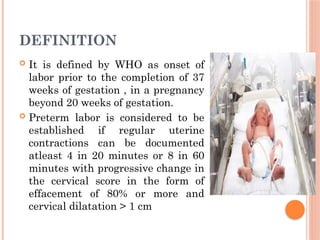
It isdefined by WHO as onset of
labor prior to the completion of 37
weeks of gestation , in a pregnancy
beyond 20 weeks of gestation.
Preterm labor is considered to be
established if regular uterine
contractions can be documented
atleast 4 in 20 minutes or 8 in 60
minutes with progressive change in
the cervical score in the form of
effacement of 80% or more and
cervical dilatation > 1 cm
3.
TYPES OF PRETERMBIRTH
According to WHO gestational age criteria
Moderate to late preterm : 32 to < 37
weeks
Very preterm : < 32 weeks
Extremely preterm : < 28 weeks
Congenital abnormalities :
Unicornuate uterus ( only half of the uterus develops ,
resulting in a smaller uterus)
Bicornuate uterus (occur when mullerian duct don’t fully
fuse resulting in heart shaped uterus instead pear shape)
Mullerian duct= paired structure that develops into female
reproductive organs in females
Pregnancy complications :
Multiple pregnancy
APH ( > 24 weeks – upto delivery )
Pre- eclampsia
PROM
Polyhydramnios
6.
Uterine anomalies– cervical incompetence ,
uterine malformations
Medical and surgical illness – acute fever,
pyelonephritis , appendicitis
Placental factors – placenta previa , placental
abruption
Hydramnios due to overdistension
7.
Fetal factors :
Congenital malformation
Intrauterine death
Fetal distress
Intrauterine growth restriction
Iatrogenic : Indicated preterm delivery
due to medical and surgical complications
8.
Genetic : Manypreterm deliveries are
familial
Idiopathic :
Early engagement of head and preterm
effacement of the cervix with irritable
uterus.
9.
SIGNS AND SYMPTOMS
Signs
Palpable uterine contractions
Engagement of the presenting part
Cervical effacement and dilatation
Show
Bulging membranes
Rupture of membranes
10.
Symptoms :
Painfulor painless uterine contractions or
frequent tightening
Lower abdominal pain or menstrual – like
cramping
Pain in lower back
Passage of blood stained vaginal
discharge( show)
Sensation of pelvic or vaginal pressure
Increased watery vaginal discharge
11.
DIAGNOSTIC EVALUATION
Pelvicexamination
Routine physical examination
Vital signs
Dipstick urine analysis
Abdominal examination
Fetal presentation
Fetal heart and uterine activity
Vaginal speculum examination
Cervix
Membranes status , for swabs
Digital assessment ( through fingers)
12.
ROUTINE INVESTIGATIONS
Fullblood count
Urine for glucose, proteins , ketones, microscopy,
and culture, urine- analysis , culture and
sensitivity
Swabs :
High vaginal swabs for gram staining and
culture, pH and fern test
(diagnostic tool to detect the presence of amniotic
fluid , which can indicate premature rupture of
membranes or onset of labor)
13.
Swab fromcervico- vaginal area for fetal
fibronectin ( protein found at the interface
between amniotic sac and uterine lining between
22 – 35 weeks of gestation , it indicates preterm
labor)
Endocervical swab for Neisseria gonorrhea and
chlamydia trachomatis culture.
14.
Urethral swabin indicated cases.
CTG for uterine contractions and fetal
heart.
USG for fetal maturity , fetal anomalies ,
presentation, liquor assessment ,
estimated fetal weight
TVS assessment for cervical length and
funneling at internal OS
Serum electrolytes and glucose levels –
when tocolytic agents are to be used
15.
MANAGEMENT
Aim ofmanagement of preterm
labor :
1. To prevent asphyxia and birth trauma
2. To prevent preterm onset of labor, if
possible
3. To arrset preterm labor
4. Appropriate management of labor and
duration of labor is usually short
5. Effective neonatal care
16.
FIRST STAGE
Thepatient lies in bed to prevent early rupture
of membranes as intact membranes may
reduce trauma to the baby.
In case of anticipated traumatic vaginal
delivery , cesarean delivery can be considered
The parents should be informed of the likely
outcome by obstetrician and pediatrician
Strong sedatives and oxytocics should be
avoided
17.
To ensureadequate fetal oxygenation by
giving oxygen to the mother by mask
Epidural analgesia is of choice
Labor should be watched by intensive
clinical monitoring if continuous electronic
monitoring is not available
Repeated digital examination are avoided
Cesearean delivery is done for obstetric
reasons
18.
SECOND STAGE
Allexperienced obstetrician should preferably
conduct the delivery in the presence of
pediatrician
The birth should be gentle and slow to avoid
rapid compression and decompression of head
Episiotomy is recommended , especially in
primigravidas , to minimize head compression
Forceps are applied only , if second stage is
delayed and not to act as a protective cage for
the soft preterm head during delivery as once
thought
19.
The cordis to be clamped immediately at
birth to prevent hypervolemia and
hyperbilirubinemia
The newborn is immediately transferred
to intensive neonatal care unit , with
ventilator facilities under the care of
neonatologist.
20.
CESAREAN SECTION
RoutineCS not recommended
Only for preterm fetuses before 34 weeks
presented by breech
Lower segment vertical / J shaped incision
made to minimize trauma during delivery.
PREVENTION
Avoid tobacco,alcohol , or other substances
while pregnant
Eat nutritious , well – balanced foods during
pregnancy
Start prenatal care in the first trimester so
that the care provider can identify health risks
as early as possible
24.
Discuss howto manage health conditions
like diabetes and high blood pressure with
the care provider. Unmanaged health
conditions can lead to preterm birth and
other complications
Attend all prenatal care appointments
Reduce the stress level
Wait at least 18 months between
pregnancies
25.
PREVENTION OF PRETERM LABOR
Primary care is aimed to reduce the incidence of
preterm labour by reducing to high risk factors
eg.infection.
Secondary care includes screening tests for early
detection and prophylactic treatment
eg.tocolytics.
Tertiary care is aimed to reduce the perinatal
morbidity and mortality after the diagnosis
eg.use of corticosteroids.
26.
USE OF ANTENATAL
CORTICOSTERIODS
ACS administered to women at risk for preterm
delivery reduced the incidence and severity of
respiratory distress syndrome and mortality of
offspring
The positive effect of antenatal corticosteriods is
apparent soon after administeration –maximal
24 to 48 hours later and for upto 1 week but
adequate upto 18 days.
It should be administered to women at imminent
risk of preterm delivery.
27.
There isa general consensus on administering
antenatal corticosteriods between 24 and 34
weeks of gestation .
In ideal circumstances , delivery should not occur
within 24 to 48 hours following the
administeration of corticosteriods.
28.
BETAMETHASONE OR
DEXAMETHASONE
Thesesteriods are preferred because they are
less extensively metabolized by the placental
enzymes .
Doses : Betamethasone : two doses of 12 mg IM
24 hour apart
Dexamethasone sodium phosphate four doses of 6
mg IM 12 hours can be given as it is equally
effective.
29.
MATERNAL SIDE EFFECTS
Transient hyperglycaemia occurs in many women.
The steriod effect begins approximately 12 hour
after the first dose and may last for five days .
Screening for GD , if indicated , should be
performed either before ACS administeration or at
least five days after the first dose.
The TLC increases by approx. 30 percent within 24
hours after ACS injection , and the lymphocyte
count significantly decreases.
These changes return to baseline within three days
but may complicate the diagnose of infection.
30.
FETAL SIDE EFFECTS
22 to 34 weeks :
• Reduction in birth weight
• Psychiatric and behaviorol diagnosis , if children
born at term
35 to 36 weeks :
• Neonatal hypoglycemia
Before planned CS at term 37- 39 weeks
• Reduce educational attainment at school age
FHR and biophysical parameters :
• Reduced fetal breathing and body movements can
results in a lower biophysical profile score or non-
reactive NST.
31.
Doppler flowstudies : improvement in
umbilical artery end – diastolic flow after ACS
administertaion.