Premature LaborPremature Labor
OROR
Preterm labourPreterm labour
Premature labourPremature labour
((Preterm labour)Preterm labour)
INTRODUCTIONINTRODUCTION
 Premature labour is generally a labourPremature labour is generally a labour
that occurs after 20 wks & beforethat occurs after 20 wks & before
37 completed wks of gestation37 completed wks of gestation
DEFINITIONDEFINITION
Pre term labour is defined by WHOPre term labour is defined by WHO
as onset of labour prior to theas onset of labour prior to the
completion of 37 weeks of gestationcompletion of 37 weeks of gestation
in a pregnancy beyond 20 weeks ofin a pregnancy beyond 20 weeks of
gestationgestation..
INCIDENCEINCIDENCE
Approx. 10% of deliveries in publicApprox. 10% of deliveries in public
hospital occur before the 37hospital occur before the 37thth
weekweek
A much smaller %age is involved inA much smaller %age is involved in
the 24-32 weeks period.the 24-32 weeks period.
ETIOLOGYETIOLOGY
In about 50%, the cause of pretermIn about 50%, the cause of preterm
labour is not knownlabour is not known
But some of theBut some of the high risk factors are:high risk factors are:
HISTORY
COMPLICATIONS
In Present
Pregnancies
IATROGENIC
IDIOPATHIC
Conti..Conti..
HISTORYHISTORY--
--previous history of abortion orprevious history of abortion or
preterm deliverypreterm delivery
--recurrent UTIrecurrent UTI
--smoking habitssmoking habits
--low socio-economic & nutritional statuslow socio-economic & nutritional status
ContiConti....
COMPLICATIONS IN PRESENTCOMPLICATIONS IN PRESENT
PREGNANCYPREGNANCY-- It may be due to 3It may be due to 3
causes:-MATERNALcauses:-MATERNAL
-FETAL-FETAL
-PLACENTAL-PLACENTAL
A)A) MATERNALMATERNAL ::
INFECTIONINFECTION PRE ECLAMPSIAPRE ECLAMPSIA
Incompetent cervixIncompetent cervix malformation of uterusmalformation of uterus
ContiConti....
FETALFETAL :: - Multiple pregnancy- Multiple pregnancy
-- Congenital malformationsCongenital malformations
- IUD- IUD
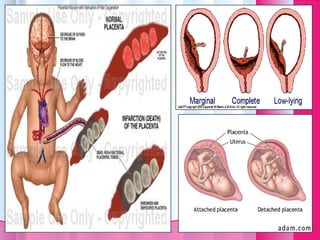
PLACENTALPLACENTAL :-:- InfarctionInfarction
-Thrombosis-Thrombosis
- Placenta praevia or- Placenta praevia or
abruptionabruption
Conti..Conti..
 IATROGENIC:IATROGENIC:
-Elective induction with wrong-Elective induction with wrong
estimation of gestational period.estimation of gestational period.
- IDIOPATHICIDIOPATHIC::
-Premature effacement of cervix with-Premature effacement of cervix with
hyper-irritable uterushyper-irritable uterus
-Early engagement of head-Early engagement of head
Risk factorsRisk factors
 Low BMILow BMI
 Short maternal heightShort maternal height
 History of spontaneous pre term birthHistory of spontaneous pre term birth
 Bacterial vaginitis.Bacterial vaginitis.
 Asymptomatic bacteriuriaAsymptomatic bacteriuria
 Low socio economic statusLow socio economic status
 Short cervical lengthShort cervical length
SIGN AND SYMPTOMSSIGN AND SYMPTOMS
 BackacheBackache
 Contractions every 10 minutes are moreContractions every 10 minutes are more
oftenoften
 Cramping in lower abdomenCramping in lower abdomen
 Menstrual like cramps( feel like gas pain ,Menstrual like cramps( feel like gas pain ,
not a/w diarrhea)not a/w diarrhea)
 Fluid leaking from vaginaFluid leaking from vagina
 Flu like symptoms- nausea, vomiting,Flu like symptoms- nausea, vomiting,
diarrheadiarrhea
Cont..Cont..
Increased pressure in pelvisIncreased pressure in pelvis
Increased vaginal bleedingIncreased vaginal bleeding
Pelvic pressurePelvic pressure
INVESTIGATIONSINVESTIGATIONS
Full blood countFull blood count
Routine urineRoutine urine-analysis,culture &-analysis,culture &
senstivitysenstivity
Cervicovaginal SwabCervicovaginal Swab --
culture,FIBRONECTINculture,FIBRONECTIN
Serum electrolytes & glucose levelsSerum electrolytes & glucose levels
when tocolytic agents are to bewhen tocolytic agents are to be
usedused
 USGUSG-fetal well being,-fetal well being,
cervical length &cervical length &
placentalplacental
localizationlocalization
FIBRONECTINFIBRONECTIN
AA PROTEINPROTEIN that bindsthat binds
thethe FETALFETAL MEMBRANESMEMBRANES
toto DECIDUADECIDUA
Normally found inNormally found in
CERVICOVAGINALCERVICOVAGINAL
dischargedischarge beforebefore 22wks22wks &&
againagain afterafter 37wks37wks ofof
pregnancypregnancy
PRESENCE OFPRESENCE OF
FIBRONECTIN IN CVDFIBRONECTIN IN CVD
B/W 24Wks & 34 WksB/W 24Wks & 34 Wks
PREDICTSPREDICTS PRE-TERMPRE-TERM
LABOURLABOUR
MANAGEMENTMANAGEMENT
Prevention of PretermPrevention of Preterm
LabourLabour
Primary CarePrimary Care ––
to reduce the incidence of pretermto reduce the incidence of preterm
labour by reducing the high risk factorslabour by reducing the high risk factors (e.g.(e.g.
infection etc.)infection etc.)
Secondary CareSecondary Care
includes screening tests for early detectionincludes screening tests for early detection
& prophylactic treatment& prophylactic treatment (e.g. tocolytics)(e.g. tocolytics)
Tertiary careTertiary care--
to reduce the perinatal morbidity &to reduce the perinatal morbidity &
mortality after the diagnosismortality after the diagnosis (e.g. use of(e.g. use of
corticosteroids)corticosteroids)
Conti..Conti..
Taking preventive medications , who hasTaking preventive medications , who has
short cervix( Progesterone)short cervix( Progesterone)
Restricting sexual activity.Restricting sexual activity.
Limiting certain physical activities.Limiting certain physical activities.
Managing chronic conditions such as DM,Managing chronic conditions such as DM,
Increased BP.Increased BP.
ARRESTING PRETERMARRESTING PRETERM
LABOURLABOUR
BED RESTBED REST--Left lateral positionLeft lateral position
ADEQUATE HYDRATIONADEQUATE HYDRATION
PROPHYLACTIC ANTIBIOTICPROPHYLACTIC ANTIBIOTIC
TOCOLYTIC AGENTSTOCOLYTIC AGENTS-Eg.-Eg.TERBUTALINETERBUTALINE
INDOMETHACININDOMETHACIN
NIFEDIPINEsNIFEDIPINEs
GLUCOCORTICOIDGLUCOCORTICOID
THERAPYTHERAPY
Advocated in pregnancy less than 34Advocated in pregnancy less than 34
wks.wks.
Helps in fetal lung maturationHelps in fetal lung maturation
Reduces incidence of RDS & IVHReduces incidence of RDS & IVH
IMMEDIATEIMMEDIATE
MANAGEMENTMANAGEMENT
 The cord is to be clamped quicklyThe cord is to be clamped quickly
 The cord length is kept long in case exchangeThe cord length is kept long in case exchange
transfusion is requiredtransfusion is required
 The air passage should be cleared of mucusThe air passage should be cleared of mucus
 Adequate oxygenationAdequate oxygenation
 Aqueous solution of vit.k 1mg given I/M toAqueous solution of vit.k 1mg given I/M to
prevent hemorrhagic manifestationsprevent hemorrhagic manifestations
 The baby should be wrapped including head inThe baby should be wrapped including head in
a sterile warm towela sterile warm towel
NURSING MANAGEMENTNURSING MANAGEMENT
1.1. Assess the mother’s condition to evaluateAssess the mother’s condition to evaluate
signs of Labour.signs of Labour.
 Obtain a through obstetrics historyObtain a through obstetrics history
 Determine the frequency , duration,&Determine the frequency , duration,&
intensity of uterine contraction.intensity of uterine contraction.
 Determine the cervical dilatation andDetermine the cervical dilatation and
effacement.effacement.
 Assess the status of membranes, andAssess the status of membranes, and
bloody showbloody show
Cont..Cont..
2.Evaluate the factors for distress, size and2.Evaluate the factors for distress, size and
maturity.maturity.
(sonography & lecithin-sphingomyelin ratio)(sonography & lecithin-sphingomyelin ratio)
3. Perform measures to manage or stop pre3. Perform measures to manage or stop pre
term labour.term labour.
Place the client on bed rest in the sidePlace the client on bed rest in the side
lying position.lying position.
Prepare for possible ultrasongraphy,Prepare for possible ultrasongraphy,
amniocentesis, tocolytic drug therapy oramniocentesis, tocolytic drug therapy or
steroid therapy.steroid therapy.
TYPESTYPES
Administer tocoltyic agent as prescribed.Administer tocoltyic agent as prescribed.
Assess for side effects of tocolytic therapyAssess for side effects of tocolytic therapy
 Decreased maternal Blood pressureDecreased maternal Blood pressure
 DyspneaDyspnea
 Chest painChest pain
 FHS >180beats/minFHS >180beats/min
Cont..Cont..
4- provide physical and emotional support4- provide physical and emotional support
5- Provide adequate hydration5- Provide adequate hydration
6- Provide client and family education.6- Provide client and family education.
Preterm

Preterm

  • 1.
  • 2.
  • 3.
    INTRODUCTIONINTRODUCTION  Premature labouris generally a labourPremature labour is generally a labour that occurs after 20 wks & beforethat occurs after 20 wks & before 37 completed wks of gestation37 completed wks of gestation
  • 4.
    DEFINITIONDEFINITION Pre term labouris defined by WHOPre term labour is defined by WHO as onset of labour prior to theas onset of labour prior to the completion of 37 weeks of gestationcompletion of 37 weeks of gestation in a pregnancy beyond 20 weeks ofin a pregnancy beyond 20 weeks of gestationgestation..
  • 5.
    INCIDENCEINCIDENCE Approx. 10% ofdeliveries in publicApprox. 10% of deliveries in public hospital occur before the 37hospital occur before the 37thth weekweek A much smaller %age is involved inA much smaller %age is involved in the 24-32 weeks period.the 24-32 weeks period.
  • 6.
    ETIOLOGYETIOLOGY In about 50%,the cause of pretermIn about 50%, the cause of preterm labour is not knownlabour is not known But some of theBut some of the high risk factors are:high risk factors are: HISTORY COMPLICATIONS In Present Pregnancies IATROGENIC IDIOPATHIC
  • 7.
    Conti..Conti.. HISTORYHISTORY-- --previous history ofabortion orprevious history of abortion or preterm deliverypreterm delivery --recurrent UTIrecurrent UTI --smoking habitssmoking habits --low socio-economic & nutritional statuslow socio-economic & nutritional status
  • 8.
    ContiConti.... COMPLICATIONS IN PRESENTCOMPLICATIONSIN PRESENT PREGNANCYPREGNANCY-- It may be due to 3It may be due to 3 causes:-MATERNALcauses:-MATERNAL -FETAL-FETAL -PLACENTAL-PLACENTAL A)A) MATERNALMATERNAL ::
  • 9.
  • 10.
    Incompetent cervixIncompetent cervixmalformation of uterusmalformation of uterus
  • 11.
    ContiConti.... FETALFETAL :: -Multiple pregnancy- Multiple pregnancy -- Congenital malformationsCongenital malformations - IUD- IUD PLACENTALPLACENTAL :-:- InfarctionInfarction -Thrombosis-Thrombosis - Placenta praevia or- Placenta praevia or abruptionabruption
  • 13.
    Conti..Conti..  IATROGENIC:IATROGENIC: -Elective inductionwith wrong-Elective induction with wrong estimation of gestational period.estimation of gestational period. - IDIOPATHICIDIOPATHIC:: -Premature effacement of cervix with-Premature effacement of cervix with hyper-irritable uterushyper-irritable uterus -Early engagement of head-Early engagement of head
  • 14.
    Risk factorsRisk factors Low BMILow BMI  Short maternal heightShort maternal height  History of spontaneous pre term birthHistory of spontaneous pre term birth  Bacterial vaginitis.Bacterial vaginitis.  Asymptomatic bacteriuriaAsymptomatic bacteriuria  Low socio economic statusLow socio economic status  Short cervical lengthShort cervical length
  • 15.
    SIGN AND SYMPTOMSSIGNAND SYMPTOMS  BackacheBackache  Contractions every 10 minutes are moreContractions every 10 minutes are more oftenoften  Cramping in lower abdomenCramping in lower abdomen  Menstrual like cramps( feel like gas pain ,Menstrual like cramps( feel like gas pain , not a/w diarrhea)not a/w diarrhea)  Fluid leaking from vaginaFluid leaking from vagina  Flu like symptoms- nausea, vomiting,Flu like symptoms- nausea, vomiting, diarrheadiarrhea
  • 16.
    Cont..Cont.. Increased pressure inpelvisIncreased pressure in pelvis Increased vaginal bleedingIncreased vaginal bleeding Pelvic pressurePelvic pressure
  • 17.
    INVESTIGATIONSINVESTIGATIONS Full blood countFullblood count Routine urineRoutine urine-analysis,culture &-analysis,culture & senstivitysenstivity Cervicovaginal SwabCervicovaginal Swab -- culture,FIBRONECTINculture,FIBRONECTIN Serum electrolytes & glucose levelsSerum electrolytes & glucose levels when tocolytic agents are to bewhen tocolytic agents are to be usedused
  • 18.
     USGUSG-fetal wellbeing,-fetal well being, cervical length &cervical length & placentalplacental localizationlocalization
  • 19.
    FIBRONECTINFIBRONECTIN AA PROTEINPROTEIN thatbindsthat binds thethe FETALFETAL MEMBRANESMEMBRANES toto DECIDUADECIDUA Normally found inNormally found in CERVICOVAGINALCERVICOVAGINAL dischargedischarge beforebefore 22wks22wks && againagain afterafter 37wks37wks ofof pregnancypregnancy PRESENCE OFPRESENCE OF FIBRONECTIN IN CVDFIBRONECTIN IN CVD B/W 24Wks & 34 WksB/W 24Wks & 34 Wks PREDICTSPREDICTS PRE-TERMPRE-TERM LABOURLABOUR
  • 20.
  • 21.
    Prevention of PretermPreventionof Preterm LabourLabour Primary CarePrimary Care –– to reduce the incidence of pretermto reduce the incidence of preterm labour by reducing the high risk factorslabour by reducing the high risk factors (e.g.(e.g. infection etc.)infection etc.) Secondary CareSecondary Care includes screening tests for early detectionincludes screening tests for early detection & prophylactic treatment& prophylactic treatment (e.g. tocolytics)(e.g. tocolytics) Tertiary careTertiary care-- to reduce the perinatal morbidity &to reduce the perinatal morbidity & mortality after the diagnosismortality after the diagnosis (e.g. use of(e.g. use of corticosteroids)corticosteroids)
  • 22.
    Conti..Conti.. Taking preventive medications, who hasTaking preventive medications , who has short cervix( Progesterone)short cervix( Progesterone) Restricting sexual activity.Restricting sexual activity. Limiting certain physical activities.Limiting certain physical activities. Managing chronic conditions such as DM,Managing chronic conditions such as DM, Increased BP.Increased BP.
  • 23.
    ARRESTING PRETERMARRESTING PRETERM LABOURLABOUR BEDRESTBED REST--Left lateral positionLeft lateral position ADEQUATE HYDRATIONADEQUATE HYDRATION PROPHYLACTIC ANTIBIOTICPROPHYLACTIC ANTIBIOTIC TOCOLYTIC AGENTSTOCOLYTIC AGENTS-Eg.-Eg.TERBUTALINETERBUTALINE INDOMETHACININDOMETHACIN NIFEDIPINEsNIFEDIPINEs
  • 24.
    GLUCOCORTICOIDGLUCOCORTICOID THERAPYTHERAPY Advocated in pregnancyless than 34Advocated in pregnancy less than 34 wks.wks. Helps in fetal lung maturationHelps in fetal lung maturation Reduces incidence of RDS & IVHReduces incidence of RDS & IVH
  • 25.
    IMMEDIATEIMMEDIATE MANAGEMENTMANAGEMENT  The cordis to be clamped quicklyThe cord is to be clamped quickly  The cord length is kept long in case exchangeThe cord length is kept long in case exchange transfusion is requiredtransfusion is required  The air passage should be cleared of mucusThe air passage should be cleared of mucus  Adequate oxygenationAdequate oxygenation  Aqueous solution of vit.k 1mg given I/M toAqueous solution of vit.k 1mg given I/M to prevent hemorrhagic manifestationsprevent hemorrhagic manifestations  The baby should be wrapped including head inThe baby should be wrapped including head in a sterile warm towela sterile warm towel
  • 26.
    NURSING MANAGEMENTNURSING MANAGEMENT 1.1.Assess the mother’s condition to evaluateAssess the mother’s condition to evaluate signs of Labour.signs of Labour.  Obtain a through obstetrics historyObtain a through obstetrics history  Determine the frequency , duration,&Determine the frequency , duration,& intensity of uterine contraction.intensity of uterine contraction.  Determine the cervical dilatation andDetermine the cervical dilatation and effacement.effacement.  Assess the status of membranes, andAssess the status of membranes, and bloody showbloody show
  • 27.
    Cont..Cont.. 2.Evaluate the factorsfor distress, size and2.Evaluate the factors for distress, size and maturity.maturity. (sonography & lecithin-sphingomyelin ratio)(sonography & lecithin-sphingomyelin ratio) 3. Perform measures to manage or stop pre3. Perform measures to manage or stop pre term labour.term labour. Place the client on bed rest in the sidePlace the client on bed rest in the side lying position.lying position. Prepare for possible ultrasongraphy,Prepare for possible ultrasongraphy, amniocentesis, tocolytic drug therapy oramniocentesis, tocolytic drug therapy or steroid therapy.steroid therapy.
  • 28.
    TYPESTYPES Administer tocoltyic agentas prescribed.Administer tocoltyic agent as prescribed. Assess for side effects of tocolytic therapyAssess for side effects of tocolytic therapy  Decreased maternal Blood pressureDecreased maternal Blood pressure  DyspneaDyspnea  Chest painChest pain  FHS >180beats/minFHS >180beats/min
  • 29.
    Cont..Cont.. 4- provide physicaland emotional support4- provide physical and emotional support 5- Provide adequate hydration5- Provide adequate hydration 6- Provide client and family education.6- Provide client and family education.