Past Tense Preterite Imperfect Preterite vs Imperfect
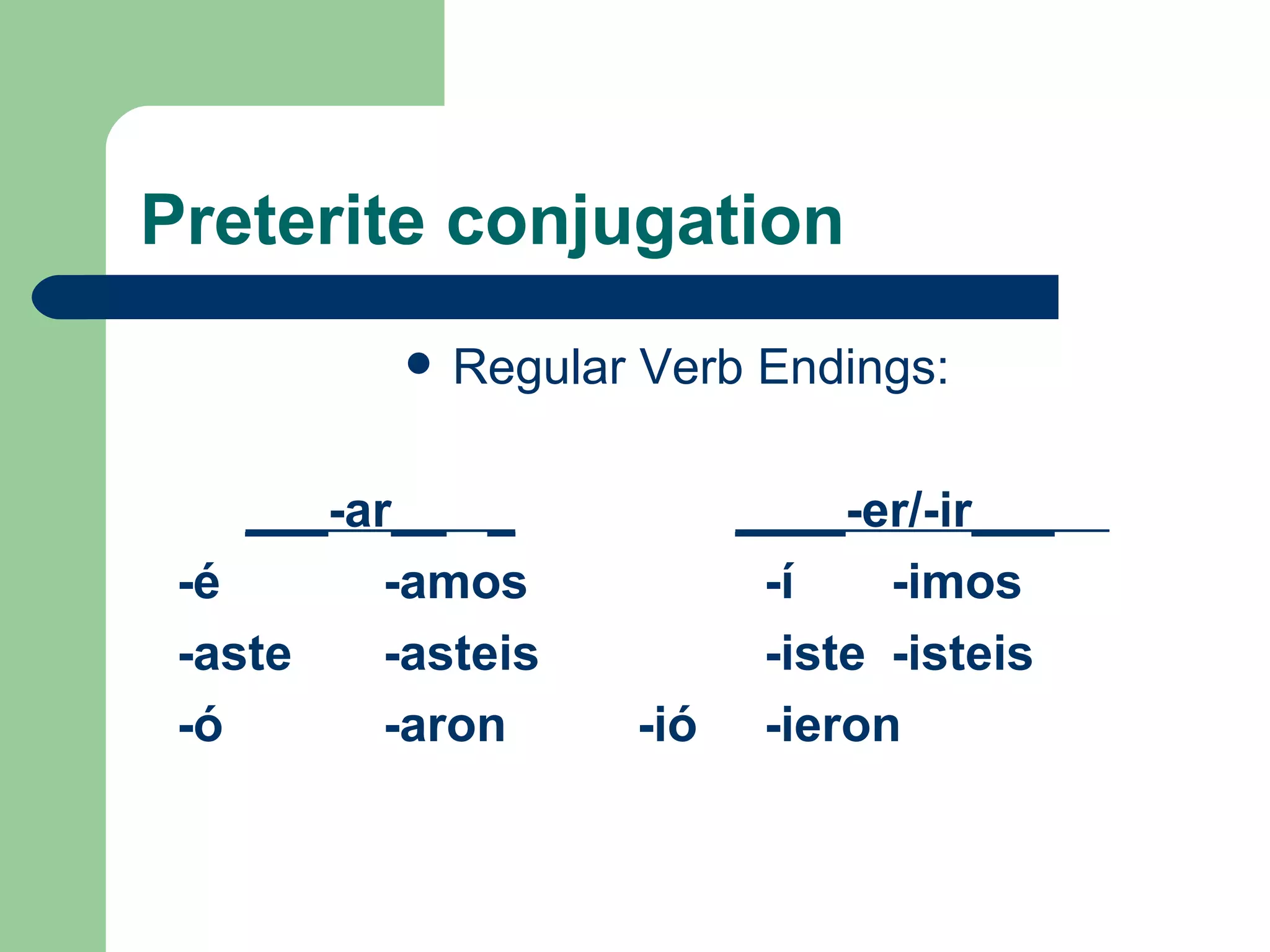
Preterite conjugation Regular Verb Endings:   ___-ar__  _   ____-er/-ir___  -é -amos -í -imos -aste -asteis -iste -isteis -ó -aron -ió -ieron
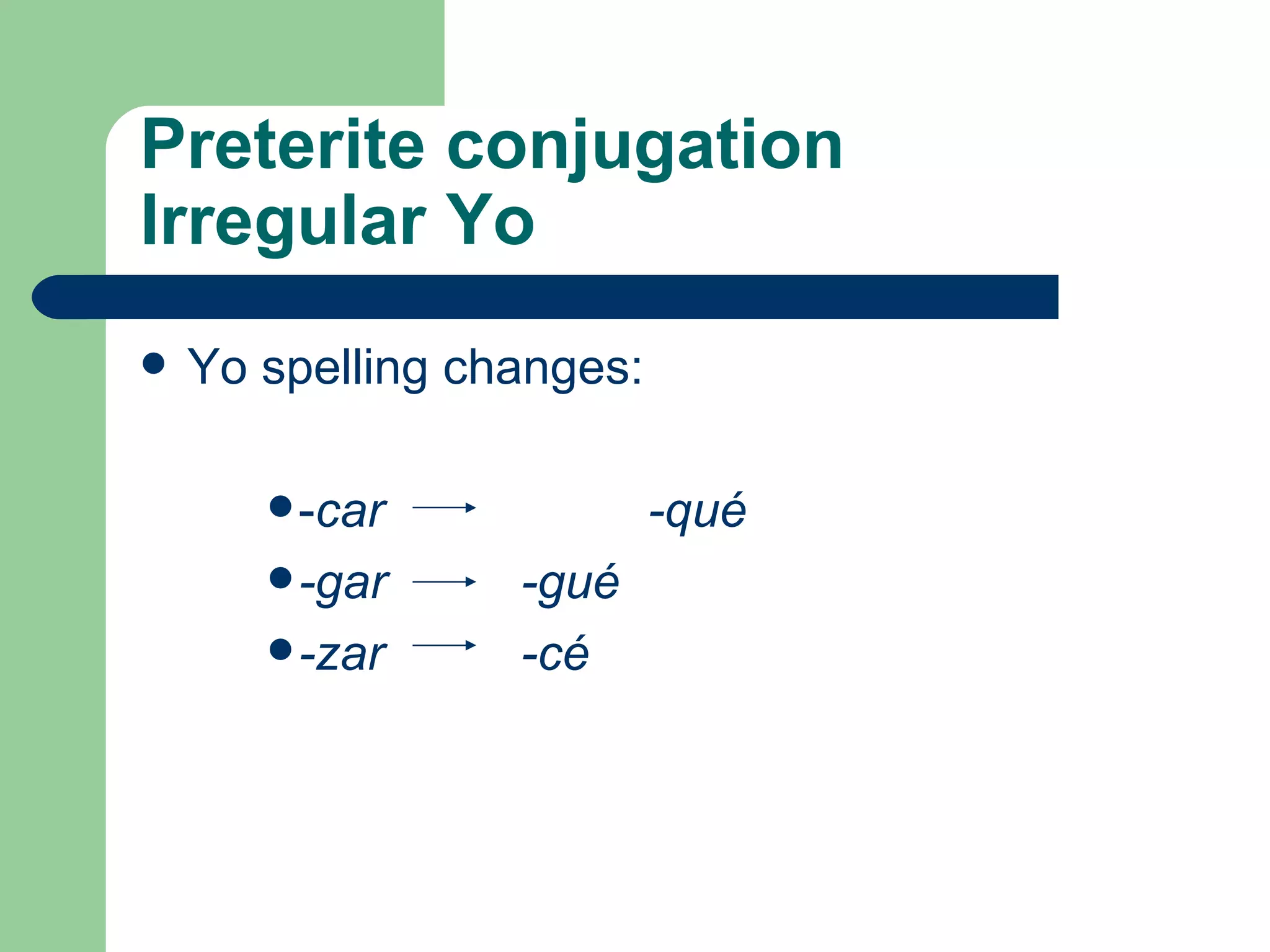
Preterite conjugation Irregular Yo Yo spelling changes: - car  -qué -gar -gu é -zar -cé
Otros verbos  –car acercarse (to come near, approach) buscar (to look for) arrancar (to pull out, start (engine) chocar (to crash) colocar (to place, put) complicar (to complicate) comunicar (to communicate) criticar (to criticize, critique) dedicar (to dedicate, devote)  educar (to educate) embarcarse (to board, go on board) marcar (to dial, mark) equivocarse (to make a mistake)  masticar (to chew) fabricar (to make, manufacture) pescar (to fish) justificar (to justify, give a reason for) platicar (to chat) practicar (to practice) secar (to dry) explicar (to explain) sacar (to take out, remove, receive [grades])
Otros verbos  –gar agregar (to add) ahogarse (to drown) apagar (to turn off) cargar (to carry, load) castigar (to punish) despegar (to take off, peel off) pagar (to pay) pegar (to hit, glue) tragar (to swallow) llegar (to arrive) encargar (to put in charge, order [goods]) Stem changers colgar (ue) (to hang up) fregar (ie) to wash dishes, scrub) negar (ie) (to deny) regar (ie) (to water plants) jugar (ue) (to play a game, sports) rogar (ue) (to beg)
Otros verbos  –zar  almorzar (to eat lunch) abrazar (to hug) aterrizar (to land) cruzar (to cross) comenzar (ie) (to begin) empezar (ie) (to begin)  especializarse en (to specialize in, major in) garantizar (to guarantee) gozar (to enjoy) lanzar (to throw) rezar (to pray) realizar (to carry out, attain, realize) tranquilizar (to calm down) tropezar (ie) (to trip, stumble) utilizar (to use, make use of)
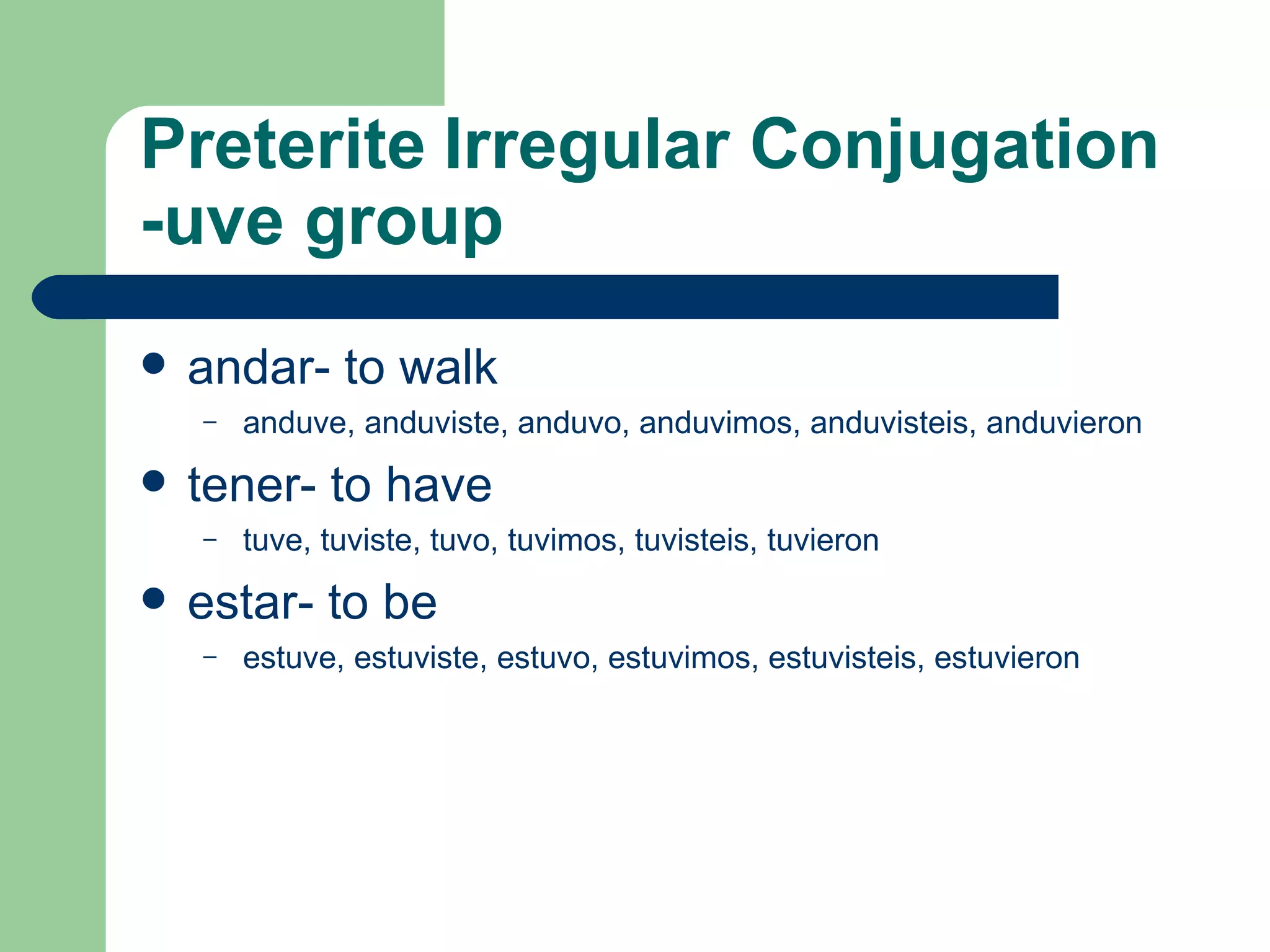
Preterite   Irregular C onjugation   -uve group andar- to walk  anduve, anduviste, anduvo, anduvimos, anduvisteis, anduvieron tener- to have tuve, tuviste, tuvo, tuvimos, tuvisteis, tuvieron estar- to be estuve, estuviste, estuvo, estuvimos, estuvisteis, estuvieron
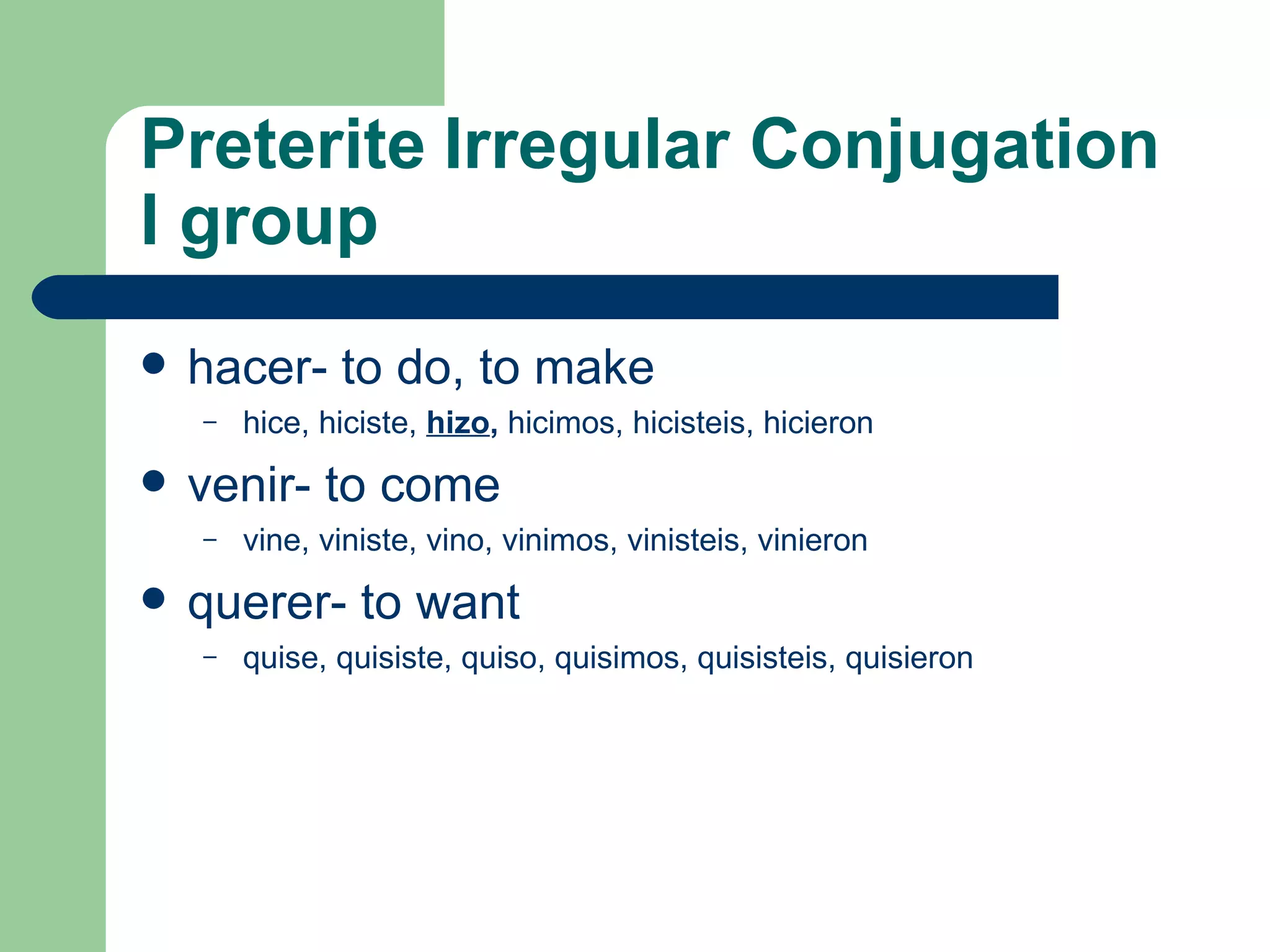
Preterite   Irregular C onjugation   I group hacer- to do, to make hice, hiciste,  hizo ,  hicimos, hicisteis, hicieron venir- to come vine, viniste, vino, vinimos, vinisteis, vinieron querer- to want quise, quisiste, quiso, quisimos, quisisteis, quisieron
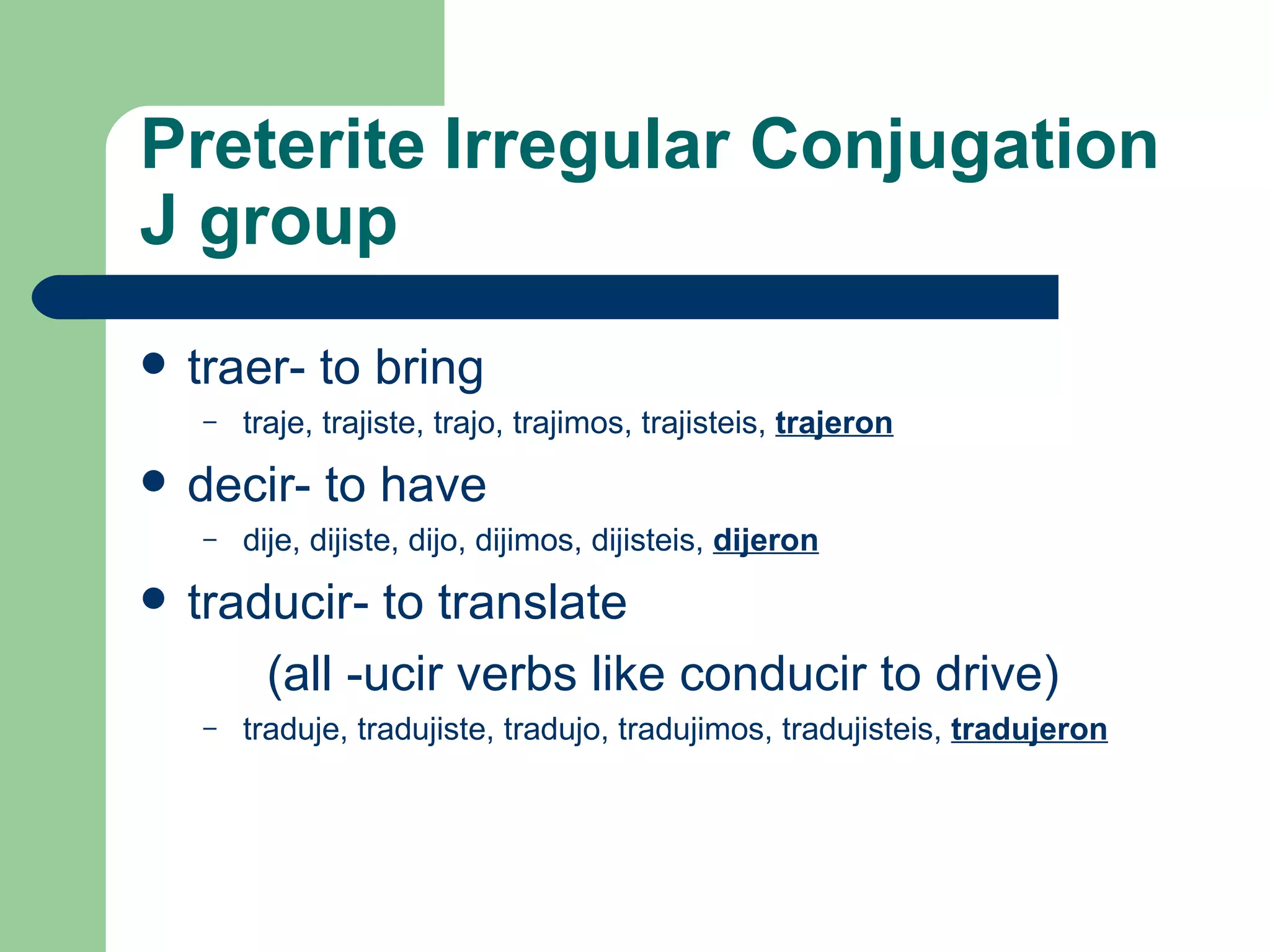
Preterite   Irregular C onjugation   J group traer- to bring traje, trajiste, trajo, trajimos, trajisteis,  trajeron decir- to have dije, dijiste, dijo, dijimos, dijisteis,  dijeron traducir- to translate  (all -ucir verbs like conducir to drive) traduje, tradujiste, tradujo, tradujimos, tradujisteis,  tradujeron
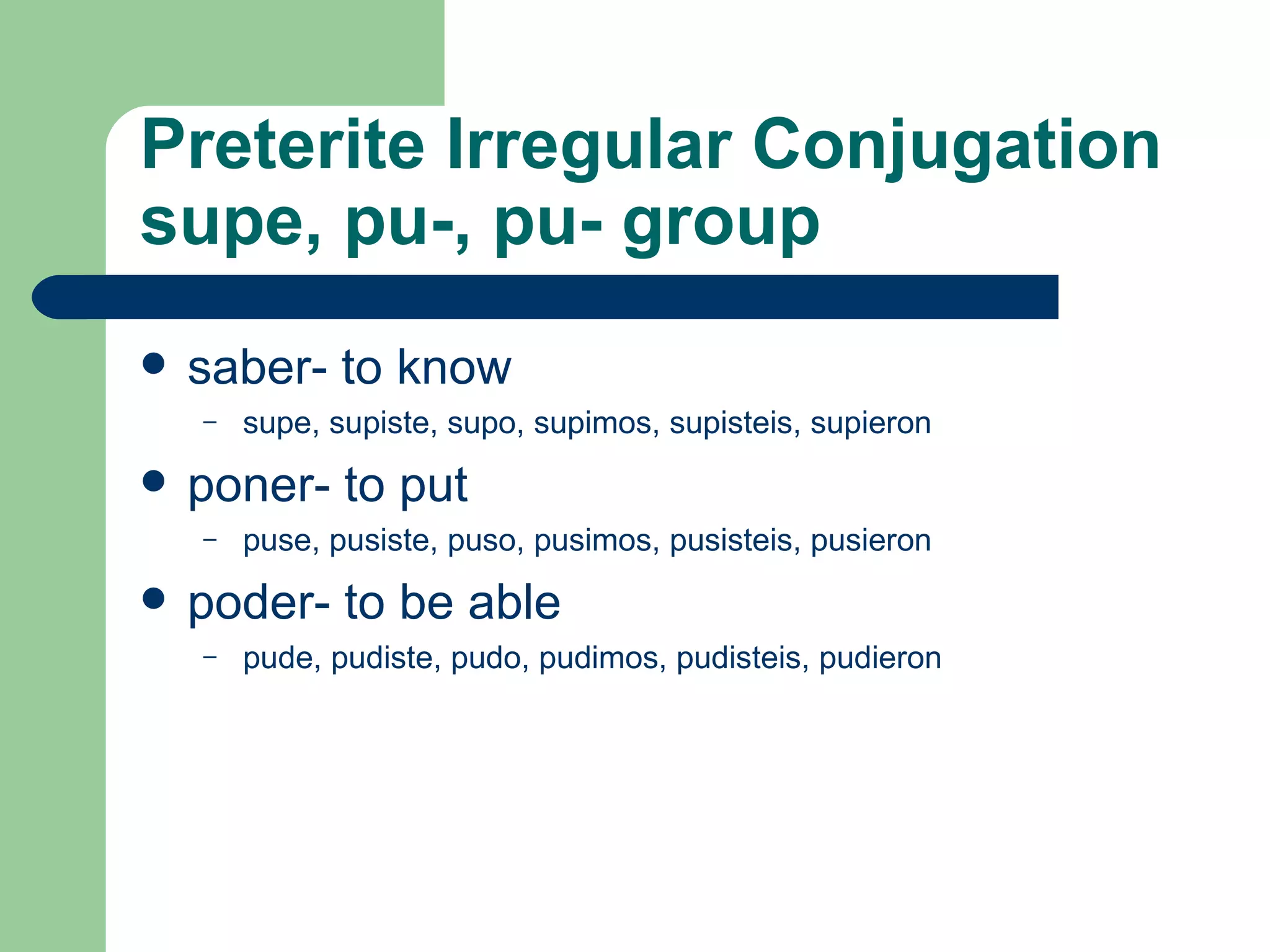
Preterite  Irregular C onjugation  supe, pu-, pu- group saber- to know supe, supiste, supo, supimos, supisteis, supieron poner- to put puse, pusiste, puso, pusimos, pusisteis, pusieron poder- to be able pude, pudiste, pudo, pudimos, pudisteis, pudieron
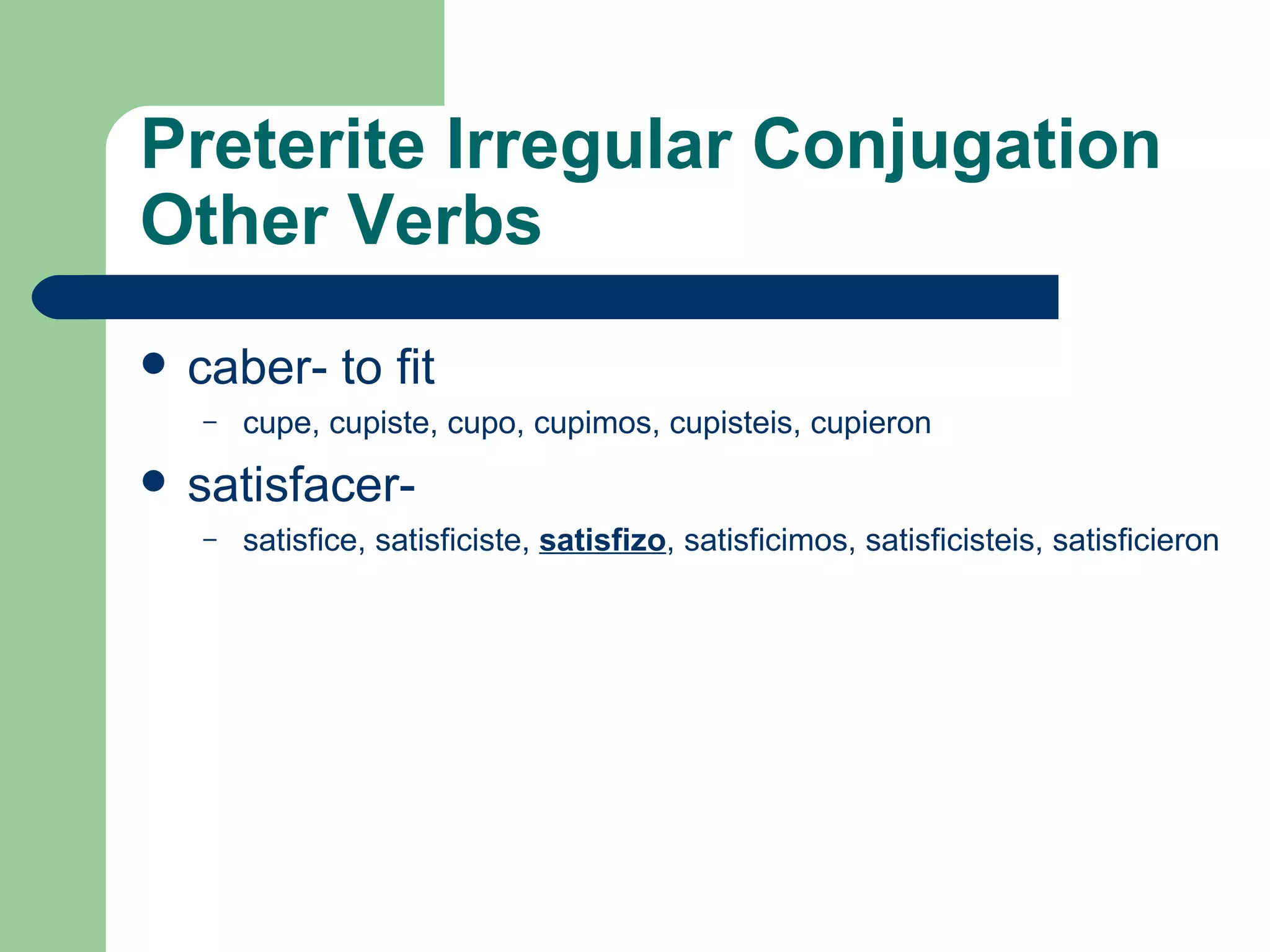
Preterite  Irregular C onjugation Other Verbs caber- to fit cupe, cupiste, cupo, cupimos, cupisteis, cupieron satisfacer-  satisfice, satisficiste,  satisfizo , satisficimos, satisficisteis, satisficieron
Preterite  Irregular C onjugation Ser- to be  and    ir- to go.  (You know which verb it is by using context of the sentence) fui fuimos fuiste fuisteis fue fueron
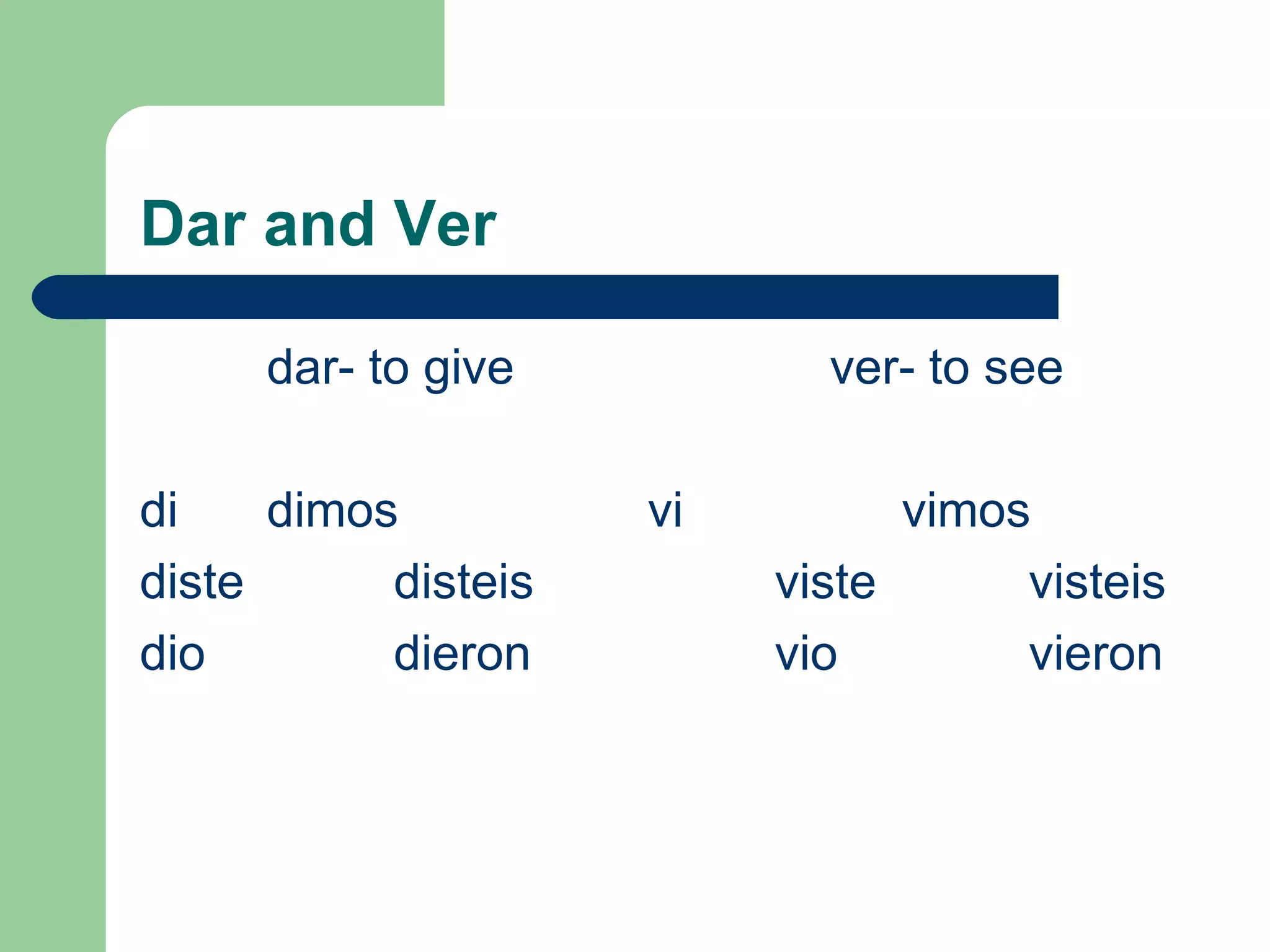
Dar and Ver dar- to give     ver- to see di dimos vi  vimos diste disteis viste visteis dio dieron vio vieron
Preterite Stem Changers Stem changes occur in  –ir  verbs only. Stem changes occur in  él /ella/Ud . and  ellos/ellas/Uds  only.  Stem changes are: e  i o  u
Preterite Stem Changers sentir (ei, i) (to feel)   advertir (ei, i) (to warn) convertir (ei, i) (to convert)   convertirse (ei, i) (to become) divertir (ei, i) (to amuse)   mentir (ei, i) (to lie) divertirse (ei, i) (to amuse oneself)  preferir (ei, i) (to prefer) sentir (ei, i) (to feel, be sorry)   sentirse (ei, i) (to feel) dormir (ue, u) (to sleep)   morir (ue, u) (to die) dormirse (ue, u) (to fall asleep)
Preterite Stem Changers servir (i, i) (to serve)  medir (i, i) (to measure) repetir (i, i) (to repeat)   seguir (i, i) (to continue) despedir (i, i) (to fire someone)   vestir (i, i) (to dress) pedir (i, i) (to ask for, request) re ír  (i, i) (to smile) conseguir (i, i) (to get, obtain)   sonreír (i, i) (to laugh) vestirse (i, i) (to dress oneself)   freír (i, i) (to fry) despedirse de (i, i) (to say good-bye to)
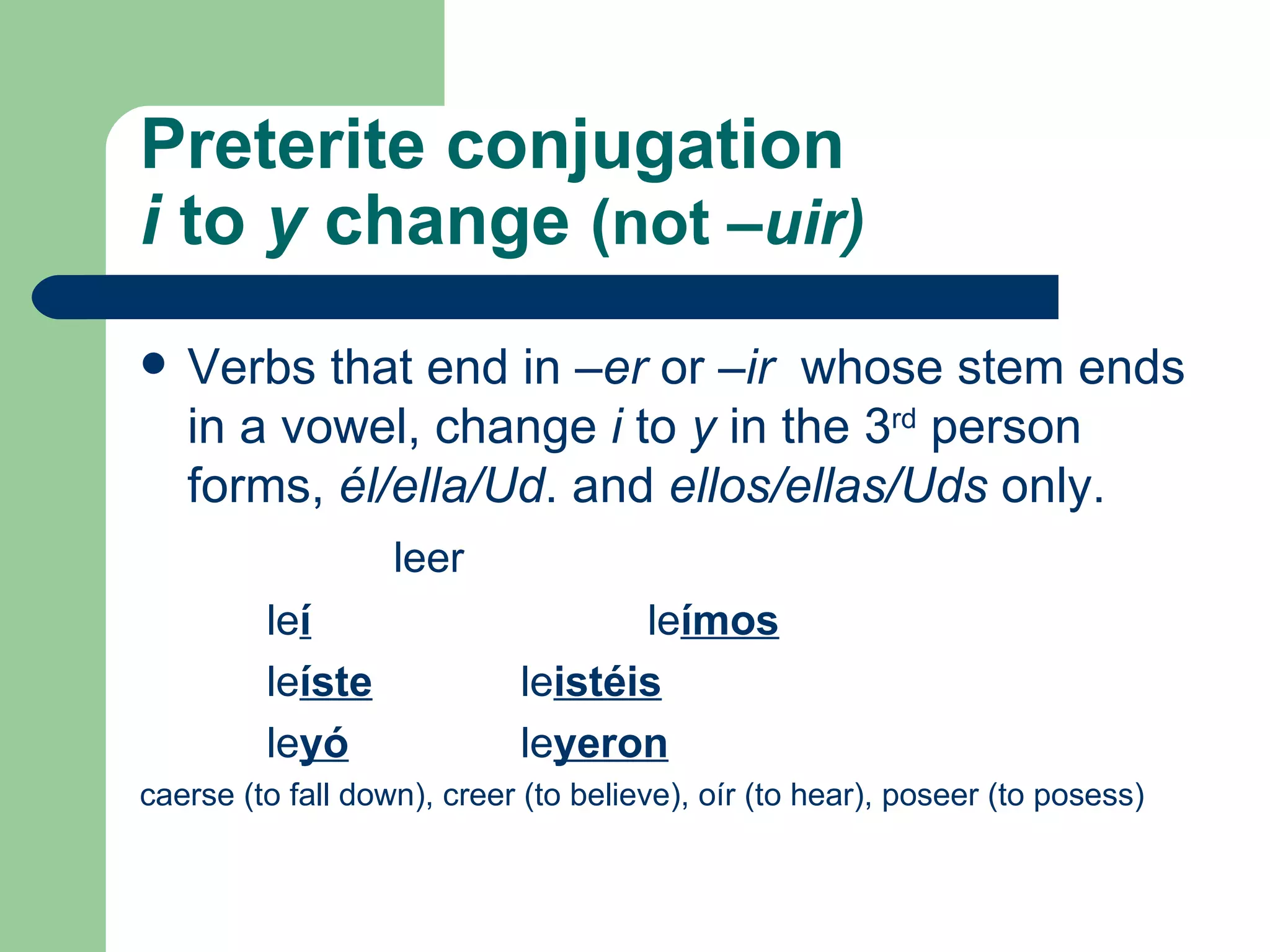
Preterite conjugation i  to  y  change   (not  –uir) Verbs that end in  –er  or  –ir  whose stem ends in a vowel, change  i  to  y  in the 3 rd  person forms,  él /ella/Ud . and  ellos/ellas/Uds  only.  leer le í le ímos le íste le istéis le yó le yeron caerse (to fall down), creer (to believe), oír (to hear), poseer (to posess)
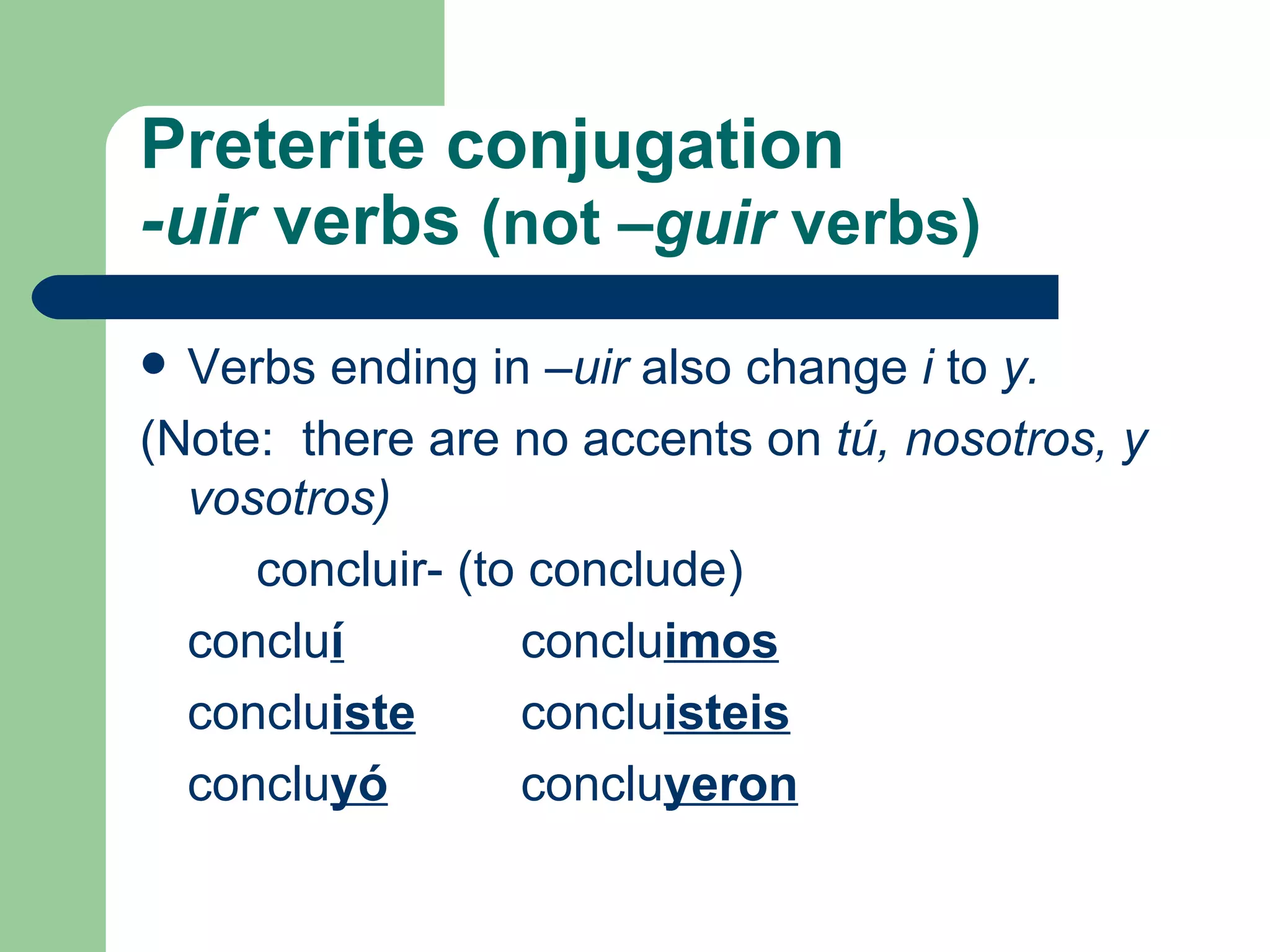
Preterite conjugation -uir  verbs  (not  –guir  verbs) Verbs ending in  –uir  also change  i  to  y.  (Note:  there are no accents on  t ú, nosotros, y vosotros)    concluir- (to conclude) conclu í conclu imos conclu iste conclu isteis conclu yó conclu yeron
Preterite conjugation   Other  –uir  Verbs atribuir (to attribute) construir (to build) contribuir (to contribute) distribuir (to distribute) huir (to flee) incluir (to include)
Translation The English Translation for the preterite is:   Yo hablé-  I spoke
Preterite Trigger Words: ayer anteayer una vez luego entonces  de repente cuando  anoche hace # años que ...   la semana pasada el mes/año pasado
Preterite   Uses: Specific Action Happened Once Specific Point in Time Sequential Actions Narration (AKA telling a story) Interrupting Action Beginning or End of an action in past
Imperfect Regular Verb Endings: __-ar__    - er/-ir_ _ -aba -ábamos -ía -íamos -abas -abais -ías -íais -aba -aban -ía -ían
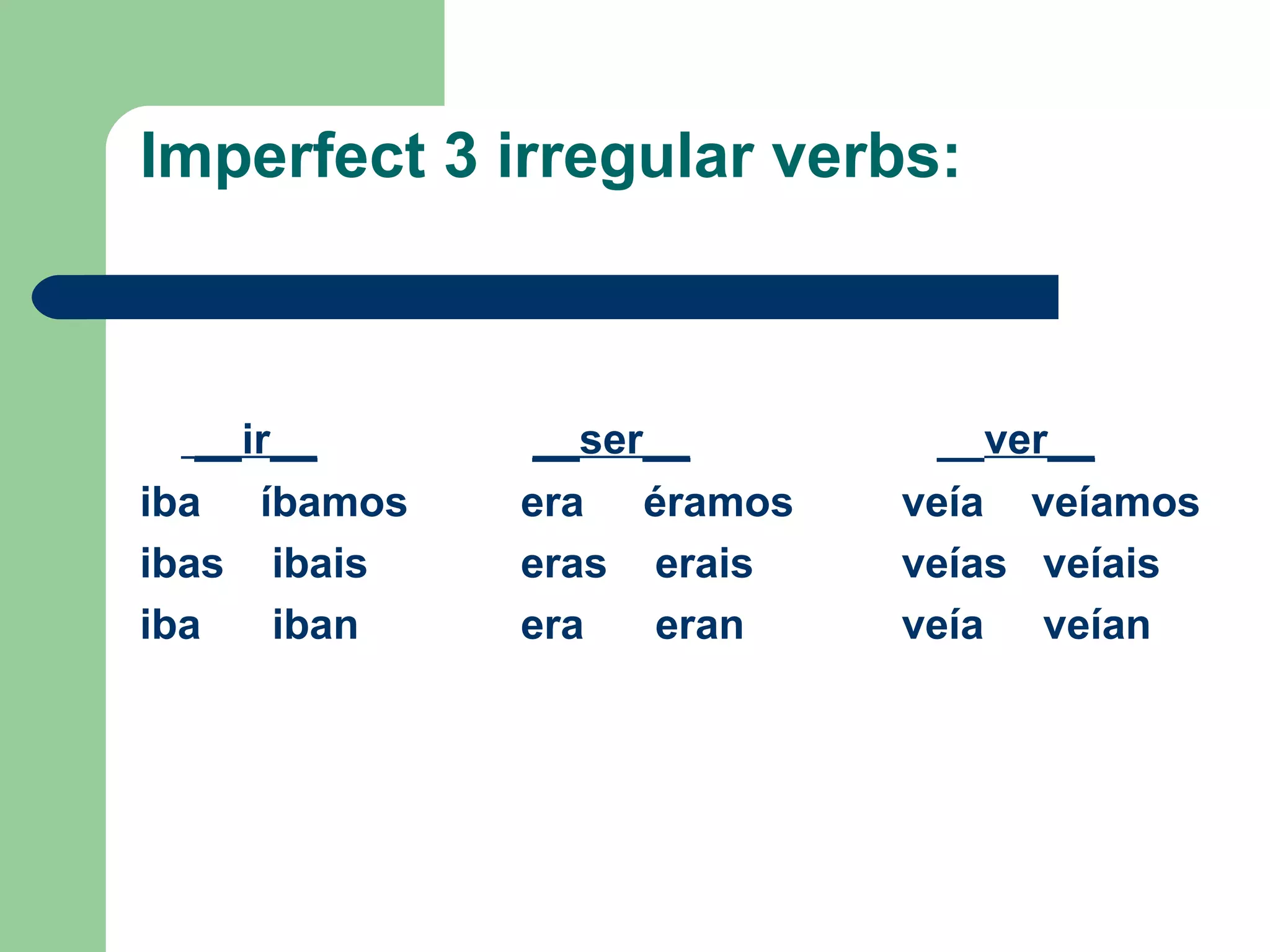
Imperfect 3 irregular verbs: __ir__     __ser__   __ ver__ iba  íbamos  era  éramos veía  veíamos ibas  ibais eras  erais veías  veíais iba  iban era  eran veía  veían
Imperfect  Translation The English Translation for the imperfect is:   I used to speak Yo hablaba-  I was speaking I would speak I spoke
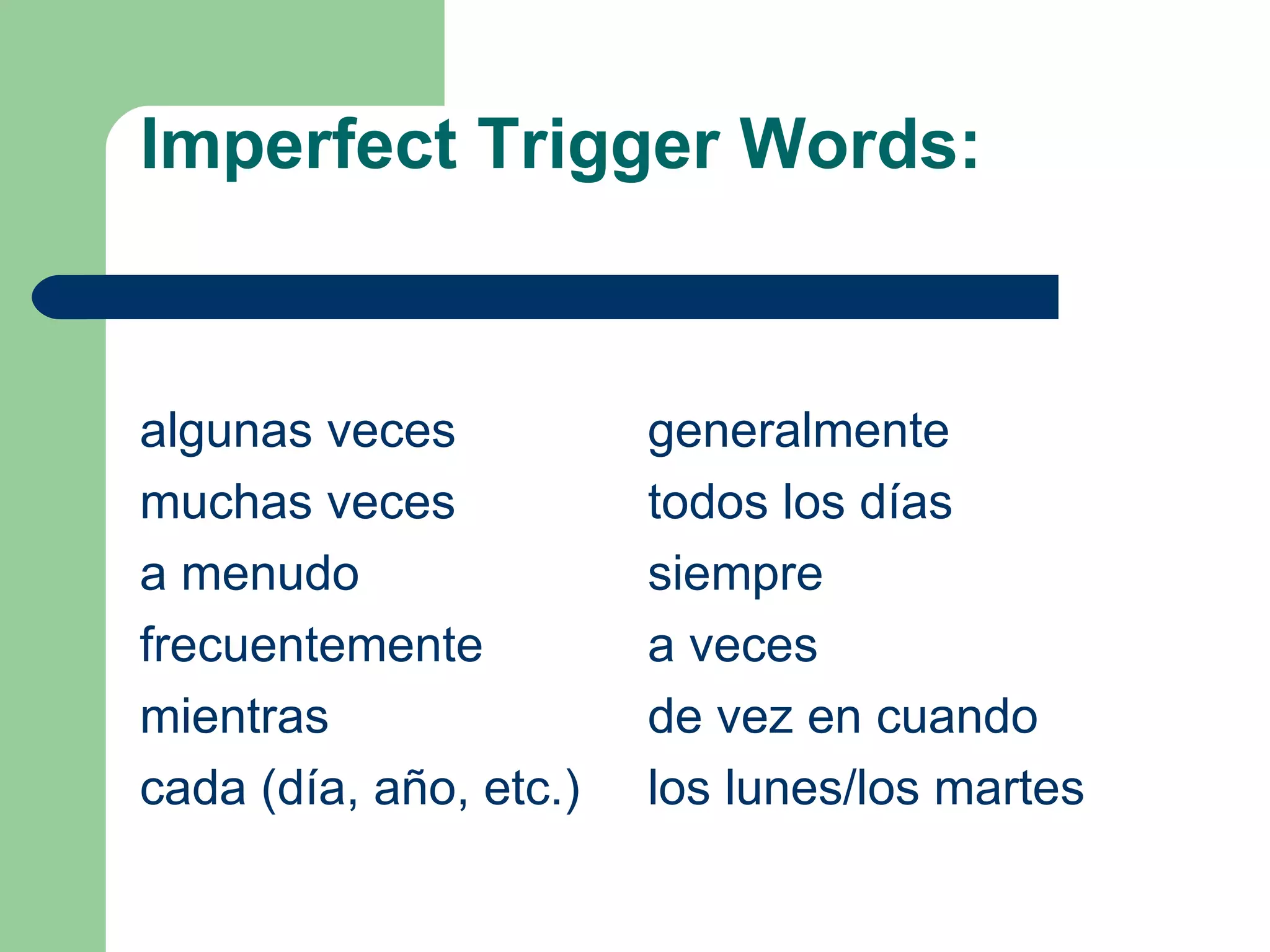
Imperfect Trigger Words: algunas veces  generalmente muchas veces todos los días a menudo  siempre frecuentemente a veces mientras de vez en cuando cada (día, año, etc.) los lunes/los martes
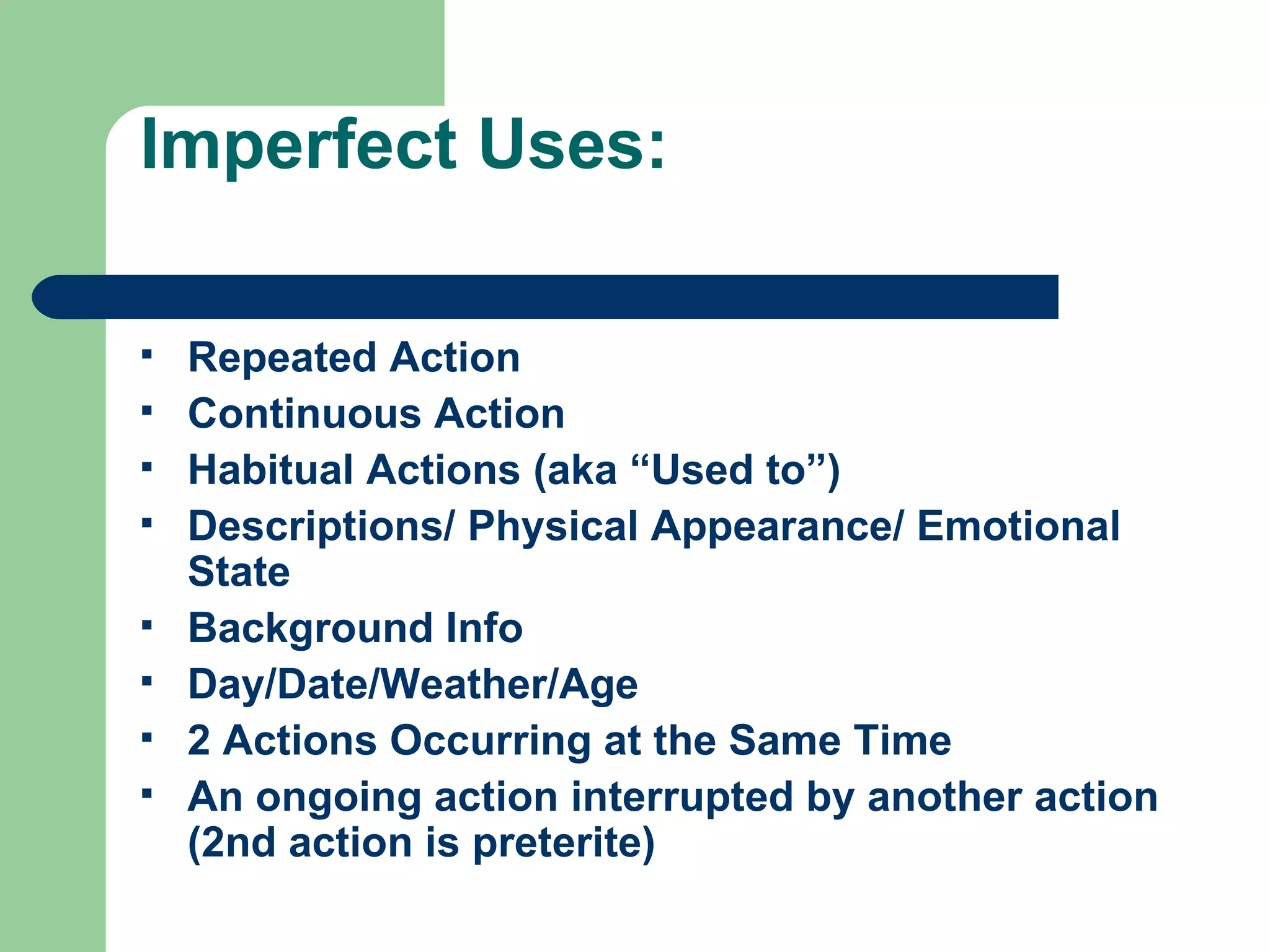
Imperfect Uses: Repeated Action Continuous Action Habitual Actions (aka “Used to”) Descriptions/ Physical Appearance/ Emotional State Background Info Day/Date/Weather/Age 2 Actions Occurring at the Same Time An ongoing action interrupted by another action (2nd action is preterite)
Comparing Usage Preterite Specific Action Happened Once Specific Point in Time Sequential Actions Narration (AKA telling a story) Interrupting Action Beginning or End of an action in past   Imperfect Repeated Action Continuous Action Habitual Actions (aka “Used to”) Descriptions/ Physical Appearance/ Emotional State Background Info Day/Date/Weather/Age 2 Actions Occurring at the Same Time An ongoing action interrupted by another action (2nd action is preterite)
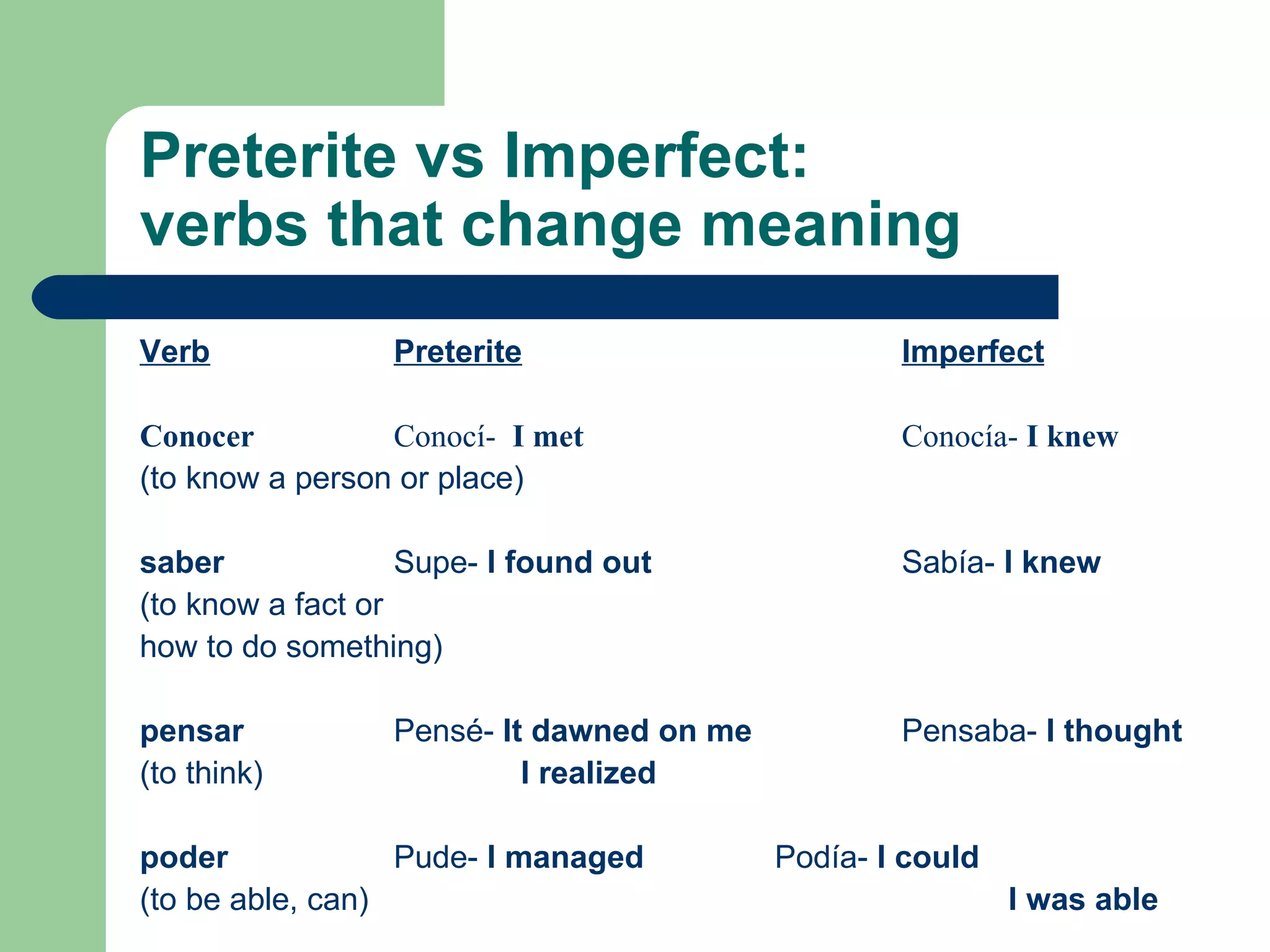
Preterite vs Imperfect:  verbs that change meaning Verb Preterite Imperfect   Conocer Conocí-  I met Conocía-  I knew (to know a person or place)   saber Supe-  I found out Sabía-  I knew (to know a fact or  how to do something)   pensar Pensé-  It dawned on me Pensaba-  I thought (to think) I realized poder Pude-  I managed Podía-  I could  (to be able, can)       I was able
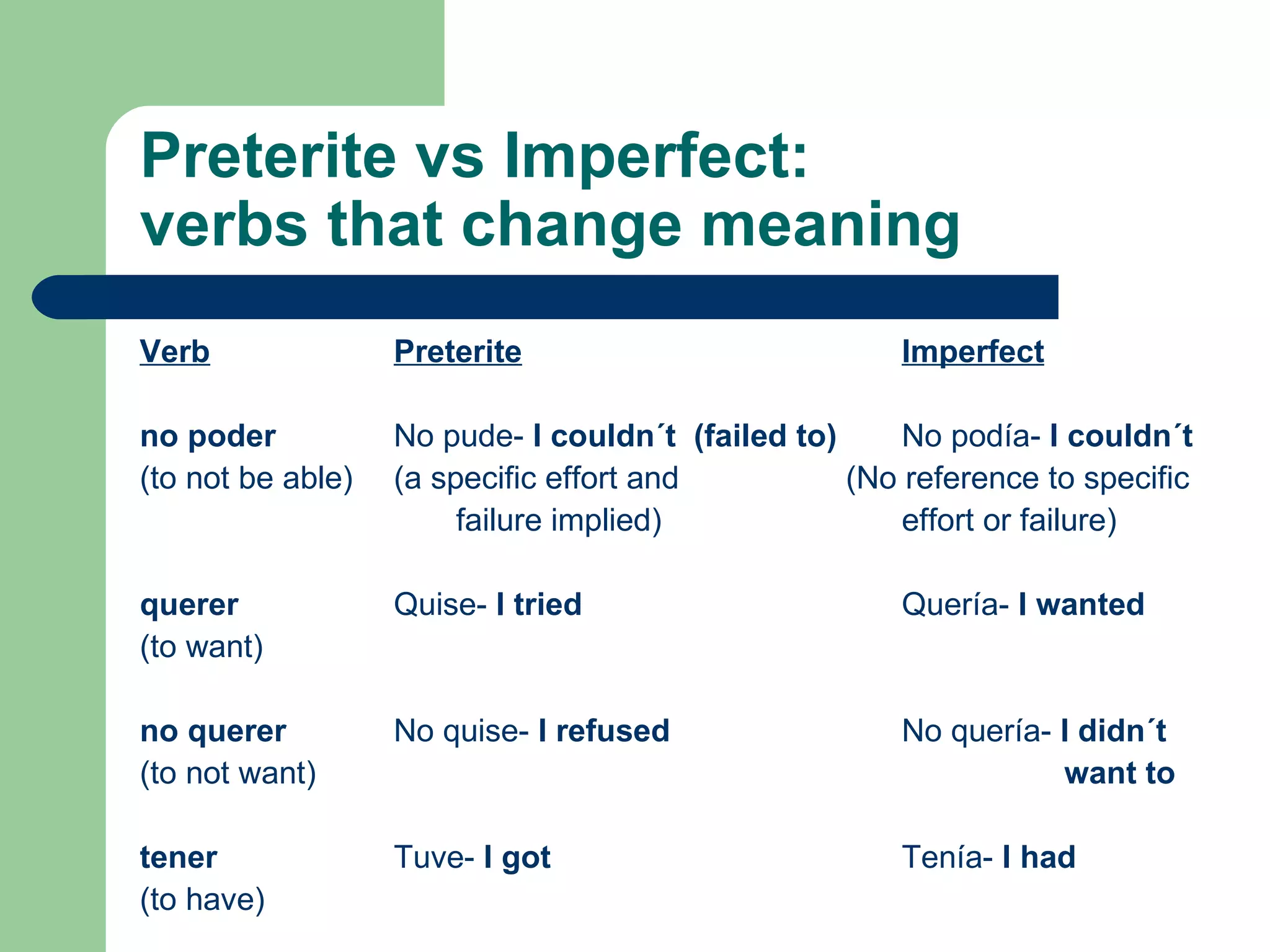
Preterite vs Imperfect:  verbs that change meaning Verb Preterite Imperfect   no poder No pude-  I couldn´t  (failed to) No podía-  I couldn´t (to not be able) (a specific effort and   (No reference to specific   failure implied)  effort or failure)   querer Quise-  I tried Quería-  I wanted (to want)   no querer No quise-  I refused No quería-  I didn´t  (to not want)     want to   tener Tuve-  I got Tenía-  I had (to have)
Preterite vs Imperfect:  verbs that change meaning Verb Preterite Imperfect tener que Tuve que...-  I had to...   Tenía que...-  I was  (to have to...)     supposed to...   costar Costó-  It cost    Costaba- It cost  (to cost)  (and I bought it   (implies that I didn´t buy it)

Preterite imperfect

  • 1.
    Past Tense PreteriteImperfect Preterite vs Imperfect
  • 2.
    Preterite conjugation RegularVerb Endings: ___-ar__ _ ____-er/-ir___ -é -amos -í -imos -aste -asteis -iste -isteis -ó -aron -ió -ieron
  • 3.
    Preterite conjugation IrregularYo Yo spelling changes: - car -qué -gar -gu é -zar -cé
  • 4.
    Otros verbos –car acercarse (to come near, approach) buscar (to look for) arrancar (to pull out, start (engine) chocar (to crash) colocar (to place, put) complicar (to complicate) comunicar (to communicate) criticar (to criticize, critique) dedicar (to dedicate, devote) educar (to educate) embarcarse (to board, go on board) marcar (to dial, mark) equivocarse (to make a mistake) masticar (to chew) fabricar (to make, manufacture) pescar (to fish) justificar (to justify, give a reason for) platicar (to chat) practicar (to practice) secar (to dry) explicar (to explain) sacar (to take out, remove, receive [grades])
  • 5.
    Otros verbos –gar agregar (to add) ahogarse (to drown) apagar (to turn off) cargar (to carry, load) castigar (to punish) despegar (to take off, peel off) pagar (to pay) pegar (to hit, glue) tragar (to swallow) llegar (to arrive) encargar (to put in charge, order [goods]) Stem changers colgar (ue) (to hang up) fregar (ie) to wash dishes, scrub) negar (ie) (to deny) regar (ie) (to water plants) jugar (ue) (to play a game, sports) rogar (ue) (to beg)
  • 6.
    Otros verbos –zar almorzar (to eat lunch) abrazar (to hug) aterrizar (to land) cruzar (to cross) comenzar (ie) (to begin) empezar (ie) (to begin) especializarse en (to specialize in, major in) garantizar (to guarantee) gozar (to enjoy) lanzar (to throw) rezar (to pray) realizar (to carry out, attain, realize) tranquilizar (to calm down) tropezar (ie) (to trip, stumble) utilizar (to use, make use of)
  • 7.
    Preterite Irregular C onjugation -uve group andar- to walk anduve, anduviste, anduvo, anduvimos, anduvisteis, anduvieron tener- to have tuve, tuviste, tuvo, tuvimos, tuvisteis, tuvieron estar- to be estuve, estuviste, estuvo, estuvimos, estuvisteis, estuvieron
  • 8.
    Preterite Irregular C onjugation I group hacer- to do, to make hice, hiciste, hizo , hicimos, hicisteis, hicieron venir- to come vine, viniste, vino, vinimos, vinisteis, vinieron querer- to want quise, quisiste, quiso, quisimos, quisisteis, quisieron
  • 9.
    Preterite Irregular C onjugation J group traer- to bring traje, trajiste, trajo, trajimos, trajisteis, trajeron decir- to have dije, dijiste, dijo, dijimos, dijisteis, dijeron traducir- to translate (all -ucir verbs like conducir to drive) traduje, tradujiste, tradujo, tradujimos, tradujisteis, tradujeron
  • 10.
    Preterite IrregularC onjugation supe, pu-, pu- group saber- to know supe, supiste, supo, supimos, supisteis, supieron poner- to put puse, pusiste, puso, pusimos, pusisteis, pusieron poder- to be able pude, pudiste, pudo, pudimos, pudisteis, pudieron
  • 11.
    Preterite IrregularC onjugation Other Verbs caber- to fit cupe, cupiste, cupo, cupimos, cupisteis, cupieron satisfacer- satisfice, satisficiste, satisfizo , satisficimos, satisficisteis, satisficieron
  • 12.
    Preterite IrregularC onjugation Ser- to be and ir- to go. (You know which verb it is by using context of the sentence) fui fuimos fuiste fuisteis fue fueron
  • 13.
    Dar and Verdar- to give ver- to see di dimos vi vimos diste disteis viste visteis dio dieron vio vieron
  • 14.
    Preterite Stem ChangersStem changes occur in –ir verbs only. Stem changes occur in él /ella/Ud . and ellos/ellas/Uds only. Stem changes are: e i o u
  • 15.
    Preterite Stem Changerssentir (ei, i) (to feel) advertir (ei, i) (to warn) convertir (ei, i) (to convert) convertirse (ei, i) (to become) divertir (ei, i) (to amuse) mentir (ei, i) (to lie) divertirse (ei, i) (to amuse oneself) preferir (ei, i) (to prefer) sentir (ei, i) (to feel, be sorry) sentirse (ei, i) (to feel) dormir (ue, u) (to sleep) morir (ue, u) (to die) dormirse (ue, u) (to fall asleep)
  • 16.
    Preterite Stem Changersservir (i, i) (to serve) medir (i, i) (to measure) repetir (i, i) (to repeat) seguir (i, i) (to continue) despedir (i, i) (to fire someone) vestir (i, i) (to dress) pedir (i, i) (to ask for, request) re ír (i, i) (to smile) conseguir (i, i) (to get, obtain) sonreír (i, i) (to laugh) vestirse (i, i) (to dress oneself) freír (i, i) (to fry) despedirse de (i, i) (to say good-bye to)
  • 17.
    Preterite conjugation i to y change (not –uir) Verbs that end in –er or –ir whose stem ends in a vowel, change i to y in the 3 rd person forms, él /ella/Ud . and ellos/ellas/Uds only. leer le í le ímos le íste le istéis le yó le yeron caerse (to fall down), creer (to believe), oír (to hear), poseer (to posess)
  • 18.
    Preterite conjugation -uir verbs (not –guir verbs) Verbs ending in –uir also change i to y. (Note: there are no accents on t ú, nosotros, y vosotros) concluir- (to conclude) conclu í conclu imos conclu iste conclu isteis conclu yó conclu yeron
  • 19.
    Preterite conjugation Other –uir Verbs atribuir (to attribute) construir (to build) contribuir (to contribute) distribuir (to distribute) huir (to flee) incluir (to include)
  • 20.
    Translation The EnglishTranslation for the preterite is:   Yo hablé- I spoke
  • 21.
    Preterite Trigger Words:ayer anteayer una vez luego entonces de repente cuando anoche hace # años que ... la semana pasada el mes/año pasado
  • 22.
    Preterite Uses: Specific Action Happened Once Specific Point in Time Sequential Actions Narration (AKA telling a story) Interrupting Action Beginning or End of an action in past
  • 23.
    Imperfect Regular VerbEndings: __-ar__ - er/-ir_ _ -aba -ábamos -ía -íamos -abas -abais -ías -íais -aba -aban -ía -ían
  • 24.
    Imperfect 3 irregularverbs: __ir__ __ser__ __ ver__ iba íbamos era éramos veía veíamos ibas ibais eras erais veías veíais iba iban era eran veía veían
  • 25.
    Imperfect TranslationThe English Translation for the imperfect is:   I used to speak Yo hablaba- I was speaking I would speak I spoke
  • 26.
    Imperfect Trigger Words:algunas veces generalmente muchas veces todos los días a menudo siempre frecuentemente a veces mientras de vez en cuando cada (día, año, etc.) los lunes/los martes
  • 27.
    Imperfect Uses: RepeatedAction Continuous Action Habitual Actions (aka “Used to”) Descriptions/ Physical Appearance/ Emotional State Background Info Day/Date/Weather/Age 2 Actions Occurring at the Same Time An ongoing action interrupted by another action (2nd action is preterite)
  • 28.
    Comparing Usage PreteriteSpecific Action Happened Once Specific Point in Time Sequential Actions Narration (AKA telling a story) Interrupting Action Beginning or End of an action in past Imperfect Repeated Action Continuous Action Habitual Actions (aka “Used to”) Descriptions/ Physical Appearance/ Emotional State Background Info Day/Date/Weather/Age 2 Actions Occurring at the Same Time An ongoing action interrupted by another action (2nd action is preterite)
  • 29.
    Preterite vs Imperfect: verbs that change meaning Verb Preterite Imperfect   Conocer Conocí- I met Conocía- I knew (to know a person or place)   saber Supe- I found out Sabía- I knew (to know a fact or how to do something)   pensar Pensé- It dawned on me Pensaba- I thought (to think) I realized poder Pude- I managed Podía- I could (to be able, can) I was able
  • 30.
    Preterite vs Imperfect: verbs that change meaning Verb Preterite Imperfect   no poder No pude- I couldn´t (failed to) No podía- I couldn´t (to not be able) (a specific effort and (No reference to specific failure implied) effort or failure)   querer Quise- I tried Quería- I wanted (to want)   no querer No quise- I refused No quería- I didn´t (to not want) want to   tener Tuve- I got Tenía- I had (to have)
  • 31.
    Preterite vs Imperfect: verbs that change meaning Verb Preterite Imperfect tener que Tuve que...- I had to... Tenía que...- I was (to have to...) supposed to...   costar Costó- It cost Costaba- It cost (to cost) (and I bought it (implies that I didn´t buy it)