2011 Spanish Grammar Book Tiana Anthony
Table of Contents Title page  Table of Contents Present  Stem Changers  Irregular “Yo” verbs  Saber vs. Conocer Reflexives  “ Se” impersonal  Dipthongs with accents Verbs similar to Gustar  Irregular verbs ending in Uir/Guir, Cer/Cir, Ger/Gir  Hace + ___ + que ___ + present/preterito  Imperfect Preterite Cucaracha verbs Spock verbs Snake and snakey Trigger words Future Comparatives Superlatives
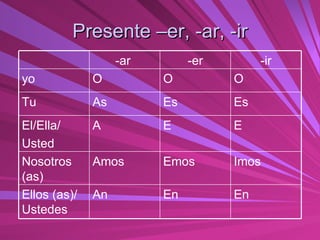
Presente –er, -ar, -ir En  En An Ellos (as)/ Ustedes Imos Emos Amos Nosotros (as) E E A El/Ella/ Usted Es Es As Tu O O O yo -ir -er -ar
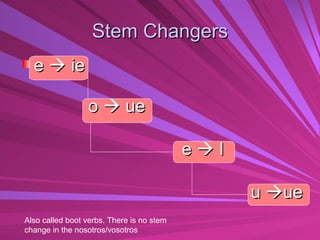
Stem Changers e    ie     o    ue   e    I    u   ue Also called boot verbs. There is no stem change in the nosotros/vosotros
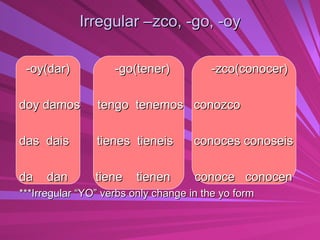
Irregular –zco, -go, -oy -oy(dar)  -go(tener)  -zco(conocer) doy damos  tengo  tenemos  conozco das  dais  tienes  tieneis  conoces conoseis da  dan  tiene  tienen  conoce  conocen ***Irregular “YO” verbs only change in the yo form
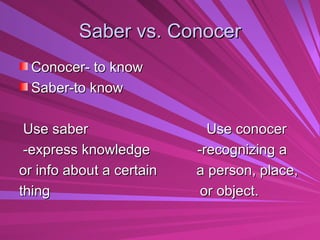
Saber vs. Conocer Conocer- to know Saber-to know Use saber  Use conocer -express knowledge  -recognizing a or info about a certain  a person, place, thing  or object.
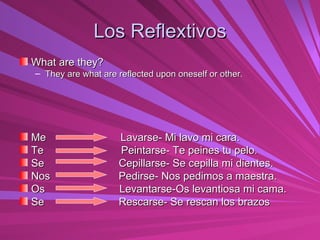
Los Reflextivos What are they? They are what are reflected upon oneself or other. Me  Lavarse- Mi lavo mi cara. Te  Peintarse- Te peines tu pelo. Se  Cepillarse- Se cepilla mi dientes. Nos  Pedirse- Nos pedimos a maestra. Os  Levantarse-Os levantiosa mi cama. Se  Rescarse- Se rescan los brazos
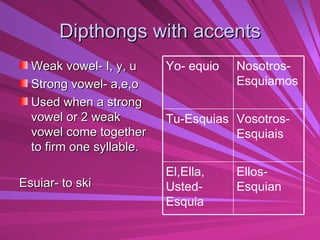
Dipthongs with accents Weak vowel- I, y, u Strong vowel- a,e,o Used when a strong vowel or 2 weak vowel come together to firm one syllable. Esuiar- to ski  Ellos-Esquian El,Ella, Usted- Esquia Vosotros- Esquiais Tu-Esquias Nosotros- Esquiamos Yo- equio
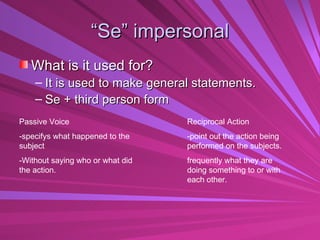
“Se” impersonal What is it used for? It is used to make general statements. Se + third person form Passive Voice -specifys what happened to the subject -Without saying who or what did the action. Reciprocal Action -point out the action being performed on the subjects. frequently what they are doing something to or with each other.
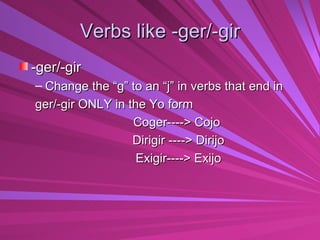
Verbs like -ger/-gir -ger/-gir Change the “g” to an “j” in verbs that end in  ger/-gir ONLY in the Yo form  Coger----> Cojo Dirigir ----> Dirijo Exigir----> Exijo
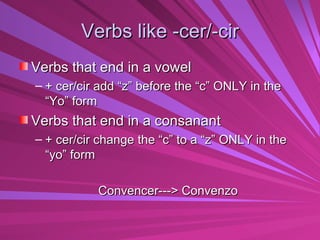
Verbs like -cer/-cir Verbs that end in a vowel  + cer/cir add “z” before the “c” ONLY in the “Yo” form Verbs that end in a consanant + cer/cir change the “c” to a “z” ONLY in the “yo” form Convencer---> Convenzo
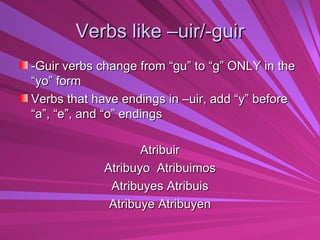
Verbs like –uir/-guir -Guir verbs change from “gu” to “g” ONLY in the “yo” form Verbs that have endings in –uir, add “y” before “a”, “e”, and “o” endings Atribuir Atribuyo  Atribuimos Atribuyes Atribuis Atribuye Atribuyen
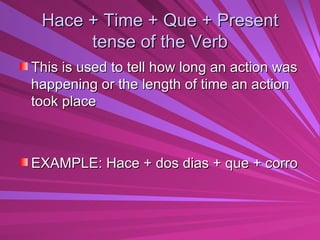
Hace + Time + Que + Present tense of the Verb This is used to tell how long an action was happening or the length of time an action took place EXAMPLE: Hace + dos dias + que + corro
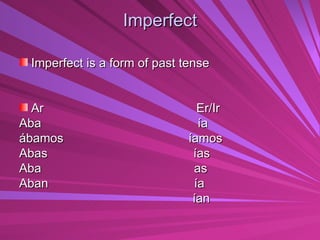
Imperfect Imperfect is a form of past tense Ar  Er/Ir Aba  ía ábamos  íamos Abas  ías Aba  as Aban  ía ían
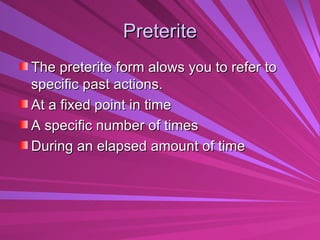
Preterite The preterite form alows you to refer to specific past actions.  At a fixed point in time A specific number of times During an elapsed amount of time
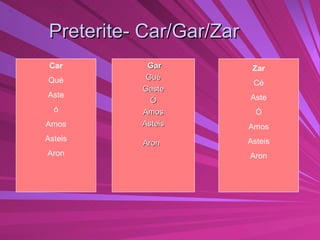
Gar Gué Gaste Ó Amos Asteis Aron   Preterite- Car/Gar/Zar Car Qué Aste ó Amos Asteis Aron Zar Cé Aste Ó Amos Asteis Aron
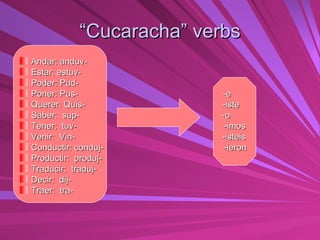
“Cucaracha” verbs Andar: anduv- Estar: estuv- Poder: Pud- Poner: Pus-  -e Querer: Quis-  -iste Saber:  sup-  -o Tener:  tuv-  -imos Venir:  Vin-  -isteis Conductir: conduj-  -ieron Productir:  produj- Traducir:  traduj- Decir:  dij- Traer:  tra-
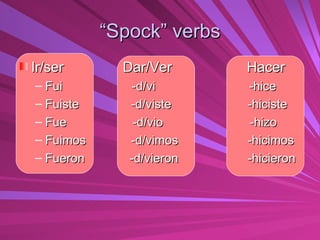
“Spock” verbs Ir/ser  Dar/Ver  Hacer Fui  -d/vi  -hice Fuiste  -d/viste  -hiciste Fue  -d/vio  -hizo Fuimos  -d/vimos  -hicimos Fueron  -d/vieron  -hicieron
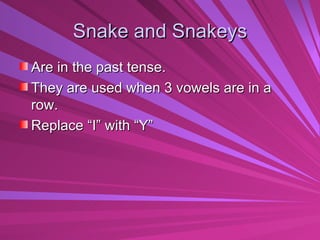
Snake and Snakeys Are in the past tense. They are used when 3 vowels are in a row.  Replace “I” with “Y”
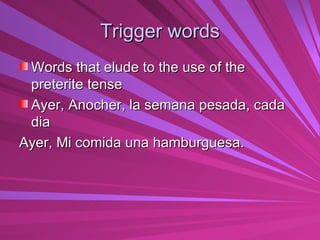
Trigger words Words that elude to the use of the preterite tense Ayer, Anocher, la semana pesada, cada dia Ayer, Mi comida una hamburguesa.
Comparatives Used to compare something to another Tan + adj/adv + como : Mas/menos +adj/adv/noun + que Tan:so  *When using numbers, use de not que Tanto: so much Tantos/as: so many
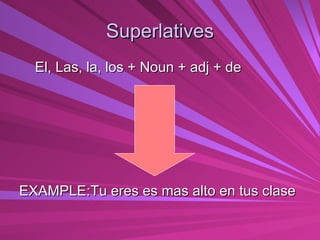
Superlatives El, Las, la, los + Noun + adj + de EXAMPLE:Tu eres es mas alto en tus clase

2011 spanish grammar book

  • 1.
    2011 Spanish GrammarBook Tiana Anthony
  • 2.
    Table of ContentsTitle page Table of Contents Present Stem Changers Irregular “Yo” verbs Saber vs. Conocer Reflexives “ Se” impersonal Dipthongs with accents Verbs similar to Gustar Irregular verbs ending in Uir/Guir, Cer/Cir, Ger/Gir Hace + ___ + que ___ + present/preterito Imperfect Preterite Cucaracha verbs Spock verbs Snake and snakey Trigger words Future Comparatives Superlatives
  • 3.
    Presente –er, -ar,-ir En En An Ellos (as)/ Ustedes Imos Emos Amos Nosotros (as) E E A El/Ella/ Usted Es Es As Tu O O O yo -ir -er -ar
  • 4.
    Stem Changers e  ie o  ue e  I u  ue Also called boot verbs. There is no stem change in the nosotros/vosotros
  • 5.
    Irregular –zco, -go,-oy -oy(dar) -go(tener) -zco(conocer) doy damos tengo tenemos conozco das dais tienes tieneis conoces conoseis da dan tiene tienen conoce conocen ***Irregular “YO” verbs only change in the yo form
  • 6.
    Saber vs. ConocerConocer- to know Saber-to know Use saber Use conocer -express knowledge -recognizing a or info about a certain a person, place, thing or object.
  • 7.
    Los Reflextivos Whatare they? They are what are reflected upon oneself or other. Me Lavarse- Mi lavo mi cara. Te Peintarse- Te peines tu pelo. Se Cepillarse- Se cepilla mi dientes. Nos Pedirse- Nos pedimos a maestra. Os Levantarse-Os levantiosa mi cama. Se Rescarse- Se rescan los brazos
  • 8.
    Dipthongs with accentsWeak vowel- I, y, u Strong vowel- a,e,o Used when a strong vowel or 2 weak vowel come together to firm one syllable. Esuiar- to ski Ellos-Esquian El,Ella, Usted- Esquia Vosotros- Esquiais Tu-Esquias Nosotros- Esquiamos Yo- equio
  • 9.
    “Se” impersonal Whatis it used for? It is used to make general statements. Se + third person form Passive Voice -specifys what happened to the subject -Without saying who or what did the action. Reciprocal Action -point out the action being performed on the subjects. frequently what they are doing something to or with each other.
  • 10.
    Verbs like -ger/-gir-ger/-gir Change the “g” to an “j” in verbs that end in ger/-gir ONLY in the Yo form Coger----> Cojo Dirigir ----> Dirijo Exigir----> Exijo
  • 11.
    Verbs like -cer/-cirVerbs that end in a vowel + cer/cir add “z” before the “c” ONLY in the “Yo” form Verbs that end in a consanant + cer/cir change the “c” to a “z” ONLY in the “yo” form Convencer---> Convenzo
  • 12.
    Verbs like –uir/-guir-Guir verbs change from “gu” to “g” ONLY in the “yo” form Verbs that have endings in –uir, add “y” before “a”, “e”, and “o” endings Atribuir Atribuyo Atribuimos Atribuyes Atribuis Atribuye Atribuyen
  • 13.
    Hace + Time+ Que + Present tense of the Verb This is used to tell how long an action was happening or the length of time an action took place EXAMPLE: Hace + dos dias + que + corro
  • 14.
    Imperfect Imperfect isa form of past tense Ar Er/Ir Aba ía ábamos íamos Abas ías Aba as Aban ía ían
  • 15.
    Preterite The preteriteform alows you to refer to specific past actions. At a fixed point in time A specific number of times During an elapsed amount of time
  • 16.
    Gar Gué GasteÓ Amos Asteis Aron Preterite- Car/Gar/Zar Car Qué Aste ó Amos Asteis Aron Zar Cé Aste Ó Amos Asteis Aron
  • 17.
    “Cucaracha” verbs Andar:anduv- Estar: estuv- Poder: Pud- Poner: Pus- -e Querer: Quis- -iste Saber: sup- -o Tener: tuv- -imos Venir: Vin- -isteis Conductir: conduj- -ieron Productir: produj- Traducir: traduj- Decir: dij- Traer: tra-
  • 18.
    “Spock” verbs Ir/ser Dar/Ver Hacer Fui -d/vi -hice Fuiste -d/viste -hiciste Fue -d/vio -hizo Fuimos -d/vimos -hicimos Fueron -d/vieron -hicieron
  • 19.
    Snake and SnakeysAre in the past tense. They are used when 3 vowels are in a row. Replace “I” with “Y”
  • 20.
    Trigger words Wordsthat elude to the use of the preterite tense Ayer, Anocher, la semana pesada, cada dia Ayer, Mi comida una hamburguesa.
  • 21.
    Comparatives Used tocompare something to another Tan + adj/adv + como : Mas/menos +adj/adv/noun + que Tan:so *When using numbers, use de not que Tanto: so much Tantos/as: so many
  • 22.
    Superlatives El, Las,la, los + Noun + adj + de EXAMPLE:Tu eres es mas alto en tus clase