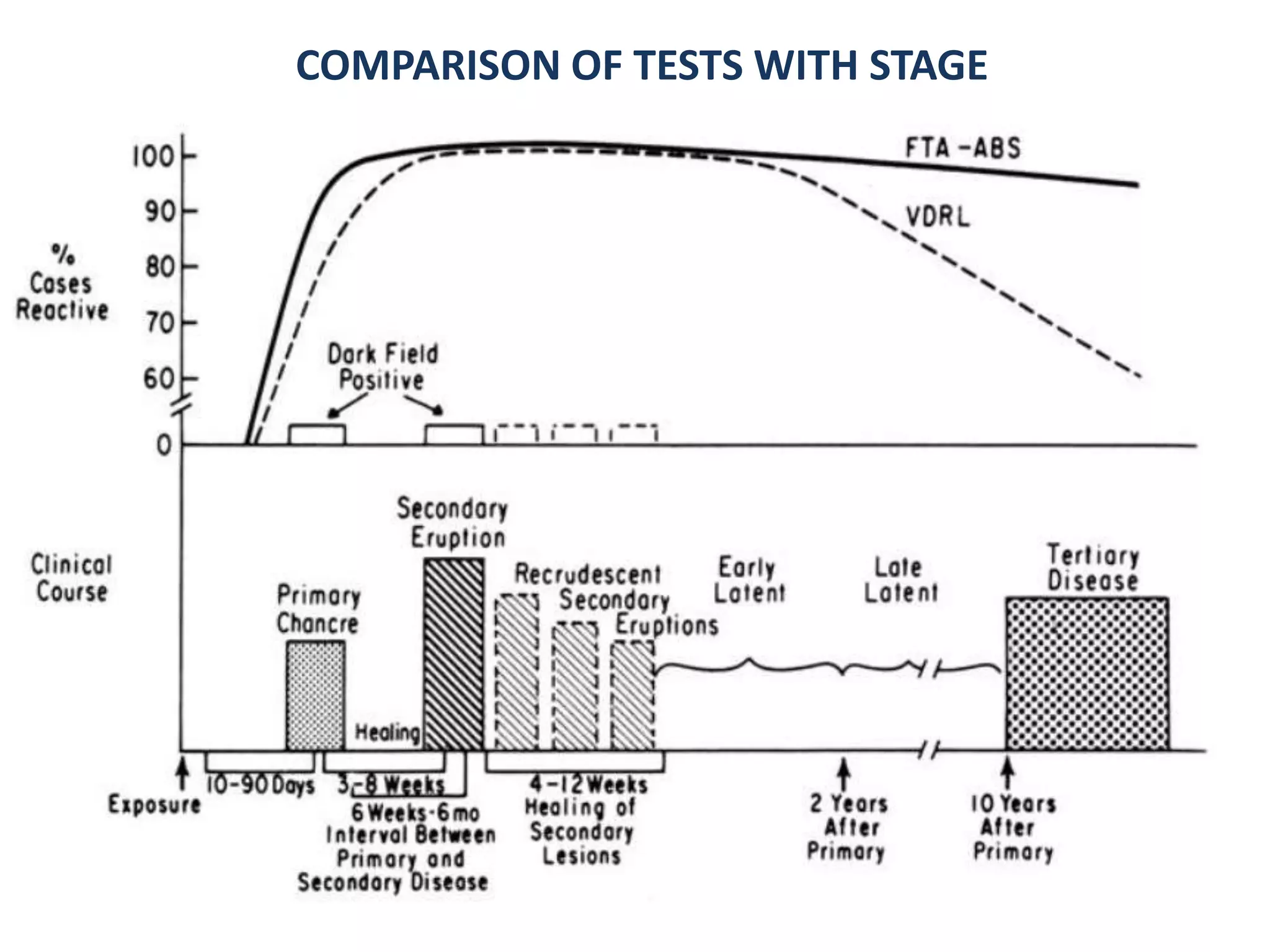
COMPARISON OF TESTS WITH STAGE
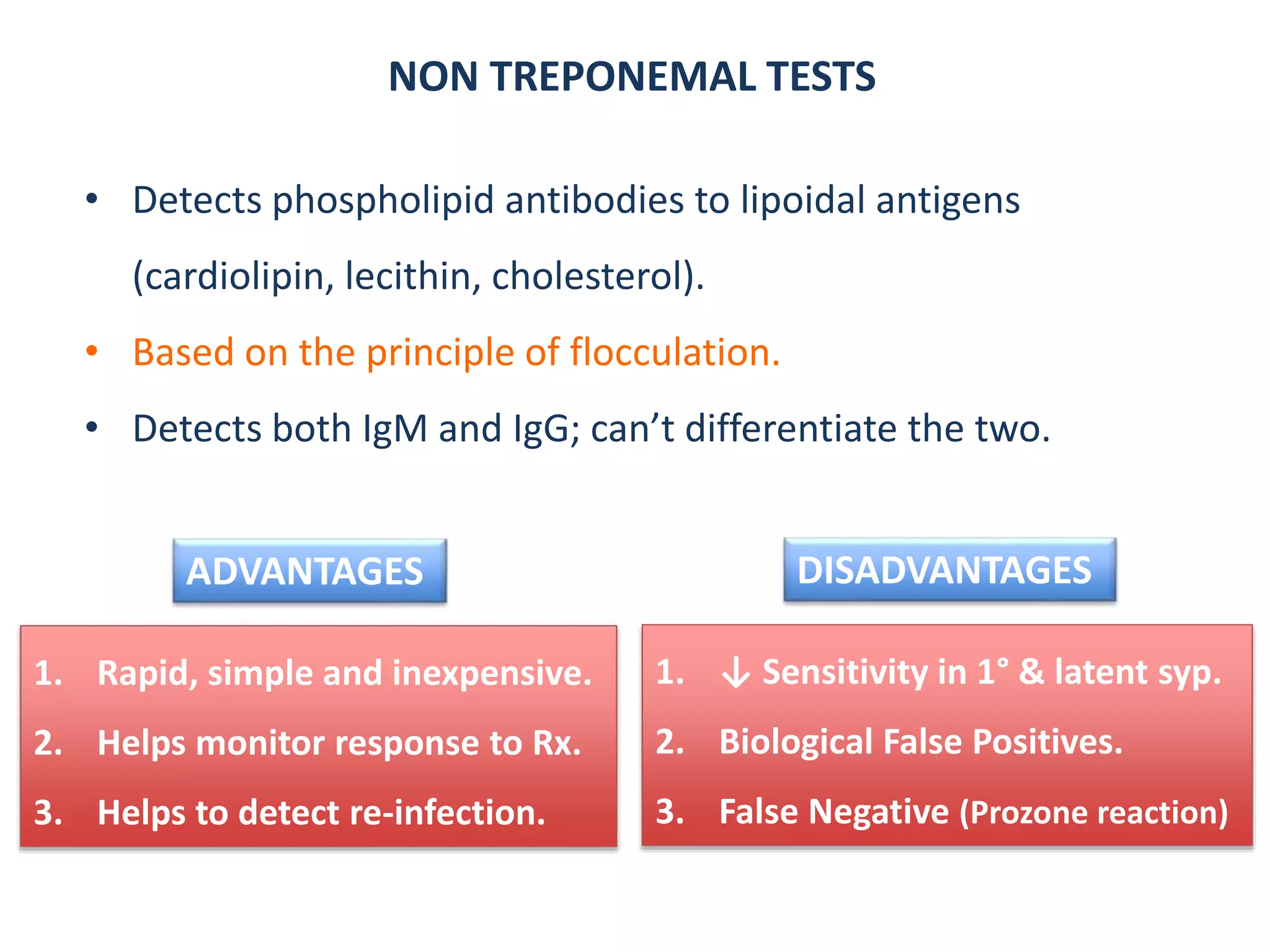
NON TREPONEMAL TESTS
• Detects phospholipid antibodies to lipoidal antigens
(cardiolipin, lecithin, cholesterol).
• Based on the principle of flocculation.
• Detects both IgM and IgG; can’t differentiate the two.
1. Rapid, simple and inexpensive.
2. Helps monitor response to Rx.
3. Helps to detect re-infection.
1. ↓ Sensitivity in 1° & latent syp.
2. Biological False Positives.
3. False Negative (Prozone reaction)
ADVANTAGES DISADVANTAGES
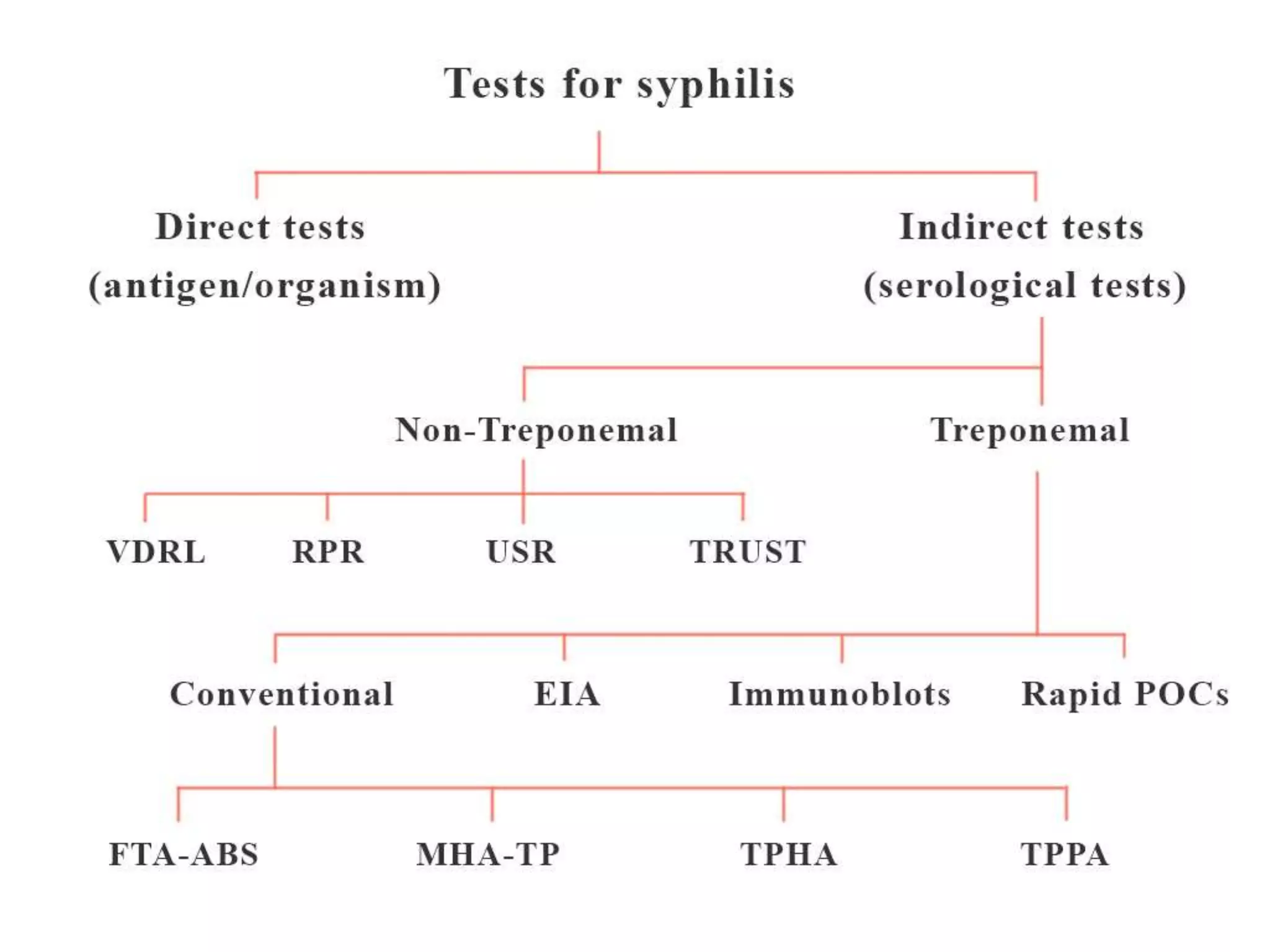
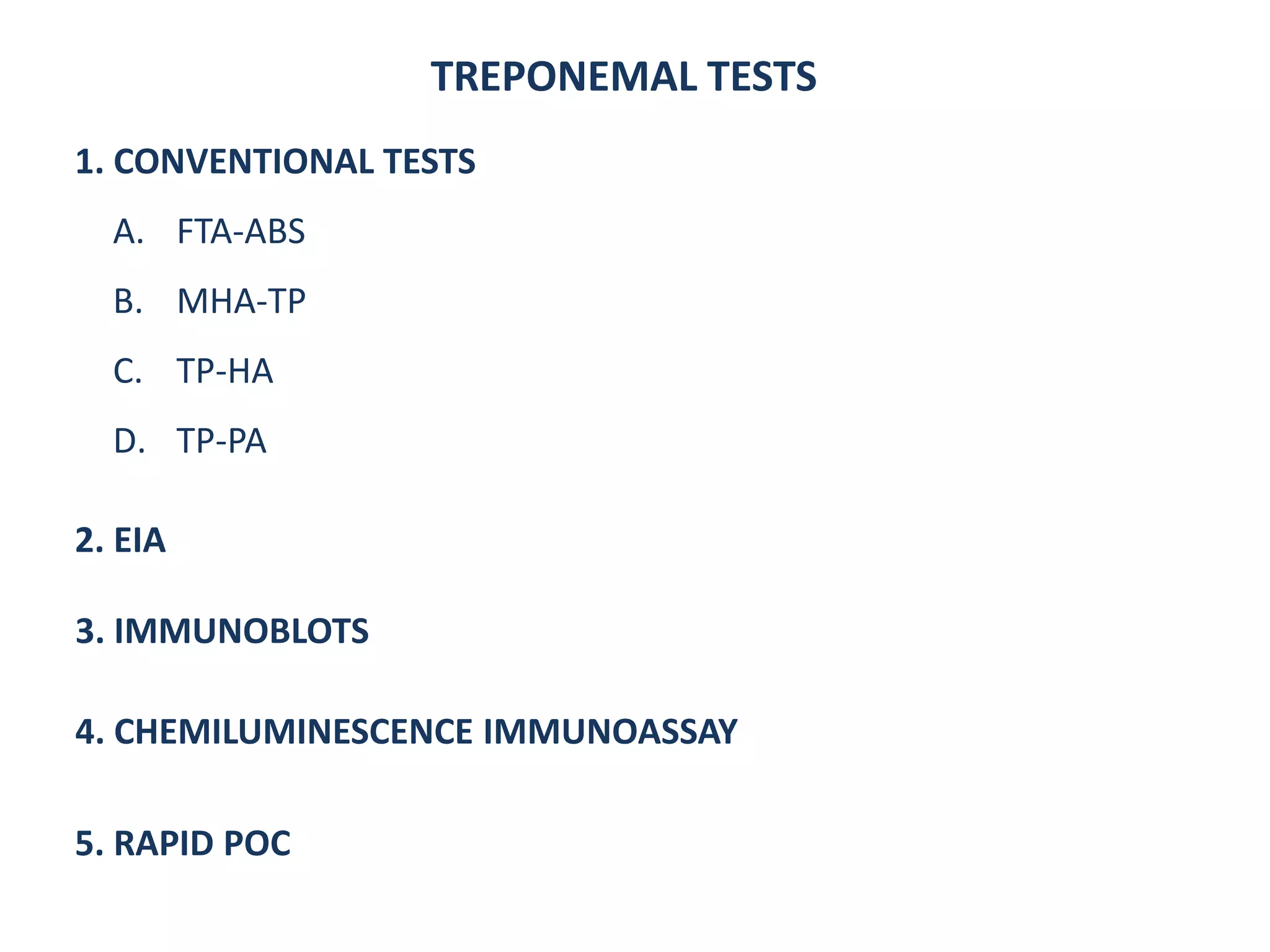
1. CONVENTIONAL TESTS
A. FTA-ABS
B. MHA-TP
C. TP-HA
D. TP-PA
TREPONEMAL TESTS
2. EIA
3. IMMUNOBLOTS
4. CHEMILUMINESCENCE IMMUNOASSAY
5. RAPID POC
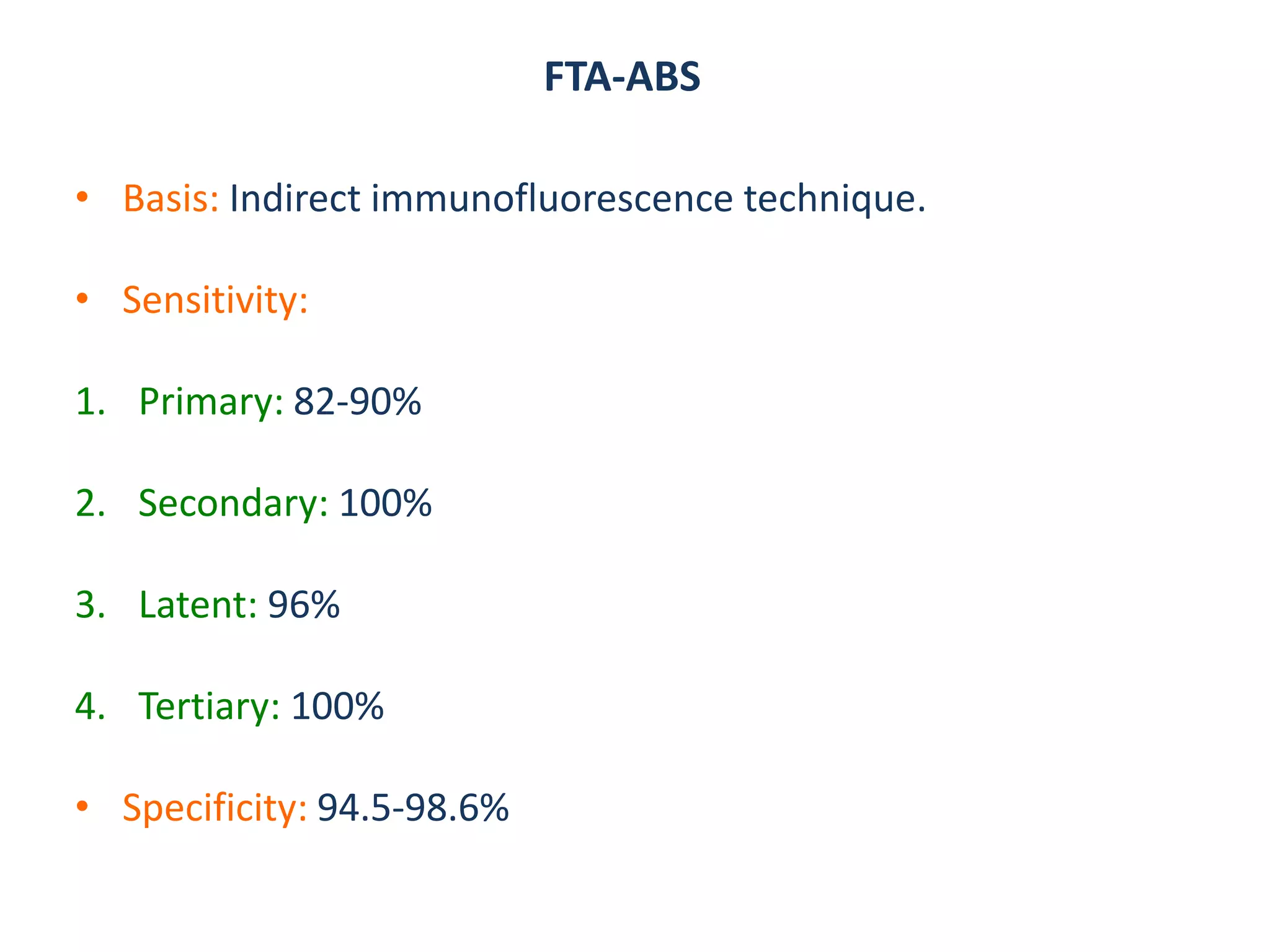
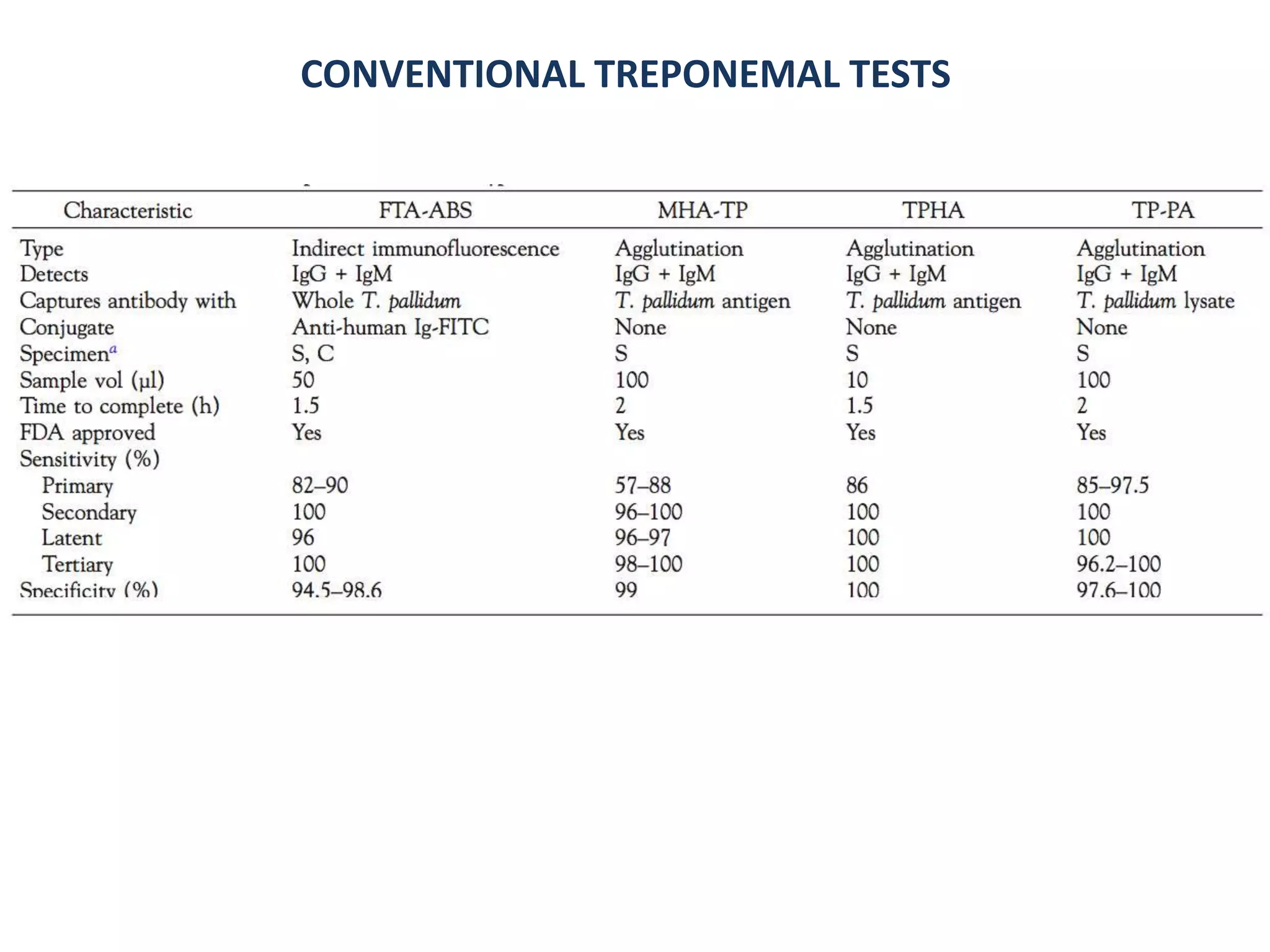
FTA-ABS
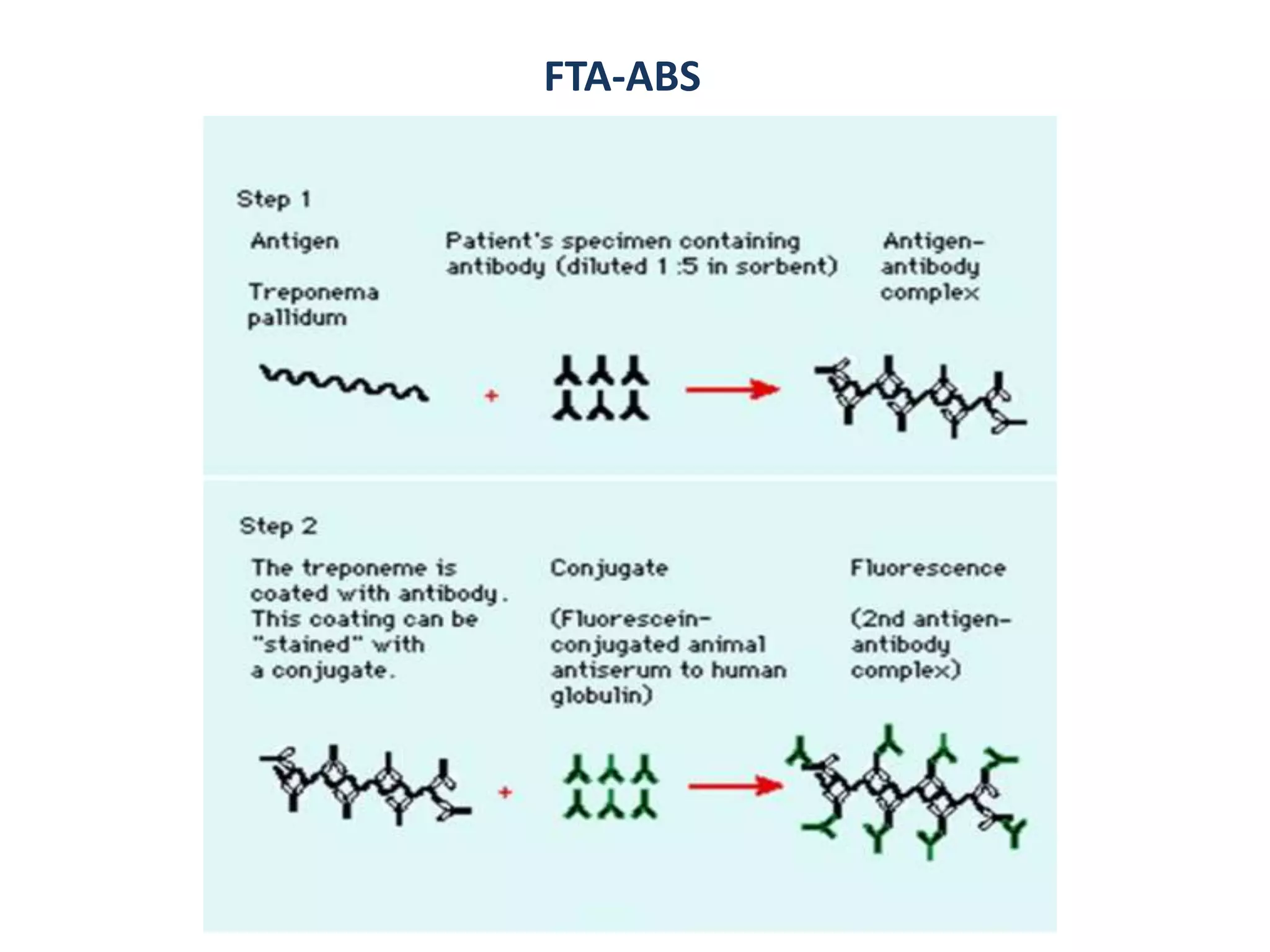
• Basis: Indirect immunofluorescence technique.
• Sensitivity:
1. Primary: 82-90%
2. Secondary: 100%
3. Latent: 96%
4. Tertiary: 100%
• Specificity: 94.5-98.6%
FTA-ABS
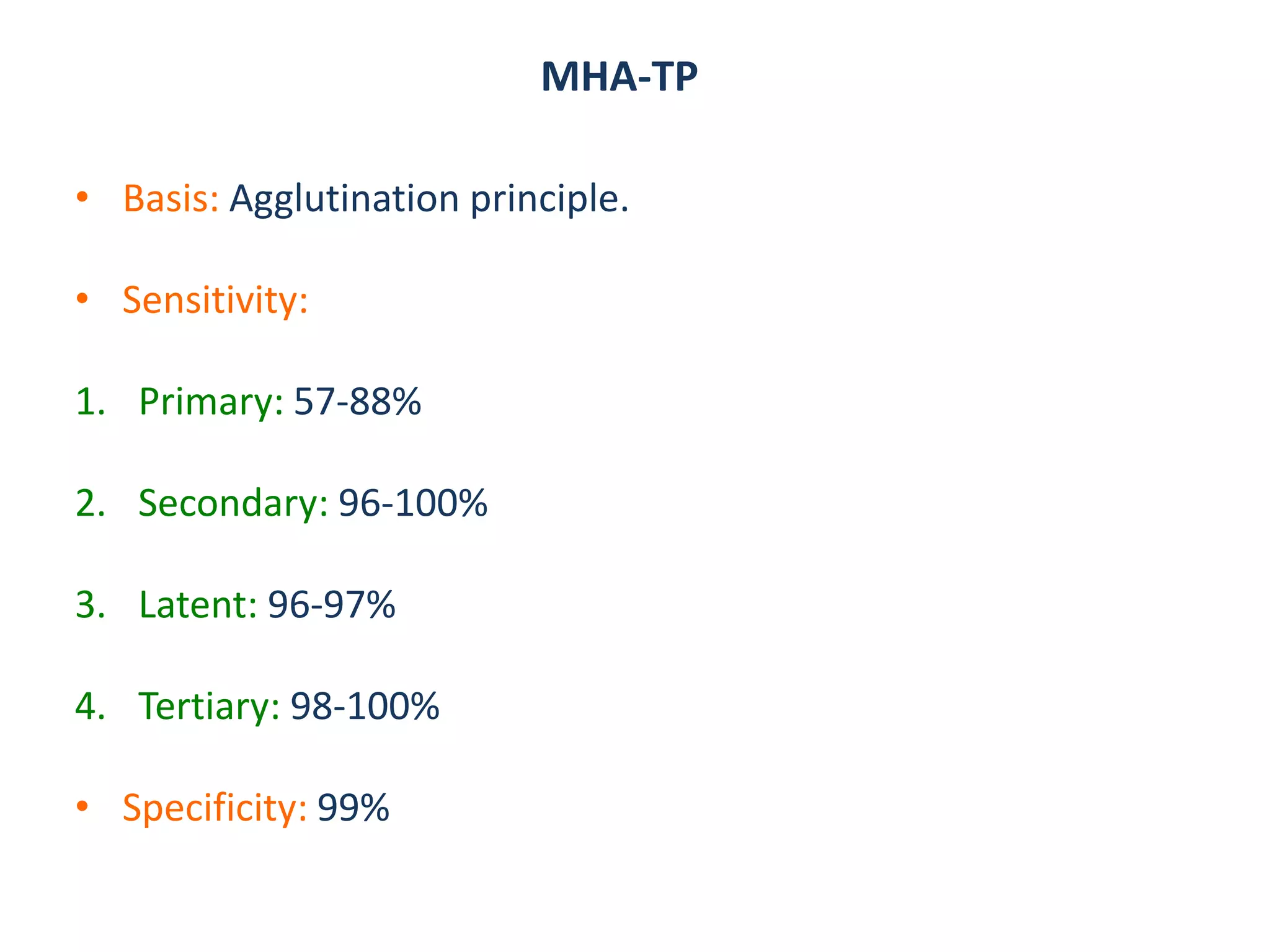
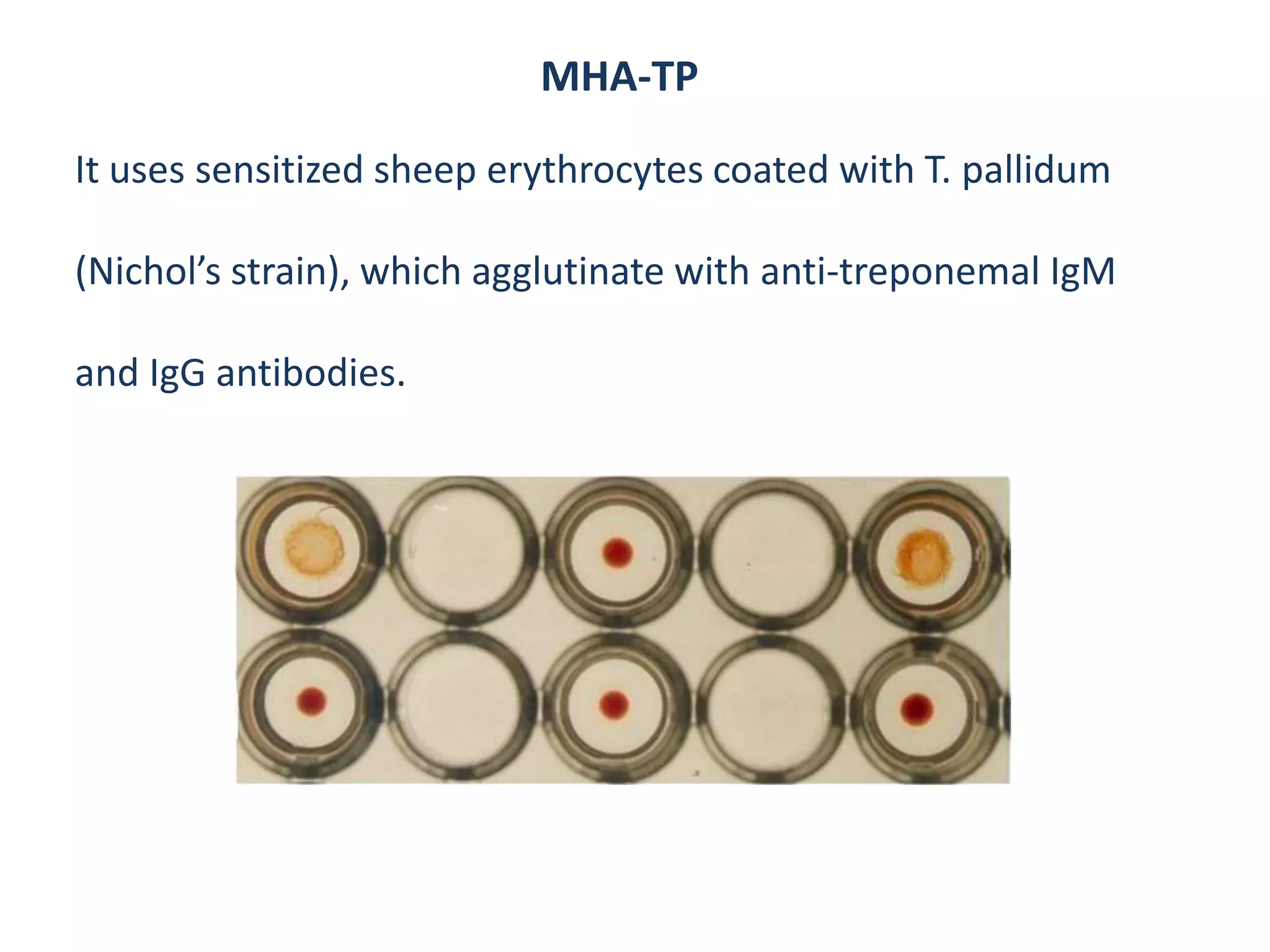
MHA-TP
• Basis: Agglutination principle.
• Sensitivity:
1. Primary: 57-88%
2. Secondary: 96-100%
3. Latent: 96-97%
4. Tertiary: 98-100%
• Specificity: 99%
MHA-TP
It uses sensitized sheep erythrocytes coated with T. pallidum
(Nichol’s strain), which agglutinate with anti-treponemal IgM
and IgG antibodies.
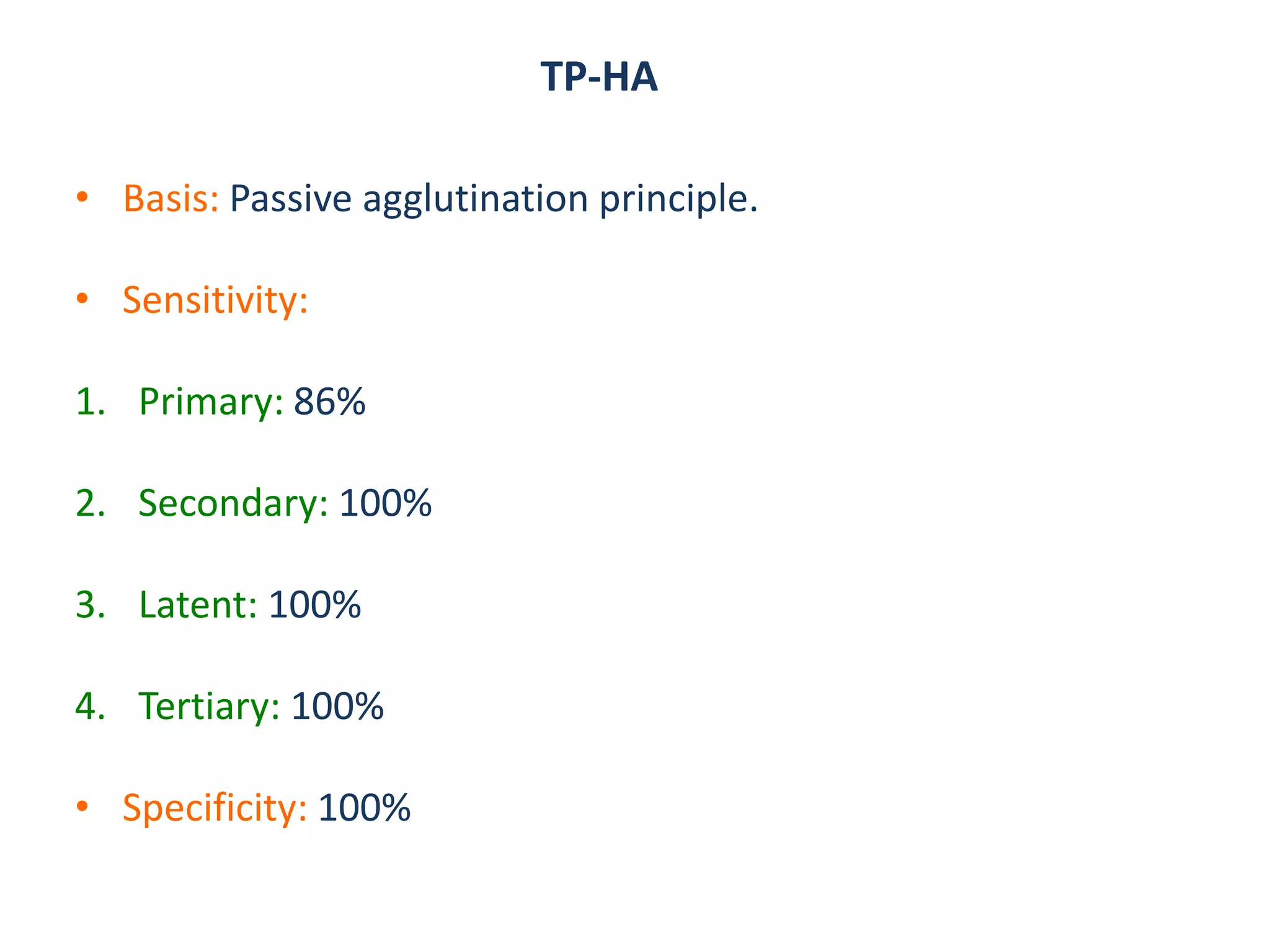
TP-HA
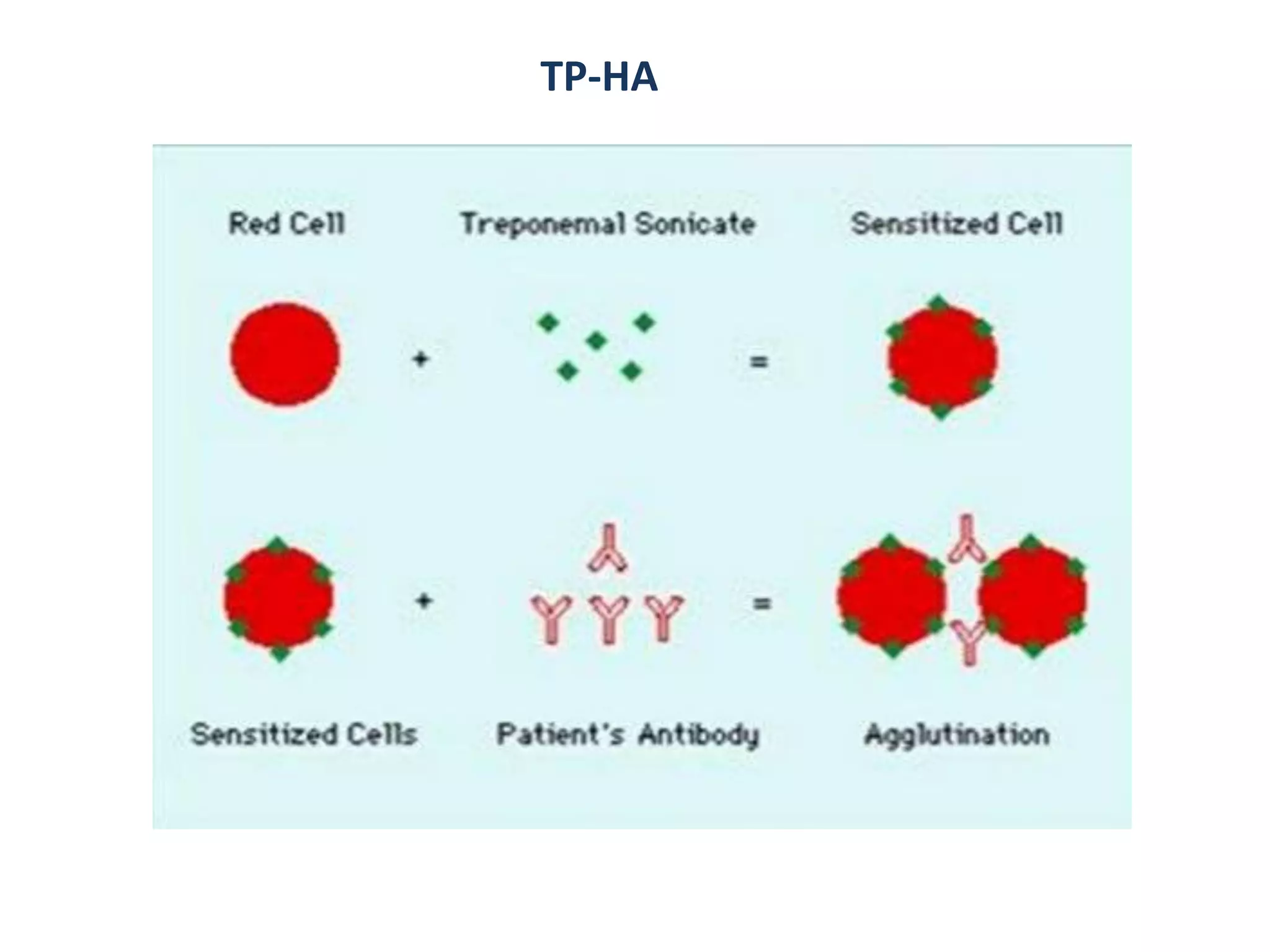
• Basis: Passive agglutination principle.
• Sensitivity:
1. Primary: 86%
2. Secondary: 100%
3. Latent: 100%
4. Tertiary: 100%
• Specificity: 100%
TP-HA
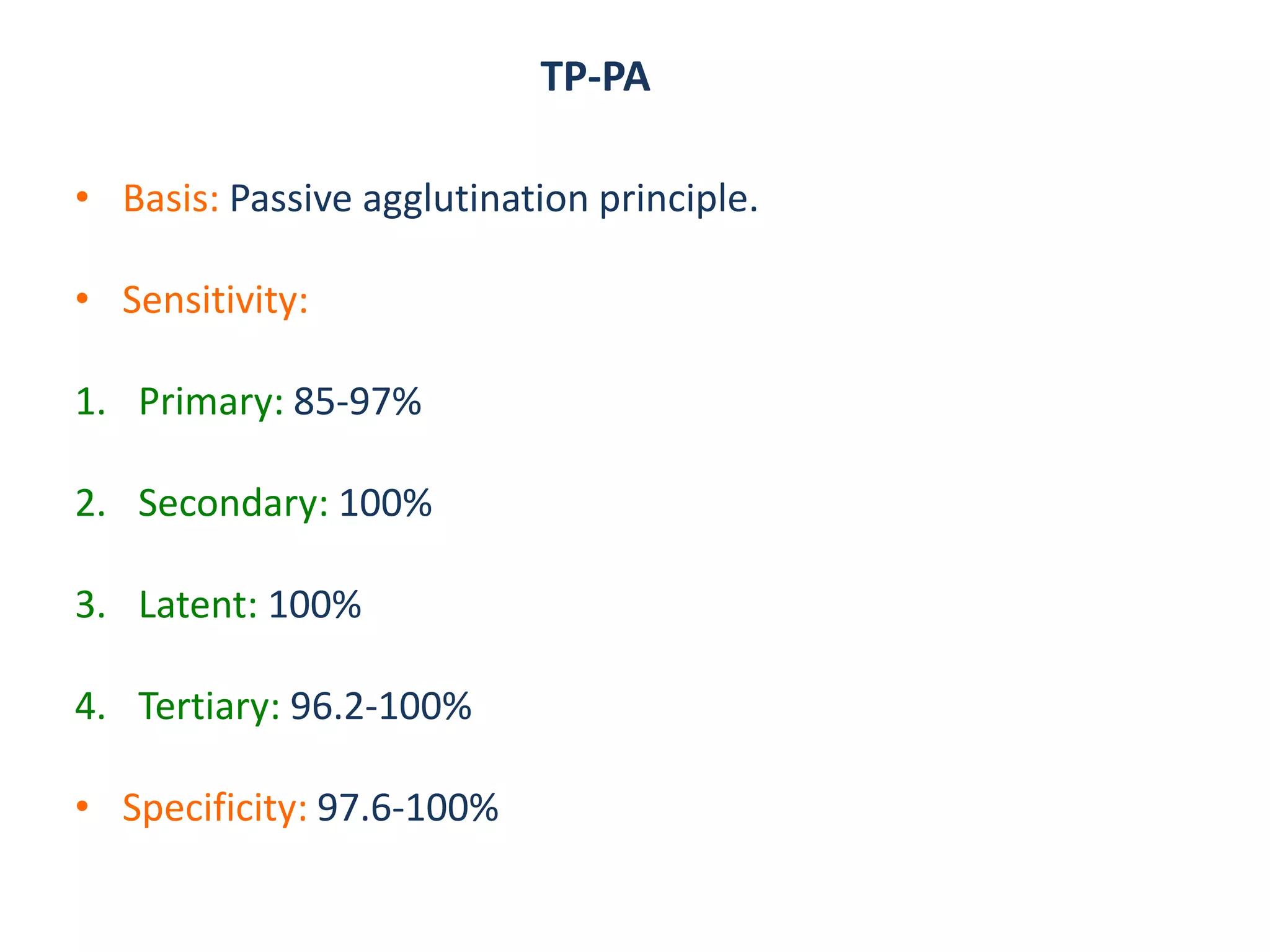
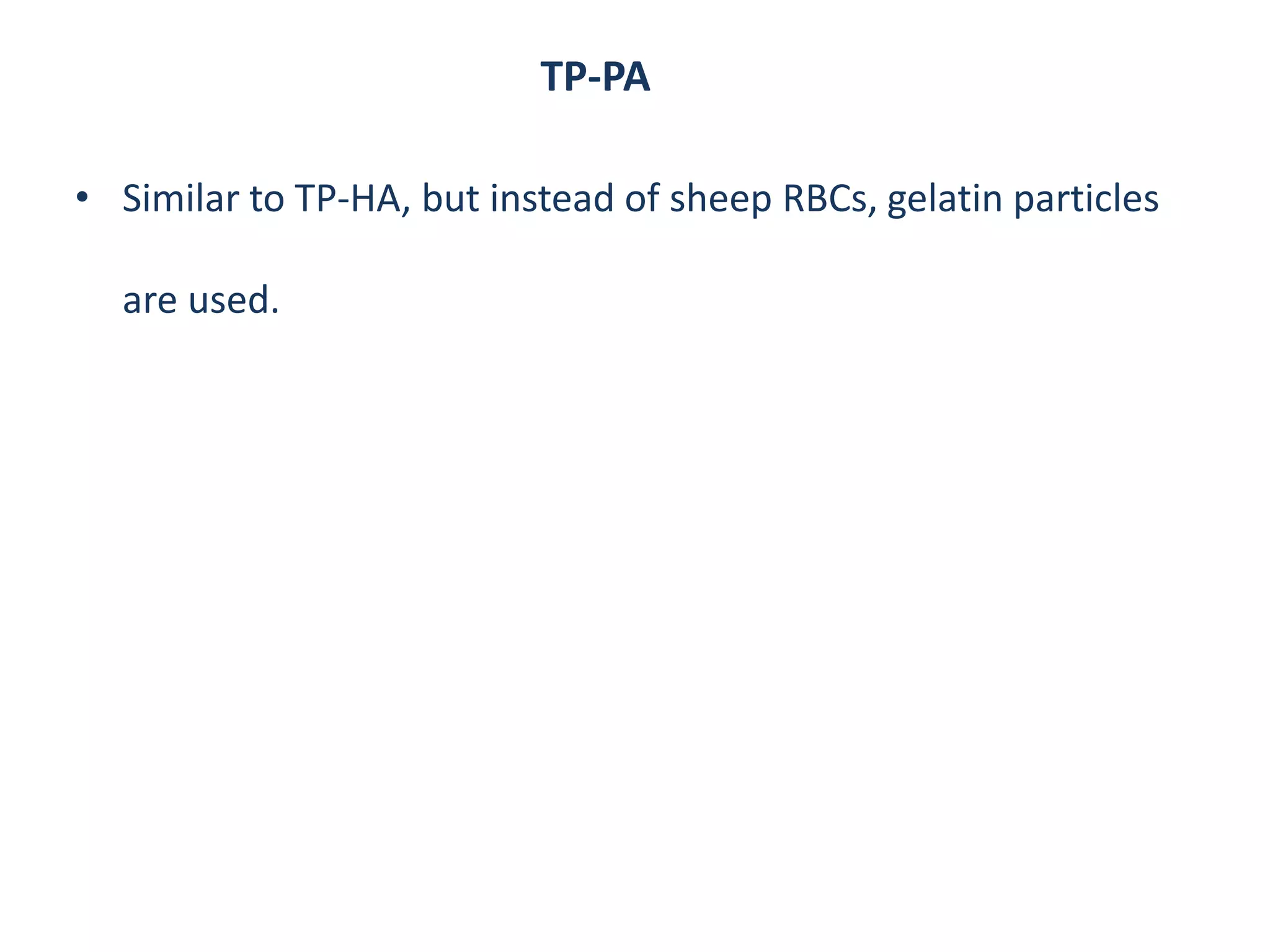
TP-PA
• Basis: Passive agglutination principle.
• Sensitivity:
1. Primary: 85-97%
2. Secondary: 100%
3. Latent: 100%
4. Tertiary: 96.2-100%
• Specificity: 97.6-100%
TP-PA
• Similar to TP-HA, but instead of sheep RBCs, gelatin particles
are used.
CONVENTIONAL TREPONEMAL TESTS
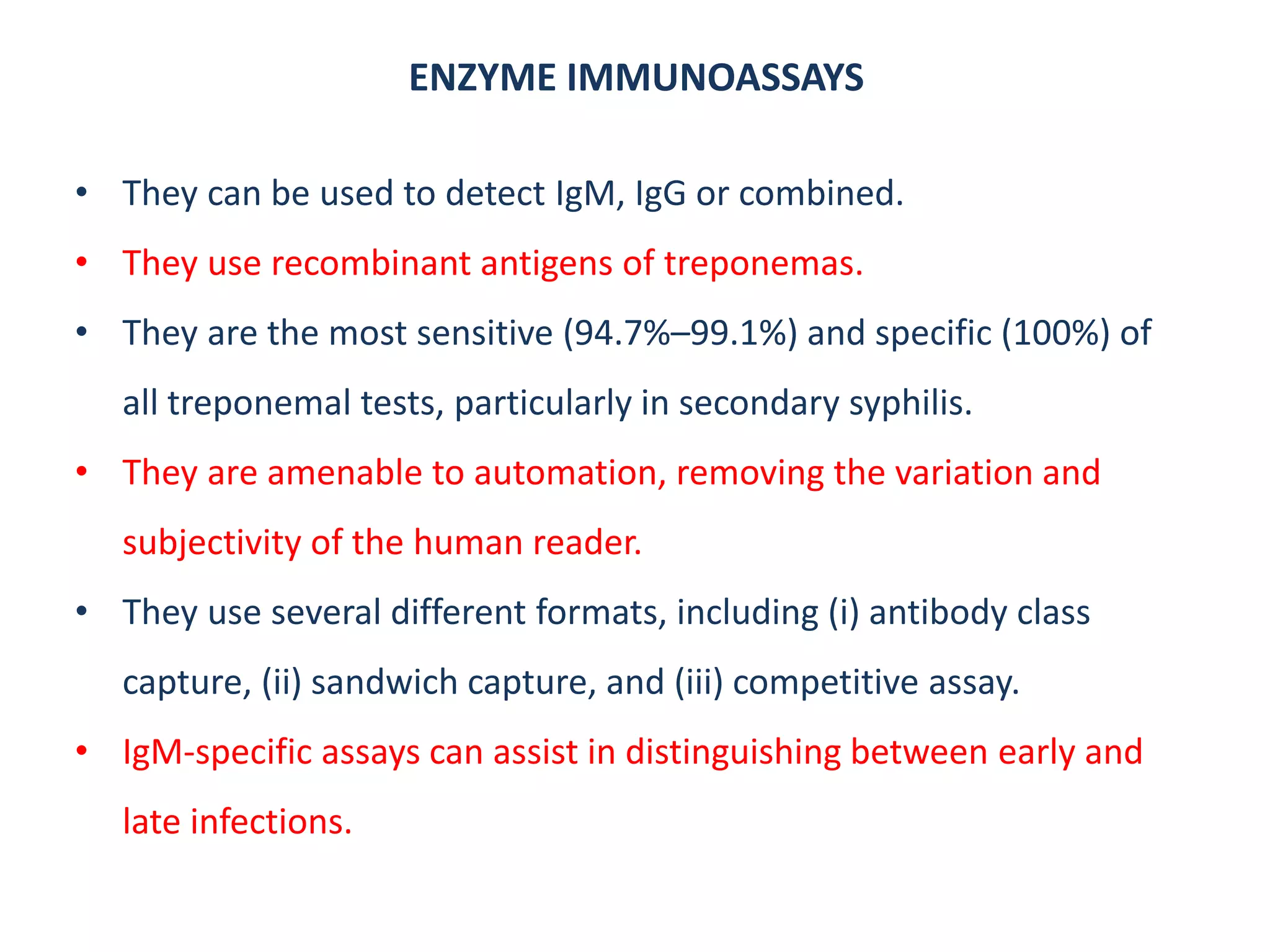
ENZYME IMMUNOASSAYS
• They can be used to detect IgM, IgG or combined.
• They use recombinant antigens of treponemas.
• They are the most sensitive (94.7%–99.1%) and specific (100%) of
all treponemal tests, particularly in secondary syphilis.
• They are amenable to automation, removing the variation and
subjectivity of the human reader.
• They use several different formats, including (i) antibody class
capture, (ii) sandwich capture, and (iii) competitive assay.
• IgM-specific assays can assist in distinguishing between early and
late infections.
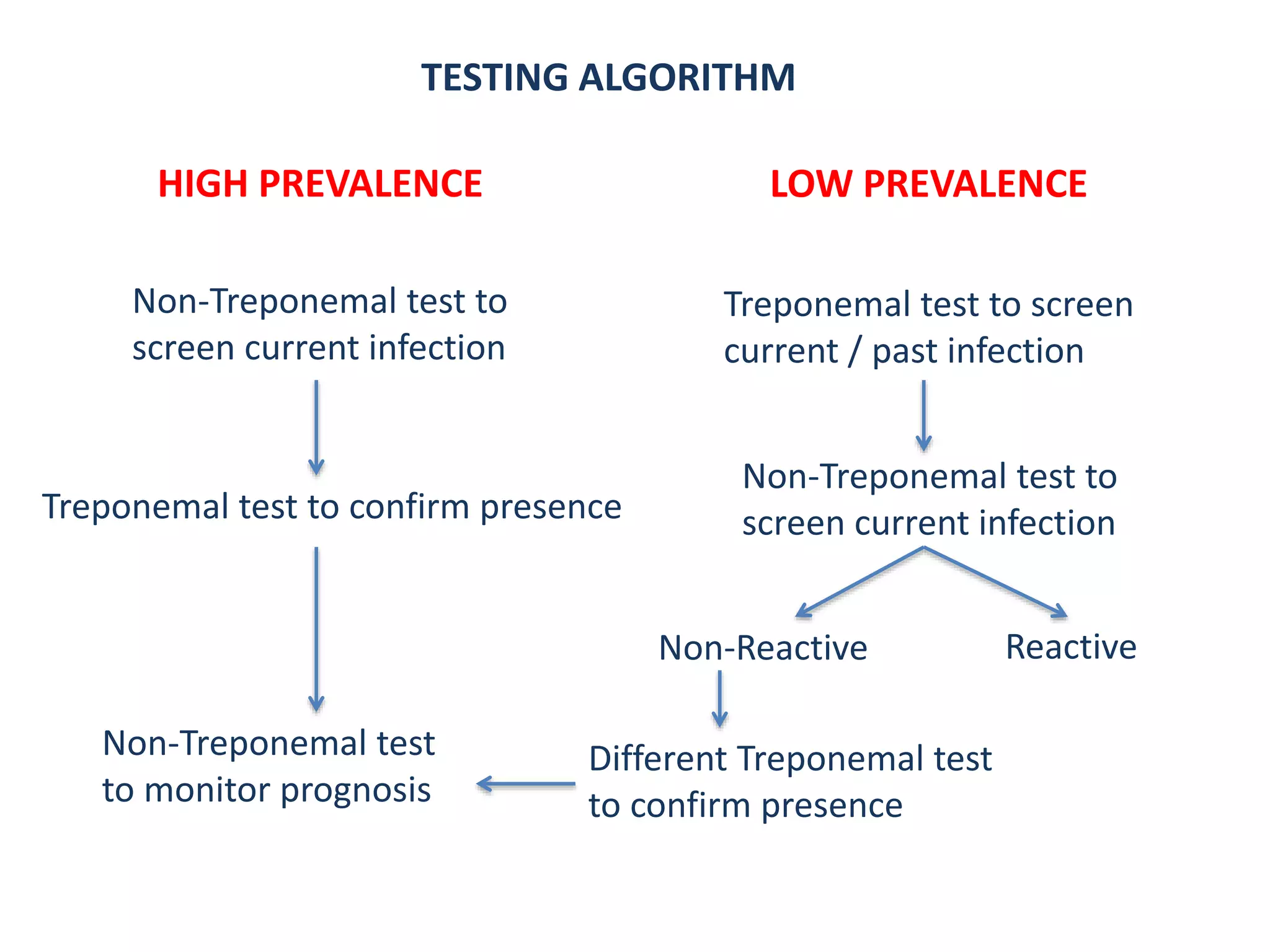
HIGH PREVALENCE
Non-Treponemal test to
screen current infection
Treponemal test to confirm presence
Non-Treponemal test
to monitor prognosis
LOW PREVALENCE
Treponemal test to screen
current / past infection
Non-Treponemal test to
screen current infection
Non-Reactive Reactive
Different Treponemal test
to confirm presence
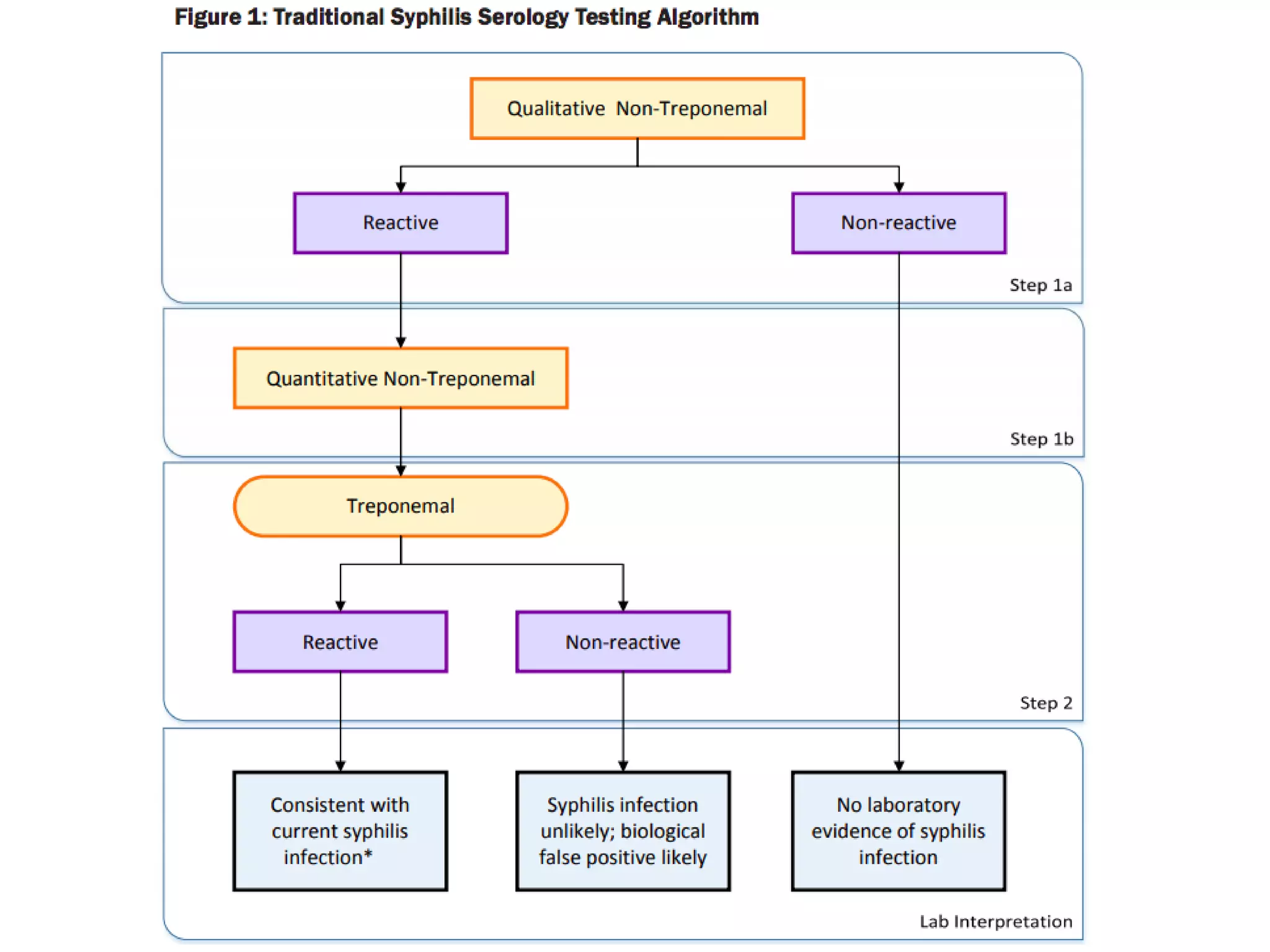
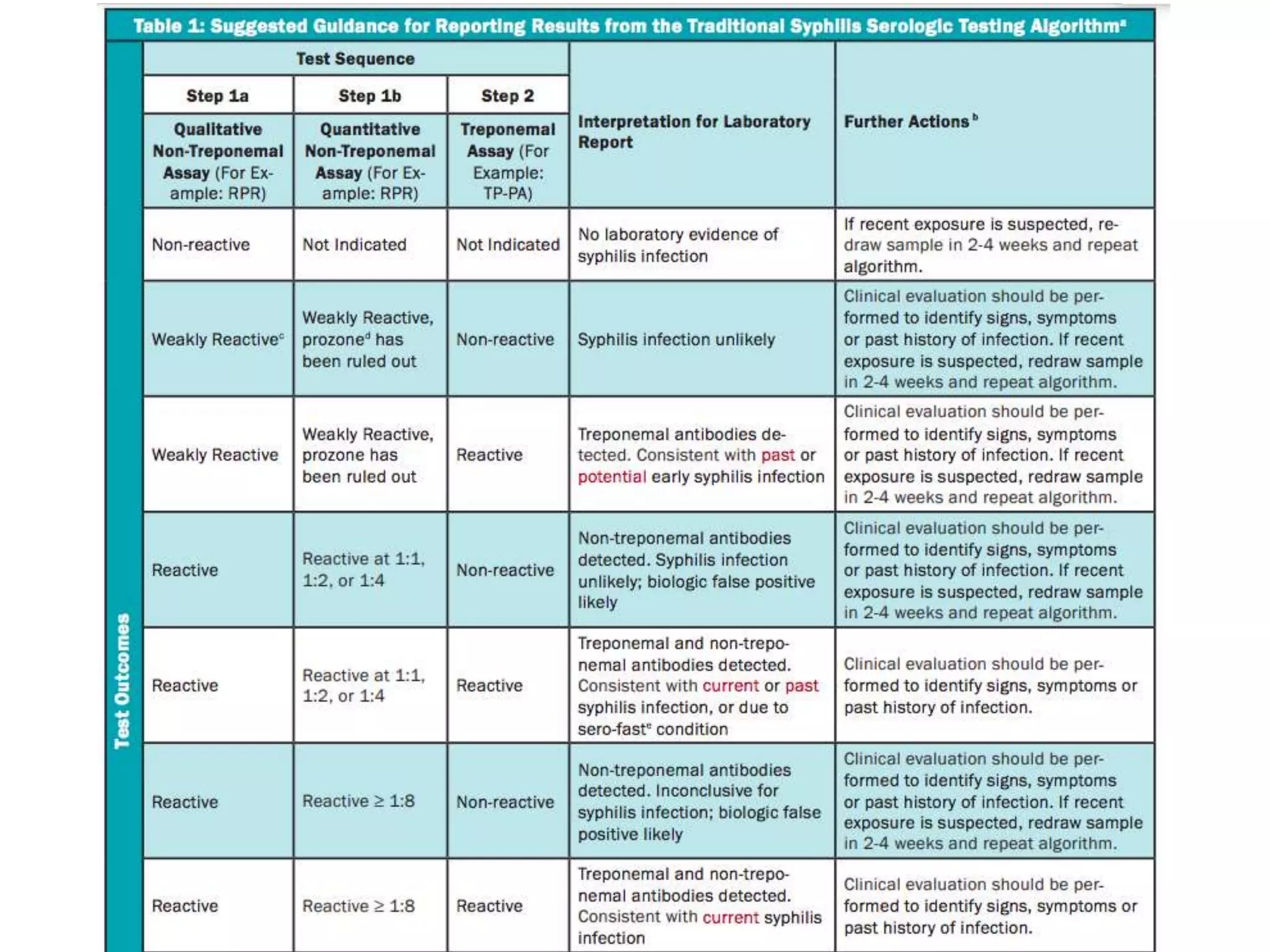
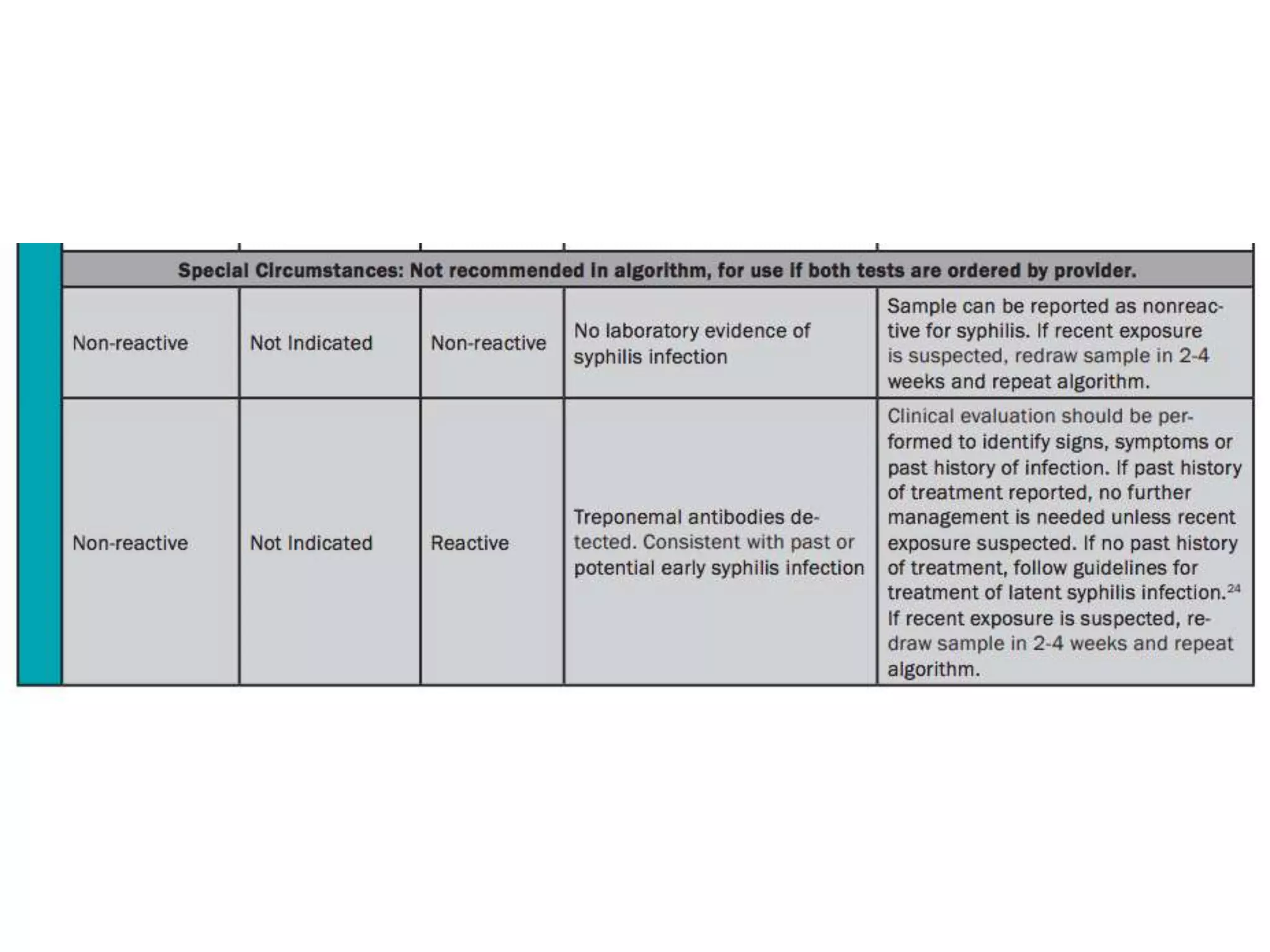
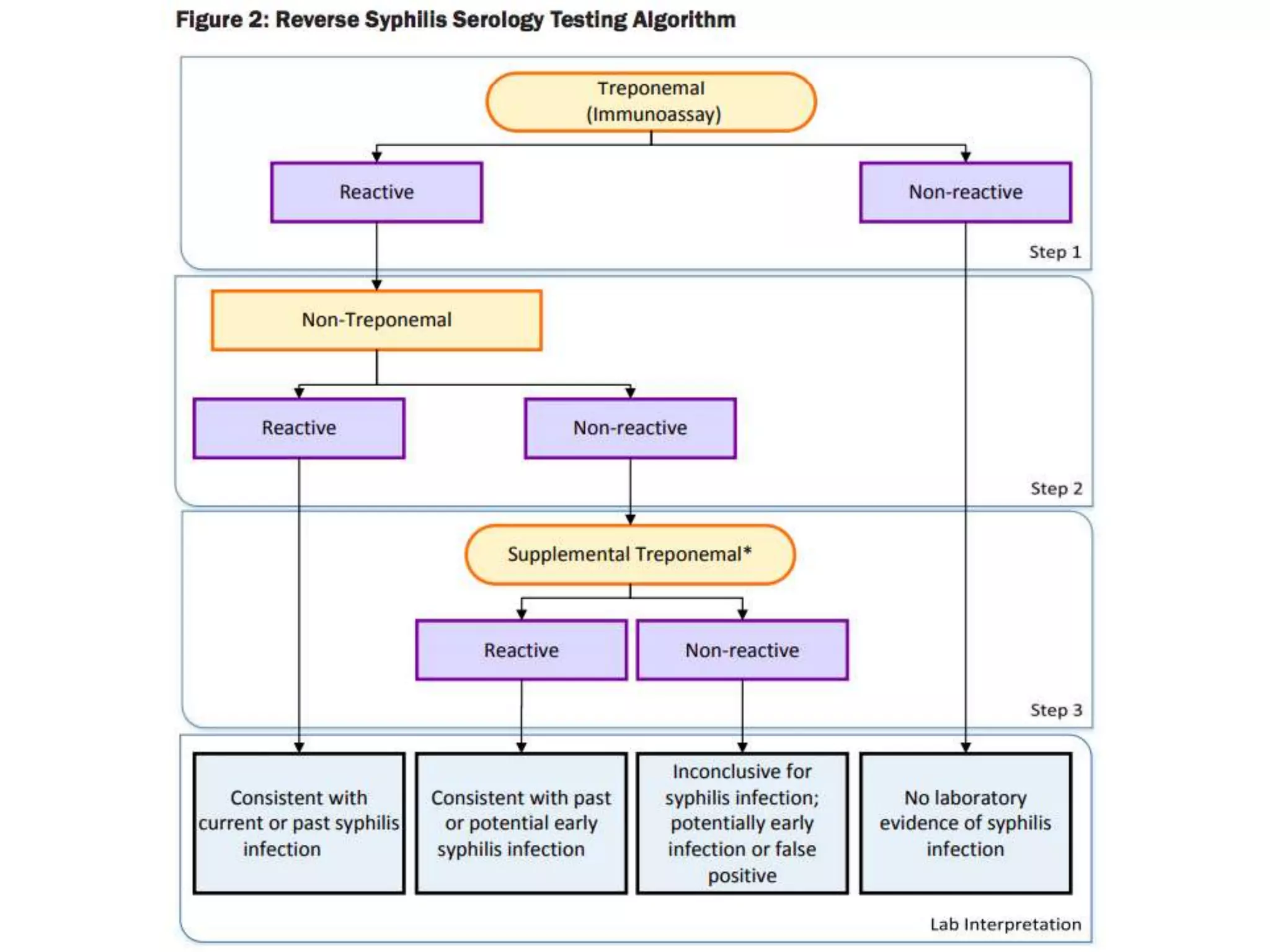
TESTING ALGORITHM
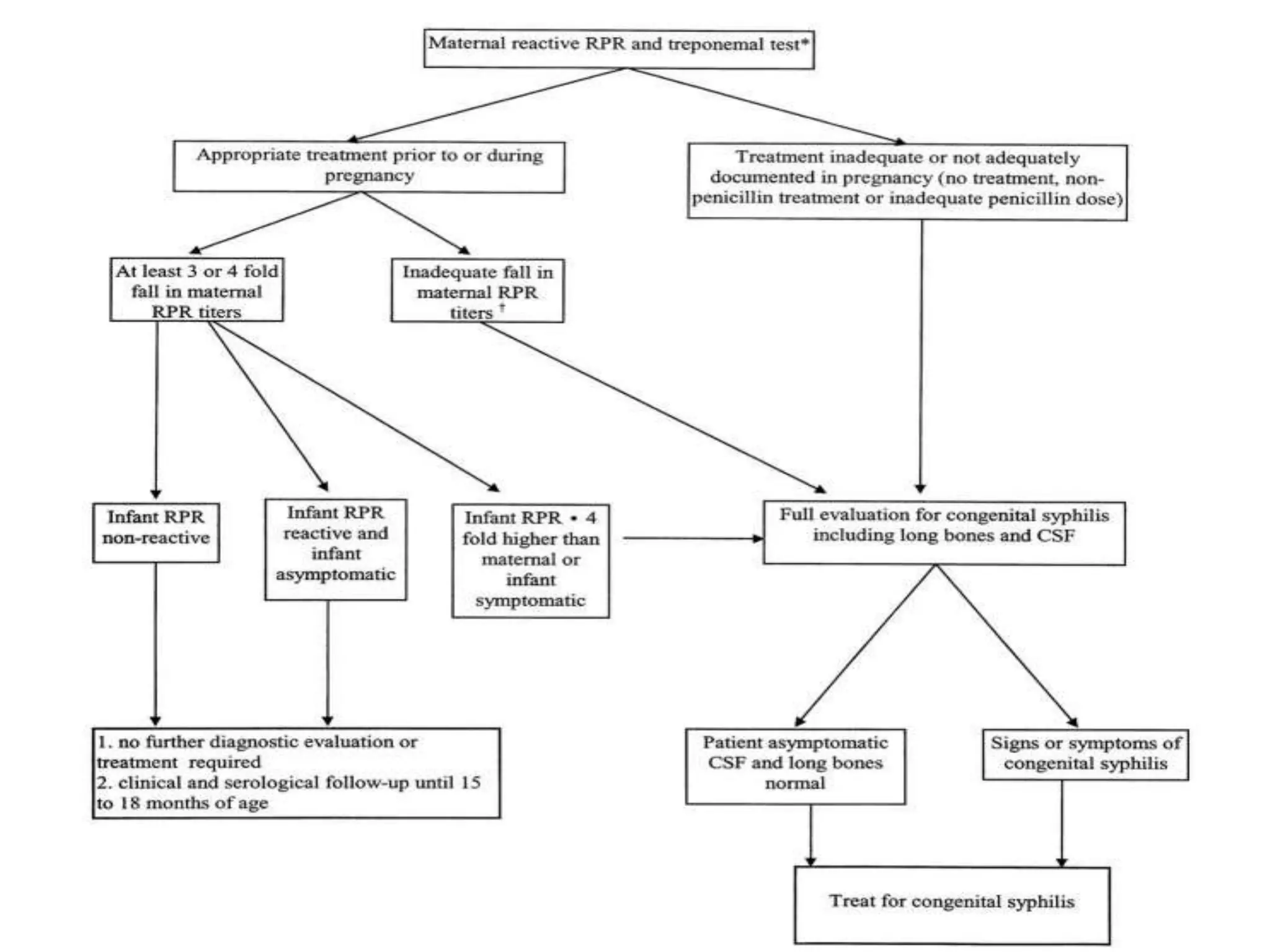
CONGENITAL SYPHILIS
• All infants born to mothers who have reactive nontreponemal
and treponemal test results should be evaluated for congenital
syphilis.
• A quantitative nontreponemal test should be performed on
infant serum and, if reactive, the infant should be examined
thoroughly for evidence of congenital syphilis.
CONGENITAL SYPHILIS
REFERENCES
1. Bhushan Kumar, Sexually Transmitted Infections.
2. King and Nicole, Sexually Transmitted Diseases.
3. Vinod K Sharma, Sexually Transmitted Diseases & AIDS.
4. James H. Jorgensen (editor) et. al., Manual of Clinical Microbiology.
5. The laboratory diagnosis of syphilis. Can J Infect Dis Med Microbiol.
2005;16(1):45-51.

Treponemal Tests for Syphilis

  • 3.
  • 4.
    NON TREPONEMAL TESTS •Detects phospholipid antibodies to lipoidal antigens (cardiolipin, lecithin, cholesterol). • Based on the principle of flocculation. • Detects both IgM and IgG; can’t differentiate the two. 1. Rapid, simple and inexpensive. 2. Helps monitor response to Rx. 3. Helps to detect re-infection. 1. ↓ Sensitivity in 1° & latent syp. 2. Biological False Positives. 3. False Negative (Prozone reaction) ADVANTAGES DISADVANTAGES
  • 5.
    1. CONVENTIONAL TESTS A.FTA-ABS B. MHA-TP C. TP-HA D. TP-PA TREPONEMAL TESTS 2. EIA 3. IMMUNOBLOTS 4. CHEMILUMINESCENCE IMMUNOASSAY 5. RAPID POC
  • 6.
    FTA-ABS • Basis: Indirectimmunofluorescence technique. • Sensitivity: 1. Primary: 82-90% 2. Secondary: 100% 3. Latent: 96% 4. Tertiary: 100% • Specificity: 94.5-98.6%
  • 7.
  • 8.
    MHA-TP • Basis: Agglutinationprinciple. • Sensitivity: 1. Primary: 57-88% 2. Secondary: 96-100% 3. Latent: 96-97% 4. Tertiary: 98-100% • Specificity: 99%
  • 9.
    MHA-TP It uses sensitizedsheep erythrocytes coated with T. pallidum (Nichol’s strain), which agglutinate with anti-treponemal IgM and IgG antibodies.
  • 10.
    TP-HA • Basis: Passiveagglutination principle. • Sensitivity: 1. Primary: 86% 2. Secondary: 100% 3. Latent: 100% 4. Tertiary: 100% • Specificity: 100%
  • 11.
  • 12.
    TP-PA • Basis: Passiveagglutination principle. • Sensitivity: 1. Primary: 85-97% 2. Secondary: 100% 3. Latent: 100% 4. Tertiary: 96.2-100% • Specificity: 97.6-100%
  • 13.
    TP-PA • Similar toTP-HA, but instead of sheep RBCs, gelatin particles are used.
  • 14.
  • 15.
    ENZYME IMMUNOASSAYS • Theycan be used to detect IgM, IgG or combined. • They use recombinant antigens of treponemas. • They are the most sensitive (94.7%–99.1%) and specific (100%) of all treponemal tests, particularly in secondary syphilis. • They are amenable to automation, removing the variation and subjectivity of the human reader. • They use several different formats, including (i) antibody class capture, (ii) sandwich capture, and (iii) competitive assay. • IgM-specific assays can assist in distinguishing between early and late infections.
  • 16.
    HIGH PREVALENCE Non-Treponemal testto screen current infection Treponemal test to confirm presence Non-Treponemal test to monitor prognosis LOW PREVALENCE Treponemal test to screen current / past infection Non-Treponemal test to screen current infection Non-Reactive Reactive Different Treponemal test to confirm presence TESTING ALGORITHM
  • 22.
    CONGENITAL SYPHILIS • Allinfants born to mothers who have reactive nontreponemal and treponemal test results should be evaluated for congenital syphilis. • A quantitative nontreponemal test should be performed on infant serum and, if reactive, the infant should be examined thoroughly for evidence of congenital syphilis.
  • 23.
  • 24.
    REFERENCES 1. Bhushan Kumar,Sexually Transmitted Infections. 2. King and Nicole, Sexually Transmitted Diseases. 3. Vinod K Sharma, Sexually Transmitted Diseases & AIDS. 4. James H. Jorgensen (editor) et. al., Manual of Clinical Microbiology. 5. The laboratory diagnosis of syphilis. Can J Infect Dis Med Microbiol. 2005;16(1):45-51.

Editor's Notes

  • #3 Chemiluiniscence immunoassays are also treponemal tests
  • #5 VDRL, RPR, USR, TRUST
  • #6 POC = Point of Care
  • #7 Reiter’s strain of T. Pallidum is ised.
  • #16 Sandwitch capture is inferior to other two formats. IgM-specific EIAs have sensitivities ranging from 88 to 90% in primary syphilis, 76 to 100% in secondary syphilis, and 19 to 69% in early latent syphilis.
  • #17 For low disease prevelance, reverse testing first by treponemal testing and then by non-treponemal testing is done. if EIA is used for screening, then an RPR test should be performed on all EIA reactives, and a second treponemal test such as TP-PA or FTA-ABS should be used for confirmation if the RPR test is reactive.