























Gram’s Staining
skill based learning
ROMA GOYAL
1
Hans Christian Gram
• The Gram stain was
devised by the Danish
physician, Hans
Christian Gram, while
working in Berlin in
1883. He later
published this
procedure in 1884. At
the time, Dr. Gram was
studying lung tissue
sections from patients
who had died of
pneumonia.
2
First Paper on Gram Staining
• In his paper, Dr. Gram described how he was able to
visualize what we now call Staphylococcus,
Streptococcus, Bacillus, and Clostridia in various
histological sections. Interestingly, Dr. Gram did not actually
use safranin as a counter stain in the original procedure
(Gram negative cells would be colorless). He instead
recommended using Bismarck brown as a counter stain to
enable tissue cell nuclei to be visualized.
3
Carl Weigert (1845-1904)
• Gram did not use a
counterstain in his
procedure. It was a
few years later,
that the German
pathologist Carl
Weigert (1845-1904)
from Frankfurt,
added a final step
of staining with
safranin. 4
Traditional Definition of Gram stain
• A method of staining bacteria using a violet stain. The gram
staining characteristics (denoted as positive or negative). A
heat fixed bacterial smear is stained with crystal violet
(methyl violet), treated with 3% iodine/potassium iodide
solution, washed with alcohol and counterstained. The
method differentiates bacteria into two main classes, gram-
positive and gram-negative.
5
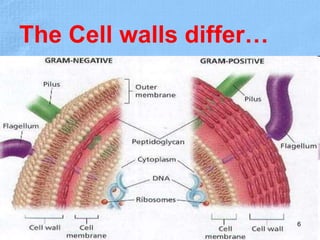
The Cell walls differ…
6
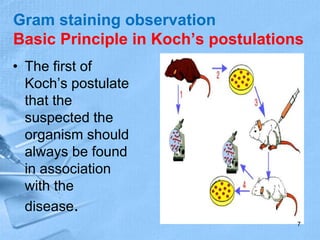
Gram staining observation
Basic Principle in Koch’s postulations
• The first of
Koch’s postulate
that the
suspected the
organism should
always be found
in association
with the
disease.
7
Requirements for Gram staining
technique
• Glass slides (25 by 75 mm), frosted ends desirable
• b. 0.85% Nacl, sterile
• c. Pasteur pipettes and wood applicator sticks, sterile
• d. Microbiological loops, inoculating needles
• e. Supplies for disposal of biological waste, including
“sharps”
• f. Bunsen burner
• g. Immersion oil
8
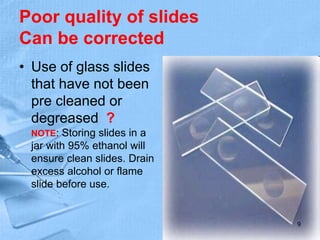
Poor quality of slides
Can be corrected
• Use of glass slides
that have not been
pre cleaned or
degreased ?
NOTE: Storing slides in a
jar with 95% ethanol will
ensure clean slides. Drain
excess alcohol or flame
slide before use.
9
Four Major Steps in Gram
Staining
• There are four basic steps of the Gram
stain, which include applying a primary
stain (crystal violet)or Methyl violet to a
heat-fixed smear of a bacterial culture,
followed by the addition of a mordant
(Gram's iodine), rapid decolorization with
alcohol or acetone, and counterstaining
with Safranin or basic fuchsin.
10
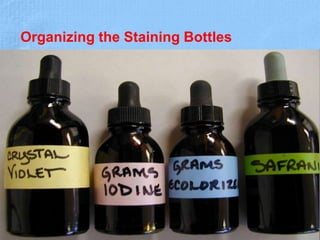
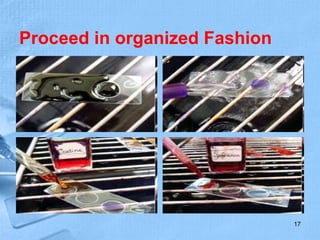
Organizing the Staining Bottles
11
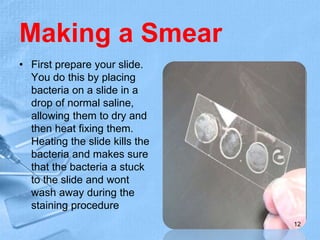
Making a Smear
• First prepare your slide.
You do this by placing
bacteria on a slide in a
drop of normal saline,
allowing them to dry and
then heat fixing them.
Heating the slide kills the
bacteria and makes sure
that the bacteria a stuck
to the slide and wont
wash away during the
staining procedure
12
Correct preparation
• Smear preparation: Proper smear preparation should
produce a monolayer of organisms sufficiently dense
for easy visualization but thin enough to reveal
characteristic morphological characteristics. Use
clean, new glass slides.
NOTE: When using the same pipette or swab,
always inoculate culture media first
13
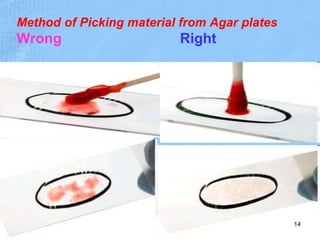
Method of Picking material from Agar plates
Wrong Right
14
Making Multiple smears in same
slide – conserve resources
• Making multiple
smears make the
optimal use of
the slide.
• Reduces the
economic costs
and saves the
technical time.
15
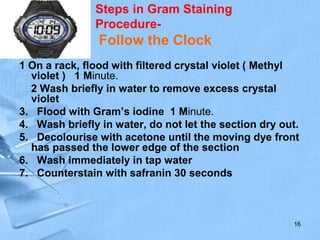
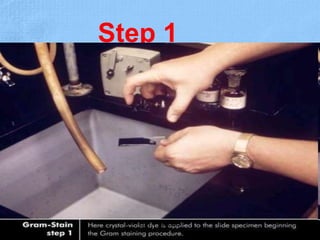
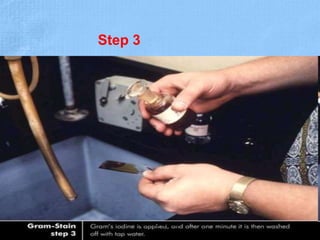
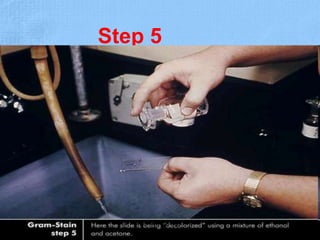
Steps in Gram Staining
Procedure-
Follow the Clock
1 On a rack, flood with filtered crystal violet ( Methyl
violet ) 1 Minute.
2 Wash briefly in water to remove excess crystal
violet
3. Flood with Gram’s iodine 1 Minute.
4. Wash briefly in water, do not let the section dry out.
5. Decolourise with acetone until the moving dye front
has passed the lower edge of the section
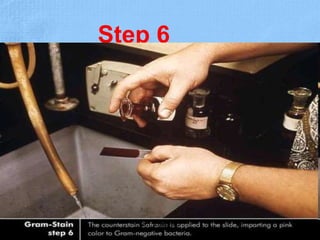
6. Wash immediately in tap water
7. Counterstain with safranin 30 seconds
16
Proceed in organized Fashion
17
Step 1
Dr.T.V.Rao MD 18
Step 2
Dr.T.V.Rao MD 19
Step 3
Dr.T.V.Rao MD 20
Step 4
Dr.T.V.Rao MD 21
Step 5
Dr.T.V.Rao MD 22
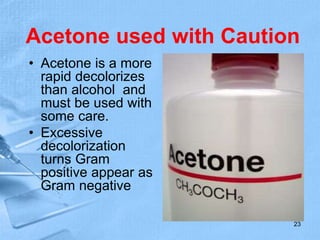
Acetone used with Caution
• Acetone is a more
rapid decolorizes
than alcohol and
must be used with
some care.
• Excessive
decolorization
turns Gram
positive appear as
Gram negative
23
Which alcohol is better
• Several alcohols have been studied, and it has been
reported that the more complex the alcohol, the slower the
decolorization action. As the carbon chain lengthens,
decolorization is slower.
• Kisskalt (84) found decolorization power decreasing in the
following order: methyl, ethyl, propyl, butyl, and amyl
alcohol.
• Conn found a mixture of equal parts of methyl and
isopropyl alcohols to have very similar decolorization
properties to ethyl alcohol.
• In practice, however, no known advantage can be gained
by substituting the higher alcohols for ethyl alcohol.
24
Step 6
Dr.T.V.Rao MD 25
Step 7
Dr.T.V.Rao MD 26
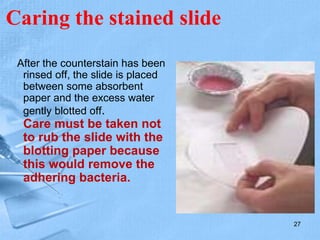
Caring the stained slide
After the counterstain has been
rinsed off, the slide is placed
between some absorbent
paper and the excess water
gently blotted off.
Care must be taken not
to rub the slide with the
blotting paper because
this would remove the
adhering bacteria.
27
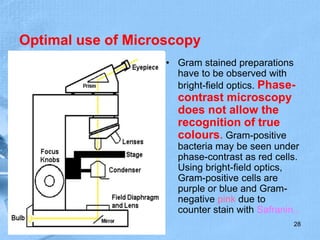
Optimal use of Microscopy
• Gram stained preparations
have to be observed with
bright-field optics. Phase-
contrast microscopy
does not allow the
recognition of true
colours. Gram-positive
bacteria may be seen under
phase-contrast as red cells.
Using bright-field optics,
Gram-positive cells are
purple or blue and Gram-
negative pink due to
counter stain with Safranin..
28
QUALITY CONTROL
• The Gram’s stain reagents should be tested using known
gram-positive and gram-negative organisms each day of
use.
• 1) Gram-positive control – Staphylococcus aureus
ATCC 25923
• 2) Gram-negative control – Escherichia coli ATCC
25922.
• B Do not interpret test unless the controls yield
expected results.
Report as follows
• 1 If no microorganisms are seen in
a smear of a clinical specimen,
report “No microorganisms seen.”
• 2. If microorganisms are seen,
report relative numbers and
Describe morphology. Observe
predominant shapes of
microorganisms
30
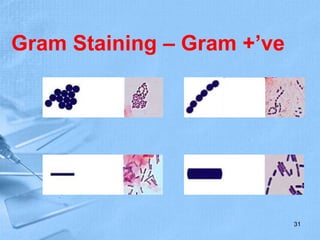
Gram Staining – Gram +’ve
31
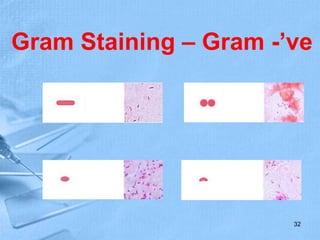
Gram Staining – Gram -’ve
32
Value of Direct Smears
• Guide the physician on initial choice of
antibiotic, pending results of culture
and sensitivity.
• Judge specimen quality.
• Contribute to selection of culture
media, especially with mixed flora.
• Provide internal quality control when
direct smear results are compared to
culture results. 33
Nature of Morphology in guides early
Diagnosis in uncommon diseases
34
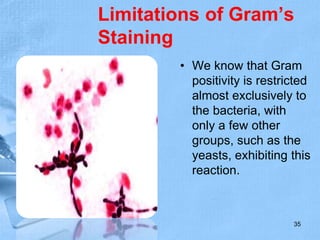
Limitations of Gram’s
Staining
• We know that Gram
positivity is restricted
almost exclusively to
the bacteria, with
only a few other
groups, such as the
yeasts, exhibiting this
reaction.
35
Better Understanding of Gram’s Staining
• We know that the Gram stain is not an all-or-nothing
phenomenon, but that quantitative variations in Gram-
positivity exist between different species, and within the
same species during different parts of the growth cycle or
under different environmental conditions. We know that
only intact cells are Gram-positive, so that cells which are
even gently broken become Gram-negative. We know
that bacterial protoplasts, devoid of cell wall, are still
Gram-positive, indicating that it is probably the
semipermeable membrane which is somehow involved in
the reaction.
36
Stains Several Fungi
37
Streptococcus
pneumonia
38
Streptococcus
pneumonia in Sputum
39
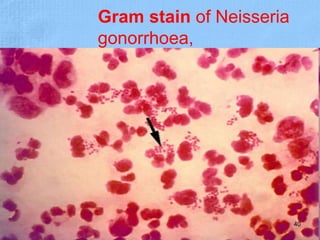
Gram stain of Neisseria
gonorrhoea,
40
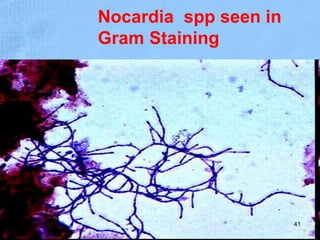
Nocardia spp seen in
Gram Staining
41
Gram Stained Actinomyctes
spp
42
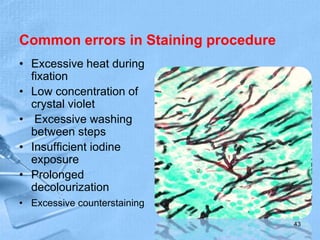
Common errors in Staining procedure
• Excessive heat during
fixation
• Low concentration of
crystal violet
• Excessive washing
between steps
• Insufficient iodine
exposure
• Prolonged
decolourization
• Excessive counterstaining
43
Gram stain results may not
correlated with culture results
• Gram stain-positive, culture-negative
specimens may be the result of
contamination of reagents and other
supplies, presence of
• Antimicrobial agents, or failure of
organisms to grow under usual Culture
conditions (media, atmosphere, etc.)
• Presence of anaerobic
microorganism
44
Artifacts in Gram Staining
• Gram stain reagents (Crystal Violet,
Iodine, Safranin and Neutral Red
• Dirty glass slides
• Contaminated water used to rinse slides
• When investigating non-viable organisms
seen in Gram stains it is always wise to
eliminate every potential source.
45
Gram staining not a fool proof
procedure
• Gram’s staining
method is not without
its problems. It is ,
complicated, and
prone to operator
error. The method
also requires a large
number of cells
However, it is also
central to phenotypic
microbial identification
techniques.
46
Gram variable observations in
Gram staining
• The Gram staining procedure does not
always give clear-cut results. Some
organisms are Gram-variable and may
appear either Gram-negative or Gram-
positive according to the conditions. With
these types of organisms, Gram-positive
and Gram-negative cells may be present
within the same preparation
47
Why Gram Variability?
• Some Gram-positive bacteria appear Gram-negative when
they have reached a certain age, varying from a few hours
to a few days. On the other hand, some Gram-negative
bacteria may become Gram-positive in older cultures. For
this reason it is strongly recommended to use very young
cultures for the staining procedure, after growth has
become just visible.
48
Overcoming in Gram Variable
Observations
• It is necessary that it is stained at two or three different
ages (very young cultures should be used). If an organism
changes from positive to negative or vice versa during its
growth cycle, this change should be recorded with a
statement as to the age of the culture when the change
was first observed. In case a Gram-variable reaction is
observed it is also good to check the purity of the culture.
49
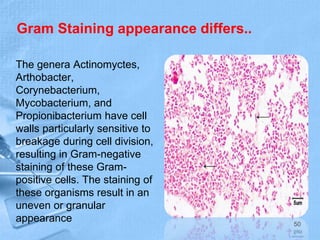
Gram Staining appearance differs..
The genera Actinomyctes,
Arthobacter,
Corynebacterium,
Mycobacterium, and
Propionibacterium have cell
walls particularly sensitive to
breakage during cell division,
resulting in Gram-negative
staining of these Gram-
positive cells. The staining of
these organisms result in an
uneven or granular
appearance 50
Interpret Gram Staining with Clinical
Picture and other Investigations
• Nevertheless,
Gram's stain
findings can be
equivocal and,
therefore, must
be assessed
carefully in light
of the clinical
picture.
51
Modification in Gram staining
methods ?
• Since the original procedure of
Gram, many variations of the Gram
staining technique have been
published. Some of them have
improved the method, others include
some minor technical variants of no
value. Bartholomew (1962) has
pointed out that each variation in the
Gram staining procedure has a
definite limit to its acceptability. 52
Modifications -Report with caution
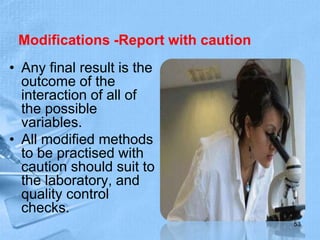
• Any final result is the
outcome of the
interaction of all of
the possible
variables.
• All modified methods
to be practised with
caution should suit to
the laboratory, and
quality control
checks.
53
Hucker and Conn's recommendation
• There is no gram procedure which
can be referred to as the best for all
laboratories and for all situations. It
is recommended that the young
microbiologists adopt at least two of
the well-accepted methods, practice
them until he is familiar with their
characteristics,
54
Better Profienncy with quality controls
• Use controls of
organisms with known
gram reactions is
excellent counsel. This
plan will give much
better results than
constant change of
methods in the hope of
finding one that is
foolproof
55
GRAM STAINING
It's a mystery
• Although it may seem strange, the reason why bacteria
with these two major types of bacteria cell walls react
differently with Gram's stain appears to be unconnected
with the wall structure itself. The exact mechanism of the
staining reaction is not fully understood, however, this
does not detract from its usefulness.
56
Words of Wisdom
Hans Christian Gram
•I am aware
that as yet
it is very
defective
and
imperfect 57
Creating Library of Gram Stains
Drain or gently blot
excess oil
For slide libraries and
teaching collections that
will be stored for longer
periods, immersion oil
can be removed with
xylene solution and the
slides can be cover
slipped using Per mount
to prevent fading.
Dr.T.V.Rao MD 58
Gram staining continues to be
Most Rapid test.
• Even new molecular methodologies
typically take hours rather than
minutes. " This simple staining
procedure remains the most useful test
performed in the microbiology lab.
Results from a Gram's stain can tell
volumes about an infection within 15
minutes of a specimen's arrival in the
lab, while most other microbiology
results require 24 hours or more. 59
60
Gram’s Staining for medical students.pptx

Gram’s Staining for medical students.pptx

  • 1.
    Gram’s Staining skill basedlearning ROMA GOYAL 1
  • 2.
    Hans Christian Gram •The Gram stain was devised by the Danish physician, Hans Christian Gram, while working in Berlin in 1883. He later published this procedure in 1884. At the time, Dr. Gram was studying lung tissue sections from patients who had died of pneumonia. 2
  • 3.
    First Paper onGram Staining • In his paper, Dr. Gram described how he was able to visualize what we now call Staphylococcus, Streptococcus, Bacillus, and Clostridia in various histological sections. Interestingly, Dr. Gram did not actually use safranin as a counter stain in the original procedure (Gram negative cells would be colorless). He instead recommended using Bismarck brown as a counter stain to enable tissue cell nuclei to be visualized. 3
  • 4.
    Carl Weigert (1845-1904) •Gram did not use a counterstain in his procedure. It was a few years later, that the German pathologist Carl Weigert (1845-1904) from Frankfurt, added a final step of staining with safranin. 4
  • 5.
    Traditional Definition ofGram stain • A method of staining bacteria using a violet stain. The gram staining characteristics (denoted as positive or negative). A heat fixed bacterial smear is stained with crystal violet (methyl violet), treated with 3% iodine/potassium iodide solution, washed with alcohol and counterstained. The method differentiates bacteria into two main classes, gram- positive and gram-negative. 5
  • 6.
    The Cell wallsdiffer… 6
  • 7.
    Gram staining observation BasicPrinciple in Koch’s postulations • The first of Koch’s postulate that the suspected the organism should always be found in association with the disease. 7
  • 8.
    Requirements for Gramstaining technique • Glass slides (25 by 75 mm), frosted ends desirable • b. 0.85% Nacl, sterile • c. Pasteur pipettes and wood applicator sticks, sterile • d. Microbiological loops, inoculating needles • e. Supplies for disposal of biological waste, including “sharps” • f. Bunsen burner • g. Immersion oil 8
  • 9.
    Poor quality ofslides Can be corrected • Use of glass slides that have not been pre cleaned or degreased ? NOTE: Storing slides in a jar with 95% ethanol will ensure clean slides. Drain excess alcohol or flame slide before use. 9
  • 10.
    Four Major Stepsin Gram Staining • There are four basic steps of the Gram stain, which include applying a primary stain (crystal violet)or Methyl violet to a heat-fixed smear of a bacterial culture, followed by the addition of a mordant (Gram's iodine), rapid decolorization with alcohol or acetone, and counterstaining with Safranin or basic fuchsin. 10
  • 11.
  • 12.
    Making a Smear •First prepare your slide. You do this by placing bacteria on a slide in a drop of normal saline, allowing them to dry and then heat fixing them. Heating the slide kills the bacteria and makes sure that the bacteria a stuck to the slide and wont wash away during the staining procedure 12
  • 13.
    Correct preparation • Smearpreparation: Proper smear preparation should produce a monolayer of organisms sufficiently dense for easy visualization but thin enough to reveal characteristic morphological characteristics. Use clean, new glass slides. NOTE: When using the same pipette or swab, always inoculate culture media first 13
  • 14.
    Method of Pickingmaterial from Agar plates Wrong Right 14
  • 15.
    Making Multiple smearsin same slide – conserve resources • Making multiple smears make the optimal use of the slide. • Reduces the economic costs and saves the technical time. 15
  • 16.
    Steps in GramStaining Procedure- Follow the Clock 1 On a rack, flood with filtered crystal violet ( Methyl violet ) 1 Minute. 2 Wash briefly in water to remove excess crystal violet 3. Flood with Gram’s iodine 1 Minute. 4. Wash briefly in water, do not let the section dry out. 5. Decolourise with acetone until the moving dye front has passed the lower edge of the section 6. Wash immediately in tap water 7. Counterstain with safranin 30 seconds 16
  • 17.
  • 18.
  • 19.
  • 20.
  • 21.
  • 22.
  • 23.
    Acetone used withCaution • Acetone is a more rapid decolorizes than alcohol and must be used with some care. • Excessive decolorization turns Gram positive appear as Gram negative 23
  • 24.
    Which alcohol isbetter • Several alcohols have been studied, and it has been reported that the more complex the alcohol, the slower the decolorization action. As the carbon chain lengthens, decolorization is slower. • Kisskalt (84) found decolorization power decreasing in the following order: methyl, ethyl, propyl, butyl, and amyl alcohol. • Conn found a mixture of equal parts of methyl and isopropyl alcohols to have very similar decolorization properties to ethyl alcohol. • In practice, however, no known advantage can be gained by substituting the higher alcohols for ethyl alcohol. 24
  • 25.
  • 26.
  • 27.
    Caring the stainedslide After the counterstain has been rinsed off, the slide is placed between some absorbent paper and the excess water gently blotted off. Care must be taken not to rub the slide with the blotting paper because this would remove the adhering bacteria. 27
  • 28.
    Optimal use ofMicroscopy • Gram stained preparations have to be observed with bright-field optics. Phase- contrast microscopy does not allow the recognition of true colours. Gram-positive bacteria may be seen under phase-contrast as red cells. Using bright-field optics, Gram-positive cells are purple or blue and Gram- negative pink due to counter stain with Safranin.. 28
  • 29.
    QUALITY CONTROL • TheGram’s stain reagents should be tested using known gram-positive and gram-negative organisms each day of use. • 1) Gram-positive control – Staphylococcus aureus ATCC 25923 • 2) Gram-negative control – Escherichia coli ATCC 25922. • B Do not interpret test unless the controls yield expected results.
  • 30.
    Report as follows •1 If no microorganisms are seen in a smear of a clinical specimen, report “No microorganisms seen.” • 2. If microorganisms are seen, report relative numbers and Describe morphology. Observe predominant shapes of microorganisms 30
  • 31.
    Gram Staining –Gram +’ve 31
  • 32.
    Gram Staining –Gram -’ve 32
  • 33.
    Value of DirectSmears • Guide the physician on initial choice of antibiotic, pending results of culture and sensitivity. • Judge specimen quality. • Contribute to selection of culture media, especially with mixed flora. • Provide internal quality control when direct smear results are compared to culture results. 33
  • 34.
    Nature of Morphologyin guides early Diagnosis in uncommon diseases 34
  • 35.
    Limitations of Gram’s Staining •We know that Gram positivity is restricted almost exclusively to the bacteria, with only a few other groups, such as the yeasts, exhibiting this reaction. 35
  • 36.
    Better Understanding ofGram’s Staining • We know that the Gram stain is not an all-or-nothing phenomenon, but that quantitative variations in Gram- positivity exist between different species, and within the same species during different parts of the growth cycle or under different environmental conditions. We know that only intact cells are Gram-positive, so that cells which are even gently broken become Gram-negative. We know that bacterial protoplasts, devoid of cell wall, are still Gram-positive, indicating that it is probably the semipermeable membrane which is somehow involved in the reaction. 36
  • 37.
  • 38.
  • 39.
  • 40.
    Gram stain ofNeisseria gonorrhoea, 40
  • 41.
    Nocardia spp seenin Gram Staining 41
  • 42.
  • 43.
    Common errors inStaining procedure • Excessive heat during fixation • Low concentration of crystal violet • Excessive washing between steps • Insufficient iodine exposure • Prolonged decolourization • Excessive counterstaining 43
  • 44.
    Gram stain resultsmay not correlated with culture results • Gram stain-positive, culture-negative specimens may be the result of contamination of reagents and other supplies, presence of • Antimicrobial agents, or failure of organisms to grow under usual Culture conditions (media, atmosphere, etc.) • Presence of anaerobic microorganism 44
  • 45.
    Artifacts in GramStaining • Gram stain reagents (Crystal Violet, Iodine, Safranin and Neutral Red • Dirty glass slides • Contaminated water used to rinse slides • When investigating non-viable organisms seen in Gram stains it is always wise to eliminate every potential source. 45
  • 46.
    Gram staining nota fool proof procedure • Gram’s staining method is not without its problems. It is , complicated, and prone to operator error. The method also requires a large number of cells However, it is also central to phenotypic microbial identification techniques. 46
  • 47.
    Gram variable observationsin Gram staining • The Gram staining procedure does not always give clear-cut results. Some organisms are Gram-variable and may appear either Gram-negative or Gram- positive according to the conditions. With these types of organisms, Gram-positive and Gram-negative cells may be present within the same preparation 47
  • 48.
    Why Gram Variability? •Some Gram-positive bacteria appear Gram-negative when they have reached a certain age, varying from a few hours to a few days. On the other hand, some Gram-negative bacteria may become Gram-positive in older cultures. For this reason it is strongly recommended to use very young cultures for the staining procedure, after growth has become just visible. 48
  • 49.
    Overcoming in GramVariable Observations • It is necessary that it is stained at two or three different ages (very young cultures should be used). If an organism changes from positive to negative or vice versa during its growth cycle, this change should be recorded with a statement as to the age of the culture when the change was first observed. In case a Gram-variable reaction is observed it is also good to check the purity of the culture. 49
  • 50.
    Gram Staining appearancediffers.. The genera Actinomyctes, Arthobacter, Corynebacterium, Mycobacterium, and Propionibacterium have cell walls particularly sensitive to breakage during cell division, resulting in Gram-negative staining of these Gram- positive cells. The staining of these organisms result in an uneven or granular appearance 50
  • 51.
    Interpret Gram Stainingwith Clinical Picture and other Investigations • Nevertheless, Gram's stain findings can be equivocal and, therefore, must be assessed carefully in light of the clinical picture. 51
  • 52.
    Modification in Gramstaining methods ? • Since the original procedure of Gram, many variations of the Gram staining technique have been published. Some of them have improved the method, others include some minor technical variants of no value. Bartholomew (1962) has pointed out that each variation in the Gram staining procedure has a definite limit to its acceptability. 52
  • 53.
    Modifications -Report withcaution • Any final result is the outcome of the interaction of all of the possible variables. • All modified methods to be practised with caution should suit to the laboratory, and quality control checks. 53
  • 54.
    Hucker and Conn'srecommendation • There is no gram procedure which can be referred to as the best for all laboratories and for all situations. It is recommended that the young microbiologists adopt at least two of the well-accepted methods, practice them until he is familiar with their characteristics, 54
  • 55.
    Better Profienncy withquality controls • Use controls of organisms with known gram reactions is excellent counsel. This plan will give much better results than constant change of methods in the hope of finding one that is foolproof 55
  • 56.
    GRAM STAINING It's amystery • Although it may seem strange, the reason why bacteria with these two major types of bacteria cell walls react differently with Gram's stain appears to be unconnected with the wall structure itself. The exact mechanism of the staining reaction is not fully understood, however, this does not detract from its usefulness. 56
  • 57.
    Words of Wisdom HansChristian Gram •I am aware that as yet it is very defective and imperfect 57
  • 58.
    Creating Library ofGram Stains Drain or gently blot excess oil For slide libraries and teaching collections that will be stored for longer periods, immersion oil can be removed with xylene solution and the slides can be cover slipped using Per mount to prevent fading. Dr.T.V.Rao MD 58
  • 59.
    Gram staining continuesto be Most Rapid test. • Even new molecular methodologies typically take hours rather than minutes. " This simple staining procedure remains the most useful test performed in the microbiology lab. Results from a Gram's stain can tell volumes about an infection within 15 minutes of a specimen's arrival in the lab, while most other microbiology results require 24 hours or more. 59
  • 60.