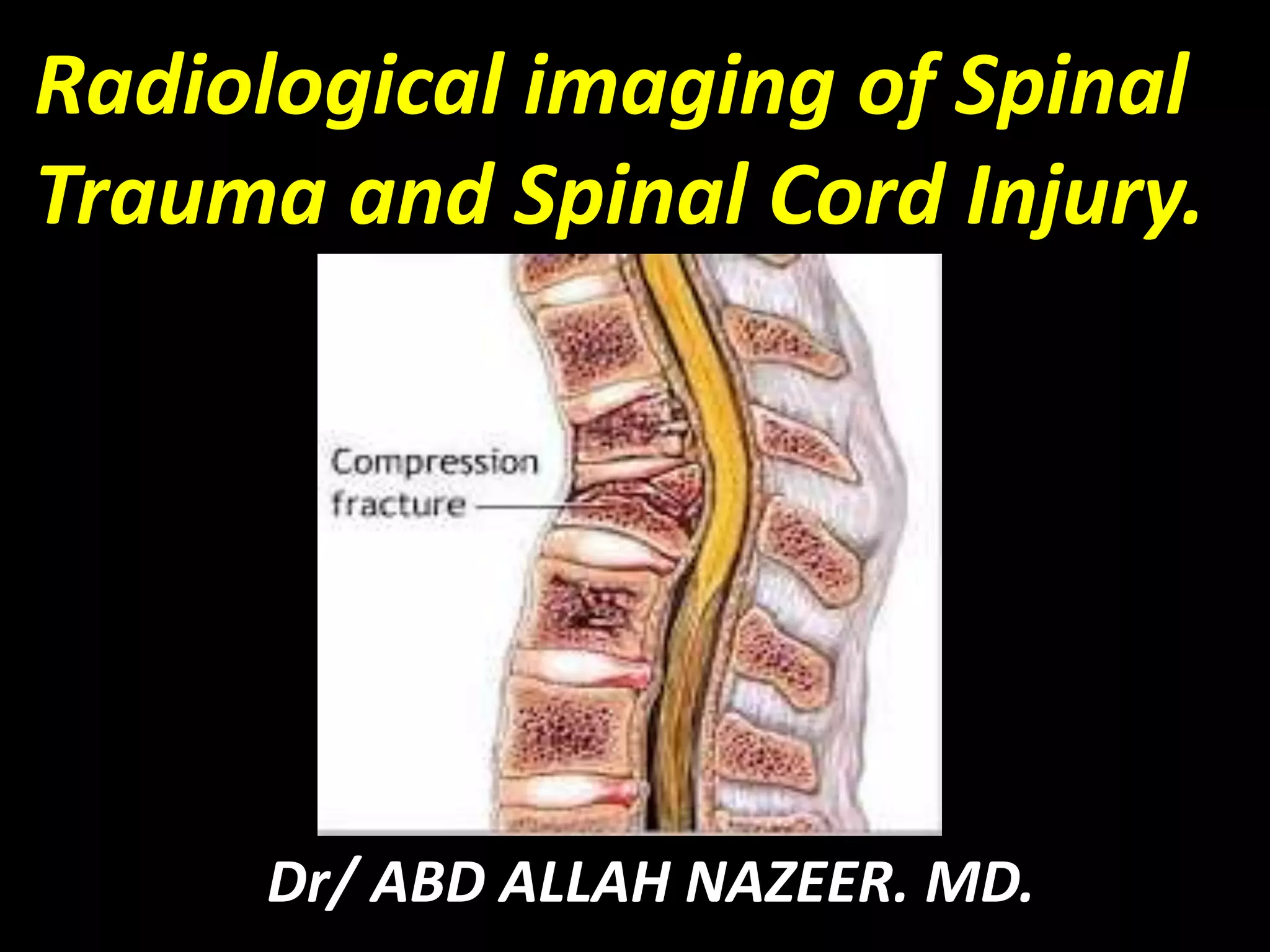
Radiological imaging of Spinal 
Trauma and Spinal Cord Injury. 
Dr/ ABD ALLAH NAZEER. MD.
MECHANISMS OF SPINAL INJURY: 
• FLEXION INJURY: leading to anterior wedging of vertebral 
body with posterior longitudinal ligament/ interspinous 
ligament disruption. 
• EXTENSION INJURY: more common in cervical spine leading 
to posterior element fracture, anterior longitudinal ligament 
rupture and subluxation. 
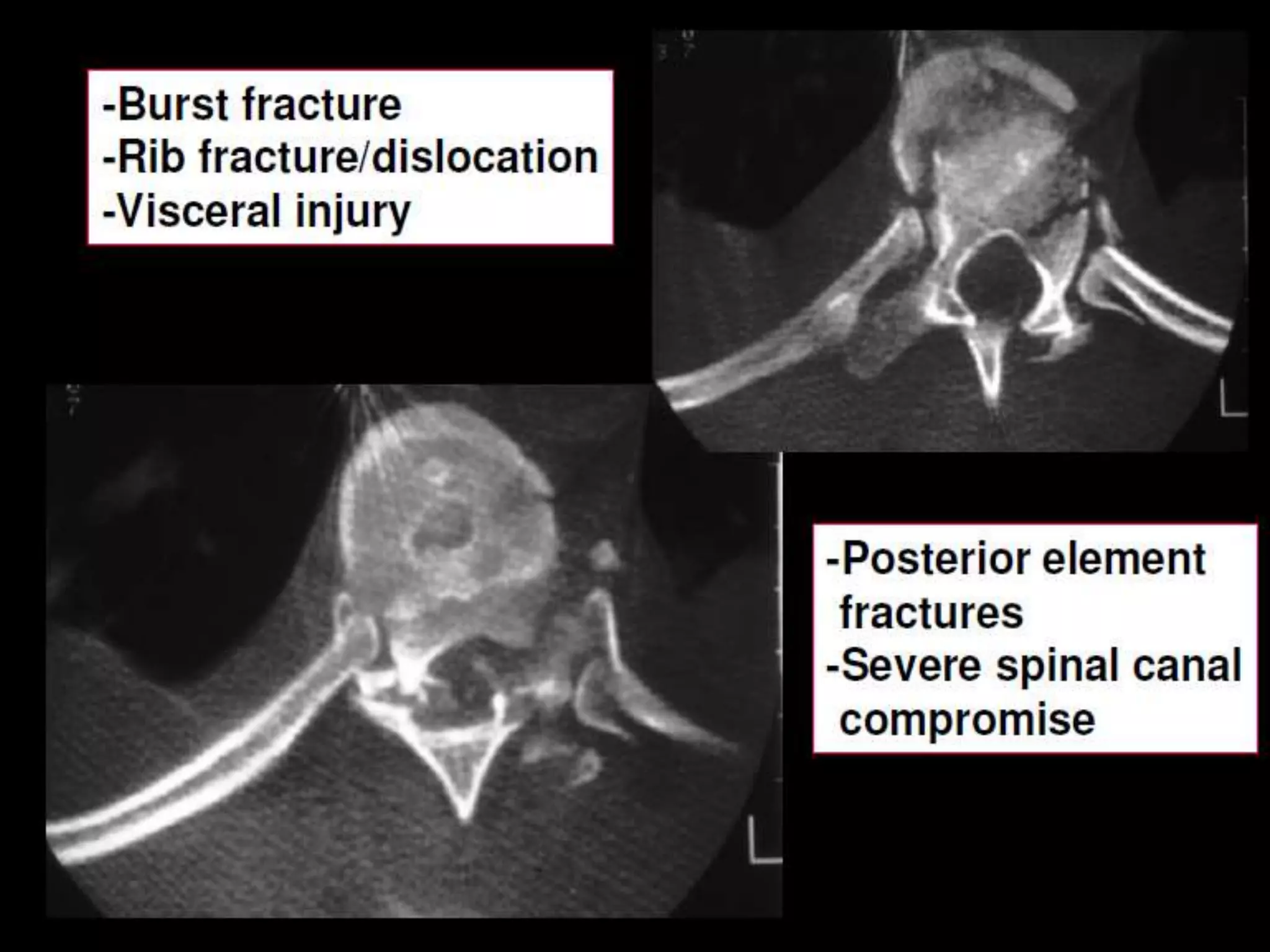
• AXIAL LOADING: Diving & jumping injury leading to burst 
fracture and lateral element fracture. 
• ROTATION INJURY: leads to lateral mass fracture and 
facet subluxation. 
AIM OF RADIOLOGIST: 
• Define complete extent and type of injury. 
• Guide management options conservative vs surgical.
IMAGING OF CERVICAL SPINE TRAUMA: 
Cervical Spine Trauma Demographics. 
Most common spinal injury. 
Responsible for 65% of all spinal injuries. 
Mechanism: MVA/Fall/Sport Injury: 
Spinal Cord Injury: 40% (10,000 annually). 
Cervical Spine Trauma Patterns. 
Areas most commonly involved 
C1-2 (particularly in children). 
C5-7. 
Other fractures 20%. 
Particular association of low cervical fracture with 
high thoracic and thoracolumbar injury.
Imaging modalities for spinal trauma. 
Radiography. 
Conventional films 
Flexion – Extension views 
• CT-Scan. 
Single slice vs Multislice 
Importance of reformatted images 
Protocol at the MGH 
CT Angiography 
• MRI. 
Modality of choice for soft tissues 
SC edema vs contusion vs hemorrhage 
Contra-indications
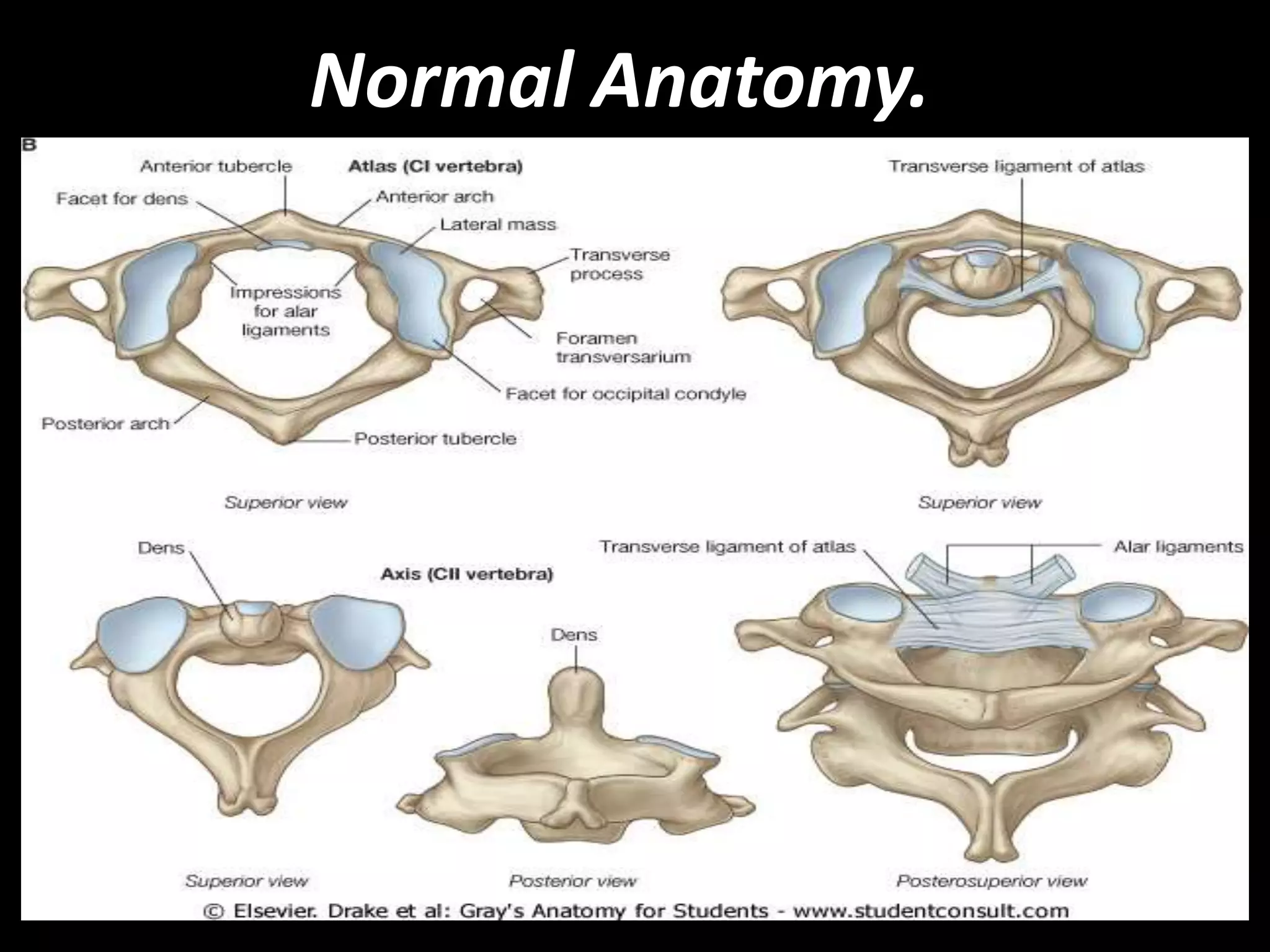
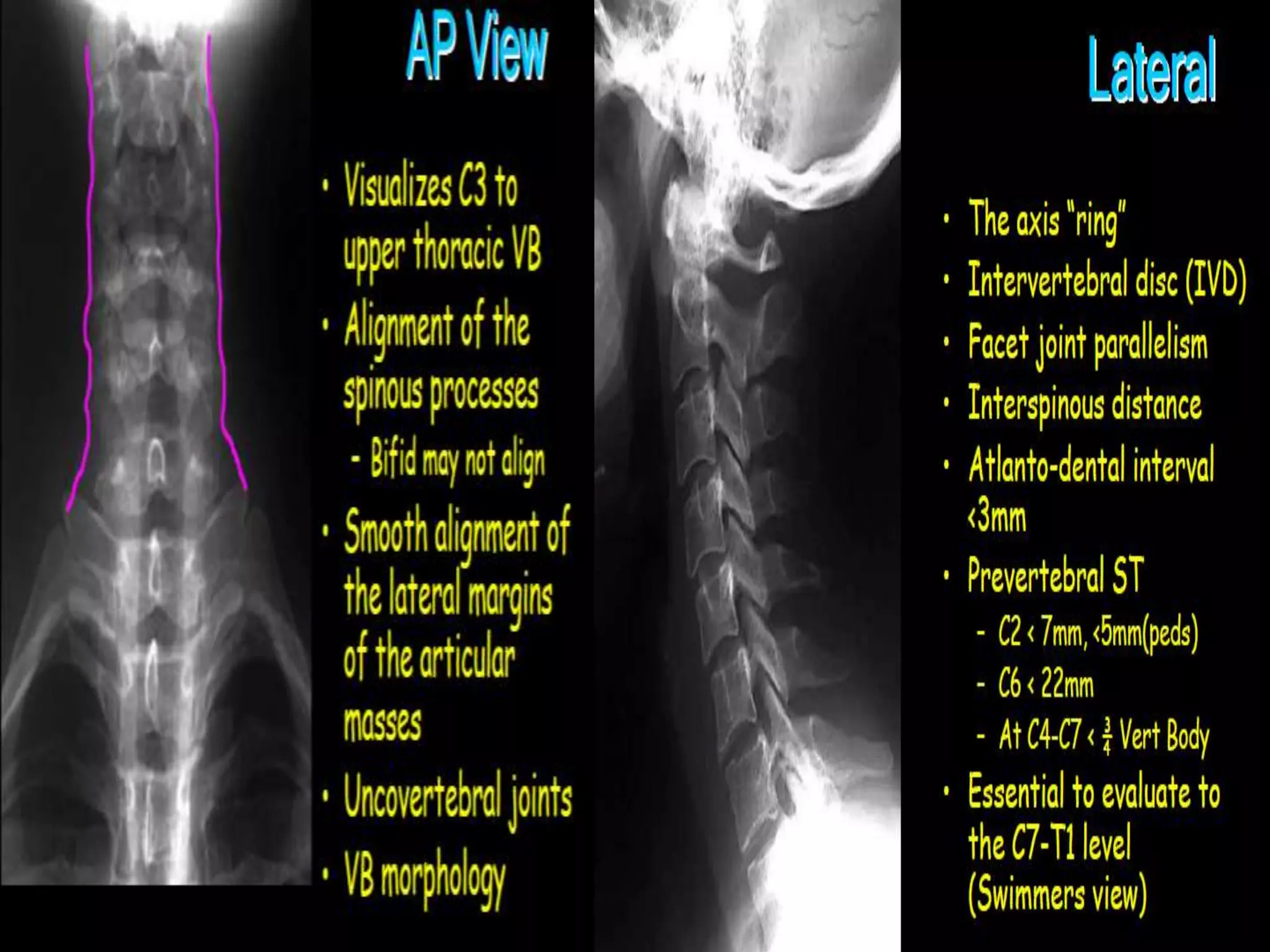
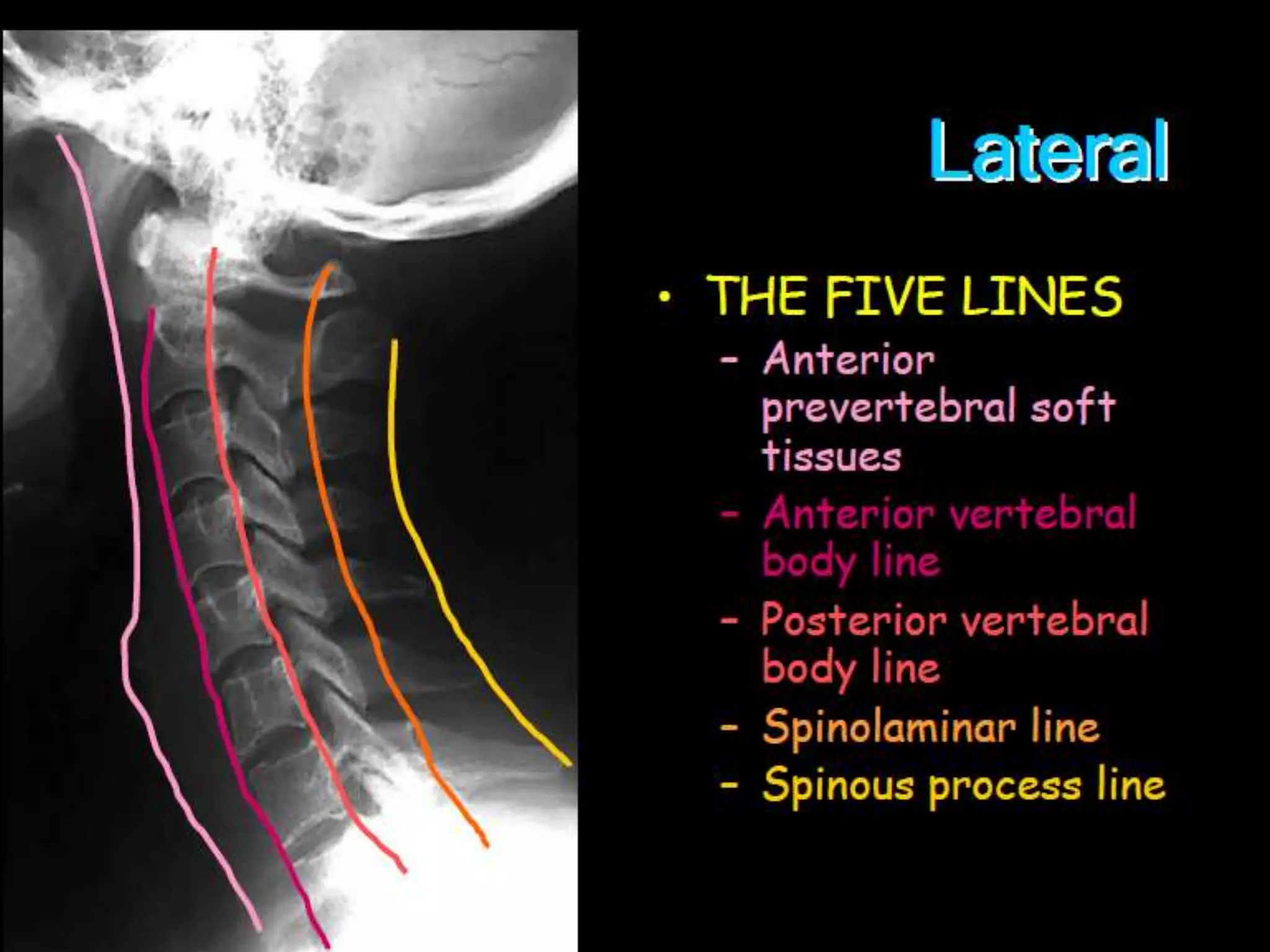
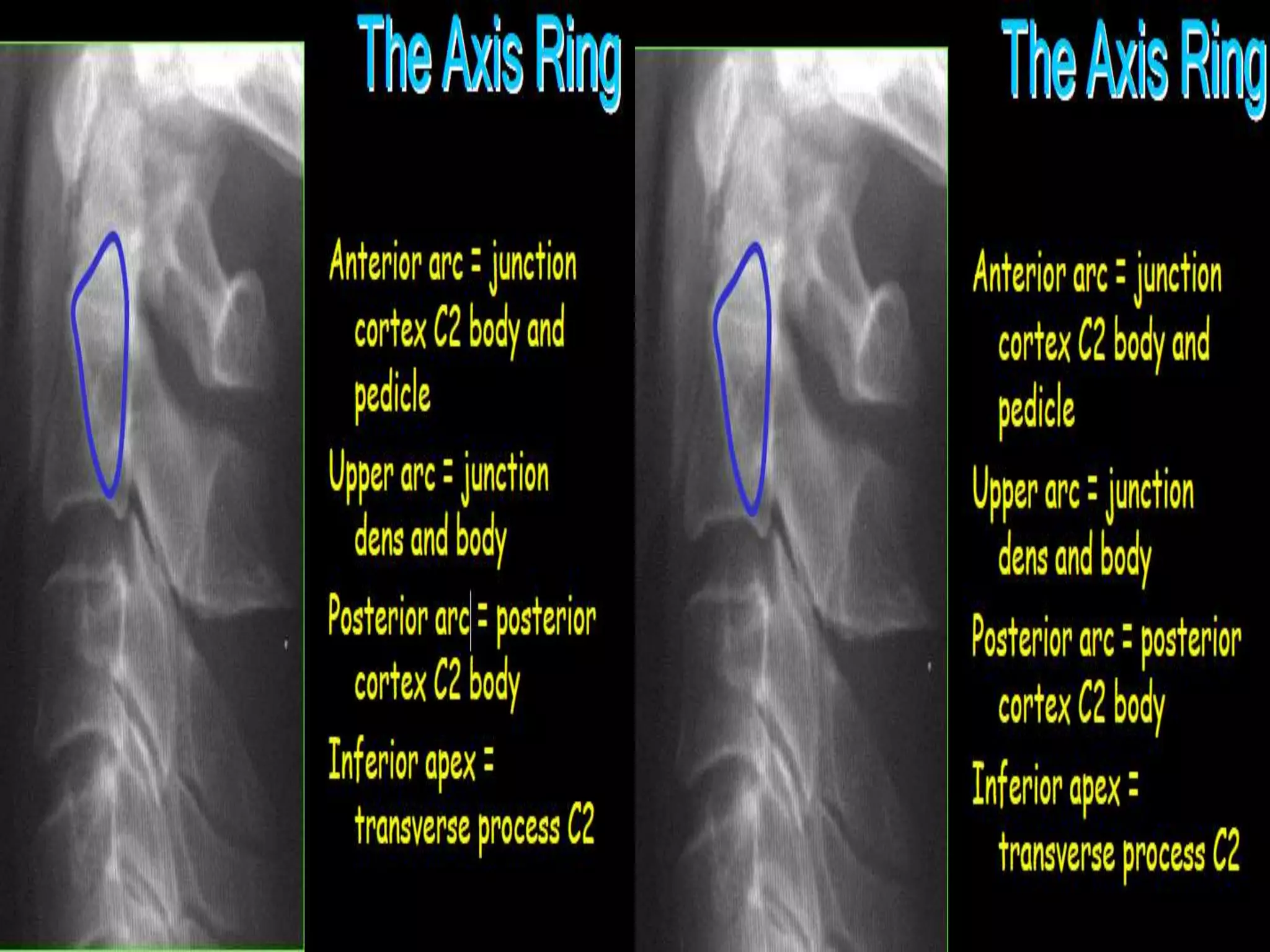
Normal Anatomy.
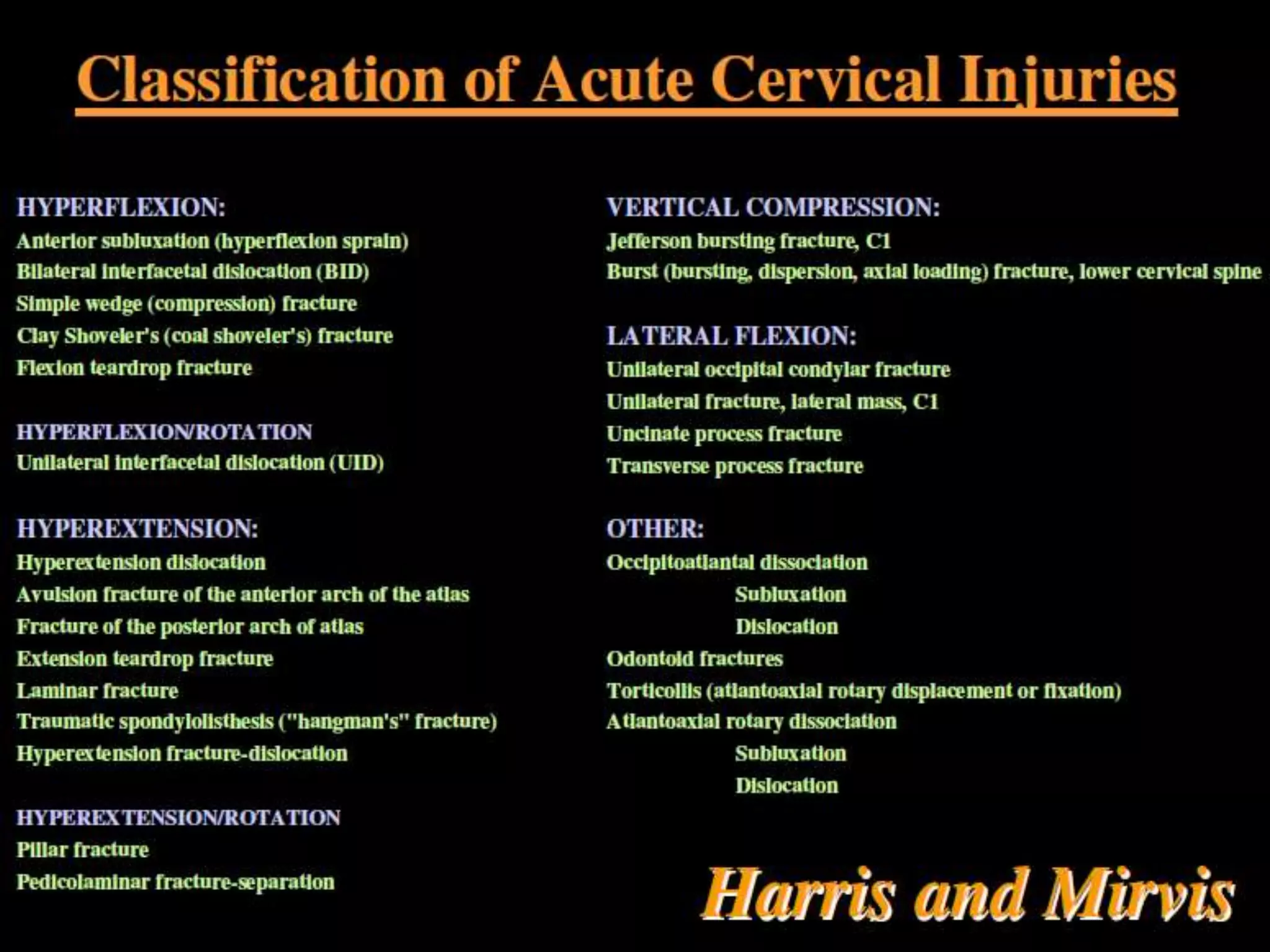
C-spine Injuries. 
Mechanism: 
•Vector of forces causing injury. 
•Classification system. 
Location: 
Upper cervical injuries: Include injuries to the 
base of the skull(Occipital condyles, C1 and 
C2 vertebra. 
Lower cervical injuries(sub-axial): Include 
injures from C3 through C7 vertebra.
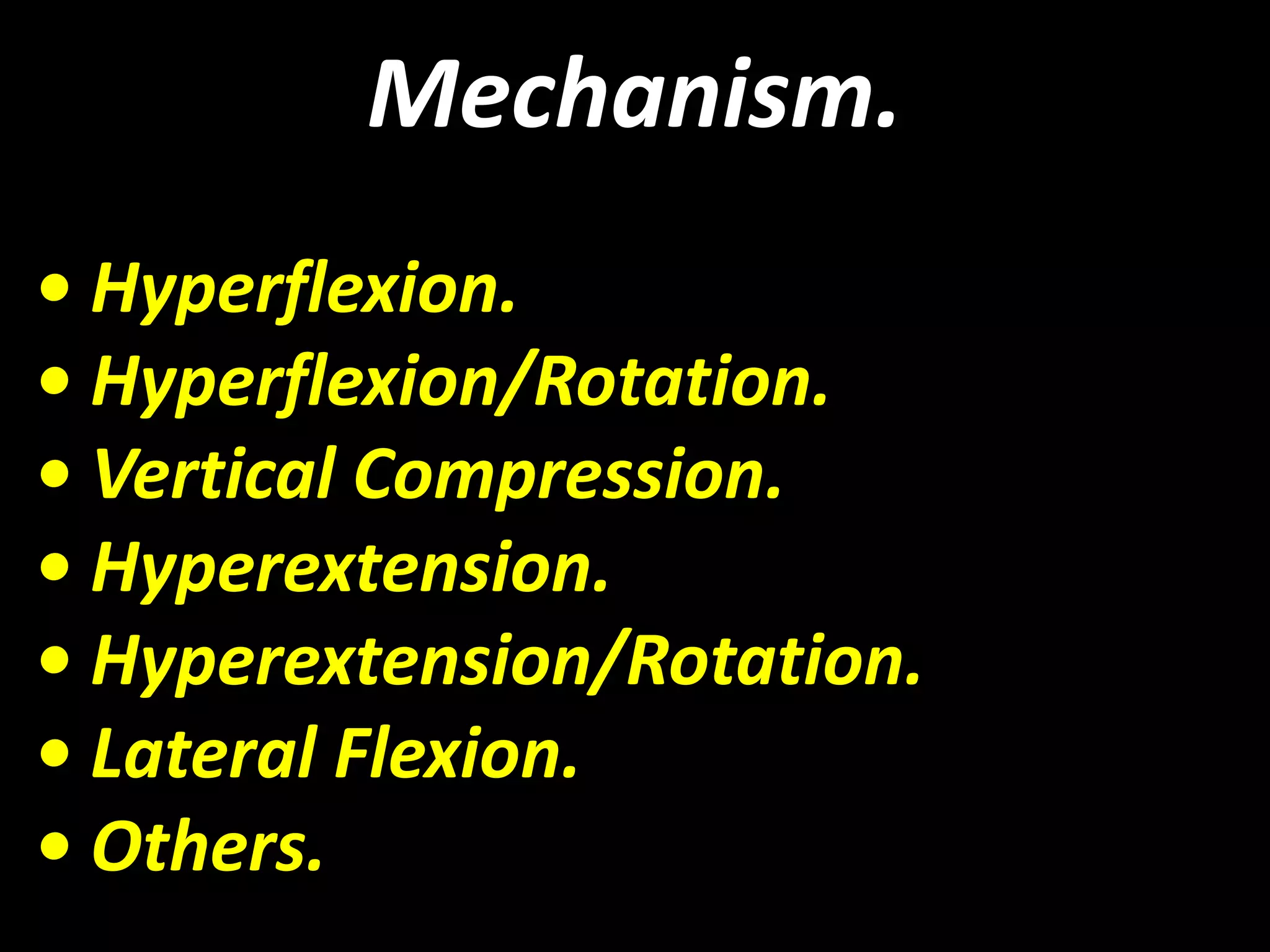
Mechanism. 
• Hyperflexion. 
• Hyperflexion/Rotation. 
• Vertical Compression. 
• Hyperextension. 
• Hyperextension/Rotation. 
• Lateral Flexion. 
• Others.
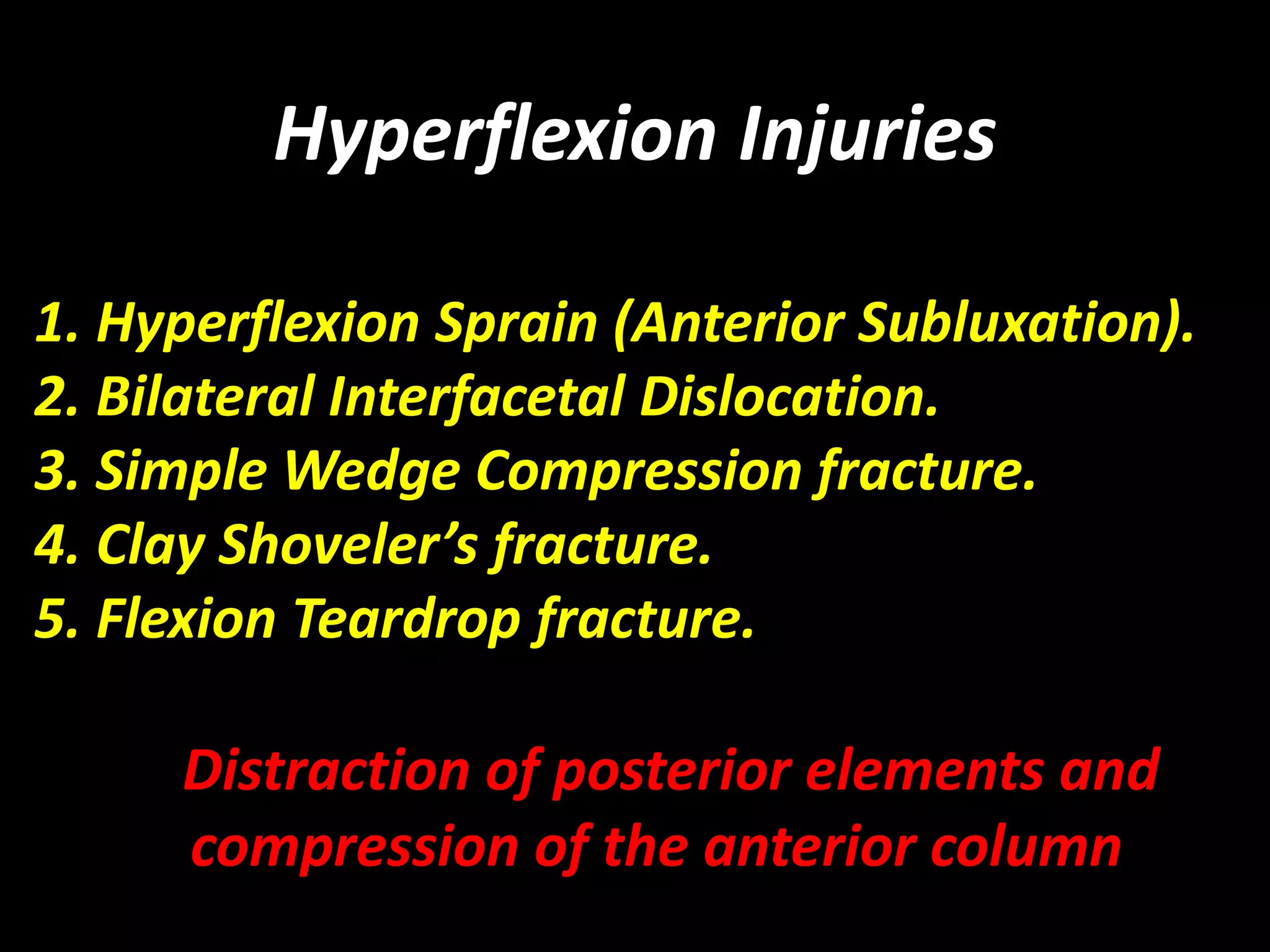
Hyperflexion Injuries 
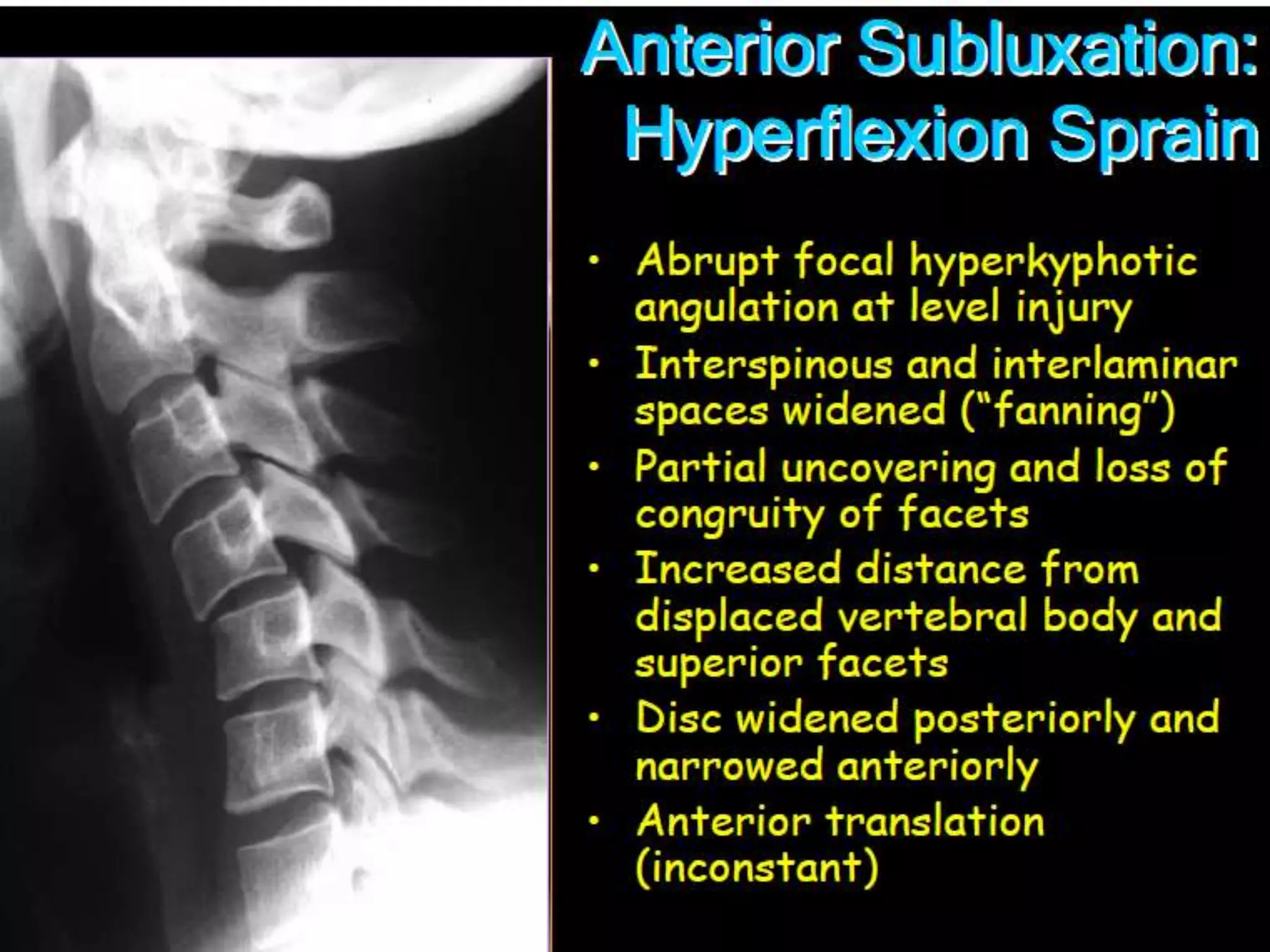
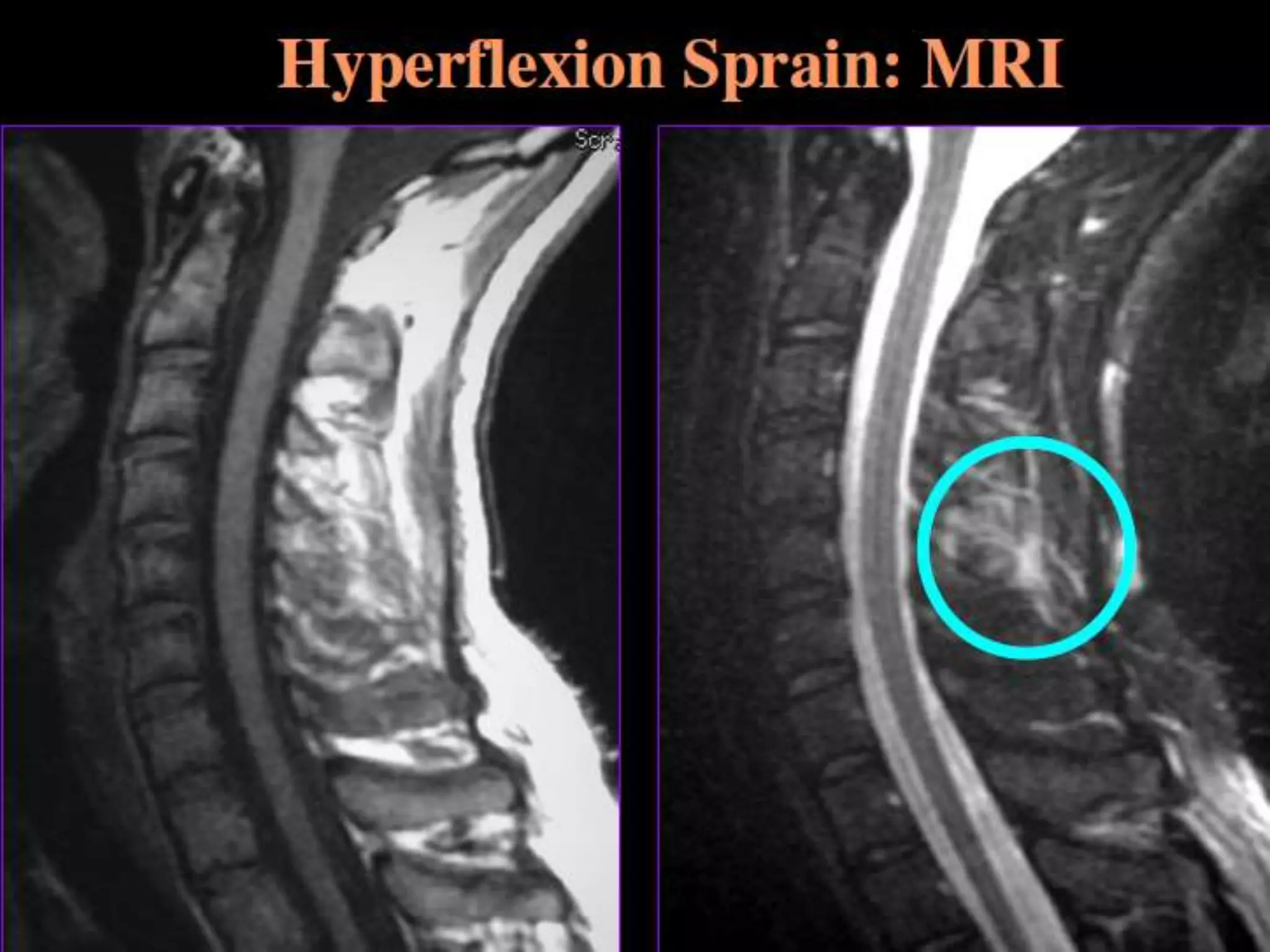
1. Hyperflexion Sprain (Anterior Subluxation). 
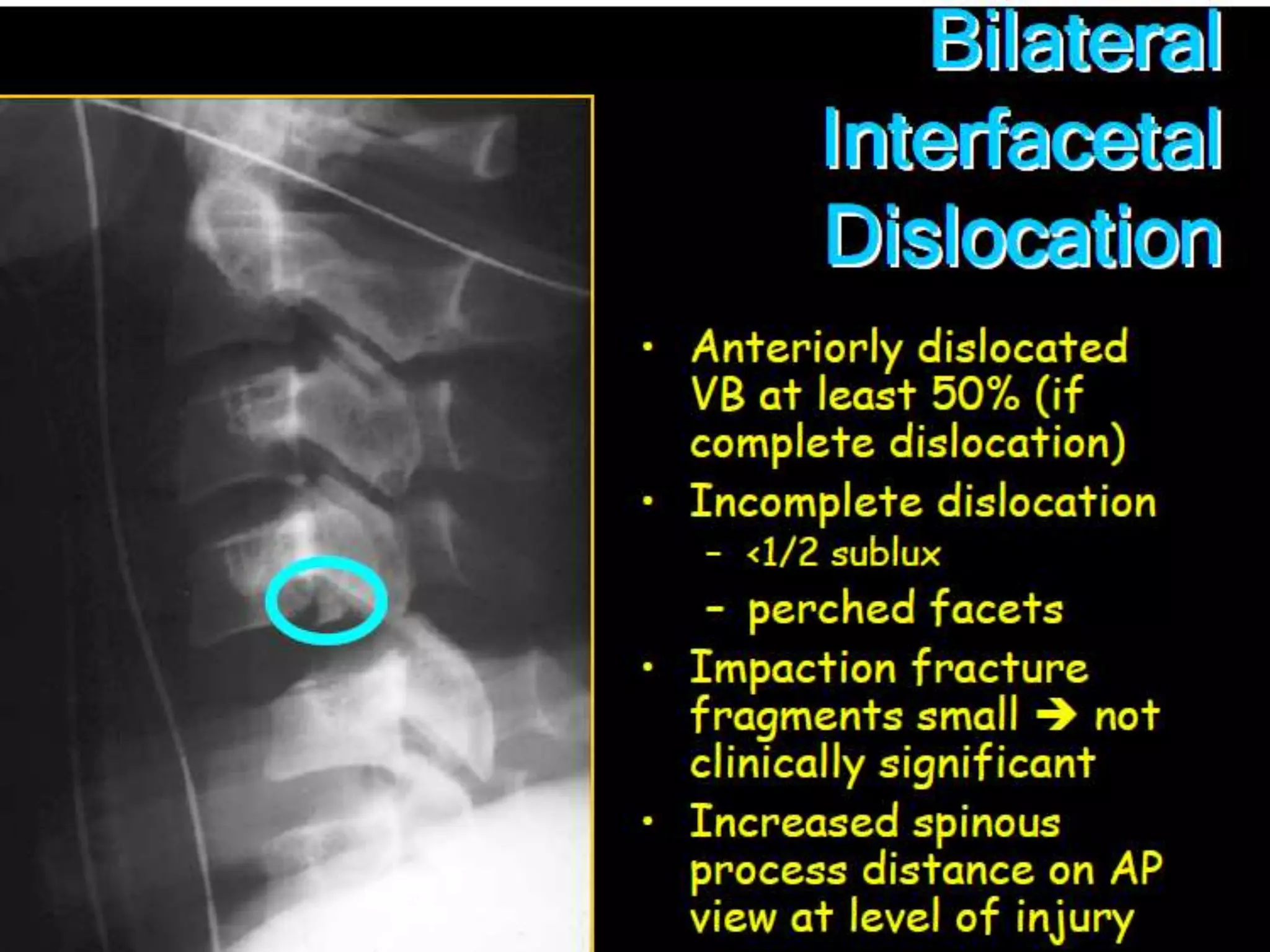
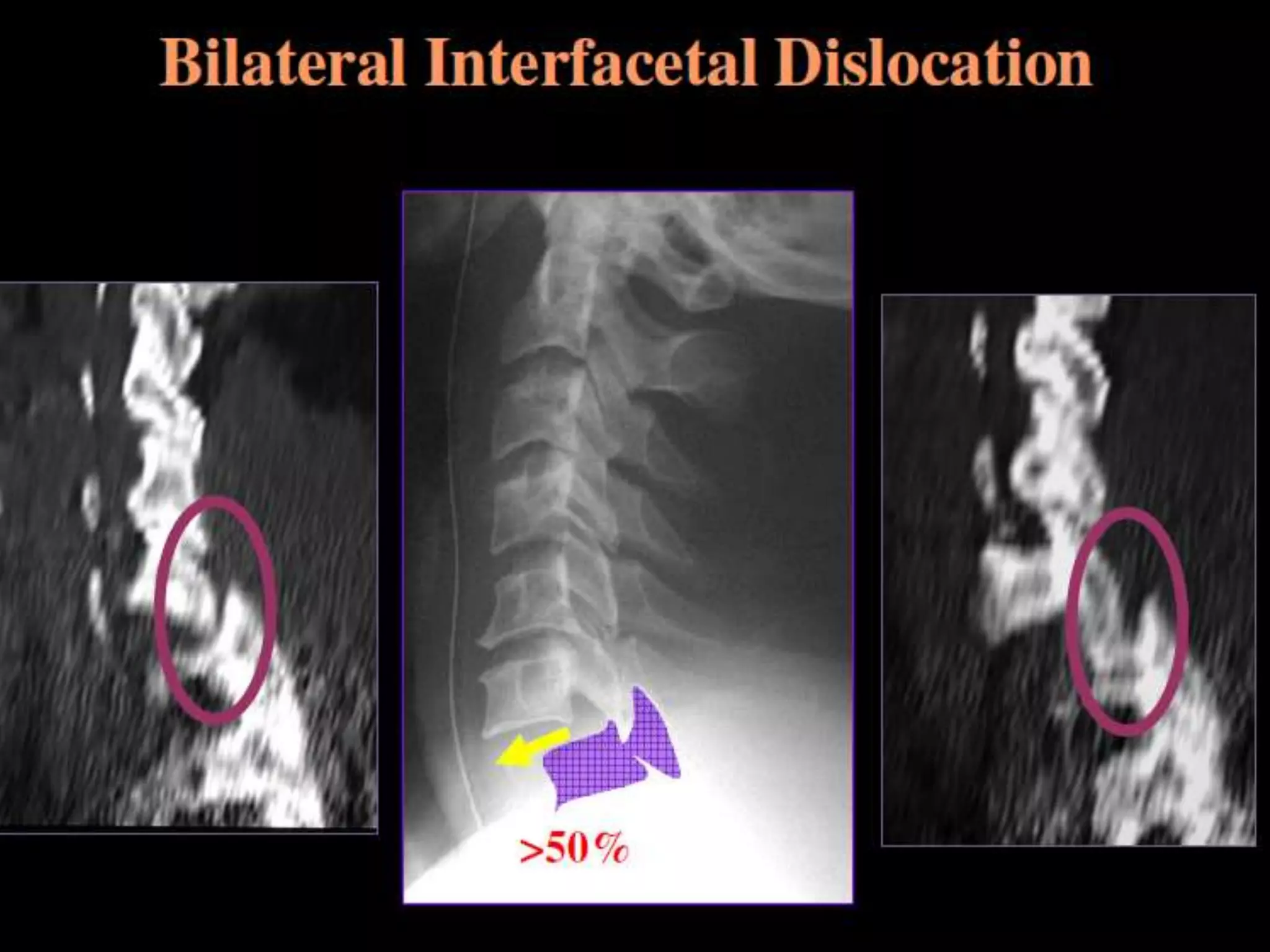
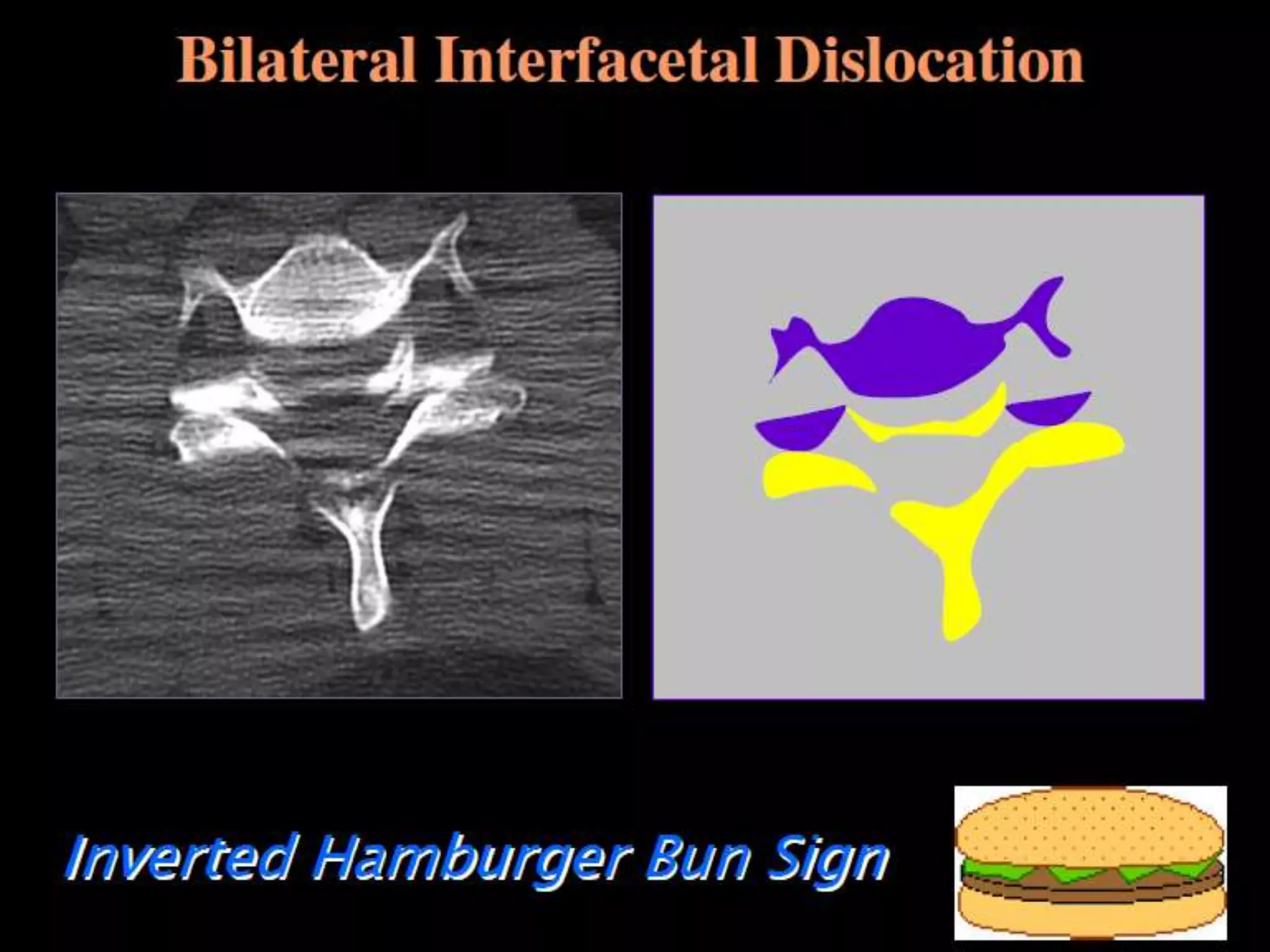
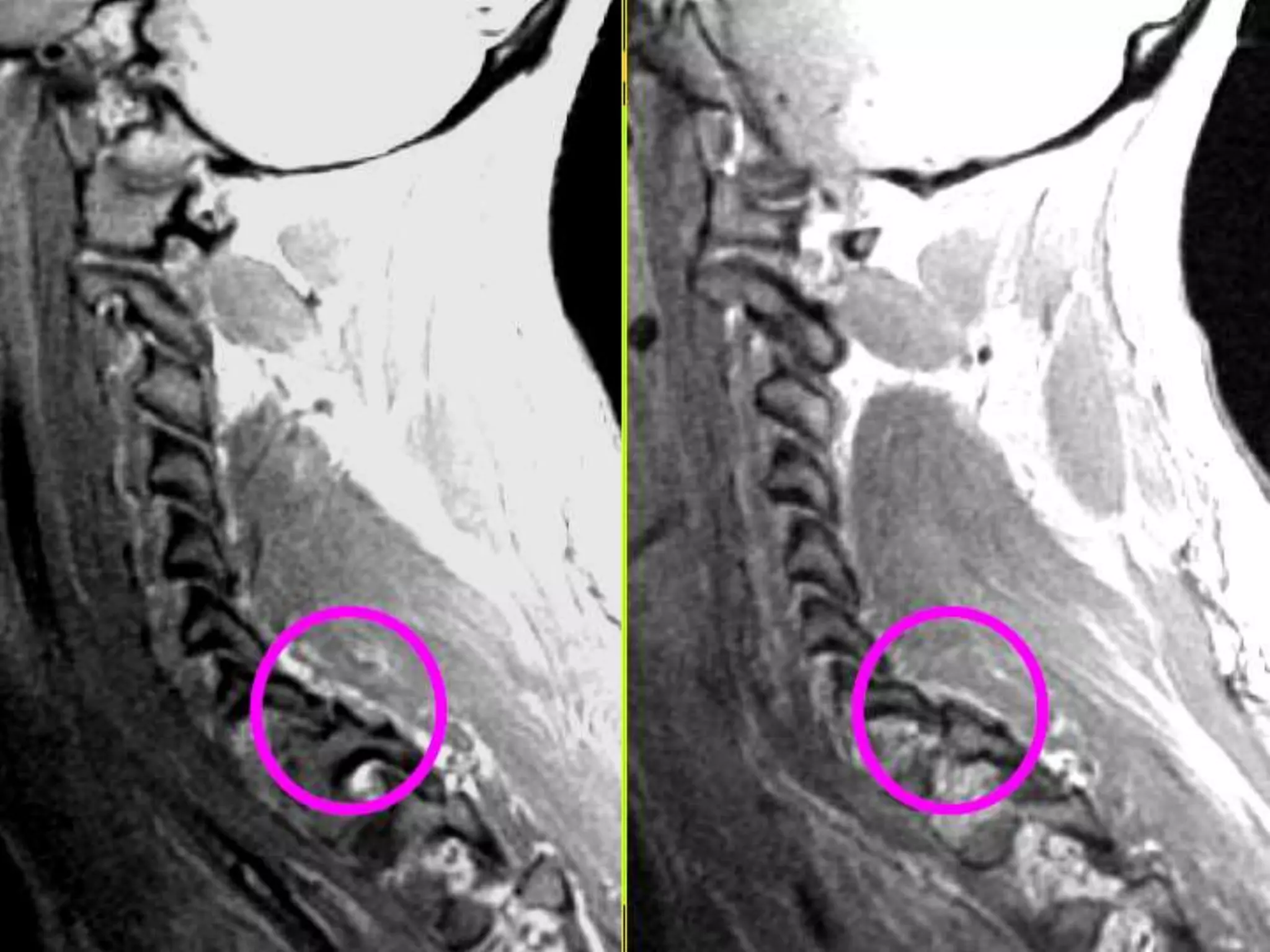
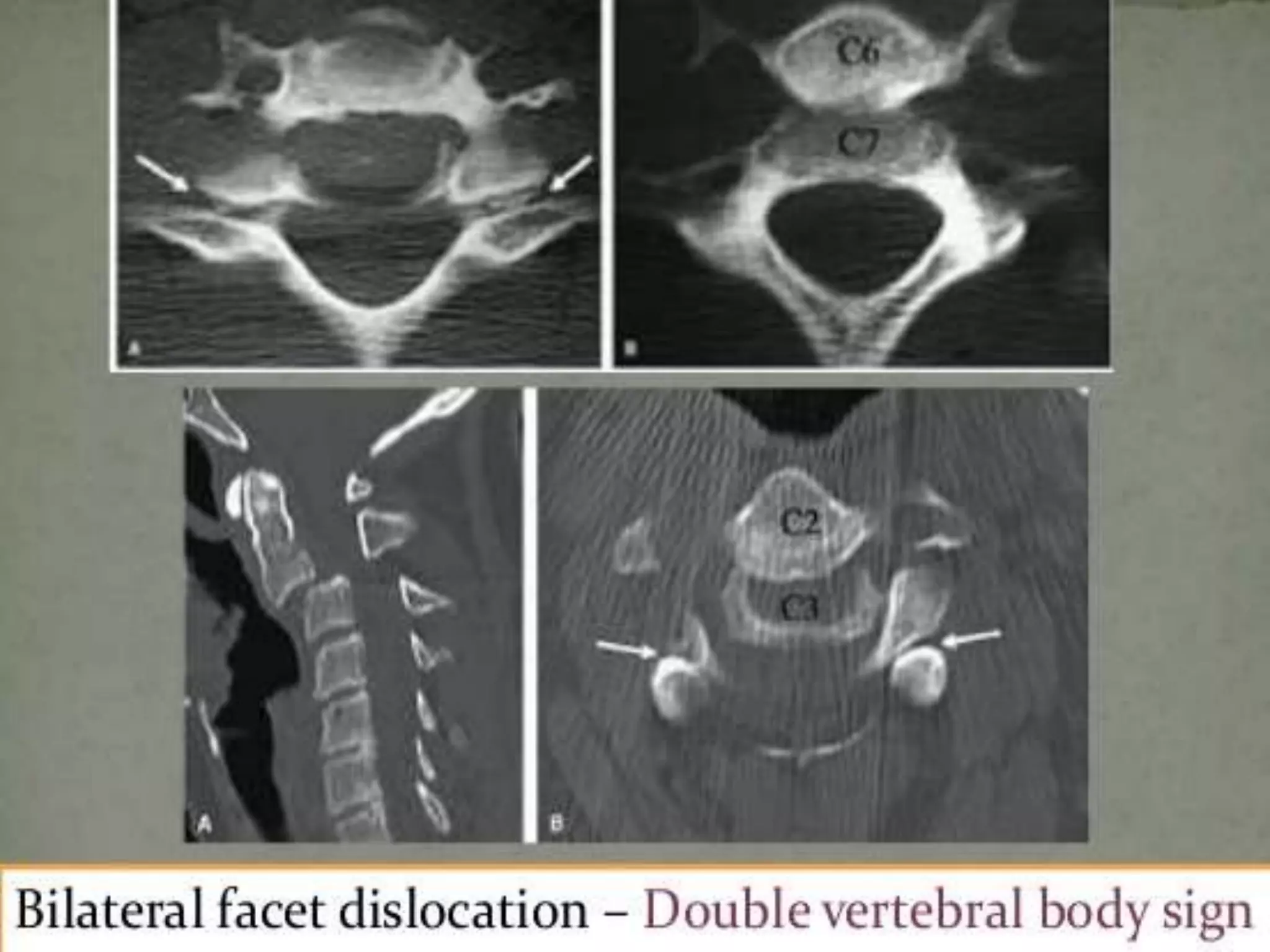
2. Bilateral Interfacetal Dislocation. 
3. Simple Wedge Compression fracture. 
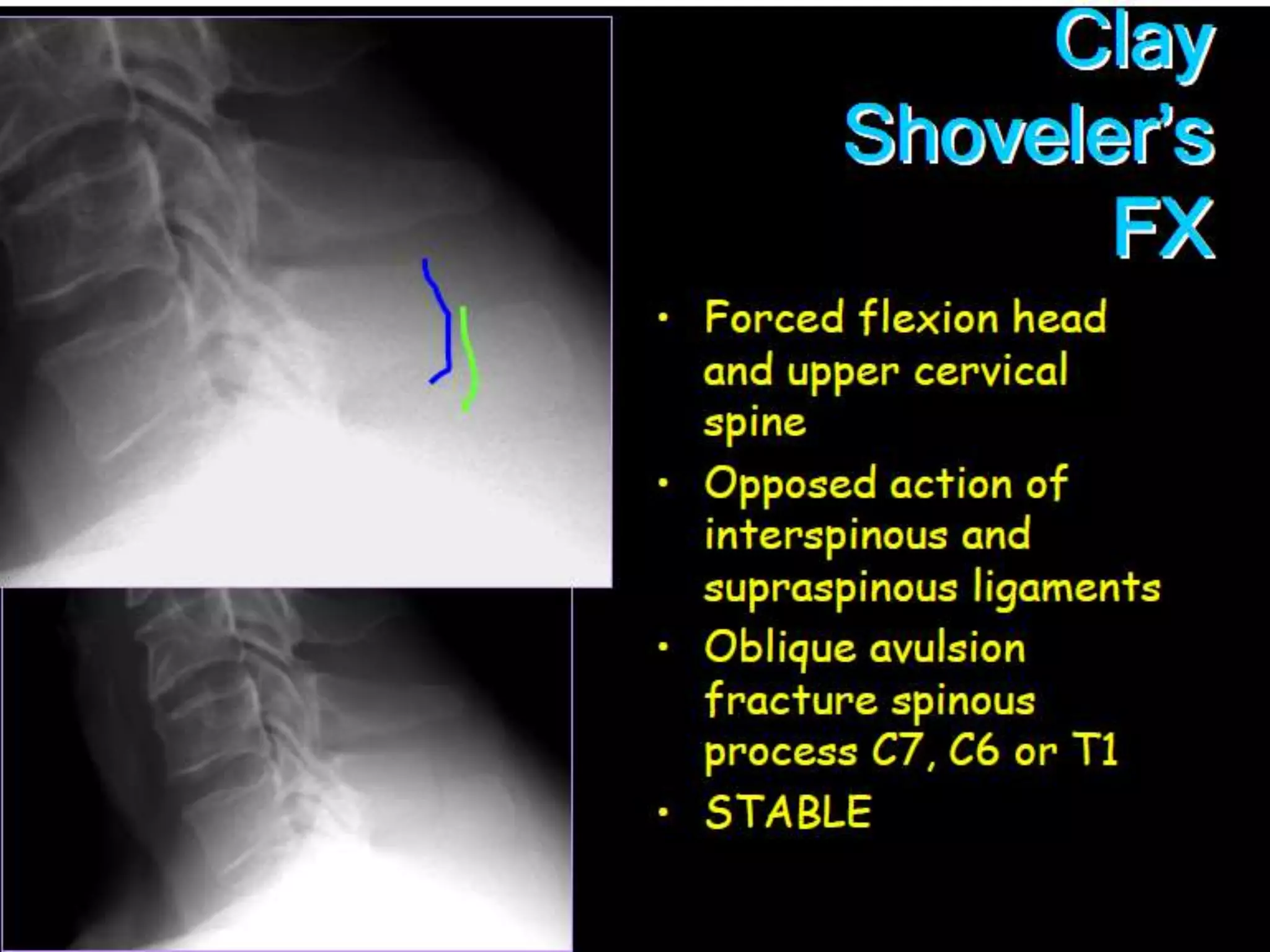
4. Clay Shoveler’s fracture. 
5. Flexion Teardrop fracture. 
Distraction of posterior elements and 
compression of the anterior column
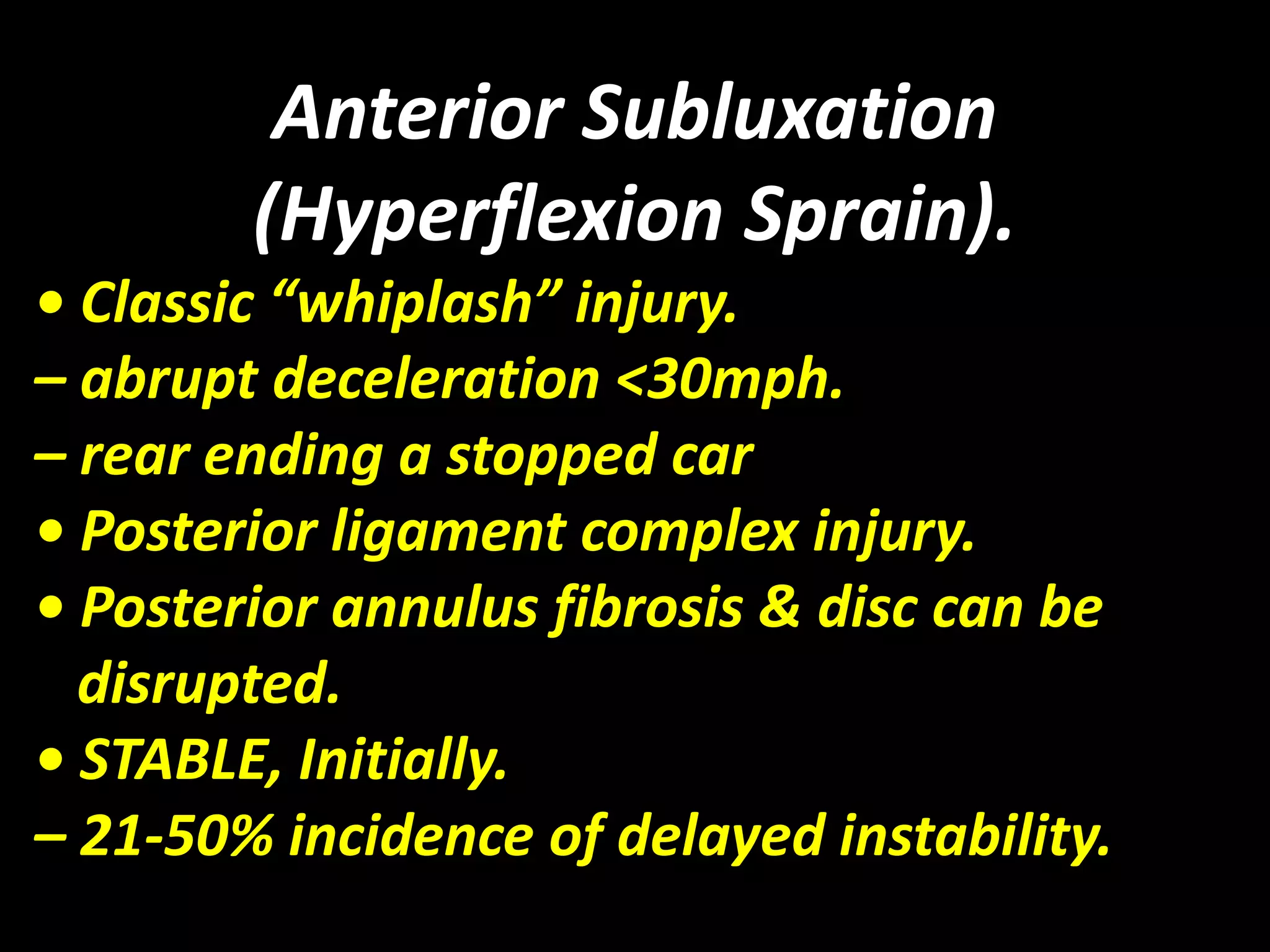
Anterior Subluxation 
(Hyperflexion Sprain). 
• Classic “whiplash” injury. 
– abrupt deceleration <30mph. 
– rear ending a stopped car 
• Posterior ligament complex injury. 
• Posterior annulus fibrosis & disc can be 
disrupted. 
• STABLE, Initially. 
– 21-50% incidence of delayed instability.
Bilateral Interfacetal 
Dislocations (BIID) 
• Soft tissue injury. 
• Disrupted ALL, PLL, Intervertebral 
disc and post ligament complex. 
• Articular masses pass superiorly and 
anteriorly. 
• High risk of cord damage. 
• UNSTABLE.
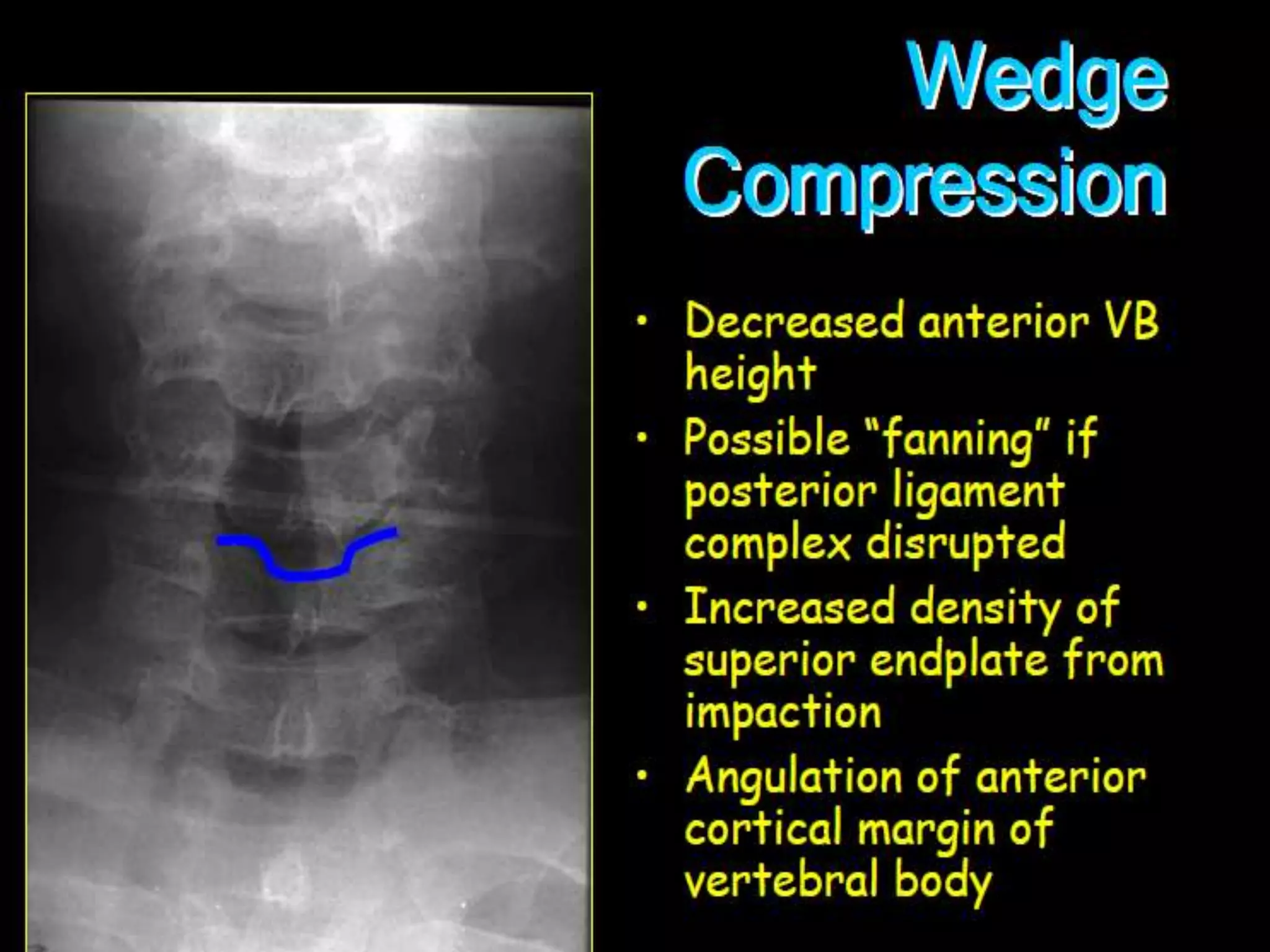
Simple Wedge Compression Fracture. 
• Mid to lower cervical spine. 
• Impacted superior endplate. 
• No vertical fracture. 
• ALL and disc intact. 
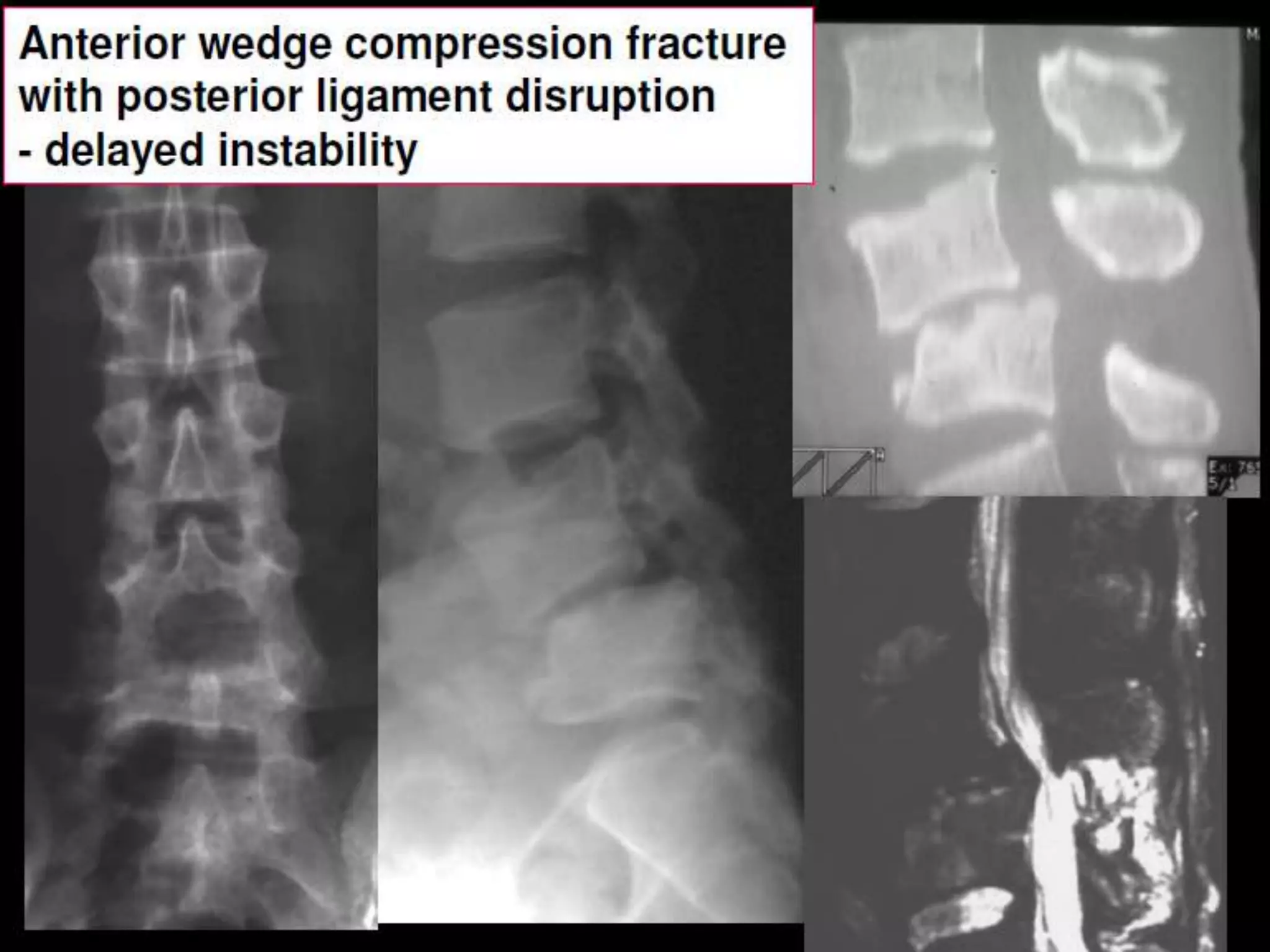
• initially STABLE, however: delayed 
instability if post ligament complex 
is injured and does not heal.
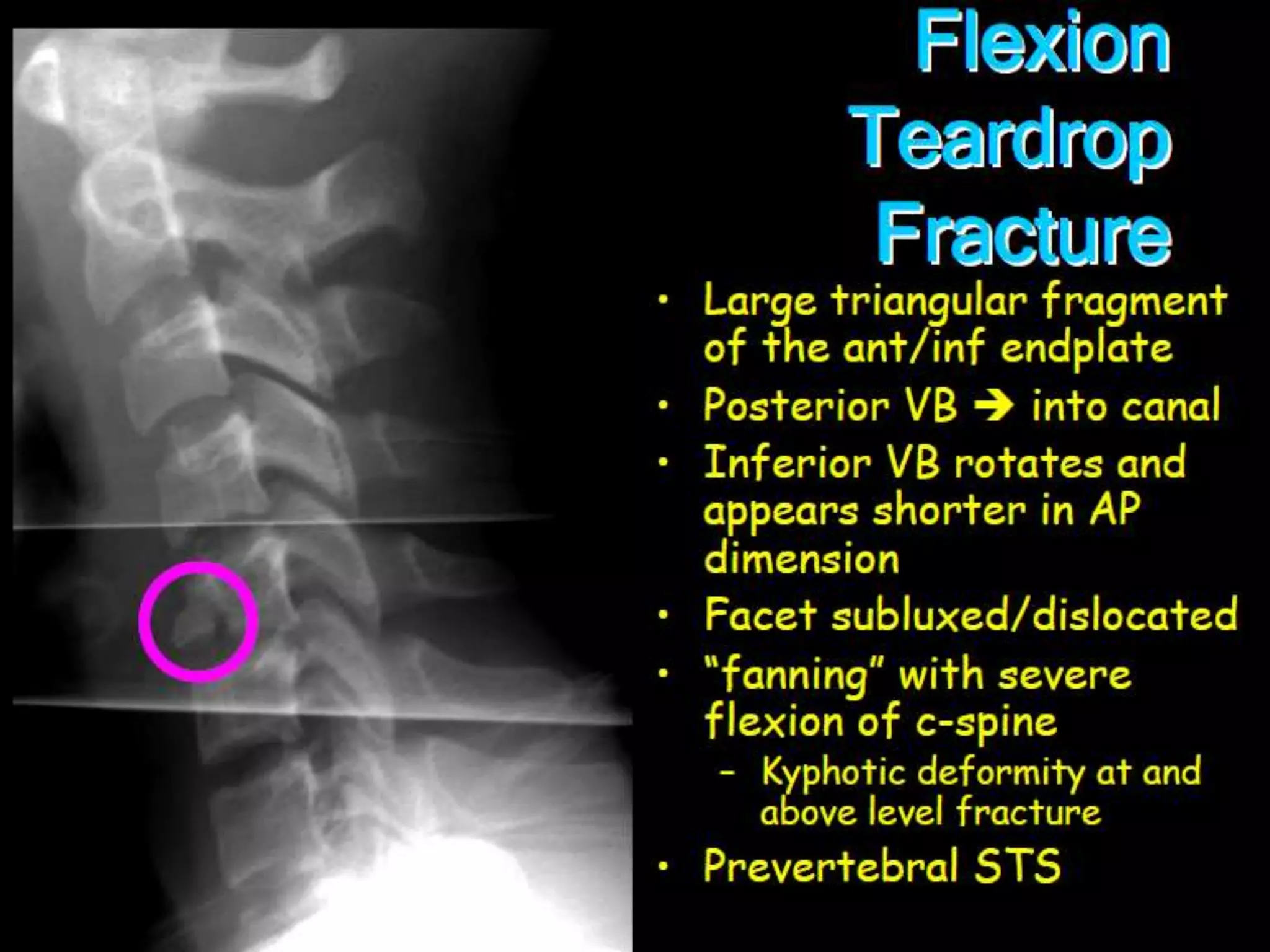
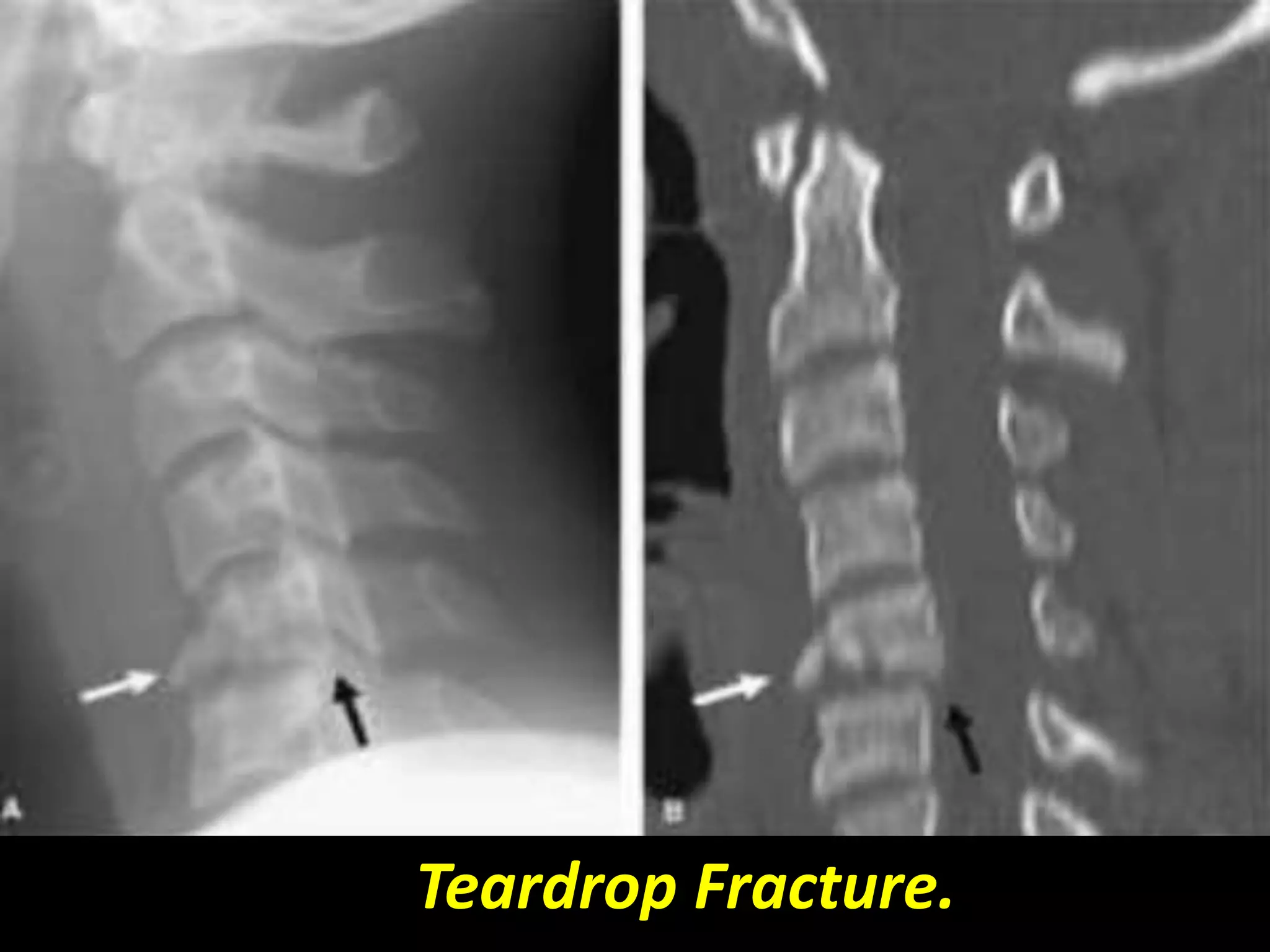
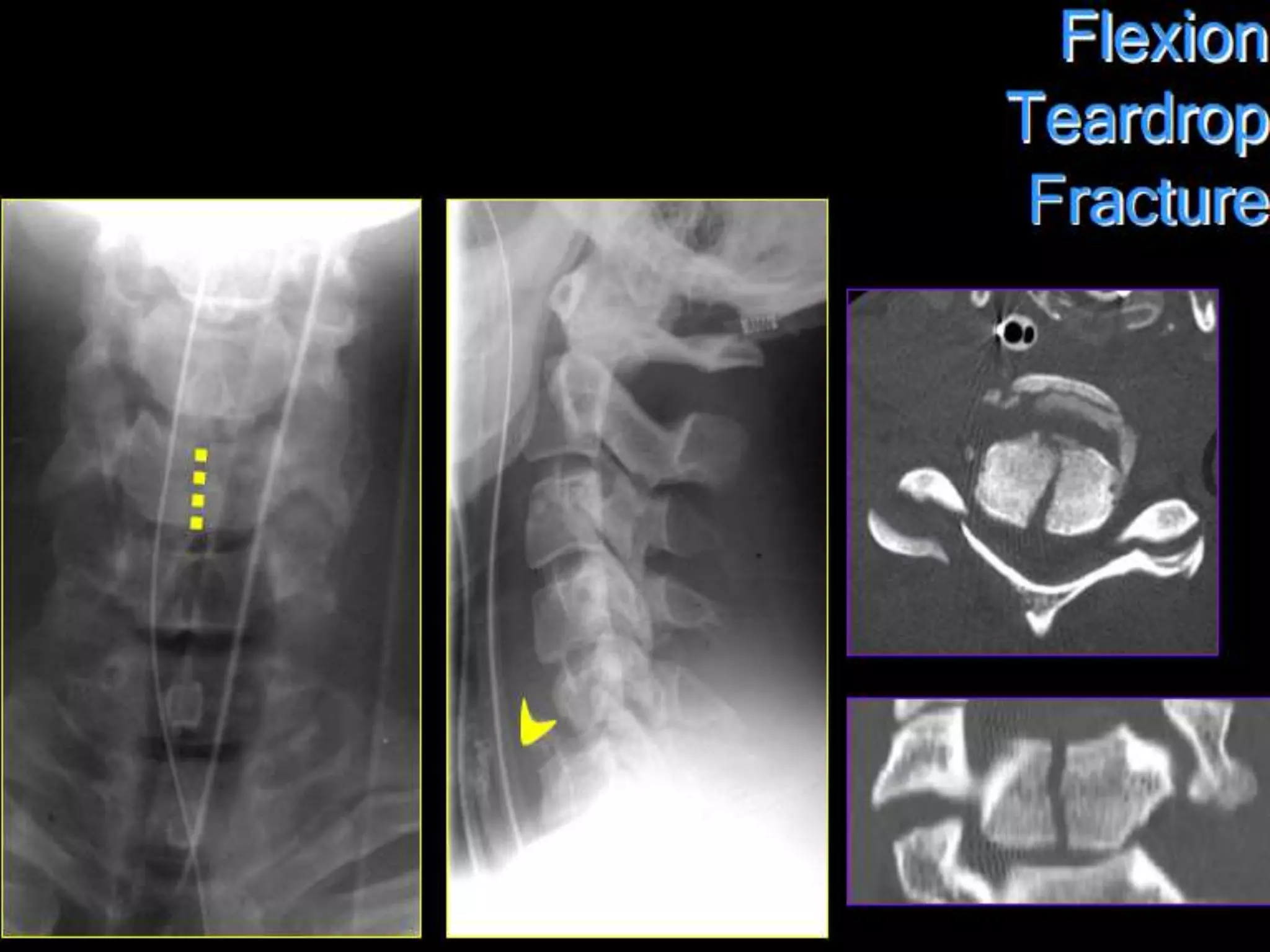
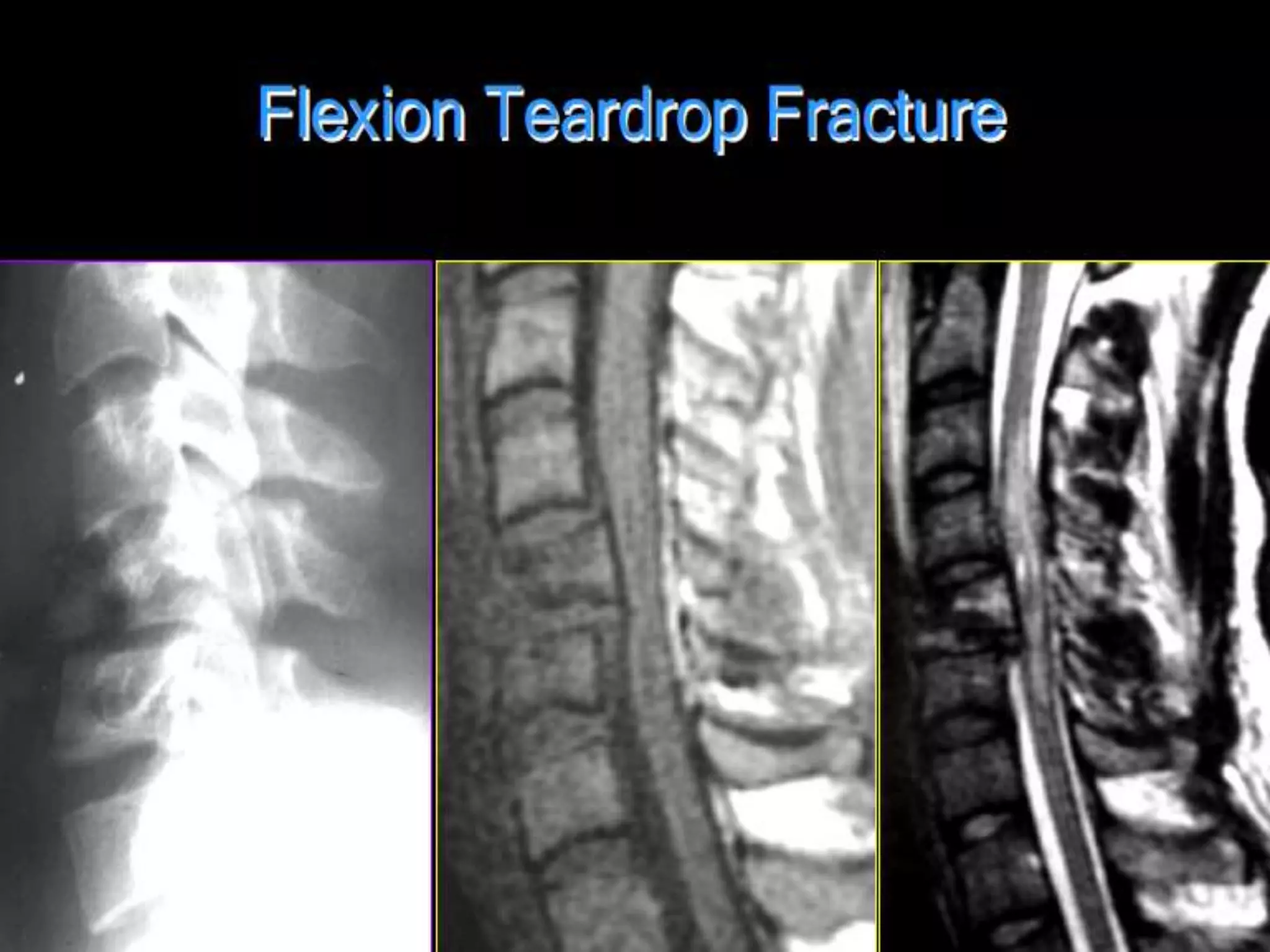
Flexion Teardrop Fracture 
• Most devastating c-spine injury 
compatible with life. 
• Severe flexion with disruption of all 
ligaments and disc + VB FX. 
• UNSTABLE 
Acute anterior cord syndrome 
1. Complete paralysis. 
2. Hypoesthesia and hypalgesia to level injury 
3. Preservation touch, motion, position and 
vibration sense.
Teardrop Fracture.
Hyperflexion Injury with Rotation. 
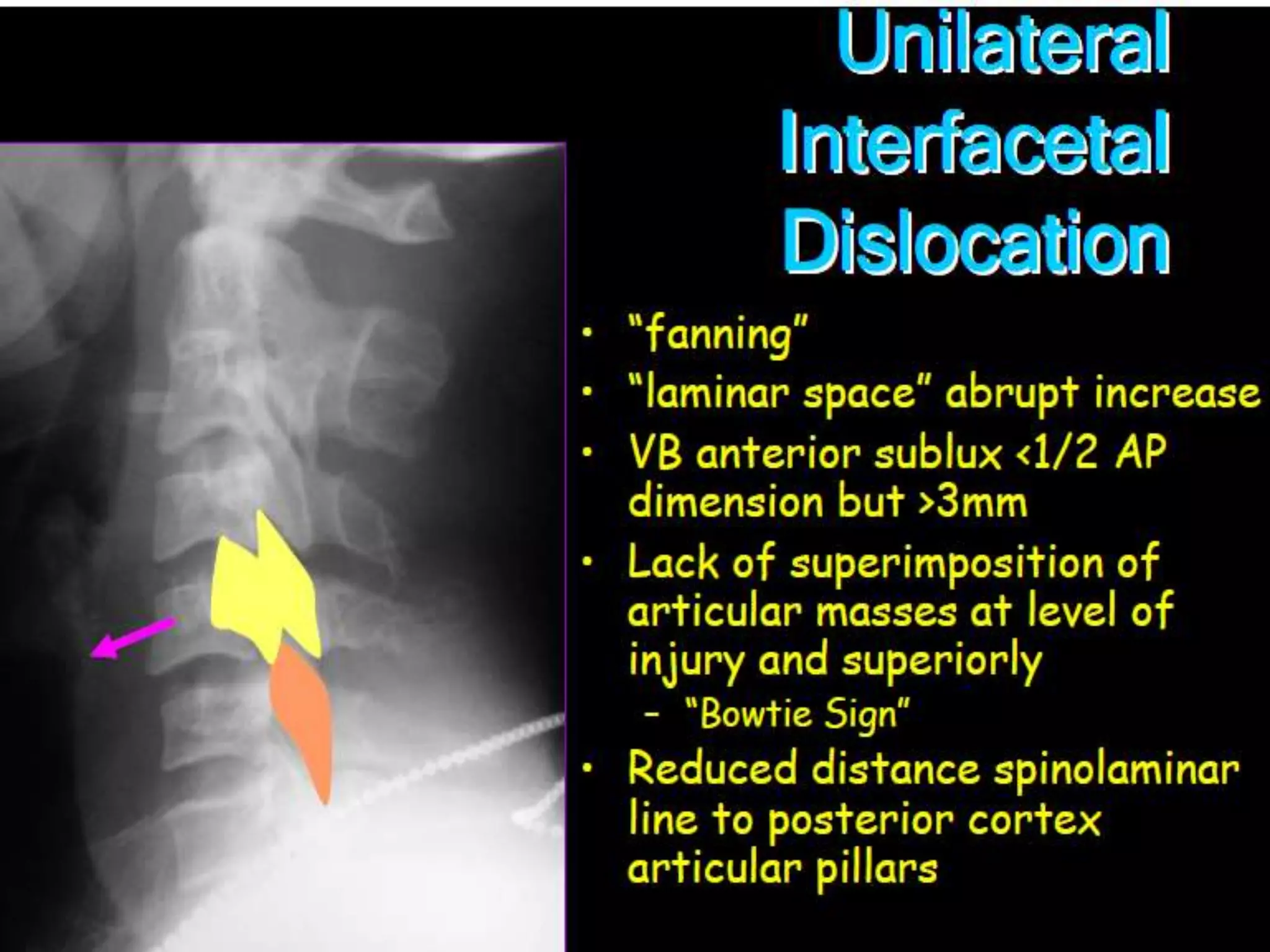
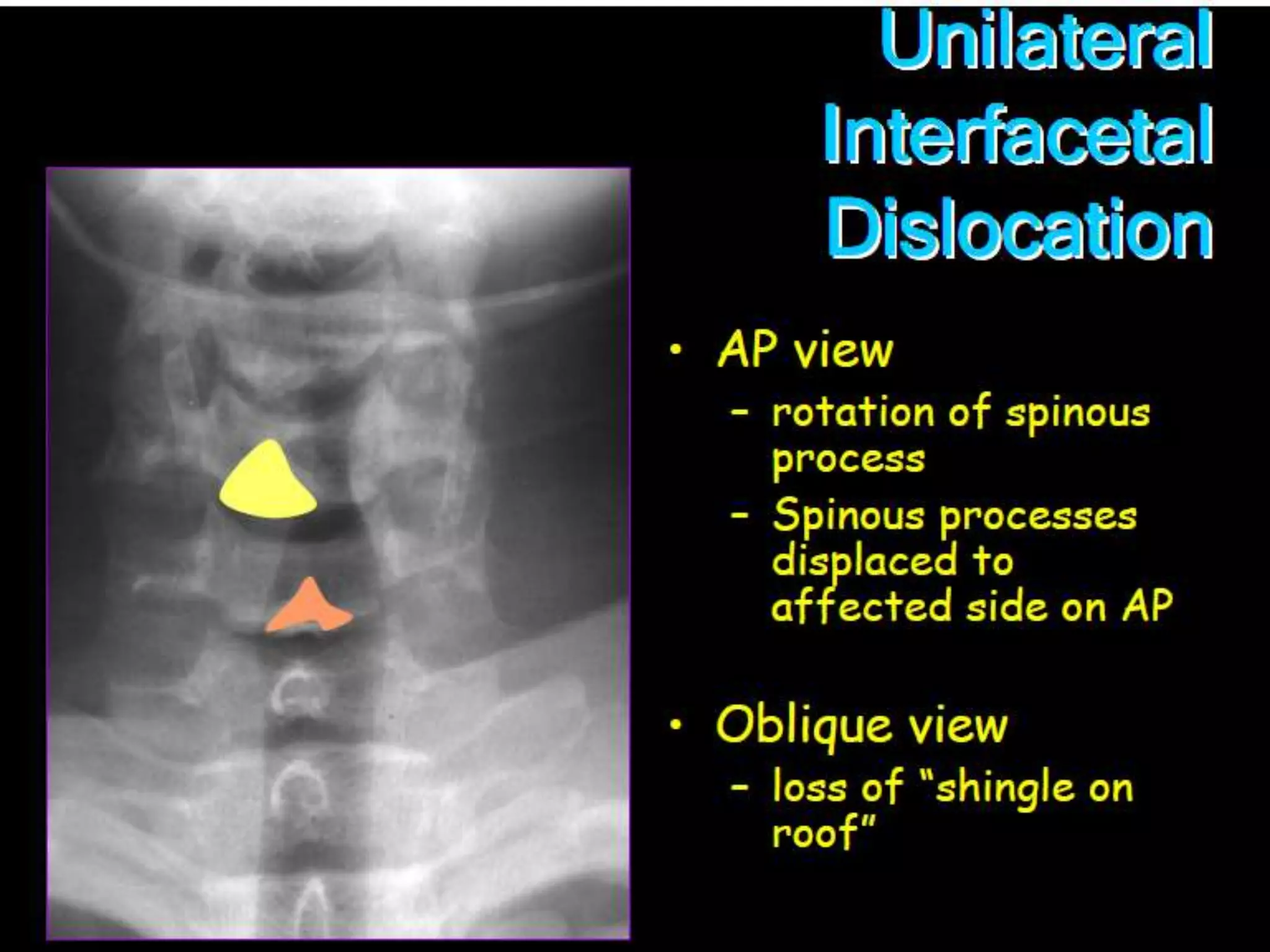
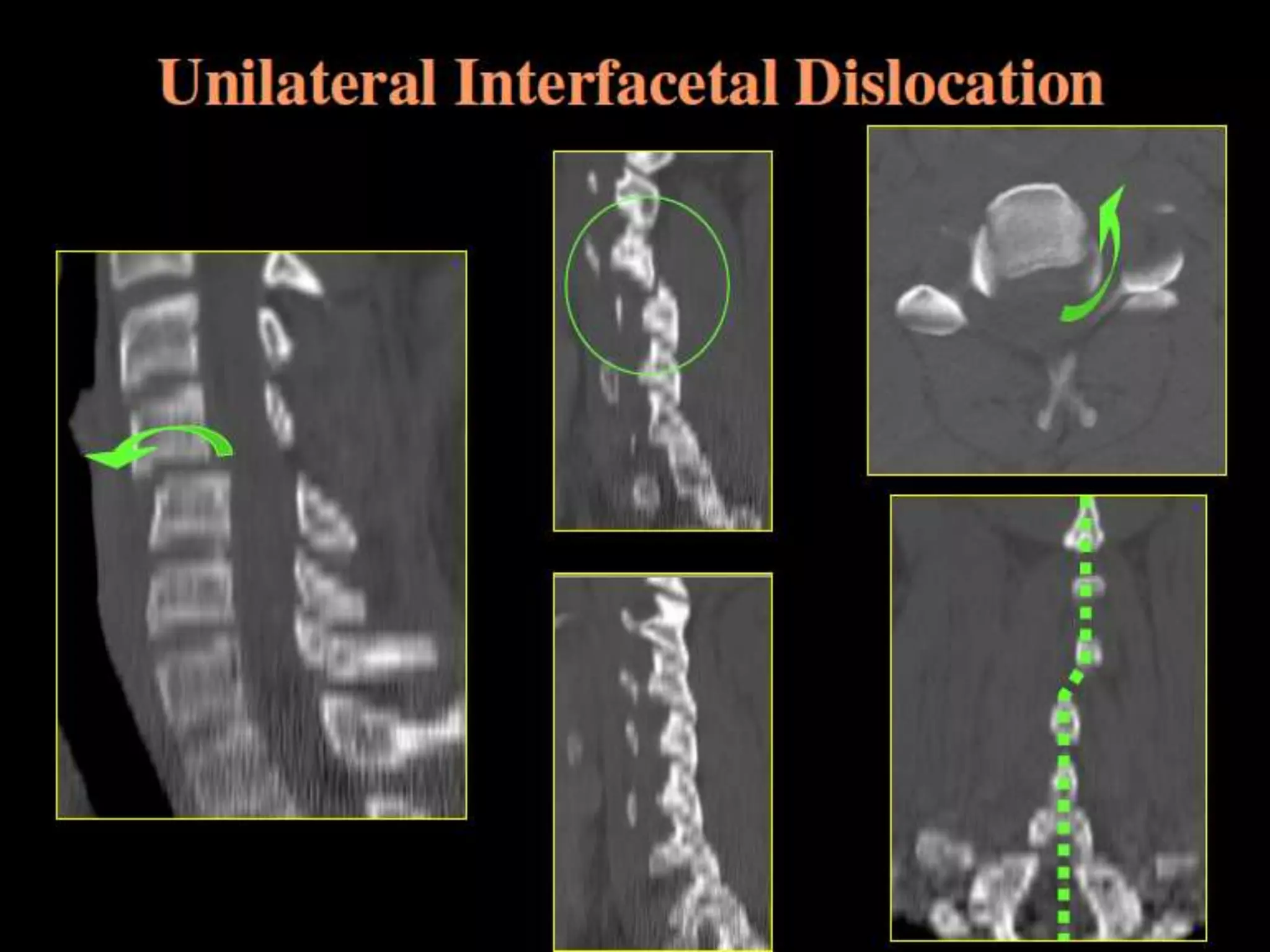
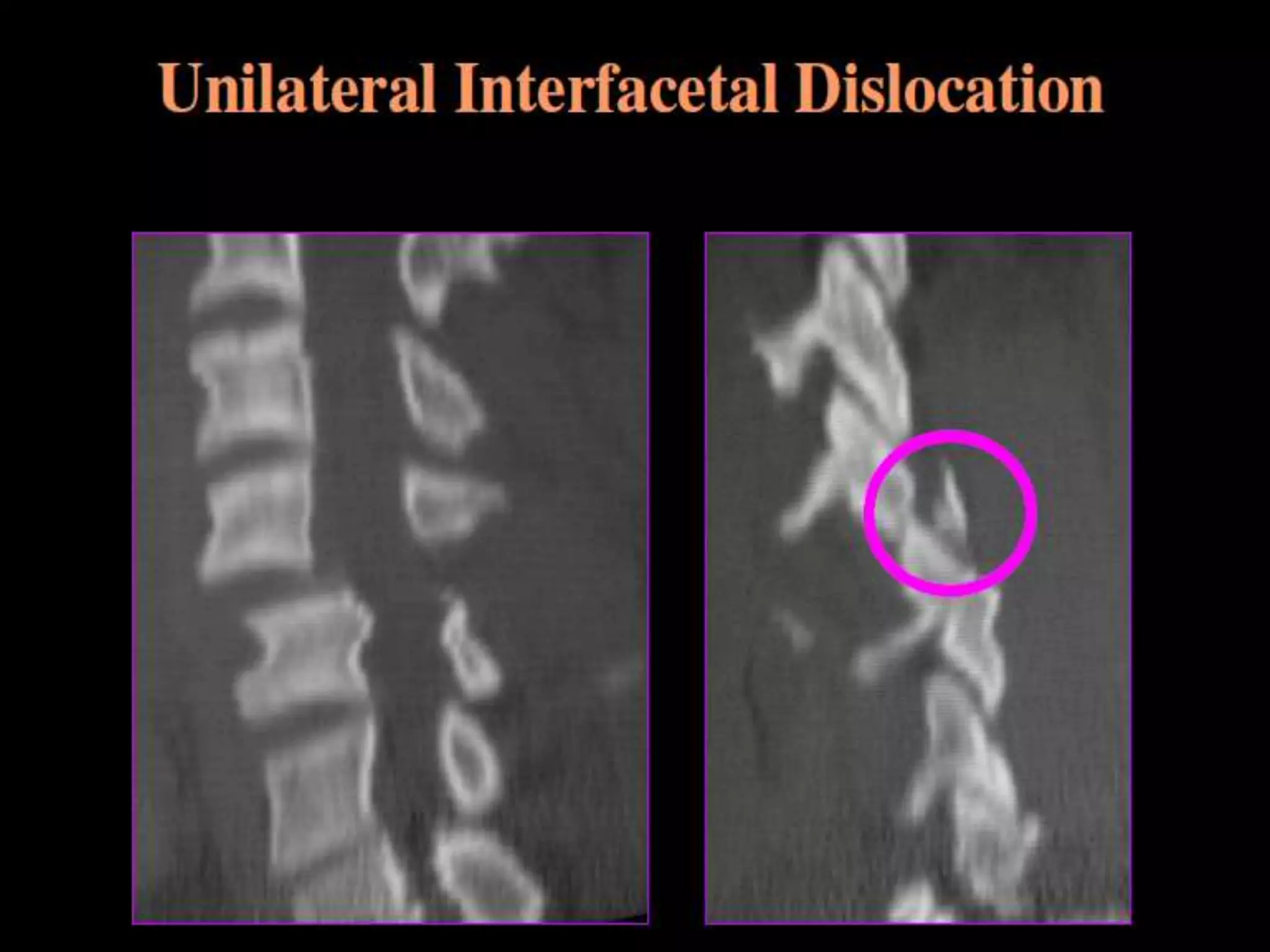
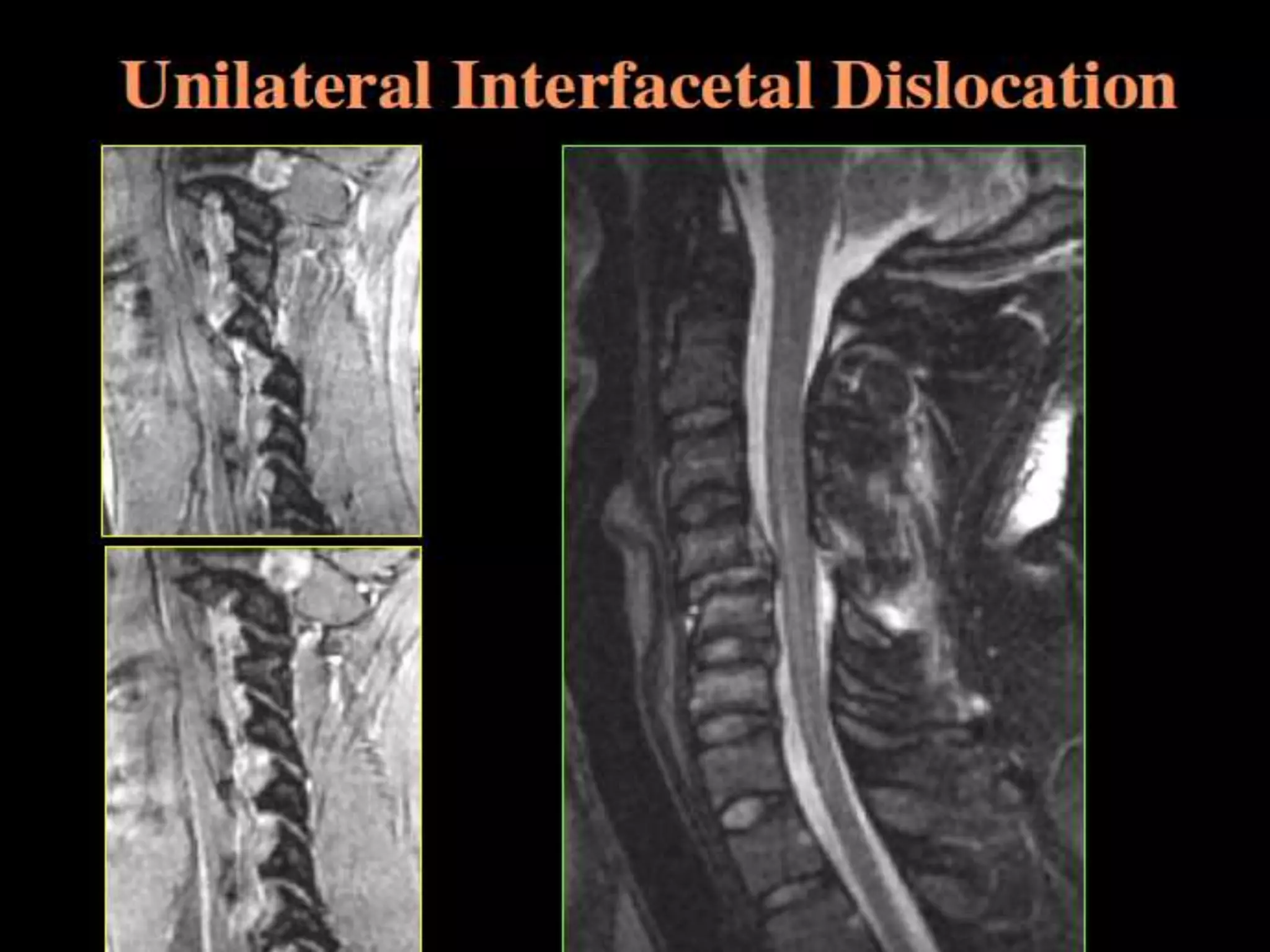
1. Unilateral Interfacetal Dislocation: 
– Dislocation of facet joint opposite that of the 
direction of rotation. 
– Posterior ligament complex and articular 
joint capsule are disrupted. 
– ALL, disc and PLL intact. 
– Most common at C5-6, C6-7. 
– Impaction fractures tip of either articular 
mass (up to 70%). 
– STABLE, unless FX isolates articular process.
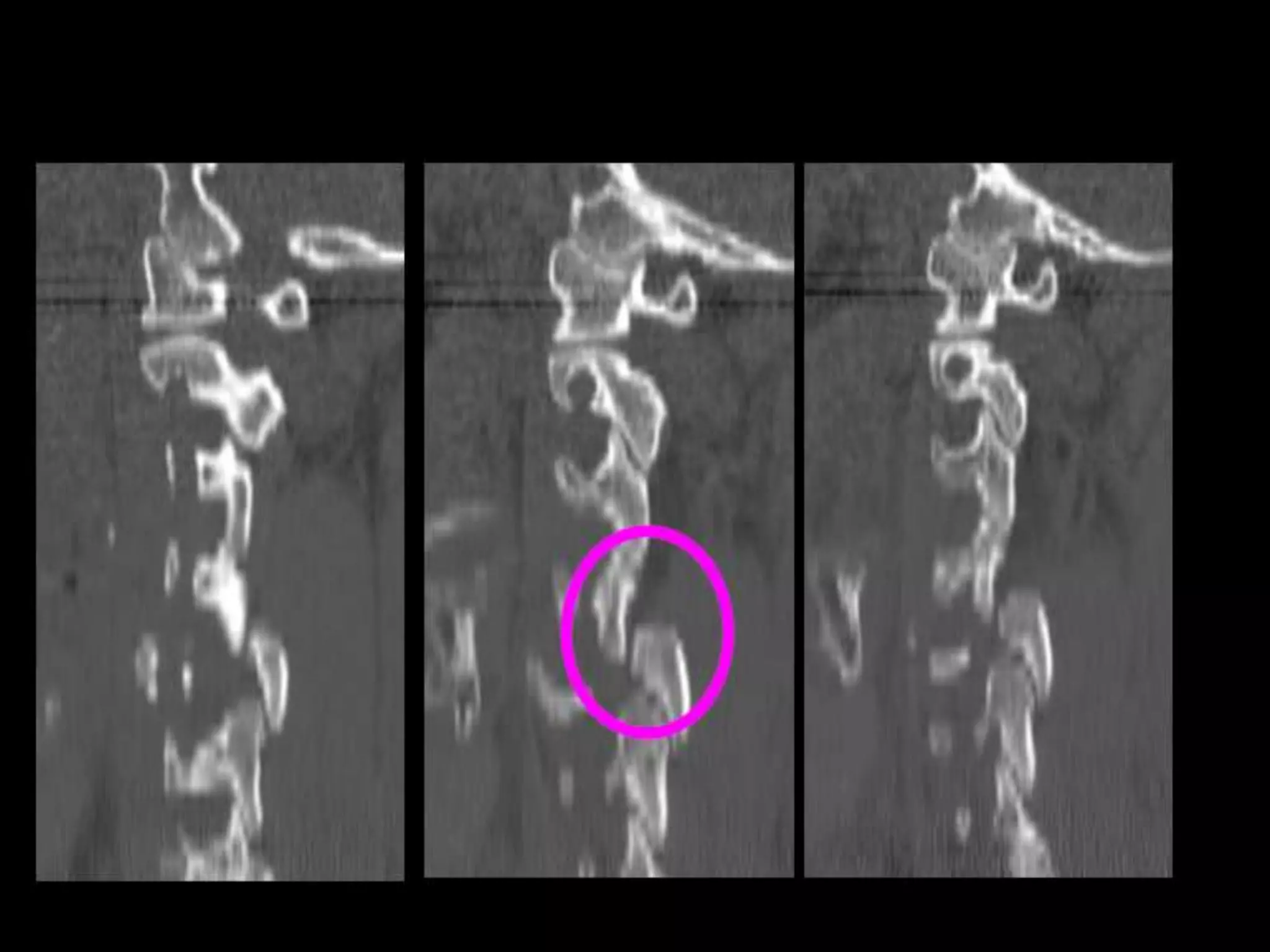
Vertical Compression(Axial Load). 
•Force delivered to top of skull 
through the occipital condyles to 
the cervical spine at the instant 
that the cervical spine is straight 
• Injury Patterns: 
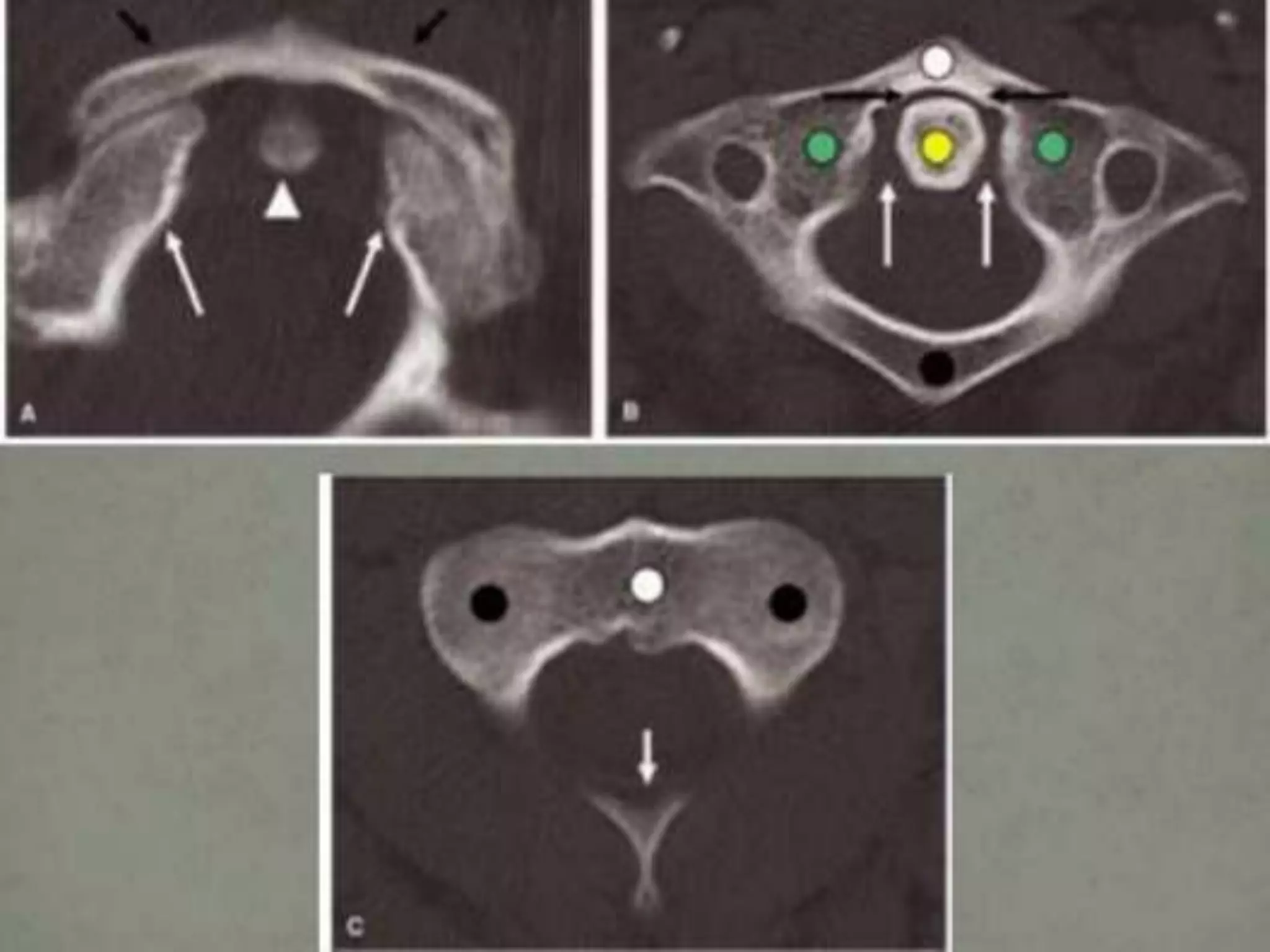
1. Jefferson fracture. 
2. Burst fracture.
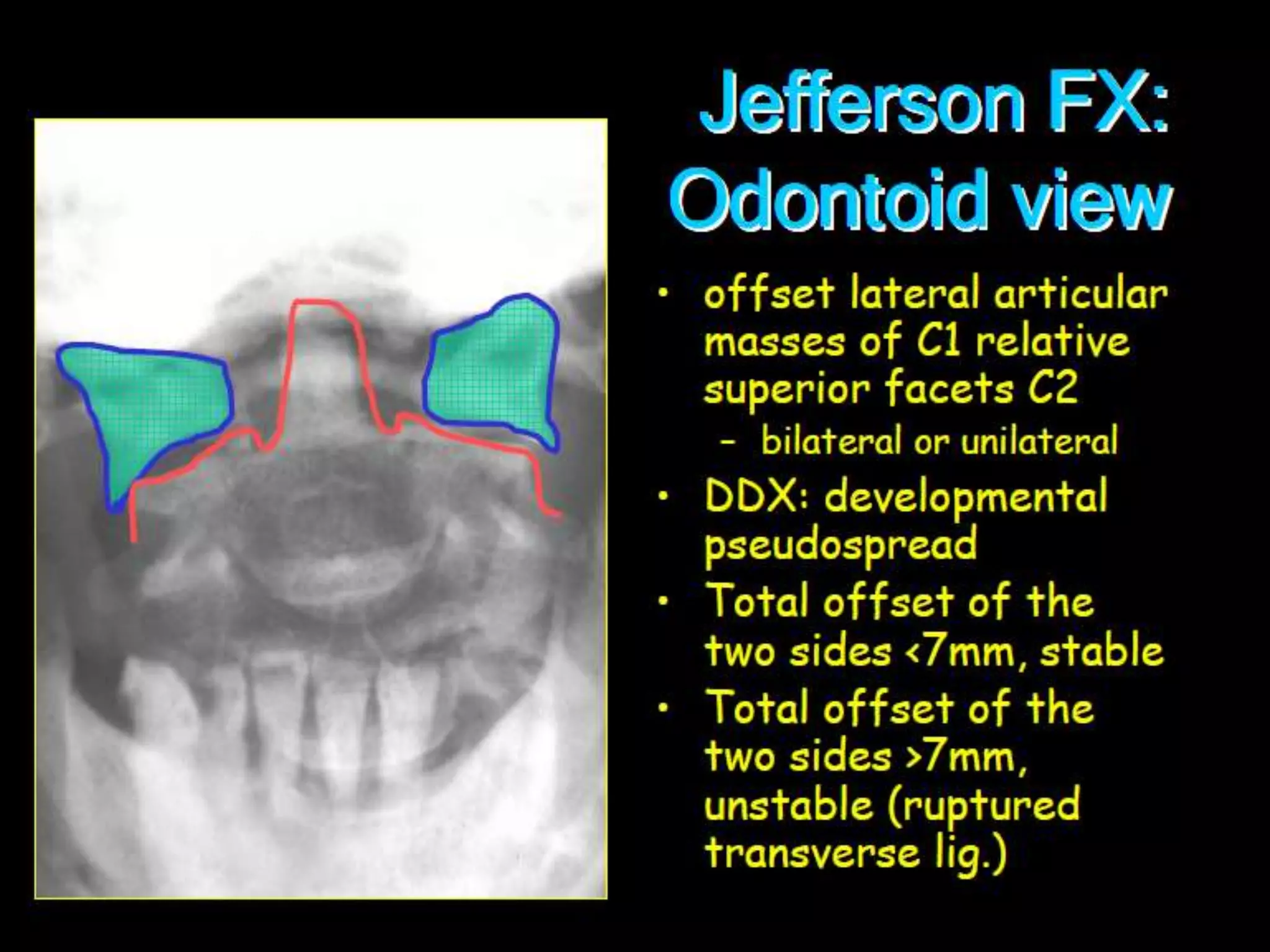
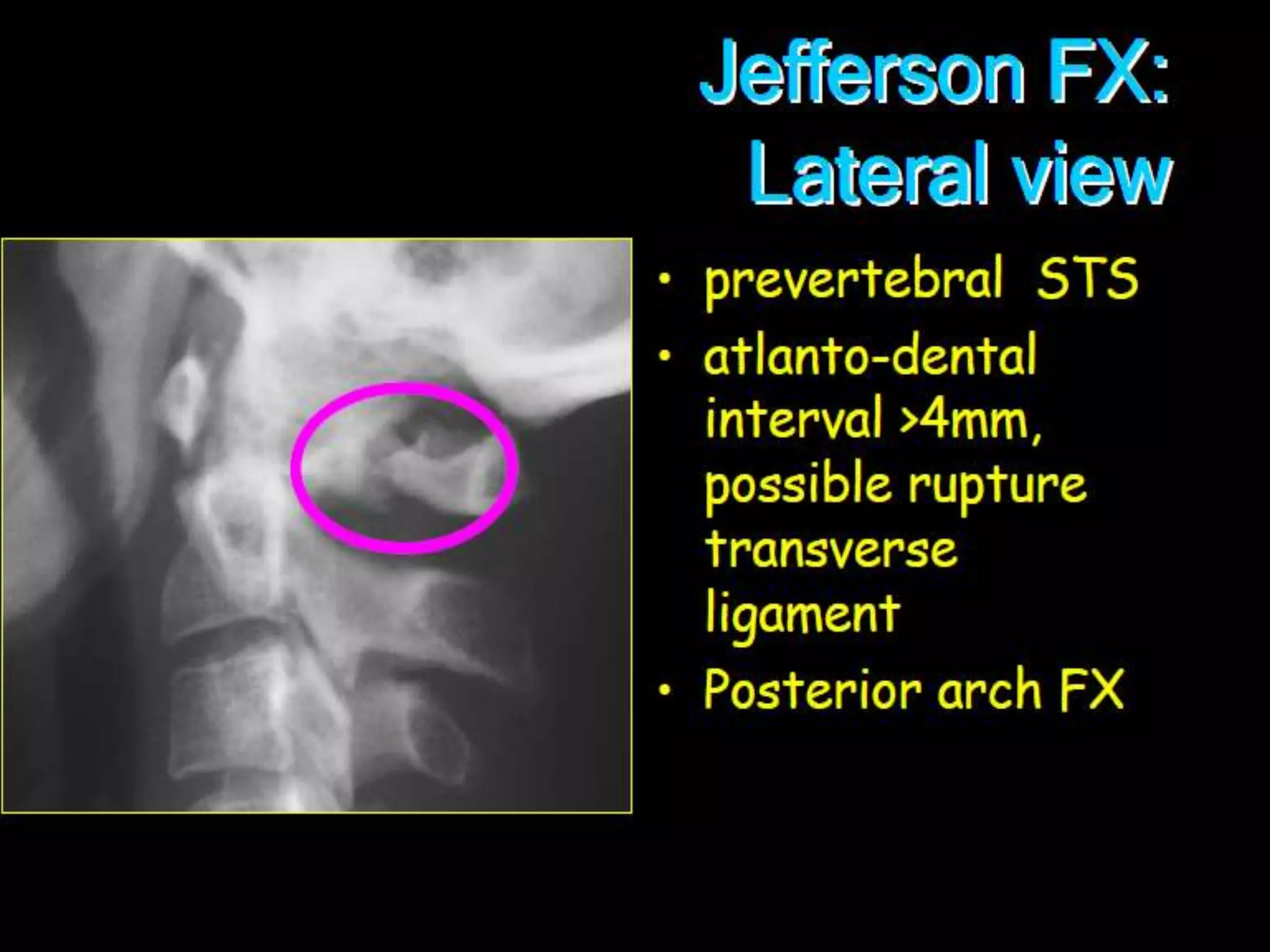
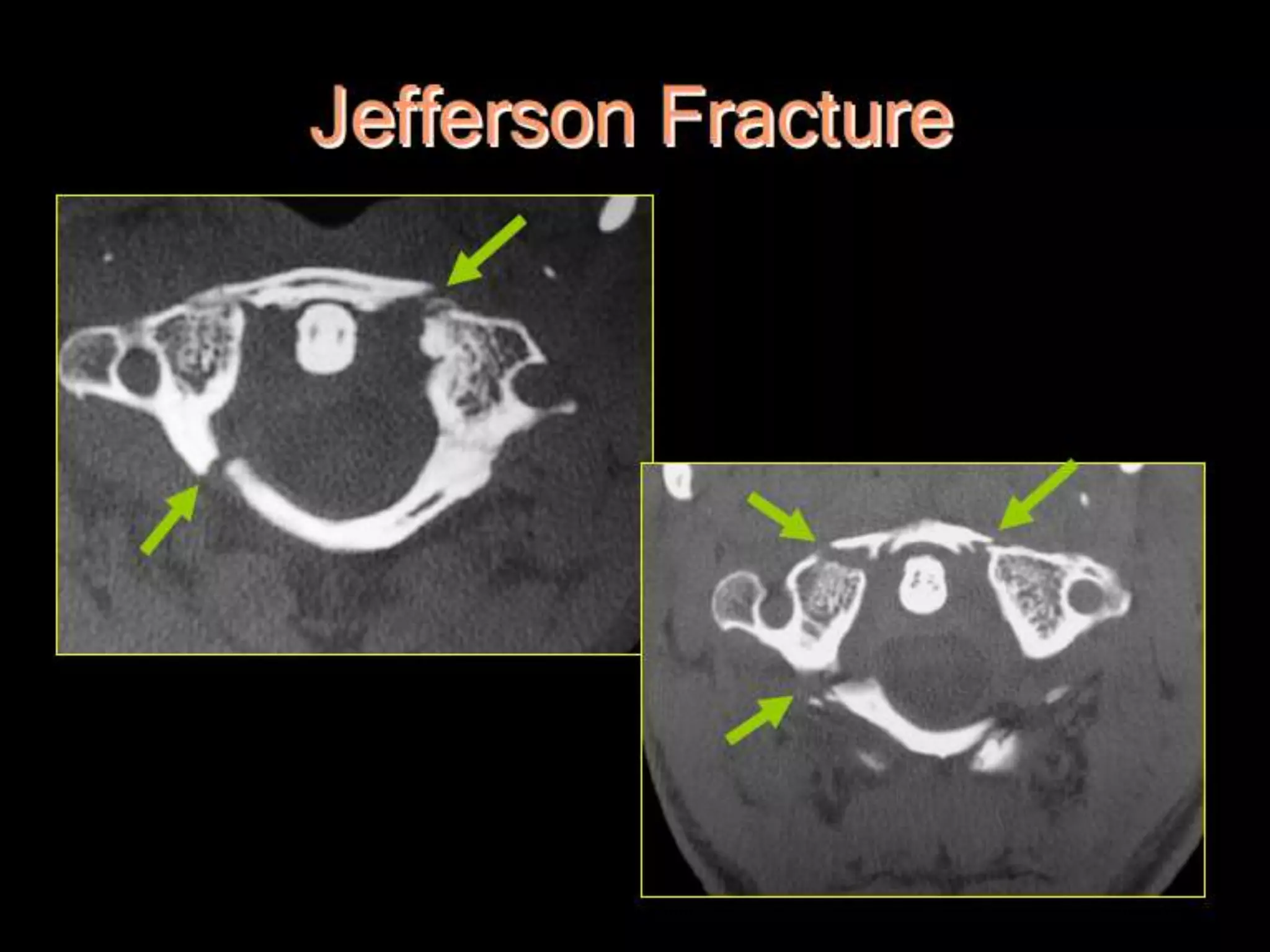
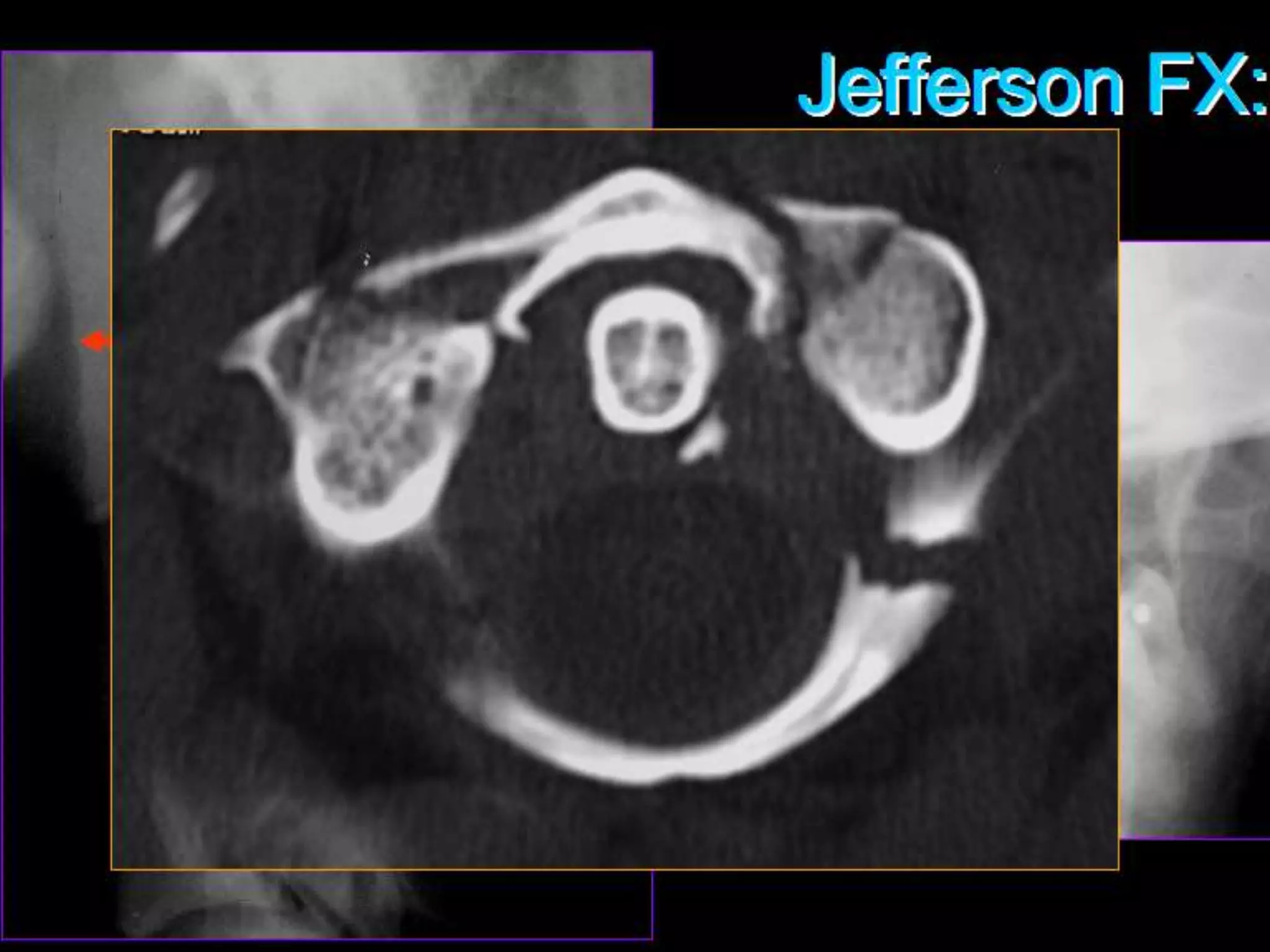
Jefferson Fracture: 
• Splitting of C1 ring with fracture of both the 
anterior and posterior arch 
– may result from a single break in each arch 
(anterior and posterior) 
– bilateral or unilateral 
• Centripetal displacement fragments 
• 50% associated fractures 
– 33% = axis fractures 
• no neurologic deficit 
• Transverse atlantal ligament intact or not 
• UNSTABLE
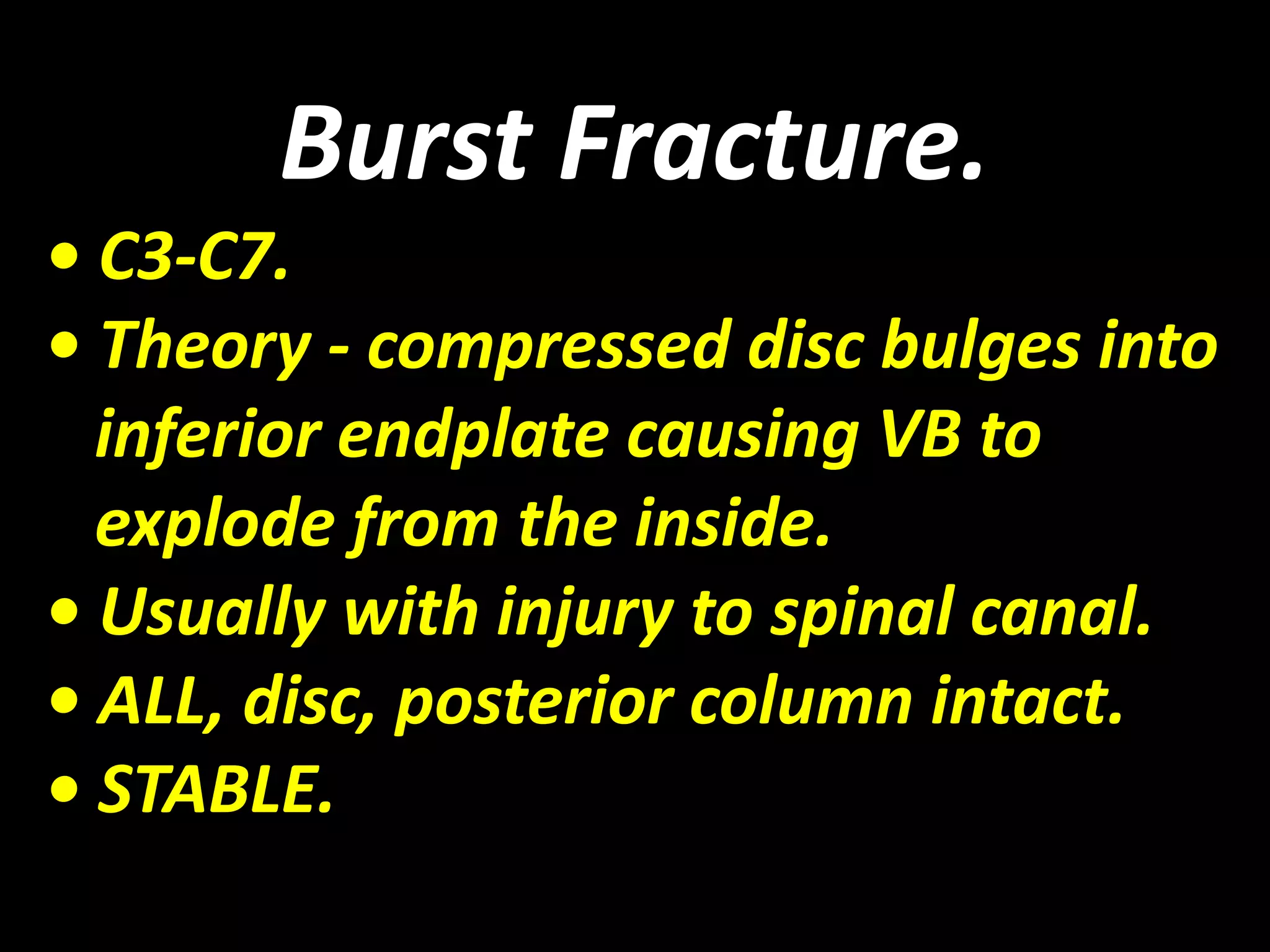
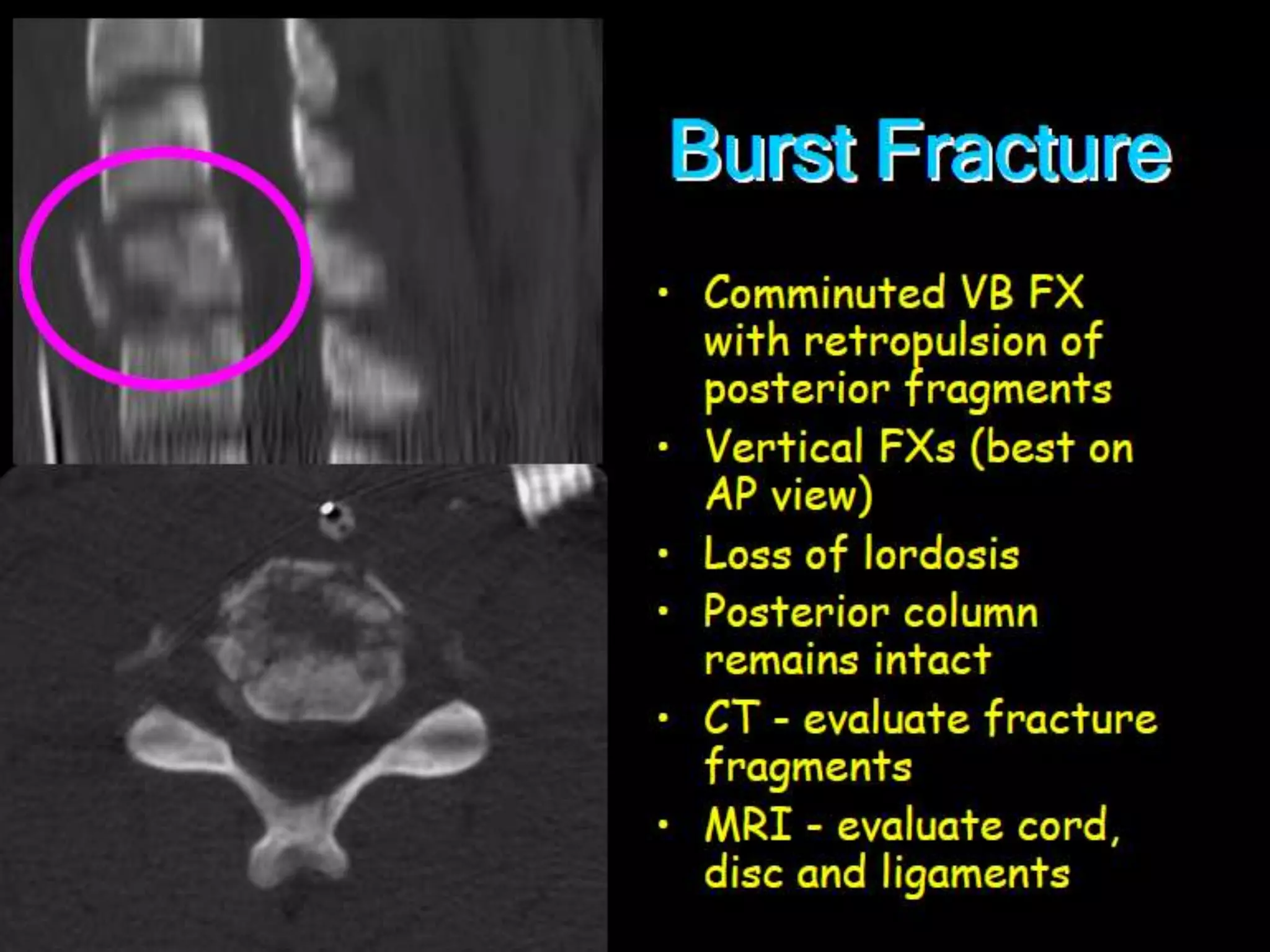
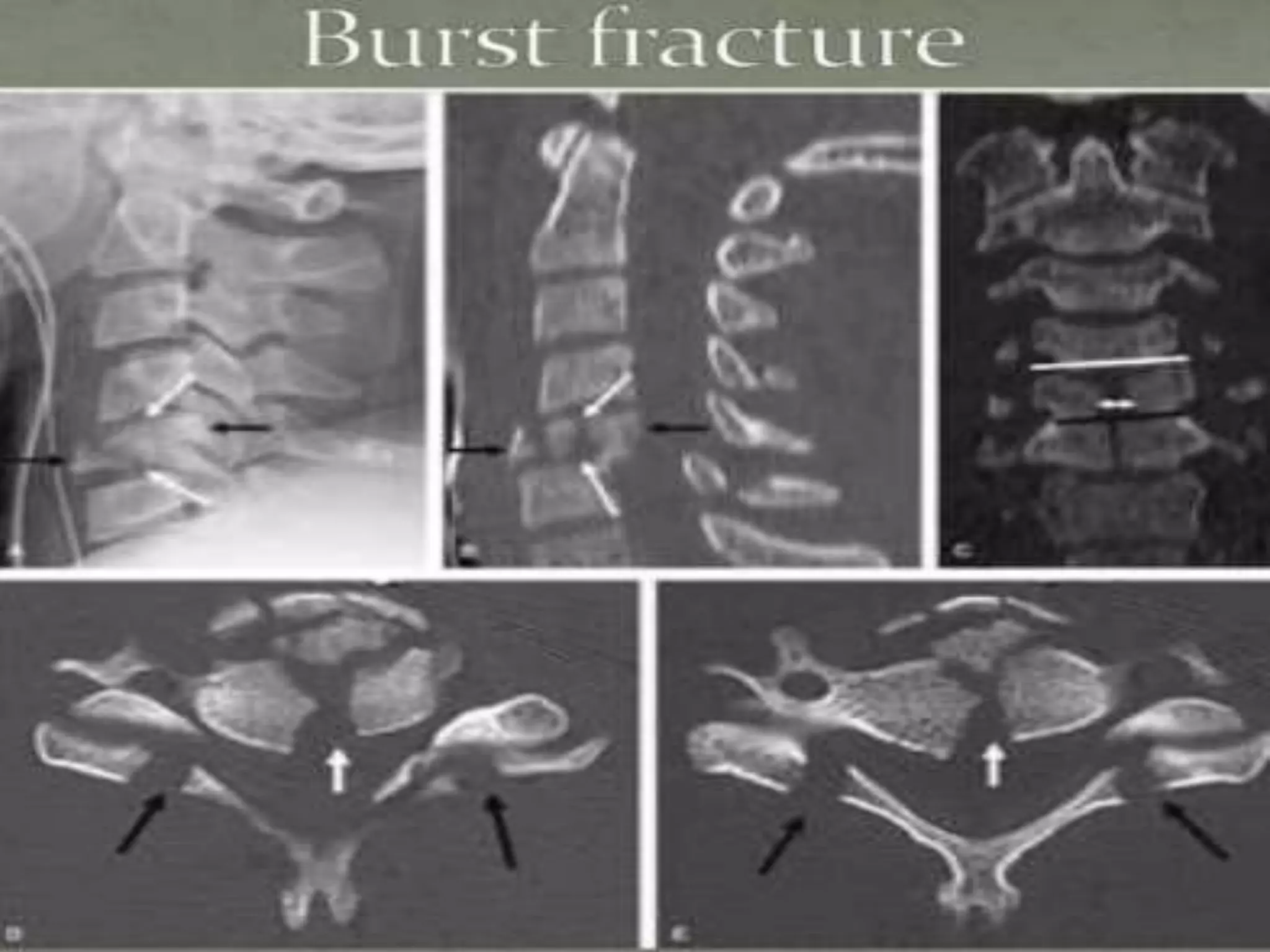
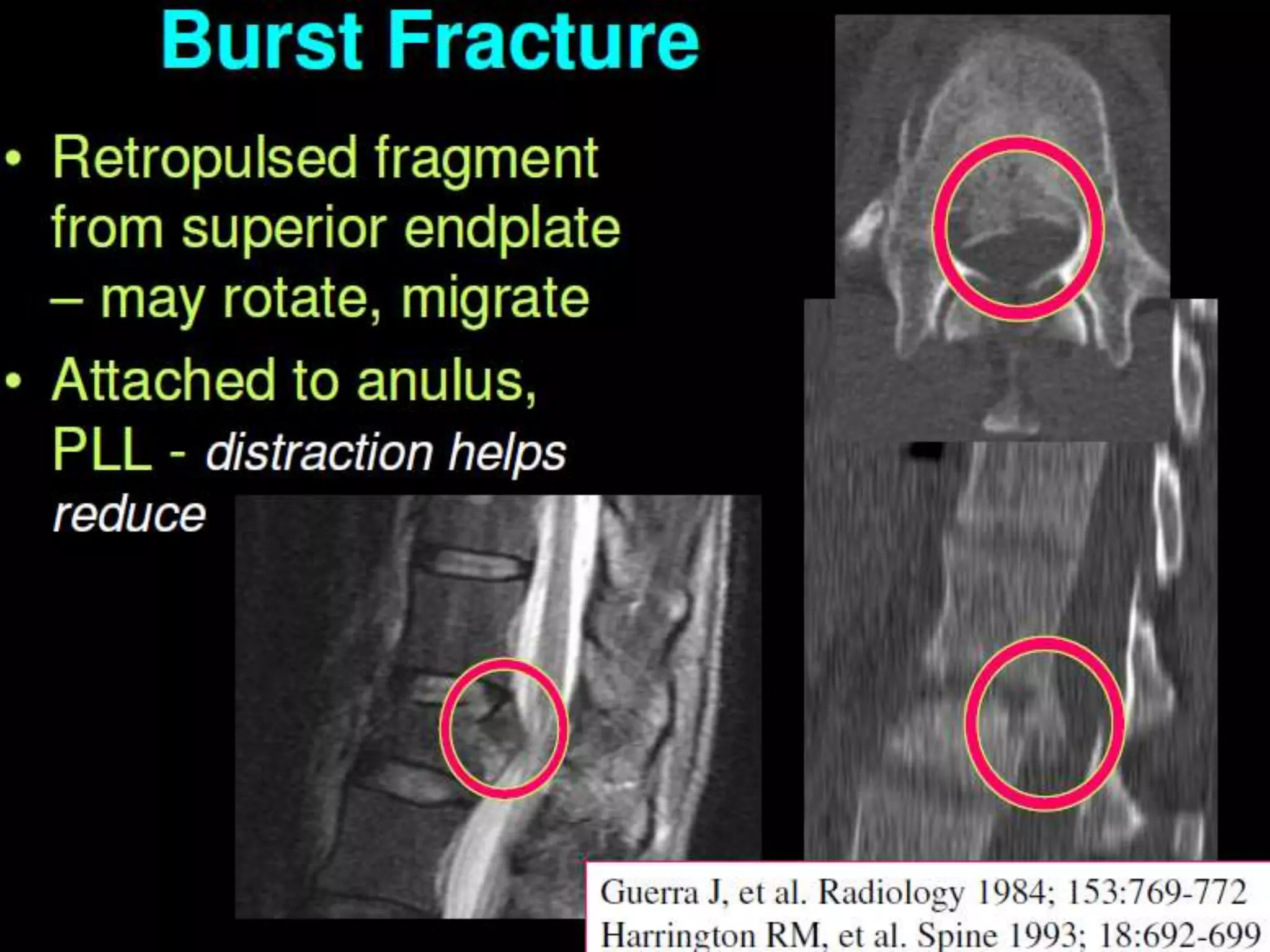
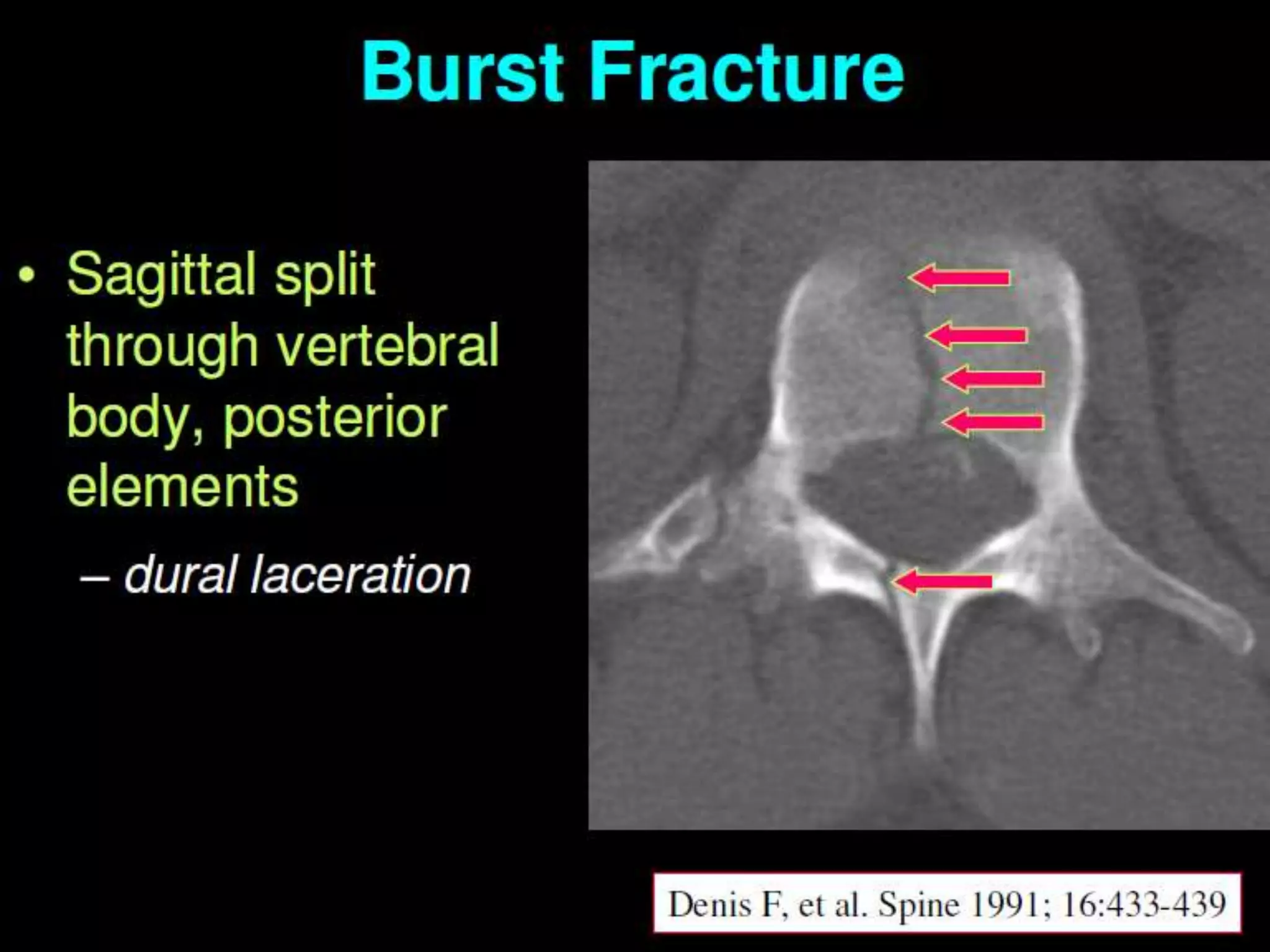
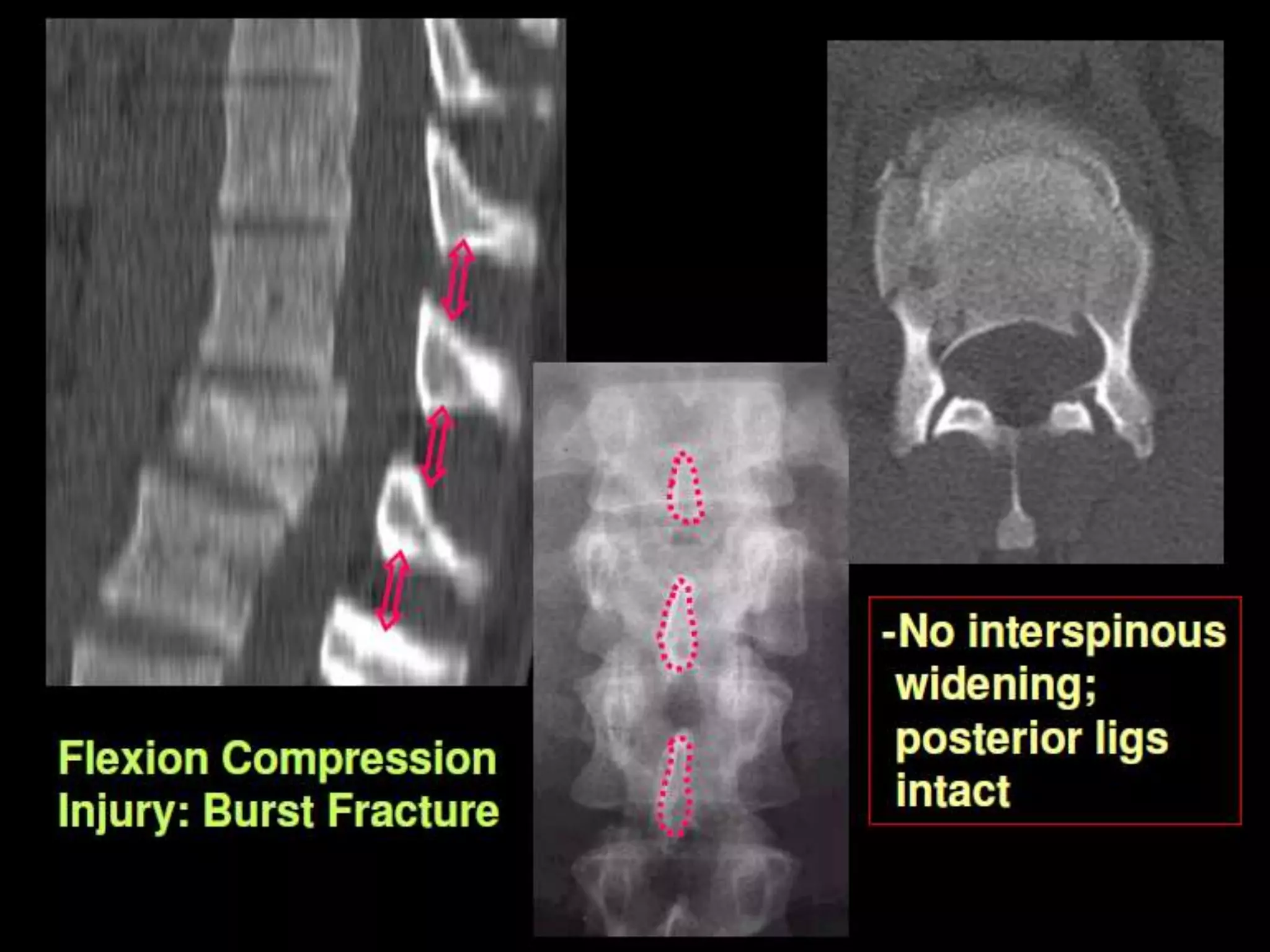
Burst Fracture. 
• C3-C7. 
• Theory - compressed disc bulges into 
inferior endplate causing VB to 
explode from the inside. 
• Usually with injury to spinal canal. 
• ALL, disc, posterior column intact. 
• STABLE.
Hyperextension Injuries: 
1. Hangman’s fracture. 
2. Hyperextension dislocation. 
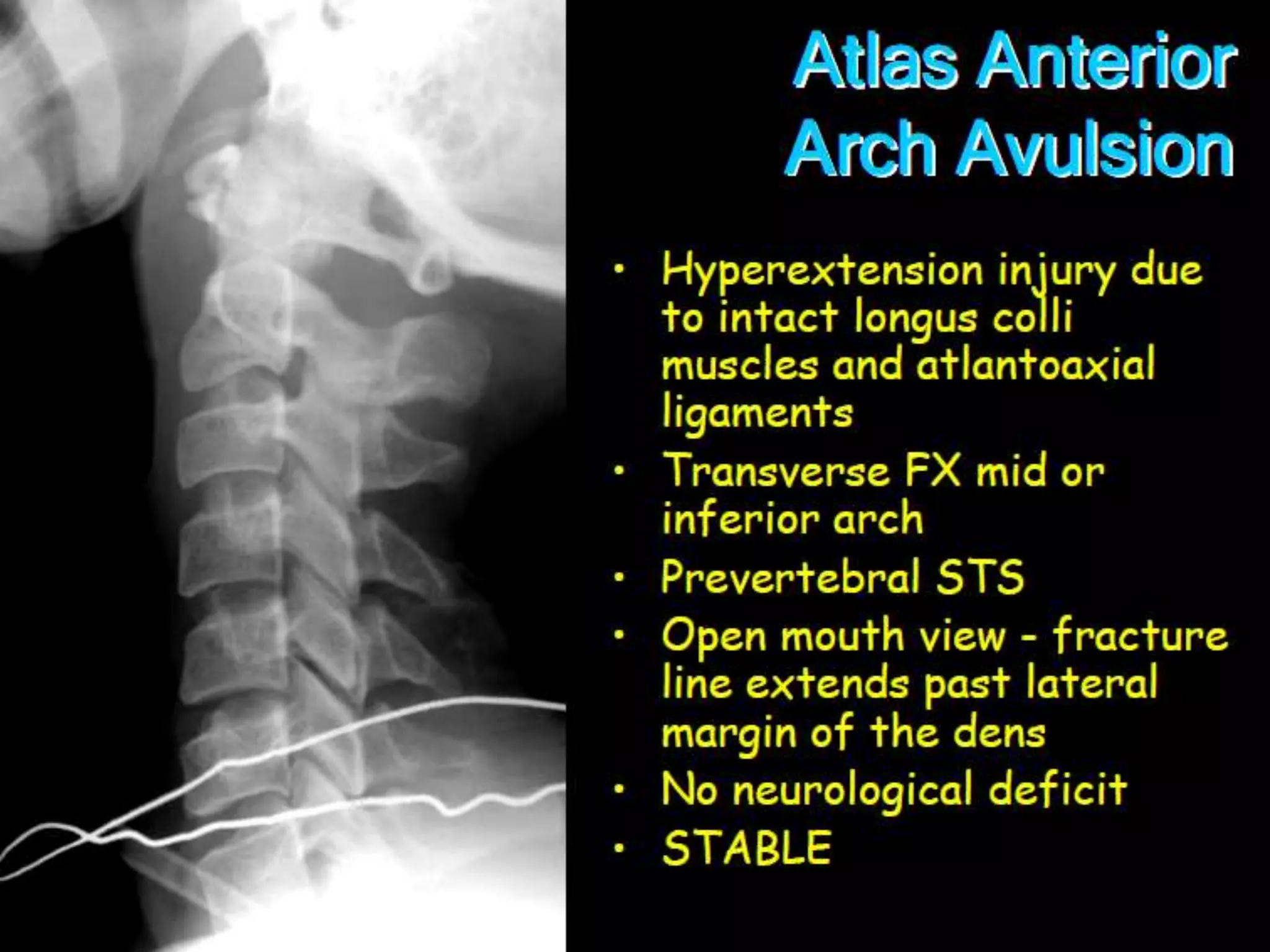
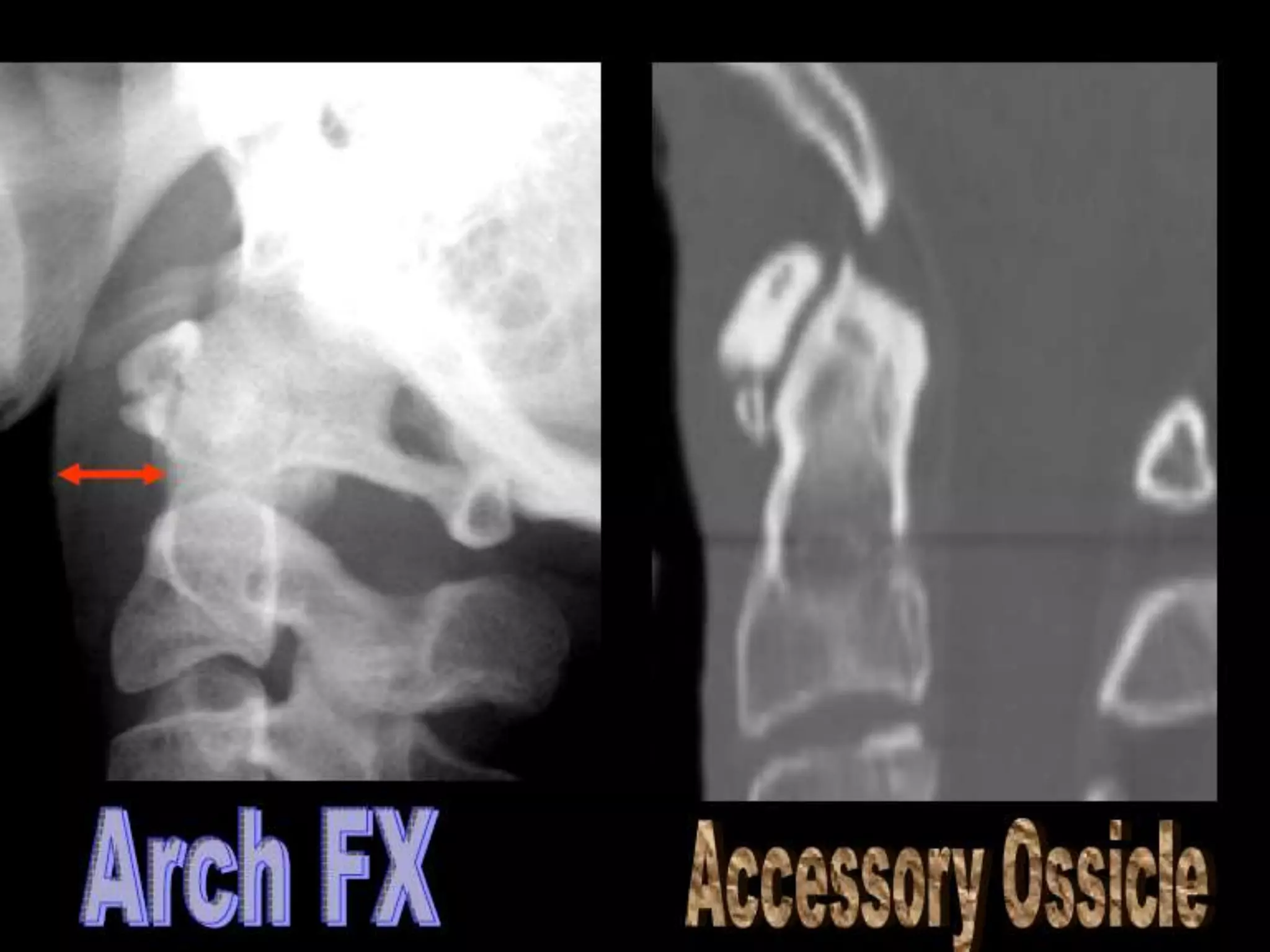
3. Anterior arch avulsion of the Atlas. 
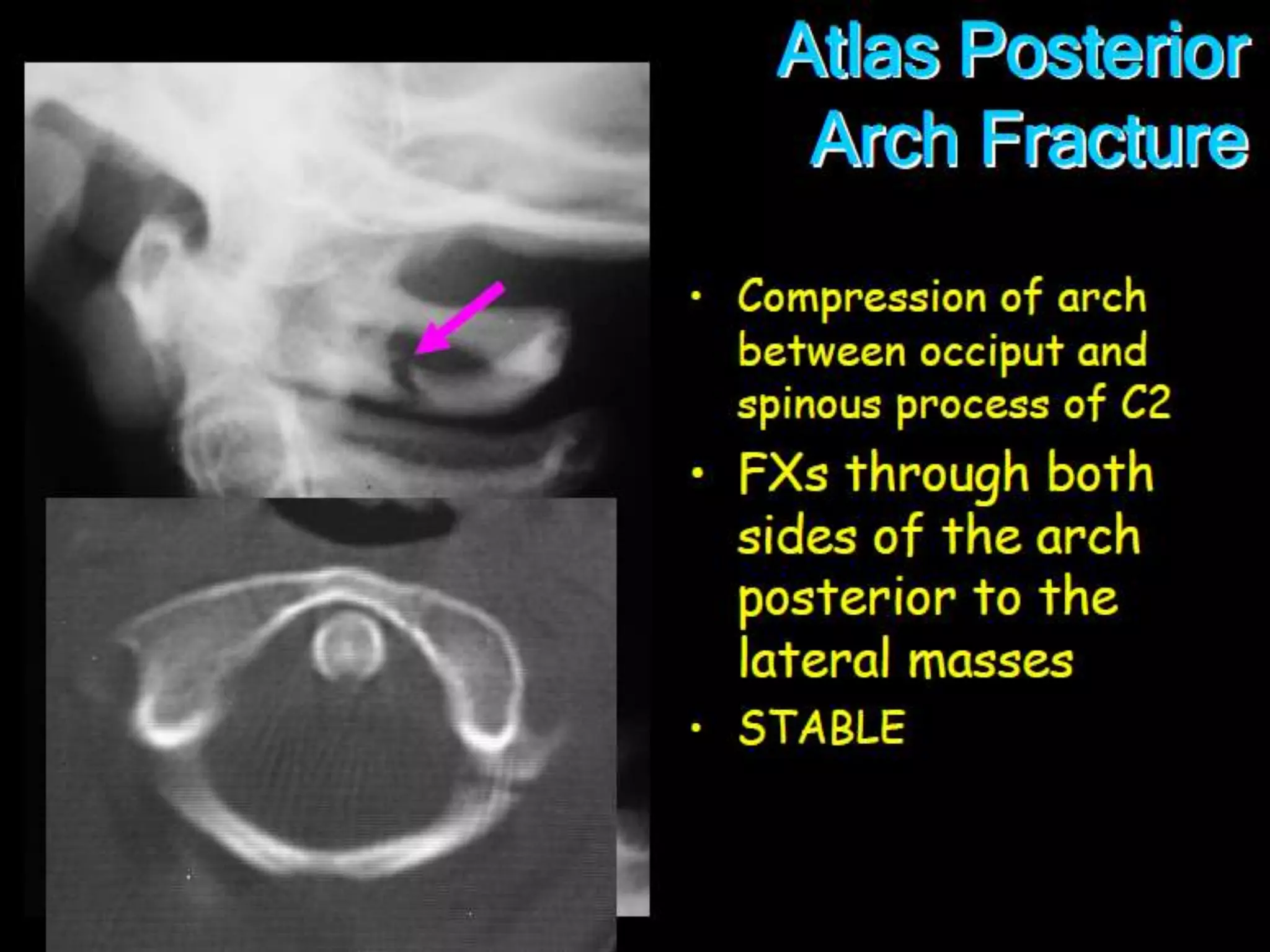
4. Posterior arch fracture of the Atlas 
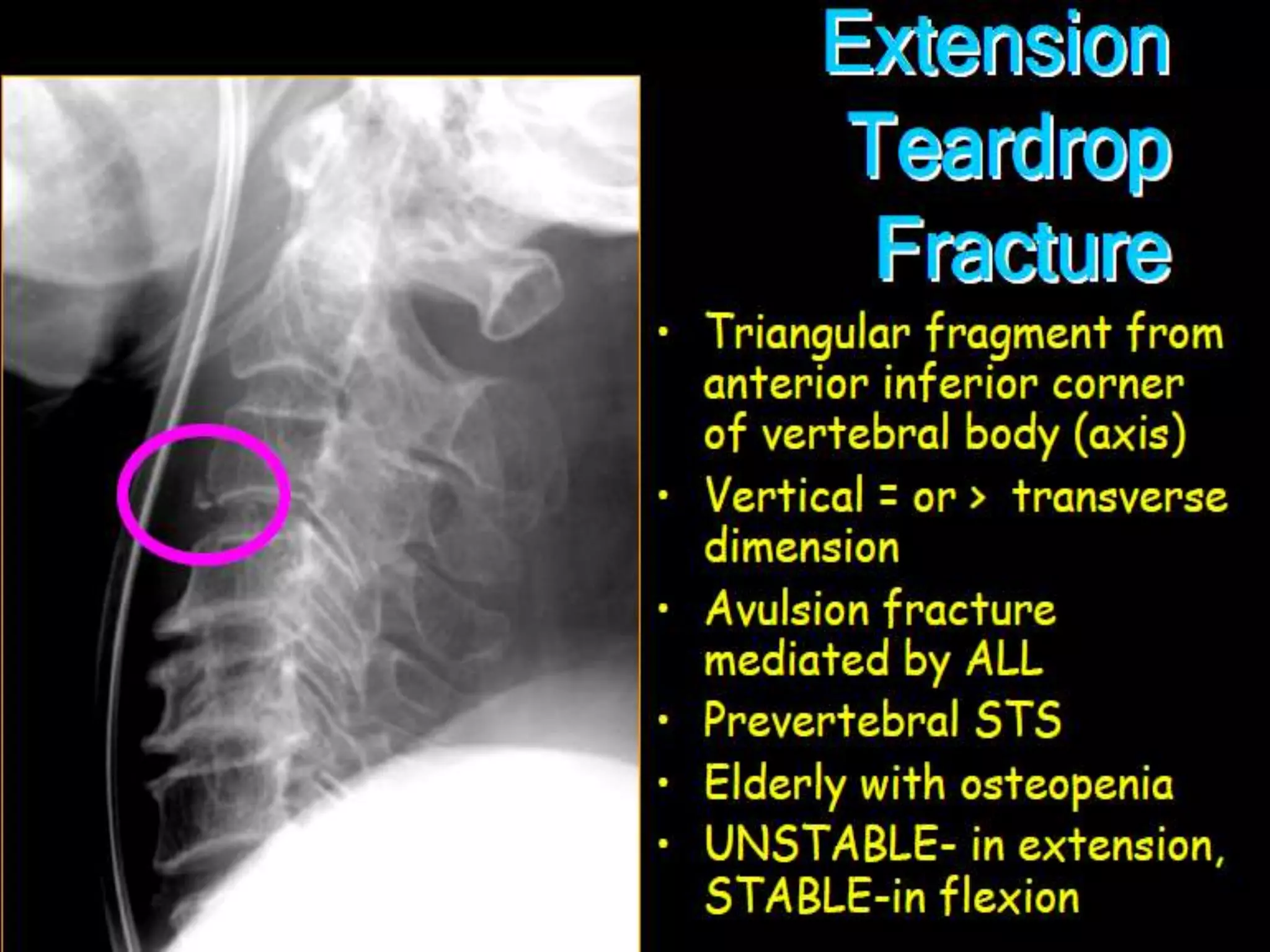
5. Extension teardrop fracture. 
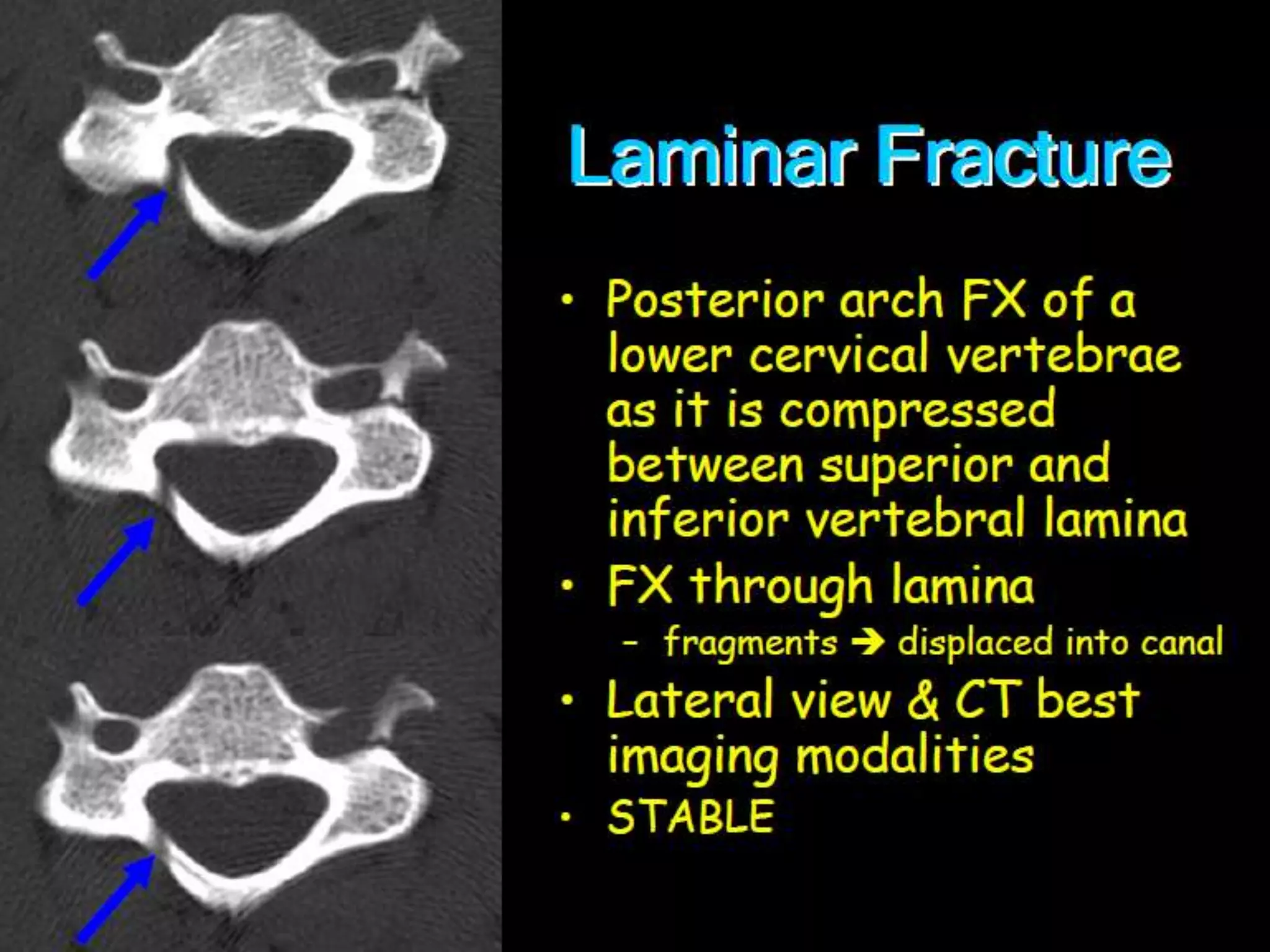
6. Laminar fracture.
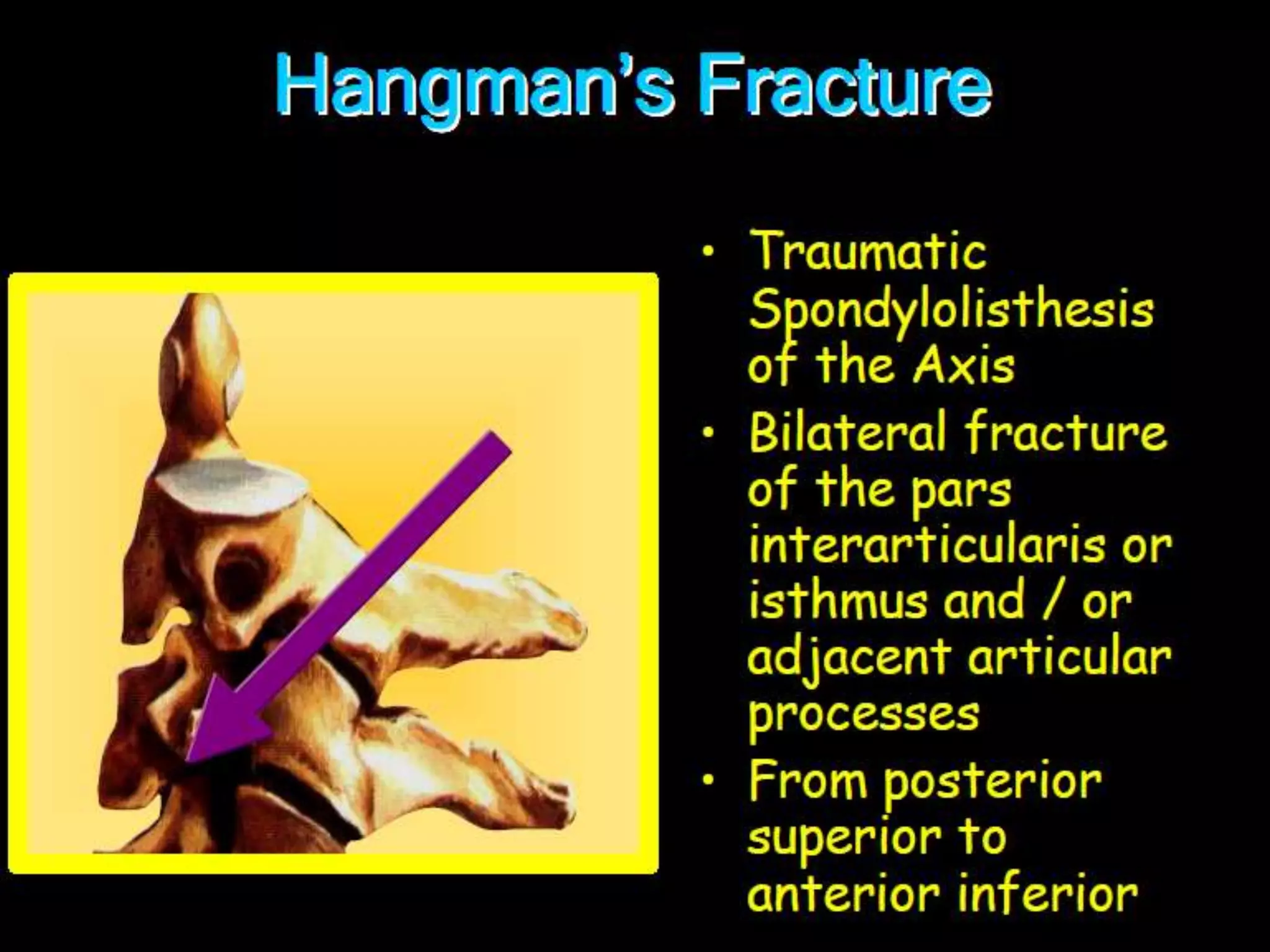
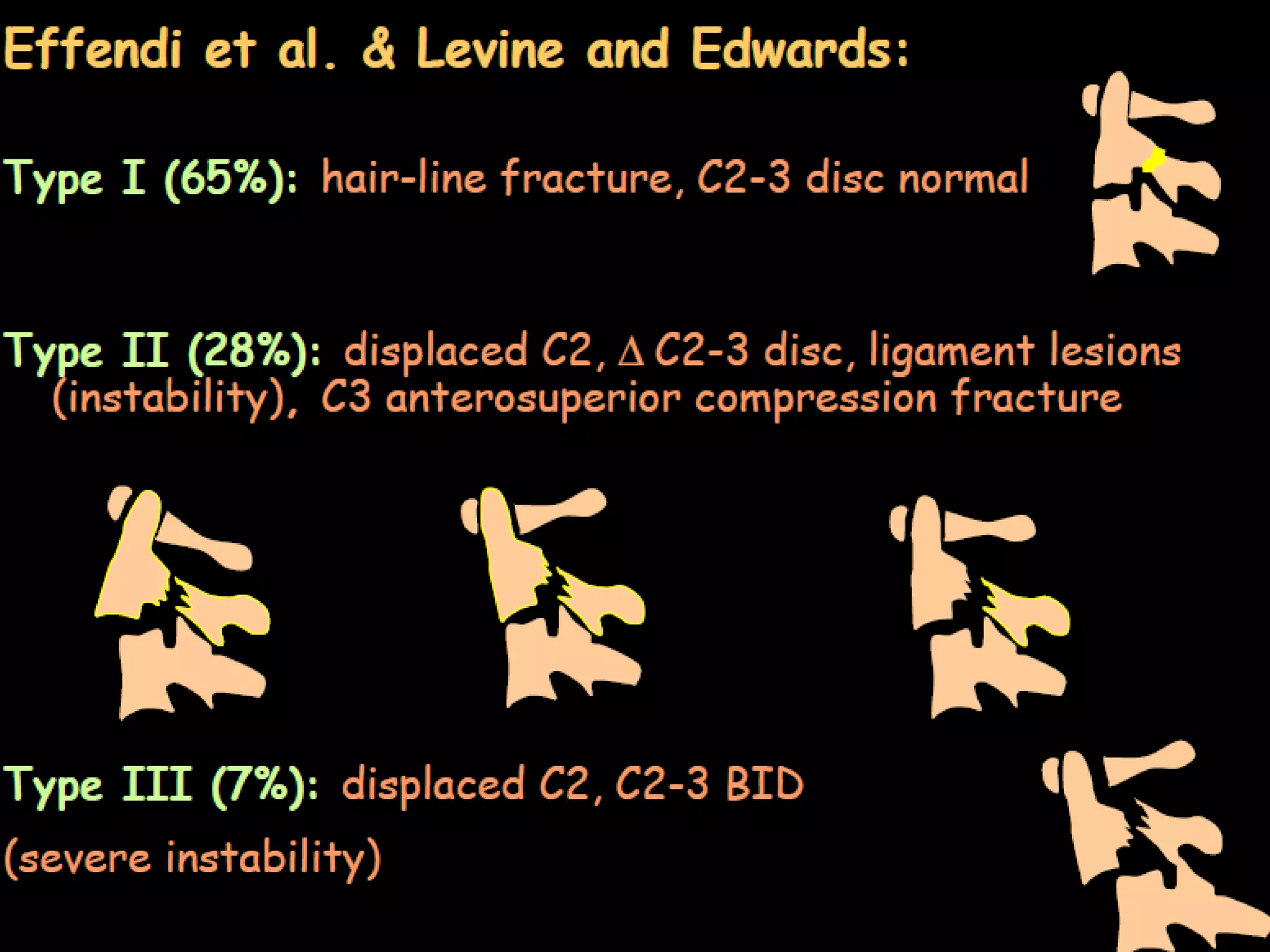
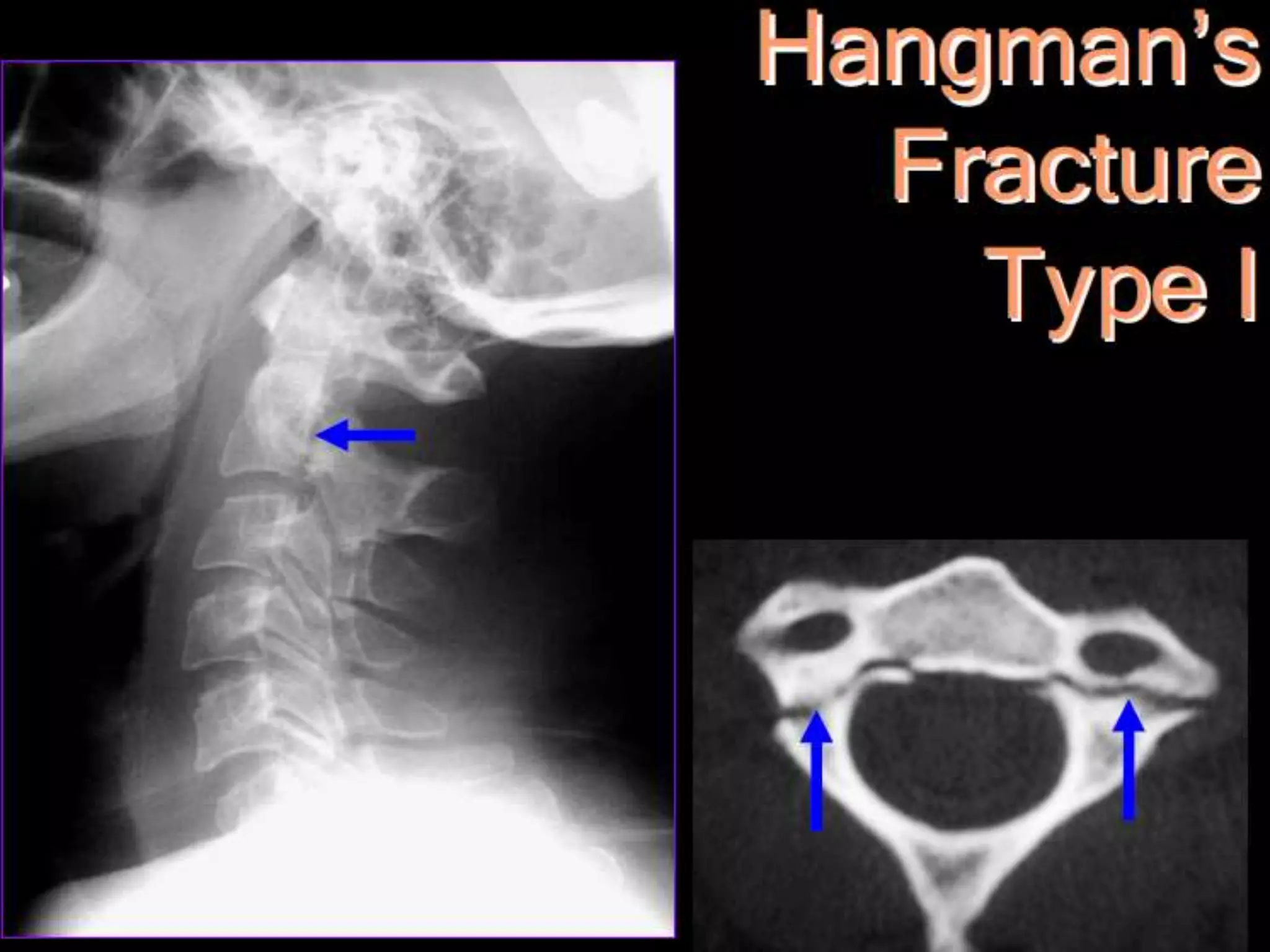
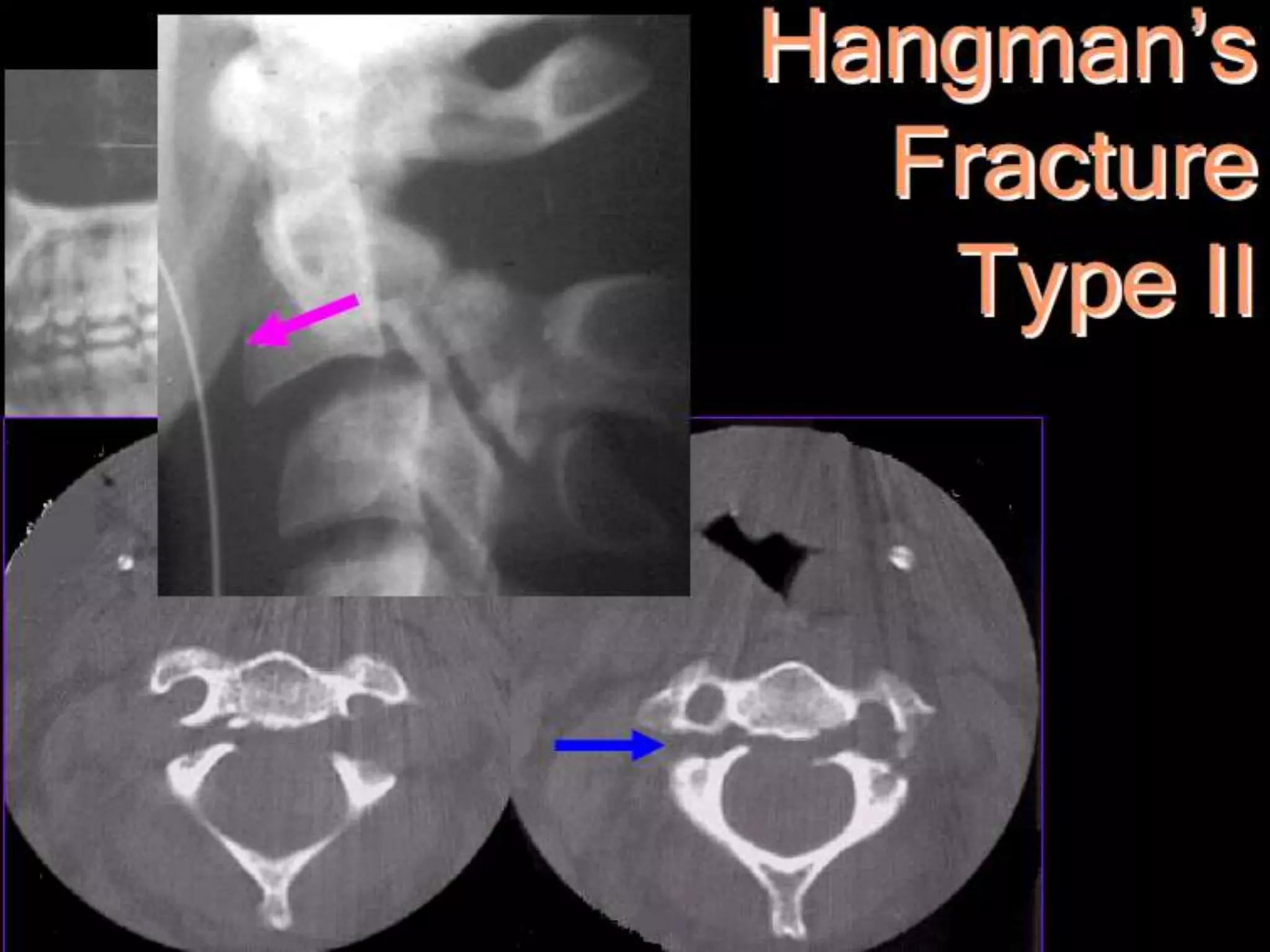
Hangman's Fracture: 
• 4-7% of all cervical FXs and/or dislocations. 
• Most frequent FX in fatal traffic accidents 
(Alker). 
• Clinical cases result from hyperextension. 
• Neurologic involvement is rare. 
• Predictive factors for neurologic injury: 
– Type II and III. 
– Locked facets. 
– Involvement transverse foramina with osseous 
fragment: 
• Dissection. 
• Embolization.
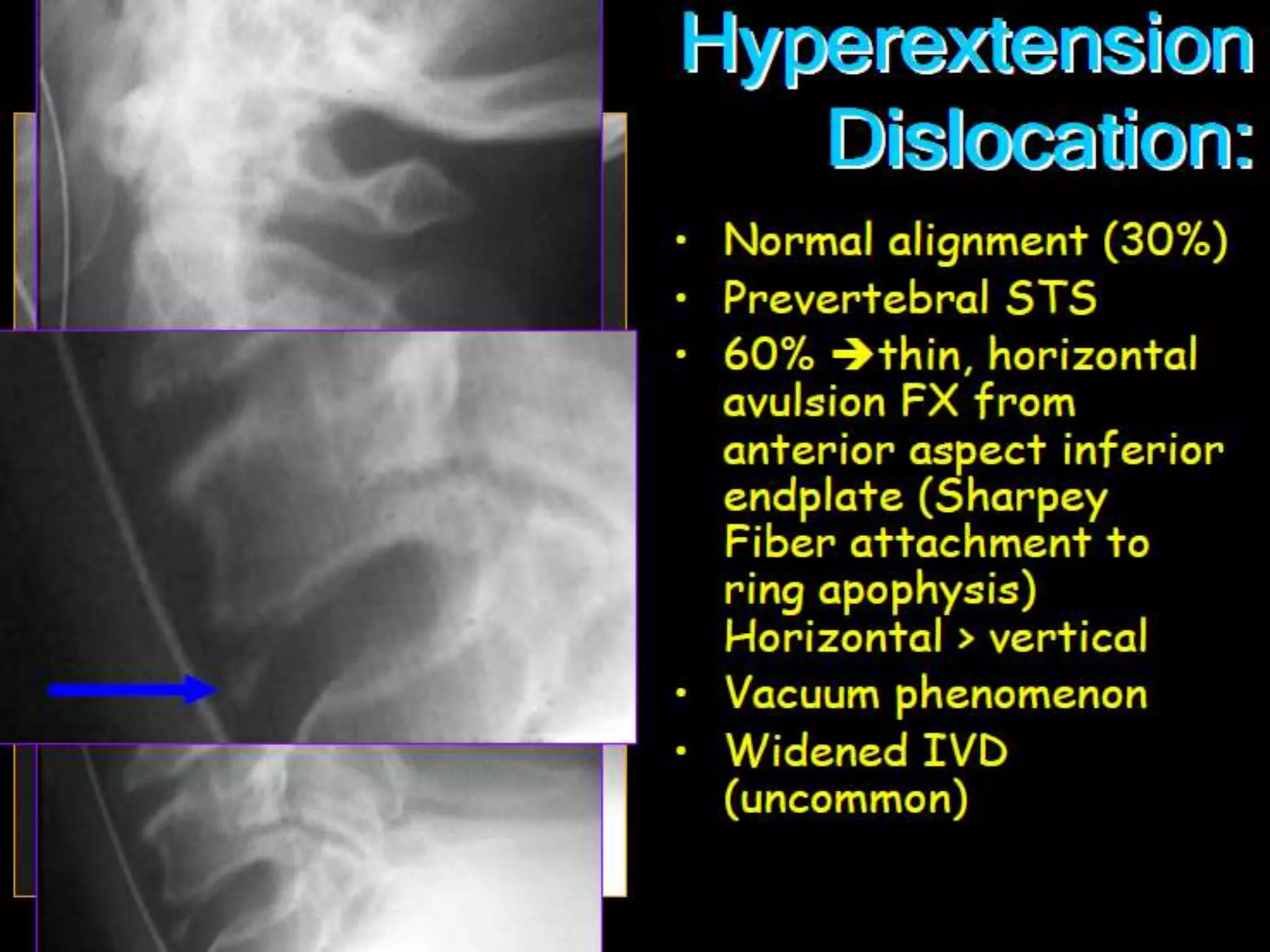
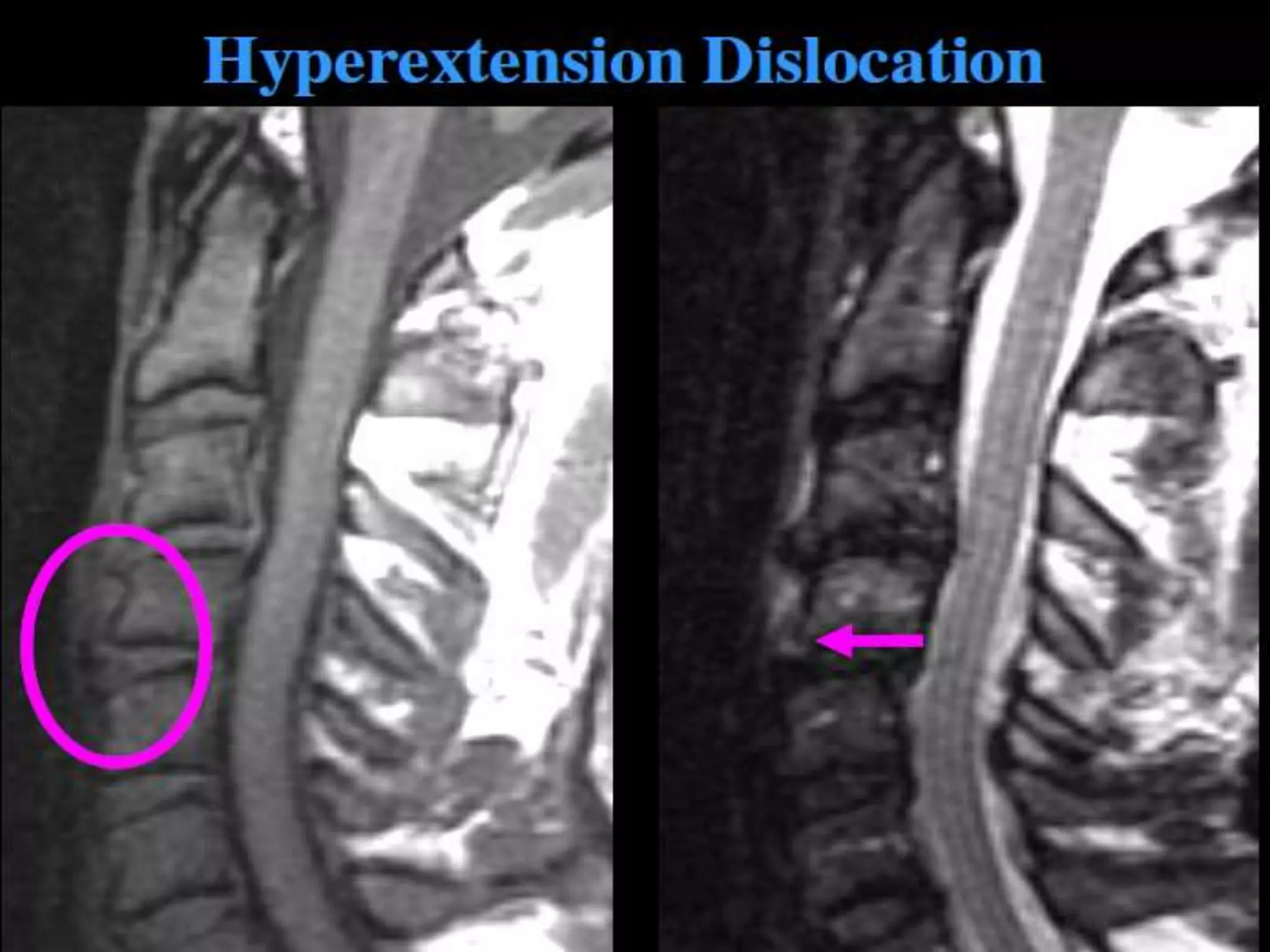
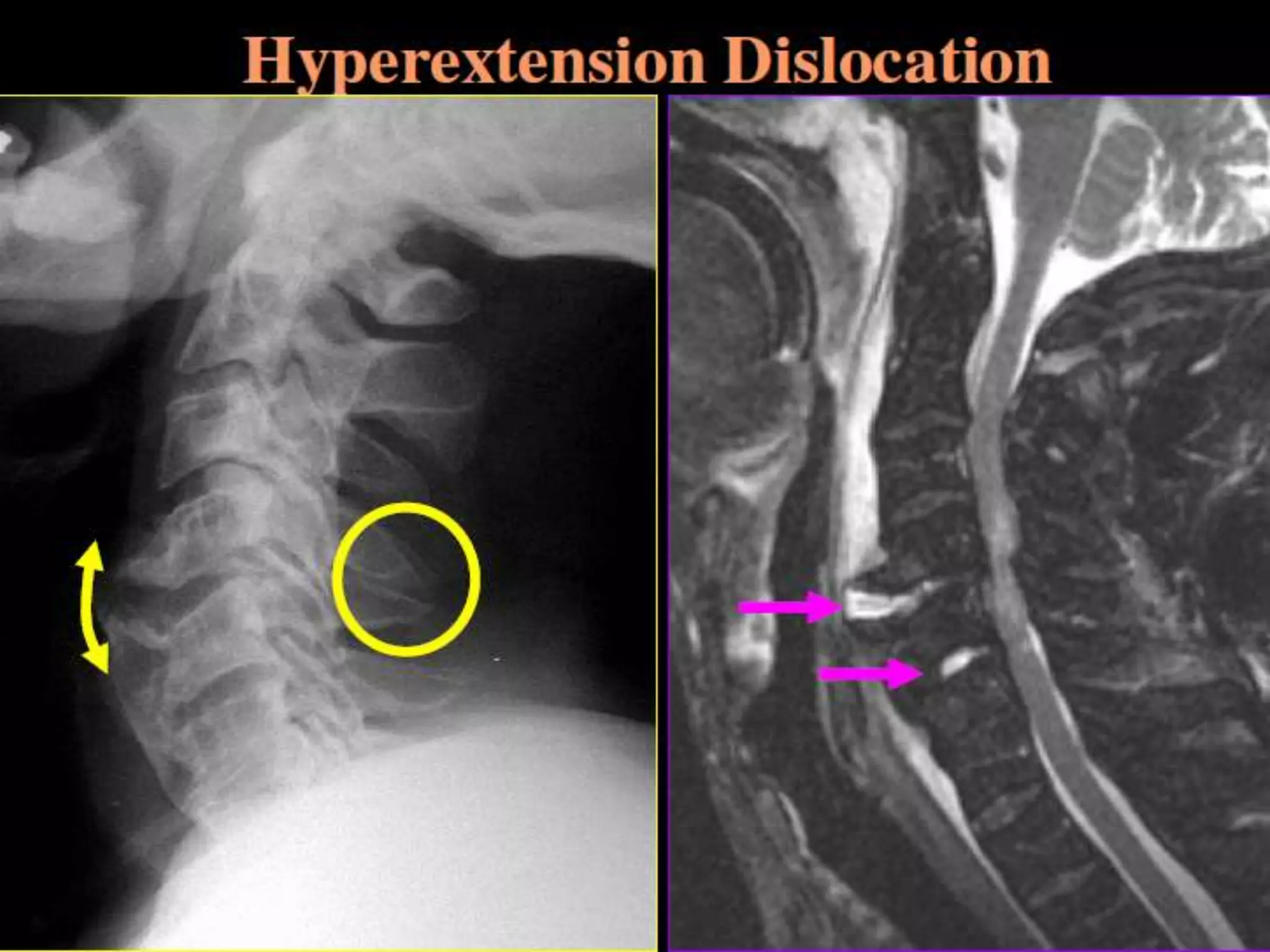
Hyperextension Dislocation 
• Soft tissue injury with disruption of ALL, 
disc and PLL. 
• Posterior column severely lordotic. 
• Compression of cord anteriorly by VB and 
posteriorly by ligaments. 
• spontaneously reduction when force gone. 
• Paralyzed patient with “normal” C-spine. 
• Spondylosis a predisposing factor. 
• UNSTABLE.
Hyperextension Dislocation: 
Triad: 
1. Facial injuries. 
2. Diffuse soft-tissue swelling with normally 
aligned vertebrae on lateral radiograph. 
3. Acute Central Cervical Cord Syndrome 
hemorrhage into central cord range of 
Sxs from upper extremity paralysis to 
quadriplegia (motor tracts to arms are 
located centrally).
Hyperextension/Rotation 
• Upward force on the forehead 
or upper face with head rotated. 
• Force which is not central is 
applied to forehead or upper face. 
• Injury Patterns. 
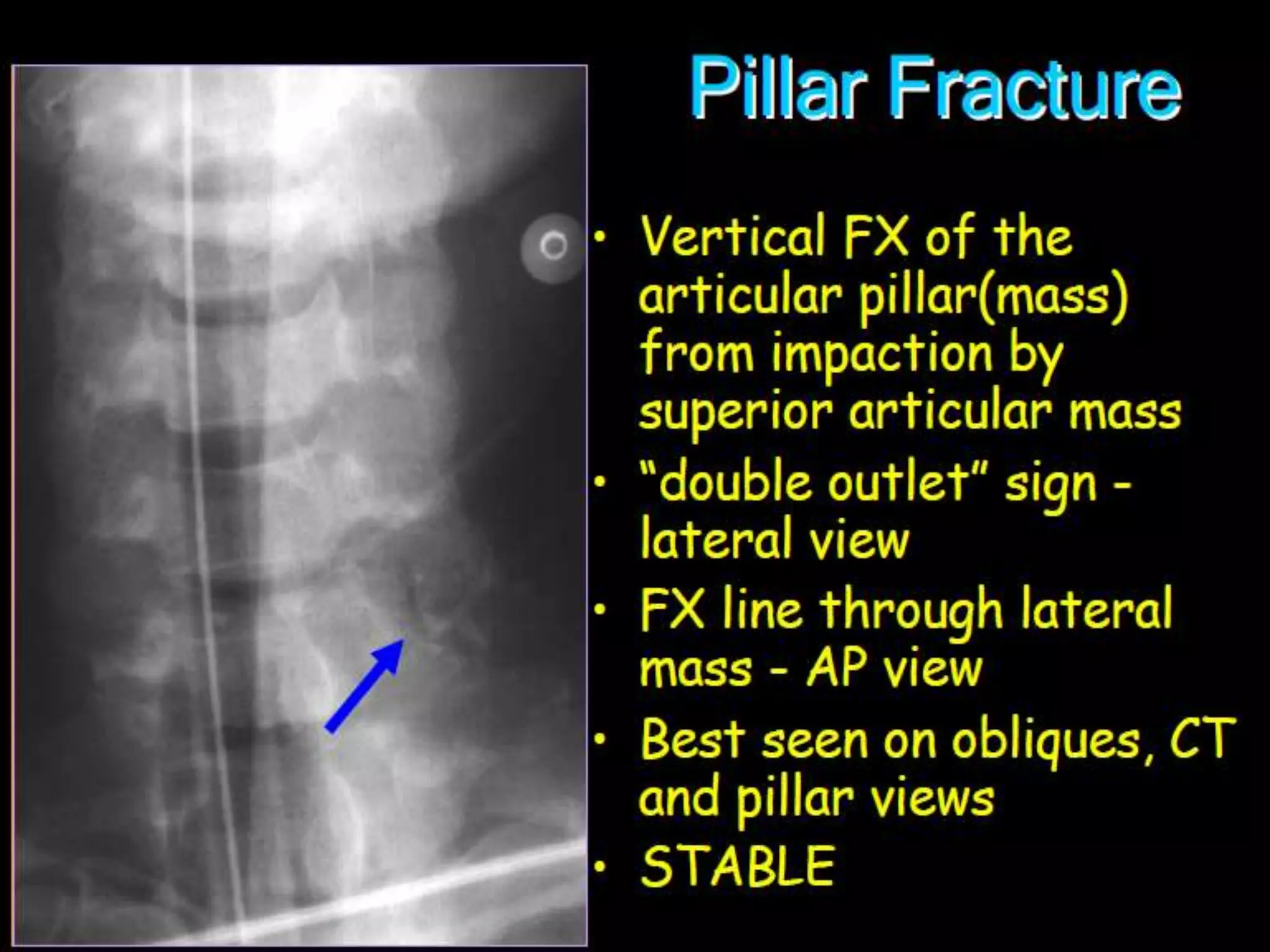
1. Pillar Fracture. 
2. Pedicolaminar Fracture-Separation
Pedicolaminar 
Fracture - Separation 
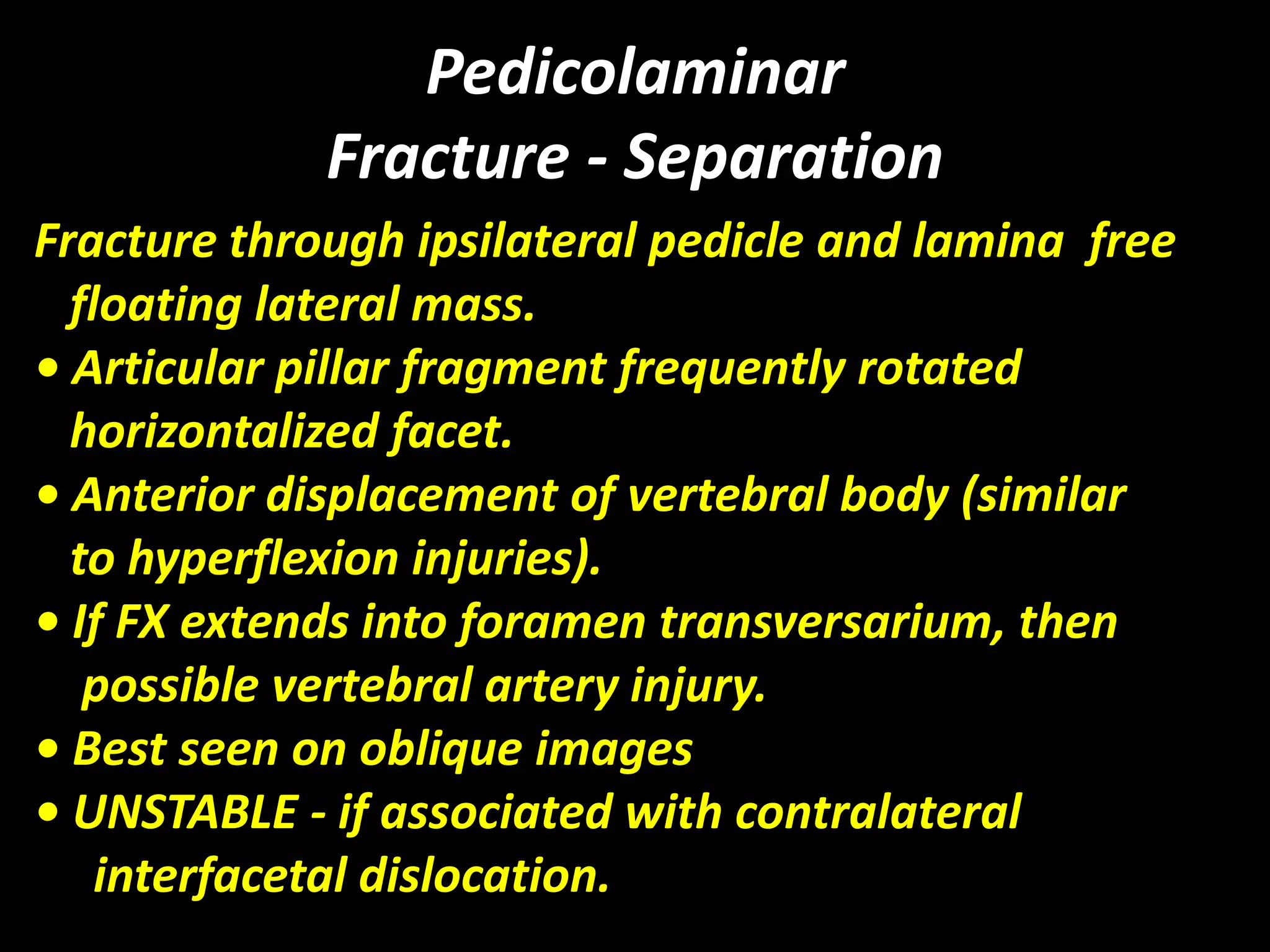
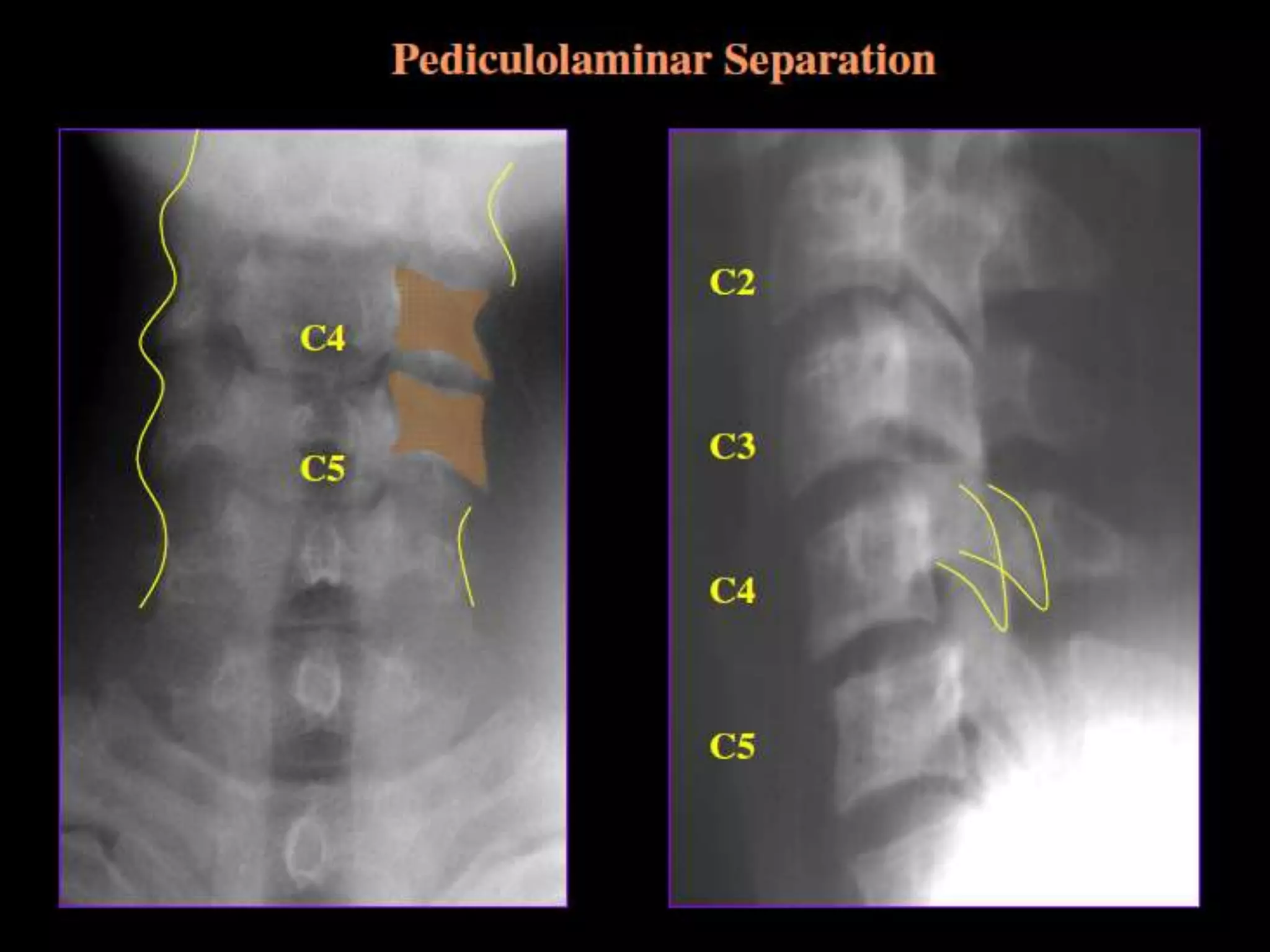
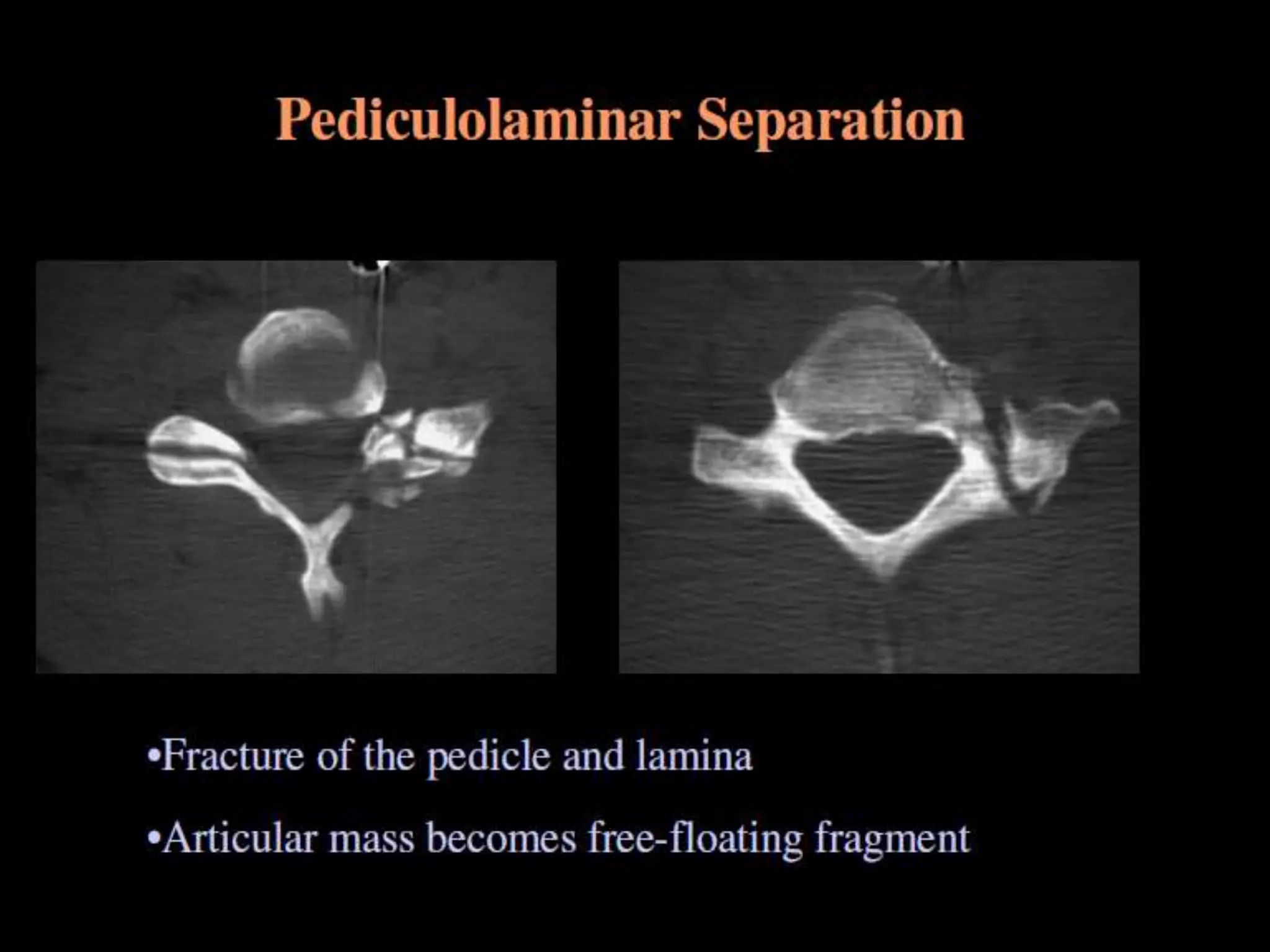
Fracture through ipsilateral pedicle and lamina free 
floating lateral mass. 
• Articular pillar fragment frequently rotated 
horizontalized facet. 
• Anterior displacement of vertebral body (similar 
to hyperflexion injuries). 
• If FX extends into foramen transversarium, then 
possible vertebral artery injury. 
• Best seen on oblique images 
• UNSTABLE - if associated with contralateral 
interfacetal dislocation.
Pedicolaminar 
Fracture - Separation 
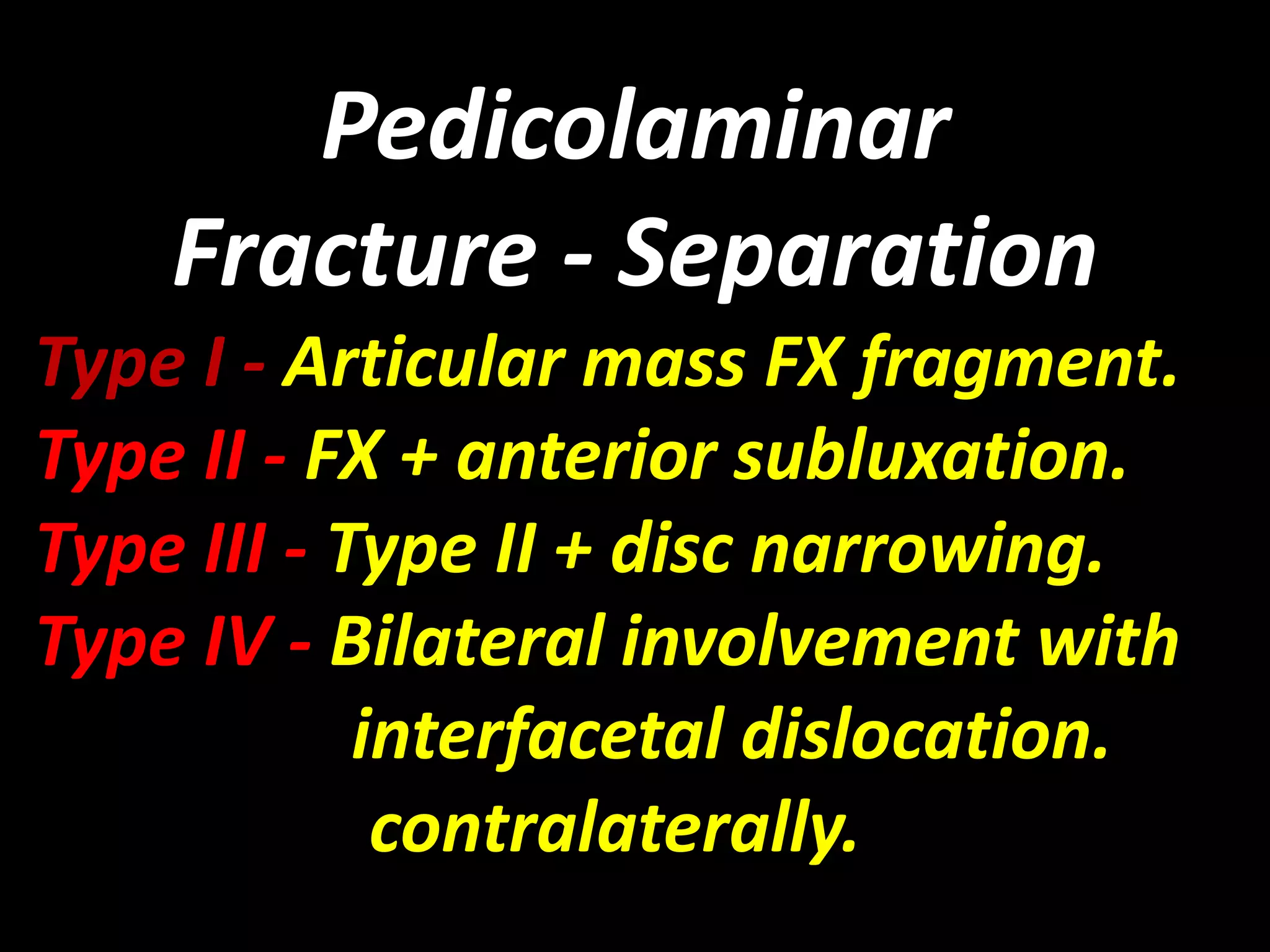
Type I - Articular mass FX fragment. 
Type II - FX + anterior subluxation. 
Type III - Type II + disc narrowing. 
Type IV - Bilateral involvement with 
interfacetal dislocation. 
contralaterally.
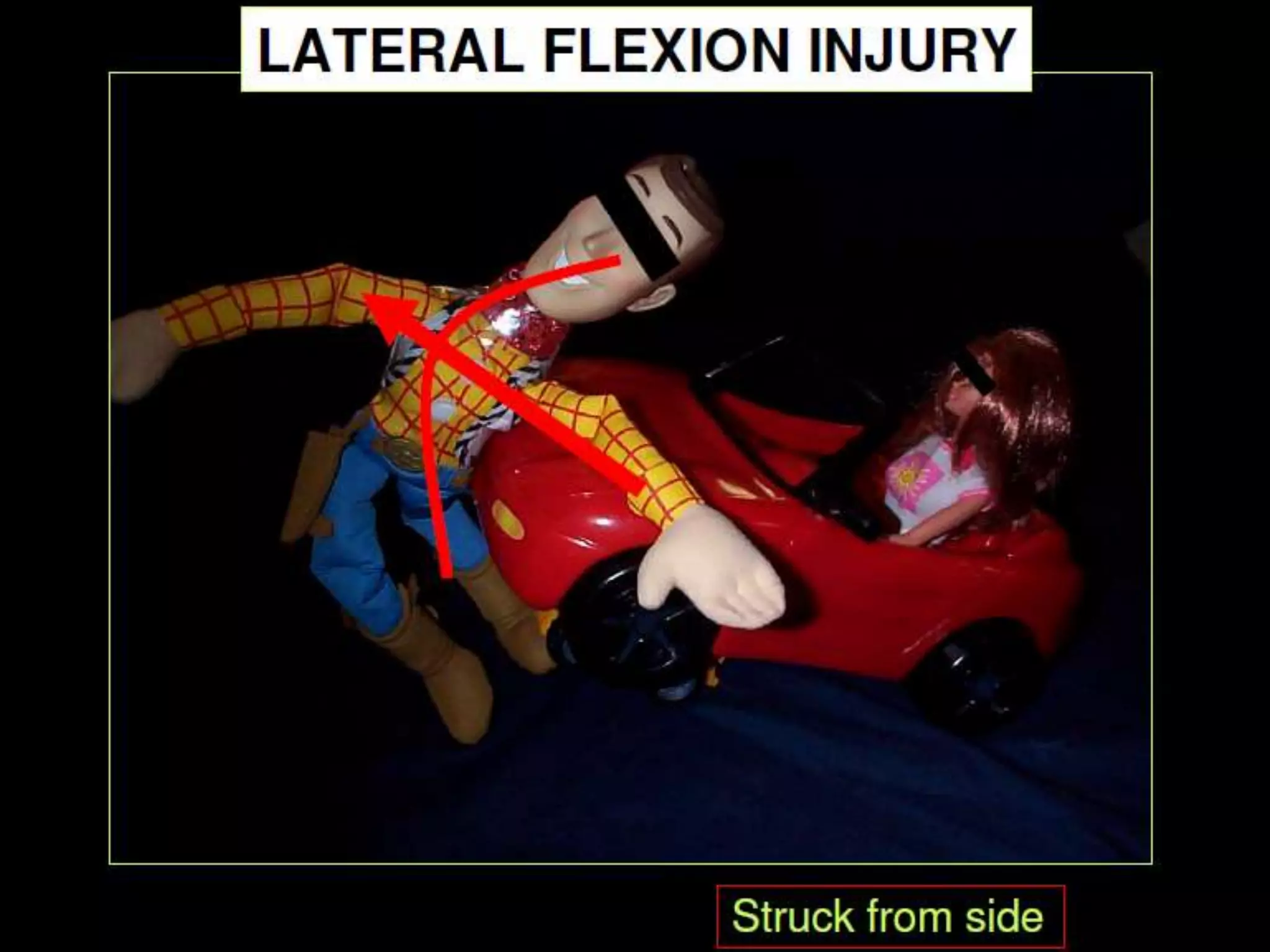
Lateral Flexion Injury. 
• Tilt in the 
coronal plane. 
• Associated with 
vertebral artery 
injury. 
• Best seen on 
AP view and CT. 
FXs: 
– uncinate process. 
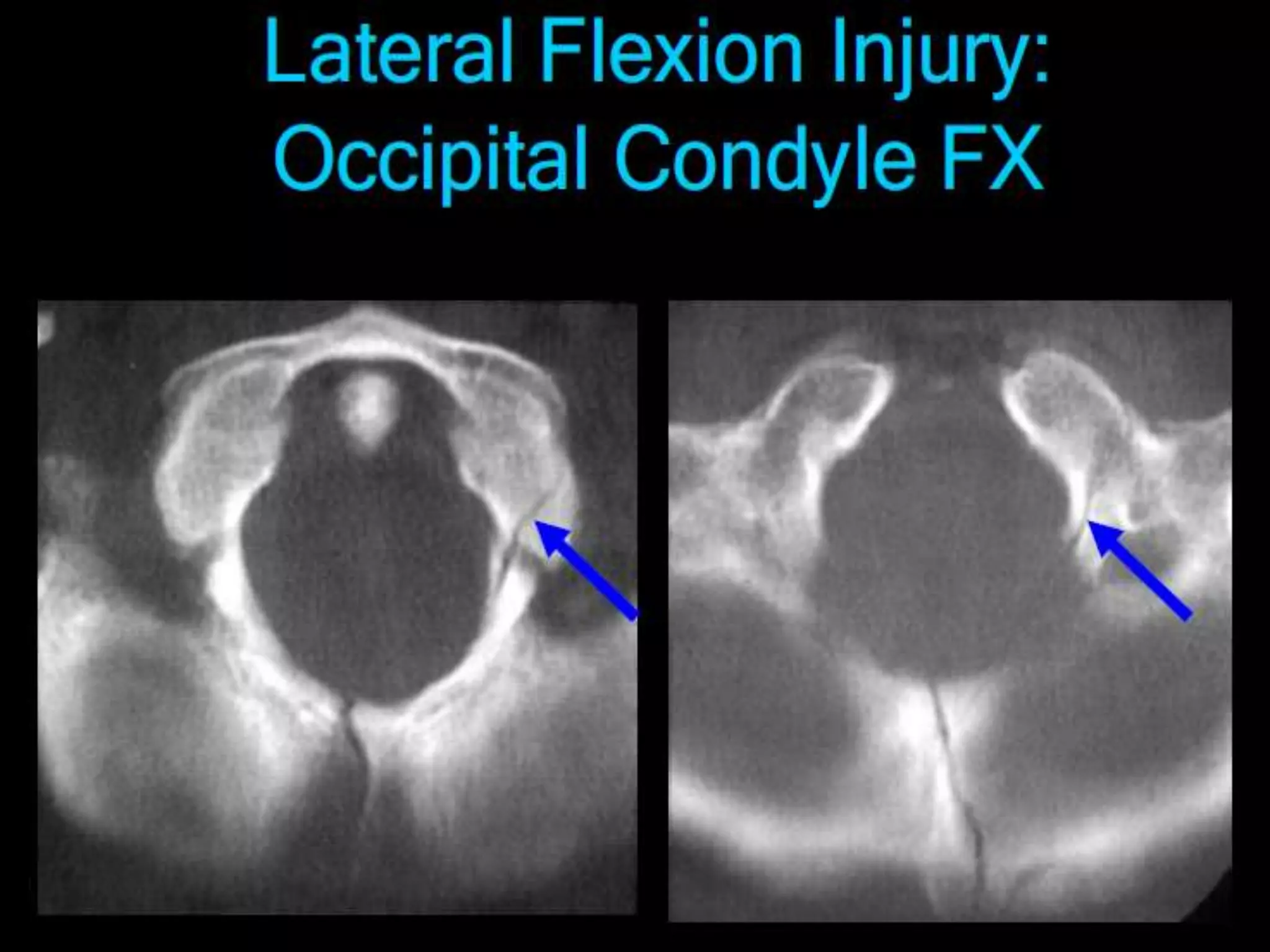
– occipital condyles. 
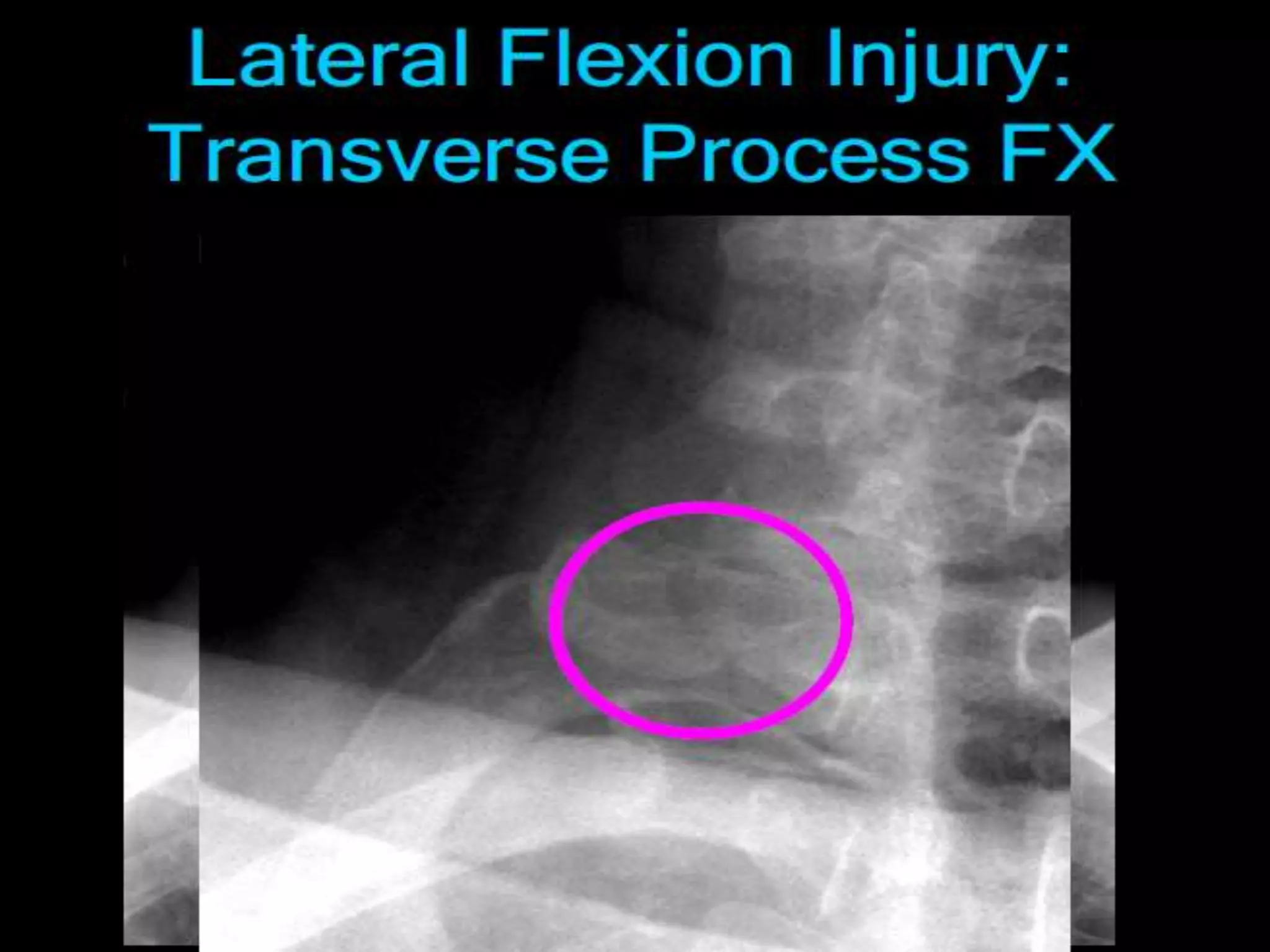
– transverse process. 
– odontoid. 
– lateral wedge 
compression. 
– eccentric atlas burst 
fracture.
Other Fractures/Injuries: 
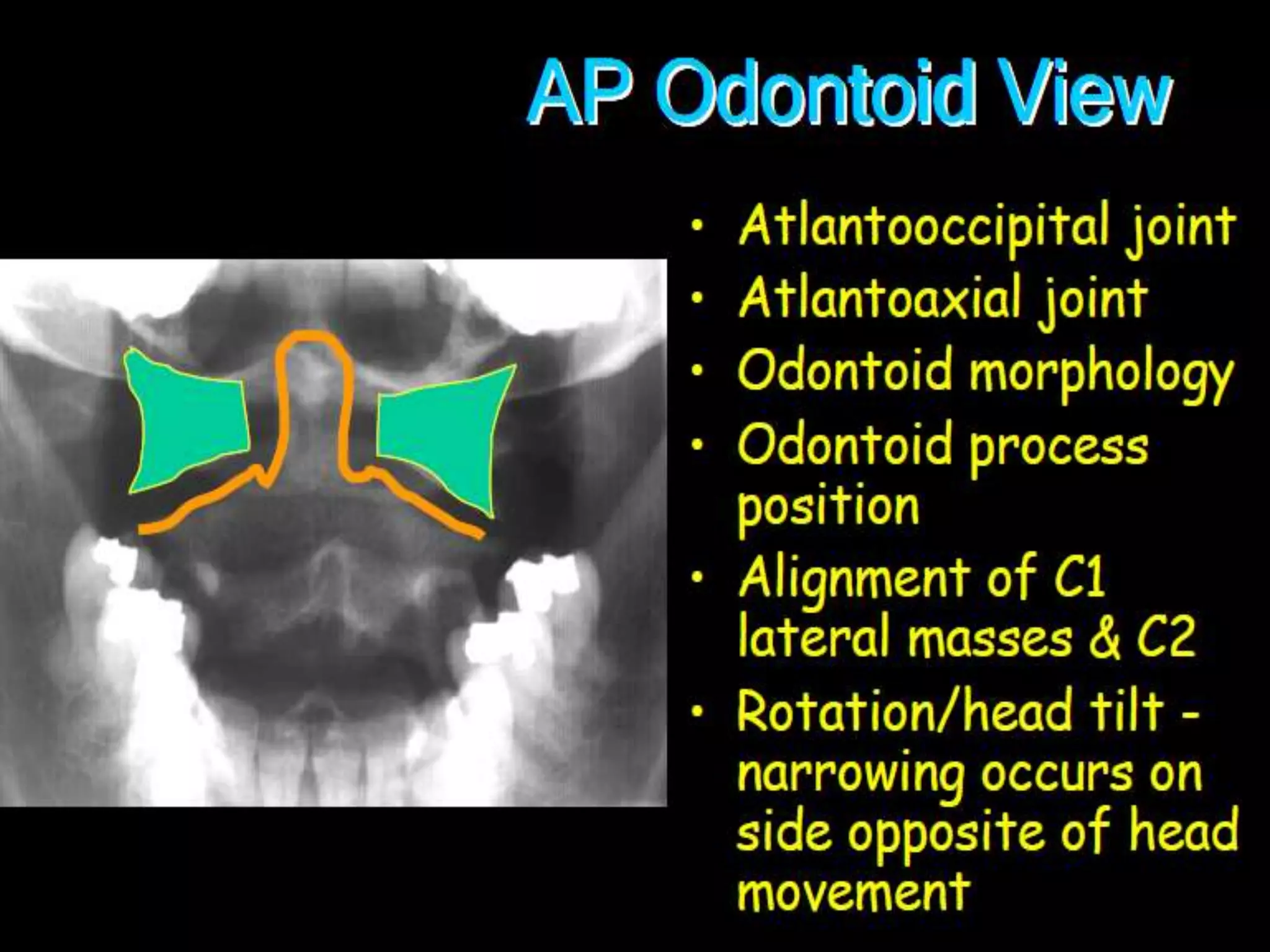
• Rotary fixation of C1/C2 – torticollis. 
• Odontoid fractures. 
• Transverse atlantal ligament rupture. 
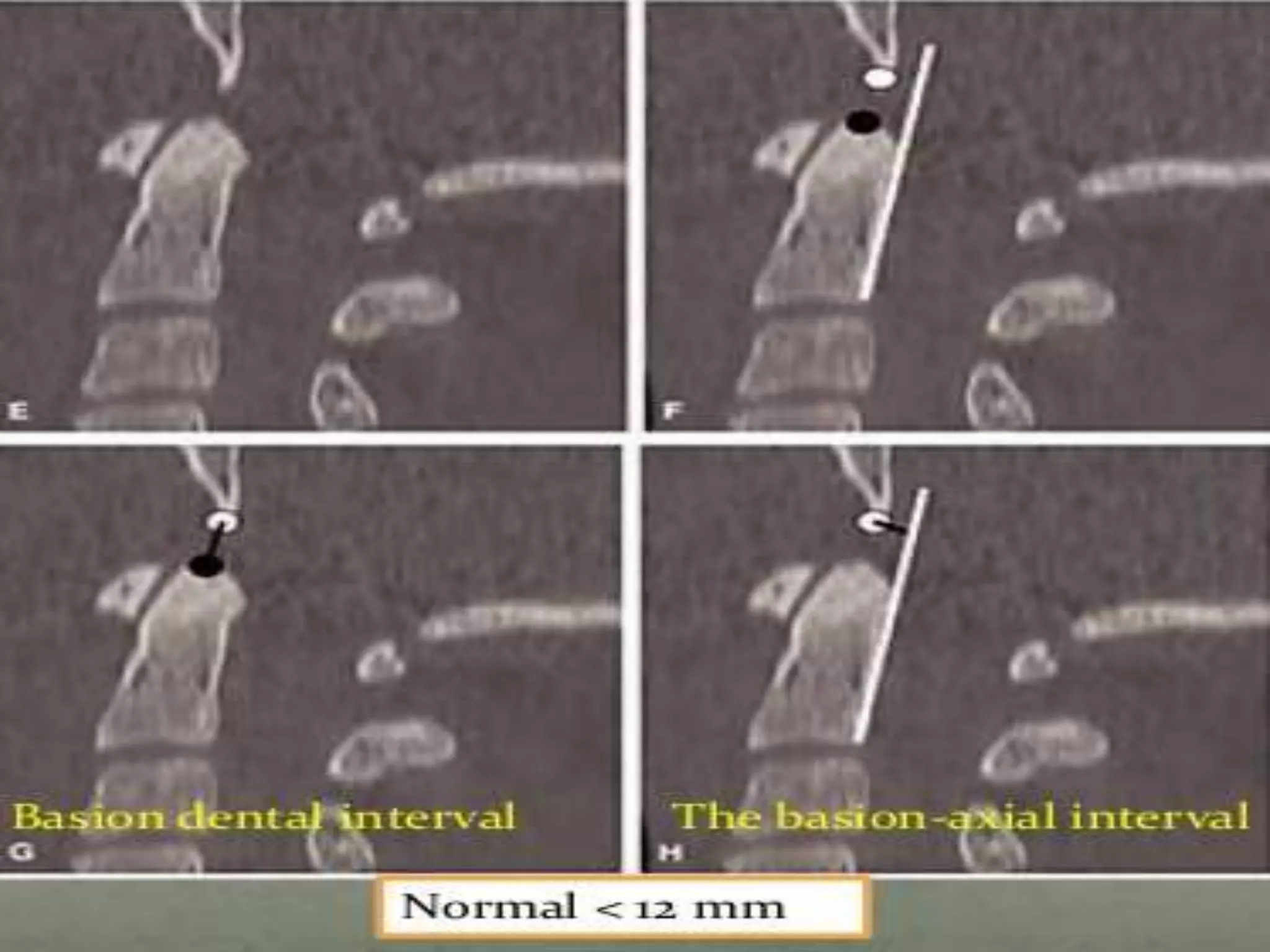
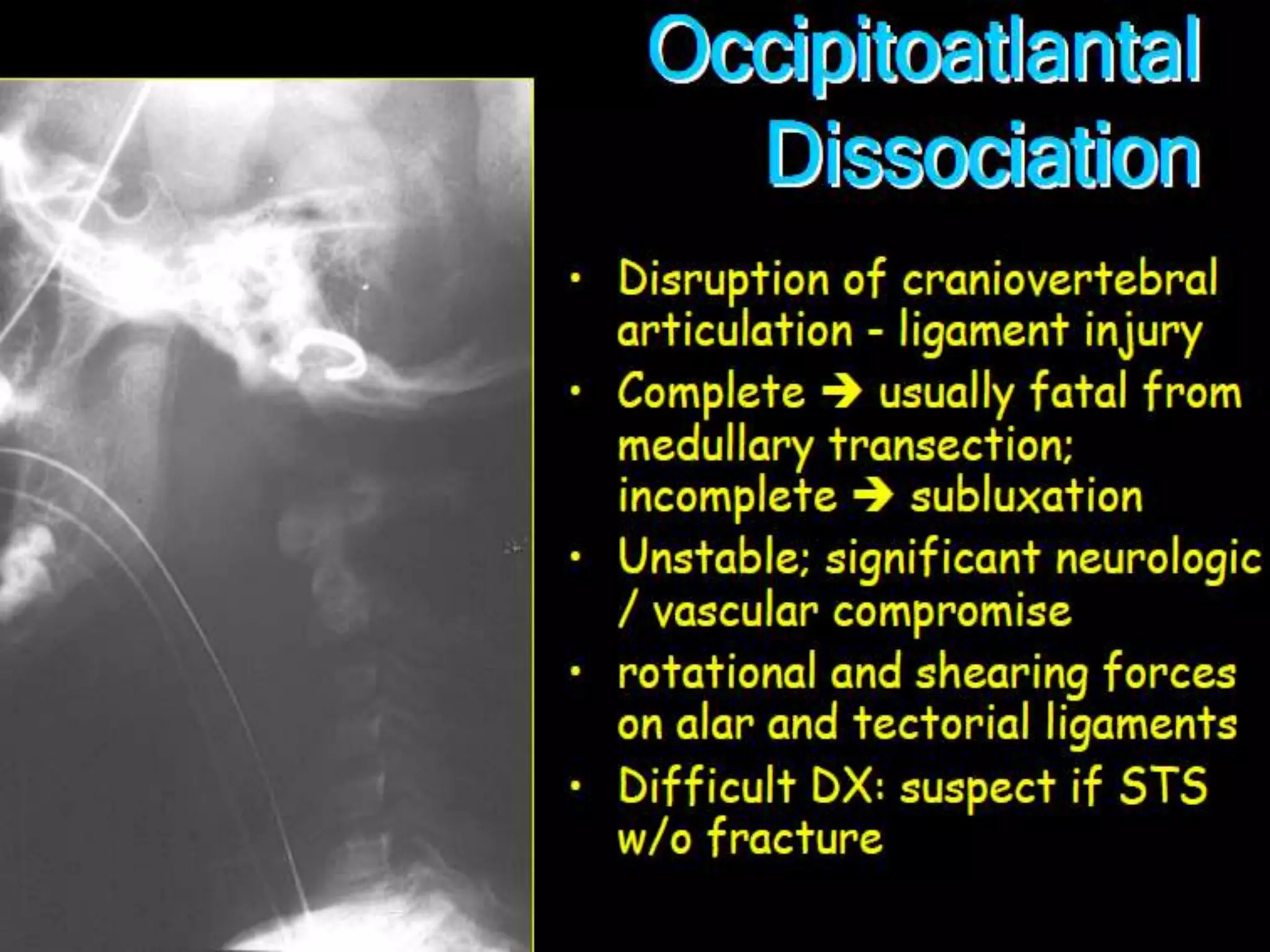
• Occipitoatlantal dissociation.
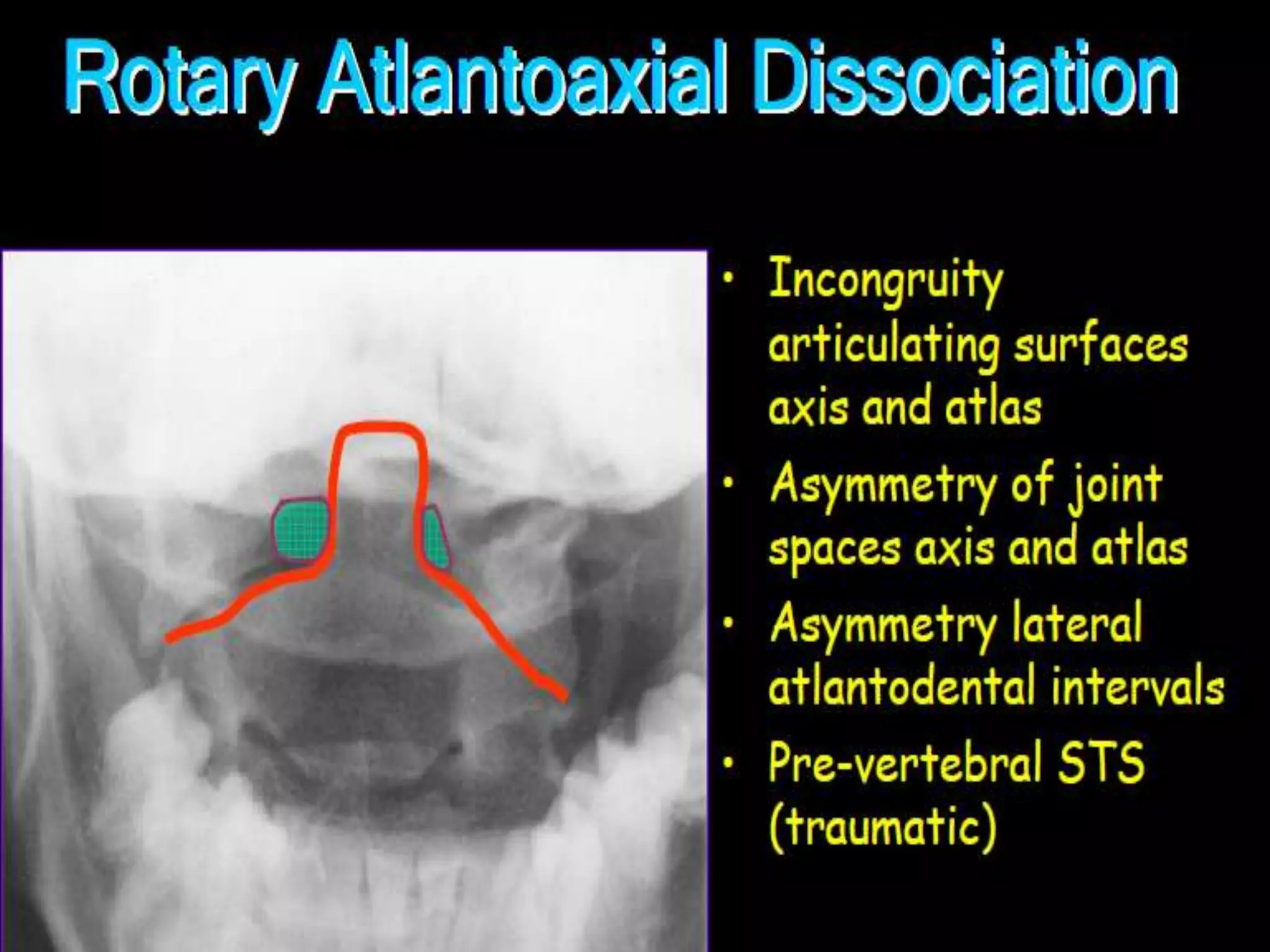
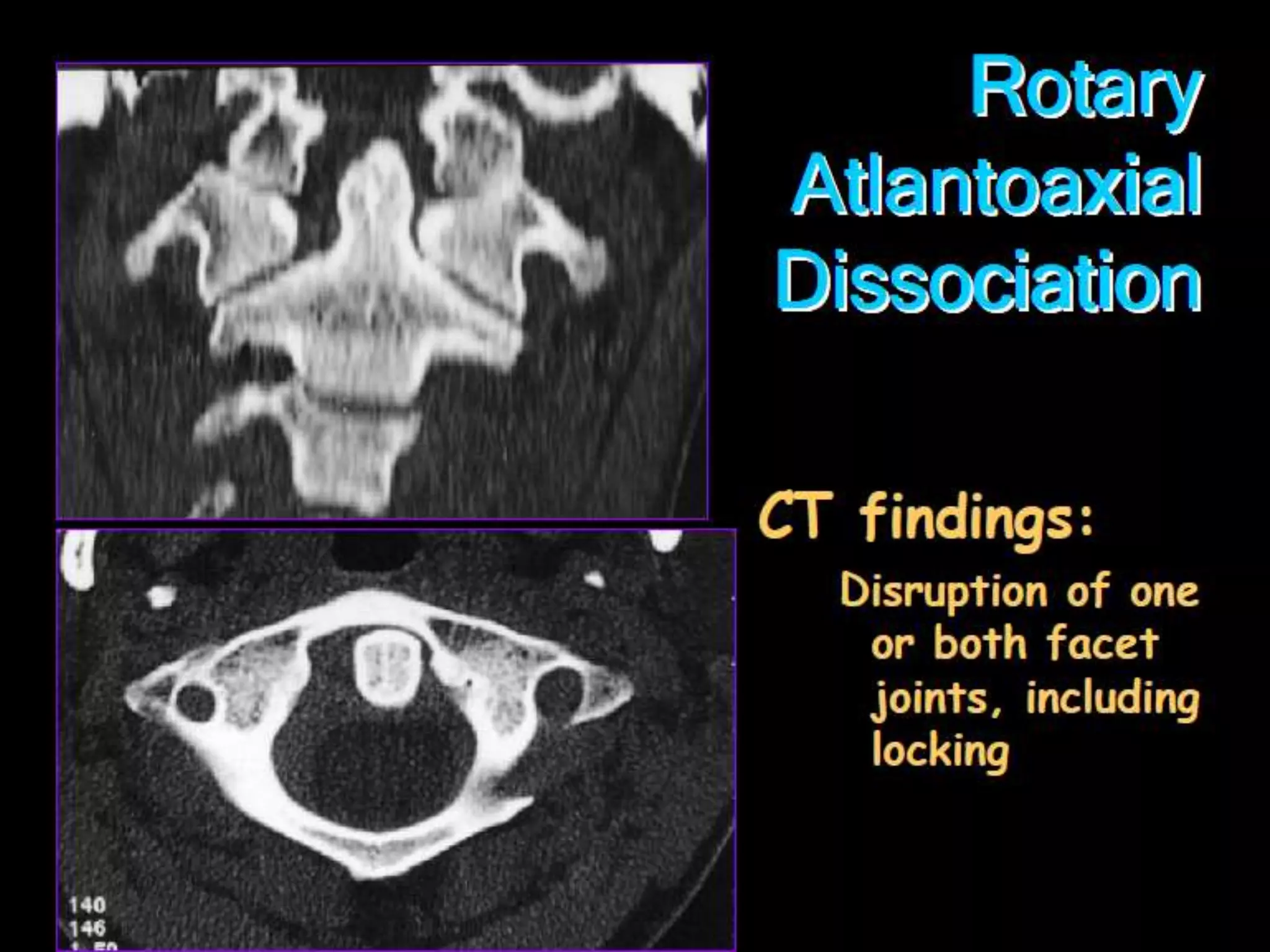
Rotary Atlantoaxial Dissociation 
(Rotary Fixation of C1/C2): 
• Usually secondary to mild trauma. 
– sleeping in an unusual position. 
– torticollis. 
• Rotation and lateral tilt at the 
atlantoaxial joint. 
• Fixation occurs when symptoms not 
resolved in a few days.
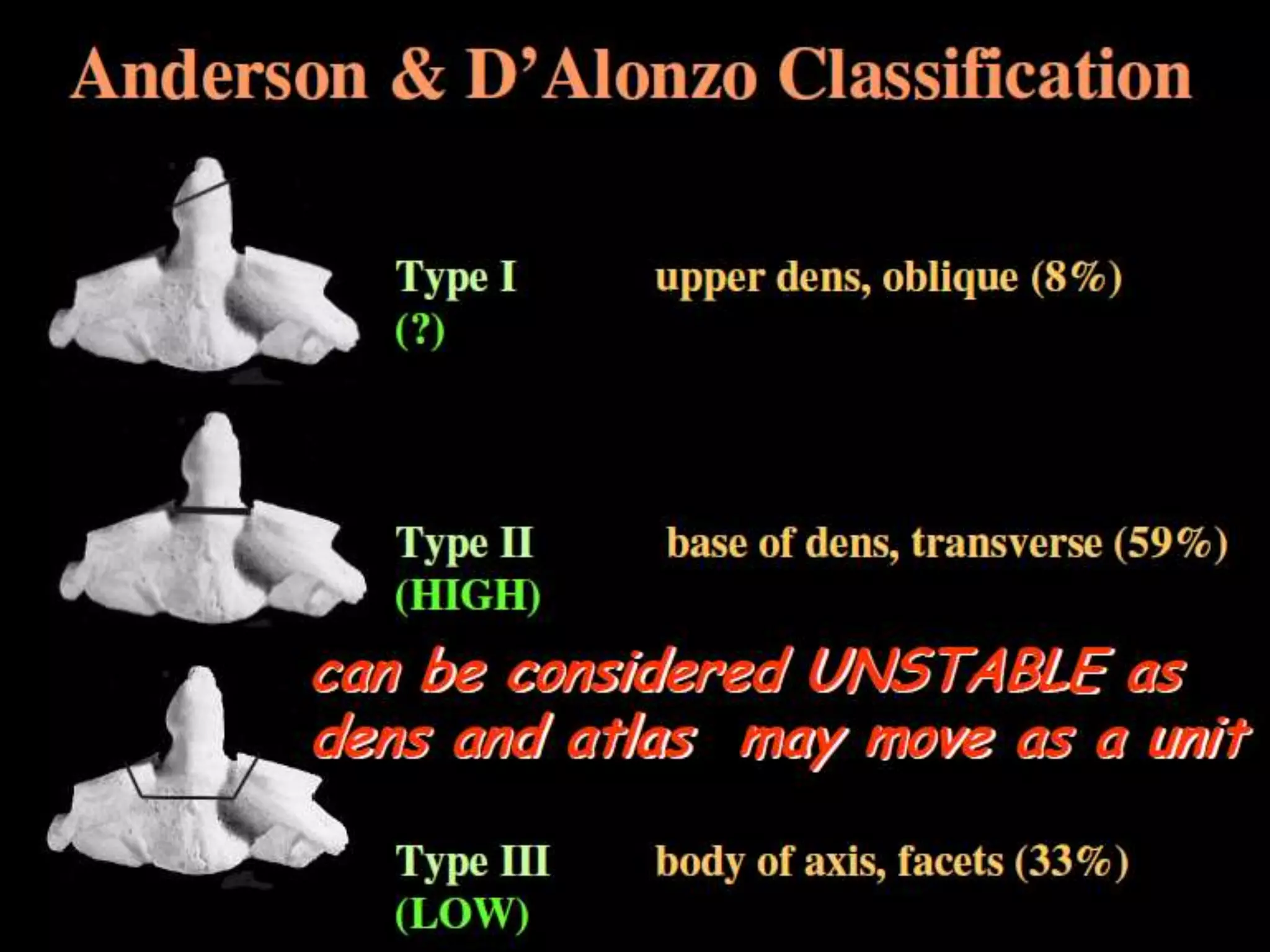
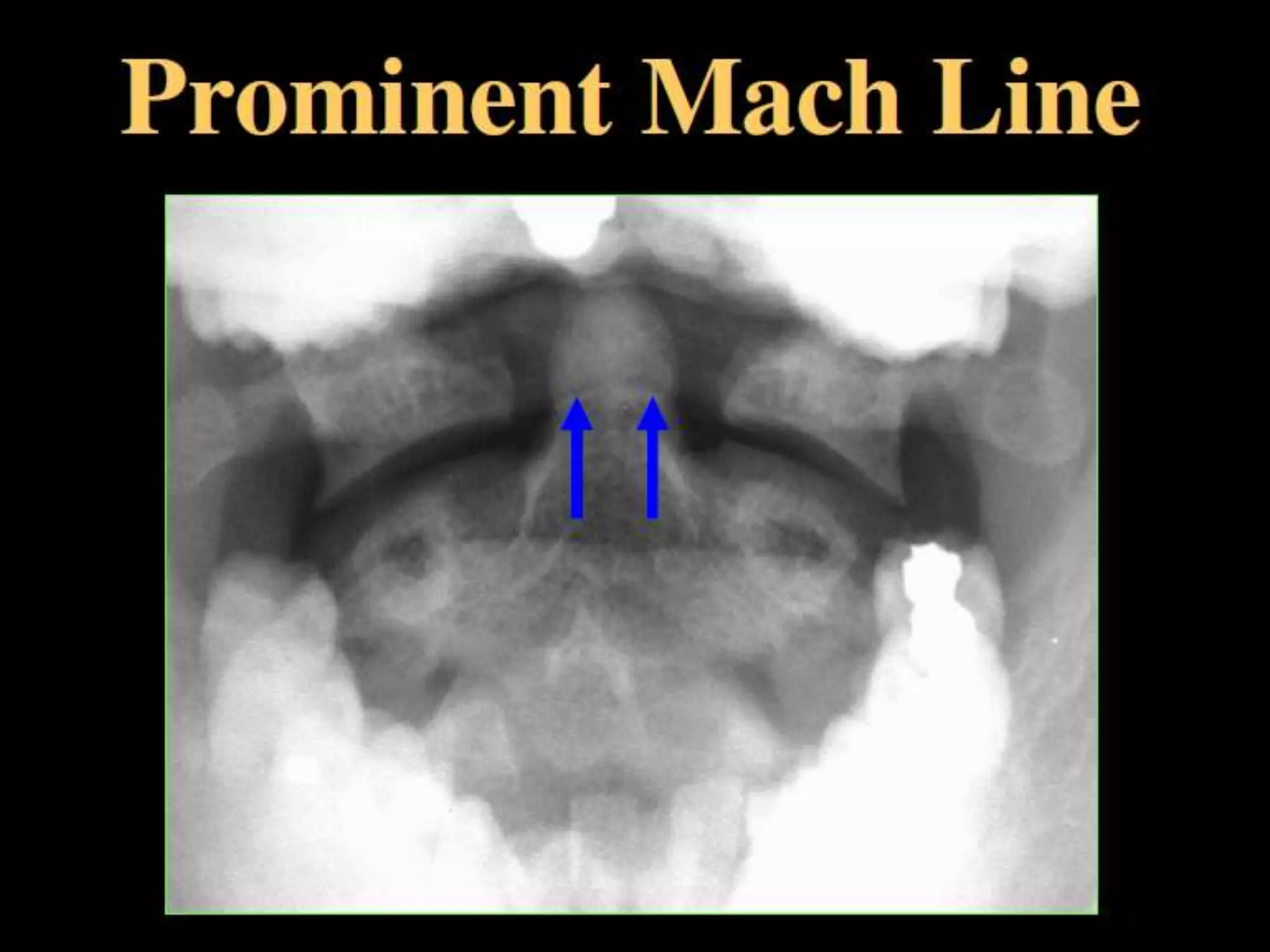
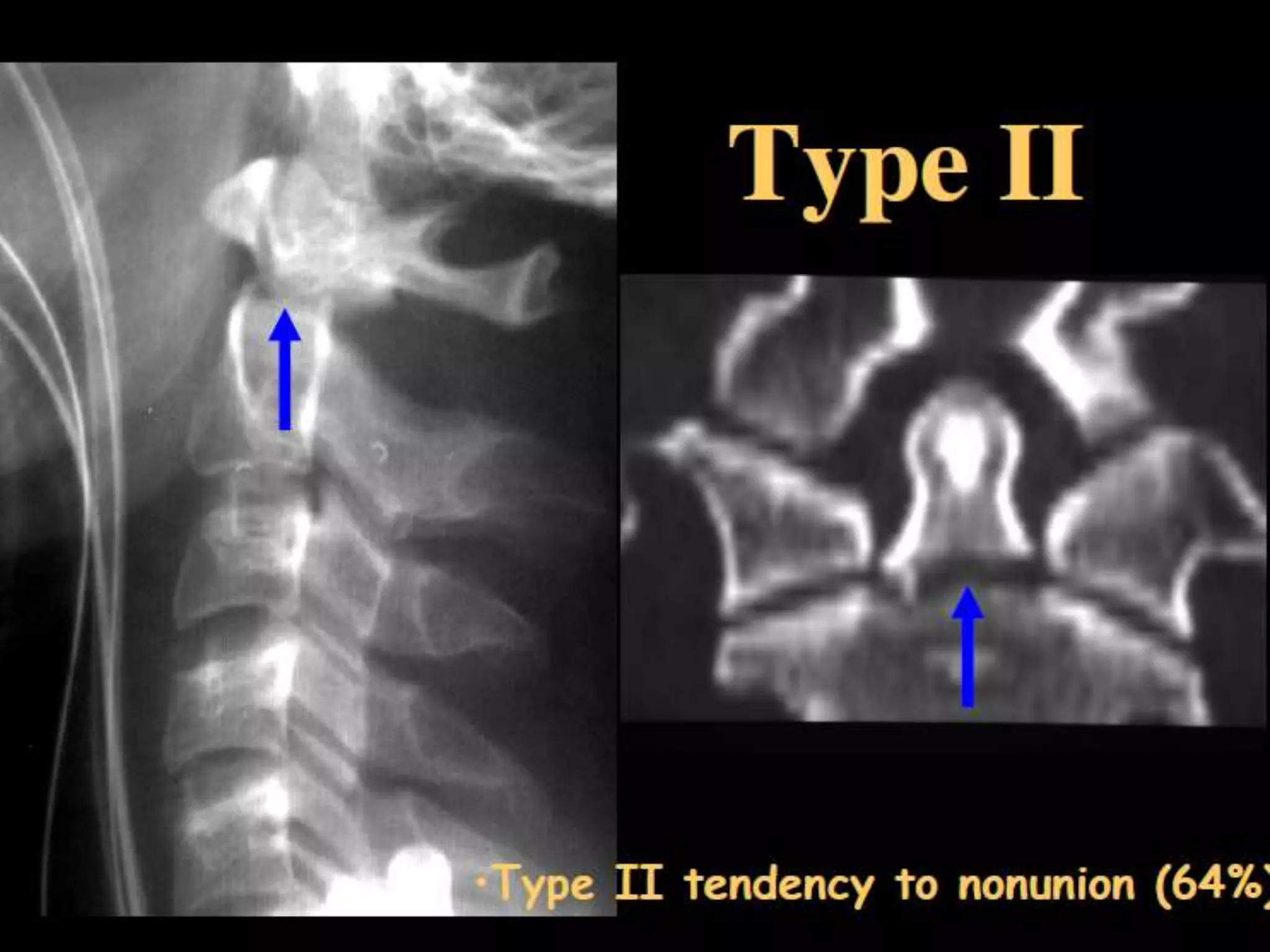
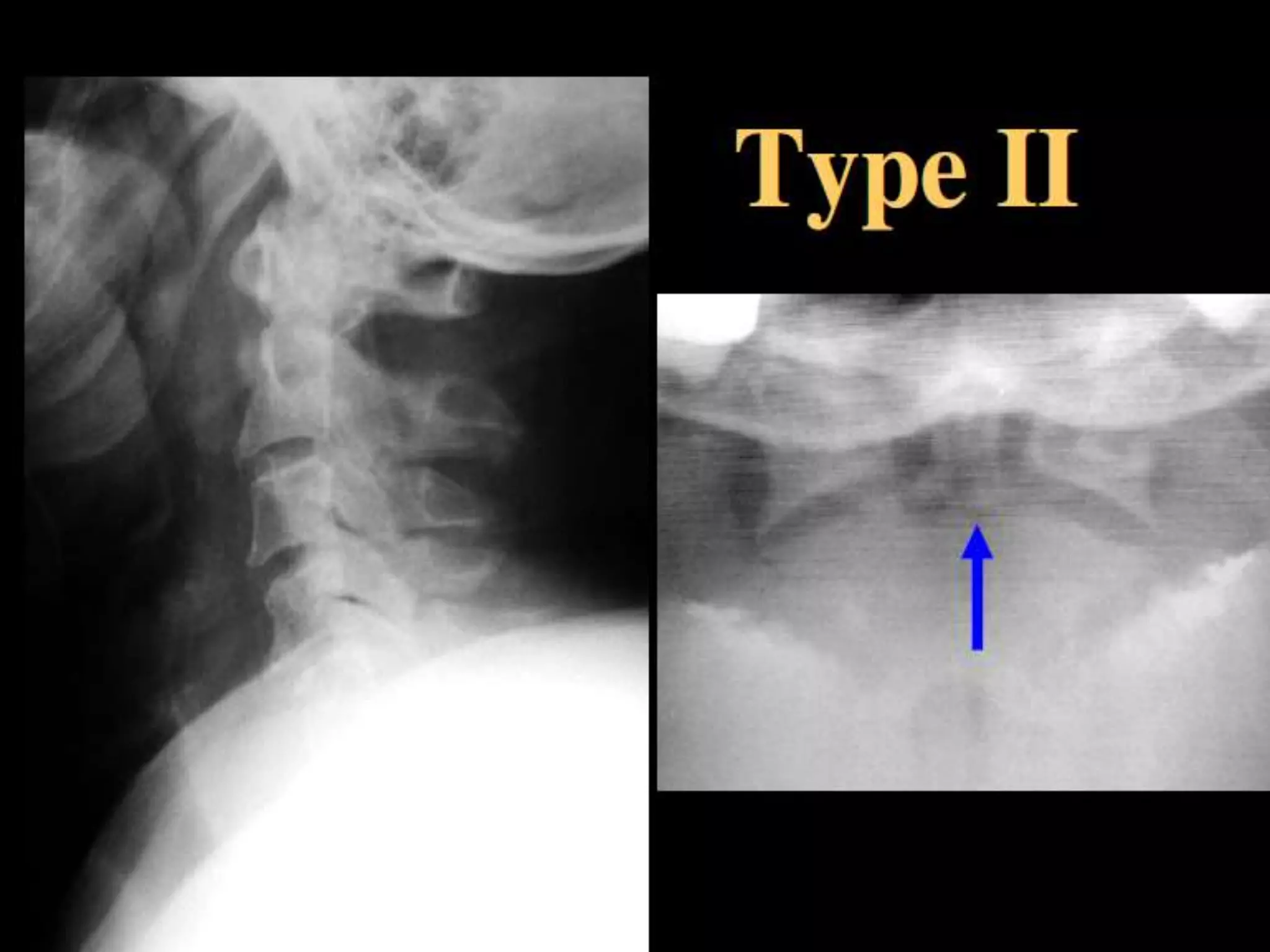
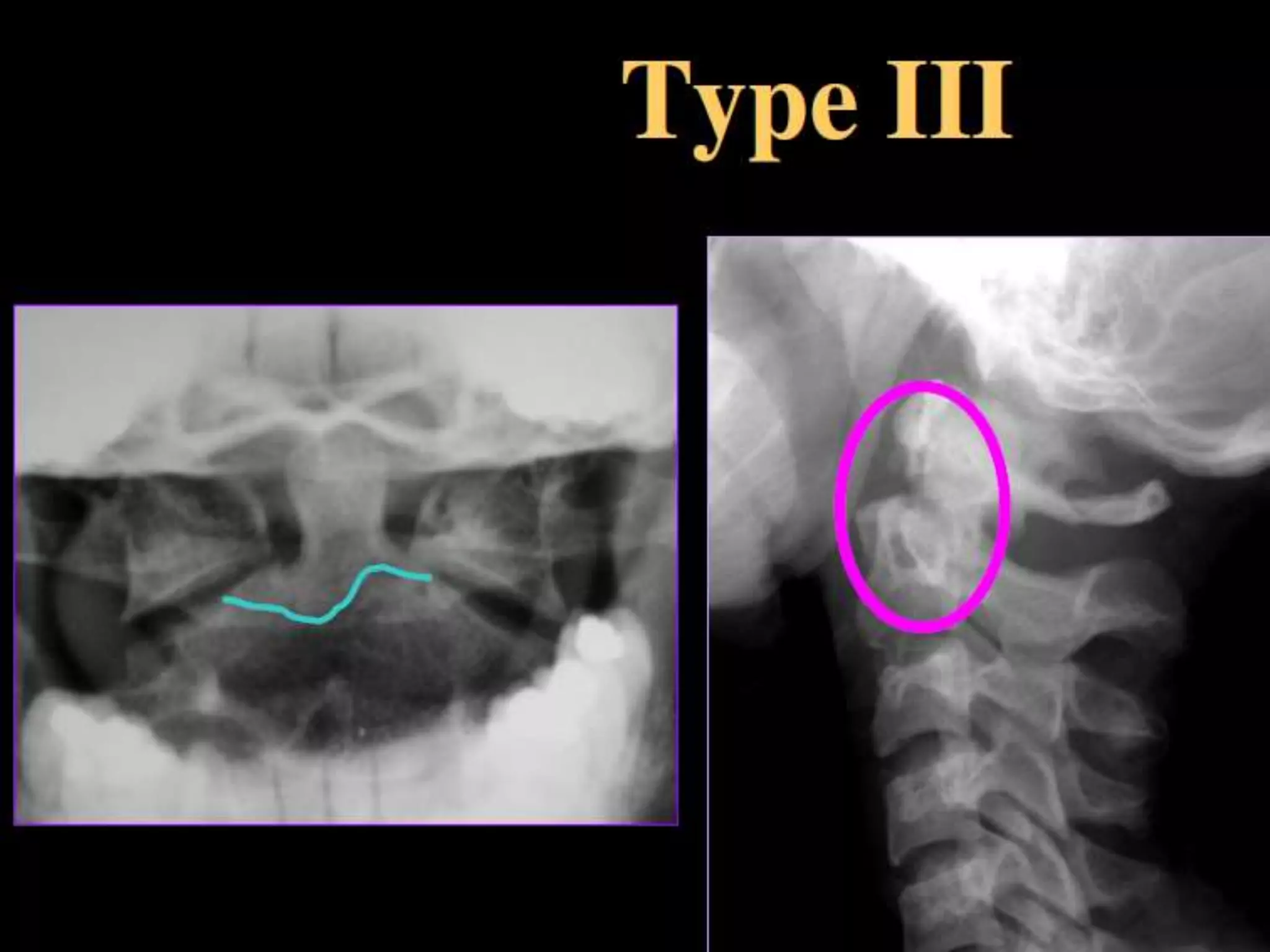
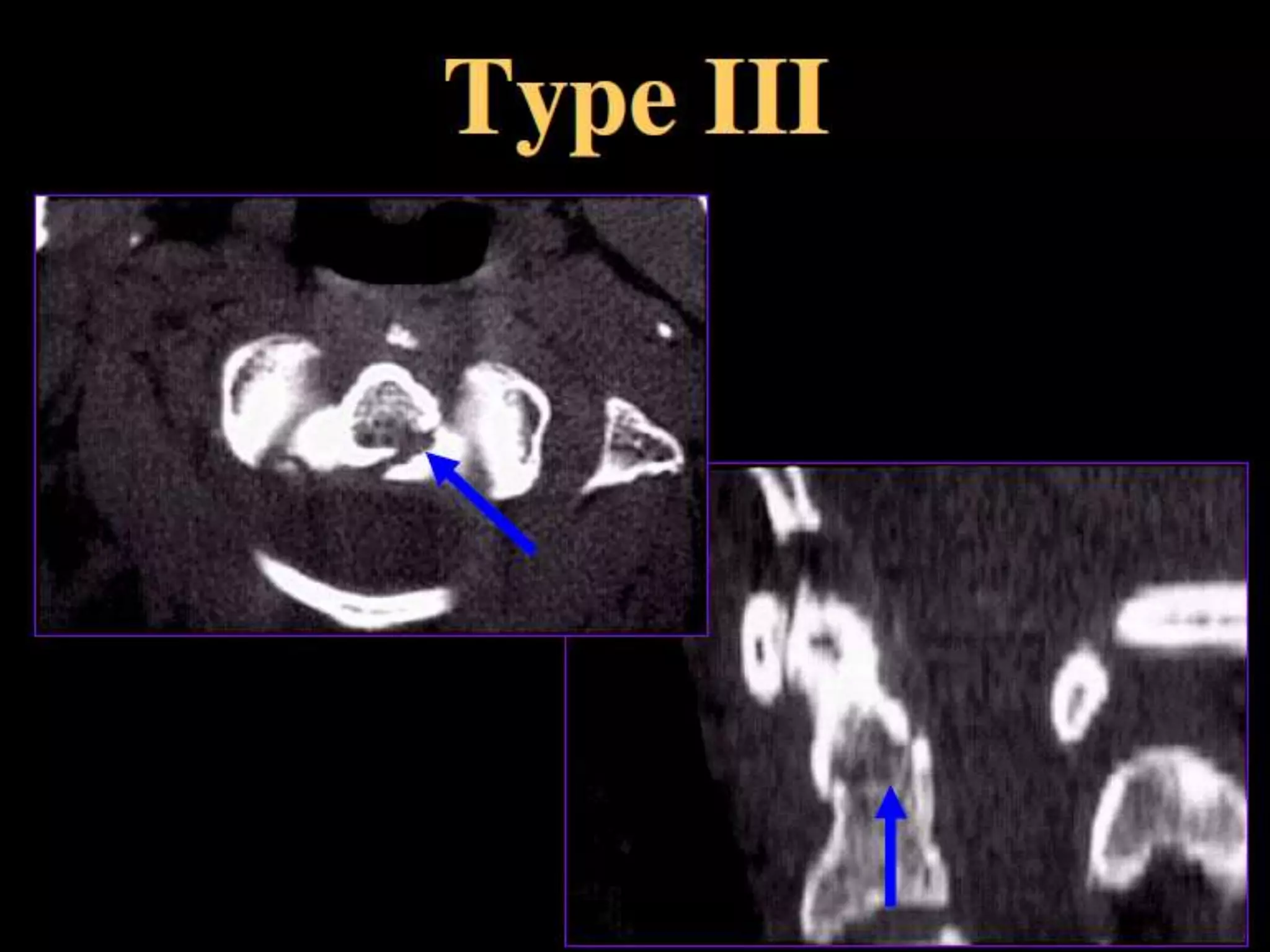
Odontoid (Dens) Fractures: 
• 11-13% c-spine injuries (up to 27% in some 
series). 
– 75% of cases are children. 
• Classification 
– Anderson & D’Alonzo (I, II and III). 
• Associations 
– atlantoaxial dislocations. 
– Jefferson FX. 
• Radiography may be subtle. 
• Prevertebral STS nasopharynx.
Transverse Atlantal 
Ligament Rupture: 
• Increased atlantodental space. 
• Anterior translation of atlas and skull. 
• Associated with Jefferson fracture.
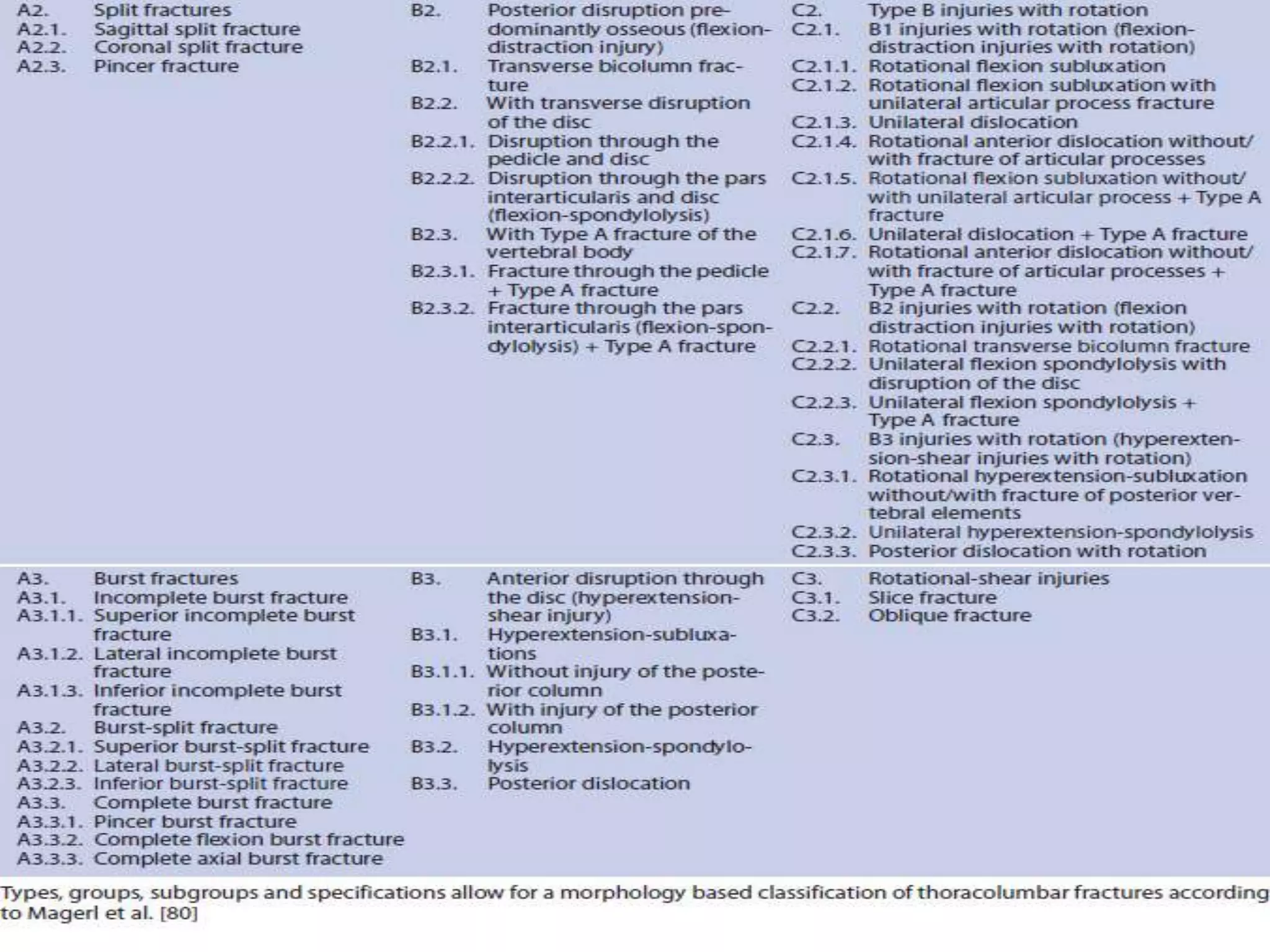
Thoracolumbar Trauma: 
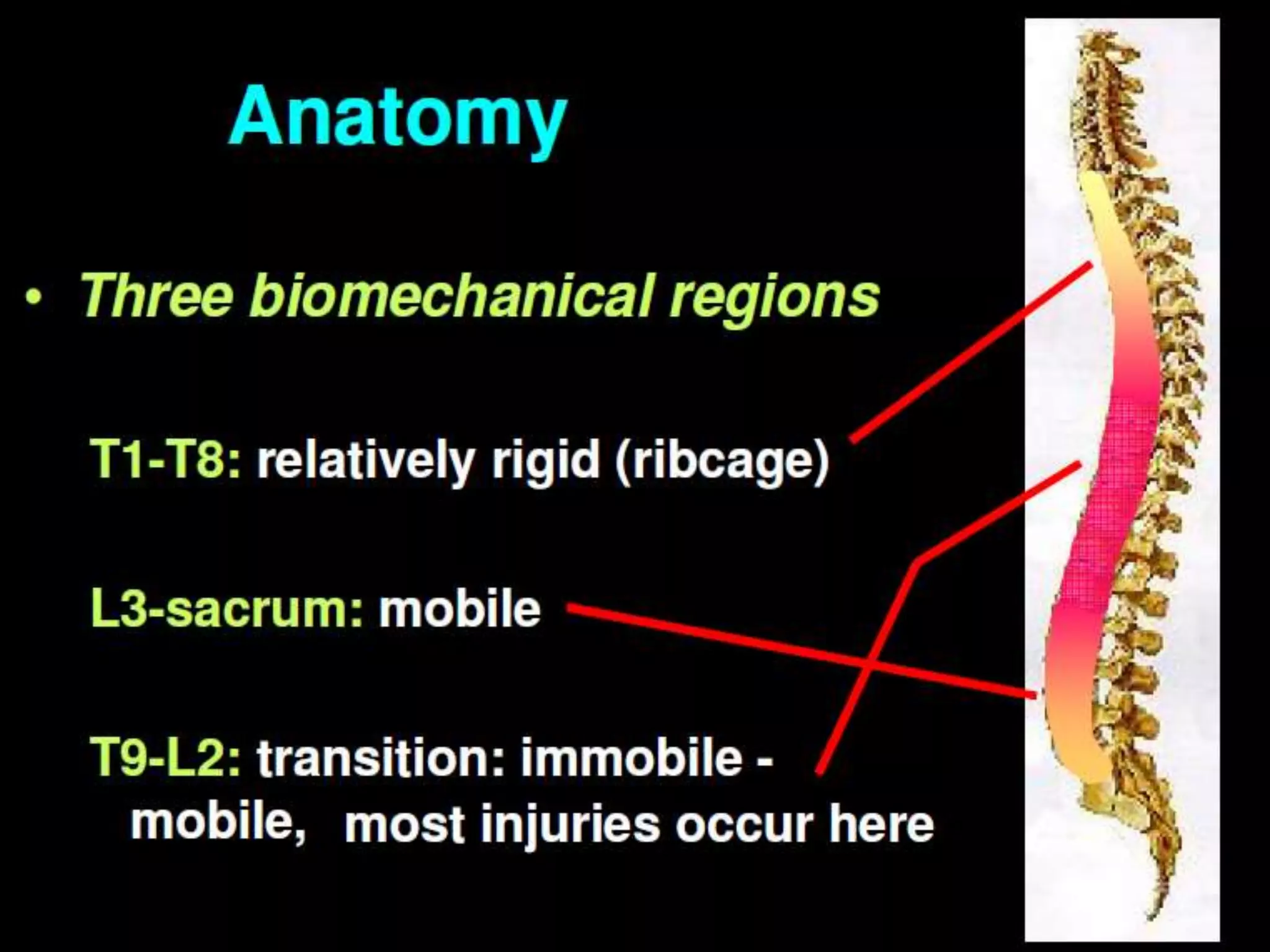
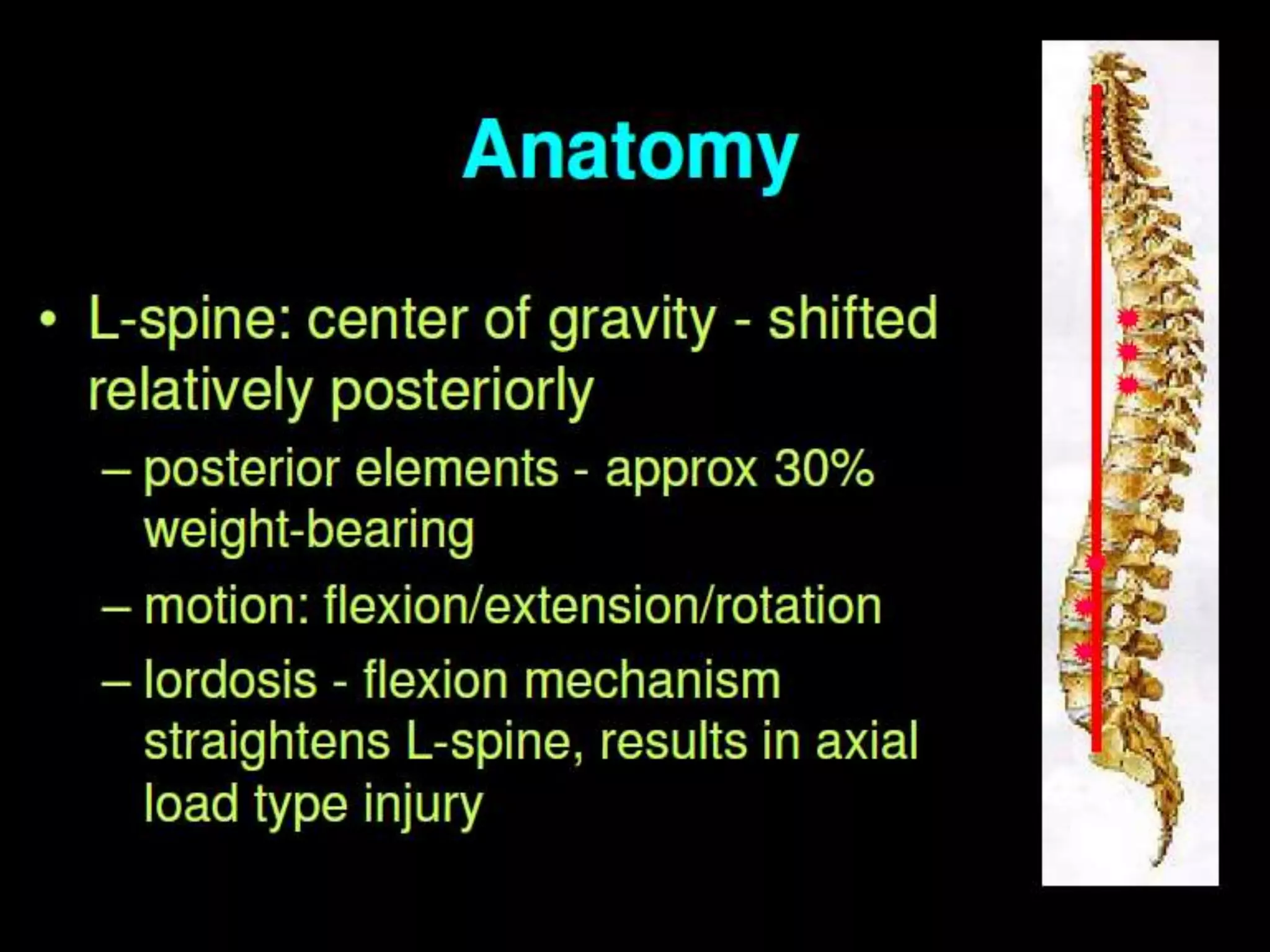
• Anatomy. 
• Stability / instability. 
• Basic trauma vectors. 
• Fracture patterns.
Thoracolumbar spine injuries are commonly related 
to high energy accidents including falls or motor 
vehicle accidents. Patients with thoracolumbar injuries 
commonly have other injuries including injuries to the 
abdomen, chest, extremities, or other spinal injuries. 
The typical “ABC” (airway, breathing, and circulation) 
evaluation is needed for all patients seen in the 
emergency room after a thoracolumbar spine trauma. 
Appropriate evaluation of the thoracolumbar spine 
trauma requires complete and thorough clinical and 
radiographic examination, which begins only after 
ensuring the patient’s other vital organ systems are 
intact.
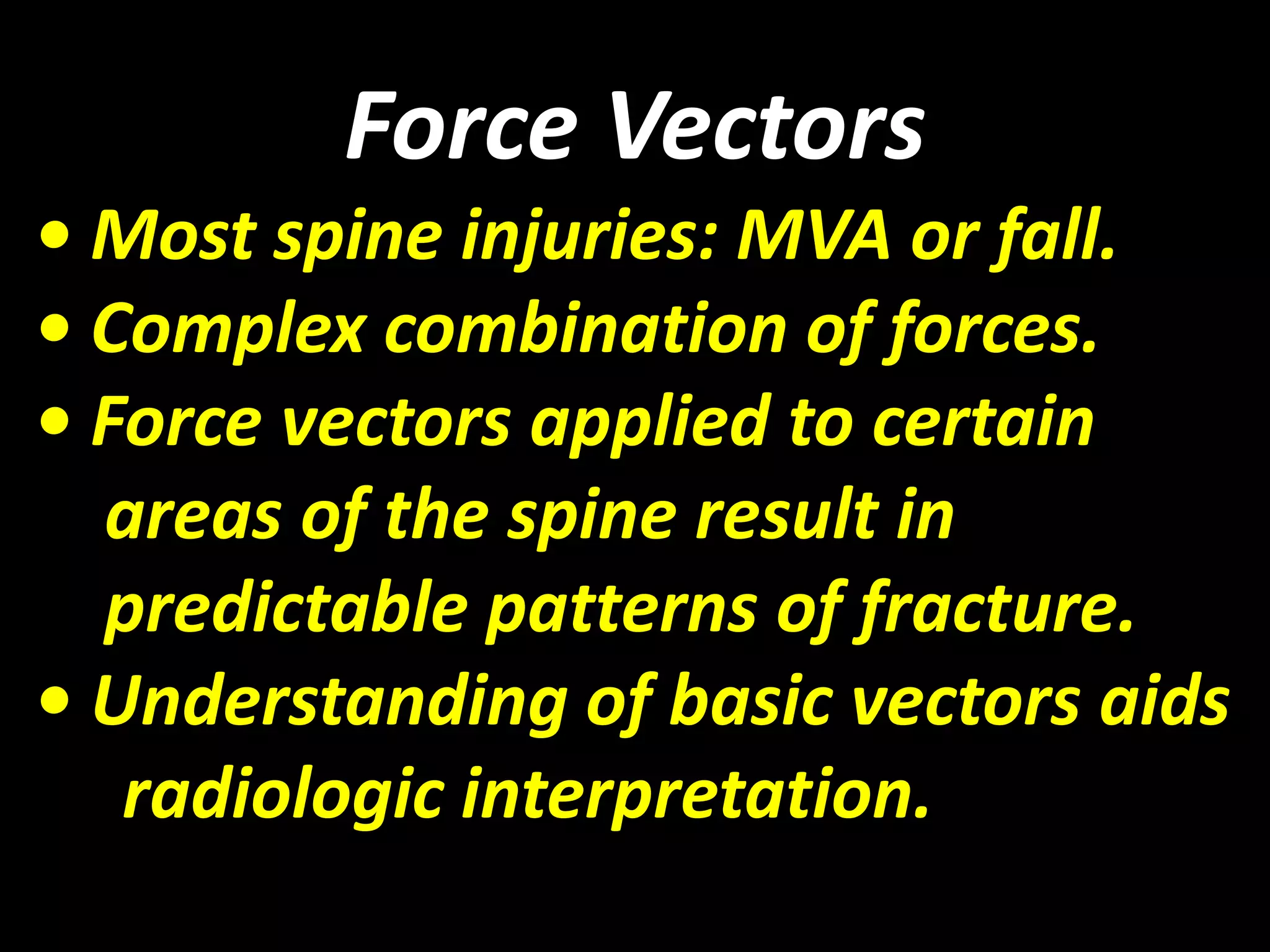
Force Vectors 
• Most spine injuries: MVA or fall. 
• Complex combination of forces. 
• Force vectors applied to certain 
areas of the spine result in 
predictable patterns of fracture. 
• Understanding of basic vectors aids 
radiologic interpretation.
Basic Spine Trauma Forces 
• Axial load. 
• Flexion / compression. 
• Flexion / rotation. 
• Flexion / distraction. 
• Lateral compression. 
• Shear. 
• Extension.
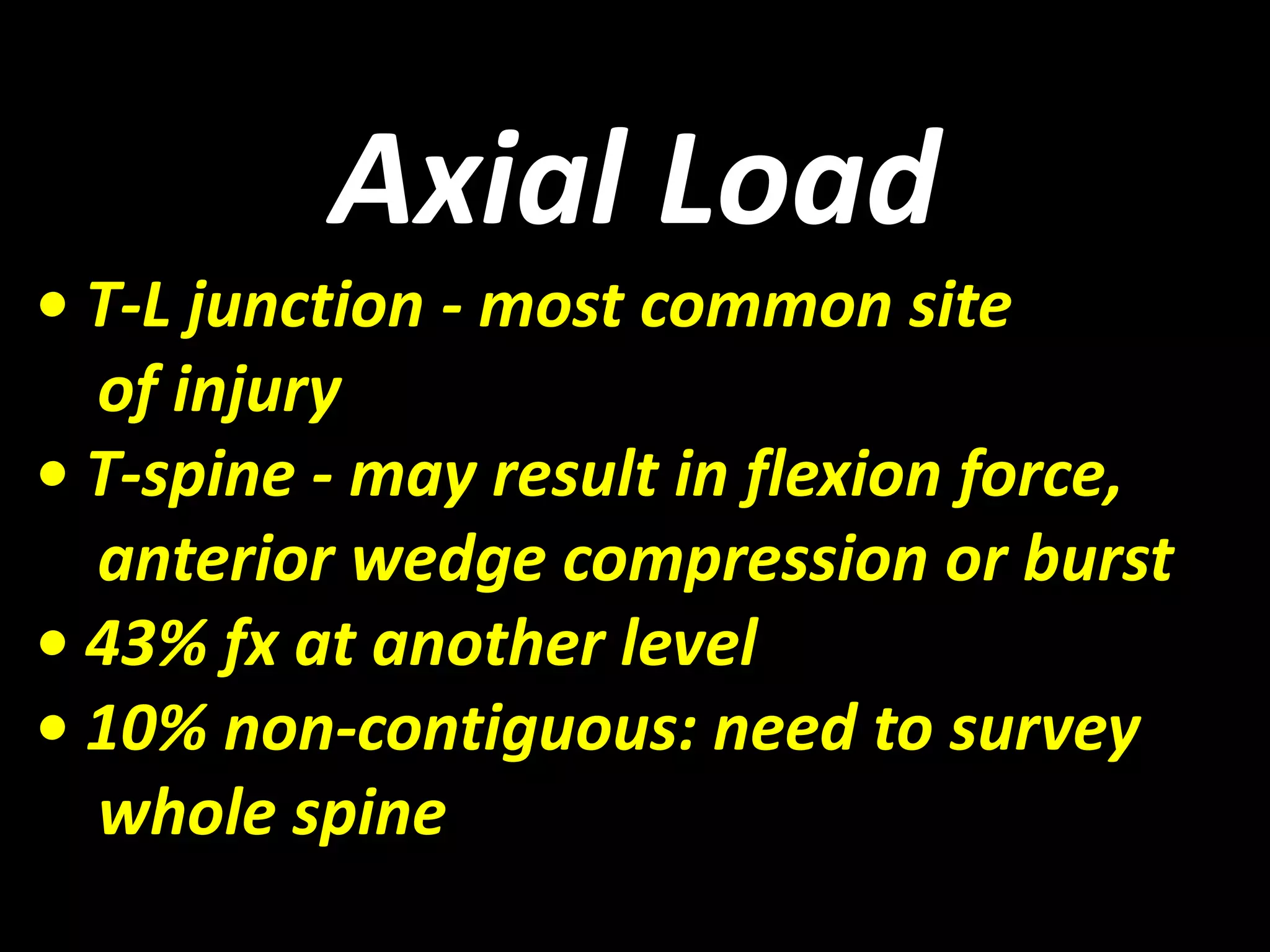
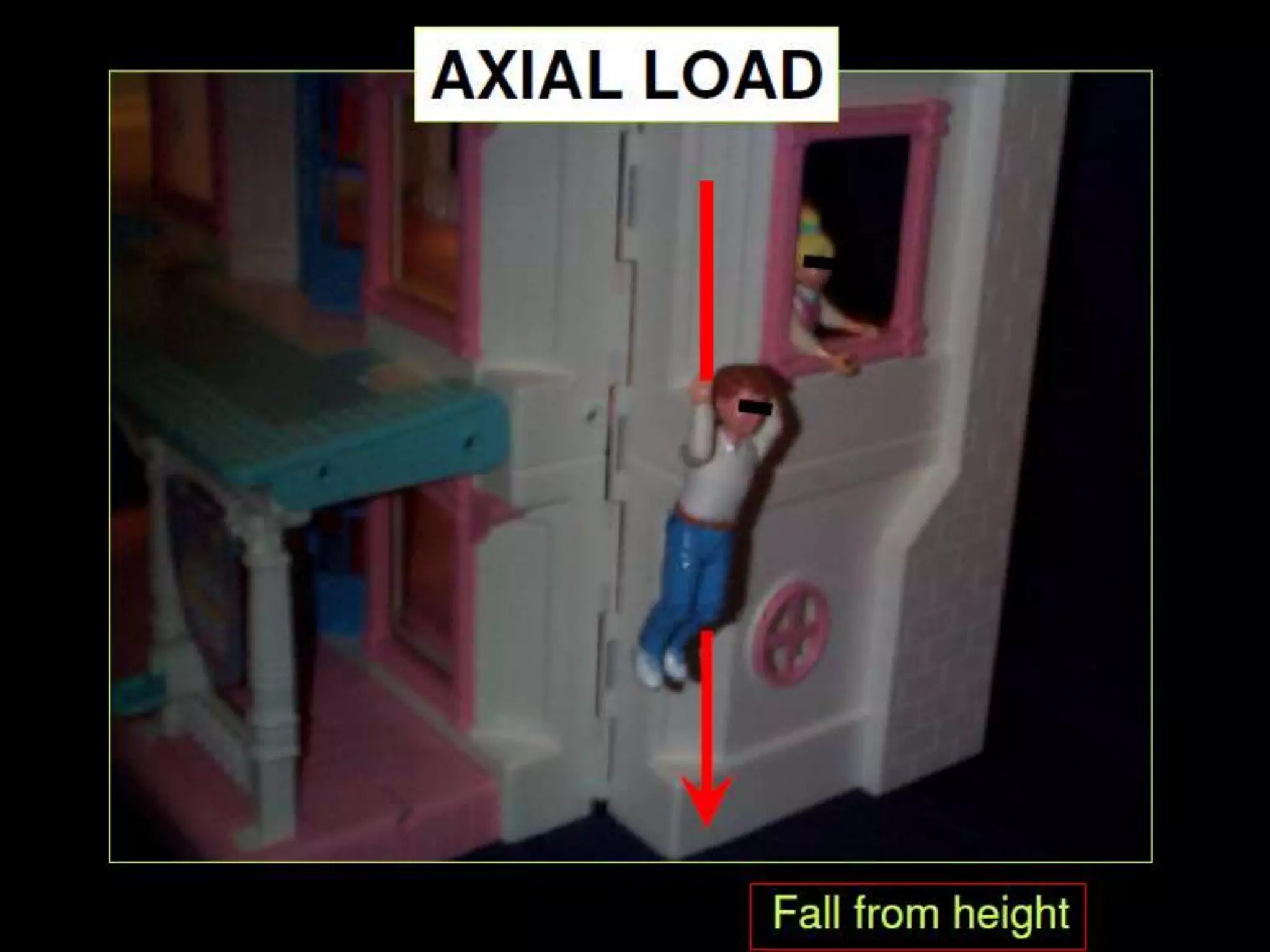
Axial Load 
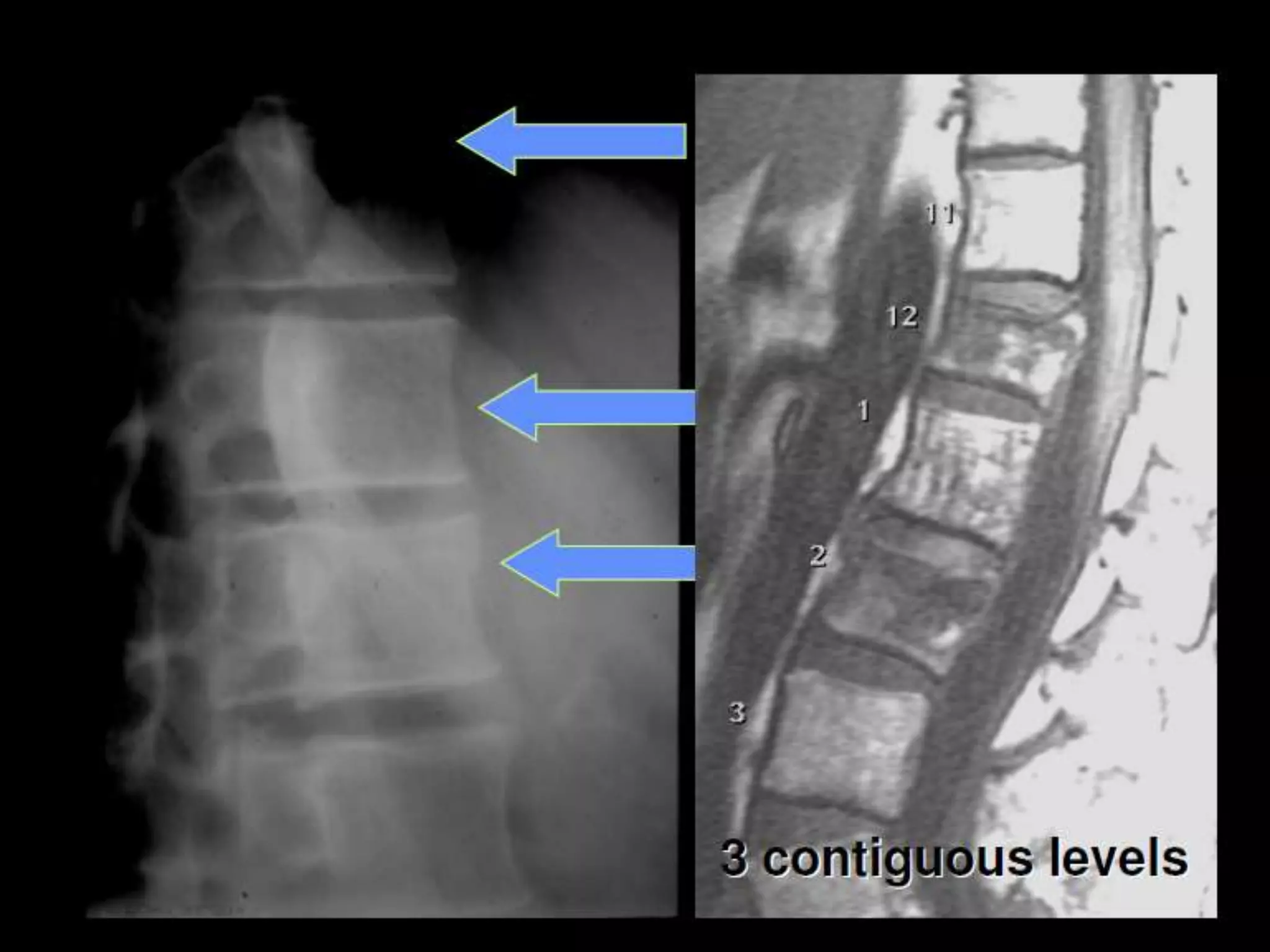
• T-L junction - most common site 
of injury 
• T-spine - may result in flexion force, 
anterior wedge compression or burst 
• 43% fx at another level 
• 10% non-contiguous: need to survey 
whole spine
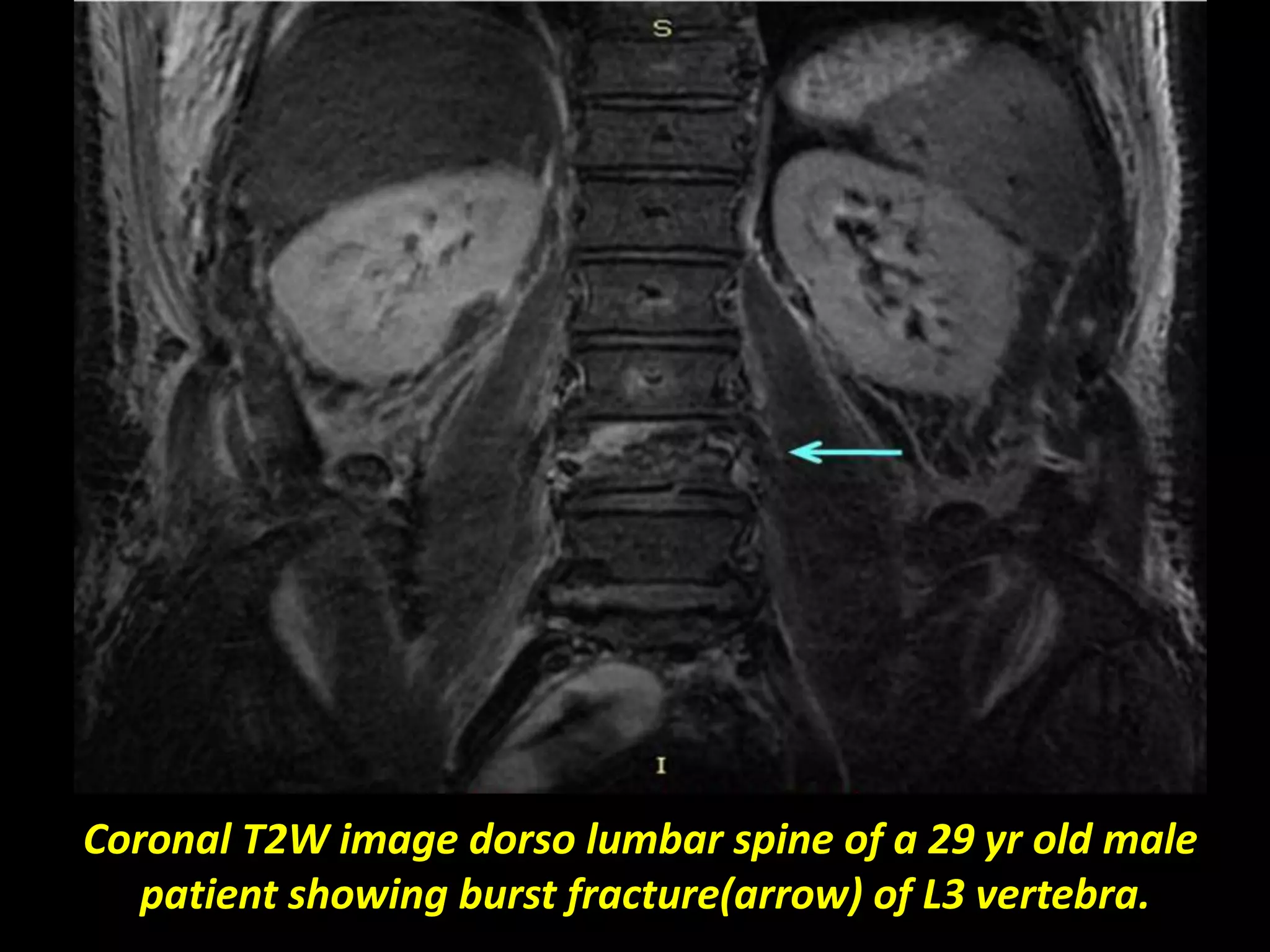
Coronal T2W image dorso lumbar spine of a 29 yr old male 
patient showing burst fracture(arrow) of L3 vertebra.
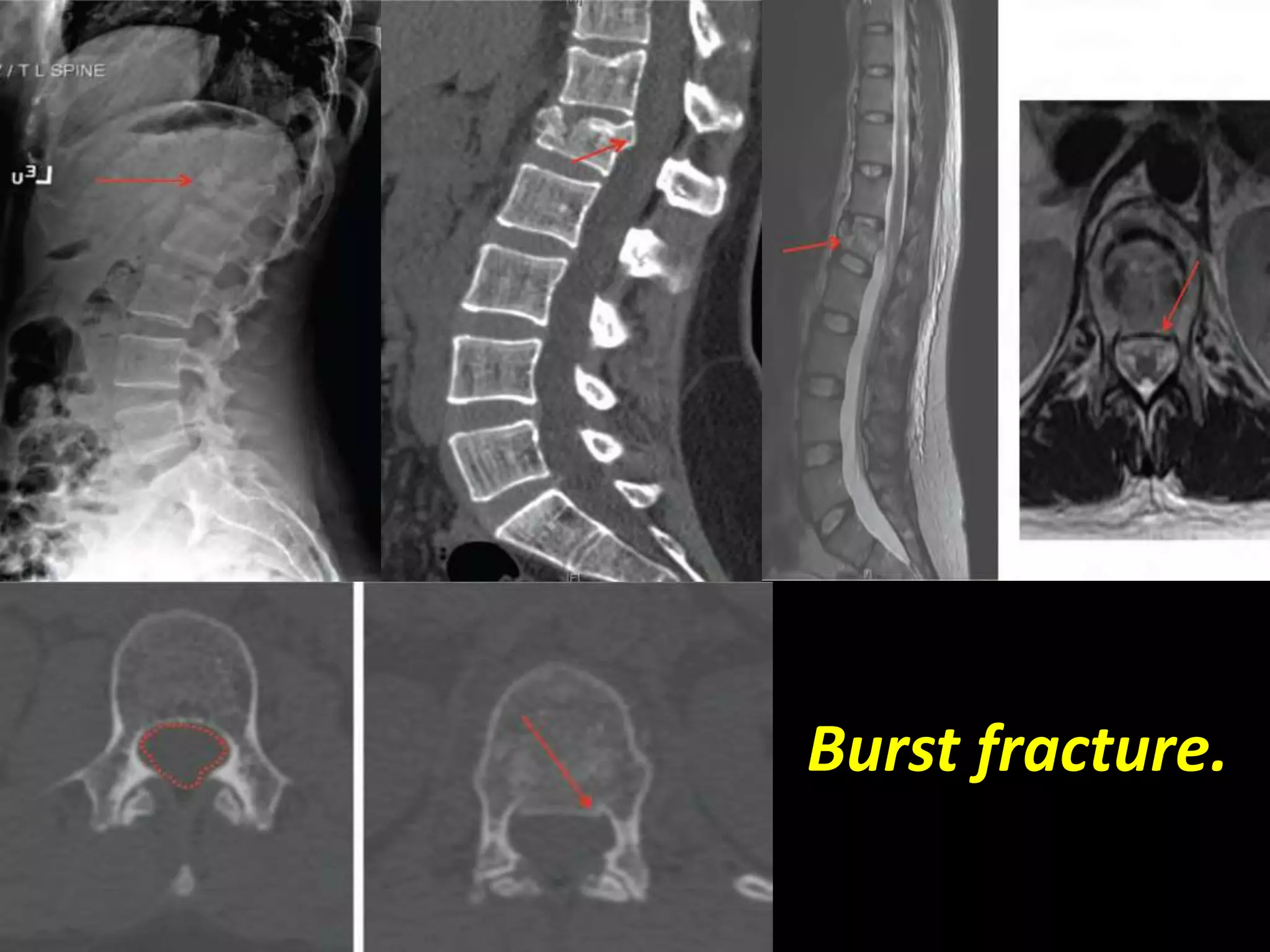
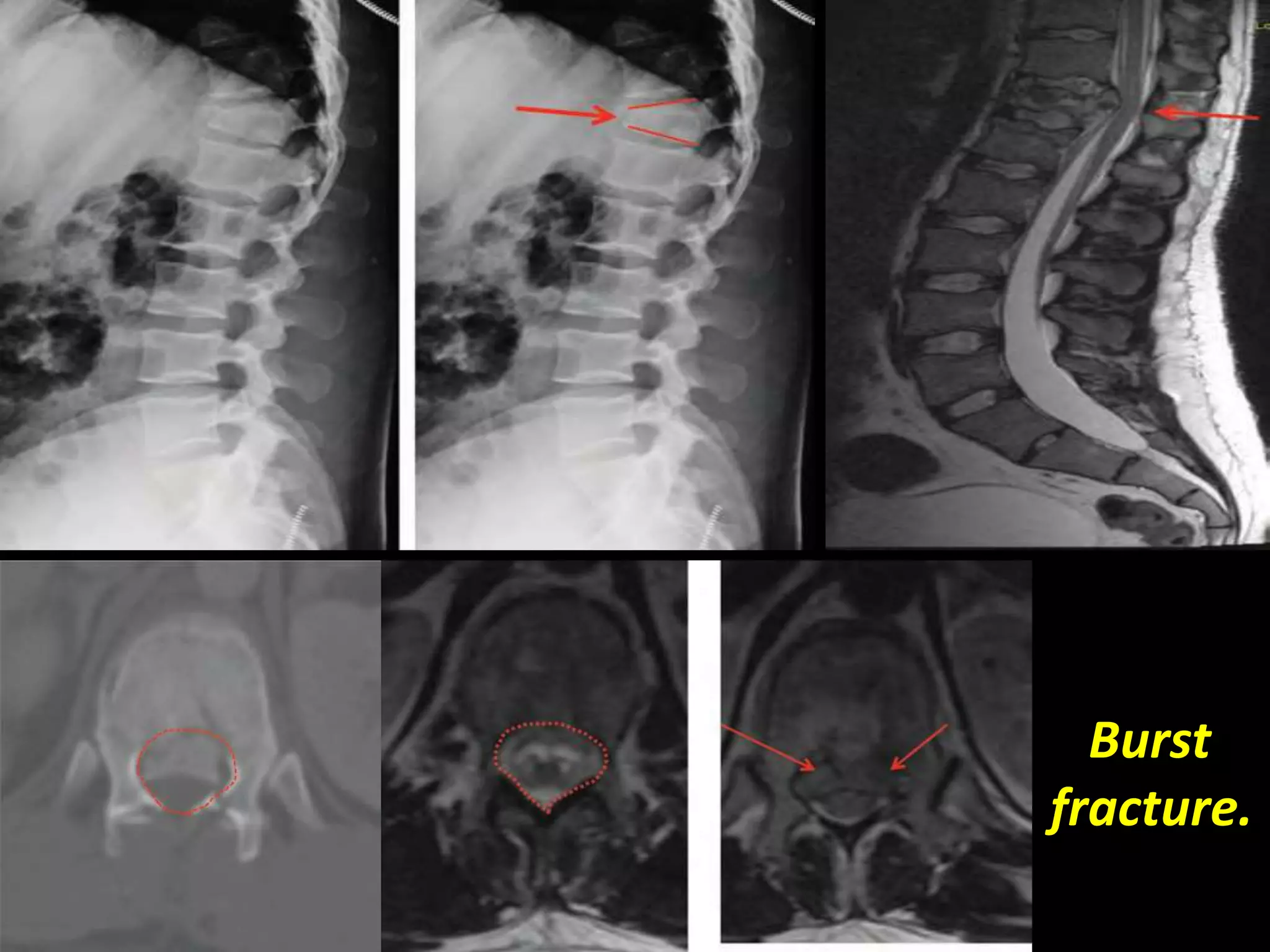
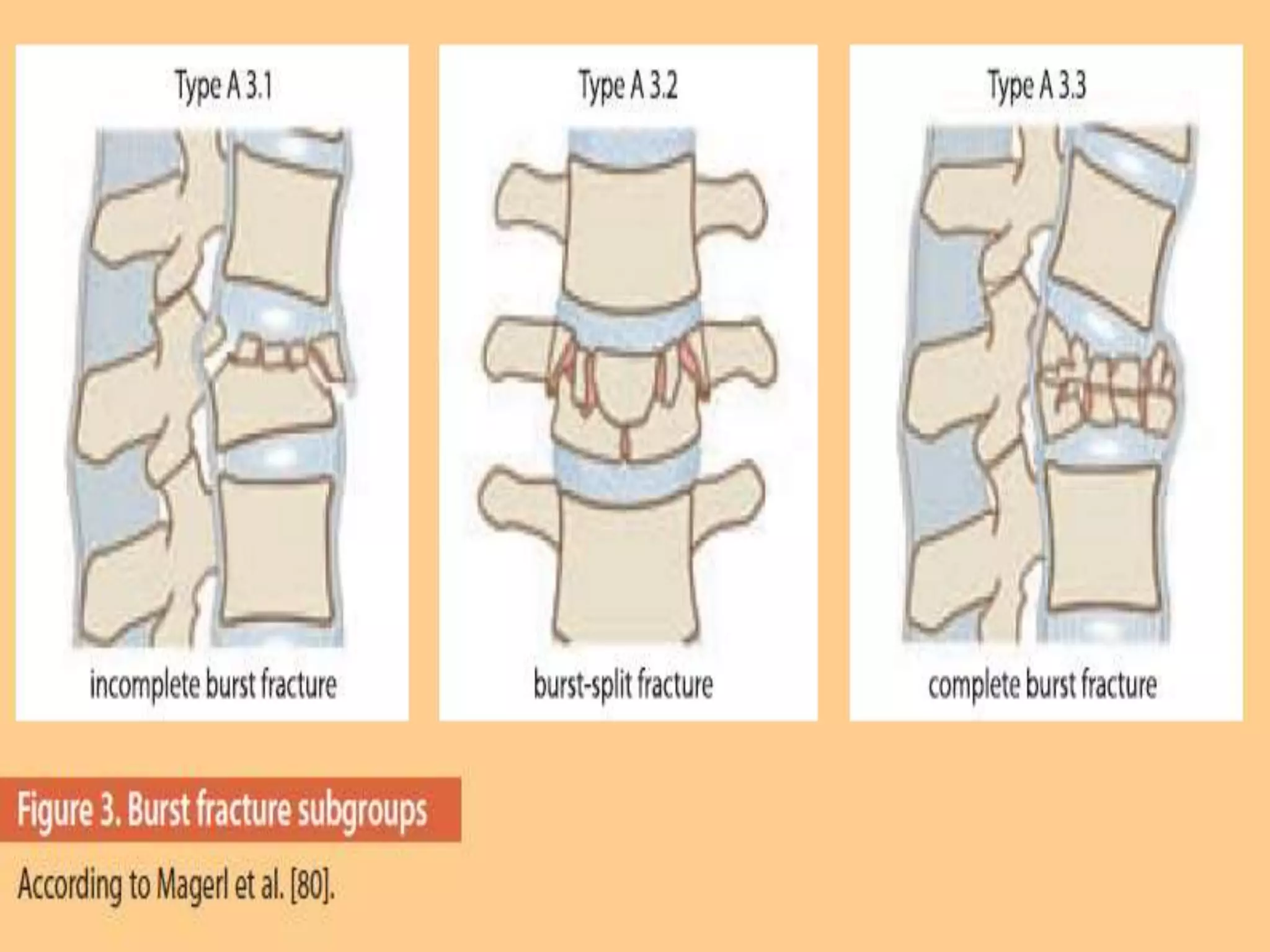
Burst fracture.
Burst 
fracture.
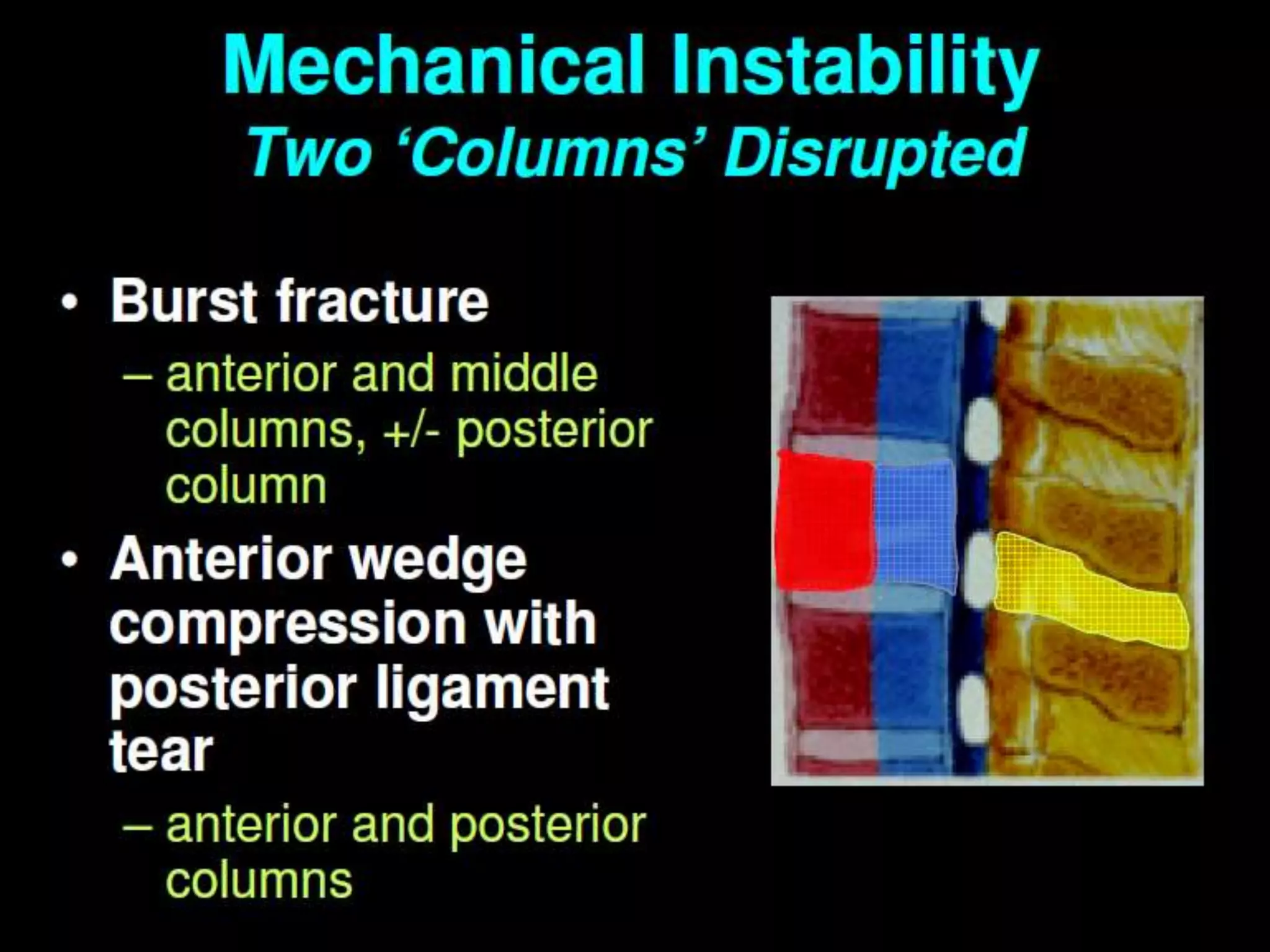
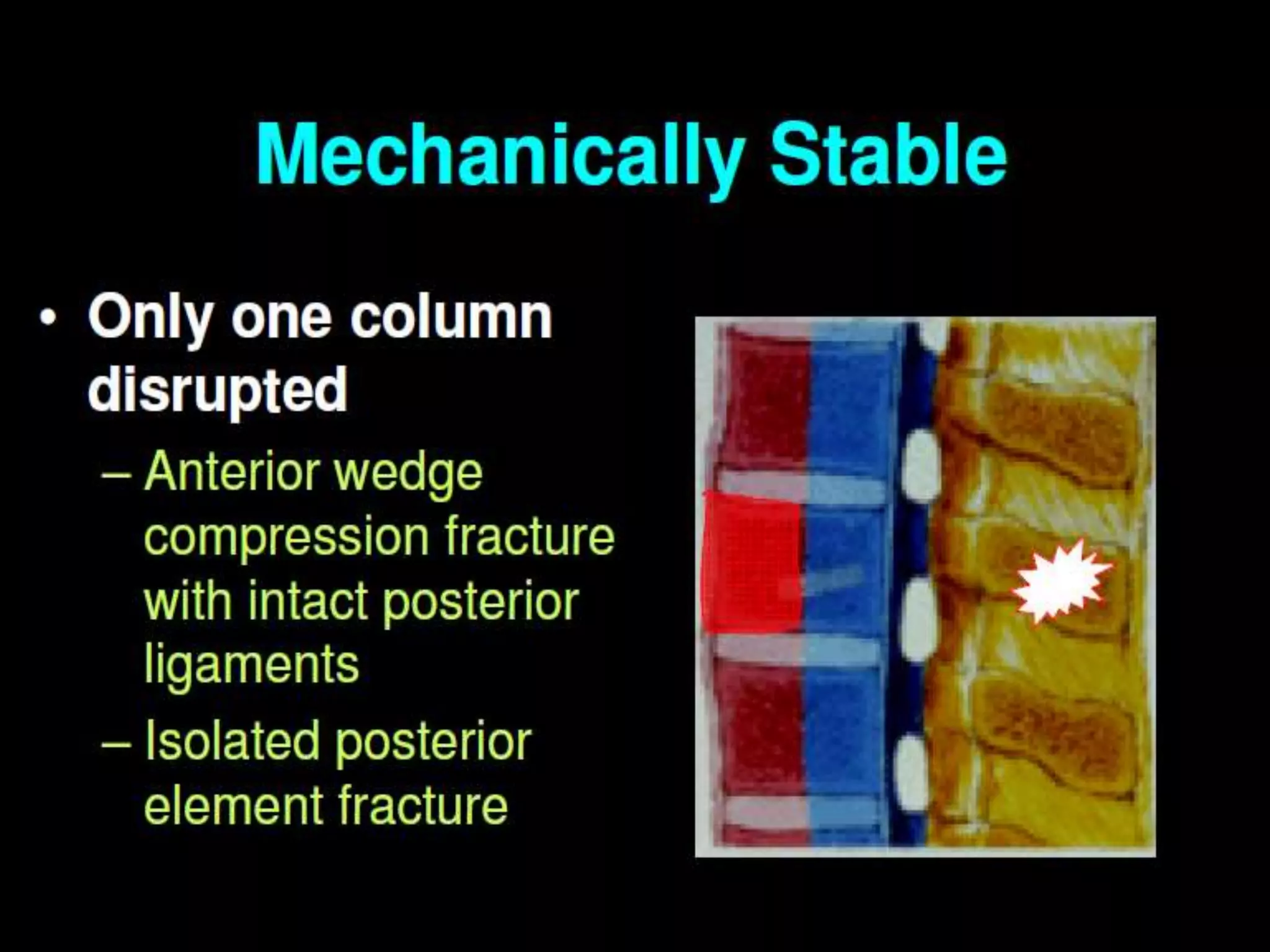
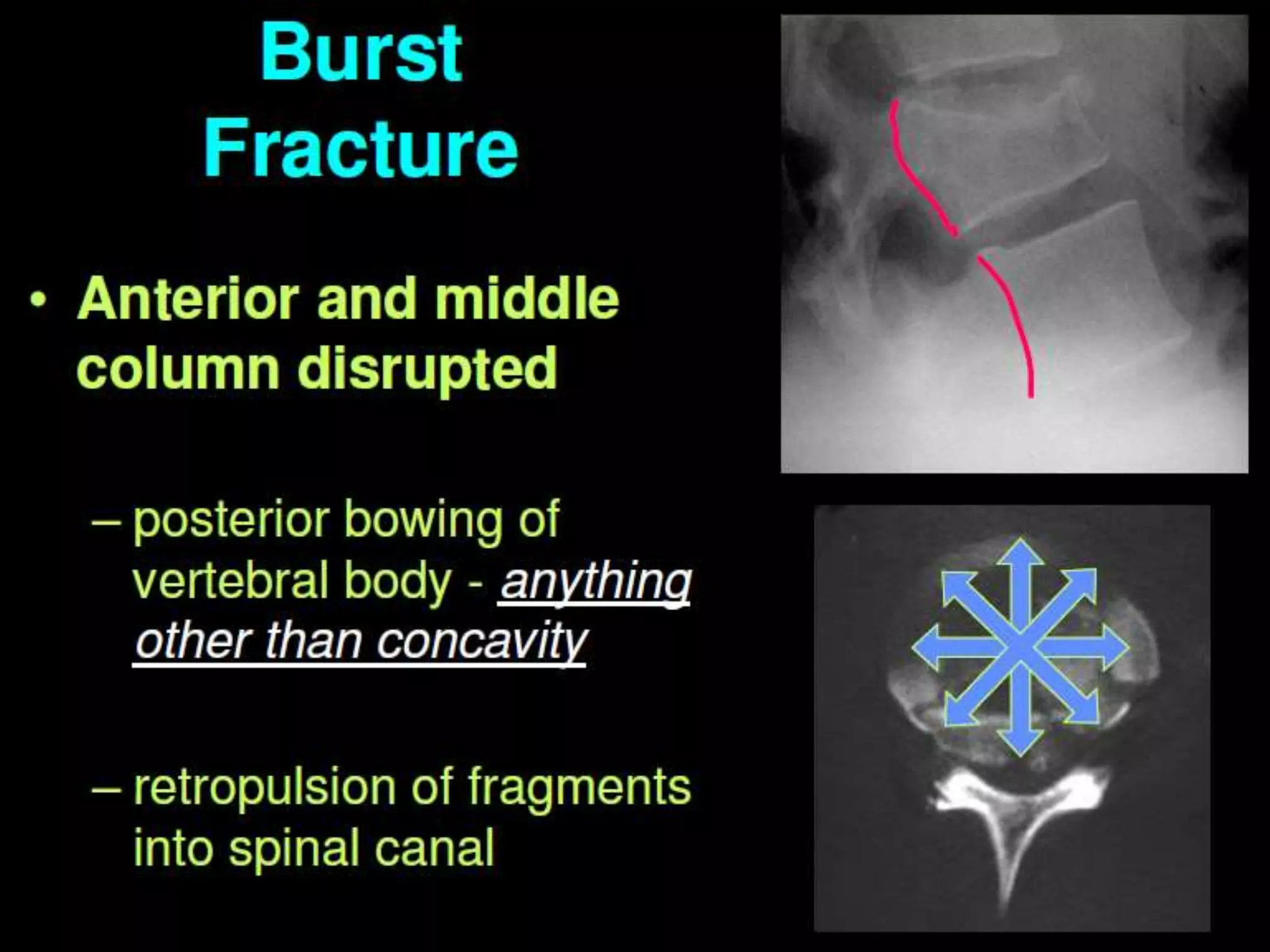
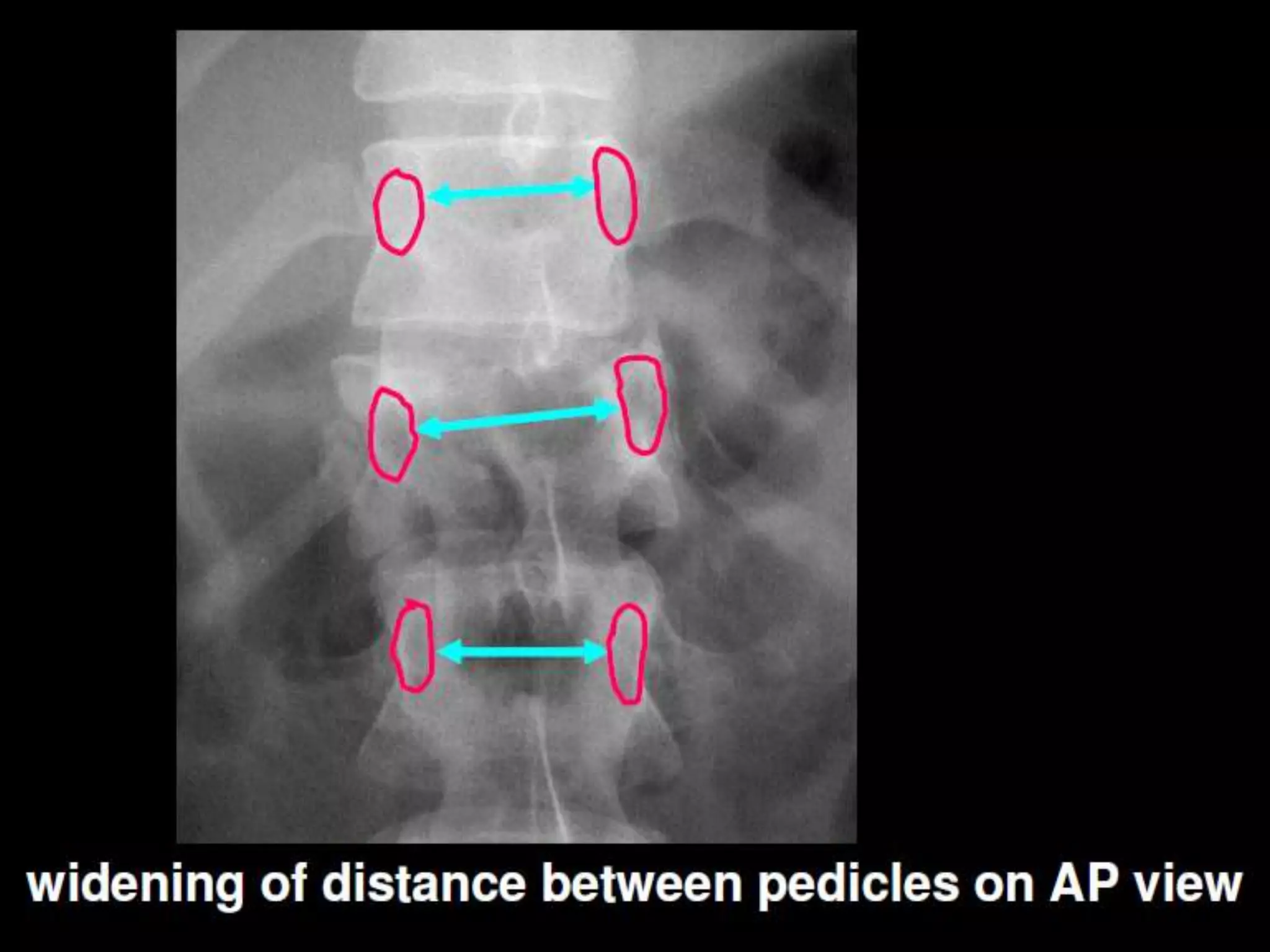
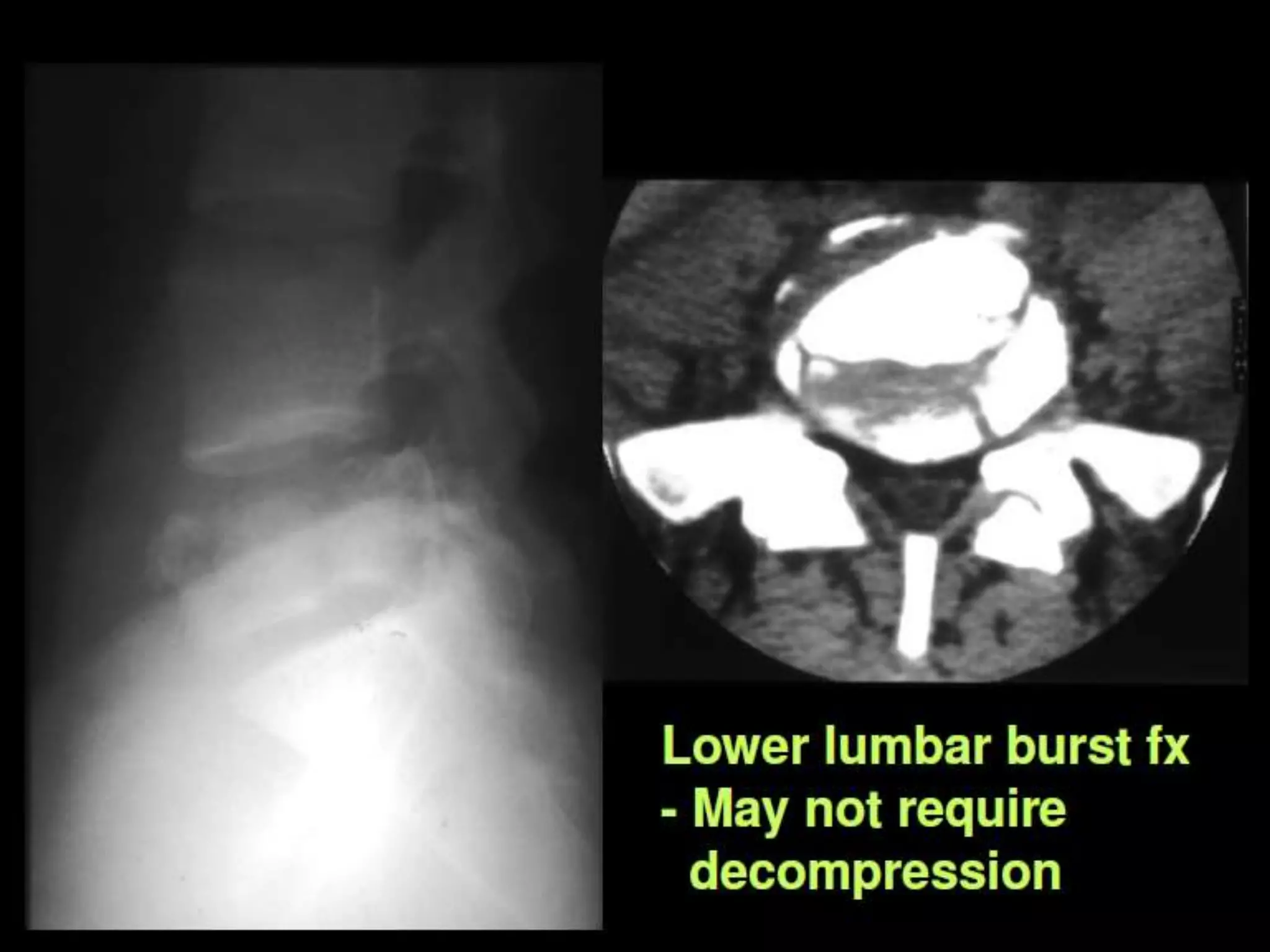
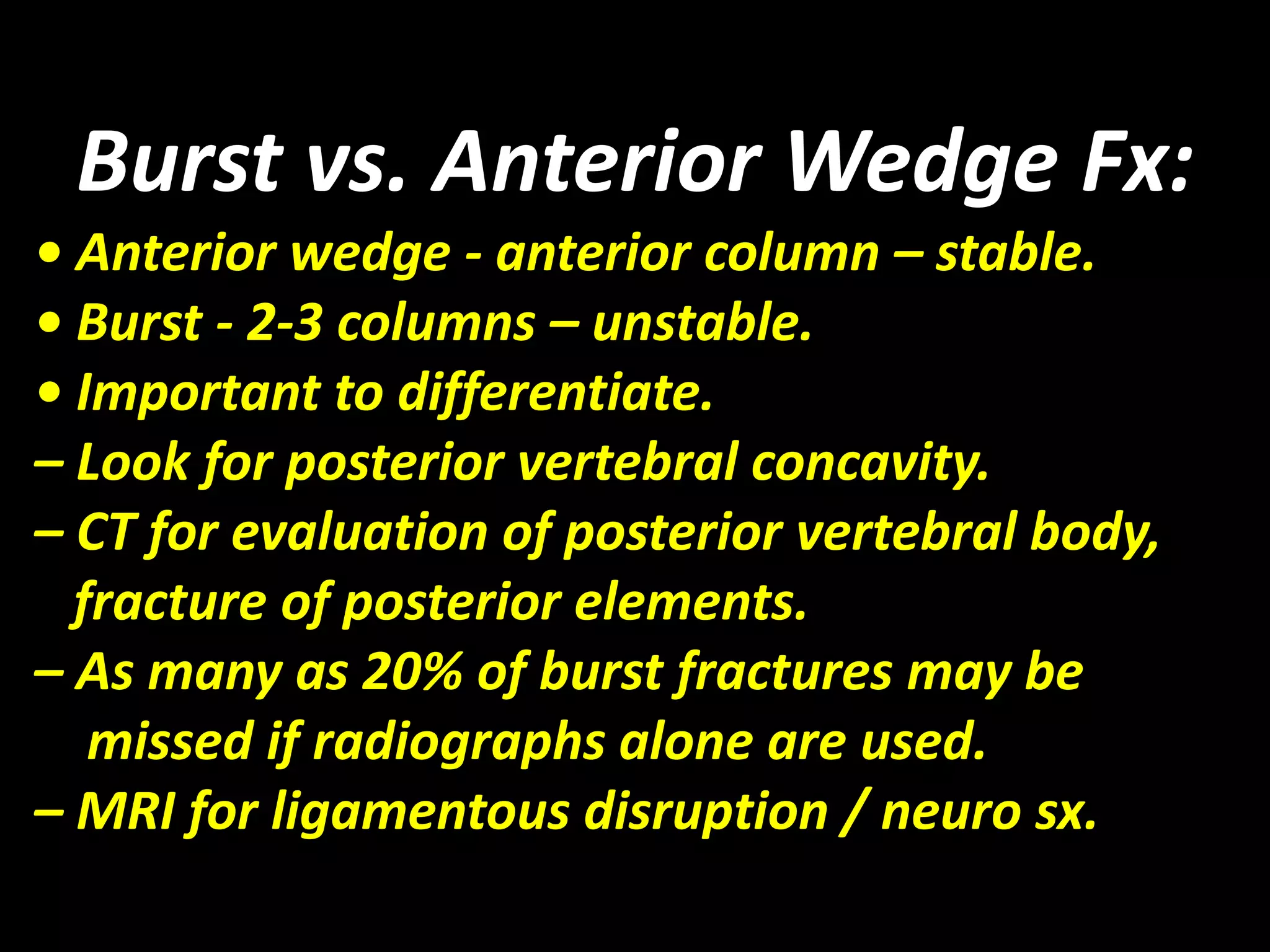
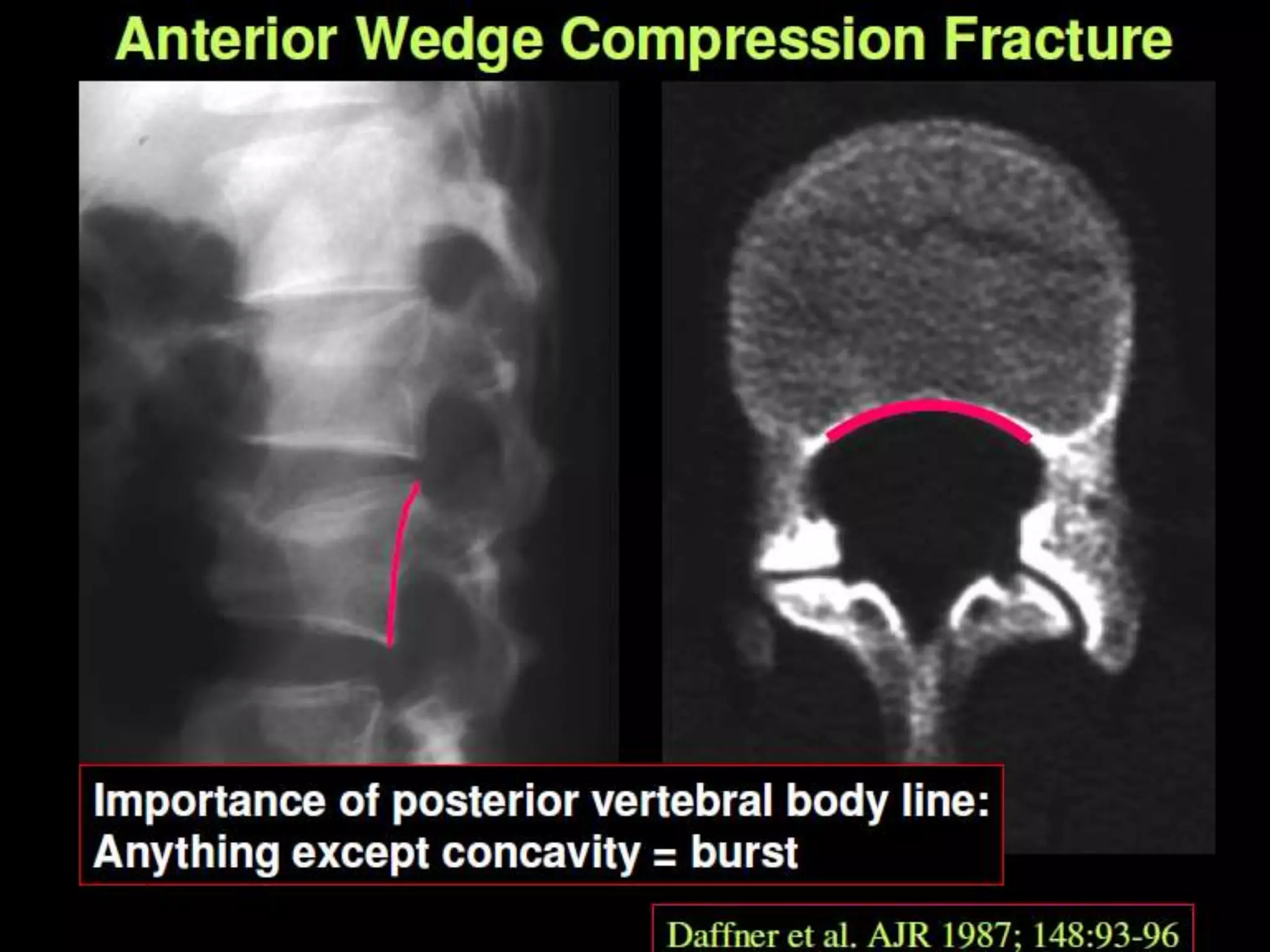
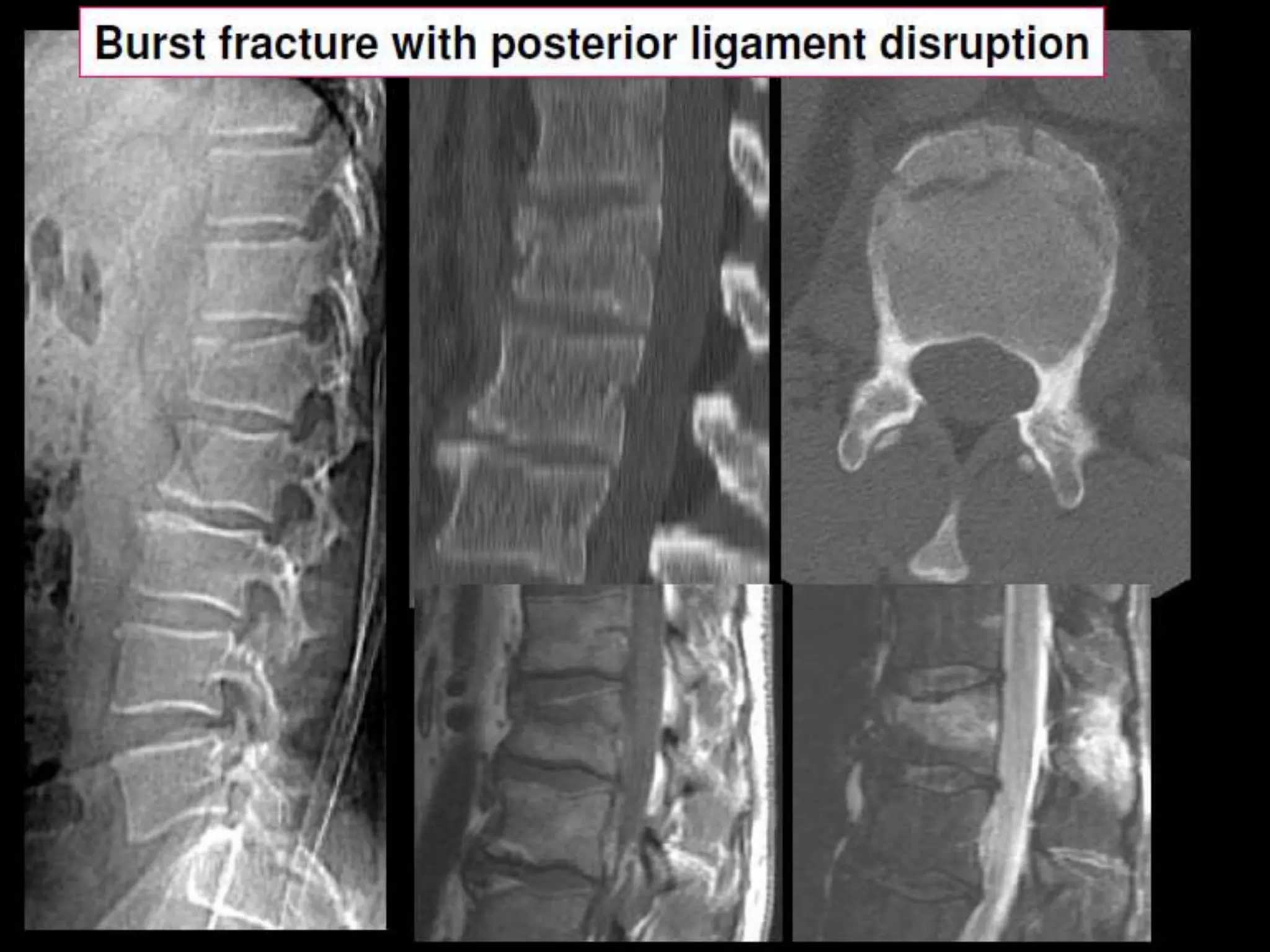
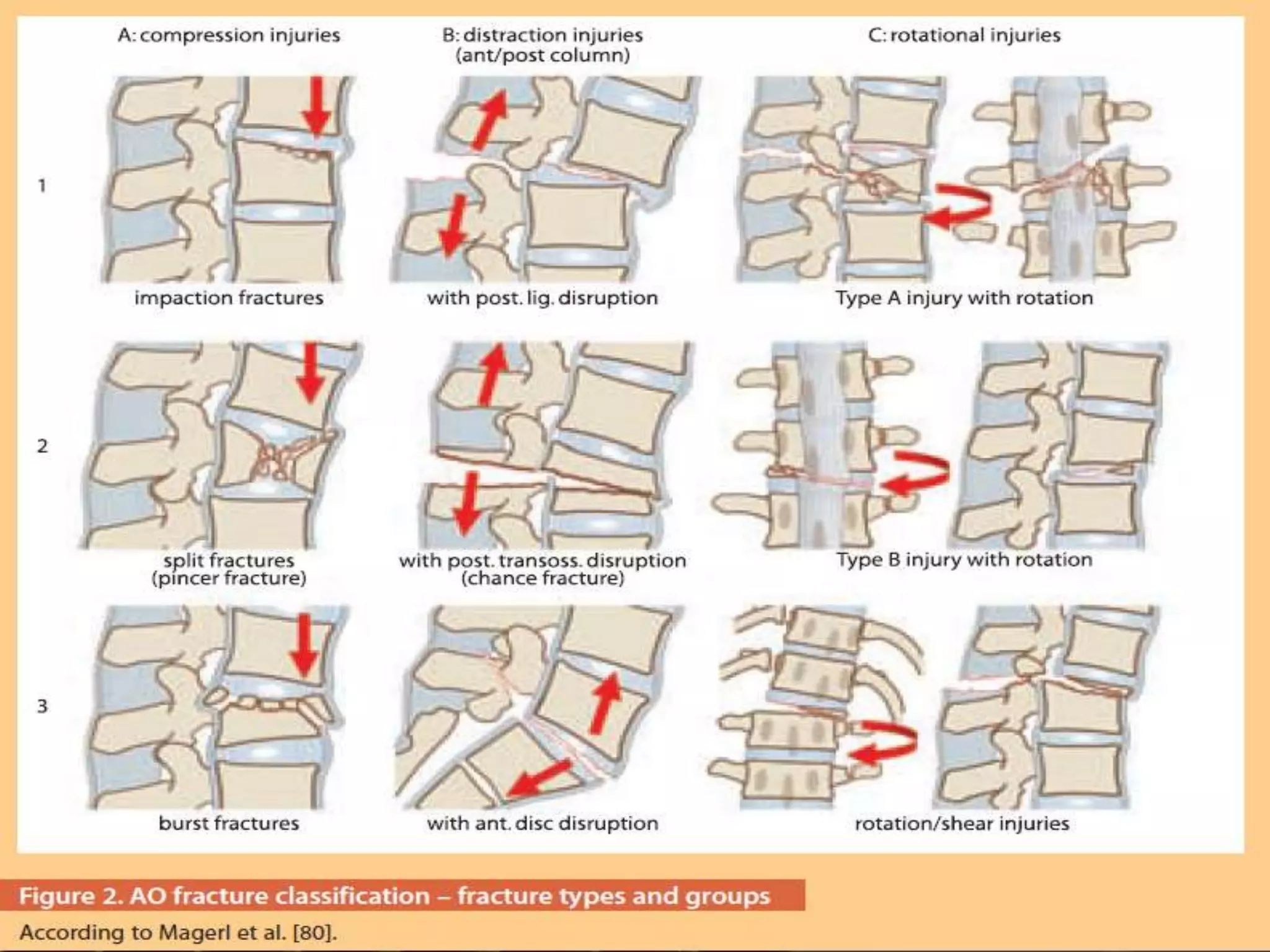
Burst vs. Anterior Wedge Fx: 
• Anterior wedge - anterior column – stable. 
• Burst - 2-3 columns – unstable. 
• Important to differentiate. 
– Look for posterior vertebral concavity. 
– CT for evaluation of posterior vertebral body, 
fracture of posterior elements. 
– As many as 20% of burst fractures may be 
missed if radiographs alone are used. 
– MRI for ligamentous disruption / neuro sx.
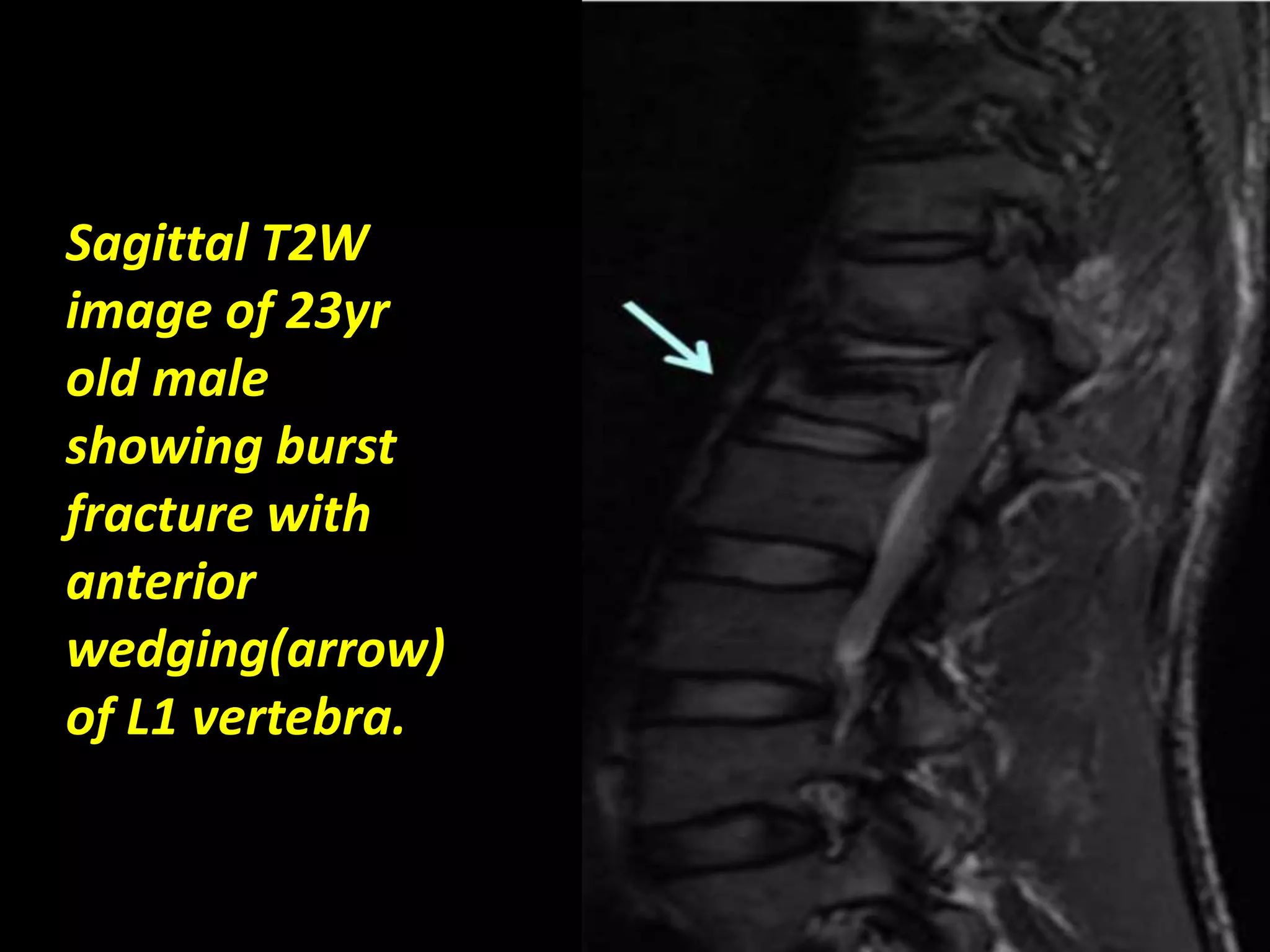
Sagittal T2W 
image of 23yr 
old male 
showing burst 
fracture with 
anterior 
wedging(arrow) 
of L1 vertebra.
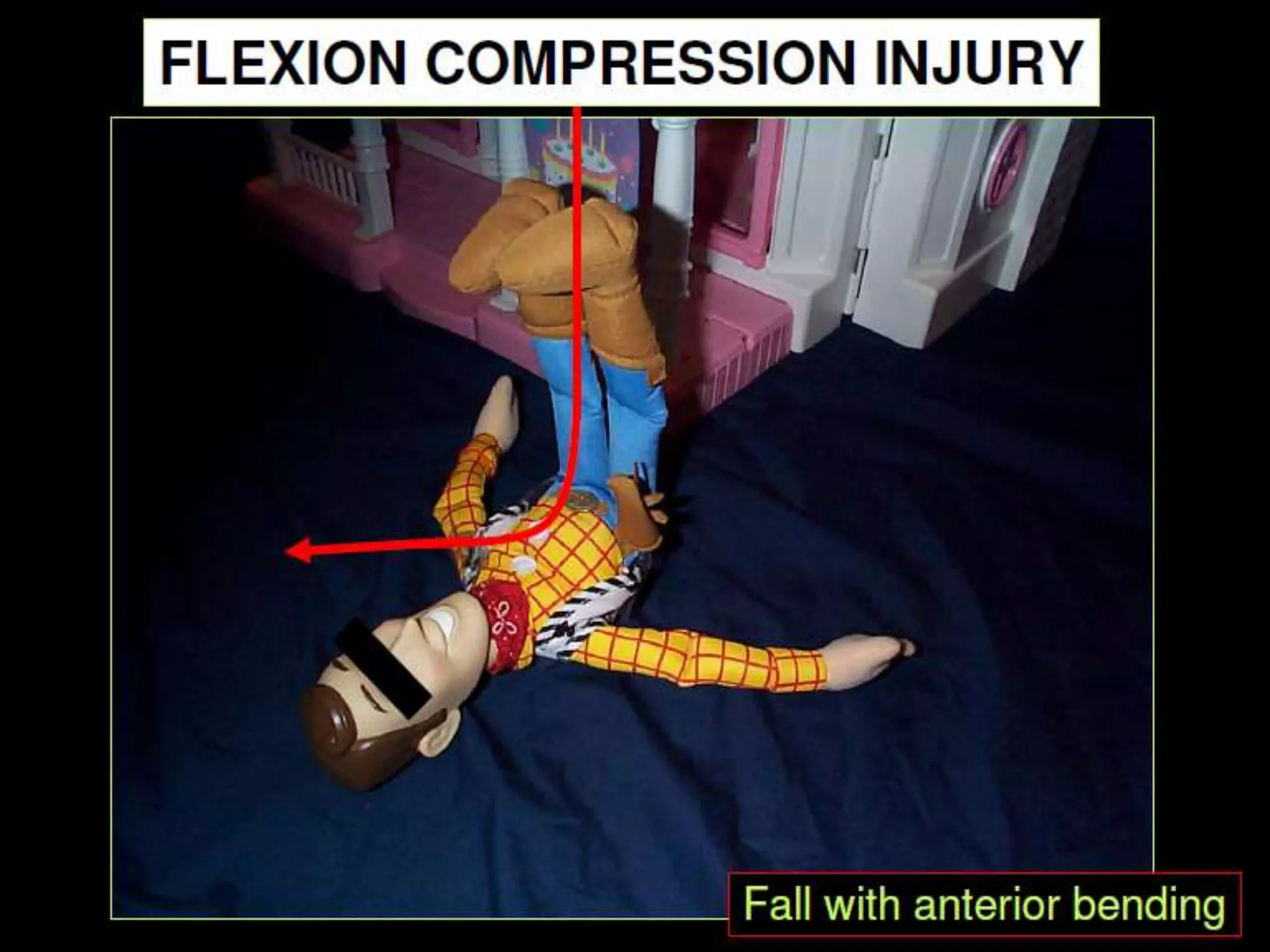
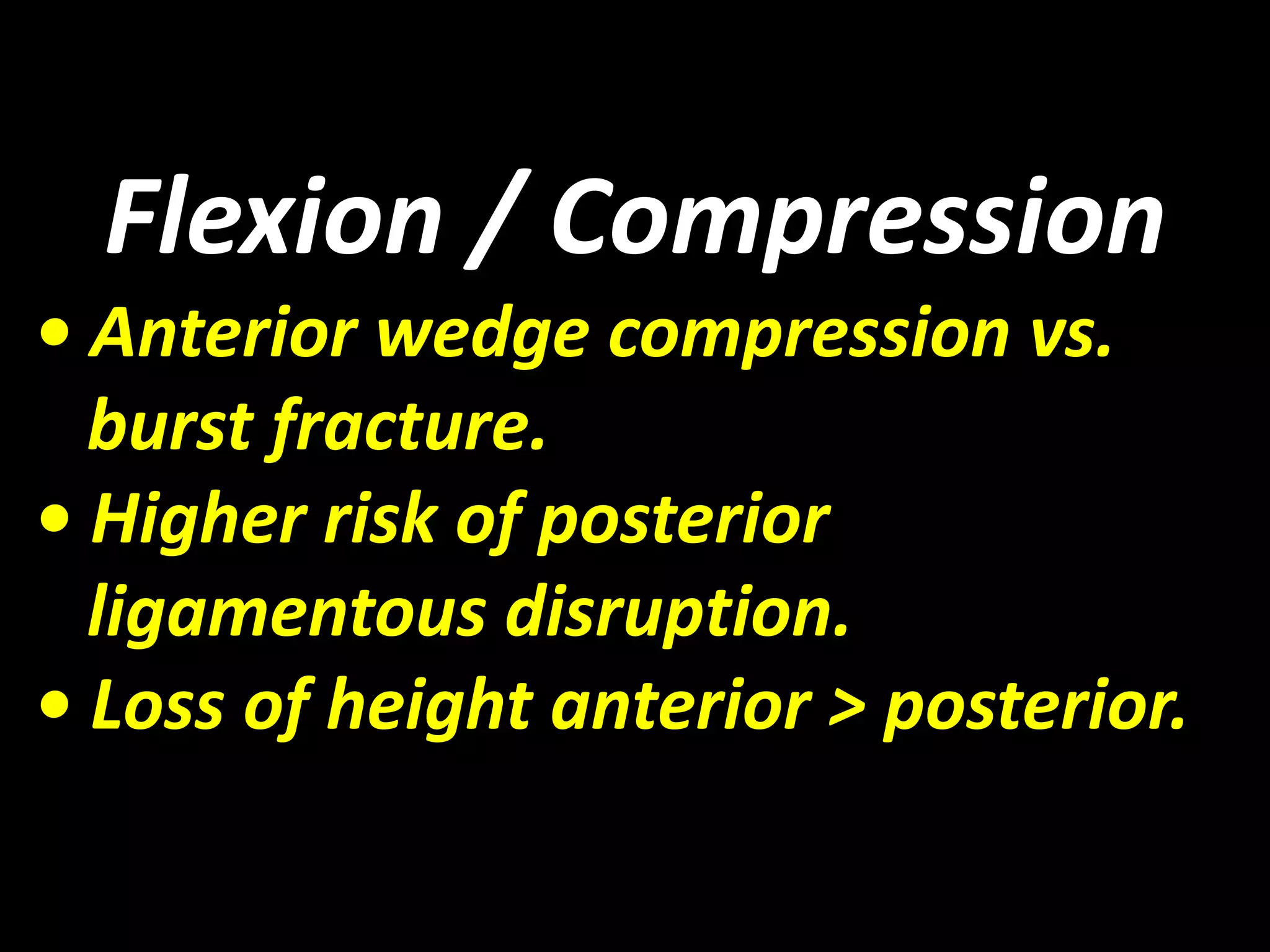
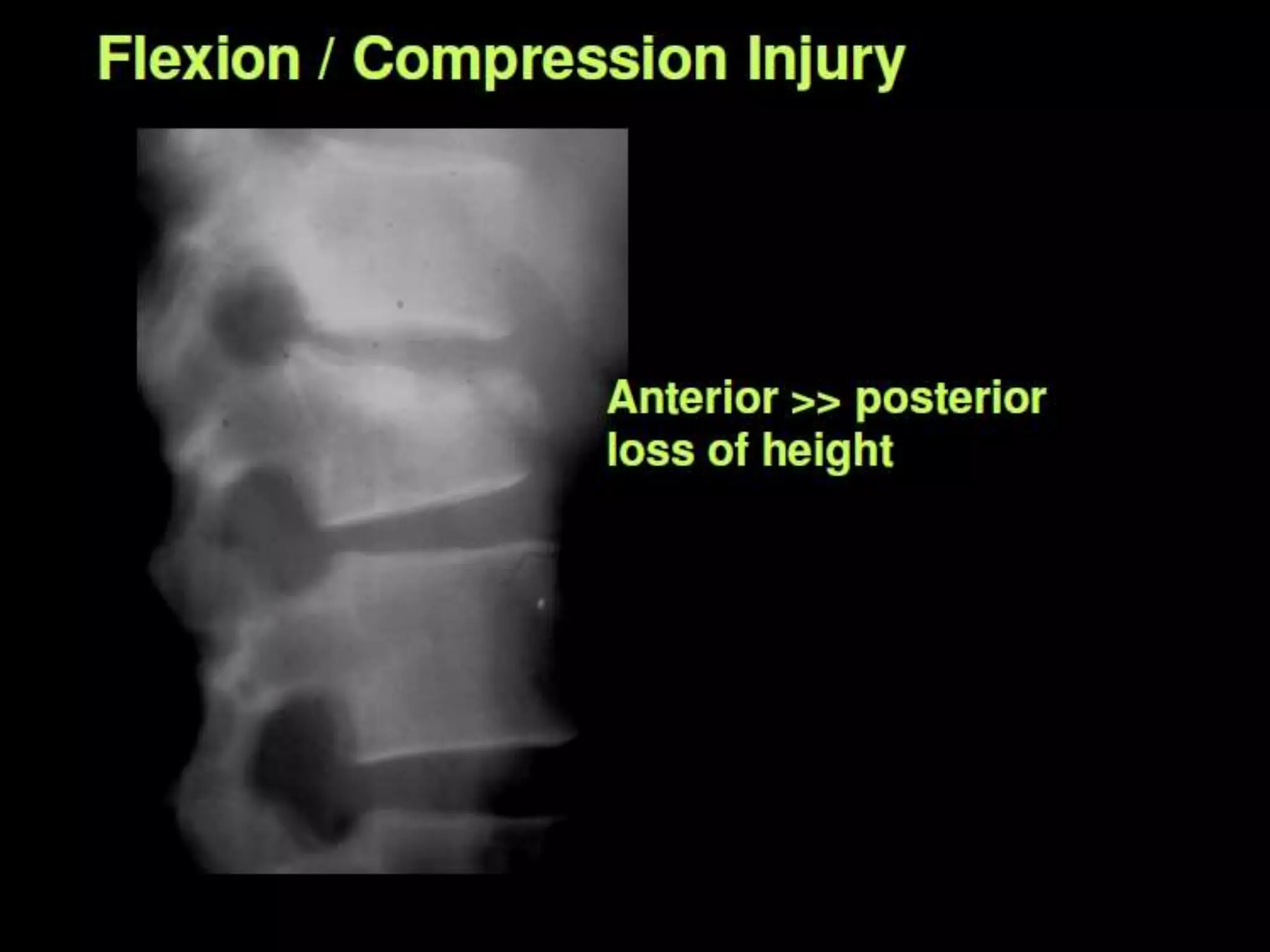
Flexion / Compression 
• Anterior wedge compression vs. 
burst fracture. 
• Higher risk of posterior 
ligamentous disruption. 
• Loss of height anterior > posterior.
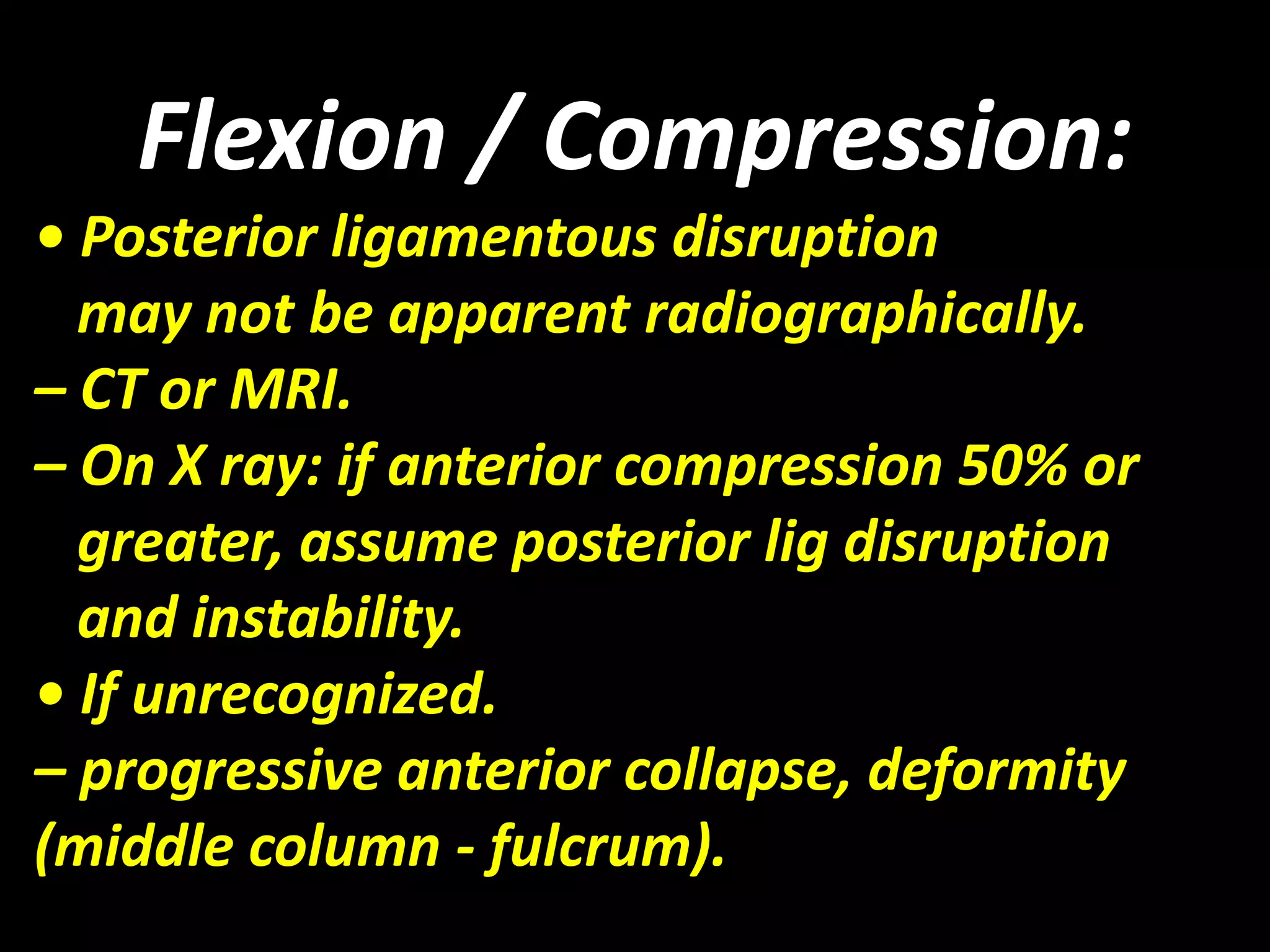
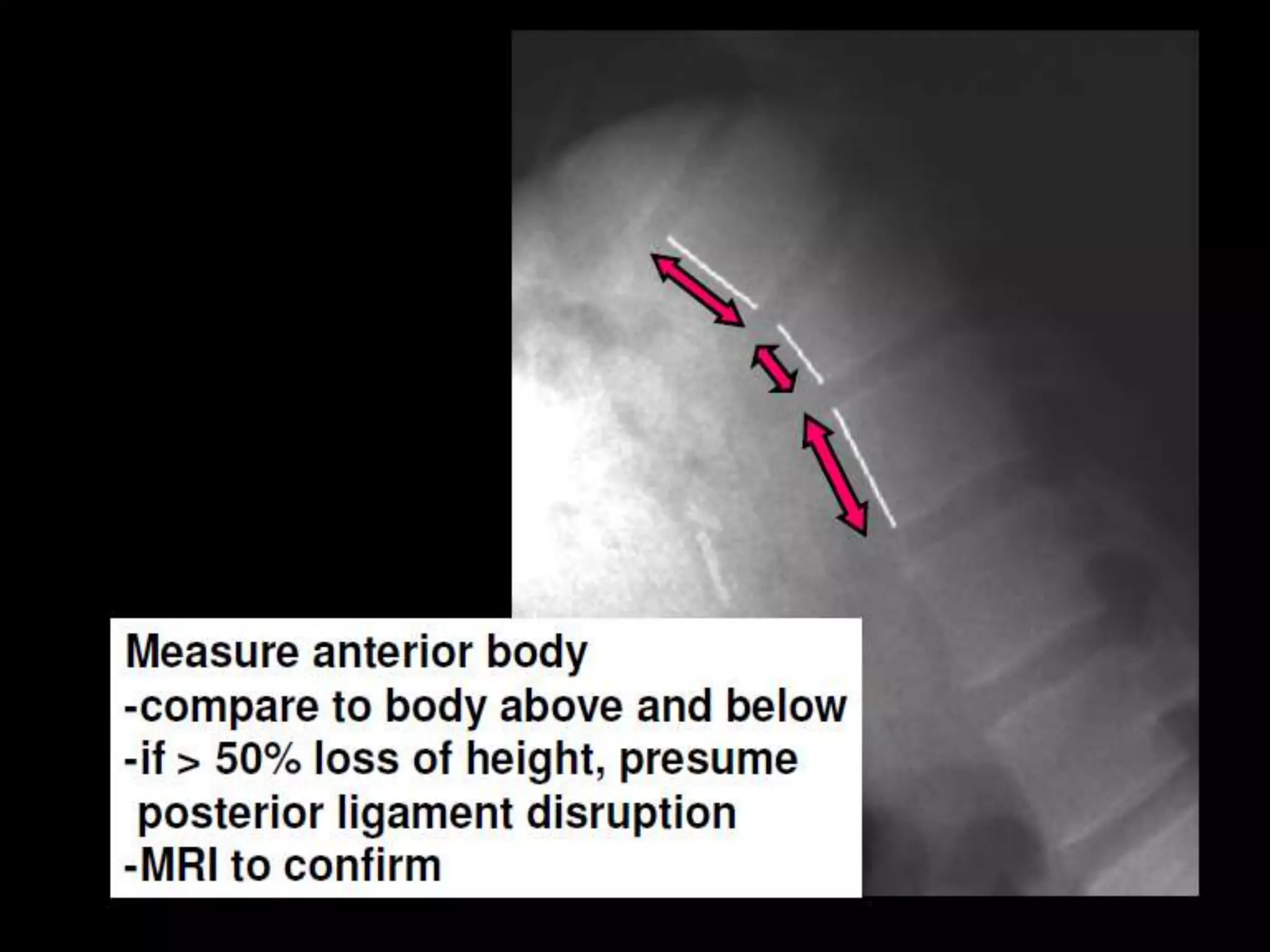
Flexion / Compression: 
• Posterior ligamentous disruption 
may not be apparent radiographically. 
– CT or MRI. 
– On X ray: if anterior compression 50% or 
greater, assume posterior lig disruption 
and instability. 
• If unrecognized. 
– progressive anterior collapse, deformity 
(middle column - fulcrum).
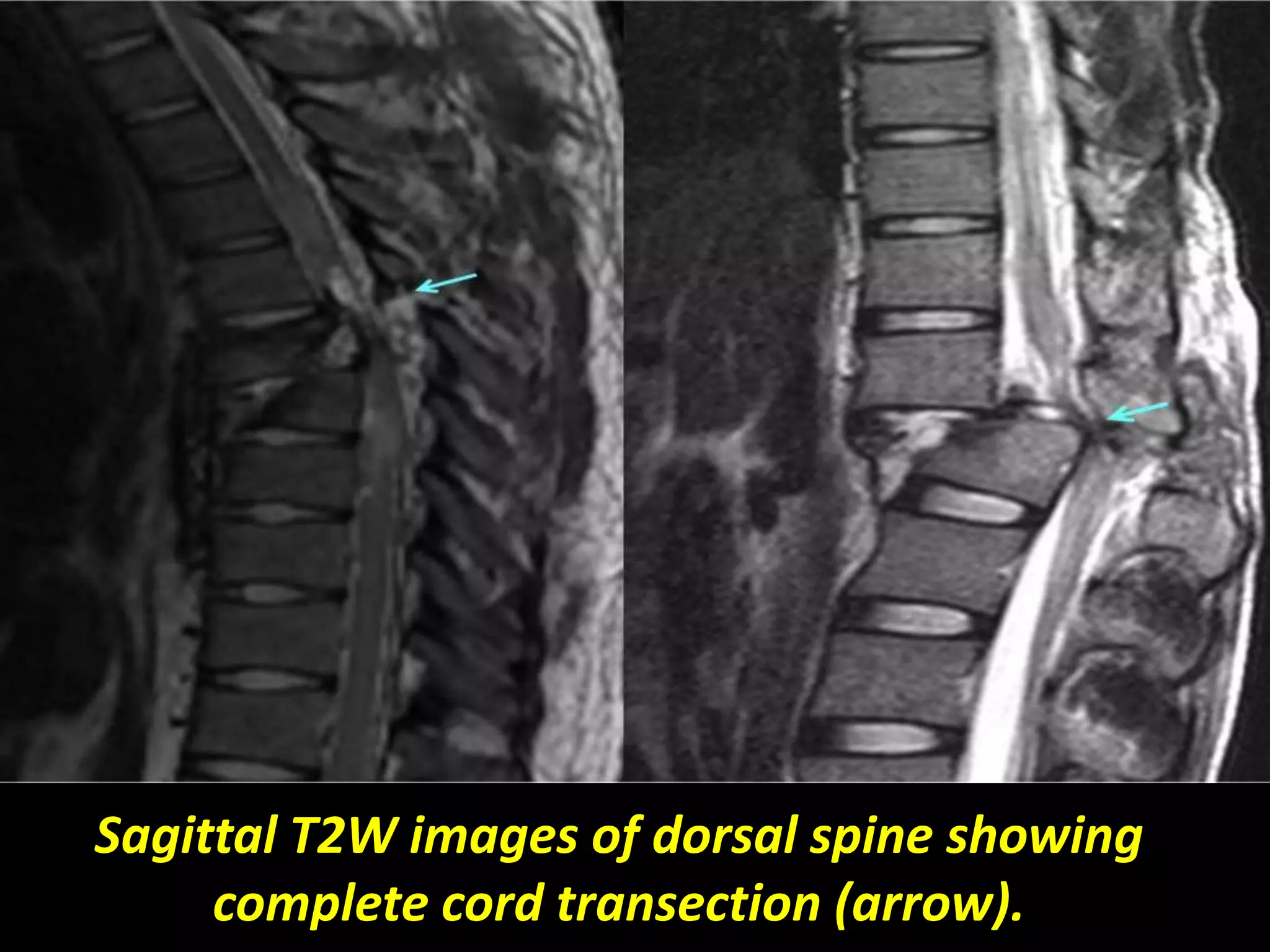
Sagittal T2W images of dorsal spine showing 
complete cord transection (arrow).
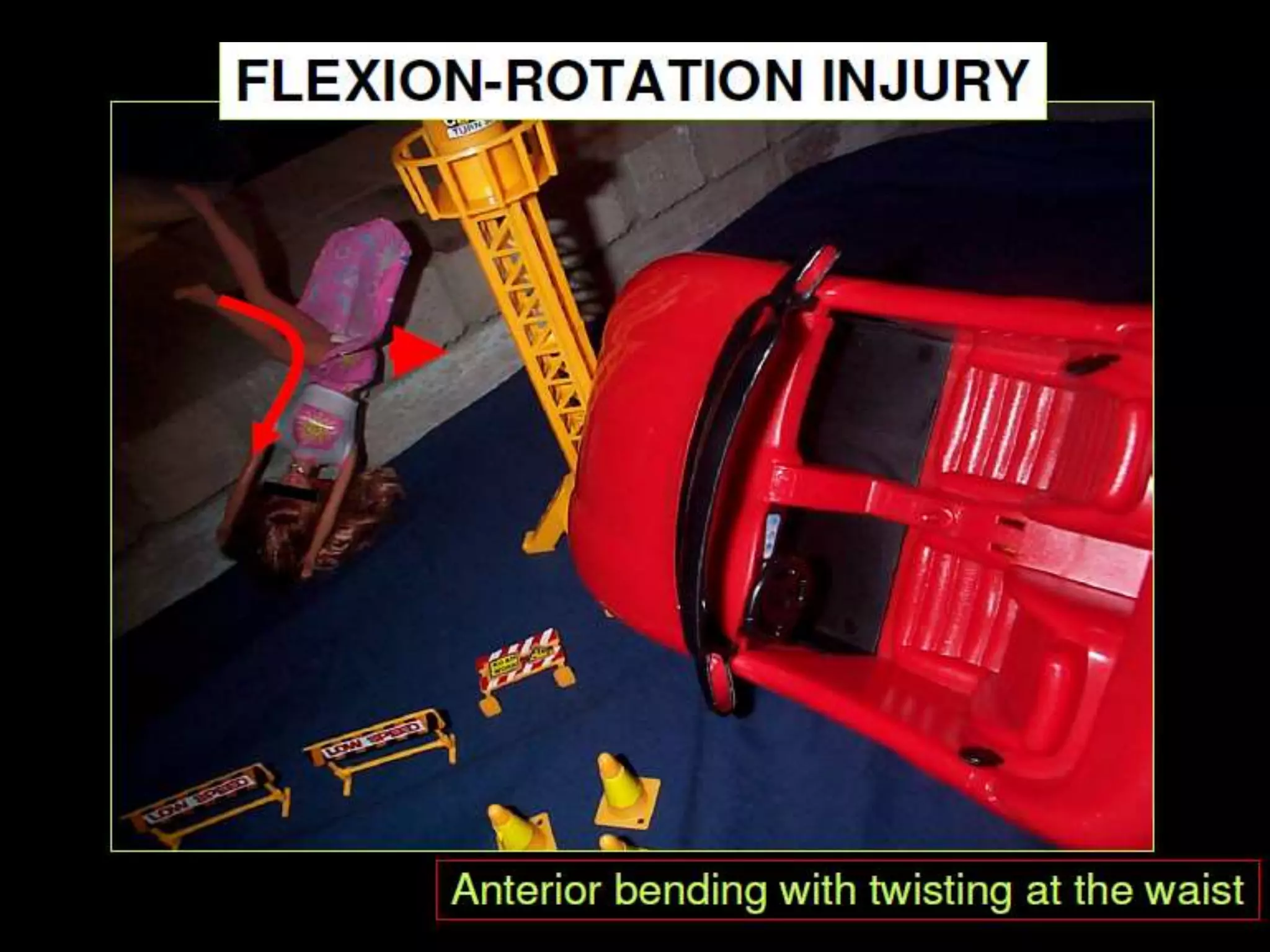
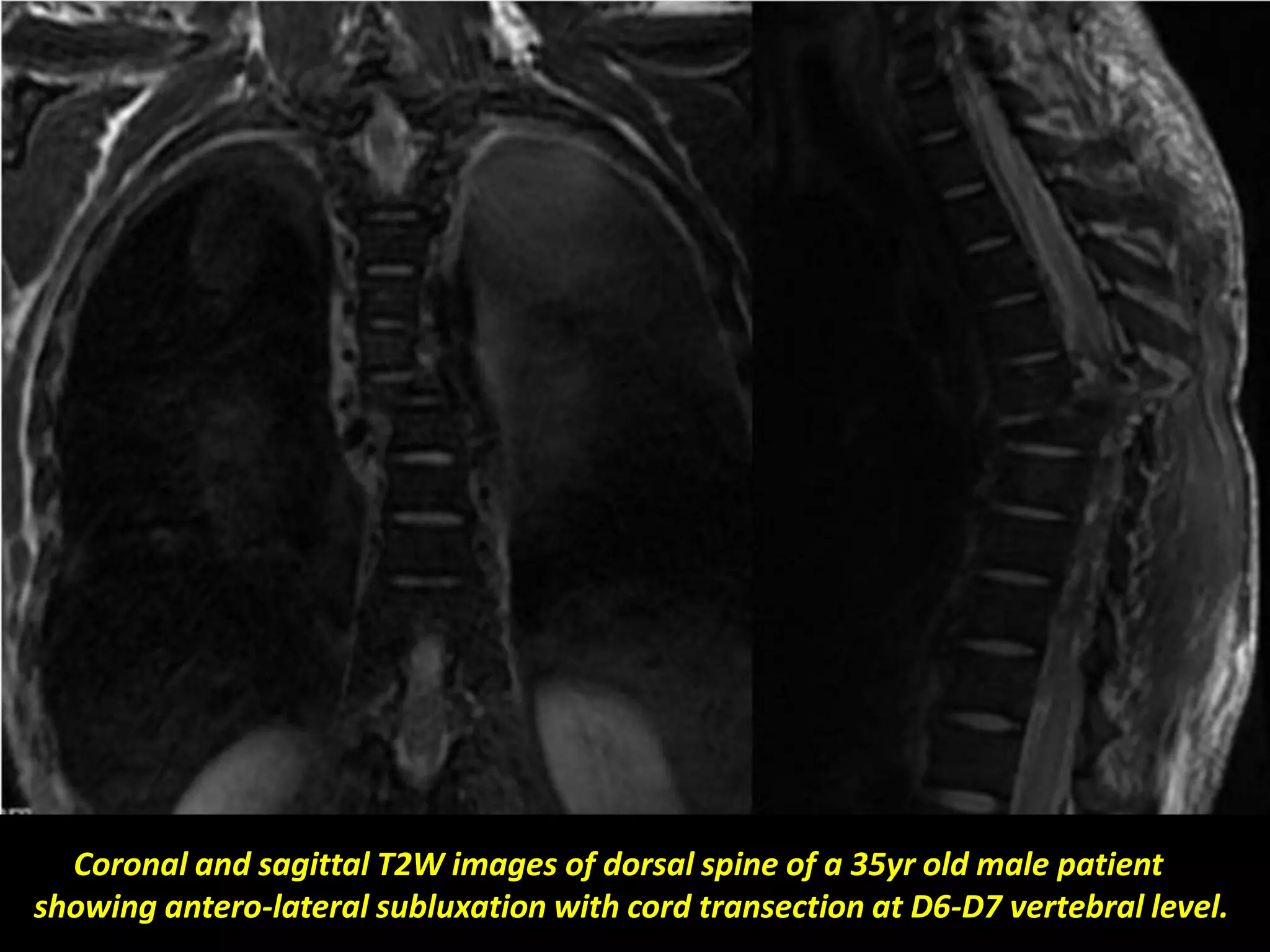
Flexion / Rotation: 
• T/L junction. 
• Flexion vector: anterior wedge or burst. 
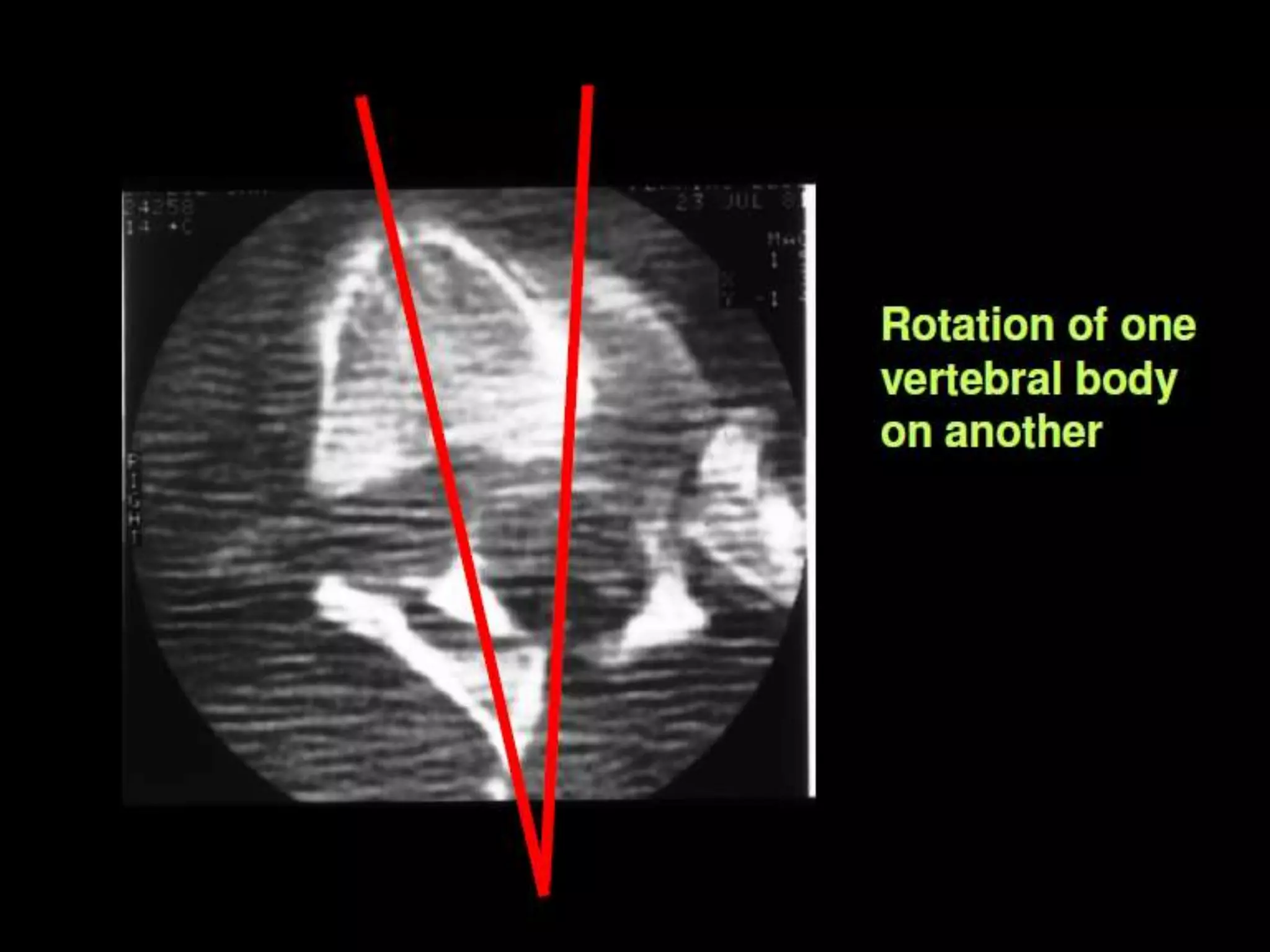
• Rotation: addition of this vector tends 
to result in instability. 
– disruption of posterior ligaments. 
– posterior element fracture. 
– can lead to dislocation. 
• High incidence of neurologic deficit.
Coronal and sagittal T2W images of dorsal spine of a 35yr old male patient 
showing antero-lateral subluxation with cord transection at D6-D7 vertebral level.
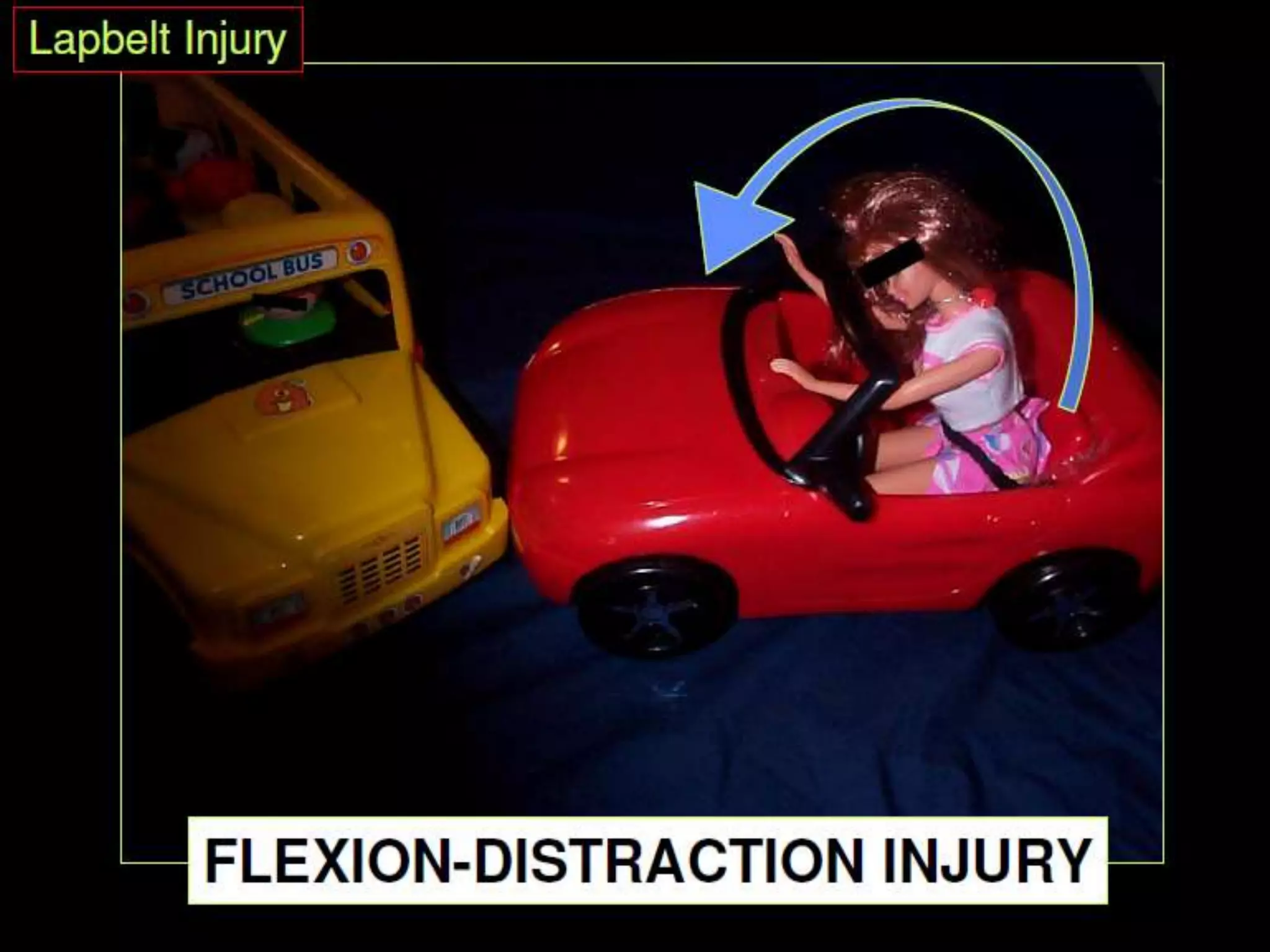
Flexion / Distraction 
• Axis of flexion is moved anteriorly 
(seatbelt injury). 
• Results in distractive force as flexion is 
applied, posterior > anterior. 
• Neuro usually preserved (approx. 10% 
with neuro deficit). 
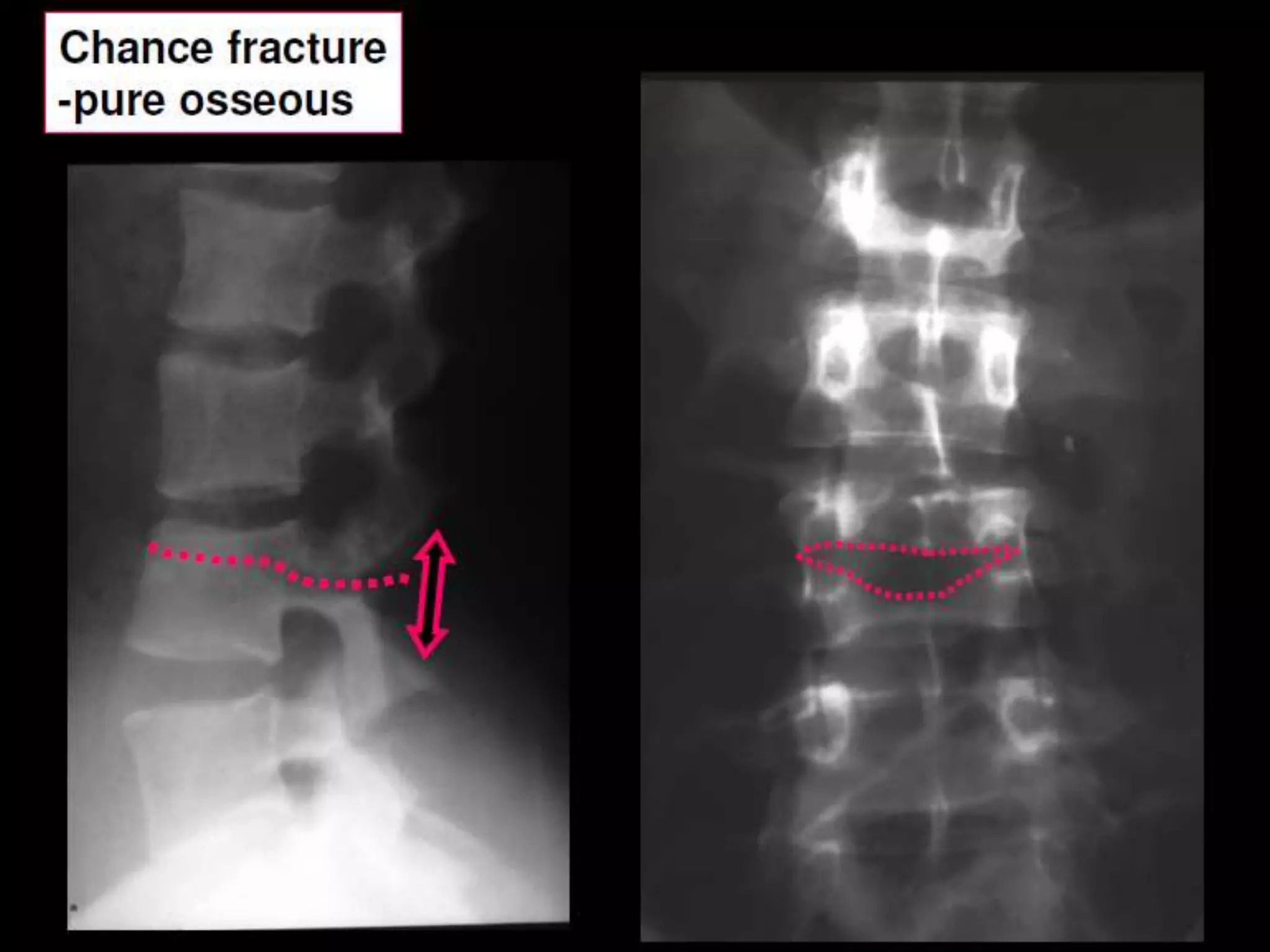
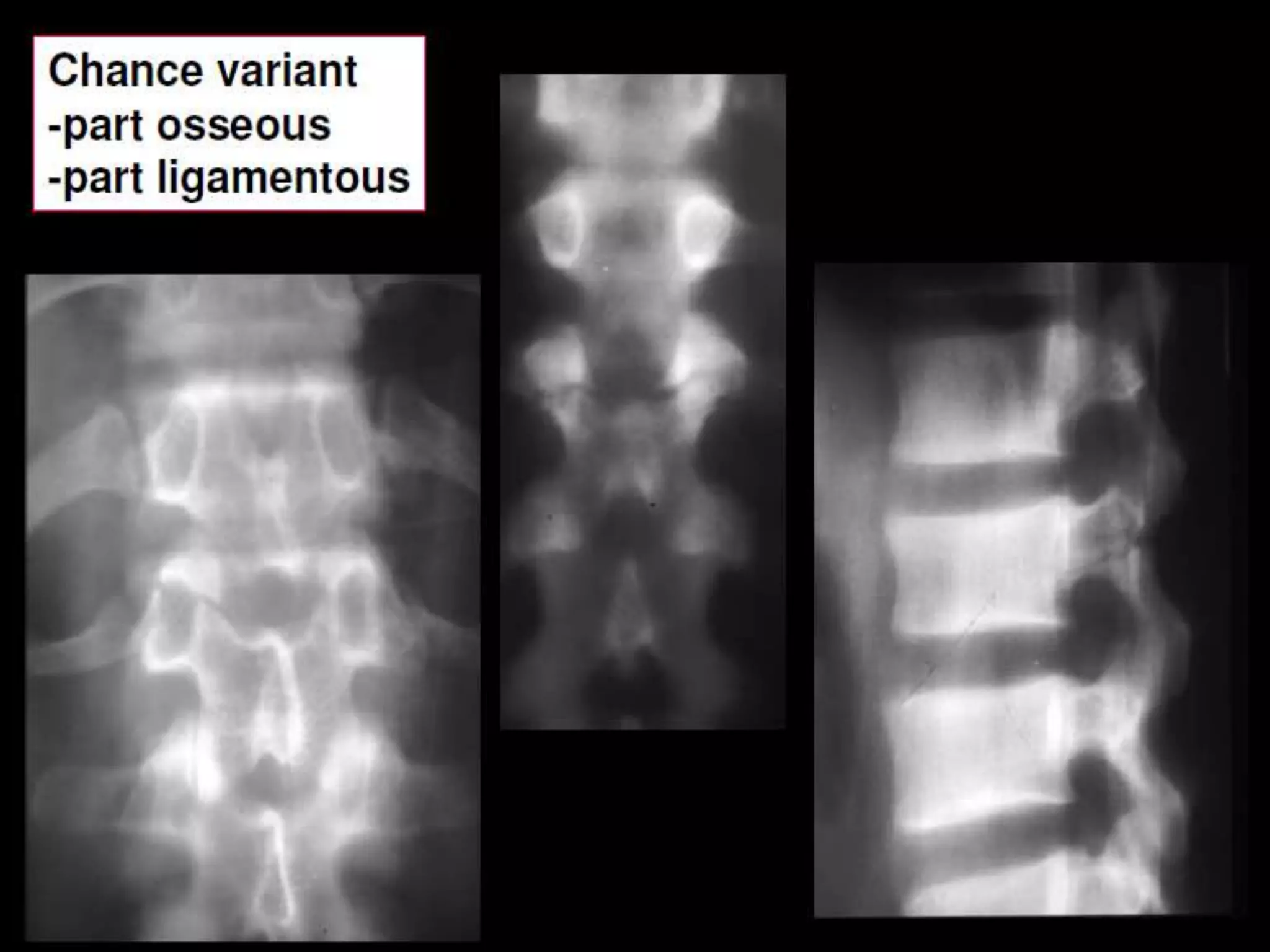
• Chance fracture and variants. 
– pure osseous. 
– combined osseous and ligamentous. 
– pure disc / ligamentous.
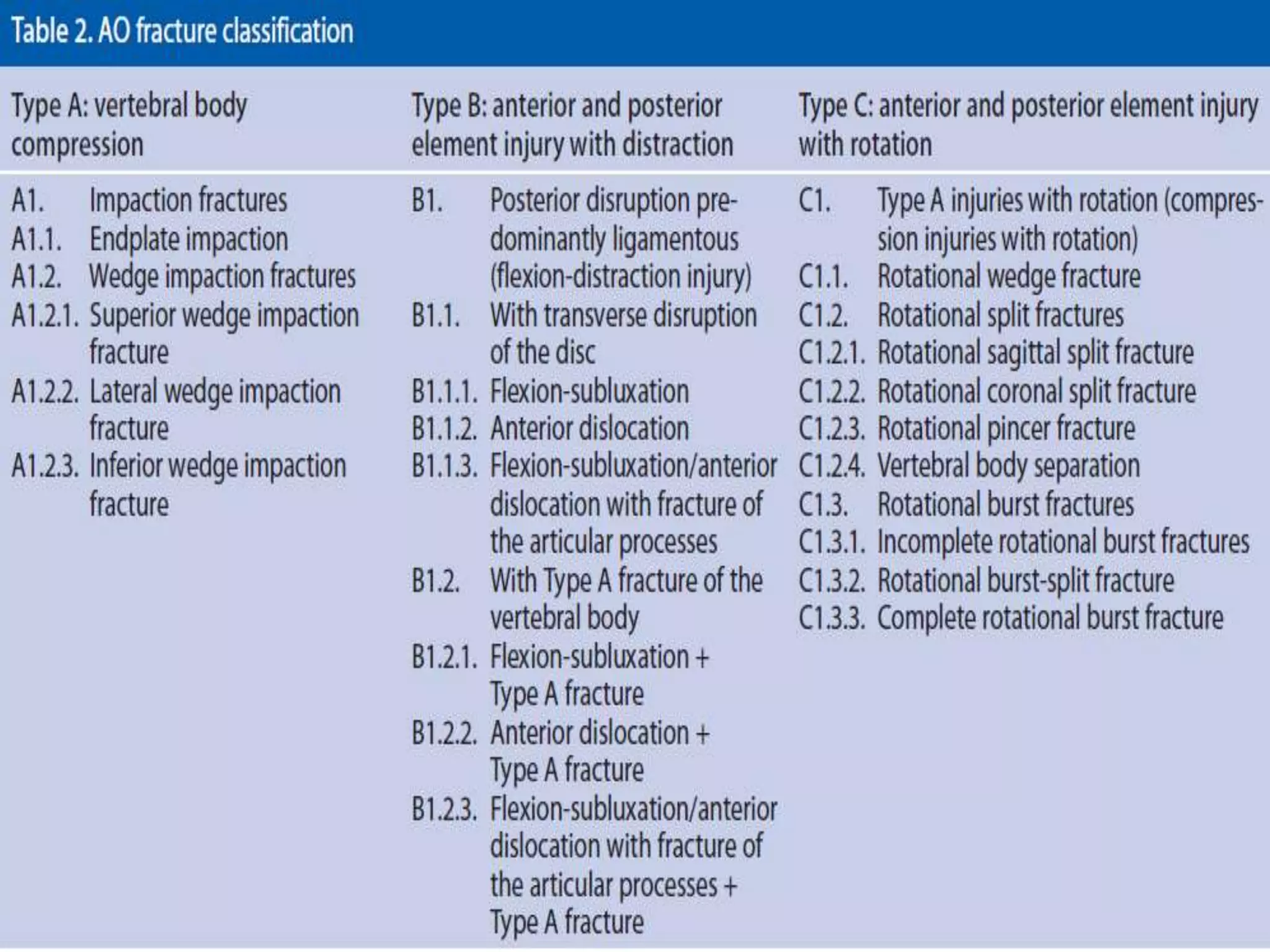
Classic Chance Fracture 
• Pure osseous. 
– Most common (approx. 50%). 
– Technically unstable. 
– But excellent prognosis for healing / long 
term stability. 
• X-ray: horizontal split - spinous process, 
lamina, pedicles, vertebral body with 
distraction posterior > anterior.
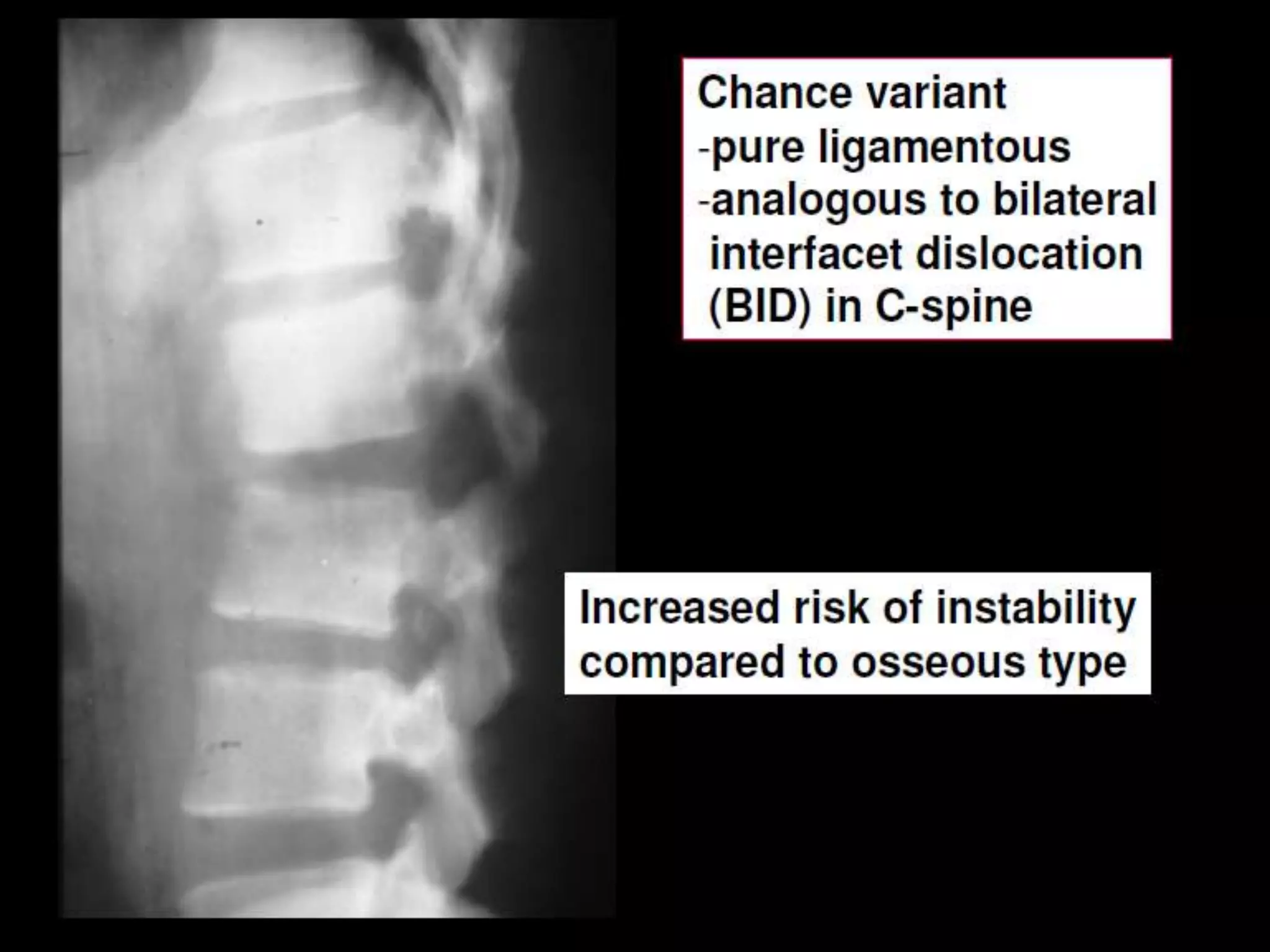
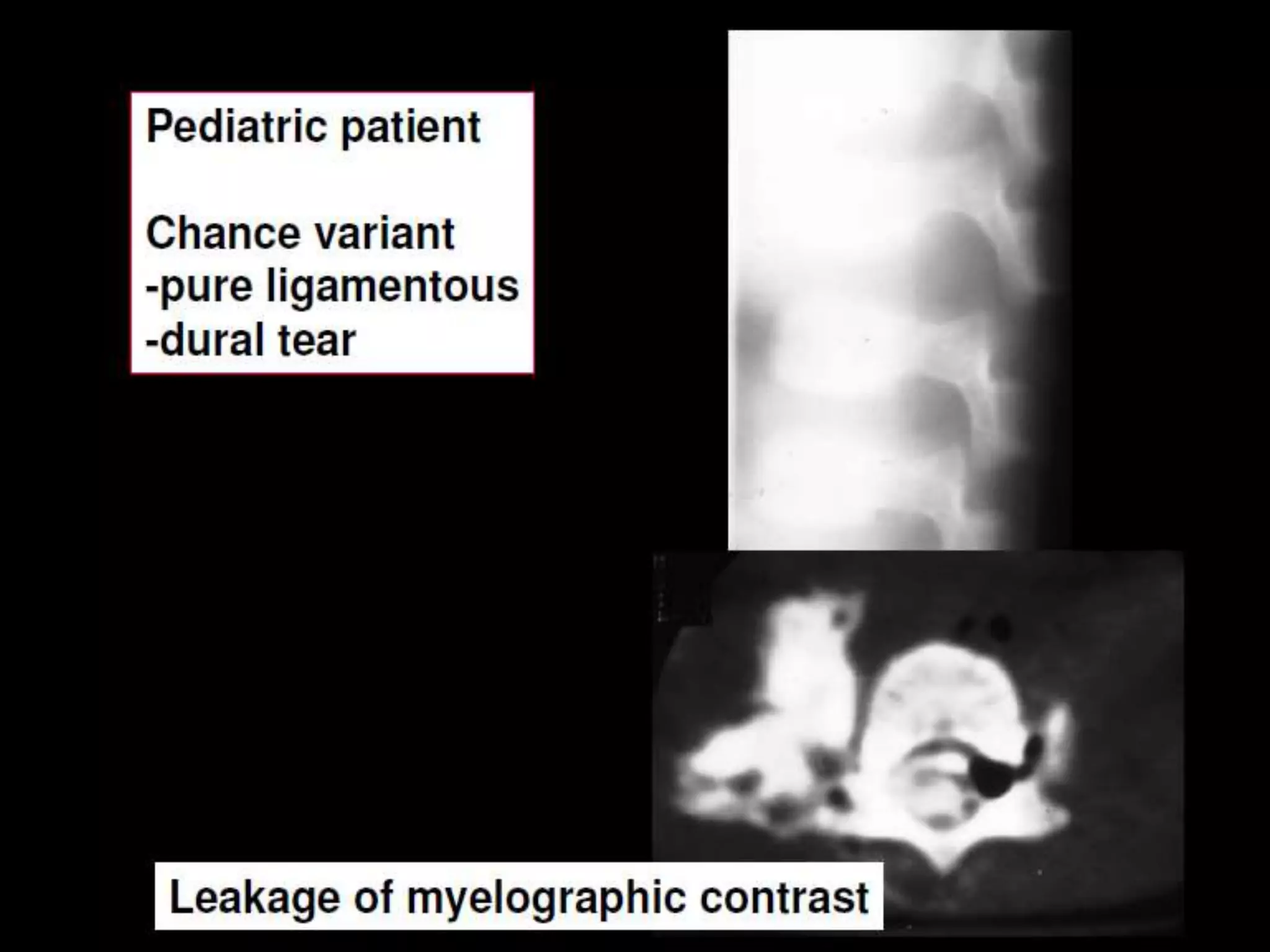
Chance Variants 
• Combined osseous / ligamentous. 
• Pure ligamentous / discal. 
• Both with worse prognosis for 
healing/stability than pure osseous. 
• Mechanism: abdominal organ injury.
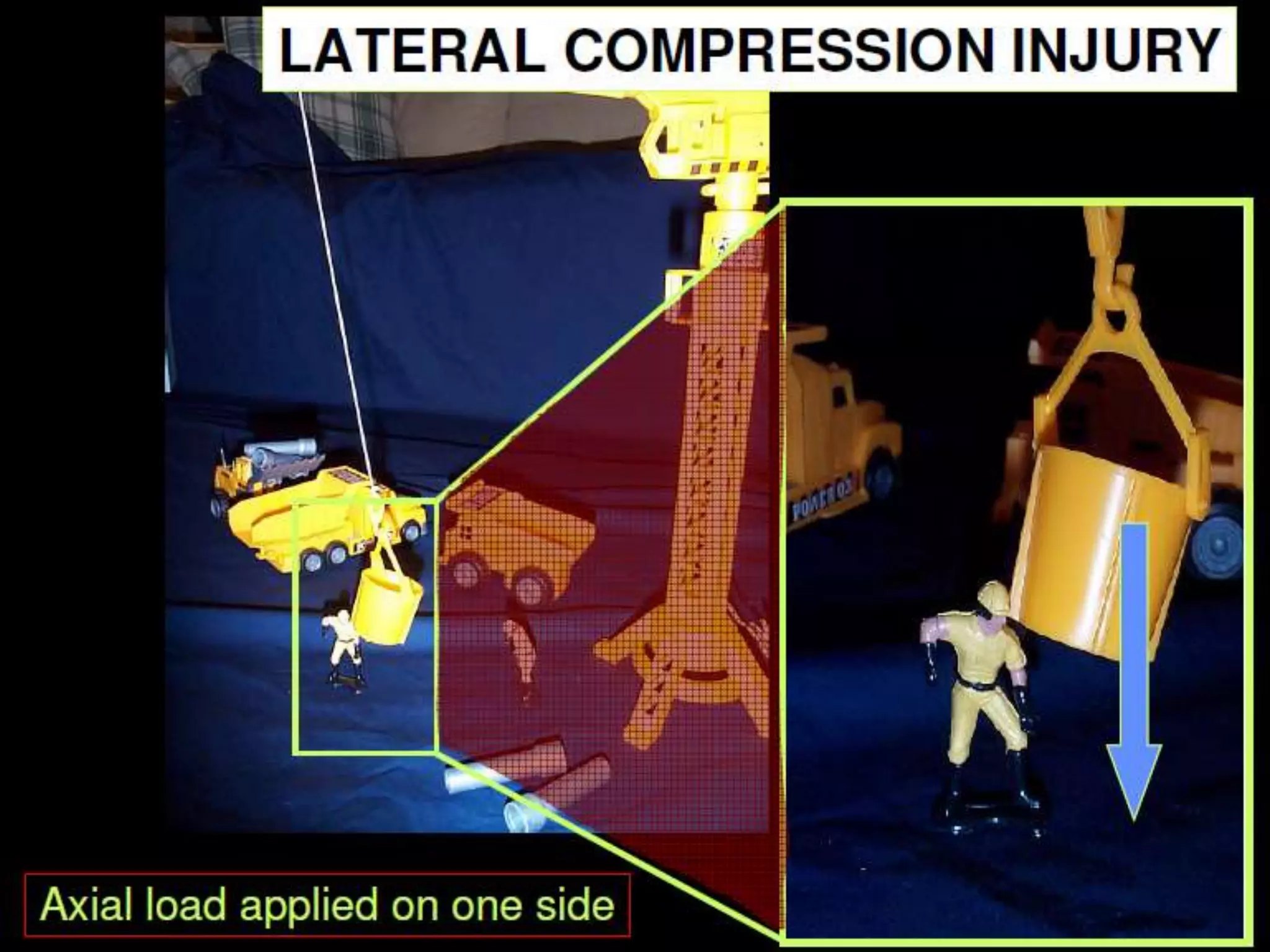
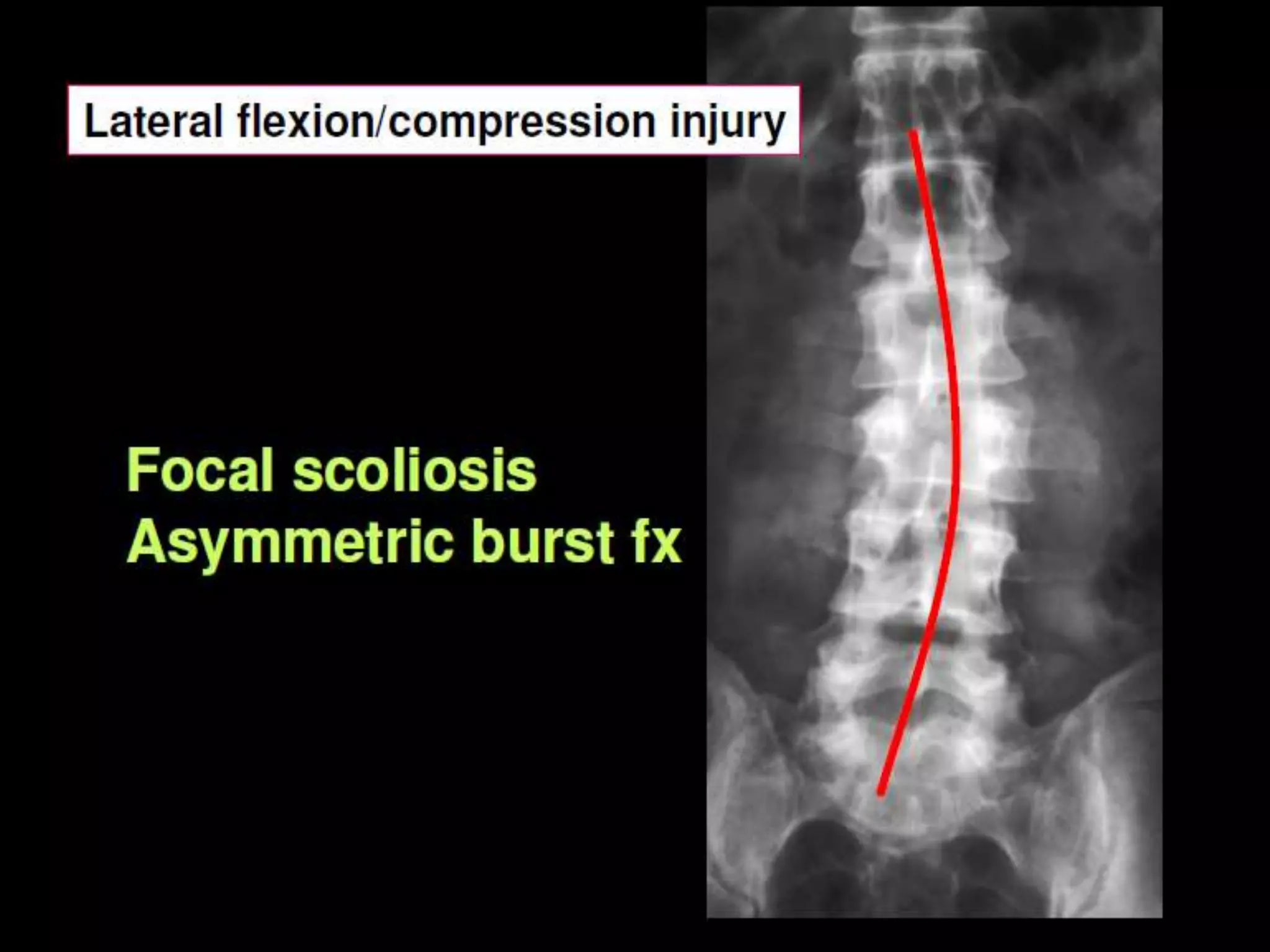
Lateral Flexion/Compression 
• Similar to flexion injury, but force is 
applied to lateral aspect of vertebra. 
• Loss of height of lateral vertebral body 
with acute scoliotic deformity. 
• Posterior elements often fractured. 
• Asymmetric burst fracture.
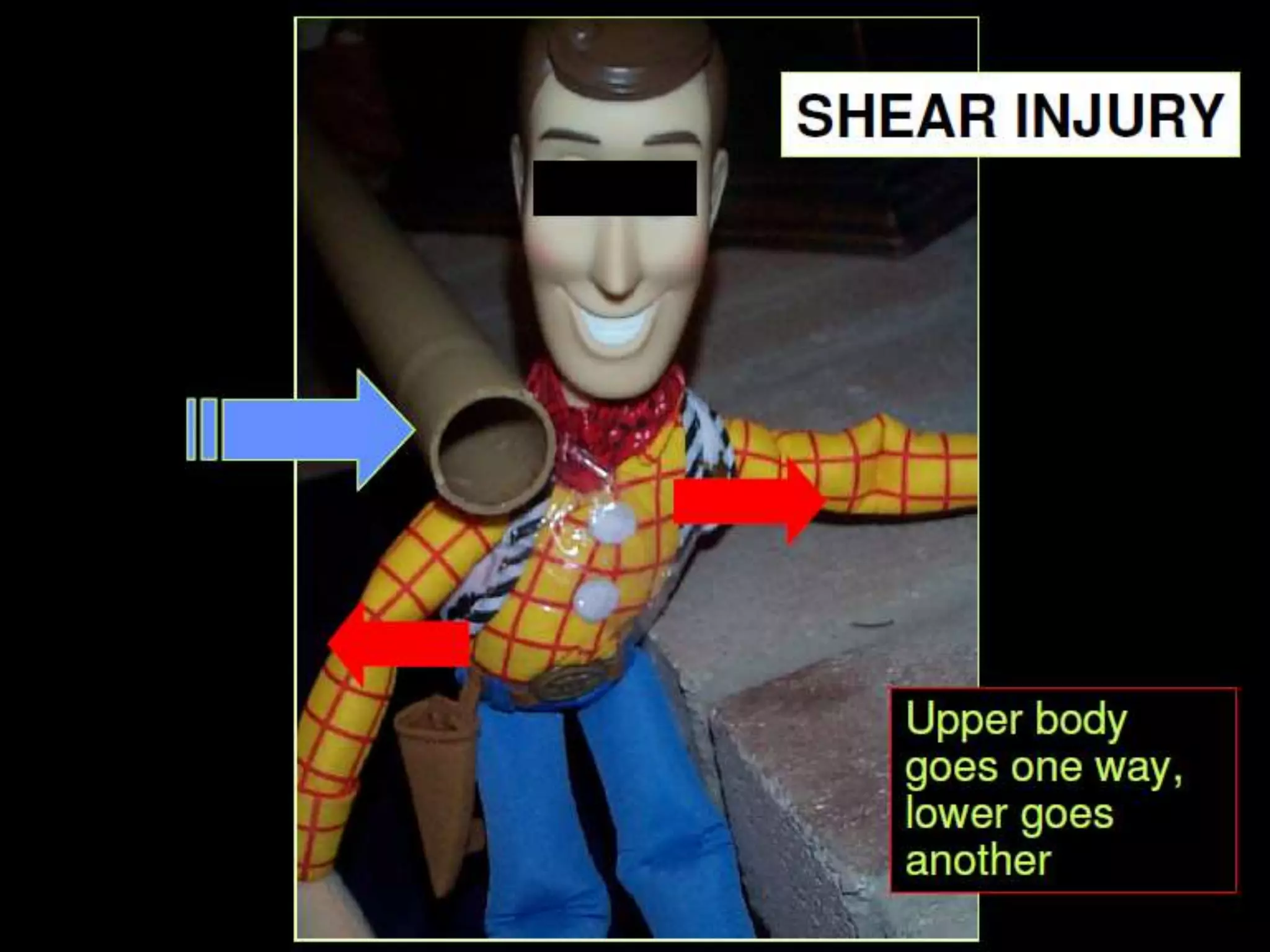
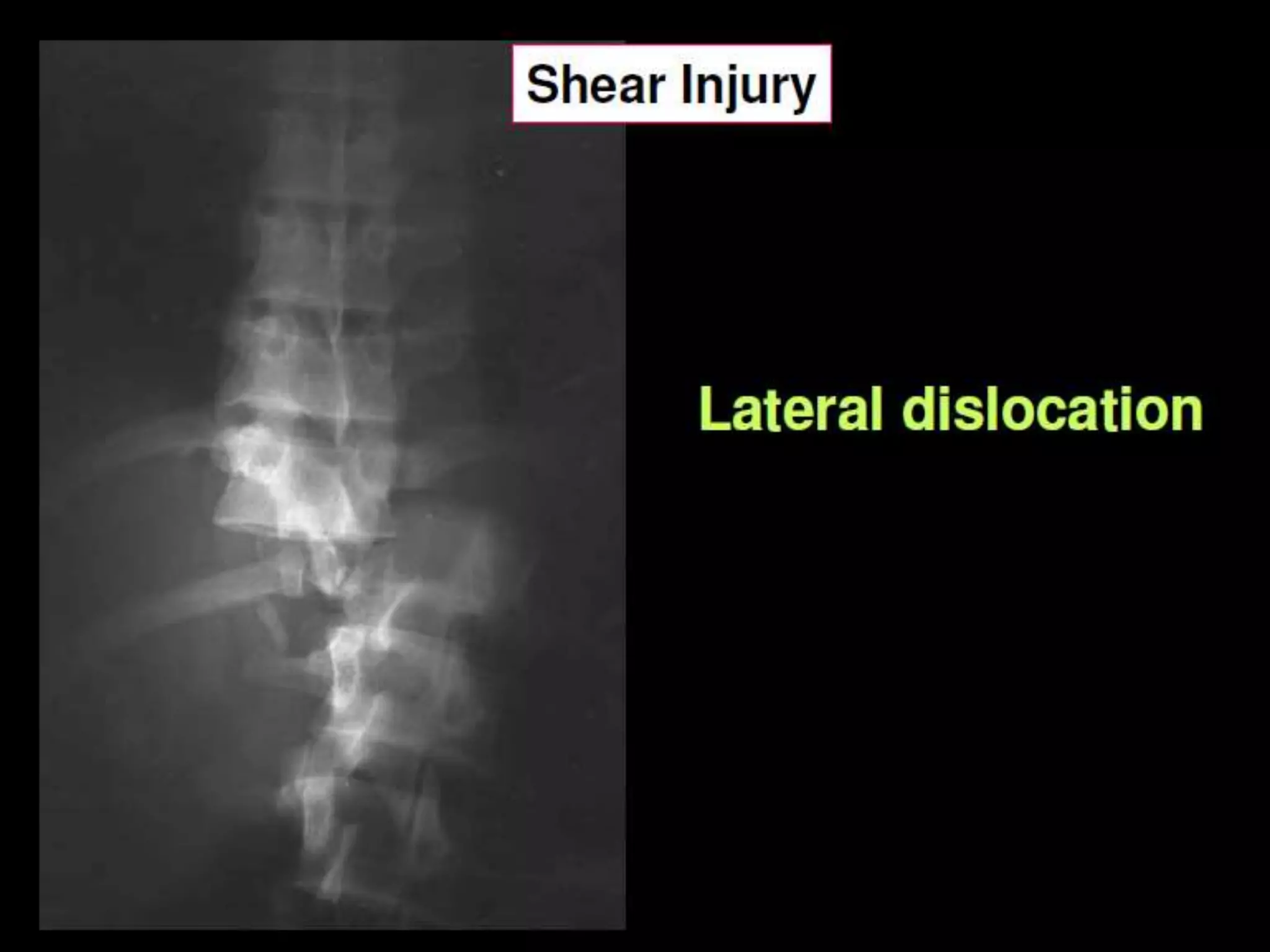
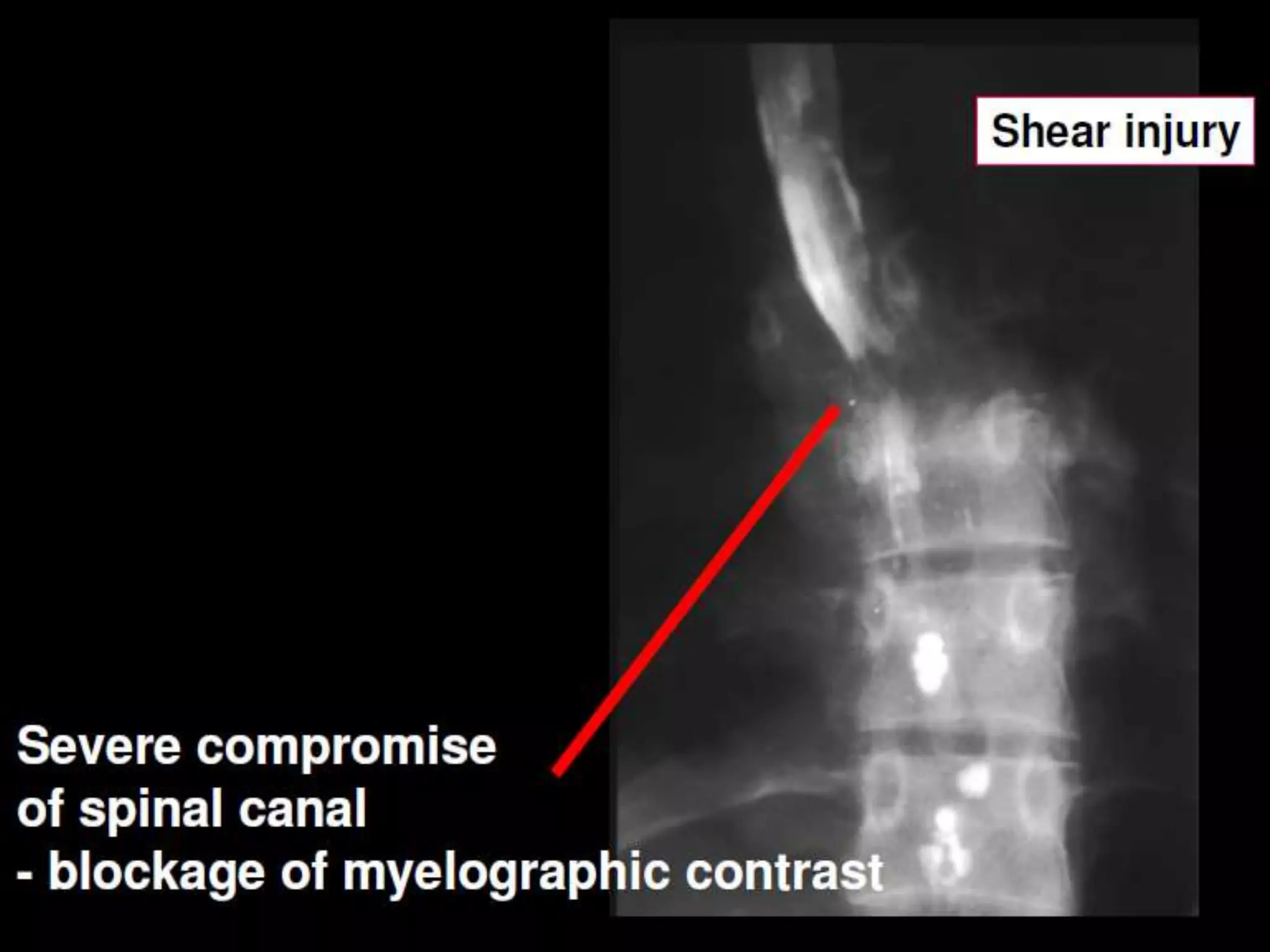
Shear Injury: 
• Results in severe ligamentous disruption. 
• Listhesis, anterior / posterior or lateral. 
• Fracture of posterior elements common, 
especially at facets. 
• Can result in dislocation. 
• Severe neurologic compromise common.
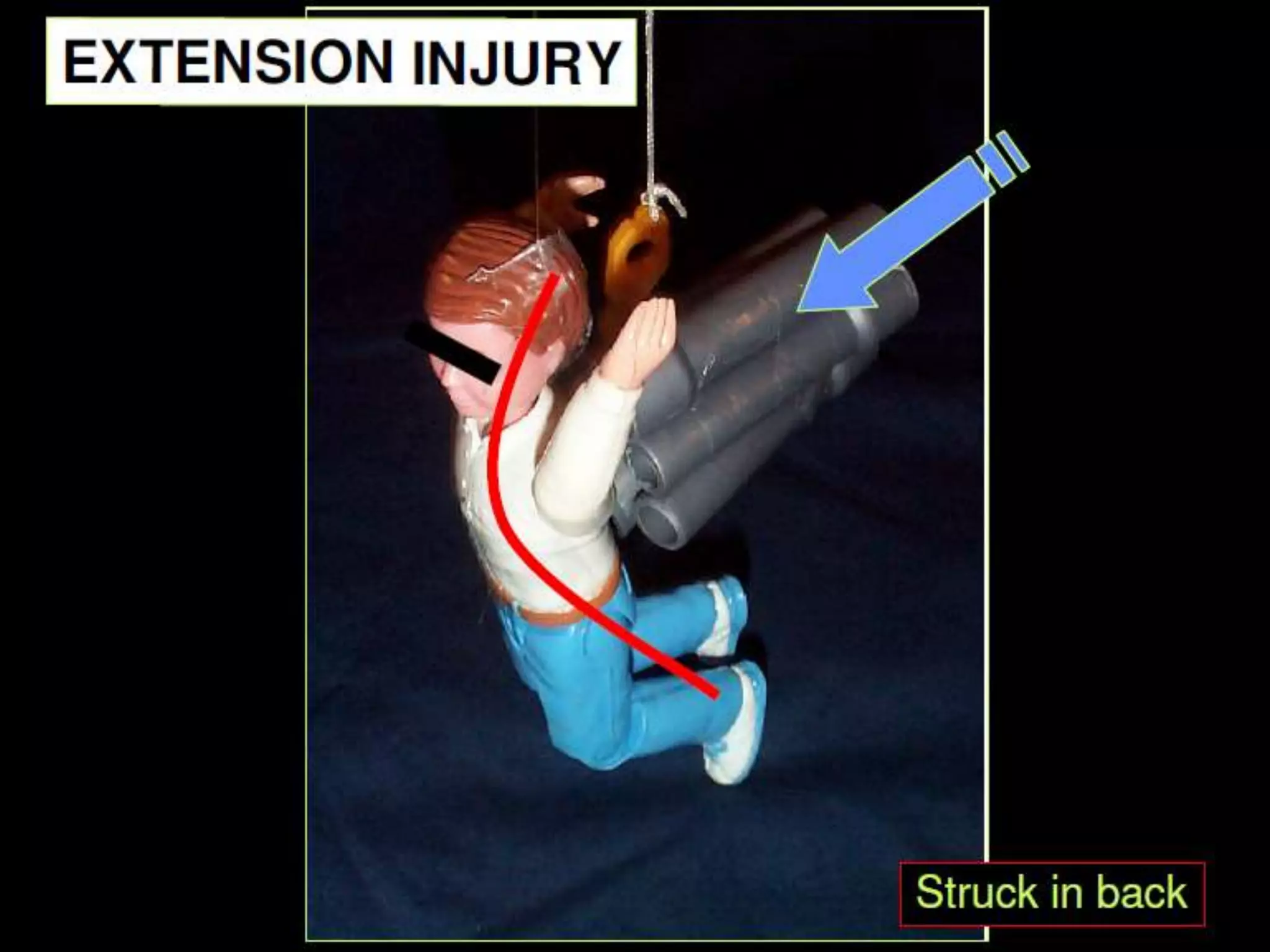
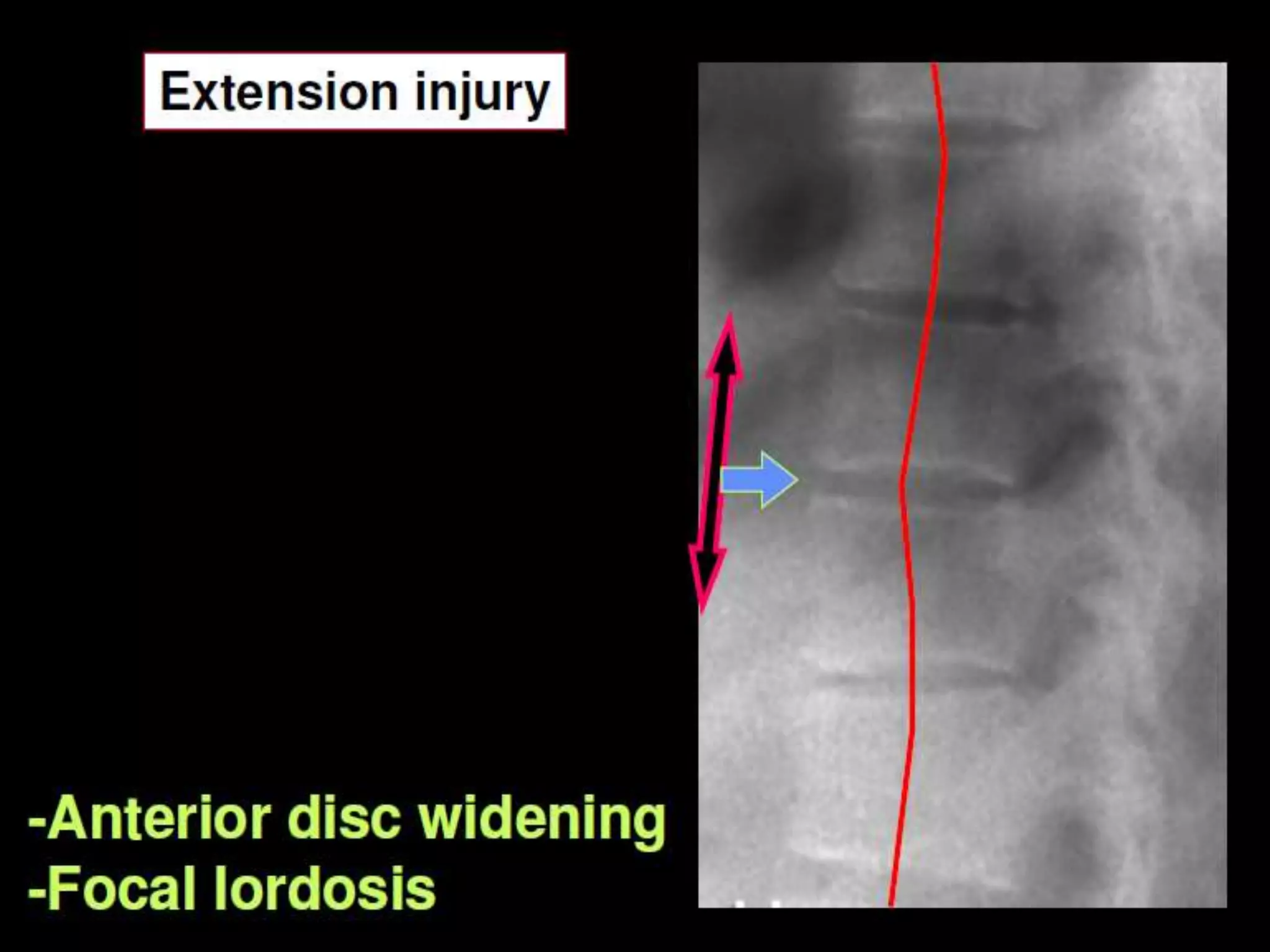
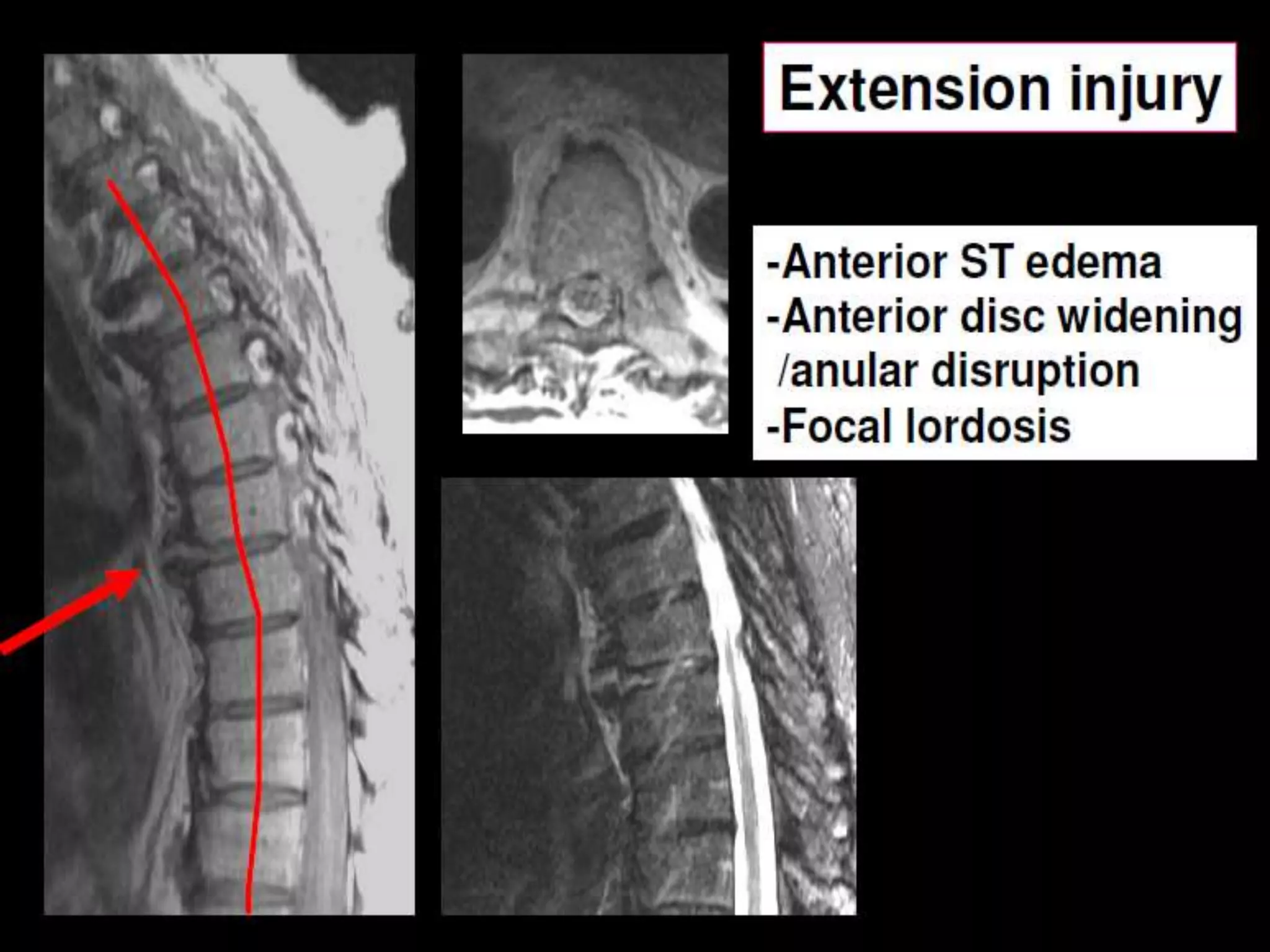
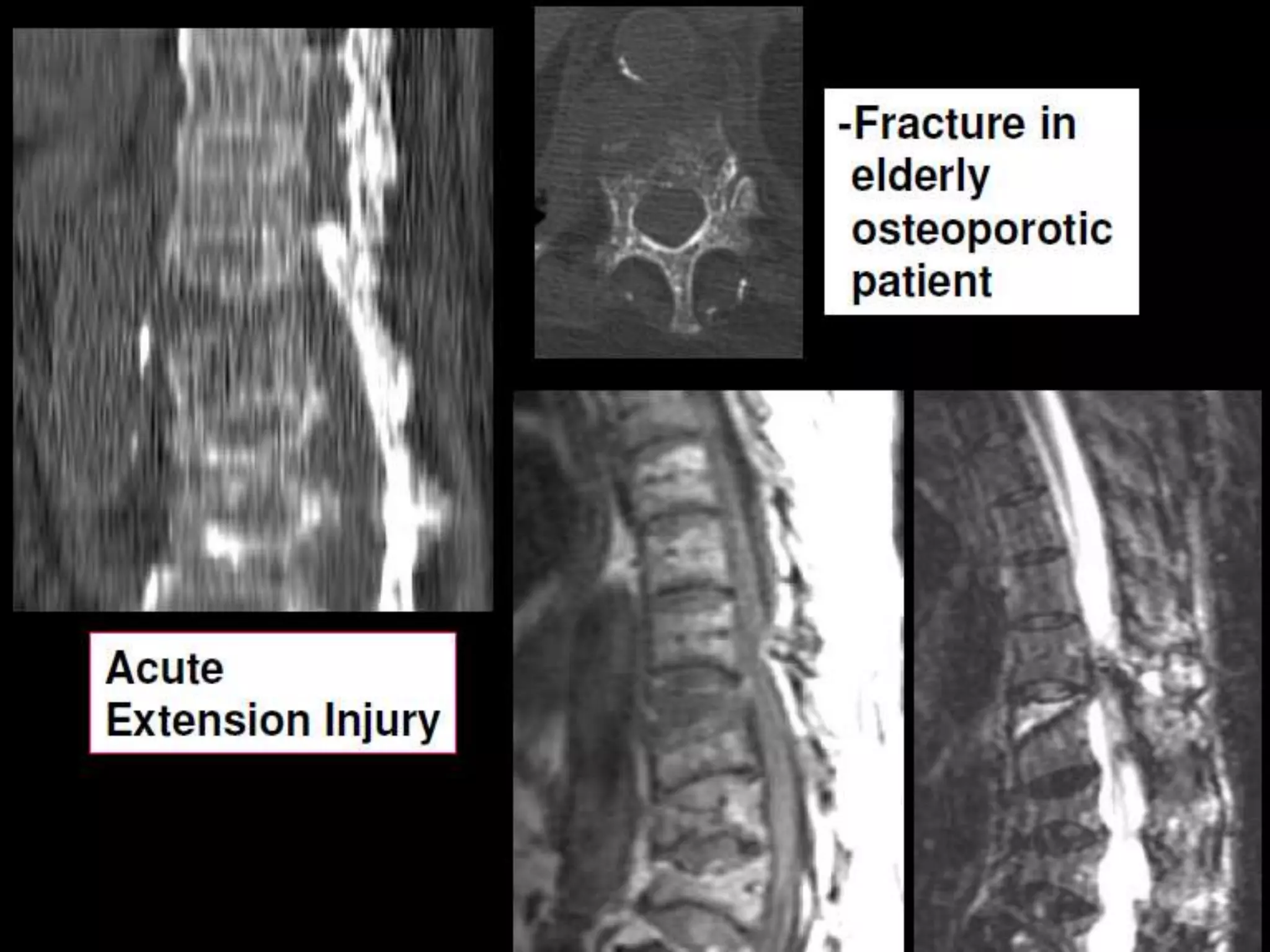
Extension: 
• Anterior distraction. 
– ALL, anterior annular fibers injured 
– avulsion anterior endplate 
• Posterior compression. 
– ‘crush’ fracture 
• Usually neuro intact, but with more severe 
injury - retrolisthesis, posterior crush. 
– ‘lumberjack fracture / dislocation’ 
• X-ray: anterior disc widening - can be 
subtle -CT for posterior element fx.
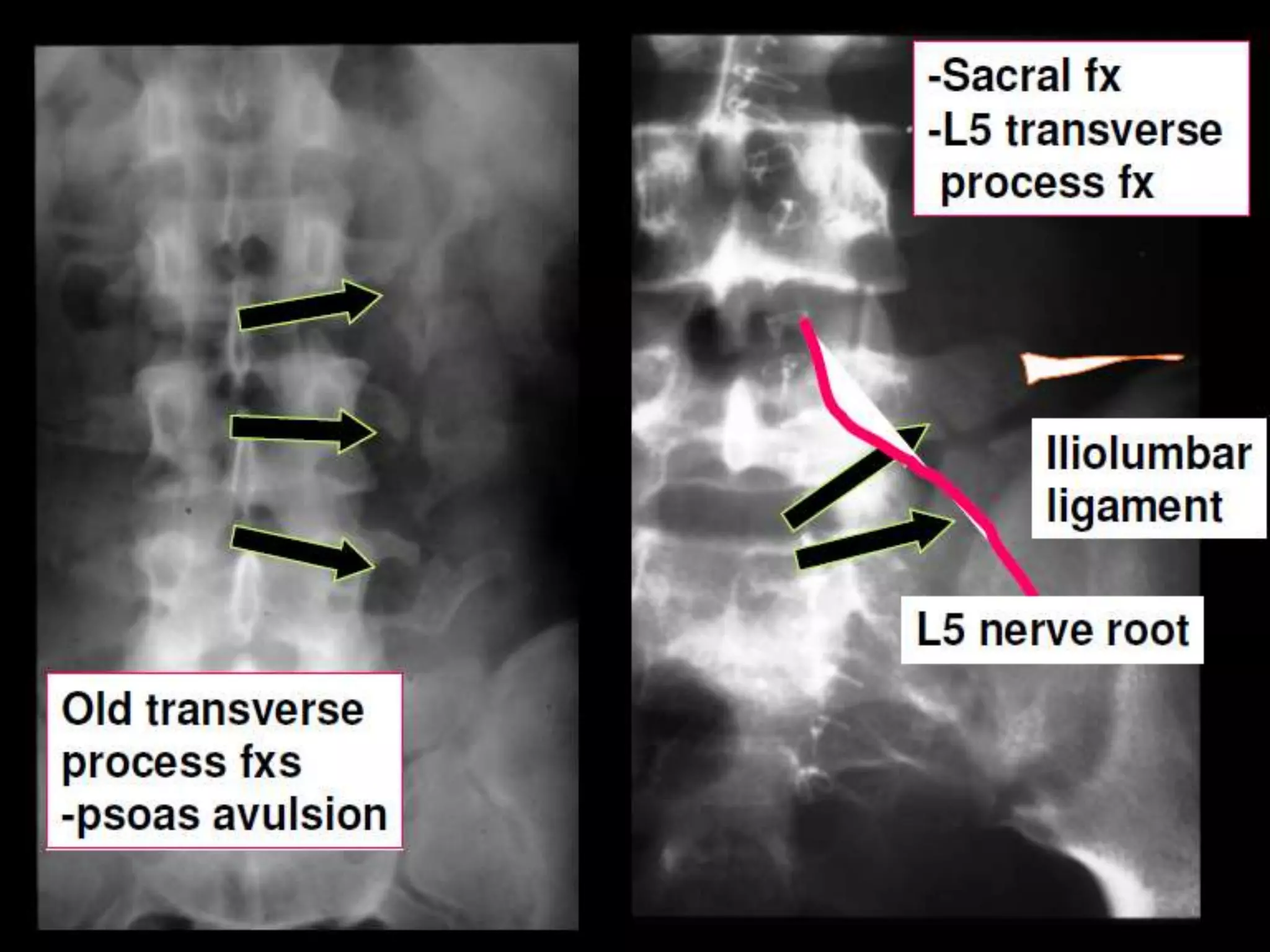
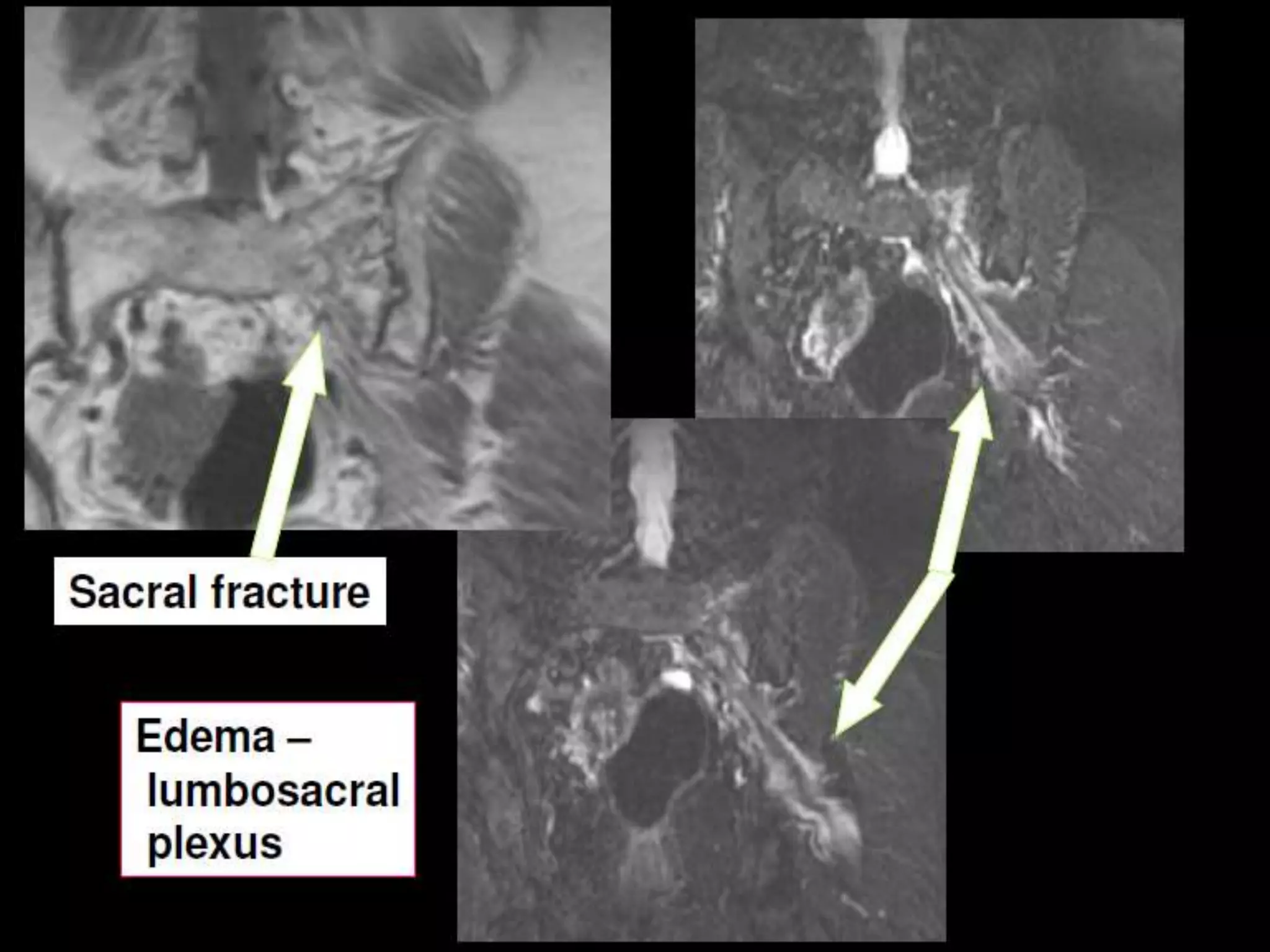
Transverse process fracture: 
• Often at multiple adjacent levels. 
• If isolated, stable - usually a result of 
avulsive stress from psoas / paraspinal 
muscle contraction. 
• Can signify more severe injury. 
– L5 transverse process fracture 
associated with sacral fracture. 
– nerve root injury (esp. L5).
Thank You.

Presentation1.pptx, radiological imaging of spinal trauma and spinal cord injury.

  • 1.
    Radiological imaging ofSpinal Trauma and Spinal Cord Injury. Dr/ ABD ALLAH NAZEER. MD.
  • 2.
    MECHANISMS OF SPINALINJURY: • FLEXION INJURY: leading to anterior wedging of vertebral body with posterior longitudinal ligament/ interspinous ligament disruption. • EXTENSION INJURY: more common in cervical spine leading to posterior element fracture, anterior longitudinal ligament rupture and subluxation. • AXIAL LOADING: Diving & jumping injury leading to burst fracture and lateral element fracture. • ROTATION INJURY: leads to lateral mass fracture and facet subluxation. AIM OF RADIOLOGIST: • Define complete extent and type of injury. • Guide management options conservative vs surgical.
  • 3.
    IMAGING OF CERVICALSPINE TRAUMA: Cervical Spine Trauma Demographics. Most common spinal injury. Responsible for 65% of all spinal injuries. Mechanism: MVA/Fall/Sport Injury: Spinal Cord Injury: 40% (10,000 annually). Cervical Spine Trauma Patterns. Areas most commonly involved C1-2 (particularly in children). C5-7. Other fractures 20%. Particular association of low cervical fracture with high thoracic and thoracolumbar injury.
  • 4.
    Imaging modalities forspinal trauma. Radiography. Conventional films Flexion – Extension views • CT-Scan. Single slice vs Multislice Importance of reformatted images Protocol at the MGH CT Angiography • MRI. Modality of choice for soft tissues SC edema vs contusion vs hemorrhage Contra-indications
  • 5.
  • 12.
    C-spine Injuries. Mechanism: •Vector of forces causing injury. •Classification system. Location: Upper cervical injuries: Include injuries to the base of the skull(Occipital condyles, C1 and C2 vertebra. Lower cervical injuries(sub-axial): Include injures from C3 through C7 vertebra.
  • 13.
    Mechanism. • Hyperflexion. • Hyperflexion/Rotation. • Vertical Compression. • Hyperextension. • Hyperextension/Rotation. • Lateral Flexion. • Others.
  • 15.
    Hyperflexion Injuries 1.Hyperflexion Sprain (Anterior Subluxation). 2. Bilateral Interfacetal Dislocation. 3. Simple Wedge Compression fracture. 4. Clay Shoveler’s fracture. 5. Flexion Teardrop fracture. Distraction of posterior elements and compression of the anterior column
  • 16.
    Anterior Subluxation (HyperflexionSprain). • Classic “whiplash” injury. – abrupt deceleration <30mph. – rear ending a stopped car • Posterior ligament complex injury. • Posterior annulus fibrosis & disc can be disrupted. • STABLE, Initially. – 21-50% incidence of delayed instability.
  • 19.
    Bilateral Interfacetal Dislocations(BIID) • Soft tissue injury. • Disrupted ALL, PLL, Intervertebral disc and post ligament complex. • Articular masses pass superiorly and anteriorly. • High risk of cord damage. • UNSTABLE.
  • 25.
    Simple Wedge CompressionFracture. • Mid to lower cervical spine. • Impacted superior endplate. • No vertical fracture. • ALL and disc intact. • initially STABLE, however: delayed instability if post ligament complex is injured and does not heal.
  • 28.
    Flexion Teardrop Fracture • Most devastating c-spine injury compatible with life. • Severe flexion with disruption of all ligaments and disc + VB FX. • UNSTABLE Acute anterior cord syndrome 1. Complete paralysis. 2. Hypoesthesia and hypalgesia to level injury 3. Preservation touch, motion, position and vibration sense.
  • 30.
  • 33.
    Hyperflexion Injury withRotation. 1. Unilateral Interfacetal Dislocation: – Dislocation of facet joint opposite that of the direction of rotation. – Posterior ligament complex and articular joint capsule are disrupted. – ALL, disc and PLL intact. – Most common at C5-6, C6-7. – Impaction fractures tip of either articular mass (up to 70%). – STABLE, unless FX isolates articular process.
  • 40.
    Vertical Compression(Axial Load). •Force delivered to top of skull through the occipital condyles to the cervical spine at the instant that the cervical spine is straight • Injury Patterns: 1. Jefferson fracture. 2. Burst fracture.
  • 41.
    Jefferson Fracture: •Splitting of C1 ring with fracture of both the anterior and posterior arch – may result from a single break in each arch (anterior and posterior) – bilateral or unilateral • Centripetal displacement fragments • 50% associated fractures – 33% = axis fractures • no neurologic deficit • Transverse atlantal ligament intact or not • UNSTABLE
  • 46.
    Burst Fracture. •C3-C7. • Theory - compressed disc bulges into inferior endplate causing VB to explode from the inside. • Usually with injury to spinal canal. • ALL, disc, posterior column intact. • STABLE.
  • 49.
    Hyperextension Injuries: 1.Hangman’s fracture. 2. Hyperextension dislocation. 3. Anterior arch avulsion of the Atlas. 4. Posterior arch fracture of the Atlas 5. Extension teardrop fracture. 6. Laminar fracture.
  • 50.
    Hangman's Fracture: •4-7% of all cervical FXs and/or dislocations. • Most frequent FX in fatal traffic accidents (Alker). • Clinical cases result from hyperextension. • Neurologic involvement is rare. • Predictive factors for neurologic injury: – Type II and III. – Locked facets. – Involvement transverse foramina with osseous fragment: • Dissection. • Embolization.
  • 55.
    Hyperextension Dislocation •Soft tissue injury with disruption of ALL, disc and PLL. • Posterior column severely lordotic. • Compression of cord anteriorly by VB and posteriorly by ligaments. • spontaneously reduction when force gone. • Paralyzed patient with “normal” C-spine. • Spondylosis a predisposing factor. • UNSTABLE.
  • 56.
    Hyperextension Dislocation: Triad: 1. Facial injuries. 2. Diffuse soft-tissue swelling with normally aligned vertebrae on lateral radiograph. 3. Acute Central Cervical Cord Syndrome hemorrhage into central cord range of Sxs from upper extremity paralysis to quadriplegia (motor tracts to arms are located centrally).
  • 65.
    Hyperextension/Rotation • Upwardforce on the forehead or upper face with head rotated. • Force which is not central is applied to forehead or upper face. • Injury Patterns. 1. Pillar Fracture. 2. Pedicolaminar Fracture-Separation
  • 67.
    Pedicolaminar Fracture -Separation Fracture through ipsilateral pedicle and lamina free floating lateral mass. • Articular pillar fragment frequently rotated horizontalized facet. • Anterior displacement of vertebral body (similar to hyperflexion injuries). • If FX extends into foramen transversarium, then possible vertebral artery injury. • Best seen on oblique images • UNSTABLE - if associated with contralateral interfacetal dislocation.
  • 68.
    Pedicolaminar Fracture -Separation Type I - Articular mass FX fragment. Type II - FX + anterior subluxation. Type III - Type II + disc narrowing. Type IV - Bilateral involvement with interfacetal dislocation. contralaterally.
  • 71.
    Lateral Flexion Injury. • Tilt in the coronal plane. • Associated with vertebral artery injury. • Best seen on AP view and CT. FXs: – uncinate process. – occipital condyles. – transverse process. – odontoid. – lateral wedge compression. – eccentric atlas burst fracture.
  • 74.
    Other Fractures/Injuries: •Rotary fixation of C1/C2 – torticollis. • Odontoid fractures. • Transverse atlantal ligament rupture. • Occipitoatlantal dissociation.
  • 75.
    Rotary Atlantoaxial Dissociation (Rotary Fixation of C1/C2): • Usually secondary to mild trauma. – sleeping in an unusual position. – torticollis. • Rotation and lateral tilt at the atlantoaxial joint. • Fixation occurs when symptoms not resolved in a few days.
  • 78.
    Odontoid (Dens) Fractures: • 11-13% c-spine injuries (up to 27% in some series). – 75% of cases are children. • Classification – Anderson & D’Alonzo (I, II and III). • Associations – atlantoaxial dislocations. – Jefferson FX. • Radiography may be subtle. • Prevertebral STS nasopharynx.
  • 85.
    Transverse Atlantal LigamentRupture: • Increased atlantodental space. • Anterior translation of atlas and skull. • Associated with Jefferson fracture.
  • 87.
    Thoracolumbar Trauma: •Anatomy. • Stability / instability. • Basic trauma vectors. • Fracture patterns.
  • 88.
    Thoracolumbar spine injuriesare commonly related to high energy accidents including falls or motor vehicle accidents. Patients with thoracolumbar injuries commonly have other injuries including injuries to the abdomen, chest, extremities, or other spinal injuries. The typical “ABC” (airway, breathing, and circulation) evaluation is needed for all patients seen in the emergency room after a thoracolumbar spine trauma. Appropriate evaluation of the thoracolumbar spine trauma requires complete and thorough clinical and radiographic examination, which begins only after ensuring the patient’s other vital organ systems are intact.
  • 97.
    Force Vectors •Most spine injuries: MVA or fall. • Complex combination of forces. • Force vectors applied to certain areas of the spine result in predictable patterns of fracture. • Understanding of basic vectors aids radiologic interpretation.
  • 98.
    Basic Spine TraumaForces • Axial load. • Flexion / compression. • Flexion / rotation. • Flexion / distraction. • Lateral compression. • Shear. • Extension.
  • 100.
    Axial Load •T-L junction - most common site of injury • T-spine - may result in flexion force, anterior wedge compression or burst • 43% fx at another level • 10% non-contiguous: need to survey whole spine
  • 107.
    Coronal T2W imagedorso lumbar spine of a 29 yr old male patient showing burst fracture(arrow) of L3 vertebra.
  • 108.
  • 109.
  • 110.
    Burst vs. AnteriorWedge Fx: • Anterior wedge - anterior column – stable. • Burst - 2-3 columns – unstable. • Important to differentiate. – Look for posterior vertebral concavity. – CT for evaluation of posterior vertebral body, fracture of posterior elements. – As many as 20% of burst fractures may be missed if radiographs alone are used. – MRI for ligamentous disruption / neuro sx.
  • 112.
    Sagittal T2W imageof 23yr old male showing burst fracture with anterior wedging(arrow) of L1 vertebra.
  • 114.
    Flexion / Compression • Anterior wedge compression vs. burst fracture. • Higher risk of posterior ligamentous disruption. • Loss of height anterior > posterior.
  • 117.
    Flexion / Compression: • Posterior ligamentous disruption may not be apparent radiographically. – CT or MRI. – On X ray: if anterior compression 50% or greater, assume posterior lig disruption and instability. • If unrecognized. – progressive anterior collapse, deformity (middle column - fulcrum).
  • 121.
    Sagittal T2W imagesof dorsal spine showing complete cord transection (arrow).
  • 122.
    Flexion / Rotation: • T/L junction. • Flexion vector: anterior wedge or burst. • Rotation: addition of this vector tends to result in instability. – disruption of posterior ligaments. – posterior element fracture. – can lead to dislocation. • High incidence of neurologic deficit.
  • 126.
    Coronal and sagittalT2W images of dorsal spine of a 35yr old male patient showing antero-lateral subluxation with cord transection at D6-D7 vertebral level.
  • 127.
    Flexion / Distraction • Axis of flexion is moved anteriorly (seatbelt injury). • Results in distractive force as flexion is applied, posterior > anterior. • Neuro usually preserved (approx. 10% with neuro deficit). • Chance fracture and variants. – pure osseous. – combined osseous and ligamentous. – pure disc / ligamentous.
  • 129.
    Classic Chance Fracture • Pure osseous. – Most common (approx. 50%). – Technically unstable. – But excellent prognosis for healing / long term stability. • X-ray: horizontal split - spinous process, lamina, pedicles, vertebral body with distraction posterior > anterior.
  • 130.
    Chance Variants •Combined osseous / ligamentous. • Pure ligamentous / discal. • Both with worse prognosis for healing/stability than pure osseous. • Mechanism: abdominal organ injury.
  • 135.
    Lateral Flexion/Compression •Similar to flexion injury, but force is applied to lateral aspect of vertebra. • Loss of height of lateral vertebral body with acute scoliotic deformity. • Posterior elements often fractured. • Asymmetric burst fracture.
  • 139.
    Shear Injury: •Results in severe ligamentous disruption. • Listhesis, anterior / posterior or lateral. • Fracture of posterior elements common, especially at facets. • Can result in dislocation. • Severe neurologic compromise common.
  • 143.
    Extension: • Anteriordistraction. – ALL, anterior annular fibers injured – avulsion anterior endplate • Posterior compression. – ‘crush’ fracture • Usually neuro intact, but with more severe injury - retrolisthesis, posterior crush. – ‘lumberjack fracture / dislocation’ • X-ray: anterior disc widening - can be subtle -CT for posterior element fx.
  • 148.
    Transverse process fracture: • Often at multiple adjacent levels. • If isolated, stable - usually a result of avulsive stress from psoas / paraspinal muscle contraction. • Can signify more severe injury. – L5 transverse process fracture associated with sacral fracture. – nerve root injury (esp. L5).
  • 155.