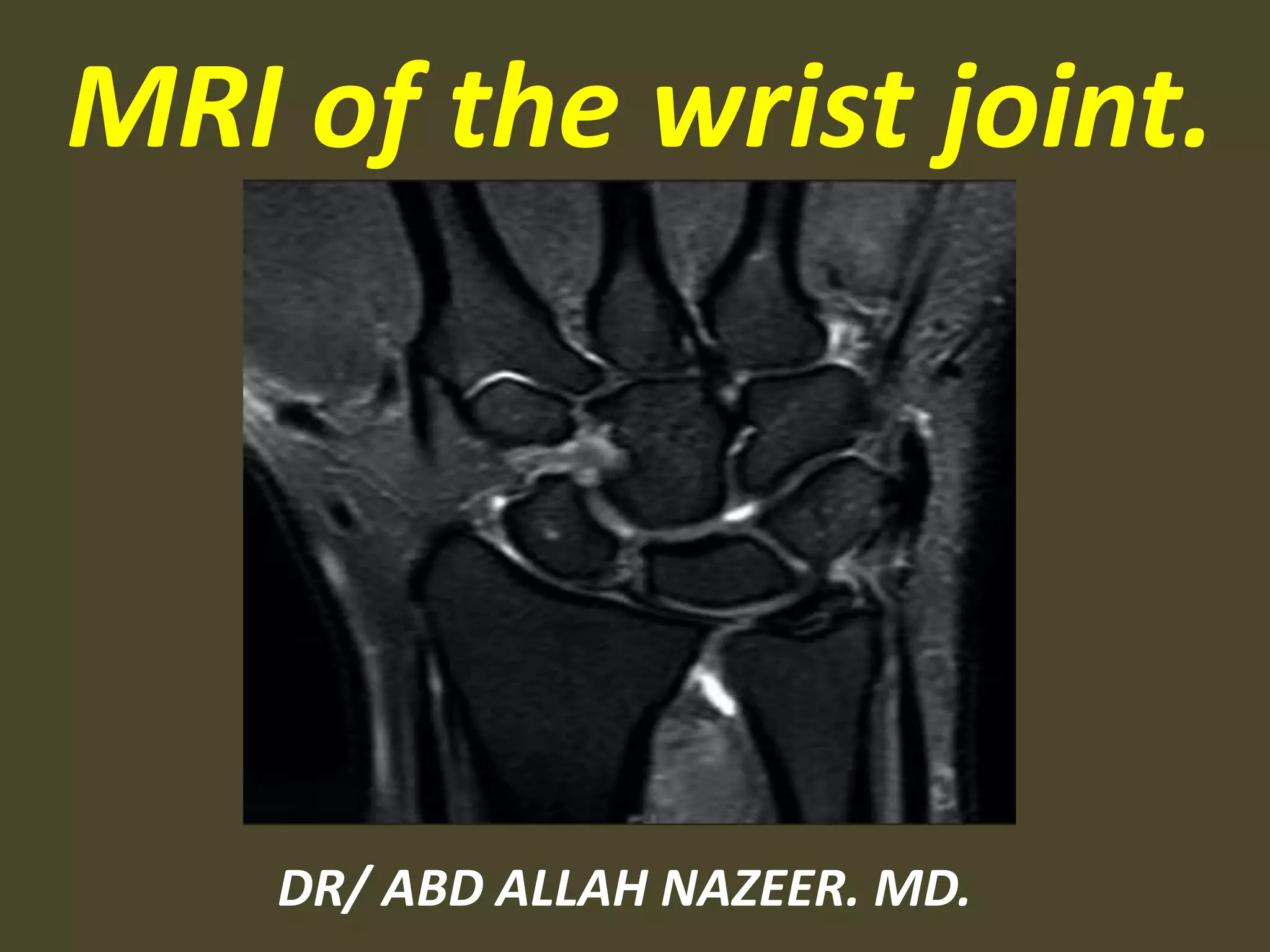
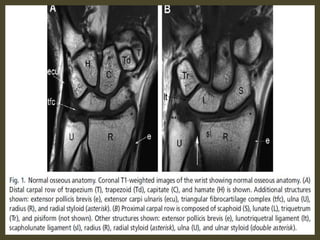
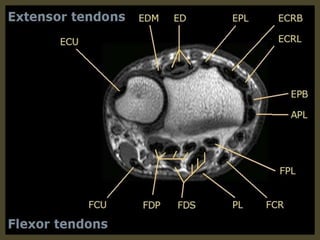
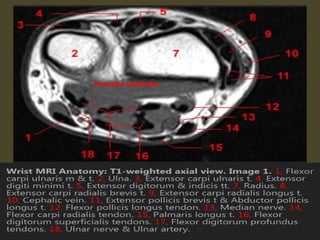
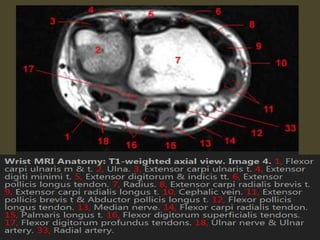
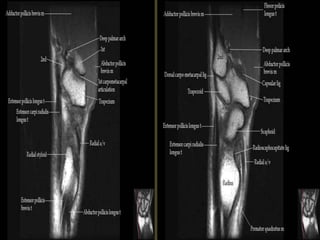
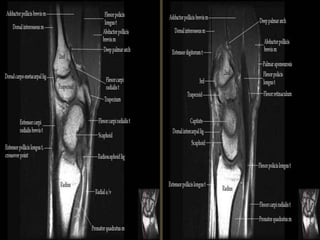
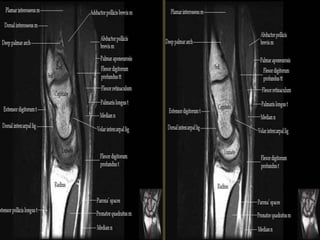
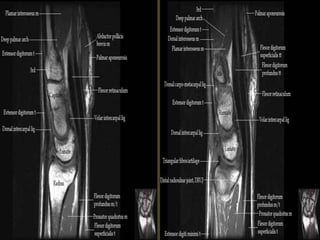
MRI of the wrist joint.
DR/ ABD ALLAH NAZEER. MD.
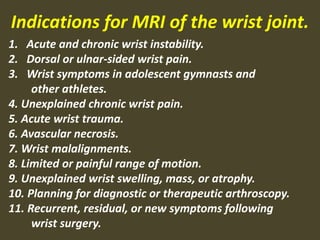
1. Acute and chronic wrist instability.
2. Dorsal or ulnar-sided wrist pain.
3. Wrist symptoms in adolescent gymnasts and
other athletes.
4. Unexplained chronic wrist pain.
5. Acute wrist trauma.
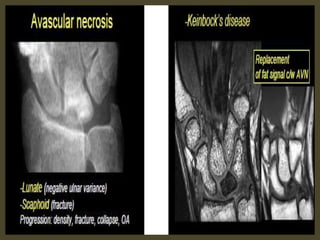
6. Avascular necrosis.
7. Wrist malalignments.
8. Limited or painful range of motion.
9. Unexplained wrist swelling, mass, or atrophy.
10. Planning for diagnostic or therapeutic arthroscopy.
11. Recurrent, residual, or new symptoms following
wrist surgery.
Indications for MRI of the wrist joint.
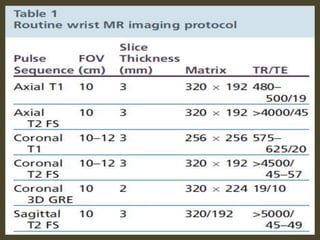
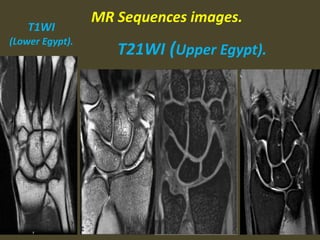
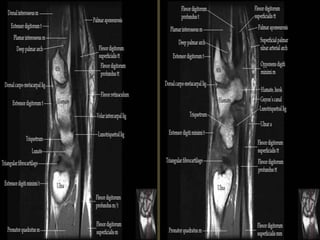
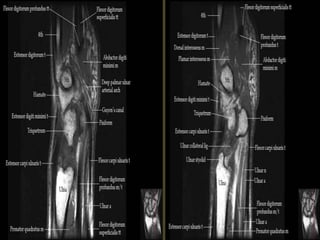
MR Sequences images.
T1WI
(Lower Egypt).
T21WI (Upper Egypt).
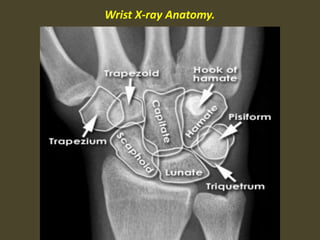
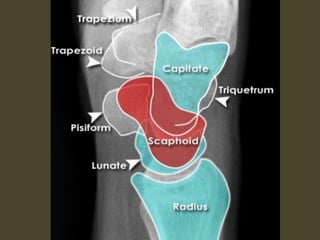
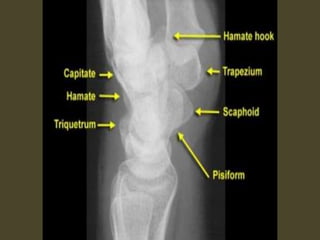
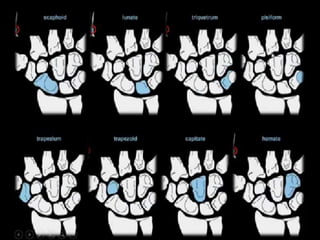
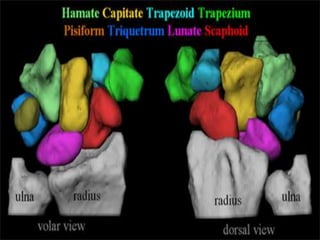
Wrist X-ray Anatomy.
Pronator quadratus.
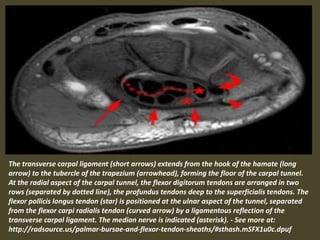
The transverse carpal ligament (short arrows) extends from the hook of the hamate (long
arrow) to the tubercle of the trapezium (arrowhead), forming the floor of the carpal tunnel.
At the radial aspect of the carpal tunnel, the flexor digitorum tendons are arranged in two
rows (separated by dotted line), the profundus tendons deep to the superficialis tendons. The
flexor pollicis longus tendon (star) is positioned at the ulnar aspect of the tunnel, separated
from the flexor carpi radialis tendon (curved arrow) by a ligamentous reflection of the
transverse carpal ligament. The median nerve is indicated (asterisk). - See more at:
http://radsource.us/palmar-bursae-and-flexor-tendon-sheaths/#sthash.mSFX1u0c.dpuf
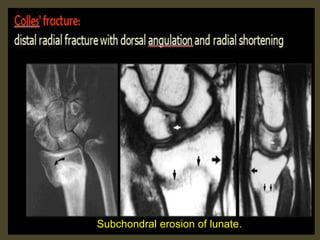
Subchondral erosion of lunate.
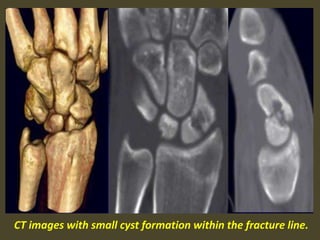
CT images with small cyst formation within the fracture line.
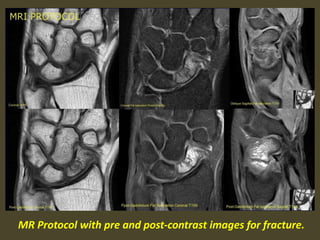
MR Protocol with pre and post-contrast images for fracture.
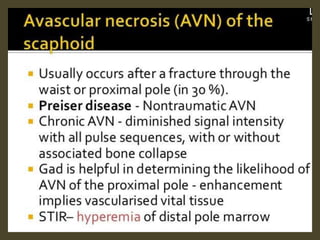
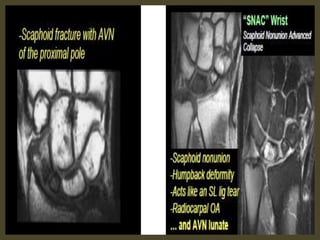
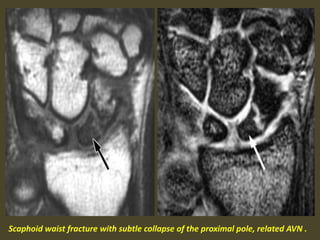
Scaphoid waist fracture with subtle collapse of the proximal pole, related AVN .
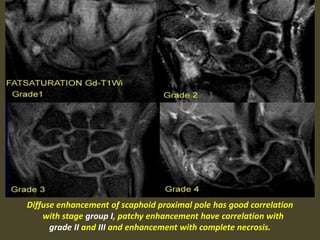
Diffuse enhancement of scaphoid proximal pole has good correlation
with stage group I, patchy enhancement have correlation with
grade II and III and enhancement with complete necrosis.
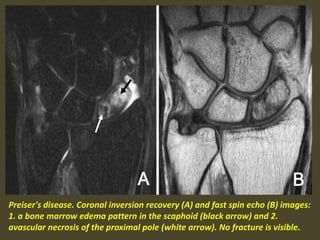
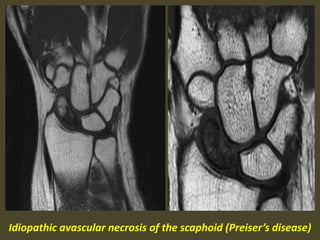
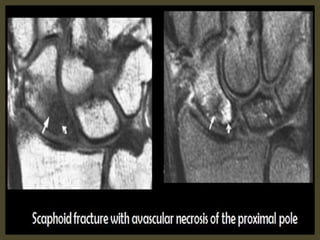
Preiser's disease. Coronal inversion recovery (A) and fast spin echo (B) images:
1. a bone marrow edema pattern in the scaphoid (black arrow) and 2.
avascular necrosis of the proximal pole (white arrow). No fracture is visible.
Idiopathic avascular necrosis of the scaphoid (Preiser’s disease)
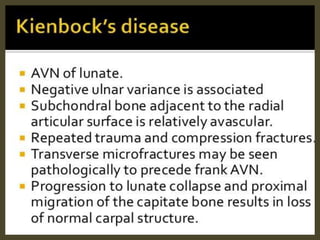
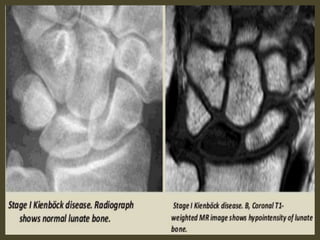
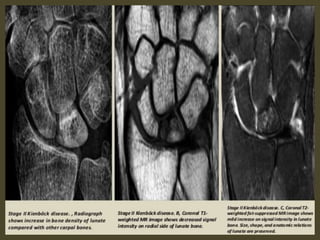
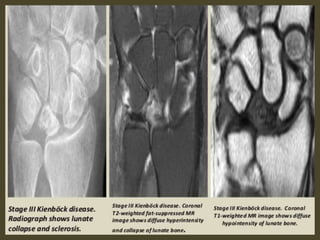
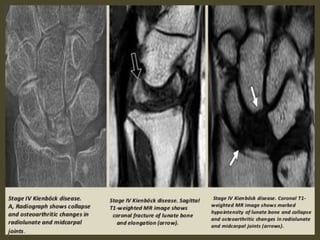
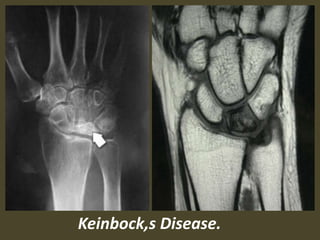
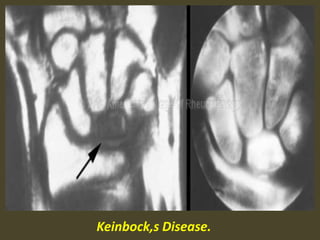
Keinbock,s Disease.
Keinbock,s Disease.
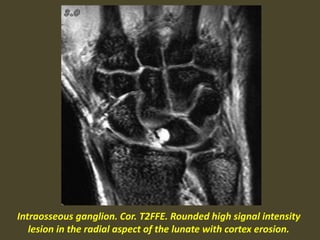
Intraosseous ganglion. Cor. T2FFE. Rounded high signal intensity
lesion in the radial aspect of the lunate with cortex erosion.
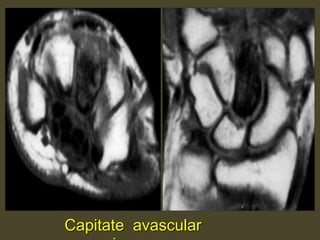
Capitate avascular
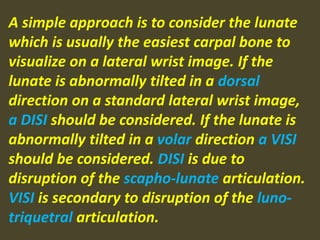
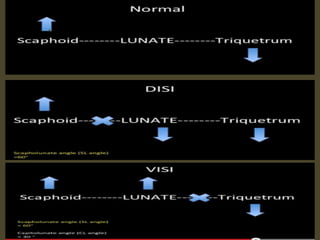
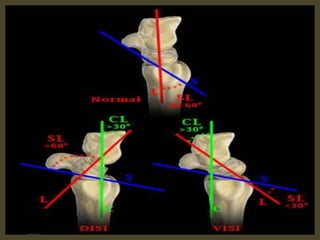
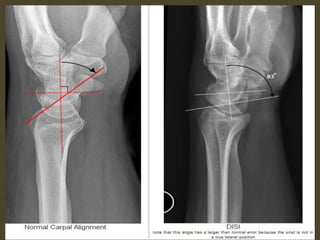
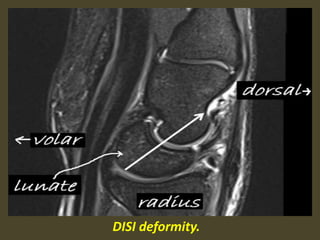
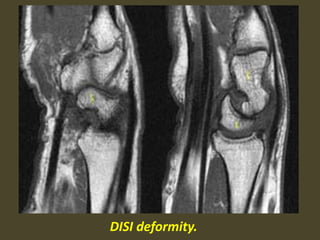
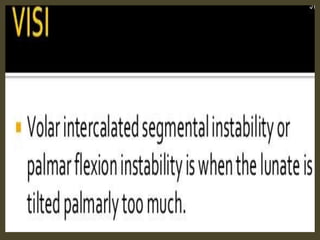
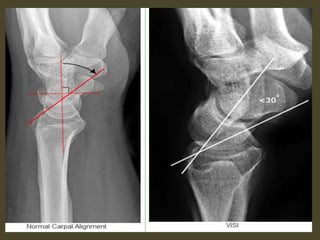
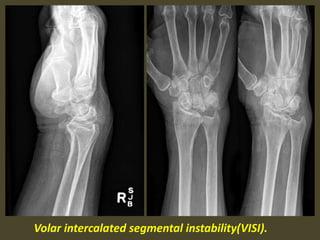
A simple approach is to consider the lunate
which is usually the easiest carpal bone to
visualize on a lateral wrist image. If the
lunate is abnormally tilted in a dorsal
direction on a standard lateral wrist image,
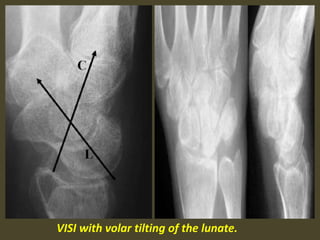
a DISI should be considered. If the lunate is
abnormally tilted in a volar direction a VISI
should be considered. DISI is due to
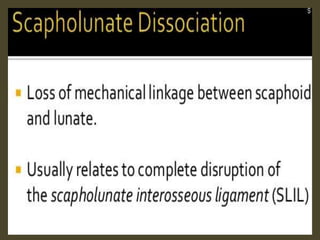
disruption of the scapho-lunate articulation.
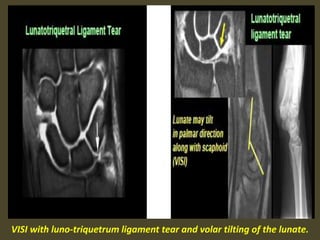
VISI is secondary to disruption of the luno-
triquetral articulation.
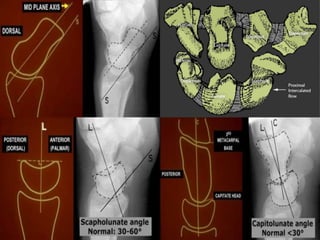
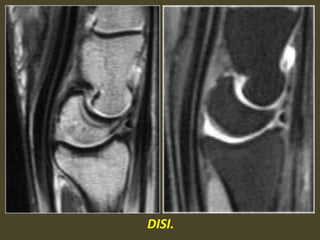
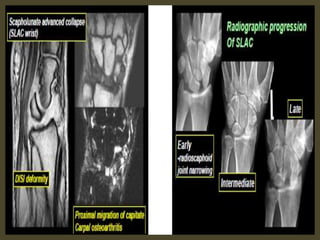
DISI deformity.
DISI deformity.
DISI.
Volar intercalated segmental instability(VISI).
VISI with volar tilting of the lunate.
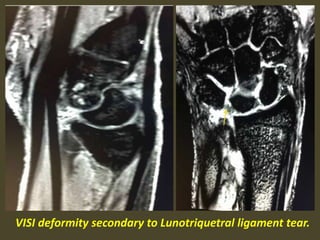
VISI with luno-triquetrum ligament tear and volar tilting of the lunate.
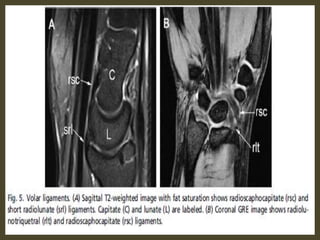
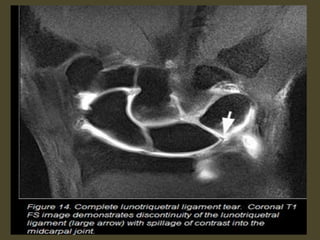
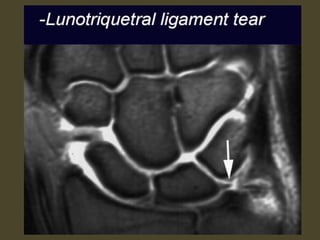
VISI deformity secondary to Lunotriquetral ligament tear.
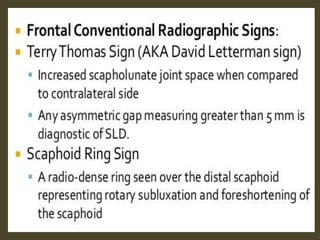
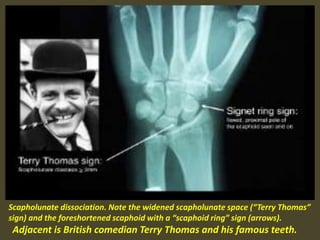
Scapholunate dissociation. Note the widened scapholunate space (“Terry Thomas”
sign) and the foreshortened scaphoid with a “scaphoid ring” sign (arrows).
Adjacent is British comedian Terry Thomas and his famous teeth.
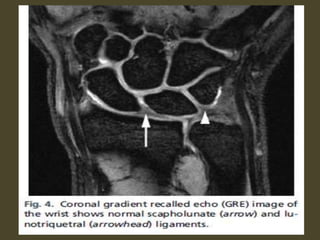
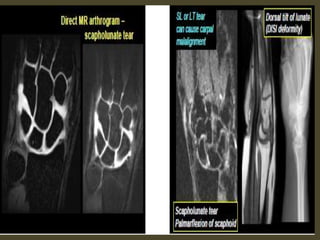
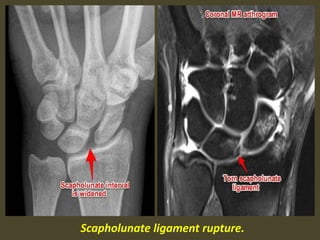
Scapholunate ligament rupture.
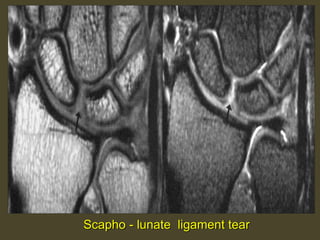
Scapho - lunate ligament tear
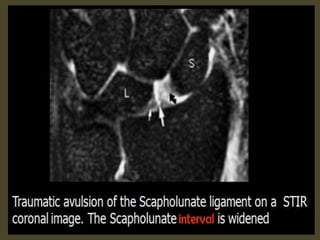
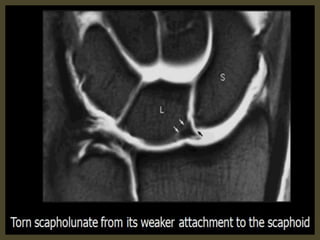
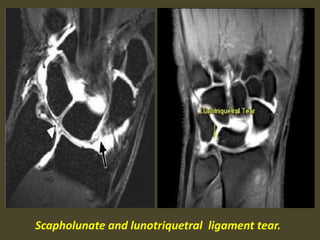
Scapholunate and lunotriquetral ligament tear.
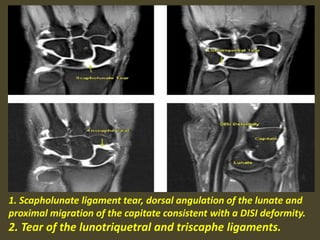
1. Scapholunate ligament tear, dorsal angulation of the lunate and
proximal migration of the capitate consistent with a DISI deformity.
2. Tear of the lunotriquetral and triscaphe ligaments.
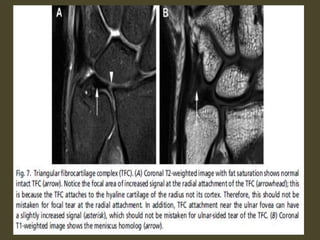
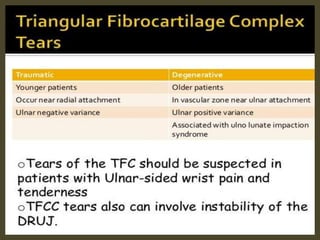
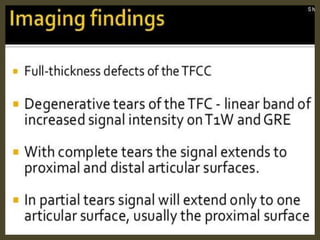
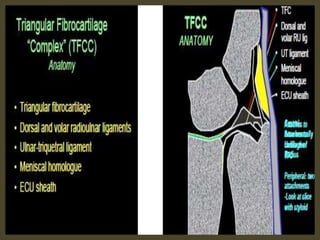
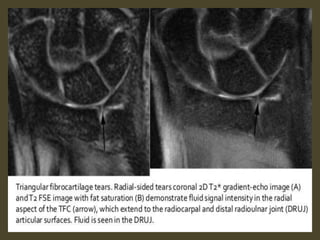
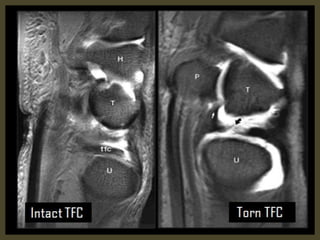
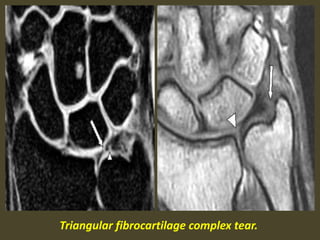
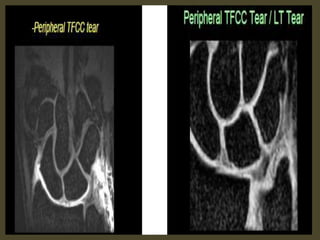
Triangular fibrocartilage complex tear.
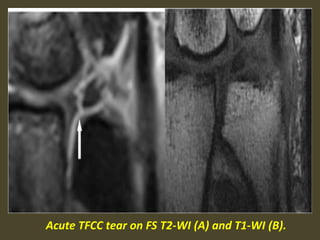
Acute TFCC tear on FS T2-WI (A) and T1-WI (B).
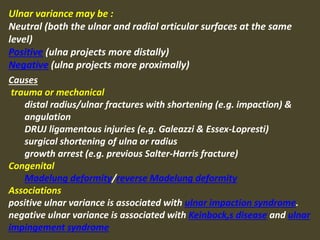
Ulnar variance may be :
Neutral (both the ulnar and radial articular surfaces at the same
level)
Positive (ulna projects more distally)
Negative (ulna projects more proximally)
Causes
trauma or mechanical
distal radius/ulnar fractures with shortening (e.g. impaction) &
angulation
DRUJ ligamentous injuries (e.g. Galeazzi & Essex-Lopresti)
surgical shortening of ulna or radius
growth arrest (e.g. previous Salter-Harris fracture)
Congenital
Madelung deformity/reverse Madelung deformity
Associations
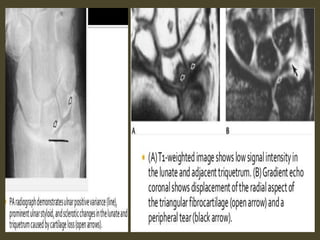
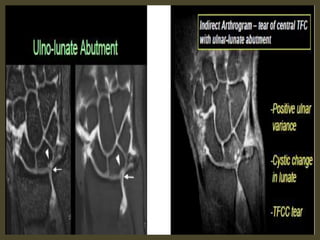
positive ulnar variance is associated with ulnar impaction syndrome.
negative ulnar variance is associated with Keinbock,s disease and ulnar
impingement syndrome
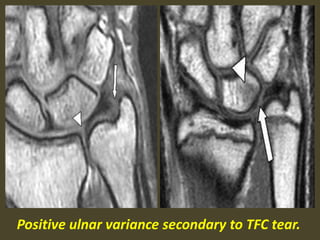
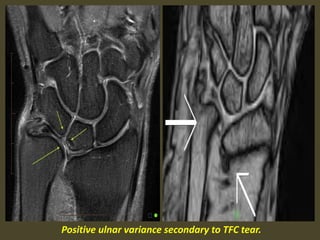
Positive ulnar variance secondary to TFC tear.
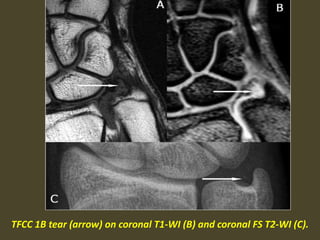
TFCC 1B tear (arrow) on coronal T1-WI (B) and coronal FS T2-WI (C).
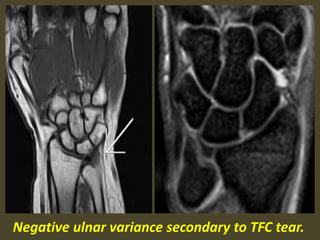
Negative ulnar variance secondary to TFC tear.
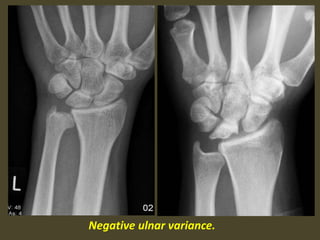
Negative ulnar variance.
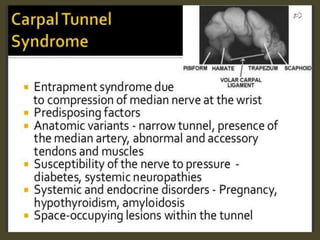
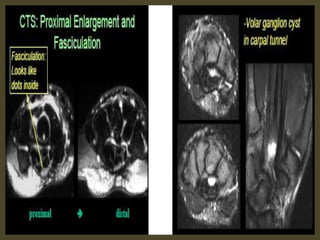
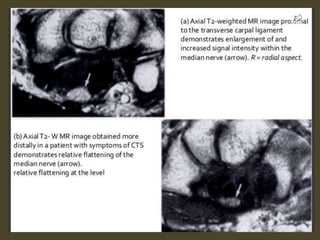
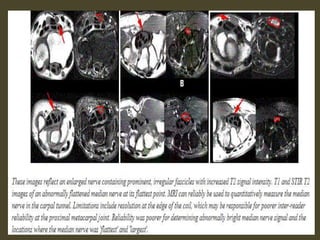
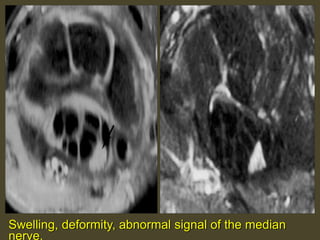
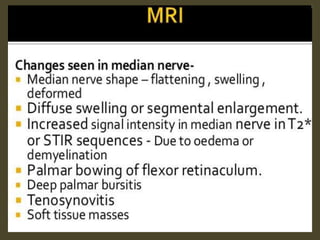
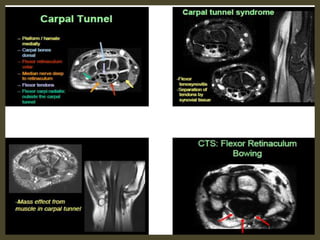
Swelling, deformity, abnormal signal of the median
nerve.
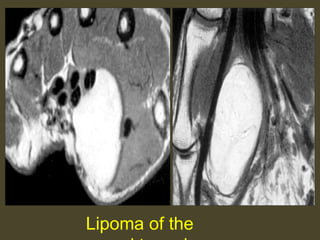
Lipoma of the
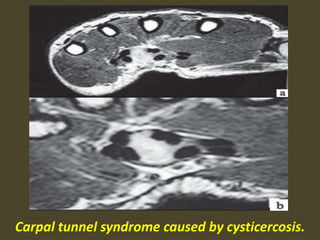
Carpal tunnel syndrome caused by cysticercosis.
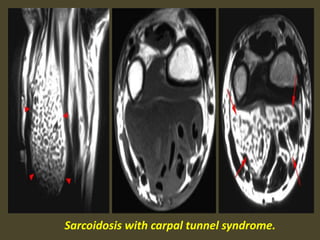
Sarcoidosis with carpal tunnel syndrome.
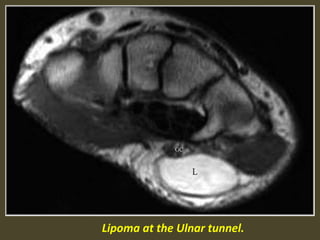
Lipoma at the Ulnar tunnel.
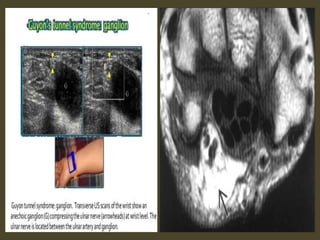
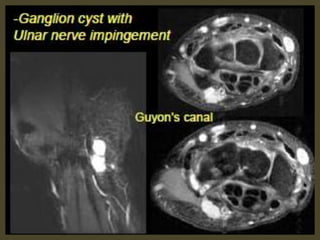
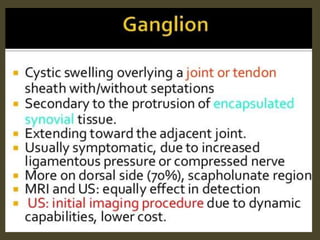
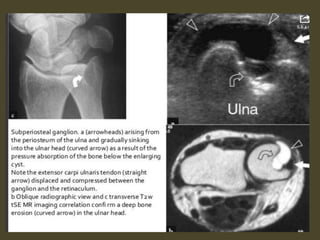
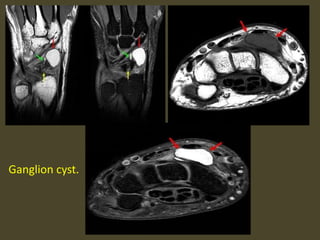
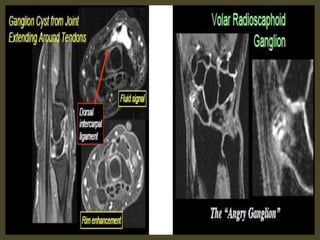
Ganglion cyst.
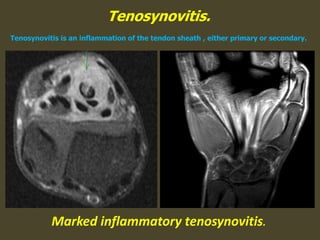
Tenosynovitis.
Tenosynovitis is an inflammation of the tendon sheath , either primary or secondary.
Marked inflammatory tenosynovitis.
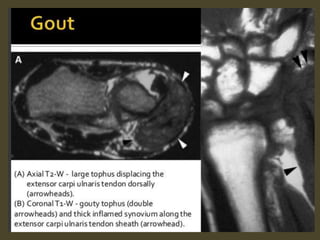
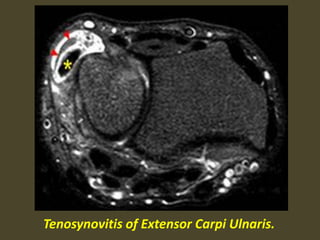
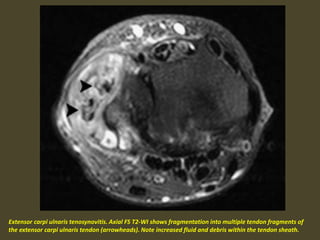
Tenosynovitis of Extensor Carpi Ulnaris.
Extensor carpi ulnaris tenosynovitis. Axial FS T2-WI shows fragmentation into multiple tendon fragments of
the extensor carpi ulnaris tendon (arrowheads). Note increased fluid and debris within the tendon sheath.
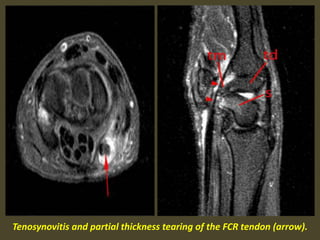
Tenosynovitis and partial thickness tearing of the FCR tendon (arrow).
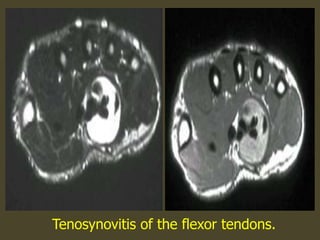
Tenosynovitis of the flexor tendons.
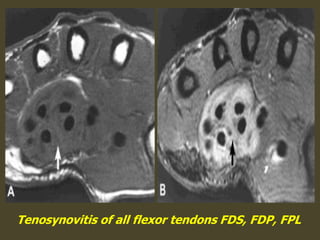
Tenosynovitis of all flexor tendons FDS, FDP, FPL
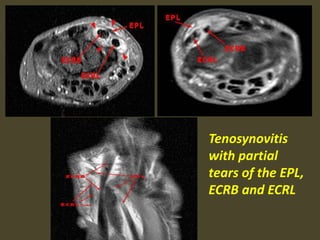
Tenosynovitis
with partial
tears of the EPL,
ECRB and ECRL
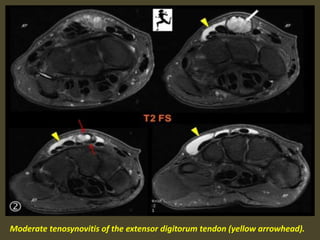
Moderate tenosynovitis of the extensor digitorum tendon (yellow arrowhead).
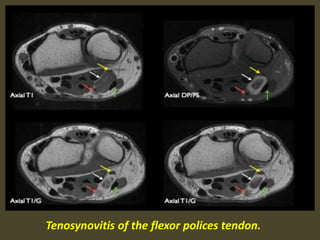
Tenosynovitis of the flexor polices tendon.
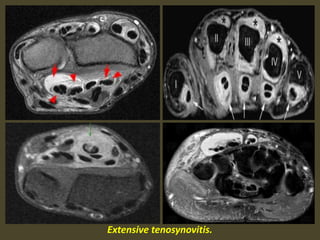
Extensive tenosynovitis.
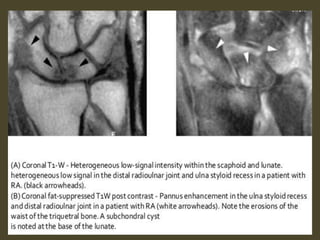
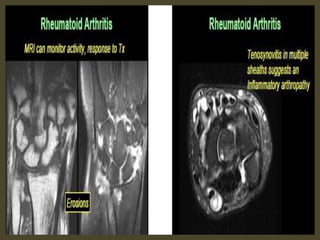
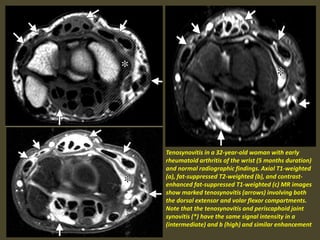
Tenosynovitis in a 32-year-old woman with early
rheumatoid arthritis of the wrist (5 months duration)
and normal radiographic findings. Axial T1-weighted
(a), fat-suppressed T2-weighted (b), and contrast-
enhanced fat-suppressed T1-weighted (c) MR images
show marked tenosynovitis (arrows) involving both
the dorsal extensor and volar flexor compartments.
Note that the tenosynovitis and periscaphoid joint
synovitis (*) have the same signal intensity in a
(intermediate) and b (high) and similar enhancement
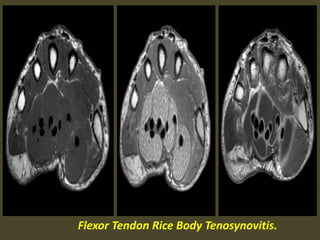
Flexor Tendon Rice Body Tenosynovitis.
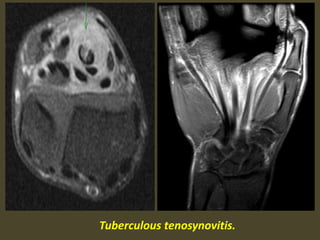
Tuberculous tenosynovitis.
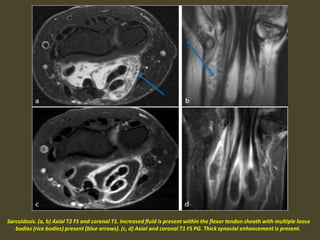
Sarcoidosis. (a, b) Axial T2 FS and coronal T1. Increased fluid is present within the flexor tendon sheath with multiple loose
bodies (rice bodies) present (blue arrows). (c, d) Axial and coronal T1 FS PG. Thick synovial enhancement is present.
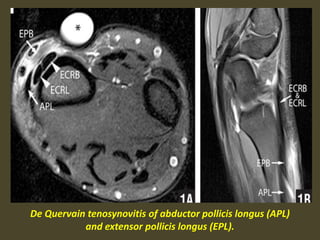
De Quervain tenosynovitis of abductor pollicis longus (APL)
and extensor pollicis longus (EPL).
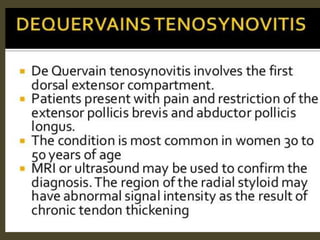
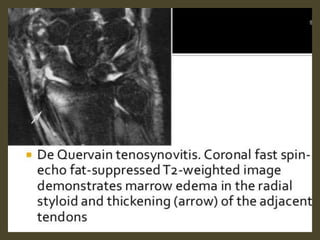
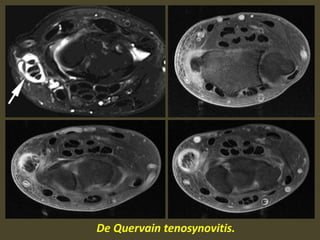
De Quervain tenosynovitis.
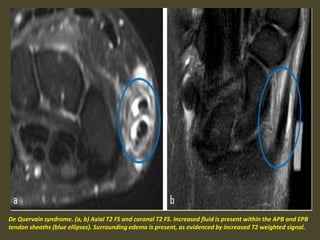
De Quervain syndrome. (a, b) Axial T2 FS and coronal T2 FS. Increased fluid is present within the APB and EPB
tendon sheaths (blue ellipses). Surrounding edema is present, as evidenced by increased T2 weighted signal.
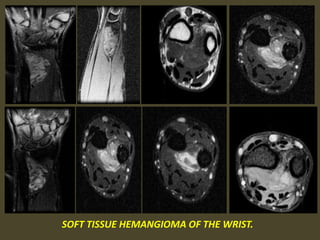
SOFT TISSUE HEMANGIOMA OF THE WRIST.
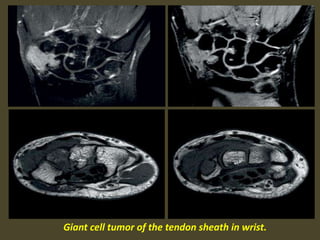
Giant cell tumor of the tendon sheath in wrist.
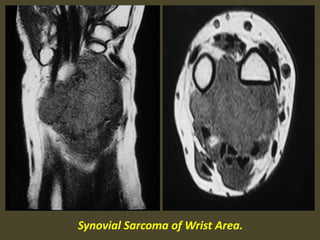
Synovial Sarcoma of Wrist Area.
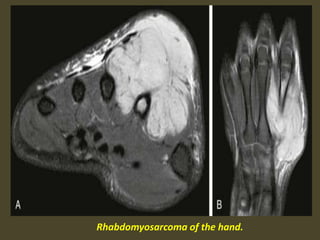
Rhabdomyosarcoma of the hand.
Presentation2.pptx wrist joint.

Presentation2.pptx wrist joint.