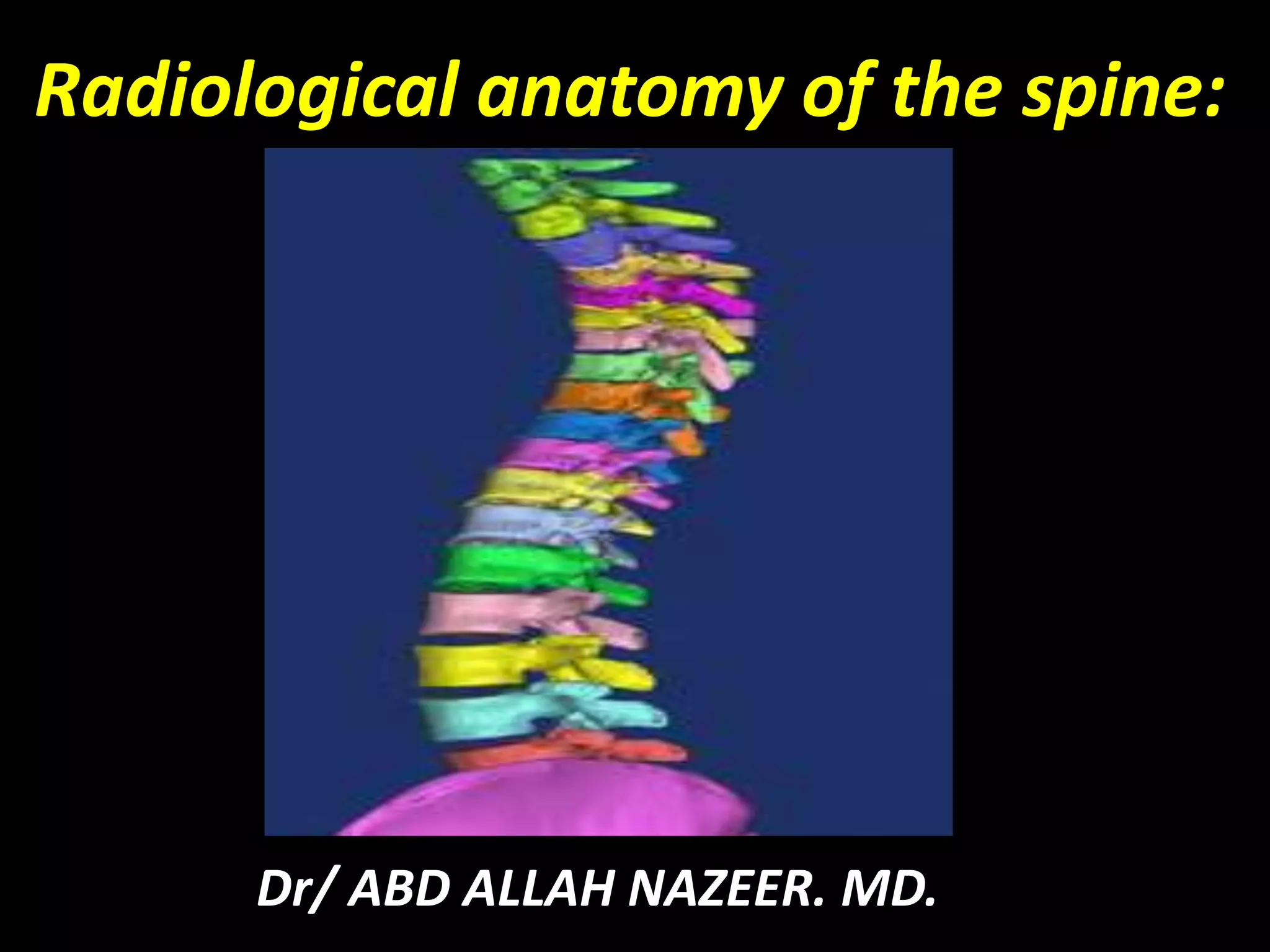
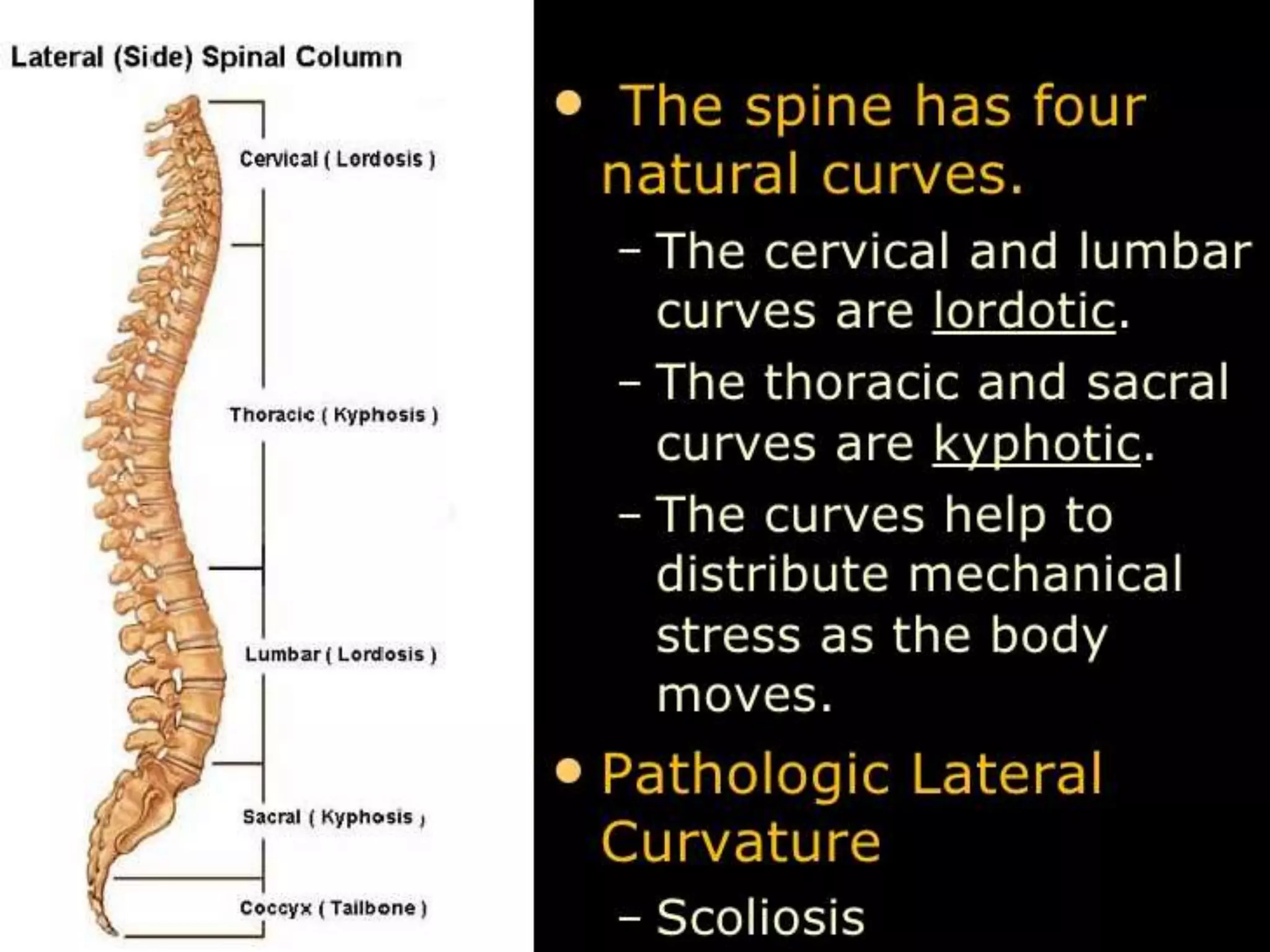
Radiological anatomy of the spine: 
Dr/ ABD ALLAH NAZEER. MD.
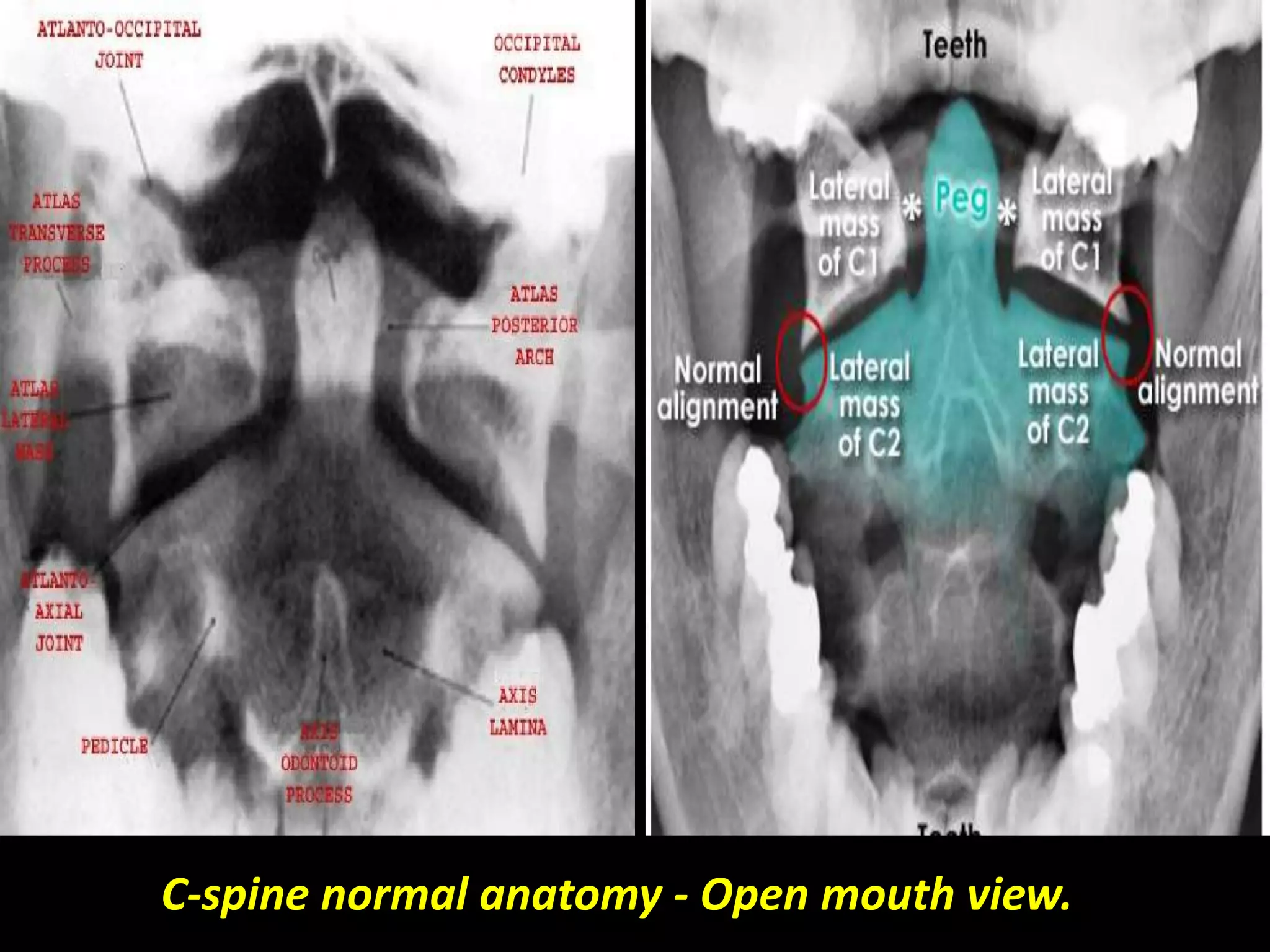
C-spine normal anatomy - Open mouth view.
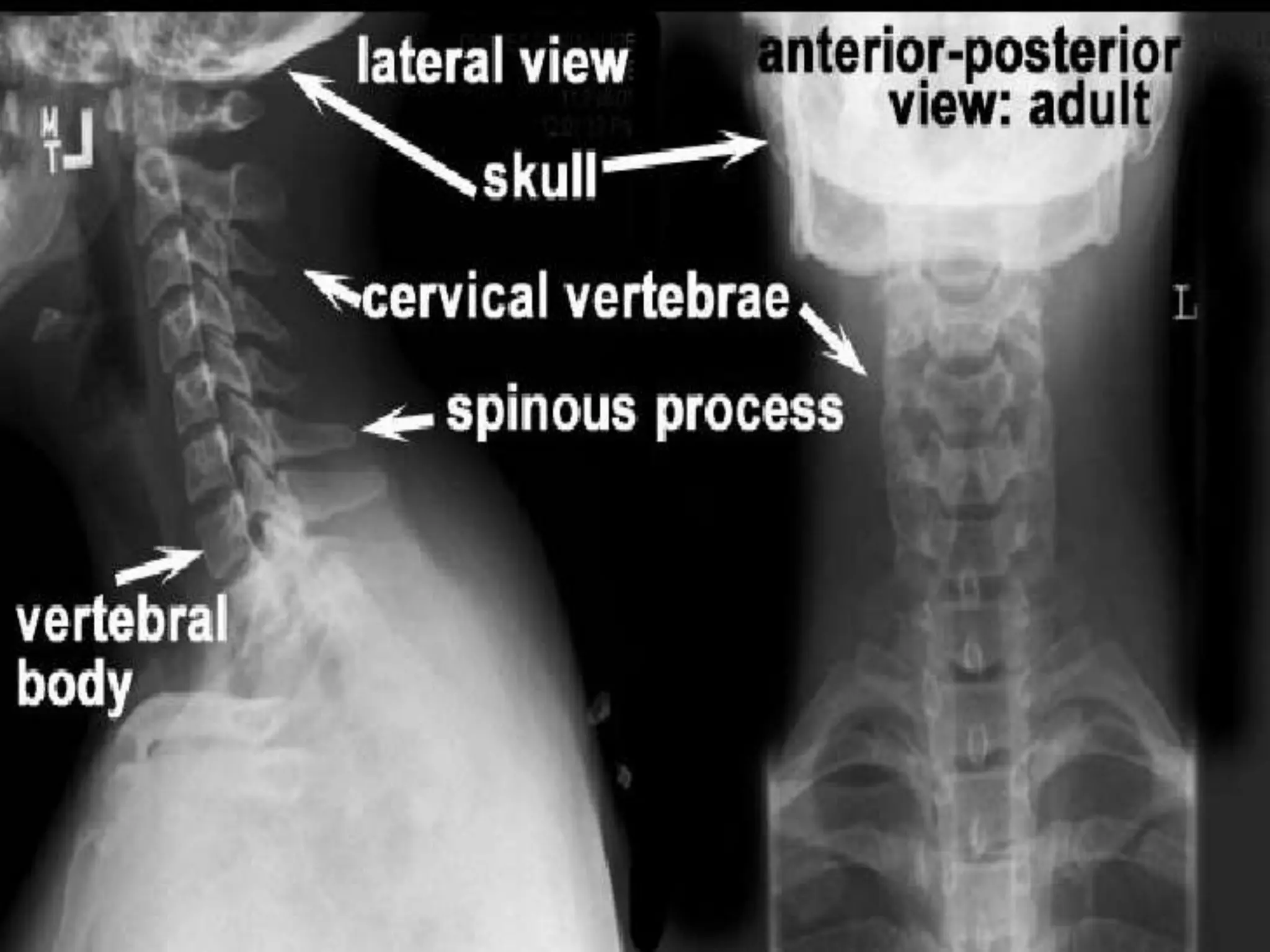
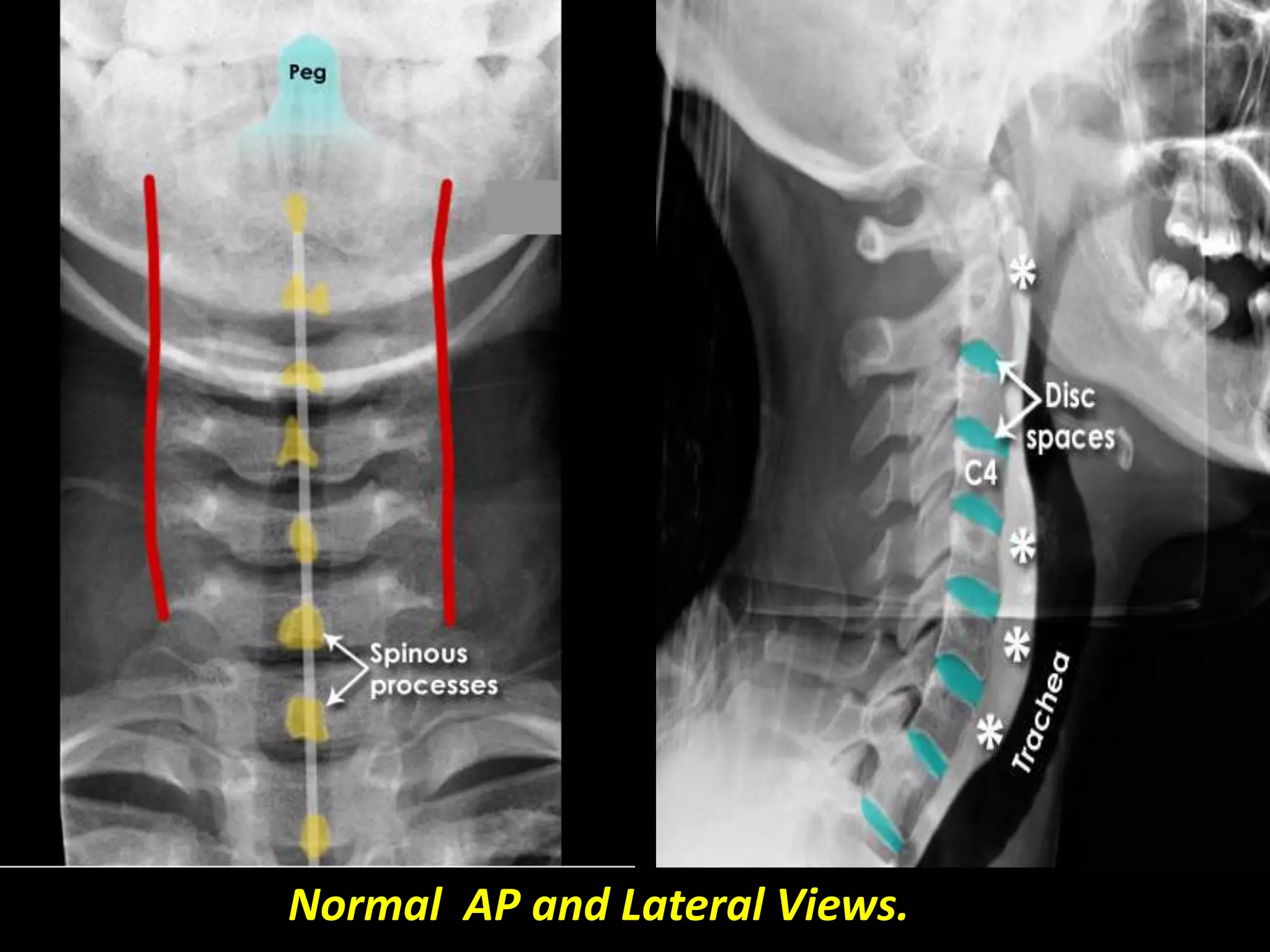
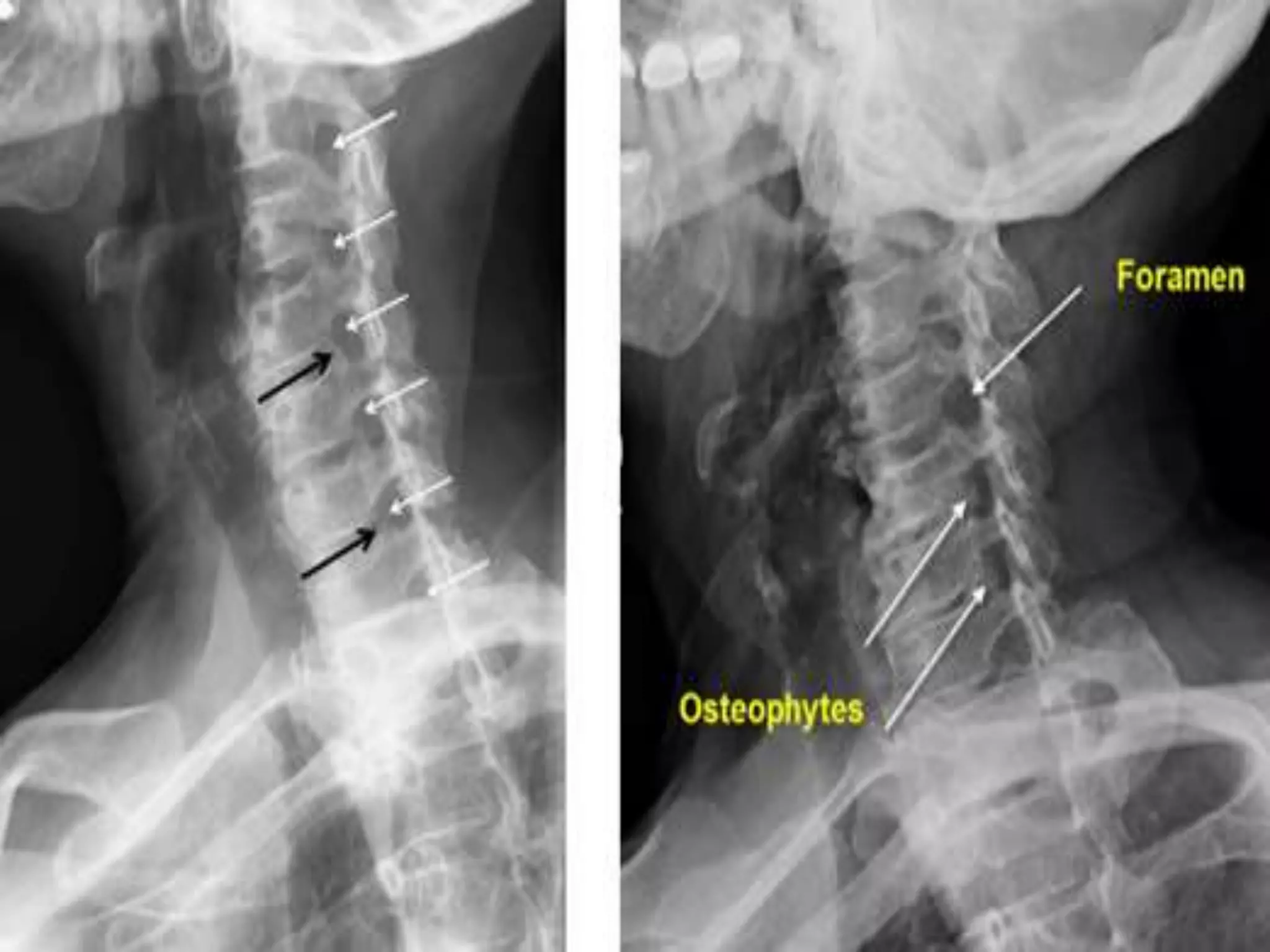
Normal AP and Lateral Views.
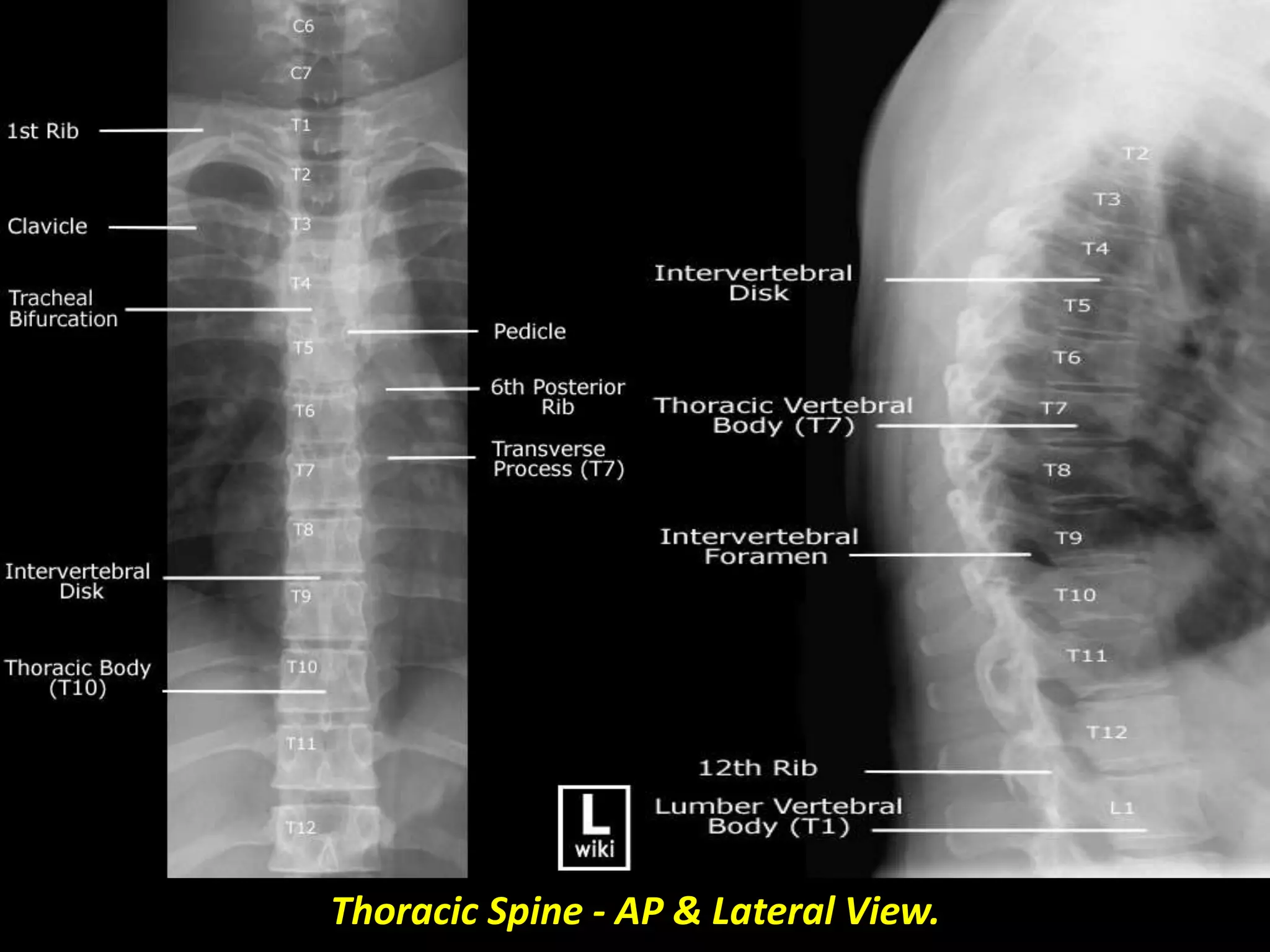
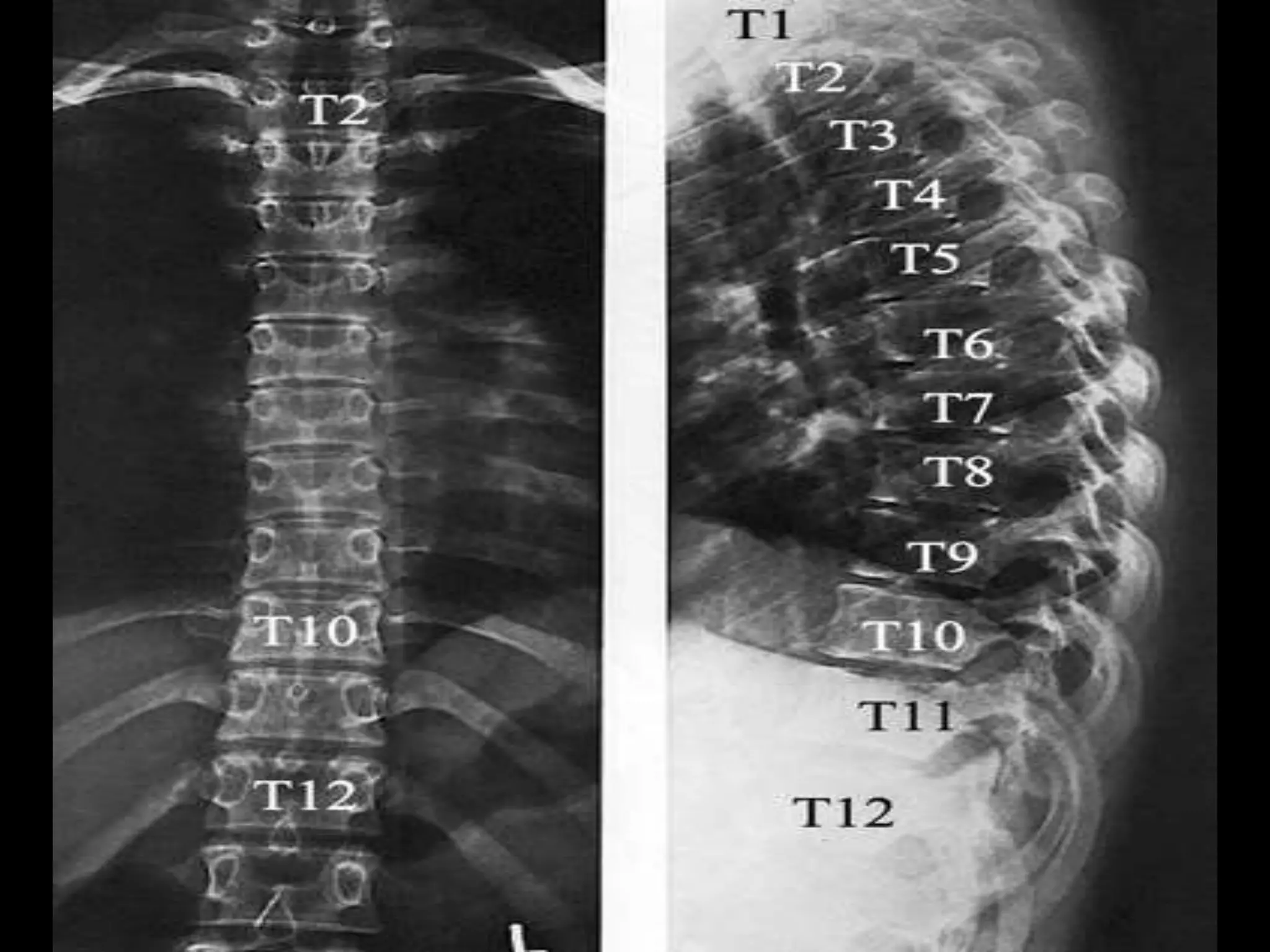
Thoracic Spine - AP & Lateral View.
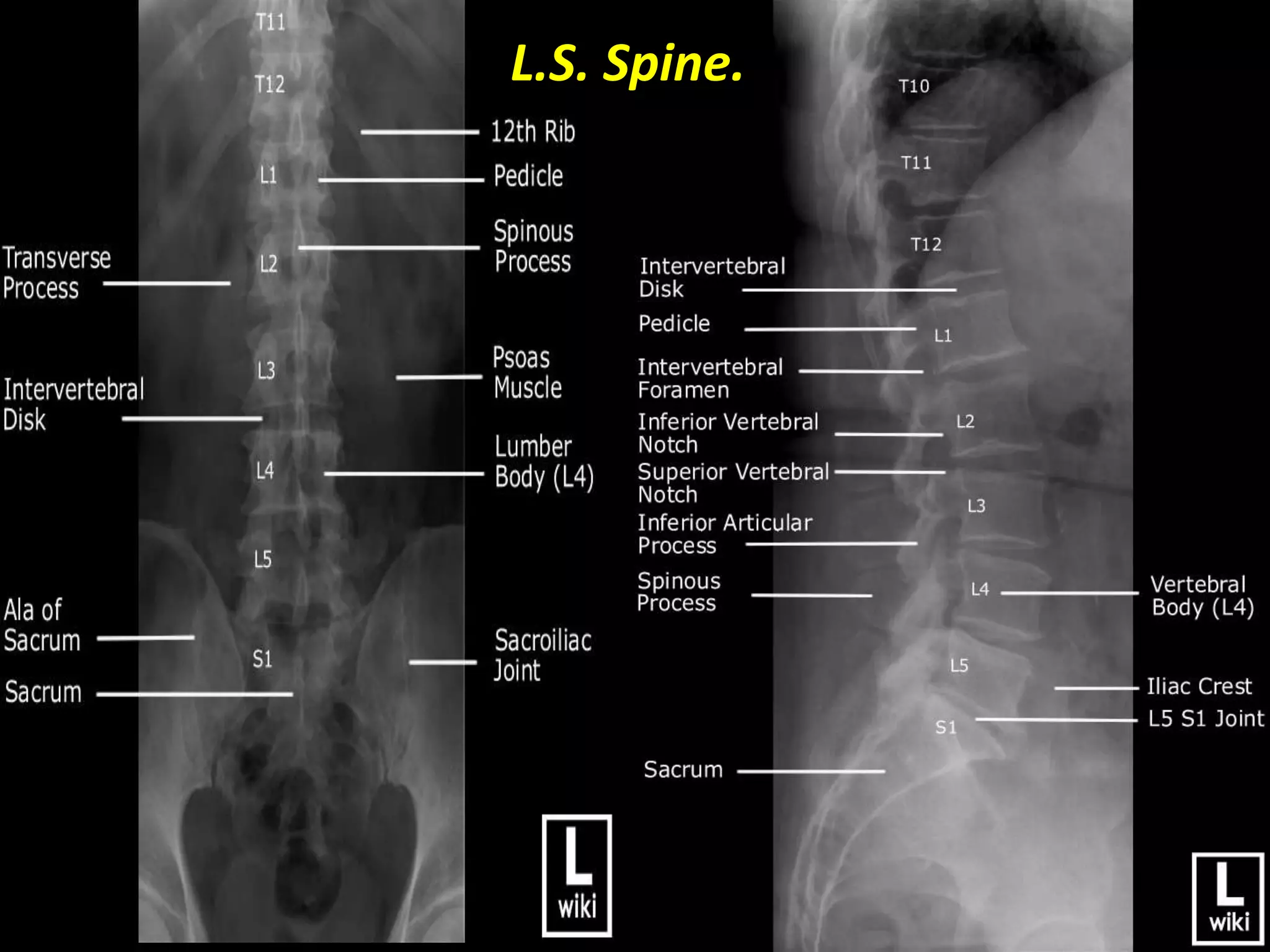
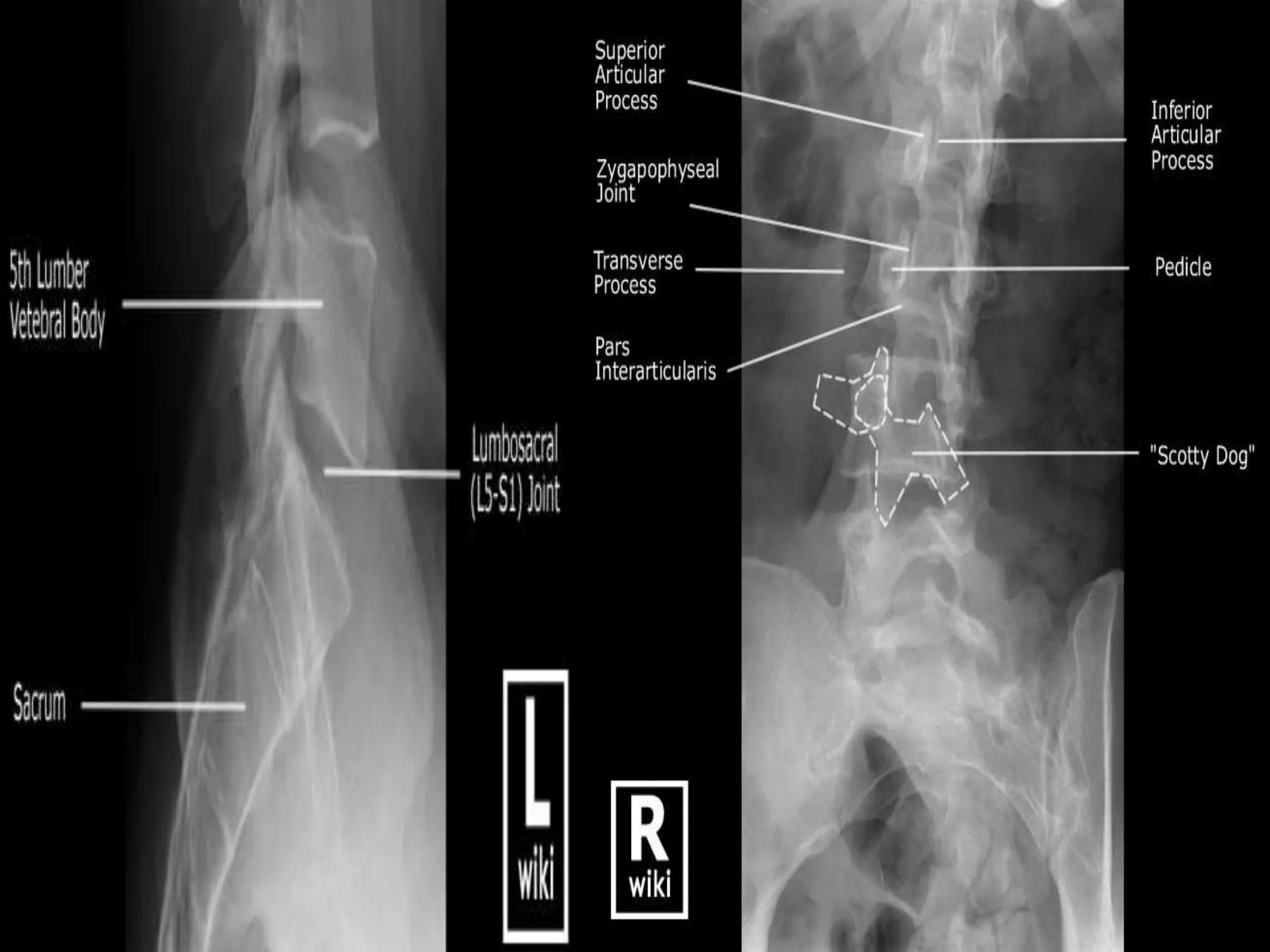
L.S. Spine.
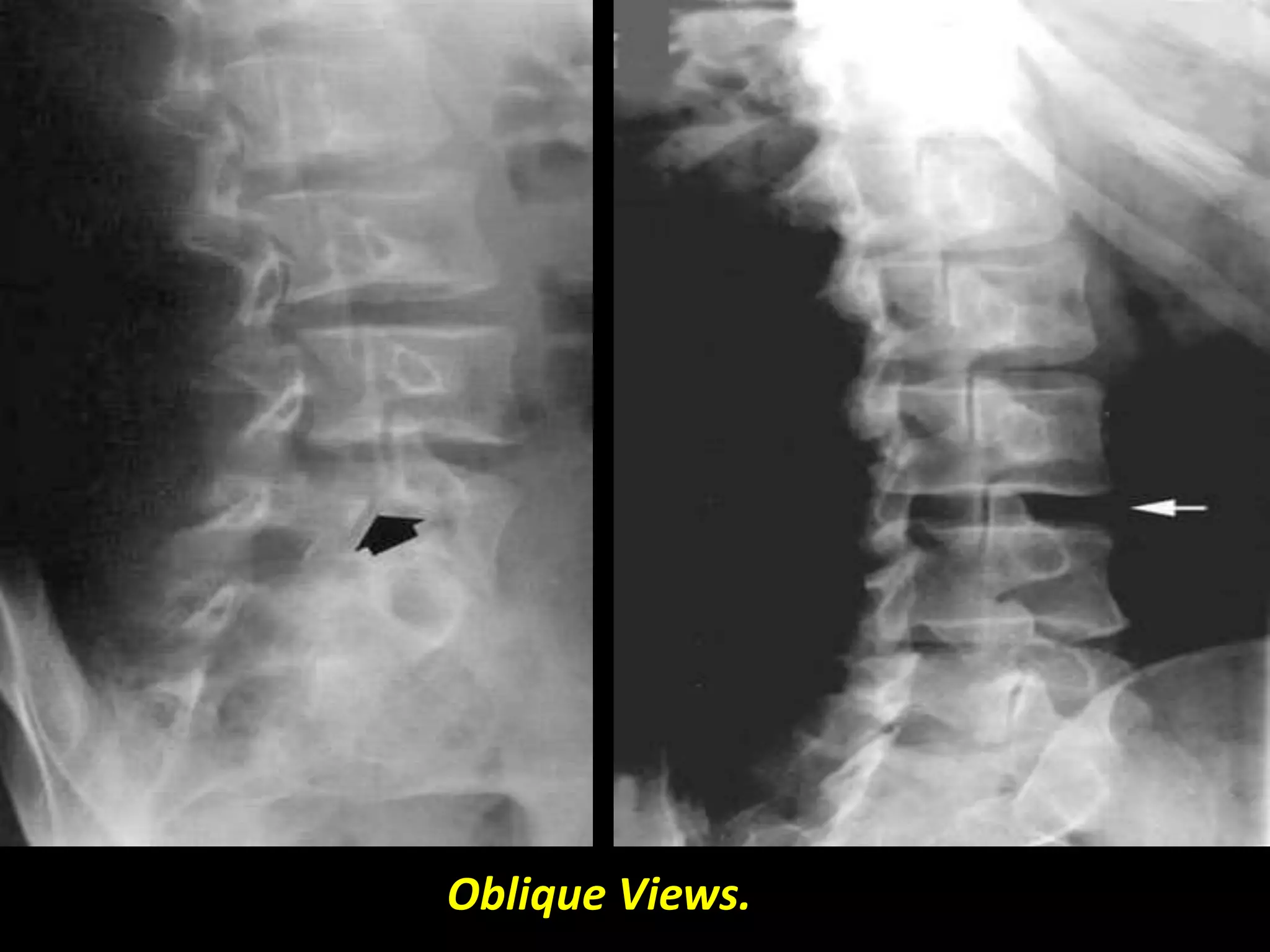
Oblique Views.
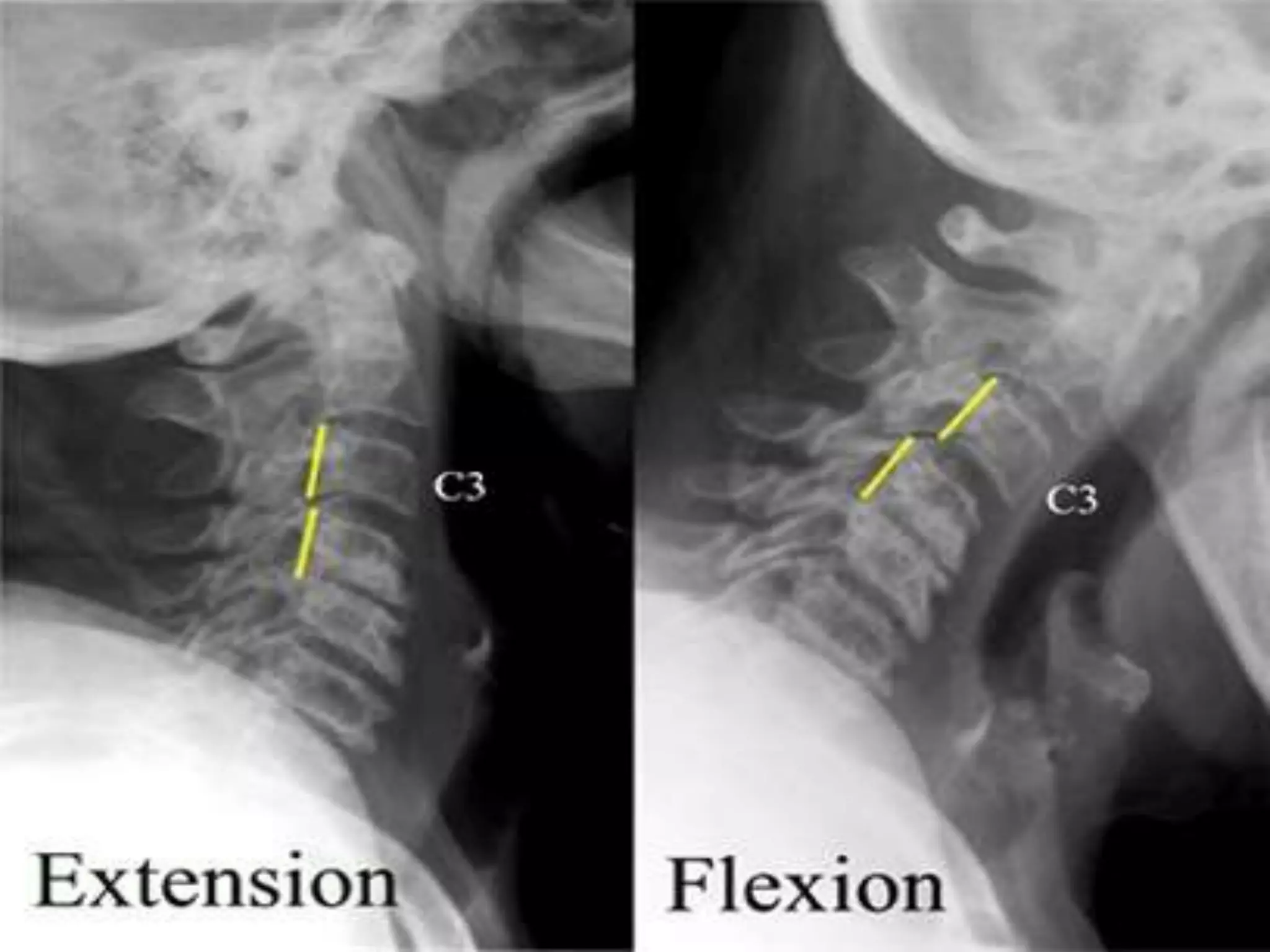
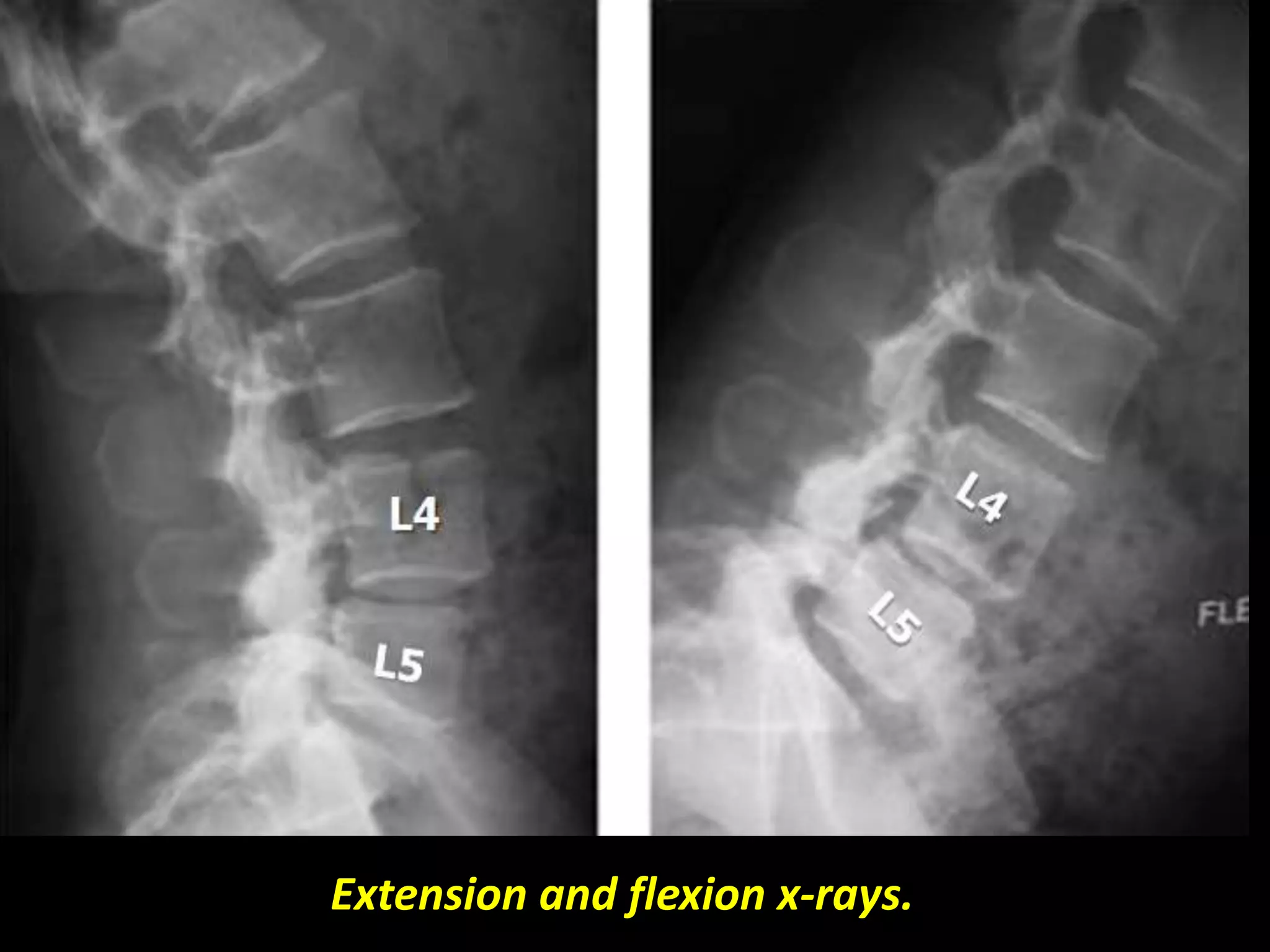
Extension and flexion x-rays.
CT of the Cervical Spine: Anatomy. 
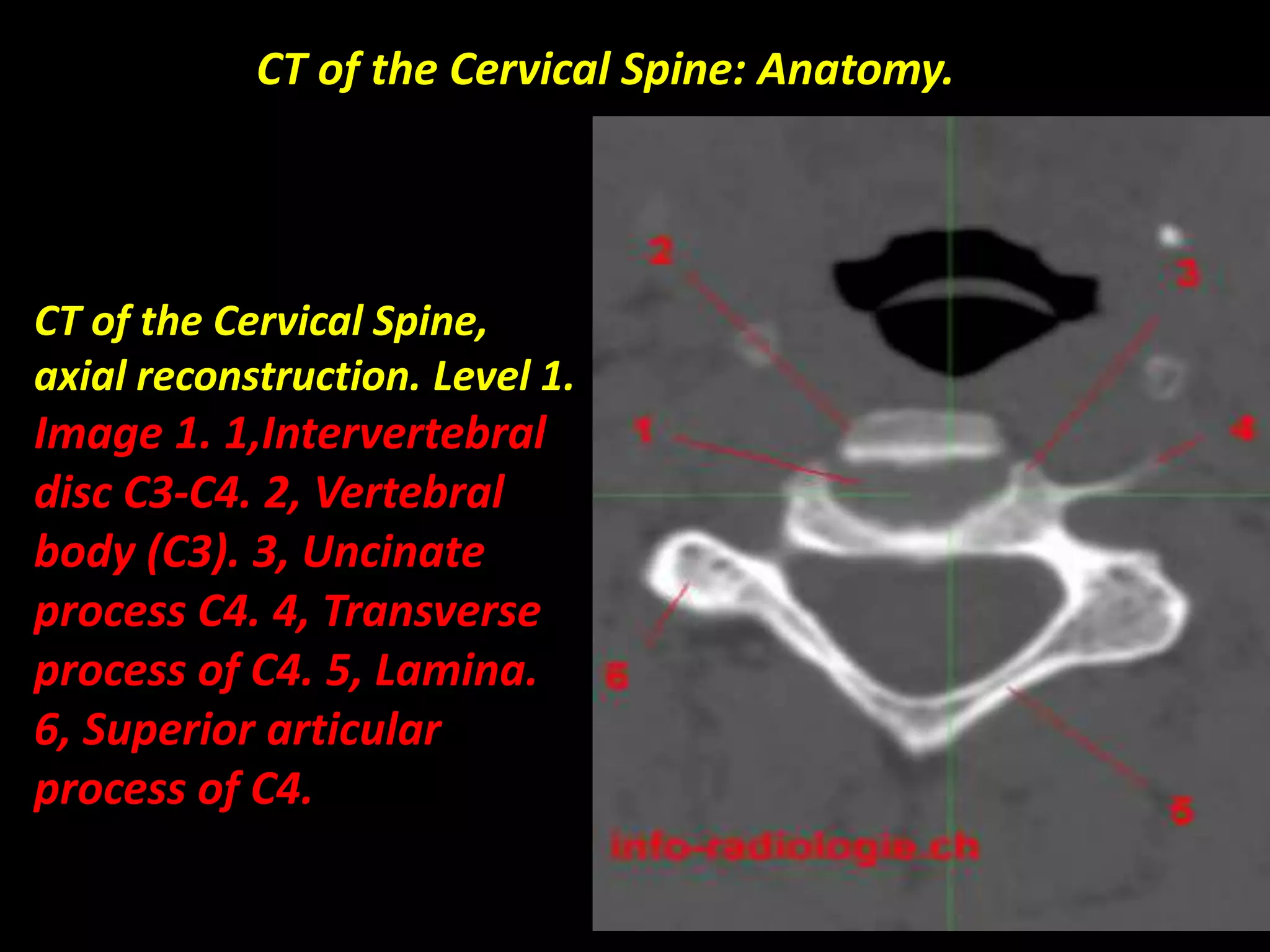
CT of the Cervical Spine, 
axial reconstruction. Level 1. 
Image 1. 1,Intervertebral 
disc C3-C4. 2, Vertebral 
body (C3). 3, Uncinate 
process C4. 4, Transverse 
process of C4. 5, Lamina. 
6, Superior articular 
process of C4.
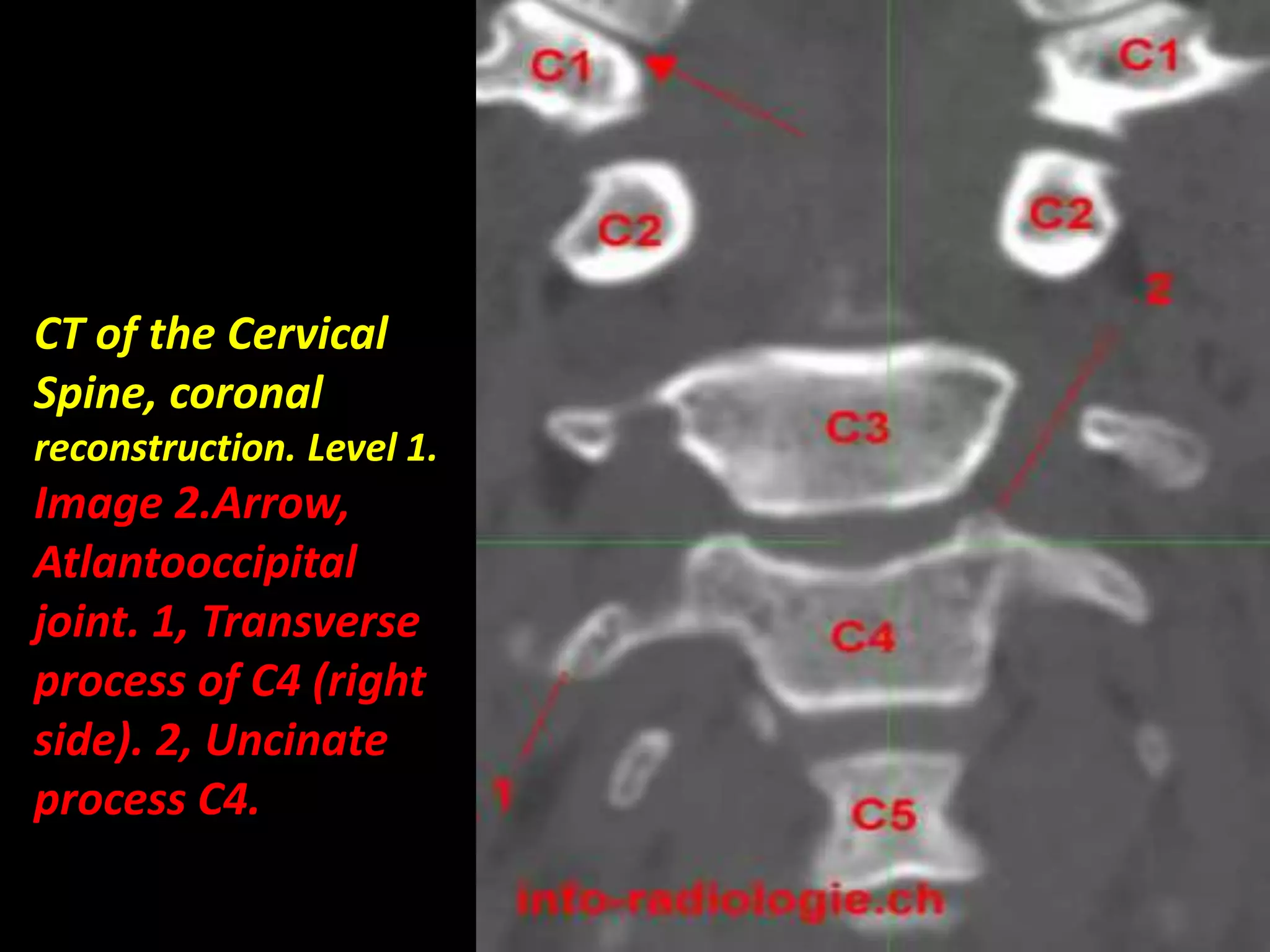
CT of the Cervical 
Spine, coronal 
reconstruction. Level 1. 
Image 2.Arrow, 
Atlantooccipital 
joint. 1, Transverse 
process of C4 (right 
side). 2, Uncinate 
process C4.
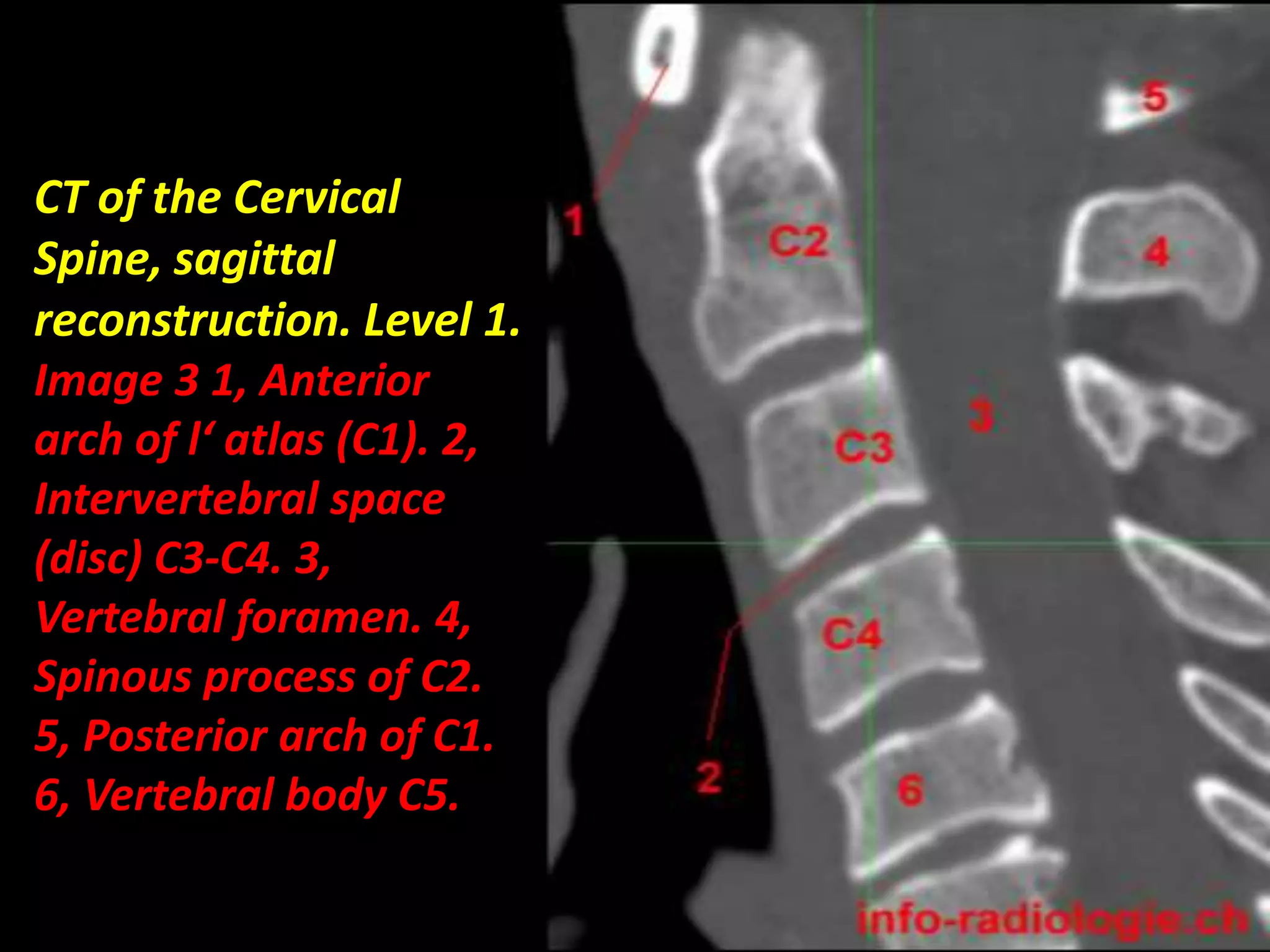
CT of the Cervical 
Spine, sagittal 
reconstruction. Level 1. 
Image 3 1, Anterior 
arch of l‘ atlas (C1). 2, 
Intervertebral space 
(disc) C3-C4. 3, 
Vertebral foramen. 4, 
Spinous process of C2. 
5, Posterior arch of C1. 
6, Vertebral body C5.
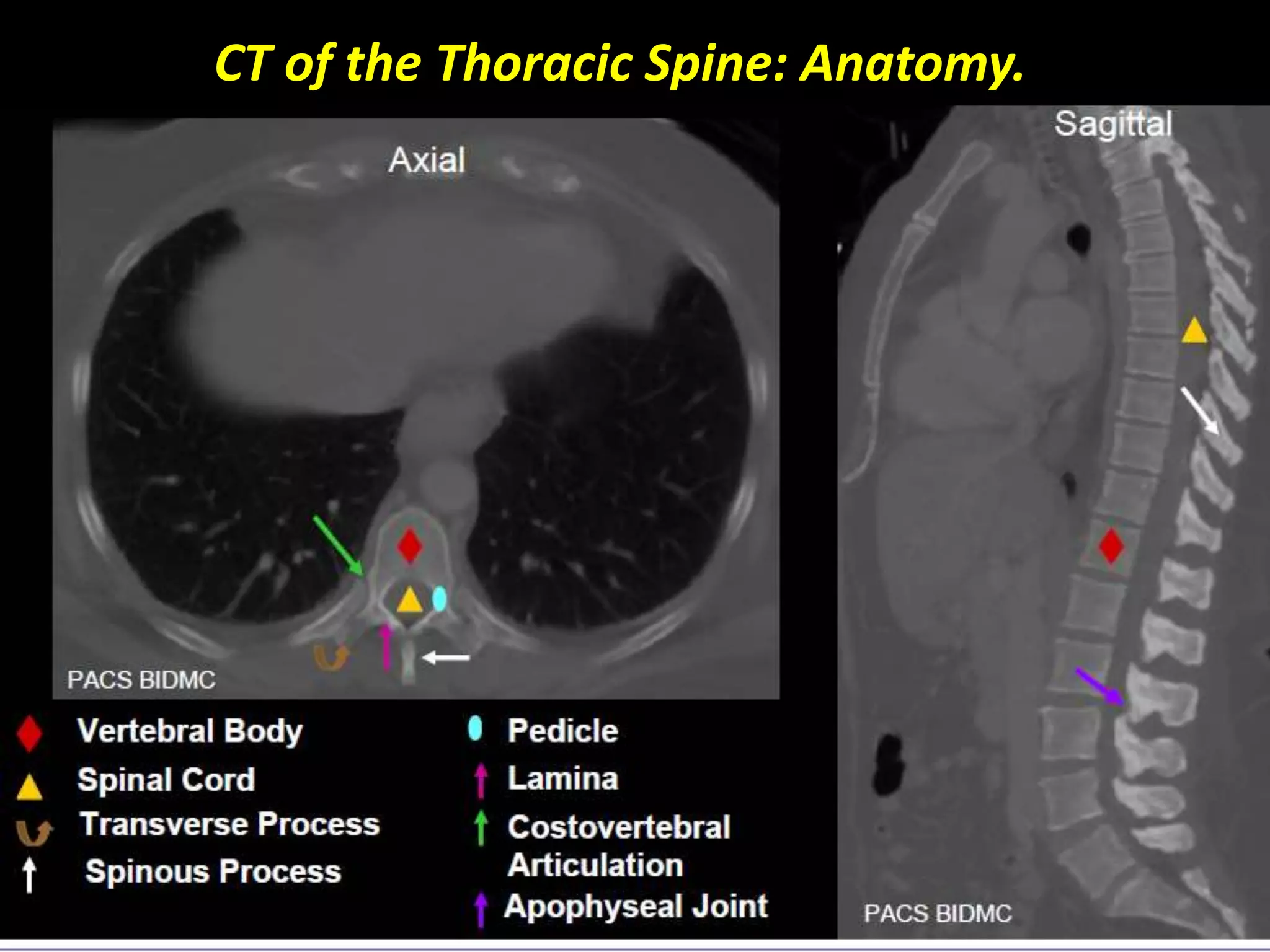
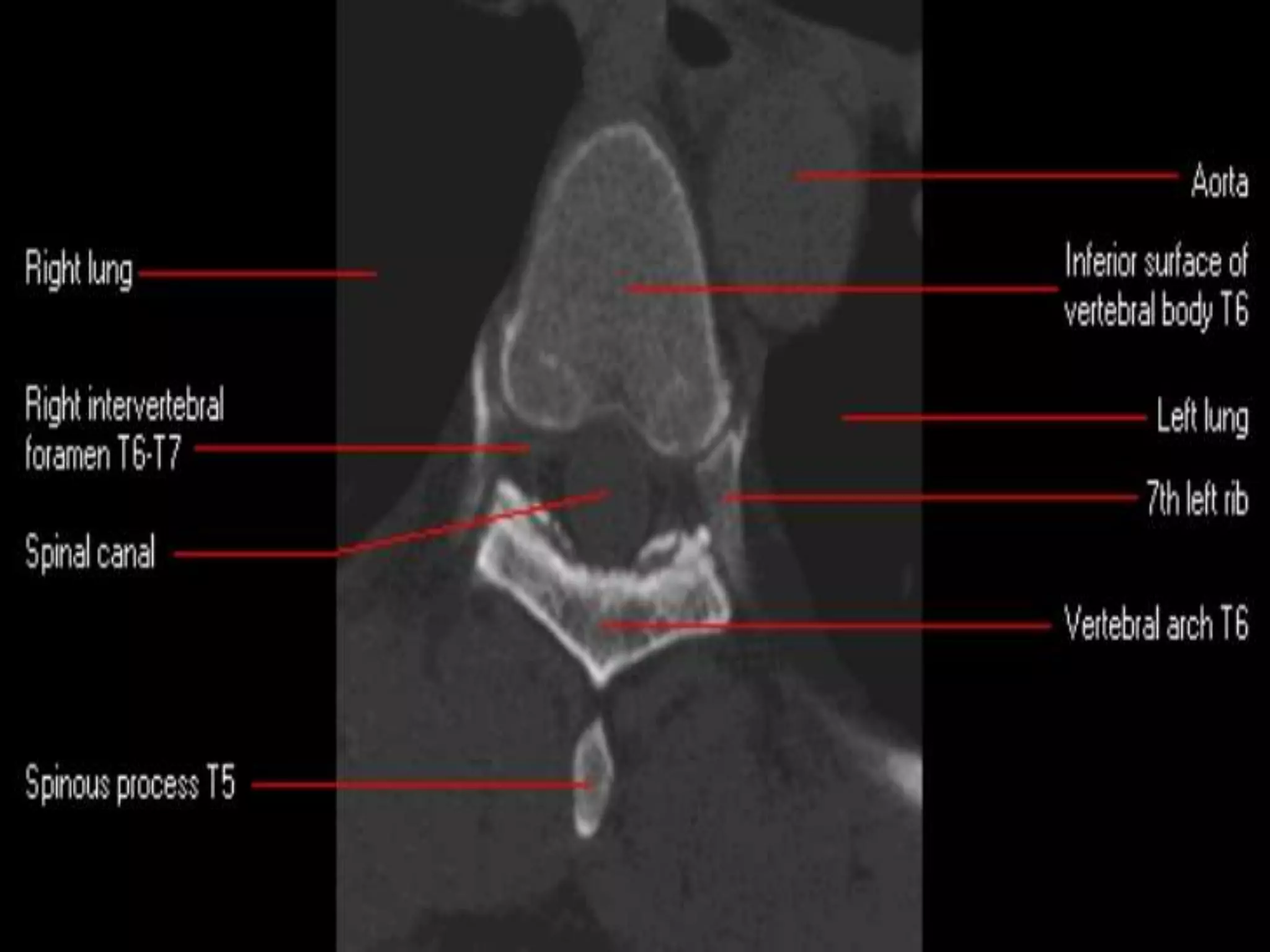
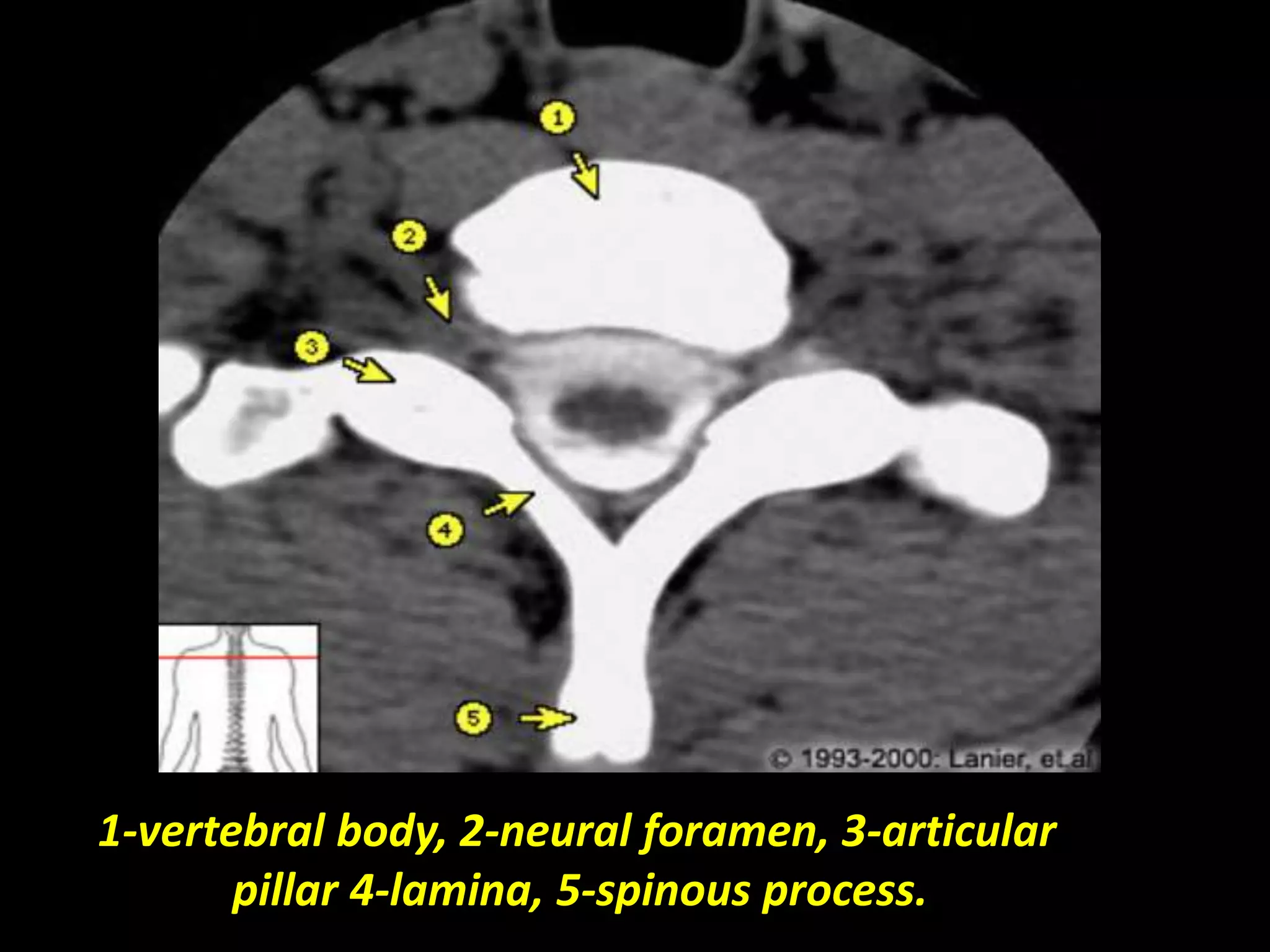
CT of the Thoracic Spine: Anatomy.
1-vertebral body, 2-neural foramen, 3-articular 
pillar 4-lamina, 5-spinous process.
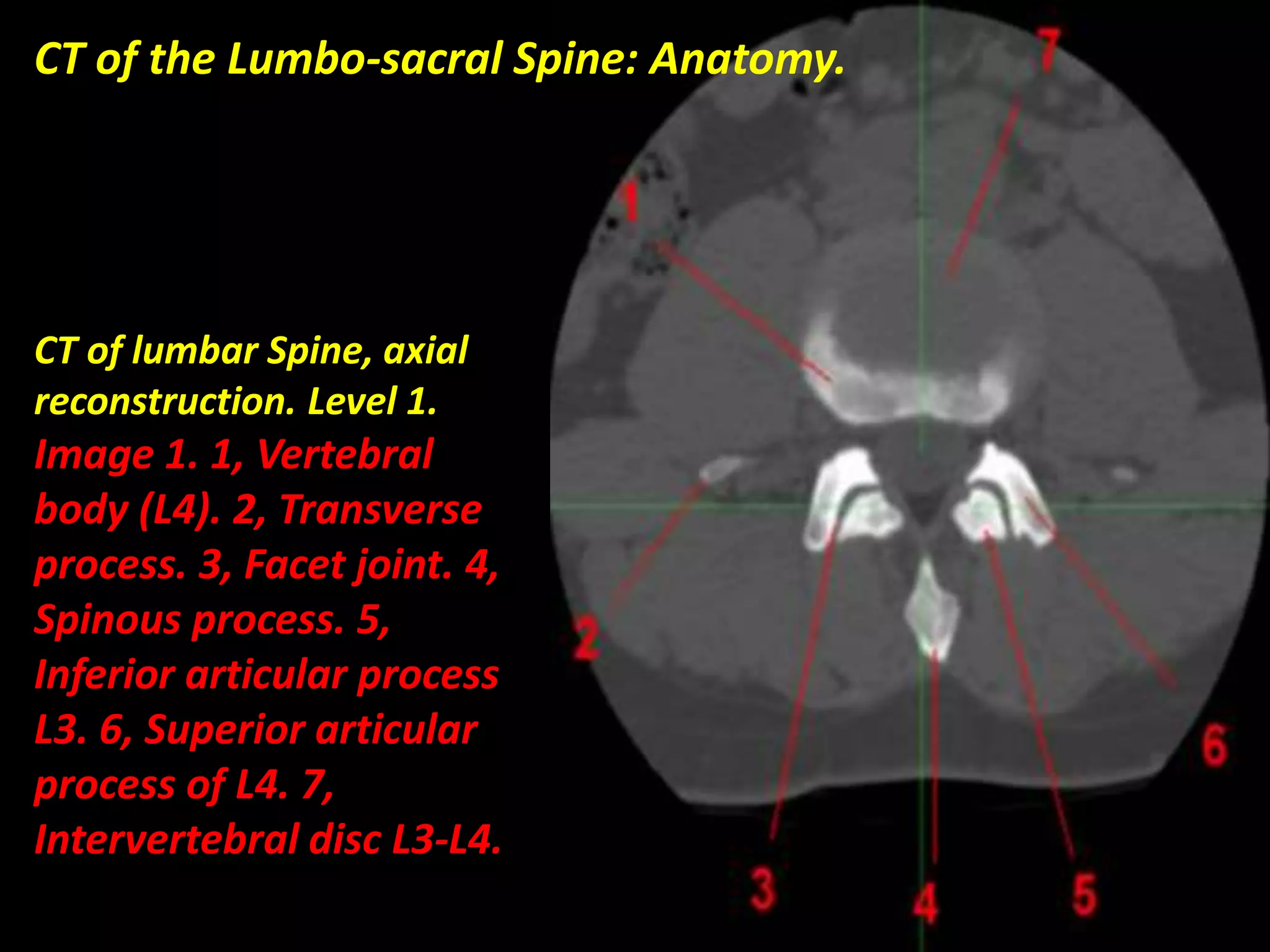
CT of the Lumbo-sacral Spine: Anatomy. 
CT of lumbar Spine, axial 
reconstruction. Level 1. 
Image 1. 1, Vertebral 
body (L4). 2, Transverse 
process. 3, Facet joint. 4, 
Spinous process. 5, 
Inferior articular process 
L3. 6, Superior articular 
process of L4. 7, 
Intervertebral disc L3-L4.
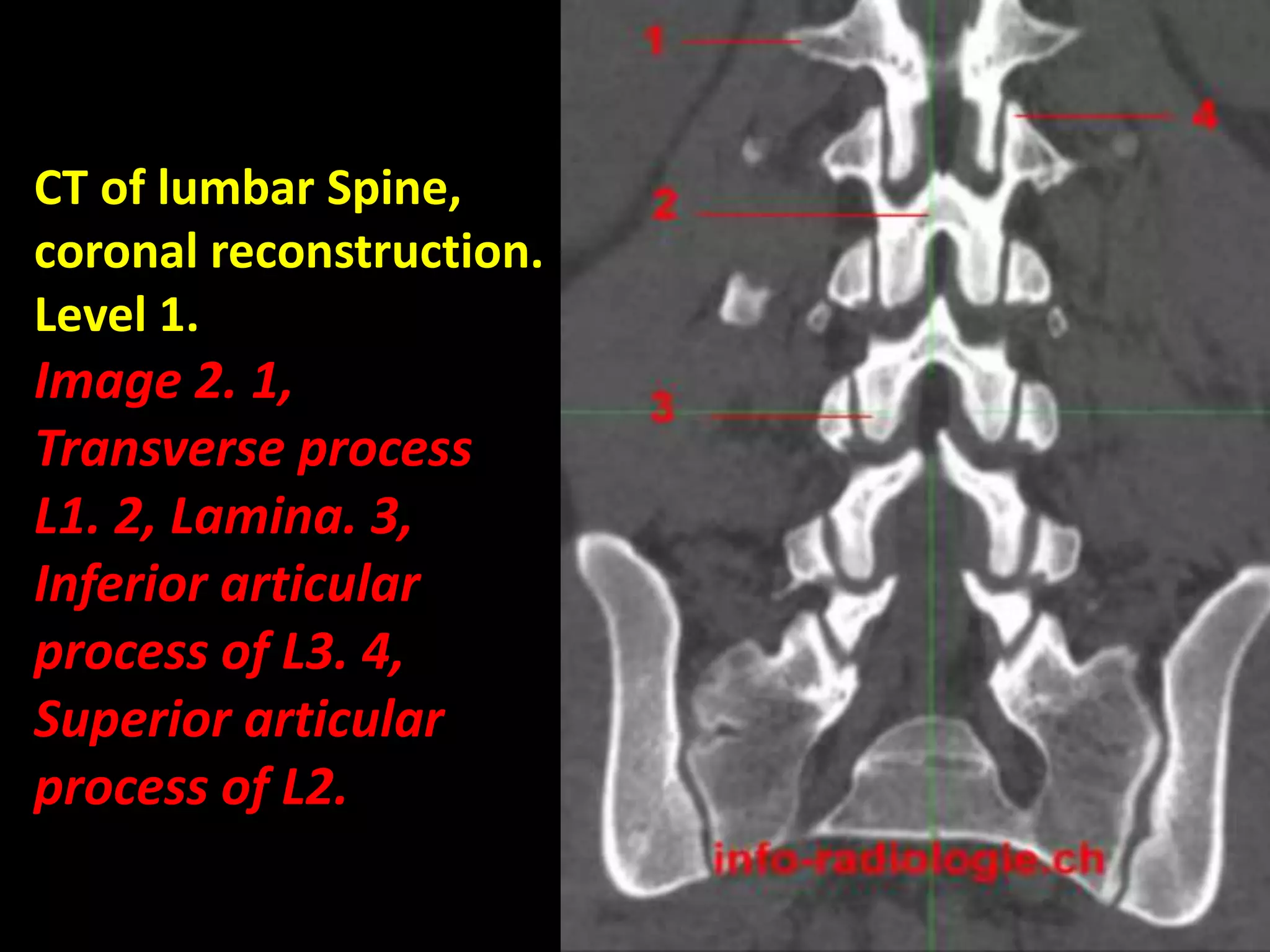
CT of lumbar Spine, 
coronal reconstruction. 
Level 1. 
Image 2. 1, 
Transverse process 
L1. 2, Lamina. 3, 
Inferior articular 
process of L3. 4, 
Superior articular 
process of L2.
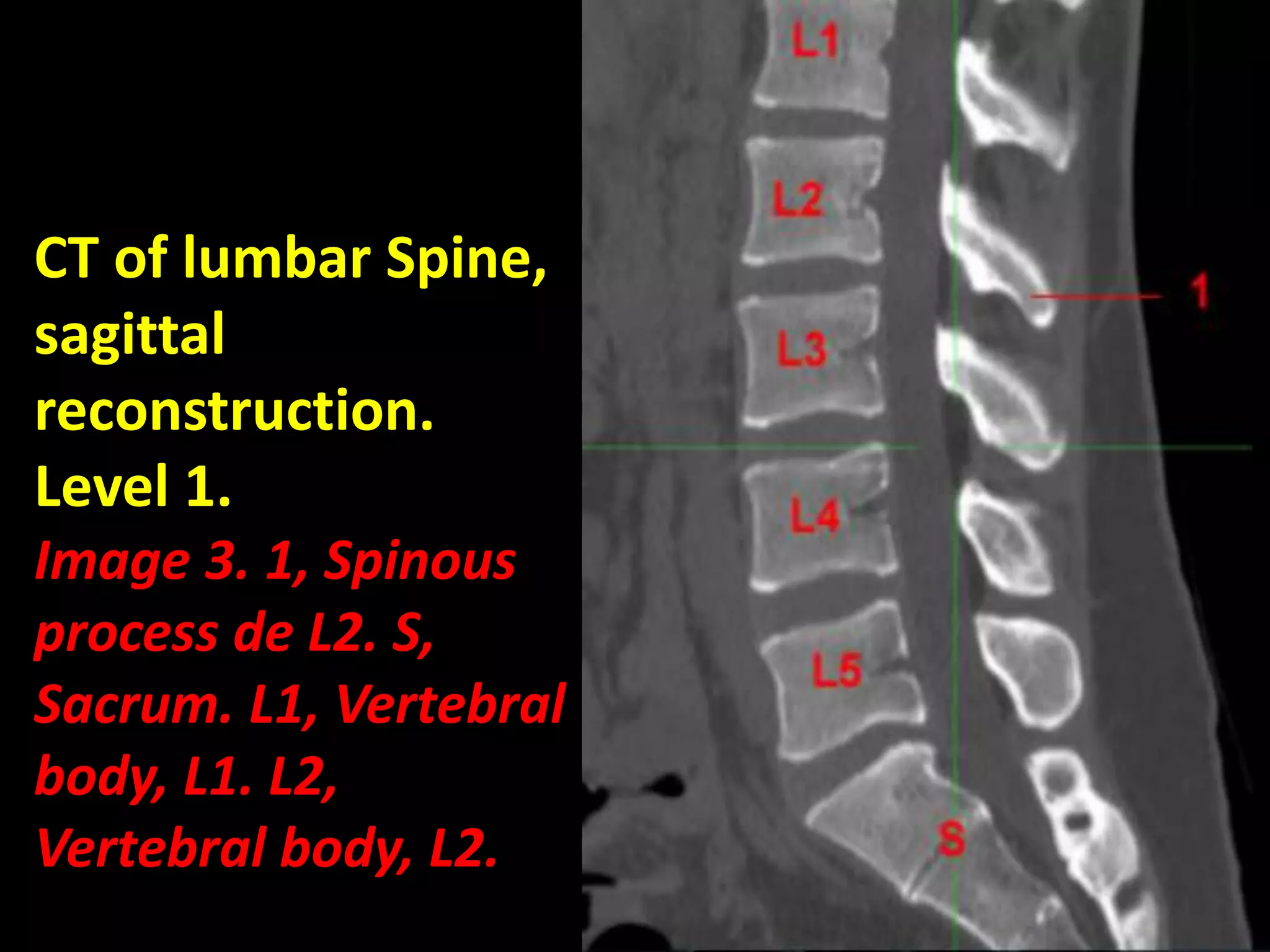
CT of lumbar Spine, 
sagittal 
reconstruction. 
Level 1. 
Image 3. 1, Spinous 
process de L2. S, 
Sacrum. L1, Vertebral 
body, L1. L2, 
Vertebral body, L2.
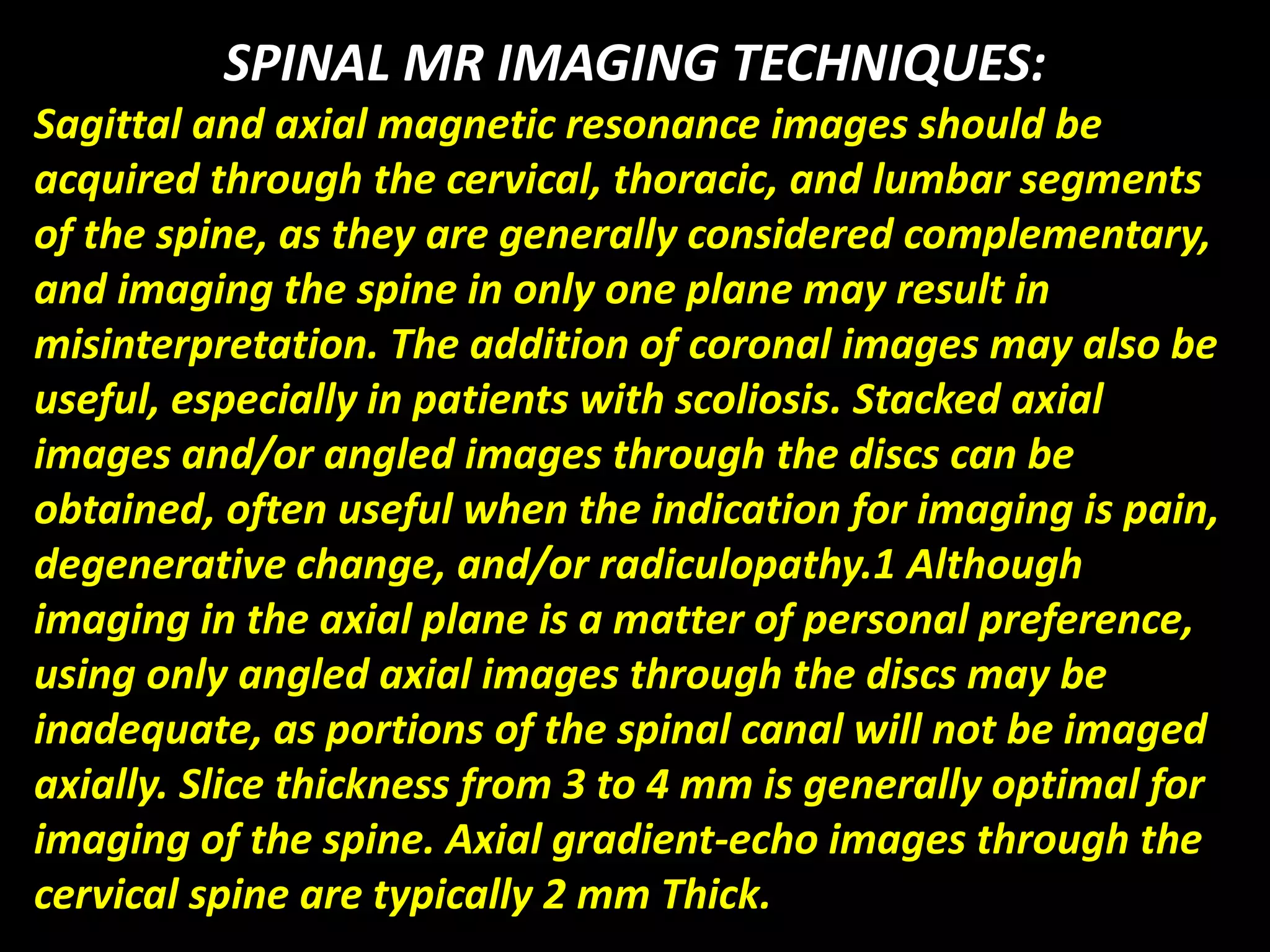
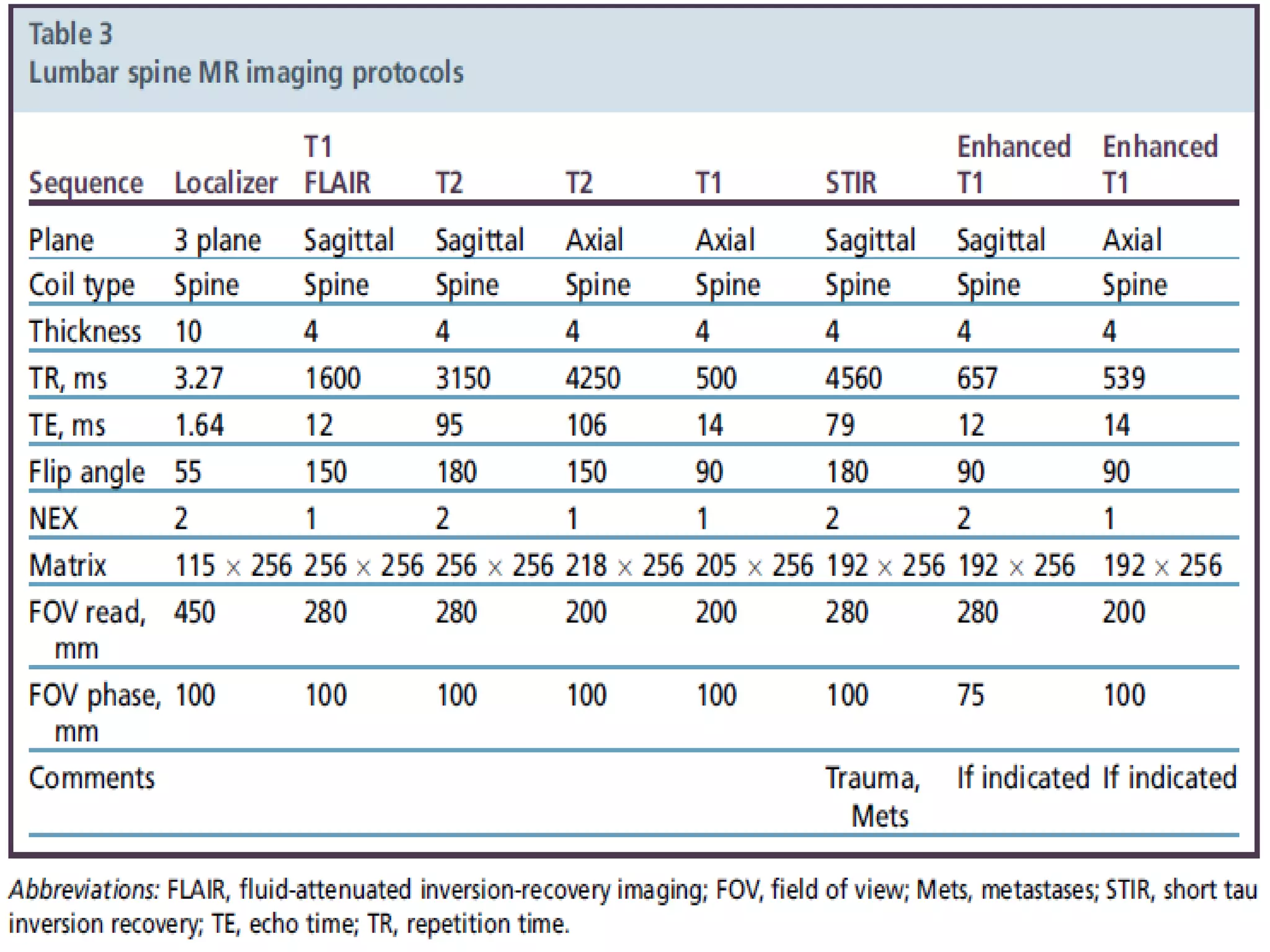
SPINAL MR IMAGING TECHNIQUES: 
Sagittal and axial magnetic resonance images should be 
acquired through the cervical, thoracic, and lumbar segments 
of the spine, as they are generally considered complementary, 
and imaging the spine in only one plane may result in 
misinterpretation. The addition of coronal images may also be 
useful, especially in patients with scoliosis. Stacked axial 
images and/or angled images through the discs can be 
obtained, often useful when the indication for imaging is pain, 
degenerative change, and/or radiculopathy.1 Although 
imaging in the axial plane is a matter of personal preference, 
using only angled axial images through the discs may be 
inadequate, as portions of the spinal canal will not be imaged 
axially. Slice thickness from 3 to 4 mm is generally optimal for 
imaging of the spine. Axial gradient-echo images through the 
cervical spine are typically 2 mm Thick.
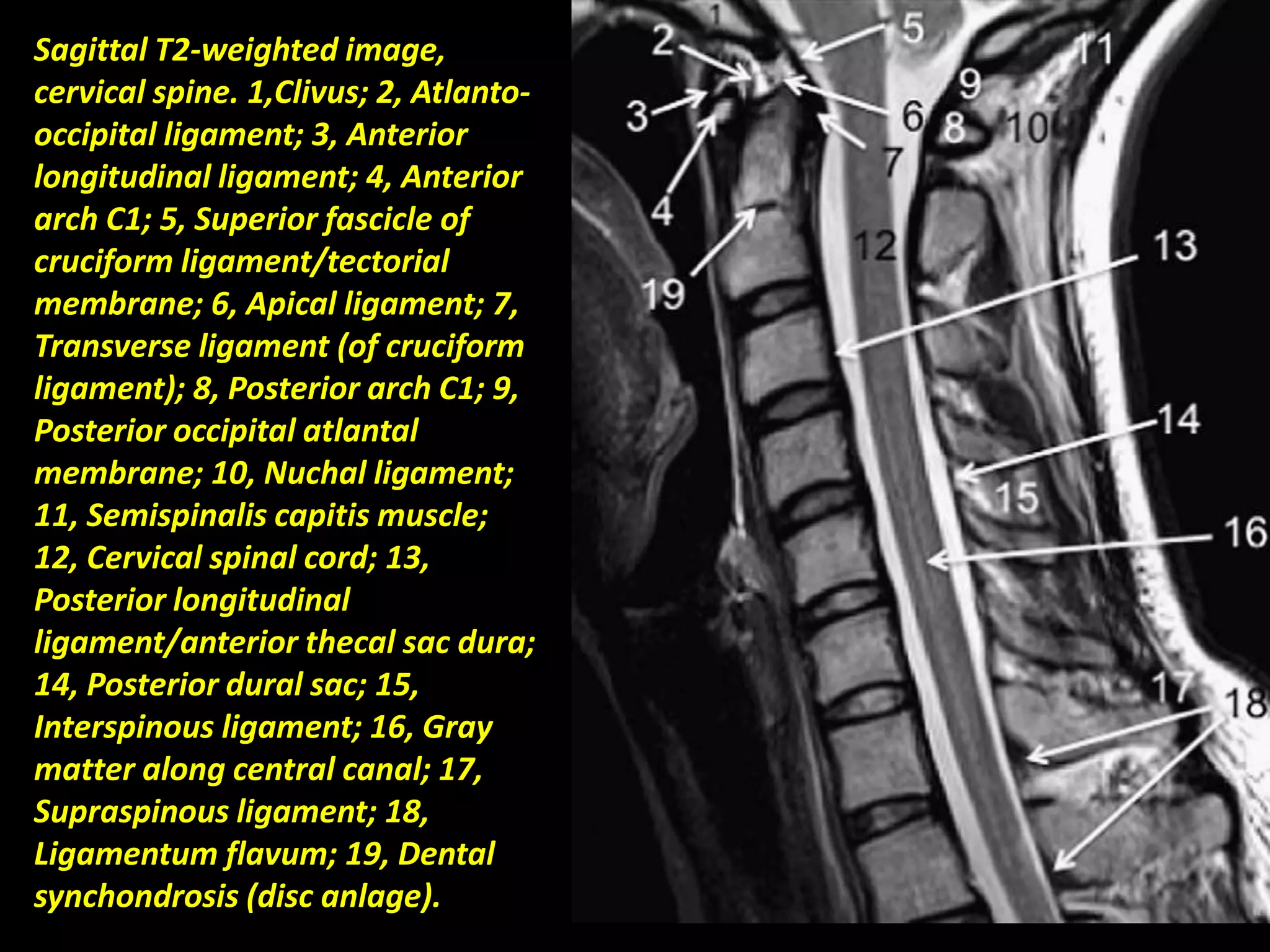
Sagittal T2-weighted image, 
cervical spine. 1,Clivus; 2, Atlanto-occipital 
ligament; 3, Anterior 
longitudinal ligament; 4, Anterior 
arch C1; 5, Superior fascicle of 
cruciform ligament/tectorial 
membrane; 6, Apical ligament; 7, 
Transverse ligament (of cruciform 
ligament); 8, Posterior arch C1; 9, 
Posterior occipital atlantal 
membrane; 10, Nuchal ligament; 
11, Semispinalis capitis muscle; 
12, Cervical spinal cord; 13, 
Posterior longitudinal 
ligament/anterior thecal sac dura; 
14, Posterior dural sac; 15, 
Interspinous ligament; 16, Gray 
matter along central canal; 17, 
Supraspinous ligament; 18, 
Ligamentum flavum; 19, Dental 
synchondrosis (disc anlage).
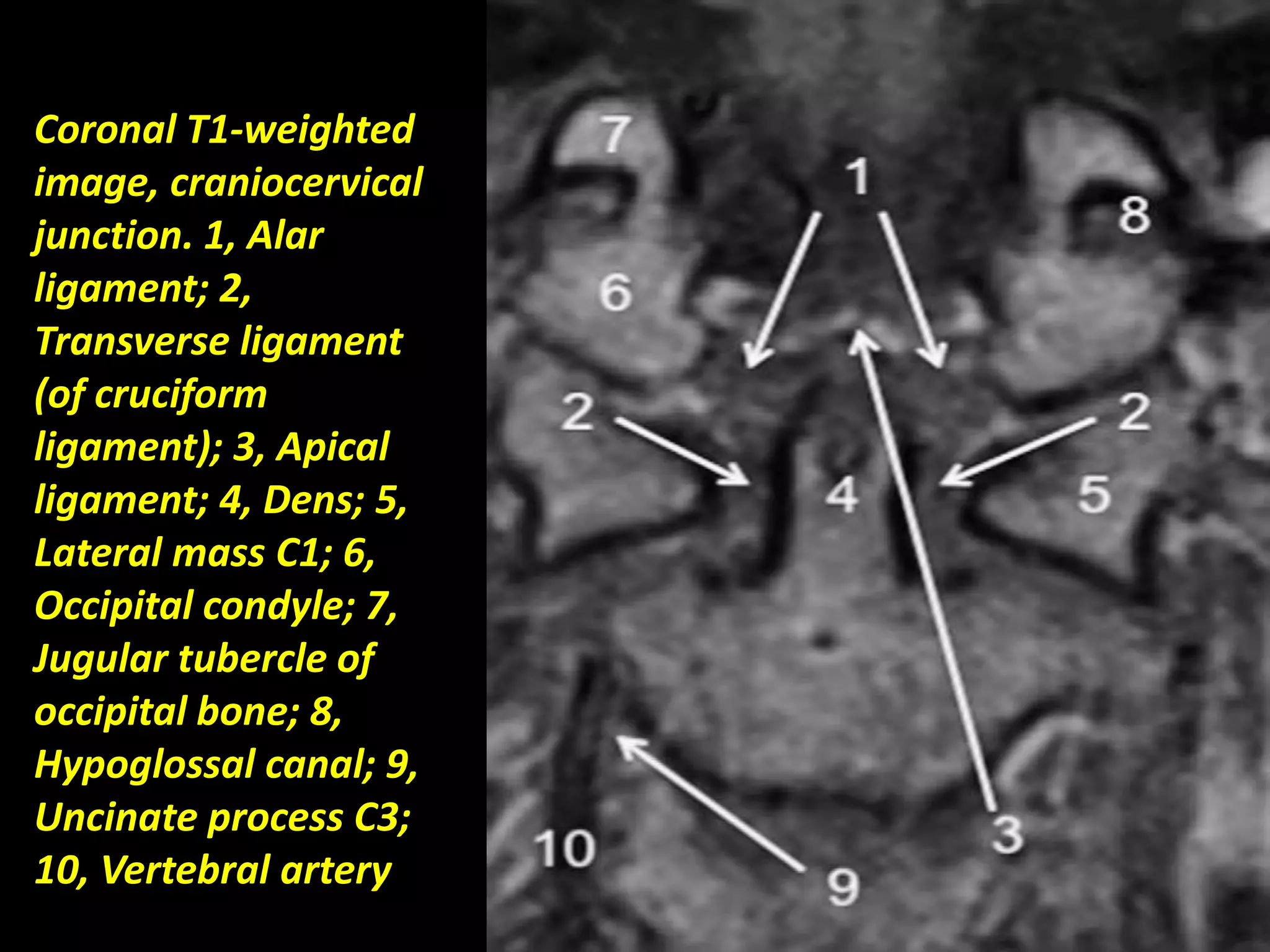
Coronal T1-weighted 
image, craniocervical 
junction. 1, Alar 
ligament; 2, 
Transverse ligament 
(of cruciform 
ligament); 3, Apical 
ligament; 4, Dens; 5, 
Lateral mass C1; 6, 
Occipital condyle; 7, 
Jugular tubercle of 
occipital bone; 8, 
Hypoglossal canal; 9, 
Uncinate process C3; 
10, Vertebral artery.
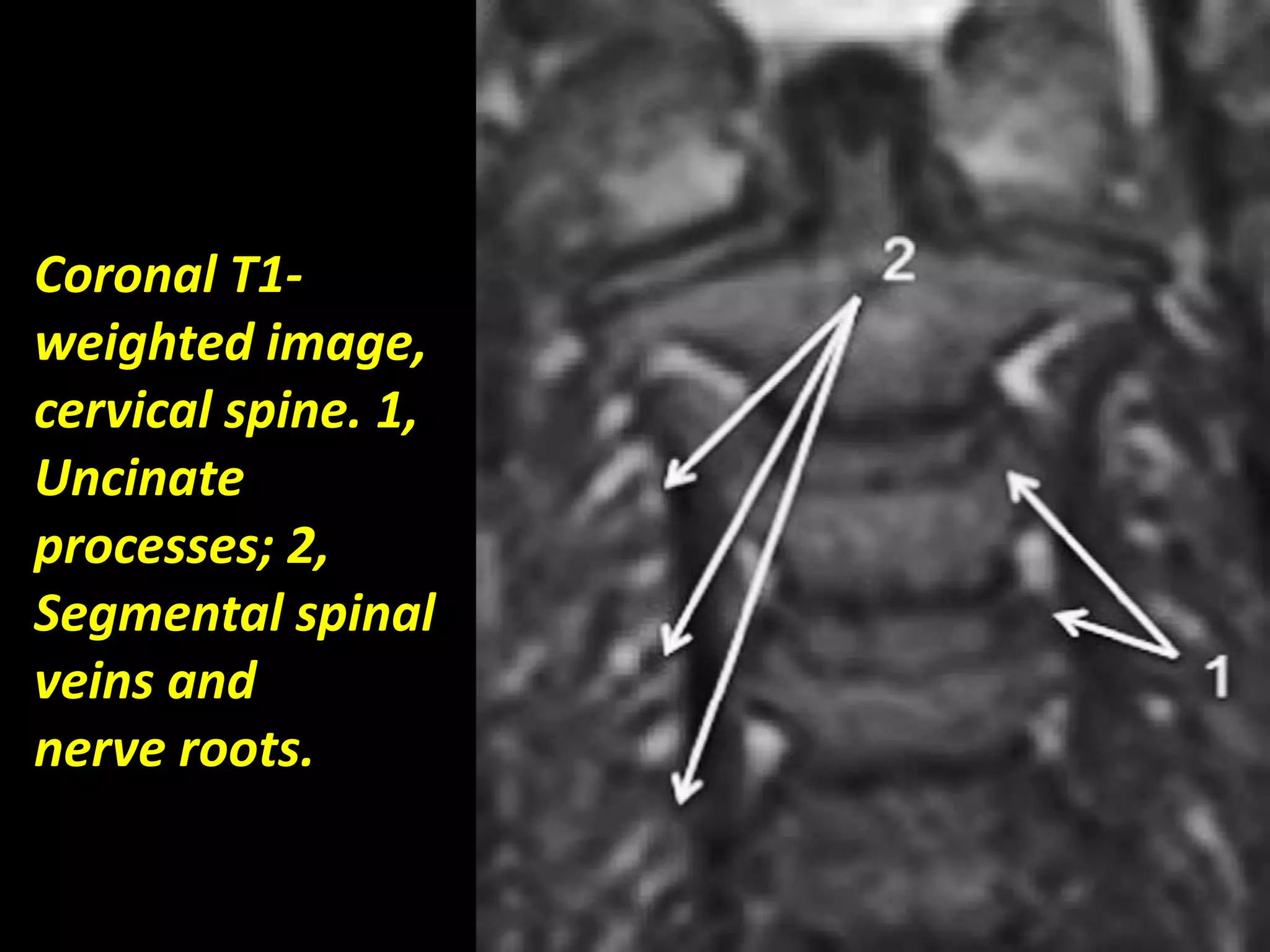
Coronal T1- 
weighted image, 
cervical spine. 1, 
Uncinate 
processes; 2, 
Segmental spinal 
veins and 
nerve roots.
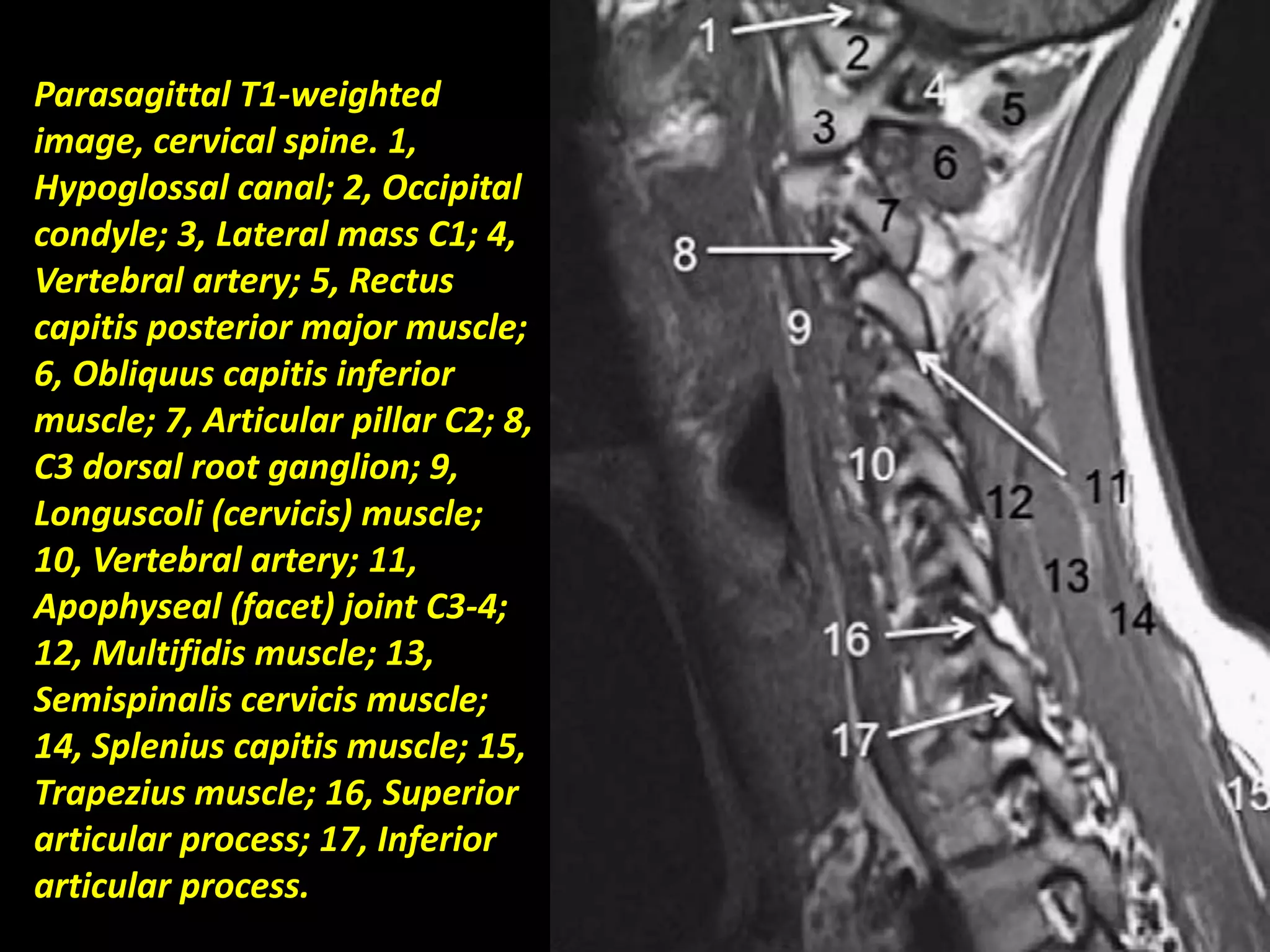
Parasagittal T1-weighted 
image, cervical spine. 1, 
Hypoglossal canal; 2, Occipital 
condyle; 3, Lateral mass C1; 4, 
Vertebral artery; 5, Rectus 
capitis posterior major muscle; 
6, Obliquus capitis inferior 
muscle; 7, Articular pillar C2; 8, 
C3 dorsal root ganglion; 9, 
Longuscoli (cervicis) muscle; 
10, Vertebral artery; 11, 
Apophyseal (facet) joint C3-4; 
12, Multifidis muscle; 13, 
Semispinalis cervicis muscle; 
14, Splenius capitis muscle; 15, 
Trapezius muscle; 16, Superior 
articular process; 17, Inferior 
articular process.
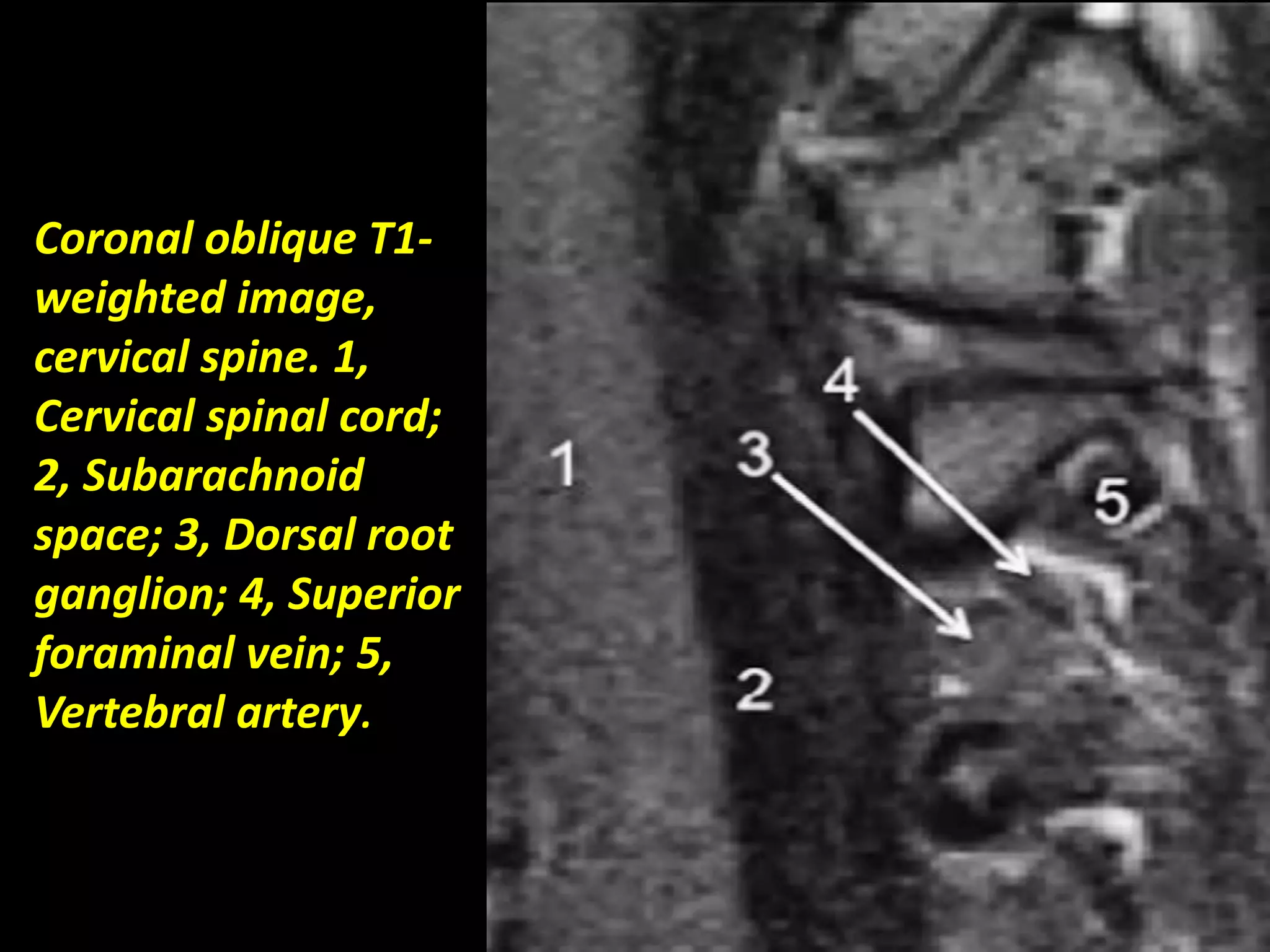
Coronal oblique T1- 
weighted image, 
cervical spine. 1, 
Cervical spinal cord; 
2, Subarachnoid 
space; 3, Dorsal root 
ganglion; 4, Superior 
foraminal vein; 5, 
Vertebral artery.
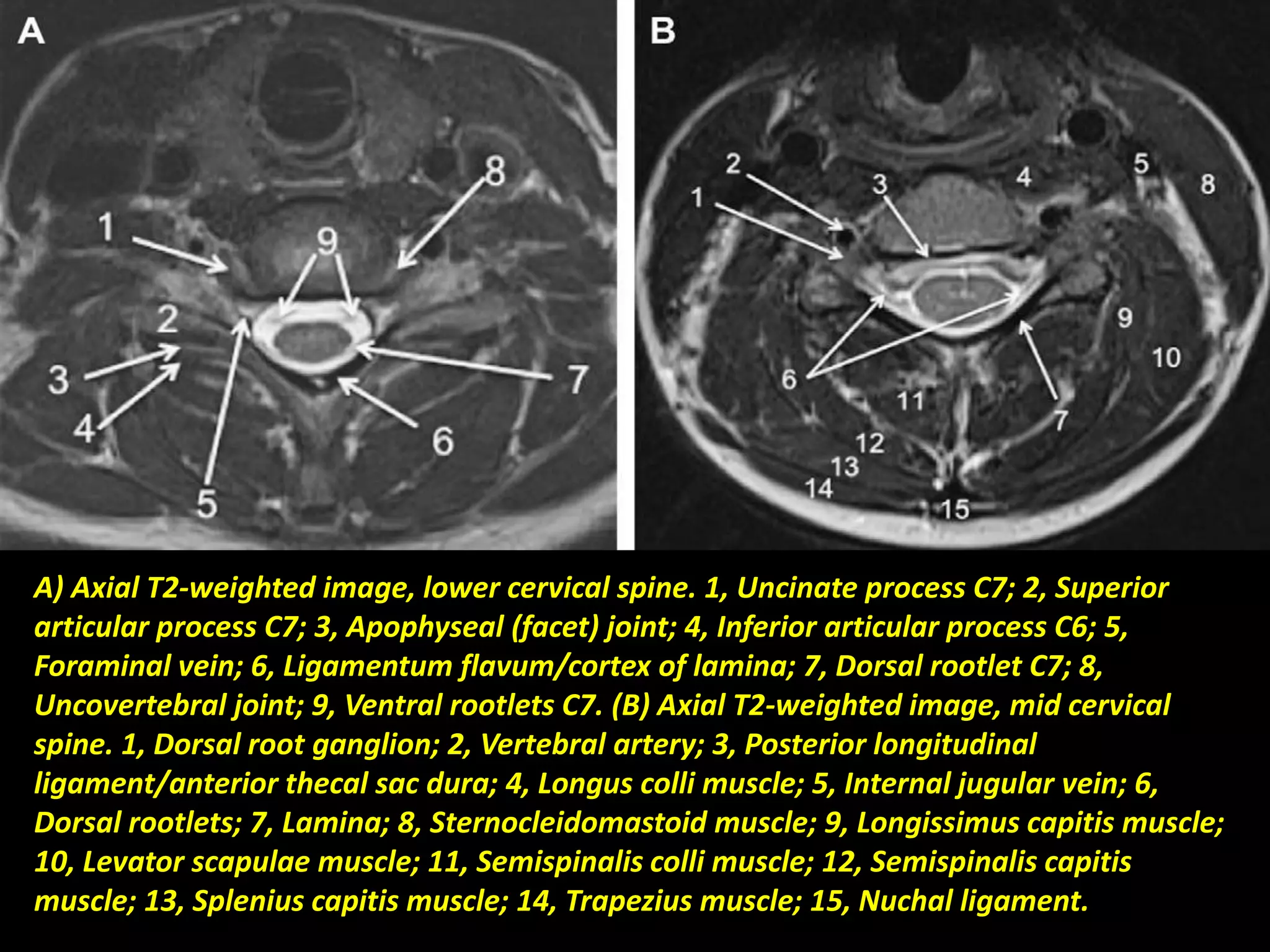
A) Axial T2-weighted image, lower cervical spine. 1, Uncinate process C7; 2, Superior 
articular process C7; 3, Apophyseal (facet) joint; 4, Inferior articular process C6; 5, 
Foraminal vein; 6, Ligamentum flavum/cortex of lamina; 7, Dorsal rootlet C7; 8, 
Uncovertebral joint; 9, Ventral rootlets C7. (B) Axial T2-weighted image, mid cervical 
spine. 1, Dorsal root ganglion; 2, Vertebral artery; 3, Posterior longitudinal 
ligament/anterior thecal sac dura; 4, Longus colli muscle; 5, Internal jugular vein; 6, 
Dorsal rootlets; 7, Lamina; 8, Sternocleidomastoid muscle; 9, Longissimus capitis muscle; 
10, Levator scapulae muscle; 11, Semispinalis colli muscle; 12, Semispinalis capitis 
muscle; 13, Splenius capitis muscle; 14, Trapezius muscle; 15, Nuchal ligament.
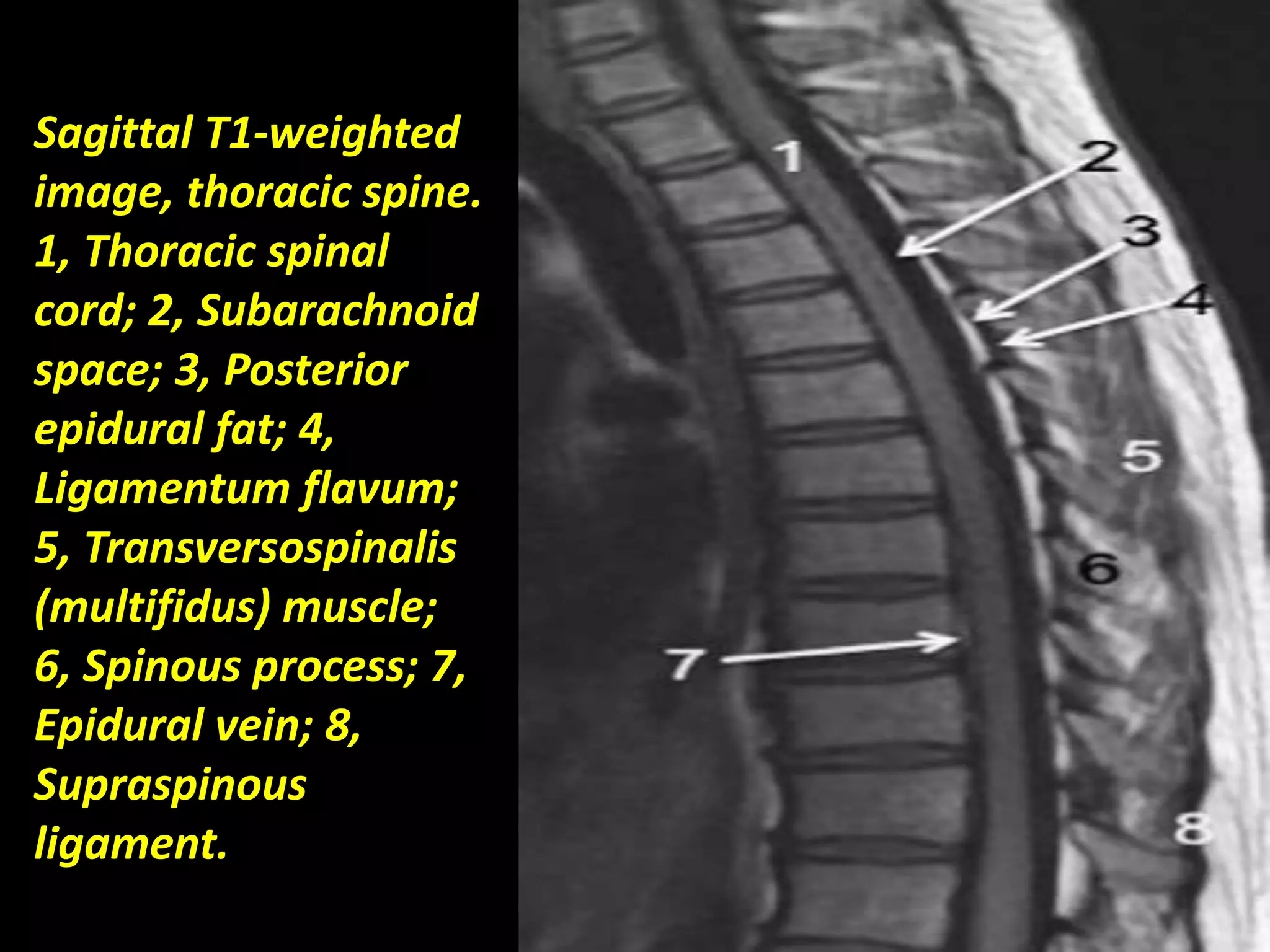
Sagittal T1-weighted 
image, thoracic spine. 
1, Thoracic spinal 
cord; 2, Subarachnoid 
space; 3, Posterior 
epidural fat; 4, 
Ligamentum flavum; 
5, Transversospinalis 
(multifidus) muscle; 
6, Spinous process; 7, 
Epidural vein; 8, 
Supraspinous 
ligament..
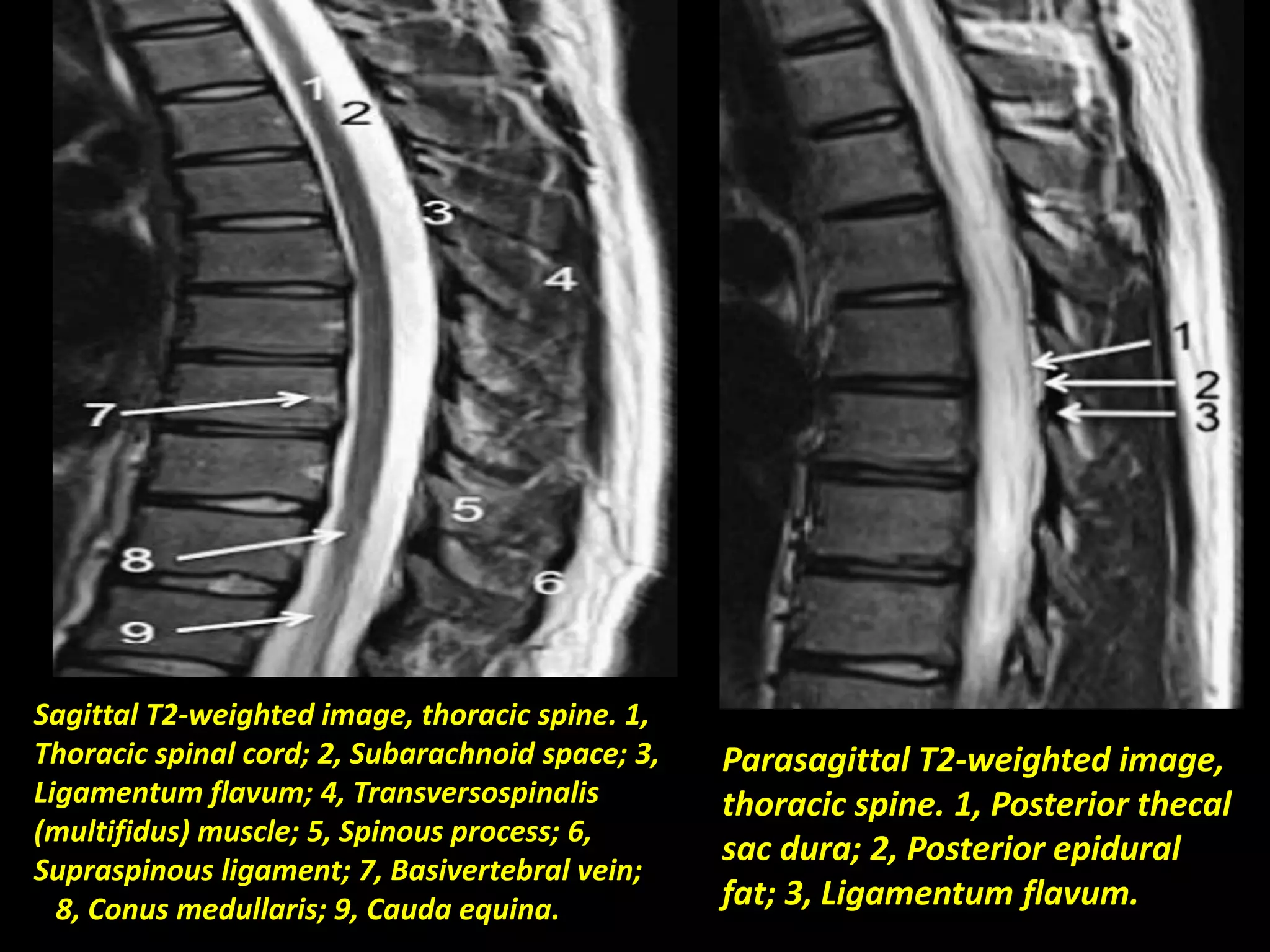
Parasagittal T2-weighted image, 
thoracic spine. 1, Posterior thecal 
sac dura; 2, Posterior epidural 
fat; 3, Ligamentum flavum. 
Sagittal T2-weighted image, thoracic spine. 1, 
Thoracic spinal cord; 2, Subarachnoid space; 3, 
Ligamentum flavum; 4, Transversospinalis 
(multifidus) muscle; 5, Spinous process; 6, 
Supraspinous ligament; 7, Basivertebral vein; 
8, Conus medullaris; 9, Cauda equina.
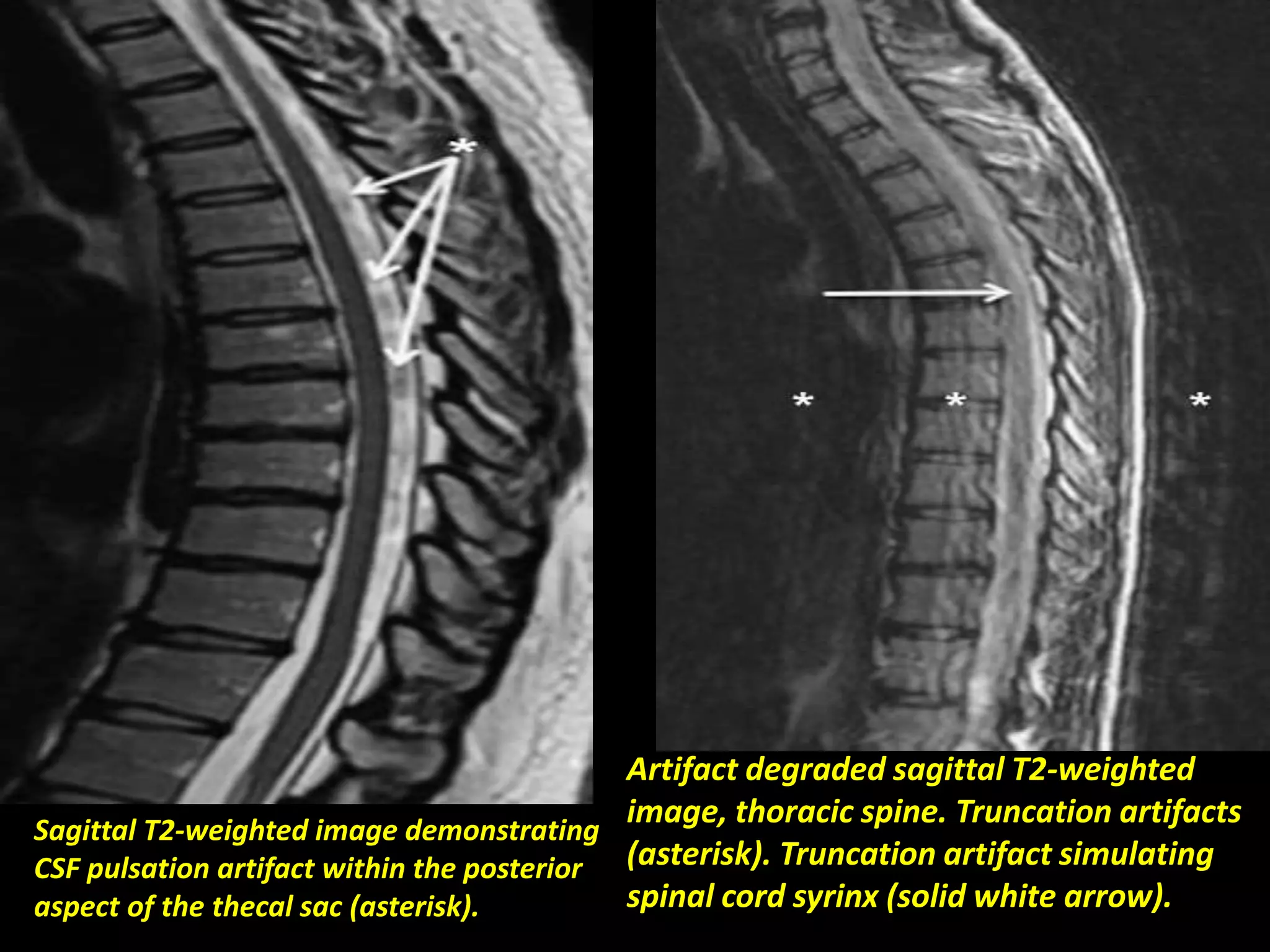
Sagittal T2-weighted image demonstrating 
CSF pulsation artifact within the posterior 
aspect of the thecal sac (asterisk). 
Artifact degraded sagittal T2-weighted 
image, thoracic spine. Truncation artifacts 
(asterisk). Truncation artifact simulating 
spinal cord syrinx (solid white arrow).
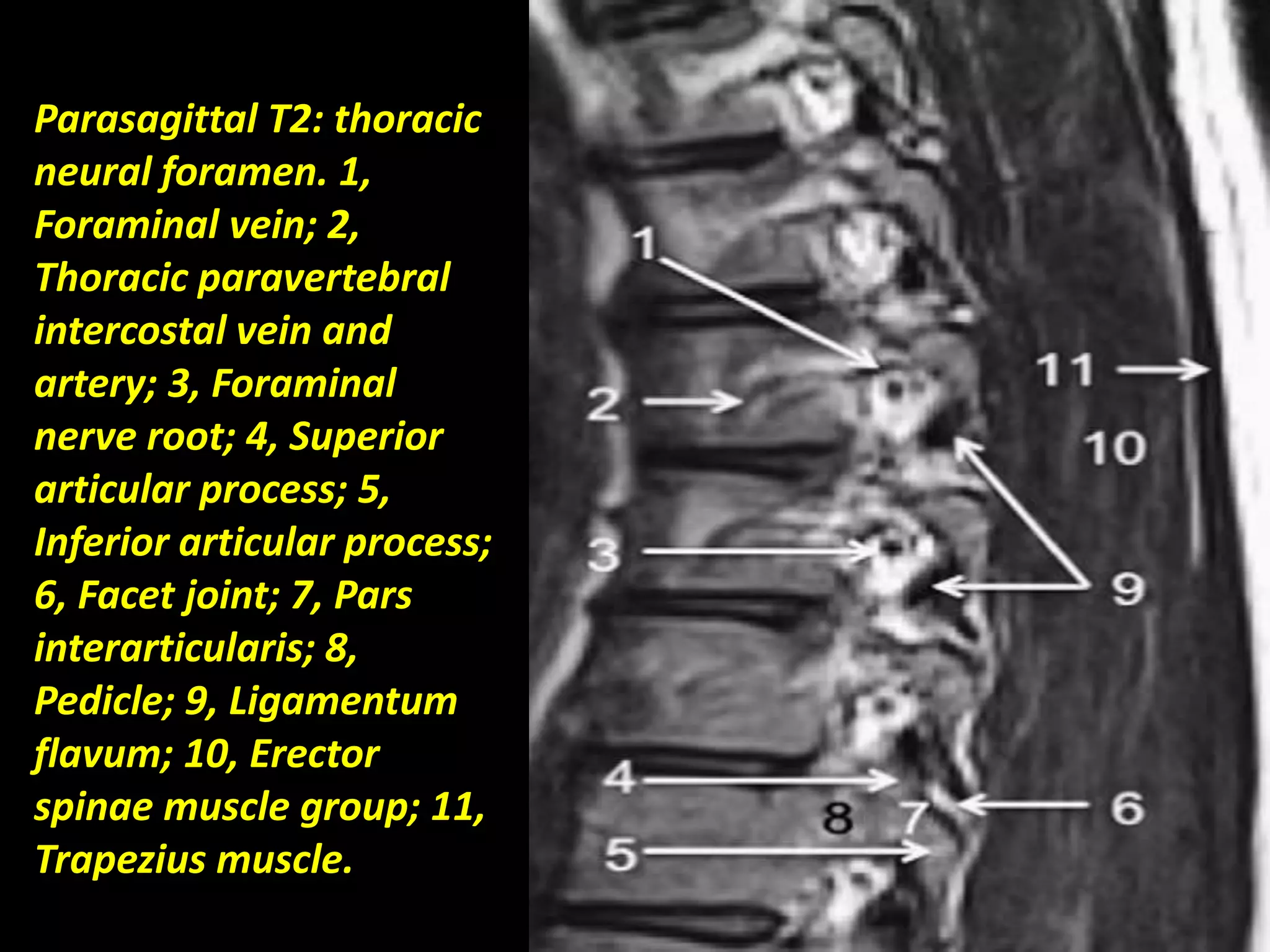
Parasagittal T2: thoracic 
neural foramen. 1, 
Foraminal vein; 2, 
Thoracic paravertebral 
intercostal vein and 
artery; 3, Foraminal 
nerve root; 4, Superior 
articular process; 5, 
Inferior articular process; 
6, Facet joint; 7, Pars 
interarticularis; 8, 
Pedicle; 9, Ligamentum 
flavum; 10, Erector 
spinae muscle group; 11, 
Trapezius muscle.
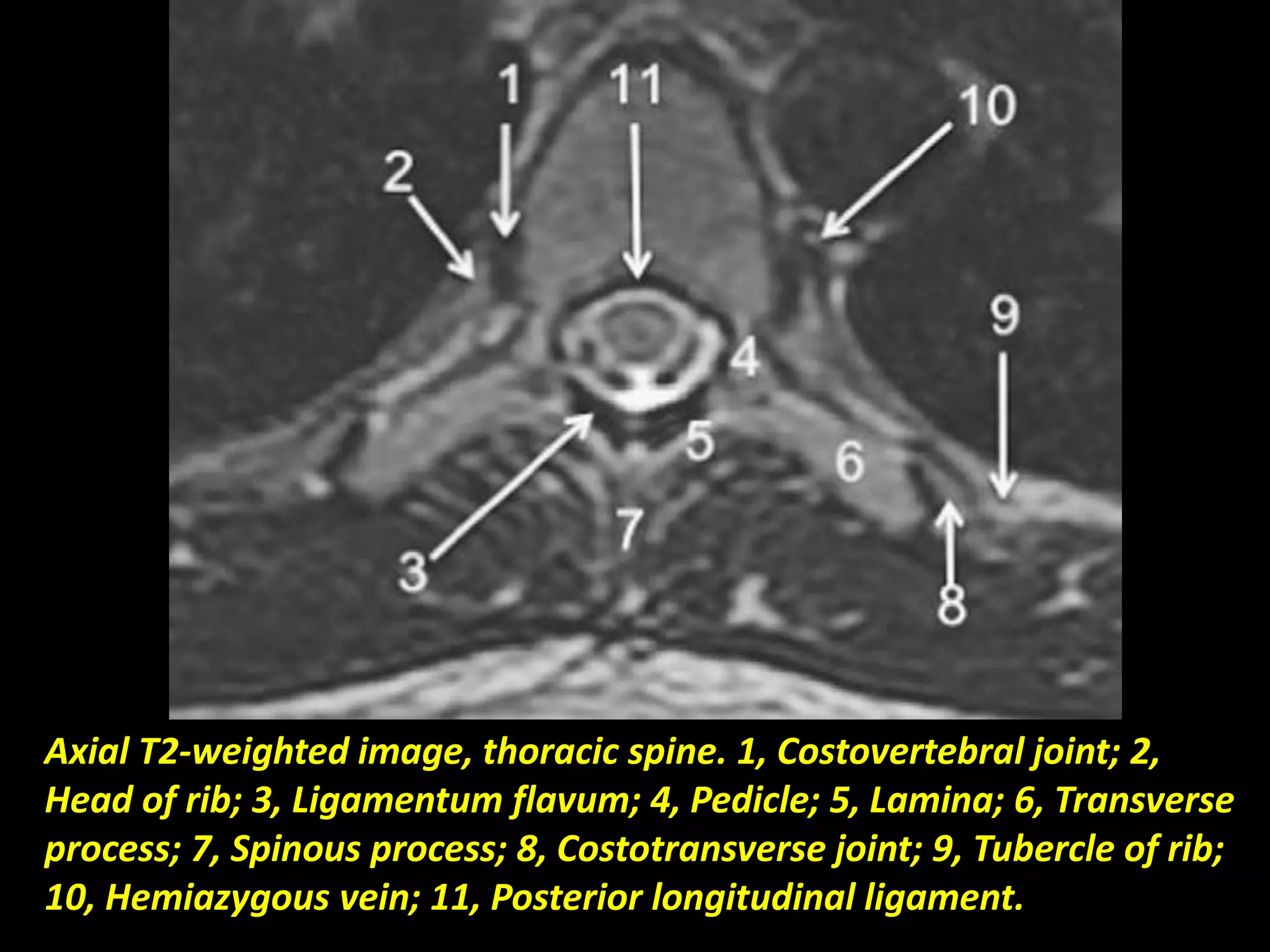
Axial T2-weighted image, thoracic spine. 1, Costovertebral joint; 2, 
Head of rib; 3, Ligamentum flavum; 4, Pedicle; 5, Lamina; 6, Transverse 
process; 7, Spinous process; 8, Costotransverse joint; 9, Tubercle of rib; 
10, Hemiazygous vein; 11, Posterior longitudinal ligament.
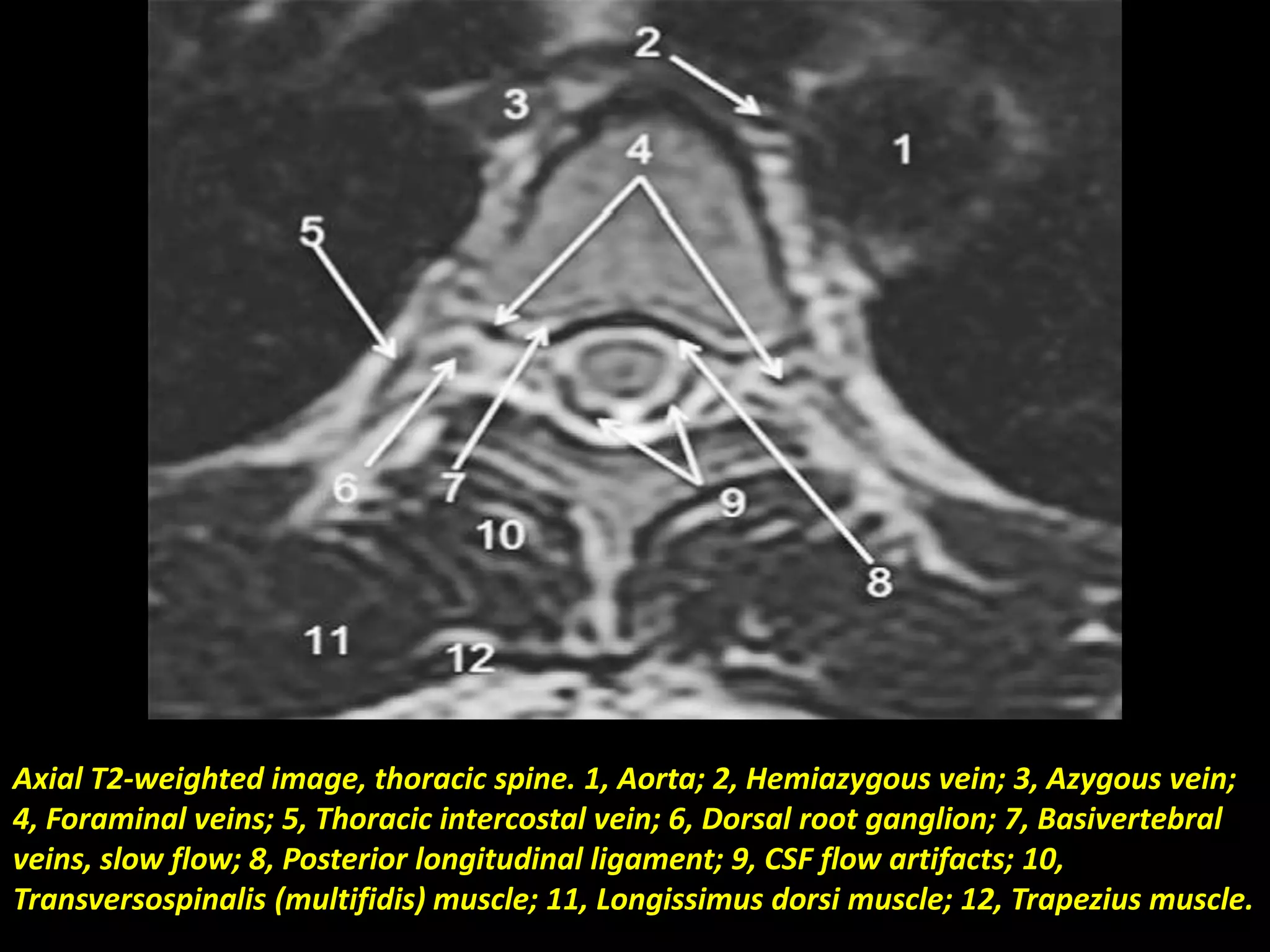
Axial T2-weighted image, thoracic spine. 1, Aorta; 2, Hemiazygous vein; 3, Azygous vein; 
4, Foraminal veins; 5, Thoracic intercostal vein; 6, Dorsal root ganglion; 7, Basivertebral 
veins, slow flow; 8, Posterior longitudinal ligament; 9, CSF flow artifacts; 10, 
Transversospinalis (multifidis) muscle; 11, Longissimus dorsi muscle; 12, Trapezius muscle.
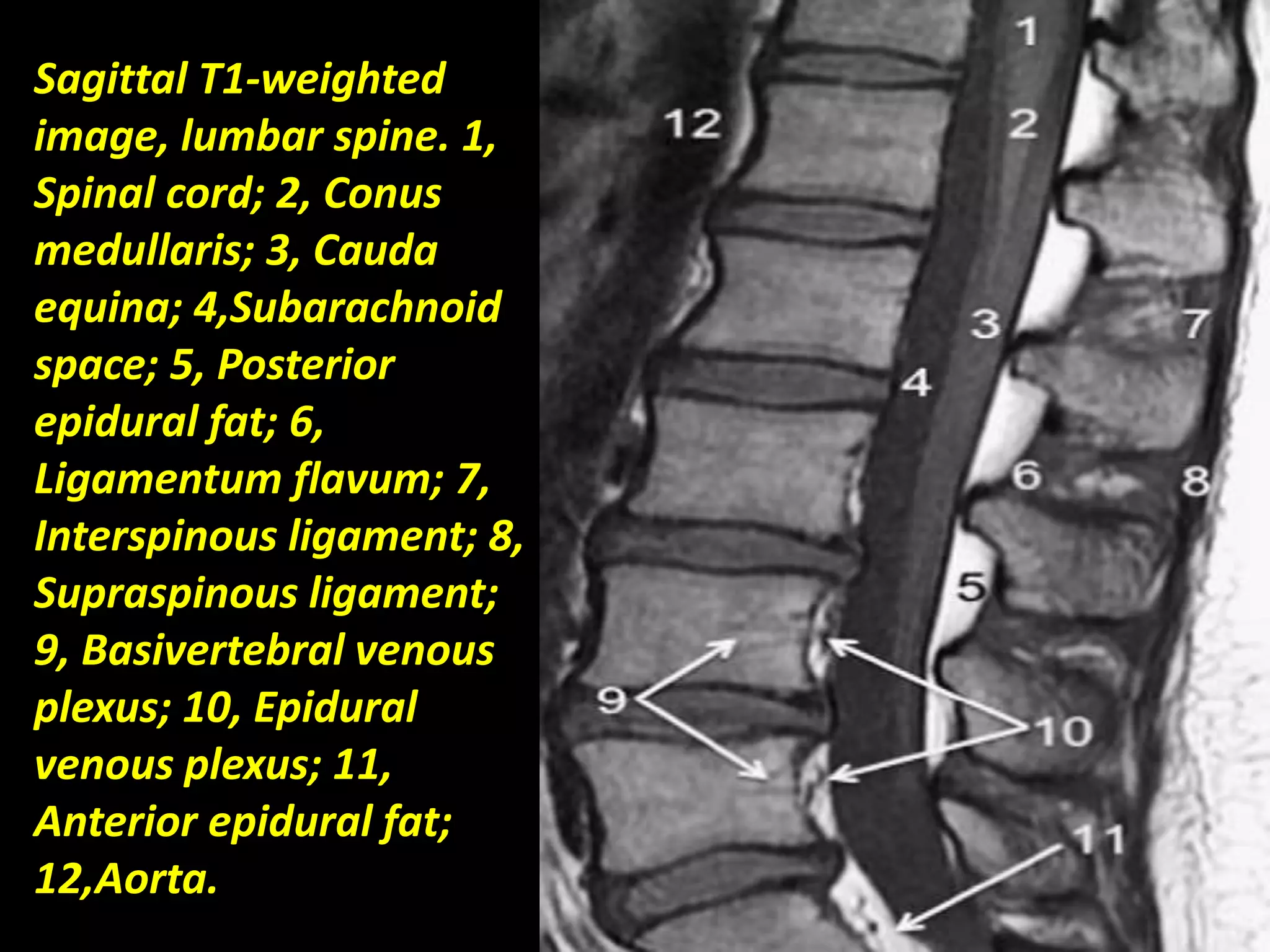
Sagittal T1-weighted 
image, lumbar spine. 1, 
Spinal cord; 2, Conus 
medullaris; 3, Cauda 
equina; 4,Subarachnoid 
space; 5, Posterior 
epidural fat; 6, 
Ligamentum flavum; 7, 
Interspinous ligament; 8, 
Supraspinous ligament; 
9, Basivertebral venous 
plexus; 10, Epidural 
venous plexus; 11, 
Anterior epidural fat; 
12,Aorta.
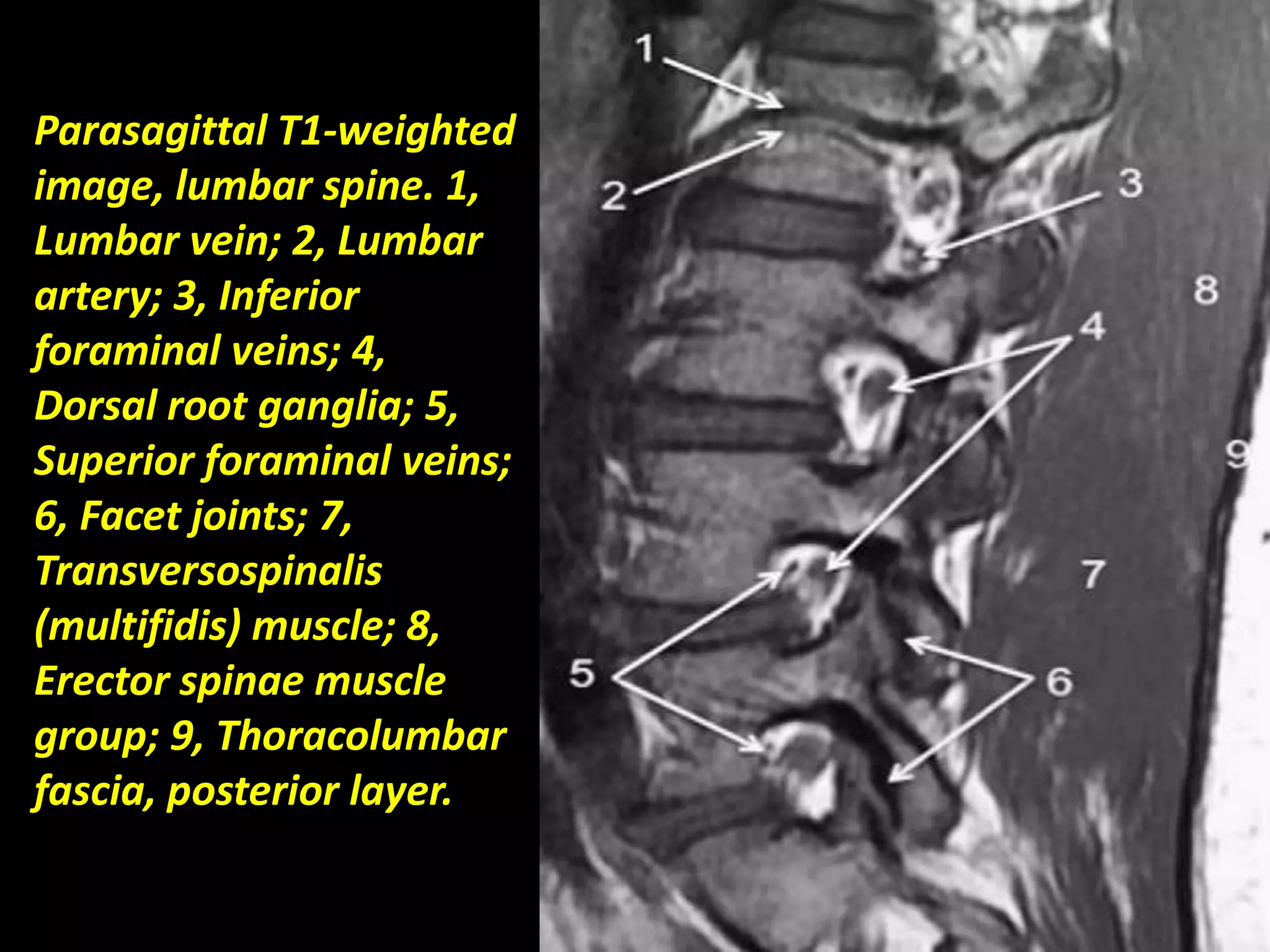
Parasagittal T1-weighted 
image, lumbar spine. 1, 
Lumbar vein; 2, Lumbar 
artery; 3, Inferior 
foraminal veins; 4, 
Dorsal root ganglia; 5, 
Superior foraminal veins; 
6, Facet joints; 7, 
Transversospinalis 
(multifidis) muscle; 8, 
Erector spinae muscle 
group; 9, Thoracolumbar 
fascia, posterior layer.
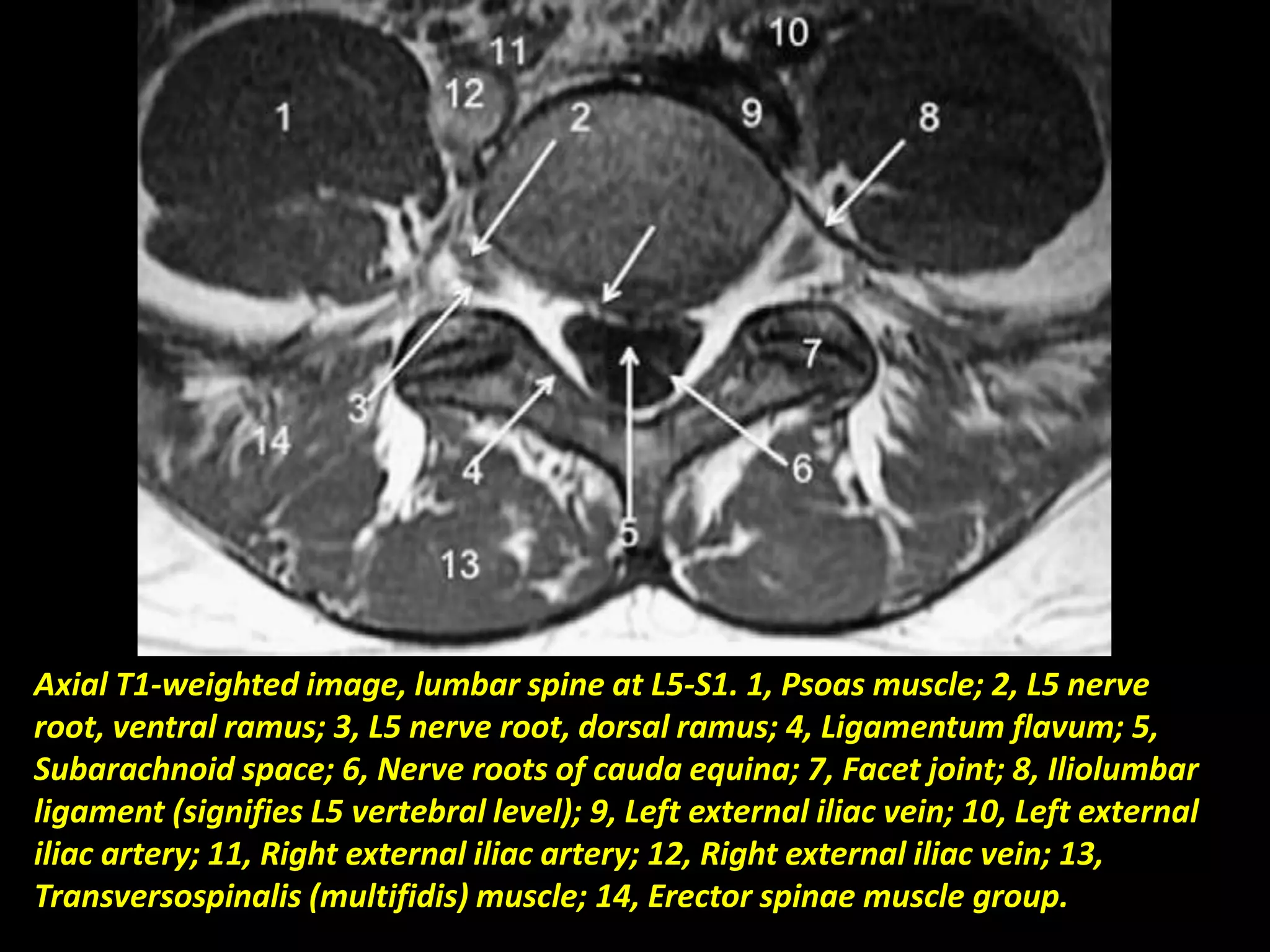
Axial T1-weighted image, lumbar spine at L5-S1. 1, Psoas muscle; 2, L5 nerve 
root, ventral ramus; 3, L5 nerve root, dorsal ramus; 4, Ligamentum flavum; 5, 
Subarachnoid space; 6, Nerve roots of cauda equina; 7, Facet joint; 8, Iliolumbar 
ligament (signifies L5 vertebral level); 9, Left external iliac vein; 10, Left external 
iliac artery; 11, Right external iliac artery; 12, Right external iliac vein; 13, 
Transversospinalis (multifidis) muscle; 14, Erector spinae muscle group.
Thank You.

Presentation1.pptx, normal spinal anatomy.

  • 1.
    Radiological anatomy ofthe spine: Dr/ ABD ALLAH NAZEER. MD.
  • 6.
    C-spine normal anatomy- Open mouth view.
  • 8.
    Normal AP andLateral Views.
  • 11.
    Thoracic Spine -AP & Lateral View.
  • 13.
  • 15.
  • 16.
  • 17.
    CT of theCervical Spine: Anatomy. CT of the Cervical Spine, axial reconstruction. Level 1. Image 1. 1,Intervertebral disc C3-C4. 2, Vertebral body (C3). 3, Uncinate process C4. 4, Transverse process of C4. 5, Lamina. 6, Superior articular process of C4.
  • 18.
    CT of theCervical Spine, coronal reconstruction. Level 1. Image 2.Arrow, Atlantooccipital joint. 1, Transverse process of C4 (right side). 2, Uncinate process C4.
  • 19.
    CT of theCervical Spine, sagittal reconstruction. Level 1. Image 3 1, Anterior arch of l‘ atlas (C1). 2, Intervertebral space (disc) C3-C4. 3, Vertebral foramen. 4, Spinous process of C2. 5, Posterior arch of C1. 6, Vertebral body C5.
  • 20.
    CT of theThoracic Spine: Anatomy.
  • 22.
    1-vertebral body, 2-neuralforamen, 3-articular pillar 4-lamina, 5-spinous process.
  • 23.
    CT of theLumbo-sacral Spine: Anatomy. CT of lumbar Spine, axial reconstruction. Level 1. Image 1. 1, Vertebral body (L4). 2, Transverse process. 3, Facet joint. 4, Spinous process. 5, Inferior articular process L3. 6, Superior articular process of L4. 7, Intervertebral disc L3-L4.
  • 24.
    CT of lumbarSpine, coronal reconstruction. Level 1. Image 2. 1, Transverse process L1. 2, Lamina. 3, Inferior articular process of L3. 4, Superior articular process of L2.
  • 25.
    CT of lumbarSpine, sagittal reconstruction. Level 1. Image 3. 1, Spinous process de L2. S, Sacrum. L1, Vertebral body, L1. L2, Vertebral body, L2.
  • 26.
    SPINAL MR IMAGINGTECHNIQUES: Sagittal and axial magnetic resonance images should be acquired through the cervical, thoracic, and lumbar segments of the spine, as they are generally considered complementary, and imaging the spine in only one plane may result in misinterpretation. The addition of coronal images may also be useful, especially in patients with scoliosis. Stacked axial images and/or angled images through the discs can be obtained, often useful when the indication for imaging is pain, degenerative change, and/or radiculopathy.1 Although imaging in the axial plane is a matter of personal preference, using only angled axial images through the discs may be inadequate, as portions of the spinal canal will not be imaged axially. Slice thickness from 3 to 4 mm is generally optimal for imaging of the spine. Axial gradient-echo images through the cervical spine are typically 2 mm Thick.
  • 30.
    Sagittal T2-weighted image, cervical spine. 1,Clivus; 2, Atlanto-occipital ligament; 3, Anterior longitudinal ligament; 4, Anterior arch C1; 5, Superior fascicle of cruciform ligament/tectorial membrane; 6, Apical ligament; 7, Transverse ligament (of cruciform ligament); 8, Posterior arch C1; 9, Posterior occipital atlantal membrane; 10, Nuchal ligament; 11, Semispinalis capitis muscle; 12, Cervical spinal cord; 13, Posterior longitudinal ligament/anterior thecal sac dura; 14, Posterior dural sac; 15, Interspinous ligament; 16, Gray matter along central canal; 17, Supraspinous ligament; 18, Ligamentum flavum; 19, Dental synchondrosis (disc anlage).
  • 31.
    Coronal T1-weighted image,craniocervical junction. 1, Alar ligament; 2, Transverse ligament (of cruciform ligament); 3, Apical ligament; 4, Dens; 5, Lateral mass C1; 6, Occipital condyle; 7, Jugular tubercle of occipital bone; 8, Hypoglossal canal; 9, Uncinate process C3; 10, Vertebral artery.
  • 32.
    Coronal T1- weightedimage, cervical spine. 1, Uncinate processes; 2, Segmental spinal veins and nerve roots.
  • 33.
    Parasagittal T1-weighted image,cervical spine. 1, Hypoglossal canal; 2, Occipital condyle; 3, Lateral mass C1; 4, Vertebral artery; 5, Rectus capitis posterior major muscle; 6, Obliquus capitis inferior muscle; 7, Articular pillar C2; 8, C3 dorsal root ganglion; 9, Longuscoli (cervicis) muscle; 10, Vertebral artery; 11, Apophyseal (facet) joint C3-4; 12, Multifidis muscle; 13, Semispinalis cervicis muscle; 14, Splenius capitis muscle; 15, Trapezius muscle; 16, Superior articular process; 17, Inferior articular process.
  • 34.
    Coronal oblique T1- weighted image, cervical spine. 1, Cervical spinal cord; 2, Subarachnoid space; 3, Dorsal root ganglion; 4, Superior foraminal vein; 5, Vertebral artery.
  • 35.
    A) Axial T2-weightedimage, lower cervical spine. 1, Uncinate process C7; 2, Superior articular process C7; 3, Apophyseal (facet) joint; 4, Inferior articular process C6; 5, Foraminal vein; 6, Ligamentum flavum/cortex of lamina; 7, Dorsal rootlet C7; 8, Uncovertebral joint; 9, Ventral rootlets C7. (B) Axial T2-weighted image, mid cervical spine. 1, Dorsal root ganglion; 2, Vertebral artery; 3, Posterior longitudinal ligament/anterior thecal sac dura; 4, Longus colli muscle; 5, Internal jugular vein; 6, Dorsal rootlets; 7, Lamina; 8, Sternocleidomastoid muscle; 9, Longissimus capitis muscle; 10, Levator scapulae muscle; 11, Semispinalis colli muscle; 12, Semispinalis capitis muscle; 13, Splenius capitis muscle; 14, Trapezius muscle; 15, Nuchal ligament.
  • 36.
    Sagittal T1-weighted image,thoracic spine. 1, Thoracic spinal cord; 2, Subarachnoid space; 3, Posterior epidural fat; 4, Ligamentum flavum; 5, Transversospinalis (multifidus) muscle; 6, Spinous process; 7, Epidural vein; 8, Supraspinous ligament..
  • 37.
    Parasagittal T2-weighted image, thoracic spine. 1, Posterior thecal sac dura; 2, Posterior epidural fat; 3, Ligamentum flavum. Sagittal T2-weighted image, thoracic spine. 1, Thoracic spinal cord; 2, Subarachnoid space; 3, Ligamentum flavum; 4, Transversospinalis (multifidus) muscle; 5, Spinous process; 6, Supraspinous ligament; 7, Basivertebral vein; 8, Conus medullaris; 9, Cauda equina.
  • 38.
    Sagittal T2-weighted imagedemonstrating CSF pulsation artifact within the posterior aspect of the thecal sac (asterisk). Artifact degraded sagittal T2-weighted image, thoracic spine. Truncation artifacts (asterisk). Truncation artifact simulating spinal cord syrinx (solid white arrow).
  • 39.
    Parasagittal T2: thoracic neural foramen. 1, Foraminal vein; 2, Thoracic paravertebral intercostal vein and artery; 3, Foraminal nerve root; 4, Superior articular process; 5, Inferior articular process; 6, Facet joint; 7, Pars interarticularis; 8, Pedicle; 9, Ligamentum flavum; 10, Erector spinae muscle group; 11, Trapezius muscle.
  • 40.
    Axial T2-weighted image,thoracic spine. 1, Costovertebral joint; 2, Head of rib; 3, Ligamentum flavum; 4, Pedicle; 5, Lamina; 6, Transverse process; 7, Spinous process; 8, Costotransverse joint; 9, Tubercle of rib; 10, Hemiazygous vein; 11, Posterior longitudinal ligament.
  • 41.
    Axial T2-weighted image,thoracic spine. 1, Aorta; 2, Hemiazygous vein; 3, Azygous vein; 4, Foraminal veins; 5, Thoracic intercostal vein; 6, Dorsal root ganglion; 7, Basivertebral veins, slow flow; 8, Posterior longitudinal ligament; 9, CSF flow artifacts; 10, Transversospinalis (multifidis) muscle; 11, Longissimus dorsi muscle; 12, Trapezius muscle.
  • 42.
    Sagittal T1-weighted image,lumbar spine. 1, Spinal cord; 2, Conus medullaris; 3, Cauda equina; 4,Subarachnoid space; 5, Posterior epidural fat; 6, Ligamentum flavum; 7, Interspinous ligament; 8, Supraspinous ligament; 9, Basivertebral venous plexus; 10, Epidural venous plexus; 11, Anterior epidural fat; 12,Aorta.
  • 43.
    Parasagittal T1-weighted image,lumbar spine. 1, Lumbar vein; 2, Lumbar artery; 3, Inferior foraminal veins; 4, Dorsal root ganglia; 5, Superior foraminal veins; 6, Facet joints; 7, Transversospinalis (multifidis) muscle; 8, Erector spinae muscle group; 9, Thoracolumbar fascia, posterior layer.
  • 44.
    Axial T1-weighted image,lumbar spine at L5-S1. 1, Psoas muscle; 2, L5 nerve root, ventral ramus; 3, L5 nerve root, dorsal ramus; 4, Ligamentum flavum; 5, Subarachnoid space; 6, Nerve roots of cauda equina; 7, Facet joint; 8, Iliolumbar ligament (signifies L5 vertebral level); 9, Left external iliac vein; 10, Left external iliac artery; 11, Right external iliac artery; 12, Right external iliac vein; 13, Transversospinalis (multifidis) muscle; 14, Erector spinae muscle group.
  • 45.