Cervical Spine
Injury
STASE SPINE
MARET-APRIL
2022
Cervical Vertebrae
Okereke I, Mmerem K, Balasubramanian D. 2021. The Management of Cervical Spine Injuries – A Literature Review. Orthop Res Rev.13:151-162https://doi.org/10.2147/ORR.S324622
• The cervical spine consists of 7 very specialized vertebrae articulating at the craniocervical joint and
with the first thoracic vertebra, which supports the head and its movements, protects the spinal
cord.
• The Cervical spine can be anatomically divided into 2 regions:
- The axial/upper segment (Occipito-cervical junction and the atlantoaxial spine C1-C2)
- The subaxial segment (C3-C7)
• The axial spine accounts for most flexion-extension and rotational movements of the cervical spine
and compared to the subaxial spine, relies considerably on ligamentous support for stability
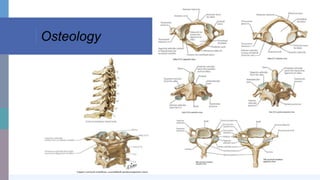
Osteology
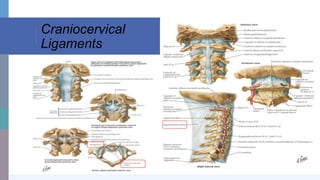
Craniocervical
Ligaments
Cervical Spine
Injuries
Okereke I, Mmerem K, Balasubramanian D. 2021. The Management of Cervical Spine Injuries – A Literature Review. Orthop Res Rev.13:151-162 https://doi.org/10.2147/ORR.S324622
Schleicher, P., Pingel, A., & Kandziora, F. 2018. Safe management of acute cervical spine injuries. EFORT open reviews, 3(5), 347–357. https://doi.org/10.1302/2058-5241.3.170076
• Between 19% and 51% of all spinal injuries are located in the cervical spine.
• Due to the inherent bony instability of the cervical spine, there is an overreliance on ligamentous
structures for stability making this segment of the vertebral column most prone to injuries.
• Motor vehicle accidents, fall from height, sports-related injuries and assault are the most common
causes of CSI in the younger population. In the elderly, non-traumatic causes of cervical spine
injuries that may be due to osteoporotic compression fractures, degenerative diseases of the spine
or compression fractures from spinal tumours are more prevalent.
Mechanism of Injuries
Okereke I, Mmerem K, Balasubramanian D. 2021. The Management of Cervical Spine Injuries – A Literature Review. Orthop Res Rev.13:151-162. https://doi.org/10.2147/ORR.S324622
Schleicher, P., Pingel, A., & Kandziora, F. 2018. Safe management of acute cervical spine injuries. EFORT open reviews, 3(5), 347–357. https://doi.org/10.1302/2058-5241.3.170076
From the biomechanical point of view, indirect, blunt trauma to the cervical spine is the major mechanism. The
direction and magnitude of the experienced forces and moments will result in specific injury patterns along the
upper and lower cervical spine. For instance:
• An axial load (compression)  Jefferson-type fractures in C1 vertebrae, occipito-condylar fractures or burst
fractures in other vertebrae
• Sagittal acceleration and deceleration (whiplash mechanism)  subaxial facet joint subluxation along with a
disruption of the posterior tension band.
• Hyperextension/hyperflexion  axis ‘ring’ fracture or an odontoid fracture.
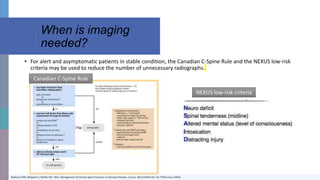
When is imaging
needed?
Beeharry MW, Moqeem K, Rohilla MU. 2021. Management of Cervical Spine Fractures: A Literature Review. Cureus. 3(4):e14418. doi: 10.7759/cureus.14418.
• For alert and asymptomatic patients in stable condition, the Canadian C-Spine Rule and the NEXUS low-risk
criteria may be used to reduce the number of unnecessary radiographs.
NEXUS low-risk criteria
Canadian C-Spine Rule
Specific
Treatment of
Upper Cervical
Spine Injuries
9/3/20XX Presentation Title 10
1. Fractures of the Occipital Condyle
2. Atlanto-occipital Dislocation
3. Fractures of the Atlas
4. Atlantoaxial Instabilities
5. Dens Fractures
6. Traumatic Spondylolisthesis of the Axis
7. Combined Atlas/Axis Fractures
1. Fractures of the Occipital Condyle
• Traumatic occipital condyle fracture (OCF) was first described
by Bell in 1817
• A Rare injuries
• CT-scan allows the establishment of the diagnosis of OCF and
for a precise assessment of fracture displacement.
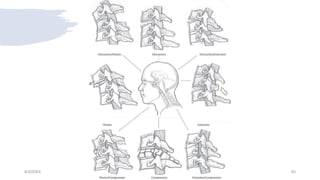
• MRI is recommended to assess the integrity of the
craniocervical ligaments
9/3/20XX Presentation Title 11
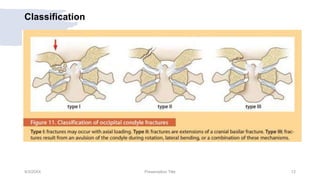
Classification
9/3/20XX Presentation Title 12
Treatment
• Depends on the extent of fracture displacement and
ligamentous injury
• Treatment ranges from collar immobilization - rigid halo jacket
or cast immobilization
• OCFs are rarely associated with neurological deficits  treated
conservatively
9/3/20XX Presentation Title 13
2. Atlanto-occipital Dislocation
• Atlanto-occipital dislocation (AOD) is a rare and often fatal
traumatic injury
• Around 20% of patients with acute traumatic AOD will have a
normal neurological examination on presentation
• Prevertebral soft tissue swelling on a lateral cervical
radiograph or craniocervical subarachnoid hemorrhage on
axial CT has been associated with AOD
9/3/20XX Presentation Title 14
Classification
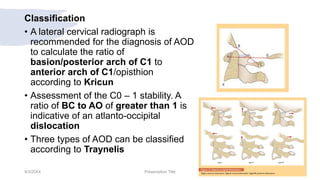
• A lateral cervical radiograph is
recommended for the diagnosis of AOD
to calculate the ratio of
basion/posterior arch of C1 to
anterior arch of C1/opisthion
according to Kricun
• Assessment of the C0 – 1 stability. A
ratio of BC to AO of greater than 1 is
indicative of an atlanto-occipital
dislocation
• Three types of AOD can be classified
according to Traynelis
9/3/20XX Presentation Title 15
Treatment
• Internal fixation and fusion is indicated in all patients with
AOD  to stabilize the cervico-occipital junction  avoid
secondary neurological deterioration
• Craniocervical fusion with internal fixation (using a Y-plate
or newer generation occipital platerod systems) is
recommended for the treatment
9/3/20XX Presentation Title 17
3. Fractures of the Atlas
• Cooper was the first to demonstrate a fracture of the atlas in
1822 at autopsy.
• In 1920, Jefferson reviewed 42 previously described cases of
atlas fractures adding 4 of his own cases.
• Although his article documents a variety of atlas fracture
patterns, it is best known for the characterization of the
“Jefferson fracture”  burst fracture injury of the atlas ring
9/3/20XX Presentation Title 18
Classification
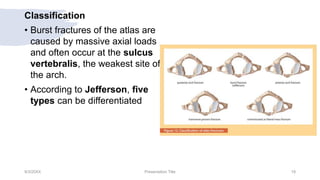
• Burst fractures of the atlas are
caused by massive axial loads
and often occur at the sulcus
vertebralis, the weakest site of
the arch.
• According to Jefferson, five
types can be differentiated
9/3/20XX Presentation Title 19
Treatment
• Depends on the stability of the fracture.
• The main criteria to determine C1–C2 instability due to
transverse atlantal ligament injury include the sum of
displacement of the lateral masses of C1 compared to C2 of
more than 8 mm on plain X-rays, a predental space of more
than 4 mm in adults and MRI evidence of ligamentous
disruption or avulsion
• It is recommended to treat isolated fractures of the atlas with
disruption of the transverse ligament with rigid external
fixation (halo vest or Minerva cast) or with atlantoaxial screw
fixation and fusion
9/3/20XX Presentation Title 20
4. Atlantoaxial Instabilities
• Atlantoaxial instability results from either a purely ligamentous injury or avulsion fractures.
• Atlantoaxial instabilities are rare after trauma
• Frequently in elderly compared to other traumatic cervical injuries
• Transverse ligament  intact  a significant narrowing of the spinal canal and subsequent potential spinal cord
damage is possible
• Transverse ligament  deficiency  complete unilateral dislocation can occur at approximately 45° with similar
consequences
• Excessive rotation  vertebral arteries can be compromised  brain stem or cerebellar infarction and death
9/3/20XX Presentation Title 22
Classification
• Classified according to the direction of the dislocation :
• anterior (transverse ligament disruption, dens or Jefferson fracture)
• posterior (dens fracture, see Fielding Type IV)
• lateral (lateral mass fracture of C1, C2, or unilateral alar ligament ruptures)
• rotatory (see Fielding Types I–III)
• vertical (rupture of the alar ligaments and tectorial membrane)
9/3/20XX Presentation Title 23
Treatment
• Anterior dislocation
• Reduction and instrumented fusion is the treatment of choice
• Unstable = dislocation of more than 3 mm  usually fail to heal
conservatively.
• Internal fixation  reduce to prevent further translation of C1 on C2
• Transarticular screw (Harms)  a surgical option
• Gallie or Brooks fusion  to obtain long-term stability
• Posterior and lateral instabilities treatment  depend on the
concomitant injury
• Vertical instability treatment  occipitocervical fusion
9/3/20XX Presentation Title 25
5. Dens Fractures
• Fracture through the odontoid process  the most common
injury
• The motion is primarily rotational
• Transverse atlantal ligaments  prevent the translational
motion of C1 on C2
9/3/20XX Presentation Title 26
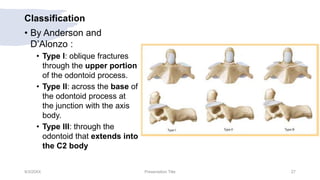
Classification
• By Anderson and
D’Alonzo :
• Type I: oblique fractures
through the upper portion
of the odontoid process.
• Type II: across the base of
the odontoid process at
the junction with the axis
body.
• Type III: through the
odontoid that extends into
the C2 body
9/3/20XX Presentation Title 27
Treatment
• Based on : fracture type, degree of (initial) dens displacement,
extent of angulation, and patient’s age
• Non-operative treatment :
• Cervical collar  type 1 fractures
• Traction  inappropriate for Type II fractures
• Minerva cast
• Halo jacket  Type I and III odontoid fractures
• The high nonunion rate of Type II fractures is due to inadequate
fracture immobilization.
9/3/20XX Presentation Title 28
• Operative treatment
• The surgical armamentarium consists of:
• Anterior dens screw fixation
• Anterior atlantoaxial screw fixation and fusion
• Posterior atlantoaxial fusion (Gallie or Brooks)
• Posterior atlantoaxial screw fixation and fusion
• Posterior atlas and axis screw-rod fixation and fusion
9/3/20XX Presentation Title 29
6. Traumatic Spondylolisthesis of the Axis
• May occur after hyperextension injuries (MVA, diving, and falls
or judicial hangings)
9/3/20XX Presentation Title 30
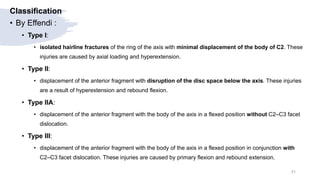
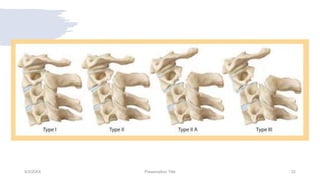
Classification
• By Effendi :
• Type I:
• isolated hairline fractures of the ring of the axis with minimal displacement of the body of C2. These
injuries are caused by axial loading and hyperextension.
• Type II:
• displacement of the anterior fragment with disruption of the disc space below the axis. These injuries
are a result of hyperextension and rebound flexion.
• Type IIA:
• displacement of the anterior fragment with the body of the axis in a flexed position without C2–C3 facet
dislocation.
• Type III:
• displacement of the anterior fragment with the body of the axis in a flexed position in conjunction with
C2–C3 facet dislocation. These injuries are caused by primary flexion and rebound extension.
31
9/3/20XX Presentation Title 32
Treatment
• Most fractures heal within 12 weeks of external immobilization
• Surgical stabilization is an option in Type II and III fractures
• Axis body fractures are usually treated conservatively
• Surgical stabilization is a preferred treatment option in cases
with:
• Severe angulation (Effendi Type II)
• Disruption of the C2–C3 disc space (Effendi Type II and III)
9/3/20XX Presentation Title 33
7. Combined Atlas/Axis Fractures
• The occurrence of the fractures in combination  a significant
structural and mechanical injury
• Combination C1-C2 complex  common injury  higher
incidence of neurological deficit
9/3/20XX Presentation Title 34
Treatment
• Based primarily on the axis fracture.
• External immobilization is recommended
• Surgical stabilization and fusion  combined atlas–Type II
odontoid fractures with an atlantodental interval of more than 4
mm and atlas–traumatic spondylolisthesis injuries with
angulation of more than 10 degrees
9/3/20XX Presentation Title 35
Classification and
Treatment of Subaxial
Injuries
9/3/20XX Presentation Title 37
• The vertebrae and articulations of the subaxial cervical spine
(C3–C7) have similar morphological and kinematic
characteristics
• Eighty percent of all cervical injuries affect the subaxial spine
9/3/20XX Presentation Title 38
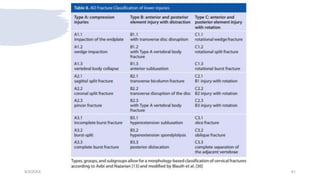
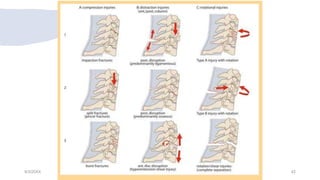
Classification
• By Allen and Ferguson  the most commonly used
• The fracture types are related to specific injury pattern:
• Injuries of the anterior elements induced by compression (Type A)
• Injuries of the posterior and anterior elements induced by distraction
(Type B)
• Injuries of the anterior and posterior elements induced by rotation
(Type C)
• Types B and C are the most common fracture types.
• Subaxial fracture-dislocation is frequently associated with
neurological injury
9/3/20XX Presentation Title 39
9/3/20XX Presentation Title 40
9/3/20XX Presentation Title 41
9/3/20XX Presentation Title 42
Treatment
• Non-operative Management
• Most subaxial cervical injuries can be treated conservatively.
• More rigid fixation techniques (halo vest fixation, Minerva cast)
appear to have better success rates than less rigid orthoses
(collars, traction only)
9/3/20XX Presentation Title 43
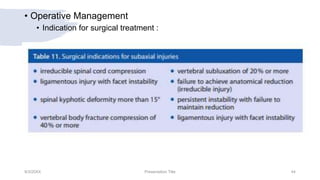
• Operative Management
• Indication for surgical treatment :
9/3/20XX Presentation Title 44
THANK YOU
9/3/20XX Presentation Title 45

Cervical Spine Injury.pptx

  • 1.
  • 2.
    Cervical Vertebrae Okereke I,Mmerem K, Balasubramanian D. 2021. The Management of Cervical Spine Injuries – A Literature Review. Orthop Res Rev.13:151-162https://doi.org/10.2147/ORR.S324622 • The cervical spine consists of 7 very specialized vertebrae articulating at the craniocervical joint and with the first thoracic vertebra, which supports the head and its movements, protects the spinal cord. • The Cervical spine can be anatomically divided into 2 regions: - The axial/upper segment (Occipito-cervical junction and the atlantoaxial spine C1-C2) - The subaxial segment (C3-C7) • The axial spine accounts for most flexion-extension and rotational movements of the cervical spine and compared to the subaxial spine, relies considerably on ligamentous support for stability
  • 3.
  • 4.
  • 5.
    Cervical Spine Injuries Okereke I,Mmerem K, Balasubramanian D. 2021. The Management of Cervical Spine Injuries – A Literature Review. Orthop Res Rev.13:151-162 https://doi.org/10.2147/ORR.S324622 Schleicher, P., Pingel, A., & Kandziora, F. 2018. Safe management of acute cervical spine injuries. EFORT open reviews, 3(5), 347–357. https://doi.org/10.1302/2058-5241.3.170076 • Between 19% and 51% of all spinal injuries are located in the cervical spine. • Due to the inherent bony instability of the cervical spine, there is an overreliance on ligamentous structures for stability making this segment of the vertebral column most prone to injuries. • Motor vehicle accidents, fall from height, sports-related injuries and assault are the most common causes of CSI in the younger population. In the elderly, non-traumatic causes of cervical spine injuries that may be due to osteoporotic compression fractures, degenerative diseases of the spine or compression fractures from spinal tumours are more prevalent.
  • 6.
    Mechanism of Injuries OkerekeI, Mmerem K, Balasubramanian D. 2021. The Management of Cervical Spine Injuries – A Literature Review. Orthop Res Rev.13:151-162. https://doi.org/10.2147/ORR.S324622 Schleicher, P., Pingel, A., & Kandziora, F. 2018. Safe management of acute cervical spine injuries. EFORT open reviews, 3(5), 347–357. https://doi.org/10.1302/2058-5241.3.170076 From the biomechanical point of view, indirect, blunt trauma to the cervical spine is the major mechanism. The direction and magnitude of the experienced forces and moments will result in specific injury patterns along the upper and lower cervical spine. For instance: • An axial load (compression)  Jefferson-type fractures in C1 vertebrae, occipito-condylar fractures or burst fractures in other vertebrae • Sagittal acceleration and deceleration (whiplash mechanism)  subaxial facet joint subluxation along with a disruption of the posterior tension band. • Hyperextension/hyperflexion  axis ‘ring’ fracture or an odontoid fracture.
  • 7.
    When is imaging needed? BeeharryMW, Moqeem K, Rohilla MU. 2021. Management of Cervical Spine Fractures: A Literature Review. Cureus. 3(4):e14418. doi: 10.7759/cureus.14418. • For alert and asymptomatic patients in stable condition, the Canadian C-Spine Rule and the NEXUS low-risk criteria may be used to reduce the number of unnecessary radiographs. NEXUS low-risk criteria Canadian C-Spine Rule
  • 8.
    Specific Treatment of Upper Cervical SpineInjuries 9/3/20XX Presentation Title 10 1. Fractures of the Occipital Condyle 2. Atlanto-occipital Dislocation 3. Fractures of the Atlas 4. Atlantoaxial Instabilities 5. Dens Fractures 6. Traumatic Spondylolisthesis of the Axis 7. Combined Atlas/Axis Fractures
  • 9.
    1. Fractures ofthe Occipital Condyle • Traumatic occipital condyle fracture (OCF) was first described by Bell in 1817 • A Rare injuries • CT-scan allows the establishment of the diagnosis of OCF and for a precise assessment of fracture displacement. • MRI is recommended to assess the integrity of the craniocervical ligaments 9/3/20XX Presentation Title 11
  • 10.
  • 11.
    Treatment • Depends onthe extent of fracture displacement and ligamentous injury • Treatment ranges from collar immobilization - rigid halo jacket or cast immobilization • OCFs are rarely associated with neurological deficits  treated conservatively 9/3/20XX Presentation Title 13
  • 12.
    2. Atlanto-occipital Dislocation •Atlanto-occipital dislocation (AOD) is a rare and often fatal traumatic injury • Around 20% of patients with acute traumatic AOD will have a normal neurological examination on presentation • Prevertebral soft tissue swelling on a lateral cervical radiograph or craniocervical subarachnoid hemorrhage on axial CT has been associated with AOD 9/3/20XX Presentation Title 14
  • 13.
    Classification • A lateralcervical radiograph is recommended for the diagnosis of AOD to calculate the ratio of basion/posterior arch of C1 to anterior arch of C1/opisthion according to Kricun • Assessment of the C0 – 1 stability. A ratio of BC to AO of greater than 1 is indicative of an atlanto-occipital dislocation • Three types of AOD can be classified according to Traynelis 9/3/20XX Presentation Title 15
  • 14.
    Treatment • Internal fixationand fusion is indicated in all patients with AOD  to stabilize the cervico-occipital junction  avoid secondary neurological deterioration • Craniocervical fusion with internal fixation (using a Y-plate or newer generation occipital platerod systems) is recommended for the treatment 9/3/20XX Presentation Title 17
  • 15.
    3. Fractures ofthe Atlas • Cooper was the first to demonstrate a fracture of the atlas in 1822 at autopsy. • In 1920, Jefferson reviewed 42 previously described cases of atlas fractures adding 4 of his own cases. • Although his article documents a variety of atlas fracture patterns, it is best known for the characterization of the “Jefferson fracture”  burst fracture injury of the atlas ring 9/3/20XX Presentation Title 18
  • 16.
    Classification • Burst fracturesof the atlas are caused by massive axial loads and often occur at the sulcus vertebralis, the weakest site of the arch. • According to Jefferson, five types can be differentiated 9/3/20XX Presentation Title 19
  • 17.
    Treatment • Depends onthe stability of the fracture. • The main criteria to determine C1–C2 instability due to transverse atlantal ligament injury include the sum of displacement of the lateral masses of C1 compared to C2 of more than 8 mm on plain X-rays, a predental space of more than 4 mm in adults and MRI evidence of ligamentous disruption or avulsion • It is recommended to treat isolated fractures of the atlas with disruption of the transverse ligament with rigid external fixation (halo vest or Minerva cast) or with atlantoaxial screw fixation and fusion 9/3/20XX Presentation Title 20
  • 18.
    4. Atlantoaxial Instabilities •Atlantoaxial instability results from either a purely ligamentous injury or avulsion fractures. • Atlantoaxial instabilities are rare after trauma • Frequently in elderly compared to other traumatic cervical injuries • Transverse ligament  intact  a significant narrowing of the spinal canal and subsequent potential spinal cord damage is possible • Transverse ligament  deficiency  complete unilateral dislocation can occur at approximately 45° with similar consequences • Excessive rotation  vertebral arteries can be compromised  brain stem or cerebellar infarction and death 9/3/20XX Presentation Title 22
  • 19.
    Classification • Classified accordingto the direction of the dislocation : • anterior (transverse ligament disruption, dens or Jefferson fracture) • posterior (dens fracture, see Fielding Type IV) • lateral (lateral mass fracture of C1, C2, or unilateral alar ligament ruptures) • rotatory (see Fielding Types I–III) • vertical (rupture of the alar ligaments and tectorial membrane) 9/3/20XX Presentation Title 23
  • 20.
    Treatment • Anterior dislocation •Reduction and instrumented fusion is the treatment of choice • Unstable = dislocation of more than 3 mm  usually fail to heal conservatively. • Internal fixation  reduce to prevent further translation of C1 on C2 • Transarticular screw (Harms)  a surgical option • Gallie or Brooks fusion  to obtain long-term stability • Posterior and lateral instabilities treatment  depend on the concomitant injury • Vertical instability treatment  occipitocervical fusion 9/3/20XX Presentation Title 25
  • 21.
    5. Dens Fractures •Fracture through the odontoid process  the most common injury • The motion is primarily rotational • Transverse atlantal ligaments  prevent the translational motion of C1 on C2 9/3/20XX Presentation Title 26
  • 22.
    Classification • By Andersonand D’Alonzo : • Type I: oblique fractures through the upper portion of the odontoid process. • Type II: across the base of the odontoid process at the junction with the axis body. • Type III: through the odontoid that extends into the C2 body 9/3/20XX Presentation Title 27
  • 23.
    Treatment • Based on: fracture type, degree of (initial) dens displacement, extent of angulation, and patient’s age • Non-operative treatment : • Cervical collar  type 1 fractures • Traction  inappropriate for Type II fractures • Minerva cast • Halo jacket  Type I and III odontoid fractures • The high nonunion rate of Type II fractures is due to inadequate fracture immobilization. 9/3/20XX Presentation Title 28
  • 24.
    • Operative treatment •The surgical armamentarium consists of: • Anterior dens screw fixation • Anterior atlantoaxial screw fixation and fusion • Posterior atlantoaxial fusion (Gallie or Brooks) • Posterior atlantoaxial screw fixation and fusion • Posterior atlas and axis screw-rod fixation and fusion 9/3/20XX Presentation Title 29
  • 25.
    6. Traumatic Spondylolisthesisof the Axis • May occur after hyperextension injuries (MVA, diving, and falls or judicial hangings) 9/3/20XX Presentation Title 30
  • 26.
    Classification • By Effendi: • Type I: • isolated hairline fractures of the ring of the axis with minimal displacement of the body of C2. These injuries are caused by axial loading and hyperextension. • Type II: • displacement of the anterior fragment with disruption of the disc space below the axis. These injuries are a result of hyperextension and rebound flexion. • Type IIA: • displacement of the anterior fragment with the body of the axis in a flexed position without C2–C3 facet dislocation. • Type III: • displacement of the anterior fragment with the body of the axis in a flexed position in conjunction with C2–C3 facet dislocation. These injuries are caused by primary flexion and rebound extension. 31
  • 27.
  • 28.
    Treatment • Most fracturesheal within 12 weeks of external immobilization • Surgical stabilization is an option in Type II and III fractures • Axis body fractures are usually treated conservatively • Surgical stabilization is a preferred treatment option in cases with: • Severe angulation (Effendi Type II) • Disruption of the C2–C3 disc space (Effendi Type II and III) 9/3/20XX Presentation Title 33
  • 29.
    7. Combined Atlas/AxisFractures • The occurrence of the fractures in combination  a significant structural and mechanical injury • Combination C1-C2 complex  common injury  higher incidence of neurological deficit 9/3/20XX Presentation Title 34
  • 30.
    Treatment • Based primarilyon the axis fracture. • External immobilization is recommended • Surgical stabilization and fusion  combined atlas–Type II odontoid fractures with an atlantodental interval of more than 4 mm and atlas–traumatic spondylolisthesis injuries with angulation of more than 10 degrees 9/3/20XX Presentation Title 35
  • 31.
    Classification and Treatment ofSubaxial Injuries 9/3/20XX Presentation Title 37
  • 32.
    • The vertebraeand articulations of the subaxial cervical spine (C3–C7) have similar morphological and kinematic characteristics • Eighty percent of all cervical injuries affect the subaxial spine 9/3/20XX Presentation Title 38
  • 33.
    Classification • By Allenand Ferguson  the most commonly used • The fracture types are related to specific injury pattern: • Injuries of the anterior elements induced by compression (Type A) • Injuries of the posterior and anterior elements induced by distraction (Type B) • Injuries of the anterior and posterior elements induced by rotation (Type C) • Types B and C are the most common fracture types. • Subaxial fracture-dislocation is frequently associated with neurological injury 9/3/20XX Presentation Title 39
  • 34.
  • 35.
  • 36.
  • 37.
    Treatment • Non-operative Management •Most subaxial cervical injuries can be treated conservatively. • More rigid fixation techniques (halo vest fixation, Minerva cast) appear to have better success rates than less rigid orthoses (collars, traction only) 9/3/20XX Presentation Title 43
  • 38.
    • Operative Management •Indication for surgical treatment : 9/3/20XX Presentation Title 44
  • 39.

Editor's Notes

  • #8 Both of these clinical decision rules have shown a good sensitivity in the range of 90% to 100% in several large prospective cross-sectional studies. In a direct comparison, the Canadian C-Spine rule showed slightly higher diagnostic values, which should be weighed against the (slightly) higher complexity of its application. National Emergency X-Radiography Utilization Study Group (NEXUS)
  • #24 Type I: rotatory fixation with no anterior displacement (transverse ligament intact) and the dens working as pivot. Type II: rotatory fixation with anterior displacement of 3 – 5 mm and one lateral articular process acting as the pivot. Type III: rotatory fixation with anterior displacement of more than 5 mm. Type IV: rotatory fixation with posterior displacement. Type III and IV were only observed in non-traumatic conditions.