Radiological imaging of parkinsonism. 
Dr/ ABD ALLAH NAZEER. MD.
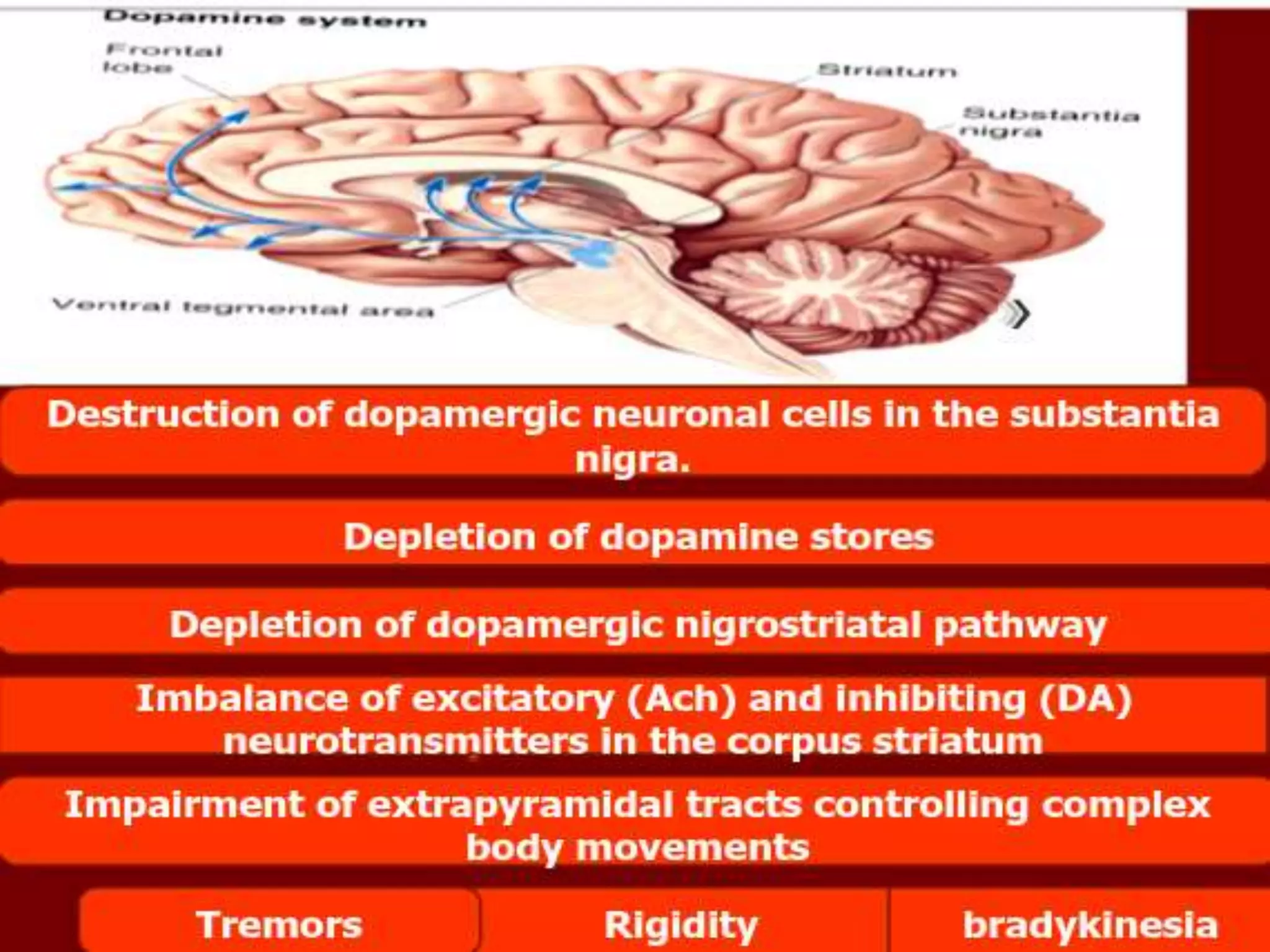
Parkinson's disease described by James Parkinson in 1817. 
Parkinson’s disease is a chronic neurodegenerative movement 
disorder affecting voluntary and emotional movements and most 
commonly seen in the elderly, but is also found in the young and 
inexorably progresses leading to significant disability. 
Average age of onset is 62.5 years. 
Men and women affected equally. 
Pathogenesis: 
Four theories. 
Oxidative damage, Mitochondrial dysfunction, enhanced 
oxidative stress, proteosomal dysfunction causes cell death. 
Environmental toxins, MPTP-Methyl-phenyl tetrahydropyridine, 
Mutation in the gene located on chromosome 4. 
Genetic predisposition, Mutation in the gene located on 
chromosome 4. 
Accelerated aging.
Classification and Etiology. 
Idiopathic Parkinson’s disease 
Parkinson-like syndromes 
Drug induced parkinsonism 
Hypoxia 
Tumor 
Trauma 
Vascular:Multiinfarct 
Toxin:Mn, CO, MPTP and cyanide 
Post-encephalitic parkinsonism (von Economo’s 
encephalitis) 
Normal pressure hydrocephalus 
Wilson’s disease, Hutington’s disease
Medications that can cause parkinsonian 
symptoms, but not PD itself, include the following: 
Metoclopramide 
Domperidone 
Reserpine-containing antihypertensives 
Neuroleptics 
Some evidence also indicates that certain 
environmental factors (including smoking and 
coffee drinking) may actually have protective 
associations.
Clinical features of Idiopathic Parkinson’s disease. 
Major features 
Resting tremor 
in hands, arms, 
legs, jaw, and 
Face. 
Bradykinesia 
Rigidity- cogwheel 
or lead-pipe 
Minor features 
Bradyphrenia 
Speech 
abnormalities 
Depression 
Dysautonomia 
Dystonia 
Constipation 
Hallucinations 
Dysphagia
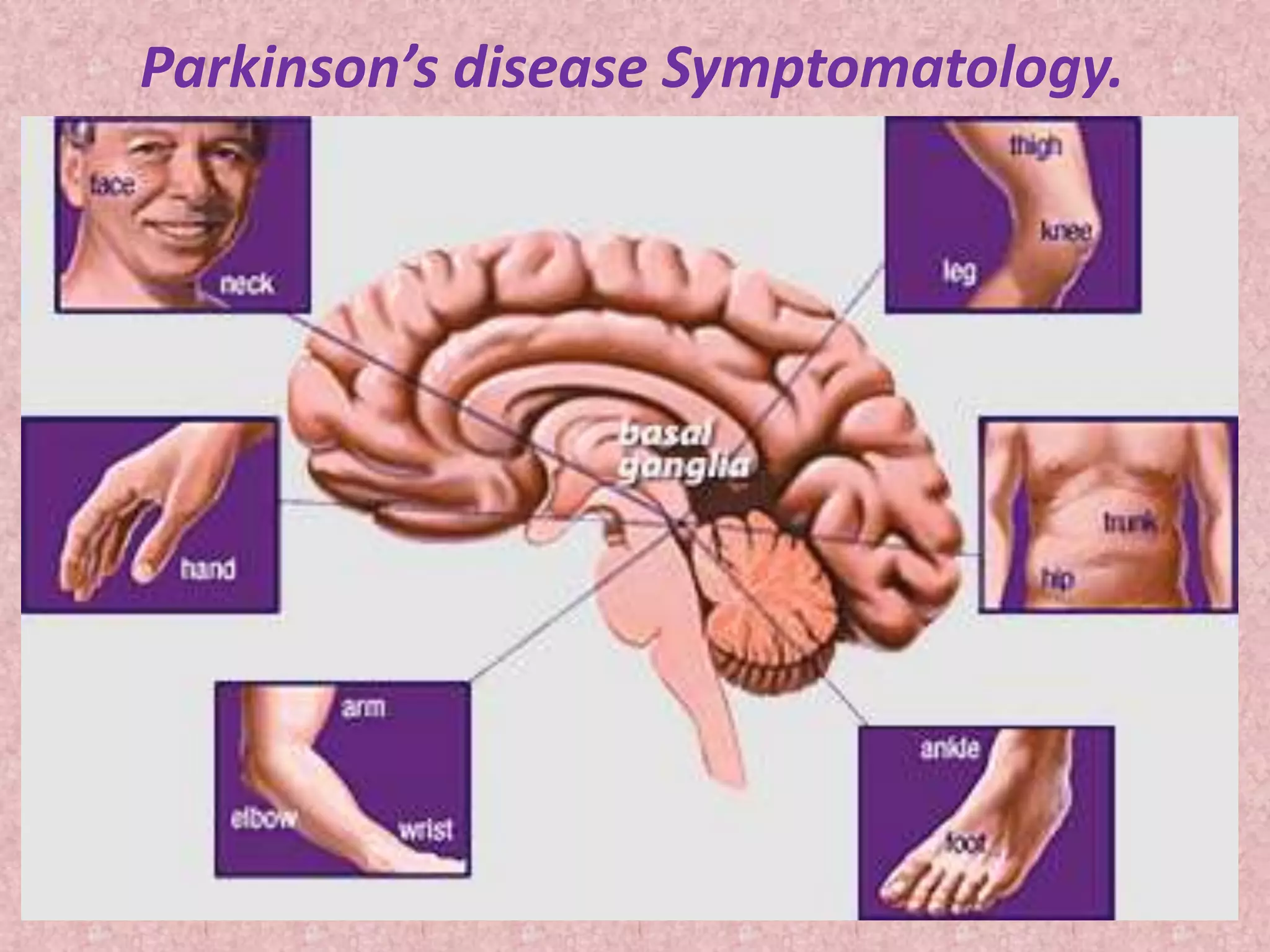
Parkinson’s disease Symptomatology.
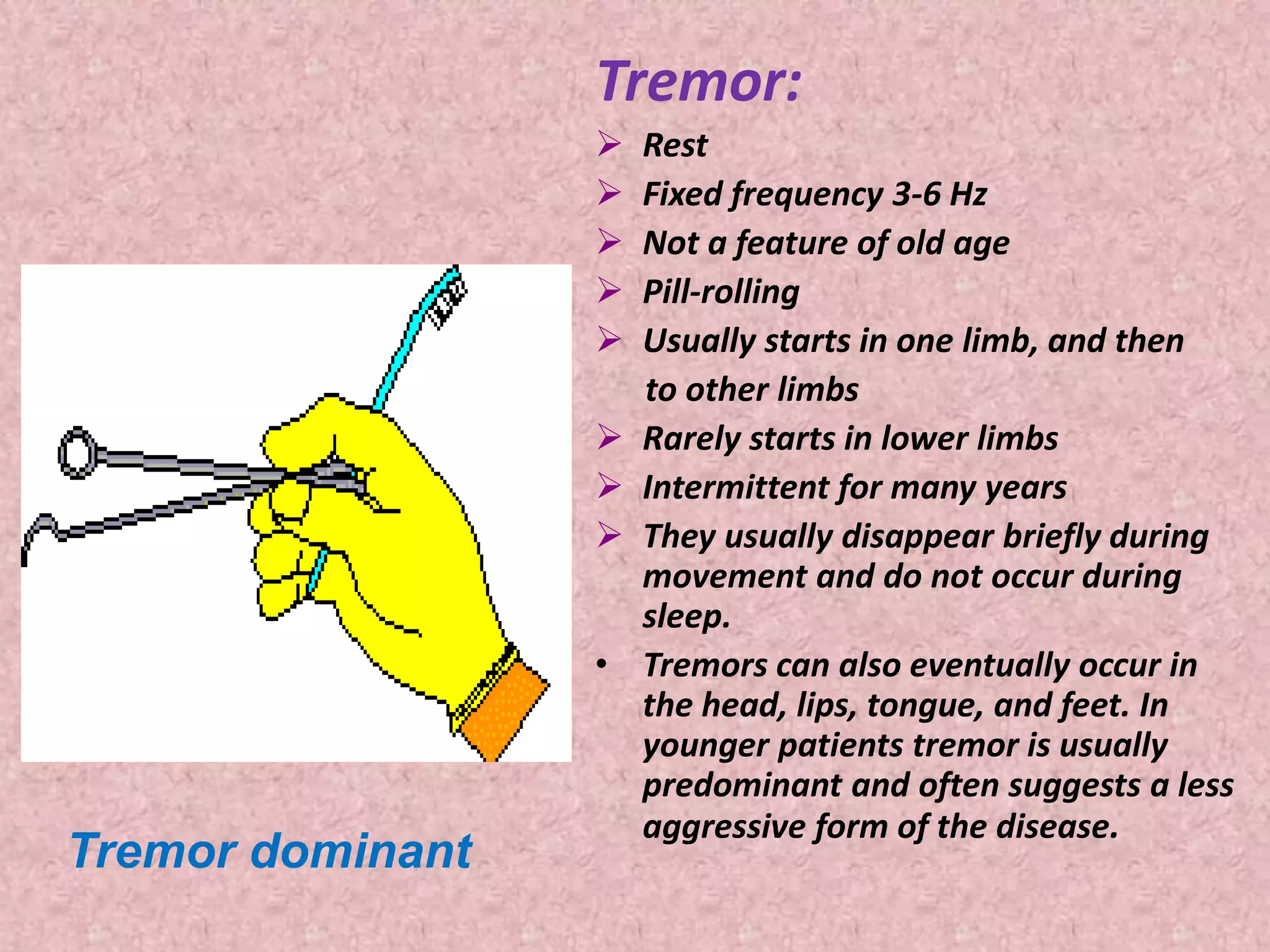
Tremor dominant 
Tremor: 
 Rest 
 Fixed frequency 3-6 Hz 
 Not a feature of old age 
 Pill-rolling 
 Usually starts in one limb, and then 
to other limbs 
 Rarely starts in lower limbs 
 Intermittent for many years 
 They usually disappear briefly during 
movement and do not occur during 
sleep. 
• Tremors can also eventually occur in 
the head, lips, tongue, and feet. In 
younger patients tremor is usually 
predominant and often suggests a less 
aggressive form of the disease.
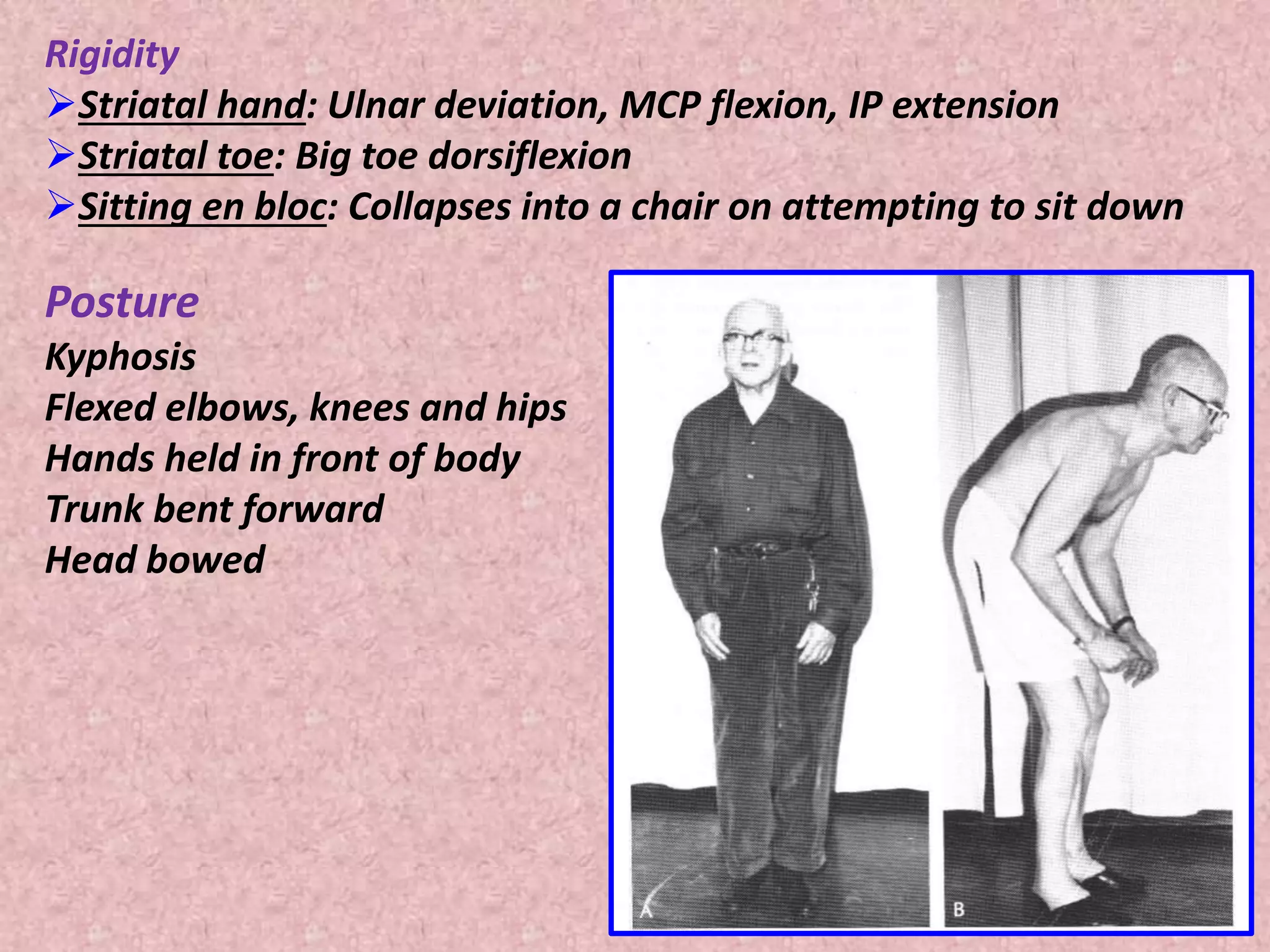
Rigidity 
Striatal hand: Ulnar deviation, MCP flexion, IP extension 
Striatal toe: Big toe dorsiflexion 
Sitting en bloc: Collapses into a chair on attempting to sit down 
Posture 
Kyphosis 
Flexed elbows, knees and hips 
Hands held in front of body 
Trunk bent forward 
Head bowed
Bradykinesia 
Slowness of motion (bradykinesia) is one of the classic 
symptoms of Parkinson's disease. 
Hypomimia- “masked facies”, expressionless face, 
blinking 
Speech abnormalities- 
Hypophonia: soft voice 
Aprosody of speech: monotonous and lack of inflection 
Tachyphemia: do not separate syllables together, 
running words together 
Patients may eventually develop a stooped posture and 
a slow, shuffling walk. The gait can be erratic and 
unsteady.
Motor fluctuations 
Freezing phenomenon- Sudden, transient inability to 
perform active movements, lasting no more than a 
few seconds: 
Start hesitation 
Turn hesitation 
Target hesitation 
Palilalia (speaking) 
Apraxia of eyelid opening 
Writing 
Kinesia paradoxica-Despite severe rigidity and 
bradykinesia, they may rise suddenly and move normally.
Festinating gait 
Drooling of saliva 
Dysphagia 
Constipation 
Dementia 
Depression 
Orthostatic 
hypotension 
Low resting blood 
pressure HTN 
Normotensive 
Sweating 
abnormalities-excessive 
perspiration 
Blepharospasm/ 
keratitis.
Investigations: 
The diagnosis is made clinically , as there is no diagnostic test 
for Parkinson's disease. 
Imaging (CT or MRI) of the brain needed if there are any 
features suggestive of pyramidal, cerebellar or autonomic 
involvement or the diagnosis is otherwise in dought (e.g to 
exclude stroke). 
Routine brain imaging is unnecessary in patients with typical 
Parkinson’s disease. 
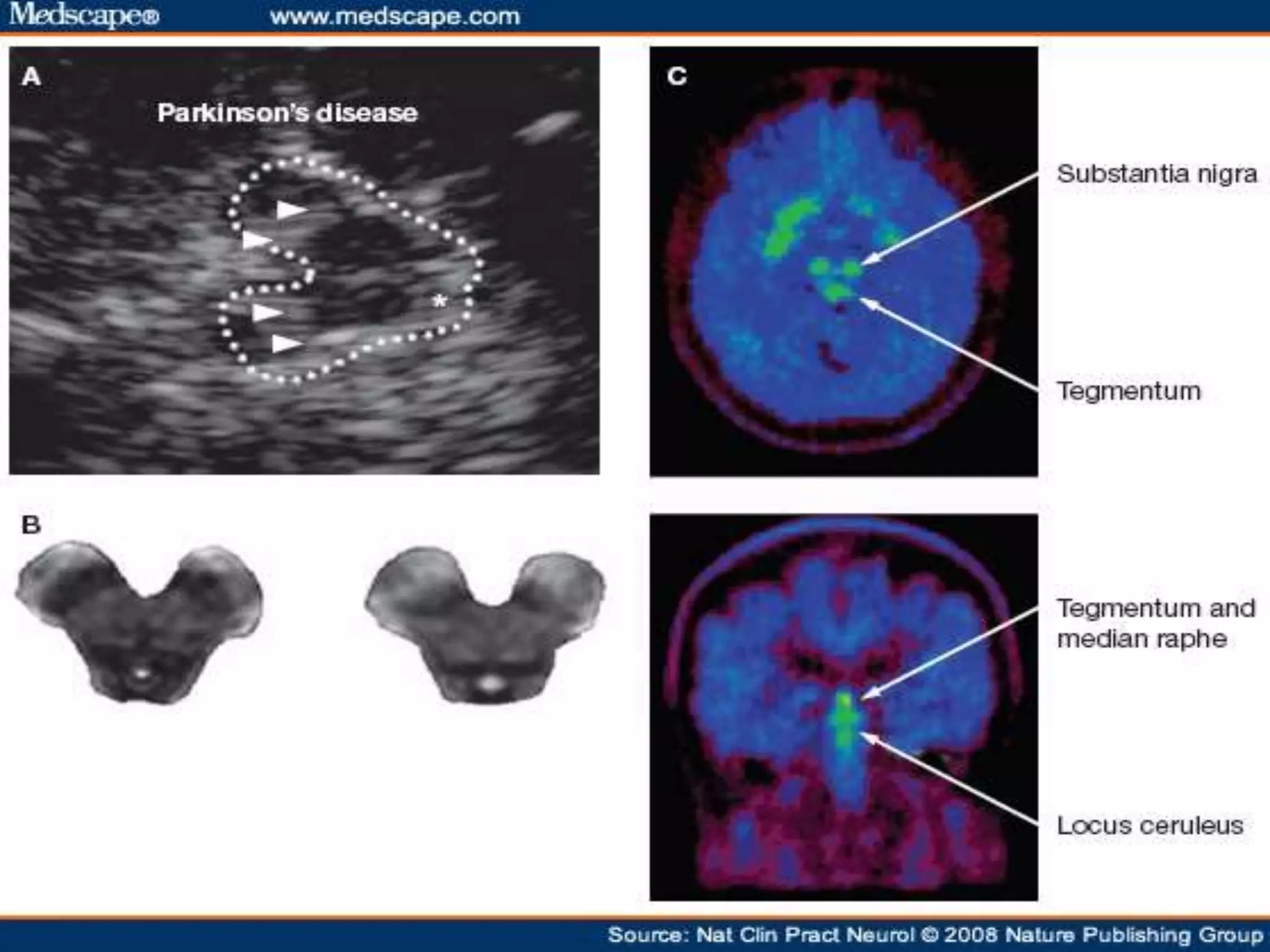
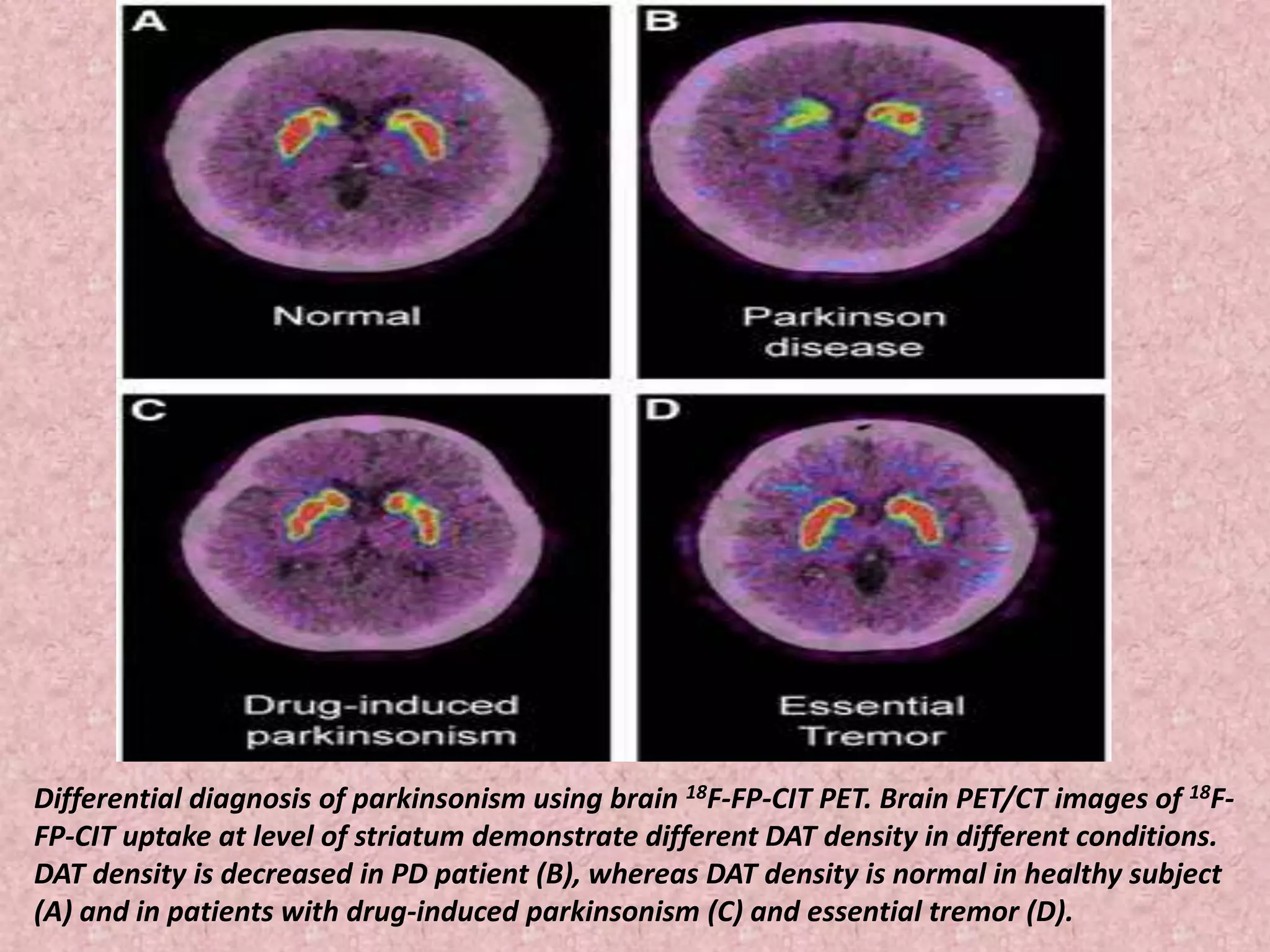
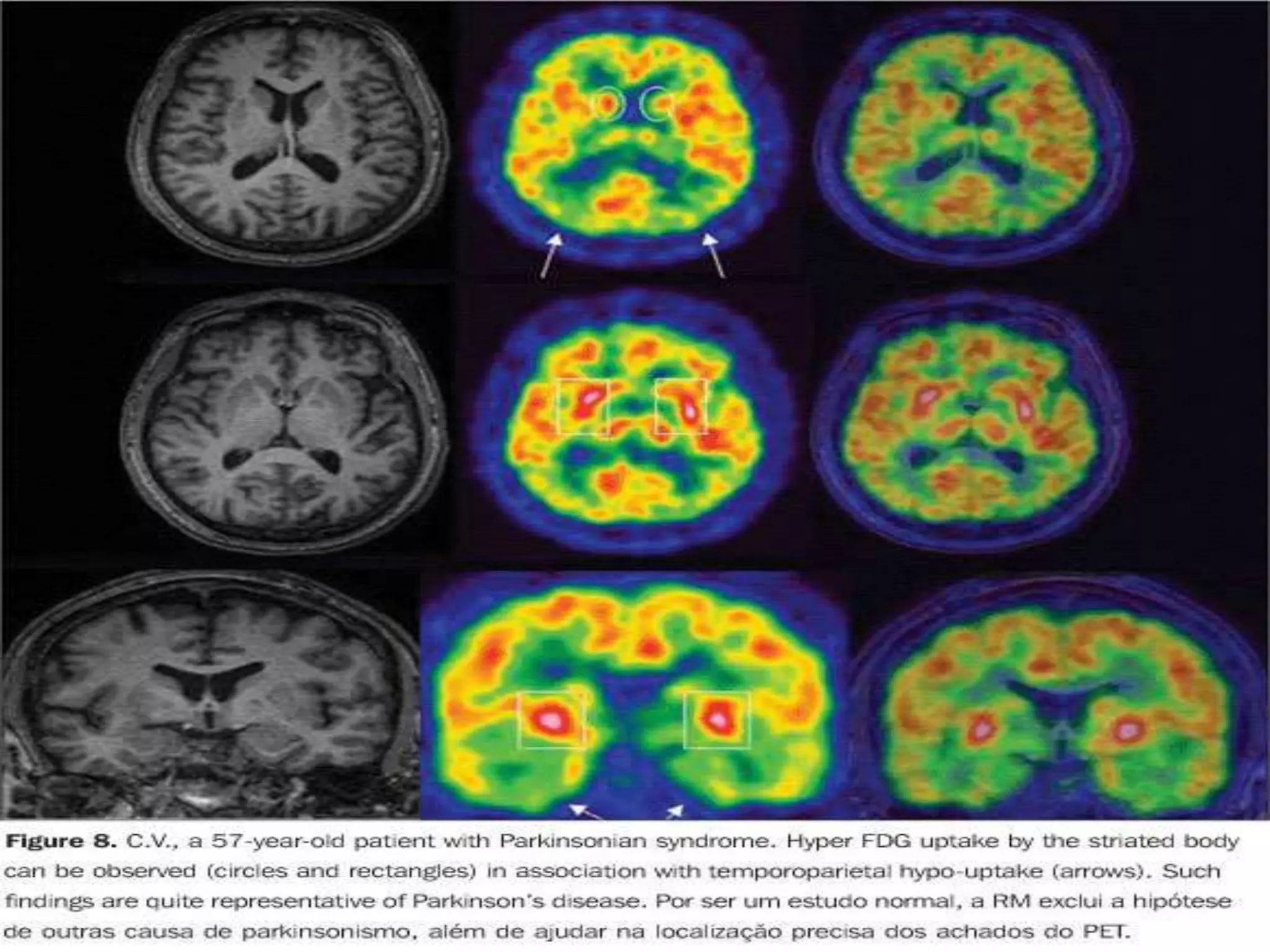
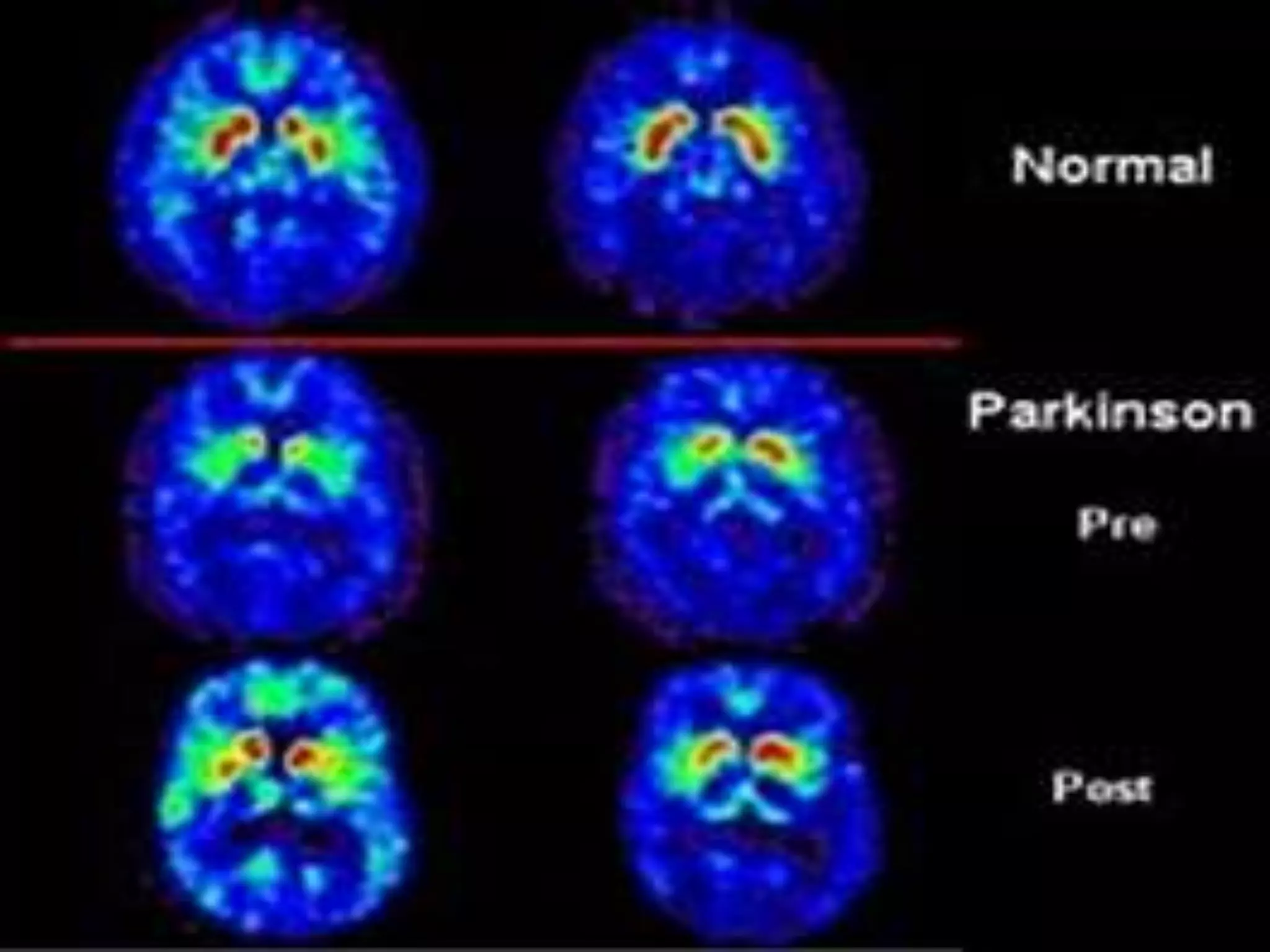
Dopamine transporter (DAT) imaging can help to differentiate 
patients with Parkinson’s disease from healthy individuals and 
patients with essential tremor or drug induced parkinsonism 
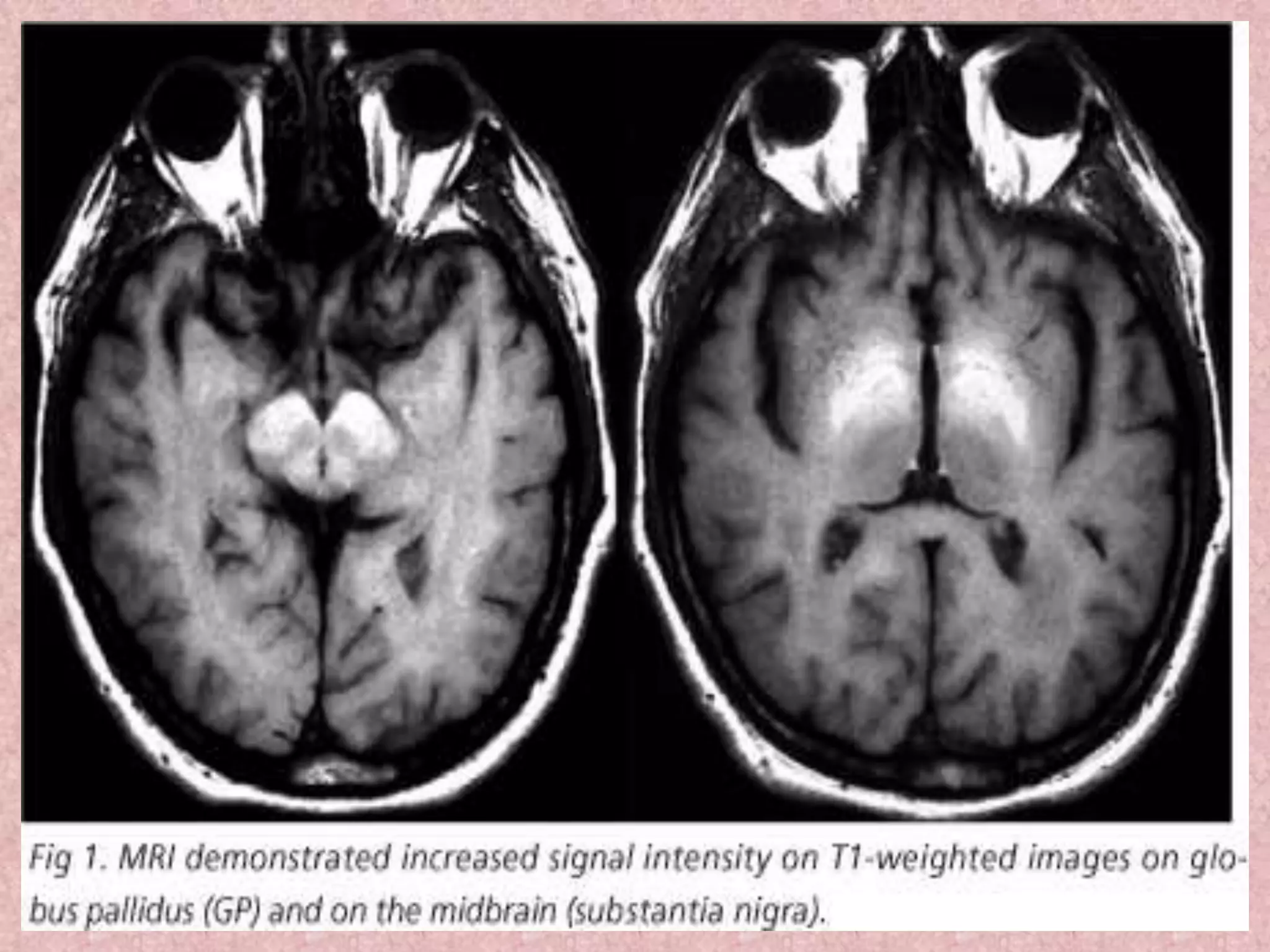
Structural MRI may be performed to rule out alternative 
diagnoses (including other neurodegenerative syndromes and 
structural or vascular lesions).
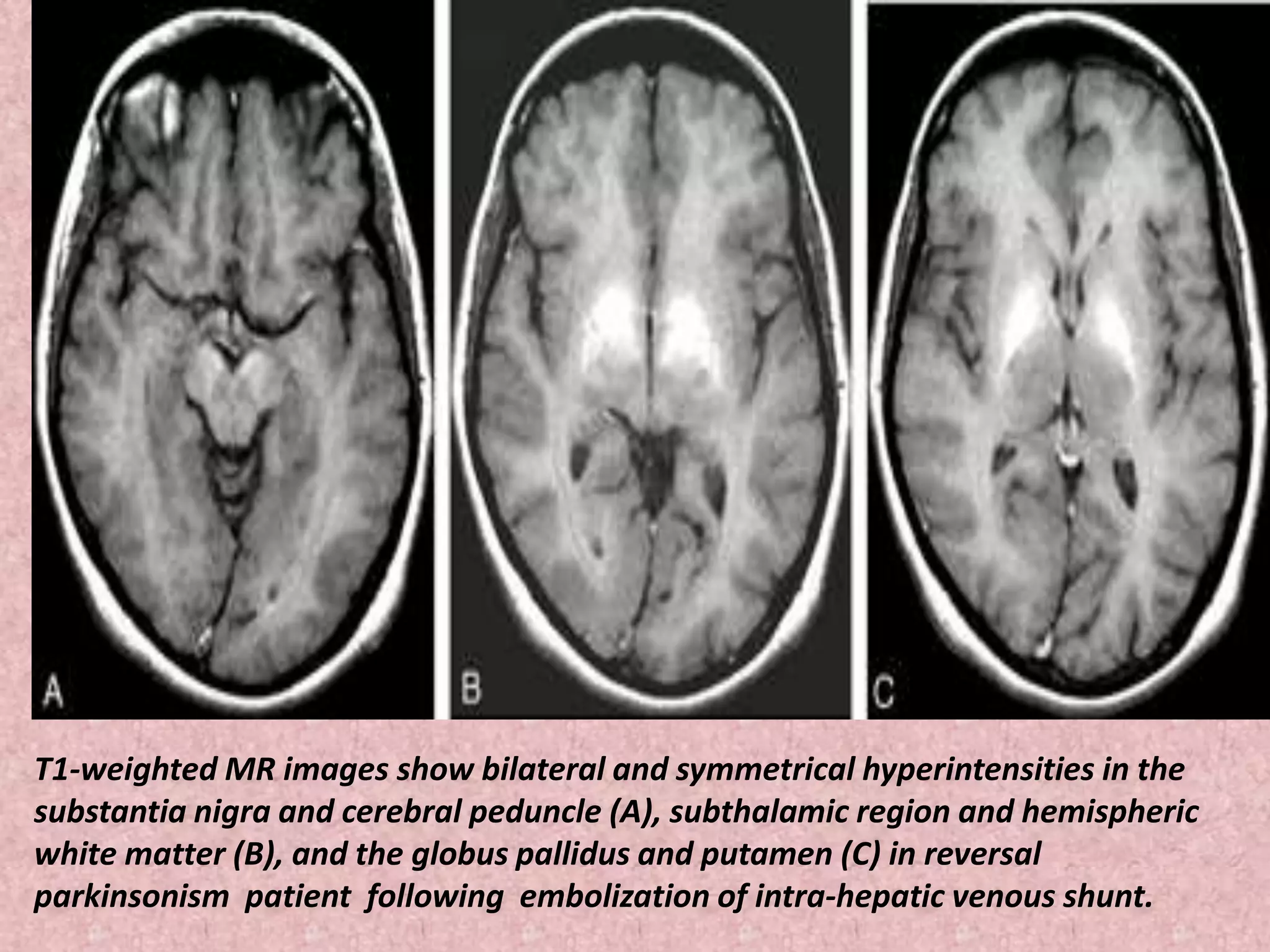
T1-weighted MR images show bilateral and symmetrical hyperintensities in the 
substantia nigra and cerebral peduncle (A), subthalamic region and hemispheric 
white matter (B), and the globus pallidus and putamen (C) in reversal 
parkinsonism patient following embolization of intra-hepatic venous shunt.
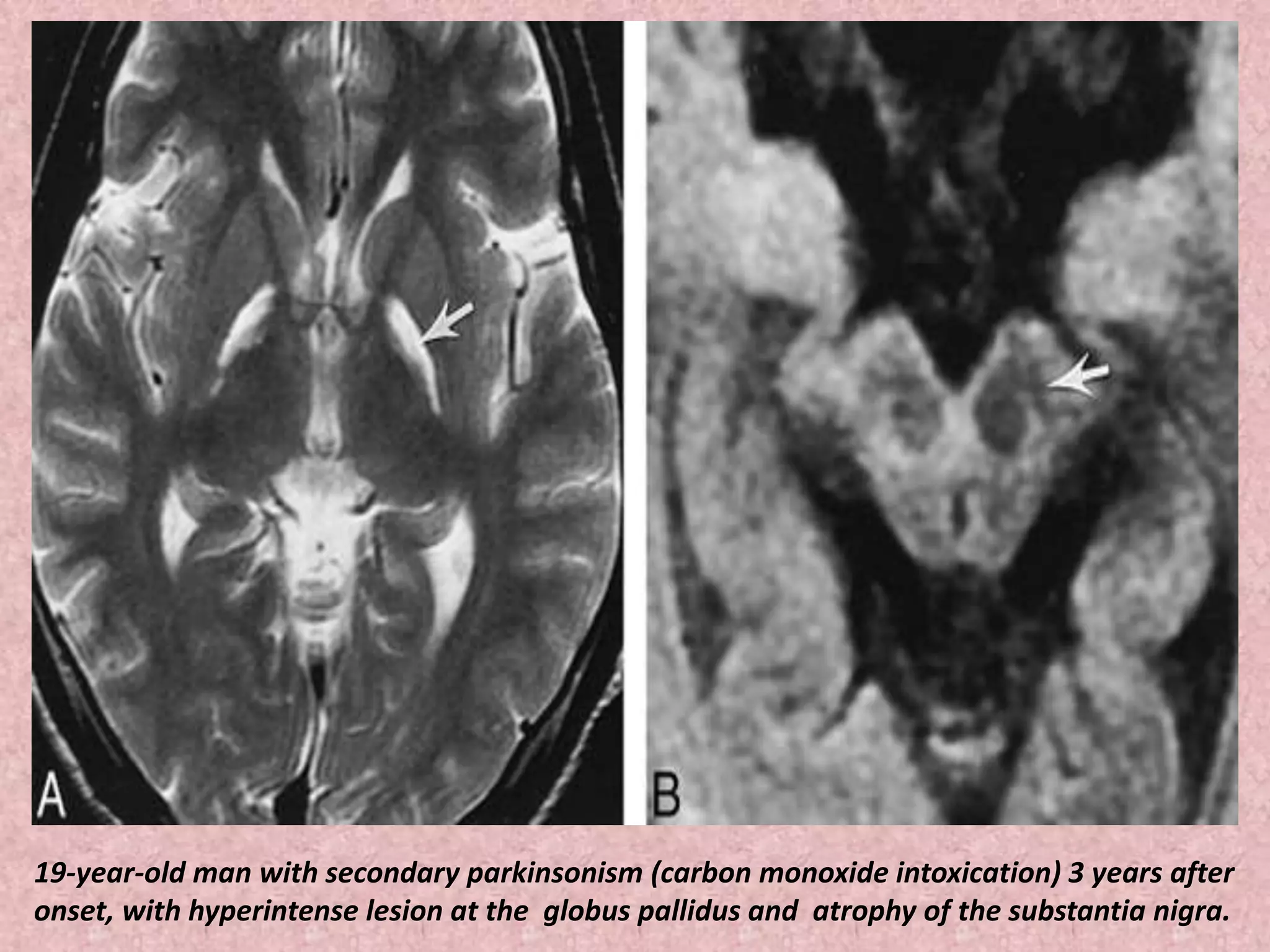
19-year-old man with secondary parkinsonism (carbon monoxide intoxication) 3 years after 
onset, with hyperintense lesion at the globus pallidus and atrophy of the substantia nigra.
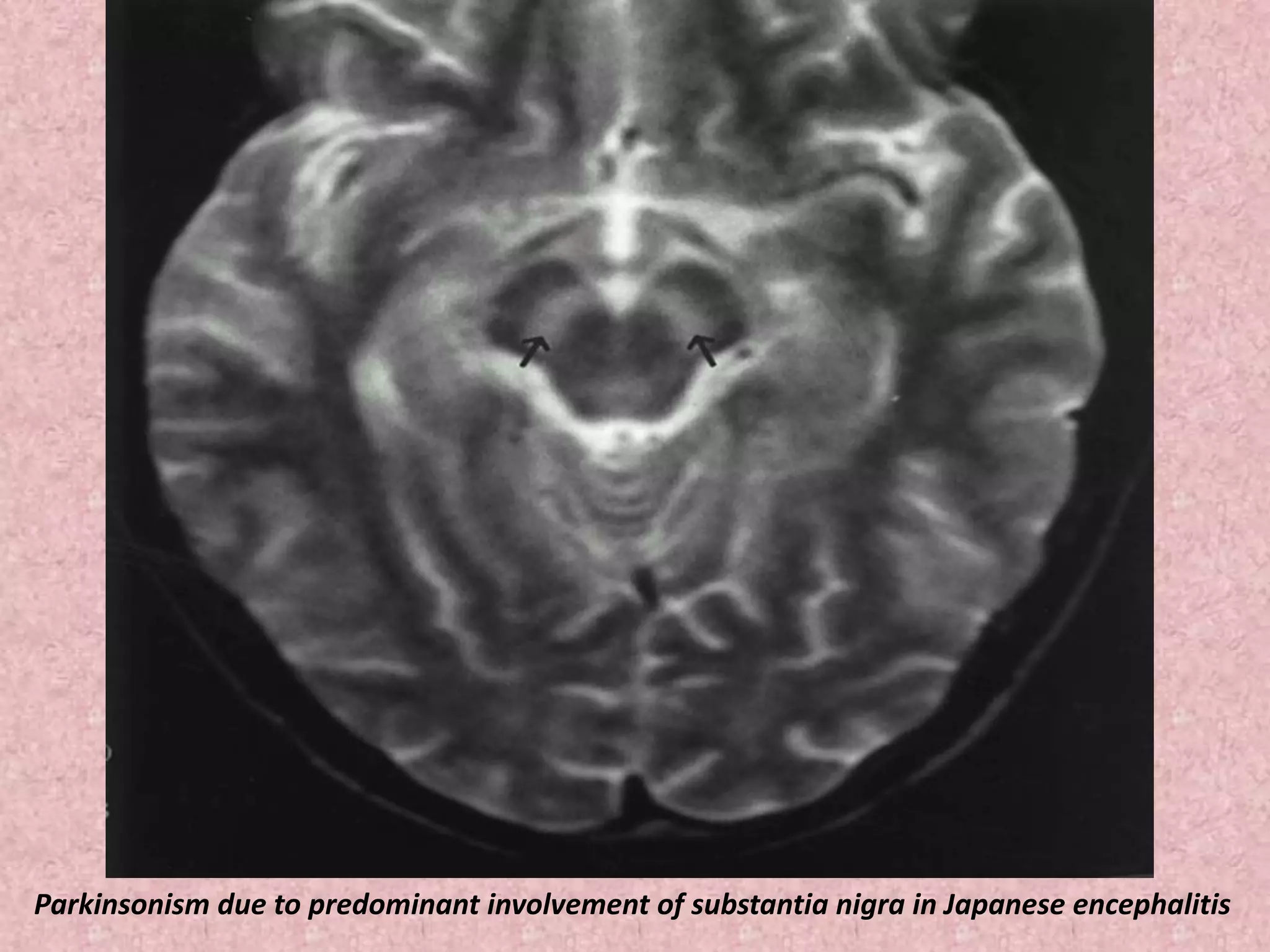
Parkinsonism due to predominant involvement of substantia nigra in Japanese encephalitis
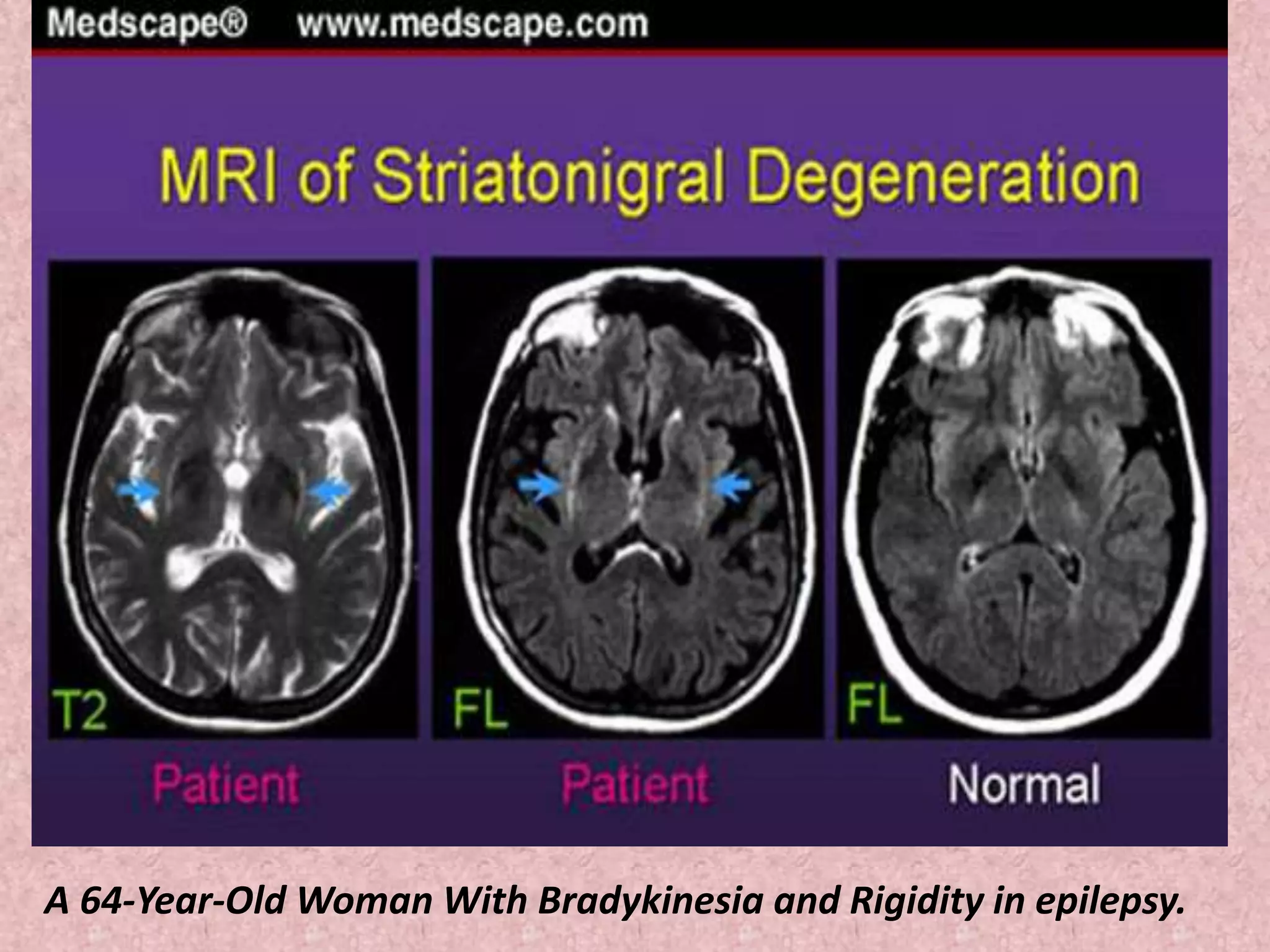
A 64-Year-Old Woman With Bradykinesia and Rigidity in epilepsy.
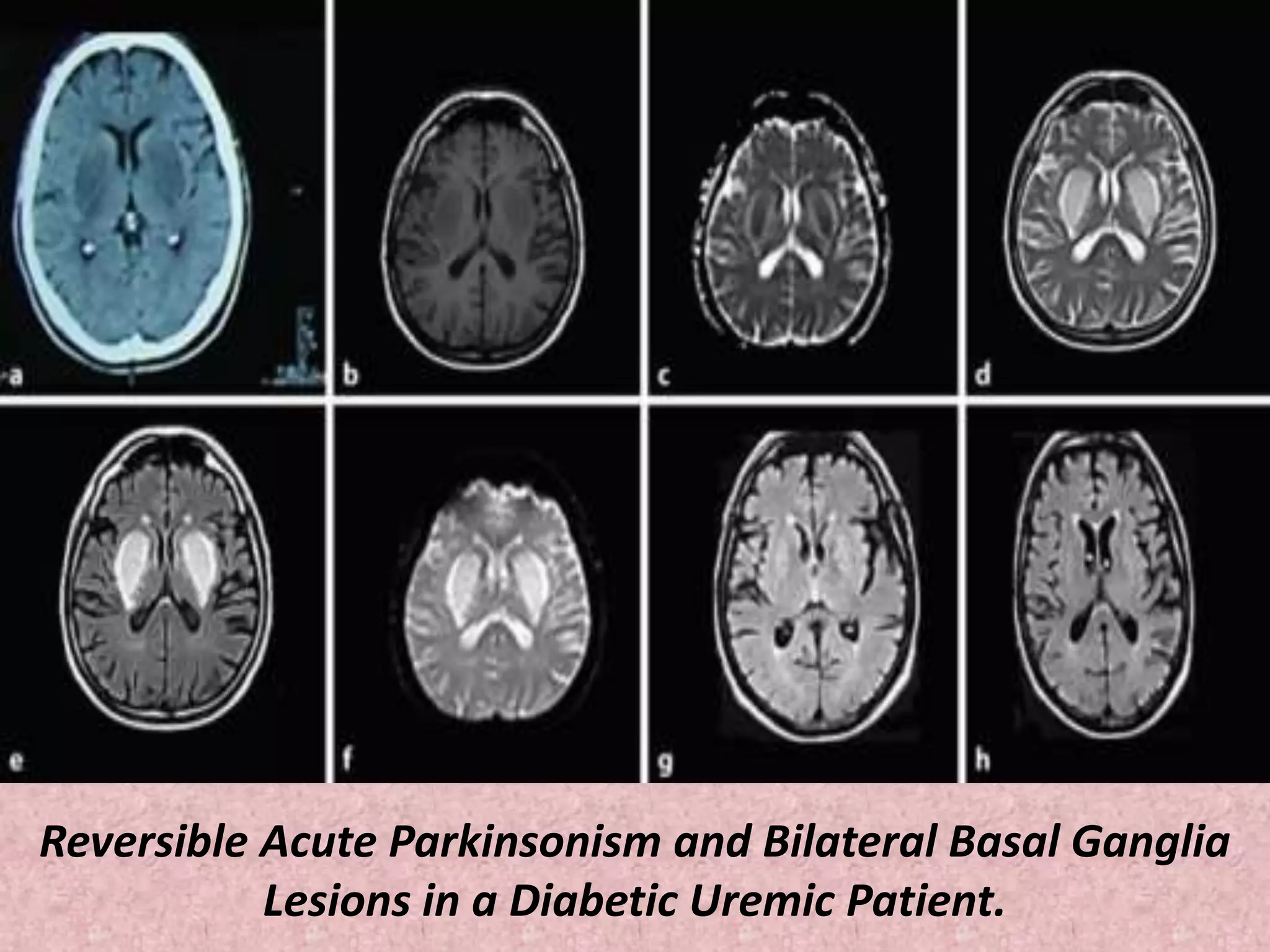
Reversible Acute Parkinsonism and Bilateral Basal Ganglia 
Lesions in a Diabetic Uremic Patient.
Differential diagnosis of parkinsonism using brain 18F-FP-CIT PET. Brain PET/CT images of 18F-FP- 
CIT uptake at level of striatum demonstrate different DAT density in different conditions. 
DAT density is decreased in PD patient (B), whereas DAT density is normal in healthy subject 
(A) and in patients with drug-induced parkinsonism (C) and essential tremor (D).
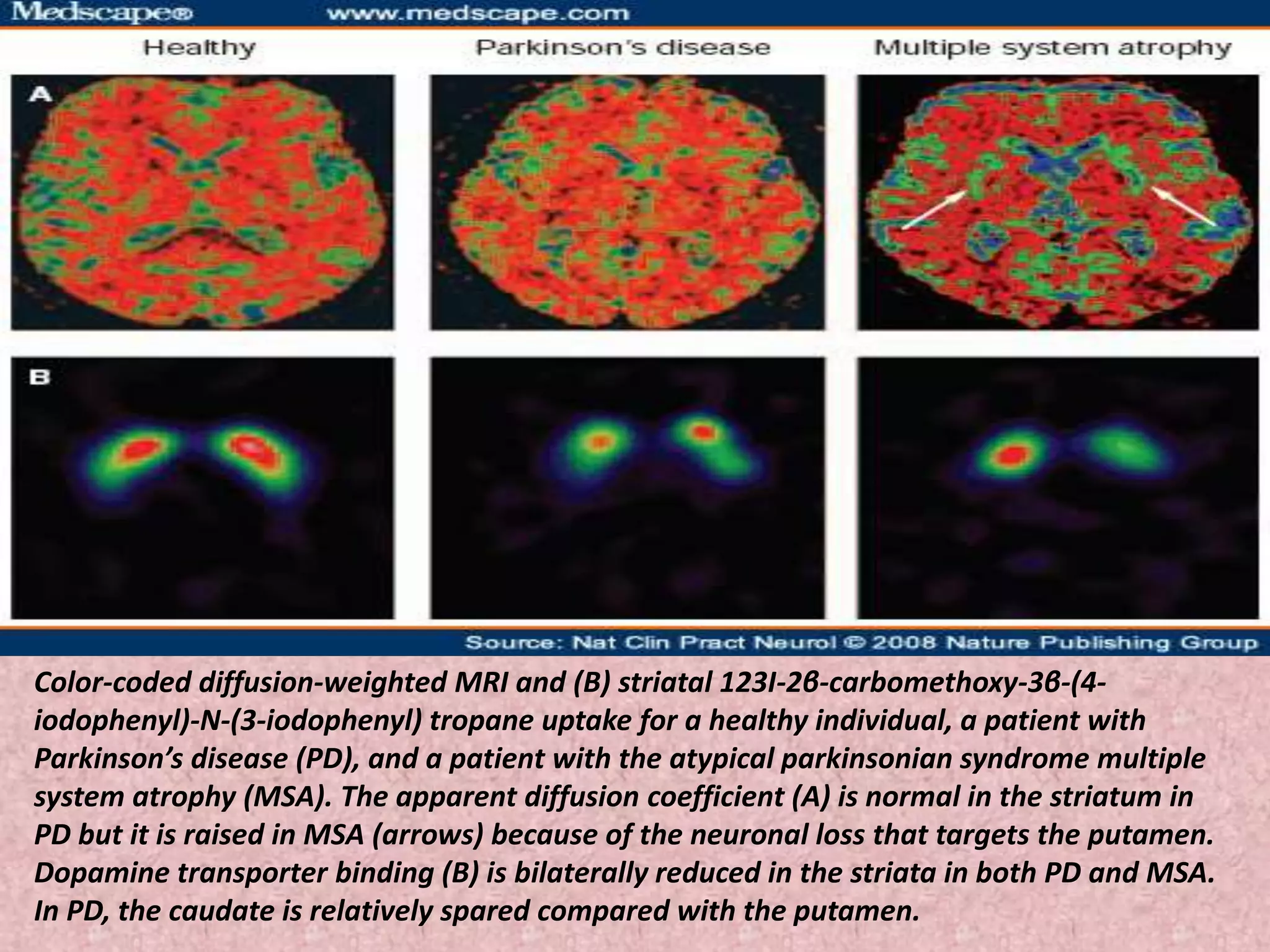
Color-coded diffusion-weighted MRI and (B) striatal 123I-2β-carbomethoxy-3β-(4- 
iodophenyl)-N-(3-iodophenyl) tropane uptake for a healthy individual, a patient with 
Parkinson’s disease (PD), and a patient with the atypical parkinsonian syndrome multiple 
system atrophy (MSA). The apparent diffusion coefficient (A) is normal in the striatum in 
PD but it is raised in MSA (arrows) because of the neuronal loss that targets the putamen. 
Dopamine transporter binding (B) is bilaterally reduced in the striata in both PD and MSA. 
In PD, the caudate is relatively spared compared with the putamen.
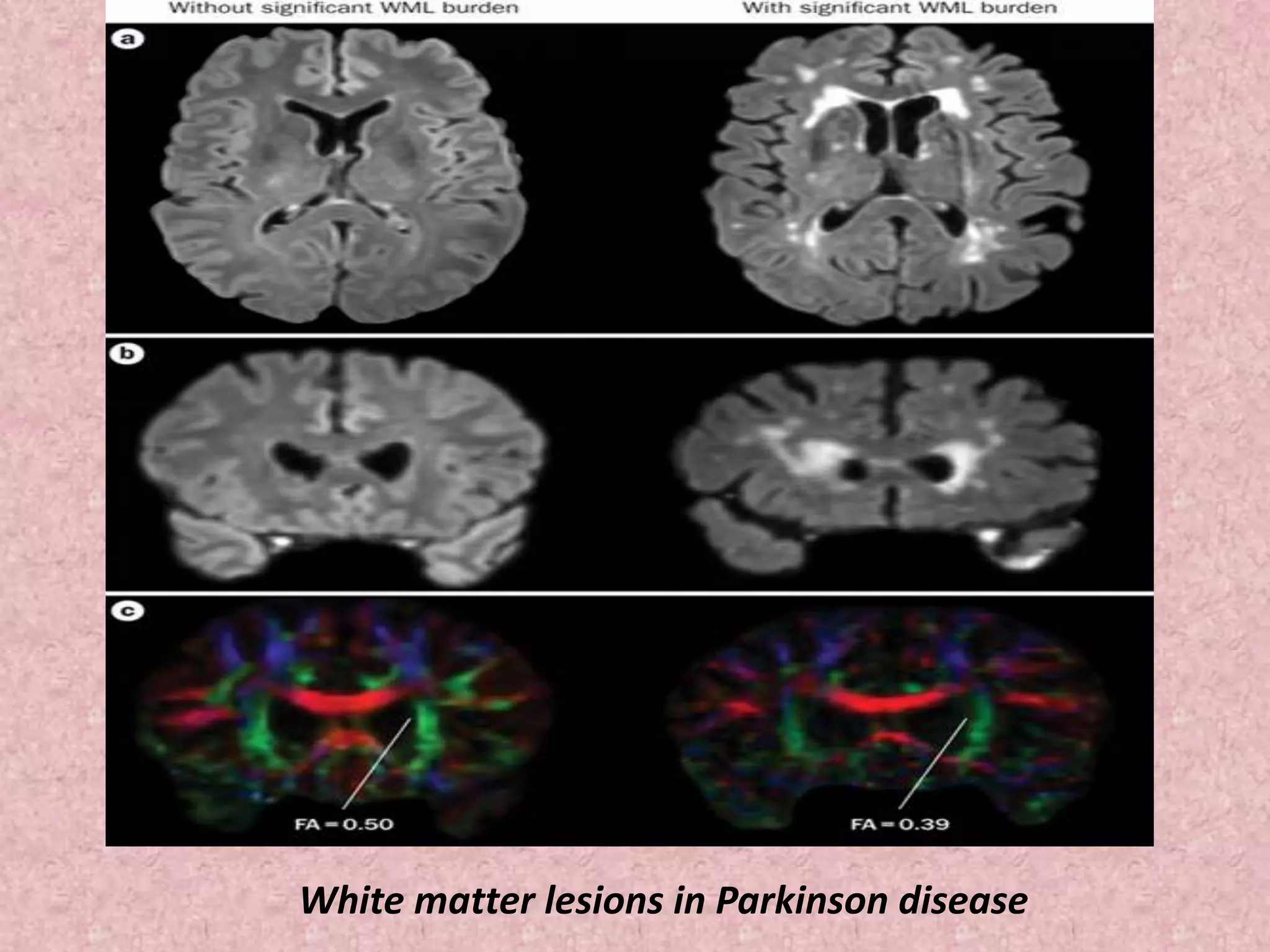
White matter lesions in Parkinson disease
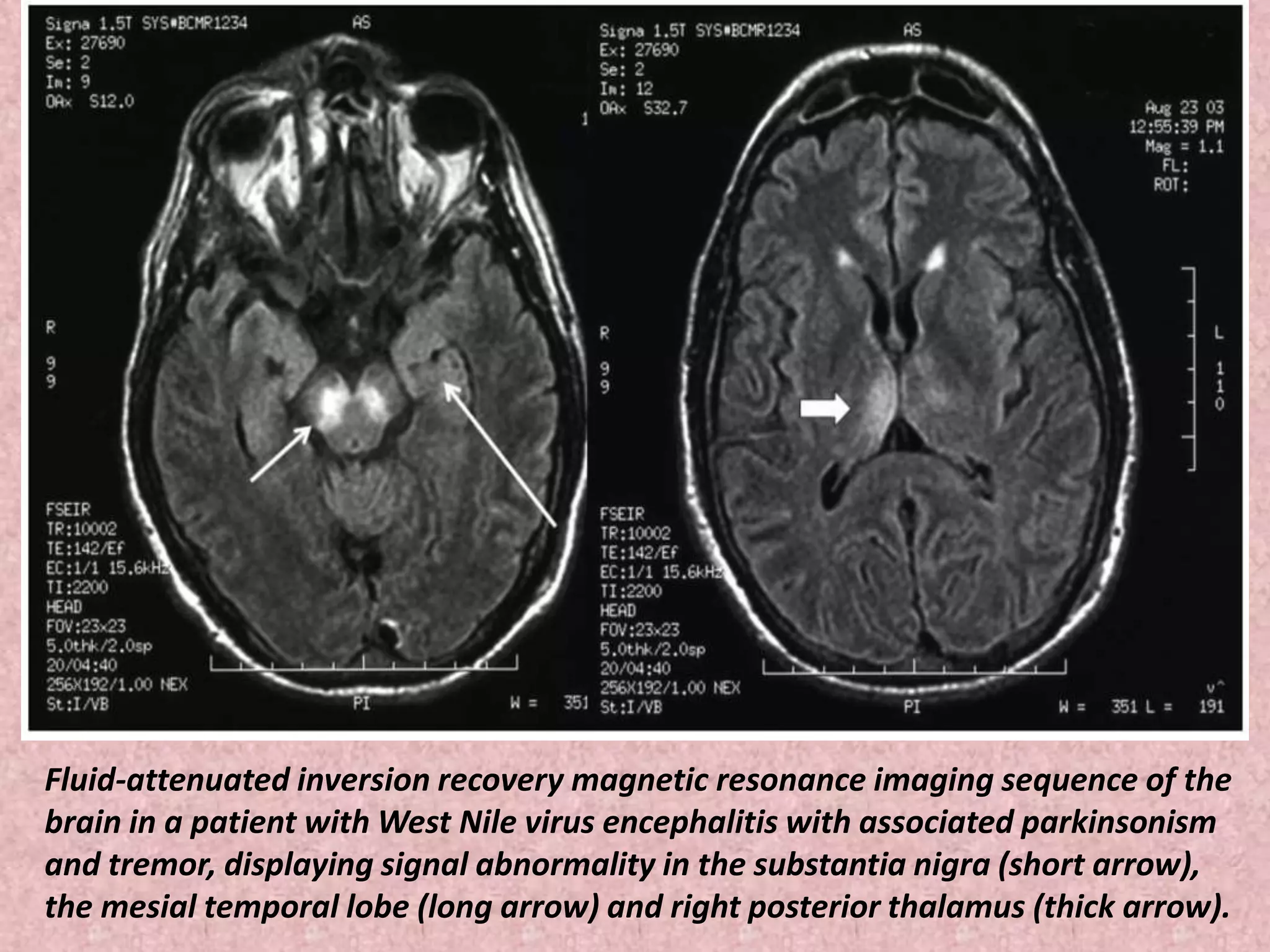
Fluid-attenuated inversion recovery magnetic resonance imaging sequence of the 
brain in a patient with West Nile virus encephalitis with associated parkinsonism 
and tremor, displaying signal abnormality in the substantia nigra (short arrow), 
the mesial temporal lobe (long arrow) and right posterior thalamus (thick arrow).
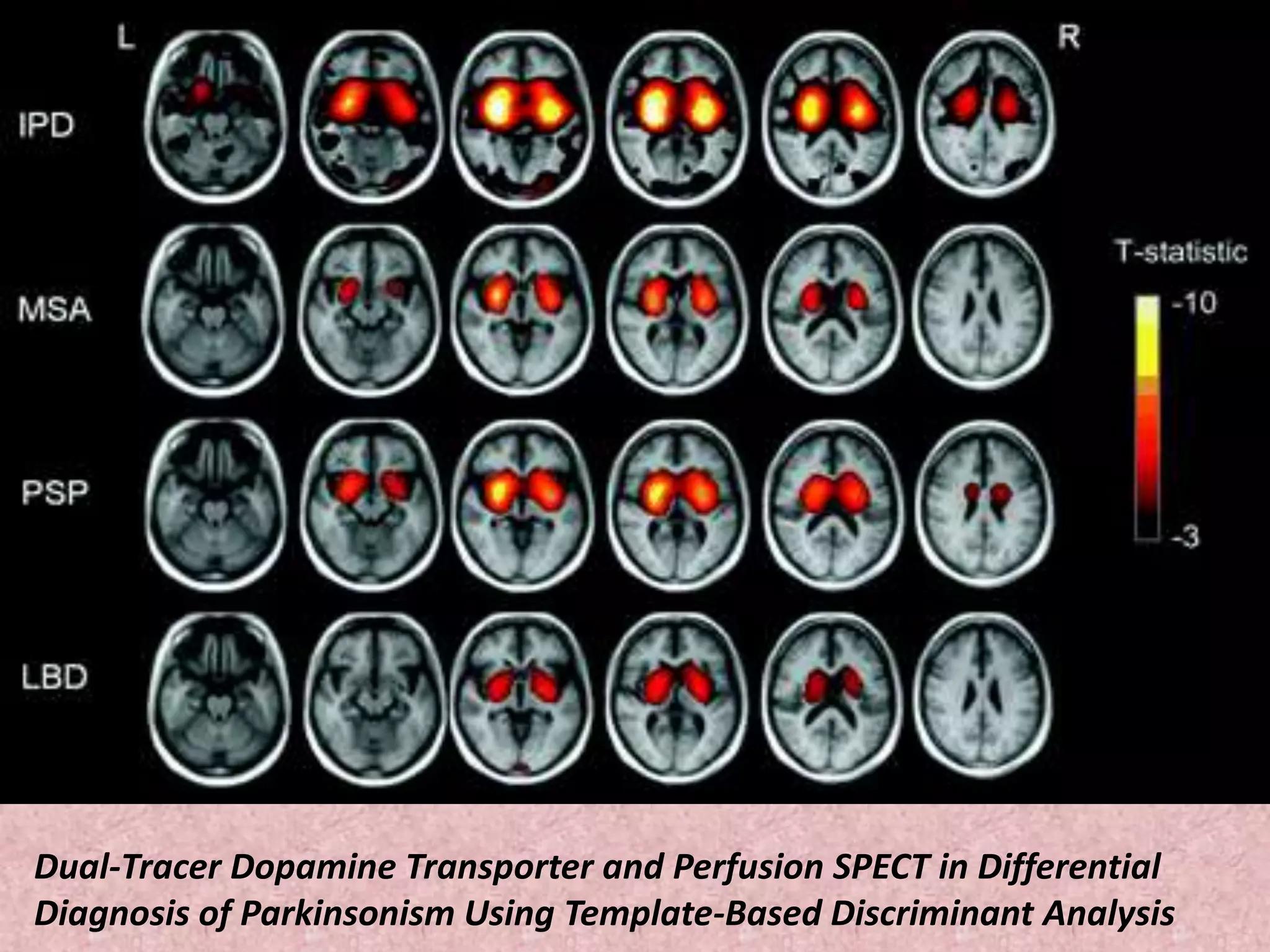
Dual-Tracer Dopamine Transporter and Perfusion SPECT in Differential 
Diagnosis of Parkinsonism Using Template-Based Discriminant Analysis
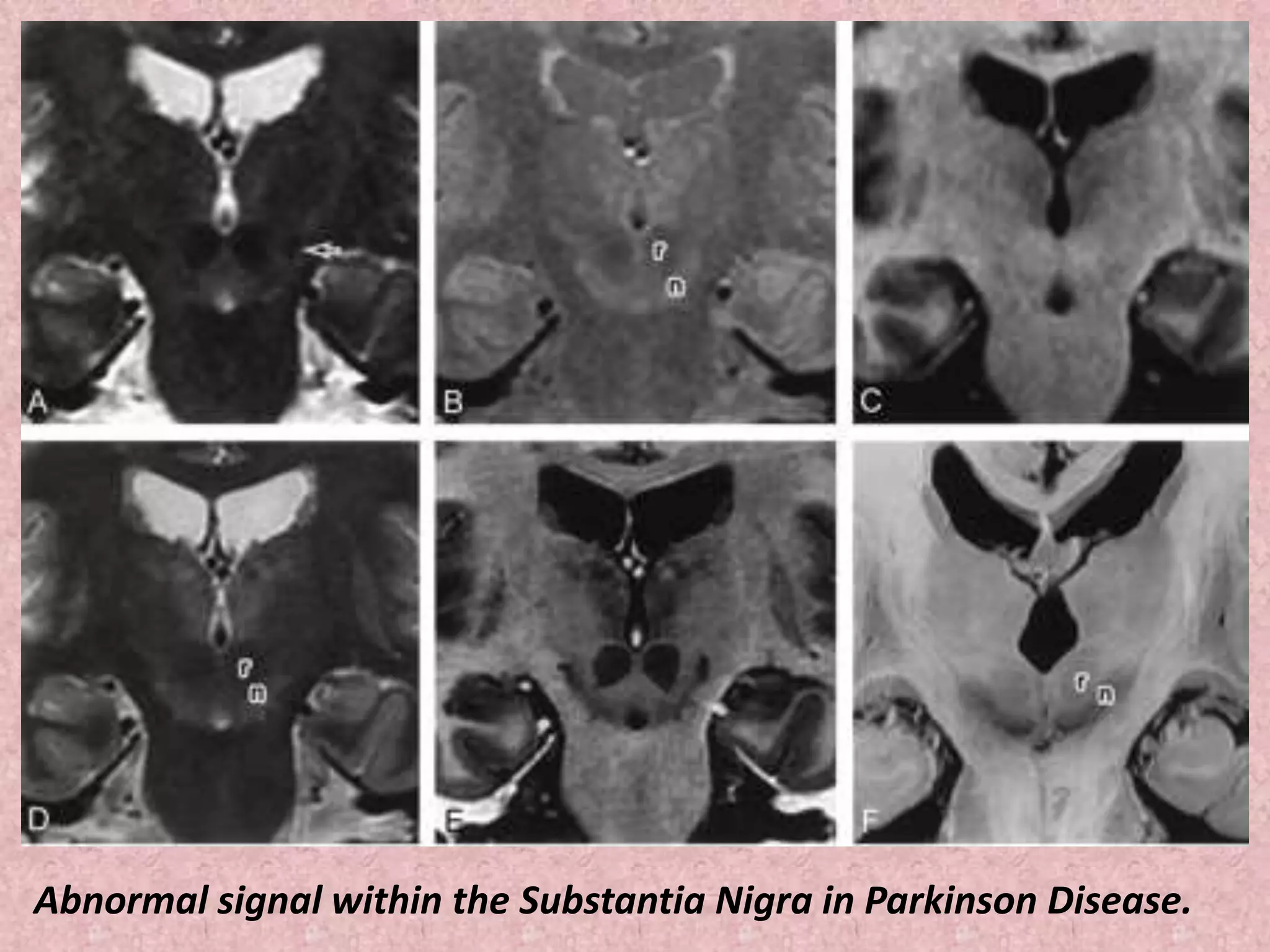
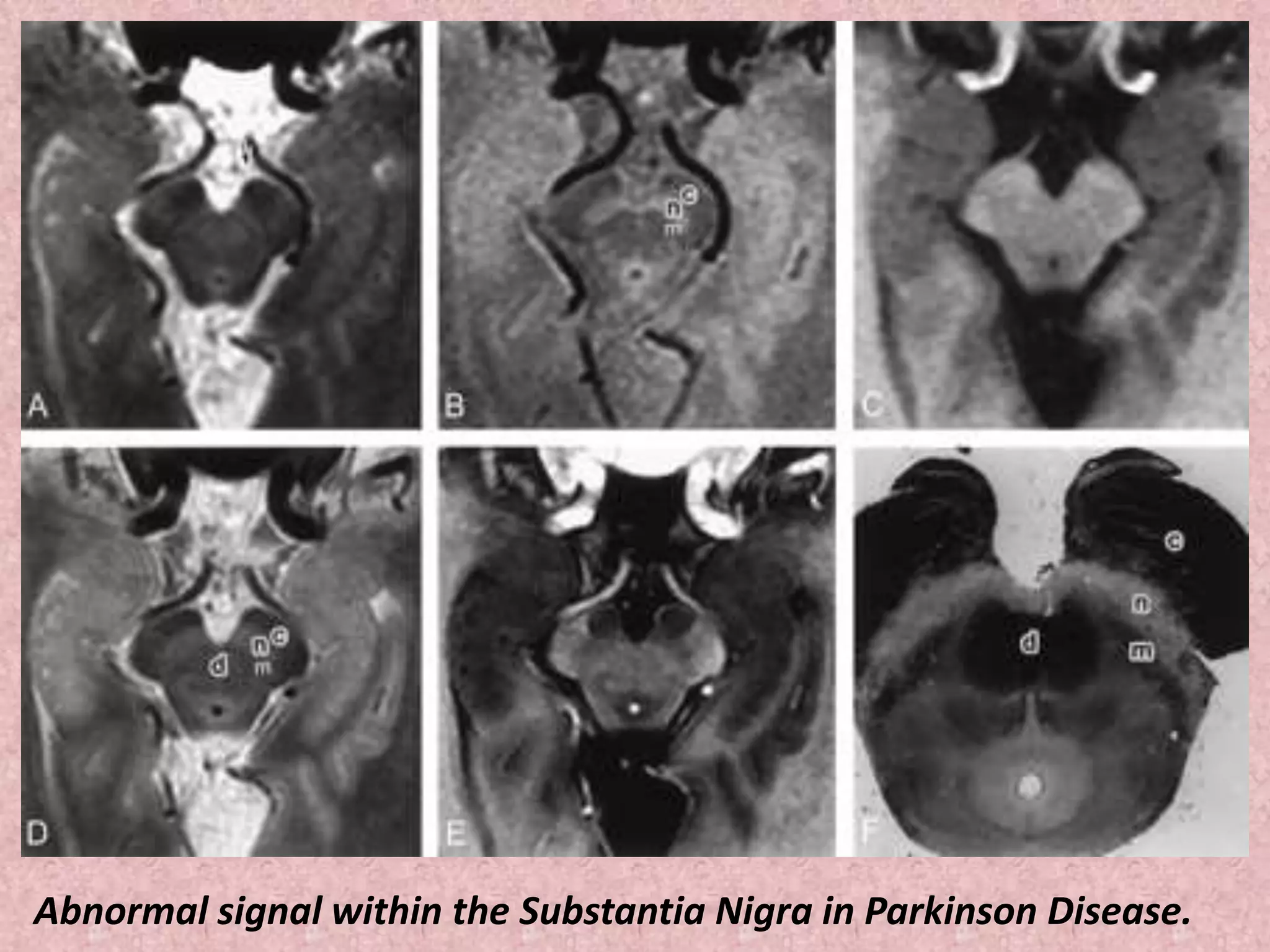
Abnormal signal within the Substantia Nigra in Parkinson Disease.
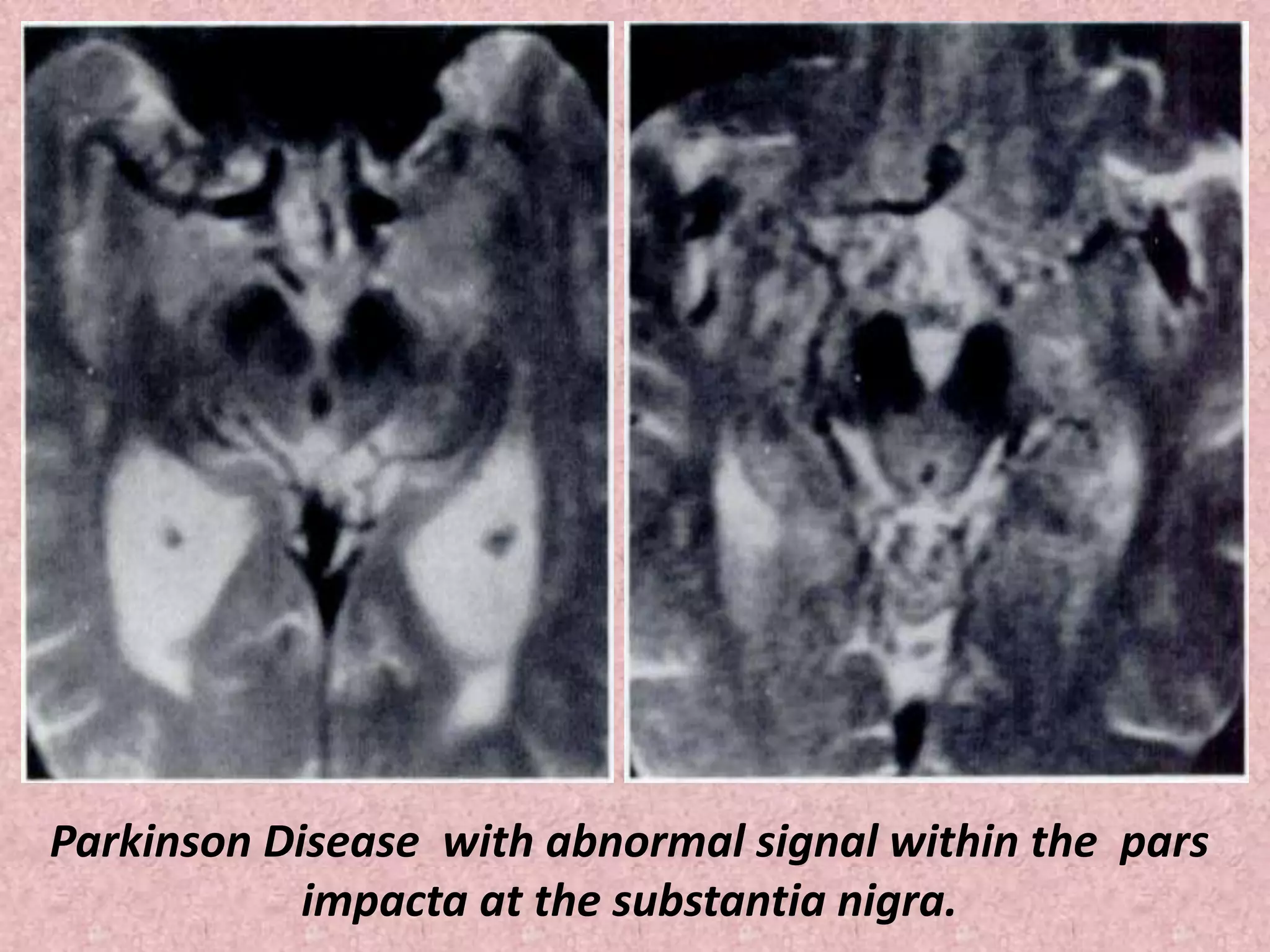
Parkinson Disease with abnormal signal within the pars 
impacta at the substantia nigra.
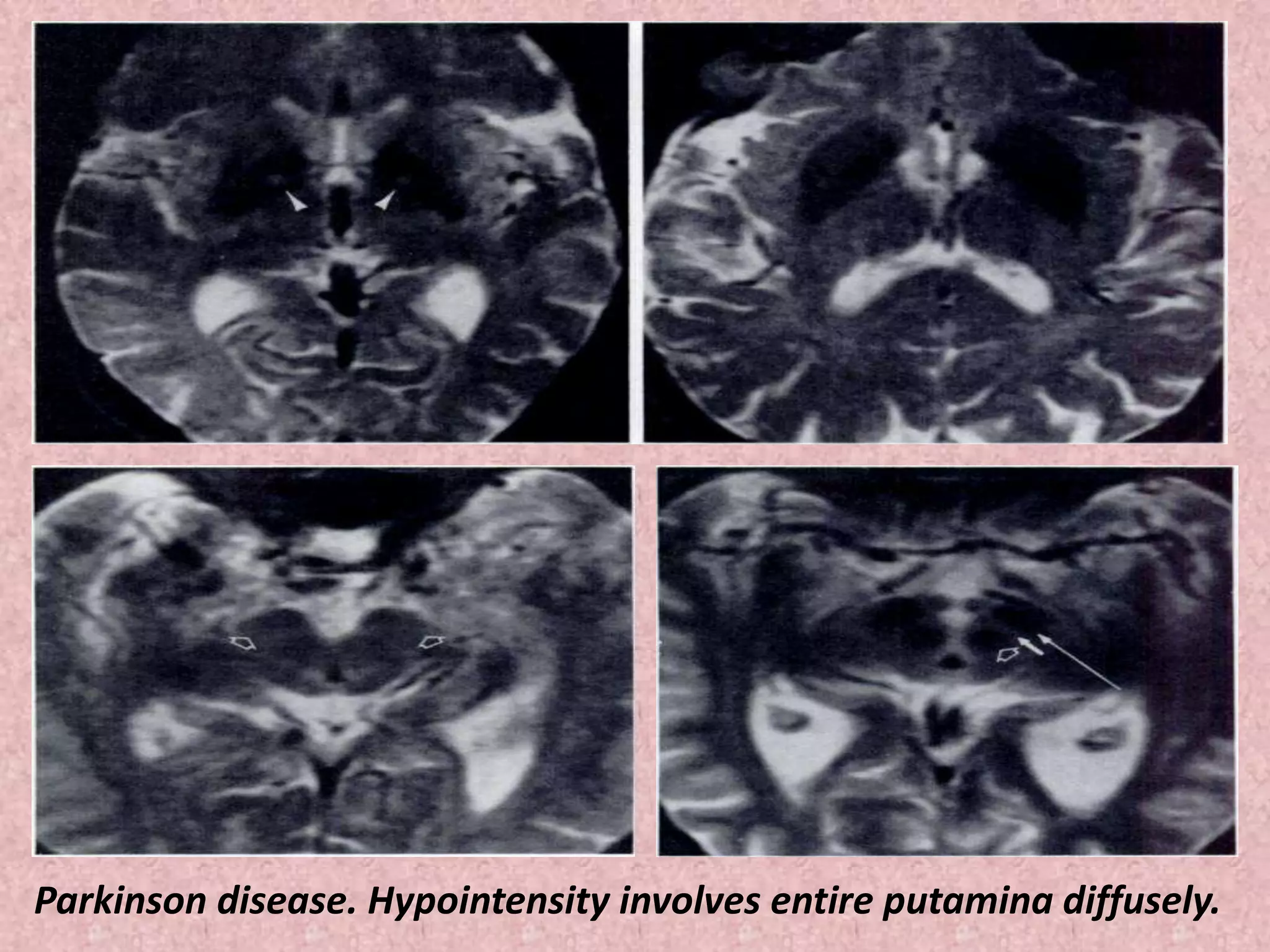
Parkinson disease. Hypointensity involves entire putamina diffusely.
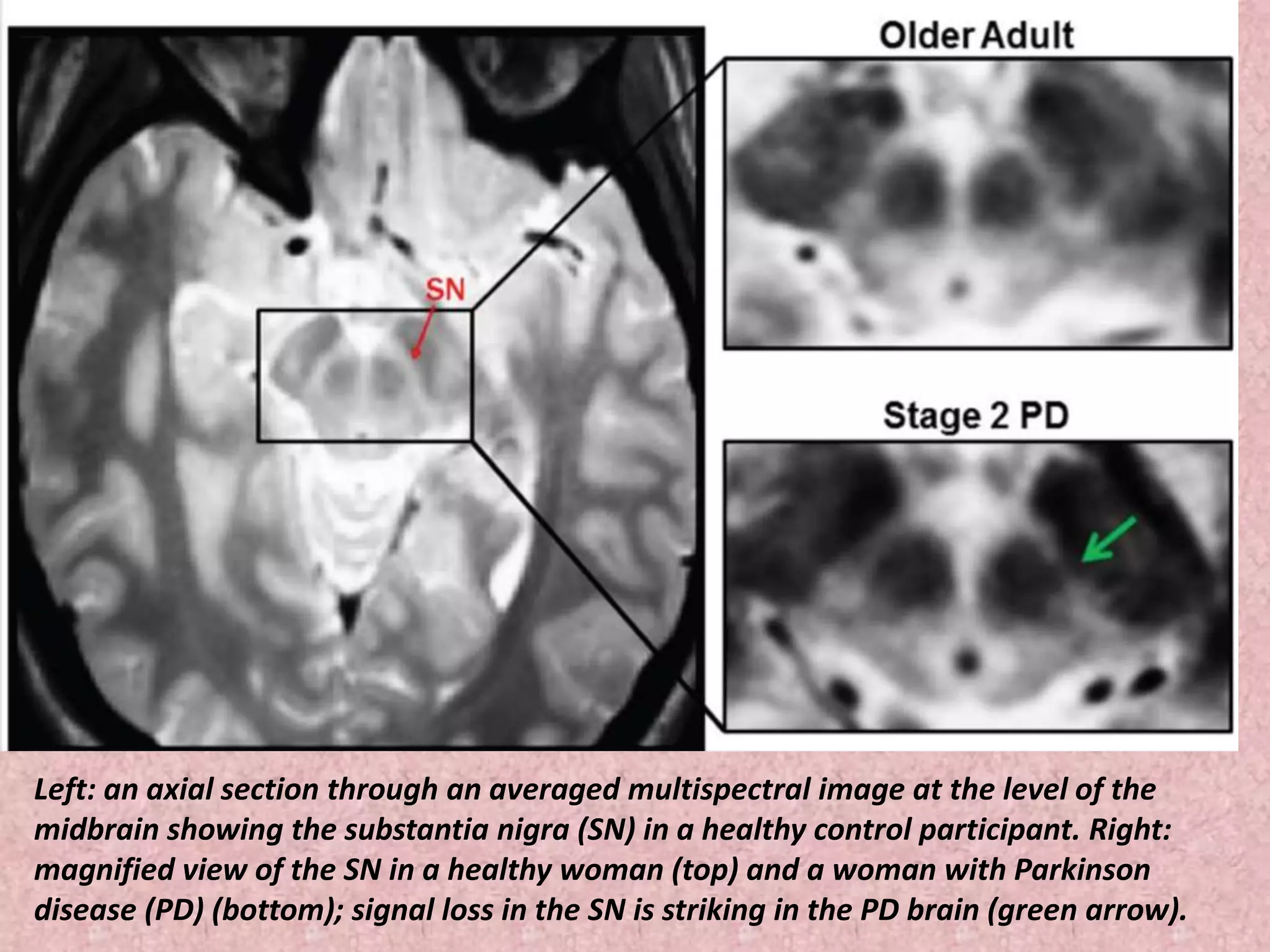
Left: an axial section through an averaged multispectral image at the level of the 
midbrain showing the substantia nigra (SN) in a healthy control participant. Right: 
magnified view of the SN in a healthy woman (top) and a woman with Parkinson 
disease (PD) (bottom); signal loss in the SN is striking in the PD brain (green arrow).
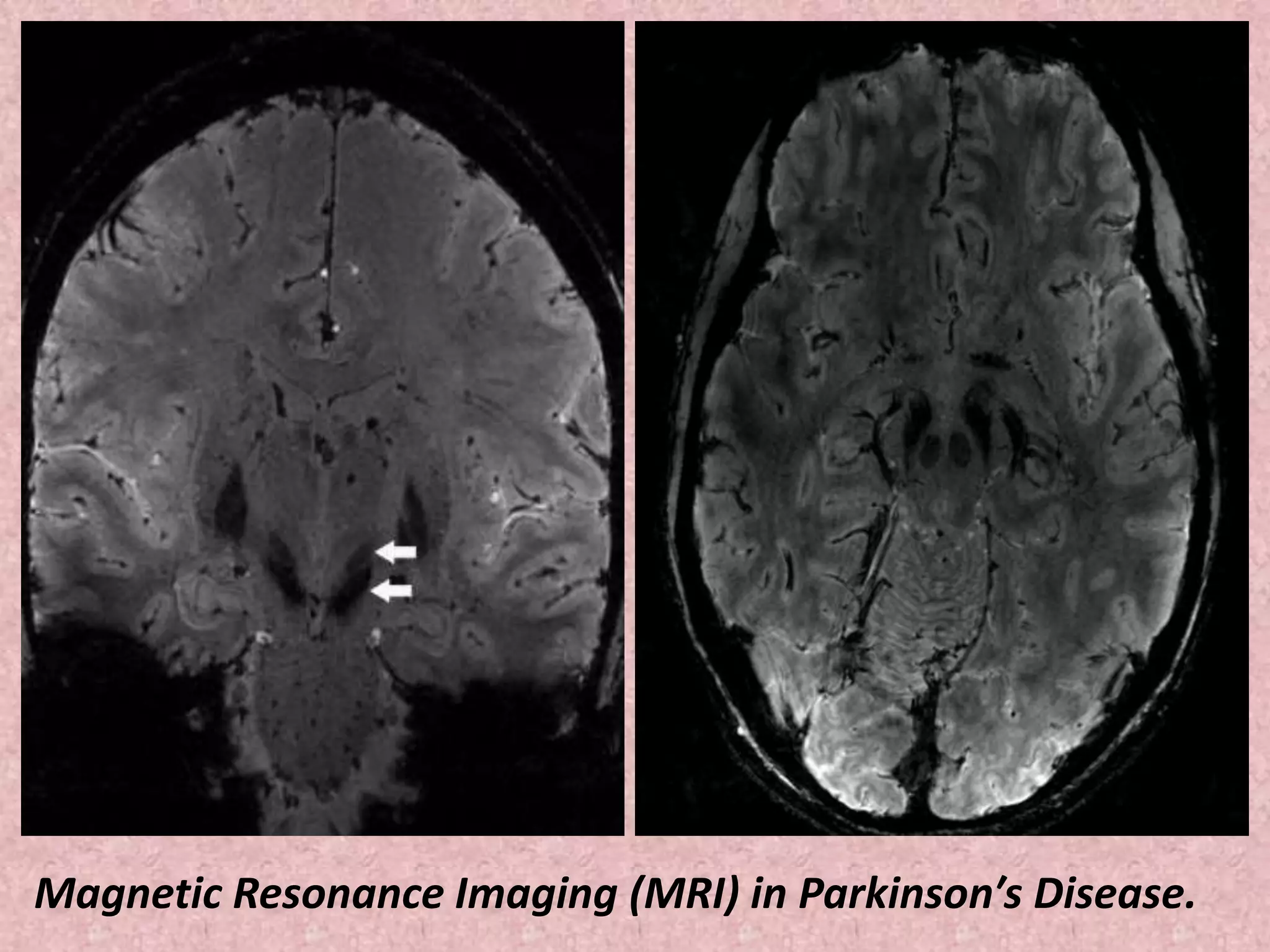
Magnetic Resonance Imaging (MRI) in Parkinson′s Disease.
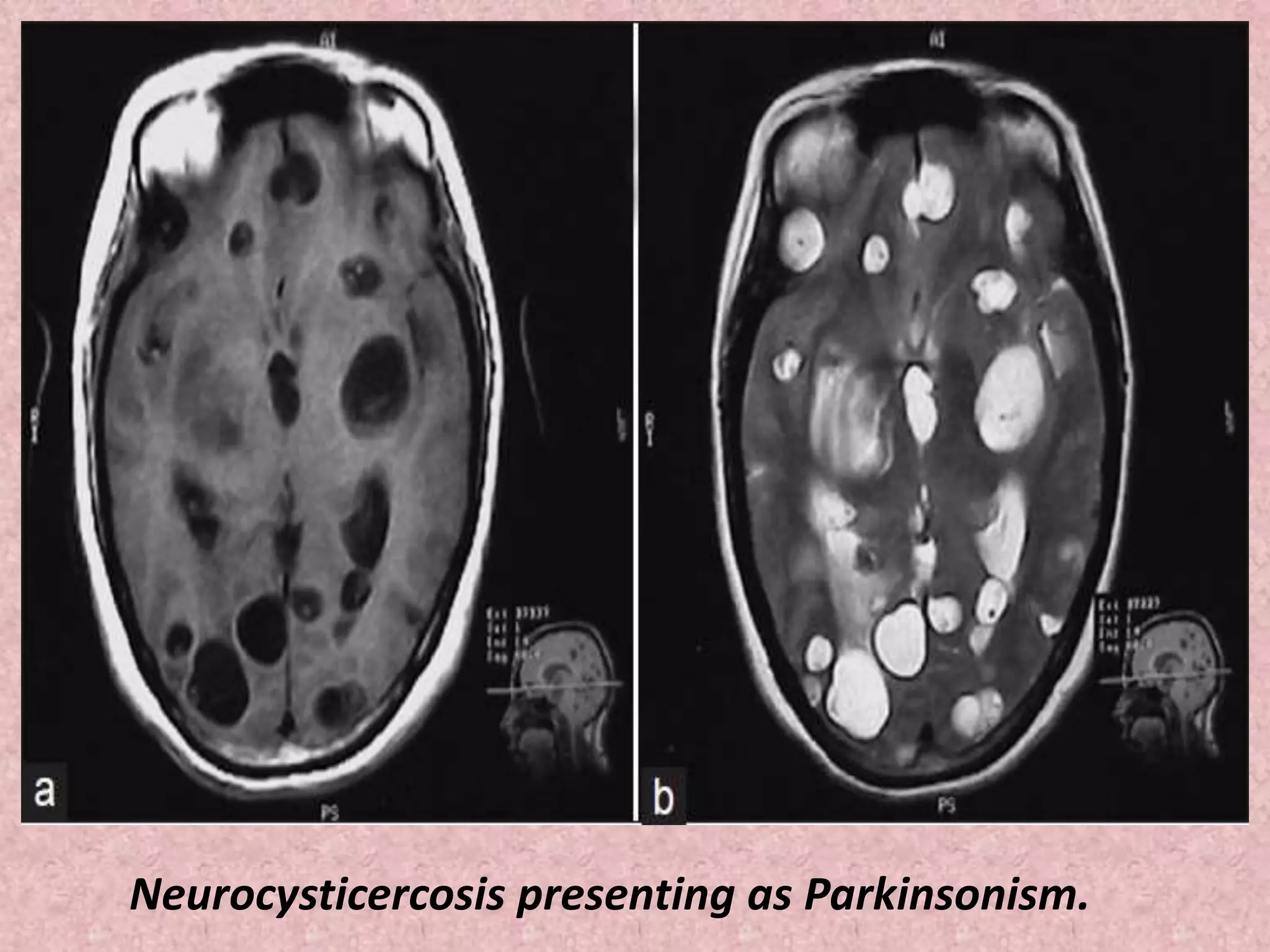
Neurocysticercosis presenting as Parkinsonism.
Thank You.

Presentation1.pptx, radiological imaging of parkinsonism.

  • 1.
    Radiological imaging ofparkinsonism. Dr/ ABD ALLAH NAZEER. MD.
  • 2.
    Parkinson's disease describedby James Parkinson in 1817. Parkinson’s disease is a chronic neurodegenerative movement disorder affecting voluntary and emotional movements and most commonly seen in the elderly, but is also found in the young and inexorably progresses leading to significant disability. Average age of onset is 62.5 years. Men and women affected equally. Pathogenesis: Four theories. Oxidative damage, Mitochondrial dysfunction, enhanced oxidative stress, proteosomal dysfunction causes cell death. Environmental toxins, MPTP-Methyl-phenyl tetrahydropyridine, Mutation in the gene located on chromosome 4. Genetic predisposition, Mutation in the gene located on chromosome 4. Accelerated aging.
  • 4.
    Classification and Etiology. Idiopathic Parkinson’s disease Parkinson-like syndromes Drug induced parkinsonism Hypoxia Tumor Trauma Vascular:Multiinfarct Toxin:Mn, CO, MPTP and cyanide Post-encephalitic parkinsonism (von Economo’s encephalitis) Normal pressure hydrocephalus Wilson’s disease, Hutington’s disease
  • 5.
    Medications that cancause parkinsonian symptoms, but not PD itself, include the following: Metoclopramide Domperidone Reserpine-containing antihypertensives Neuroleptics Some evidence also indicates that certain environmental factors (including smoking and coffee drinking) may actually have protective associations.
  • 6.
    Clinical features ofIdiopathic Parkinson’s disease. Major features Resting tremor in hands, arms, legs, jaw, and Face. Bradykinesia Rigidity- cogwheel or lead-pipe Minor features Bradyphrenia Speech abnormalities Depression Dysautonomia Dystonia Constipation Hallucinations Dysphagia
  • 7.
  • 8.
    Tremor dominant Tremor:  Rest  Fixed frequency 3-6 Hz  Not a feature of old age  Pill-rolling  Usually starts in one limb, and then to other limbs  Rarely starts in lower limbs  Intermittent for many years  They usually disappear briefly during movement and do not occur during sleep. • Tremors can also eventually occur in the head, lips, tongue, and feet. In younger patients tremor is usually predominant and often suggests a less aggressive form of the disease.
  • 9.
    Rigidity Striatal hand:Ulnar deviation, MCP flexion, IP extension Striatal toe: Big toe dorsiflexion Sitting en bloc: Collapses into a chair on attempting to sit down Posture Kyphosis Flexed elbows, knees and hips Hands held in front of body Trunk bent forward Head bowed
  • 10.
    Bradykinesia Slowness ofmotion (bradykinesia) is one of the classic symptoms of Parkinson's disease. Hypomimia- “masked facies”, expressionless face, blinking Speech abnormalities- Hypophonia: soft voice Aprosody of speech: monotonous and lack of inflection Tachyphemia: do not separate syllables together, running words together Patients may eventually develop a stooped posture and a slow, shuffling walk. The gait can be erratic and unsteady.
  • 11.
    Motor fluctuations Freezingphenomenon- Sudden, transient inability to perform active movements, lasting no more than a few seconds: Start hesitation Turn hesitation Target hesitation Palilalia (speaking) Apraxia of eyelid opening Writing Kinesia paradoxica-Despite severe rigidity and bradykinesia, they may rise suddenly and move normally.
  • 12.
    Festinating gait Droolingof saliva Dysphagia Constipation Dementia Depression Orthostatic hypotension Low resting blood pressure HTN Normotensive Sweating abnormalities-excessive perspiration Blepharospasm/ keratitis.
  • 13.
    Investigations: The diagnosisis made clinically , as there is no diagnostic test for Parkinson's disease. Imaging (CT or MRI) of the brain needed if there are any features suggestive of pyramidal, cerebellar or autonomic involvement or the diagnosis is otherwise in dought (e.g to exclude stroke). Routine brain imaging is unnecessary in patients with typical Parkinson’s disease. Dopamine transporter (DAT) imaging can help to differentiate patients with Parkinson’s disease from healthy individuals and patients with essential tremor or drug induced parkinsonism Structural MRI may be performed to rule out alternative diagnoses (including other neurodegenerative syndromes and structural or vascular lesions).
  • 16.
    T1-weighted MR imagesshow bilateral and symmetrical hyperintensities in the substantia nigra and cerebral peduncle (A), subthalamic region and hemispheric white matter (B), and the globus pallidus and putamen (C) in reversal parkinsonism patient following embolization of intra-hepatic venous shunt.
  • 17.
    19-year-old man withsecondary parkinsonism (carbon monoxide intoxication) 3 years after onset, with hyperintense lesion at the globus pallidus and atrophy of the substantia nigra.
  • 18.
    Parkinsonism due topredominant involvement of substantia nigra in Japanese encephalitis
  • 19.
    A 64-Year-Old WomanWith Bradykinesia and Rigidity in epilepsy.
  • 20.
    Reversible Acute Parkinsonismand Bilateral Basal Ganglia Lesions in a Diabetic Uremic Patient.
  • 21.
    Differential diagnosis ofparkinsonism using brain 18F-FP-CIT PET. Brain PET/CT images of 18F-FP- CIT uptake at level of striatum demonstrate different DAT density in different conditions. DAT density is decreased in PD patient (B), whereas DAT density is normal in healthy subject (A) and in patients with drug-induced parkinsonism (C) and essential tremor (D).
  • 22.
    Color-coded diffusion-weighted MRIand (B) striatal 123I-2β-carbomethoxy-3β-(4- iodophenyl)-N-(3-iodophenyl) tropane uptake for a healthy individual, a patient with Parkinson’s disease (PD), and a patient with the atypical parkinsonian syndrome multiple system atrophy (MSA). The apparent diffusion coefficient (A) is normal in the striatum in PD but it is raised in MSA (arrows) because of the neuronal loss that targets the putamen. Dopamine transporter binding (B) is bilaterally reduced in the striata in both PD and MSA. In PD, the caudate is relatively spared compared with the putamen.
  • 23.
    White matter lesionsin Parkinson disease
  • 24.
    Fluid-attenuated inversion recoverymagnetic resonance imaging sequence of the brain in a patient with West Nile virus encephalitis with associated parkinsonism and tremor, displaying signal abnormality in the substantia nigra (short arrow), the mesial temporal lobe (long arrow) and right posterior thalamus (thick arrow).
  • 27.
    Dual-Tracer Dopamine Transporterand Perfusion SPECT in Differential Diagnosis of Parkinsonism Using Template-Based Discriminant Analysis
  • 28.
    Abnormal signal withinthe Substantia Nigra in Parkinson Disease.
  • 29.
    Abnormal signal withinthe Substantia Nigra in Parkinson Disease.
  • 30.
    Parkinson Disease withabnormal signal within the pars impacta at the substantia nigra.
  • 31.
    Parkinson disease. Hypointensityinvolves entire putamina diffusely.
  • 32.
    Left: an axialsection through an averaged multispectral image at the level of the midbrain showing the substantia nigra (SN) in a healthy control participant. Right: magnified view of the SN in a healthy woman (top) and a woman with Parkinson disease (PD) (bottom); signal loss in the SN is striking in the PD brain (green arrow).
  • 33.
    Magnetic Resonance Imaging(MRI) in Parkinson′s Disease.
  • 34.
  • 35.