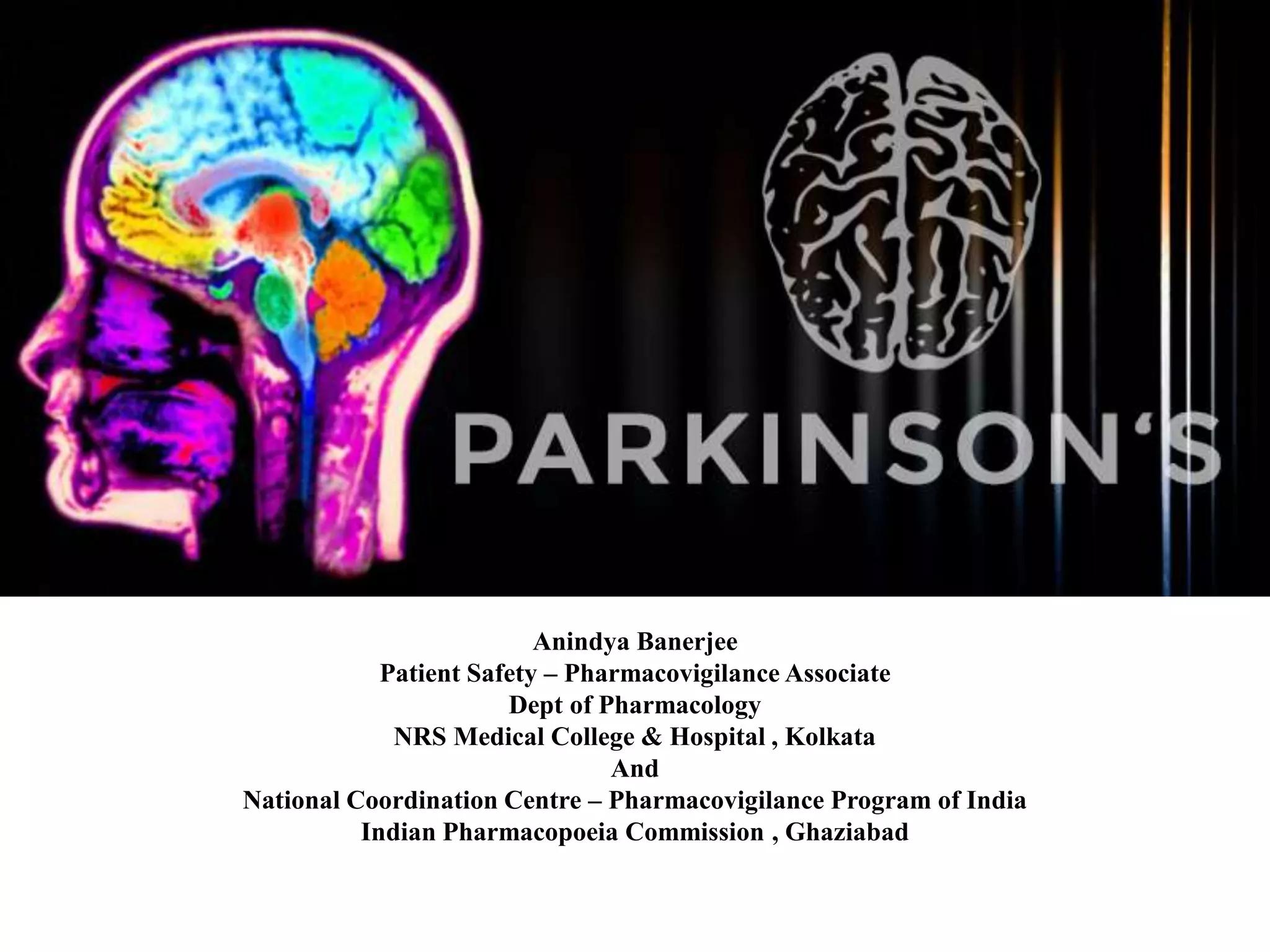
Anindya Banerjee
Patient Safety โ€“ Pharmacovigilance Associate
Dept of Pharmacology
NRS Medical College & Hospital , Kolkata
And
National Coordination Centre โ€“ Pharmacovigilance Program of India
Indian Pharmacopoeia Commission , Ghaziabad
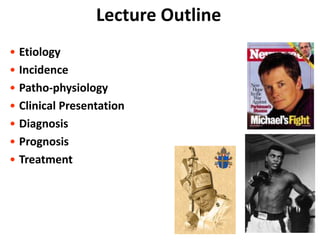
Lecture Outline
โ€ข Etiology
โ€ข Incidence
โ€ข Patho-physiology
โ€ข Clinical Presentation
โ€ข Diagnosis
โ€ข Prognosis
โ€ข Treatment
Parkinsonโ€™s Disease
Parkinsonโ€™s disease , is named after James
Parkinson who in 1817 wrote a classic โ€œshaking
palsyโ€a disease for which the reason is still
unknown .
โ€ข Definition :-
It is a chronic degenerative disorder that
primarily affects the neurons of the basal
ganglia.
It is a syndrome that consists of slowing down in
the initiation and execution of movement
(brady kinesia), increased muscle tone
(rigidity), tremor and impaired postural
reflexes
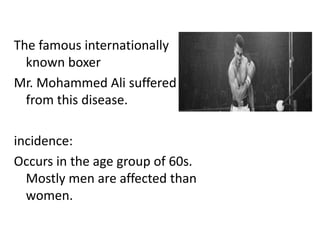
The famous internationally
known boxer
Mr. Mohammed Ali suffered
from this disease.
incidence:
Occurs in the age group of 60s.
Mostly men are affected than
women.
Etiology
๏ฎ Parkinsonism: differing combinations of slowness of
movement (bradykinesia), increased tone/stiffness
(rigidity), tremor & loss of postural reflexes(akinetic-
rigid syndromes).
๏ฎ The most common cause of parkinsonism is
idiopathic (no known cause) Parkinson's disease.
In most-may be combination of factors:
๏ฎ Environmental toxins (MPTP, occasionally
pesticides):
The discovery that methyl-phenyl-
tetrahydropyridine (MPTP; A contaminant in
methylenedioxymethamphetamine ("ecstasyโ€œ))
caused severe parkinsonism in young drug users
suggests that the idiopathic disease might be due
to an environmental toxin.
๏ฎ Viral infections (encephalitis lethargica)
๏ฎ No strong genetic factors, but genetic influence
may be greater than previously thought. Genetic
mutations 1-2%; alpha-synuclein gene, Parkin
gene, Ubiquitin gene mutations.
๏ฎ Protective factors-Both smoking and coffee
drinking have been associated with a lower risk
for PD.
PARKINSON'S DISEASE-Incidence
7
๏ฎ Annual incidence 0.2/1000 & prevalence of 1.5/1000.
๏ฎ Prevalence rates are similar throughout the world, except lower rates in
China /West Africa.
๏ฎ Affects 1% of those over 55 years, 1.5% of people 70-79 years of age
๏ฎ Generally occurs between 50-80 years
๏ฎ Sex incidence is about equal.
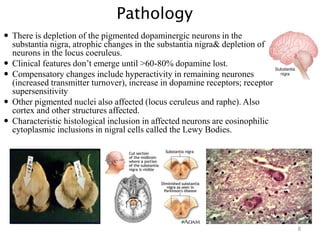
Pathology
๏‚— There is depletion of the pigmented dopaminergic neurons in the
substantia nigra, atrophic changes in the substantia nigra& depletion of
neurons in the locus coeruleus.
๏‚— Clinical features donโ€™t emerge until >60-80% dopamine lost.
๏‚— Compensatory changes include hyperactivity in remaining neurones
(increased transmitter turnover), increase in dopamine receptors; receptor
supersensitivity
๏‚— Other pigmented nuclei also affected (locus ceruleus and raphe). Also
cortex and other structures affected.
๏‚— Characteristic histological inclusion in affected neurons are eosinophilic
cytoplasmic inclusions in nigral cells called the Lewy Bodies.
8
Free Radicals
โ€ข Unpaired electrons that can easily react with
surrounding molecules and destroy them.
โ€ข Metabolism of dopamine by MAO produce hydrogen
peroxide.
โ€ข Glutathione normally breaks down the hydrogen
peroxide quickly.
โ€ข Reduced glutathione = loss of protection against free
radicals ๏ƒ  cell damage
Genetic Factors
โ€ข Mutation of SNCA genes in chromosome 4.
โ€ข 2 types of alterations:
โ€ข Alanine is replaced with
threonine.
โ€ข Cause alpha-synuclein to
misfold.
โ€ข SNCA genes is
inappropriately duplicated or
triplicated.
โ€ข Extra copies of the gene lead
to an excess of alpha-
synuclein.
โ€ข Aggregate (Lewy bodies) and attract other protein.
โ€ข Clog neuron and impair the function of neuron.
Parkinsonโ€™s Disease-Patho-physiology
11
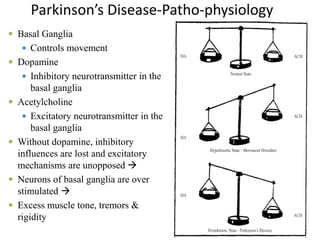
๏‚— Basal Ganglia
๏‚— Controls movement
๏‚— Dopamine
๏‚— Inhibitory neurotransmitter in the
basal ganglia
๏‚— Acetylcholine
๏‚— Excitatory neurotransmitter in the
basal ganglia
๏‚— Without dopamine, inhibitory
influences are lost and excitatory
mechanisms are unopposed ๏ƒ 
๏‚— Neurons of basal ganglia are over
stimulated ๏ƒ 
๏‚— Excess muscle tone, tremors &
rigidity
Parkinsonโ€™s Disease-Clinical features:
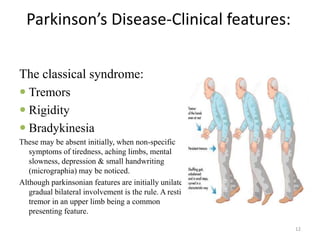
The classical syndrome:
๏‚— Tremors
๏‚— Rigidity
๏‚— Bradykinesia
These may be absent initially, when non-specific
symptoms of tiredness, aching limbs, mental
slowness, depression & small handwriting
(micrographia) may be noticed.
Although parkinsonian features are initially unilateral,
gradual bilateral involvement is the rule. A resting
tremor in an upper limb being a common
presenting feature.
12
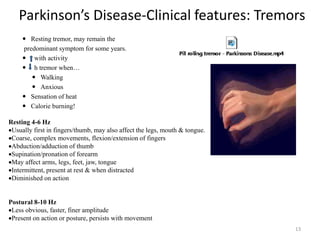
๏‚— Resting tremor, may remain the
predominant symptom for some years.
๏‚— with activity
๏‚— h tremor whenโ€ฆ
๏‚— Walking
๏‚— Anxious
๏‚— Sensation of heat
๏‚— Calorie burning!
Resting 4-6 Hz
๏‚ทUsually first in fingers/thumb, may also affect the legs, mouth & tongue.
๏‚ทCoarse, complex movements, flexion/extension of fingers
๏‚ทAbduction/adduction of thumb
๏‚ทSupination/pronation of forearm
๏‚ทMay affect arms, legs, feet, jaw, tongue
๏‚ทIntermittent, present at rest & when distracted
๏‚ทDiminished on action
Postural 8-10 Hz
๏‚ทLess obvious, faster, finer amplitude
๏‚ทPresent on action or posture, persists with movement
13
Parkinsonโ€™s Disease-Clinical features: Tremors
14
Parkinsonโ€™s Disease-Clinical features: Rigidity
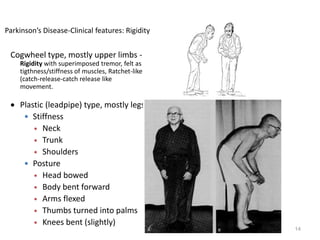
Cogwheel type, mostly upper limbs -
Rigidity with superimposed tremor, felt as
tigthness/stiffness of muscles, Ratchet-like
(catch-release-catch release like
movement.
๏‚ท Plastic (leadpipe) type, mostly legs
๏‚— Stiffness
๏‚— Neck
๏‚— Trunk
๏‚— Shoulders
๏‚— Posture
๏‚— Head bowed
๏‚— Body bent forward
๏‚— Arms flexed
๏‚— Thumbs turned into palms
๏‚— Knees bent (slightly)
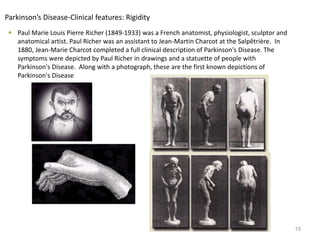
๏‚— Paul Marie Louis Pierre Richer (1849-1933) was a French anatomist, physiologist, sculptor and
anatomical artist. Paul Richer was an assistant to Jean-Martin Charcot at the Salpรชtriรจre. In
1880, Jean-Marie Charcot completed a full clinical description of Parkinson's Disease. The
symptoms were depicted by Paul Richer in drawings and a statuette of people with
Parkinson's Disease. Along with a photograph, these are the first known depictions of
Parkinson's Disease
15
Parkinsonโ€™s Disease-Clinical features: Rigidity
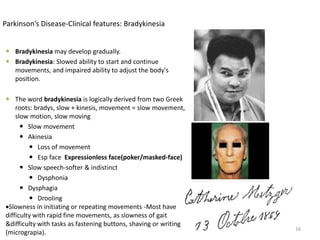
๏‚— Bradykinesia may develop gradually.
๏‚— Bradykinesia: Slowed ability to start and continue
movements, and impaired ability to adjust the body's
position.
๏‚— The word bradykinesia is logically derived from two Greek
roots: bradys, slow + kinesis, movement = slow movement,
slow motion, slow moving
๏‚— Slow movement
๏‚— Akinesia
๏‚— Loss of movement
๏‚— Esp face Expressionless face(poker/masked-face)
๏‚— Slow speech-softer & indistinct
๏‚— Dysphonia
๏‚— Dysphagia
๏‚— Drooling
๏‚ทSlowness in initiating or repeating movements -Most have
difficulty with rapid fine movements, as slowness of gait
&difficulty with tasks as fastening buttons, shaving or writing
(micrograpia).
16
Parkinsonโ€™s Disease-Clinical features: Bradykinesia
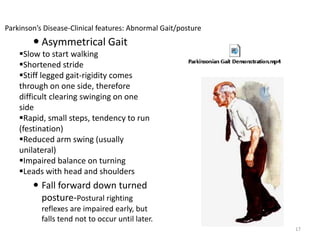
๏‚— Asymmetrical Gait
๏‚งSlow to start walking
๏‚งShortened stride
๏‚งStiff legged gait-rigidity comes
through on one side, therefore
difficult clearing swinging on one
side
๏‚งRapid, small steps, tendency to run
(festination)
๏‚งReduced arm swing (usually
unilateral)
๏‚งImpaired balance on turning
๏‚งLeads with head and shoulders
๏‚— Fall forward down turned
posture-Postural righting
reflexes are impaired early, but
falls tend not to occur until later.
17
Parkinsonโ€™s Disease-Clinical features: Abnormal Gait/posture
Additional information to read later Clinical features:
There are a number of abnormalities on neurological examination:
๏‚— Muscle strength / reflexes remain normal, plantar responses are flexor.
๏‚— There is a paucity of facial expression (hypomimia) & the blink reflex may be
exaggerated & fail to habituate (glabellar tap sign).
๏‚— Eye movements are normal to standard clinical testing, provided allowance
is made for the normal limitation of upward gaze with age.
๏‚— Sensation is normal & intellectual abilities are not affected initially.
๏‚— As the disease progresses, 1/3 develop cognitive impairment.
๏‚— PD commonly associated with other features; loss of smell, depression,
dementia, autonomic dysfunction, sleep disturbance- due to involvement of
other non-dopaminergic structures as disease progresses.
18
PARKINSON'S DISEASE
DIAGNOSIS
19
Investigations:
๏‚— The diagnosis is made clinically, as there is no diagnostic test for Parkinson's
disease.
๏‚— Imaging (CT or MRI) of the head may be needed if there are any features
suggestive of pyramidal, cerebellar or autonomic involvement, or the
diagnosis is otherwise in doubt (e.g to exclude stroke).
20
[18F]dopa PET and ฮฒ-CIT SPECT images.
[18F]dopa PET uptake in the putamen
is reduced in PD.
Investigations:
Causes of parkinsonism:
๏‚— Toxins (manganese, CO poisoning), CNS infs, structural
lesions, metabolic disorders, other neurologic disorders.
๏‚— Most are rare& suggested by atypical features, history or
exam.
Routinely needed to consider 2 alternative diagnoses:
๏‚— Drug-induced parkinsonism
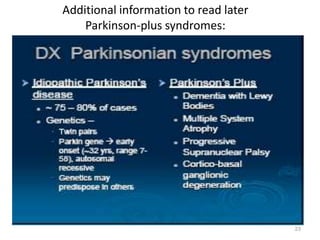
๏‚— โ€œParkinsonism-plusโ€ syndromes: parkinsonian features
with other neurological signs atypical of parkinson
disease.
21
Drug-induced parkinsonism:
๏‚— Important because it is reversible, although may require weeks or
months after discontinuation.
๏‚— Dopamine antagonists;neuroleptic agents (HALPERIDOL), atypical
neuroleptic agents, antiemetic drugs, CCB (flunarizine ,cinnarizine).
๏‚— Amiodarone, valproic acid,lithium,by uncertain mechanisms.
๏‚— Dopamine antagonists also exacerbate Parkinsonโ€™s disease& should
be avoided, if possible, in the treatment of patients with the
disease.
22
Additional information to read later
Parkinson-plus syndromes:
23
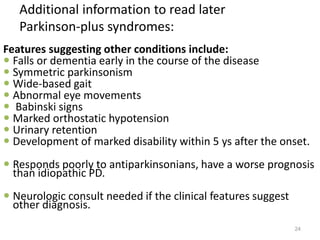
Features suggesting other conditions include:
๏‚— Falls or dementia early in the course of the disease
๏‚— Symmetric parkinsonism
๏‚— Wide-based gait
๏‚— Abnormal eye movements
๏‚— Babinski signs
๏‚— Marked orthostatic hypotension
๏‚— Urinary retention
๏‚— Development of marked disability within 5 ys after the onset.
๏‚— Responds poorly to antiparkinsonians, have a worse prognosis
than idiopathic PD.
๏‚— Neurologic consult needed if the clinical features suggest
other diagnosis.
24
Additional information to read later
Parkinson-plus syndromes:
PARKINSON'S DISEASE PROGNOSIS
25
Prognosis:
๏‚—Variable& depends partly on the age of onset.
๏‚—If symptoms start in middle life, the disease is
usually slowly progressive & likely to shorten
lifespan because of the complications of
immobility & tendency to fall.
๏‚— Onset after 70 is unlikely to shorten life or
become severe.
26
PARKINSON'S DISEASE
TREATMENT
27
Current pharmacological therapies โ€“
symptomatic treatment
28
๏ฎ Levodopa to replace dopamine L-DOPA + peripheral-acting dopa-
decarboxylase inhibitor to improve L-dopa availability in the CNS,
e.g. benserazide, entacapone.
๏ฎ D1 and D2 receptor agonists e.g. Apomorphine, bromocriptine,
pergolide - favoured early in L-dopa-sparing pharmacotherapeutic
approaches
๏ฎ MAOB inhibitors e.g. selegiline
๏ฎ COMT (catechol-O-methyl-transferase) inhibitors: e.g Entacapone
๏ฎ Amantadine โ€“ dopamine releaser, reuptake inhibitor?
๏ฎ Anticholinergic drugs (Muscarinic receptor antagonists) e.g.
L-DOPA (LEVODOPA)
29
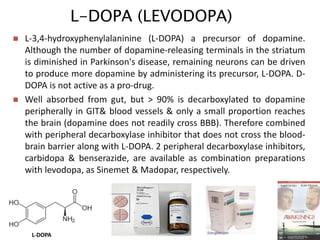
๏ฎ L-3,4-hydroxyphenylalaninine (L-DOPA) a precursor of dopamine.
Although the number of dopamine-releasing terminals in the striatum
is diminished in Parkinson's disease, remaining neurons can be driven
to produce more dopamine by administering its precursor, L-DOPA. D-
DOPA is not active as a pro-drug.
๏ฎ Well absorbed from gut, but > 90% is decarboxylated to dopamine
peripherally in GIT& blood vessels & only a small proportion reaches
the brain (dopamine does not readily cross BBB). Therefore combined
with peripheral decarboxylase inhibitor that does not cross the blood-
brain barrier along with L-DOPA. 2 peripheral decarboxylase inhibitors,
carbidopa & benserazide, are available as combination preparations
with levodopa, as Sinemet & Madopar, respectively.
L-DOPA
๏‚— The initiation of levodopa should be delayed until there is significant
disability, since there is concern regarding long-term side-effects.
๏‚— Some suggest to initiate treatment with a dopamine agonist or a slow-
release levodopa to minimise or delay the onset of long-term side-effects.
๏‚— 90% of patients show improvement of rigidity and bradykinesia and (to a
lesser extent) tremor. 20% restored to normal motor function
๏‚— The initial dose is 50 mg 8-hourly, increased if necessary.
The total levodopa dose may be increased to over 1000 mg/day, but should
be kept as low as possible.
๏‚— Effective on a 3x/day regime with smooth control even though
phamacological T1/2 = 90min i.e biological T1/2 >> pharmacological T1/2
initially.
30
L-DOPA (LEVODOPA): dose/therapeutic
effects
L-DOPA (LEVODOPA): unwanted effects
31
Acute effects (tend to disappear over first few weeks):
The peripheral conversion of levodopa is responsible for the
high incidence of side-effects if used alone.
๏ฎ Nausea and anorexia, hypotension, psychological effects
(confusion, insomnia, euphoria, inappropriate behaviours,
nightmares, hallucinosis, psychosis) Reduced by the use of
a peripheral dopamine antagonist as domperidone.
32
L-DOPA (LEVODOPA): unwanted effects
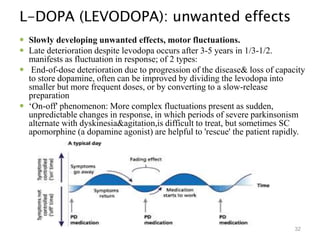
๏‚— Slowly developing unwanted effects, motor fluctuations.
๏‚— Late deterioration despite levodopa occurs after 3-5 years in 1/3-1/2.
manifests as fluctuation in response; of 2 types:
๏‚— End-of-dose deterioration due to progression of the disease& loss of capacity
to store dopamine, often can be improved by dividing the levodopa into
smaller but more frequent doses, or by converting to a slow-release
preparation
๏‚— โ€˜On-off' phenomenon: More complex fluctuations present as sudden,
unpredictable changes in response, in which periods of severe parkinsonism
alternate with dyskinesia&agitation,is difficult to treat, but sometimes SC
apomorphine (a dopamine agonist) are helpful to 'rescue' the patient rapidly.
L-DOPA (LEVODOPA): unwanted effects
33
๏ฎ Slowly developing unwanted effects, motor fluctuations.
๏ฎ Develop in most patients after 3-5years on L-dopa, esp if young, high
dose
๏ฎ Involuntary movements, sp orofacial dyskinesias, limb &axial
dystonias,occasionally depression, hallucinations& delusions.
Involuntary movements (dyskinesia), can be violent; may occur as a
peak-dose phenomenon, or as a biphasic phenomenon (during build-up
& wearing-off phases). Management is difficult, but again involves
modifying the way levodopa is administered (reduce dose) to obtain
constant levels in the brain & use of alternatives, particularly dopamine
agonists. Thought to be related to the short phamacological T1/2 of L-
dopa causing pulsatile stimulation of the striatum and eventual
disordered basal ganglia output.
๏ฎ Dopamine dysregulation syndrome (DDS) dysfunction of the reward
system, characterized by self-control problems such as addiction to
medication, gambling, or hypersexuality.
Optimization of PD pharmacological treatment
34
Now aim to prolong the pharmacological dopaminergic
stimulation of the striatum to limit the development of motor
fluctuations
๏ฎ In younger patients, preference is given to neuroprotective and
L-DOPA sparing therapies.
๏ฎ L-DOPA should only be started to help overcome significant
disability. In young (<65) aim to avoid L-DOPA for as long as
possible (although all patients eventually need it) and tend to
use long-acting (t1/2 8+hrs) dopamine agonists initially.
๏ฎ L-DOPA plusโ€ฆ
๏ฎ Peripheral COMT inhibitors, e.g. entacapone
๏ฎ MAOB inhibitors, e.g. selegiline; may retard progression of
disease
๏ฎ D1 and D2 receptor agonists
Anticholinergic therapy
35
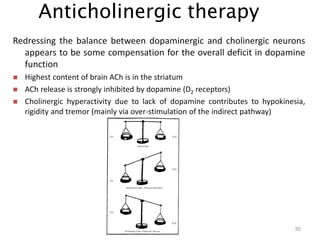
Redressing the balance between dopaminergic and cholinergic neurons
appears to be some compensation for the overall deficit in dopamine
function
๏ฎ Highest content of brain ACh is in the striatum
๏ฎ ACh release is strongly inhibited by dopamine (D2 receptors)
๏ฎ Cholinergic hyperactivity due to lack of dopamine contributes to hypokinesia,
rigidity and tremor (mainly via over-stimulation of the indirect pathway)
๏‚— Muscarinic receptor antagonists (anticholinergicโ€™s)
๏‚— These have a useful effect on tremor & rigidity, but do not help bradykinesia.
๏‚— They can be prescribed early in the disease before bradykinesia is a problem,
but should be avoided in elderly patients in whom they cause
confusion/dementia/hallucinations.
๏‚— Other side-effects include dry mouth, blurred vision, difficulty with
micturition / constipation.
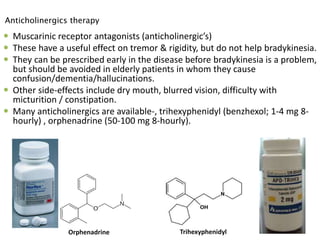
๏‚— Many anticholinergics are available-, trihexyphenidyl (benzhexol; 1-4 mg 8-
hourly) , orphenadrine (50-100 mg 8-hourly).
36
TrihexyphenidylOrphenadrine
Anticholinergics therapy
Amantadine
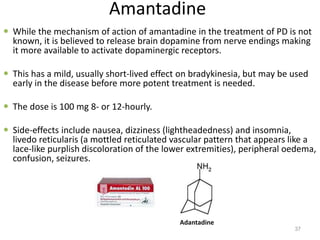
๏‚— While the mechanism of action of amantadine in the treatment of PD is not
known, it is believed to release brain dopamine from nerve endings making
it more available to activate dopaminergic receptors.
๏‚— This has a mild, usually short-lived effect on bradykinesia, but may be used
early in the disease before more potent treatment is needed.
๏‚— The dose is 100 mg 8- or 12-hourly.
๏‚— Side-effects include nausea, dizziness (lightheadedness) and insomnia,
livedo reticularis (a mottled reticulated vascular pattern that appears like a
lace-like purplish discoloration of the lower extremities), peripheral oedema,
confusion, seizures.
37
Adantadine
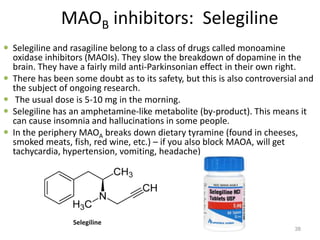
MAOB inhibitors: Selegiline
๏‚— Selegiline and rasagiline belong to a class of drugs called monoamine
oxidase inhibitors (MAOIs). They slow the breakdown of dopamine in the
brain. They have a fairly mild anti-Parkinsonian effect in their own right.
๏‚— There has been some doubt as to its safety, but this is also controversial and
the subject of ongoing research.
๏‚— The usual dose is 5-10 mg in the morning.
๏‚— Selegiline has an amphetamine-like metabolite (by-product). This means it
can cause insomnia and hallucinations in some people.
๏‚— In the periphery MAOA breaks down dietary tyramine (found in cheeses,
smoked meats, fish, red wine, etc.) โ€“ if you also block MAOA, will get
tachycardia, hypertension, vomiting, headache)
38
Selegiline
COMT (catechol-O-methyl-transferase) inhibitors:
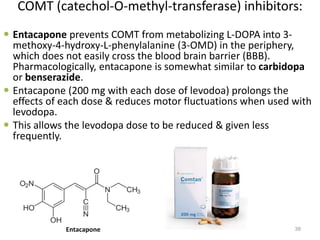
๏‚— Entacapone prevents COMT from metabolizing L-DOPA into 3-
methoxy-4-hydroxy-L-phenylalanine (3-OMD) in the periphery,
which does not easily cross the blood brain barrier (BBB).
Pharmacologically, entacapone is somewhat similar to carbidopa
or benserazide.
๏‚— Entacapone (200 mg with each dose of levodoa) prolongs the
effects of each dose & reduces motor fluctuations when used with
levodopa.
๏‚— This allows the levodopa dose to be reduced & given less
frequently.
39Entacapone
Dopamine receptor agonists :
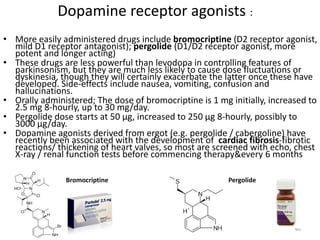
โ€ข More easily administered drugs include bromocriptine (D2 receptor agonist,
mild D1 receptor antagonist); pergolide (D1/D2 receptor agonist, more
potent and longer acting)
โ€ข These drugs are less powerful than levodopa in controlling features of
parkinsonism, but they are much less likely to cause dose fluctuations or
dyskinesia, though they will certainly exacerbate the latter once these have
developed. Side-effects include nausea, vomiting, confusion and
hallucinations.
โ€ข Orally administered; The dose of bromocriptine is 1 mg initially, increased to
2.5 mg 8-hourly, up to 30 mg/day.
โ€ข Pergolide dose starts at 50 ฮผg, increased to 250 ฮผg 8-hourly, possibly to
3000 ฮผg/day.
โ€ข Dopamine agonists derived from ergot (e.g. pergolide / cabergoline) have
recently been associated with the development of cardiac fibrosis-fibrotic
reactions/ thickening of heart valves, so most are screened with echo, chest
X-ray / renal function tests before commencing therapy&every 6 months
40
Bromocriptine Pergolide
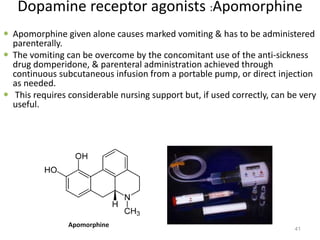
Dopamine receptor agonists :Apomorphine
๏‚— Apomorphine given alone causes marked vomiting & has to be administered
parenterally.
๏‚— The vomiting can be overcome by the concomitant use of the anti-sickness
drug domperidone, & parenteral administration achieved through
continuous subcutaneous infusion from a portable pump, or direct injection
as needed.
๏‚— This requires considerable nursing support but, if used correctly, can be very
useful.
41
Apomorphine
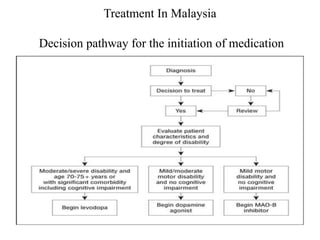
Treatment In Malaysia
Decision pathway for the initiation of medication
Additional information to read later: Alternative
treatment approaches
Surgery :
๏‚— Stereotactic thalamotomy can be used to treat tremor, though this is needed
relatively infrequently because of the medical treatments available.
๏‚— Other stereotactic lesions are currently undergoing evaluation, in particular
pallidotomy to help in the management of drug-induced dyskinesia.
๏‚— Implantation of dopamine rich fragments of brain
into the striatum
๏‚— Implantation of stem cells
๏‚— Midbrain neurones transplanted into the striatum
๏‚— Immortalised neuronal precursor cells
Physiotherapy& rehab:
Patients at all stages of Parkinson's disease benefit from physiotherapy, which
helps reduce rigidity& corrects abnormal posture.
Speech therapy may help in cases where dysarthria & dysphonia interfere
with communication.
๏‚— Gene therapy
๏‚— Transfection of tyrosine hydroxylase gene into the brain 43
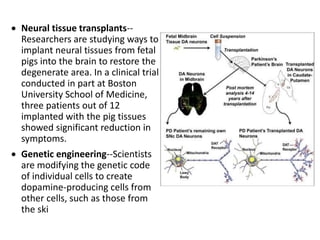
๏‚ท Neural tissue transplants--
Researchers are studying ways to
implant neural tissues from fetal
pigs into the brain to restore the
degenerate area. In a clinical trial
conducted in part at Boston
University School of Medicine,
three patients out of 12
implanted with the pig tissues
showed significant reduction in
symptoms.
๏‚ท Genetic engineering--Scientists
are modifying the genetic code
of individual cells to create
dopamine-producing cells from
other cells, such as those from
the ski
Conclusion
โ€ข Patient has idiopathic Parkinsonโ€™s disease
โ€ข There is no cure but therapies are available
โ€ข Treatments aim to:
๏ƒ˜ Prevent clinical progression
๏ƒ˜ Improvement of parkinsonism
๏ƒ˜ Delay of motor complications
โ€ข Complications: choking, falls and side effects of drugs
โ€ข Prognosis: normal life expectancy for treated patients
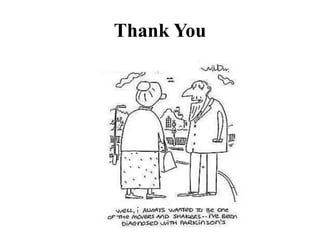
Thank You

Parkinson's disease

  • 1.
    Anindya Banerjee Patient Safetyโ€“ Pharmacovigilance Associate Dept of Pharmacology NRS Medical College & Hospital , Kolkata And National Coordination Centre โ€“ Pharmacovigilance Program of India Indian Pharmacopoeia Commission , Ghaziabad
  • 2.
    Lecture Outline โ€ข Etiology โ€ขIncidence โ€ข Patho-physiology โ€ข Clinical Presentation โ€ข Diagnosis โ€ข Prognosis โ€ข Treatment
  • 3.
    Parkinsonโ€™s Disease Parkinsonโ€™s disease, is named after James Parkinson who in 1817 wrote a classic โ€œshaking palsyโ€a disease for which the reason is still unknown .
  • 4.
    โ€ข Definition :- Itis a chronic degenerative disorder that primarily affects the neurons of the basal ganglia. It is a syndrome that consists of slowing down in the initiation and execution of movement (brady kinesia), increased muscle tone (rigidity), tremor and impaired postural reflexes
  • 5.
    The famous internationally knownboxer Mr. Mohammed Ali suffered from this disease. incidence: Occurs in the age group of 60s. Mostly men are affected than women.
  • 6.
    Etiology ๏ฎ Parkinsonism: differingcombinations of slowness of movement (bradykinesia), increased tone/stiffness (rigidity), tremor & loss of postural reflexes(akinetic- rigid syndromes). ๏ฎ The most common cause of parkinsonism is idiopathic (no known cause) Parkinson's disease. In most-may be combination of factors: ๏ฎ Environmental toxins (MPTP, occasionally pesticides): The discovery that methyl-phenyl- tetrahydropyridine (MPTP; A contaminant in methylenedioxymethamphetamine ("ecstasyโ€œ)) caused severe parkinsonism in young drug users suggests that the idiopathic disease might be due to an environmental toxin. ๏ฎ Viral infections (encephalitis lethargica) ๏ฎ No strong genetic factors, but genetic influence may be greater than previously thought. Genetic mutations 1-2%; alpha-synuclein gene, Parkin gene, Ubiquitin gene mutations. ๏ฎ Protective factors-Both smoking and coffee drinking have been associated with a lower risk for PD.
  • 7.
    PARKINSON'S DISEASE-Incidence 7 ๏ฎ Annualincidence 0.2/1000 & prevalence of 1.5/1000. ๏ฎ Prevalence rates are similar throughout the world, except lower rates in China /West Africa. ๏ฎ Affects 1% of those over 55 years, 1.5% of people 70-79 years of age ๏ฎ Generally occurs between 50-80 years ๏ฎ Sex incidence is about equal.
  • 8.
    Pathology ๏‚— There isdepletion of the pigmented dopaminergic neurons in the substantia nigra, atrophic changes in the substantia nigra& depletion of neurons in the locus coeruleus. ๏‚— Clinical features donโ€™t emerge until >60-80% dopamine lost. ๏‚— Compensatory changes include hyperactivity in remaining neurones (increased transmitter turnover), increase in dopamine receptors; receptor supersensitivity ๏‚— Other pigmented nuclei also affected (locus ceruleus and raphe). Also cortex and other structures affected. ๏‚— Characteristic histological inclusion in affected neurons are eosinophilic cytoplasmic inclusions in nigral cells called the Lewy Bodies. 8
  • 9.
    Free Radicals โ€ข Unpairedelectrons that can easily react with surrounding molecules and destroy them. โ€ข Metabolism of dopamine by MAO produce hydrogen peroxide. โ€ข Glutathione normally breaks down the hydrogen peroxide quickly. โ€ข Reduced glutathione = loss of protection against free radicals ๏ƒ  cell damage
  • 10.
    Genetic Factors โ€ข Mutationof SNCA genes in chromosome 4. โ€ข 2 types of alterations: โ€ข Alanine is replaced with threonine. โ€ข Cause alpha-synuclein to misfold. โ€ข SNCA genes is inappropriately duplicated or triplicated. โ€ข Extra copies of the gene lead to an excess of alpha- synuclein. โ€ข Aggregate (Lewy bodies) and attract other protein. โ€ข Clog neuron and impair the function of neuron.
  • 11.
    Parkinsonโ€™s Disease-Patho-physiology 11 ๏‚— BasalGanglia ๏‚— Controls movement ๏‚— Dopamine ๏‚— Inhibitory neurotransmitter in the basal ganglia ๏‚— Acetylcholine ๏‚— Excitatory neurotransmitter in the basal ganglia ๏‚— Without dopamine, inhibitory influences are lost and excitatory mechanisms are unopposed ๏ƒ  ๏‚— Neurons of basal ganglia are over stimulated ๏ƒ  ๏‚— Excess muscle tone, tremors & rigidity
  • 12.
    Parkinsonโ€™s Disease-Clinical features: Theclassical syndrome: ๏‚— Tremors ๏‚— Rigidity ๏‚— Bradykinesia These may be absent initially, when non-specific symptoms of tiredness, aching limbs, mental slowness, depression & small handwriting (micrographia) may be noticed. Although parkinsonian features are initially unilateral, gradual bilateral involvement is the rule. A resting tremor in an upper limb being a common presenting feature. 12
  • 13.
    ๏‚— Resting tremor,may remain the predominant symptom for some years. ๏‚— with activity ๏‚— h tremor whenโ€ฆ ๏‚— Walking ๏‚— Anxious ๏‚— Sensation of heat ๏‚— Calorie burning! Resting 4-6 Hz ๏‚ทUsually first in fingers/thumb, may also affect the legs, mouth & tongue. ๏‚ทCoarse, complex movements, flexion/extension of fingers ๏‚ทAbduction/adduction of thumb ๏‚ทSupination/pronation of forearm ๏‚ทMay affect arms, legs, feet, jaw, tongue ๏‚ทIntermittent, present at rest & when distracted ๏‚ทDiminished on action Postural 8-10 Hz ๏‚ทLess obvious, faster, finer amplitude ๏‚ทPresent on action or posture, persists with movement 13 Parkinsonโ€™s Disease-Clinical features: Tremors
  • 14.
    14 Parkinsonโ€™s Disease-Clinical features:Rigidity Cogwheel type, mostly upper limbs - Rigidity with superimposed tremor, felt as tigthness/stiffness of muscles, Ratchet-like (catch-release-catch release like movement. ๏‚ท Plastic (leadpipe) type, mostly legs ๏‚— Stiffness ๏‚— Neck ๏‚— Trunk ๏‚— Shoulders ๏‚— Posture ๏‚— Head bowed ๏‚— Body bent forward ๏‚— Arms flexed ๏‚— Thumbs turned into palms ๏‚— Knees bent (slightly)
  • 15.
    ๏‚— Paul MarieLouis Pierre Richer (1849-1933) was a French anatomist, physiologist, sculptor and anatomical artist. Paul Richer was an assistant to Jean-Martin Charcot at the Salpรชtriรจre. In 1880, Jean-Marie Charcot completed a full clinical description of Parkinson's Disease. The symptoms were depicted by Paul Richer in drawings and a statuette of people with Parkinson's Disease. Along with a photograph, these are the first known depictions of Parkinson's Disease 15 Parkinsonโ€™s Disease-Clinical features: Rigidity
  • 16.
    ๏‚— Bradykinesia maydevelop gradually. ๏‚— Bradykinesia: Slowed ability to start and continue movements, and impaired ability to adjust the body's position. ๏‚— The word bradykinesia is logically derived from two Greek roots: bradys, slow + kinesis, movement = slow movement, slow motion, slow moving ๏‚— Slow movement ๏‚— Akinesia ๏‚— Loss of movement ๏‚— Esp face Expressionless face(poker/masked-face) ๏‚— Slow speech-softer & indistinct ๏‚— Dysphonia ๏‚— Dysphagia ๏‚— Drooling ๏‚ทSlowness in initiating or repeating movements -Most have difficulty with rapid fine movements, as slowness of gait &difficulty with tasks as fastening buttons, shaving or writing (micrograpia). 16 Parkinsonโ€™s Disease-Clinical features: Bradykinesia
  • 17.
    ๏‚— Asymmetrical Gait ๏‚งSlowto start walking ๏‚งShortened stride ๏‚งStiff legged gait-rigidity comes through on one side, therefore difficult clearing swinging on one side ๏‚งRapid, small steps, tendency to run (festination) ๏‚งReduced arm swing (usually unilateral) ๏‚งImpaired balance on turning ๏‚งLeads with head and shoulders ๏‚— Fall forward down turned posture-Postural righting reflexes are impaired early, but falls tend not to occur until later. 17 Parkinsonโ€™s Disease-Clinical features: Abnormal Gait/posture
  • 18.
    Additional information toread later Clinical features: There are a number of abnormalities on neurological examination: ๏‚— Muscle strength / reflexes remain normal, plantar responses are flexor. ๏‚— There is a paucity of facial expression (hypomimia) & the blink reflex may be exaggerated & fail to habituate (glabellar tap sign). ๏‚— Eye movements are normal to standard clinical testing, provided allowance is made for the normal limitation of upward gaze with age. ๏‚— Sensation is normal & intellectual abilities are not affected initially. ๏‚— As the disease progresses, 1/3 develop cognitive impairment. ๏‚— PD commonly associated with other features; loss of smell, depression, dementia, autonomic dysfunction, sleep disturbance- due to involvement of other non-dopaminergic structures as disease progresses. 18
  • 19.
  • 20.
    Investigations: ๏‚— The diagnosisis made clinically, as there is no diagnostic test for Parkinson's disease. ๏‚— Imaging (CT or MRI) of the head may be needed if there are any features suggestive of pyramidal, cerebellar or autonomic involvement, or the diagnosis is otherwise in doubt (e.g to exclude stroke). 20 [18F]dopa PET and ฮฒ-CIT SPECT images. [18F]dopa PET uptake in the putamen is reduced in PD.
  • 21.
    Investigations: Causes of parkinsonism: ๏‚—Toxins (manganese, CO poisoning), CNS infs, structural lesions, metabolic disorders, other neurologic disorders. ๏‚— Most are rare& suggested by atypical features, history or exam. Routinely needed to consider 2 alternative diagnoses: ๏‚— Drug-induced parkinsonism ๏‚— โ€œParkinsonism-plusโ€ syndromes: parkinsonian features with other neurological signs atypical of parkinson disease. 21
  • 22.
    Drug-induced parkinsonism: ๏‚— Importantbecause it is reversible, although may require weeks or months after discontinuation. ๏‚— Dopamine antagonists;neuroleptic agents (HALPERIDOL), atypical neuroleptic agents, antiemetic drugs, CCB (flunarizine ,cinnarizine). ๏‚— Amiodarone, valproic acid,lithium,by uncertain mechanisms. ๏‚— Dopamine antagonists also exacerbate Parkinsonโ€™s disease& should be avoided, if possible, in the treatment of patients with the disease. 22
  • 23.
    Additional information toread later Parkinson-plus syndromes: 23
  • 24.
    Features suggesting otherconditions include: ๏‚— Falls or dementia early in the course of the disease ๏‚— Symmetric parkinsonism ๏‚— Wide-based gait ๏‚— Abnormal eye movements ๏‚— Babinski signs ๏‚— Marked orthostatic hypotension ๏‚— Urinary retention ๏‚— Development of marked disability within 5 ys after the onset. ๏‚— Responds poorly to antiparkinsonians, have a worse prognosis than idiopathic PD. ๏‚— Neurologic consult needed if the clinical features suggest other diagnosis. 24 Additional information to read later Parkinson-plus syndromes:
  • 25.
  • 26.
    Prognosis: ๏‚—Variable& depends partlyon the age of onset. ๏‚—If symptoms start in middle life, the disease is usually slowly progressive & likely to shorten lifespan because of the complications of immobility & tendency to fall. ๏‚— Onset after 70 is unlikely to shorten life or become severe. 26
  • 27.
  • 28.
    Current pharmacological therapiesโ€“ symptomatic treatment 28 ๏ฎ Levodopa to replace dopamine L-DOPA + peripheral-acting dopa- decarboxylase inhibitor to improve L-dopa availability in the CNS, e.g. benserazide, entacapone. ๏ฎ D1 and D2 receptor agonists e.g. Apomorphine, bromocriptine, pergolide - favoured early in L-dopa-sparing pharmacotherapeutic approaches ๏ฎ MAOB inhibitors e.g. selegiline ๏ฎ COMT (catechol-O-methyl-transferase) inhibitors: e.g Entacapone ๏ฎ Amantadine โ€“ dopamine releaser, reuptake inhibitor? ๏ฎ Anticholinergic drugs (Muscarinic receptor antagonists) e.g.
  • 29.
    L-DOPA (LEVODOPA) 29 ๏ฎ L-3,4-hydroxyphenylalaninine(L-DOPA) a precursor of dopamine. Although the number of dopamine-releasing terminals in the striatum is diminished in Parkinson's disease, remaining neurons can be driven to produce more dopamine by administering its precursor, L-DOPA. D- DOPA is not active as a pro-drug. ๏ฎ Well absorbed from gut, but > 90% is decarboxylated to dopamine peripherally in GIT& blood vessels & only a small proportion reaches the brain (dopamine does not readily cross BBB). Therefore combined with peripheral decarboxylase inhibitor that does not cross the blood- brain barrier along with L-DOPA. 2 peripheral decarboxylase inhibitors, carbidopa & benserazide, are available as combination preparations with levodopa, as Sinemet & Madopar, respectively. L-DOPA
  • 30.
    ๏‚— The initiationof levodopa should be delayed until there is significant disability, since there is concern regarding long-term side-effects. ๏‚— Some suggest to initiate treatment with a dopamine agonist or a slow- release levodopa to minimise or delay the onset of long-term side-effects. ๏‚— 90% of patients show improvement of rigidity and bradykinesia and (to a lesser extent) tremor. 20% restored to normal motor function ๏‚— The initial dose is 50 mg 8-hourly, increased if necessary. The total levodopa dose may be increased to over 1000 mg/day, but should be kept as low as possible. ๏‚— Effective on a 3x/day regime with smooth control even though phamacological T1/2 = 90min i.e biological T1/2 >> pharmacological T1/2 initially. 30 L-DOPA (LEVODOPA): dose/therapeutic effects
  • 31.
    L-DOPA (LEVODOPA): unwantedeffects 31 Acute effects (tend to disappear over first few weeks): The peripheral conversion of levodopa is responsible for the high incidence of side-effects if used alone. ๏ฎ Nausea and anorexia, hypotension, psychological effects (confusion, insomnia, euphoria, inappropriate behaviours, nightmares, hallucinosis, psychosis) Reduced by the use of a peripheral dopamine antagonist as domperidone.
  • 32.
    32 L-DOPA (LEVODOPA): unwantedeffects ๏‚— Slowly developing unwanted effects, motor fluctuations. ๏‚— Late deterioration despite levodopa occurs after 3-5 years in 1/3-1/2. manifests as fluctuation in response; of 2 types: ๏‚— End-of-dose deterioration due to progression of the disease& loss of capacity to store dopamine, often can be improved by dividing the levodopa into smaller but more frequent doses, or by converting to a slow-release preparation ๏‚— โ€˜On-off' phenomenon: More complex fluctuations present as sudden, unpredictable changes in response, in which periods of severe parkinsonism alternate with dyskinesia&agitation,is difficult to treat, but sometimes SC apomorphine (a dopamine agonist) are helpful to 'rescue' the patient rapidly.
  • 33.
    L-DOPA (LEVODOPA): unwantedeffects 33 ๏ฎ Slowly developing unwanted effects, motor fluctuations. ๏ฎ Develop in most patients after 3-5years on L-dopa, esp if young, high dose ๏ฎ Involuntary movements, sp orofacial dyskinesias, limb &axial dystonias,occasionally depression, hallucinations& delusions. Involuntary movements (dyskinesia), can be violent; may occur as a peak-dose phenomenon, or as a biphasic phenomenon (during build-up & wearing-off phases). Management is difficult, but again involves modifying the way levodopa is administered (reduce dose) to obtain constant levels in the brain & use of alternatives, particularly dopamine agonists. Thought to be related to the short phamacological T1/2 of L- dopa causing pulsatile stimulation of the striatum and eventual disordered basal ganglia output. ๏ฎ Dopamine dysregulation syndrome (DDS) dysfunction of the reward system, characterized by self-control problems such as addiction to medication, gambling, or hypersexuality.
  • 34.
    Optimization of PDpharmacological treatment 34 Now aim to prolong the pharmacological dopaminergic stimulation of the striatum to limit the development of motor fluctuations ๏ฎ In younger patients, preference is given to neuroprotective and L-DOPA sparing therapies. ๏ฎ L-DOPA should only be started to help overcome significant disability. In young (<65) aim to avoid L-DOPA for as long as possible (although all patients eventually need it) and tend to use long-acting (t1/2 8+hrs) dopamine agonists initially. ๏ฎ L-DOPA plusโ€ฆ ๏ฎ Peripheral COMT inhibitors, e.g. entacapone ๏ฎ MAOB inhibitors, e.g. selegiline; may retard progression of disease ๏ฎ D1 and D2 receptor agonists
  • 35.
    Anticholinergic therapy 35 Redressing thebalance between dopaminergic and cholinergic neurons appears to be some compensation for the overall deficit in dopamine function ๏ฎ Highest content of brain ACh is in the striatum ๏ฎ ACh release is strongly inhibited by dopamine (D2 receptors) ๏ฎ Cholinergic hyperactivity due to lack of dopamine contributes to hypokinesia, rigidity and tremor (mainly via over-stimulation of the indirect pathway)
  • 36.
    ๏‚— Muscarinic receptorantagonists (anticholinergicโ€™s) ๏‚— These have a useful effect on tremor & rigidity, but do not help bradykinesia. ๏‚— They can be prescribed early in the disease before bradykinesia is a problem, but should be avoided in elderly patients in whom they cause confusion/dementia/hallucinations. ๏‚— Other side-effects include dry mouth, blurred vision, difficulty with micturition / constipation. ๏‚— Many anticholinergics are available-, trihexyphenidyl (benzhexol; 1-4 mg 8- hourly) , orphenadrine (50-100 mg 8-hourly). 36 TrihexyphenidylOrphenadrine Anticholinergics therapy
  • 37.
    Amantadine ๏‚— While themechanism of action of amantadine in the treatment of PD is not known, it is believed to release brain dopamine from nerve endings making it more available to activate dopaminergic receptors. ๏‚— This has a mild, usually short-lived effect on bradykinesia, but may be used early in the disease before more potent treatment is needed. ๏‚— The dose is 100 mg 8- or 12-hourly. ๏‚— Side-effects include nausea, dizziness (lightheadedness) and insomnia, livedo reticularis (a mottled reticulated vascular pattern that appears like a lace-like purplish discoloration of the lower extremities), peripheral oedema, confusion, seizures. 37 Adantadine
  • 38.
    MAOB inhibitors: Selegiline ๏‚—Selegiline and rasagiline belong to a class of drugs called monoamine oxidase inhibitors (MAOIs). They slow the breakdown of dopamine in the brain. They have a fairly mild anti-Parkinsonian effect in their own right. ๏‚— There has been some doubt as to its safety, but this is also controversial and the subject of ongoing research. ๏‚— The usual dose is 5-10 mg in the morning. ๏‚— Selegiline has an amphetamine-like metabolite (by-product). This means it can cause insomnia and hallucinations in some people. ๏‚— In the periphery MAOA breaks down dietary tyramine (found in cheeses, smoked meats, fish, red wine, etc.) โ€“ if you also block MAOA, will get tachycardia, hypertension, vomiting, headache) 38 Selegiline
  • 39.
    COMT (catechol-O-methyl-transferase) inhibitors: ๏‚—Entacapone prevents COMT from metabolizing L-DOPA into 3- methoxy-4-hydroxy-L-phenylalanine (3-OMD) in the periphery, which does not easily cross the blood brain barrier (BBB). Pharmacologically, entacapone is somewhat similar to carbidopa or benserazide. ๏‚— Entacapone (200 mg with each dose of levodoa) prolongs the effects of each dose & reduces motor fluctuations when used with levodopa. ๏‚— This allows the levodopa dose to be reduced & given less frequently. 39Entacapone
  • 40.
    Dopamine receptor agonists: โ€ข More easily administered drugs include bromocriptine (D2 receptor agonist, mild D1 receptor antagonist); pergolide (D1/D2 receptor agonist, more potent and longer acting) โ€ข These drugs are less powerful than levodopa in controlling features of parkinsonism, but they are much less likely to cause dose fluctuations or dyskinesia, though they will certainly exacerbate the latter once these have developed. Side-effects include nausea, vomiting, confusion and hallucinations. โ€ข Orally administered; The dose of bromocriptine is 1 mg initially, increased to 2.5 mg 8-hourly, up to 30 mg/day. โ€ข Pergolide dose starts at 50 ฮผg, increased to 250 ฮผg 8-hourly, possibly to 3000 ฮผg/day. โ€ข Dopamine agonists derived from ergot (e.g. pergolide / cabergoline) have recently been associated with the development of cardiac fibrosis-fibrotic reactions/ thickening of heart valves, so most are screened with echo, chest X-ray / renal function tests before commencing therapy&every 6 months 40 Bromocriptine Pergolide
  • 41.
    Dopamine receptor agonists:Apomorphine ๏‚— Apomorphine given alone causes marked vomiting & has to be administered parenterally. ๏‚— The vomiting can be overcome by the concomitant use of the anti-sickness drug domperidone, & parenteral administration achieved through continuous subcutaneous infusion from a portable pump, or direct injection as needed. ๏‚— This requires considerable nursing support but, if used correctly, can be very useful. 41 Apomorphine
  • 42.
    Treatment In Malaysia Decisionpathway for the initiation of medication
  • 43.
    Additional information toread later: Alternative treatment approaches Surgery : ๏‚— Stereotactic thalamotomy can be used to treat tremor, though this is needed relatively infrequently because of the medical treatments available. ๏‚— Other stereotactic lesions are currently undergoing evaluation, in particular pallidotomy to help in the management of drug-induced dyskinesia. ๏‚— Implantation of dopamine rich fragments of brain into the striatum ๏‚— Implantation of stem cells ๏‚— Midbrain neurones transplanted into the striatum ๏‚— Immortalised neuronal precursor cells Physiotherapy& rehab: Patients at all stages of Parkinson's disease benefit from physiotherapy, which helps reduce rigidity& corrects abnormal posture. Speech therapy may help in cases where dysarthria & dysphonia interfere with communication. ๏‚— Gene therapy ๏‚— Transfection of tyrosine hydroxylase gene into the brain 43
  • 44.
    ๏‚ท Neural tissuetransplants-- Researchers are studying ways to implant neural tissues from fetal pigs into the brain to restore the degenerate area. In a clinical trial conducted in part at Boston University School of Medicine, three patients out of 12 implanted with the pig tissues showed significant reduction in symptoms. ๏‚ท Genetic engineering--Scientists are modifying the genetic code of individual cells to create dopamine-producing cells from other cells, such as those from the ski
  • 45.
    Conclusion โ€ข Patient hasidiopathic Parkinsonโ€™s disease โ€ข There is no cure but therapies are available โ€ข Treatments aim to: ๏ƒ˜ Prevent clinical progression ๏ƒ˜ Improvement of parkinsonism ๏ƒ˜ Delay of motor complications โ€ข Complications: choking, falls and side effects of drugs โ€ข Prognosis: normal life expectancy for treated patients
  • 46.