Synopsis
PARKINSON’S DISEASE
Introduction
• Parkinson’s disease is a slowly progressive degenerative condition of the central
nervous system that affects body movement by altering the overall tone and control of
skeletal muscle action. It was first described as the ‘shaking palsy' by the physician
James Parkinson in 1817.
• It results from a deficiency of dopamine, a chemical neurotransmitter in the brain. This
substance is produced by cells of the substantia nigra, whose axons project into the
basal ganglia, an area of the brain that influences motor control by way of the extra-
pyramidal pathways.
• The pathophysiology of the condition is characterized by a loss of pigmented neurons
in the substantia nigra of the basal cell ganglions of the brain stem. The presence of
Lewy bodies (concentric cellular inclusions in the pigmented neurons of the substantia
nigra) was thought to be pathognomonic but these have since been found in other brain
disorders and are not specific to Parkinson’s disease. Approximately 60-80% of
dopaminergic neurons are lost before clinical symptoms appear.
• A parkinsonian syndrome may result from a primary deficiency of dopamine production
by the neurons of the substantia nigra but may also arise secondary to other
neurological diseases and from toxicity. Nomenclature is often used inconsistently. For
the purposes of this review the term “Parkinson’s disease” will be used to describe the
primary condition and “parkinsonism” or “secondary parkinsonism” to refer to the
syndrome resulting from other causes.
Clinical Symptoms
• Parkinson’s disease is the one of the most common of the degenerative neurological
disorders of the elderly. Prevalence in UK, Canada and USA is between 200 and 300
per 100,000. Prevalence in GCC is in between 27 to 43 per 100,000. Prevalence rises
with age and affects 0.4% of those over 40 yrs old. The youngest PD patients in UAE is
18 years old. 1% of those over 65 yrs old. The mean age of onset is 57 yrs. It can occur
in childhood or adolescence (juvenile Parkinsonism). It is 1.5 times more common in
men than women.
• The essential clinical features are:
> Tremor
> Rigidity
> Bradykinesia Impaired postural reflexes
> In later stages there may be a decline in cognitive function.
• The disease begins insidiously and effects may be noticed first by relatives and friends.
There is thought to be a ‘pre-clinical phase’ that may last several years when dopamine
production may be falling. Progression tends to be slower when presenting in younger
patients and may run a course over 35 yrs. The first symptoms may be non-specific
such as fatigue or depression.
• Early signs of movement loss that may first be noticed by others are:
> Infrequent blinking
> Lack of facial expression
> Decreased spontaneous movement and gestures
> Effects on speech - dysphonia and dysarthria
• Tremor may be the first symptom noticed by the patient. When present it is a typical,
low frequency, unconscious ‘pill rolling’ movement of the fingers, starting usually in
one hand. Typically the tremor is maximal at rest, absent during sleep, and lessens with
intentional movement such as reaching or grasping. It may be more noticeable with
emotional stress or tiredness. Hands, arms and legs may be first affected by tremor and
as the condition progresses, the jaw, tongue and eyelids become involved.
• In some patients tremor is absent and only rigidity occurs. The effects of
bradykinesia and rigidity are generally more disabling than tremor. Tremor can be
embarrassing but the effects of rigidity impede manual dexterity, balance and
walking. As the condition progresses, movement becomes slower and more laborious
(bradykinesia), with loss of spontaneous gestures. The face develops a mask-like
expressionless character which may be mistaken for depression. Posture becomes
stooped and it becomes difficult to initiate walking, with short shuffling steps which
may break into a short-stepped run to maintain balance. This is described as the
typical ‘festinating gait’. Impaired control of the small muscles of the hand often
results in changes in the handwriting with decreasing size of the script
(micrographia) and use of fewer words. The combination of these factors leads to
significant impairment of activities of daily living such as dressing, bathing and
using cutlery.
• In addition to the signs referred to above that will have been evident on observation,
clinical examination reveals features of rigidity. Attempts to move a limb joint
passively are met with increased resistance which is either smooth (lead-pipe
rigidity) or intermittent and oscillatory (cogwheel rigidity).
• Impairment of postural reflexes with instability is an important stage in development
as it responds poorly to treatment and leads to significant disability.
• Dementia is a late manifestation of the condition and affects around 30% of sufferers.
Short-term memory is affected but aphasia is rare.
• Depression occurs in between 15 -20% of patients at some stage of the illness.
• There is no specific test for the diagnosis of Parkinson’s disease. Diagnosis is largely
based on clinical presentation, examination, progress of symptoms and response to
treatment with dopaminergic medication. Magnetic resonance imaging (MRI) and
computerized axial tomography (CT) are unremarkable. In atypical presentations of
Parkinsonism, MRI or CT may identify an underlying condition. Positron emission
tomography (PET) and single photon emission CT (SPECT) are useful diagnostic
imaging studies but they are not widely available and are not indicated in cases that
have a typical clinical presentation.
Causes
• There is no known cause for Parkinson’s disease and it is likely that it is due to a
complex association of genetic and environmental factors. Problems with case
definition, study design, size and methodology compound the difficulties of
interpretation of study results. In addition, reliance on self-reporting and difficulties in
obtaining objective data on environmental exposure, make it difficult to evaluate the
many claimed causative associations. Secondary Parkinsonism can arise from a variety
of causes such as the toxic effects of drugs and chemicals and Parkinson-like movement
disorders may be encountered as a component of other neurological diseases.
• The motor effects of Parkinson’s disease are due to reduced production of dopamine
from the substantia nigra of the basal ganglia, resulting in inhibition of impulses in the
direct motor pathways of the thalamus. These impulses normally affect fine control of
voluntary muscle movement.
• It is helpful to consider causes under the following headings:
 Parkinson’s disease
 Secondary parkinsonism
 Parkinson-like movement disorders secondary to other neurological
disease
• Parkinson’s disease. In Parkinson’s disease there is a progressive failure in production
of dopamine. The reasons for this are not known but various factors may play a part.
Genetic and environmental factors are possibly at play.
• Genetic factors. A direct genetic cause of Parkinson's disease has not been established.
One study compared concordance rates of Parkinson’s disease in monozygotic and
dizygotic male twins where one twin was suspected of having Parkinson’s disease. This
study concluded that there was no evidence that genetic factors play a significant role in
typical Parkinson’s disease that begins after age 50. However, genetic factors may play
a part in cases where the condition presents below age 50.
• Environmental factors. The fact that many toxins can cause symptoms
indistinguishable from Parkinson’s disease suggests that long-term exposure to low
dose environmental toxins may possibly result in ‘idiopathic’ Parkinson’s disease.
Factors that have been postulated as being associated with the development of
Parkinson’s disease include the use of pesticides, living in a rural environment,
consumption of well water, exposure to herbicides, and proximity to industrial plants or
quarries. Several studies have found an association between rural living, drinking well
water and an increased incidence of Parkinson’s disease. It is not clear whether this may
be due to contamination of supplies by herbicides or pesticides, or to naturally
occurring high levels of potentially toxic metals such as manganese in drinking water.
Both factors could be present in rural communities.
1. Metoclopramide. This drug is used to treat gastro-intestinal disturbances and
nausea. The drug is generally prescribed for short courses to treat acute
symptoms but long term use can result in Parkinsonism.
2. 1-methyl-4-phenyl-1,2,3,6-tetrahydropyridine (MPTP). MPTP is an
unwanted by-product of illicit attempts to synthesize meperidine for drug
abusers and results in severe Parkinsonism after injection. The neurotoxic
effects are limited to damage of the substantia nigra and consistently cause a
parkinsonian state.
3. Neurotoxins. Apart from the toxic effects of inhibition of dopamine due to
drugs, a variety of neurotoxins can have a similar effect. Substances that have
been implicated include:
 Manganese
 Copper
 Lead
 Mercury
 Iron
 Herbicides e.g. paraquat and rotenone
• Smoking. Parkinson’s disease appears less common in smokers than non- smokers
and despite some findings to the contrary there is a large body of evidence that
indicates that smoking tobacco protects against the condition, possibly by inhibiting
the effect of monoamine oxidase, an enzyme which breaks down dopamine in the
body.
• Trauma. Dementia pugilistica experienced by boxers is a well-documented
syndrome with features of Parkinsonism, ataxia and intellectual loss. It results from
repeated head trauma over a period of years. The effects of single or infrequently
repeated head injury are less clear.
Psychotropic drugs. Psychotropic or neuroleptic drugs, particularly the
phenothiazine and butyropherone groups, are used for treatment of schizophrenia or
in short-term use for severe anxiety. They act by interfering with dopaminergic
transmission in the brain by blocking dopamine
• Secondary Parkinsonism. Symptoms of Parkinson’s disease are commonly known
to be caused specifically by certain drugs and toxins.
• Psychotropic drugs. Psychotropic or neuroleptic drugs, particularly the
phenothiazine and butyropherone groups, are used for treatment of schizophrenia
or in short-term use for severe anxiety. They act by interfering with dopaminergic
transmission in the brain by blocking dopamine
• Disorders secondary to other neurological disease. The basal ganglia and the
motor control systems of the brain stem can be affected by other degenerative
neurological diseases including cerebro-vascular disease and stroke, cortical
degeneration, multiple system atrophy, progressive supranuclear palsy (Steele-
Richardson syndrome) and Prion disease
• One study from the Mayo Clinic looked at the effects of non-repetitive head
injury using a case-control study of subjects with Parkinson’s disease and showed
an increased risk from head injury with an odds ratio of 4.3 with an associated
95% confidence interval of 1.2 to 15.2. The study was population based with 196
cases and the same number of age- and sex-matched controls. Episodes of head
trauma were taken from case notes and there were only 13 cases of head trauma
with varying degrees of severity. The results showed that the frequency of head
trauma was significantly higher in cases than in controls but the association only
related to more severe head trauma and late onset disease. The numbers were
small and other factors such as personality type or the effects of motor dysfunction
increasing the incidence of head trauma could have influenced the outcome
Prognosis
• Parkinson’s disease is progressive and there is no effective treatment to reverse its
progress. Treatment is aimed at reducing and controlling symptoms, reducing disability
and prolonging the period before disability becomes severe. Parkinson’s disease is
uncommon before age 40 but in cases that present early, the course may run over 35
years. There appears to be no significant reduction in life expectancy but obviously
cases starting in later life run a shorter course. Although progression tends to become
slower with time, the patient is likely to have a markedly reduced quality of life. In the
late stages the illness can produce severe disability and dependence. Side effects from
medication such as depression and dementia can compound the disability, and
dysphagia can lead to distressing drooling and reduced nutrition. Impairment in
respiratory muscle function combined with poor nutrition and posture can lead to
postural pneumonia and death.
• Dopaminergic drugs are the mainstay for reducing the main symptomatic effects of
Parkinson’s disease, but treatment does not reverse the progress of the condition.
Although this treatment is effective in reducing symptoms for several years, with time
the response becomes less effective. Drug treatment is continually developing with
newer substances helping to prolong the beneficial effect and delay the onset of
disability. Neurosurgical procedures are also showing promise.
• Parkinson-type side effects of anti-psychotic drugs which inhibit the action of
dopamine are usually reversible on cessation of treatment. However as the need to
continue treatment for the underlying condition may be essential, the side-effects may
have to be tolerated.
Cost Analysis
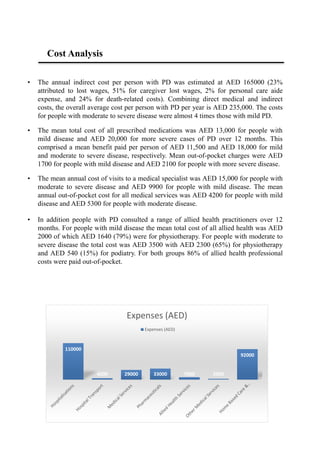
• The annual indirect cost per person with PD was estimated at AED 165000 (23%
attributed to lost wages, 51% for caregiver lost wages, 2% for personal care aide
expense, and 24% for death-related costs). Combining direct medical and indirect
costs, the overall average cost per person with PD per year is AED 235,000. The costs
for people with moderate to severe disease were almost 4 times those with mild PD.
• The mean total cost of all prescribed medications was AED 13,000 for people with
mild disease and AED 20,000 for more severe cases of PD over 12 months. This
comprised a mean benefit paid per person of AED 11,500 and AED 18,000 for mild
and moderate to severe disease, respectively. Mean out-of-pocket charges were AED
1700 for people with mild disease and AED 2100 for people with more severe disease.
• The mean annual cost of visits to a medical specialist was AED 15,000 for people with
moderate to severe disease and AED 9900 for people with mild disease. The mean
annual out-of-pocket cost for all medical services was AED 4200 for people with mild
disease and AED 5300 for people with moderate disease.
• In addition people with PD consulted a range of allied health practitioners over 12
months. For people with mild disease the mean total cost of all allied health was AED
2000 of which AED 1640 (79%) were for physiotherapy. For people with moderate to
severe disease the total cost was AED 3500 with AED 2300 (65%) for physiotherapy
and AED 540 (15%) for podiatry. For both groups 86% of allied health professional
costs were paid out-of-pocket.
110000
4000 29000 33000 7000 2000
92000
Expenses (AED)
Expenses (AED)
Summary
• Parkinson’s disease is one of the more common of the degenerative diseases of the
nervous system, affecting one in five hundred people, mainly beyond the age of 50
years.
• It has typical clinical features of increased muscle tone, resting tremor and slowness of
movement.
• Other conditions affecting the central nervous system can produce a syndrome
indistinguishable from Parkinson’s disease.
• The causes of Parkinson’s disease are unknown and it is possible that multiple factors,
both genetic and environmental, contribute. Although epidemiological studies have
identified a number of environmental exposures associated with an increased risk of
Parkinson’s disease, none has been proven as causative.
• Parkinson’s disease is slowly progressive and irreversible but where a parkinsonian
syndrome is the result of adverse effects of psychotropic drug treatment, it may
improve when the drug is withdrawn.
• Treatment is aimed at reducing the severity of symptoms and delaying the onset of
disability.
Reference
• https://www.mavoclinic.org/diseases-conditions/parkinsons-disease/svmptoms-
causes/svc-
20376055#:~:text=Parkinson's%20disease%20is%20a%20progressive.stiffness%20or
%20slow ing%20of%20movement.
• https://www.parkinson.org/understanding-parkinsons/what-is-parkinsons
• https: //www.webmd.com/parkinsons -disease/default.htm
• https://www.medicalnewstodav.com/articles/323396
• https://www.nhs.uk/conditions/parkinsons-disease/
• https://www.healthline.com/health/parkinsons
• https://www.medicinenet.com/parkinsons disease/article.htm
• https://www.patientcareonline.com/economic-burden-associated-parkinson-disease
• https://www.hindawi.com/iournals/pd/2017/5932675/
https://www.michaelifox.org/sites/default/files/media/document/2019%20Parkinson%
27s%20 Economic%20Burden%20Studv%20-%20FINAL.pdf
• https://pubmed.ncbi.nlm.nih.gov/22978629/
• https://www.ncbi.nlm.nih.gov/pmc/articles/PMC5488490/
• https://www.dovepress.com/average-annual-cost-of-parkinsons-disease-in-sao-paulo-
brazil-with-a-f-peer-reviewed-fulltext-article-CIA
• https://parkinsonsnewstodav.com/2019/06/17/economic-burden-parkinsons-double-
previous-estimates/
• https://www.researchgate.net/publication/47299288 Costs of illness and care in
Parkinson' s Disease An evaluation in six countries
• https://www.researchgate.net/publication/283324214 Estimating the direct and indirect
cost s associated with Parkinson's disease
• https://www.michaelifox.org/publication/parkinsons-disease-economic-burden-
patients-families-and-federal -government-52-billion
• https://www.parkinson.org/about-us/Press-Room/Press-Releases/Parkinsons-
Economic-Burden
• https://www.aimc.com/newsroom/the-financial-burden-of-parkinson-disease-is-52-
billion-more- than-double-previous-estimates-
• https: //www.parkinsons.org .uk/sites/default/files/2017-
07/CS2547%20Cost%20of%20Parkinson%27s%20report%202017%20-%20UK 1.pdf
• https://parkinsonsdisease.net/living/real-costs-of-pd/
• https://link.springer.com/chapter/10.1007/978-3-030-23816-2 18
• https: //www.ncbi .nlm .nih.gov/pmc/articles/PMC3757266/
• https://pubmed.ncbi.nlm.nih.gov/23436720/
• https://parkinsonsnewstodav.com/2019/12/04/chronic-illness-costs-sacrifices-decisions/
http://shura.shu.ac.uk/15930/12/Gumber%20Economic%20Social%20and%20Financial%20
C ost%20of%20Parkinsons%20.pdf
• https://www.sciencedirect.com/science/article/abs/pii/S096758681932171X
• https://research.unl.pt/ws/portalfiles/portal/4387190/Sonia Eur Neuropsvchopharmacologv 2
011 21 2 180.pdf

Parkinson's disease

  • 1.
  • 2.
    Introduction • Parkinson’s diseaseis a slowly progressive degenerative condition of the central nervous system that affects body movement by altering the overall tone and control of skeletal muscle action. It was first described as the ‘shaking palsy' by the physician James Parkinson in 1817. • It results from a deficiency of dopamine, a chemical neurotransmitter in the brain. This substance is produced by cells of the substantia nigra, whose axons project into the basal ganglia, an area of the brain that influences motor control by way of the extra- pyramidal pathways. • The pathophysiology of the condition is characterized by a loss of pigmented neurons in the substantia nigra of the basal cell ganglions of the brain stem. The presence of Lewy bodies (concentric cellular inclusions in the pigmented neurons of the substantia nigra) was thought to be pathognomonic but these have since been found in other brain disorders and are not specific to Parkinson’s disease. Approximately 60-80% of dopaminergic neurons are lost before clinical symptoms appear. • A parkinsonian syndrome may result from a primary deficiency of dopamine production by the neurons of the substantia nigra but may also arise secondary to other neurological diseases and from toxicity. Nomenclature is often used inconsistently. For the purposes of this review the term “Parkinson’s disease” will be used to describe the primary condition and “parkinsonism” or “secondary parkinsonism” to refer to the syndrome resulting from other causes.
  • 3.
    Clinical Symptoms • Parkinson’sdisease is the one of the most common of the degenerative neurological disorders of the elderly. Prevalence in UK, Canada and USA is between 200 and 300 per 100,000. Prevalence in GCC is in between 27 to 43 per 100,000. Prevalence rises with age and affects 0.4% of those over 40 yrs old. The youngest PD patients in UAE is 18 years old. 1% of those over 65 yrs old. The mean age of onset is 57 yrs. It can occur in childhood or adolescence (juvenile Parkinsonism). It is 1.5 times more common in men than women. • The essential clinical features are: > Tremor > Rigidity > Bradykinesia Impaired postural reflexes > In later stages there may be a decline in cognitive function. • The disease begins insidiously and effects may be noticed first by relatives and friends. There is thought to be a ‘pre-clinical phase’ that may last several years when dopamine production may be falling. Progression tends to be slower when presenting in younger patients and may run a course over 35 yrs. The first symptoms may be non-specific such as fatigue or depression. • Early signs of movement loss that may first be noticed by others are: > Infrequent blinking > Lack of facial expression > Decreased spontaneous movement and gestures > Effects on speech - dysphonia and dysarthria • Tremor may be the first symptom noticed by the patient. When present it is a typical, low frequency, unconscious ‘pill rolling’ movement of the fingers, starting usually in one hand. Typically the tremor is maximal at rest, absent during sleep, and lessens with intentional movement such as reaching or grasping. It may be more noticeable with emotional stress or tiredness. Hands, arms and legs may be first affected by tremor and as the condition progresses, the jaw, tongue and eyelids become involved.
  • 4.
    • In somepatients tremor is absent and only rigidity occurs. The effects of bradykinesia and rigidity are generally more disabling than tremor. Tremor can be embarrassing but the effects of rigidity impede manual dexterity, balance and walking. As the condition progresses, movement becomes slower and more laborious (bradykinesia), with loss of spontaneous gestures. The face develops a mask-like expressionless character which may be mistaken for depression. Posture becomes stooped and it becomes difficult to initiate walking, with short shuffling steps which may break into a short-stepped run to maintain balance. This is described as the typical ‘festinating gait’. Impaired control of the small muscles of the hand often results in changes in the handwriting with decreasing size of the script (micrographia) and use of fewer words. The combination of these factors leads to significant impairment of activities of daily living such as dressing, bathing and using cutlery. • In addition to the signs referred to above that will have been evident on observation, clinical examination reveals features of rigidity. Attempts to move a limb joint passively are met with increased resistance which is either smooth (lead-pipe rigidity) or intermittent and oscillatory (cogwheel rigidity). • Impairment of postural reflexes with instability is an important stage in development as it responds poorly to treatment and leads to significant disability. • Dementia is a late manifestation of the condition and affects around 30% of sufferers. Short-term memory is affected but aphasia is rare. • Depression occurs in between 15 -20% of patients at some stage of the illness. • There is no specific test for the diagnosis of Parkinson’s disease. Diagnosis is largely based on clinical presentation, examination, progress of symptoms and response to treatment with dopaminergic medication. Magnetic resonance imaging (MRI) and computerized axial tomography (CT) are unremarkable. In atypical presentations of Parkinsonism, MRI or CT may identify an underlying condition. Positron emission tomography (PET) and single photon emission CT (SPECT) are useful diagnostic imaging studies but they are not widely available and are not indicated in cases that have a typical clinical presentation.
  • 5.
    Causes • There isno known cause for Parkinson’s disease and it is likely that it is due to a complex association of genetic and environmental factors. Problems with case definition, study design, size and methodology compound the difficulties of interpretation of study results. In addition, reliance on self-reporting and difficulties in obtaining objective data on environmental exposure, make it difficult to evaluate the many claimed causative associations. Secondary Parkinsonism can arise from a variety of causes such as the toxic effects of drugs and chemicals and Parkinson-like movement disorders may be encountered as a component of other neurological diseases. • The motor effects of Parkinson’s disease are due to reduced production of dopamine from the substantia nigra of the basal ganglia, resulting in inhibition of impulses in the direct motor pathways of the thalamus. These impulses normally affect fine control of voluntary muscle movement. • It is helpful to consider causes under the following headings:  Parkinson’s disease  Secondary parkinsonism  Parkinson-like movement disorders secondary to other neurological disease • Parkinson’s disease. In Parkinson’s disease there is a progressive failure in production of dopamine. The reasons for this are not known but various factors may play a part. Genetic and environmental factors are possibly at play. • Genetic factors. A direct genetic cause of Parkinson's disease has not been established. One study compared concordance rates of Parkinson’s disease in monozygotic and dizygotic male twins where one twin was suspected of having Parkinson’s disease. This study concluded that there was no evidence that genetic factors play a significant role in typical Parkinson’s disease that begins after age 50. However, genetic factors may play a part in cases where the condition presents below age 50. • Environmental factors. The fact that many toxins can cause symptoms indistinguishable from Parkinson’s disease suggests that long-term exposure to low dose environmental toxins may possibly result in ‘idiopathic’ Parkinson’s disease. Factors that have been postulated as being associated with the development of Parkinson’s disease include the use of pesticides, living in a rural environment, consumption of well water, exposure to herbicides, and proximity to industrial plants or quarries. Several studies have found an association between rural living, drinking well water and an increased incidence of Parkinson’s disease. It is not clear whether this may be due to contamination of supplies by herbicides or pesticides, or to naturally occurring high levels of potentially toxic metals such as manganese in drinking water. Both factors could be present in rural communities.
  • 6.
    1. Metoclopramide. Thisdrug is used to treat gastro-intestinal disturbances and nausea. The drug is generally prescribed for short courses to treat acute symptoms but long term use can result in Parkinsonism. 2. 1-methyl-4-phenyl-1,2,3,6-tetrahydropyridine (MPTP). MPTP is an unwanted by-product of illicit attempts to synthesize meperidine for drug abusers and results in severe Parkinsonism after injection. The neurotoxic effects are limited to damage of the substantia nigra and consistently cause a parkinsonian state. 3. Neurotoxins. Apart from the toxic effects of inhibition of dopamine due to drugs, a variety of neurotoxins can have a similar effect. Substances that have been implicated include:  Manganese  Copper  Lead  Mercury  Iron  Herbicides e.g. paraquat and rotenone • Smoking. Parkinson’s disease appears less common in smokers than non- smokers and despite some findings to the contrary there is a large body of evidence that indicates that smoking tobacco protects against the condition, possibly by inhibiting the effect of monoamine oxidase, an enzyme which breaks down dopamine in the body. • Trauma. Dementia pugilistica experienced by boxers is a well-documented syndrome with features of Parkinsonism, ataxia and intellectual loss. It results from repeated head trauma over a period of years. The effects of single or infrequently repeated head injury are less clear. Psychotropic drugs. Psychotropic or neuroleptic drugs, particularly the phenothiazine and butyropherone groups, are used for treatment of schizophrenia or in short-term use for severe anxiety. They act by interfering with dopaminergic transmission in the brain by blocking dopamine • Secondary Parkinsonism. Symptoms of Parkinson’s disease are commonly known to be caused specifically by certain drugs and toxins. • Psychotropic drugs. Psychotropic or neuroleptic drugs, particularly the phenothiazine and butyropherone groups, are used for treatment of schizophrenia or in short-term use for severe anxiety. They act by interfering with dopaminergic transmission in the brain by blocking dopamine
  • 7.
    • Disorders secondaryto other neurological disease. The basal ganglia and the motor control systems of the brain stem can be affected by other degenerative neurological diseases including cerebro-vascular disease and stroke, cortical degeneration, multiple system atrophy, progressive supranuclear palsy (Steele- Richardson syndrome) and Prion disease • One study from the Mayo Clinic looked at the effects of non-repetitive head injury using a case-control study of subjects with Parkinson’s disease and showed an increased risk from head injury with an odds ratio of 4.3 with an associated 95% confidence interval of 1.2 to 15.2. The study was population based with 196 cases and the same number of age- and sex-matched controls. Episodes of head trauma were taken from case notes and there were only 13 cases of head trauma with varying degrees of severity. The results showed that the frequency of head trauma was significantly higher in cases than in controls but the association only related to more severe head trauma and late onset disease. The numbers were small and other factors such as personality type or the effects of motor dysfunction increasing the incidence of head trauma could have influenced the outcome
  • 8.
    Prognosis • Parkinson’s diseaseis progressive and there is no effective treatment to reverse its progress. Treatment is aimed at reducing and controlling symptoms, reducing disability and prolonging the period before disability becomes severe. Parkinson’s disease is uncommon before age 40 but in cases that present early, the course may run over 35 years. There appears to be no significant reduction in life expectancy but obviously cases starting in later life run a shorter course. Although progression tends to become slower with time, the patient is likely to have a markedly reduced quality of life. In the late stages the illness can produce severe disability and dependence. Side effects from medication such as depression and dementia can compound the disability, and dysphagia can lead to distressing drooling and reduced nutrition. Impairment in respiratory muscle function combined with poor nutrition and posture can lead to postural pneumonia and death. • Dopaminergic drugs are the mainstay for reducing the main symptomatic effects of Parkinson’s disease, but treatment does not reverse the progress of the condition. Although this treatment is effective in reducing symptoms for several years, with time the response becomes less effective. Drug treatment is continually developing with newer substances helping to prolong the beneficial effect and delay the onset of disability. Neurosurgical procedures are also showing promise. • Parkinson-type side effects of anti-psychotic drugs which inhibit the action of dopamine are usually reversible on cessation of treatment. However as the need to continue treatment for the underlying condition may be essential, the side-effects may have to be tolerated.
  • 9.
    Cost Analysis • Theannual indirect cost per person with PD was estimated at AED 165000 (23% attributed to lost wages, 51% for caregiver lost wages, 2% for personal care aide expense, and 24% for death-related costs). Combining direct medical and indirect costs, the overall average cost per person with PD per year is AED 235,000. The costs for people with moderate to severe disease were almost 4 times those with mild PD. • The mean total cost of all prescribed medications was AED 13,000 for people with mild disease and AED 20,000 for more severe cases of PD over 12 months. This comprised a mean benefit paid per person of AED 11,500 and AED 18,000 for mild and moderate to severe disease, respectively. Mean out-of-pocket charges were AED 1700 for people with mild disease and AED 2100 for people with more severe disease. • The mean annual cost of visits to a medical specialist was AED 15,000 for people with moderate to severe disease and AED 9900 for people with mild disease. The mean annual out-of-pocket cost for all medical services was AED 4200 for people with mild disease and AED 5300 for people with moderate disease. • In addition people with PD consulted a range of allied health practitioners over 12 months. For people with mild disease the mean total cost of all allied health was AED 2000 of which AED 1640 (79%) were for physiotherapy. For people with moderate to severe disease the total cost was AED 3500 with AED 2300 (65%) for physiotherapy and AED 540 (15%) for podiatry. For both groups 86% of allied health professional costs were paid out-of-pocket. 110000 4000 29000 33000 7000 2000 92000 Expenses (AED) Expenses (AED)
  • 10.
    Summary • Parkinson’s diseaseis one of the more common of the degenerative diseases of the nervous system, affecting one in five hundred people, mainly beyond the age of 50 years. • It has typical clinical features of increased muscle tone, resting tremor and slowness of movement. • Other conditions affecting the central nervous system can produce a syndrome indistinguishable from Parkinson’s disease. • The causes of Parkinson’s disease are unknown and it is possible that multiple factors, both genetic and environmental, contribute. Although epidemiological studies have identified a number of environmental exposures associated with an increased risk of Parkinson’s disease, none has been proven as causative. • Parkinson’s disease is slowly progressive and irreversible but where a parkinsonian syndrome is the result of adverse effects of psychotropic drug treatment, it may improve when the drug is withdrawn. • Treatment is aimed at reducing the severity of symptoms and delaying the onset of disability.
  • 11.
    Reference • https://www.mavoclinic.org/diseases-conditions/parkinsons-disease/svmptoms- causes/svc- 20376055#:~:text=Parkinson's%20disease%20is%20a%20progressive.stiffness%20or %20slow ing%20of%20movement. •https://www.parkinson.org/understanding-parkinsons/what-is-parkinsons • https: //www.webmd.com/parkinsons -disease/default.htm • https://www.medicalnewstodav.com/articles/323396 • https://www.nhs.uk/conditions/parkinsons-disease/ • https://www.healthline.com/health/parkinsons • https://www.medicinenet.com/parkinsons disease/article.htm • https://www.patientcareonline.com/economic-burden-associated-parkinson-disease • https://www.hindawi.com/iournals/pd/2017/5932675/ https://www.michaelifox.org/sites/default/files/media/document/2019%20Parkinson% 27s%20 Economic%20Burden%20Studv%20-%20FINAL.pdf • https://pubmed.ncbi.nlm.nih.gov/22978629/ • https://www.ncbi.nlm.nih.gov/pmc/articles/PMC5488490/ • https://www.dovepress.com/average-annual-cost-of-parkinsons-disease-in-sao-paulo- brazil-with-a-f-peer-reviewed-fulltext-article-CIA • https://parkinsonsnewstodav.com/2019/06/17/economic-burden-parkinsons-double- previous-estimates/ • https://www.researchgate.net/publication/47299288 Costs of illness and care in Parkinson' s Disease An evaluation in six countries • https://www.researchgate.net/publication/283324214 Estimating the direct and indirect cost s associated with Parkinson's disease • https://www.michaelifox.org/publication/parkinsons-disease-economic-burden- patients-families-and-federal -government-52-billion • https://www.parkinson.org/about-us/Press-Room/Press-Releases/Parkinsons- Economic-Burden • https://www.aimc.com/newsroom/the-financial-burden-of-parkinson-disease-is-52- billion-more- than-double-previous-estimates-
  • 12.
    • https: //www.parkinsons.org.uk/sites/default/files/2017- 07/CS2547%20Cost%20of%20Parkinson%27s%20report%202017%20-%20UK 1.pdf • https://parkinsonsdisease.net/living/real-costs-of-pd/ • https://link.springer.com/chapter/10.1007/978-3-030-23816-2 18 • https: //www.ncbi .nlm .nih.gov/pmc/articles/PMC3757266/ • https://pubmed.ncbi.nlm.nih.gov/23436720/ • https://parkinsonsnewstodav.com/2019/12/04/chronic-illness-costs-sacrifices-decisions/ http://shura.shu.ac.uk/15930/12/Gumber%20Economic%20Social%20and%20Financial%20 C ost%20of%20Parkinsons%20.pdf • https://www.sciencedirect.com/science/article/abs/pii/S096758681932171X • https://research.unl.pt/ws/portalfiles/portal/4387190/Sonia Eur Neuropsvchopharmacologv 2 011 21 2 180.pdf