Drugs Used in Affective
Disorders
MOOD/MOOD DISORDER
• Sustained emotion
INCIDENCE
• Higher in women than in men
• Between ages 25 to 44
Etiology of Depression
Biogenic Amine Hypothesis
• Depression and mania are due to an alteration in neuronal
and synaptic catecholamine concentration at adrenergic
receptor sites in the brain.
– Depression: deficiency of catecholamine,
especially norepinephrine
– Mania: excess amines
ETIOLOGY
• Biogenic amine theory
• Dysregulation theory
• Family history
Range of emotions
• Euthymia
• Hypomania
• Euphoria
• Mania
• Dysthymia
• Dysphoria
• Depression
Clinical features of major depression
One of the following must be present:
– Depressed mood
– Anhedonia (i.e., loss of interest or pleasure)
Plus four or more of the following:
– Decreased or increased appetite
– Unintentional weight loss or gain
– Insomnia or hypersomnia
– Psychomotor agitation or retardation
– Fatigue or loss of energy
– Feelings of worthlessness or excessive or inappropriate
guilt
– Diminished ability to think or concentrate or
indecisiveness
– Recurrent thoughts of death and/or suicidal ideation
– Suicide attempt
Treatment
• Psychotherapy
• Pharmacotherapy
• ECT
Treatment phases for depression
Treatment phase Duration Goal
Acute 6 weeks Resolve
symptoms
Continuation 6-9 months Prevent relapse
Maintenance 3-5 years of
lifelong
Prevent
recurrence in high
risk patients
Drug selection/administration
• All drugs are equally effective
• Half the lowest dose
• 1-2 wks
• 4-6wks
• Try onother class
Changing antidepressant
• 2 wks
• 5 wks with fluoxetine
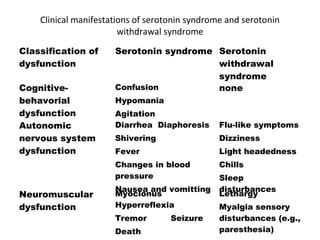
Clinical manifestations of serotonin syndrome and serotonin
withdrawal syndrome
Classification of
dysfunction
Serotonin syndrome Serotonin
withdrawal
syndrome
Cognitive-
behavorial
dysfunction
Confusion
Hypomania
Agitation
none
Autonomic
nervous system
dysfunction
Diarrhea Diaphoresis
Shivering
Fever
Changes in blood
pressure
Nausea and vomitting
Flu-like symptoms
Dizziness
Light headedness
Chills
Sleep
disturbances
Neuromuscular
dysfunction
Myoclonus
Hyperreflexia
Tremor Seizure
Death
Lethargy
Myalgia sensory
disturbances (e.g.,
paresthesia)
Selective 5-HT uptake inhibitors (SSRI)
• 1st
line for depression
• Actions similar in efficacy & time course to TCA
• Acute toxicity is less than that of MAOI or TCA
• Side-effects include nausea, insomnia & sexual
dysfunction.
• dangerous 'serotonin reaction'
– (hyperthermia, muscle rigidity, cardiovascular collapse)
can occur if given with MAOI.
• Long half-lives
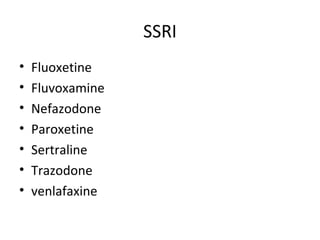
SSRI
• Fluoxetine
• Fluvoxamine
• Nefazodone
• Paroxetine
• Sertraline
• Trazodone
• venlafaxine
SSRIs
• Am bec of its stimulatory effect
• Metabolize via cytochrome P450
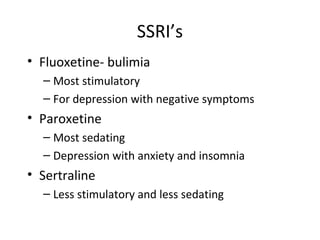
SSRI’s
• Fluoxetine- bulimia
– Most stimulatory
– For depression with negative symptoms
• Paroxetine
– Most sedating
– Depression with anxiety and insomnia
• Sertraline
– Less stimulatory and less sedating
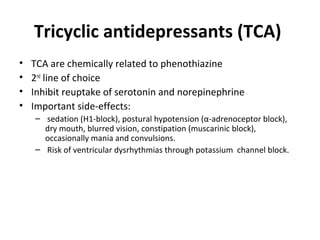
Tricyclic antidepressants (TCA)
• TCA are chemically related to phenothiazine
• 2nd
line of choice
• Inhibit reuptake of serotonin and norepinephrine
• Important side-effects:
– sedation (H1-block), postural hypotension (α-adrenoceptor block),
dry mouth, blurred vision, constipation (muscarinic block),
occasionally mania and convulsions.
– Risk of ventricular dysrhythmias through potassium channel block.
Cyclic Antidepressants
• Tricyclic antidepressants—primary: amitriptyline
(Elavil), doxepin (Sinequan), imipramine (Tofranil)
• Tricyclic antidepressants—secondary:
desipramine (Norpramin), nortriptyline (Aventyl),
protriptyline (Vivactil)
• Tetracyclic antidepressants:
amoxapine (Asendin), maprotiline (Ludiomil)
Cyclic Antidepressants
Mechanism of Action
• Block reuptake of neurotransmitters, causing
accumulation at the nerve endings.
• It is thought that increasing concentrations of
neurotransmitters will correct the abnormally
low levels that lead to depression.
Cyclic Antidepressants
Mechanism of Action—Drug Effects
Blockade of norepinephrine:
– antidepressant, tremors, tachycardia, additive
pressor effects with sympathomimetic drugs
Blockade of serotonin:
– antidepressant, nausea, headache, anxiety,
sexual dysfunction
Cyclic Antidepressants
Therapeutic Uses
• Depression
• Childhood enuresis (imipramine)
• Obsessive-compulsive disorders
(clomipramine)
• Adjunctive analgesics
• Trigeminal neuralgia
TCA
– PM DOSAGE ALL- SEDATING ACTIVITY
– 4-6 WKS- FULL RESPOSE
– 1 WK ASSYMPTOMATIC RELIEF
– ANTICHOLINERGIC SIDE EFFECTS
Cyclic Antidepressants
Side Effects
• Sedation
• Impotence
• Orthostatic hypotension
• Older patients:
– dizziness, postural hypotension, constipation,
delayed micturation, edema, muscle tremors
TCA
• TCA USER
• HEALTHY
• NONSUICIDAL
• REFRACTORY TO NEWER DRUGS
Monoamine oxidase inhibitors
(MAOI)
• Action is long lasting (weeks) due to irreversible inhibition of
MAO A & B.
– Moclobemide has a short duration of action
• 3rd
line of choice
• Main side-effects:
– postural hypotension (sympathetic block)
– atropine-like effects (as with TCA);
– weight gain
– CNS stimulation
– Serotonin syndrome
– liver damage (rare). ISOCARBOXAZID
Antidepressants: MAOIs Hypertensive
Crisis and Tyramine
• Ingestion of foods and/or drinks with
the amino acid TYRAMINE leads to
hypertensive crisis, which may lead
to cerebral hemorrhage, stroke,
coma, or death
Antidepressants: MAOIs Hypertensive
Crisis and Tyramine
Avoid foods that contain tyramine!
• Aged, mature cheeses (cheddar, blue, Swiss)
• Smoked/pickled or aged meats, fish, poultry (herring,
sausage, corned beef, salami, pepperoni, paté)
• Yeast extracts
• Red wines (Chianti, burgundy, sherry, vermouth)
• Italian broad beans (fava beans)
MAOI
• ATYPICAL DEPRESSION
• HYPERSOMNIA
• AGITATION
• ANXIETY
Monoamine oxidase inhibitors
(MAOI)
• Phenelezine,Tranylcypromine,
• Isocarboxazid
– Rarely clinical due to serotonin syndrome
– hypertensive crisis- most common (tyramine-rich foods)
– 3 -4 wks- do not discontinue
– Insomnia effect – not at pm
Side effects
• Othostatic hypotension
• Weight gain
• Edema
• Sexual dysfunction
• Hepatocellular damage-isocarboxacid
MANIA
Etiology
• Genetics
• Neurotransmitter level
• GABA level
• Calcium
• G proteins
• Psychosocial and physical stressors
Symptoms of mania
• Grandiose ideations or expansive self-esteem
• Decreased need for sleep
• Pressured speech
• Racing thoughts or flight of ideas
• Distractability
• Psychomotor agitation
• Engaging in dangerous, high-risk activities
LITHIUM
• Mechanism of Action
–?
–alters intracellular second messengers:
adenyl cyclase-cyclic AMP system and the G
protein-coupled phosphoinositide systems
(NE and serotonin)
–alters ion channel function
–alters metabolism of GABA
LITHIUM
• Adverse effects
–Narrow therapeutic index
–Therapeutic range: 0.5-1.5mEq/L
–Minor S/E: tremors, polyuria,
GI distress,
memory problems, acne,
weight gain
–Long-term S/E: hypothyroidism
–Toxic levels: ataxia, tremors, confusion, coma, sinus
arrest, death
LITHIUM
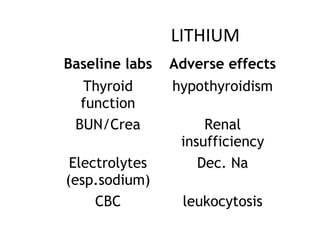
Baseline labs Adverse effects
Thyroid
function
hypothyroidism
BUN/Crea Renal
insufficiency
Electrolytes
(esp.sodium)
Dec. Na
CBC leukocytosis
• Alternative mood-stabilising drugs
(e.g. carbamazepine, valproate,
gabapentin,clonazepam)
Summary
• ANTICHOLINERGIC-TCA
• CHLOMIPRAMINE-OC
• IMIPRAMINE –NOCTURNAL
• MAOI- HYPERTENSIVE CRISIS
• SEIZURE-SE OF BUPROPION

Antidepressants

  • 1.
    Drugs Used inAffective Disorders
  • 2.
  • 3.
    INCIDENCE • Higher inwomen than in men • Between ages 25 to 44
  • 4.
    Etiology of Depression BiogenicAmine Hypothesis • Depression and mania are due to an alteration in neuronal and synaptic catecholamine concentration at adrenergic receptor sites in the brain. – Depression: deficiency of catecholamine, especially norepinephrine – Mania: excess amines
  • 5.
    ETIOLOGY • Biogenic aminetheory • Dysregulation theory • Family history
  • 6.
    Range of emotions •Euthymia • Hypomania • Euphoria • Mania • Dysthymia • Dysphoria • Depression
  • 7.
    Clinical features ofmajor depression One of the following must be present: – Depressed mood – Anhedonia (i.e., loss of interest or pleasure) Plus four or more of the following: – Decreased or increased appetite – Unintentional weight loss or gain – Insomnia or hypersomnia – Psychomotor agitation or retardation – Fatigue or loss of energy – Feelings of worthlessness or excessive or inappropriate guilt – Diminished ability to think or concentrate or indecisiveness – Recurrent thoughts of death and/or suicidal ideation – Suicide attempt
  • 8.
  • 9.
    Treatment phases fordepression Treatment phase Duration Goal Acute 6 weeks Resolve symptoms Continuation 6-9 months Prevent relapse Maintenance 3-5 years of lifelong Prevent recurrence in high risk patients
  • 10.
    Drug selection/administration • Alldrugs are equally effective • Half the lowest dose • 1-2 wks • 4-6wks • Try onother class
  • 11.
    Changing antidepressant • 2wks • 5 wks with fluoxetine
  • 12.
    Clinical manifestations ofserotonin syndrome and serotonin withdrawal syndrome Classification of dysfunction Serotonin syndrome Serotonin withdrawal syndrome Cognitive- behavorial dysfunction Confusion Hypomania Agitation none Autonomic nervous system dysfunction Diarrhea Diaphoresis Shivering Fever Changes in blood pressure Nausea and vomitting Flu-like symptoms Dizziness Light headedness Chills Sleep disturbances Neuromuscular dysfunction Myoclonus Hyperreflexia Tremor Seizure Death Lethargy Myalgia sensory disturbances (e.g., paresthesia)
  • 13.
    Selective 5-HT uptakeinhibitors (SSRI) • 1st line for depression • Actions similar in efficacy & time course to TCA • Acute toxicity is less than that of MAOI or TCA • Side-effects include nausea, insomnia & sexual dysfunction. • dangerous 'serotonin reaction' – (hyperthermia, muscle rigidity, cardiovascular collapse) can occur if given with MAOI. • Long half-lives
  • 14.
    SSRI • Fluoxetine • Fluvoxamine •Nefazodone • Paroxetine • Sertraline • Trazodone • venlafaxine
  • 15.
    SSRIs • Am becof its stimulatory effect • Metabolize via cytochrome P450
  • 16.
    SSRI’s • Fluoxetine- bulimia –Most stimulatory – For depression with negative symptoms • Paroxetine – Most sedating – Depression with anxiety and insomnia • Sertraline – Less stimulatory and less sedating
  • 17.
    Tricyclic antidepressants (TCA) •TCA are chemically related to phenothiazine • 2nd line of choice • Inhibit reuptake of serotonin and norepinephrine • Important side-effects: – sedation (H1-block), postural hypotension (α-adrenoceptor block), dry mouth, blurred vision, constipation (muscarinic block), occasionally mania and convulsions. – Risk of ventricular dysrhythmias through potassium channel block.
  • 18.
    Cyclic Antidepressants • Tricyclicantidepressants—primary: amitriptyline (Elavil), doxepin (Sinequan), imipramine (Tofranil) • Tricyclic antidepressants—secondary: desipramine (Norpramin), nortriptyline (Aventyl), protriptyline (Vivactil) • Tetracyclic antidepressants: amoxapine (Asendin), maprotiline (Ludiomil)
  • 19.
    Cyclic Antidepressants Mechanism ofAction • Block reuptake of neurotransmitters, causing accumulation at the nerve endings. • It is thought that increasing concentrations of neurotransmitters will correct the abnormally low levels that lead to depression.
  • 20.
    Cyclic Antidepressants Mechanism ofAction—Drug Effects Blockade of norepinephrine: – antidepressant, tremors, tachycardia, additive pressor effects with sympathomimetic drugs Blockade of serotonin: – antidepressant, nausea, headache, anxiety, sexual dysfunction
  • 21.
    Cyclic Antidepressants Therapeutic Uses •Depression • Childhood enuresis (imipramine) • Obsessive-compulsive disorders (clomipramine) • Adjunctive analgesics • Trigeminal neuralgia
  • 22.
    TCA – PM DOSAGEALL- SEDATING ACTIVITY – 4-6 WKS- FULL RESPOSE – 1 WK ASSYMPTOMATIC RELIEF – ANTICHOLINERGIC SIDE EFFECTS
  • 23.
    Cyclic Antidepressants Side Effects •Sedation • Impotence • Orthostatic hypotension • Older patients: – dizziness, postural hypotension, constipation, delayed micturation, edema, muscle tremors
  • 24.
    TCA • TCA USER •HEALTHY • NONSUICIDAL • REFRACTORY TO NEWER DRUGS
  • 25.
    Monoamine oxidase inhibitors (MAOI) •Action is long lasting (weeks) due to irreversible inhibition of MAO A & B. – Moclobemide has a short duration of action • 3rd line of choice • Main side-effects: – postural hypotension (sympathetic block) – atropine-like effects (as with TCA); – weight gain – CNS stimulation – Serotonin syndrome – liver damage (rare). ISOCARBOXAZID
  • 26.
    Antidepressants: MAOIs Hypertensive Crisisand Tyramine • Ingestion of foods and/or drinks with the amino acid TYRAMINE leads to hypertensive crisis, which may lead to cerebral hemorrhage, stroke, coma, or death
  • 27.
    Antidepressants: MAOIs Hypertensive Crisisand Tyramine Avoid foods that contain tyramine! • Aged, mature cheeses (cheddar, blue, Swiss) • Smoked/pickled or aged meats, fish, poultry (herring, sausage, corned beef, salami, pepperoni, paté) • Yeast extracts • Red wines (Chianti, burgundy, sherry, vermouth) • Italian broad beans (fava beans)
  • 28.
    MAOI • ATYPICAL DEPRESSION •HYPERSOMNIA • AGITATION • ANXIETY
  • 29.
    Monoamine oxidase inhibitors (MAOI) •Phenelezine,Tranylcypromine, • Isocarboxazid – Rarely clinical due to serotonin syndrome – hypertensive crisis- most common (tyramine-rich foods) – 3 -4 wks- do not discontinue – Insomnia effect – not at pm
  • 30.
    Side effects • Othostatichypotension • Weight gain • Edema • Sexual dysfunction • Hepatocellular damage-isocarboxacid
  • 31.
  • 32.
    Etiology • Genetics • Neurotransmitterlevel • GABA level • Calcium • G proteins • Psychosocial and physical stressors
  • 33.
    Symptoms of mania •Grandiose ideations or expansive self-esteem • Decreased need for sleep • Pressured speech • Racing thoughts or flight of ideas • Distractability • Psychomotor agitation • Engaging in dangerous, high-risk activities
  • 34.
    LITHIUM • Mechanism ofAction –? –alters intracellular second messengers: adenyl cyclase-cyclic AMP system and the G protein-coupled phosphoinositide systems (NE and serotonin) –alters ion channel function –alters metabolism of GABA
  • 35.
    LITHIUM • Adverse effects –Narrowtherapeutic index –Therapeutic range: 0.5-1.5mEq/L –Minor S/E: tremors, polyuria, GI distress, memory problems, acne, weight gain –Long-term S/E: hypothyroidism –Toxic levels: ataxia, tremors, confusion, coma, sinus arrest, death
  • 36.
    LITHIUM Baseline labs Adverseeffects Thyroid function hypothyroidism BUN/Crea Renal insufficiency Electrolytes (esp.sodium) Dec. Na CBC leukocytosis
  • 37.
    • Alternative mood-stabilisingdrugs (e.g. carbamazepine, valproate, gabapentin,clonazepam)
  • 38.
    Summary • ANTICHOLINERGIC-TCA • CHLOMIPRAMINE-OC •IMIPRAMINE –NOCTURNAL • MAOI- HYPERTENSIVE CRISIS • SEIZURE-SE OF BUPROPION