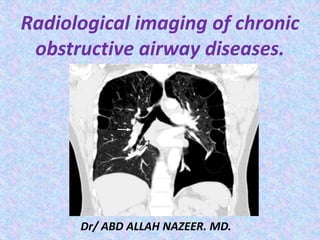
Radiological imaging of chronic
obstructive airway diseases.
Dr/ ABD ALLAH NAZEER. MD.
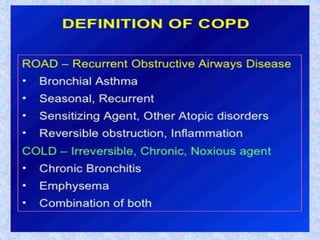
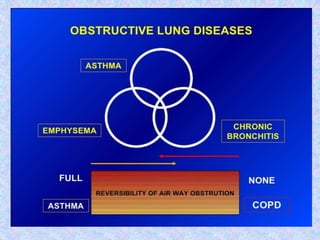
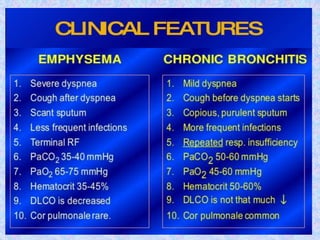
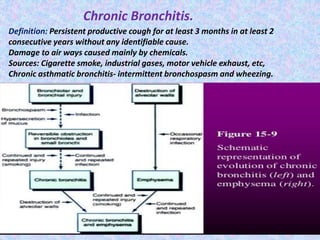
Chronic Bronchitis.
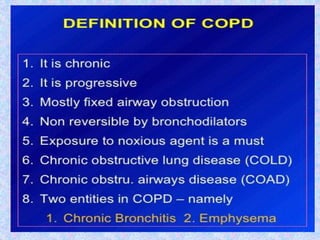
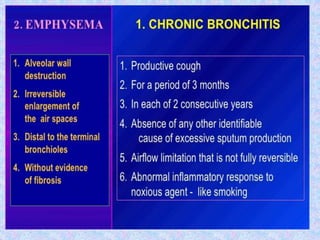
Definition: Persistent productive cough for at least 3 months in at least 2
consecutive years without any identifiable cause.
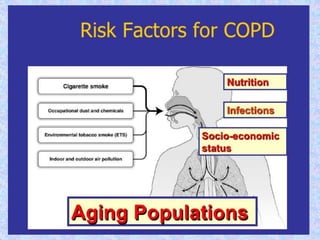
Damage to air ways caused mainly by chemicals.
Sources: Cigarette smoke, industrial gases, motor vehicle exhaust, etc,
Chronic asthmatic bronchitis- intermittent bronchospasm and wheezing.
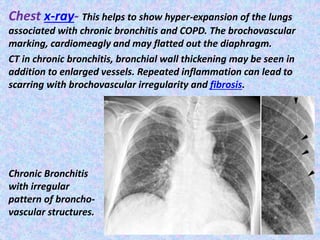
Chest x-ray- This helps to show hyper-expansion of the lungs
associated with chronic bronchitis and COPD. The brochovascular
marking, cardiomeagly and may flatted out the diaphragm.
Chronic Bronchitis
with irregular
pattern of broncho-
vascular structures.
CT in chronic bronchitis, bronchial wall thickening may be seen in
addition to enlarged vessels. Repeated inflammation can lead to
scarring with brochovascular irregularity and fibrosis.
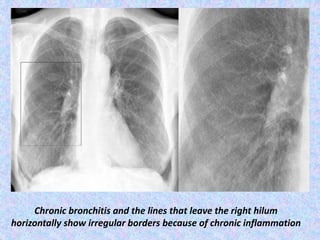
Chronic bronchitis and the lines that leave the right hilum
horizontally show irregular borders because of chronic inflammation
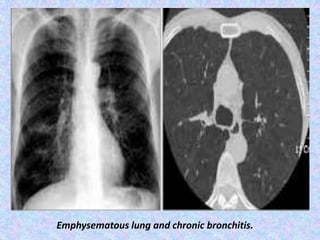
Emphysematous lung and chronic bronchitis.
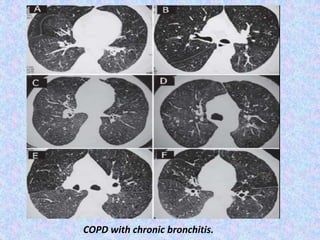
COPD with chronic bronchitis.
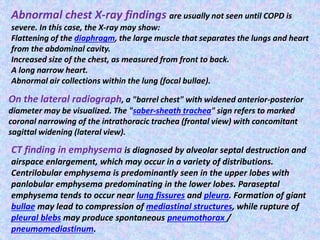
Abnormal chest X-ray findings are usually not seen until COPD is
severe. In this case, the X-ray may show:
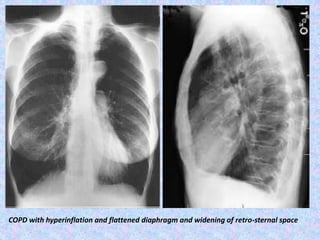
Flattening of the diaphragm, the large muscle that separates the lungs and heart
from the abdominal cavity.
Increased size of the chest, as measured from front to back.
A long narrow heart.
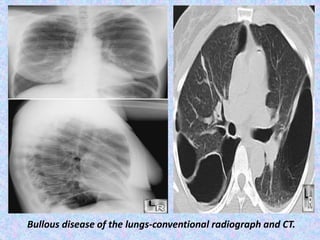
Abnormal air collections within the lung (focal bullae).
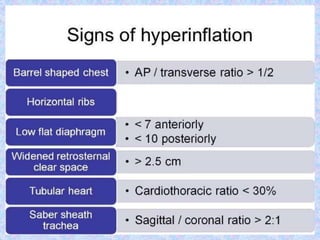
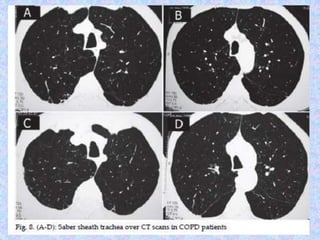
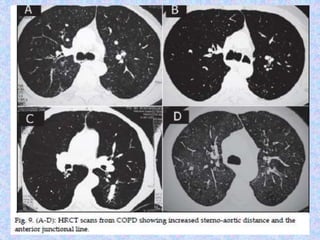
On the lateral radiograph, a "barrel chest" with widened anterior-posterior
diameter may be visualized. The "saber-sheath trachea" sign refers to marked
coronal narrowing of the intrathoracic trachea (frontal view) with concomitant
sagittal widening (lateral view).
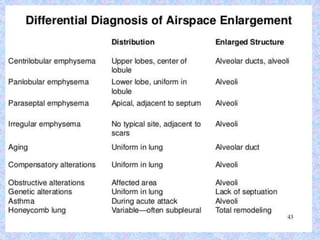
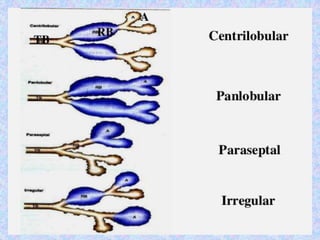
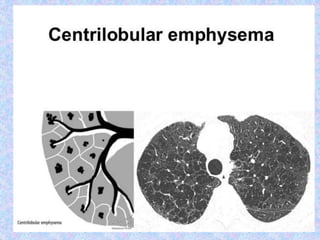
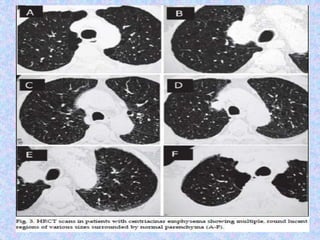
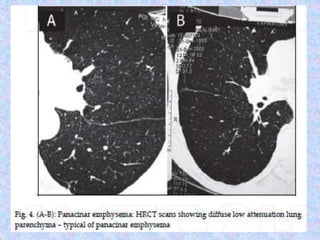
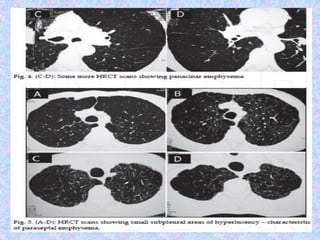
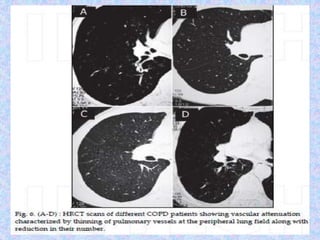
CT finding in emphysema is diagnosed by alveolar septal destruction and
airspace enlargement, which may occur in a variety of distributions.
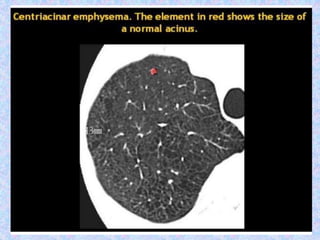
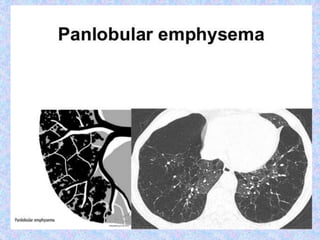
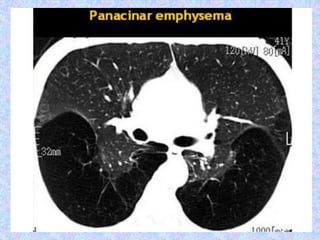
Centrilobular emphysema is predominantly seen in the upper lobes with
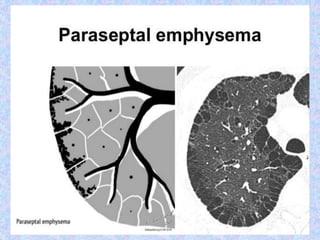
panlobular emphysema predominating in the lower lobes. Paraseptal
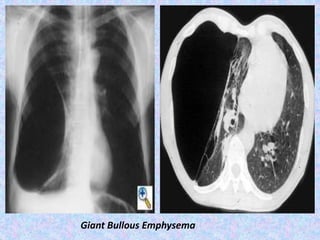
emphysema tends to occur near lung fissures and pleura. Formation of giant
bullae may lead to compression of mediastinal structures, while rupture of
pleural blebs may produce spontaneous pneumothorax /
pneumomediastinum.
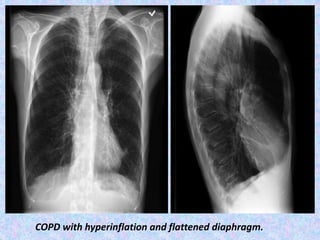
COPD with hyperinflation and flattened diaphragm.
COPD with hyperinflation and flattened diaphragm and widening of retro-sternal space
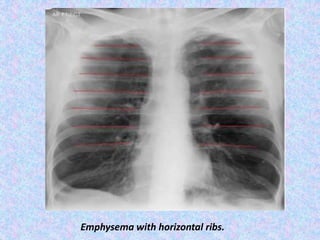
Emphysema with horizontal ribs.
Bullous disease of the lungs-conventional radiograph and CT.
Giant Bullous Emphysema
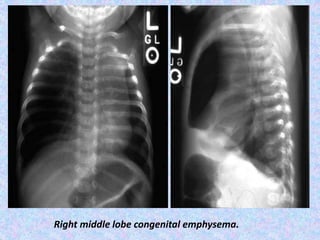
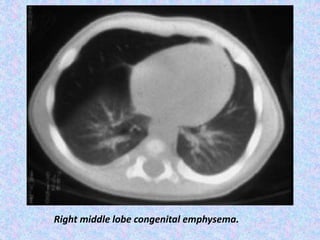
Congenital Lobar Emphysema.
CLE almost always involves one lobe, with rates of
occurrence as follows:
Left upper lobe - 41%
Right middle lobe - 34%
Right upper lobe - 21%
Congenital lobar emphysema has 2 forms:
Hypoalveolar (fewer than expected number of alveoli)
Polyalveolar (greater than expected number of alveoli)
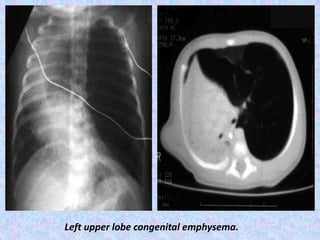
X-Ray shows unilateral –translucency.
CT Scan shows hyperinflation of one or more lobes with
attenuated pulmonary vasculatures, compression
atelectasis of the adjacent lung and mediastinal shift.
Left upper lobe congenital emphysema.
Right middle lobe congenital emphysema.
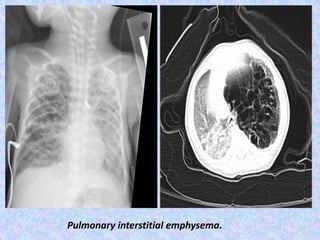
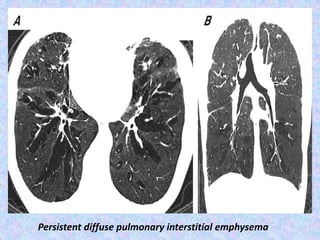
Pulmonary interstitial emphysema.
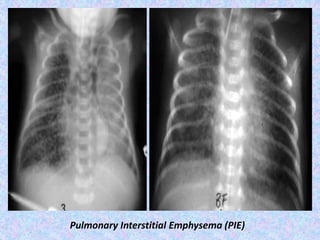
Pulmonary interstitial emphysema (PIE) refers to the abnormal location of air
within the pulmonary interstitium and lymphatics. It typically results from rupture
of overdistended alveoli following barotrauma in infants who have respiratory
distress syndrome. Interstitial emphysema can also occasionally be incidentally
detected in adults.
Radiographic features
Plain film - chest radiograph shows bubbles (round) or streaky (linear)
radioculencies in the interstitium radiating from the hilum . Affected segment is
often hyperexpanded and static in volume on multiple radiographs. Patients may
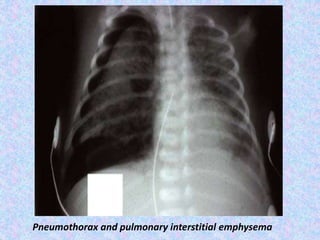
have pneumothorax, pneumomediastinum, or pneumopericardium in supine
patients, pneumomediastinum is evident by the sharp mediastinum sign
CT chest
shows cystic radioculencies in affected segment may characteristically show a line
and dot pattern with pulmonary arterial branches surrounded by radiolucent air
may help differentiate persistent PIE from a hyperlucent mass such as congenital
lobar emphysema, congenital pulmonary airway malformation (CPAM)
allows better visualization of a pneumothorax or pneumomediastinum
if incidentally detected in adults, it may appear as perivascular lucent or low-
attenuating halos and small cysts.
Pulmonary interstitial emphysema.
Pulmonary Interstitial Emphysema (PIE)
Pneumothorax and pulmonary interstitial emphysema
Persistent diffuse pulmonary interstitial emphysema
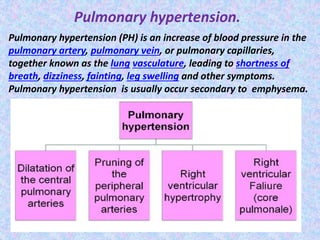
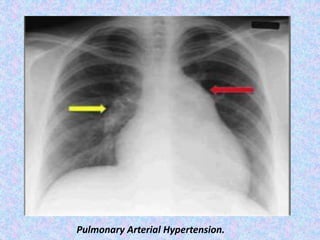
Pulmonary hypertension.
Pulmonary hypertension (PH) is an increase of blood pressure in the
pulmonary artery, pulmonary vein, or pulmonary capillaries,
together known as the lung vasculature, leading to shortness of
breath, dizziness, fainting, leg swelling and other symptoms.
Pulmonary hypertension is usually occur secondary to emphysema.
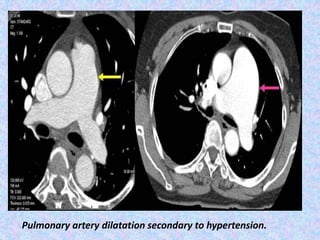
Pulmonary artery dilatation secondary to hypertension.
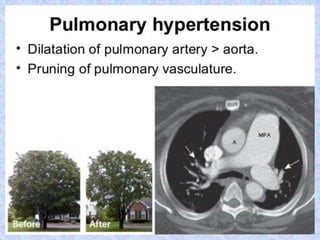
Pulmonary Arterial Hypertension.
Thank You.

Presentation1.pptx, radiological imaging of copd.

  • 1.
    Radiological imaging ofchronic obstructive airway diseases. Dr/ ABD ALLAH NAZEER. MD.
  • 17.
    Chronic Bronchitis. Definition: Persistentproductive cough for at least 3 months in at least 2 consecutive years without any identifiable cause. Damage to air ways caused mainly by chemicals. Sources: Cigarette smoke, industrial gases, motor vehicle exhaust, etc, Chronic asthmatic bronchitis- intermittent bronchospasm and wheezing.
  • 18.
    Chest x-ray- Thishelps to show hyper-expansion of the lungs associated with chronic bronchitis and COPD. The brochovascular marking, cardiomeagly and may flatted out the diaphragm. Chronic Bronchitis with irregular pattern of broncho- vascular structures. CT in chronic bronchitis, bronchial wall thickening may be seen in addition to enlarged vessels. Repeated inflammation can lead to scarring with brochovascular irregularity and fibrosis.
  • 19.
    Chronic bronchitis andthe lines that leave the right hilum horizontally show irregular borders because of chronic inflammation
  • 20.
    Emphysematous lung andchronic bronchitis.
  • 21.
    COPD with chronicbronchitis.
  • 22.
    Abnormal chest X-rayfindings are usually not seen until COPD is severe. In this case, the X-ray may show: Flattening of the diaphragm, the large muscle that separates the lungs and heart from the abdominal cavity. Increased size of the chest, as measured from front to back. A long narrow heart. Abnormal air collections within the lung (focal bullae). On the lateral radiograph, a "barrel chest" with widened anterior-posterior diameter may be visualized. The "saber-sheath trachea" sign refers to marked coronal narrowing of the intrathoracic trachea (frontal view) with concomitant sagittal widening (lateral view). CT finding in emphysema is diagnosed by alveolar septal destruction and airspace enlargement, which may occur in a variety of distributions. Centrilobular emphysema is predominantly seen in the upper lobes with panlobular emphysema predominating in the lower lobes. Paraseptal emphysema tends to occur near lung fissures and pleura. Formation of giant bullae may lead to compression of mediastinal structures, while rupture of pleural blebs may produce spontaneous pneumothorax / pneumomediastinum.
  • 24.
    COPD with hyperinflationand flattened diaphragm.
  • 25.
    COPD with hyperinflationand flattened diaphragm and widening of retro-sternal space
  • 26.
  • 27.
    Bullous disease ofthe lungs-conventional radiograph and CT.
  • 28.
  • 35.
    Congenital Lobar Emphysema. CLEalmost always involves one lobe, with rates of occurrence as follows: Left upper lobe - 41% Right middle lobe - 34% Right upper lobe - 21% Congenital lobar emphysema has 2 forms: Hypoalveolar (fewer than expected number of alveoli) Polyalveolar (greater than expected number of alveoli) X-Ray shows unilateral –translucency. CT Scan shows hyperinflation of one or more lobes with attenuated pulmonary vasculatures, compression atelectasis of the adjacent lung and mediastinal shift.
  • 36.
    Left upper lobecongenital emphysema.
  • 37.
    Right middle lobecongenital emphysema.
  • 38.
    Right middle lobecongenital emphysema.
  • 39.
    Pulmonary interstitial emphysema. Pulmonaryinterstitial emphysema (PIE) refers to the abnormal location of air within the pulmonary interstitium and lymphatics. It typically results from rupture of overdistended alveoli following barotrauma in infants who have respiratory distress syndrome. Interstitial emphysema can also occasionally be incidentally detected in adults. Radiographic features Plain film - chest radiograph shows bubbles (round) or streaky (linear) radioculencies in the interstitium radiating from the hilum . Affected segment is often hyperexpanded and static in volume on multiple radiographs. Patients may have pneumothorax, pneumomediastinum, or pneumopericardium in supine patients, pneumomediastinum is evident by the sharp mediastinum sign CT chest shows cystic radioculencies in affected segment may characteristically show a line and dot pattern with pulmonary arterial branches surrounded by radiolucent air may help differentiate persistent PIE from a hyperlucent mass such as congenital lobar emphysema, congenital pulmonary airway malformation (CPAM) allows better visualization of a pneumothorax or pneumomediastinum if incidentally detected in adults, it may appear as perivascular lucent or low- attenuating halos and small cysts.
  • 40.
  • 41.
  • 42.
    Pneumothorax and pulmonaryinterstitial emphysema
  • 43.
    Persistent diffuse pulmonaryinterstitial emphysema
  • 44.
    Pulmonary hypertension. Pulmonary hypertension(PH) is an increase of blood pressure in the pulmonary artery, pulmonary vein, or pulmonary capillaries, together known as the lung vasculature, leading to shortness of breath, dizziness, fainting, leg swelling and other symptoms. Pulmonary hypertension is usually occur secondary to emphysema.
  • 45.
    Pulmonary artery dilatationsecondary to hypertension.
  • 47.
  • 48.