
Winch dyeing machine
By: Asaye Dessie
Contents
 Introduction
 Types of Winch
 Features and Parameters of Winch Dyeing Machine
 Description And Dyeing method of winch dyeing
machine
 Typical recipes for various processes in winch
 Advantages
 Limitation
Introduction
 The winch dyeing machine is the oldest form of piece dyeing machine.
 It is also called beck dyeing machine.
 All pre-dyeing treatments such as scouring, bleaching, washing-off and
softening process.
 Winch dyeing machines comes with the lucrative options of low cost
design, simplicity in operation and maintenance yet uncompromising
features when it comes to versatility.
 Mostly woollen fabrics are dyed by using Winch Dyeing machine.
 The dyeing machine derives its name “Winch” as the fabric rope gets
circulated in the machine by way of a mechanical action of a horizontal
rotor or reel, called as a winch or sometimes wince.
 The cross-section of the winch rotor may be circular or elliptical.
Cont..
 Winch is a batch processing machine in rope form.
 It is suitable for practical all types of fabric, especially light
weights, which can normally withstand creasing when in rope
form as woolen and silk fabric, loosely woven cotton and synthetic
fabrics, circular and warp knitted fabrics.
 It is a dyeing machine for fabrics in rope forms with stationary
liquor and moving material.
 The machine contains a length of fabric with the ends sewn together,
which is compressed to form a continuous rope.
Cont.…
 One of the major differences a winch has with a jigger is lower
amount of tension working on fabrics during processing.
 During processing, most of the fabric remains submersed in a deep
trough which increases M:L ratio (1:20 or 25) as compared to a
jigger.
 Due to much lower lengthwise tension imposed on the fabric,
winches are better suited for processing of delicate fabrics like knits
& woollens.
 In winch the fabric is processed in the form of an endless loop.
Types of Winch
 Winch can be classified as follows:
1. Conventional winch dyeing machine
2. High temperature winch
3. High temperature winch with circulating liquor.
 The liquor ratio is typically about 20:1 but for small winches it may be as high as
1:40.
 The most modern machines have upto 500 m/min depending on the fabric properties.
 The nominal chamber capacities are 100Kg, 200Kg & 250Kg.
 Operating temperature can be extended upto 140℃ (for closed systems).
 The rate of dyeing is controlled by the number of fabric cycles in a given time.
Features and Parameters of Winch Dyeing Machine
The machine operates at a maximum temperature 95-98°C
The liquor ratio is generally quite high (1:20-1:40)
This is a dyeing machine for fabrics in rope form with stationary liquor and
moving material.
In winch machines, a number (1-40) of endless ropes or loops of fabrics of equal
length (about 50-100m) are loaded with much of their length immersed in folded
form inside the dye bath.
As for all forms of rope dyeing, the fabric must be fairly resistant to length ways
creasing.
A perforated separating compartment, positioned at a distance of 15-30 cm from its
vertical side creates an inter space for heating and for adding reagents.
Heating can be supplied by means of direct or indirect steam heating.
Cont…
The rope passes from the dye bath over two elevated reels. The first roller
is free-running (jockey or fly roller) and the second is winch reel.
The winch reel not only controls the rate of movement of the fabric rope,
but also the configuration of the rope in the dye bath.
The winch reel does not grip the fabric positively, but by the weight of the
wet fabric and the friction between the reel and fabric.
Now-a-days stainless reels with corrugated and broken surface for increase
frictional forces are used.
The maximum motion speed of the fabric must be approximately 40m/min.
The winch dyeing method is suitable for all fabrics, except those which
tend to originate permanent creases or which could easily distort under the
winch stretching action.
Description and Dyeing Method of Winch Dyeing Machine
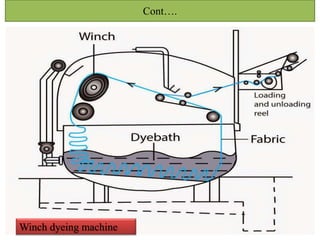
 The basic principle of all winch dyeing machines is to have a number of
loops or ropes of the fabric in the dye bath, these ropes are of equal length ,
which are mostly immersed in the liquor in the bath.
 The upper part of each rope runs over two reels which are mounted over
dyebath.
 At the front of the machine , above the top of the dye liquor , is
a smaller reel, which is called jockey or fly roller.
 The fly roller remain free wheeling along with fabric rope.
 At the back of winch tank is the winch wheel, which pulls the fabric rope
from the dye bath over the jockey reel for dropping in the dye bath for
immersion.
 From the dropped location , the fabric rope travels back to be lifted and
fed to winch wheel.
 The dyeing process on winch dyeing machines is based on higher M:L as
compared with other dyeing machines.
 The process is conducted with very little tension .
 The total dyeing time is lengthier as compared to other machines.
Description And Dyeing Method Of Winch Dyeing Machine
 In winch the fabric is processed in the form of an endless loop.
 The fabric is piled over the sloping bottom of a deep trough.
 At the deeper end of the trough, the fabric rises & passes over a 15
cm diameter reel known as jockey or flyer and then over a much
larger elliptical winch reel.
 The rotation of the winch reel provides the motion to the fabric.
 There is no positive grip between the fabric and the reel.
 The fabric movement takes place due to the friction and the weight
of wet fabric.
 Covering the winch with polypropylene or polyester tape increases
the friction.
Cont….
Winch dyeing machine
Cont..
 At a time one and more ropes can be dyed.
 When dyeing multiple ropes, separation is maintained by a peg rail.
 The peg rail runs through the width of machine and is located at
about 20 cm above liquor level.
 The main chamber of winch is divided into two parts by a perforated
stainless steel sheet.
 The smaller chamber situated towards the front of the machine is
used for making additions of dyes & auxiliaries as well as for
housing the steam pipes.
Cont.….
 The M:L ratio in winches is high, generally around 1:25.
 Winch provides little sideways movement of the fabric, as it can
result in entanglement.
 Most of the fabric remains in the form of a slowly moving pile at the
machine bottom. This can result in uneven dyeing.
 The high M:L ratio also results in poor dye exhaustion of low
substantivity dyes.
 Winches can be used for desizing, scouring, bleaching or even
washing of textile fabrics.
Typical recipes for various processes in winch
 Combined scouring & bleaching:
 Hydrogen Peroxide ( Bleaching agent) - 2-5%
 Caustic soda ( Scouring agent) - 1-2%
 Wetting agent (Improve wetting tendency of fabric) - 0.1-0.5%
 Sodium silicate ( Peroxide stabilizer) - 1-3%
 Sequestering agent ( To reduce hardness of water) - 0.5%
 Dyeing and washing:
 Reactive dyes ( Colouring agent) - 2-4%
 Wetting agent (Improve wetting tendency of fabric) - 0.5%
 Sodium chloride (Exhausting agent) - 5%
 Sodium carbonate (Fixing agent) - 1-2%
 Soap (Removing unfixed dyes) - 0.5%
Advantage of Winch dyeing machine
 Construction and operation of winch are very simple.
 The winch dyeing machines are suitable for all types of wet
processing operations from desizing to softening.
 The winch dyeing machine is suitable for practically all types of
fabrics, which can withstand creasing in rope form processing.
 The tension exerted on winch is less than jigger dyeing machine, the
material thus dyed is with fuller hand.
 The appearance of the dyed goods is clean and smooth on winch
dyeing machines.
Cont..
 It imposes much less tension than Jigger, so it’s suitable for delicate
fabrics.
 Scouring efficiency is high due to greater mechanical action caused
by constant reformation of lengthways folds.
 Tubular knitted fabrics are scoured & dyed extensive because of
the low tension.
 Crimps are developed due to greater mechanical action & low
tension.
 The dyed fabric is thicker with fuller handle, more fabric cover &
better crease recovery.
Limitation of Winch dyeing machine
 Batch dyeing operations needs trimming, sewing, opening out the
rope , loading and unloading for individual lots separately.
 Since several lengths of fabric are run over the winch reel into the
liquor and sewn end to end, Continuous length processing is not
possible in a single batch.
 Fabric is processed in rope form which may lead to crease marks ,
particularly in heavy , woven , thin and light synthetics.
 Due to high liquor ratio, dye exhaustion is poor & considerable
amount of dye remains in the bath which hampers the economy.
 Most of the machine work under atmospheric conditions.
 Longer rope may cause entanglement at the bottom.
THANK YOU FOR YOUR ATTENTION!!!

Winch Dyeing Machine

  • 1.
  • 2.
    Contents  Introduction  Typesof Winch  Features and Parameters of Winch Dyeing Machine  Description And Dyeing method of winch dyeing machine  Typical recipes for various processes in winch  Advantages  Limitation
  • 3.
    Introduction  The winchdyeing machine is the oldest form of piece dyeing machine.  It is also called beck dyeing machine.  All pre-dyeing treatments such as scouring, bleaching, washing-off and softening process.  Winch dyeing machines comes with the lucrative options of low cost design, simplicity in operation and maintenance yet uncompromising features when it comes to versatility.  Mostly woollen fabrics are dyed by using Winch Dyeing machine.  The dyeing machine derives its name “Winch” as the fabric rope gets circulated in the machine by way of a mechanical action of a horizontal rotor or reel, called as a winch or sometimes wince.  The cross-section of the winch rotor may be circular or elliptical.
  • 4.
    Cont..  Winch isa batch processing machine in rope form.  It is suitable for practical all types of fabric, especially light weights, which can normally withstand creasing when in rope form as woolen and silk fabric, loosely woven cotton and synthetic fabrics, circular and warp knitted fabrics.  It is a dyeing machine for fabrics in rope forms with stationary liquor and moving material.  The machine contains a length of fabric with the ends sewn together, which is compressed to form a continuous rope.
  • 5.
    Cont.…  One ofthe major differences a winch has with a jigger is lower amount of tension working on fabrics during processing.  During processing, most of the fabric remains submersed in a deep trough which increases M:L ratio (1:20 or 25) as compared to a jigger.  Due to much lower lengthwise tension imposed on the fabric, winches are better suited for processing of delicate fabrics like knits & woollens.  In winch the fabric is processed in the form of an endless loop.
  • 6.
    Types of Winch Winch can be classified as follows: 1. Conventional winch dyeing machine 2. High temperature winch 3. High temperature winch with circulating liquor.  The liquor ratio is typically about 20:1 but for small winches it may be as high as 1:40.  The most modern machines have upto 500 m/min depending on the fabric properties.  The nominal chamber capacities are 100Kg, 200Kg & 250Kg.  Operating temperature can be extended upto 140℃ (for closed systems).  The rate of dyeing is controlled by the number of fabric cycles in a given time.
  • 7.
    Features and Parametersof Winch Dyeing Machine The machine operates at a maximum temperature 95-98°C The liquor ratio is generally quite high (1:20-1:40) This is a dyeing machine for fabrics in rope form with stationary liquor and moving material. In winch machines, a number (1-40) of endless ropes or loops of fabrics of equal length (about 50-100m) are loaded with much of their length immersed in folded form inside the dye bath. As for all forms of rope dyeing, the fabric must be fairly resistant to length ways creasing. A perforated separating compartment, positioned at a distance of 15-30 cm from its vertical side creates an inter space for heating and for adding reagents. Heating can be supplied by means of direct or indirect steam heating.
  • 8.
    Cont… The rope passesfrom the dye bath over two elevated reels. The first roller is free-running (jockey or fly roller) and the second is winch reel. The winch reel not only controls the rate of movement of the fabric rope, but also the configuration of the rope in the dye bath. The winch reel does not grip the fabric positively, but by the weight of the wet fabric and the friction between the reel and fabric. Now-a-days stainless reels with corrugated and broken surface for increase frictional forces are used. The maximum motion speed of the fabric must be approximately 40m/min. The winch dyeing method is suitable for all fabrics, except those which tend to originate permanent creases or which could easily distort under the winch stretching action.
  • 9.
    Description and DyeingMethod of Winch Dyeing Machine  The basic principle of all winch dyeing machines is to have a number of loops or ropes of the fabric in the dye bath, these ropes are of equal length , which are mostly immersed in the liquor in the bath.  The upper part of each rope runs over two reels which are mounted over dyebath.  At the front of the machine , above the top of the dye liquor , is a smaller reel, which is called jockey or fly roller.  The fly roller remain free wheeling along with fabric rope.  At the back of winch tank is the winch wheel, which pulls the fabric rope from the dye bath over the jockey reel for dropping in the dye bath for immersion.  From the dropped location , the fabric rope travels back to be lifted and fed to winch wheel.  The dyeing process on winch dyeing machines is based on higher M:L as compared with other dyeing machines.  The process is conducted with very little tension .  The total dyeing time is lengthier as compared to other machines.
  • 10.
    Description And DyeingMethod Of Winch Dyeing Machine  In winch the fabric is processed in the form of an endless loop.  The fabric is piled over the sloping bottom of a deep trough.  At the deeper end of the trough, the fabric rises & passes over a 15 cm diameter reel known as jockey or flyer and then over a much larger elliptical winch reel.  The rotation of the winch reel provides the motion to the fabric.  There is no positive grip between the fabric and the reel.  The fabric movement takes place due to the friction and the weight of wet fabric.  Covering the winch with polypropylene or polyester tape increases the friction.
  • 11.
  • 12.
    Cont..  At atime one and more ropes can be dyed.  When dyeing multiple ropes, separation is maintained by a peg rail.  The peg rail runs through the width of machine and is located at about 20 cm above liquor level.  The main chamber of winch is divided into two parts by a perforated stainless steel sheet.  The smaller chamber situated towards the front of the machine is used for making additions of dyes & auxiliaries as well as for housing the steam pipes.
  • 13.
    Cont.….  The M:Lratio in winches is high, generally around 1:25.  Winch provides little sideways movement of the fabric, as it can result in entanglement.  Most of the fabric remains in the form of a slowly moving pile at the machine bottom. This can result in uneven dyeing.  The high M:L ratio also results in poor dye exhaustion of low substantivity dyes.  Winches can be used for desizing, scouring, bleaching or even washing of textile fabrics.
  • 14.
    Typical recipes forvarious processes in winch  Combined scouring & bleaching:  Hydrogen Peroxide ( Bleaching agent) - 2-5%  Caustic soda ( Scouring agent) - 1-2%  Wetting agent (Improve wetting tendency of fabric) - 0.1-0.5%  Sodium silicate ( Peroxide stabilizer) - 1-3%  Sequestering agent ( To reduce hardness of water) - 0.5%  Dyeing and washing:  Reactive dyes ( Colouring agent) - 2-4%  Wetting agent (Improve wetting tendency of fabric) - 0.5%  Sodium chloride (Exhausting agent) - 5%  Sodium carbonate (Fixing agent) - 1-2%  Soap (Removing unfixed dyes) - 0.5%
  • 15.
    Advantage of Winchdyeing machine  Construction and operation of winch are very simple.  The winch dyeing machines are suitable for all types of wet processing operations from desizing to softening.  The winch dyeing machine is suitable for practically all types of fabrics, which can withstand creasing in rope form processing.  The tension exerted on winch is less than jigger dyeing machine, the material thus dyed is with fuller hand.  The appearance of the dyed goods is clean and smooth on winch dyeing machines.
  • 16.
    Cont..  It imposesmuch less tension than Jigger, so it’s suitable for delicate fabrics.  Scouring efficiency is high due to greater mechanical action caused by constant reformation of lengthways folds.  Tubular knitted fabrics are scoured & dyed extensive because of the low tension.  Crimps are developed due to greater mechanical action & low tension.  The dyed fabric is thicker with fuller handle, more fabric cover & better crease recovery.
  • 17.
    Limitation of Winchdyeing machine  Batch dyeing operations needs trimming, sewing, opening out the rope , loading and unloading for individual lots separately.  Since several lengths of fabric are run over the winch reel into the liquor and sewn end to end, Continuous length processing is not possible in a single batch.  Fabric is processed in rope form which may lead to crease marks , particularly in heavy , woven , thin and light synthetics.  Due to high liquor ratio, dye exhaustion is poor & considerable amount of dye remains in the bath which hampers the economy.  Most of the machine work under atmospheric conditions.  Longer rope may cause entanglement at the bottom.
  • 18.
    THANK YOU FORYOUR ATTENTION!!!