SHRINKAGE
CONTROL
Prajwal Mohanta Shreya Anand Tanya Gupta
INTRODUCTION
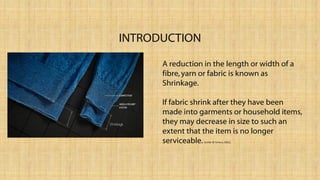
A reduction in the length or width of a
fibre,yarn or fabric is known as
Shrinkage.
If fabric shrink after they have been
made into garments or household items,
they may decrease in size to such an
extent that the item is no longer
serviceable.(Collier & Tortora, 2001)
WHY SHRINKAGE OCCURS?
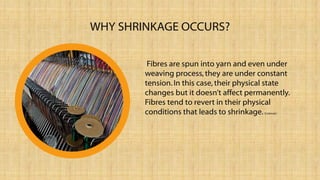
Fibres are spun into yarn and even under
weaving process,they are under constant
tension.In this case, their physical state
changes but it doesn’t affect permanently.
Fibres tend to revert in their physical
conditions that leads to shrinkage.(Corbman)
FACTORS CONTROLLING SHRINKAGE
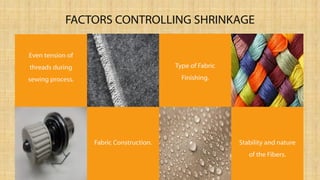
Even tension of
threads during
sewing process.
Fabric Construction.
Type of Fabric
Finishing.
Stability and nature
of the Fibers.
When the fabric (initially made under tension)
is wet in a tensionless condition,this kind of
shrinkage occurs. (Pizzuto, 2005)
Relaxation Shrinkage
This is caused by the action of heat generally
occurs in synthetic fibers or fabrics.(Pizzuto, 2005)
Thermal Shrinkage
Even if the fabric is preshrunk in finishing,a
small amount of shrinkage remains,known as
Residual Shrinkage. (Pizzuto, 2005)
Residual Shrinkage
This type of shrinkage continues and the
fabric shrinks a bit more with each laundering.
(Pizzuto, 2005)
Progressive Shrinkage
TYPES OF SHRINKAGE
1 2
3 4
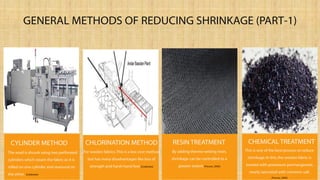
GENERAL METHODS OF REDUCING SHRINKAGE (PART-1)
The wool is shrunk using two perforated
cylinders which steam the fabric as it is
rolled on one cylinder and rewound on
the other. (Corbman)
CYLINDER METHOD CHLORINATION METHOD
For woolen fabrics.This is a low cost method
but has many disadvantages like loss of
strength and harsh hand feel.(Corbman)
By adding thermo-setting resin,
shrinkage can be controlled to a
greater extent.(Pizzuto, 2005)
RESIN TREATMENT
This is one of the best process to reduce
shrinkage.In this,the woolen fabric is
treated with potassium permanganate,
nearly saturated with common salt.
(Pizzuto, 2005)
CHEMICAL TREATMENT
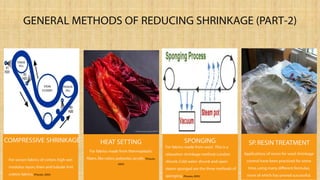
GENERAL METHODS OF REDUCING SHRINKAGE (PART-2)
For woven fabrics of cotton, high wet
modulus rayon,linen and tubular knit
cotton fabrics.(Pizzuto, 2005)
COMPRESSIVE SHRINKAGE HEAT SETTING
For fabrics made from thermoplastic
fibers,like nylon,polyester, acrylic. (Pizzuto,
2005)
For fabrics made from wool .This is a
relaxation shrinkage method. London
shrunk,Cold water shrunk and open
steam sponged are the three methods of
sponging.(Pizzuto, 2005)
SPONGING
Applications of resins for wool shrinkage
control have been practiced for some
time, using many different formulas,
none of which has proved successful.
SP.RESIN TREATMENT
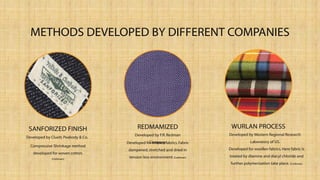
METHODS DEVELOPED BY DIFFERENT COMPANIES
Compressive Shrinkage method
developed for woven cotton.
(Corbman)
SANFORIZED FINISH
Developed for knitted fabrics.Fabric
dampened,stretched and dried in
tension less environment. (Corbman)
REDMAMIZED
Developed by F.R.Redman
Company.
Developed for woollen fabrics. Here fabric is
treated by diamine and diacyl chloride and
further polymerization take place.(Corbman)
WURLAN PROCESS
Developed by Western Regional Research
Laboratory of US.
Developed by Cluett, Peabody & Co.
METHODS DEVELOPED BY DIFFERENT COMPANIES
Mechanical Shrinkage method
developed for cotton fabric. Here
fabric is washed till desired
shrinkage.(Corbman)
RIGMEL
For cotton knitted goods.It guarantees
less 1% of the shrinkage.Treated in
special machine and shrunk by
overfeeding. (Corbman)
PAK- NIT
Developed by Compax Corp.
It is cold water process of
preshrinking wool fabrics. (Corbman)
LONDON SHRINKING
Developed by team in London.
Developed by Bradford Dyeing Association.
SHRINKAGE TESTING
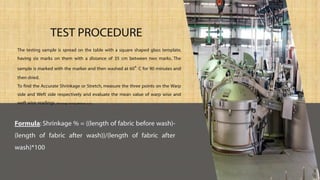
The testing sample is spread on the table with a square shaped glass template,
having six marks on them with a distance of 35 cm between two marks. The
sample is marked with the marker and then washed at 60° C for 90 minutes and
then dried.
To find the Accurate Shrinkage or Stretch, measure the three points on the Warp
side and Weft side respectively and evaluate the mean value of warp wise and
weft wise readings. (Shrinkage Testing Method, n.d.)
TEST PROCEDURE
Formula: Shrinkage % = {(length of fabric before wash)-
(length of fabric after wash)}/(length of fabric after
wash)*100
LAUNDEROMETER
Launderometer is a machine that is used to conduct
washing test in testing laboratories in which similar
machines are used to determine the shrinkage
happening. The distance is measured and marked on
the unwashed sample of the fabric with the indelible
ink. These samples are then washed in the boiling
water, dried and pressed. Any change in the
measurement of the marked sample is referred to as
the amount of shrinkage.(Corbman)
SANFORIZING PROCESS
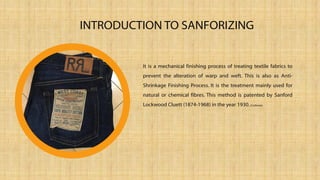
It is a mechanical finishing process of treating textile fabrics to
prevent the alteration of warp and weft. This is also as Anti-
Shrinkage Finishing Process. It is the treatment mainly used for
natural or chemical fibres. This method is patented by Sanford
Lockwood Cluett (1874-1968) in the year 1930.(Corbman)
INTRODUCTION TO SANFORIZING
PRINCIPLE OF SANFORIZING PROCESS
• Determination of the potential wash
shrinkage is done prior to shrinking,and
accordingly,the compressive shrinkage
machine can be adjusted.
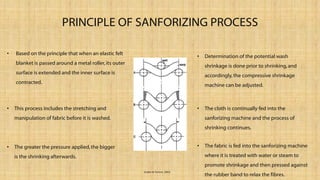
• Based on the principle that when an elastic felt
blanket is passed around a metal roller,its outer
surface is extended and the inner surface is
contracted.
• The greater the pressure applied,the bigger
is the shrinking afterwards.
• The fabric is fed into the sanforizing machine
where it is treated with water or steam to
promote shrinkage and then pressed against
the rubber band to relax the fibres.
• The cloth is continually fed into the
sanforizing machine and the process of
shrinking continues.
• This process includes the stretching and
manipulation of fabric before it is washed.
(Collier & Tortora, 2001)
PROCESS OF SANFORIZING
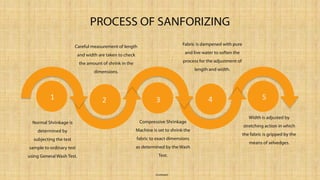
Normal Shrinkage is
determined by
subjecting the test
sample to ordinary test
using General Wash Test.
Compressive Shrinkage
Machine is set to shrink the
fabric to exact dimensions
as determined by the Wash
Test.
Width is adjusted by
stretching action in which
the fabric is gripped by the
means of selvedges.
Fabric is dampened with pure
and live water to soften the
process for the adjustment of
length and width.
Careful measurement of length
and width are taken to check
the amount of shrink in the
dimensions.
1 2 3 4 5
(Corbman)
Fabric is held under
rubber blanket which is
controlled under
tension.
Fabric is heated by heating
rolls and surface finishes are
restored.
Wash test is conducted
again to check that the
shrinkage doesn’t exceed
1%.
This rubber blanket is present in
an assembly along with
cylindrical rollers and here,
shrinkage of fabric takes place.
6 7 8 9
CONTINUED…
(Corbman)
1 2 3 4
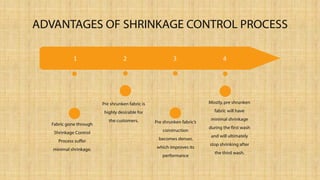
Fabric gone through
Shrinkage Control
Process suffer
minimal shrinkage.
Pre shrunken fabric is
highly desirable for
the customers. Pre shrunken fabric’s
construction
becomes denser,
which improves its
performance
Mostly,pre shrunken
fabric will have
minimal shrinkage
during the first wash
and will ultimately
stop shrinking after
the third wash.
ADVANTAGES OF SHRINKAGE CONTROL PROCESS
1 2 3 4
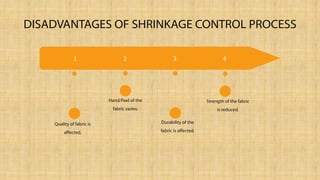
Quality of fabric is
affected.
Hand/Feel of the
fabric varies.
Durability of the
fabric is affected.
Strength of the fabric
is reduced.
DISADVANTAGES OF SHRINKAGE CONTROL PROCESS
VIDEOS
AUTOMATIC SHRINKAGE TESTER TEXTILE SHRINKAGE
Bibliography• Collier, B. J., & Tortora, P. G. (2001). Understanding Textiles (Vol. 6th Edition). Dave Garza. Retrieved January
27, 2018
• Corbman, B. P. (n.d.). Textiles fibre to fabrics (Vol. 6th Edition). Mcgraw Hills Intl. Publications. Retrieved
January 27, 2018
• Lewin, M., & Sello, S. B. (n.d.). Chemical Processing of fibres and fabrics (Vol. 2). New York: Mercel Dekker.
Retrieved January 27, 2018
• Pizzuto, J. (2005). Fabric Science. India. Retrieved January 27, 2018
• Shrinkage Testing Method. (n.d.). Retrieved January 27, 2018, from Textile Learner: www.textilelearner.com
THANK YOU

Shrinkage Control

  • 1.
  • 2.
    INTRODUCTION A reduction inthe length or width of a fibre,yarn or fabric is known as Shrinkage. If fabric shrink after they have been made into garments or household items, they may decrease in size to such an extent that the item is no longer serviceable.(Collier & Tortora, 2001)
  • 3.
    WHY SHRINKAGE OCCURS? Fibresare spun into yarn and even under weaving process,they are under constant tension.In this case, their physical state changes but it doesn’t affect permanently. Fibres tend to revert in their physical conditions that leads to shrinkage.(Corbman)
  • 4.
    FACTORS CONTROLLING SHRINKAGE Eventension of threads during sewing process. Fabric Construction. Type of Fabric Finishing. Stability and nature of the Fibers.
  • 5.
    When the fabric(initially made under tension) is wet in a tensionless condition,this kind of shrinkage occurs. (Pizzuto, 2005) Relaxation Shrinkage This is caused by the action of heat generally occurs in synthetic fibers or fabrics.(Pizzuto, 2005) Thermal Shrinkage Even if the fabric is preshrunk in finishing,a small amount of shrinkage remains,known as Residual Shrinkage. (Pizzuto, 2005) Residual Shrinkage This type of shrinkage continues and the fabric shrinks a bit more with each laundering. (Pizzuto, 2005) Progressive Shrinkage TYPES OF SHRINKAGE 1 2 3 4
  • 6.
    GENERAL METHODS OFREDUCING SHRINKAGE (PART-1) The wool is shrunk using two perforated cylinders which steam the fabric as it is rolled on one cylinder and rewound on the other. (Corbman) CYLINDER METHOD CHLORINATION METHOD For woolen fabrics.This is a low cost method but has many disadvantages like loss of strength and harsh hand feel.(Corbman) By adding thermo-setting resin, shrinkage can be controlled to a greater extent.(Pizzuto, 2005) RESIN TREATMENT This is one of the best process to reduce shrinkage.In this,the woolen fabric is treated with potassium permanganate, nearly saturated with common salt. (Pizzuto, 2005) CHEMICAL TREATMENT
  • 7.
    GENERAL METHODS OFREDUCING SHRINKAGE (PART-2) For woven fabrics of cotton, high wet modulus rayon,linen and tubular knit cotton fabrics.(Pizzuto, 2005) COMPRESSIVE SHRINKAGE HEAT SETTING For fabrics made from thermoplastic fibers,like nylon,polyester, acrylic. (Pizzuto, 2005) For fabrics made from wool .This is a relaxation shrinkage method. London shrunk,Cold water shrunk and open steam sponged are the three methods of sponging.(Pizzuto, 2005) SPONGING Applications of resins for wool shrinkage control have been practiced for some time, using many different formulas, none of which has proved successful. SP.RESIN TREATMENT
  • 8.
    METHODS DEVELOPED BYDIFFERENT COMPANIES Compressive Shrinkage method developed for woven cotton. (Corbman) SANFORIZED FINISH Developed for knitted fabrics.Fabric dampened,stretched and dried in tension less environment. (Corbman) REDMAMIZED Developed by F.R.Redman Company. Developed for woollen fabrics. Here fabric is treated by diamine and diacyl chloride and further polymerization take place.(Corbman) WURLAN PROCESS Developed by Western Regional Research Laboratory of US. Developed by Cluett, Peabody & Co.
  • 9.
    METHODS DEVELOPED BYDIFFERENT COMPANIES Mechanical Shrinkage method developed for cotton fabric. Here fabric is washed till desired shrinkage.(Corbman) RIGMEL For cotton knitted goods.It guarantees less 1% of the shrinkage.Treated in special machine and shrunk by overfeeding. (Corbman) PAK- NIT Developed by Compax Corp. It is cold water process of preshrinking wool fabrics. (Corbman) LONDON SHRINKING Developed by team in London. Developed by Bradford Dyeing Association.
  • 10.
  • 11.
    The testing sampleis spread on the table with a square shaped glass template, having six marks on them with a distance of 35 cm between two marks. The sample is marked with the marker and then washed at 60° C for 90 minutes and then dried. To find the Accurate Shrinkage or Stretch, measure the three points on the Warp side and Weft side respectively and evaluate the mean value of warp wise and weft wise readings. (Shrinkage Testing Method, n.d.) TEST PROCEDURE Formula: Shrinkage % = {(length of fabric before wash)- (length of fabric after wash)}/(length of fabric after wash)*100
  • 12.
    LAUNDEROMETER Launderometer is amachine that is used to conduct washing test in testing laboratories in which similar machines are used to determine the shrinkage happening. The distance is measured and marked on the unwashed sample of the fabric with the indelible ink. These samples are then washed in the boiling water, dried and pressed. Any change in the measurement of the marked sample is referred to as the amount of shrinkage.(Corbman)
  • 13.
  • 14.
    It is amechanical finishing process of treating textile fabrics to prevent the alteration of warp and weft. This is also as Anti- Shrinkage Finishing Process. It is the treatment mainly used for natural or chemical fibres. This method is patented by Sanford Lockwood Cluett (1874-1968) in the year 1930.(Corbman) INTRODUCTION TO SANFORIZING
  • 15.
    PRINCIPLE OF SANFORIZINGPROCESS • Determination of the potential wash shrinkage is done prior to shrinking,and accordingly,the compressive shrinkage machine can be adjusted. • Based on the principle that when an elastic felt blanket is passed around a metal roller,its outer surface is extended and the inner surface is contracted. • The greater the pressure applied,the bigger is the shrinking afterwards. • The fabric is fed into the sanforizing machine where it is treated with water or steam to promote shrinkage and then pressed against the rubber band to relax the fibres. • The cloth is continually fed into the sanforizing machine and the process of shrinking continues. • This process includes the stretching and manipulation of fabric before it is washed. (Collier & Tortora, 2001)
  • 16.
    PROCESS OF SANFORIZING NormalShrinkage is determined by subjecting the test sample to ordinary test using General Wash Test. Compressive Shrinkage Machine is set to shrink the fabric to exact dimensions as determined by the Wash Test. Width is adjusted by stretching action in which the fabric is gripped by the means of selvedges. Fabric is dampened with pure and live water to soften the process for the adjustment of length and width. Careful measurement of length and width are taken to check the amount of shrink in the dimensions. 1 2 3 4 5 (Corbman)
  • 17.
    Fabric is heldunder rubber blanket which is controlled under tension. Fabric is heated by heating rolls and surface finishes are restored. Wash test is conducted again to check that the shrinkage doesn’t exceed 1%. This rubber blanket is present in an assembly along with cylindrical rollers and here, shrinkage of fabric takes place. 6 7 8 9 CONTINUED… (Corbman)
  • 18.
    1 2 34 Fabric gone through Shrinkage Control Process suffer minimal shrinkage. Pre shrunken fabric is highly desirable for the customers. Pre shrunken fabric’s construction becomes denser, which improves its performance Mostly,pre shrunken fabric will have minimal shrinkage during the first wash and will ultimately stop shrinking after the third wash. ADVANTAGES OF SHRINKAGE CONTROL PROCESS
  • 19.
    1 2 34 Quality of fabric is affected. Hand/Feel of the fabric varies. Durability of the fabric is affected. Strength of the fabric is reduced. DISADVANTAGES OF SHRINKAGE CONTROL PROCESS
  • 20.
  • 21.
    Bibliography• Collier, B.J., & Tortora, P. G. (2001). Understanding Textiles (Vol. 6th Edition). Dave Garza. Retrieved January 27, 2018 • Corbman, B. P. (n.d.). Textiles fibre to fabrics (Vol. 6th Edition). Mcgraw Hills Intl. Publications. Retrieved January 27, 2018 • Lewin, M., & Sello, S. B. (n.d.). Chemical Processing of fibres and fabrics (Vol. 2). New York: Mercel Dekker. Retrieved January 27, 2018 • Pizzuto, J. (2005). Fabric Science. India. Retrieved January 27, 2018 • Shrinkage Testing Method. (n.d.). Retrieved January 27, 2018, from Textile Learner: www.textilelearner.com
  • 22.