
Amanuzzaman
ID- 69/17
Level 3, Term 1
Welcome
To My
Presentation
Shyamoli Textile Engineering College
B.Sc. In Textile Engineering
Printing
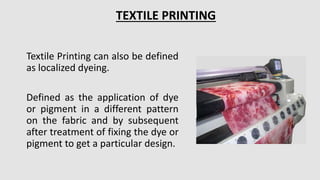
Textile Printing can also be defined
as localized dyeing.
Defined as the application of dye
or pigment in a different pattern
on the fabric and by subsequent
after treatment of fixing the dye or
pigment to get a particular design.
TEXTILE PRINTING
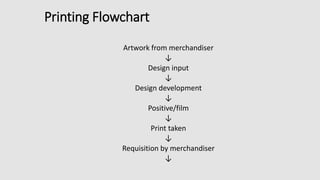
Printing Flowchart
Artwork from merchandiser
↓
Design input
↓
Design development
↓
Positive/film
↓
Print taken
↓
Requisition by merchandiser
↓
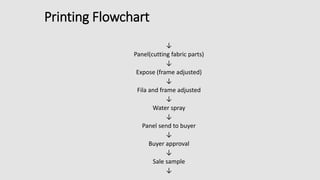
Printing Flowchart
↓
Panel(cutting fabric parts)
↓
Expose (frame adjusted)
↓
Fila and frame adjusted
↓
Water spray
↓
Panel send to buyer
↓
Buyer approval
↓
Sale sample
↓
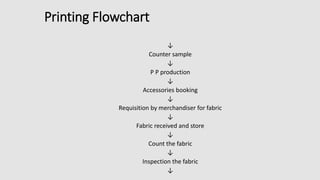
Printing Flowchart
↓
Counter sample
↓
P P production
↓
Accessories booking
↓
Requisition by merchandiser for fabric
↓
Fabric received and store
↓
Count the fabric
↓
Inspection the fabric
↓
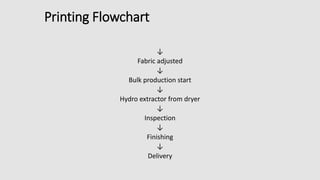
Printing Flowchart
↓
Fabric adjusted
↓
Bulk production start
↓
Hydro extractor from dryer
↓
Inspection
↓
Finishing
↓
Delivery
 Block Printing
 Roller printing
 Resist Printing
 Direct Printing
 Burn-out Printing
 Rubber Printing etc.
TECHNIQUES OF PRINTING
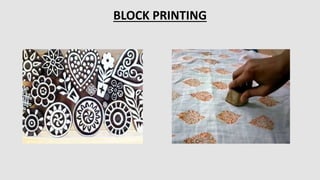
 It is the oldest and simplest way of printing.
 In this method a wooden block with a raised pattern on the
surface was dipped into the printing colorant and then
pressed face down on to fabric.
 The desired pattern was obtained by repeating the process
using different colors.
 Generally the wooden block is carved out of hand.
 Printing is done manually
BLOCK PRINTING
BLOCK PRINTING
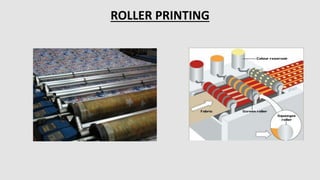
 It is the machine method of printing designs on cloths by
engraved rollers.
 The design is engraved on the surface of a metal roller.
 Dye is applied and the excess is scraped off the roller’s
surface then leaving the dyes in the engraved sections.
 When it rolls across the fabric, the dye on the roller
transfers to the fabric.
ROLLER PRINTING
ROLLER PRINTING
There are two types of resist printing
1. Discharge printing
2. Batik Printing
RESIST PRINTING
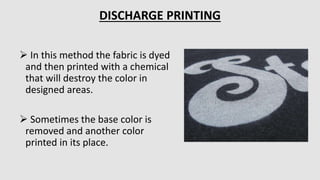
 In this method the fabric is dyed
and then printed with a chemical
that will destroy the color in
designed areas.
 Sometimes the base color is
removed and another color
printed in its place.
DISCHARGE PRINTING
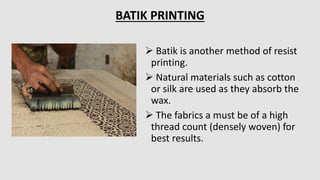
 Batik is another method of resist
printing.
 Natural materials such as cotton
or silk are used as they absorb the
wax.
 The fabrics a must be of a high
thread count (densely woven) for
best results.
BATIK PRINTING
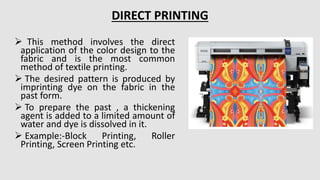
 This method involves the direct
application of the color design to the
fabric and is the most common
method of textile printing.
 The desired pattern is produced by
imprinting dye on the fabric in the
past form.
 To prepare the past , a thickening
agent is added to a limited amount of
water and dye is dissolved in it.
 Example:-Block Printing, Roller
Printing, Screen Printing etc.
DIRECT PRINTING
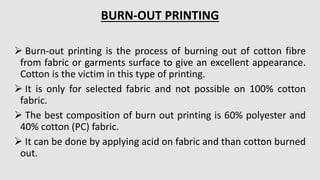
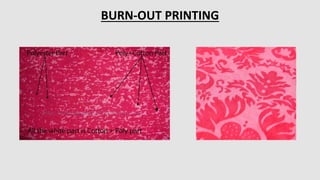
 Burn-out printing is the process of burning out of cotton fibre
from fabric or garments surface to give an excellent appearance.
Cotton is the victim in this type of printing.
 It is only for selected fabric and not possible on 100% cotton
fabric.
 The best composition of burn out printing is 60% polyester and
40% cotton (PC) fabric.
 It can be done by applying acid on fabric and than cotton burned
out.
BURN-OUT PRINTING
BURN-OUT PRINTING
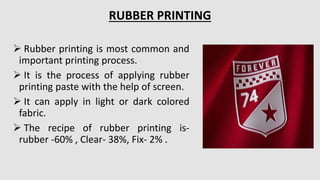
 Rubber printing is most common and
important printing process.
 It is the process of applying rubber
printing paste with the help of screen.
 It can apply in light or dark colored
fabric.
 The recipe of rubber printing is-
rubber -60% , Clear- 38%, Fix- 2% .
RUBBER PRINTING
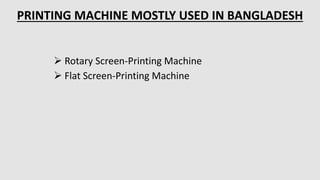
 Rotary Screen-Printing Machine
 Flat Screen-Printing Machine
PRINTING MACHINE MOSTLY USED IN BANGLADESH
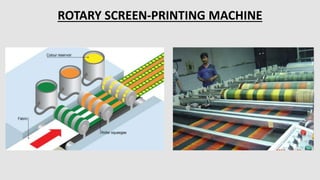
ROTARY SCREEN-PRINTING MACHINE
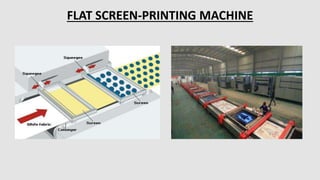
FLAT SCREEN-PRINTING MACHINE
THANK
YOU

Presentation on Textile Printing

  • 1.
    Amanuzzaman ID- 69/17 Level 3,Term 1 Welcome To My Presentation Shyamoli Textile Engineering College B.Sc. In Textile Engineering
  • 2.
  • 3.
    Textile Printing canalso be defined as localized dyeing. Defined as the application of dye or pigment in a different pattern on the fabric and by subsequent after treatment of fixing the dye or pigment to get a particular design. TEXTILE PRINTING
  • 4.
    Printing Flowchart Artwork frommerchandiser ↓ Design input ↓ Design development ↓ Positive/film ↓ Print taken ↓ Requisition by merchandiser ↓
  • 5.
    Printing Flowchart ↓ Panel(cutting fabricparts) ↓ Expose (frame adjusted) ↓ Fila and frame adjusted ↓ Water spray ↓ Panel send to buyer ↓ Buyer approval ↓ Sale sample ↓
  • 6.
    Printing Flowchart ↓ Counter sample ↓ PP production ↓ Accessories booking ↓ Requisition by merchandiser for fabric ↓ Fabric received and store ↓ Count the fabric ↓ Inspection the fabric ↓
  • 7.
    Printing Flowchart ↓ Fabric adjusted ↓ Bulkproduction start ↓ Hydro extractor from dryer ↓ Inspection ↓ Finishing ↓ Delivery
  • 8.
     Block Printing Roller printing  Resist Printing  Direct Printing  Burn-out Printing  Rubber Printing etc. TECHNIQUES OF PRINTING
  • 9.
     It isthe oldest and simplest way of printing.  In this method a wooden block with a raised pattern on the surface was dipped into the printing colorant and then pressed face down on to fabric.  The desired pattern was obtained by repeating the process using different colors.  Generally the wooden block is carved out of hand.  Printing is done manually BLOCK PRINTING
  • 10.
  • 11.
     It isthe machine method of printing designs on cloths by engraved rollers.  The design is engraved on the surface of a metal roller.  Dye is applied and the excess is scraped off the roller’s surface then leaving the dyes in the engraved sections.  When it rolls across the fabric, the dye on the roller transfers to the fabric. ROLLER PRINTING
  • 12.
  • 13.
    There are twotypes of resist printing 1. Discharge printing 2. Batik Printing RESIST PRINTING
  • 14.
     In thismethod the fabric is dyed and then printed with a chemical that will destroy the color in designed areas.  Sometimes the base color is removed and another color printed in its place. DISCHARGE PRINTING
  • 15.
     Batik isanother method of resist printing.  Natural materials such as cotton or silk are used as they absorb the wax.  The fabrics a must be of a high thread count (densely woven) for best results. BATIK PRINTING
  • 16.
     This methodinvolves the direct application of the color design to the fabric and is the most common method of textile printing.  The desired pattern is produced by imprinting dye on the fabric in the past form.  To prepare the past , a thickening agent is added to a limited amount of water and dye is dissolved in it.  Example:-Block Printing, Roller Printing, Screen Printing etc. DIRECT PRINTING
  • 17.
     Burn-out printingis the process of burning out of cotton fibre from fabric or garments surface to give an excellent appearance. Cotton is the victim in this type of printing.  It is only for selected fabric and not possible on 100% cotton fabric.  The best composition of burn out printing is 60% polyester and 40% cotton (PC) fabric.  It can be done by applying acid on fabric and than cotton burned out. BURN-OUT PRINTING
  • 18.
  • 19.
     Rubber printingis most common and important printing process.  It is the process of applying rubber printing paste with the help of screen.  It can apply in light or dark colored fabric.  The recipe of rubber printing is- rubber -60% , Clear- 38%, Fix- 2% . RUBBER PRINTING
  • 20.
     Rotary Screen-PrintingMachine  Flat Screen-Printing Machine PRINTING MACHINE MOSTLY USED IN BANGLADESH
  • 21.
  • 22.
  • 23.