DYEING & PRINTING
DEFECTS
By
Dipali Rathod
Induja R
Tejas Krishna
• Textiles are usually coloured to make them
attractive or for functional reasons.
• There are two ways of adding colour to a
textile substrate.
- Dyeing
- Printing
Dyeing
• Dyeing is employed to give an all-over shade
to the fabric.
• Coloration of Dyeing involves the use of Dye
Stuff.
Common Causes of Defects
• The material is not well prepared for dyeing
and printing.
• Water Quality not Proper.
• Due to Shortcomings in making Dyeing
Solution.
• Due to Shortcomings in the dye machinery
Barre
Causes Remedies
Temperature variations Maintaining suitable
dyeing temperature,
chemicals and carriers.
Density Variation in
material
Relaxing material before
dyeing.
Difference in filling yarn
size
Material comprised of
fibres of different origins
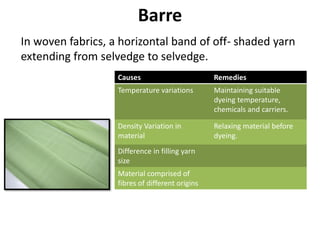
In woven fabrics, a horizontal band of off- shaded yarn
extending from selvedge to selvedge.
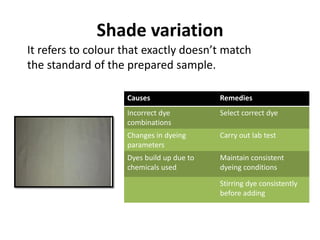
Shade variation
Causes Remedies
Incorrect dye
combinations
Select correct dye
Changes in dyeing
parameters
Carry out lab test
Dyes build up due to
chemicals used
Maintain consistent
dyeing conditions
Stirring dye consistently
before adding
It refers to colour that exactly doesn’t match
the standard of the prepared sample.
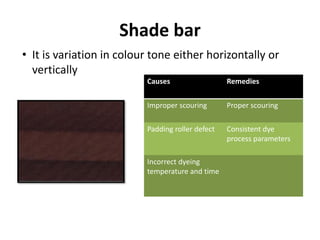
Shade bar
Causes Remedies
Improper scouring Proper scouring
Padding roller defect Consistent dye
process parameters
Incorrect dyeing
temperature and time
• It is variation in colour tone either horizontally or
vertically
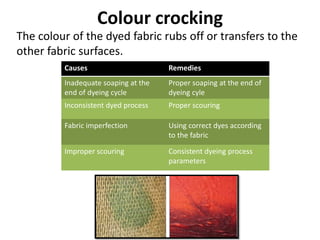
Colour crocking
Causes Remedies
Inadequate soaping at the
end of dyeing cycle
Proper soaping at the end of
dyeing cyle
Inconsistent dyed process Proper scouring
Fabric imperfection Using correct dyes according
to the fabric
Improper scouring Consistent dyeing process
parameters
The colour of the dyed fabric rubs off or transfers to the
other fabric surfaces.
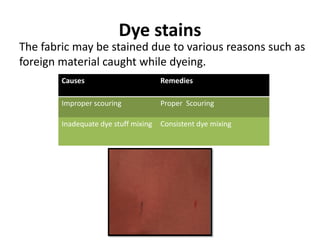
Dye stains
Causes Remedies
Improper scouring Proper Scouring
Inadequate dye stuff mixing Consistent dye mixing
The fabric may be stained due to various reasons such as
foreign material caught while dyeing.
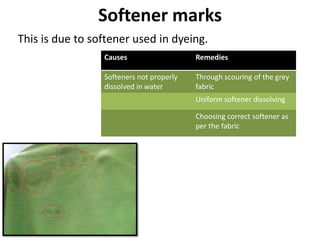
Softener marks
Causes Remedies
Softeners not properly
dissolved in water
Through scouring of the grey
fabric
Uniform softener dissolving
Choosing correct softener as
per the fabric
This is due to softener used in dyeing.
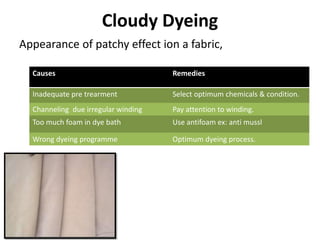
Cloudy Dyeing
Causes Remedies
Inadequate pre trearment Select optimum chemicals & condition.
Channeling due irregular winding Pay attention to winding.
Too much foam in dye bath Use antifoam ex: anti mussl
Wrong dyeing programme Optimum dyeing process.
Appearance of patchy effect ion a fabric,
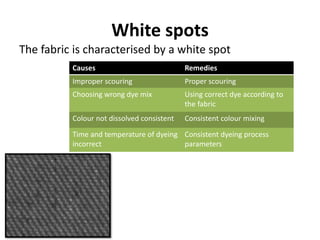
White spots
Causes Remedies
Improper scouring Proper scouring
Choosing wrong dye mix Using correct dye according to
the fabric
Colour not dissolved consistent Consistent colour mixing
Time and temperature of dyeing
incorrect
Consistent dyeing process
parameters
The fabric is characterised by a white spot
Printing
• Printing can be defined as localized
application of dye or pigment in a paste form
to generate a pattern or design in the fabric.
• It is also called localized dyeing.
Printing Defects
• Printing defects may result from:
-Faulty or improper printing procedures.
-Faults or improper preparation of fabric
prior to printing.
-Imperfections in the material being
printed.
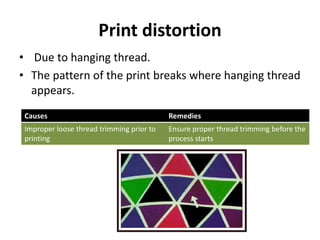
Print distortion
• Due to hanging thread.
• The pattern of the print breaks where hanging thread
appears.
Causes Remedies
Improper loose thread trimming prior to
printing
Ensure proper thread trimming before the
process starts
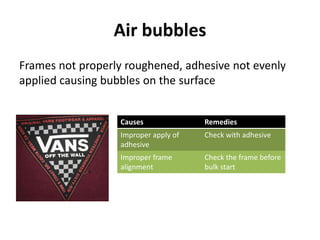
Air bubbles
Frames not properly roughened, adhesive not evenly
applied causing bubbles on the surface
Causes Remedies
Improper apply of
adhesive
Check with adhesive
Improper frame
alignment
Check the frame before
bulk start
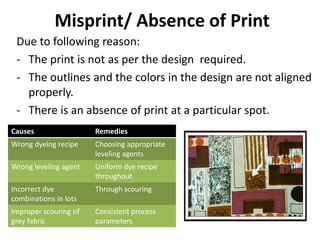
Misprint/ Absence of Print
Due to following reason:
- The print is not as per the design required.
- The outlines and the colors in the design are not aligned
properly.
- There is an absence of print at a particular spot.
Causes Remedies
Wrong dyeing recipe Choosing appropriate
leveling agents
Wrong leveling agent Uniform dye recipe
throughout
Incorrect dye
combinations in lots
Through scouring
Improper scouring of
grey fabric
Consistent process
parameters
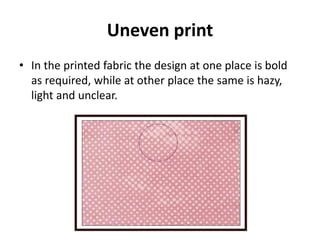
Uneven print
• In the printed fabric the design at one place is bold
as required, while at other place the same is hazy,
light and unclear.
Uneven print
Causes Remedies
Uneven pressure on the printing rollers Ensure even pressure on the printing
rollers and the doctor table
Uneven diameter of the printing roller Central drum lapping should be set
evenly
Defective doctor blade or uneven
pressure applied on the doctor blade
Ensure the printing roller’s dimension is
even throughout
Use of defective printing table
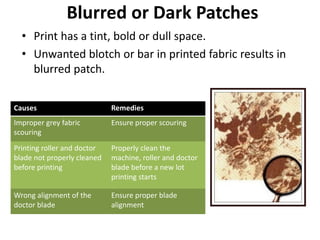
Blurred or Dark Patches
• Print has a tint, bold or dull space.
• Unwanted blotch or bar in printed fabric results in
blurred patch.
Causes Remedies
Improper grey fabric
scouring
Ensure proper scouring
Printing roller and doctor
blade not properly cleaned
before printing
Properly clean the
machine, roller and doctor
blade before a new lot
printing starts
Wrong alignment of the
doctor blade
Ensure proper blade
alignment
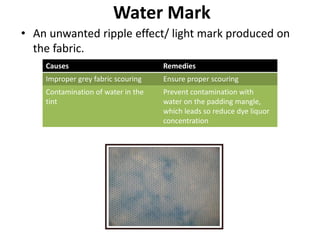
Water Mark
• An unwanted ripple effect/ light mark produced on
the fabric.
Causes Remedies
Improper grey fabric scouring Ensure proper scouring
Contamination of water in the
tint
Prevent contamination with
water on the padding mangle,
which leads so reduce dye liquor
concentration
Misfits
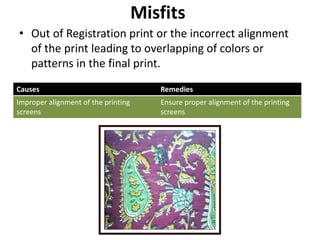
• Out of Registration print or the incorrect alignment
of the print leading to overlapping of colors or
patterns in the final print.
Causes Remedies
Improper alignment of the printing
screens
Ensure proper alignment of the printing
screens
Wicking/Flushing
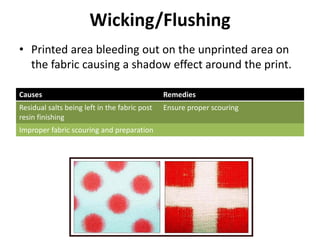
• Printed area bleeding out on the unprinted area on
the fabric causing a shadow effect around the print.
Causes Remedies
Residual salts being left in the fabric post
resin finishing
Ensure proper scouring
Improper fabric scouring and preparation
Bleeding
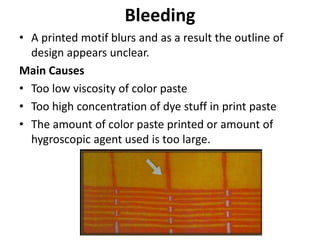
• A printed motif blurs and as a result the outline of
design appears unclear.
Main Causes
• Too low viscosity of color paste
• Too high concentration of dye stuff in print paste
• The amount of color paste printed or amount of
hygroscopic agent used is too large.
Blebbiness
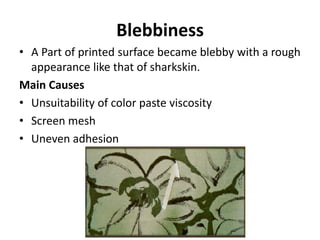
• A Part of printed surface became blebby with a rough
appearance like that of sharkskin.
Main Causes
• Unsuitability of color paste viscosity
• Screen mesh
• Uneven adhesion
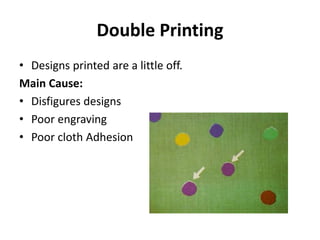
Double Printing
• Designs printed are a little off.
Main Cause:
• Disfigures designs
• Poor engraving
• Poor cloth Adhesion
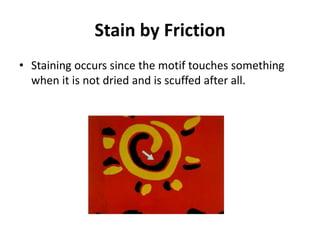
Stain by Friction
• Staining occurs since the motif touches something
when it is not dried and is scuffed after all.
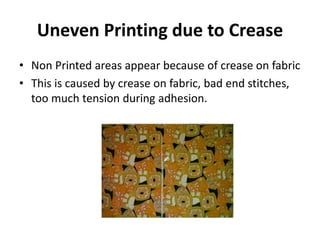
Uneven Printing due to Crease
• Non Printed areas appear because of crease on fabric
• This is caused by crease on fabric, bad end stitches,
too much tension during adhesion.
Reference
• http://vasantkothari.com/content/view_presentatio
n/252/12-Printing-Defects
• http://stitchdiary.com/classify-fault-defects-due-
dyeing-printing-defects/
• http://vasantkothari.com/content/view_presentatio
n/237/20-Dyeing-Defects
Dyeing_ printing_defects

Dyeing_ printing_defects

  • 1.
    DYEING & PRINTING DEFECTS By DipaliRathod Induja R Tejas Krishna
  • 2.
    • Textiles areusually coloured to make them attractive or for functional reasons. • There are two ways of adding colour to a textile substrate. - Dyeing - Printing
  • 3.
    Dyeing • Dyeing isemployed to give an all-over shade to the fabric. • Coloration of Dyeing involves the use of Dye Stuff.
  • 4.
    Common Causes ofDefects • The material is not well prepared for dyeing and printing. • Water Quality not Proper. • Due to Shortcomings in making Dyeing Solution. • Due to Shortcomings in the dye machinery
  • 5.
    Barre Causes Remedies Temperature variationsMaintaining suitable dyeing temperature, chemicals and carriers. Density Variation in material Relaxing material before dyeing. Difference in filling yarn size Material comprised of fibres of different origins In woven fabrics, a horizontal band of off- shaded yarn extending from selvedge to selvedge.
  • 6.
    Shade variation Causes Remedies Incorrectdye combinations Select correct dye Changes in dyeing parameters Carry out lab test Dyes build up due to chemicals used Maintain consistent dyeing conditions Stirring dye consistently before adding It refers to colour that exactly doesn’t match the standard of the prepared sample.
  • 7.
    Shade bar Causes Remedies Improperscouring Proper scouring Padding roller defect Consistent dye process parameters Incorrect dyeing temperature and time • It is variation in colour tone either horizontally or vertically
  • 8.
    Colour crocking Causes Remedies Inadequatesoaping at the end of dyeing cycle Proper soaping at the end of dyeing cyle Inconsistent dyed process Proper scouring Fabric imperfection Using correct dyes according to the fabric Improper scouring Consistent dyeing process parameters The colour of the dyed fabric rubs off or transfers to the other fabric surfaces.
  • 9.
    Dye stains Causes Remedies Improperscouring Proper Scouring Inadequate dye stuff mixing Consistent dye mixing The fabric may be stained due to various reasons such as foreign material caught while dyeing.
  • 10.
    Softener marks Causes Remedies Softenersnot properly dissolved in water Through scouring of the grey fabric Uniform softener dissolving Choosing correct softener as per the fabric This is due to softener used in dyeing.
  • 11.
    Cloudy Dyeing Causes Remedies Inadequatepre trearment Select optimum chemicals & condition. Channeling due irregular winding Pay attention to winding. Too much foam in dye bath Use antifoam ex: anti mussl Wrong dyeing programme Optimum dyeing process. Appearance of patchy effect ion a fabric,
  • 12.
    White spots Causes Remedies Improperscouring Proper scouring Choosing wrong dye mix Using correct dye according to the fabric Colour not dissolved consistent Consistent colour mixing Time and temperature of dyeing incorrect Consistent dyeing process parameters The fabric is characterised by a white spot
  • 13.
    Printing • Printing canbe defined as localized application of dye or pigment in a paste form to generate a pattern or design in the fabric. • It is also called localized dyeing.
  • 14.
    Printing Defects • Printingdefects may result from: -Faulty or improper printing procedures. -Faults or improper preparation of fabric prior to printing. -Imperfections in the material being printed.
  • 15.
    Print distortion • Dueto hanging thread. • The pattern of the print breaks where hanging thread appears. Causes Remedies Improper loose thread trimming prior to printing Ensure proper thread trimming before the process starts
  • 16.
    Air bubbles Frames notproperly roughened, adhesive not evenly applied causing bubbles on the surface Causes Remedies Improper apply of adhesive Check with adhesive Improper frame alignment Check the frame before bulk start
  • 17.
    Misprint/ Absence ofPrint Due to following reason: - The print is not as per the design required. - The outlines and the colors in the design are not aligned properly. - There is an absence of print at a particular spot. Causes Remedies Wrong dyeing recipe Choosing appropriate leveling agents Wrong leveling agent Uniform dye recipe throughout Incorrect dye combinations in lots Through scouring Improper scouring of grey fabric Consistent process parameters
  • 18.
    Uneven print • Inthe printed fabric the design at one place is bold as required, while at other place the same is hazy, light and unclear.
  • 19.
    Uneven print Causes Remedies Unevenpressure on the printing rollers Ensure even pressure on the printing rollers and the doctor table Uneven diameter of the printing roller Central drum lapping should be set evenly Defective doctor blade or uneven pressure applied on the doctor blade Ensure the printing roller’s dimension is even throughout Use of defective printing table
  • 20.
    Blurred or DarkPatches • Print has a tint, bold or dull space. • Unwanted blotch or bar in printed fabric results in blurred patch. Causes Remedies Improper grey fabric scouring Ensure proper scouring Printing roller and doctor blade not properly cleaned before printing Properly clean the machine, roller and doctor blade before a new lot printing starts Wrong alignment of the doctor blade Ensure proper blade alignment
  • 21.
    Water Mark • Anunwanted ripple effect/ light mark produced on the fabric. Causes Remedies Improper grey fabric scouring Ensure proper scouring Contamination of water in the tint Prevent contamination with water on the padding mangle, which leads so reduce dye liquor concentration
  • 22.
    Misfits • Out ofRegistration print or the incorrect alignment of the print leading to overlapping of colors or patterns in the final print. Causes Remedies Improper alignment of the printing screens Ensure proper alignment of the printing screens
  • 23.
    Wicking/Flushing • Printed areableeding out on the unprinted area on the fabric causing a shadow effect around the print. Causes Remedies Residual salts being left in the fabric post resin finishing Ensure proper scouring Improper fabric scouring and preparation
  • 24.
    Bleeding • A printedmotif blurs and as a result the outline of design appears unclear. Main Causes • Too low viscosity of color paste • Too high concentration of dye stuff in print paste • The amount of color paste printed or amount of hygroscopic agent used is too large.
  • 25.
    Blebbiness • A Partof printed surface became blebby with a rough appearance like that of sharkskin. Main Causes • Unsuitability of color paste viscosity • Screen mesh • Uneven adhesion
  • 26.
    Double Printing • Designsprinted are a little off. Main Cause: • Disfigures designs • Poor engraving • Poor cloth Adhesion
  • 27.
    Stain by Friction •Staining occurs since the motif touches something when it is not dried and is scuffed after all.
  • 28.
    Uneven Printing dueto Crease • Non Printed areas appear because of crease on fabric • This is caused by crease on fabric, bad end stitches, too much tension during adhesion.
  • 29.