PRESENTATION ON
The Postmethod Condition:
Emerging Strategies for
Second/ Foreign Language
Teaching
INTRODUCTION
 Recent studies in L2 pedagogy show a shift
away from the conventional concept of
method to “postmethod condition.”
 It refigures the relationship between
theorizers and teachers by empowering
teachers with knowledge, skill and
autonomy.
 It also reshapes the character and content
of L2 teaching and classroom research.
POSTMETHOD CONDITION
It enables teachers to
theorize from practice and
practice what they theorize.
CONT.
 In the past years, there were
evaluative thoughts on the nature and
scope of method (Allwrght: 1992,
Brown: 1991).
 We have also seen the emergence of
alternative ideas to redefined our
understanding of method
(Kumaravadivelu:1992).
CONT.
 These studies caution us against the
uncritical acceptance of untested
methods as well as against the search
for the best methods and even against
the very concept of method itself.
 Method analysis is one thing and
teaching analysis is quite another
(Mackey:1965).
CONT.
 If the concept of method authorizes
theorizers to centralize pedagogic
decision making, the post method
condition enables practitioners to
generate location-specific and
classroom oriented innovative
practices.
CONT.
 The post method condition searches for an
alternative to methods rather than an
alternative methods.
 From the practitioner’s point of view, none of
them can be realized in the purest form in the
actual classroom because they are not derived
from classroom experimentation but
artificially transplanted into the classroom
(Nunan:1991).
CONT.
 Syllabus designers and textbook
producers do not follow the philosophy
of a given method and even the
teacher do not fully conform to its
theoretical principles in classroom
(Kumaravadivelu:1993).
 It signifies teacher autonomy.
CONT.
 It promotes teachers how to
1. teach autonomously
2. analyze and evaluate their own
teaching practice
3. initiate changes in their classroom
and
4. monitor the effects of such changes
CONT.
 The next feature of post method
condition is Principled Pragmatism
which can be followed by developing
‘the sense of plausibility’
(Prabhu:1990) which is the subjective
understanding of what teachers do.
CONT.
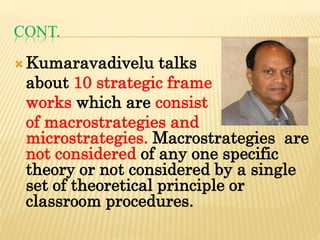
Kumaravadivelu talks
about 10 strategic frame
works which are consist
of macrostrategies and
microstrategies. Macrostrategies are
not considered of any one specific
theory or not considered by a single
set of theoretical principle or
classroom procedures.
CONT.
10 macrostrategies are…
CONT.
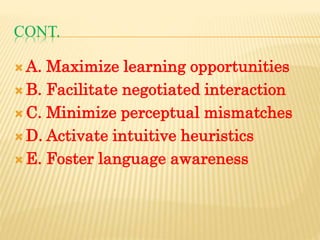
 A. Maximize learning opportunities
 B. Facilitate negotiated interaction
 C. Minimize perceptual mismatches
 D. Activate intuitive heuristics
 E. Foster language awareness
CONT.
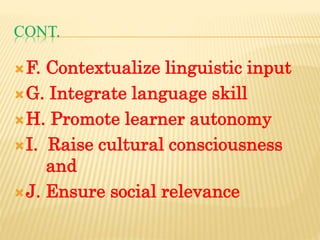
F. Contextualize linguistic input
G. Integrate language skill
H. Promote learner autonomy
I. Raise cultural consciousness
and
J. Ensure social relevance
1. MAXIMIZE LEARNING OPPORTUNITIES:
Teacher is the creator of
learning opportunities and
utilizer of learning
opportunities created by
learners.
CONT.
Teachers maintain a balance between their
role as planers of teaching acts and their
role as mediators of learning acts.
Effective result encourages teacher to
modify their lesson plans according to their
feedback.
CONT.
As a utilizer of learning
opportunities created by learners
both teacher and learner are
cooperative in classroom.
2. FACILITATE NEGOTIATED INTERACTION:
Meaningful learner- learner and
learner- teacher interaction in class.
Learner should actively involve in all
activities in classroom.
Learner should be given freedom and
encouragement to initiate talk.
CONT.
L2 learners need to be provided with
opportunities for negotiated
interaction in order to accelerate their
comprehension and production.
Opportunities to modify enables
learners to move beyond their current
receptive and expressive capacities.
(Long:1081)
CONT.
Some microstrategies…
A. Design group activity
B. Small group arrangement and
C. Asking referential questions
(Brock:1986)
3. MINIMIZE PERCEPTUAL MISMATCHES:
It determines the relative success
or failure between teacher’s
intention and learner’s
interpretation.
There are ten potential sources of
perceptual mismatch.
(Kumaravadivelu:1991)
CONT.
A. Cognitive
B. Communicative
C. Linguistic
D. Pedagogic
E. Strategic
CONT.
F. Cultural
G. Evaluative
H. Procedural
I. Instructional and
J. Attitudinal
4. ACTIVE INTUITIVE HEURISTICS:
Heuristics means to discover things
within oneself.
Grammar contraction can be neatly
analyzed and explain explicitly.
Enough textual data will be provided
by the teacher.
CONT.
Grammatical information can be
conveyed through indirect examples.
They should encounter linguistic
structure in inductive way.
It enlarges learner’s comprehension
and retention skill.
5. FOSTER LANGUAGE AWARENESS:
It is the combination of consciousness
raising and input enhancement
(Rutherford:1987).
It defines learners’ sensitivity and
awareness of the nature of language
and role in human life.
CONT.
It helps learners to sensitize
themselves to aspects of L2.
6. CONTEXTUALIZE LINGUISTIC INPUT:
Connected text is the main foundation
of language study (Sweet:1899/1964).
Words should be practiced in sentence
and sentence should be practiced in
meaningful context but nether
isolated nor disconnected.
CONT.
The phonological form which L2
learners practice depends on the
content of discourse and the
syntactic, semantic and pragmatic
features can not be understood in
isolated linguistic components.
CONT.
linguistic input should be
contextualized for learner’s benefit.
Isolated items will result in
pragmatic dissonance, depriving the
learner of necessary pragmatic cues
and make the meaning harder.
CONT.
The responsibilities for
contextualizing linguistic input
lie more with teacher than
with syllabus or textbook
designer.
7. INTEGRATE LANGUAGE SKILL:
The nature of L2 learning
involves an integration of
listening, speaking, reading
and writing.
CONT.
Reading exposure is “the primary
means of developing reading
comprehension, writing style and
more sophisticated vocabulary
and grammar” (Krashen: 1989).
CONT.
Listening activities help to make the
broader connection between function
and expression of language
(Rost: 1990).
Language knowledge and language
ability are best developed when
language is learned and used
holistically (Rigg: 1991).
CONT.
Learners do not focus on one skill at a
time.
When the teacher follows textbooks,
learners are supposed to move from
one language skill to another.
Learners use language skills in
different combination.
8. PROMOTING LEARNER AUTONOMY:
Learner autonomy involves…
A. helping learner to learn
B. equipping them with means for
their learning
C. making strategies explicit and
systematic
CONT.
Steps to promote learner autonomy…
A. psychological preparation
B. strategic training
CONT.
Teacher wishing to promote learner
autonomy can…
A. help learner to take
responsibility for their learning
B. bring about necessary changes
C. help learner understand what
the strategies are
9. RAISE CULTURAL CONSCIOUSNESS:
Cultural consciousness…
A. creates an awareness and empathy
toward the culture of L2 community
B. helps to conduct in culturally
appropriate
C. helps to find the differences of life
CONT.
The teacher’s task is to create a
network of mental association
similar to the way a native
speaker does.
The learner can be cultural
informant like the teacher.
10. ENSURE SOCIAL RELEVANCE:
L2 learning is deeply embedded in the
social context.
We can not separate classroom life
from the dynamics of social
institutions.
CONT.
The social context includes some
issues…
A. motivation for L2 learning
B. the goal of L2 learning
C. the problems of L2 learning
CONT.
Social contexts contribute to the
emergence of various communicative
competences.
The learner is not becoming an
imitator native speaker but a person
who can stand between the two
languages.
CONCLUSION
The strategic framework is not a closed set
of formula rather it is an interim term
which can be modified, expanded and
enriched. The frame can be used to
transform classroom practitioners into
strategic teachers and researchers.
Postmethod condition can potentially
reshape L2 teaching, teacher education
and classroom organization.
Presentation on post methodology

Presentation on post methodology

  • 1.
    PRESENTATION ON The PostmethodCondition: Emerging Strategies for Second/ Foreign Language Teaching
  • 2.
    INTRODUCTION  Recent studiesin L2 pedagogy show a shift away from the conventional concept of method to “postmethod condition.”  It refigures the relationship between theorizers and teachers by empowering teachers with knowledge, skill and autonomy.  It also reshapes the character and content of L2 teaching and classroom research.
  • 3.
    POSTMETHOD CONDITION It enablesteachers to theorize from practice and practice what they theorize.
  • 4.
    CONT.  In thepast years, there were evaluative thoughts on the nature and scope of method (Allwrght: 1992, Brown: 1991).  We have also seen the emergence of alternative ideas to redefined our understanding of method (Kumaravadivelu:1992).
  • 5.
    CONT.  These studiescaution us against the uncritical acceptance of untested methods as well as against the search for the best methods and even against the very concept of method itself.  Method analysis is one thing and teaching analysis is quite another (Mackey:1965).
  • 6.
    CONT.  If theconcept of method authorizes theorizers to centralize pedagogic decision making, the post method condition enables practitioners to generate location-specific and classroom oriented innovative practices.
  • 7.
    CONT.  The postmethod condition searches for an alternative to methods rather than an alternative methods.  From the practitioner’s point of view, none of them can be realized in the purest form in the actual classroom because they are not derived from classroom experimentation but artificially transplanted into the classroom (Nunan:1991).
  • 8.
    CONT.  Syllabus designersand textbook producers do not follow the philosophy of a given method and even the teacher do not fully conform to its theoretical principles in classroom (Kumaravadivelu:1993).  It signifies teacher autonomy.
  • 9.
    CONT.  It promotesteachers how to 1. teach autonomously 2. analyze and evaluate their own teaching practice 3. initiate changes in their classroom and 4. monitor the effects of such changes
  • 10.
    CONT.  The nextfeature of post method condition is Principled Pragmatism which can be followed by developing ‘the sense of plausibility’ (Prabhu:1990) which is the subjective understanding of what teachers do.
  • 11.
    CONT. Kumaravadivelu talks about 10strategic frame works which are consist of macrostrategies and microstrategies. Macrostrategies are not considered of any one specific theory or not considered by a single set of theoretical principle or classroom procedures.
  • 12.
  • 13.
    CONT.  A. Maximizelearning opportunities  B. Facilitate negotiated interaction  C. Minimize perceptual mismatches  D. Activate intuitive heuristics  E. Foster language awareness
  • 14.
    CONT. F. Contextualize linguisticinput G. Integrate language skill H. Promote learner autonomy I. Raise cultural consciousness and J. Ensure social relevance
  • 15.
    1. MAXIMIZE LEARNINGOPPORTUNITIES: Teacher is the creator of learning opportunities and utilizer of learning opportunities created by learners.
  • 16.
    CONT. Teachers maintain abalance between their role as planers of teaching acts and their role as mediators of learning acts. Effective result encourages teacher to modify their lesson plans according to their feedback.
  • 17.
    CONT. As a utilizerof learning opportunities created by learners both teacher and learner are cooperative in classroom.
  • 18.
    2. FACILITATE NEGOTIATEDINTERACTION: Meaningful learner- learner and learner- teacher interaction in class. Learner should actively involve in all activities in classroom. Learner should be given freedom and encouragement to initiate talk.
  • 19.
    CONT. L2 learners needto be provided with opportunities for negotiated interaction in order to accelerate their comprehension and production. Opportunities to modify enables learners to move beyond their current receptive and expressive capacities. (Long:1081)
  • 20.
    CONT. Some microstrategies… A. Designgroup activity B. Small group arrangement and C. Asking referential questions (Brock:1986)
  • 21.
    3. MINIMIZE PERCEPTUALMISMATCHES: It determines the relative success or failure between teacher’s intention and learner’s interpretation. There are ten potential sources of perceptual mismatch. (Kumaravadivelu:1991)
  • 22.
    CONT. A. Cognitive B. Communicative C.Linguistic D. Pedagogic E. Strategic
  • 23.
    CONT. F. Cultural G. Evaluative H.Procedural I. Instructional and J. Attitudinal
  • 24.
    4. ACTIVE INTUITIVEHEURISTICS: Heuristics means to discover things within oneself. Grammar contraction can be neatly analyzed and explain explicitly. Enough textual data will be provided by the teacher.
  • 25.
    CONT. Grammatical information canbe conveyed through indirect examples. They should encounter linguistic structure in inductive way. It enlarges learner’s comprehension and retention skill.
  • 26.
    5. FOSTER LANGUAGEAWARENESS: It is the combination of consciousness raising and input enhancement (Rutherford:1987). It defines learners’ sensitivity and awareness of the nature of language and role in human life.
  • 27.
    CONT. It helps learnersto sensitize themselves to aspects of L2.
  • 28.
    6. CONTEXTUALIZE LINGUISTICINPUT: Connected text is the main foundation of language study (Sweet:1899/1964). Words should be practiced in sentence and sentence should be practiced in meaningful context but nether isolated nor disconnected.
  • 29.
    CONT. The phonological formwhich L2 learners practice depends on the content of discourse and the syntactic, semantic and pragmatic features can not be understood in isolated linguistic components.
  • 30.
    CONT. linguistic input shouldbe contextualized for learner’s benefit. Isolated items will result in pragmatic dissonance, depriving the learner of necessary pragmatic cues and make the meaning harder.
  • 31.
    CONT. The responsibilities for contextualizinglinguistic input lie more with teacher than with syllabus or textbook designer.
  • 32.
    7. INTEGRATE LANGUAGESKILL: The nature of L2 learning involves an integration of listening, speaking, reading and writing.
  • 33.
    CONT. Reading exposure is“the primary means of developing reading comprehension, writing style and more sophisticated vocabulary and grammar” (Krashen: 1989).
  • 34.
    CONT. Listening activities helpto make the broader connection between function and expression of language (Rost: 1990). Language knowledge and language ability are best developed when language is learned and used holistically (Rigg: 1991).
  • 35.
    CONT. Learners do notfocus on one skill at a time. When the teacher follows textbooks, learners are supposed to move from one language skill to another. Learners use language skills in different combination.
  • 36.
    8. PROMOTING LEARNERAUTONOMY: Learner autonomy involves… A. helping learner to learn B. equipping them with means for their learning C. making strategies explicit and systematic
  • 37.
    CONT. Steps to promotelearner autonomy… A. psychological preparation B. strategic training
  • 38.
    CONT. Teacher wishing topromote learner autonomy can… A. help learner to take responsibility for their learning B. bring about necessary changes C. help learner understand what the strategies are
  • 39.
    9. RAISE CULTURALCONSCIOUSNESS: Cultural consciousness… A. creates an awareness and empathy toward the culture of L2 community B. helps to conduct in culturally appropriate C. helps to find the differences of life
  • 40.
    CONT. The teacher’s taskis to create a network of mental association similar to the way a native speaker does. The learner can be cultural informant like the teacher.
  • 41.
    10. ENSURE SOCIALRELEVANCE: L2 learning is deeply embedded in the social context. We can not separate classroom life from the dynamics of social institutions.
  • 42.
    CONT. The social contextincludes some issues… A. motivation for L2 learning B. the goal of L2 learning C. the problems of L2 learning
  • 43.
    CONT. Social contexts contributeto the emergence of various communicative competences. The learner is not becoming an imitator native speaker but a person who can stand between the two languages.
  • 44.
    CONCLUSION The strategic frameworkis not a closed set of formula rather it is an interim term which can be modified, expanded and enriched. The frame can be used to transform classroom practitioners into strategic teachers and researchers. Postmethod condition can potentially reshape L2 teaching, teacher education and classroom organization.