In The Name Of the Most
High
Chabahar Maritime University
Faculty of Humanities
The role of Materials
Professor:
Dr. Khoshsima
Student:
Z. Dehghan
May 2014
Overview
The purpose of materials
Writers or providers of materials
Teacher-generated material
Learner-generated material
Materials and technology
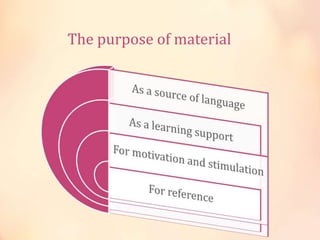
The purpose of material
1) As a source of language
Where classroom is the primary source of
language,
the materials need to maximize exposure
to the language.
2) As a learning support
As a learning support, materials need to be reliable.
To enhance learning , materials must involve :
1. learners in thinking about language
2. Learners in using the language
The activities need to stimulate cognitive not
mechanical process.
The learners need a sense of progression.
3)For motivation and stimulation
 Materials need to be challenging yet achievable.
 To offer new ideas and information while being grounded in
the learners' experience and knowledge; to encourage fun
and creativity.
4)For reference
Many ESP learners have little time for class
contact and rely on a mix of classes , self-study
and reference material.
For self-study or reference purposes , materials
need to be complete , well laid out and self-
explanatory.
The materials should have overt organization-
through informative contents pages and an
index.
Writers or providers of materials?
All this places high demands on the materials and great
pressure on materials writers.
Producing one hour of good learning material demands
hours of preparation time. Each stage of finding suitable
carrier content , matching real content to learning and
real world activities is time-consuming.
Preparing new materials from scratch for every course
taught is impractical , even if the teacher had the ability.
What all ESP practitioners have to be is good providers
of materials.
A good provider of materials will be
able to:
Select appropriately from what is available;
Be creative with what is available
Modify activities to suit learners' needs ; and
Supplement by providing extra activities(and extra
input)
Selecting materials involves making choices and decisions.
Considering these criteria for the analysis of materials:
factors about the learners , the role of materials, the topics, the
language.
Initial questions to ask when selecting materials include:
 Will the materials stimulate and motivate?
 To what extent does the material match the stated learning
objectives and your learning objectives?
 To what extent will the materials support that learning?
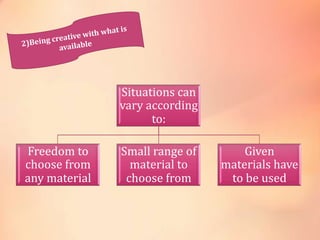
Situations can
vary according
to:
Freedom to
choose from
any material
Small range of
material to
choose from
Given
materials have
to be used
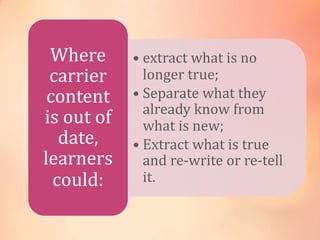
• extract what is no
longer true;
• Separate what they
already know from
what is new;
• Extract what is true
and re-write or re-tell
it.
Where
carrier
content
is out of
date,
learners
could:
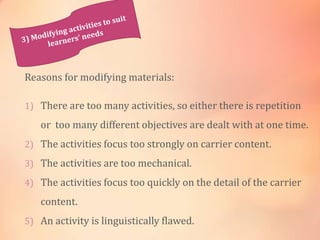
Reasons for modifying materials:
1) There are too many activities, so either there is repetition
or too many different objectives are dealt with at one time.
2) The activities focus too strongly on carrier content.
3) The activities are too mechanical.
4) The activities focus too quickly on the detail of the carrier
content.
5) An activity is linguistically flawed.
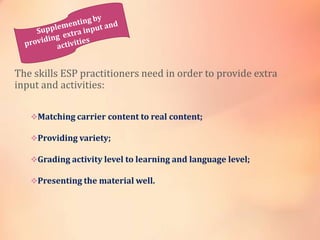
The skills ESP practitioners need in order to provide extra
input and activities:
Matching carrier content to real content;
Providing variety;
Grading activity level to learning and language level;
Presenting the material well.
Teacher-generated material
1. Matching carrier content to real content
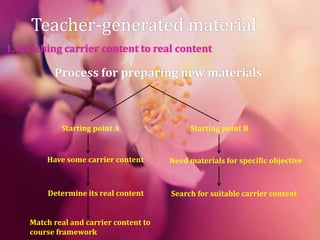
Process for preparing new materials
Starting point A Starting point B
Have some carrier content Need materials for specific objective
Determine its real content Search for suitable carrier content
Match real and carrier content to
course framework
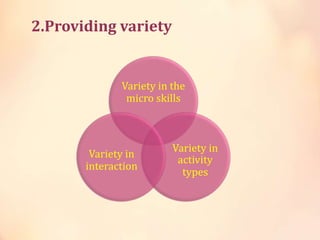
2.Providing variety
Variety in the
micro skills
Variety in
activity
types
Variety in
interaction
3. Grading exercises
Grading concerns with the amount of support provided to enable
learners to do a set of exercises;
It provides learners with tasks at different levels of difficulty.
one way to achieve this is by setting tasks at three levels:
1) Unsupported
2) Partially supported
3) Fully supported
4. presenting the material well
 The final and important step is to present the material well.
 It includes writing good, consistent rubrics, planning layout and
proofing.
Focus on learning
Learner-generated material
Framework materials
• Framework materials set a context within which the learners fit their
own carrier content and their existing language competence.
• They supplement rather than replace more traditional materials.
• They may be used at:
 a practice stage after specific language input
or
 as a starting point for a deep-end approach.
• They are enjoyed most by people with right-brained learning style.
With mixed learning styles, they complement the more left- brained
material.
• Learners who have only experienced traditional, teacher-centered
education, may need help and time to adjust to framework materials.
Devising frameworks
 First, using published frameworks devised and tested by
others.
 For devising frameworks the golden rule would be” keep
it simple”.
 The visual variables within the framework include: shape
, size, color ,relative positions and connections.
 The content variables are primarily whether the
framework generates particular language or generates
particular interaction.
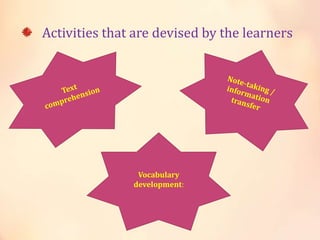
Activities that are devised by the learners
Vocabulary
development:
Materials and technology
 Technology offers the possibility of alternative materials
and classroom interaction.
 After audio and video cassettes, the next major
technological change was the use of computers and CD-
ROM.
 The Internet is bringing further changes as courses can
now be downloaded from all over the world.
Everyone is a genius. But if you judge a
fish by it's ability to climb a tree, it will
live it's whole life believing that it is
stupid.
-Albert Einstein

The role of materials

  • 1.
    In The NameOf the Most High
  • 2.
    Chabahar Maritime University Facultyof Humanities The role of Materials Professor: Dr. Khoshsima Student: Z. Dehghan May 2014
  • 4.
    Overview The purpose ofmaterials Writers or providers of materials Teacher-generated material Learner-generated material Materials and technology
  • 5.
  • 6.
    1) As asource of language Where classroom is the primary source of language, the materials need to maximize exposure to the language.
  • 7.
    2) As alearning support As a learning support, materials need to be reliable. To enhance learning , materials must involve : 1. learners in thinking about language 2. Learners in using the language The activities need to stimulate cognitive not mechanical process. The learners need a sense of progression.
  • 8.
    3)For motivation andstimulation  Materials need to be challenging yet achievable.  To offer new ideas and information while being grounded in the learners' experience and knowledge; to encourage fun and creativity.
  • 9.
    4)For reference Many ESPlearners have little time for class contact and rely on a mix of classes , self-study and reference material. For self-study or reference purposes , materials need to be complete , well laid out and self- explanatory. The materials should have overt organization- through informative contents pages and an index.
  • 10.
    Writers or providersof materials? All this places high demands on the materials and great pressure on materials writers. Producing one hour of good learning material demands hours of preparation time. Each stage of finding suitable carrier content , matching real content to learning and real world activities is time-consuming. Preparing new materials from scratch for every course taught is impractical , even if the teacher had the ability. What all ESP practitioners have to be is good providers of materials.
  • 11.
    A good providerof materials will be able to: Select appropriately from what is available; Be creative with what is available Modify activities to suit learners' needs ; and Supplement by providing extra activities(and extra input)
  • 12.
    Selecting materials involvesmaking choices and decisions. Considering these criteria for the analysis of materials: factors about the learners , the role of materials, the topics, the language. Initial questions to ask when selecting materials include:  Will the materials stimulate and motivate?  To what extent does the material match the stated learning objectives and your learning objectives?  To what extent will the materials support that learning?
  • 13.
    Situations can vary according to: Freedomto choose from any material Small range of material to choose from Given materials have to be used
  • 14.
    • extract whatis no longer true; • Separate what they already know from what is new; • Extract what is true and re-write or re-tell it. Where carrier content is out of date, learners could:
  • 15.
    Reasons for modifyingmaterials: 1) There are too many activities, so either there is repetition or too many different objectives are dealt with at one time. 2) The activities focus too strongly on carrier content. 3) The activities are too mechanical. 4) The activities focus too quickly on the detail of the carrier content. 5) An activity is linguistically flawed.
  • 16.
    The skills ESPpractitioners need in order to provide extra input and activities: Matching carrier content to real content; Providing variety; Grading activity level to learning and language level; Presenting the material well.
  • 17.
    Teacher-generated material 1. Matchingcarrier content to real content Process for preparing new materials Starting point A Starting point B Have some carrier content Need materials for specific objective Determine its real content Search for suitable carrier content Match real and carrier content to course framework
  • 18.
    2.Providing variety Variety inthe micro skills Variety in activity types Variety in interaction
  • 19.
    3. Grading exercises Gradingconcerns with the amount of support provided to enable learners to do a set of exercises; It provides learners with tasks at different levels of difficulty. one way to achieve this is by setting tasks at three levels: 1) Unsupported 2) Partially supported 3) Fully supported 4. presenting the material well  The final and important step is to present the material well.  It includes writing good, consistent rubrics, planning layout and proofing. Focus on learning
  • 20.
    Learner-generated material Framework materials •Framework materials set a context within which the learners fit their own carrier content and their existing language competence. • They supplement rather than replace more traditional materials. • They may be used at:  a practice stage after specific language input or  as a starting point for a deep-end approach. • They are enjoyed most by people with right-brained learning style. With mixed learning styles, they complement the more left- brained material. • Learners who have only experienced traditional, teacher-centered education, may need help and time to adjust to framework materials.
  • 21.
    Devising frameworks  First,using published frameworks devised and tested by others.  For devising frameworks the golden rule would be” keep it simple”.  The visual variables within the framework include: shape , size, color ,relative positions and connections.  The content variables are primarily whether the framework generates particular language or generates particular interaction.
  • 22.
    Activities that aredevised by the learners Vocabulary development:
  • 23.
    Materials and technology Technology offers the possibility of alternative materials and classroom interaction.  After audio and video cassettes, the next major technological change was the use of computers and CD- ROM.  The Internet is bringing further changes as courses can now be downloaded from all over the world.
  • 24.
    Everyone is agenius. But if you judge a fish by it's ability to climb a tree, it will live it's whole life believing that it is stupid. -Albert Einstein