This document provides a literature review on instructed second language acquisition commissioned by the New Zealand Ministry of Education. It examines theories and research on effective pedagogical approaches for teaching a second language in a classroom setting. The review is divided into three main sections:
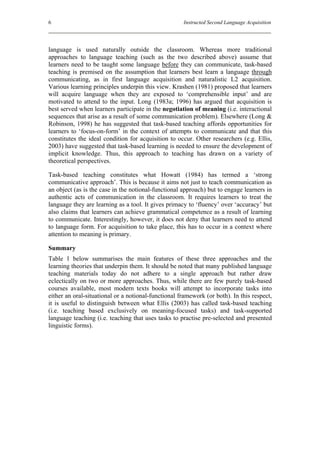
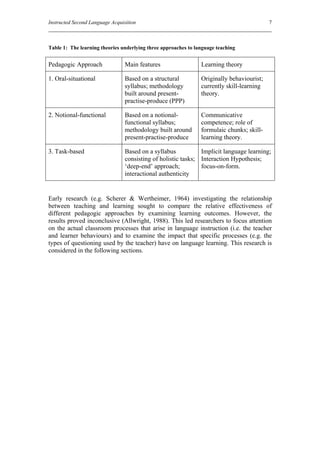
1) It discusses three general approaches to language teaching - oral-situational, notional-functional, and task-based - and the learning theories that inform them.
2) It considers empirical studies on various classroom language teaching techniques and their effectiveness.
3) It proposes ten general principles for successful instructed language learning based on the theories and research.



![CONTENTS
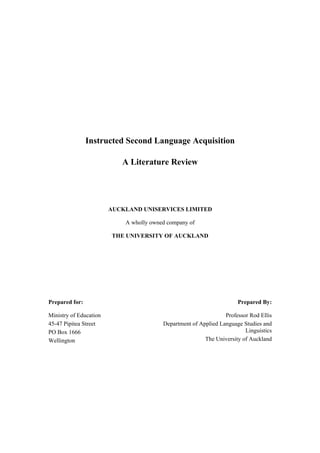
Introduction...................................................................................................................... 1
Section A: Pedagogic Approaches And General Theories of Language Learning..........3
The Oral-Situational Approach...................................................................................3
The Notional-Functional Approach ............................................................................4
The Task-Based Approach..........................................................................................5
Summary .....................................................................................................................6
Section B: Classroom-Based Research Into Language Teaching And Learning [1].......9
Direct intervention ....................................................................................................10
Indirect intervention..................................................................................................17
Corrective feedback ..................................................................................................19
Small Groupwork ......................................................................................................22
Individual Differences and Instruction .....................................................................26
Section C: General Principles For Successful Instructed Learning ...............................33
Principle 1: Instruction needs to ensure that learners develop both a rich repertoire
of formulaic expressions and a rule-based competence.......................33
Principle 2: Instruction needs to ensure that learners focus predominantly on
meaning................................................................................................34
Principle 3: Instruction needs to ensure that learners also focus on form ...............34
Principle 4: Instruction needs to be predominantly directed at developing implicit
knowledge of the L2 while not neglecting explicit knowledge ...........36
Principle 5: Instruction needs to take into account learners’ ‘built-in syllabus’......37
Principle 6: Successful instructed language learning requires extensive L2 input.....38
Principle 7: Successful instructed language learning also requires opportunities for
output ...................................................................................................39
Principle 8: The opportunity to interact in the L2 is central to developing L2
proficiency ...........................................................................................40
Principle 9: Instruction needs to take account of individual differences in learners ..41
Principle 10: In assessing learners’ L2 proficiency it is important to examine free as
well as controlled production................................................................42
Conclusion: Making Use of the Research.......................................................................43
Notes .........................................................................................................................44
Glossary...........................................................................................................................47
References.......................................................................................................................51](https://image.slidesharecdn.com/instructed-second-languager-ellis-110915033909-phpapp02/85/Instructed-second-language-r-ellis-5-320.jpg)






![Instructed Second Language Acquisition 9
SECTION B: CLASSROOM-BASED RESEARCH INTO
LANGUAGE TEACHING AND LEARNING [1]
In this section we will review empirical studies of classroom teaching and learning,
focusing in particular on studies published in the last fifteen years (see Chaudron,
1998 for an extensive review of the earlier research). These studies have adopted a
variety of research approaches:
a. Descriptive (i.e. studies that examined the kinds of language produced by
teachers and learners in classroom contexts).
b. Experimental (i.e. studies that manipulated the instructional treatment
provided to learners and measured the learning outcomes of the different
treatments).
c. Ethnographic (i.e. studies based on field observations of classrooms and
retrospective and introspective reports from teachers and learners).
d. Correlational (i.e. studies that seek to establish relationships between different
sets of variables).
While all these studies have shed light on the kinds of learning opportunities made
available to learners through instruction, only the experimental studies address the
effects that instruction (in its various modes) has on language learning.
The empirical research has been informed by a number of theoretical perspectives,
which can be loosely grouped under two main headings (see Lantolf, 1996); the
computational model and sociocultural theory of the mind. The former views
language learning in terms of input-output, specifying the psycholinguistic processes
involved in the development of L2 knowledge and in its use in planned and unplanned
discourse. Key concepts in this model are input processing, intake, interlanguage
development, output processing, and monitoring. An assumption of this model is
that learners have a ‘built-in syllabus’ which directs how they gradually acquire the
linguistic properties of a language (i.e. how their interlanguage develops). The latter
views language learning as something that originates in the social interaction; learners
collaboratively produce structures that they are unable to perform independently and
subsequently internalize them. Key concepts in this theory are zone of proximal
development, private speech, other regulation, self-regulation and scaffolding.
Instruction can be viewed as an attempt to intervene in the process of language
learning. This intervention can involve two broad types of curriculum. In direct
intervention, the instruction specifies what it is that learners will learn and when they
will learn it. This is reflected in the oral-situational and notional-functional
approaches discussed above, i.e. in a Type A Curriculum. In indirect intervention, the
purpose of instruction is to create conditions where learners can learn experientially
through learning how to communicate in the L2. This is reflected in the task-based
approach, a Type B Curriculum. The review that follows will first consider research
related to these two types of intervention. It will then examine studies that have
addressed two aspects of language teaching that are currently attracting attention from
researchers: corrective feedback and small group interaction. Finally, it will address
research that has investigated instruction in relation to individual learner difference
factors.](https://image.slidesharecdn.com/instructed-second-languager-ellis-110915033909-phpapp02/85/Instructed-second-language-r-ellis-15-320.jpg)
![10 Instructed Second Language Acquisition
Direct intervention
To date, direct intervention studies have been based almost exclusively on the
computational model [2]. They seek to establish whether instruction, defined as the
manipulation of input and/or output, results in inter-language development. The key
questions here are: (1) Is direct intervention effective in the sense that learners learn
what they are taught? and (2) Are some forms of direct intervention more effective
than others? These questions can be addressed by examining any level of language
(pronunciation, vocabulary, grammar, discourse structure and functions) in any of the
four language skills (listening, speaking, reading and writing). For reasons of space,
this review will limit consideration to grammar (a traditional focus for direct
interventional programs).
Is direct intervention effective?
There is now ample evidence to show that grammar instruction can help learners to
perform grammatical features more accurately in experimentally elicited performance.
Norris and Ortega (2000) carried out a meta-analysis of some 51 studies that utilized
either ‘selected response’ or ‘constrained constructed response’ as the measure of
learning. They report an effect size of 1.46 and 1.20 respectively for these two types
of measure, indicating that, overall, form-focused instruction is effective when the
learning outcomes are measured in these ways. Furthermore, the beneficial effects of
instruction are also durable, as evident in delayed post-tests. One conclusion to be
drawn from the research, then, is that learners can benefit from instruction in specific
grammatical features if their goal is to perform well on discrete-point tests like the
TOEFL.
The evidence relating to the effects of grammar instruction on learners’ ability to use
the targeted features in communicative language use (especially unplanned oral
language use) is somewhat meagre. This reflects the difficulty researchers have in
designing instruments to elicit spontaneous use of specific L2 features (see Loshcky
& Bley-Vroman, 1993, for a discussion of this issue). Norris and Ortega could only
locate eight studies that included a measure of ‘free constructed response’. Instruction
appears to have a much reduced effect when the learning outcome is measured in this
way, the effect size being less than half of that for ‘selected response’ and
‘constrained constructed response’. They note that ‘particular outcome measure types
may result in very different observations about the effectiveness of a treatment’ (p.
199). Ellis (2002a) examined 11 studies that included a measure of free oral
production. Instruction was found to have a significant effect in only six of these.
However, this effect was also evident in delayed post-tests and, in fact, in two of the
studies, was stronger in these. Two conclusions are in order. First, grammar
instruction does not always result in more accurate use of the targeted features in free
oral production. Second, when an effect is found it is durable.
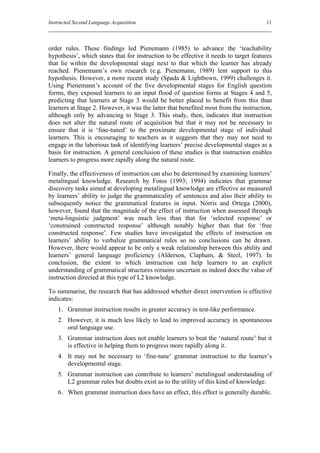
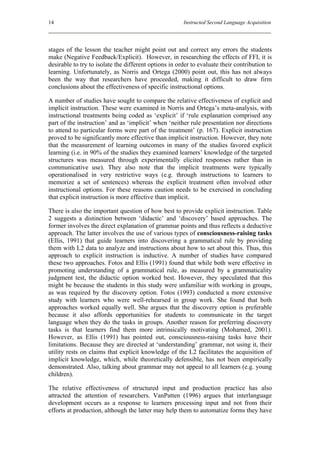
Grammar instruction does not enable learners to ‘beat’ the natural route of
acquisition (i.e. the order in which learners have been found to acquire specific
grammatical features and the stages of development involved in this). Studies
comparing instructed and naturalistic learners (e.g. Ellis, 1989; Pica, 1983) report the
same order of acquisition for grammatical morphemes and the same sequence of
acquisition for syntactic structures such as English relative clauses and German word](https://image.slidesharecdn.com/instructed-second-languager-ellis-110915033909-phpapp02/85/Instructed-second-language-r-ellis-16-320.jpg)


![Instructed Second Language Acquisition 25
5. To work collaboratively to improve a knowledge artefact. (Wells, 1999, pp.
112-3).
From the perspective of a sociocultural theory of the mind, the activity of ‘coming to
know’ through conversation depends crucially on the participants being able to utilize
each other’s utterances as objects that can be extended, questioned or rejected. As we
have seen this can be accomplished much more easily if the ‘knowledge artefact’ that
the task requires students to construct is written rather than oral. When constructing a
written text, students are able to focus on an ‘improvable object’ and, importantly,
have the time and space to treat language itself as an object, thus achieving the focus
on form considered crucial for acquisition. In tasks that afford such ‘improvable
objects’, the quality of the interaction is enhanced, with longer and more
grammaticalized utterances apparent, as illustrated in the task performances in
Swain’s research involving dictogloss tasks [3] (see, for example, Swain, 2000; Swain
& Lapkin, 2001). Thus again we can see that the extent to which students achieve
effective collaboration depends on the nature of the task, as much as on their own
efforts.
There are, however, a number of more practical matters that teachers can attend to in
order to foster student cooperation in group/pair work. It should be noted, however,
that there is little L2 research available that has directly addressed these issues. They
include:
1. Students’ orientation to the task
For groupwork to be effective students need to be convinced that the task is
worthwhile and not simply an opportunity for some ‘fun’ (as Foster (1998)
suggests was the case in the learners she investigated – see Chapter 6).
Students, then, need to be serious and committed towards obtaining the best
outcome possible for the task.
2. Individual accountability
Each student needs to be made accountable for his/her own contribution to the
completion of the task. One way in which this can be achieved is by giving
each group member a specific role to perform (Jacobs, 1998). Another is by
asking each student to make an explicit comment on their personal
contribution in the post-task report.
3. Group composition
The key questions here concern size and membership. Jacobs points out that
many books of cooperative learning recommend groups of four, which can be
subsequently divided into pairs. Mixed groups (in terms of ethnicity and
proficiency) are considered to work better than homogeneous groups, although
we know of no study that has demonstrated this.
4. Distribution of information
In one-way information gap tasks involving students of differing proficiency
levels, collaborativeness is enhanced if the student with the lower proficiency
is put in charge of the information to be exchanged (Yule, Powers, &
McDonald, 1992).](https://image.slidesharecdn.com/instructed-second-languager-ellis-110915033909-phpapp02/85/Instructed-second-language-r-ellis-31-320.jpg)
![28 Instructed Second Language Acquisition
to identify additional aptitudinal aspects, in particular the ability to attend to form in
the input and to access language material from memory.
Studies have shown that aptitude scores are related to both formal, test-like measures
of L2 proficiency and to more informal measures based on communicative
performance. Horwitz (1987), for example, found that MLAT scores correlated
significantly with scores on a discrete-point grammar test and with scores derived
from relatively spontaneous oral production. A number of recent experimental studies
have examined the relationship between language aptitude and implicit/explicit
learning. In these studies, implicit learning was operationalized as exposure to
sentences exemplifying a specific structure with the instruction to memorize the
sentences, while explicit learning involved asking learners to actively look for the rule
or, in some cases, to process the sentences after they have received an explanation of
the rule. Robinson (1997) found that language aptitude is implicated in both types of
learning [4].
It is possible, however, that different aspects of language aptitude are involved in
informal and formal learning. For example, if, as Grigorenko, Sternberg and Ehrman
(2000) suggest, intelligence is a factor in explicit learning, we might expect measures
of linguistic-analytic ability to be important here, while the phonemic-coding and
memory abilities may play a bigger role in informal learning.
Robinson (2002) argues for a research program that systematically examines the
interactions between task demands, language aptitude and language learning. He
suggests that ‘the information processing demands of tasks draw differentially on
cognitive abilities’ (p. 386) and that we need to discover how this affects learning
outcomes. However, there have been surprisingly few studies that have examined
language aptitude in relation to specific pedagogical tasks as opposed to general
achievement. Nagata, Aline and Ellis (1999) examined learners’ performance on a
one-way information gap task involving listening to and carrying out instructions that
contained new L2 words – a task directed at incidental acquisition. They reported
moderate but statistically significant correlations between measures of sound-symbol
association, grammatical-semantic sensitivity and memory for words on the one hand
and comprehension of the instructions on the other. In contrast, only memory for
words was systematically related to post-test measures of the acquisition of the new
words. This study suggests that different aspects of language aptitude may be
implicated in different kinds of language processing.
There have been proposals for new models of language aptitude. Skehan (1998)
suggests that Carroll’s original four-part model can be collapsed into a three-part one
by incorporating grammatical sensitivity and inductive language learning ability into a
single ‘language analytic ability’. He argues that these three aptitudes operate
differently during the course of adult language learning. Language analytic ability,
which is closely related to general intelligence, is involved throughout, while
phonemic-coding ability plays a major role only in the early stages. Memory ability is
involved in all stages but in the case of exceptional learners it is enhanced allowing
them to achieve a more or less native-like level of proficiency. In a later publication
Skehan (2002) suggests the need to relate different components of aptitude to four
macro stages in language acquisition; noticing (e.g. phonemic coding and working](https://image.slidesharecdn.com/instructed-second-languager-ellis-110915033909-phpapp02/85/Instructed-second-language-r-ellis-34-320.jpg)

![Instructed Second Language Acquisition 35
necessary for acquisition to take place. Schmidt (1994), for example, has argued that
there is no learning without conscious attention to form [5].
Again, though, the term ‘focus on form’ is capable of more than one interpretation.
First, it might refer to a general orientation to language as form. Schmidt (2001)
dismisses this global attention hypothesis, arguing that learners need to attend to
specific forms. Second, it might be taken to suggest that learners need to attend only
to the graphic or phonetic instantiations of linguistic forms. However, theorists such
as Schmidt and Long are insistent that focus on form refers to form-function mapping
(i.e. the correlation between a particular form and the meaning(s) it realises in
communication). Third, ‘focus on form’ might be assumed to refer to awareness of
some underlying, abstract rule. Schmidt, however, is careful to argue that attention to
form refers to the noticing of specific linguistic items, as they occur in the input to
which learners are exposed, not to an awareness of grammatical rules.
Instruction can cater to a focus on form in a number of ways:
1. Through grammar lessons designed to teach specific grammatical features by
means of input- or output processing. See Table 2 for a summary of the
different options. An inductive approach to grammar teaching is designed to
encourage ‘noticing’ of pre-selected forms; a deductive approach seeks to
establish an awareness of the grammatical rule.
2. Through focused tasks, i.e. tasks that require learners to comprehend and
process specific grammatical structures in the input, and/or to produce the
structures in the performance of the task.
3. By means of methodological options that induce attention to form in the
context of performing a task. Two methodological options that have received
considerable attention from researchers and that have been discussed in earlier
sections are: (a) the provision of time for strategic and on-line planning, and
(b) corrective feedback.
Instruction can seek to provide an intensive focus on pre-selected linguistic forms (as
in a focus-on-forms approach or in a lesson built around a focused task) or it can offer
incidental and extensive attention to form (as in a lesson based on an unfocused task).
There are pros and cons for both intensive and extensive grammar instruction. Some
structures may not be mastered without the opportunity for repeated practice. Harley
(1989), for example found that Anglophone learners of L2 French failed to acquire the
distinction between the prétérite and imparfait past tenses after hours of exposure (and
presumably some corrective feedback) in an immersion programme but were able to
improve their accuracy in the use of these two tenses after intensive instruction.
However, intensive instruction is time consuming (in Harley’s study the targeted
structures were taught over a 6 month period) and thus there will be constraints on
how many structures can be addressed. Extensive grammar instruction, on the other
hand, affords the opportunity for large numbers of grammatical structures to be
attended. Also, more likely than not, many of the structures will be addressed
repeatedly over a period of time. Further, because this kind of instruction involves a
response to the errors each learner makes it is individualized and affords the skilled
teacher on-line opportunities for the kind of contextual analysis that Celce-Murcia
(2002) recommends as a basis for grammar teaching. However, it is not possible to](https://image.slidesharecdn.com/instructed-second-languager-ellis-110915033909-phpapp02/85/Instructed-second-language-r-ellis-41-320.jpg)
![38 Instructed Second Language Acquisition
There followed a number of empirical studies designed to (1) compare the order of
acquisition of instructed and naturalistic learners (e.g. Pica, 1983), (2) compare the
success of instructed and naturalistic learners (Long, 1983b) and (3) examine whether
attempts to teach specific grammatical structures resulted in their acquisition (Ellis,
1984b). These studies showed that, by and large, the order of acquisition was the
same for instructed and naturalistic learners; that instructed learners generally
achieved higher levels of grammatical competence than naturalistic learners; and that
instruction was no guarantee that learners would acquire what they had been taught.
This led to the conclusion that it was beneficial to teach grammar but that it was
necessary to ensure that it was taught in a way that was compatible with the natural
processes of acquisition. Subsequent research has borne out Long’s claim (see earlier
discussion).
How, then, can instruction take account of the learner’s built-in syllabus? There are a
number of possibilities:
1. Adopt a zero grammar approach, as proposed by Krashen. That is, employ a
Type B curriculum (e.g. a task-based approach) that makes no attempt to
predetermine the linguistic content of a lesson.
2. Ensure that learners are developmentally ready to acquire a specific target
feature. However, this is probably impractical as teachers have no easy way of
determining where individual students have reached and it would necessitate a
highly individualized approach to cater for differences in developmental level
among the students. Also, as we noted earlier, such fine-tuning may not be
necessary. While instruction in a target feature may not enable learners to
‘beat’ the built-in syllabus, it may serve to push them along it as long as the
target structure is not too far ahead of their developmental stage.
3. Focus the instruction on explicit rather than implicit knowledge as explicit
knowledge is not subject to the same developmental constraints as implicit
knowledge. While it is probably true that some declarative facts about
language are easier to master than others, this is likely to reflect their cognitive
rather than their developmental complexity, which can more easily be taken
into account in deciding the order of instruction. Traditional structural
syllabuses, in fact, are graded on the basis of cognitive complexity [6].
Principle 6: Successful instructed language learning requires extensive L2 input
Language learning, whether it occurs in a naturalistic or an instructed context, is a
slow and labour-intensive process. Children acquiring their L1 take between two and
five years to achieve full grammatical competence, during which time they are
exposed to massive amounts of input. Ellis and Wells (1980) demonstrated that a
substantial portion of the variance in speed of acquisition of children can be
accounted for by the amount and the quality of input they receive. The same is
undoubtedly true of L2 acquisition. If learners do not receive exposure to the target
language they cannot acquire it. In general, the more exposure they receive, the more
and the faster they will learn. Krashen (1981, 1994) has adopted a very strong position
on the importance of input. He points to studies that have shown that length of
residence in the country where the language is spoken is related to language
proficiency and that have found positive correlations between the amount of reading
reported and proficiency/ literacy. For Krashen, however, the input must be made](https://image.slidesharecdn.com/instructed-second-languager-ellis-110915033909-phpapp02/85/Instructed-second-language-r-ellis-44-320.jpg)
![Instructed Second Language Acquisition 41
2. Providing opportunities for learners to use the language to express their own
personal meanings.
3. Helping students to participate in language-related activities that are beyond
their current level of proficiency.
4. Offering a full range of contexts that cater for a ‘full performance’ in the
language.
Johnson suggests that these are more likely to occur when the academic task structure
(i.e. how the subject matter is sequenced in a lesson) and the social participation
structure (i.e. how the allocation of interactional rights and obligations shapes the
discourse) are less rigid. Once again, this is more likely to be provided through ‘tasks’
than through exercises. Ellis (1999) suggests that a key to ensuring interaction
beneficial to acquisition is giving control of the discourse topic to the students. This,
of course, is not easily achieved, given that teachers have a duty to ensure that
classroom discourse is orderly, which, in turn, is most easily achieved by taking
control of the discourse topic by means of IRF (teacher initiate - student respond -
teacher feedback) exchanges. Thus creating the right kind of interaction for
acquisition constitutes a major challenge for teachers. One solution is to incorporate
small group work into a lesson. As we noted above, when students interact amongst
themselves, acquisition-rich discourse is more likely to ensue. However, as we also
noted, there are a number of dangers in groupwork which may militate against this
(e.g. excessive use of the L1 in monolingual groups).
Principle 9: Instruction needs to take account of individual differences in learners
We have seen that although there are identifiable universal aspects of L2 acquisition,
there is also considerable variability in the rate of learning and in the ultimate level of
achievement. Learning will be more successful when:
1. The instruction is matched to students’ particular aptitude for learning.
2. The students are motivated.
It is probably beyond the abilities of most teachers to design lessons involving the
kind of matching instruction employed in Wesche’s study (see earlier discussion).
However, teachers can cater to variation in the nature of their students’ aptitude by
adopting a flexible teaching approach involving a variety of learning activities. They
can also make use of simple learner-training materials (e.g. Ellis & Sinclair, 1989)
designed to make students more aware of their own approaches to learning and to
develop awareness of alternative approaches. The good language learner studies
suggest that successful language learning requires a flexible approach to learning.
Thus, increasing the range of learning strategies at learners’ disposal is one way in
which teachers can help them to learn. Such strategy training needs to foster an
understanding that language learning requires both an experiential and an analytical
approach and to demonstrate the kinds of strategies related to both approaches.
School-based students often tend to adopt an analytical approach to learning (even if
this does not accord with their natural aptitude) as this is the kind of approach
generally fostered in schools (Sternberg, 2001). They may have greater difficulty in
adopting the kind of experiential approach required in task-based language teaching.
Some learner-training, therefore, may be essential if learners are to perform tasks
effectively [7].](https://image.slidesharecdn.com/instructed-second-languager-ellis-110915033909-phpapp02/85/Instructed-second-language-r-ellis-47-320.jpg)


![52 Instructed Second Language Acquisition
Corder, S. P. (1967). The significance of Dornyei, Z. (2001). Motivational strategies in
learners’ errors. International Review of the language classroom. Cambridge:
Applied Linguistics, 5, 161-169. Cambridge University Press.
Coughlan, P. & Duff, P. A. (1994). Same task, Doughty, C., & Varela, E. (1998).
different activities: Analysis of an SLA Communicative focus on form. In C.
task from an activity theory perspective. In Doughty & J. Williams (Eds.), Focus on
J. Lantolf & G. Appel (Eds.), Vygotskian form in classroom second language
approaches to second language research. acquisition. Cambridge: Cambridge
(pp. 173-194). Norwood, NJ: Ablex. University Press.
Cronbach, L., & Snow, R. (1977). Aptitudes and Doughty, C., & Williams, J. (Eds.). (1998).
instructional methods. New York: Focus on form in classroom second
Irvington. language acquisition. Cambridge:
Cambridge University Press.
Crookes, G. (1986). Task classification: A cross-
disciplinary review. Technical Report No. 4. Duff, P. (1986). Another look at interlanguage
Honolulu: Center for Second Language talk: Taking task to task. In R. Day (Ed.),
Classroom Research, Social Science Talking to learn: Conversation in second
Research Institute, University of Hawaii. language acquisition. Rowley, Mass.:
Newbury House.
Crookes, G. (1989). Planning and interlanguage
variability. Studies in Second Language
Acquisition, 11, 367-383.
Elley, W. (1991). Acquiring literacy in a
Crookes, G., & Gass, S. (Eds.). (1993). Tasks in second language: The effect of book-based
a pedagogical context: Integrating theory programs. Language Learning, 41, 375-
and practice. Clevedon: Multilingual 411.
Matters.
Ellis, G., & Sinclair, B. (1989). Learning to
Crookes, G., & Schmidt, R. (1991). Language learn English. Cambridge: Cambridge
learning motivation: Reopening the research University Press.
agenda. Language Learning, 41, 469-512.
Ellis, N. (1996). Sequencing in SLA:
Phonological memory, chunking, and points
of order. Studies in Second Language
Danesi, M. (1996). Adesso [Now] (2nd ed.). Acquisition, 18, 91-126.
Boston, MA: Heinle and Heinle.
Ellis, N. (1998). Emergentism, connectionism
Day, R (Ed.). (1986). Talking to learn: and language learning. Language
Conversation in second language Learning, 48, 631-664.
acquisition. Rowley, Mass.: Newbury
House. Ellis, R. (1984a). Classroom second language
development. Oxford: Pergamon.
DeKeyser, R. (1998). Beyond focus on form:
Cognitive perspectives on learning and Ellis, R. (1984b). Can syntax be taught? A study
practicing second language grammar. In C. of the effects of formal instruction on the
Doughty & J. Williams (Eds.), Focus on acquisition of WH questions by children.
form in classroom second language Applied Linguistics, 5, 138-55.
acquisition. Cambridge: Cambridge
University Press Ellis, R. (1987). Interlanguage variability in
narrative discourse: Style shifting in the
Donato, R. (1994). Collective scaffolding in use of the past tense. Studies in Second
second language learning. In J. Lantolf & Language Acquisition, 9, 1-20.
G. Appel (Eds.), Vygotskian approaches to
second language research. Norwood, NJ:
Ablex.](https://image.slidesharecdn.com/instructed-second-languager-ellis-110915033909-phpapp02/85/Instructed-second-language-r-ellis-58-320.jpg)