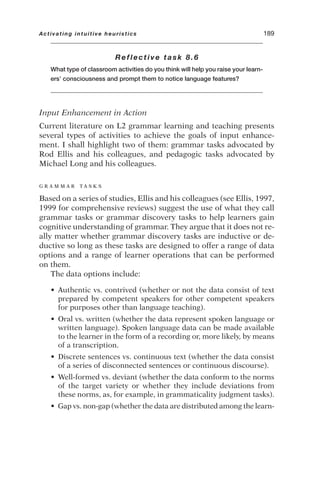
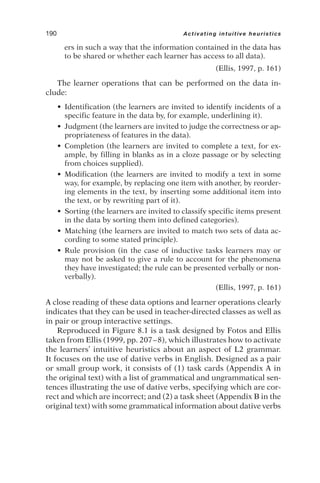
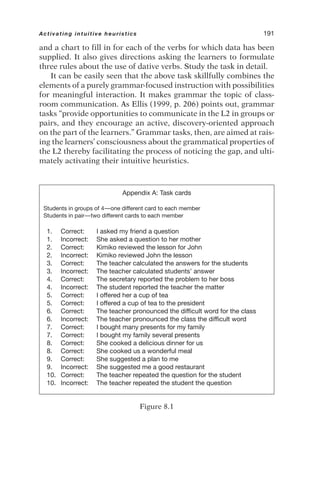
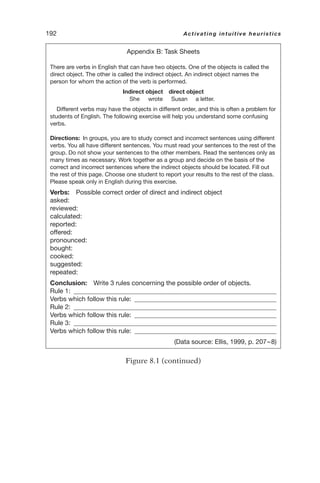
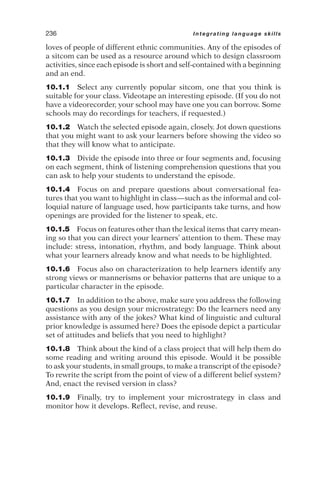
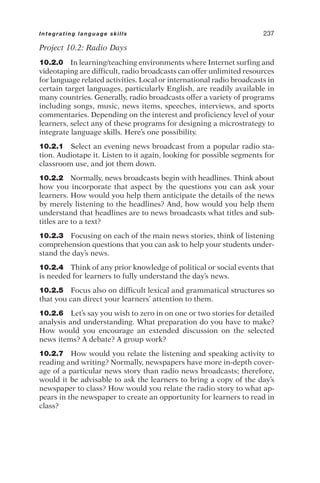
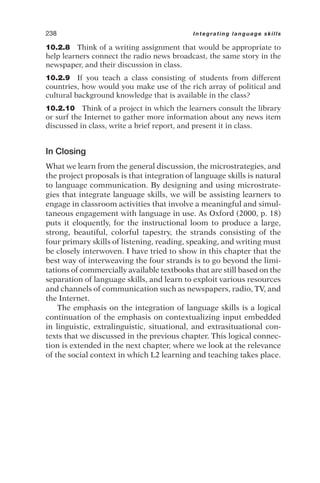
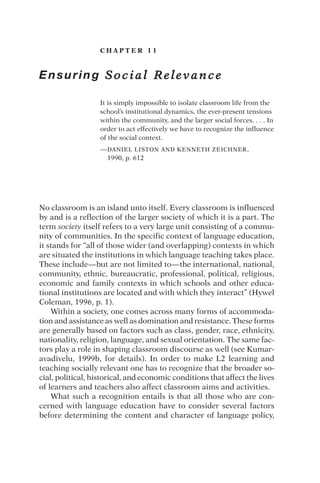
Yale Language Series
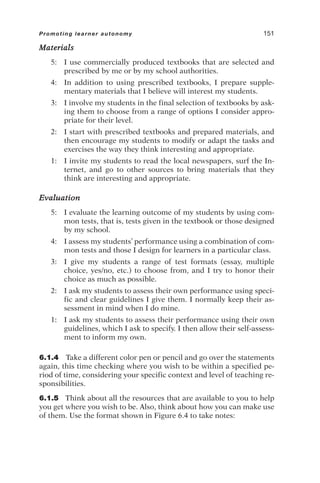
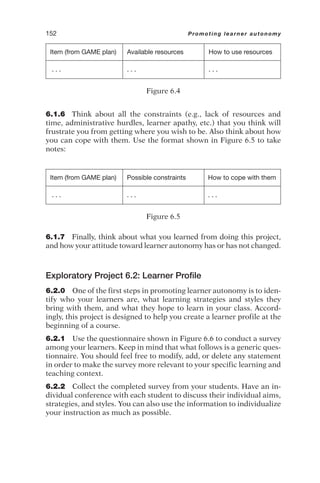
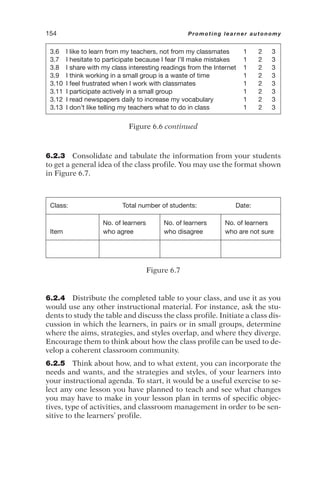
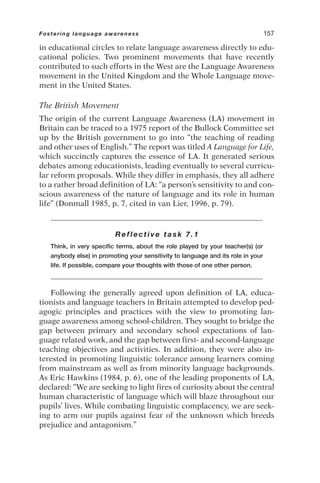
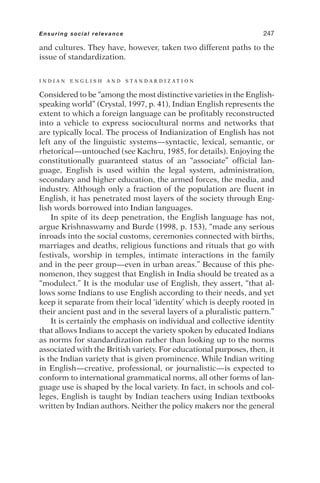
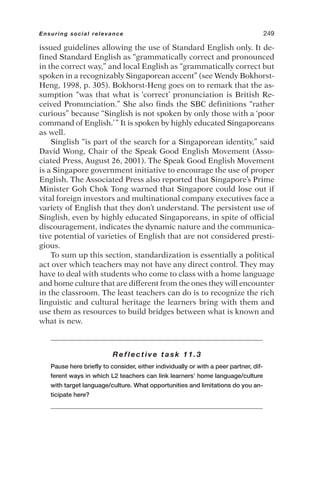
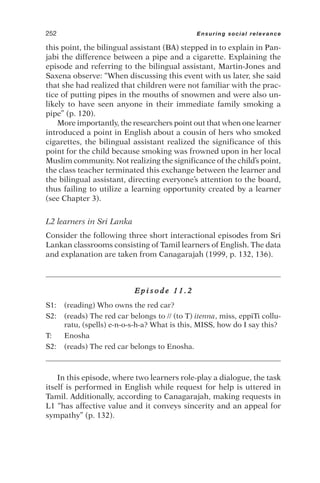
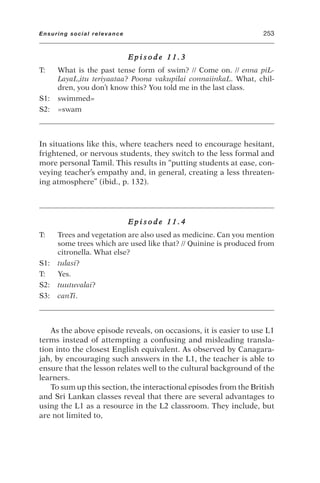
B e y o n d M e t h o d s :
Macrostrategies for
Language Teaching
B . K U M A R A V A D I V E L U
Yale University Press N e w H a v e n a n d L o n d o n
Published with assistance from the Louis Stern Memorial Fund.
Copyright © 2003 by Yale University.
All rights reserved.
This book may not be reproduced, in whole or in part, including illustrations,
in any form (beyond that copying permitted by Sections 107 and 108 of the
U.S. Copyright Law and except by reviewers for the public press),
without written permission from the publishers.
Publisher: Mary Jane Peluso
Manuscript Editor: Jeffrey Schier
Production Controller: Aldo R. Cupo
Designer: James J. Johnson
Editorial Assistant: Emily Saglimbeni
Marketing Manager: Timothy Shea
Set in New Aster type by Integrated Publishing Solutions.
Printed in the United States of America.
Library of Congress Cataloging-in-Publication Data
Kumaravadivelu, B., 1948–
Beyond methods : macrostrategies for language teaching / B.
Kumaravadivelu.
p. cm.—(Yale Language Series)
Includes bibliographical references and index.
ISBN 0-300-09573-2 (paperback : alk. paper)
1. Language and languages—Study and teaching. I. Title.
P51 .K88 2003
418. 0071—dc21
2002014040
A catalogue record for this book is available from the British Library.
The paper in this book meets the guidelines for permanence and durability of the Committee
on Production Guidelines for Book Longevity of the Council on Library Resources.
10 9 8 7 6 5 4 3 2 1
Dedicated with gratitude to the memory of my father
A father earns the gratitude of his children
by nurturing them to be preeminent
in the Assembly of the Learned.
(Thirukural, verse 67, circa 100 A.D.)
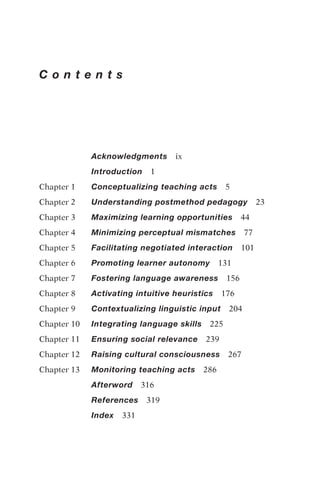
C o n t e n t s
Acknowledgments ix
Introduction 1
Chapter 1 Conceptualizing teaching acts 5
Chapter 2 Understanding postmethod pedagogy 23
Chapter 3 Maximizing learning opportunities 44
Chapter 4 Minimizing perceptual mismatches 77
Chapter 5 Facilitating negotiated interaction 101
Chapter 6 Promoting learner autonomy 131
Chapter 7 Fostering language awareness 156
Chapter 8 Activating intuitive heuristics 176
Chapter 9 Contextualizing linguistic input 204
Chapter 10 Integrating language skills 225
Chapter 11 Ensuring social relevance 239
Chapter 12 Raising cultural consciousness 267
Chapter 13 Monitoring teaching acts 286
Afterword 316
References 319
Index 331
Acknowledgments
I wish to record my sense of gratitude to the entire Yale team, par-
ticularly to Mary Jane Peluso, publisher, whose sustained encour-
agement enabled the whole project to reach fruition; to Jeffrey
Schier, manuscript editor, whose meticulous care made the manu-
script more readable; and to Emily Saglimbeni for her efficient sup-
port work. It has been a pleasure to work with them all.
My debt to those who have contributed to the thinking under-
lying this book is immeasurable. I cannot mention them all here,
but they include professors R. N. Ghosh, N. Krishnaswamy, N. S.
Prabhu, and M. L. Tickoo at the Central Institute of English and
Foreign Languages in India, where I was initiated into English lan-
guage teaching; professors Dick Allwright, Mike Breen, and Chris
Candlin at the University of Lancaster in England, where I contin-
ued my academic interest; and professors Alton Becker, Susan Gass,
and Larry Selinker at the University of Michigan, where I completed
my formal education. My personal and professional association with
these colleagues have immensely shaped and reshaped my own ped-
agogic orientation. I also owe a debt to my past and present gradu-
ate students—too many to name here—who argued with me, chal-
lenged me, and forced me to clarify my thoughts, thereby making
me a better teacher and a better thinker.
Always supportive of my academic ambitions, my family mem-
bers—Arunagiri, Velliangiri, Janaki, and Gowri—have encouraged
me to go where they have never gone before. My wife, Revathi, her-
self an academic, has always been there for me, offering me profes-
sional critique and personal care. Our two little children, Chandrika
and Anand, have not only happily adjusted to the demands of their
professorial parents but have also created for us a joyous space
outside our demanding professional pursuits. To all of them, I say:
Thank you.
Beyond Methods
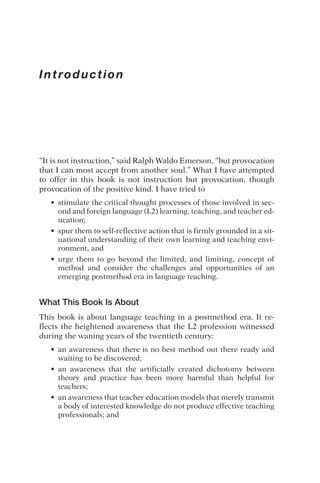
Introduction
“It is not instruction,” said Ralph Waldo Emerson, “but provocation
that I can most accept from another soul.” What I have attempted
to offer in this book is not instruction but provocation, though
provocation of the positive kind. I have tried to
• stimulate the critical thought processes of those involved in sec-
ond and foreign language (L2) learning, teaching, and teacher ed-
ucation;
• spur them to self-reflective action that is firmly grounded in a sit-
uational understanding of their own learning and teaching envi-
ronment, and
• urge them to go beyond the limited, and limiting, concept of
method and consider the challenges and opportunities of an
emerging postmethod era in language teaching.
What This Book Is About
This book is about language teaching in a postmethod era. It re-
flects the heightened awareness that the L2 profession witnessed
during the waning years of the twentieth century:
• an awareness that there is no best method out there ready and
waiting to be discovered;
• an awareness that the artificially created dichotomy between
theory and practice has been more harmful than helpful for
teachers;
• an awareness that teacher education models that merely transmit
a body of interested knowledge do not produce effective teaching
professionals; and
• an awareness that teacher beliefs, teacher reasoning, and teacher
cognition play a crucial role in shaping and reshaping the content
and character of the practice of everyday teaching.
To shape the practice of everyday teaching, teachers need to
have a holistic understanding of what happens in their classroom.
They need to systematically observe their teaching, interpret their
classroom events, evaluate their outcomes, identify problems, find
solutions, and try them out to see once again what works and what
doesn’t. In other words, they have to become strategic thinkers as
well as strategic practitioners. As strategic thinkers, they need to re-
flect on the specific needs, wants, situations, and processes of learn-
ing and teaching. As strategic practitioners, they need to develop
knowledge and skills necessary to self-observe, self-analyze, and
self-evaluate their own teaching acts.
To help teachers become strategic thinkers and strategic practi-
tioners, I present in this book a macrostrategic framework consist-
ing of ten macrostrategies derived from theoretical, empirical, and
experiential knowledge of L2 learning, teaching, and teacher edu-
cation. The framework represents a synthesis of useful and usable
insights derived from various disciplines including psycholinguis-
tics, sociolinguistics, cognitive psychology, second language acqui-
sition, and critical pedagogy. It has the potential to transcend the
limitations of the concept of method and empower teachers with
the knowledge, skill, attitude, and autonomy necessary to devise for
themselves a systematic, coherent, and relevant theory of practice.
How the Book Is Organized
The book consists of thirteen chapters. The first deals with the con-
cept of teaching in general and the second with the concept of post-
method pedagogy in particular. Thus, these two chapters lay the
philosophical and conceptual foundation needed to make sense of
what follows. The last chapter pulls together ideas from different
chapters, and offers a classroom observational scheme that can be
used by teachers to monitor how well they theorize what they prac-
tice, and to practice what they theorize.
Each of the ten intervening chapters focuses on individual mac-
rostrategies. They all follow the same format with three broad sec-
tions: macrostrategy, microstrategies, and exploratory projects:
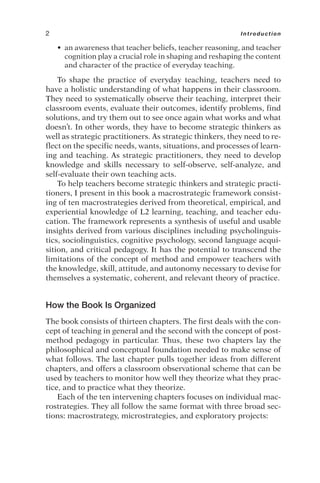
2 Introduction
• the macrostrategy section provides theoretical, empirical, and ex-
periential rationale underpinning a particular macrostrategy;
• the microstrategies section provides sample microstrategies that
illustrate how to realize the goals of the particular macrostrategy
in a classroom situation; and
• the exploratory projects section provides detailed guidelines for
teachers to conduct their own situated teacher research aimed at
generating new ideas for realizing the goals of a particular macro-
strategy in their specific learning and teaching context.
All the chapters have built-in reflective tasks that encourage read-
ers to pause at crucial points along the text and think critically about
the issues in light of their own personal as well as professional ex-
perience. In addition to these reflective tasks, several chapters con-
tain authentic classroom interactional data that illustrate the issues
raised and the suggestions made.
How to Use the Book
The chapters in the book need not be read and used sequentially.
Each is written as a self-contained unit and, therefore, can be used
separately. It would, however, be beneficial to start with the first
two chapters to understand the rationale behind the macrostrategic
framework. The next ten chapters on specific macrostrategies can
be read in any order although, as will become clear, certain macro-
strategies closely relate to each other to form a meaningful cluster.
The last chapter shows how the framework can be used for moni-
toring classroom aims and activities. Similarly, the reflective tasks
and the exploratory projects can be carried out selectively depend-
ing on teachers’ experience and their perceived needs.
Regardless of the sequence in which the book is read and used,
it is worthwhile to keep its primary purpose in mind: to facilitate
the growth and development of teachers’ own theory of practice.
This is not a recipe book with ready-made solutions for recurring
problems. Rather, it is designed to give teachers broad guiding prin-
ciples to assist them in the construction of their own context-specific
postmethod pedagogy. Readers will quickly recognize that neither
the suggested microstrategies nor the proposed projects can be
used without suitably modifying them to meet the linguistic, con-
ceptual, and communicative capacities of a given group of learners.
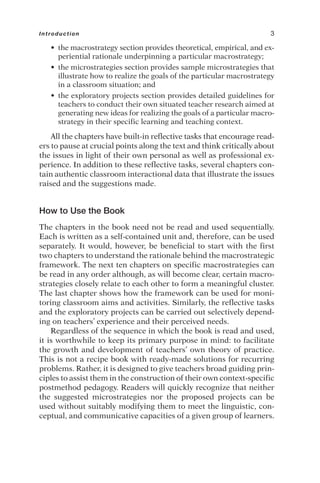
Introduction 3
Because this is not a recipe book, it does not specify any one par-
ticular way of “doing” the teaching. To do so, I believe, is to dimin-
ish the complexity of teaching as well as the capacity of teachers.
Using their own language learning and teaching experience as a
personal knowledge base, the theoretical insights on macrostrate-
gies as a professional knowledge base, the suggested microstrate-
gies as illustrative examples, and the exploratory projects as inves-
tigative tools, teachers should be able to develop their own distinct
way of teaching. In their attempt to become self-directed individu-
als, teachers may follow the same operating principles discussed in
this book, but the style and substance of the theory of practice they
eventually derive will be quite different.
4 Introduction
C H A P T E R 1
Conceptualizing Te a c h i n g A c t s
To teach is to be full of hope.
—LARRY CUBAN, 1989, p. 249
We often hear educators say that teaching is both an art and a sci-
ence. I take this to mean that teaching is basically a subjective ac-
tivity carried out in an organized way. In fact, there are educators
who believe that teaching lacks a unified or a commonly shared set
of rules, and as such cannot even be considered a discipline. As
Donald Freeman points out,
when we speak of people “teaching a discipline” such as math or bi-
ology, we are separating the knowledge or content from the activity
or the teaching. These traces of activity that teachers accumulate
through the doing of teaching are not seen as knowledge; they are
referred to as experience. Experience is the only real reference point
teachers share: experiences as students that influence their views of
teaching, experiences in professional preparation, experience as
members of society. This motley and diverse base of experience
unites people who teach, but it does not constitute a disciplinary
community.
(Freeman, 1998, p.10)
It is this motley and diverse base of experience that makes teaching
challenging as well as engaging, fulfilling as well as frustrating.
It is no wonder that diverse experiences lead to diverse percep-
tions about teaching. In his inspiring book The Call to Teach David
Hansen characterizes teaching as a vocation. Recalling its Latin root
vocare, meaning “to call,” he explains vocation as a summons or bid-
ding to be of service. According to him, teaching as a vocation “com-
prises a form of public service to others that at the same time pro-
vides the individual a sense of identity and personal fulfillment”
(Hansen, 1995, p. 2). He compares the language of vocation with the
language that goes with other terms that are used to characterize
teaching: job, work, career, occupation, and profession. For Hansen,
• a job is an activity that provides sustenance or survival. It com-
prises highly repetitive tasks that are not defined and developed
by those performing them.
• vocation goes well beyond sustenance and survival; it guarantees
personal autonomy and personal significance.
• work may ensure personal autonomy and can therefore yield gen-
uine personal meaning but, unlike vocation, it need not imply
being of service to others.
• a career describes a long-term involvement in a particular activ-
ity but differs from vocation in similar ways that job and work
do, that is, it need not provide personal fulfillment, a sense of
identity, nor a public service.
• an occupation is an endeavor harbored within a society’s eco-
nomic, social, and political system, but persons can have occu-
pations that do not entail a sense of calling in the same way vo-
cations do.
• a profession broadens the idea of an occupation by emphasizing
the expertise and the social contribution that persons in an occu-
pation render to society. However, profession differs from voca-
tion in two important ways. First, persons can conduct them-
selves professionally but not regard the work as a calling, and can
derive their sense of identity and personal fulfillment elsewhere.
Second, perks such as public recognition and rewards normally
associated with professions run counter to personal and moral
dimensions of vocations.
Hansen believes that it is the language of vocation that “brings us
closer to what many teachers do, and why they do it, than does the
language of job, work, occupation or profession” (ibid., p. 8).
As these terms clearly show, “the doing of teaching” defies clas-
sification. The goal of teaching, however, seems to be rather obvious.
Teaching is aimed at creating optimal conditions for desired learn-
ing to take place in as short a time as possible. Even such a seem-
ingly simple statement hides a troublesome correlation: a cause-
effect relationship between teaching and learning. That is, the
statement is based on the assumption that teaching actually causes
learning to occur. Does it, really? We know by experiential knowl-
edge that teaching does not have to automatically lead to learning;
conversely, learning can very well take place in the absence of teach-
6 Conceptualizing teaching acts
ing. The entire edifice of education, however, is constructed on the
foundation that teaching can contribute to accelerated and accom-
plished learning.
The overall process of education certainly involves several play-
ers—educational administrators, policy makers, curriculum plan-
ners, teacher educators, textbook writers, and others—each consti-
tuting an important link in the educational chain. However, the
players who have a direct bearing on shaping and reshaping the de-
sired learning outcome are the classroom teachers. This is not very
different from saying that the success or failure of a theatrical pro-
duction depends largely on the histrionic talent of the actors who
actually appear on the stage. It is true that several individuals have
worked hard behind the scenes to make that production possible:
the director, the scriptwriter, and the production manager, to name
a few. But if the actors do not perform well on the stage, and if they
are not able to connect with the audience, then all the behind-the-
scenes activities will come to naught.
In fact, the educational role played by teachers in the classroom
is much more demanding and daunting than the theatrical role
played by actors on the stage for the simple reason that the failure
of an educational enterprise has more far-reaching consequences for
an individual or for a nation than the failure of a theatrical produc-
tion. Such is the significance of the teacher. Nevertheless, there is very
little consensus about the precise role the teacher is expected to play.
The Role of the Teacher
The role of the teacher has been a perennial topic of discussion in
the field of general education as well as in language education. Un-
able to precisely pin down the role and function of the teacher, the
teaching profession has grappled with a multitude of metaphors.
The teacher has been variously referred to as an artist and an ar-
chitect; a scientist and a psychologist; a manager and a mentor; a
controller and a counselor; a sage on the stage; a guide on the side;
and more. There is merit in each of these metaphors. Each of them
captures the teacher’s role partially but none of them fully.
Instead of delving deep into the familiar metaphors, I believe it
is much more beneficial to view the historical role and function of
classroom teachers to understand how the concept of teacher role
has developed over the years, and how that development has shaped
Conceptualizing teaching acts 7
the nature and scope of institutionalized education. From a histor-
ical perspective, one can glean from the current literature on gen-
eral education and language teaching at least three strands of
thought: (a) teachers as passive technicians, (b) teachers as reflec-
tive practitioners, and (c) teachers as transformative intellectuals.
Teachers as Passive Technicians
The basic tenets of the concept of teachers as technicians can be
partly traced to the behavioral school of psychology that empha-
sized the importance of empirical verification. In the behavioral
tradition, the primary focus of teaching and teacher education is
content knowledge that consisted mostly of a verified and verifiable
set of facts and clearly articulated rules. Content knowledge is bro-
ken into easily manageable discrete items and presented to the
teacher in what might be called teacher-proof packages. Teachers
and their teaching methods are not considered very important
because their effectiveness cannot be empirically proved beyond
doubt. Therefore, teacher education programs concentrate more on
the education part than on the teacher part. Such a view came to be
known as the technicist view of teaching and teacher education.
The primacy of empirical verification and content knowledge
associated with the technicist view of teaching overwhelmingly
privileges one group of participants in the educational chain—pro-
fessional experts! They are the ones who create and contribute to
the professional knowledge base that constitutes the cornerstone of
teacher education programs. Classroom teachers are assigned the
role of passive technicians who learn a battery of content knowl-
edge generally agreed upon in the field and pass it on to successive
generations of students. They are viewed largely as apprentices
whose success is measured in terms of how closely they adhere to
the professional knowledge base, and how effectively they transmit
that knowledge base to students.
In this technicist or transmission approach, the teacher’s pri-
mary role in the classroom is to function like a conduit, channeling
the flow of information from one end of the educational spectrum
(i.e., the expert) to the other (i.e., the learner) without significantly
altering the content of information. The primary goal of such an ac-
tivity, of course, is to promote student comprehension of content
knowledge. In attempting to achieve that goal, teachers are con-
8 Conceptualizing teaching acts
strained to operate from handed-down fixed, pedagogic assump-
tions and to seldom seriously question their validity or relevance to
specific learning and teaching contexts. If any context-specific learn-
ing and teaching problem arises, they are supposed to turn once
again to the established professional knowledge base and search for
a formula to fix it by themselves.
Viewing teachers as passive technicians is traditional and is still
in vogue in many parts of the world. It might even be said, with
some justification, that the technicist view provides a safe and se-
cure environment for those teachers who may not have the ability,
the resources, or the willingness to explore self-initiated, innovative
teaching strategies. The technicist approach to teaching and teacher
education is clearly characterized by a rigid role relationship be-
tween theorists and teachers: theorists conceive and construct
knowledge, teachers understand and implement knowledge. Cre-
ation of new knowledge or a new theory is not the domain of teach-
ers; their task is to execute what is prescribed for them.
Such an outlook inevitably leads to the disempowerment of
teachers whose classroom behavior is mostly confined to received
knowledge rather than lived experience. That is why the technicist
approach is considered “so passive, so unchallenging, so boring that
teachers often lose their sense of wonder and excitement about learn-
ing to teach” (Kincheloe, 1993, p. 204). The concept of reflective
teaching evolved partly as a reaction to the fixed assumptions and
frozen beliefs of the technicist view of teaching.
Reflective task 1.1
What are the advantages and disadvantages of the role and function of
teachers as passive technicians? Think about some of your own teachers
whom you might call technicists. What aspect of their teaching did you like
most? Least? Is there any aspect of technicist orientation that you think is
relevant in your specific learning and teaching context?
Teachers as Reflective Practitioners
While there has recently been a renewed interest in the theory and
practice of reflective teaching, the idea of teachers as reflective prac-
Conceptualizing teaching acts 9
titioners is nothing new. It was originally proposed by educational
philosopher John Dewey in the early twentieth century. He has ar-
ticulated his seminal thoughts on reflective teaching in several of
his books, particularly in How We Think (1933). In a nutshell, Dewey
makes a distinction between action that is routine and action that
is reflective. Routine action is guided primarily by an uncritical be-
lief in tradition, and an unfailing obedience to authority, whereas
reflective action is prompted by a conscious and cautious “consid-
eration of any belief or practice in light of the grounds that support
it and the further consequences to which it leads” (Dewey, 1933, p. 4).
In the Deweyan view, teaching is seen not just as a series of pre-
determined and presequenced procedures but as a context-sensitive
action grounded in intellectual thought. Teachers are seen not as
passive transmitters of received knowledge but as problem-solvers
possessing “the ability to look back critically and imaginatively, to
do cause-effect thinking, to derive explanatory principles, to do task
analysis, also to look forward, and to do anticipatory planning” (ibid.,
p. 13). Reflective teaching, then, is a holistic approach that empha-
sizes creativity, artistry, and context sensitivity.
Exactly half a century after the publication of Dewey’s book came
further thoughts on reflective teaching. In 1983, Don Schon pub-
lished a book titled The Reflective Practitioner in which he expands
Dewey’s concept of reflection. He shows how teachers, through
their informed involvement in the principles, practices, and pro-
cesses of classroom instruction, can bring about fresh and fruitful
perspectives to the complexities of teaching that cannot be matched
by experts who are far removed from classroom realities. He distin-
guishes between two interlocking frames of reflection: reflection-
on-action and reflection-in-action.
Reflection-on-action can occur before and after a lesson, as teach-
ers plan for a lesson and then evaluate the effectiveness of their
teaching acts afterward. Reflection-in-action, on the other hand, oc-
curs during the teaching act when teachers monitor their ongoing
performance, attempting to locate unexpected problems on the spot
and then adjusting their teaching instantaneously. Schon rightly ar-
gues that it is the teachers’ own reflection-in/on-action, and not an
undue reliance on professional experts, that will help them identify
and meet the challenges they face in their everyday practice of
teaching.
Because the term reflective teaching has been used so widely, its
10 Conceptualizing teaching acts
meaning has become rather diffused. Concerned that the essence of
the concept might get diluted even further, Kenneth Zeichner and
Daniel Liston thought it fit to talk about what it is that will not make
a teacher a reflective practitioner. In their 1996 book Reflective Teach-
ing: An Introduction, they caution that “not all thinking about teach-
ing constitutes reflective teaching. If a teacher never questions the
goals and the values that guide his or her work, the context in which
he or she teaches, or never examines his or her assumptions, then
it is our belief that this individual is not engaged in reflective teach-
ing” (Zeichner and Liston, 1996, p. 1).
They then go on to summarize what they consider to be the role
of a reflective practitioner. According to them, a reflective practi-
tioner
• “examines, frames, and attempts to solve the dilemmas of class-
room practice;
• is aware of and questions the assumptions and values he or she
brings to teaching;
• is attentive to the institutional and cultural contexts in which he
or she teaches;
• takes part in curriculum development and is involved in school
change efforts; and
• takes responsibility for his or her own professional development”
(ibid., p. 6).
By delineating these five roles, Zeichner and Liston make it clear
that learning to teach does not end with obtaining a diploma or a
degree in teacher education but is an ongoing process throughout
one’s teaching career. Reflective teachers constantly attempt to
maximize their learning potential and that of their learners through
classroom-oriented action research and problem-solving activities.
While the concept of teachers as reflective practitioners has
been around for quite some time in the field of general education,
it has only recently started percolating in the domain of language
teaching. In Training Foreign Language Teachers: A Reflective Ap-
proach (1991), Michael Wallace offers ways in which a reflective
approach can be applied to many areas of teacher development,
including classroom observation, microteaching, and teacher edu-
cation. In a book titled Reflective Teaching in Second Language Class-
rooms (1994), Jack Richards and Charles Lockhart introduce sec-
Conceptualizing teaching acts 11
ond language teachers to ways of exploring and reflecting upon
their classroom experiences, using a carefully structured approach
to self-observation and self-evaluation.
These initial efforts to spread the values of reflective teaching
among second and foreign language teachers have been further
strengthened by Donald Freeman and Karen Johnson. In his book
Doing Teacher Research: From Inquiry to Understanding (1998), Free-
man demonstrates how practicing teachers can transform their class-
room work by doing what he calls teacher research. He provides a
teacher-research cycle mapping out the steps and skills associated
with each part of the research process. In a similar vein, Johnson,
in her book Understanding Language Teaching: Reasoning in Action
(1999), examines how “reasoning teaching represents the complex
ways in which teachers conceptualize, construct explanations for,
and respond to the social interactions and shared meanings that
exist within and among teachers, students, parents, and adminis-
trators, both inside and outside the classroom” (p. 1).
Reflective task 1.2
Consider the true meaning of being a reflective practitioner in a specific
learning and teaching context. What are the obstacles you may face in car-
rying out the responsibilities of a reflective teacher? And how might you
overcome them?
The concept of teachers as reflective practitioners is clearly a vast
improvement over the limited and limiting concept of teachers as
passive technicians. However, the reflective movement has at least
three serious shortcomings:
• First, by focusing on the role of the teacher and the teacher alone,
the reflective movement tends to treat reflection as an introspec-
tive process involving a teacher and his or her reflective capacity,
and not as an interactive process involving the teacher and a host
of others: learners, colleagues, planners, and administrators.
• Second, the movement has focused on what the teachers do in
the classroom and has not paid adequate attention to the socio-
political factors that shape and reshape a teacher’s reflective
practice.
12 Conceptualizing teaching acts
• Third, in spite of its expressed dislike for the teachers’ excessive
reliance on established professional wisdom, the movement con-
tributed very little to change it.
Out of these and other concerns has emerged the concept of
teachers as transformative intellectuals.
Teachers as Transformative Intellectuals
The idea of teachers as transformative intellectuals is derived mainly
from the works of a particular group of educationists called critical
pedagogists. They include general educationists such as Henry
Giroux (1988), Peter McLaren (1995), and Roger Simon (1987), and
language teaching professionals such as Elsa Auerbach (1995),
Sarah Benesch (2001), and Alastair Pennycook (2001). All of them
are heavily influenced by the educational philosophy of the Brazil-
ian thinker Paulo Freire. Through a quarter century of writings rang-
ing from Pedagogy of the Oppressed (1972) to Pedagogy of the Heart,
published posthumously in 1998, Freire tirelessly espoused the cause
of sociopolitical emancipation and individual empowerment through
the democratic process of education.
Following Freire’s philosophy, critical pedagogists believe that
pedagogy, any pedagogy, is embedded in relations of power and dom-
inance, and is employed to create and sustain social inequalities.
For them, schools and colleges are not simply instructional sites;
they are, in fact, “cultural arenas where heterogeneous ideological,
discursive, and social forms collide in an unremitting struggle for
dominance” (McLaren, 1995, p. 30). Classroom reality is socially
constructed and historically determined. What is therefore re-
quired to challenge the social and historical forces is a pedagogy
that empowers teachers and learners. Such a pedagogy would take
seriously the lived experiences that teachers and learners bring to
the educational setting.
Critical pedagogists view teachers as “professionals who are
able and willing to reflect upon the ideological principles that in-
form their practice, who connect pedagogical theory and practice
to wider social issues, and who work together to share ideas, exer-
cise power over the conditions of their labor, and embody in their
teaching a vision of a better and more humane life” (Giroux and
McLaren, 1989, p. xxiii). In order to reflect such a radical role as-
signed to teachers, Giroux characterized them as “transformative
Conceptualizing teaching acts 13
intellectuals.” In his 1988 book Teachers as Intellectuals: Toward
a Critical Pedagogy of Learning, Giroux points to “the role that teach-
ers and administrators might play as transformative intellectuals
who develop counterhegemonic pedagogies that not only empower
students by giving them the knowledge and social skills they will
need to be able to function in the larger society as critical agents,
but also educate them for transformative action” (Giroux, 1988,
p. xxxiii).
By requiring teachers to be sociopolitically conscious and to be
assertive in acting upon their sociopolitical consciousness, the con-
cept of teachers as transformative intellectuals stretches their role
beyond the borders of the classroom. As transformative intellectu-
als, teachers are engaged in a dual task: they strive not only for ed-
ucational advancement but also for personal transformation.
To achieve educational advancement, they try to organize them-
selves as a community of educators dedicated to the creation and
implementation of forms of knowledge that are relevant to their
specific contexts and to construct curricula and syllabi around their
own and their students’ needs, wants, and situations. Such a task
makes it imperative for them to maximize sociopolitical awareness
among their learners using consciousness-raising, problem-posing
activities.
To achieve personal transformation, they try to educate them-
selves and their students about various forms of inequality and in-
justice in the wider society and to address and redress them in pur-
poseful and peaceful ways. The dual role, thus, requires teachers to
view pedagogy not merely as a mechanism for maximizing learning
opportunities in the classroom but also as a means for transform-
ing life in and outside the classroom.
What exactly do transformative teachers do? Using a related
term, postformal teachers, to refer to teachers as transformative in-
tellectuals, Joe Kincheloe (1993, pp. 201–3) summarizes their teach-
ing as:
• inquiry oriented: teachers cultivate and extend research skills that
help them and their students to explore problems they them-
selves have posed about life in and outside the classroom;
• socially contextualized: aware of the sociohistorical context and
the power dimensions that have helped shape it, teachers always
monitor and respond to its effect on themselves, their students,
and the social fabric;
14 Conceptualizing teaching acts
• grounded on a commitment to world making: teachers realize that
appropriate knowledge is something that is produced by inter-
action of teacher and student in a given context, and act on that
realization;
• dedicated to an art of improvisation: teachers recognize that they
operate in classroom conditions of uncertainty and uniqueness
and therefore are able and willing to improvise their lesson plans
and instructional procedures;
• dedicated to the cultivation of situated participations: teachers pro-
mote student discussion in class by situating the class in the words,
concerns, and experience of the students;
• extended by a concern with critical self- and social-reflection: teach-
ers conceptualize classroom techniques that encourage intro-
spection and self-reflection;
• shaped by a commitment to democratic self-directed education:
teachers consider ways of helping themselves and their students
gain a sense of ownership of their own education;
• steeped in a sensitivity by pluralism: familiarize themselves with
the linguistic and cultural diversity of their student population
and conceptualize multiple perspectives on issues that matter to
them and to their students;
• committed to action: teachers come to see thinking as a first step
to action and continually design plans of action to carry out their
critical thoughts; and
• concerned with the affective dimension of human beings: teachers
think in terms of developing both the emotional and logical sides
of their students and themselves.
Reflective task 1.3
What are the implications of becoming/being a transformative intellectual?
For what reasons would you support or oppose the expanded role that
teachers as transformative intellectuals are expected to play? To what ex-
tent do teacher education programs with which you are familiar prepare
student teachers to become transformative intellectuals—in terms of im-
parting necessary knowledge, skill, and attitude?
The three perspectives on the role and function of teachers—as
passive technicians, as reflective practitioners, and as transforma-
Conceptualizing teaching acts 15
tive intellectuals—have evolved over time and have overlapping
characteristics. Table 1.1 provides a summary of salient features
that clearly illustrate the overlap.
16 Conceptualizing teaching acts
Teachers as Teachers as Teachers as
passive reflective transformative
technicians practitioners intellectuals
Primary role of
teacher conduit facilitator change agent
Primary source professional professional professional
of knowledge knowledge + knowledge + knowledge +
empirical teacher’s teacher’s
research personal personal
by experts knowledge + knowledge +
guided action self-
research exploratory
by teachers research
by teachers
Primary goal maximizing all above + all above +
of teaching content maximizing maximizing
knowledge learning sociopolitical
through potential awareness
prescribed through through
activities problem- problem-
solving posing
activities activities
Primary discrete integrated holistic
orientation approach, approach, approach,
to teaching anchored in anchored in the anchored in
the discipline classroom the society
Primary players experts + teachers + teachers +
in the teaching teachers experts + learners +
process learners experts +
(in rank order) community
activists
Table 1.1 The Roles of the Teacher: a summary
The overlapping and expanding characteristics of teacher roles can
be related in terms of a hierarchy as well, as shown in Fig. 1.1. This
hierarchy is interpreted to mean that teachers’ role as transforma-
tive intellectuals includes some of the characteristics of teachers’
role as reflective practitioners, which in turn include some of the
characteristics of teachers’ role as passive technicians.
It is useful to treat the three perspectives not as absolute oppo-
sites but as relative tendencies, with teachers leaning toward one or
the other at different moments. What is crucial to remember, how-
ever, is that passive technicians can hardly become transformative
intellectuals without a continual process of self-reflection and self-
renewal. One major aspect of that process relates to the teachers’
ability and willingness to go beyond the professional theories trans-
mitted to them through formal teacher education programs and try
to conceive and construct their own personal theory of teaching. In
other words, the process of transformative teaching demands that
teachers take a critical look at the dichotomy between theory and
practice, between theorists and practitioners.
Theory and Practice
It is generally agreed that teachers’ classroom practice is directly or
indirectly based on some theory whether or not it is explicitly artic-
ulated. Teachers may have gained this crucial theoretical knowl-
edge either through professional education, personal experience,
robust commonsense, or a combination. In fact, it has been sug-
gested that there is no substantial difference between common sense
and theory, particularly in the field of education. Cameron et al.
(1992, pp. 18–19), for instance, assert that common sense is dif-
ferent from theory “only by the degree of formality and self-
consciousness with which it is invoked. When someone purports
to criticize or ‘go beyond’ commonsense, they are not putting the-
ory where previously there was none, but replacing one theory with
another.”
That most successful teaching techniques are in one way or an-
other informed by principled theories does not seem to be in dis-
Conceptualizing teaching acts 17
Figure 1.1 A hierarchy of teacher roles
Teachers as Teachers as Teachers as
transformative  reflective  passive
intellectuals practitioners technicians
pute. What have become controversial are questions such as what
constitutes a theory, who constructs a theory, and whose theory
counts as theory. Traditionally, there has been a clearly articulated
separation between theory and practice. For instance, in the con-
text of L2 education, theory is generally seen to constitute a set of
insights and concepts derived from academic disciplines such as
general education, linguistic sciences, second language acquisition,
cognitive psychology, and information sciences. These and other al-
lied disciplines provide the theoretical bases necessary for the study
of language, language learning, language teaching, and language
teacher education.
Practice is seen to constitute a set of teaching and learning stra-
tegies indicated by the theorist or the syllabus designer or the ma-
terials producer, and adopted or adapted by the teacher and the
learner in order to jointly accomplish the stated and unstated goals
of language learning and teaching in the classroom. Consequently,
there is, as mentioned earlier, a corresponding division of labor be-
tween the theorist and the teacher: the theorist conceives and con-
structs knowledge and the teacher understands and applies that
knowledge. Thus, the relationship between the theorist and the
teacher is not unlike that of the producer and the consumer of a
commercial commodity. Such a division of labor is said to have re-
sulted in the creation of a privileged class of theorists and an under-
privileged class of practitioners.
Professional Theory and Personal Theory
Well aware of the harmful effects of the artificial division between
theory and practice, general educationists correctly affirm that the-
ory and practice should inform each other, and should therefore
constitute a unified whole. Their stand on the theory/practice divide
is reflected in a distinction they made between a “professional the-
ory” and a “personal theory” of education. Charles O’Hanlon sum-
marizes the distinction in this way:
A professional theory is a theory which is created and perpetuated
within the professional culture. It is a theory which is widely known
and understood like the developmental stages of Piaget. Profes-
sional theories are generally transmitted via teacher/professional
training in colleges, polytechnics and universities. Professional
theories form the basis of a shared knowledge and understanding
18 Conceptualizing teaching acts
about the “culture” of teaching and provide the opportunity to de-
velop discourse on the implicit and explicit educational issues
raised by these theoretical perspectives . . .
A personal theory, on the other hand, is an individual theory
unique to each person, which is individually developed through the
experience of putting professional theories to the test in the practi-
cal situation. How each person interprets and adapts their previous
learning particularly their reading, understanding and identifica-
tion of professional theories while they are on the job is potentially
their own personal theory (O’Hanlon, 1993, pp. 245–6).
Implied in this distinction is the traditional assumption that
professional theory belongs to the domain of the theorist and per-
sonal theory belongs to the domain of the teacher. Although this ap-
proach does not place theory and practice in positions of antitheti-
cal polarity, it nevertheless perpetuates the artificial divide between
theory and practice and between the theorist’s professional theory
and the teacher’s personal theory. Another drawback is that this ap-
proach offers only limited possibilities for practicing teachers be-
cause they are not empowered to design their personal theories
based on their own experiential knowledge; instead, they are encour-
aged to develop them by understanding, interpreting, and testing the
professional theories and ideas constructed by outside experts (Ku-
maravadivelu, 1999a).
Critical pedagogists have come out strongly against such an ap-
proach. They argue that it merely forces teachers to take orders
from established theorists and faithfully execute them, thereby leav-
ing very little room for self-conceptualization and self-construction
of truly personal theories. They go on to say that supporters of this
teacher-as-implementer approach “exhibit ideological naiveté. They
are unable to recognize that the act of selecting problems for teach-
ers to research is an ideological act, an act that trivialized the role
of the teacher” (Kincheloe, 1993, pp. 185–6). A huge obstacle to the
realization of the kind of flexibility and freedom that critical peda-
gogists advocate is that the artificial dichotomy between the theo-
rist and the teacher has been institutionalized in the teaching com-
munity and that most teachers have been trained to accept the
dichotomy as something that naturally goes with the territory.
Conceptualizing teaching acts 19
Reflective task 1.4
What might be a productive connection between a theorist’s professional
theory and a teacher’s personal theory? Which one, according to you, would
be relevant and reliable for your specific learning and teaching context? Is
there (or, should there be) a right mix, and if so, what?
Teacher’s Theory of Practice
Any serious attempt to help teachers construct their own theory of
practice requires a re-examination of the idea of theory and theory-
making. A distinction that Alexander (1984, 1986) makes between
theory as product and theory as process may be useful in this con-
text. Theory as product refers to the content knowledge of one’s dis-
cipline; whereas, theory as process refers to the intellectual activity
(i.e., the thought process) needed to theorize. Appropriately, Alex-
ander uses the term theorizing to refer to theory as intellectual ac-
tivity. Theorizing as an intellectual activity, then, is not confined
to theorists alone; it is something teachers should be enabled to do
as well.
According to Alexander, a teacher’s theory of practice should be
based on different types of knowledge: (a) speculative theory (by
which he refers to the theory conceptualized by thinkers in the
field), (b) the findings of empirical research, and (c) the experiential
knowledge of practicing teachers. None of these, however, should
be presented as the privileged source of knowledge. He advises
teachers to approach their own practice with “principles drawn
from the consideration of these different types of knowledge” (Alex-
ander 1986, p. 146), and urges teacher educators “to concentrate
less on what teachers should know, and more on how they might
think” (ibid., p. 145). In other words, the primary concern of teach-
ers and teacher educators should be the depth of critical thinking
rather than the breadth of content knowledge.
Extending Alexander’s notion of teacher theorizing, and draw-
ing from research conducted by others, Donald McIntyre (1993)
differentiates three levels of theorizing.
• At the first, technical level, teacher theorizing is concerned with
the effective achievement of short-term, classroom-centered in-
20 Conceptualizing teaching acts
structional goals. In order to achieve that, teachers are content
with using ideas generated by outside experts and exercises de-
signed by textbook writers.
• At the second, practical level, teacher theorizing is concerned with
the assumptions, values, and consequences with which classroom
activities are linked. At this level of practical reflectivity, teachers
not only articulate their criteria for developing and evaluating
their own practice but also engage in extensive theorizing about
the nature of their subjects, their students, and learning/teaching
processes.
• At the third, critical or emancipatory level, teacher theorizing is
concerned with wider ethical, social, historical, and political is-
sues, including the institutional and societal forces which may
constrain the teacher’s freedom of action to design an effective
theory of practice.
Incidentally, the three levels correspond roughly to the three
types of teacher roles—teachers as passive technicians, reflective
practitioners, and transformative intellectuals—discussed earlier.
Reflective task 1.5
What are the benefits, and who stands to benefit, if teachers become effec-
tive producers of their own personal theories? What, in your specific learn-
ing and teaching context, are the possibilities and limitations you face if you
wish to theorize from your practice?
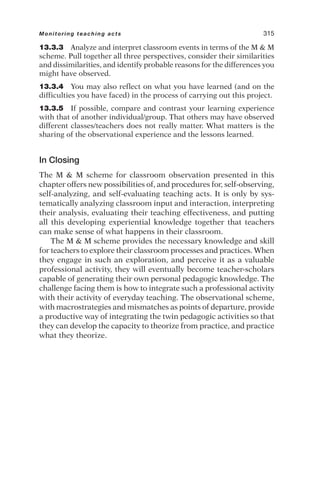
In Closing
This chapter has been concerned mainly with the general nature of
teaching as a professional activity. Whether teachers characterize
their activity as a job or as work, career, occupation, or vocation,
they play an unmistakable and unparalleled role in the success of
any educational enterprise. Whether they see themselves as passive
technicians, reflective practitioners, transformative intellectuals, or
as a combination, they are all the time involved in a critical mind
engagement. Their success and the satisfaction they derive from
it depends to a large extent on the quality of their mind engage-
Conceptualizing teaching acts 21
ment. One way of enhancing the quality of their mind engagement
is to recognize the symbiotic relationship between theory, research,
and practice, and between professional, personal, and experiential
knowledge.
In the next chapter, I shall attempt to relate the general nature of
teaching as a professional activity to the emerging concept of post-
method pedagogy in the specific field of second and foreign langu-
age education.
22 Conceptualizing teaching acts
C H A P T E R 2
Understanding P o s t m e t h o d
P e d a g o g y
As fashions in language teaching come and go, the
teacher in the classroom needs reassurance that there is
some bedrock beneath the shifting sands. Once solidly
founded on the bedrock, like the sea anemone, the
teacher can sway to the rhythms of any tides or currents,
without the trauma of being swept away purposelessly.
—WILGA RIVERS, 1992, p. 373
William Mackey, a distinguished professor of language teaching at
the University of London and the author of an authoritative book
on method, Language Teaching Analysis, lamented that the word
method “means so little and so much” (1965, p. 139). The reason for
this, he said, “is not hard to find. It lies in the state and organiza-
tion of our knowledge of language and language learning. It lies in
wilful ignorance of what has been done and said and thought in the
past. It lies in the vested interests which methods become. And it
lies in the meaning of method” (p. 139). What Mackey said nearly
four decades ago is true of today as well.
Most of us in the language teaching profession hear and use the
term method so much and so often that we hardly pause to think
about its meaning. In this chapter, I discuss the meaning of method.
The discussion is in five parts. In the first part, I attempt to tease
out the conceptual as well as terminological confusion surrounding
the concept of method. In the second, I describe the limited and
limiting nature of method and the widespread dissatisfaction it has
created among teachers and teacher educators. In the third, I discuss
how a state of heightened awareness about the futility of searching
for the best method has resulted in a postmethod condition. Then,
I highlight the basic parameters of a postmethod pedagogy that
seeks to transcend the limitations of method. Finally, I present the
outlines of a macrostrategic framework that is consistent with the
characteristics of a postmethod pedagogy—a framework on which
I will elaborate throughout the rest of this book.
The Concept of Method
A core course in Theory and Practice of Methods, with the same or
a different title, is an integral part of language teacher education
programs all over the world. A survey of 120 teacher education
programs in Teachers of English to Speakers of Other Languages
(TESOL) in the United States, for instance, shows that the Methods
course functions as the primary vehicle for the development of
basic knowledge and skill in the prospective teacher (Grosse, 1991).
The survey also shows that specific classroom techniques receive
“the greatest amount of attention and time in the methods courses”
(p. 32) and that the three books that top the list of textbooks that are
widely prescribed for methods classes “deal almost exclusively with
specific language teaching methods” (p. 38).
The term methods, as currently used in the literature on second
and foreign language (L2) teaching, does not refer to what teachers
actually do in the classroom; rather, it refers to established methods
conceptualized and constructed by experts in the field. The exact
number of methods that are commonly used is unclear. A book
published in the mid sixties, for instance, provides a list of fifteen
“most common” types of methods “still in use in one form or an-
other in various parts of the world” (Mackey, 1965, p. 151). Two
books published in the mid eighties (Larsen-Freeman, 1986; and
Richards and Rodgers, 1986)—which have long-occupied the top
two ranks among the books prescribed for methods classes in the
United States—provide, between them, a list of eleven methods that
are currently used. They are (in alphabetical order): Audiolingual
Method, Communicative Methods, Community Language Learning,
Direct Method, Grammar-Translation Method, Natural Approach,
Oral Approach, Silent Way, Situational Language Teaching, Sug-
gestopedia, and Total Physical Response.
It would be wrong to assume that these eleven methods provide
eleven different paths to language teaching. In fact, there is consid-
erable overlap in their theoretical as well as practical approaches to
L2 learning and teaching. Sometimes, as Wilga Rivers (1991, p. 283)
rightly points out, what appears to be a radically new method is more
24 Understanding postmethod pedagogy
often than not a variant of existing methods presented with “the
fresh paint of a new terminology that camouflages their fundamen-
tal similarity.” It is therefore useful, for the purpose of analysis and
understanding, to cluster these methods in terms of certain identi-
fiable common features. One way of doing that is to classify them as
(a) language-centered methods, (b) learner-centered methods, and
(c) learning-centered methods (Kumaravadivelu, 1993a).
Reflective task 2.1
Individually or with a peer partner, reflect on the meaning of method. Then,
try to guess how the meaning of method might be treated in (a) language-
centered, (b) learner-centered, and (c) learning-centered methods.
Language-Centered Methods
Language-centered methods are those that are principally con-
cerned with linguistic forms, also called grammatical structures.
These methods (e.g., audiolingual method) seek to provide oppor-
tunities for learners to practice preselected, presequenced linguis-
tic structures through form-focused exercises in class. The assump-
tion is that a preoccupation with form will ultimately lead to a
mastery of the target language and that learners can draw from this
formal repertoire whenever they wish to communicate in the target
language outside the class. According to this belief, language devel-
opment is largely intentional rather than incidental, that is, it takes
place through conscious effort as in the case of adult L2 learning
and not through unconscious processes as in the case of child L1
acquisition.
Language-centered methods treat language learning as a linear,
additive process. That is, they believe language develops primarily
in terms of what William Rutherford (1987) calls “accumulated en-
tities.” In practice, a set of grammatical structures and vocabulary
items are carefully selected for their potential use and graded from
simple to complex. The teacher’s task is to introduce them one at a
time and help the learner practice them until the learner internal-
izes them. Secondly, language-centered methods generally advocate
explicit introduction, analysis, and explanation of linguistic systems.
Understanding postmethod pedagogy 25
That is, they believe that the linguistic systems are simple enough
and that our explanatory power sophisticated enough to provide
explicit rules of thumb, and explain them in such a way that the
learner can understand and assimilate them.
Learner-Centered Methods
Learner-centered methods are those that are principally concerned
with language use and learner needs. These methods (e.g., some ver-
sions of communicative methods) seek to provide opportunities for
learners to practice preselected, presequenced grammatical struc-
tures as well as communicative functions (i.e., speech acts such as
apologizing, requesting, etc.) through meaning-focused activities.
The assumption is that a preoccupation with both form and func-
tion will ultimately lead to target language mastery and that the
learners can make use of both formal and functional repertoire to
fulfill their communicative needs outside the class. In this approach,
as in the case of language-centered methods, language development
is considered largely intentional rather than incidental.
Learner-centered methods aim at making language learners gram-
matically accurate and communicatively fluent. They take into ac-
count the learner’s real-life language use for social interaction or for
academic study, and present necessary linguistic structures in com-
municative contexts. Proponents of learner-centered methods, like
those of language-centered methods, believe in accumulated enti-
ties. The one major difference is that in the case of the latter, the
accumulated entities represent linguistic structures, and in the case
of the former they represent structures plus notions and functions.
Furthermore, just as language-centered methods advocate that the
linguistic structures of a language could be sequentially presented
and explained, learner-centered methods also advocate that each
functional category could be matched with one or more linguistic
forms and sequentially presented and systematically explained to
the learner.
Learning-Centered Methods
Learning-centered methods are those that are principally con-
cerned with learning processes. These methods (e.g., the Natural
Approach) seek to provide opportunities for learners to participate
in open-ended meaningful interaction through communicative ac-
tivities or problem-solving tasks in class. The assumption is that a
26 Understanding postmethod pedagogy
preoccupation with meaning-making will ultimately lead to gram-
matical as well as communicative mastery of the language and that
learners can learn through the process of communication. In this
approach, unlike the other two, language development is consid-
ered more incidental than intentional.
According to learning-centered methods, language development
is a nonlinear process, and therefore, does not require preselected,
presequenced systematic language input but requires the creation
of conditions in which learners can engage in meaningful activities
in class. Proponents of learning-centered methods believe that lan-
guage is best learned when the learner’s attention is focused on
understanding, saying and doing something with language, and
not when their attention is focused explicitly on linguistic features.
They also hold the view that linguistic systems are too complex to
be neatly analyzed, explicitly explained, and sequentially presented
to the learner.
In seeking to redress what they consider to be a fundamental
flaw that characterizes previous methods, proponents of learning-
centered methods attempt to draw insights from the findings of re-
search in second language acquisition. They claim that these insights
can inform the theory and practice of language teaching methods.
As a result, the changes they advocate relate to all aspects of learn-
ing and teaching operations: syllabus design, materials production,
classroom teaching, outcomes assessment, and teacher education.
Reflective task 2.2
Recall the method of teaching followed by your teacher when you learned
an L2 in a formal, classroom context. Was it language-centered, learner-
centered, learning-centered, or a combination? Alternatively, if you have
been recently teaching an L2, think about how your classroom practices do
or do not fit in with these categories of methods.
It is worthwhile to remember that language-, learner-, and learn-
ing-centered methods, in their prototypical version, consist of a
specified set of theoretical principles and a specified set of classroom
procedures. Theoretical principles are insights derived from lin-
guistics, second language acquisition, cognitive psychology, infor-
mation sciences, and other allied disciplines that provide theoreti-
Understanding postmethod pedagogy 27
cal bases for the study of language, language learning, and language
teaching. Classroom procedures are teaching and learning tech-
niques indicated by the syllabus designer and/or the materials pro-
ducer, and adopted/adapted by the teacher and the learner in order
to jointly accomplish the goals of language learning and teaching in
the classroom.
Classroom teachers have always found it difficult to use any of
the established methods as designed and delivered to them. In fact,
even the authors of the two textbooks on methods widely used in the
United States were uneasy about the efficacy of the methods they
selected to include in their books, and wisely refrained from rec-
ommending any of them for adoption. “Our goal,” Richards and
Rodgers (1986, p. viii) told their readers, “is to enable teachers to
become better informed about the nature, strengths, and weaknesses
of methods and approaches so they can better arrive at their own
judgments and decisions.” Larsen-Freeman (1986, p. 1) went a step
further and explicitly warned her readers that “the inclusion of a
method in this book should not be construed as an endorsement
of that method. What is being recommended is that, in the interest
of becoming informed about existing choices, you investigate each
method” (emphasis as in original).
Limitations of the Concept of Method
The disjunction between method as conceptualized by theorists and
method as conducted by teachers is the direct consequence of the in-
herent limitations of the concept of method itself. First and foremost,
methods are based on idealized concepts geared toward idealized
contexts. Since language learning and teaching needs, wants, and sit-
uations are unpredictably numerous, no idealized method can visu-
alize all the variables in advance in order to provide situation-specific
suggestions that practicing teachers sorely need to tackle the chal-
lenges they confront every day of their professional lives. As a pre-
dominantly top-down exercise, the conception and construction of
methods have been largely guided by a one-size-fits-all, cookie-cutter
approach that assumes a common clientele with common goals.
Not anchored in any specific learning and teaching context, and
caught up in the whirlwind of fashion, methods tend to wildly drift
from one theoretical extreme to the other. At one time, grammatical
drills were considered the right way to teach; at another, they were
given up in favor of communicative tasks. At one time, explicit error
28 Understanding postmethod pedagogy
correction was considered necessary; at another, it was frowned
upon. These extreme swings create conditions in which certain as-
pects of learning and teaching get overly emphasized while certain
others are utterly ignored, depending on which way the pendulum
swings.
Yet another crucial shortcoming of the concept of method is that
it is too inadequate and too limited to satisfactorily explain the com-
plexity of language teaching operations around the world. Concerned
primarily and narrowly with classroom instructional strategies, it
ignores the fact that the success or failure of classroom instruction
depends to a large extent on the unstated and unstable interaction
of multiple factors such as teacher cognition, learner perception,
societal needs, cultural contexts, political exigencies, economic im-
peratives, and institutional constraints, all of which are inextricably
interwoven.
The limitations of the concept of method gradually led to the
realization that “the term method is a label without substance”
(Clarke, 1983, p. 109), that it has “diminished rather than enhanced
our understanding of language teaching” (Pennycook, 1989, p. 597),
and that “language teaching might be better understood and better
executed if the concept of method were not to exist at all” (Jarvis,
1991, p. 295). This realization has resulted in a widespread dissat-
isfaction with the concept of method.
Dissatisfaction with Method
Based on theoretical, experimental, and experiential knowledge,
teachers and teacher educators have expressed their dissatisfaction
with method in different ways. Studies by Janet Swaffer, Katherine
Arens, and Martha Morgan (1982), David Nunan (1987), Michael Le-
gutke and Howard Thomas (1991), Kumaravadivelu (1993b), and
others clearly demonstrate that, even as the methodological band
played on, practicing teachers have been marching to a different
drum. These studies show, collectively and clearly, that
• teachers who are trained in and even swear by a particular
method do not conform to its theoretical principles and class-
room procedures,
• teachers who claim to follow the same method often use different
classroom procedures that are not consistent with the adopted
method,
Understanding postmethod pedagogy 29
• teachers who claim to follow different methods often use same
classroom procedures, and
• over time, teachers develop and follow a carefully delineated task-
hierarchy, a weighted sequence of activities not necessarily asso-
ciated with any established method.
In short, confronted with “the complexity of language, learning,
and language learners every day of their working lives in a more di-
rect fashion than any theorist does,” teachers have developed the
conviction that “no single perspective on language, no single expla-
nation for learning, and no unitary view of the contributions of lan-
guage learners will account for what they must grapple with on a
daily basis” (Larsen-Freeman, 1990, p. 269).
Justifiable dissatisfaction with established methods inevitably
and increasingly led practicing teachers to rely on their intuitive
ability and experiential knowledge. As Henry Widdowson (1990,
p. 50) observes: “It is quite common to hear teachers say that they
do not subscribe to any particular approach or method in their
teaching but are ‘eclectic’. They thereby avoid commitment to any
current fad that comes up on the whirligig of fashion.” He further
asserts that “if by eclecticism is meant the random and expedient
use of whatever technique comes most readily to hand, then it has
no merit whatever” (p. 50).
While there have been frequent calls for teachers to develop in-
formed or enlightened eclecticism based on their own understanding
of the strengths and weaknesses of established methods, teacher ed-
ucation programs seldom make any sustained and systematic effort
to develop in prospective teachers the knowledge and skill necessary
to be responsibly eclectic. Nor do any of the widely prescribed text-
books for methods courses, to my knowledge, have a chapter titled
“Eclectic Method.”
Reflective task 2.3
Continuing your thoughts on the previous reflective task, consider whether
your teachers (when you learned your L2) or you (if you have recently taught
an L2) have followed what might be called an eclectic method. If yes, what
actually made the method “eclectic”? And, what are the difficulties in de-
veloping an eclectic method?
30 Understanding postmethod pedagogy
The difficulties faced by teachers in developing an enlightened
eclectic method are apparent. Stern (1992, p. 11) pointed out some
of them: “The weakness of the eclectic position is that it offers no
criteria according to which we can determine which is the best the-
ory, nor does it provide any principles by which to include or ex-
clude features which form part of existing theories or practices. The
choice is left to the individual’s intuitive judgment and is, therefore,
too broad and too vague to be satisfactory as a theory in its own
right.” The net result is that practicing teachers have neither the
comfort of a context-sensitive professional theory that they can rely
on nor the confidence of a fully developed personal theory that they
can build on. Consequently, they find themselves straddling two
methodological worlds: one that is imposed on them, and another
that is improvised by them.
Teachers’ efforts to cope with the limitations of method are
matched by teacher educators’ attempts to develop images, options,
scenarios, tasks, or activities based on a fast-developing knowledge
of the processes of second language acquisition and on a growing
understanding of the dynamics of classroom learning and teaching.
Scholars such as Earl Stevick, Alice Omaggio, and Robert Di Pietro,
to name just a few, provided the initial impetus to cope with the lim-
itations of method in a sustained and systematic way, but they all
tried to do it within the conceptual confines of methods. Drawing
from “a wider range of methods—some old, some new, some widely
used, some relatively unknown” (1982, p. 2), Earl Stevick attempted
to aid teachers in identifying and evaluating many of the alterna-
tives that are available for their day-to-day work in the classroom.
Alice Omaggio (1986) advocated a proficiency-oriented instruc-
tion that focuses on “a hierarchy of priorities set by the instructor
or the program planners rather than a ‘prepackaged’ set of proce-
dures to which everyone is expected to slavishly subscribe” (p. 44).
Robert Di Pietro (1987) proposed strategic interaction with scenar-
ios that motivate students “to converse purposefully with each
other by casting them in roles in episodes based on or taken from
real life” (p. 2).
Several others extended the lead given by the three scholars
mentioned above and attempted to nudge the profession away from
the concept of method. David Nunan (1989) sought to assign “the
search for the one right method to the dustbin” by helping teachers
“develop, select, or adapt tasks which are appropriate in terms of
Understanding postmethod pedagogy 31
goals, input, activities, roles and settings, and difficulty” (p.2). Dick
Allwright investigated and introduced the concept of exploratory
teaching that teachers can pursue in their own classroom settings
(see, for instance, Allwright and Bailey, 1991). Chiding the profession
for its obsession with method, Stern (1992) proposed “teaching
strategies” based on intralingual-crosslingual, analytic-experiential,
and explicit-implicit dimensions. His comprehensive and coherent
approach to language teaching is derived from “flexible sets of con-
cepts which embody any useful lessons we can draw from the his-
tory of language teaching but which do not perpetuate the rigidities
and dogmatic narrowness of the earlier methods concept” (p. 278).
While scholars such as Allwright, Nunan, and Stern pointed out
the pedagogic limitations of the concept of method, others focused
on its larger, rather insidious, sociocultural and political agenda.
Alastair Pennycook (1989) explained how the concept of method
introduces and legitimizes “interested knowledge” that plays an
important role in preserving and promoting inequities between
the participants in the learning, teaching, and teacher education
processes. Educationist Donaldo Macedo (1994, p. 8) called for an
“anti-methods pedagogy,” declaring that such a pedagogy “should
be informed by critical understanding of the sociocultural context
that guides our practices so as to free us from the beaten path of
methodological certainties and specialisms.”
Emerging gradually over the years, and accelerating during the
last decade, are critical thoughts that question the nature and scope
of method, and creative ideas that redefine our understanding of
method. Having witnessed how methods go through endless cycles
of life, death, and rebirth, the language teaching profession seems
to have reached a state of heightened awareness—an awareness
that, as long as we remain in the web of method, we will continue
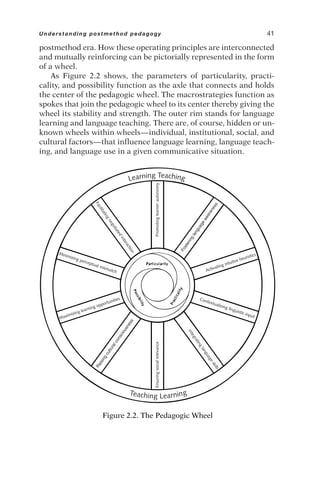
to get entangled in an unending search for an unavailable solution;
that such a search drives us to continually recycle and repackage
the same old ideas; and that nothing short of breaking the cycle can
salvage the situation. Out of this awareness has emerged what I
have called a “postmethod condition” (Kumaravadivelu, 1994a).
Postmethod Condition
The postmethod condition signifies three interrelated attributes.
First and foremost, it signifies a search for an alternative to method
32 Understanding postmethod pedagogy
rather than an alternative method. While alternative methods are
primarily products of top-down processes, alternatives to method
are mainly products of bottom-up processes. In practical terms,
this means that, as discussed in Chapter 1, we need to refigure the
relationship between the theorizer and the practitioner of language
teaching. If the conventional concept of method entitles theorizers
to construct professional theories of pedagogy, the postmethod con-
dition empowers practitioners to construct personal theories of
practice. If the concept of method authorizes theorizers to central-
ize pedagogic decision-making, the postmethod condition enables
practitioners to generate location-specific, classroom-oriented in-
novative strategies.
Secondly, the postmethod condition signifies teacher autonomy.
The conventional concept of method “overlooks the fund of experi-
ence and tacit knowledge about teaching which the teachers already
have by virtue of their lives as students” (Freeman, 1991, p. 35). The
postmethod condition, however, recognizes the teachers’ potential
to know not only how to teach but also how to act autonomously
within the academic and administrative constraints imposed by in-
stitutions, curricula, and textbooks. It also promotes the ability of
teachers to know how to develop a critical approach in order to self-
observe, self-analyze, and self-evaluate their own teaching practice
with a view to effecting desired changes.
The third attribute of the postmethod condition is principled
pragmatism. Unlike eclecticism which is constrained by the con-
ventional concept of method, in the sense that one is supposed to
put together practices from different established methods, prin-
cipled pragmatism is based on the pragmatics of pedagogy where
“the relationship between theory and practice, ideas and their ac-
tualization, can only be realized within the domain of application,
that is, through the immediate activity of teaching” (Widdowson,
1990, p. 30). Principled pragmatism thus focuses on how classroom
learning can be shaped and reshaped by teachers as a result of self-
observation, self-analysis, and self-evaluation.
One way in which teachers can follow principled pragmatism is
by developing what Prabhu (1990) calls “a sense of plausibility.”
Teachers’ sense of plausibility is their “subjective understanding of
the teaching they do” (Prabhu, 1990, p. 172). This subjective under-
standing may arise from their own experience as learners and teach-
ers, and through professional education and peer consultation. Since
Understanding postmethod pedagogy 33
teachers’ sense of plausibility is not linked to the concept of method,
an important concern is “not whether it implies a good or bad
method, but more basically, whether it is active, alive, or operational
enough to create a sense of involvement for both the teacher and
the student” (Ibid., p. 173).
The three major attributes of the postmethod condition outlined
above provide a solid foundation on which the fundamental param-
eters of a postmethod pedagogy can be conceived and constructed.
Reflective task 2.4
Pause for a minute and consider what possible criteria a postmethod ped-
agogy has to meet in order to overcome the limitations of a method-based
pedagogy.
Postmethod Pedagogy
Postmethod pedagogy allows us to go beyond, and overcome the
limitations of, method-based pedagogy. Incidentally, I use the term
pedagogy in a broad sense to include not only issues pertaining to
classroom strategies, instructional materials, curricular objectives,
and evaluation measures but also a wide range of historiopolitical
and sociocultural experiences that directly or indirectly influence
L2 education. Within such a broad-based definition, I visualize post-
method pedagogy as a three-dimensional system consisting of ped-
agogic parameters of particularity, practicality, and possibility. I
briefly outline below the salient features of each of these parame-
ters indicating how they interweave and interact with each other
(for more details, see Kumaravadivelu, 2001).
The Parameter of Particularity
The parameter of particularity requires that any language peda-
gogy, to be relevant, must be sensitive to a particular group of teach-
ers teaching a particular group of learners pursuing a particular set
of goals within a particular institutional context embedded in a par-
ticular sociocultural milieu. The parameter of particularity then is
34 Understanding postmethod pedagogy
opposed to the notion that there can be an established method with
a generic set of theoretical principles and a generic set of classroom
practices.
From a pedagogic point of view, then, particularity is at once a
goal and a process. That is to say, one works for and through partic-
ularity at the same time. It is a progressive advancement of means
and ends. It is the ability to be sensitive to the local educational,
institutional and social contexts in which L2 learning and teaching
take place (see Chapter 11 on ensuring social relevance). It starts
with practicing teachers, either individually or collectively, observing
their teaching acts, evaluating their outcomes, identifying problems,
finding solutions, and trying them out to see once again what works
and what doesn’t (see Chapter 13 on monitoring teaching acts). Such
a continual cycle of observation, reflection, and action is a prereq-
uisite for the development of context-sensitive pedagogic theory and
practice. Since the particular is so deeply embedded in the practi-
cal, and cannot be achieved or understood without it, the parame-
ter of particularity is intertwined with the parameter of practicality
as well.
The Parameter of Practicality
The parameter of practicality relates to a much larger issue that
directly impacts on the practice of classroom teaching, namely, the
relationship between theory and practice that was discussed in
Chapter 1. The parameter of practicality entails a teacher-generated
theory of practice. It recognizes that no theory of practice can be
fully useful and usable unless it is generated through practice. A
logical corollary is that it is the practicing teacher who, given ade-
quate tools for exploration, is best suited to produce such a practi-
cal theory. The intellectual exercise of attempting to derive a theory
of practice enables teachers to understand and identify problems,
analyze and assess information, consider and evaluate alternatives,
and then choose the best available alternative that is then subjected
to further critical appraisal. In this sense, a theory of practice in-
volves continual reflection and action.
If teachers’ reflection and action are seen as constituting one side
of the practicality coin, their insights and intuition can be seen as
constituting the other. Sedimented and solidified through prior and
Understanding postmethod pedagogy 35
ongoing encounters with learning and teaching is the teacher’s un-
explained and sometimes unexplainable awareness of what consti-
tutes good teaching. Teachers’ sense-making (van Manen, 1977) of
good teaching matures over time as they learn to cope with compet-
ing pulls and pressures representing the content and character of
professional preparation, personal beliefs, institutional constraints,
learner expectations, assessment instruments, and other factors.
The seemingly instinctive and idiosyncratic nature of the
teacher’s sense-making disguises the fact that it is formed and re-
formed by the pedagogic factors governing the microcosm of the
classroom as well as by the sociopolitical forces emanating from
outside. Consequently, sense-making requires that teachers view
pedagogy not merely as a mechanism for maximizing learning op-
portunities in the classroom but also as a means for understanding
and transforming possibilities in and outside the classroom. In this
sense, the parameter of practicality metamorphoses into the pa-
rameter of possibility.
The Parameter of Possibility
The parameter of possibility is derived mainly from the works of
critical pedagogists of Freirean persuasion. As discussed in Chapter
1, critical pedagogists take the position that any pedagogy is impli-
cated in relations of power and dominance, and is implemented to
create and sustain social inequalities. They call for recognition of
learners’ and teachers’ subject-positions, that is, their class, race,
gender, and ethnicity, and for sensitivity toward their impact on ed-
ucation.
In the process of sensitizing itself to the prevailing sociopolitical
reality, the parameter of possibility is also concerned with individ-
ual identity. More than any other educational enterprise, language
education provides its participants with challenges and opportu-
nities for a continual quest for subjectivity and self-identity for, as
Weeden (1987, p. 21) points out, “Language is the place where ac-
tual and possible forms of social organization and their likely so-
cial and political consequences are defined and contested. Yet it
is also the place where our sense of ourselves, our subjectivity, is
constructed.” This is even more applicable to L2 education, which
brings languages and cultures in contact (see chapters 11 and 12 for
more details).
36 Understanding postmethod pedagogy
To sum up this section, I have suggested that one way of concep-
tualizing a postmethod pedagogy is to look at it three-dimensionally
as a pedagogy of particularity, practicality, and possibility. The pa-
rameter of particularity seeks to facilitate the advancement of a
context-sensitive, location-specific pedagogy that is based on a true
understanding of local linguistic, sociocultural, and political par-
ticularities. The parameter of practicality seeks to rupture the rei-
fied role relationship by enabling and encouraging teachers to the-
orize from their practice and to practice what they theorize. The
parameter of possibility seeks to tap the sociopolitical conscious-
ness that participants bring with them to the classroom so that it
can also function as a catalyst for a continual quest for identity for-
mation and social transformation.
Inevitably, the boundaries of the particular, the practical, and the
possible are blurred. As Figure 2.1 shows, the characteristics of these
parameters overlap. Each one shapes and is shaped by the other. They
interweave and interact with each other in a synergic relationship
where the whole is greater than the sum of its parts. The result of
such a relationship will vary from context to context depending on
what the participants bring to bear on it.
Understanding postmethod pedagogy 37
Figure 2.1. Parameters of a postmethod pedagogy
Reflective task 2.5
Do the parameters of particularity, practicality, and possibility seem appro-
priate to you? If they do, in what way can they guide you in your practice of
everyday teaching?
If we assume that the three pedagogic parameters of particu-
larity, practicality, and possibility have the potential to form the
foundation for a postmethod pedagogy, and propel the language
teaching profession beyond the limited and limiting concept of
method, then we need a coherent framework that can guide us to
carry out the salient features of the pedagogy in a classroom con-
text. I present below one such framework—a macrostrategic frame-
work (Kumaravadivelu, 1994a).
Macrostrategic Framework
The macrostrategic framework for language teaching consists of
macrostrategies and microstrategies. Macrostrategies are defined
as guiding principles derived from historical, theoretical, empirical,
and experiential insights related to L2 learning and teaching. A
macrostrategy is thus a general plan, a broad guideline based on
which teachers will be able to generate their own situation-specific,
need-based microstrategies or classroom techniques. In other words,
macrostrategies are made operational in the classroom through
microstrategies. The suggested macrostrategies and the situated
microstrategies can assist L2 teachers as they begin to construct
their own theory of practice.
Macrostrategies may be considered theory-neutral as well as
method-neutral. Theory-neutral does not mean atheoretical; rather
it means that the framework is not constrained by the underlying
assumptions of any one particular professional theory of language,
language learning, or language teaching. Likewise, method-neutral
does not mean methodless; rather it means that the framework is
not conditioned by any of the particular set of theoretical principles
or classroom procedures normally associated with any of the par-
ticular language teaching methods discussed in the early part of
this chapter.
38 Understanding postmethod pedagogy
I list below ten macrostrategies with brief descriptions. Each one
will be discussed in detail in subsequent chapters. These macro-
strategies are couched in imperative terms only to connote their op-
erational character. The choice of action verbs over static nouns to
frame these macrostrategies should not therefore be misconstrued
as an attempt to convey any prescriptive quality or frozen finality.
The macrostrategies are:
• Maximize learning opportunities: This macrostrategy envisages
teaching as a process of creating and utilizing learning opportu-
nities, a process in which teachers strike a balance between their
role as managers of teaching acts and their role as mediators of
learning acts;
• Minimize perceptual mismatches: This macrostrategy emphasizes
the recognition of potential perceptual mismatches between in-
tentions and interpretations of the learner, the teacher, and the
teacher educator;
• Facilitate negotiated interaction: This macrostrategy refers to
meaningful learner-learner, learner-teacher classroom interaction
in which learners are entitled and encouraged to initiate topic
and talk, not just react and respond;
• Promote learner autonomy: This macrostrategy involves helping
learners learn how to learn, equipping them with the means nec-
essary to self-direct and self-monitor their own learning;
• Foster language awareness: This macrostrategy refers to any at-
tempt to draw learners’ attention to the formal and functional
properties of their L2 in order to increase the degree of explicit-
ness required to promote L2 learning;
• Activate intuitive heuristics: This macrostrategy highlights the
importance of providing rich textual data so that learners can infer
and internalize underlying rules governing grammatical usage and
communicative use;
• Contextualize linguistic input: This macrostrategy highlights how
language usage and use are shaped by linguistic, extralinguistic,
situational, and extrasituational contexts;
• Integrate language skills: This macrostrategy refers to the need to
holistically integrate language skills traditionally separated and
sequenced as listening, speaking, reading, and writing;
• Ensure social relevance: This macrostrategy refers to the need for
teachers to be sensitive to the societal, political, economic, and
educational environment in which L2 learning and teaching take
place; and
Understanding postmethod pedagogy 39
• Raise cultural consciousness: This macrostrategy emphasizes the
need to treat learners as cultural informants so that they are en-
couraged to engage in a process of classroom participation that
puts a premium on their power/knowledge.
Reflective task 2.6
Individually or with a peer partner, go over the list of macrostrategies again.
Which ones already inform your day-to-day teaching? Which ones are not
relevant to your learning/teaching context? Based on your professional and
experiential knowledge, can you add to this list of macrostrategies?
The basic insights for the macrostrategic framework are drawn
mostly from theoretical, empirical, and experiential knowledge
grounded in classroom-oriented research. The classroom research
perspective adopted here is governed by the belief that a pedagogic
framework must emerge from classroom experience and experi-
mentation. It is also motivated by the fact that a solid body of class-
room research findings is available for careful consideration and
judicious application. It should, however, be recognized that the
classroom research path is by no means the only path that has the
potential to lead to the construction of a pedagogic framework.
There may very well be other, equally valid paths one can take.
Whatever orientation one pursues, what should be remembered
is that practicing and prospective teachers need a framework that
can enable them to develop the knowledge, skill, attitude, and au-
tonomy necessary to devise for themselves a systematic, coherent,
and relevant personal theory of practice that is informed by the pa-
rameters of particularity, practicality, and possibility. While the pur-
pose of such a framework is to help teachers become autonomous
decision-makers, it should, without denying the value of individual
autonomy, provide adequate conceptual underpinnings based on cur-
rent theoretical, empirical, and experiential insights so that their
teaching act may come about in a principled fashion.
The parameters of particularity, practicality, and possibility along
with the suggested macrostrategies constitute the operating prin-
ciples that can guide practicing teachers in their effort to construct
their own situation-specific pedagogic knowledge in the emerging
40 Understanding postmethod pedagogy
postmethod era. How these operating principles are interconnected
and mutually reinforcing can be pictorially represented in the form
of a wheel.
As Figure 2.2 shows, the parameters of particularity, practi-
cality, and possibility function as the axle that connects and holds
the center of the pedagogic wheel. The macrostrategies function as
spokes that join the pedagogic wheel to its center thereby giving the
wheel its stability and strength. The outer rim stands for language
learning and language teaching. There are, of course, hidden or un-
known wheels within wheels—individual, institutional, social, and
cultural factors—that influence language learning, language teach-
ing, and language use in a given communicative situation.
Understanding postmethod pedagogy 41
R
a
i
s
i
n
g
c
u
l
t
u
r
a
l
c
o
n
s
c
i
o
u
s
n
e
s
s
F
o
s
t
e
r
i
n
g
l
a
n
g
u
a
g
e
a
w
a
r
e
n
e
s
s
Figure 2.2. The Pedagogic Wheel
What the pedagogic wheel also indicates is that the ten macro-
strategies are typically in a systemic relationship, supporting one
another. That is to say, a particular macrostrategy is connected with
and is related to a cluster of other macrostrategies. For instance, as
will become clear in the following pages, there may be a single exer-
cise or a task that can facilitate negotiated interaction, activate intu-
itive heuristics, foster language awareness, and raise cultural con-
sciousness all at once. Clustering of macrostrategies may be useful
depending on specific teaching objectives for a given day of instruc-
tion. When teachers have an opportunity to process and practice
their teaching through a variety of macrostrategies, they will dis-
cover how they all hang together.
In Closing
There are at least three broad, overlapping strands of thought that
emerge from what we have discussed so far. First, the traditional
concept of method with its generic set of theoretical principles and
classroom techniques offers only a limited and limiting perspective
on language learning and teaching. Second, learning and teaching
needs, wants, and situations are unpredictably numerous. There-
fore, current models of teacher education programs can hardly
prepare teachers to tackle all these unpredictable needs, wants, and
situations. Third, the primary task of in-service and pre-service
teacher education programs is to create conditions for present and
prospective teachers to acquire the necessary knowledge, skill, au-
thority, and autonomy to construct their own personal pedagogic
knowledge. Thus, there is an imperative need to move away from a
method-based pedagogy to a postmethod pedagogy.
One possible way of conceptualizing and constructing a post-
method pedagogy is to be sensitive to the parameters of particularity,
practicality, and possibility, which can be incorporated in the macro-
strategic framework. The framework, then, seeks to transform class-
room practitioners into strategic thinkers, strategic teachers, and
strategic explorers who channel their time and effort in order to
• reflect on the specific needs, wants, situations, and processes of
learning and teaching;
• stretch their knowledge, skill, and attitude to stay informed and
involved;
42 Understanding postmethod pedagogy
• design and use appropriate microstrategies to maximize learning
potential in the classroom; and
• monitor and evaluate their ability to react to myriad situations in
meaningful ways.
In short, the framework seeks to provide a possible mechanism for
classroom teachers to begin to theorize from their practice and prac-
tice what they theorize.
In the next ten chapters, I discuss the macrostrategic frame-
work in greater detail, providing theoretical, empirical, and expe-
riential support for each of the ten macrostrategies. I also provide
illustrative microstrategies and exploratory projects to show how a
particular macrostrategy can be implemented in a classroom situ-
ation. In the final chapter, I demonstrate how the macrostrategic
framework can be used by teachers to self-observe, self-analyze, and
self-evaluate their own teaching acts.
Understanding postmethod pedagogy 43
C H A P T E R 3
Maximizing L e a r n i n g
O p p o r t u n i t i e s
We cannot really teach a language; we can only create
conditions under which it will develop in the mind
in its own way.
—VON HUMBOLDT, 1836, as paraphrased in
Noam Chomsky, 1965, p. 51
Our first and foremost duty as teachers is to maximize learning op-
portunities for our learners. To say that is to state the obvious. It is
difficult to disagree with such a commonplace statement. We may,
however, disagree on the details. That is, we may have different re-
sponses to questions such as: What constitutes learning opportuni-
ties? How do we know learning opportunities have or have not been
created? Do learners utilize learning opportunities created by teach-
ers? Is it the responsibility of the teacher alone to create learning
opportunities? Can learners also create learning opportunities? Do
teachers recognize learning opportunities created by learners? Do
learners see learning opportunities as learning opportunities? These
are some of the questions that I will be addressing in this chapter.
Teaching, however purposeful, cannot automatically lead to
learning for the simple reason that learning is primarily a personal
construct controlled by the individual learner. Every teaching act
will be seen through the prism of what the individual learner brings
to it as well as takes from it. If learning is indeed controlled by the
learner, then teachers can only try to create the conditions nec-
essary for learning to take place. The success of their attempt is, of
course, dependent on their learners’ willing cooperation to make
use of the conditions that have been created. It is because of this
collaborative nature of learning and teaching that Dick Allwright
(1986, p. 6) defined classroom instruction as “the interactive pro-
cess whereby learning opportunities are created.” An interesting as-
pect of this definition is that it avoids what he calls a “provider;”
that is to say, both teachers and learners are considered to be most
valuable players in managing the creation and utilization of learn-
ing opportunities in the classroom.
Traditional Players
If classroom management should be directed toward the creation
and utilization of learning opportunities, and if that managerial
role is jointly vested with teachers and learners, then we need to
reconsider the role of some of the factors that we have traditionally
believed to be crucial for classroom management. Specifically, we
may have to get away from the long-cherished notion that peda-
gogic success is determined by a combination of a well-planned
teachers’ agenda supported by a well-designed textbook based on a
well-conceived syllabus. We need to recognize the possibility that
creation and utilization of learning opportunities are
• not bound by teachers’ agenda,
• not bound by teaching materials, and
• not bound by syllabus specifications.
These three factors are all predetermined even before the class-
room interaction with learners begins. Traditional classroom man-
agement with its emphasis on these predetermined factors has cer-
tain inherent limitations.
Limitations of Teachers’ Agenda
Teachers generally have a prepared teaching agenda in the form of
lesson plans, written or otherwise. No doubt lesson plans offer a
sense of direction to classroom activity. However, teachers know
that they cannot become prisoners of their own agenda. They need
to constantly monitor how the lesson is unfolding and make suit-
able changes as necessary. While the prepared lesson plan may offer
a general road map to teachers, the specific route they follow, the
speed limits they impose, and the unexpected detours they take will
all depend on the “road conditions” they encounter in the classroom.
Most often, teachers’ prepared agenda focus almost exclusively
on what is taught whereas, in reality, what is taught is different from
Maximizing learning opportunities 45
what is available to learn. In making this important distinction, All-
wright (1981, p. 7) points out that what is available to learn is “a re-
sult of the interactive nature of classroom events.” That is, beyond
the teachers’ planned agenda, the unfolding classroom interaction
provides opportunities for teachers to explain something in the target
language, and for learners to ask questions. All the things said in the
target language by all the participants are available for all the learn-
ers to learn, if they pay attention to them. In other words, learners
join their teachers in generating language input that is potentially
available for everybody to learn. In doing so, they change the course
of their teacher’s agenda.
Limitations of Teaching Materials
By their very nature, teaching materials represent the product of
careful and creative planning on the part of textbook writers; they
are not the result of any interactive process of classroom events.
They are frequently looked upon as carriers of grammatical struc-
tures or vocabulary items that have to be introduced to the learners.
Commercially produced for mass consumption, they can hardly ad-
dress the specific interactive needs and wants of a given group of
learners.
Because of these limitations, it is better to treat a text as a pre-
text (or, even as a pretext, an excuse). That is, it should be treated as
no more than a springboard to launch the interactive process in the
classroom. In that sense, textbooks should function as source-books
rather than course-books (Prabhu, 1987, p. 94). The language that
is needed for the interactive process has to be negotiated by the
learner with the help of the teacher, whose job it is to maximize
learning opportunities in class.
Limitations of Syllabus Specifications
Just as a prescribed textbook, a syllabus is also a preplanned and
presequenced inventory of linguistic specifications handed down,
in most cases, to teachers and learners. The practicing teacher is ex-
pected to chart a course of action in the classroom to achieve the
goals of syllabus specifications. The teacher tries to do that either
by using textbooks that closely follow those syllabus specifications
or by designing supplementary activities that are appropriate to the
needs of a particular group of learners. In doing so, teachers recog-
46 Maximizing learning opportunities
nize that “syllabus as a source of teacher reference can only effect
learning through methodological mediation” (Widdowson, 1990,
p. 130). In other words, without effective methodological media-
tion, a syllabus remains a lifeless list of linguistic labels.
The preplanned syllabus, just like the prescribed textbook, can
be treated only as a pre-syllabus that has to be negotiated through
classroom interactive process. Pit Corder (1967) has talked about
the notion of a “built-in syllabus” that the learners themselves con-
struct by selecting what can be learned from the choices available
in the predetermined syllabus presented to them. What the partici-
pants actually do during the interactive process will inevitably con-
vert the teaching syllabus that the teachers bring to class into a
learning syllabus with which both teachers and learners feel com-
fortable. In fact, in the very process of that conversion, both teach-
ers and learners will find themselves creating and utilizing a wide
range of learning opportunities.
I am not suggesting that predetermined lesson plans, textbooks,
and syllabuses are unnecessary or that they have no role to play in
generating learning opportunities in class, only that they are insuf-
ficient to achieve their stated purposes. The reason is simple: cre-
ation and utilization of learning opportunities in the classroom are
ultimately in the hands of teachers and learners who are engaged in
a joint exploration of learning and teaching. Such an interactive
process effectively minimizes the role of teachers’ prepared agenda,
the textbook, and the syllabus and, conversely, maximizes the role
of the teacher and the learner in the classroom.
Reflective task 3.1
Focus on any language teacher education program (pre-service or in-service)
that you are recently associated with, either as a student or as a teacher.
What has been the main thrust of that program: (a) learning how to use
teaching techniques, write lesson plans, use textbooks, and follow syl-
labuses, or (b) learning how to manage classroom interaction in order to
generate learning opportunities in class? What specific changes do we
have to make in a teacher education program to shift its main thrust from
(a) to (b)?
Maximizing learning opportunities 47
Learning Opportunities
The inadequacy of the teaching agenda, the textbook, and the
syllabus—mainly because of their predetermined nature—presents
a challenge for the classroom participants who are actually respon-
sible for creating and utilizing learning opportunities. I shall now
discuss how teachers and learners can generate learning opportu-
nities inside and outside the classroom.
Learning Opportunities Inside the Classroom
Two aspects of classroom management that will have a huge impact
on the generation of learning opportunities inside the classroom
are learner involvement and teacher questioning. I will briefly touch
on these two aspects of classroom management and then use ex-
amples of authentic classroom interactional data to exemplify some
of my points.
L E A R N E R I N V O L V E M E N T
Clearly, the best way we can maximize learning opportunities in
our classes is through meaningful learner involvement. Considering
that the learners are actually in control of their learning, and that
they all come to the class with varied notions about what consti-
tutes teaching and what constitutes learning, we have no sensible
option but to involve them in the process of maximizing learning
opportunities. Learner involvement will help both the learners and
the teachers in making informed choices: the learners will be able
to find their own path to learning, and the teachers will be able to
create the optimal environment necessary for learning to take place.
Any other prepackaged shortcut we may bring to the classroom is
bound to be inadequate.
An important facet of learner involvement is what Bonny Nor-
ton has called learner investment. The notion of learner investment
“presupposes that when language learners speak, they are not only
exchanging information with target language speakers, but they are
constantly organizing and reorganizing a sense of who they are and
how they relate to the social world. Thus an investment in the target
language is also an investment in a learner’s own identity, an iden-
tity which is constantly changing across time and space” (Norton,
2000, pp. 10–11). Therefore, one way of maximizing learning op-
48 Maximizing learning opportunities
portunities in the classroom is to seriously “listen” when language
learners speak, and build on what they say. In other words, the
learners’ voice in the classroom should not be treated merely as lan-
guage practice, but “must be regarded as constituting the very fab-
ric of students’ lives and as determining their investment in learn-
ing the target language” (McKay and Wong, 1996, p. 603).
Recognizing the learners’ voice also means recognizing their at-
tempt to create learning opportunities for themselves and for other
participants in class. When learners ask a question or say some-
thing, even if it appears to be far removed from the topic at hand,
they might possibly be creating learning opportunities. They may
also be indicating that they are capable of not only contributing to
the classroom discourse but also navigating it in a direction not an-
ticipated by the teacher. Therefore, by utilizing learning opportuni-
ties created by learners, teachers can send an important message to
them: their voice counts and they, too, are partners in the joint pro-
duction of classroom discourse.
T E A C H E R Q U E S T I O N I N G
Yet another possibility for creating learning opportunities is for the
teacher to ask the right type of questions that will trigger meaning-
ful interaction. In the field of general education, Hugh Mehan (1979)
has identified four types of questions that normally occur in a class-
room setting:
• choice questions that call upon the learners to agree or disagree
with the teacher’s statement and/or choose a yes or no response
from a list provided by the teacher;
• product questions that ask the learners to provide a factual re-
sponse such as a name, a place, etc.;
• process questions that ask for the learners’ opinions or interpre-
tations; and
• metaprocess questions that ask the learners to formulate the
grounds for their reasoning, or to produce the rule or procedure
by which they arrived at or remembered answers.
Although choice and product questions do have a place in L2
classroom teaching, process and metaprocess questions, by nature,
are likely to facilitate negotiated interaction (see Chapter 5 for more
details), and, therefore, create more learning opportunities.
Maximizing learning opportunities 49
Studies on L2 development have generally focused on two types
of questions:
• display questions that permit predetermined answers already
known to the teacher; and
• referential questions that permit open-ended answers containing
new information.
Researchers in L2 development have found that nearly 79 per-
cent of the questions asked in the classroom are display questions,
which clearly contrasts with the use of referential questions in con-
versations outside the class (Long and Sato, 1983). They have also
found that learners’ responses to referential questions were propo-
sitionally longer and grammatically more complex than their re-
sponses to display questions (Brock, 1986).
As can be expected, process/metaprocess or referential ques-
tions have the potential to generate learning opportunities. They
have the capacity to elicit new pieces of information from learners.
They also have the capacity to prompt them to actively engage their
reasoning skills, and not just passively draw from memory, as
choice and product questions are prone to do. Scott Thornbury
goes even further and argues that “the effort involved in asking ref-
erential questions prompts a greater effort and depth of processing
on the part of the teacher.” With that understanding, he good-hu-
moredly challenges the classroom teacher: “Try conducting a lesson
in which every question is referential!” (Thornbury, 1996, p. 281).
Reflective task 3.2
Try to recall, as specifically as possible, instances of learner involvement
and teacher questioning in the most recent class you taught or attended. Do
you think learning opportunities were generated in that class? If yes, how
were they achieved? If not, what might be the reasons?
I L L U S T R A T I O N S O F L E A R N E R I N V O L V E M E N T
A N D T E A C H E R Q U E S T I O N I N G
The pedagogical significance of the issues raised above will become
even more apparent as we look at the following classroom interac-
50 Maximizing learning opportunities
tional data. Before we proceed, a note about the way the transcrip-
tion of classroom data is presented in this book: First, the meaning
of a conversational turn. I use the term turn throughout to refer to
a single, unitary contribution to classroom talk by a teacher or a stu-
dent or a group of students raising their voice in chorus, irrespective
of the length of the linguistic unit (a conversational filler, a word, a
clause, a sentence, etc.) and irrespective of the discoursal functions
(question, statement, evaluation, etc.). For instance, Episode 1 given
below has thirty turns (serially numbered).
Second, for the purpose of simplicity, I use the following broad
transcription convention, which does not show features like into-
nation, pause time, etc.:
T Teacher
S Student (unidentified)
S1, S2 . . . Student (identified, by number)
SS Unidentified subgroup of class
SSS Whole class
x Incomprehensible, probably one word
xx Incomprehensible, probably one phrase
xxx Incomprehensible, more than a phrase
Uh, mmm Conversation fillers
. . . Pause
Now to the interactional data. I mentioned earlier that teaching ac-
tivity that has the potential to lead to the creation and utilization of
learning opportunities depends largely on learner involvement and
teacher questioning. Consider the following episode from an inter-
mediate level ESL Speaking class. The teacher was trying to gather
from students controversial topics, some of which she wanted to
take up for further discussion. After collecting a couple of topics
from students, she introduced one of her own: euthanasia, or mercy
killing. Notice that when a student asked for the meaning of the
word (turn 10), the teacher did not immediately give a definition.
Instead, she asked other students to volunteer.
Maximizing learning opportunities 51
E p i s o d e 3 . 1
1 T: What are some other controversial topics, S4, can you try?
2 S4: Divorce.
3 T: Divorce? (writes on the board)
4 S: AIDS.
5 T: Good. That’s very controversial. How about . . . have you
heard the term . . . euthanasia?
6 S: Yah.
7 S1: How do you pronounce this?
8 T: Eu-tha-na-sia.
9 S1: Euthanasia.
10 S2: What does it mean?
11 T: Explain. Somebody explain what euthanasia is?
12 S3: If you . . . if you kill somebody with . . . for example . . . if you
feel sorry for somebody because this person is . . . very ill and
has no choice . . .
13 T: Hmmm . . .
14 S3: (turning to S2 who asked the question) Do you understand?
15 S2: I understand.
16 S3: Hmmm.
17 T: (to class) Do you understand what euthanasia is . . . no?
18 S4: People . . . that taken . . . xxx.
19 S5: Mercy killing.
20 S4: taken . . .
21 S5: It can be very mercy killing.
22 T: Right, mercy killing.
23 S5: There are two kinds of . . .
24 T: Positive and negative . . . right . . . mercy killing is another
word for it (writes on board). Have you heard of that?
25 S: Ah . . . hmmm.
26 T: Have you heard of that before?
27 S: No.
28 T: OK, let’s say . . . you have . . .
29 S: xx.
52 Maximizing learning opportunities
30 T: No . . . let’s say you have a grandmother who is very sick and
can’t get out of bed, can’t take care of herself and all she
wants to do is die . . . and she asks you to let her die . . . that’s
what euthanasia is . . . if the doctor lets the patient die . . .
OK?
(Data source: Kumaravadivelu, 1992)
Even after a fairly satisfactory answer was given by a student (turn
12), the teacher turned to other students (turn 17) to make sure that
everybody had understood the concept of euthanasia. It is only after
a lengthy dialogue that she gave her own explanation (turn 30). The
episode presents a situation where the teacher created not only an
opportunity for students to learn a new concept but also conditions
for learners to interact with her and with other students.
Contrast that with what the teacher of an advanced level Com-
munication Skills class did in the following brief exchange. The class
was discussing an essay on rural development in developing coun-
tries. The students were asked to read the essay at home and come
prepared for a discussion on rural development projects in their
countries. Most of the students from the Middle East and Southeast
Asia reported problems in rural development in their countries. The
teacher then turned to a student from Turkey:
E p i s o d e 3 . 2
1 T: S5, what about Turkey? Do people in rural areas have elec-
tricity and running water?
2 S5: Yah . . . most of them . . . uh . . . this problem has been solved
five . . . we did . . . past five or seven years.
3 T: OK.
(Data source: Kumaravadivelu, 1992)
Here was a student who said that the problems of rural electrifica-
tion and water supply were solved five or seven years ago. A logical
step here for the teacher would be to create more learning opportu-
nities for other students by asking the Turkish student to give more
Maximizing learning opportunities 53
information on what the government and the people of Turkey did to
solve rural developmental problems. That would have given the other
students in class not only some valuable information and additional
linguistic input but also an opportunity to participate in meaning-
ful interaction. It would have also involved the Turkish student him-
self in an interactive situation. Instead, the teacher merely said “OK”
and moved on.
My interview with the teacher after the class revealed that he did
not have any particular reason in mind for closing the learner dis-
course; it just did not occur to him to pursue the matter any further.
He realized later that he had lost an opportunity to engage the minds
of the learners, and also to relate the Turkish case as an example for
some of the issues raised in the prescribed essay. The loss is all the
more noticeable because this was a class about developing com-
munication skills, and the teacher was expected to create as many
opportunities as possible for the learners to communicate in the
target language.
Reflective task 3.3
On any given day in any given class, so many learning opportunities go un-
recognized and unrealized by teachers as well as learners. How do factors
such as poor classroom management, or rigid relationships between teach-
ers and learners, or lack of training or lack of motivation, or X (insert a fac-
tor that occurs to you) contribute to this situation?
While the first two episodes illustrate the success or failure on the
part of the teacher to create learning opportunities, the next two
highlight the importance of the teacher’s attempt (or failure) to uti-
lize the learning opportunities created by the learners. It should be
remembered that the classroom teacher is only one of the partici-
pants—one with greater competence and authority, of course—but
only a participant nonetheless, and as such s/he cannot afford to ig-
nore any contributory discourse from other partners engaged in a
joint venture to “accomplish lessons” (Mehan, 1979).
One crucial way to ensure the accomplishment of lessons is for
the teacher to show a willingness to utilize learning opportunities
created by the learner, even if the learner talk, from the teacher’s
point of view, is not highly relevant to the task at hand. More often
54 Maximizing learning opportunities
than not, a learner talk has much wider implications for classroom
learning than most teachers seem to realize. Consider the following
episode from a low proficiency level Reading class. The lesson in the
prescribed textbook was titled Dangerous Growth of Deserts, and
the teacher, as a prereading strategy, was helping the learners ana-
lyze the key words in the title:
E p i s o d e 3 . 3
1 T: Who can tell me what this word . . . is (writes Deserts on the
board) . . . Yes?
2 S1: xx.
3 T: Hmm?
4 S: It’s a fruit . . . or—
5 T: No . . . that’s . . .
6 S2: That’s a . . .
7 T: That’s . . . (writes Desserts next to Deserts on the board).
8 S3: Deserts . . . ah . . . without . . . water . . .
9 T: Without what?
10 SS: Water.
11 T: OK. Good.
12 SS: Sand . . .
13 T: What is it? Dry without water . . . sand . . . what do we call it?
Dry what? xx.
15 T: Is it a dry fruit . . . dry what?
16 S4: Dry place.
17 T: OK. Good. Dry land or dry place . . . is a desert. What does
the other one mean? Desserts? . . . S1?
18 S1: uh . . . I don’t . . .
19 S: Sweet . . . ice cream . . .
20 T: OK. It can mean fruit or ice cream or cake. When do we
eat it?
21 S: After . . . dinner.
22 T: OK. After we’ve eaten dinner. We’ll have dessert. So the dif-
ference between deserts and desserts is quite a bit, isn’t it?
(Data source: Kumaravadivelu, 1992)
Maximizing learning opportunities 55
A learner (turn 4) mistook deserts for desserts and answered incor-
rectly, thereby creating a learning opportunity for himself and, prob-
ably, for some others as well. The teacher, instead of ignoring the
learner’s incorrect response or simply calling it wrong, wrote the
two words on the board but went ahead with her original question
related to deserts. Once that discussion was accomplished, she uti-
lized the learning opportunity created by the learner and returned
(turn 17) to the student’s initial response to make sure that all the
learners understood the difference between deserts and desserts.
A point that needs to be stressed here is that, in a class of learners
with similar language proficiency, if one learner indicates, directly
or indirectly, any difficulty in understanding a particular linguistic
item or a propositional content, we can assume that there may be
several others who experience a similar difficulty. Therefore, a par-
ticular learner’s problem of comprehension should be brought to
the attention of the whole class and dealt with suitably. Failing to do
so would indicate failure on the part of the teacher to utilize effec-
tively the learning opportunity created by the learner. Often teach-
ers do not dwell on the learner discourse and unintentionally ignore
learning opportunities created by learners, as the following episode
testifies.
The teacher in this intermediate level Speaking class planned to
discuss wedding customs in different cultures. She used six picto-
rial cues to stimulate a discussion on wedding customs in the
United States and hoped that the learners, who were from different
cultural backgrounds, would talk about their own. Focus on how
she handled the learners’ questions about two problematic words:
reception and miscellaneous.
E p i s o d e 3 . 4
1 T: Now, you are going to ask questions, OK. I have six pictures
here. First one is the bride; second is the groom; third we
have bridesmaids; four we have groomsmen; five we have re-
ception and six has . . . just let’s say miscellaneous. OK? I’m
going to give each one of you a picture. On the back of the
picture, I’ve written two questions. I’ll give you some time. I
want you to think of some more questions that you can ask
the other students . . . OK . . . and then you are going to lead
a discussion . . .
56 Maximizing learning opportunities
2 S: Uh . . . xx.
3 T: I’ll give you the groomsmen . . . OK? Would you like . . . you
have the reception. Do you want a picture . . . here is the mis-
cellaneous. Take a few minutes . . . think of some more ques-
tions . . . and then you can ask other students . . . OK?
4 S1: (to another) Know this?
5 T: You have a question?
6 S1: This means bridesmaid?
7 S2: What does this mean?
8 T: (answering an inaudible question raised by the S sitting next
to her) Reception is a party . . .
9 S1: Groomsmen . . . you know . . .
10 S2: (gestures; directed to T)
11 T: (T again busy with the S sitting next to her) Miscellaneous?
ah . . . I’ll use a simple word . . . don’t worry (goes to the
board and erases Miscellaneous and writes other items related
to wedding)
12 S1: Like this . . . I can’t identify who is the groom in this pic-
ture . . .
13 T: That’s what you’ll ask other students a little later . . .
(Data source: Kumaravadivelu, 1992)
A video replay of this episode indicates that the teacher was re-
sponding to a question (not picked up by the microphone) asked by
a learner sitting next to her (the class was arranged in a semicircu-
lar fashion to facilitate group discussion). She answered: “Recep-
tion is a party” (turn 8) clearly in response to the learner’s query
on the meaning of the word reception. This turned out to be a pri-
vate exchange between the teacher and one particular learner. The
teacher did not seem to realize that other learners might have
the same problem.
A much more revealing exchange occurred moments later. An-
other learner sitting close to the teacher had apparently asked her
(not picked up by the microphone) the meaning of the word mis-
cellaneous—a difficult vocabulary item for low intermediate level
learners. The teacher repeated the word miscellaneous (turn 11)
with a rising intonation and quietly walked over to the board, say-
Maximizing learning opportunities 57
ing, “I’ll use a simple word . . . don’t worry.” She erased “miscellane-
ous” and wrote: “other items related to wedding.”
A video replay of this episode shows that the other students in
class were unaware of what was happening. The teacher ignored a
learning opportunity she herself created when she introduced the
word miscellaneous. She also failed to bring to the attention of the
other students the question raised by a learner, thereby failing to
utilize an excellent learning opportunity created by that individual.
Reflective task 3.4
It was stated earlier that what is taught is different from what is available to
learn. The teachers in these episodes focused on helping the learners under-
stand euthanasia, desert/dessert, etc. Read the four episodes again. Apart
from what the teachers explicitly taught, what else was actually “available”
for the learners to learn if they were paying full attention to the input and in-
teraction in class?
The discussion so far has highlighted the importance of learner in-
volvement and teacher questioning in maximizing learning oppor-
tunities in class. The analysis of classroom interactional data, in
particular, has revealed the collaborative nature of the creation and
utilization of learning opportunities. Such a collaborative work can
form the basis for a more systematic participatory research aimed
at generating learning opportunities outside the classroom.
Learning Opportunities Outside the Classroom
When we think about participatory research, we seldom think about
involving our learners. If, however, we consider teachers and learn-
ers as co-participants in the generation of learning opportunities,
then it makes sense to involve them in this process. The fundamen-
tal belief governing participatory research is that human beings have
a natural tendency to observe, analyze, and reflect on life experience.
In our specific context, the term participatory research may be used
narrowly to refer to sustained and systematic activities in which
58 Maximizing learning opportunities
learners and teachers together explore all the available avenues to
generate learning opportunities in and outside the classroom.
One such avenue is to try to connect the classroom with the local
community and with the global community, and thereby enhance
the creation and utilization of learning opportunities.
C O N N E C T I N G W I T H T H E L O C A L C O M M U N I T Y
Among those suggesting several variations of participatory research
aimed at creating opportunities for teachers and learners to connect
with the community outside the classroom are Shirley Brice Heath
(1983, 1993), Sudia McCaleb (1994), Bonny Norton Pierce (1995),
Kumaravadivelu, (1999b), and Geneva Smitherman (2000). They all
emphasize the necessity to create opportunities for the learners to
develop their oral and written communication skills as well as their
critical thinking skills by analyzing and understanding how language
rules and language use operate in various communicative settings.
The following five recommendations about the aims and activi-
ties of participatory research that are useful for teachers and learn-
ers can be derived from a close reading of the authors cited above:
(1) Form communities of learners. The goal here is to bring together
teachers, students, family members, and community activists to
form what may be called learning communities: socially cohesive
and mutually supportive groups seeking self-awareness and self-
improvement. In order to realize that goal, participants may be en-
couraged to assume the role of mini-ethnographers so that they
can, at a personal level, investigate their own difficulties in adjust-
ing to a new culture, or a new educational system, or a new lan-
guage, and, at a social level, explore family and community con-
cerns and aspirations, and their impact on their education.
(2) Interact with competent speakers of the target language. This can
be done by encouraging the learners to use their still developing tar-
get language and engage in conversations with competent speakers
of the language during social and cultural events whether at school,
in the neighborhood, or in the community at large. To make that
engagement meaningful and critical, the learners may be asked, at
lower levels of proficiency, to give a brief oral or written report
about their social interaction. At higher levels of proficiency, they
may be asked to reflect on and write about how language use is so-
cially structured in terms of power and prestige.
Maximizing learning opportunities 59
(3) Develop a habit of keeping diaries or journals. It is beneficial for
participants to keep diaries or write journal entries about issues
that directly concern them. They may be encouraged to reflect and
write about a wide range of topics including their developing sense
of who they are and how they relate to the outside world, and how
they and other members of the learning community react and re-
spond to various sociocultural issues. They may also use the diaries
and journals to write about how they handled communication
breakdowns arising from their language difficulties, and to keep
track of their own progress in learning their L2.
(4) Exchange information with teachers and peers. Participants can
share their diary and journal entries on certain common topics,
comparing and contrasting their experiences and perspectives with
interested members of the learning community. Teachers may se-
lect a few interesting exchanges of information and use them, with
permission from the participants concerned, to structure their
classroom activities. In this way, teachers can forge a direct link be-
tween the classroom and larger social processes as seen by the
learners.
(5) Adapt and create new teaching materials. In addition to using
their diary and journal entries, participants can bring to class any
news stories or write-ups that can be adapted and used as teaching
materials. This opens up the participants’ creative involvement in
identifying and selecting interesting reading materials that can be
used in the classroom. This activity, by itself, may give them a
greater sense of purpose and a greater degree of commitment to
shaping their own learning agenda.
Reflective task 3.5
To what extent do these recommendations make sense to you in your spe-
cific learning and teaching context? In other words, what challenges will
you face if you wish to follow some of them? How can you overcome the
challenges?
The practice of participatory research briefly outlined above will
necessarily change from class to class, from context to context. As
McCaleb rightly points out, there are no right or wrong ways of
doing this kind of research. The thoughts and knowledge that each
60 Maximizing learning opportunities
one of the members of the learning community brings to the pro-
cess is valuable. They all contribute to this research by listening to
each other, asking questions, doing interviews, writing, and con-
stantly thinking about how to improve what they are already doing
(McCaleb, 1994, p. 143). In fact, such an endeavor can be enriched
by moving from the local community to the global community.
C O N N E C T I N G W I T H T H E G L O B A L C O M M U N I T Y
In these days of global communication, one exciting option avail-
able for teachers and learners is to bring the global community into
the local classroom. They can easily do this by using the Internet as
a tool for participatory research. The Internet offers unlimited pos-
sibilities for teachers and learners to connect the word and the
world. Using the Internet, teachers and learners can easily gain rich
and varied knowledge on global matters, and develop their own
critical perspectives about them. They can also, if they wish, access
useful materials with explicit pedagogical focus on grammar and
vocabulary or on reading and writing. For illustrative examples of
using the Internet as a tool, see the microstrategies described below.
For an easy-to-use guide to language and culture on the Internet,
see, for example, Carl Blyth (1998).
In several North American and European countries, individual
learners and teachers have ready access to Internet facilities, either
at home or at school. In other settings, educational institutions pro-
vide common facilities for learners and teachers in computer labs.
In countries such as China, Egypt, India, and Nigeria, almost every
major city has “Internet Cafés,” where users have Internet access at
a nominal cost. Even in places where Internet facilities are either
expensive or simply unavailable, there are always the traditional
sources of information in the form of magazines, newspapers, radio,
and TV, all of which now devote a considerable amount of time and
space to issues related to economic and cultural globalization.
How the twin processes of economic and cultural globalization
impact the L2 learners’ individual identity is a subject that is wait-
ing to be exploited for effective learning and teaching (see chapters
11 and 12 for details). Teachers and learners can start in that direc-
tion by following the five recommendations for participatory re-
search outlined above and by just stretching their scope beyond the
boundaries of the local community. In other words, they can carry
Maximizing learning opportunities 61
the aims and activities of participatory research into cyberspace. By
doing so they enter an exciting world of authentic resources that
have the potential, if used properly, to help them read cultural arti-
facts and political events in ways that resonate with their individual
experiences.
More specifically and in terms of the five recommendations,
participants can form a virtual community of learners using the
World Wide Web. They can contact different language schools in
the country in which their target language is spoken as the first lan-
guage and, through them, get in touch with learners of that partic-
ular language. The can get the Web addresses of these schools
through search engines such as Yahoo or Google. They can then in-
teract with teachers and learners at those schools through pen pal
Web sites or by posting messages via chat rooms or news groups,
thus sharing their joys and sorrows of encountering a new language
or a new culture.
The same channels of communication can be used to interact
with competent speakers of the target language as well. Partici-
pants can exchange information with other members of the virtual
learning community and gain new perspectives on personal concerns
and political events. Finally, they can select interesting reading ma-
terials on a topic but from different sources, thus broadening their
critical understanding of that particular topic. Such cross-cultural
materials can be collected and later used as teaching/learning ma-
terials in class. Thus, the options available on the Internet for gen-
erating learning opportunities are truly phenomenal.
Reflective task 3.6
From your perspective, is connecting with the global community to critically
link the word and the world a desirable and doable activity? In responding
to this task, consider the widespread belief that language teachers and
learners are in a privileged position to deal with various themes and topics
as long as they are appropriate and done through the medium of the target
language being taught and learned.
To sum up this section on generating learning opportunities in
and outside the classroom, I discussed how particular types of
62 Maximizing learning opportunities
learner involvement and teacher questioning mediated through for-
mal or informal collaboration can contribute to the creation and
utilization of learning opportunities. I also pointed out how con-
necting with the local and the global community promises even
greater, perhaps unlimited, possibilities for the generation of learn-
ing opportunities.
Let us now turn to sample microstrategies to illustrate how
some of the ideas discussed in this chapter can be translated into
classroom activities.
Microstrategies for Maximizing Learning Opportunities
The three microstrategies included here are designed to encourage
learners to generate learning opportunities for themselves and for
their classmates through participatory research. What follows are
general guidelines. Teachers should feel free to adapt the guidelines
(and even cut the project short) to suit the needs and wants as well
as the linguistic and communicative abilities of their learners.
Microstrategy 3.1: Connecting with the Campus Community
3.1.0 Beyond the activities carried out inside the classroom, aca-
demic campuses offer plenty of learning opportunities to practice the
still-developing target language in several communicative contexts.
This microstrategy is designed to help learners explore on-campus
student-related services and activities, and, in the process, benefit from
informational content as well as language practice. Even if the students
have already attended an orientation program during which they may
have obtained information about student services, it is still worthwhile
to do a more detailed project as a language learning exercise. What fol-
lows is one possible set of activities, and the teachers should modify
any of them to suit the linguistic and communicative abilities of their
learners.
3.1.1 Most colleges and schools offer a range of noninstructional
services and activities for students. Ask your students whether they are
aware of them. They may mention sports facilities, health services, stu-
dent associations, counseling services, literary or artistic clubs, and the
like. Try to elicit from them as much information as possible about any
service they might mention. Make a list on the blackboard of available
service centers or offices.
Maximizing learning opportunities 63
3.1.2 Divide your class into small groups, preferably not more than
five students in each. Ask each group to select a particular student ser-
vice, and then go to these centers, either individually or in groups, and
collect informative bulletins, brochures, and leaflets. In educational
settings where no such centers or offices exist, ask the students to find
out for themselves where to go to get information about noninstruc-
tional services.
3.1.3 Have each group read the printed materials in class and make
a list of interview questions to ask officials in those centers in order to
seek additional information about the services that interest them. If no
printed materials are available, ask the students to make a list of ques-
tions they would like to have answered.
3.1.4 Have students in each group go to the designated service cen-
ter and request an appointment to interview an officer there for addi-
tional details about the services offered. Ask them to take notes from
the conversation.
3.1.5 In class, have each group present a report about a particular
service center, combining the information in the printed materials with
notes from interviews with the official at that center. Conclude with a
question-and-answer session. Also, ask them what kind of linguistic or
communicative difficulties they encountered, and try to address those
difficulties.
3.1.6 Focus on one of the student services, preferably student asso-
ciations. In most colleges and schools, student associations are forever
asking for members and volunteers to help with ongoing activities. Ask
your students whether they would be interested in doing some volun-
teer work either for the student association or for any other on-campus
agency that interests them. Have them state why they would or would
not like to participate.
3.1.7 Find out from your students whether they are willing to invite
an officer from the student association they researched (or, depending
on student preference, from any other student service) to visit the class
and give a structured, informational talk on what the student associa-
tion does and how it benefits the student community. Encourage dis-
cussion and negotiation among the students in order to come to a con-
sensus on the choice of topic/person.
3.1.8 On the appointed day, ask the students to listen to the guest lec-
turer and to take notes. If the speaker permits (most will because of the
promotional nature of the talk), videotape (or, if the resources are not
available, audiotape) the talk. After the lecture, encourage the students
to ask questions.
64 Maximizing learning opportunities
3.1.9 In the next class session, play back the video (or the audio),
asking the students to listen carefully for a closer examination of the
structure and the content of the talk. If students have difficulty doing
so, highlight the salient features of the talk in terms of pronunciation,
vocabulary, etc.
3.1.10 After a month or so, ask whether any of the students have ac-
tually participated in any campus event or volunteered to do any ser-
vice, and, if so, ask them to share their experience with the rest of the
class.
Microstrategy 3.2: Connecting with the Local Community
3.2.0 This microstrategy is designed to bring together members of
the classroom and the local community. It aims at creating opportu-
nities for the learners to develop their oral and written communica-
tion skills as well as critical thinking and decision-making skills by fol-
lowing, analyzing, understanding, and reporting a news story of local
interest.
3.2.1 Ask your students to read a target-language newspaper, or lis-
ten to radio news broadcasts, or watch TV news coverage focusing on
stories of local interest—any act or event that excites or agitates the
local community. Ask them to select any one news story that interests
them, and be prepared to talk about it briefly in class (What’s the story?
Why is it interesting? etc.).
3.2.2 Divide your class into small groups, preferably no more than
five in each. Let the members of the group listen to each other’s choice
of story. Ask them to negotiate among themselves and decide on one
story to work on. If necessary, guide them to select stories that have the
potential to develop further.
3.2.3 If two or three groups select the same news item, let them do
so. But you may ask one group to concentrate on local newspaper cov-
erage, another on radio coverage, and yet another on TV coverage.
3.2.4 Allow a week or two (depending on how the story unfolds) for
each group to follow the story and develop a sense of what the story is
about, why it interests or excites or agitates the local community. En-
courage group work and advise each group to meet as often as possible
either in the class or outside to discuss the story and to maintain a diary
tracing its development.
3.2.5 Have each group plan to interview members of the community
to elicit reactions to the developing story. It would be a good idea for
learners as a group to come up with a list of questions they can use
Maximizing learning opportunities 65
for their interviews. Depending on time, resources, and the nature of
the story, they can talk to their family members, their teachers, their
neighbors, or even city council officials. The objective here is to gather
different perspectives on the same story.
3.2.6 Ask the learners to discuss within their group the full story and
the reactions to it. They should then write a brief consensus report on it.
3.2.7 Have each group present its report to whole class, followed by
class discussion.
3.2.8 After the class discussion is over, ask them to share with the
class what they actually learned in doing the project. In addition to any
linguistic items they may have learned, the focus here should be on the
story itself, how it unfolded/ended, whether it unfolded/ended the way
they expected, whether they had any difficulty with their negotiating,
decision-making, interviewing skills, etc.
3.2.9 At higher levels of proficiency, you may ask the learners to
compare how different channels of communication (newspaper, radio,
and TV) shape news coverage. You may also encourage them to think
critically on any bias in reporting, and how language is used (or mani-
pulated) to present a particular point of view.
Microstrategy 3.3: Connecting with the Global Community
3.3.0 This microstrategy is designed to help learners cross the phys-
ical borders of their classroom and their local community in order to
create learning opportunities. They will do so by entering virtual com-
munities in cyberspace and by using the Internet as a tool for partici-
patory research. In settings where access to the Internet is limited or
unavailable, traditional sources of information such as newspapers,
magazines, radio, and TV may be used to do a simplified version of this
activity.
In this project, teachers and learners will connect with the global
community to explore certain aspects of economic and cultural glob-
alization, with particular reference to McDonald’s. Yes, McDonald’s!
The golden arches is something that is familiar to most city-dwelling
students in most countries. The reason behind selecting McDonald’s
for this microstrategy is to prompt the participants to think globally
about something they know locally. This microstrategy can be imple-
mented at different levels of sophistication. What follows is one pos-
sible activity that I deliberately designed to be fairly extended. Teach-
ers should feel free to change it by deleting or diluting parts of it to suit
their particular situation.
66 Maximizing learning opportunities
3.3.1 Begin by asking your students what they know about global-
ization. You might even start with different word forms: globe, global,
globalize, globalization, and globalism. Touch upon how, in terms of
economy, culture, and communication, the world is shrinking and is
becoming more and more interdependent. Do not hesitate to use the
cliche “global village.” Draw from your students names of multinational
corporations that have global reach. If necessary, ask leading questions
to elicit names that should be familiar to them—Nike, Coca-Cola, Mc-
Donald’s, etc. Zero in on McDonald’s, and ask them what they know
about it. Then, as homework, have them access McDonald’s official
Web site (www.mcdonalds.com) and find out as much as possible about
McDonald’s and its services around the world. Keep the assignment
open-ended so that they can bring back any information they like.
3.3.2 In class, ask a few students to share the information they col-
lected. They may have found that, for instance, McDonald’s “is the
largest and best-known global food service retailer” with more than
28,000 restaurants in 120 countries—or any figure displayed at the
time they accessed the Web site. Ask them whether they noticed any
difference in the food and the ambiance in McDonald’s compared with
other fast-food restaurants. Also, engage them generally on what chal-
lenges McDonald’s may have to face to serve food in so many countries
with so many different cultures, religions, and dietary habits.
3.3.3 Next, have them return to McDonald’s home page and from
there go to various links in which information about McDonald’s in sev-
eral countries is given. This time, ask them to focus on how McDonald’s
tries to be sensitive to local diet customs conditioned by cultural and
religious beliefs and practices. Let them comment on its global reach
and local touch.
3.3.4 In class, ask a few students to share the information they col-
lected. Or, pair students and ask each pair to exchange information.
For instance, they may have found out how McDonald’s serves Kosher
food in Israel, conforming to the laws of the Jewish religion; or Halal
food in Saudi Arabia and other Muslim countries, following Islamic re-
ligious traditions; or vegetarian food in India, where most people do
not eat meat. Ask your students to share their views on why McDon-
ald’s has to be culturally and religiously sensitive, and how it manages
to do so.
3.3.5 Moving beyond the official Web site and focusing specifically
on the issue of cultural and economic globalization, ask your students
to find any recent news items from any part of the world where local
people opposed McDonald’s for cultural or economic reasons. Suggest
Maximizing learning opportunities 67
that they can go to any search engine (such as Google or Yahoo) and
enter: “globalization and McDonald’s.” The search will show them an
overwhelming number of entries, and they can quickly browse through
and select one or two items to read. Alternatively, they can go to the
archives of on-line versions of leading international news agencies such
as the New York Times (http://www.nytimes.com) or British Broad-
casting Corporation (http://news.bbc.ac.uk), or any other leading news
agency in their country. Ask them to make a printout of one or two
items that are relevant for the assignment.
3.3.6 In class, lead a discussion on what they found. Even if only a
few students obtained appropriate reading materials, share them with
other students. Or, you may help them with materials you collected.
Focus on the cultural factor first. If, for whatever reason, an appropri-
ate example was not found in time, use the following:
On 24 May 2001, BBC News Online reported a news story titled “Mc-
Donald’s grilled over ‘veggie fries’” (http://news.bbc.co.uk/low/english/
world/newsid_1348000/1348296.stm). On the same day, a similar
story appeared in the New York Times titled McDonald’s Apologizes for
Fries (http://www.nytimes.com/aponline/business/AP-McDonald’s-Fries
.html).
Here’s the BBC story:
McDonald’s grilled over ‘veggie fries’
by Steven Evans in New York
Fast food giant McDonald’s has expressed regret for not giving the
public what it calls “complete” information about the way its potato
chips are cooked.
With a multi-million dollar court case on the way, the BBC has
learned that McDonald’s has conceded that it may have confused
customers over whether its fries were vegetarian, and so acceptable
to Hindus.
In 1990, McDonald’s announced with much fanfare that it would
switch to cooking its fries in vegetable oil, making them acceptable
to vegetarians who will not eat food cooked in beef fat.
However, it has now emerged that this is only part of the process.
In North America, the fries are first cooked at plants using beef
fat, and then frozen before being shipped to the restaurants for fur-
ther frying.
American Hindus have started legal action seeking damages,
which they say could run to millions of dollars.
In India the revelation caused rioting until the company assured
local people that the method of cooking there was strictly vegetarian.
68 Maximizing learning opportunities
McDonald’s has nearly 30 restaurants in India, selling chicken,
lamb and vegetarian products.
Apology
McDonald’s has now conceded ground. The corporation’s web site
on nutrition says it regrets if customers felt information was in-
complete.
A spokesman for McDonald’s said: “We’re not too big to apolo-
gize.”
The company has also clarified its policy, saying that in pre-
dominantly Muslim countries it conforms strictly to Halal stan-
dards with no beef or pork flavouring.
But the apology is unlikely to head off the lawsuit in the United
States being brought by the Hindus, for whom the cow is a sacred
animal.
In America, non-Hindu vegetarians are divided on the issue.
Some say they are outraged, but others say that the name of Mc-
Donald’s is synonymous with beef—so what did customers really
expect?
3.3.7 Use one or two texts that students brought, or use the text given
above. Ask them to read and analyze the texts critically, arguing for and
against the practice McDonald’s followed in a particular case. In the
case of the above story, ask them whether it is fair for McDonald’s not
to have given “complete” information to its customers. Touch upon any
compromise McDonald’s may have to make to balance economic com-
pulsions, cultural expectations, and public relations.
3.3.8 Next, focus on the economic aspect of globalization, again with
particular reference to McDonald’s. Use text selected by students them-
selves as part of assignment 3.3.6 above. If necessary, use the following
text.
Background information: When McDonald’s opened its restaurants
in India, labor unions and political activists opposed the company
using catchy slogans such as Micro chips, yes; potato chips, no. What
they meant was that the government of India should invite computer
companies to make microchips in India, which would benefit the In-
dian economy, rather than allowing foreign companies to make potato
chips, which would harm the economic interests of small farmers and
restaurant owners. More strikingly, in France, Jose Bové, a leader of a
farmers’ union, was recently jailed for organizing the destruction of
a McDonald’s under construction in his town. He has since become a
celebrity in France and elsewhere.
Maximizing learning opportunities 69
The Indian and the French examples are just the tip of the iceberg.
Many labor organizations and political activists around the world
regularly protest against multinational companies, accusing them of
world economic domination. They also protest what they consider to
be immense harm that multinational corporations inflict on small
businesses in many countries. For the last few years, protesters have
been marching to the venues of meetings of the International Monetary
Fund (IMF), the World Bank, or the World Trade Organization (WTO),
all of which, they argue, directly or indirectly aid multinational corpo-
rations in their world economic domination. Every year, they stage
demonstrations on May Day (1 May) to protest economic globalization,
and they usually target multinational corporations like McDonald’s.
Given below are the first two paragraphs of a long essay that ap-
peared 1 May 2001 in the on-line edition of The Economist, an inter-
nationally reputed magazine based in London (http://www.economist.
co.uk). The essay is titled “Mayhem in May” and was written by the
staff of the magazine.
Mayhem in May
1 May 2001
From The Economist Global Agenda
The first of May is one of the highlights of the increasingly de-
manding social calendar of anti-globalization activists. Nowadays
large numbers of protesters also show up at meetings of the IMF
and World Bank, the annual gathering of the World Economic
Forum’s in Davos, Switzerland, and any talks on trade liberaliza-
tion such as this month’s Summit of the Americas in Quebec. Plenty
of anti-globalists were again out in force on city streets throughout
the world this week for May 1st, the traditional day of solidarity for
labor movements. Berlin, Sydney and Melbourne saw violent con-
frontations with the police. In London this year’s theme was Mo-
nopoly, the capitalist board game. Scheduled events include a mass
bike ride, a pigeon feed on Trafalgar Square and the building of the
world’s largest cardboard hotel in Mayfair.
For all their entertainment value, and despite the stupid vio-
lence which mars some of them, the anti-globalists’ demonstrations
cannot be dismissed as a recurring juvenile joke. How to reduce
poverty in the third world—and whether globalization is a help or
a hindrance—is one of the most pressing moral, political and eco-
nomic issues of our times. Undeniably, anti-globalism demonstra-
tions have moved these questions higher up the public agenda.
Whether they are pushing governments towards more enlightened
answers is quite another matter.
70 Maximizing learning opportunities
3.3.9 First, using selected texts from students or combining the
background information and the text given above, help your learners
understand what the basic issues are. Again, instead of telling them,
ask leading questions so that they themselves can come up with an-
swers. Then, ask them why McDonald’s is targeted by anti-globalization
protesters in several parts of the world. Have them form two groups
and debate whether or not it is fair to target McDonald’s, and what the
protesters achieve by doing so.
3.3.10 Finally, ask the students to consider all the readings and the
discussions, and write a brief report of what they have learned in doing
this project. Ask them to focus on both language and content: any new
ideas, new vocabulary, new grammatical structures, or any other no-
table items they may have come across.
Exploratory Projects
I present below two interrelated exploratory projects designed to
help teachers do a self-assessment of their attempts to generate
learning opportunities in class. The first one relates mainly to what
the teacher taught and the second one to mainly what the learners
may have learned. An important caveat: because it is difficult to as-
certain clear evidence for the creation and utilization of learning
opportunities, all we will have are teacher perception of learning op-
portunities created and learner perception of learning opportunities
utilized. The point to remember, though, is that the feedback from
this informal project, however unscientific it is, is still of immense
value to the teacher (for a more systematic way of studying teach-
ing acts, see the exploratory projects in Chapter 13). For designing
these two projects, I have drawn ideas from Ellis (1995), Kumar-
avadivelu (1995a), and Slimani (1989).
Project 3.1: What the Teacher Taught
3.1.0 We learned that display questions elicit a closed set of pre-
determined answers, and referential questions elicit an open-ended set
of unpredictable answers. We also learned that, compared with display
questions, referential questions are likely to generate more learning
opportunities. This exploratory project is designed to help you analyze
your questioning pattern and its possible impact on the creation of
learning opportunities.
Maximizing learning opportunities 71
3.1.1 Plan a lesson in which you anticipate a good deal of interactive
exchanges. It would be helpful for the purpose of this project if you
focus on learner comprehension of a passage with a considerable num-
ber of new words that are challenging to your students at their current
proficiency level. Write a detailed lesson plan that includes the follow-
ing: (a) general objectives of the lesson in terms of reading skills, and
(b) specific objectives, that is, targeted items of the lesson in terms of
new words, concepts, etc.
3.1.2 Arrange to videotape (if that is not possible, at least audiotape)
the lesson. Teach this lesson as you normally would, that is, do not do
anything special because you are videotaping or analyzing this lesson.
Just be yourself!
3.1.3 Immediately after the lesson, distribute the Student Response
Sheet shown in Figure 3.1 for students to complete. Explain the questions
in the response sheet, if necessary, so that the students clearly under-
stand them. Ask them to take as much time as they want and write as
much as they want but to be specific in their responses. Collect their
response sheets and keep them; you will need them for doing the next
project. (Incidentally, consider using a suitably revised version of the Stu-
72 Maximizing learning opportunities
Student Response Sheet
Name: Class: Date:
1. What do you think the teacher most wanted you to learn from today’s
lesson? Be specific.
2. What are the words in this lesson that are completely new to you?
List all of them.
3. What are the new words that you think you learned FULLY today?
4. What are the new words that you think you learned PARTIALLY today?
5. What are the new words that you think you still do not understand at all?
6. Other than words and their meanings, what else did you learn in class
today?
7. Do you want to say anything else about today’s lesson?
Figure 3.1
Figure 3.3
Referential Learning opportunity
question it presumably Reasons to change
Episode # (turns x to y) created or to keep
dent Response Sheet in all your classes. The feedback you get from your
students will be useful to monitor the effectiveness of your teaching.)
3.1.4 As the students work on the response sheet, jot down any
changes you may have made in your lesson plan as the lesson unfolded.
Revise your list of targeted items (Go to your Specific Objectives col-
umn in your lesson plan). You may find yourself deleting some words
or concepts that you did not have time to deal with, or adding new ones
that came up during the lesson.
3.1.5 Watch the video (or listen to the tape). Keeping in mind the ob-
jective of this particular project, select a few episodes in which there
are several occurrences of teacher questions. Transcribe only those seg-
ments; you do not need to transcribe the whole tape.
3.1.6 Now, collect instances of questions that you can easily identify
as display questions or referential questions. If there are doubtful cases,
ignore them for the moment.
3.1.7 Review the interactive exchanges where display questions oc-
curred. Keeping in mind that display questions do have a place in lan-
guage teaching, reflect on the suitability of the display questions you
asked in the specific contexts in which they occurred. Think about
whether your questions, from your perspective, created the kind of
learning opportunities that you wanted to create. You may want to jot
down your notes using the table shown in Figure 3.2 (or a similar one).
Maximizing learning opportunities 73
Display Learning opportunity Reasons to change
question it presumably to referential
Episode # (turns x to y) created or to keep
Figure 3.2
Now, do the same for referential questions in Figure 3.3.
3.1.8 Go over the content of your completed tables. Think about
whether this particular lesson is typical or atypical of your classroom
teaching in terms of the occurrence of display and referential ques-
tions. Decide on the kind of changes you will have to make in order to
maximize the creation of learning opportunities in class.
Exploratory Project 3.2: What the Learners Learned
3.2.0 One of the most important challenges of classroom teaching is
to assess whether the learners see learning opportunities as learning
opportunities. In the previous project, you tried to self-assess the de-
gree to which you created opportunities for vocabulary learning in the
lesson you taught. It would be interesting to see what learners thought
they learned from that lesson.
3.2.1 Go over the Student Response Sheets you collected for the pre-
vious project (see 3.1.3 above). Consolidate their responses to each of
the following seven items in Figure 3.4 and take down key words from
their responses.
74 Maximizing learning opportunities
Item Key words taken from My reaction to their
student responses responses
1. What they think I
wanted them to learn
2. Words they say are
completely new to them
3. Words they say they
learned fully
4. Words they say they
learned partially
5. Words they say they do
not understand even
after teaching
6. Other things they say
they learned
7. Their general comments
Figure 3.4
3.2.2 Write down, again in key words, your reaction (your first im-
pression) to their responses to each of the items, and complete the table.
3.2.3 For the purpose of interpretation, you may look at student re-
sponses to each of the items, and try to understand them in relation to
your own teaching agenda. Or, you can form two clusters: Cluster One
consisting of responses to questions 2, 3, 4, and 5, and Cluster Two con-
sisting of responses to questions 1, 6, and 7.
3.2.4 Look at Cluster One. Think about possible reasons why they say
they learned certain words completely, certain other words partially, etc.
Recall your teaching, or if necessary, replay the relevant video/audio seg-
ments to see what might be the connection between how you generated
learning opportunities (i.e., what you did, how you actually explained
the meaning of a word, or the kind of questions you asked, etc.) and the
degrees of learning perceived by the learners.
3.2.5 Now look at Cluster Two. Compare the targeted teaching items
as per your lesson plan and student responses to questions 1, 6, and 7.
The comparison must be very revealing. It should reveal, for instance,
the gap between the teacher’s agenda and the learners’ understanding
of it, and the gap between what is taught and what is available to learn.
3.2.6 There is yet more useful information you can draw from the
data you have collected from Student Response Sheets. You have in-
formation about what every individual learner said he or she did or did
not get out of this particular lesson. There will definitely be individual
variations. Student responses to a couple of more lessons on different
teaching items will show which student will have difficulty coping with
the challenges of your classroom objectives. Think about how you can
make use of that information if you wish to individualize your class-
room instruction or student counseling.
3.2.7 Finally, reflect on what you learned from the process of doing
this two-part exploratory project. Does it provide valuable information?
Is it doable? Time consuming? Will it become easier once you do it a
couple of times? Will it help if a group of teachers join together as a
team and help each other collect, analyze, and interpret data? Anything
else?
In Closing
I began this chapter with a series of questions on maximizing learn-
ing opportunities. There are no satisfactory answers to those ques-
Maximizing learning opportunities 75
tions. However, what seems to be clear is that both teachers and
learners—teachers more than learners—have a responsibility to cre-
ate and utilize learning opportunities in class. What is also clear is
that, more than anything else, the classroom is the prime site where
the success or failure of any attempt to generate learning opportu-
nities will be determined.
The authentic classroom interactional episodes used and ana-
lyzed in this chapter are very short, and together constitute no more
than a few minutes of talk between the participants in classroom
events. But, even such simple and short exchanges are sufficient to
show the significance of the interactive process of learning and
teaching while at the same time revealing the limitations of pre-
determined teaching agenda, the textbook, and the syllabus. It is
only through collaborative work that teachers and learners generate
classroom discourse, and in generating classroom discourse, they
also generate a wide range of learning opportunities. Considering
their collaborative role in the classroom, “we can no longer see teach-
ers simply as teachers, and learners simply as learners, because both
are, for good or ill, managers of learning” (Allwright, 1984, p. 156).
If teachers and learners are jointly vested with the task of man-
aging learning in the classroom, then it is imperative that there is
a considerable degree of understanding between them about the
aims and activities, and the processes and the procedures govern-
ing classroom learning and teaching. What could easily undermine
their joint effort are potential mismatches between teacher inten-
tion and learner interpretation. We turn to that subject in the next
chapter.
76 Maximizing learning opportunities
C H A P T E R 4
Minimizing P e r c e p t u a l
M i s m a t c h e s
Ways of seeing are also ways of not seeing.
—KENNETH BURKE, 1995, p. 70
We learned in the previous chapter that generating learning op-
portunities in class is the joint responsibility of teachers and learn-
ers alike, because both are co-managers of learning. Even if the
co-managers believe that they have carried out that responsibility
successfully, it is perfectly possible that they have very different per-
ceptions about what constitutes a successful learning opportunity.
An anecdote reported by Allwright (1987, p. 99) makes this point
clear: “An ESL teacher used to handle ‘conversation’ classes by
going in with a dialogue which the learners first practise and then
build into a more general discussion. One day he went in with a di-
alogue on paper as usual, but his learners immediately started a
conversation on some topical issue. After twenty minutes or so of
lively discussion—just what the teacher always wanted but rarely
got from these learners—one member of the class put up her hand
and asked: ‘Please, when are we going to start the conversation?’”
What this anecdote tells us is that teachers and learners do not
look at the same classroom event as a potential learning event. In
other words, there can be, and often are, mismatches between teacher
perceptions and learner perceptions of what is available to learn. At
least for the particular learner mentioned above, twenty minutes of
student-initiated, lively, authentic conversation did not constitute
conversational practice. She was impatiently waiting for the lesson
on conversation to start.
The gap between teacher and learner perceptions of the aims
and activities of classroom events can easily increase the gap be-
tween teacher input and learner intake. Input refers to oral and
written data of the target language to which learners are exposed
through various sources, and recognized by them as useful and us-
able for language learning purposes (Kumaravadivelu, 1994b). In-
take, on the other hand, is “what goes in and not what is available
to go in” (Corder, 1967, p. 165, his emphasis). To a large extent, what
actually goes in is determined by how learners perceive the useful-
ness of classroom events through which they are exposed to input.
While the significance of learner perception of learning opportuni-
ties has been recognized since Corder made the distinction between
input and intake, there have been very few systematic studies on
learner and teacher perceptions in the field of classroom L2 learn-
ing and teaching. Only recently have researchers attempted to in-
vestigate it.
Studies on Learner Perceptions
Four experimental studies conducted in four different countries
involving learners of different proficiency levels have shed light on
the learner and teacher perceptions of classroom events. These stud-
ies were conducted by Kumaravadivelu (1989, 1991), Assia Slimani
(1989, 1992), David Block (1994, 1996), and Gary Barkhuizen (1998).
A common thread that runs through these studies is an unfailing
realization that one and the same classroom event is interpreted
differently by each participant.
Slimani (1989) investigated a group of first-year university stu-
dents studying English as a foreign language (EFL) in Algeria. She
focused on uptake, or the students’ report of their perception of what
they learned after each of six lessons she observed and recorded.
She found that “on many occasions the teacher focused on various
specific instructional features without the learners reporting them”
(p. 226) and, conversely, the learners reported to have learned sev-
eral items that were different from what the teacher had planned
for them. She also found that the learners mentioned only 44 per-
cent of the explicit focus of the lessons, and a majority of the items
unnoticed by the learners are instances of error treatment provided
by the teacher. Thus, Slimani’s study confirmed beyond doubt the
widespread belief that there are perceptual mismatches between
teaching agenda and learning outcome.
In a study focusing on the similarities and differences between
78 Minimizing perceptual mismatches
learner and teacher perceptions of learning purpose, Block (1994,
1996) examined the ways in which learners describe and attribute
purpose to the activities that teachers ask them to do. The experi-
ment was carried out in an EFL class for MBA students in Spain. The
lesson that Block observed consisted of five activities: a brief conver-
sation warm-up, a vocabulary review, a review of a news broadcast,
a practice minitest, and an extended activity about job advertise-
ments. Block found that while the teacher attached great importance
to the job ad activity, which took the bulk of class time, the learners
“tended to write it off” (1994, p. 483). On the other hand, the learn-
ers spoke most highly of the news reviewing task, which, from the
teacher’s perspective, “hardly deserved mention.” This study points
“not only to the autonomy of learner thought but also to the exis-
tence of a gap between the way teachers and learners ‘see’ the class-
room and all that occurs within it” (Block, 1996, p. 168).
Yet another study conducted in South Africa involved high school
students learning English as a second language (ESL). Barkhuizen
(1998) focused on the students’ perceptions of learning and teach-
ing activities they encountered in their classes. Predictably, he, too,
found that students’ perception of classroom aims and events did
not match those of their teachers. The teachers involved in the
study were frequently surprised to learn about the thoughts and
feelings of their students that, of course, were very different from
theirs. For instance, the teachers “could hardly believe the high
ranking given to the mechanical language skills. They were obvi-
ously not aware of the students’ and their own focus on these skills
in their classes and would hardly have predicted that their students
see the acquiring of these skills as the most effective means of learn-
ing English” (p. 102). Based on his study, Barkhuizen advises teach-
ers to “continuously explore their classes, particularly their learn-
ers’ perceptions” (p. 104).
Reflective task 4.1
Why do you think perceptual mismatches occur in the language classroom?
What does it show when learners say they learned certain items that were
not at all highlighted by teachers, and did not learn certain items highlighted
by teachers?
Minimizing perceptual mismatches 79
The three experimental studies reviewed above confirm our ex-
periential knowledge that there indeed are perceptual mismatches
between teaching objectives and learning outcomes, and more im-
portantly, between the instruction that makes sense to teachers and
instruction that makes sense to learners. The studies strongly sup-
port the view that “the more we know about the learner’s personal
approaches and personal concepts, the better and more productive
our intervention will be” (Kumaravadivelu, 1991, p. 107). An impor-
tant first step in knowing more about the learners’ personal per-
spectives on classroom aims and events is to understand the pos-
sible sources that could contribute to potential mismatches between
teacher intention and learner interpretation.
Sources of Potential Mismatches
More than a decade ago, Kumaravadivelu (1989, 1991) attempted to
identify sources of potential mismatch between teacher intention and
learner interpretation by exploring learners’ and teachers’ percep-
tions of the nature, the goals, and the demands of a selected language-
learning task carried out by low intermediate level ESL learners in
the United States. The task chosen for this study deals with news-
paper advertisements. It focuses on the rhetorical features of com-
parison, and the grammatical features of too and enough. The task
has two parts. Part one, “Finding an inexpensive wedding dress,”
presents information about a bride-to-be (her budget, her size, etc.,)
and six brief classified advertisements for wedding gowns. Part two,
“Finding an apartment,” presents information about a renter couple
(their budget, apartment specifications, etc.,) and six brief classified
advertisements for apartment rentals. The learners have to decide
which advertisement the bride-to-be and the renters would answer.
Two intermediate level ESL classes, taught by two different teach-
ers, participated in this study. The teachers (TI and T2) were given
the same task and were advised to follow the instructional guidelines
given in the prescribed textbook. The suggested classroom manage-
ment for the first part, on wedding gowns, directs the teacher to
have the learners read the paragraph posing the task, elicit vocabu-
lary concerning wedding gowns, and, finally, to have the learners
read the advertisements orally to complete the problem posed by
80 Minimizing perceptual mismatches
the task. The second part, dealing with renting an apartment, follows
the same format.
The selected task was introduced as a paired activity, and the re-
searcher focused his attention on two pairs of learners. One pair
consisted of a Japanese male (S1) and a Brazilian female (S2), and
another consisted of a Japanese male (S3) and a Malaysian female
(S4). Pairing was done in such a way that learners in each pair did
not share a common native language; the idea was to avoid the use
of native language during paired activities.
The classroom interaction was audiotaped and transcribed. Dur-
ing the analysis stage, the researcher/observer talked with the teach-
ers and the learners in order to seek certain clarifications on the
questions asked and the responses given. The classroom transcripts
formed the primary data, and the interview transcripts formed the
secondary data. A combination of the interactional analysis of pri-
mary and secondary data, and learner, teacher, and observer per-
spectives of classroom events revealed insights into the mismatches
between teacher intention and learner interpretation.
Reflective task 4.2
Pause here for a moment. Think about possible sources or causes behind
perceptual mismatches that occur in the classroom. Try to recall specific in-
stances of learning difficulties experienced by you or your learners, and see
whether you can identify possible reasons for them.
Based on the study reported above, Kumaravadivelu identified
ten sources that have the potential to contribute to the mismatch
between teacher intention and learner interpretation. They are:
1. Cognitive mismatch: This source refers to the general, cognitive
knowledge of the world that adult language learners bring with
them to the classroom. It pertains to mental processes such as
remembering, perceiving, recognizing, and inferencing. Learners
use these processes to obtain a conceptual understanding of not
only the physical and natural phenomena in general but also of
language and language learning in particular. Consider the fol-
lowing episode:
Minimizing perceptual mismatches 81
E p i s o d e 4 . 1
S1 In United States hmm . . . what’s apartments made of? Wood?
T1 Wood.
S1 Wood? In United States . . .
T1 Uh . . . if . . . if you are building new apartments, probably wood
will be more expensive . . . uh . . .
This particular foreign student does not know that, in most cases,
wood is used to build apartments and houses in the United States,
unlike his country, where mostly brick and mortar are used. His
lack of prior knowledge about building construction in the United
States hinders his ability to do the task. The teacher, who lacks
knowledge about how buildings are constructed in the learners’
country, is not able to fully understand the reason behind the
learner’s query. She assumes that the learner might be thinking
about the expenses involved in using wood and merely makes a
comment on it. This cognitive mismatch is not intended or an-
ticipated by the teacher.
2. Communicative mismatch: This source refers to the commu-
nicative skills necessary for the learners to exchange messages or
express personal views. Because the learners have only a limited
command of the target language, they struggle to convey their
message.
E p i s o d e 4 . 2
S1 In this kind of exercise, you have to be careful and use our . . .
which . . . do . . . uh . . . I forget . . . like it eliminates . . .
T1 Analyzing? It teaches you . . . you to analyze?
S1 No . . . hmm . . . through elimination of words you can find the
best answer for the . . . we must use our intellect.
T1 OK . . .
82 Minimizing perceptual mismatches
The learner in this episode has the right strategy to solve a prob-
lem posed by the task through a process of elimination, but is
unable to communicate his ideas clearly because of his limited
communicative ability. He employs the familiar communication
strategy of circumlocution to get his message across. The teacher,
as my interview with her revealed, does not get the learner’s in-
tended message, but nevertheless closes the interactional se-
quence by saying “OK.”
3. Linguistic mismatch: This source refers to the linguistic reper-
toire—syntactic, semantic, and pragmatic knowledge of the tar-
get language—that is minimally required to do a task, and to talk
about it. In this case, the teacher correctly senses that the stu-
dent has a problem and offers assistance:
E p i s o d e 4 . 3
T1 Do you need any help?
SI (points to something in the text)
T1 Do you know what AC is?
S1 I don’t know . . . I don’t know.
T1 It is an abbreviation . . . uh . . . abbreviation means to make some-
thing shorter . . . like Mr. . . . United States–U.S. . . . uh . . . it is an
air conditioner.
SI Oh, air conditioner.
This is a linguistic mismatch in the sense that the teacher did
not expect that a very familiar linguistic abbreviation such as AC
would be problematic for the learner.
4. Pedagogic mismatch: This source refers to the teacher and learner
perceptions of stated or unstated short- or long-term instructional
objective(s) of language learning tasks. Consider the following
attempt made by the teacher to determine the learners’ percep-
tion of the main purpose of the lesson, just finished, on scanning
advertisements:
Minimizing perceptual mismatches 83
E p i s o d e 4 . 4
T1 What do you think is the purpose of this lesson?
S3 So that we can make the right choice . . . how to buy through news-
paper ads . . .
S4 Increase vocabulary . . . and learn English . . .
T1 Learn English? By what . . . by practicing? By what?
S4 By conversation . . . and writing.
T1 OK, do you think there is any one thing, one grammar thing we
were working on?
S4 Yeah.
T1 What part of grammar do you think?
S4 What part?
T1 Yeah, what part of grammar do you think we were working on?
S4 Capital . . . uh . . . comma.
T1 What do you mean?
S4 No, not too much grammar . . . vocabulary.
The lesson in question was primarily a meaning-focused activ-
ity with some attention given to the grammatical features of too
and enough. Clearly, the teacher was trying get the learners to
identify those grammatical items. It is evident from this episode
that the perception of the two learners’ in terms of the purpose of
the lesson do not match each other’s; neither do they match that
of the teacher. An intriguing part of the interaction is that S4
mentioned the use of capital letters and comma as the teaching
and learning objectives of the lesson, something that was not at
all mentioned by the teacher during this particular class. Inter-
views conducted later with the teacher revealed that punctuation
was indeed the focus of a lesson taught the week before.
5. Strategic mismatch: This source refers to learning strategies:
operations, steps, plans, and routines used by the learner to fa-
cilitate the obtaining, storage, retrieval, and use of information,
that is, what learners do to learn and to regulate learning. In the
following episode dealing with the task of finding an inexpensive
wedding gown, the teacher gave the learners fifteen minutes to
solve a problem. She expected that it would trigger the use of
84 Minimizing perceptual mismatches
certain specific language learning strategies that would generate
discussions, disagreements, and negotiations thereby giving an
opportunity for an extended conversational practice. However,
consider the interaction between S1 and S2:
E p i s o d e 4 . 5
S1 First, one hundred ten dollars. This is costly.
S2 Yeah.
S1 Second, uh . . . size . . . five.
S2 Small.
S1 This one . . . size big.
S2 Which one . . . (laughs) . . . oh . . . yeah, that’s right. No.
S1 This . . . she has only seven . . .
S2 Seventy dollars.
S1 Seventy-seven.
S2 Oh . . . yeah . . . Seventy-seven dollars.
S1 It’s expensive.
S2 Yeah . . . number five.
S1 Yeah.
The learners used the simplest possible strategy of elimination
and solved the problem within a few minutes and without much
negotiation. The teacher’s expectation of an extended dialogue
did not materialize. The mismatch here is between the strategies
the teacher expected the learners to use and ones they actually
used.
6. Cultural mismatch: This source refers to the prior knowledge of
the cultural norms of the target language community minimally
required for the learners to understand and solve a problem-
oriented task. Consider this:
Minimizing perceptual mismatches 85
E p i s o d e 4 . 6
T2 (noticed S4 looking puzzled) Do you need any help?
S4 She . . . she wants a used . . . a used wedding dress?
T2 Yeah.
S4 Why?
T2 Well, you tell me why? Why does she want to buy a used one?
Hmm?
The teacher diagnoses the question asked by S4 as a problem of
reading comprehension and, since the answer is rather easy to
find in the text, tosses the question back to the learner. The source
of S4’s problem, however, is not textual but cultural. Coming from
an Eastern culture, the learner, a Malaysian female, just could not
believe that a bride would rent a wedding dress worn by some-
body else. Her culture attaches enormous sentimental value to a
wedding dress; every bride buys it, cherishes it, and keeps it for-
ever. In her culture, a wedding ceremony is a once-in-a-lifetime
event and therefore anything associated with it becomes a sen-
timental object to be treasured. It is not something that can be
returned to the store to be reused by somebody else. The teacher
is clearly unaware of the cultural nuances associated with the
learner question.
7. Evaluative mismatch: This source refers to articulated or unar-
ticulated types of self-evaluation measures used by learners to
monitor their ongoing progress in their language-learning activ-
ities. Consider the following episode:
E p i s o d e 4 . 7
S1 Can we just say too expensive . . . or . . .
T1 Yeah, that’s fine.
S1 Too expensive . . . hmm . . . to buy?
TI Yeah.
S1 (looks confused)
86 Minimizing perceptual mismatches
At the surface, this episode shows a perfectly normal interac-
tional exchange between the teacher and the learner. However, a
detailed analysis of the intentions and interpretations of the par-
ticipants reveals a different story. During this lesson, the teacher
used the phrases too expensive and too large more than once. In
the learner’s mind, this usage conflicted with his prior knowl-
edge of pedagogic grammar learned in previous classes, namely,
that too plus an adjective should be followed by to plus a verb, as
in too expensive to buy—a simple grammatical rule that, accord-
ing to the learner, the teacher did not bother to follow. So, as part
of his continual self-evaluation, he seeks feedback to confirm or
reject his previous understanding of the rule. Not knowing the
real intention of the learner, the teacher not only fails to clarify
the learner’s legitimate doubt, but creates additional confusion
by responding affirmatively to both too expensive and too expen-
sive to buy.
8. Procedural mismatch: This source refers to stated or unstated
paths chosen by the learners to do a task. The procedural source
pertains to locally specified, currently identified, bottom-up tac-
tics that seek an immediate resolution to a specific problem
whereas the strategic source, discussed earlier, pertains to any
broad-based, higher-level, top-down strategy that seeks an over-
all solution in a general language learning situation. Consider
this episode:
E p i s o d e 4 . 8
T2 (to S2) Do you have any idea?
S2 I think . . . uh . . . we have to imagine that situation, we have to
find an apartment . . . so . . . I have to call them . . . ask price or
something . . . I think it is better for us, this situation, so . . . uh . . .
imagine you are the landlord . . . and you don’t say anything . . .
hmm . . . I have to ask you how much is the price or where is it or
can I have a pet or something . . .
T2 (turning to S1) Do you understand?
S1 No.
T2 OK, let’s try again . . .
Minimizing perceptual mismatches 87
The learner (S2) attempts a fairly detailed, bottom-up explana-
tion of how to go about solving a problem. This procedural think-
ing on the part of S2 is not what the teacher expected to hear, al-
though it is correct. She, therefore, gives up on the student
without giving any feedback and decides to try another tactic.
9. Instructional mismatch: This source refers to instructional guid-
ance given by the teacher or indicated by the textbook writer to
help learners carry out the task successfully.
E p i s o d e 4 . 9
T2 OK . . . hmm . . . what this lesson is . . . it is called advertisement.
It is supposed to help you learn to read advertisements . . .
hmm . . . and they do that by . . . they give you a paragraph to read
and some question . . . a task to figure out. Read and remember
the items . . .
S3 (much later in the class, S3 asks a question) Do we have to mem-
orize?
T2 No . . . no . . . you don’t have to memorize.
The instructional direction given by the teacher is simple and
clear enough not to be misunderstood—just read and remem-
ber the items. However, S3 was doubtful about what he was ex-
pected to do. It became clear during the postobservational in-
terview that the word remember in the teacher talk had misled
the learner. He associated the word with memorizing. He did
not see any sense in memorizing the text and therefore asked a
question that appeared to the teacher to be silly, as she con-
fided later. Even straightforward instructional guidance can
produce unintended effects.
10. Attitudinal mismatch: This source refers to participants’ atti-
tudes toward the nature of L2 learning and teaching, the nature
of classroom culture, and teacher-learner role relationships.
Adult learners, by virtue of their prior experience, have fairly
well-established attitudes toward classroom management, and
these preconceived notions can easily contribute to the mis-
match between teacher intention and learner interpretation.
Consider the following episode:
88 Minimizing perceptual mismatches
E p i s o d e 4 . 1 0
S3 This is . . .
S4 Large.
S3 Big size.
T2 Too big? Too large? OK, same thing . . .
S3 Big for her . . . and uh . . .
S4 The price . . .
S3 A little costly.
T2 Too expensive.
S3 No . . . not . . . a little costly.
T2 OK, so you won’t choose that because it is too expensive . . .
S3 I think it’s costly.
T2 Yeah, in English we say too expensive.
S3 I can’t say costly?
T2 Well . . . (long pause). Costly is OK, yeah, but more often . . . prob-
ably we say expensive.
S3 OK, you are my teacher . . . (laughs)
T2 No, you don’t have to agree with me . . .
S3 I don’t have to?
This episode shows a fairly extended exchange on what the par-
ticipants consider to be “standard” English. The learner has
learned a particular variety of English (which, of course, is “stan-
dard” in his country) where costly is considered an appropriate
usage in the given context. The teacher, a native speaker of Eng-
lish, spends some time trying to get the learner to accept and
repeat what she considers to be the “standard” usage: expensive.
What is crucial in this discourse is the fact that the learner, fi-
nally, gives up his stand invoking a norm that is largely accepted
in classroom culture: the teacher is the authority figure. The
teacher’s generous remark on the learner’s right to disagree only
triggers an almost derisive response from the learner. In this
episode, the mismatch relates to one’s attitude toward a particu-
lar variety of English; however, there can be various types of at-
titudinal mismatches arising out of preconceived notions about
factors such as participant expectations, classroom management,
learning strategies and cultural stereotypes.
Minimizing perceptual mismatches 89
Reflective task 4.3
Assuming that these ten sources are among the underlying causes for po-
tential mismatches in the language classroom, what are the ways in which
you can make use of this information for improving teaching effectiveness?
Pedagogic Insights
There are at least three broad pedagogic insights we can derive
from the above discussion. They are:
• Mismatches are unavoidable. They are a part of the practice of
everyday teaching. Even highly structured and meticulously
planned lessons will result in perceptual mismatches of one kind
or another. In fact, given the number of participants and the vary-
ing perspectives they bring to bear on classroom events, it would
be surprising if perceptual mismatches do not occur at all.
• Mismatches are identifiable. Even a preliminary study such as
the one reported above has revealed ten different sources of mis-
match between teacher intention and learner interpretation. These
mismatches are not exhaustive, that is, further research might re-
veal more of them. Nor are they mutually exclusive, that is, they
do not all have distinct boundaries. They are, however, distinct
enough to be related to a particular source. Incidentally, the study
also shows the importance of putting together learner, teacher,
and observer perspectives in order to achieve a rich understand-
ing of classroom aims and events. This is an important method-
ological issue we will revisit in greater detail in Chapter 13.
• Mismatches are manageable. Perceptual mismatches may be un-
avoidable, but they are not unmanageable. In fact, if identified in
time and addressed with care, a mismatch can be converted into
a learning opportunity in class. The mere recognition of the
source of a mismatch could help both the learners and the teach-
ers understand that there is an underlying reason for the diffi-
culties the learners may have encountered in making sense of a
classroom event.
90 Minimizing perceptual mismatches
Reflective task 4.4
How do any pre-service teacher education programs you are familiar with
or any in-service teacher training you have undergone prepare you to deal
with perceptual mismatches? In what way, do you think, can teacher edu-
cation programs be restructured to impart knowledge and skill necessary to
identify and minimize perceptual mismatches?
Given the importance of perceptual mismatches, it is imperative that
we try to identify them, understand them, and address them effec-
tively if we are serious about facilitating desired learning outcomes
in the classroom. It is reasonable to assume that the narrower the gap
between teacher intention and learner interpretation, the greater the
chances of achieving learning and teaching objectives. If we wish to
act on this assumption, two crucial but difficult questions have to
be tackled: How can the teachers and learners identify perceptual
mismatches, and how can they minimize the mismatches once they
are identified? Although very little research has been conducted in
the field of L2 teaching and teacher education to address these two
questions specifically, there are certain steps the teacher can take to
identify and minimize perceptual mismatches. I present some of
them in the form of microstrategies and exploratory projects.
Microstrategies for Minimizing Perceptual Mismatches
The following two microstrategies are designed to train learners
themselves to identify and express their thoughts on potential mis-
matches.
Microstrategy 4.1: Learner Training
4.1.0 It is reasonable to assume that some of the difficulties learners
may face in understanding the aims and activities of the classroom are
due to potential mismatches between their interpretation and their
teacher’s intention. Because mismatches are based, at least partly, on
the learners’ interpretations of what happens in class, they themselves
can play an important role in identifying what they are. One way is
to make them aware of the ten sources of mismatch introduced in
this chapter. That can be done by treating the sources as a lesson in
Minimizing perceptual mismatches 91
reading comprehension. What follows is one possible approach; teach-
ers should change it to suit their particular learning and teaching en-
vironment.
4.1.1 First, talk about possible differences between teacher intention
and learner interpretation of classroom aims and activities. By asking
leading questions, get the learners to come up with their own explana-
tions and examples, however tentative.
4.1.2 Introduce the ten sources of potential mismatches. Depending
on the proficiency level of the learners, you might even wish to use a
subset of five major mismatches—say, cognitive, communicative, lin-
guistic, cultural, and attitudinal. Also, if necessary, simplify (see the
simplified statements given for Microstrategy 4.2. below).
4.1.3 Using the sample interactional data given above to illustrate
each of the mismatches (or any suitable examples you can draw from
your own classes), help them understand the concept.
4.1.4 Form small groups, probably five. Allot two mismatches to
each group. Have the learners talk about the allotted mismatches in
their groups. Encourage them to share their understanding of mis-
matches and come up with examples drawn from their own classroom
experiences.
4.1.5 Have a representative from each group present their examples
to the class, followed by discussion. It is all right if some groups are not
able to come up with examples within the limited time given to them.
4.1.6 If you judge that one more session on a similar activity will
help the learners understand the concept better, select some of the in-
teractional episodes presented in other chapters of this book (see, par-
ticularly, Chapter 13) and help your learners to identify possible mis-
matches in them. You may have to give them the necessary background
information about these episodes.
4.1.7 Ask your learners to pay conscious attention to possible mis-
matches whenever they face any difficulty in understanding classroom
aims and events. Suggest to them that they keep a journal or a diary in
which they monitor mismatches in their various classes. Tell them this
might be one way of finding out the sources of their learning difficul-
ties before they can be addressed effectively.
Microstrategy 4.2: Learner Perception
4.2.0 This microstrategy is designed as a follow-up to the previous
one. The objective here is to get learners’ perceptions of a selected
92 Minimizing perceptual mismatches
lesson. Do the following activity at the end of a just-completed lesson.
Time is of essence here because the learners must be able to recall what
happened during a lesson before they forget it.
Using Figure 4.1 as a suggested format, design a questionnaire
that is appropriate to your class. You can design an open-ended ques-
tionnaire in which the learners are free to comment on any learning/
teaching item(s) they wish, or a closed questionnaire in which you es-
tablish specific items on which they must focus. If you wish to design
an open-ended questionnaire, ask the learners to insert in the blanks
any item or items on which they wish to give feedback. If you wish to
design a closed questionnaire, insert in the blanks the specific learning/
teaching focus. It can be a particular activity within a lesson, a vocab-
ulary item, a grammatical item, a task, an exercise, or a combination
of any of these. Feel free to reformulate the statements to make them
suitable to the proficiency level of your students.
Minimizing perceptual mismatches 93
Learner Perceptions
Name: Class: Date:
Please complete this questionnaire with reference to what we did in class today. Write
as much as you can and give specific examples.
1. (Cognitive mismatch): I do not understand or recognize _____.
2. (Communicative mismatch): I understand _____ but I am unable to
express my ideas or give an answer because I am not confident of talking
in class.
3. (Linguistic mismatch): I understand _____ but I am unable to express my
ideas or give an answer because I don’t have enough knowledge of the
language.
4. (Pedagogic mismatch): I am not clear about the main purpose of _____.
5. (Strategic mismatch): I am not clear about the overall approach I need to
take in order to work on _____.
6. (Cultural mismatch): I do not have enough cultural knowledge to _____.
7. (Evaluative mismatch): I try to find out whether what I already know about
_____ is correct or not.
8. (Procedural mismatch): I am not clear about what specific steps I need to
follow in order to _____.
9. (Instructional mismatch): I do not understand the direction given by the
teacher regarding _____.
10. (Attitudinal mismatch): I am not happy with the way the teacher did or
discussed _____.
Figure 4.1
4.2.1 At the end of a lesson, distribute copies of a fully formulated
questionnaire and ask your students to think about the activities just
finished. Have them complete the questionnaire.
4.2.2 Go over the completed questionnaire as soon as possible, cer-
tainly before you forget the classroom events. Select a few outstanding
comments from learners to mention in class.
4.2.3 In the next class, return the feedback sheets back to the students.
Form small groups, and ask the members of each group to exchange
their feedback sheets and read what other members have written. Have
them discuss the perceptions of the members of the group, highlight-
ing similarities and differences.
4.2.4 Ask the groups to share their group conversation with the whole
class, followed by discussion.
4.2.5 Based on your reading of learners’ perceptions and the group re-
port, clear any misunderstanding not only about identifying mismatches
but also about any classroom aims and events that the learners have
highlighted. If necessary, re-do portions of the previous lesson to help
your students learn what they are supposed to learn in that lesson.
Exploratory Projects
The two exploratory projects presented below are designed to help
you understand perceptual mismatches better. The first one relates to
how the learners and teachers look at the aims and activities of a par-
ticular course in general. The second relates specifically to the teacher
and learner differences in the attitudes they bring to the class.
Project 4.1: Perceptions of Classroom Aims
4.1.0 This project is aimed at helping you explore possible mismatches
between learner and teacher perceptions of class aims and activities. By
comparing learners’ perceptions with yours, you may be able to better
orient your instructional goals and strategies. Using the collected in-
formation, you may also be able to negotiate the content of the course
with your learners.
4.1.1 Design a survey questionnaire on the aims and activities of a
particular class you are about to teach. You may adapt the question-
naire shown in Figure 4.2 to suit your specific needs, by revising, delet-
ing, or adding to the items. This is a common questionnaire for teach-
ers and learners.
94 Minimizing perceptual mismatches
Minimizing perceptual mismatches 95
Figure 4.2
Prioritizing Aims and Activities
Name: Class: Date:
Please read the following statements carefully and indicate your priority by circling
1 (high priority), 2 (low priority), or 3 (no priority).
I think this course is aimed at helping students to . . .
learn new words 1 2 3
use the right words in the right place 1 2 3
understand and use grammar rules 1 2 3
improve listening skills 1 2 3
speak correctly and confidently 1 2 3
improve pronunciation 1 2 3
read a lot of materials 1 2 3
read for better comprehension 1 2 3
communicate ideas in writing 1 2 3
(add any other aim not listed here) 1 2 3
I expect to achieve the aims through the following class activities:
making a list of new words 1 2 3
finding word meanings in a dictionary 1 2 3
doing grammar exercises 1 2 3
reading a textbook 1 2 3
reading newspapers and stories 1 2 3
listening to radio 1 2 3
watching TV or videos 1 2 3
practicing sounds for good pronunciation 1 2 3
speaking with classmates in pairs 1 2 3
speaking with classmates in small groups 1 2 3
role-playing dialogs 1 2 3
listening to teacher explanations 1 2 3
practicing in class 1 2 3
practicing outside the class 1 2 3
doing communicative tasks 1 2 3
paying attention to teacher corrections 1 2 3
paying attention to learner mistakes 1 2 3
(add any other activity not listed here) 1 2 3
4.1.2 Based on your curricular as well as methodological plans, pri-
oritize the aims and activities of your class.
4.1.3 On the first day of class, or as soon as possible, administer the
questionnaire and collect the completed sheets.
4.1.4 Compile the information from the completed questionnaire
(both yours and the learners’) and make a chart as shown in Figure 4.3:
96 Minimizing perceptual mismatches
Learner priority
(total for each)
Item 1 2 3 Teacher priority Remarks
Figure 4.3
4.1.5 Return the completed questionnaire to the students. Ask them
to discuss their responses in small groups for about ten–fifteen min-
utes, and then report back to class on what they discussed.
4.1.6 Lead a discussion on their report. Focus on whether some stu-
dents changed their expectations after talking to their classmates in
their groups and, if so, why.
4.1.7 Based on the information compiled from the questionnaire and
class discussion, reflect on the mismatches between teacher and learner
perceptions. See whether and to what extent you are willing to modify
your plans or negotiate with the learners.
4.1.8 In the next class, take your learners into confidence about any
changes you contemplate. If you would rather stick to some of your
own priorities, even if they are at variance with those of your learners,
explain your rationale to them. Whatever the choice, it is important to
make the initial expectations quite clear to everybody.
4.1.9 Monitor class progress and do not hesitate to make suitable
changes in the aims and activities based on ongoing feedback from the
learners.
4.1.10 Finally, at the end of the course, look back to assess whether
and to what extent this process of finding out mismatches between
learner and teacher perceptions of classroom aims and activities is
worth the time and effort. Reflect also on how you can improve this ex-
ploratory process.
Project 4.2: Perceptions of Attitudes
4.2.0 This project is similar to the previous one except that it focuses
narrowly on the teacher and learner differences in the attitudes they
bring to the class. There is a wide range of classroom behavior toward
which teachers and learners bring different attitudes. For the purpose
of this project, you may narrow the focus to immediately relevant top-
ics such as teacher-learner role relationship, classroom participation,
teacher error correction, or learner motivation.
4.2.1 Design a survey questionnaire on possible attitudes teachers
and learners may bring to class. You may adapt Figure 4.4 to suit your
specific needs by revising, deleting, or adding to the items.
Minimizing perceptual mismatches 97
Perceptions About Teacher/Learner Attitudes
Name: Class: Date:
The purpose of this project is to enable you to examine your attitude to classroom
learning and teaching. For each statement, indicate whether you agree (1), are not sure
(2), or disagree (3). This survey is about your own opinion; feel free to express it. There
are no right or wrong answers.
1. I like to join my classmates and work in groups. 1 2 3
2. I don’t mind being corrected by other classmates
who know better than me. 1 2 3
3. I am reluctant to express my views or raise questions
in class because I fear I will make mistakes. 1 2 3
4. I hesitate to question my teachers because they
have superior knowledge. 1 2 3
5. I can learn better if teachers explain to me
why we are doing what we are doing in class. 1 2 3
6. I am afraid I will learn their mistakes if I work
with other students in class. 1 2 3
7. I hesitate to disagree with teachers because
they have authority in class. 1 2 3
8. It is the responsibility of the teachers to transmit
knowledge in class. 1 2 3
9. I am reluctant to express my views or raise questions
in class because of my respect for teachers. 1 2 3
10. I think teachers have the authority and knowledge
to evaluate my learning. 1 2 3
(continues)
Figure 4.4
4.2.2 Based on your prior experience with students, state your agree-
ment or disagreement in order to identify your own attitudes toward
the statements given above (change the pronouns suitably to make it a
questionnaire for teachers).
4.2.3 On the first day of class, or as soon as possible, administer the
questionnaire and collect the completed sheets.
4.2.4 Compile the information from the completed questionnaire
(both yours and the learners’) and make a chart as shown in Figure 4.5:
98 Minimizing perceptual mismatches
11. I am learning this second language because I like
the culture of the people who speak the language. 1 2 3
12. I can learn better if the teachers explain to me
how all the activities we do in class are connected
to each other. 1 2 3
13. I think it is the responsibility of the teacher
to correct students in class. 1 2 3
14. I can do tasks or exercises well if I see
their practical value. 1 2 3
15. I feel motivated to do my best in class. 1 2 3
16. I believe I learn well when I actively participate
in classroom conversation. 1 2 3
17. I would like to learn in my own way
if I am allowed to. 1 2 3
18. I learn better by listening to what other
classmates say in class. 1 2 3
19. I am learning this second language because
I would like to better my job opportunities. 1 2 3
20. I like teachers who are friendly and
not authoritative. 1 2 3
21. I keep quiet in the classroom because that is
the way I am expected to behave. 1 2 3
22. I think the best way to learn is by listening
to the teacher talk. 1 2 3
23. I feel bored in class because I don’t understand
why we do what we do in class. 1 2 3
24. I want the teachers to help me discover
knowledge by myself. 1 2 3
25. I feel motivated when teachers ask me what
classroom activities really interest me. 1 2 3
Figure 4.4 continued
4.2.5 Return the completed questionnaire to the students. Ask them
to discuss their responses in small groups for about ten–fifteen min-
utes, and then report back to class on what they discussed.
4.2.6 Lead a discussion on their report. Focus on whether students
changed their attitudes after talking to their classmates in their groups
and if so, why.
4.2.7 Based on the information compiled from the questionnaire and
class discussion, reflect on the differences between teacher and learner
attitudes. See whether and to what extent these attitudes are based on
stereotypes.
4.2.8 Reflect on the extent to which you can modify the aims and ac-
tivities of your class in order to be reasonably sensitive to the attitudes
learners bring with them.
4.2.9 Monitor changes in the learners’ attitudes, individually or col-
lectively, during the course of a semester or an academic year.
4.2.10 Finally, at the end of the course, look back to assess whether and
to what extent this process of finding out differences between learner
and teacher attitudes is worth the time and effort.
In Closing
This chapter reveals the importance of minimizing perceptual mis-
matches in the language classroom. It also shows how challenging
it is to identify and analyze them. Only a concerted and cooperative
effort on the part of the teacher and the learner will bring out the gap
between teacher intentions and learner interpretations. An under-
standing of the similarities and differences in the way the partici-
pants perceive classroom aims and events can only lead to an effec-
tive pedagogic intervention.
Minimizing perceptual mismatches 99
Learner attitudes
(total for each)
Item 1 2 3 Teacher attitudes Remarks
Figure 4.5
Perceptual mismatches are hidden; they are not easily revealed.
And yet, an awareness of them is required to achieve the objectives
of learning and teaching. The aim of creating an awareness of the
perceptual mismatches in the language classroom can be achieved
only through negotiated interaction among the participants in the
classroom event. The next chapter deals with the importance of ne-
gotiated interaction in class.
100 Minimizing perceptual mismatches
C H A P T E R 5
Facilitating N e g o t i a t e d
I n t e r a c t i o n
(T)he importance of interaction is not simply that it
creates learning opportunities, it is that it constitutes
learning itself.
—DICK ALLWRIGHT, 1984, p. 9.
One of the aspects of learning to talk in an L2 is talking to learn.
Studies on L2 learning and teaching point to the significance of talk
in the learners’ comprehension of linguistic input exposed to them.
As Swain and Lapkin (1998, p. 320) recently concluded on the basis
of an experimental study, dialogue “provides both the occasion for
language learning and the evidence for it.” A remarkably similar
statement was made a hundred years ago by one of the pioneers of
language teaching methods, Henry Sweet (1899–1964), when he
observed that “conversation in a foreign language may be regarded
from two very different points of view: (1) as an end in itself, and
(2) as a means of learning the language and testing the pupil’s knowl-
edge of it” (p. 210, emphasis added).
As a means of language learning, conversation may not be a causal
factor in language acquisition, but it is considered to be a priming
device that sets the stage for acquisition to take place (Gass, 1997).
The precise role of conversation in L2 development has not been
sufficiently investigated. Nevertheless, many researchers believe that
an L2 learning and teaching environment must include opportuni-
ties for learners to engage in meaningful interaction with competent
speakers of the target language. A recurring theme in the L2 profes-
sional literature is that meaningful interaction increases the possi-
bility of a greater amount of input becoming available, thus consid-
erably enhancing the opportunities for the activation of fundamental
processes that are essential to L2 development.
Types of Interactional Activity
In the current literature on L2 interactional studies, one comes across
terms such as talk, dialogue, conversation, conversational interac-
tion, negotiation and negotiated interaction. These terms are used
sometimes interchangeably and sometimes differentially. It seems
to me that one way of gaining a clear and coherent understanding
of the role of interaction in language learning is by looking at it in
terms of the three macrofunctions of language proposed by Michael
Halliday (e.g., 1985): textual, interpersonal, and ideational. I attempt
below an operational definition of these terms in the specific con-
text of input, interaction, and L2 development.
Interaction as a textual activity refers mainly to the use of lin-
guistic and metalinguistic features of language necessary for under-
standing language input. The linguistic dimension deals with pho-
nological, syntactic, and semantic signals that enable learners and
their interlocutors to understand input and transmit messages as
intended. The metalinguistic dimension deals with the language
awareness necessary to talk about language structures and me-
chanics.
Interaction as an interpersonal activity refers to the use of lan-
guage to promote communication between participants. It thus in-
volves sociolinguistic features of language required to establish
roles, relationships, and responsibilities. It focuses on the nuances
of interpersonal understanding, especially those necessary to open
and maintain conversational channels and to identify and repair
communication breakdowns.
Interaction as an ideational activity refers to an expression of
the participants’ own experience of the processes, persons, objects,
and events of the real or imaginary world in, around, and outside
the situated learning and teaching context. Specifically, it focuses
on ideas and emotions participants bring with them based on their
lived experiences, past and present. It also involves a cognitive
awareness of, and a sociocultural sensitivity to, the external world
and its impact on the formation of individual identities.
By introducing such a tripartite division of an interactional ac-
tivity, I am not suggesting that these three types are equal or sepa-
rate. Clearly, the three components overlap; I separate them only for
the ease of analysis and understanding. As we will see below, L2 in-
teractional studies conducted so far have been concerned more
102 Facilitating negotiated interaction
with the textual and interpersonal dimensions than with the ide-
ational dimension. Let us consider each of these in detail.
Interaction as a Textual Activity
Most early interactional studies treat interaction as a textual activity
in which learners and their interlocutors modify their input phono-
logically, lexically, and syntactically in order to maximize chances of
mutual understanding. Such a preoccupation with textual aspects of
input and interaction can best be understood in a historical per-
spective. A major impetus for L2 interactional studies came from
research on caretaker-talk conducted in the context of child first
language acquisition.
Empirical studies carried out during the 1970s (e.g., Snow and
Ferguson, 1977) showed that the caretaker’s speech addressed to
the child contained utterances with a number of formal (i.e., lin-
guistic) adjustments in comparison to speech used in adult-adult
conversations. The formal adjustments include: short utterances;
limited range of syntactic-semantic relations; few subordinate and
coordinate constructions; modified pitch, intonation and rhythm;
and frequent repetitions.
Extending the concept of caretaker-talk to L2 speakers, re-
searchers studied modified speech used by native speakers of a lan-
guage to outsiders with limited language proficiency. This modified
speech has been referred to as foreigner-talk. Foreigner-talk has
been found to be very similar to caretaker-talk (Ferguson, 1975).
Specifically, it is characterized by a slow rate of delivery, clear artic-
ulation, pauses, emphatic stress, exaggerated pronunciation, para-
phrasing, and substitutions of lexical items by synonyms, and by
omission, addition, and replacement of syntactic features.
Moving from foreigner-talk to teacher-talk was an easy and log-
ical step. Teacher-talk, that is, the simplified language teachers use
in order to talk to L2 learners, was also found to contain character-
istics of foreigner-talk. Teacher-talk, as can be expected, puts more
emphasis on simplified input rather than on any extended verbal
interaction between teachers and learners. Such a limited talk was
considered sufficient for classroom L2 development, at least at the
initial stages. A well-known hypothesis that emphasized the impor-
tance of simplified teacher-talk, and thus the textual dimension of
interaction, is Krashen’s input hypothesis.
Facilitating negotiated interaction 103
I N P U T H Y P O T H E S I S
The input hypothesis proposed by Krashen forms part of his Moni-
tor Model of second language acquisition. The hypothesis states
that “humans acquire language in only one way—by understanding
messages, or by receiving comprehensible input” (Krashen, 1985,
p. 2). By comprehensible input, Krashen refers to linguistic input
containing structures that are a little bit beyond a learner’s current
level of competence. He further states that learners move from i,
the current level, to i + 1, the next level, by understanding input con-
taining i + 1. According to him, all that is needed for L2 acquisition
is comprehensible input made available in an environment that
does not create high anxiety for the learners.
Krashen believes that listening and reading are of primary im-
portance and the ability to speak or write will come automatically.
Therefore, he does not attach much importance to the role of inter-
action in L2 acquisition, arguing that it is useful only to the extent
that it can be a good source of comprehensible input. He empha-
sizes the significance of teacher-talk that is aimed at providing com-
prehensible input. He asserts that when we “just talk” to our stu-
dents, and if they understand our talk, then “we are not only giving
a language lesson, we may be giving the best possible language les-
son since we will be supplying input for acquisition” (Krashen and
Terrell, 1983, p. 35).
Reflective task 5.1
Do you agree with Krashen that teachers can give “the best possible lan-
guage lesson” by just talking? Imagine this scenario: a school in Wonder-
land gives a free TV set to each of the beginning learners of an L2 on the first
day of school. Every day, the learners watch programs that use simplified
language with full of visual aids to make the input comprehensible (such as
children’s programs). They do it with great enthusiasm and by their own will.
If that’s all the assistance they get in their L2, will they ever develop ade-
quate language competence? Give reasons.
According to Krashen, providing the best possible language les-
son means providing manageable, comprehensible input. One way
of increasing comprehensibility of the input is to use repetitions
104 Facilitating negotiated interaction
and paraphrases, as in: “There are two young men. Two. One, two
(counting). They are young. There are two young men. At least I
think they are young. Do you think that they are young? Are the two
men young? Or old? Do you think that they are young or old?” (Data
source: Krashen  Terrell, 1983, p. 77).
Or, to use simple conversations as in the following teacher-talk
based on pictures (expected responses from students follow in paren-
theses): “Is there a woman in this picture? (Yes.) Is there a man in
the picture? (No.) Is the woman old or young? (Young.) Yes, she’s
young, but very ugly. (Class responds, no, pretty.) That’s right, she’s
not ugly, she’s pretty. What is she wearing? (Dress.) Yes, she’s wear-
ing a dress. What color is the dress? (Blue.) Right, she’s wearing a
blue dress. And what do you see behind her? (Tree.) Yes, there are
trees. Are they tall? (Yes.) And beside her is a—? (Dog.) Yes, a large
dog standing to her right.” (Data source: Krashen  Terrell, 1983,
p. 79).
Or, to use a situational role-play for the creation of what Krashen
calls “original dialogs” among students: “You are a young girl who
is sixteen years old. You went out with a friend at eight o’clock. You
are aware of the fact that your parents require you to be at home at
11:00 at the latest. But you return at 12:30 and your father is very
angry. Your father: ‘Well, I’m waiting for an explanation. Why did
you return so late?’ You: ‘———’” (Data source: Krashen and Ter-
rell, 1983, p. 101).
L I M I T A T I O N S O F I N T E R A C T I O N A S A T E X T U A L A C T I V I T Y
The examples given above illustrate one essential feature of inter-
action as a textual activity, namely, the simplified nature of lan-
guage use by the teacher. Krashen has convincingly argued that
comprehensible input is necessary to help the learners understand
this information. However, the importance given to the input aspect
of interaction is such that there is very little exchange of informa-
tion one would normally associate with an interactional activity. In
fact, several interactional studies (see Gass, 1997, for a comprehen-
sive review) have questioned Krashen’s claim that linguistic input
can be made comprehensible without any active participation on
the part of the learner. Studies show that learner comprehension
can best be assisted by input as well as interactional modifications,
a belief captured in the interaction hypothesis.
Facilitating negotiated interaction 105
Interaction as an Interpersonal Activity
In light of the limitations of interaction as a textual activity, con-
versation and its role in language learning gained some importance.
We shall elaborate by focusing on two hypotheses: interaction hy-
pothesis and output hypothesis.
I N T E R A C T I O N H Y P O T H E S I S
Recognizing that L2 interactional studies had hitherto focused nar-
rowly on linguistic input, be it foreigner-talk or teacher-talk, Evelyn
Hatch (1978, p. 403) pointed out that “it is not enough to look at
input and the frequency of the use of a particular structure; the im-
portant thing is to look at the corpus as a whole and examine the
interactions that take place within conversations to see how that in-
teraction, itself, determines frequency of forms and how it shows
language functions evolving.” She further argued that it is possible
to learn an L2 through the process of interaction. The lead given by
Hatch has prompted several studies resulting in a substantial body
of literature on input and interaction.
In a series of studies on the relationship between input, inter-
action, and L2 development spanning over a period of fifteen years,
Michael Long proposed (Long, 1981) and updated (Long, 1996)
what has come to be known as the interaction hypothesis. To put it
simply, the hypothesis claims that oral interaction in which com-
munication problems are negotiated between participants pro-
motes L2 comprehension and production, ultimately facilitating
language development. The term interaction is used restrictively to
refer to a particular type of interaction in which negotiation of
meaning is involved. The need for negotiation of meaning arises
when participants in an interactional activity try either to prevent a
potential communication breakdown or to repair an actual com-
munication breakdown that has already occurred.
In the context of negotiation of meaning, Long makes a distinc-
tion between modified input and modified interaction. The former
involves modifications of language input that has short phrases
and sentences, fewer embeddings, and greater repetition of nouns
and verbs, while the latter involves modifications of the conversa-
tional structure that has a considerable number of comprehension
checks, confirmation checks, and clarification requests. A compre-
hension check is the speaker’s way of finding out whether the
hearer has understood what was said (“Do you understand me?” or
106 Facilitating negotiated interaction
“Do you follow me?”). A confirmation check is the speaker’s way of
verifying whether his or her understanding of the hearer’s meaning
is correct (“Is this what you mean?” or “Are you saying you did go
to Disneyland?”). A clarification request is a request for further in-
formation or help in understanding something that has been said
(“Can you say that again?” or “Huh?”).
Although interactional modifications do occur in day-to-day
conversations among native speakers of a language, studies show
(see Gass, 1997) that they occur to a greater degree in conversations
involving speakers with unequal language competence, such as
between native speakers and non–native speakers, or non–native
speakers-non–native speakers (NNS-NNS) of different proficiency
levels. The following conversation between a native speaker (NS)
and a non–native speaker (NNS) shows how the participants nego-
tiate meaning using conversational adjustments. For the immediate
purpose of focusing on interactional modifications, I have simpli-
fied the transcription convention (not the content of the conversa-
tion), removing diacritic features pertaining to overlap and the time
between pauses, etc.
E p i s o d e 5 . 1
1. NS: Well what do you think about, um, mothers, um, have
their baby and they—
2. NNS: Uh-huh.
3. NS: —leave them in garbage cans.
4. NNS: Huh? What do you s—.
5. NS: They have . . . they have their baby?
6. NNS: My mom?
7. NS: No, no (laughs). Not your (laughs) m— Mothers.
8. NNS: Uh-huh—mothers—uh-huh.
9. NS: They have their baby?
10. NNS: Uh-huh.
11. NS: And then—they leave it in garbage cans.
12. NNS: Garbage?
13. NS: Garbage cans. Like big garbage cans. Outside of busi-
ness—
14. NNS: Uh-huh.
Facilitating negotiated interaction 107
15. NS: —and apartments.
16. NNS: Ahh . . .
17. NS: You know what I mean?
18. NNS: No I don’t know. I d— I understand garbage.
19. NS: Yeah. You know dumpsters? Where—you know our
garbage.
20. NNS: Garbage. Garbage?
21. NS: Uh-huh.
22. NNS: Ah, yeah.
23. NS: Yeah. And they’ll have a baby and they’ll leave it there.
24. NNS: Uh-yuh? (tone displays shock)
25. NS: Yeah. For someone to— to take it or for it to die.
26. NNS: Die? Ahh . . . Like a . . . (incomprehensible)
27. NS: Mm-hm.
28. NNS: I know. (clears throat) What do you . . .
29. NS: It’s mean.
30. NNS: What’s mean?
31. NS: No— It’s mean. It’s mean.
32. NNS: Mean.
33. NS: Yeah (laughs) It’s bad.
34. NNS: It’s bad. Uh- I know . . . (mumbles) . . .
35. NS: Mm-hm.
36. NNS: Because baby is not thing . . . is y’know.
37. NS: Baby’s what?
38. NNS: Not thing. Baby is animal— (laughs) don’t know . . .
Humor.
39. NS: Human, yeah.
40. NNS: So I can’t do that. I can’t do that. I can’t sell, I can’t— I
can’t throw garbage.
41. NS: Throw it away.
42. NNS: Throw away.
43. NS: Yeah.
44. NNS: But—I can’t kill because it’s human.
(Data adapted from: Riggenbach, 1999, p. 214–5)
108 Facilitating negotiated interaction
Reflective task 5.2
Before you proceed further, read the above interactional data again. Identify
examples of comprehension checks, confirmation checks, and clarification
requests. Do you think modified interactions of this kind can facilitate L2 ac-
quisition better than the three examples of modified input given earlier (see
the examples from Krashen and Terrell given above)? In what way?
Interactional modifications made possible through negotiation
of meaning, like the one exemplified above, are considered to facil-
itate L2 development in two important ways. First, unlike any input
modification that may make some of the structural features and
lexical items salient by providing a lot of examples, it is the inter-
actional modification that makes syntactic-semantic relationships
transparent to the learner. In other words, input modifications may
provide potentially acceptable input, but they do not help learners
learn the relationship between form and meaning in order to de-
velop the necessary capacity to use language for interactive purposes.
It is the learner’s interactional efforts that make form-meaning
relationships in the L2 data accessible and able to be internalized.
Studies by Long as well as by Pica and her colleagues (e.g., Pica,
Young, and Doughty, 1987) demonstrate that learners who were ex-
posed to linguistically unmodified input with opportunities to
negotiate meaning understood it better than learners who were ex-
posed to a linguistically simplified version of the input but offered
no opportunity for such negotiation.
Second, the communicative and cognitive effort required to ne-
gotiate meaning can bring any problematic linguistic features to
the learner’s immediate attention—features that might otherwise
go unnoticed by the learner. In fact, the negative feedback learners
receive through interactional modifications might induce them to
selectively pay attention to some of the problematic features. By
helping learners notice the linguistic features that are problematic
for them, interactional modifications can help them focus and try
to produce them correctly. In that sense, negotiated interaction
“connects input, internal learner capacities, particularly selective
attention, and output in productive ways” (Long, 1996, p. 452).
As the above discussion shows, interactional studies have high-
Facilitating negotiated interaction 109
lighted the importance of modified input and modified interaction
in L2 development. They have also started focusing on the language
output that learners produce as a result of input and interactional
modifications.
C O M P R E H E N S I B L E O U T P U T H Y P O T H E S I S
Research on learner output is fairly new because, traditionally, out-
put has been treated as a final outcome of what has already been
learned, and not as a source of learning itself. The precise role
learner output plays in L2 development is as yet undetermined. The
impetus for output studies came from Merrill Swain (1985), who
suggested that, while comprehensible input and negotiated inter-
action are essential, what she called comprehensible output is equally
important. She argued that negotiated interaction “needs to incor-
porate the notion of being pushed towards the delivery of a message
that is not only conveyed, but that is conveyed precisely, coherently,
and appropriately” (Swain, 1985, pp. 248–9). She further asserted
that production “may force the learner to move from semantic pro-
cessing to syntactic processing” (p. 249). In other words, an attempt
to produce language will move learners from processing language
at the level of word meaning (which can sometimes be done by
guessing from the context or by just focusing on key words) to pro-
cessing language at the level of grammatical structures (which re-
quires a much higher level of cognitive activity).
In a later work, Swain (1995) identified three possible functions
of output: the noticing function, the hypothesis-testing function,
and the metalinguistic function. The noticing function relates to
the possibility that when learners try to communicate in their still-
developing target language, they may encounter a linguistic prob-
lem and become aware of what they do not know or know only par-
tially. Such an encounter may raise their consciousness and lead to
an appropriate, conscious action on their part.
The hypothesis-testing function of output relates to the possibil-
ity that when learners use the target language, they may be experi-
menting with what works and what does not. In fact, learner output,
however deficient, can itself be an indication of the learners’ attempt
to test how something should be said and written. Moreover, when
they participate in negotiated interaction and receive negative feed-
back, they are likely to test different hypotheses about a particular
linguistic system.
110 Facilitating negotiated interaction
Finally, the metalinguistic function of output relates to the pos-
sibility that learners may be consciously thinking about language
and its system, about its phonological, grammatical, and semantic
rules in order to guide them to produce utterances that are linguis-
tically correct and communicatively appropriate. In fact, learners
can be encouraged to think consciously about linguistic forms and
their relationship to meaning when they are asked to do commu-
nicative tasks that focus on form as well as meaning (see Chapter 8
on activating intuitive heuristics). In espousing these three functions
of output, Swain makes it clear that we do not yet know whether or
how any of these functions really operate when learners attempt to
produce the target language.
Further research on output-related studies conducted by Pica
and her colleagues (e.g., Pica, Holliday, Lewis and Morgenthaler,
1989) and Gass and her colleagues (see Gass, 1997) confirms that
output has the potential to provide learners with a forum for im-
portant language learning functions such as hypothesis testing, cor-
rective feedback, and moving from meaning-based processing to a
grammar-based processing. Krashen (1998, p. 180), however, ques-
tions the usefulness of comprehensible output, saying that it is “too
scarce to make a real contribution to linguistic competence.” While
that is true, it is worthwhile to remember that comprehensible out-
put, where available, can provide much-needed impetus for learn-
ers to notice specific features that are problematic to them and thus
take corrective measures to progress toward language development.
Reflective task 5.3
Krashen has consistently argued the case of comprehensible input and has
almost dismissed the role of learner interaction as well as learner output. In
what way do you think the input hypothesis, the interaction hypothesis, and
the output hypothesis complement or contradict each other?
L I M I T A T I O N S O F I N T E R A C T I O N A S A N
I N T E R P E R S O N A L A C T I V I T Y
Clearly, interaction as an interpersonal activity is not as limited as
interaction as a textual activity. Unlike the latter, which is con-
cerned mostly with the linguistic aspect of modified input, the for-
Facilitating negotiated interaction 111
mer is concerned with the relationship between modified input and
modified interaction. Thus, the former is oriented to a study of the
use of language structures and conversational adjustments neces-
sary to create a coherent piece of written or spoken text suitable to
a particular communicative event.
There are at least three strands of knowledge we have gained
from the studies on the relationship between input, interaction, and
output:
• comprehensible input is necessary but not sufficient to promote
L2 development;
• negotiated interaction consisting of comprehension checks, con-
firmation checks, and clarification requests plays a facilitative,
not a causative, role in the development of linguistic competence
among L2 learners; and
• comprehensible output has the potential to provide learners with
opportunities to notice the gap in their developing interlanguage,
to test their hypotheses, to use corrective feedback, and to move
from meaning-based processing to a grammar-based processing.
While this knowledge is indeed noteworthy, there are certain
limitations to treating interaction as a textual/interpersonal activ-
ity. That input modifications and interactional modifications are
crucial for L2 development has been widely recognized. However,
there has not been adequate recognition that providing input and
interactional modifications means much more than providing op-
portunities for comprehensible input or for conversational adjust-
ments.
Treating an interactional engagement as no more than a con-
versational adjustment cannot but yield a distorted picture of the
role of interaction in L2 development. No doubt, conversational ad-
justments do have a role to play in promoting communication or in
resolving miscommunication. But, clearly, negotiated interaction is
much broader than a mere linguistic construct. It entails a spec-
trum of individual, social, cultural, and political factors that create
the very context and character of language communication. There-
fore, in order to facilitate an effective interplay of various factors
involved in language communication and language development,
we may have to go beyond the narrow confines of interaction as a
textual/interpersonal activity, and consider the role of interaction as
an ideational activity as well.
112 Facilitating negotiated interaction
Interaction as an Ideational Activity
Recall the operational definition given earlier for interaction as an
ideational activity. Essentially, it involves a cognitive awareness of,
and a sociocultural sensitivity to, the external world and its impact
on the formation of individual identities. It puts a premium on the
ideas and emotions participants bring with them owing to their
past and present experiences both in and outside the learning and
teaching environment. In short, interaction as an ideational activ-
ity focuses on the complex relationship between the individual and
the social, particularly the impact of the social on the individual
(see also Chapter 11).
T H E I N D I V I D U A L A N D T H E S O C I A L
As Michael Breen rightly pointed out during the early days of the
interactional studies, interaction is more than a sociolinguistic pro-
cess; it is “a socio-cognitive process which continually relates social
action and experience to the content and capabilities of the mind,
and vice versa” (1985, p. 155). What this means is that an individual’s
interactional behavior and its impact on the learning process can
hardly be interpreted in terms of linguistic and sociolinguistic fea-
tures of input and interaction alone. What also need to be seriously
taken into account are the sociopsychological and sociocultural
forces that shape that behavior. In drawing our attention to the
sociocognitive aspect of interaction, Breen was, in part, echoing the
Vygotskyan approach to language acquisition.
The Russian psychologist Lev Vygotsky emphasized the role
played by social interaction in the development of language and
thought. According to him (Vygotsky, 1963), meaning is constructed
through social interaction. For language learners, social interaction
can occur when they interact with competent speakers of the target
language, and when they interact with themselves (Vygotsky called
it “private speech”). It is this social interaction that shapes and so-
lidifies learning.
Social interaction entails active participation on the part of the
learners. Their participation is guided by competent speakers whose
utterances should be within, what Vygotsky called, the learners’
zone of proximal development (ZPD). He defines this zone as the
distance between the actual level of language development and
the level of potential development. Notice the two crucial factors
Facilitating negotiated interaction 113
emphasized here: active participation by learners in meaningful in-
teraction, and appropriate mediational assistance from competent
speakers.
It is beneficial to compare Vygotsky’s ZPD and Krashen’s i + 1.
Although they may bear superficial resemblance to each other,
there are significant differences. To begin with, Krashen’s i + 1 is an
input construct; Vygotsky’s ZPD is an interactional construct. For
Krashen, learners’ movement from current level to the next level
of language development marks a linear progression along a pre-
dictable order of sequence. For Vygotsky, such a movement is cycli-
cal, organic, and unpredictable. For Krashen, the movement depends
largely on the comprehensible input provided by the speaker. For
Vygotsky, the movement depends largely on the richness of inter-
actional experiences of the hearer. As Ellis (1999, p. 20) succinctly
summarizes: in Vygotsky’s sociocultural theory, “interaction is not
just a device that facilitates learners’ movement along the interlan-
guage continuum, but a social event which helps learners participate
in their own development, including shaping the path it follows.”
Reflective task 5.4
If the promotion of negotiated interaction demands serious attention to the
individual and social factors, what do you think teachers have to do to re-
orient their classroom input and interaction? One way of addressing this
question is to think about a lesson you have been recently associated with
(either as a teacher or as a student-teacher) and determine what qualitative
changes would have to be made to make input and interaction in that class
sensitive to the individual and social factors.
Impact on Language Teaching
Helping learners participate in their own language development and
shape their own path should indeed be the prime responsibility of
the classroom teacher. What can help the teacher in carrying out
such a responsibility is promotion of negotiated interaction. Based
on the above discussion, I would like to suggest that negotiated inter-
action is a matter of coming to grips with all three—textual, inter-
114 Facilitating negotiated interaction
personal and ideational—aspects of classroom discourse (see also,
Kumaravadivelu, 1999b). As we have seen, interaction as a textual
activity emphasizes formal concepts, interaction as an interper-
sonal activity emphasizes conversational signals, and interaction as
an ideational activity emphasizes propositional content. Together,
these three dimensions provide opportunities for teachers to create a
conducive atmosphere in which learners can stretch their linguistic
repertoire, sharpen their conversational capacities, and share their
individual experiences.
If our objective, as it should be, is to engage our learners in a
process of participation that puts a premium on their personal
knowledge gained from their lived experience, then we need to re-
define the concept of negotiated interaction. Moving beyond the
narrow confines of conversational adjustments such as compre-
hension checks, confirmation checks, and clarification requests,
the concept of negotiated interaction has to be extended to include
the propositional content as well as the procedural conduct of par-
ticipatory discourse. In other words, it has to include the creation
of opportunities for the learners to share their own individual per-
spectives on issues that matter to them, and to share in a way that
makes sense to them.
In more practical terms, this means that teachers should seek
to promote negotiated interaction by yielding to the learners a
reasonable degree of control over what Allwright (1981) has called
the management of learning. In the specific context of promoting
negotiated interaction, management of learning consists chiefly of
talk management and topic management. The former may be said
to refer to the management of how participants talk, and the latter
to the management of what they talk about.
Talk Management
Talk management is concerned with how participants conduct their
classroom conversation in order to accomplish their immediate ed-
ucational goals. It represents what van Lier (1988) has called the
“activity” of classroom discourse. The way in which talk is con-
trolled and managed will be determined, to a large extent, by the
structure of information exchange, or, simply, by the type of ques-
tions asked and the type of responses given. The structure of infor-
mation exchange in most language classes usually signals what is
Facilitating negotiated interaction 115
called the IRF sequence, that is, the teacher initiates (I), the learner
responds (R), the teacher supplies feedback (F), and the sequence
continues. For example, consider the following exchange taken
from a beginning ESL class:
E p i s o d e 5 . 2
1. Teacher: How many elephants are there in the picture? . . . How
many elephants? . . . Keiko?
2. Keiko: Two.
3. Teacher: Two . . . good. What are the elephants doing? . . . Carlos,
what are the elephants doing?
4. Carlos: Fight . . . fighting.
5. Teacher: They are fighting. Uh-huh . . . According to the writer,
what dies when two elephants fight? What dies . . . ?
Maria?
6. Maria: mm . . . grass.
7. Teacher: The grass, that’s right. When two elephants fight, it’s the
grass that dies. (laughs) OK . . .
(Data source: Author)
As is clear, the teacher initiates the talk by asking a question (turn
1), a student responds (turn 2), and the teacher acknowledges her
response by saying, “That’s right” (turn 3). And, in the same turn (3),
the teacher asks the next question, a student responds (turn 4), and
the response is evaluated by the teacher (turn 5), and so on. This
kind of IRF structure rarely provides any opportunity for the learn-
ers to ask questions or to express their views. In most traditional
classes where the teacher controls talk management, the IRF struc-
ture predominates.
If teachers can hardly promote negotiated interaction by exces-
sively adhering to the familiar IRF structure, the question then
arises: what sort of talk management is necessary to promote nego-
tiated interaction in class? In other words, how does one tell a class-
room where negotiated interaction takes place from one where it
does not? Consider the following episode taken from another ESL
class of beginning level proficiency:
116 Facilitating negotiated interaction
E p i s o d e 5 . 3
1 T: OK. . . . All right. You know what divorce means?
2 S1: Yes.
3 T: What does divorce mean?
4 S1: If finish . . . marriage . . . x
5 T: Finish?
6 S1: Yes.
7 S2: No.
8 S1: Yes.
9 T: What do you think it means?
10 S3: Separate.
11 T: Separate?
12 S2: Yes.
13 T: OK. Why . . . why do you think people get a divorce?
14 S2: May be . . . may be different . . . eh.
15 S1: New . . . new.
16 T: Let him try.
17 S2: No . . . no . . . may be different between . . . eh . . . be-
tween . . . he like something . . . she didn’t like something . . .
may be . . .
18 T: They have problems . . .
19 S2: I go swimming . . . I eat . . . I don’t eat pork . . .
20 S4: Different idea . . . eh . . . between . . .
21 S2: Yah.
22 T: S5, why do you think people get divorce?
23 S5: Eh . . . they . . . eh . . . broken . . . their love . . .
24 T: They don’t love each other . . .
25 S5: Yah.
26 T: Do people get divorced in Japan?
27 S5: Yah.
28 T: S6, Do people get divorced in China?
29 S2: (has been consulting an Arab-English dictionary) no com-
patibility . . .
30 T: No compatibility. Good. No dictionary . . . put that away . . .
Facilitating negotiated interaction 117
31 S2: xxx.
32 T: S6, do people get divorced in China? No . . . ? (S6 turns to
another student and asks something) . . . you know what di-
vorce means?
33 S6: No.
34 T: It means . . . no more marriage . . . people are married . . .
if they are married . . . then they are divorced (gestures sep-
aration) . . . they are not married any more. So . . . that does-
n’t happen in China?
35 S6: (nods her head)
36 T: Yes, sometimes . . . OK.
(Data source: Kumaravadivelu, 1992, p. 44)
Reflective task 5.5
Reread the interactional data given in episodes 5.2 and 5.3. What similari-
ties and differences do you see in the way the two teachers manage class-
room talk? Focus on, among other points, display questions and referential
questions. Which style of talk management do you generally prefer and
why? Are there specific learning and teaching situations where both (or nei-
ther) of them will be appropriate?
The contrast between episodes 5.2 and 5.3 is striking. What we
have in episode 5.3 are elements of negotiated interaction in the
sense that the teacher and the learners were jointly engaged in gen-
erating meaningful classroom talk. The teacher’s questions were
aimed at eliciting the learner’s own opinions and interpretations on
divorce, rather than at getting linguistic samples that could be me-
chanically lifted from the textbook or recalled from memory. The
teacher even tried to involve a shy Chinese student whose behavior
indicated that she did not fully understand what divorce means.
Notice that it is only at this juncture, in turn 34, that the teacher, for
the first time, explained the meaning of divorce in his words.
The teacher’s management of classroom talk facilitated negoti-
ated interaction by providing linguistic as well as paralinguistic cues
that helped the low proficiency learners try to struggle with their
118 Facilitating negotiated interaction
still-developing language capacity, and in the process enhance their
learning potential. In a class where negotiated interaction hardly
takes place, teachers would have answered their own questions or
stopped with the first correct response from a student, thereby de-
priving other learners of extended linguistic input and, more impor-
tantly, robbing them of a chance to stretch their limited linguistic
repertoire.
There was also some information exchange taking place in
episode 5.3. As we discussed in Chapter 3, one way of ensuring ex-
change of information is by asking referential questions that seek
information and permit open-ended responses rather than asking
display questions that allow teachers and learners to demonstrate
their knowledge of the language only. The episode clearly shows
that by asking referential questions, the teacher has succeeded in
promoting negotiated interaction even in a class where the learners
have very limited linguistic and communicative ability.
Employing referential questions can also become, like the use
of the traditional IRF exchange structure, routinized and ritualized
if no attention is paid to the actual meaning of what the learners
are saying. As Scott Thornbury (1996, p. 282) points out, ritualized
responses, even within a referential question-answer framework,
“anchor the classroom discourse firmly in the traditional IRF camp,
and suggest that ‘it doesn’t matter what you say so long as you pro-
nounce it properly.’” Teachers are most likely to promote genuine
negotiated interaction in class if they engage the learners on the
merit of their message. In other words, they have to closely link
their efficient talk management with effective topic management.
Topic Management
During the early stages of interactional studies, Hatch (1978) re-
ported that giving the learners the freedom to nominate topics pro-
vided an effective basis for interactional opportunities. A decade
later, van Lier (1988, p. 153) stressed the importance of what he has
called “topicalization,” a process by which “learners take up some-
thing the teacher or another learner says and (attempt to) make it
into next topic.” Experimental studies show several advantages to
letting the learners have control over the topic: it can result (a) in
the tailoring of the linguistic complexity of the input to the learner’s
own level, (b) in the creation of better opportunities for negotiating
Facilitating negotiated interaction 119
meaning when a communication problem arises, and (c) in the stim-
ulation of more extensive and more complex production on the part
of the learner (Ellis, 1992, p. 177).
Although insufficient work has been done on the effect of
learner topic control, an oft-quoted study by Assia Slimani (1989)
found that learners benefited more from self- and peer-nominated
topics than from teacher-nominated topics. Investigating the no-
tion of “uptake,” which is defined as what learners claim to have
learned from a particular lesson, she discovered that even in classes
where the discourse initiation was predominantly in the hands of
the teacher, “the topicalizations which provoked more attention
and attracted more claims from more people were initiated by the
learners themselves” (p. 228). Her study demonstrates that self- and
peer-nominated topics are likely to create and sustain motivation
among the learners, and give them a sense of freedom and achieve-
ment in taking partial control of the classroom discourse.
A significant aspect of topic control is that it allows the learners
to share their individual perspectives on current topics with the
teacher as well as other learners whose lives, and hence perspec-
tives, may differ from theirs. Consider, for example, the following
episode taken from a high intermediate ESL class conducted in Cal-
ifornia. The class focuses on “speaking” skills. The teacher had
asked the class to read, as homework, a newspaper article on eu-
thanasia, or mercy killing, of relatives with incurable, terminal dis-
eases. The text is actually in the form of a debate between two speak-
ers, Speaker A arguing for and Speaker B arguing against mercy
killing.
In class, the teacher formed two groups, asking one group to
focus on the arguments of Speaker A and another group on those of
Speaker B. The learners were asked to work together and make a
list of the arguments of their respective speaker. The groups worked
together for about ten minutes and then reported to the class on
their group discussion. The classroom interactional extract given
below begins there. As you read, focus on the features of topic man-
agement.
120 Facilitating negotiated interaction
E p i s o d e 5 . 4
1. T: OK, let’s look at it together. What does Speaker A believe and
what does Speaker B believe? . . . mmm . . . Somebody from
Group A, can you tell me what this speaker basically believes
about euthanasia?
2. S1: Human rights.
3. T: What do you mean, “human rights?”
4. S1: Nobody kills someone . . . mmm . . . mercy killing will be
like . . . like murder. If they . . .
5. T: So, you have got words like murder (writes “murder” on the
board). OK, what are some other points? mmm . . . what are
some other arguments given?
6. S2: If mercy killing . . . you are permitting . . . (reads from the
text) “some people would be tempted to kill for selfish rea-
sons” . . . It is dangerous.
7. T: OK, it’s a dangerous idea (writes “dangerous idea” on the
board).
8. S3: Other point. If they . . . (reads from the text) “if the patient
waits, maybe the doctor will find a way to help.”
9. T: Yeah, advancement in medical science . . .
10. S4: Or a miracle can . . .
11. T: That’s a really good word. It’s not in the text. What does
“miracle” mean, S4?
12. S4: I don’t know.
13. SS: (laugh)
14. T: Miracle. That’s a key word. What’s a miracle?
15. S1: Miracle means . . . eh . . . very . . . eh . . . very fantastic.
16. S2: Inhuman . . .
17. T: You mean non-human . . . It has to do with superhuman
or supernatural happenings. Right? Something God does
is a miracle . . . For instance, Christ has performed many
miracles . . .
18. S4: Because I think xx maybe something will change. Maybe
some kind of energy will help . . . Miracle . . .
19. T: Ah . . . some kind of energy . . .
20. S5: Miracle xxx.
Facilitating negotiated interaction 121
21. T: A higher power . . . like God . . .
22. S4: No, maybe a machine or something.
23. T: That’s right God can actually cause . . .
24. S4: No, it’s not God. . . . medical care . . . or nature . . .
25. S6: Yeah, nature.
26. S7: Nature cure . . . like . . .
27. T: You don’t think it’s God?
28. S4: No, God is not a doctor (SS laugh).
29. T: True, but faith in God can cure . . .
30. S4: I don’t have faith in God . . . I’m not . . .
31. T: Well, I do. OK, we need to cut it off. It’s a difficult issue. Let’s
turn to the other group. Group B, what did you find?
(Data source: Author)
Reflective task 5.6
Read episode 5.4 again and do a quick topic analysis. That is, what are the
topics and subtopics (however loosely you define them) introduced by the
learners? How would you characterize the teacher’s style of topic manage-
ment? Is she consistent in her style or does she change course? If you think
she does change course, what might be the reason?
In terms of topic management, the teacher initially seems to be
content with students recalling ideas from the text: murder, a dan-
gerous idea, advancement in medical science, etc. But the tone and
the tenor of the talk changes when S4 (in turn 10) brings up the pos-
sibility of a miracle, something that is not mentioned in the text.
The teacher, to her credit, acknowledges the originality of the topic
initiated by the learner and decides to pursue it. Her decision leads
to an extended discussion for nearly twenty more turns involving
six students.
Unfortunately, however, when an interesting debate seems to be
developing between an apparently religious-minded teacher and a
less-pious student (S4), the teacher decides to “cut it off.” Neither
did she pursue the topic of nature or nature cure initiated by learn-
122 Facilitating negotiated interaction
ers (turns 24–26). It is unfortunate because, this being a “Speaking”
class, had her topic management been a little more flexible, it
would have allowed the students to continue to speak on the topics
that interested them, and thus offered more opportunities for them
to improve their conversational skills. Flexible topic control is so
vital for promoting negotiated interaction that Ellis (1999, p. 251)
sees it “as a far more important construct than meaning negotiation
where language teaching is concerned.”
Before closing this section, a cautionary note is in order. The
emphasis on talk and topic management, however important it is,
should not blind us to believe that only those students who initiate
talk and topic in the classroom succeed in learning the target lan-
guage. We know from the Slimani study that learners claim to have
learned from the talk and topic initiated by their peers, even if they
themselves have not participated. More interestingly, Slimani found
that even those students who did not rank highly their classmates’
contribution as a productive source of linguistic input profited from
it unknowingly.
The Slimani finding, which is supported by experiential knowl-
edge as well, is crucial because, while there are always some learn-
ers in every class who love to talk, there are also some who keep
quiet because they may find speaking in their still-developing L2
very stressful. High anxiety resulting from a stressful situation may,
as Krashen has cautioned us, slow the ability to process input. It is
possible that “the learners who maintain silence may experience
less anxiety and so be better able to ‘let in’ the input their fellow stu-
dents have secured for them” (Ellis, 1999, p. 246).
Microstrategies for Facilitating Negotiated Interaction
Let us now turn to the kind of microstrategies that are likely to help
the practicing teacher facilitate negotiated interaction in the class-
room. The four interactional episodes included in this chapter and
the discussion that followed each one indicate the need for teachers
to engage the learners in all three dimensions of negotiated inter-
action: textual, interpersonal, and ideational. Therefore, as indicated
earlier, microstrategies for facilitating negotiated interaction must
be designed in such a way as to provide opportunities for learners
to stretch their linguistic repertoire, sharpen their conversational
Facilitating negotiated interaction 123
capacities, and share their individual experiences. Here are a couple
of microstrategies that illustrate such a possibility.
Microstrategy 5.1: Holiday Shopping
5.1.0 The primary objective of this microstrategy is to promote nego-
tiated interaction through a cooperative decision-making activity that
facilitates talk and topic management on the part of the learners. One
possibility is to design a task centering on what people normally do
during a national festival season: shopping for a gift. The unpredictable
nature of interaction required by the activity and the challenges of
cooperative decision making will possibly force the learners to exploit
their linguistic, communicative, and cognitive resources to the maxi-
mum. Here are some possible steps, and, as usual, you might wish to
adapt this microstrategy to meet your particular setting.
5.1.1 First, explain the activity: learners are to form small groups and
decide which items to buy as a holiday gift for their beloved teacher (!)
or for any other individual they jointly choose. To avoid misunder-
standing, tell them that this is only a pretend game.
5.1.2 Explain the rules. Rule 1: Together, they can spend a total of
one hundred dollars (or any specified amount of local currency) in-
cluding sales tax, if any. Rule 2: They have to buy at least three items
for the total amount. Rule 3: The decision has to be unanimous, that is,
all the members of the group have to agree on the gift items. Rule 4:
They can choose the gifts only from a published department store cat-
alog. In several Western countries, large department stores publish cat-
alogs listing items and their suggested price, and distribute them free
of charge. In places where a catalog is not available, the teacher or a
student volunteer can get a price list from a local department store, and
make copies for students.
Yet another possible rule relates to the use of first language. This is
a decision you have to make. Most established L2 teaching methods
discourage the use of L1 in class. In a setting where the students share
a common L1, I do not see any reason why L1 cannot be used in a ju-
dicious fashion (see Chapter 11 for more details). Of course, the mean-
ing of “judicious” may vary from teacher to teacher. For instance, in
this particular task, you may decide to allow the use of L1 (probably a
code-mixing of L1 and L2) for conversations within small groups but
insist on the group report and the ensuing class discussion being in L2.
Whatever you decide, make the rules clear to your students. You may,
of course, modify these rules or add new ones.
124 Facilitating negotiated interaction
5.1.3 Explain the procedure they are to follow: They should com-
plete the activity within the specified time limit. They need to select
one of the group members as a facilitator. It is the job of the facilitator
to conduct the group discussion in an orderly fashion, to take notes, and
to report back to the class. Tell the facilitator to pay attention to how
the members arrive at a consensus, how they negotiate communication
breakdowns, and how they resolve any conflict in decision making.
5.1.4 Select any number of groups to briefly report their discussions
to the class. Using leading questions if necessary, encourage the facili-
tators to describe the group’s talk and topic management. Specifically,
ask them to zero in on any linguistic or communicative difficulty they
may have had to overcome.
5.1.5 After the group reports, ask the students to identify features
that are strikingly common and strikingly different in the way the
groups went about performing and reporting the task, followed by class
discussion.
An additional activity you may want to consider is to make an au-
diotape or videotape of the performance of any two of the groups—one
group that you expect to do well and another that you expect to do
poorly. You can also transcribe portions of the discussion. Later, you
can play the tapes back to the whole class and also use the transcribed
data to help the learners analyze and interpret their own talk and topic
management during the group discussion. This will increase their
awareness of what they actually do versus what they need to do.
Microstrategy 5.2: Topic of the Week
5.2.0 This activity consists of a brief, prepared talk by students fol-
lowed by an extended discussion moderated by the teacher. Depending
on the class’s proficiency level, one or two hours per week or month
may be designated for this activity. The goal is to encourage the learn-
ers to talk about whatever interests them. The idea is to recognize their
voice and their vision. Adult L2 learners bring to their class a wealth
of knowledge that often remains unknown and untapped. In a multi-
lingual and multicultural class, this knowledge may be about their cul-
ture or their community. In other settings, it may be about their passion
for music or sports or their opinions about the generation gap or gen-
der gap. If given a chance to talk about what interests them, they will
be more than willing to share their knowledge with their teachers and
their classmates and feel rightfully empowered.
Facilitating negotiated interaction 125
This microstrategy can be implemented at different levels of so-
phistication. At lower levels of proficiency, you can launch the inter-
action simply by preselecting one learner per week and helping him or
her prepare a brief talk in advance, and then saying in class, “Please tell
us about X.” At this level, you may need to allow the students to read
from a prepared script, so long as it is read properly. This may be fol-
lowed by a question–answer session. At higher levels, the same activ-
ity may be done more systematically and more challengingly. One pos-
sible way:
5.2.1 Have each of the students in your class select a topic of per-
sonal interest. You should approve the topics in advance to avoid sub-
jects that might be offensive to some.
5.2.2 Ask them to do library or Internet research on the topic and
prepare a talk. It is perfectly all right for more than one student to se-
lect the same or similar topic; the class can only benefit from the dif-
ferent perspectives.
5.2.3 Ask the presenting students to make a one-page summary of
the talk with some initial questions for discussion, and distribute it to
all the students before the talk. This might stimulate thinking on the
part of other learners.
5.2.4 Let the presenting student talk. Encourage talking rather than
reading, but do not insist. As the student talks, ask the other students
to take notes on key points, examples, or any questions they might want
to ask later.
5.2.5 At the end of the talk, have the class react to the talk. You may
wish to start the discussion with one or two questions of your own. En-
courage the students to ask questions, seek clarifications, and agree or
disagree with the presenter (and state their reasons).
5.2.6 After the discussion, give the presenter a few minutes to make
closing remarks.
5.2.7 Finally, as moderator, you give your informal evaluation of the
talk focusing mostly on its positive aspects, but you also make sugges-
tions for improvement. Comment also on how the other students shared
their views on the topic. And, remember to appreciate the presenter for
his or her effort.
Exploratory Projects
I present two exploratory projects, one dealing with talk manage-
ment and another with topic management.
126 Facilitating negotiated interaction
Project 5.1: Talk Management
5.1.0 The objective of this exploratory project is to help you make a
self-assessment of talk management in your class. One way of doing
that is by collecting, transcribing, analyzing, and interpreting certain
selected episodes from your own teaching. Although all of us have a
rough idea of what we do in class in terms of talk management, a de-
tailed analysis of classroom discourse may offer some surprises from
which we can learn and benefit.
5.1.1 Arrange to videotape (if that is not possible, at least audiotape)
a lesson in which you anticipate a good deal of input and interactional
modifications, a lesson in which there is a scope for information ex-
change. You might ask a colleague to observe and videotape your class,
promising to return the favor later.
5.1.2 Watch the video (or listen to the tape) and select a few episodes
or segments of classroom discourse to transcribe for analysis. You do
not need to transcribe the whole tape. Again, you may wish to seek
your colleague’s help.
5.1.3 Do a quick discourse analysis of the episodes you selected.
You will find yourself going back to the tape (and/or the transcribed
version) several times, looking to analyze different items each time.
To begin with, focus on instances of input modifications where you
simplified your teacher-talk to make it comprehensible to your stu-
dents. What features of simplification did you find—in pronunciation,
grammatical structure, word meaning? What actually prompted you
to decide to simplify (e.g., learners’ clarification questions, their facial
expressions, etc.)? Note also instances where you did not simplify, de-
liberately or otherwise.
5.1.4 Focus on the IRF (initiation-response-feedback) sequences. How
many such sequences were there in the episodes you transcribed?
5.1.5 Select an episode with two or three IRF sequences to do a de-
tailed analysis. It is quite possible that, for the teaching item(s) you are
focused on in this episode, IRF sequences are well suited. Is that the
case? If not, consider ways (such as changing question types) in which
you can convert a closed IRF sequence into a more open-ended inter-
active exchange.
5.1.6 Turn now to learner talk. In the segments that you transcribed,
how many students actually participated? What was the average length
of their responses (one word, a phrase, a sentence, etc.)? How many
times did the students respond to your questions and how many times
did they initiate a turn on their own?
Facilitating negotiated interaction 127
5.1.7 Reflect on your findings, relating them to the issues discussed
in this chapter. Were the findings close to what you expected? Are you
satisfied with the nature of your classroom discourse, particularly in
terms of the number of IRF sequences and display and referential
questions?
5.1.8 Based on your understanding of the lesson, reflect on aspects
of talk management that you would or would not change. You might
want to do this project a couple of more times at reasonable intervals
to see whether any pattern emerges.
5.1.9 Finally, reflect on what you have learned about yourself as a
teacher in doing this exploratory project on talk management.
Project 5.2: Topic Management
5.2.0 The purpose of this project is to help you reflect further on
topic management. We learned earlier that learners benefit more from
self- and peer-nominated topics than from teacher-nominated topics.
As mentioned before, letting learners introduce their own topics and
subtopics will certainly encourage them to share with the teacher
and classmates their own perspectives on contemporary issues.
5.2.1 To do a self-assessment of how you manage topic control in
your own class, you may use the same classroom data that you col-
lected and transcribed for the previous project on talk management.
This time, concentrate on topics and subtopics that came up in the
lesson. Go back to your findings for 5.1.5 above. Take a look at the
segments containing referential questions that are likely to prompt
learner-initiated topics.
5.2.2 Analyze student responses to your referential questions and
what you actually did with their responses. Try to interpret them. For
instance, how many times did you pursue the topics/subtopics intro-
duced by your learners? How many times did you, like the teacher in
episode 5.4, “cut off” learner topic initiation in order to pursue your
carefully prepared lesson plan, or to avoid a potentially controversial
topic?
5.2.3 Speaking of controversial topics, during the lesson you tran-
scribed did you ever feel that students were introducing unrelated or
even uncomfortable topics? If so, how did you handle the situation? If
no such occasion arose in your lesson, think about the following ex-
ample.
128 Facilitating negotiated interaction
5.2.4 The student-student conversation given below is taken from
student conferences carried out through electronic media as part of a
class taught and reported by Suresh Canagarajah (1997). He was teach-
ing academic English to a group of predominantly African-American
students just entering college in Texas. The students are discussing a
lesson on recent revisions in history textbooks used in U.S. schools. In
his analysis, Canagarajah points out that the students here exhibit a
heightened consciousness of their ethnic identity by exploring many is-
sues not raised in the passage, thus giving additional depth to the sub-
ject. Read this extract from a chat room discussion:
David: Yea you know it is weird how the people who write most of
the history books we read in school are white. Why is that? And
why does it seem that the white man in those history books are
portrayed as being the better of the races?
Sonny: Exactly. Ray. Have you heard the song by BDP (I think)
that talks about the black people of the Bible?
Dexter: i feel the reason for the distortion is because whites want
to portray themselves as doing the right thing to their children
since they are the majority.
Andrew: as in the book 1984 whoever controls the present con-
trols the past. Since the white man is in power he can belittle the
role of the Indian and black cowboys.
(break in sequence)
Amos: it’s kind of funny the only Blacks mentioned in the history
books are those that have been assassinated by the white man
(malcom x, and martin luther king jr.)
Sonny: I think minorities would write their history if they could.
How many companies want to publish “History of the Negro
(igga)?”
(Data source: Canagarajah, 1997, p. 182)
5.2.5 First of all, what would be your strategy for topic management
if a student exchange like the one above took place in your class? Would
you politely tell the students that the issues they raise are not directly
related to the prescribed text? Or, would you just let them have their say
and then quietly move on to the next item on your teaching agenda? Or,
would you actively pursue these issues and try to involve other students
as well by asking for their opinion? Or, anything else? What would be
your rationale for doing any of these?
Facilitating negotiated interaction 129
5.2.6 Finally, in doing this exploratory project on topic management,
what have you learned about yourself as a teacher?
In Closing
This chapter on facilitating negotiated interaction focused on how
teachers and learners manage classroom discourse, and how such
management influences the very nature and scope of input, interac-
tion, output, and, ultimately, L2 development. An underlying thread
that runs through this chapter is the joint responsibility vested with
both teachers and learners. Without the willing and active cooper-
ation of all the participants, it would be almost impossible to create
a conducive atmosphere in the classroom needed to promote nego-
tiated interaction that involves textual, interpersonal, and ideational
aspects of language use. Together, the detailed discussion on the
macrostrategy for facilitating negotiated interaction, the sample in-
teractional data, the illustrative microstrategies, and the exploratory
projects indicate the challenges and opportunities practicing teach-
ers face in helping their learners maximizing their learning potential.
Any attempt at facilitating negotiated interaction can yield de-
sired results only if all the participants feel that they have flexibility
and freedom to contribute to talk and topic management. In that
sense, what is also involved here is the degree of autonomy given to
the learner. In the next chapter, we turn to what it means to promote
learner autonomy.
130 Facilitating negotiated interaction
C H A P T E R 6
Promoting L e a r n e r A u t o n o m y
Learners must no longer sit there and expect to be
taught; teachers must no longer stand up there teaching
all the time. Teachers have to learn to let go and learners
have to learn to take hold.
—BRIAN PAGE, 1992, p. 84
The concept of autonomy, in one form or another, has long engaged
the minds of people everywhere. It is grounded in a human ten-
dency to seek control over one’s life. It is displayed in different ways
by different people. How it is theorized and practiced varies from
time to time, context to context, and culture to culture. In its most
basic form, it represents a fundamental longing for freedom of
thought and freedom of action in personal, economic, social, polit-
ical, and other walks of life. Individuals and societies alike have
often turned to educational institutions looking for tools that can
guide them toward their pursuit of autonomy.
In educational circles, autonomy is considered a worthy goal to
achieve for philosophical as well as for psychological reasons. From
a philosophical point of view, one of the desirable, though not easily
achievable, goals of general education has always been to create au-
tonomous individuals who are willing and able to think independ-
ently and act responsibly. In a rapidly changing world where instant
and informed decision making is a prerequisite for successful func-
tioning, helping learners become autonomous is one way of maxi-
mizing their chances for success. The psychological foundation for
learner autonomy can be traced to various branches of psychology:
to cognitive psychology, which suggests that learning is very effective
if the learner integrates knowledge within a personal framework; to
humanistic psychology, which emphasizes the promotion of learners’
self-esteem through personal ownership of learning; and to educa-
tional psychology, which posits a strong connection between learner
autonomy and learner motivation (Broady and Kenning, 1996).
In the field of L2 education, scholarly interest in learner auton-
omy received a shot in the arm during the late 1970s and early ‘80s
with the advent and advancement of communicative language teach-
ing, which sought to put the learner at the center of L2 pedagogy.
A review of the literature on learner autonomy in L2 education re-
veals a diversity of ideas as well as terms. Some of the terms that are
widely used in the context of learner autonomy are: self-instruction,
self-direction, self-access learning, and individualized instruction. To
paraphrase Leslie Dickinson (1987, p. 11),
• self-instruction refers to situations in which learners are working
without the direct control of the teacher;
• self-direction refers to situations in which learners accept re-
sponsibility for all the decisions concerned with learning but not
necessarily for the implementation of those decisions;
• self-access learning refers to situations in which learners make
use of self-access teaching material or instructional technology
that is made available to them;
• individualized instruction refers to situations in which the learn-
ing process is adapted, either by the teacher or by the learner, to
suit the specific characteristics of an individual learner.
As these definitions indicate, there are varying degrees of learner
involvement and teacher engagement, ranging from total learner
control over the aims and activities of learning to partial learner con-
trol to indirect teacher control in terms of methods and materials,
and place and pace of study.
Reflective task 6.1
Focusing on any one class you have taught or taken recently, consider the
degree of autonomy exercised by the learners in that class in terms of goals,
tasks, and assessment. Think about possible factors that may have con-
tributed to total or partial or no learner control in that class.
In spite of the conceptual and terminological variations found in
the L2 literature, one can easily discern two complementary views
on learner autonomy, particularly with regard to its aims and ob-
jectives. For the purpose of analysis and discussion, I shall call
132 Promoting learner autonomy
them a narrow view and a broad view of learner autonomy. In a nut-
shell, the narrow view maintains that the chief goal of learner au-
tonomy is to learn to learn while the broad view maintains that the
goal should be to learn to liberate.
Narrow View of Learner Autonomy: Learning to Learn
The narrow view of learner autonomy involves, simply, enabling
learners to learn how to learn. This enabling process includes
equipping them with the tools necessary to learn on their own, and
training them to use appropriate strategies for realizing their learn-
ing objectives. The primary focus then is on the learner’s academic
achievement through strategic engagement. In an oft-quoted and
widely used definition, Henri Holec (1981, p. 3) calls learner au-
tonomy “the ability to take charge of one’s own learning.” He goes
on to explain that taking charge actually means to have and to hold
the responsibility for determining learning objectives, defining con-
tents and progressions, selecting methods and techniques to be used,
monitoring the procedure of acquisition, and, finally, evaluating what
has been acquired.
Following the learning-to-learn approach, scholars such as Dick-
inson (1987), Ellis and Sinclair (1989), Little (1990), Wenden (1991),
Broady and Kenning (1996) have enriched our understanding of the
concept of learner autonomy. We learn from these and other scholars
that promoting learner autonomy is a matter of helping learners to
• develop a capacity for critical thinking, decision making, and in-
dependent action;
• discover their learning potential, in addition to merely gathering
knowledge about the learning process;
• take responsibility for learning and for using appropriate strate-
gies to achieve their general and specific objectives;
• face heavy psychological demands that require learners to con-
front their weaknesses and failures;
• develop self-control and self-discipline, which lead to self-esteem
and self-confidence;
• give up total dependence on the teacher and the educational sys-
tem, and move beyond a mere response to instruction; and
• understand that autonomy is a complex process of interacting
with one’s self, the teacher, the task, and the educational environ-
ment.
Promoting learner autonomy 133
While these scholars tell us what learner autonomy actually is,
they also tell us what it is not:
• Autonomy is not independence, that is, learners have to learn to
work cooperatively with their teachers, peers, and the educa-
tional system;
• Autonomy is not context-free, that is, the extent to which it can
be practiced depends on factors such as learners’ personality and
motivation, their language learning needs and wants, and the ed-
ucational environment within which learning takes place; and
• Autonomy is not a steady state achieved by learners, that is, au-
tonomous learners are likely to be autonomous in one situation,
but not necessarily in another, and they may very well choose to
abdicate their own autonomy and look for teacher direction at
certain stages in their learning.
Drawing insights from extensive research conducted during
the 1990s, Anna Chamot and her colleagues have identified four
processes that have the potential to enable learners to exercise con-
trol over their learning (Chamot, et al., 1999). They are: planning,
monitoring, problem solving, and evaluating. These processes are
better explained through their own words and through their own
example:
In a typical classroom task, such as an interactive speaking inter-
view of a classmate’s leisure time activities, the good learner might
begin planning by thinking about various activities in which people
often engage in their free time. She continues planning by narrow-
ing her focus to those activities for which she knows vocabulary in
the target language. Depending on the extent of her knowledge, she
may decide to gather additional vocabulary by asking her teacher,
looking at her notes, or checking a dictionary. She thinks about how
to formulate questions in the target language, and she anticipates
the types of response she may get to her questions. She then writes
down her questions and/or some key vocabulary pertinent to her
topics. She reminds herself of language features such as pronunci-
ation and intonation. After she begins her interview, she monitors
herself listening to herself speak, watching the interviewee’s face,
and listening to the interviewee’s answers such as pronunciation
and intonation. She asks for clarification when she does not under-
stand a response (problem solving). This good learner repeats the
interviewee’s main points to make sure she understands, and she
gives feedback to show she is paying attention. After the interview
is finished, she evaluates by reflecting on her use of language and any
134 Promoting learner autonomy
new words or phrases she acquired. She may think about whether
she opened and closed interview in appropriate ways. Finally, she
makes written or mental notes of what she might do differently the
next time to improve her performance. In this example, the student
used all four processes to successfully complete the assignment. Her
strategic behavior helped her prepare for the task, actually do the
task, resolve difficulties and overcome her lack of information, and
reflect on her performance (Chamot et al., 1999, p. 11–12, emphases
as in original).
As Chamot and her colleagues suggest, learners can use these four
processes for any language learning task pertaining to listening,
speaking, reading, and writing. Clearly, to what extent learners
manage to do this depends on at least two factors: (a) the learners’
awareness of learning strategies, and (b) the teachers’ effectiveness
of learner training.
Learning Strategies
Research on the learning-to-learn approach to learner autonomy
has produced useful taxonomies of learning strategies (e.g., O’Mal-
ley and Chamot, 1990; Oxford, 1990) as well as user-friendly manu-
als (e.g., Ellis and Sinclair, 1989; Chamot et al., 1999; Scharle and
Szabo, 2000). These and other researchers seek to make learners
more active participants in their language learning, and to make
teachers more sensitive to learner diversity and learning difficulties.
A taxonomy that offers a comprehensive system of learning
strategies is the one proposed by Rebecca Oxford (1990). Her sys-
tem consists of six strategy groups, three direct and three indirect.
Direct strategies are those that directly involve the target language.
They are composed of memory strategies for remembering and
retrieving new information, cognitive strategies for understanding
and producing the language, and compensation strategies for mak-
ing do with the limited, still-developing proficiency in the target
language. They are all considered direct strategies since they re-
quire mental processing of the target language. Indirect strategies
are those that support and manage language learning without di-
rectly involving the target language. They are composed of meta-
cognitive strategies for coordinating the learning process, affective
strategies for regulating emotions and attitudes, and social strate-
gies for learning and working with others. Figure 6.1 captures the
salient features of the Oxford strategy system. Notice that many of
Promoting learner autonomy 135
the strategies suggested by Oxford are learner-centered, that is, they
represent actions taken by learners to maximize their learning po-
tential.
Taxonomies of learning strategies, such as Oxford’s, have provided
us with useful insights into what learners need to know and can do
to plan and regulate their learning. We know from research on learn-
ing strategies that, in addition to generic metacognitive, cognitive,
social, and affective strategies that learners follow, there are many
individual ways of learning a language successfully and that different
students will approach language learning differently. We also learn
136 Promoting learner autonomy
A. Creating
mental
linkages
B. Applying
images and
sources
C. Reviewing
well
D. Employing
action
A. Practicing
B. Receiving
and sending
messages
C. Analyzing
and
reasoning
D. Creating
structure for
input and
output
A. Guessing
intelligently
B. Overcoming
limitations in
speaking
and writing
A. Centering
your learning
B. Arranging
and planning
your learning
C. Evaluating
your learning
A. Lowering
your anxiety
B. Encouraging
yourself
C. Taking your
emotional
temperature
A. Asking
questions
B. Cooperating
with others
C. Empathizing
with others
I. Memory
strategies
II. Cognitive
strategies
III. Compensation
strategies
I. Metacognitive
strategies
II. Affective
strategies
III. Social
strategies
Figure 6.1 Oxford’s Strategy System
INDIRECT STRATEGIES
DIRECT STRATEGIES
that the most successful students use a greater variety of strategies
and use them in ways appropriate to the language learning task and
that less-successful learners not only have fewer strategy types in
their repertoire but also frequently use strategies that are inappro-
priate to the task. The use and nonuse of appropriate strategies for
appropriate tasks can easily make the difference between learning
and nonlearning. It is therefore necessary to train learners in the
effective use of learning strategies.
Reflective task 6.2
If the effective use of learning strategies will help learners become au-
tonomous, in what way, do you think, can teachers contribute to the devel-
opment of such an autonomy?
Learner Training
Successful learner training includes psychological as well as strate-
gic preparation. Owing to past experience, adult L2 learners tend to
bring with them preconceived notions about what constitutes
learning and what constitutes teaching. They also bring with them
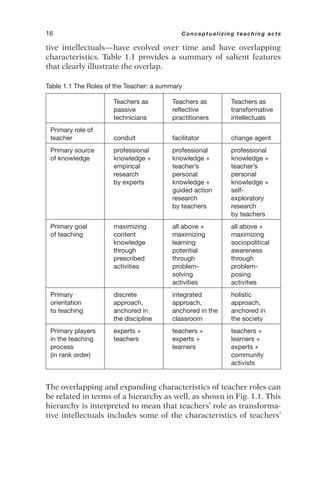
prior expectations about the role-relationship between the learner
and the teacher in the classroom. A crucial task of the teacher wish-
ing to promote learner autonomy is to help learners take responsi-
bility for their learning, and to bring about necessary attitudinal
changes in them. This psychological preparation should be com-
bined with strategic training that helps learners understand what
the learning strategies are, how to use them for accomplishing var-
ious language learning tasks, how to monitor their performance,
and how to assess the outcome of their learning.
Clearly, learners’ ability to take charge of their own learning can
be made possible only if they are trained to identify and use appro-
priate strategies. They not only have to consider the strategies that
contribute to effective learning, but, more importantly, they have to
discover those that suit their learning objectives and their person-
ality traits best. Accordingly, learner training “aims to provide
learners with the alternatives from which to make informed choices
about what, how, why, when, and where they learn. This is not to
Promoting learner autonomy 137
say that they have to make all of these decisions all of the time. They
may, indeed, choose to be teacher-dependent” (Ellis and Sinclair,
1989, p. 2, emphasis as in original). It is, of course, natural for learn-
ers to expect their teachers to train them how to use learning strate-
gies; hence, teachers have to be ready to play a major role in learner
training.
What Teachers Can Do
Gail Ellis and Barbara Sinclair (1989) and Anita Wenden (1991) offer
useful suggestions for teachers in their attempts to train their learn-
ers. According to Ellis and Sinclair (1989, p. 10), teachers can play
an instrumental role in learner training by:
• negotiating with learners about course content and methodology,
if appropriate;
• sharing with learners, in a way that is accessible to them, the kind
of information about language and language learning that teach-
ers have but that is not always passed on to learners;
• encouraging discussion in the classroom about language and lan-
guage learning;
• helping learners become aware of the wide range of alternative
strategies available to them for language learning;
• creating a learning environment where learners feel they can ex-
periment with their language learning;
• allowing learners to form their own views about language learn-
ing, and respecting their points of view;
• counseling and giving guidance to individual learners when pos-
sible.
In order to carry out these objectives and to make learner train-
ing truly meaningful, Wenden (1991, p. 105) suggests that learner
training should be:
• Informed. The purpose of the training should be made explicit and
its value brought to the students’ attention.
• Self-regulated. Students should be trained how to plan and regu-
late the use of the strategy, and also how to monitor the difficul-
ties they may face in implementing it.
• Contextualized. Training should be relevant to the context of the
subject matter content and/or skill for which it is appropriate. It
138 Promoting learner autonomy
should be directed to specific language learning problems related
the learners’ experience.
• Interactive. Learners should not be merely told what to do and
when to do it and then left on their own to practice. Rather, until
they evidence some ability to regulate their use of the strategy,
teachers are expected to continue to work with them.
• Diagnostic. The content of the training should be based on the ac-
tual proficiency of the learners. Therefore, at the outset of any
strategy training, information on which strategies students use
and how well they use them should be collected.
Reflective task 6.3
If you wish to implement some of the learner training guidelines given above,
what possibilities and limitations do you anticipate in your specific learning/
teaching context? Focus, among other factors, on the attitudes of adminis-
trators, colleagues, and students.
What Learners Can Do
The wealth of information now available on learning strategies and
learner training opens up opportunities for learners to monitor their
learning process and maximize their learning potential. With the
help of their teachers and their peers, learners can exploit some of
these opportunities by:
• identifying their learning strategies and styles to know their
strengths and weaknesses as language learners. Learners can
achieve this, for example, by administering, or being adminis-
tered, select portions of strategy inventories and style surveys and
writing their own language learning histories;
• stretching their strategies and styles by incorporating some of
those employed by successful language learners. For example, if
some learners are “global” in their learning style, they might have
to develop strategies that are associated with the analytic learn-
ing style, such as breaking down words and sentences in order to
find meaning;
• evaluating their language performance to see how well they have
achieved their learning objective(s). This can be achieved by mon-
Promoting learner autonomy 139
itoring language learning progress through personal journal writ-
ings, in addition to taking regular class tests and other standard-
ized tests;
• reaching out for opportunities for additional language reception
or production beyond what they get in the classroom, for example,
through library resources, learning centers, and electronic media
such as the Internet;
• seeking their teachers’ intervention to get adequate feedback on
areas of difficulty and to solve problems. This can be done through
dialogues and conversations in and outside the class;
• collaborating with other learners to pool information on a speci-
fic project they are working on. This is done by learners forming
small groups and dividing the responsibilities of consulting ref-
erence materials such as dictionaries and encyclopedias to col-
lect information and sharing it with the group; and
• taking advantage of opportunities to communicate with compe-
tent speakers of the language. This can be achieved by participat-
ing in social and cultural events and by engaging in conversations
with competent speakers either in person or “virtually” through
Web sites.
Collectively, these activities can contribute to at least two bene-
ficial results. Learners gain a sense of responsibility for aiding their
own learning and that of their peers. They also develop a degree of
sensitivity and understanding toward other learners who may be
more or less proficient than they are.
As the above discussion reveals, proponents of the learning-to-
learn approach to learner autonomy aim at making the learners
aware of learning strategies and at training them to use those strate-
gies effectively. Wenden (1991, p. 15) captures the spirit of this ap-
proach when she says this about learners whom she considers to
be “successful” or “expert” or “intelligent”: “They have acquired the
learning strategies, the knowledge about learning, and the attitudes
that enable them to use these skills and knowledge confidently, flex-
ibly, appropriately and independently of a teacher. Therefore, they
are autonomous.” Proponents of this approach also claim that “the
ideal system is one which allows the learner to take as much re-
sponsibility for his own learning as he wishes to, and which makes
provision both for those who want full autonomy and those who do
not want any!” (Dickinson,1987, p. 88). There are, however, critics
140 Promoting learner autonomy
who point out that the learning-to-learn approach may be neces-
sary to produce successful language learners but is certainly not
sufficient to produce truly autonomous individuals. They recom-
mend a broader view of learner autonomy that will help learners
how to learn to liberate themselves.
Broad View Of Learner Autonomy: Learning To Liberate
The narrow view of learner autonomy treats learning to learn a lan-
guage as an end in itself, while the broad view treats learning to
learn a language as a means to an end, the end being learning to lib-
erate (cf. Benson and Voller, 1997, p. 2). In other words, the former
stands for academic autonomy, and the latter for liberatory auton-
omy. While academic autonomy enables learners to be strategic
practitioners in order to realize their learning potential, liberatory
autonomy empowers them to be critical thinkers in order to realize
their human potential. Liberatory autonomy goes much further
than academic autonomy by actively seeking to help learners rec-
ognize sociopolitical impediments placed in their paths to progress,
and by providing them with the intellectual tools necessary to over-
come them.
The idea of liberatory autonomy has been propagated by educa-
tional philosophers such as Paulo Freire (1972), who emphasized
the development of sociopolitical consciousness as a tool for en-
gagement in social struggle, and by social scientists such as Ivan
Illich (1971), who emphasized the need to liberate learning from
the constraints of schooling. General educationists such as Henry
Giroux (1988) and Roger Simon (1987) sought to incorporate the
idea of liberatory autonomy into the school curriculum. Similar
attempts have been made by scholars such as Phil Benson (1997,
2001) and Alastair Pennycook (1997) in the field of L2 education
(see Chapter 1 for more details).
Pointing out the inadequacy of the learning-to-learn approach,
Benson (1997) advocates what he calls a “political version” of learner
autonomy that can offer alternative political frameworks for learn-
ing purposes. Conscious of the prevalent opinion that students
may neither want nor need to be concerned with political issues,
Benson suggests a redefinition of the term politics. We are generally
Promoting learner autonomy 141
accustomed, he argues, “to think of politics in terms of elections,
parties, revolutions, and so on while neglecting the political content
of everyday language and language learning practices. In proposing
a political orientation for learner autonomy, therefore, we need a
considerably expanded notion of the political which would embrace
issues such as the societal context in which learning takes place,
roles and relationships in the classroom and outside, kinds of learn-
ing tasks, and the content of the language that is learned” (p. 32).
In a similar vein, Pennycook (1997) calls for a version of auton-
omy that relates to the social, cultural, and political contexts of ed-
ucation. To become an autonomous language learner and user, he
reckons, “is not so much a question of learning how to learn as it is
a question of learning how to struggle for cultural alternatives”
(p. 45). Accordingly, he advocates the notion of a pedagogy of cul-
tural alternatives, an educational project that seeks to create au-
tonomous learners by providing them with alternative ways of
thinking and being in the world, a project that seeks “to open up
spaces for those learners to deal differently with the world, to be-
come authors of their own worlds” (p. 53).
What the learning-to-liberate approach to learner autonomy
emphasizes is that if we are seriously committed to helping learn-
ers become autonomous individuals, then we need to take into ac-
count the sociopolitical factors that shape the culture of the L2
classroom. More than any other educational arena, the L2 class-
room, where almost any and all topics can constitute the content of
instructional activity, offers ample opportunities for experimenting
with liberatory autonomy. Meaningful liberatory autonomy can be
promoted in the language classroom by:
• encouraging learners to assume, with the help of their teachers,
the role of mini-ethnographers so that they can investigate and
understand how language rules and language use are socially
structured, and also explore whose vested interests these rules
serve;
• making them write diaries or journal entries about issues that di-
rectly engage their sense of who they are and how they relate to
the social world, and continually reflect on their observations
and the observations made by their peers;
• helping them in the formation of learning communities where
learners develop into unified, socially cohesive, mutually sup-
portive groups seeking self-awareness and self-improvement;
142 Promoting learner autonomy
• enabling them to think critically and develop interpretive capabil-
ities needed to contest the regulated representations of language
and culture normally found in prescribed textbooks; and
• providing opportunities for them to explore the unfolding fron-
tiers in cyberspace and the unlimited possibilities offered by on-
line services on the World Wide Web, and bringing back to the
class their own topics for discussion and their own perspectives
on those topics.
The suggestions sketched above can easily be modified and made
more relevant to suit the instructional aims and activities, and in-
stitutional constraints and resources of various learning and teach-
ing contexts. They may be treated as foundations for promoting
a full range of academic and liberatory autonomy for the benefit
of the learner. Taken together, these aspects of autonomy promise
the development of an overall academic ability, intellectual com-
petence, social consciousness, and mental attitude necessary for
learners to avail opportunities and overcome challenges both in and
outside the classroom.
Reflective task 6.4
How do you see the relationship between academic and liberatory auton-
omy—as opposite concepts of autonomy or as two points on a continuum
of autonomy? One way of addressing this question is to think about where
they differ—in their objectives? In their methods? In their emphasis?
Degrees of Autonomy
An important challenge facing both teachers and learners is to de-
termine the degree of autonomy that would be appropriate for their
specific learning and teaching context. As partners in the pursuit of
academic as well as liberatory autonomy, teachers and learners can
negotiate a comfortable degree of autonomy. Several researchers,
including Vee Harris (1996, p. 260), David Nunan (1997, p. 195),
and Scharle and Szabo (2000, p. 9), have considered the issue of the
degree of autonomy accorded to the learner. Generally, they all ad-
vocate a gradual and guided introduction of autonomy over peda-
Promoting learner autonomy 143
gogic choices related to the aims, outcomes, tasks, and materials of
learning and teaching. At the initial stage of autonomy, the empha-
sis is simply on raising the learner’s awareness of the reasons be-
hind the teacher’s choice of goals, tasks, and materials. At the in-
termediary stage, the emphasis is on allowing the learner to choose
from a range of options given by the teacher. Finally, at the ad-
vanced stage, the emphasis is on learner determination of his or her
own goals, tasks, and materials.
It certainly makes sense to start with a modest beginning and
gradually move toward greater challenges. However, it would be a
mistake to try to correlate the initial, intermediary, and advanced
stages of autonomy mentioned in the previous paragraph with the
beginning, intermediate, and advanced levels of language profi-
ciency of a given group of learners. In fact, teachers and learners
can follow different stages of autonomy depending on the linguistic
and communicative demands of a particular task in a particular
class. It would also be a mistake to presuppose that academic au-
tonomy is suitable for learners of lower proficiency levels, and lib-
eratory autonomy for learners of higher proficiency levels. Given
appropriate conditions and adequate preparations, learners at dif-
ferent proficiency levels will profit from an emphasis on academic
as well as liberatory autonomy.
Whether one believes in the narrow or broad view of learner au-
tonomy, what should be recognized is that autonomy is a complex
construct that can be understood only through careful study, and
achieved only through continual struggle. Autonomy cannot be
effectively promoted in the absence of a supportive institutional en-
vironment and a conducive classroom culture. It also requires
teachers who are willing to let go and learners who are willing to
take hold. As Christopher Candlin wisely warns us: “Autonomy can-
not be legislated, independence cannot be wished, in the curricu-
lum as anywhere else in the social polity; what can be done is to
embed their defining principles in the actions of teachers and
learners and make such actions not only open for reasoned choice
by both, but, much more importantly, to establish the philosophi-
cal, purposeful and language acquisitional bases of such choices
themselves as part of the subject matter of the curriculum. After all,
deciding what is to be done and why is one of the few genuinely
communicative acts any classroom can encourage” (Candlin, 1987,
p. xi–xii).
144 Promoting learner autonomy
Microstrategies for Promoting Learning Autonomy
What, then, are the types of microstrategies that can embed the defin-
ing principles of autonomy in the actions of teachers and learners?
I offer some possibilities below in terms of microstrategies and ex-
ploratory projects. In considering these possibilities, keep in mind
that it would be a pedagogically sound practice to build exercises to
promote learner autonomy into the overall language teaching cur-
riculum rather than to devote isolated lessons on it.
Microstrategy 6.1: Learning Preferences Across Generations
6.1.0 The purpose of this microstrategy is to help your students think
about learning preferences across generations. The idea is to start
them on as broad a concept as “generational” learning preferences and
move them toward more specific cases. You may modify the following
activities, depending on the proficiency level of your students and your
specific context of learning and teaching.
6.1.1 Have your students read the chart shown in Figure 6.2. It is
made out of information compiled from an article by an educational
administrator, Lynn Little (2000, p. 4–5). He has identified some gen-
eral characteristics, including learning preferences, of leading genera-
tions of Americans.
6.1.2 Ask your students to discuss, in small groups, the general char-
acteristics of four generations of Americans. Guide them, where nec-
essary, to relate the generational characteristics to the history of the
time period.
6.1.3 Ask them to discuss whether similar (not identical) general
characteristics can be identified among people of different generations
in any other society familiar to them.
6.1.4 Have them discuss the learning preferences of four generations
of Americans. Guide them, where necessary, to relate the learning pref-
erences to the generational characteristics as well as the historical de-
velopment of the time period.
6.1.5 Ask them to imagine what might be the general characteristics
and the learning preferences of the future generation of children born
between 2000 and 2020, whose lives will be shaped by the process of
globalization in terms of economy, culture, and communication.
6.1.6 Then, give them an individual task in which you ask them to
think about and write down their own specific learning preferences.
Promoting learner autonomy 145
Leading
Generations
Veterans:
Born between 1922
and 1943; Many served
in World War I
Baby Boomers:
Born between 1943
and 1960; Children of
World War II veterans
Generation-X’ers:
Born during 1960-
1980; Experienced the
effects of feminist, civil-
rights movements
General
Characteristics
Believe in discipline,
law and order, duty
before pleasure; hard
working; respect for
authority; group-
centered.
Believe in equal
opportunities, personal
gratification, health and
wealth; optimistic;
team-oriented;
self-centered.
Believe in self-reliance
and independent
thinking; accept
diversity; pragmatic in
outlook; not intimidated
by authority.
Learning
Preferences
Prefer a stable, orderly,
risk-free learning
environment; respect
teachers’ authority;
motivated to learn;
focus on practice-
oriented knowledge.
Prefer an interactive
learning environment,
with non-authoritarian
teachers; welcome
opportunities for team
work, but believe in
competition over
cooperation.
Beginning to use
technology.
Prefer a self-directed
learning environment;
want knowledge and
skills that increase
productivity; more
comfortable with
graphics and visual
images than with print
media.
Figure 6.2
Let them draw from the list of adjectives given in the chart and go be-
yond those, if necessary.
6.1.7 Ask them to rejoin their groups, exchange their notes about in-
dividual preferences, and identify features that are common to the mem-
bers of the group.
6.1.8 Have each group of students report to the class and present the
common learning preferences they have identified, followed by class
discussion.
146 Promoting learner autonomy
6.1.9 Where appropriate, challenge your students to discuss whether
the information given in the table is too much of an overgeneralization
to be of use.
6.1.10 Design a task that you might want to give them as homework
(e.g., ask them to write a brief report on the learning preferences of
other students that they would like to develop themselves and what
they may have to do to achieve their goal).
Microstrategy 6.2: Inferencing as a Learning Strategy
6.2.0 This microstrategy is designed to help your students know
whether and how well they use inferencing as a strategy for improving
their reading comprehension. You may design similar microstrategies
focusing on other learning strategies appropriate to your students.
Keep in mind that, in this and in any similar microstrategy on learner
autonomy you may design, your task is to probe the how rather than
the what of learners’ responses, that is, focus on the thought processes
underlying their answers rather than on the answers themselves.
6.2.1 Put the following passage on an overhead transparency and
ask your students to read it quickly. Tell them not to be bothered, at this
stage, by any new words they may come across. The passage is taken
from Runaway World. It was written by Antony Giddens, director of
London School of Economics and Political Science.
A friend of mine studies village life in central Africa. A few years
ago, she paid her first visit to a remote area where she was to carry
out her fieldwork. The day she arrived, she was invited to a local
home for an evening’s entertainment. She expected to find out
about the traditional pastimes of this isolated community. Instead,
the occasion turned out to be a viewing of Basic Instinct on video.
The film at that point hadn’t even reached the cinemas in London.
Such vignettes reveal something about our world. And what
they reveal isn’t trivial. It isn’t just a matter of people adding mod-
ern paraphernalia—videos, television sets, personal computers and
so forth—to their existing ways of life. We live in a world of trans-
formations, affecting almost every aspect of what we do. For better
or worse, we are being propelled into a global order that no one
fully understands, but which is making its effects felt upon all of us.
Antony Giddens (2000, p. 24–25)
6.2.2 Have your students read it again, this time jotting down all new
words.
Promoting learner autonomy 147
6.2.3 Ask a few students to share with the class some of the words
that are new to them. As they respond, write the words down on the
board, or on a separate transparency.
6.2.4 Call upon a couple of students to explain the strategies they
might use to find the meanings of some of the listed words that are new
to them.
6.2.5 Then, introduce or elaborate (depending on the level of your
students’ awareness) inferencing as a learning strategy. Encourage them
to think by asking questions such as: What is inferencing? Do you use it
for language learning purposes? What do you actually do when you use
it? Do you find it useful? Etc. Lead them to understand that inferenc-
ing as a strategy involves the use of textual clues (such as knowledge of
their L1 and their still-developing L2) or contextual clues (such as back-
ground knowledge), and has been found to be very useful in guessing
the meaning of unknown words.
6.2.6 Focusing on the first paragraph, ask the students to guess the
meaning of, for example, the word remote. If students give a partially
correct answer, ask them questions such as: How do you know? How
did you guess? If they don’t do it themselves, draw their attention to
two other related words—village life and isolated community—that
offer clues to the meaning of remote. Also, ask them to guess the pro-
fession of Giddens’ friend. Find out whether they are able to make use
of textual information such as studies village life and fieldwork. If nec-
essary, draw their attention to the difference between what a sociolo-
gist does and what an anthropologist does.
6.2.7 Taking the discussion to a higher level of inferencing, have
them read the last sentence again: The film at that point hadn’t even
reached the cinemas in London. Zero in on the word even. Concentrate
on whether and how they are able to understand the irony of a just-
released American movie finding its way to a remote village in central
Africa even before it had reached a European Capital city like London.
Similarly, ask them to read the sentence, She expected to find out
about the traditional pastimes of this isolated community. Ask them to
think about what it means when an outsider—whether a tourist or an
anthropologist—goes to places like central Africa “expecting” to find
something.
6.2.8 Now focus on the second paragraph, which contains some
challenging words. Ask your learners, for instance, to guess the mean-
ing of vignettes, trivial, and paraphernalia and to tell the rest of the
class how they did it. See whether they are able to make use of all
148 Promoting learner autonomy
the semantic redundancies in the paragraph (e.g., the word parapher-
nalia is followed by a list of items). Focus on their process of meaning-
making, prompting them with questions such as, How did you come up
with that?
6.2.9 Follow a slightly different procedure in helping your learners
understand the author’s choice of words like transformation and propel.
For instance, rewrite We live in a world of transformations to read We
live in a changing world and see whether your learners notice any dif-
ference. Similarly, replace we are being propelled into a global order with
we are moving into a global order and ask them if and how they see the
difference in meaning.
6.2.10 Finally, in order to help your students reflect on their knowl-
edge and use of inferencing as a learning strategy, ask them to write a
brief report recalling the thought processes that were going through
their mind while working on this task in class.
Exploratory Project 6.1: Where Am I and
Where Do I Want To Be?
6.1.0 As the title suggests, the objective of this project is to help you
reflect on where you are right now as an individual wishing to promote
learner autonomy, and where you want to be within a time period you
set for yourself (one semester? one year? two years?).
6.1.1 Select any one class you recently taught. Try to recall the de-
gree of learner autonomy you promoted in that class. Consider the en-
tire semester (or academic year), not just one class session. Think in
terms of an interrelated GAME plan:
• Goals: general as well as specific instructional goals and objec-
tives,
• Activities: the type of classroom activities needed for realizing the
goals,
• Materials: the selection of appropriate instructional materials,
and
• Evaluation: methods of assessing desired learning outcomes.
6.1.2 Note down your random thoughts about what you did to pro-
mote learner autonomy in terms of the GAME plan. A possible format
for your note-taking is shown in Figure 6.3.
Promoting learner autonomy 149
6.1.3 Read the following twenty statements, and, using your random
notes as a guide, rate yourself on a 5–1 (5 = no promotion of learner
autonomy; 1 = substantial promotion of learner autonomy) to estimate
where you stand now. Check the statements that reflect your current
status.
Goals
5: I start with and follow a set of instructional goals I have pre-
pared (or given to me) for all the classes I teach.
4: I discuss my instructional goals with my students, and modify
them suitably based on their feedback.
3: I present my students with a set of instructional goals for them
to choose from.
2: I ask my students to tell me what they expect to learn from my
class and try to incorporate their goals in my teaching agenda.
1: I honor my students’ needs and wants, their goals and objec-
tives that I identify by administering a questionnaire specially
prepared for a particular class.
Activities
5: I achieve my instructional goals by presenting language items
clearly, and by providing ample opportunities for students to
practice.
4: I determine the type of activity (individual task, pair-work,
group work, whole class) that best suits my instructional goal.
3: I encourage my students to adapt the content, the goal and the
method of an activity within limits acceptable to me.
2: I let my students work independently on tasks and, when neces-
sary, help them get back on track.
1: I invite my students to create a task and accomplish it at their
own pace, in their own way and reach a jointly determined goal.
150 Promoting learner autonomy
Year/Semester: Class:
Goals Activities Materials Evaluation
Figure 6.3
Materials
5: I use commercially produced textbooks that are selected and
prescribed by me or by my school authorities.
4: In addition to using prescribed textbooks, I prepare supple-
mentary materials that I believe will interest my students.
3: I involve my students in the final selection of textbooks by ask-
ing them to choose from a range of options I consider appro-
priate for their level.
2: I start with prescribed textbooks and prepared materials, and
then encourage my students to modify or adapt the tasks and
exercises the way they think interesting and appropriate.
1: I invite my students to read the local newspapers, surf the In-
ternet, and go to other sources to bring materials that they
think are interesting and appropriate.
Evaluation
5: I evaluate the learning outcome of my students by using com-
mon tests, that is, tests given in the textbook or those designed
by my school.
4: I assess my students’ performance using a combination of com-
mon tests and those I design for learners in a particular class.
3: I give my students a range of test formats (essay, multiple
choice, yes/no, etc.) to choose from, and I try to honor their
choice as much as possible.
2: I ask my students to assess their own performance using speci-
fic and clear guidelines I give them. I normally keep their as-
sessment in mind when I do mine.
1: I ask my students to assess their performance using their own
guidelines, which I ask to specify. I then allow their self-assess-
ment to inform my own.
6.1.4 Take a different color pen or pencil and go over the statements
again, this time checking where you wish to be within a specified pe-
riod of time, considering your specific context and level of teaching re-
sponsibilities.
6.1.5 Think about all the resources that are available to you to help
you get where you wish to be. Also, think about how you can make use
of them. Use the format shown in Figure 6.4 to take notes:
Promoting learner autonomy 151
6.1.6 Think about all the constraints (e.g., lack of resources and
time, administrative hurdles, learner apathy, etc.) that you think will
frustrate you from getting where you wish to be. Also think about how
you can cope with them. Use the format shown in Figure 6.5 to take
notes:
152 Promoting learner autonomy
Item (from GAME plan) Available resources How to use resources
. . . . . . . . .
Figure 6.4
Item (from GAME plan) Possible constraints How to cope with them
. . . . . . . . .
Figure 6.5
6.1.7 Finally, think about what you learned from doing this project,
and how your attitude toward learner autonomy has or has not changed.
Exploratory Project 6.2: Learner Profile
6.2.0 One of the first steps in promoting learner autonomy is to iden-
tify who your learners are, what learning strategies and styles they
bring with them, and what they hope to learn in your class. Accord-
ingly, this project is designed to help you create a learner profile at the
beginning of a course.
6.2.1 Use the questionnaire shown in Figure 6.6 to conduct a survey
among your learners. Keep in mind that what follows is a generic ques-
tionnaire. You should feel free to modify, add, or delete any statement
in order to make the survey more relevant to your specific learning and
teaching context.
6.2.2 Collect the completed survey from your students. Have an in-
dividual conference with each student to discuss their individual aims,
strategies, and styles. You can also use the information to individualize
your instruction as much as possible.
Name: Class: Date:
Note: This is not a test. This is a survey to seek your opinion about yourself. This
survey will help me understand what you expect to learn in this class, and what you
normally like to do in order to learn. Please read the following statements carefully and
circle 1 if you agree, 2 if you disagree, or 3 if you are not sure. Do not think too much;
your first impression is always the best.
1.0 Aims
1.1 I want to improve my listening skills 1 2 3
1.2 I want to improve my speaking skills 1 2 3
1.3 I want to be able to read well and read fast 1 2 3
1.4 I want to be able to write well 1 2 3
1.5 I want to improve my critical thinking skills 1 2 3
1.6 I want to improve my grammar 1 2 3
1.7 I want to increase my vocabulary 1 2 3
1.8 I want to learn to pronounce words correctly 1 2 3
1.9 I want to be able to participate in class discussions 1 2 3
2.0 Strategies
2.1 I know how to read well in my first language 1 2 3
2.2 I know how to write well in my first language 1 2 3
2.3 I use my first language knowledge to learn the second 1 2 3
2.4 I compare the grammar rules of the languages I know 1 2 3
2.5 I use what I already know to learn something new 1 2 3
2.6 When I read, I focus on pictures, subtitles, and key words 1 2 3
2.7 I think about grammar rules when I speak and write 1 2 3
2.8 I associate new information with images and pictures 1 2 3
2.9 I monitor and judge my progress in language learning 1 2 3
2.10 When I read, I use a dictionary to understand new words 1 2 3
2.11 I think about strategies that will help me learn better 1 2 3
2.12 I identify the problems that slow down my progress 1 2 3
2.13 I use the library, the Internet, and other sources to learn 1 2 3
2.14 I seek out conversation partners to improve my skills 1 2 3
2.15 I do not like to make mistakes when I speak or write 1 2 3
2.16 When I read, I try to guess the meaning of new words 1 2 3
2.17 I like to find out grammar rules myself 1 2 3
2.18 I don’t think I can evaluate my own learning 1 2 3
3.0 Styles
3.1 I like working with a partner in class 1 2 3
3.2 I participate actively in whole-class discussions 1 2 3
3.3 I like to work on topics and themes that I select 1 2 3
3.4 I learn best when my teachers explain grammar rules 1 2 3
3.5 I think I do better when I work alone 1 2 3
(continues)
Promoting learner autonomy 153
Figure 6.6
Class: Total number of students: Date:
No. of learners No. of learners No. of learners
Item who agree who disagree who are not sure
Figure 6.7
6.2.3 Consolidate and tabulate the information from your students
to get a general idea of the class profile. You may use the format shown
in Figure 6.7.
154 Promoting learner autonomy
3.6 I like to learn from my teachers, not from my classmates 1 2 3
3.7 I hesitate to participate because I fear I’ll make mistakes 1 2 3
3.8 I share with my class interesting readings from the Internet 1 2 3
3.9 I think working in a small group is a waste of time 1 2 3
3.10 I feel frustrated when I work with classmates 1 2 3
3.11 I participate actively in a small group 1 2 3
3.12 I read newspapers daily to increase my vocabulary 1 2 3
3.13 I don’t like telling my teachers what to do in class 1 2 3
Figure 6.6 continued
6.2.4 Distribute the completed table to your class, and use it as you
would use any other instructional material. For instance, ask the stu-
dents to study the table and discuss the class profile. Initiate a class dis-
cussion in which the learners, in pairs or in small groups, determine
where the aims, strategies, and styles overlap, and where they diverge.
Encourage them to think about how the class profile can be used to de-
velop a coherent classroom community.
6.2.5 Think about how, and to what extent, you can incorporate the
needs and wants, and the strategies and styles, of your learners into
your instructional agenda. To start, it would be a useful exercise to se-
lect any one lesson you have planned to teach and see what changes
you may have to make in your lesson plan in terms of specific objec-
tives, type of activities, and classroom management in order to be sen-
sitive to the learners’ profile.
In Closing
It is clear that any serious promotion of learner autonomy involves
the willing cooperation of teachers as well as learners. They are re-
quired to jointly determine the degree of autonomy that would be
appropriate for their specific learning and teaching context, and the
right path to reach their goals. This might call for a fundamental at-
titudinal change on their part. In practical terms, what this means
is that teachers have to determine the degree of control they are
willing and able to yield to their students in terms of curricular aims
and objectives, selection of tasks and materials, and assessment of
learning outcomes. Conversely, this also means that learners have
to decide, with some guidance from their teachers if necessary, the
degree of responsibility they are willing and able to take in those
areas of learning and teaching.
Promoting learner autonomy 155
C H A P T E R 7
Fostering L a n g u a g e Aw a r e n e s s
As you are reading these words, you are taking part in
one of the wonders of the natural world. For you and I
belong to a species with a remarkable ability. . . . That
ability is language. . . . The ability comes so naturally
that we are apt to forget what a miracle it is.
—STEPHEN PINKER, 1994, p. 15
Language is intricately woven into the fabric of human life. It is
closely linked to the relationship between mother and child, between
self and society, between thought and action, between war and
peace. It is all-pervasive. We use it, misuse it, and abuse it. And yet,
we seldom think about it. We hardly notice its presence around us.
We rarely recognize when people use it to control others. We barely
notice when politicians manipulate it to manage public opinion.
It is no wonder, therefore, that educational centers seek to play
a pivotal role in fostering students’ awareness of the role played by
language in the development of individuals as well as institutions.
The relevant literature in the fields of education and language
teaching presents various strands of thought about how language
awareness can be fostered. These thoughts may be classified under
the rubric of (a) general language awareness and (b) critical lan-
guage awareness. The former treats language awareness primarily
as an awareness of linguistic and sociolinguistic features governing
language usage, while the latter treats it primarily as an awareness
of social and political factors governing language use. Let us con-
sider both in relation to L2 classroom teaching.
General Language Awareness
Educational philosophers all over the world have long emphasized
the role of general language awareness in human development.
However, it is only recently that concerted efforts have been made
in educational circles to relate language awareness directly to edu-
cational policies. Two prominent movements that have recently
contributed to such efforts in the West are the Language Awareness
movement in the United Kingdom and the Whole Language move-
ment in the United States.
The British Movement
The origin of the current Language Awareness (LA) movement in
Britain can be traced to a 1975 report of the Bullock Committee set
up by the British government to go into “the teaching of reading
and other uses of English.” The report was titled A Language for Life,
which succinctly captures the essence of LA. It generated serious
debates among educationists, leading eventually to several curricu-
lar reform proposals. While they differ in emphasis, they all adhere
to a rather broad definition of LA: “a person’s sensitivity to and con-
scious awareness of the nature of language and its role in human
life” (Donmall 1985, p. 7, cited in van Lier, 1996, p. 79).
Reflective task 7.1
Think, in very specific terms, about the role played by your teacher(s) (or
anybody else) in promoting your sensitivity to language and its role in your
life. If possible, compare your thoughts with those of one other person.
Following the generally agreed upon definition of LA, educa-
tionists and language teachers in Britain attempted to develop ped-
agogic principles and practices with the view to promoting lan-
guage awareness among school-children. They sought to bridge the
gap between primary and secondary school expectations of lan-
guage related work, and the gap between first- and second-language
teaching objectives and activities. In addition, they were also in-
terested in promoting linguistic tolerance among learners coming
from mainstream as well as from minority language backgrounds.
As Eric Hawkins (1984, p. 6), one of the leading proponents of LA,
declared: “We are seeking to light fires of curiosity about the central
human characteristic of language which will blaze throughout our
pupils’ lives. While combating linguistic complacency, we are seek-
ing to arm our pupils against fear of the unknown which breeds
prejudice and antagonism.”
Fostering language awareness 157
The American Movement
As the LA movement was spreading in Britain, a similar effort was
undertaken in the United States under the label Whole Language
movement. It was aimed at providing rich language experience for
school-children by integrating the four language skills of listening,
speaking, reading, and writing, and by introducing language re-
lated activities in content areas across the school curriculum. Sup-
porters of the movement argued that various components of lan-
guage such as sounds, words, phrases, and sentences should be
taught holistically using authentic materials and meaningful activ-
ities that resonate with learners and their daily life.
In addition, the Whole Language movement wanted to recognize
the diverse linguistic resources that learners bring to the class—
resources that include dialectal variations in L1 as well as L2. As
Ken Goodman (1986, p. 27), one of the leading supporters of the
Whole Language movement, observed: “Whole language is whole. It
does not exclude some languages, some dialects, or some registers
because their speakers lack status in a particular society. Every lan-
guage form constitutes a precious linguistic resource for its users.
This does not mean that whole language teachers are not aware of
the social values assigned to different language varieties and how
these affect people who use them. But they can put these social val-
ues in proper perspective.”
Reflective task 7.2
If the educational institution you are associated with has an official policy of
promoting a “standard” variety as opposed to a “nonstandard” variety of a
language, what are the ways in which you can be sensitive to those students
who may speak a “nonstandard” variety at home? How can you make use
of the linguistic resources such learners bring to your class?
A common theme stressed by both American and British educa-
tors relates to the integration of language experience across the
curriculum at elementary as well as secondary school levels. Since
elementary school teachers deal with all the subjects taught at their
level, they already are considered to conceive of their task in terms
of integrated rather than subject-oriented teaching. That is not the
158 Fostering language awareness
case in departmentalized secondary schools. The American and
British educators, therefore, emphasize the need for secondary
school subject teachers to think of the language of math, or the lan-
guage of science, or the language of history, as something that
should be explicitly taught along with mathematical problems, sci-
entific concepts, or historical events. They therefore suggest that
secondary school teachers, regardless of their subject specializa-
tion, should be trained in areas such as the nature and function of
language, language and thought, and language and culture (Haw-
kins, 1984, p. 28). In other words, they should be equipped with the
knowledge and skill necessary “to consider how language is used in
their fields and then think of their curriculum as a dual curriculum
with a double agenda it implies” (Goodman, 1986, p. 31).
General Language Awareness in Action
While there are minor variations between the British and American
approaches to actual classroom practices aimed at promoting lan-
guage awareness, they largely focus on the properties of language
structure and language usage with particular reference to literacy
skills (reading and writing). Furthermore, in spite of their well-
intentioned emphasis on language across the curriculum, their ef-
forts were mostly directed at language classes since these classes,
whether L1 or L2, easily lend themselves to metalinguistic activities
through which participants can objectify a language and talk about
it. They showed that there are interesting ways in which learners’
attention can be explicitly drawn to the logic of a linguistic sub-
system be it spelling, intonation, or grammar.
It is only natural for language learners to expect some logic in the
way a language operates. The fact that certain language subsystems
defy logic can itself be considered an opportunity for creating lan-
guage awareness. The English language is a prime candidate if one
is looking for a language full of what appear to be irregularities.
Calling it “a zany logic-defying tongue,” Stephen Pinker (1994, p. 18)
reminds us that English is a language in which “one drives on a
parkway and parks in a driveway, plays at a recital and recites at
a play.” Nothing perhaps testifies to the “zaniness” of the English
language more than its spelling system. As Hawkins (1984, p. 118)
points out, there are at least nine different spellings for the sound
of the vowel [I:] in English: believe, receive, people, key, leave, ma-
chine, quay, be, and see). Similarly, one is often reminded of the
Fostering language awareness 159
well-known complaint by British playwright George Bernard Shaw
that fish could just as well be spelled ghoti (gh as in tough, o as in
women, ti as in nation).
Simple examples like the above can provide an interesting way of
fostering general language awareness among learners, particularly
about the regularity or the irregularity of linguistic systems. The
same examples can also be used creatively to help learners analyze
and understand whether there is underlying logic behind apparent
irregularities. For instance, Stubbs (1980, p. 48, cited in Hawkins,
1984, p. 118–9) observes that Shaw’s fish-ghoti example is actually
a clear case of a misunderstanding of the English spelling system
because gh cannot represent the sound f in initial position in any
word in English. Other sounds in ghoti also have restrictions about
whether they can occur in the initial, middle, or final position of an
English word.
Reflective task 7.3
How can you make use of just this one example (fish-ghoti) to teach some
of the basics of the spelling system in English?
Subtle nuances of stress and intonation are yet another area of L2
learning and teaching where any attempt at explicit language aware-
ness will be of immense help. Several studies on discourse strategies
of everyday communication between native and non-native speak-
ers of a language reveal the importance of proper use of prosodic
features. John Gumperz (1982), for instance, has studied commu-
nicative tensions between London residents and immigrants from
India, Pakistan, and the Caribbean islands. He found that the mis-
trust and miscommunication prevalent among these communities
arise in part because of faulty use of stress and intonation features
by non-native speakers of English, and he has provided several in-
teresting examples to support his claim.
One such example deals with a London bus driver, an immigrant
from the West Indies. When a passenger boarded the bus and pre-
sented a large bill to buy a ticket, the driver said, “Exact change,
please,” putting extra emphasis on please and with falling intona-
tion. Walking down the aisle, the passenger wondered aloud, “Why
do these people have to be so rude and threatening?” (Gumperz,
160 Fostering language awareness
1982, p. 168). Gumperz explains that, according to the conventions
of British English, the polite way of marking this directive would be
to put the stress on change and not on please, the reason being that
change is the new information that needs to be highlighted. Or, the
driver could have used please with a rising intonation, signaling a
polite question.
A strong stress on please with a falling intonation would be equiv-
alent to giving an order—a convention that would be appropriate
only if the speaker is in a position of authority, as in the case of
a parent who might firmly say to a child: “Clean up the mess . . .
please.” Gumperz goes on to say that the driver did not intend to be
impolite, and that putting emphasis on please in this context, even
with a falling intonation, would indicate politeness according to
speech conventions used by West Indian speakers. From a class-
room point of view, raising the learners’ awareness of subtle nu-
ances of intonation patterns would be beneficial particularly if the
learners’ L1 does not possess prosodic features similar to those in
their L2.
Sometimes, even without teacher initiative, learners themselves
might raise questions that provide opportunities for teachers to cre-
ate explicit language awareness in class. But teachers may not be al-
ways ready and attentive as shown in the following classroom dia-
logue on renting a house. A learner is curious about the expression
a three bedroom house:
1 S: Why three bed, er, three bedroom? Why we don’t say three bed-
rooms?
2 T: Ahhm, oh, I don’t know.
3 S: Is not right.
4 T: We don’t say it. We don’t say it. There’s no explanation. But we
often do that in English. Three bedroom house.
5 S: (Another student) Don’t ask for it.
6 S: Yes.
7 T: Well, do ask why, ask why and 99 percent of the time I know
the answer. One percent of the time nobody knows the answer.
If I don’t know it, nobody knows (laughter). Ah, no, I don’t
know the answer.
(Data source: Nunan, 1989, p. 181–2.)
Fostering language awareness 161
While, as Nunan observes, the teacher’s reply is “hardly encourag-
ing,” it highlights the need for incorporating a focus on language
awareness in teacher education programs.
Reflective task 7.4
Do you approve of the way the teacher handled the student’s question in the
above episode? Why/why not? What are the different ways of responding to
this question—if your objective is to create general language awareness?
Language Awareness of Language Teachers
A conscious awareness of the way the language they are teaching
works and the way it is used is absolutely essential for teachers
whether they are native speakers or non-native speakers. Most na-
tive speaking teachers, having unconsciously mastered their L1 in
their childhood, may know the underlying system of their language
intuitively, but they may lack explicit knowledge needed to give a
proper explanation. Most non-native speaking teachers may have
consciously learned their L2 and learned about it as well, but still
may lack adequate competence and confidence in it.
Emphasizing the need for creating language awareness among
language teachers, Scott Thornbury (1997, p. xii) correctly cautions
that teachers’ limited knowledge of language may result in “a failure
on the part of the teacher to anticipate learners’ learning problems
and a consequent inability to plan lessons that are pitched at the
right level; an inability to interpret course book syllabuses and
materials and to adapt these to the specific needs of the learners;
an inability to deal satisfactorily with errors, or to field learners’
queries; and a general failure to earn the confidence of the learners
due to a lack of basic terminology and ability to present new lan-
guage clearly and efficiently.” In order to address these concerns,
Thornbury (1997) has written a book, About Language: Tasks for
Teachers of English, consisting of nearly three hundred tasks start-
ing with phonemes and progressing through words, phrases, sen-
tences, and complete texts.
Taking a different approach, Leo van Lier (1996) has called for
Language Awareness in Teacher Education (LATE) based not on
162 Fostering language awareness
additional courses in linguistics or grammar, “not on sweeping
changes or reforms of great magnitude, but on one small moment
in the educational process: teachers and students talking to each
other” (p. 85). He would like a LATE course for teachers that would
“examine the reality of language use in relevant educational set-
tings, preferably incorporating classroom observation and gather-
ing of data by students” (p. 88). He suggests three things a LATE
course should do:
• Take an experimental approach to LA, one that acknowledges that
teachers have a great deal of knowledge and know-how of lan-
guage, and which systematically draws upon that experiential
base.
• Reject language-as-product, i.e., focus not on language as a body
of content matter that can be transmitted piecemeal to an audi-
ence, but rather as a living thing that shapes our existence and
that we use to make sense of our world and our work.
• Study language critically, i.e., emphasize that language study is
not only relevant to teacher education and classroom practice,
but that it is essential to human growth and self-fulfillment.
(van Lier, 1996, p. 88–9)
Van Lier argues that within each of these three components, teach-
ers should explore issues that are of interest to them and to their
learners, and he believes that linguistic features of phonology, syn-
tax, discourse, etc., will automatically become a part of that larger
exploration.
Reflective task 7.5
To what extent, do you think, has the teacher education program you are as-
sociated with helped you to “examine the reality of language use in relevant
educational settings” in order for you to develop language awareness?
It is clear from the above that American and British educators
have made serious attempts to promote general language aware-
ness among language teachers in particular and among teachers in
general. For most part, however, they narrowly focused on language
structures and literacy skills rather than on the broader role lan-
Fostering language awareness 163
guage plays in shaping and reshaping human lives. In addition, as
van Lier (1996) rightly points out, they also dissipated their energy
by indulging in endless arguments about the importance of phon-
ics (as American educators did), or the imposition of “standard
English” (as their British counterparts did).
I am not suggesting that the work on general language awareness
has been useless or unnecessary, only that it has been insufficient.
In other words, in spite of their lofty ideals about creating aware-
ness of language and its potential to liberate the human mind, sup-
porters of general language awareness shied away from sociopo-
litical aspects of language, especially aspects of the relationship
between language and power. A widespread dissatisfaction with the
limitations of the general language awareness movements led to the
emergence of another school of thought that emphasizes what is
called critical language awareness.
Critical Language Awareness
The principles and practices of Critical Language Awareness (CLA)
can be traced to the contributions made by, among others, Norman
Fairclough (1992, 1995) and his colleagues in Britain, and later by
Allan Luke (1996, 1997) and his colleagues in Australia. Without dis-
missing the basic linguistic and sociolinguistic aspects of general
language awareness, advocates of CLA seek to consider the sociopo-
litical nature of language use as well. They particularly wish to ac-
knowledge and act upon the fact that language, any language, is im-
plicitly linked to the exercise of power. Therefore, given that “power
relations work increasingly at an implicit level through language, and
given that language practices are increasingly targets for interven-
tion and control, a critical awareness of language is a prerequisite
for effective citizenship, and democratic entitlement” (Fairclough,
1995, p. 222).
Like critical pedagogists (see Chapter 1), CLA advocates, too, as-
sert that a critical awareness of the word is essential to develop a
critical awareness of the world. They also see language education as
a prime source for sensitizing learners to social inequalities that
confront them and for developing necessary capabilities for address-
ing those inequalities. CLA, therefore, should be fully integrated not
only with the development of language practices across the curricu-
164 Fostering language awareness
lum but also with the development of the individual learner’s in-
tellectual capabilities that are required for long-term, multifaceted
struggles in various sociopolitical arenas (Fairclough, 1992).
One way of integrating CLA with the development of learners’
intellectual capabilities is to help them understand how power is
produced, maintained, and also resisted with the help of different
language forms. This is not an easy task because, as Allan Luke (1996)
reminds us, what lends controlling power to language is the way it
is used and interpreted in specific sociopolitical contexts. There-
fore, he and his colleagues suggest that the teaching of CLA should
begin by putting any textual material used in the class “up for grabs,
for critical debate, for weighing, judging, critiquing.” Such a criti-
cal analysis of texts “also requires classroom frames for talking
about how and in whose interests social institutions and texts can
refract and bend social and natural reality, manipulate and position
readers and writers” (Luke, O’Brian, and Comber, 1994, p. 141).
If we wish to encourage L2 learners to do the kind of critical
analysis of language use suggested by CLA advocates, then we
should take into account the ideological markers of a text in addi-
tion to its propositional message. Only then will we be able to help
our learners understand how language is used by some as a tool for
social, economic, and political control. If we refrain from taking
such a critical approach, we will knowingly or unknowingly con-
tribute not only to the marginalization of our learners but to our
own marginalization as well. What James Gee (1994, p. 190) says
about teachers of English is also true of all language teachers: “Eng-
lish teachers can cooperate in their own marginalization by seeing
themselves as “language teachers” with no connection to such so-
cial and political issues. Or they . . . accept their role as persons who
socialize students into a world view that, given its power here and
abroad, must be looked at critically, comparatively, and with a con-
stant sense of the possibilities for change.”
Reflective task 7.6
Do you agree with Gee that, if your language teaching is not connected to
social and political issues, you are cooperating in your own marginalization?
In what way is this true or not true?
Fostering language awareness 165
Critical Language Awareness in Action
There are several ways of fostering CLA in the L2 classroom. A be-
ginning can be made by paying attention to the selection of text-
books and supplementary materials. Rather than selecting textbooks
for the strings of grammatical structures and vocabulary items that
provide much needed linguistic input to the learner, they should be
selected for their potential to challenge the intellectual capabilities
of the learner as well. Whether centrally prescribed or self-selected
by teachers, textbooks can be excellent resources for critical read-
ing aimed at sensitizing learners to subtle meanings, concealed as-
sumptions, and hidden attitudes embedded in a text.
As suggested by CLA practitioners (see, for example, Catherine
Wallace, 1992; Kristine Brown, 1999), a critical dimension to read-
ing can be easily added to usual classroom practice by
• incorporating open-ended questions to the ones already given in
the textbook;
• shifting from an emphasis on one right answer to multiple inter-
pretations, as long as plausible reasons are provided;
• encouraging learners to recognize and respect a variety of view-
points;
• asking learners to discuss how topics could be dealt with dif-
ferently, from the point of their own linguistic and cultural per-
spective;
• helping learners to critically reflect on taken-for-granted views
and aspects of language;
• encouraging learners to regularly keep diaries or journals in which
they note and comment on social practices and language use that
particularly strike them—something they read or heard on the
bus, or on the street, or at the mall.
Such a critical approach can actually lend a motivating dimen-
sion to texts that are normally no more than a bland, boring collec-
tion of linguistic input.
Reflective task 7.7
The ideas given above pertain mainly to critical reading. In what way can

CLA be promoted through speaking, listening, and writing activities as well?
166 Fostering language awareness
While a critical reading of passages included in most L2 textbooks
can provide opportunities for fostering CLA in the classroom, per-
haps nothing is more useful for that purpose than supplementary
materials such as government reports or newspaper articles. They
have a tendency to use deceptive language to hide real intentions
particularly when dealing with sensitive cultural or political issues.
In his perceptive essay Politics and the English Language, George
Orwell (1946) observed that the “great enemy of clear language is
insincerity. When there is a gap between one’s real and one’s de-
clared aims, one turns as it were instinctively to long words and ex-
hausted idioms, like a cuttlefish squirting out ink.”
The language of insincerity results in what is called doublespeak.
According to William Lutz (1989, p. 1), doublespeak “is language
that makes the bad seem good, the negative appear positive, the un-
pleasant appear attractive or at least tolerable.” A detailed discourse
analysis of newspaper and news magazine articles will yield telling
examples of doublespeak that can be used in class for creating crit-
ical language awareness. Brian Morgan (1998), for instance, cites
a British newspaper article that printed a collection of terms used
by the British media to describe the 1991 Gulf War. Here are some
examples.
They have a war machine. We have army, navy and air force.
Their men are brainwashed. Our boys are professional.
They have propaganda. We have press briefings.
They destroy. We take out.
They kill (enemies). We neutralize (enemies).
They are ruthless. We are resolute.
Their missiles cause civilian Our missiles cause collateral damage.
casualties.
Their planes are zapped. Our planes fail to return from missions.
As these examples show, doublespeak is the result of a deliberate at-
tempt to mislead and misinform. A critical engagement with polit-
ical discourse appearing in newspapers and news magazines can go
a long way in helping learners realize that language can conceal as
much as it can reveal. Doublespeak is not limited to times of war;
newspapers carry political discourses full of doublespeak other times
as well (see the microstrategy 7.2 below).
Fostering language awareness 167
Reflective task 7.8
Do you think helping learners analyze and understand the language of cur-
rent affairs in the L2 classroom is a good way of fostering critical language
awareness? How would you respond to those who may believe that such
discussions can come only at the expense of the important task of devel-
oping basic language skills?
To sum up our discussion so far, language is an integral part of the
practice of everyday life. Therefore, any educational enterprise must
include the teaching of language awareness. A general awareness of
the way in which a language operates in terms of phonology, syntax,
semantics, and discourse is necessary but not sufficient. What is also
needed is the fostering of critical language awareness that can en-
rich one’s understanding of how a language is often used to control
people economically, culturally, and socially. It is therefore important
for teachers, language teachers in particular, to design activities that
foster both general and critical language awareness in the classroom.
Microstrategies for Fostering Language Awareness
This section presents two microstrategies—one dealing with general
language awareness and another with critical language awareness.
Microstrategy 7.1: Language Use and Levels of Formality
7.1.0 This microstrategy is designed to foster general language aware-
ness about levels of formality involved in interpersonal communica-
tion. One example of formal-informal language use pertains to the way
in which we address people at home, in school, or at our workplace.
Therefore, a useful microstrategy may be to ask L2 learners to explore
how different cultural communities require different levels of formality
in addressing people. Here’s one way of doing it. Make changes to suit
your specific learning/teaching situation.
7.1.1 Write the following (or similar) forms of address on the board:
Madam President
Mr. Chairman
168 Fostering language awareness
Your Honor
Sir
Hello Darling
Hey
Divide the class into small groups and ask each group to discuss in
what context(s) and with whom would it be appropriate to use these
forms of address. Also, ask them to discuss whether more than one of
these forms can be used to address the same person in different con-
texts, and if so, in which contexts.
7.1.2 Have representatives from groups briefly share their discus-
sion with the entire class. Let them also talk about any disagreements
within their groups.
7.1.3 Have individual learners make a list of terms they use to
address family members (grandfather, grandmother, father, mother,
elder brother, younger brother, elder sister, younger sister, etc.,) in their
cultural communities. Specifically, ask them to think about when and
where they use the address forms they listed, and when and where (and
if) they use actual names to address family members. Allow them to use
their L1 script if they wish, but advise them to give English gloss as well.
If they normally use any honorific terms, ask them to write these, too.
7.1.4 Divide the class into small groups (or form pairs, depending on
your convenience). Ask the learners to share their list with others and
compare how forms of address work within a family in different lin-
guistic or cultural communities.
7.1.5 Have them talk about how factors such as setting, age, and
gender of participants affect forms of address, and in what contexts
boundaries may be crossed.
7.1.6 Again in small groups, ask them to compare how forms of
address are structured in their L1 (or in various L1’s represented in
class) and in L2. Depending on the proficiency level and cultural
knowledge of your students, you may have to give them different forms
of address in L2.
7.1.7 Ask the students to share some of their salient points with the
class. Lead a detailed discussion on any selected issues that came up in
small groups.
7.1.8 Help them (if necessary, through leading questions) reflect on
how different forms of address may actually reveal cultural values and
beliefs, and how these are reflected in language use.
Fostering language awareness 169
Microstrategy 7.2: Language Use and Doublespeak
7.2.0 This microstrategy aims at fostering critical language aware-
ness in learners by drawing their attention to doublespeak, that is,
deceptive language that is widely used to mislead people—whether in
a democratic society or in a totalitarian regime. For illustrative pur-
poses, I will be using the first paragraph from a book that was devoted
to doublespeak. It was written by William Lutz in 1989 and titled
Doublespeak: From “Revenue Enhancement” to “Terminal Living”: How
Government, Business, Advertisers, and Others Use Language to Deceive
You. Here’s a possible classroom activity:
7.2.1 Write the full title of Lutz’s book on the board. Ask your stu-
dents to focus on the key words in the title and give them some time to
think about how (a) government, (b) business, and (c) advertisers use
language to deceive the general public. Let them share their thoughts
and examples with the class.
Write the following paragraph on the board or, if you have prepared
a transparency, project it on the OHP screen. Ask your students to read
it carefully.
There are no potholes in the streets of Tucson, Arizona, just “pave-
ment deficiencies.” The Reagan Administration didn’t propose any
new taxes, just “revenue enhancement” through new “user’s fees.”
Those aren’t bums on the street, just “non-goal oriented members
of society.” There was no robbery of an automatic teller machine,
just an “unauthorized withdrawal.” The patient didn’t die of medi-
cal malpractice, it was just a “diagnostic misadventure of a high
magnitude.” The U.S. Army doesn’t kill the enemy anymore, it just
“services the target.” (Lutz, 1989, p. 1)
7.2.2 If there are any difficult vocabulary items, deal with them first,
so that the students fully understand the text before proceeding further.
If necessary, make a two-column table highlighting only the juxtaposed
lexical items (potholes/pavement deficiencies, etc.).
7.2.3 Form small groups and allot one or two sentences to each
group for a detailed analysis. Ask them to think about critical questions
such as: What is achieved by the use of such doublespeak? At what
cost? At whose cost? Who benefits from such doublespeak and how?
7.2.4 Ask a representative from each group to present a brief report,
followed by class discussion.
170 Fostering language awareness
7.2.5 Help them (with leading questions, if necessary) to think why
many people fail to notice doublespeak even though it is so common in
public discourse and in private conversations.
7.2.6 Help them (again with leading questions, if necessary) to think
of ways in which a critical awareness of doublespeak and its function
can help them in their role as language learners, and in their role as ed-
ucated citizens.
7.2.7 Give them a suitable take-home assignment. For instance, have
them read a newspaper or a news magazine of their choice for one
week. Ask them to make a list of what they consider to be instances of
doublespeak, and bring this list to class on a specified day.
7.2.8 In class, form pairs and have them exchange their list with
their partner’s. After a brief conversation between partners, ask them
to share some of their interesting examples with the class.
7.2.9 Based on the class discussion, ask them to draft a letter to the
editor of the newspaper or the news magazine, drawing the editor’s at-
tention to doublespeak. Help them revise the draft, and encourage
them to actually send the letter to the editor.
Exploratory Projects
I present ideas for a two-part exploratory project focusing on gen-
eral and critical language awareness. Both parts deal with the con-
cept of speech acts—what people actually do with language, like
ordering, persuading, informing, instructing, negotiating, insult-
ing, soothing, etc. Specifically, the project pertains to apologizing as
a speech act, because the way people apologize differs from context
to context, language to language, and culture to culture. This proj-
ect then is aimed at creating language as well cultural awareness
among L2 learners about the language of personal and political
apologies.
Project 7.1: The Language of Personal Apologies
7.1.0 The objective of this part of the project is to design a classroom
activity to make learners explore the language of personal apology in
formal and informal contexts. Here are some suggestions for designing
such an activity:
Fostering language awareness 171
7.1.1 Imagine a couple of scenarios where people normally tender
an apology, one in a formal context and another in an informal context—
such as, a job-seeker apologizing to a potential employer for being late
for a job interview, or a teenager apologizing to parents for returning
home very late after a date on a Saturday night. Or, think of other sce-
narios that are suitable to your learning and teaching context.
7.1.2 Make a brief lesson plan about what the scenarios will be and
how you will implement your plan.
7.1.3 Think about how you will introduce the scenarios. Would it be
appropriate to start with a set of pre-activity questions to elicit from
your students their own idea of an apology? If yes, what might be the
actual questions?
7.1.4 Anticipate some possible student responses. What would be a
good transitional strategy that can relate student responses to the two
scenarios you have planned to use in class?
7.1.5 Think about the best way of carrying out the activity—through
group work? Pair work? Role play? What would be the justification for
your choice?
7.1.6 What are the ideas and issues you expect your learners to come
up with during class discussion? And, how would you relate them to
your objective of creating language awareness?
7.1.7 What are the ways in which you can explicitly draw your learn-
ers’ attention to how English usage varies between formal and informal
contexts for apologizing?
7.1.8 What are the ways in which you can help learners consciously
think and talk about probable variations in the realization of apology
as a speech act in L1 and L2 speech communities?
7.1.9 Think about difficulties—linguistic, conceptual, or communica-
tive—you may have to anticipate and deal with in order to achieve your
classroom objectives.
7.1.10 Finally, design an appropriate take-home writing assignment
on linguistic and cultural variations in tendering a personal apology.
Project 7.2: The Language of Political Apologies
7.2.0 The objective of this part of the project is to design a classroom
activity to make learners explore the language of political apology be-
tween nations or within a nation between various groups of people.
172 Fostering language awareness
7.2.1 Recently, we have been witnessing a global phenomenon: offi-
cial apologies emanating from political as well as religious leaders of
the world for real or perceived human rights abuses of the past. Ex-
amine the archives of the on-line edition of a national newspaper (or a
news magazine) of your choice. Go to any search engine on the Inter-
net (such as Yahoo, Google) to find the web address of the newspaper
or the news magazine you are interested in. Look for information on
recent political apologies.
7.2.2 Your research may have revealed several instances of political
apologies of a sensitive nature: (a) the Pope apologizing to Jews for the
Vatican’s indifference during the Holocaust, (b) Switzerland apologiz-
ing to Jews for the loss of their money deposited in Swiss banks during
the Holocaust, (c) the United States apologizing to Japanese-Americans
for their internment during the Second World War, (d) Japan apolo-
gizing to some of its Asian neighbors for treating enemy women as
“comfort women,” and (e) Australia trying to reconcile its past with an
apology to the aboriginals in that country, and so on.
7.2.3 Select any one of the above five cases or any other similar case
that you came up with in your archival research. Then, write an outline
of a classroom activity—a step-by-step teaching strategy to make your
learners aware of the complex factors (e.g., historical, political, national,
cultural, linguistic) involved in political apologies, keeping in mind the
proficiency level of your students.
7.2.4 Think about the best way of carrying out the classroom activ-
ity—through group work? Pair work? Role play? How to steer class
discussion to achieve the major objective of creating critical language
awareness?
7.2.5 Plan how to start the activity in class—for instance, how you
would extend the earlier discussion on personal apologies to the con-
cept of national or international apology.
7.2.6 If it is difficult to do archival research on the Internet, focus on
current newspapers or news magazines and select stories of political
apologies that are linguistically and conceptually appropriate to your
class. I present below one such story; you may find several others.
In early April 2001, a Chinese interceptor plane and a U.S. intelli-
gence plane collided off China’s southern coast, killing the Chinese
pilot, Wang Wei. The American spy plane with its twenty-four-member
crew made a safe emergency landing on Hainan Island without formal
approval from the Chinese control tower. The Chinese government
demanded a formal apology from the American government. After a
Fostering language awareness 173
prolonged negotiation between the two countries, the matter was re-
solved. Here’s how the on-line edition of the Washington Post reported
the story (www.washingtonpost.com/wp-dyn/articles/A6425-2001Apr11
.html). Only one-third of the story is reproduced below, unedited.
Resolving Crisis Was a Matter of Interpretation
By John Pomfret
Washington Post Foreign Service
Thursday, April 12, 2001; Page A01
BEIJING, April 11—In the end, it was a matter of what the United
States chose to say and what China chose to hear.
The letter that U.S. Ambassador Joseph W. Prueher handed to
Chinese Foreign Minister Tang Jiaxuan today asked Tang to “con-
vey to the Chinese people and to the family of pilot Wang Wei that
we are very sorry for their loss.” And it said, “We are very sorry the
entering of China’s airspace and the landing did not have verbal
clearance.”
The word “apology” did not appear in the English-language doc-
ument handed to Tang. But in announcing the U.S. move and de-
scribing the letter to the Chinese people, China chose to translate
the double “very sorry” as “shenbiao qianyi,” which means “a deep
expression of apology or regret.”
And the deal was done, with both sides proclaiming they got
what they wanted.
“In Chinese, you don’t use that phrase unless you’re admitting
you’re wrong and accepting responsibility,” said Mei Renyi, direc-
tor of the American Studies Center at Beijing Foreign Studies Uni-
versity. “If they’re translating it that way, especially in the context of
a formal letter, it means the U.S. is admitting it was wrong.”
But a translation into Chinese released by the U.S. Embassy used
other language. For “very sorry,” it used the Chinese words “feichang
wanxi,” which linguists described as an expression of great sympathy
but not an apology. It also used “feichang baoqian,” or extremely
sorry.
7.2.7 Write a detailed lesson plan using this or a similar news story
of your choice. Think about how you can use a topical text like this to
foster general as well as critical language awareness.
7.2.8 Plan how you will conduct your classroom activity in terms of
group work, whole class discussion, etc.
7.2.9 Plan how you would highlight the use of translation between
English and Chinese languages in this delicate diplomatic negotiation.
If there are students in your class who know the Chinese language, plan
174 Fostering language awareness
how you can make use of their linguistic and cultural knowledge to en-
rich class discussion
7.2.10 Design an appropriate take-home writing assignment for your
students on any aspect of political apologies.
7.2.11 Finally, reflect on the desirability or the difficulty of dis-
cussing topics such as political apology in your class—in other words,
what difficulties you anticipate if you do decide to take up such topics
for discussion in class. Later, compare your anticipated difficulties
with how the students actually reacted to the classroom activity.
In Closing
An unmistakable lesson we learn from this chapter is that language
awareness, general as well as critical, should form an integral part of
language education as well as content education. Language aware-
ness is essential for the realization of an individual’s full potential
and, through that, for the realization of a nation’s democratic ideals.
Fostering general and critical language awareness is one way of con-
necting the curricular agenda of a teaching program with the learn-
ing purpose of an individual learner, and both with contemporary
sociopolitical order.
While language awareness activities are commonly associated
with the development of advanced skills in critical thinking, read-
ing, and writing, they are useful for grammar learning and teaching
as well. Clearly, language awareness facilitates the process of notic-
ing or consciousness-raising on the part of the learners. It is then
possible that such a process of noticing could activate the learners’
intuitive heuristics, ultimately enhancing their state of readiness to
internalize the grammatical system of their L2. We will explore that
possibility in the next chapter.
Fostering language awareness 175
C H A P T E R 8
Activating I n t u i t i v e H e u r i s t i c s
. . . give free play to those creative principles that
humans bring to the process of language learning . . .
(and) create a rich linguistic environment for the intu-
itive heuristics that the normal human being automati-
cally possesses.
—NOAM CHOMSKY, 1970, p. 108
In educational contexts, heuristics refers to the process of self-
discovery on the part of the learner. It also refers to a particular
method of teaching—“a method of teaching allowing the students
to learn by discovering things by themselves and learning from
their own experiences rather than by telling them things” (Cam-
bridge International Dictionary of English, 1995, p. 666). When ap-
plying it to language learning and teaching it means that an impor-
tant task facing the language teacher is to create a rich linguistic
environment in the classroom so that learners can activate their in-
tuitive heuristics and discover the linguistic system by themselves.
The concept of language awareness we discussed in the previous
chapter is closely linked to intuitive heuristics. That is to say, one
can increase one’s language awareness by attempting to discover
the rules and patterns of the linguistic system, and, conversely, one
can enhance one’s capacity to discover the linguistic system by in-
creasing one’s language awareness.
It is common knowledge that language is systematic and rule-
governed. There are phonological rules that deal with the nature
of sound systems in a language. There are syntactic rules that deal
with the grammatical construction of morphemes and words into
larger units of phrases, clauses, and sentences. There are semantic
rules that deal with the way in which meaning in a language is
structured. While all the systems and subsystems of a language are
rule-governed, the one that teachers and learners readily associate
rigid rules with is grammar. I shall therefore discuss the macrostrat-
egy of activating intuitive heuristics with particular reference to the
teaching of L2 grammar.
The primacy of grammar in language teaching has been recog-
nized from time immemorial. However, an informed consensus on
how to teach grammar is yet to be reached. In his analysis of twenty-
five centuries of language teaching, Louis Kelly points out that “since
the beginning of language teaching the manner of learning the syntax
and flexions of language has been disputed. Accepted methods have
ranged from the inductive, by which the pupil himself arrives at rules
from examples, to the deductive whereby one proceeds from rules
to knowledge. At all periods of language teaching both have existed,
but never on an equal footing” (Louis Kelly, 1969, p. 34).
In spite of the historical truth that both inductive and deductive
methods have coexisted for a long time, scholars have reminded the
language teaching profession of the virtues of learner self-discovery,
and they have done so with remarkable consistency. Long before
Chomsky expressed his views in the above quotation, Henry Sweet
(1899–1964) had suggested that “the pre-grammatical stage may be
utilized to convey a good deal of grammatical information not di-
rectly through rules, but indirectly through examples, so that when
the learner comes to the rule, he finds that he knows it already, or,
at any rate, has advanced half-way towards knowing it” (p. 128).
Even stronger views were expressed by Otto Jesperson (1904), who
advocated what he called an “Inventional Grammar” created by
learners themselves as they gained insights into the underlying pat-
terns of grammar based on their discovery process.
The refrain of learner self-discovery has continued unabated in
recent times as well. William Rutherford (1987), for instance, uses
the term grammaticization to focus more on the psycholinguistic
processes governing the relationship between grammatical products
such as the passive, the relative clauses, etc., than on the grammat-
ical products themselves. Through the process of grammaticization
“the learner is constantly engaged in reanalysing data, reformulat-
ing hypotheses, recasting generalizations, etc.” (Rutherford, 1987,
p. 159). Diane Larsen-Freeman (2000) uses an even more elegant
term, grammaring, to focus more on reasoning than on rules. Both
grammaticization and grammaring seek to help learners discover
powerful patterns underlying the linguistic system. The persistent
emphasis on a process-oriented approach to grammar teaching has
Activating intuitive heuristics 177
serious consequences to the learning and teaching of L2 grammar
because, as Eric Hawkins (1984, pp. 150–1) concludes: “Grammar,
approached as a voyage of discovery into the patterns of the lan-
guage rather than the learning of prescriptive rules, is no longer a
bogey word.”
Reflective task 8.1
Based on your experience as a language learner (and teacher), consider the
usefulness of self-discovery in learning/teaching the grammatical system of
an L2. Compare your thoughts with those of another person, if possible.
The logic of preferring reasoning over rules appears to be fairly
simple. What is not so simple is the way such logic can be translated
into the practice of everyday teaching. Let us turn to that complex
issue.
Grammar in Action
In the true spirit of heuristics, let us first try to discover what the
teachers in the following interactional episodes actually do in the
classroom to help their learners understand the pattern underlying
certain grammatical rules. The interactional episodes are taken from
two different grammar classes taught by two different teachers. The
classes consisted of high intermediate to low advanced ESL learners.
The teacher in episode 8.1 was focusing on adverbial clauses.
The day before the class, she had asked her students to read one
unit of a lesson in the prescribed book. The unit presented defini-
tions of clause, dependent clause, independent clause, etc., followed
by a series of fill-in-the-blank-type questions. The students were sup-
posed to have read the lesson and come prepared with the answers.
Study the classroom interaction:
178 Activating intuitive heuristics
E p i s o d e 8 . 1
1 T: Who wants to try number one?
2 S: (reads from the text) A clause is a group of words containing
a subject and a verb.
3 T: All right. Does everybody agree? Is that all right? hmm . . .
All right. Look at number two and fill in the blanks. Who
wants to try number two? . . . Yes . . .
4 S: (reads from the text) A dependent . . . independent clause is
a complete sentence. It contains the main subject and verb
of sentence. It is also called a main clause.
5 T: Right, everybody agrees? Let’s try to do number three.
6 S: A dependent clause is not a complete sentence.
7 T: All right.
8 S: The dependent clause?
9 T: The dependent clause . . . right.
10 S: Must be connected to the independent clause.
11 T: All right. Is that clear? . . . OK. eh . . . let’s see now . . . num-
ber four. What would be your answer, S1?
12 S1: Yah . . . main clause . . .
13 T: Main clause. Agreed, everybody? OK?
14 Ss: Yah.
15 T: Right. Now, answer this question: does a dependent clause
have a subject and a verb?
16 Ss: Yah.
17 T: Yes, fine. Can it stand alone as a sentence?
18 Ss: Yes.
19 T: eh . . . mmm. Now, let’s go to the dependent clause. Same
question. Does it have a subject and a verb?
20 S: No.
21 S: Yah.
22 S: Yah.
23 S: No.
Activating intuitive heuristics 179
24 T: (in a very authoritative tone) Who said no?
25 Ss: Yes.
26 T: a . . . ah . . . (showing strong approval)
27 S: Yes.
28 T: Right. Now . . .
(Data source: Kumaravadivelu, 1992, p. 46)
Reflective task 8.2
Consider the teacher’s instructional method. Is it good enough to foster lan-
guage awareness? Is it good enough to activate intuitive heuristics? What
would you have done differently?
Now consider episode 8.2. The teacher in this class was focusing
on complex sentences with cause and effect relationships. She did
not use any textbook in this episode. Instead, she distributed a hu-
morous cartoon with the caption “a modern way to eat your apple.”
It pictured a rat jumping on a piece of cheese, a candle, a rope, a
fifty-pound weight, an apple, and a human face with a wide-open
mouth. The initial action of the rat jumping on the cheese triggers
a series of actions that will ultimately pop the apple into the per-
son’s mouth. Here is a part of the interaction:
E p i s o d e 8 . 2
1 T: What happens if the rat or the mouse doesn’t jump on the
cheese?
2 S1: The man . . . doesn’t eat the apple.
3 T: Doesn’t eat the apple?
4 S2: The man has to use his hands.
5 T: Yes, imagine the man doesn’t want to use his hands. The
man . . .
6 S1: Will not eat the apple xxx
180 Activating intuitive heuristics
7 T: What happens if the candle doesn’t burn the rope?
8 S3: The weight . . . the weight will not fall down . . .
9 T: OK, the weight won’t . . . (writes on board)
10 S3: Won’t fall down.
11 T: What happens after the candle burns the rope?
12 S: The weight will . . .
13 T: The weight will fall down. eh . . . use a consequence. Connect
one action to another action . . . using a word like . . . eh . . .
14 S4: If . . .
15 T: If . . . that might be good example. S4?
16 S4: If rat does not eat the cheese the candle won’t . . . won’t burn
the rope . . .
17 T: OK, the candle won’t burn the rope. Use another word
like . . . “when” . . .
18 S3: When the rat eats the cheese, the candle will burn.
19 T: A . . . hmm. Use another word like eh . . . “after.”
20 S5: After the weight fall down, the apple will throw up . . .
21 T: Throw up? S6? Will . . .
22 S6: Will be thrown up.
23 T: Will be thrown up. Right. And use another one like . . .
“unless” . . .
24 S: The 50-pound weight won’t fall down unless the rope is
burned.
25 T: Good. Yes . . . (writes on the board) You can connect any of
these two actions with any of these words. What do you no-
tice about this part?
26 S: will xxx
27 T: Yes . . . it is always going to have something to do with “will.”
Do you notice over here . . .
28 S: Present xx
29 T: Always present tense. This is our new unit. We will start with
complex sentences of this nature using relationships that in-
volve cause and effect, OK?
(Data source: Kumaravadivelu, 1992, p. 45)
Activating intuitive heuristics 181
Reflective task 8.3
Pause here for a moment and think about what the teacher in episode 8.2
has been able to achieve that the teacher in 8.1 has not. And, how did she
manage to do that?
Let us compare the two episodes. The teacher in episode 8.1 is
interested mainly in eliciting grammatical descriptions that can
be easily lifted from the handout, with either no or partial under-
standing on the part of the learner. With her mode of presentation,
she has not only minimized the creation of learning opportunity in
class but has resisted any attempt on the part of the learner to seek
any clarification. For instance, in turn 8 a student has doubts about
the answer given by another student (turn 6) and says with a rising
intonation: “the dependent clause?” The teacher, instead of clearing
the learner’s confusion, merely asserts: “the dependent clause . . .
right” (turn 9) and moves on. On another occasion, two learners
(turns 20 and 23) say “no” to the question whether a dependent
clause has a subject and a verb. Their incorrect response prompts
no more than a stern disapproval (turn 24: “Who said no?”) from
the teacher, which triggers a choral “yes” from the class.
In the end, neither the teacher nor the those two learners seem
to understand what each other is trying say. If the teacher had given
a few examples and asked the learners to analyze them, they would
have had an opportunity to find out more about how dependent and
independent clauses are structured in English. The teacher’s preoc-
cupation with grammatical description may have even been an ob-
stacle to grammar learning. What seems to be clear is that in her en-
thusiasm to deal with the grammatical rules governing dependent/
independent clauses in English, the teacher missed an opportunity
to create the kind of linguistic environment that is necessary to acti-
vate the learners’ intuitive heuristics.
In sharp contrast, the teacher in episode 8.2 asks a series of
questions for which the answers cannot be lifted from the distrib-
uted material. Her method of presentation seems to actively engage
the learners’ minds. Like the teacher in the previous episode, she, too,
focuses explicitly on grammar (turn 17: “use another word like . . .
182 Activating intuitive heuristics
‘when’”; turn 19: “Use another word like eh . . . ‘after’”; turn 23: “use
another one like . . . ‘unless’”) and error correction (turn 23: “will be
thrown up”). However, she does not even mention the teaching item
of grammatical relations involving cause and effect for the first
twenty-eight interactional turns. She gradually and logically leads
the learners to think and talk about that relationship. She success-
fully elicits from them the main grammatical item that she wants
to highlight (see turns 26 and 28) before she herself mentions it in
turn 29.
Even in an explicitly grammar focused class, the teacher in this
episode has involved the learners in a meaningful conversational
exchange. She appears to have created learning opportunities, pro-
moted interaction in class, and fostered general language aware-
ness. In the process of doing all this, she also appears to have suc-
ceeded in activating the intuitive heuristics of her learners.
Evidently, the two teachers have followed two different methods
of teaching grammar. The first one has followed a deductive method
and the second an inductive method. Let us consider these two meth-
ods of grammar teaching in relation to their usefulness for activating
intuitive heuristics.
Deductive Teaching and Intuitive Heuristics
In a typical deductive method of teaching grammar, the teacher pres-
ents learners with a set of grammatical rules, offers explicit expla-
nations of those rules, and then provides opportunities for learners
to practice them. After adequate practice, the learners are expected
to use those rules in their speech and writing. Although such a
method of grammar teaching is widespread, there are concerns
about its feasibility as well as its desirability.
The suitability of a deductive method of grammar teaching has
been called into question by theoretical as well as applied linguists.
The preeminent linguist Chomsky firmly believes that one does not
learn the grammatical structure of a second language through “ex-
planation and instruction” beyond the most rudimentary elements,
for the simple reason that no one has enough explicit knowledge
about this structure to provide explanation and instruction (Chom-
sky, 1970). What he implies is that the linguistic system of a language,
any language, is so complex that even theoretical linguists who
Activating intuitive heuristics 183
spend their lives trying to describe, explain, and understand it have
not been able to do so satisfactorily. Therefore, it is too much to ex-
pect either the language teacher or the language learner to do so.
Of course, it could be argued that, unlike theoretical linguists
who are concerned with the principles and parameters of an overall
grammatical system in order to derive a comprehensive theory of
syntax, language teachers are interested only in what is called ped-
agogical grammar that has been selected and simplified to meet the
needs of L2 learners. But even that simplification is not as simple
as it seems. As Rutherford (1987, p. 17), echoing Chomsky, asks: “The
most brilliant linguists can as yet come nowhere near knowing
fully what constitute the proper generalizations and the correct for-
mulations of the rule of English syntax, then, how can anything of
this sort, in whatever ‘simplified’ form, be profitably ‘taught’ by any
teacher or ‘learned’ by any learner?” The pedagogical grammar of
even a language like English—one of the most analyzed and stud-
ied languages in the world—remains unsatisfactory, prompting a
prominent pedagogical grammarian to conclude: “Pedagogical
grammar is not static: Many problems remain to be understood,
and until they are, second language teaching will depend on guess-
work” (Terence Odlin, 1994, p. 11).
In spite of persistent questions about the feasibility of explicit
grammar description and instruction, the deductive method of gram-
mar teaching has long been a desired method for many teachers
and learners. They see certain advantages to it. For example, many
adult L2 learners, particularly those who bring an analytical ap-
proach to language learning, would like explicit description and in-
struction of grammatical rules so that they can consciously analyze
them to understand how the linguistic system works. They can also
use the explicit grammar rules for language practice and for error
correction. Some learners may even use explicit rules to work out
the similarities and differences between their L1 and L2.
The deductive approach with its explicit description and expla-
nation of grammar rules may have its advantages for teaching gram-
mar to adults. However, with regard to the specific purpose of acti-
vating learners’ intuitive heuristics, it has only limited use. The reason
is simple: it encourages very little teacher-learner interaction and
almost no learner-learner interaction that is necessary to create an
environment conducive to self-discovery. Once a grammatical rule
is explicitly stated, the natural tendency of the learners will be not
184 Activating intuitive heuristics
to think about its underlying rationale—a tendency that might lead
to a superficial knowledge rather than a sound understanding of the
rule. This might be one reason why we often come across learners
who can supply the correct grammar on a class test but cannot use
it for communicative purposes outside the class.
Reflective task 8.4
With reference to your specific L2 learning and teaching situation, what fea-
tures of the deductive method would you keep and what features would you
give up or modify? Why?
Inductive Teaching and Intuitive Heuristics
The inductive approach is based on the premise that the essence of
grammar teaching lies in helping learners discover what the gram-
matical rules are. Teachers present their learners with contextual-
ized oral and written samples of a grammatical element, draw their
attention to it in different ways, and guide them to see and hear the
underlying pattern. They avoid explicit description and explana-
tion, and minimize the use of technical terms, at least at the initial
stages of teaching a particular grammatical item. Learners analyze
the samples provided to them and try to develop a working hypoth-
esis that can later be confirmed or rejected based on additional in-
formation and experience.
It is easy to see why the inductive method of teaching is well
suited to activate the intuitive heuristics of the learner. In inductive
teaching, learners have an opportunity to encounter a grammatical
structure or a language expression “several times in contexts where
its relationship to the design of the language may be observed, and
its meaning (structural, lexical, and socio-cultural) inductively ab-
sorbed from its use in such varying situations” (Rivers, 1964,
p. 152). Such encounters can help them infer the underlying rules
and principles governing the communicative use of grammatical
structures. It can also help them see grammar “as a comprehensive
conglomerate, uniting all the levels of structure or rule complexes
of a language, viz. the structure of words and phrases, the structure
of sentences, the structure of texts and the structure of interaction”
Activating intuitive heuristics 185
(Dirven, 1990, pp. 7–8). Thus, the inductive teaching of grammar has
the potential to activate the learners’ intuitive heuristics and stim-
ulate their working hypotheses not only about a grammatical sub-
system but also about the L2 system as a whole.
It is then fair to assume that learning through self-discovery rather
than learning from teacher explanation will favorably affect grammar
learning in particular and language learning in general. If the teach-
ers have the ability to devise creative exercises and if the learners
have the ability to derive probable generalizations based on the pre-
sented data and classroom interaction, then the inductive method
will prove to be highly beneficial. After all, learners will be able to
comprehend and retain better if they themselves discover the gram-
matical rules.
The emphasis on the inductive mode of presentation is not meant
to prohibit the use of explicit explanation through form-focused ac-
tivities. Instead, what needs to be seriously considered is whether the
presentation of definitions and rules should be preceded by the pres-
entation of relevant data, promotion of negotiated interaction, and
fostering of language awareness; and, whether a judicious combi-
nation of the inductive and deductive methods of teaching will be
more effective. Developments in research on L2 grammar learning
and teaching indicate that with suitable instructional modifications,
teachers can strike a balance along the inductive-deductive contin-
uum. I shall discuss these developments under the rubric input en-
hancement and intuitive heuristics.
Reflective task 8.5
What difficulties do you anticipate if you wish to follow the inductive method
of grammar teaching? Consider factors such as your own teacher prepara-
tion, textbooks, learner attitudes, etc. How would you overcome some of
the difficulties you’ve identified?
Input Enhancement and Intuitive Heuristics
Input enhancement can be considered to encompass two interrelated
acts of consciousness-raising and noticing the gap, both of which
have a direct bearing on activating learners’ intuitive heuristics. Al-
186 Activating intuitive heuristics
though the term input enhancement is originally used in the L2 lit-
erature to refer more to consciousness-raising activities than to
noticing the gap activities, for reasons that will become clear I use
it here as a cover term to refer to both.
Consciousness-Raising
Put simply, consciousness-raising (C-R) refers to a deliberate attempt
to draw the learner’s explicit attention to features of the target lan-
guage, particularly to its grammatical features. This may look de-
ceptively similar to traditional grammar teaching, but, as Ruther-
ford points out, C-R differs from it in fundamental ways. First, C-R
“is a means to attainment of grammatical competence . . . whereas
‘grammar teaching’ typically represents an attempt to instill that
competence directly” (Rutherford, 1987, p. 24). Second, C-R treats an
explicit focus on grammar as necessary but not sufficient for devel-
oping grammatical competence whereas traditional grammar teach-
ing treats it as necessary and sufficient. Third, C-R acknowledges
the learner’s active role in grammar construction; traditional gram-
mar teaching considers the learner tabula rasa, a blank slate. Finally,
traditional grammar teaching is concerned mainly with syntax, while
C-R is concerned with syntax and its relation to semantics, discourse,
and pragmatics.
Because the term consciousness does not lend itself to a clear-cut
definition, Sharwood Smith (1991) suggested input enhancement in
the place of consciousness-raising. The new term correctly shifts
the attention from an internal process related to what happens in
the mind to an external operation related to input and interaction.
According to Rutherford and Sharwood Smith, there are simple
ways in which input enhancement can be effected. They include
color coding or bold-faced type for selected linguistic features in
reading texts, pointing out an error in speech or writing, and asking
learners to unscramble sentences of a paragraph and provide their
reasons for reordering.
Classroom interactional episode 8.2 discussed above, for instance,
illustrates how input can be enhanced through negotiated interac-
tion in class. In that episode, what was made salient was not just
the grammatical product of cause-effect relationship but the process
of grammaticization, that is, the ability to handle form-meaning re-
lationship with particular reference to grammatical clauses in En-
Activating intuitive heuristics 187
glish. The process of grammaticization also involves making the con-
nection between propositional content and syntactic forms within
a communicative context. The episode also shows that through
proper management of classroom interaction, teachers can help
learners notice the gap between their current level of knowledge
and the target level they wish to achieve.
Noticing the Gap
Learners’ ability to notice the gap between what they already know
and what they need to know is, of course, crucial for making progress
in language learning. Schmidt and Frota (1986, p. 311), who pro-
posed what is called the “notice the gap principle,” categorically state
that “a second language learner will begin to acquire the target-like
form if and only if it is present in comprehended input and ‘noticed’
in the normal sense of the word, that is consciously.” In order to
notice the gap, learners have to first recognize that there is some-
thing to be learned. Susan Gass (1997, p. 4) calls this apperception—
“an internal cognitive act in which a linguistic form is related to
some bit of existing knowledge (or gap in knowledge).” By making
the selected linguistic features noticeable or recognizable, teachers
can aid learners in their cognitive act of connecting the known to
the new.
Both consciousness-raising and noticing the gap activities sen-
sitize learners to the way linguistic systems work. The act of con-
sciousness-raising is largely external to learners, that is, teachers
can create the conditions necessary for raising learners’ conscious-
ness about aspects of linguistic properties. They can do that by
providing sufficient linguistic data for their learners to formulate
their own working hypotheses about a particular grammatical rule.
They can also do that by promoting meaningful classroom interac-
tion centering on the selected linguistic features. Of course, learners
themselves can raise their own consciousness to some extent. The
act of noticing the gap, however, is entirely internal to learners, that
is, they have to make an effort to notice the gap in their developing
linguistic knowledge. Thus, by making learners become aware of
the need to pay attention to various aspects of language use, input
enhancing activities contribute to the activation of their intuitive
heuristics.
188 Activating intuitive heuristics
Reflective task 8.6
What type of classroom activities do you think will help you raise your learn-
ers’ consciousness and prompt them to notice language features?
Input Enhancement in Action
Current literature on L2 grammar learning and teaching presents
several types of activities to achieve the goals of input enhance-
ment. I shall highlight two of them: grammar tasks advocated by
Rod Ellis and his colleagues, and pedagogic tasks advocated by
Michael Long and his colleagues.
G R A M M A R T A S K S
Based on a series of studies, Ellis and his colleagues (see Ellis, 1997,
1999 for comprehensive reviews) suggest the use of what they call
grammar tasks or grammar discovery tasks to help learners gain
cognitive understanding of grammar. They argue that it does not re-
ally matter whether grammar discovery tasks are inductive or de-
ductive so long as these tasks are designed to offer a range of data
options and a range of learner operations that can be performed
on them.
The data options include:
• Authentic vs. contrived (whether or not the data consist of text
prepared by competent speakers for other competent speakers
for purposes other than language teaching).
• Oral vs. written (whether the data represent spoken language or
written language). Spoken language data can be made available
to the learner in the form of a recording or, more likely, by means
of a transcription.
• Discrete sentences vs. continuous text (whether the data consist
of a series of disconnected sentences or continuous discourse).
• Well-formed vs. deviant (whether the data conform to the norms
of the target variety or whether they include deviations from
these norms, as, for example, in grammaticality judgment tasks).
• Gap vs. non-gap (whether the data are distributed among the learn-
Activating intuitive heuristics 189
ers in such a way that the information contained in the data has
to be shared or whether each learner has access to all data).
(Ellis, 1997, p. 161)
The learner operations that can be performed on the data in-
clude:
• Identification (the learners are invited to identify incidents of a
specific feature in the data by, for example, underlining it).
• Judgment (the learners are invited to judge the correctness or ap-
propriateness of features in the data).
• Completion (the learners are invited to complete a text, for ex-
ample, by filling in blanks as in a cloze passage or by selecting
from choices supplied).
• Modification (the learners are invited to modify a text in some
way, for example, by replacing one item with another, by reorder-
ing elements in the text, by inserting some additional item into
the text, or by rewriting part of it).
• Sorting (the learners are invited to classify specific items present
in the data by sorting them into defined categories).
• Matching (the learners are invited to match two sets of data ac-
cording to some stated principle).
• Rule provision (in the case of inductive tasks learners may or
may not be asked to give a rule to account for the phenomena
they have investigated; the rule can be presented verbally or non-
verbally).
(Ellis, 1997, p. 161)
A close reading of these data options and learner operations clearly
indicates that they can be used in teacher-directed classes as well as
in pair or group interactive settings.
Reproduced in Figure 8.1 is a task designed by Fotos and Ellis
taken from Ellis (1999, pp. 207–8), which illustrates how to activate
the learners’ intuitive heuristics about an aspect of L2 grammar.
It focuses on the use of dative verbs in English. Designed as a pair
or small group work, it consists of (1) task cards (Appendix A in
the original text) with a list of grammatical and ungrammatical sen-
tences illustrating the use of dative verbs, specifying which are cor-
rect and which are incorrect; and (2) a task sheet (Appendix B in the
original text) with some grammatical information about dative verbs
190 Activating intuitive heuristics
Appendix A: Task cards
Students in groups of 4—one different card to each member
Students in pair—two different cards to each member
1. Correct: I asked my friend a question
1. Incorrect: She asked a question to her mother
2. Correct: Kimiko reviewed the lesson for John
2. Incorrect: Kimiko reviewed John the lesson
3. Correct: The teacher calculated the answers for the students
3. Incorrect: The teacher calculated students’ answer
4. Correct: The secretary reported the problem to her boss
4. Incorrect: The student reported the teacher the matter
5. Correct: I offered her a cup of tea
5. Correct: I offered a cup of tea to the president
6. Correct: The teacher pronounced the difficult word for the class
6. Incorrect: The teacher pronounced the class the difficult word
7. Correct: I bought many presents for my family
7. Correct: I bought my family several presents
8. Correct: She cooked a delicious dinner for us
8. Correct: She cooked us a wonderful meal
9. Correct: She suggested a plan to me
9. Incorrect: She suggested me a good restaurant
10. Correct: The teacher repeated the question for the student
10. Incorrect: The teacher repeated the student the question
and a chart to fill in for each of the verbs for which data has been
supplied. It also gives directions asking the learners to formulate
three rules about the use of dative verbs. Study the task in detail.
It can be easily seen that the above task skillfully combines the
elements of a purely grammar-focused instruction with possibilities
for meaningful interaction. It makes grammar the topic of class-
room communication. As Ellis (1999, p. 206) points out, grammar
tasks “provide opportunities to communicate in the L2 in groups or
pairs, and they encourage an active, discovery-oriented approach
on the part of the learners.” Grammar tasks, then, are aimed at rais-
ing the learners’ consciousness about the grammatical properties of
the L2 thereby facilitating the process of noticing the gap, and ulti-
mately activating their intuitive heuristics.
Activating intuitive heuristics 191
Figure 8.1
192 Activating intuitive heuristics
Appendix B: Task Sheets
There are verbs in English that can have two objects. One of the objects is called the
direct object. The other is called the indirect object. An indirect object names the
person for whom the action of the verb is performed.
Indirect object direct object
She wrote Susan a letter.
Different verbs may have the objects in different order, and this is often a problem for
students of English. The following exercise will help you understand some confusing
verbs.
Directions: In groups, you are to study correct and incorrect sentences using different
verbs. You all have different sentences. You must read your sentences to the rest of the
group. Do not show your sentences to the other members. Read the sentences only as
many times as necessary. Work together as a group and decide on the basis of the
correct and incorrect sentences where the indirect objects should be located. Fill out
the rest of this page. Choose one student to report your results to the rest of the class.
Please speak only in English during this exercise.
Verbs: Possible correct order of direct and indirect object
asked:
reviewed:
calculated:
reported:
offered:
pronounced:
bought:
cooked:
suggested:
repeated:
Conclusion: Write 3 rules concerning the possible order of objects.
Rule 1:
Verbs which follow this rule:
Rule 2:
Verbs which follow this rule:
Rule 3:
Verbs which follow this rule:
(Data source: Ellis, 1999, p. 207–8)
Figure 8.1 (continued)
Reflective task 8.7
If you believe that grammar tasks are relevant for your learning and teach-
ing context, what constraints do you anticipate in designing and using them
in your class? Lack of resources? Lack of time? Lack of training? Some
other restraint? And, how can you try to overcome some of the constraints?
P E D A G O G I C T A S K S
Pedagogic tasks, like grammar discovery tasks, aim at input enhance-
ment in terms of consciousness-raising and noticing the gap, but seek
to achieve that aim in a very different way. Unlike grammar discov-
ery tasks, which focus primarily and explicitly on the grammatical
form, pedagogic tasks draw the learners’ attention to it if and only
if it is absolutely necessary to carry out the communicative activities
and negotiation of meaning in class.
In this context, Long and his colleagues (see Long, 1991, and
Doughty and Williams, ed., 1998) make a distinction between focus
on form and focus on formS (plural). The former refers to meaning-
focused activities in which an attention to form is secondary and
implicit, whereas the latter refers to grammar-focused activities in
which an attention to form is primary and explicit. Focus on form
“overtly draws students’ attention to linguistic elements as they
arise incidentally in lessons whose overriding focus is on meaning
or communication” (Long, 1991, pp. 45–6). It entails a prerequisite
engagement in meaning before attention to grammatical forms can
be expected to be effective, that is, the meaning of an utterance must
be evident to learners before their attention is drawn to the gram-
matical features embedded in that utterance. It constitutes an occa-
sional shift of attention to grammatical forms by teachers or learn-
ers when they notice problems with comprehension or production
(Long and Robinson, 1998, p. 23).
While stressing their preference for activities that focus on form
over activities that focus on formS, Long and his colleagues stress
that “focus on formS and focus on form are not polar opposites in
the way that form and meaning have often been considered to be.
Rather, focus on form entails a focus on formal elements of lan-
guage; whereas focus on formS is limited to such a focus, and focus
Activating intuitive heuristics 193
on meaning excludes it” (Doughty and Williams, 1998, p. 4, all ital-
ics as in original).
The basic principles of focus on form can be implemented
through any of the communicative activities that make the learners
preoccupied with meaning rather than form. These activities in-
clude attending a job interview, making an airline reservation, read-
ing a journal abstract, writing a lab report, or locating a book in the
library. To give a specific activity suggested by Long and Robinson,
(1998, pp. 24–5), learners may be asked to work in pairs or in small
groups on a problem-solving task that requires them to collect and
synthesize information on economic growth in Japan. They may be
required to read published reports on economic trends for different
sectors of the Japanese economy.
Long and Robinson point out that, in doing this task on econ-
omy, learners are likely to come across terms such as rose, fell,
grew, sank, plummeted, increased, decreased, declined, doubled,
deteriorated, and exceeded. The frequent occurrence of these lexi-
cal items in the input makes them salient, and so increases the like-
lihood of being noticed by learners. A subsequent speaking or writ-
ing task may encourage the learners to incorporate them in their
speech or writing. Certain grammatical items can be dealt with in
an appropriate manner if there is an expressed need for it.
Reflective task 8.8
Are pedagogic tasks designable and doable in your specific learning and
teaching context? If not, and if you wish to design them and use them, how
can you make use of the resources (however limited they are) you may al-
ready have at your disposal?
To sum up this section, it is fair to assume from the above dis-
cussion that grammar tasks and pedagogic tasks offer two comple-
mentary types of input enhancement. Together, they can help teach-
ers to meet the needs of learners with different learning styles and
learning purposes. They carry the potential to assist teachers in
their attempt to activate their intuitive heuristics by raising learn-
ers’ awareness of linguistic features and language use. Gliding com-
fortably along the inductive-deductive continuum, they offer sev-
194 Activating intuitive heuristics
eral options for teachers to design and implement microstrategies
that are appropriate to the needs and wants of their learners.
Microstrategies for Activating Intuitive Heuristics
The grammar of a language consists of a number of systems such
as time and tense, prepositions, articles, interrogatives, etc., and sev-
eral subsystems within each. For the purpose of designing micro-
strategies for activating the learner’s intuitive heuristics, teachers
can select any of the grammatical subsystems suitable to the profi-
ciency level of their students. In designing microstrategies, teachers
may find it useful to consult a good pedagogic grammar book such
as A Communicative Grammar of English (Leech and Svartvik, 1980)
or The Grammar Book (Celce-Murcia and Larsen-Freeman, 1983).
Also useful are learner resource books such as Grammar Practice
Activities (Ur, 1988) and teacher resource books such as About Lan-
guage (Thornbury, 1997). The activities and tasks given in these
grammar-based books can be easily adapted to suit the needs and
wants of a specific group of learners. Given below are two illustra-
tive microstrategies on different aspects of the English grammati-
cal system.
Microstrategy 8.1: Articles of Trouble
8.1.0 The article system in English is one of most troublesome as-
pects of English grammar for L2 learners to learn to use satisfactorily.
In this microstrategy, I focus on a subset of the article system dealing
with basic features of the definite (the) and the indefinite (a, an, and 
[zero]) articles, and present one way of teaching them. You may wish
to modify the suggested steps depending on what your learners already
know or do not know. Keep the main objective in mind, i.e., creating
conditions for activating learners’ intuitive heuristics (conditions that
also promote negotiated interaction and foster language awareness).
8.1.1 Write on the board (or project on the OHP screen) two or three
clusters of simple sentences to illustrate singular count nouns with in-
definite/definite references. Here’s a sample cluster:
There is a table in this classroom.
There is a book on the table.
The book belongs to me.
Activating intuitive heuristics 195
8.1.2 Ask the learners in pairs or in small groups to study the sample
sentences and suggest possible rules governing the use of a and the in
these sentences. Depending on their responses, ask leading questions
and/or give more sample sentences till they reach a reasonable degree
of understanding.
8.1.3 By way of testing their understanding, give a cluster of sen-
tences like
John bought——book and——calculator yesterday.
He returned——book but kept——calculator.
with all the articles deleted. Ask them to supply the missing articles and
justify their response.
8.1.4 Write on the board (or project on the OHP screen) clusters of
simple sentences like the ones given below:
There is an apple on the table.
There is also an orange on the table.
The apple is fully ripe but the orange is not.
8.1.5 Have your students study the data and generate the rules gov-
erning the use of an and the. Ask them to explain their reasoning. Then
give clusters of sentences deleting the articles and ask them to supply
the missing ones and justify their response. Follow up their work with
a class discussion.
8.1.6 Using leading questions and appropriate sample data, help your
learners understand that we use the definite article when the speaker(s)
and the hearer(s) know what is being talked about, which is not the
case when we use the indefinite articles. Turn now to other contexts in
which the definite article is used. Give sample data such as
The stars; the earth; the moon
(where the reference is to only one object or the group of objects
that exists or has existed);
The press; the media; the parliament
(where the reference is to an institution shared by the community);
The president; the queen
(where the reference is understood to be unique in the context);
The tiger is a beautiful animal
(where the reference is to what is general or typical of a whole class
of objects);
and ask the learners in pairs or in small groups to find out and explain
the rules governing these usages. Discuss their response suitably.
196 Activating intuitive heuristics
8.1.7 Now, extend the focus to include use of the zero article before
first mentions of plural countable nouns and uncountable (mass) nouns.
Again, provide your learners with a cluster of appropriate examples,
such as
There are  apples on the table;
There are  books on the table;
There is  grass in my garden;
and ask them in pairs or in small groups to find out and explain the
rules governing these usages.
8.1.8 Ask your students to bring a newspaper to class. In pairs, have
them select a few headlines, insert suitable articles into the headlines,
and then rewrite each of the headlines in complete sentence form. Have
them also focus on any variation of meaning if the article usage is varied.
8.1.9 Select a short text that is linguistically and conceptually appro-
priate to your learners, one which also has a variety of article usages.
Delete each of the articles and insert a blank of equal length (——). Re-
member to insert a blank wherever the  article occurs. Ask your
learners to fill in each blank with a, an, the, or  on their own in class.
Then they should form pairs, exchange their completed work, and dis-
cuss each other’s responses. Then, ask each pair to talk before the class
about one item that they were not able to agree on. Ask other students
in class to resolve the differences; you should step in only if they are not
able to do it by themselves.
8.1.10 Finally, reflect on (a) the degree to which this kind of activity
achieves your objective of activating the learners’ intuitive heuristics,
and (b) the feasibility and the desirability of designing and imple-
menting a microstrategy like this, in terms of your time, effort, and the
result. Also think about which part of the activity you will keep, which
part you will modify, and why.
Microstrategy 8.2: Dictating Grammar
8.2.0 Dictogloss as a grammar task was originally popularized by
Ruth Wajnryb (1990). It encourages learners to communicate about
grammar and, through the process of communication, makes them
“confront their own strengths and weaknesses” (1990, p.10) and find
out what they need to know. A dictogloss task has the potential to result
in a context-sensitive knowledge of grammatical rules because form,
function, and meaning are so intimately linked in the way this task is
normally done (Swain, 1995). It basically involves listening to a short
Activating intuitive heuristics 197
text dictated by the teacher, taking notes, reconstructing the text, and
identifying the gap between the reconstructed and the original text in
addition to all the negotiated interaction that goes with the process. The
following microstrategy reflects the general thrust of a dictogloss task.
8.2.1 Select (or write) a short but dense text (just a short paragraph
will do) dealing with any topic that is being discussed in class. It should
include grammatical features just introduced or about to be intro-
duced. Make sure that the linguistic level of the text is at or slightly
above the current level of your students.
8.2.2 In class, give clear directions as to what you expect the learn-
ers to do. At this stage of the task, they need to listen to your dictation
carefully and take notes as fast, and as much, as they can. Read the text
twice at normal speed, which should prevent them from taking down
the text verbatim.
8.2.3 Have them work together in small groups and reconstruct the
text as accurately as possible, putting together notes from all the mem-
bers of the group. Ask them to think aloud and talk about the content
as well as the grammatical features of the text they just heard. As a
group, they have to arrive at a consensus version of the text.
8.2.4 Write the short text on the board (or project it on the OHP
screen). Ask your learners, once again in their groups, to analyze and
compare their version with the original version, in terms of content as
well as grammar.
8.2.5 Ask each group to report back to class. Let them first focus on
the message as well as the grammatical features they got right.
8.2.6 Do 8.2.5 again, this time focusing on the message they missed
as well as the grammatical features they did not get right.
8.2.7 In class discussion, first focus on the message of the text and
help them understand it. Do it inductively or deductively as you deem
appropriate given the response of your students.
8.2.8 Now, focus on the grammatical features. Highlight what you
need to highlight, that is, their success or failure in noticing what they
are supposed to notice.
8.2.9 Finally, ask the learners what they were able to learn from the
process of doing the dictogloss task. By asking leading questions, try to
find out whether the task achieved its purpose of raising their language
awareness, of helping them notice the gap, etc.
198 Activating intuitive heuristics
Exploratory Projects
With some basic exploratory research projects, teachers should be
able to design microstrategies like the ones illustrated above. I pres-
ent below two such projects, one dealing predominantly with focus
on formS and the other predominantly with focus on form, but
both attempt to activate the learner’s intuitive heuristics.
Project 8.1: Focus on FormS
8.1.0 The purpose of this project is to help you explore how to plan
for teaching a grammatical subsystem keeping in mind the overall ob-
jective of activating the learner’s intuitive heuristics. Luckily, you do
not have to reinvent grammar; all you need to do is to consult the re-
sources that are already available (see above for a sample list of four
books) and make use of them for designing grammar tasks. For the
purpose of illustrating a doable project, I focus on a deceptively simple
grammatical item in English: present progressive (also called present
continuous). You may do this project individually or with another col-
league.
8.1.1 A common textbook explanation for present progressive is that
it is used to describe an action in progress. Taking this explanation at
the face value, write down a couple of sentences to exemplify present
progressive.
8.1.2 Study the following six different uses for the present progres-
sive and write down at least one example for each.
1. To describe events/situations in progress at the moment of
speaking
2. To describe temporary situations in the present, though not nec-
essarily at the moment of speaking
3. To describe changing or developing situations in the present
4. To describe repeated events or situations (with always, constantly,
forever, etc.)
5. To describe the background to an event in the present
6. To describe a present arrangement for a future event
(Data source: Thornbury, 1997, p. 80)
8.1.3 Keeping in mind the proficiency level of your students, select
one or a combination of these six uses and think of possible ways of in-
troducing them to your students in such a way as to prompt them to
guess the general rules governing their use.
Activating intuitive heuristics 199
8.1.4 Having been told repeatedly that the present progressive is
used to describe an action in progress, L2 learners of English, at least
at the initial level of grammar learning, wonder why a sentence like I
am leaving for Washington tomorrow is considered grammatically cor-
rect. Think about ways of helping them reflect on the connection be-
tween the present progressive and future time reference.
8.1.5 Read the following:
We all know that the present continuous tense is used to describe
actions that are taking place now. However, native speakers do not
use this tense to describe people’s actions all the time. We don’t
spend our time saying “Look. I’m opening the door. I’m drinking a
cup of tea . . . etc.” That’s not how we use the present continuous.
We actually use it when there is some point, some value in com-
menting on people’s actions. So we might ring home and say “Oh,
what’s John doing at the moment?” It’s a reasonable question since
we can’t see him and don’t know the answer to the question.
(Data source: Harmer, 1991, p. 56)
Think of a couple of other scenarios in which present progressive can
be used in a communicatively appropriate sense. Having told your stu-
dents that the present progressive is used to describe an action in
progress, how would you help them understand the absurdity of a sen-
tence like Look, I’m opening the door? In other words, how would you
help them connect communicative appropriateness with grammatical
correctness in this particular grammatical context?
8.1.6 A general rule prevents the use of the present progressive in
English with stative verbs such as see, love, etc. However, read the fol-
lowing:
For example, the following verb form would appear to violate a rule
in English which says the -ing of the progressive aspect cannot be
attached to a stative verb such as love:
I am loving every minute of my class.
And yet, most English speakers would agree that combining the
progressive aspect with a stative verb, as has been done in this ex-
ample, accomplishes the special effect of intensifying the emotion
expressed by the verb, which makes it at least conversationally ac-
ceptable, and meaningful, in English.
(Data source: Larsen Freeman, 2000, p. 10)
Write down a few more examples of this kind. If, as per the pre-
scriptive rules of English grammar, the -ing of the progressive aspect
cannot be attached to a stative verb, how would you explain what is
200 Activating intuitive heuristics
“conversationally acceptable” in English? Would it be necessary to
bring up the issue of style and language variety here? Would it be nec-
essary to discuss how people are supposed to speak and write and how
they actually speak and write?
8.1.7 Think about what kind of out-of-class assignment you can give
your students to strengthen their understanding of the use of the pres-
ent progressive. For instance, would the running commentary of a sports
event broadcast over the radio be a good source of data containing sev-
eral instances of the present progressive in a communicative context?
If yes, how would you design an assignment based on that?
8.1.8 Go back to what you have done so far and see to what extent
your classroom plans and procedures can actually raise your learners’
language awareness, promote meaningful interaction, and, ultimately,
activate their intuitive heuristics.
8.1.9 At the earliest opportunity, try to implement your plan (or
parts of it) in the classroom and see how it actually works. When the
students are working in pairs or in small groups, use the time to jot
down your impression of how the activity develops in class. Based on
your classroom experience, reflect on what part to keep and what part
to change in order to achieve your goals.
8.1.10 Finally, critically reflect on the process of doing this project.
Specifically reflect on the usefulness of exploratory projects like this
for designing appropriate microstrategies.
Project 8.2: Focus on Form
8.2.0 Recall the earlier discussion on pedagogic tasks, which focus
on form attempting to draw the learners’ attention to grammar only if
it is needed to carry out the tasks. Their main focus then is on com-
municating to solve a problem or to perform an activity. One of the ob-
jectives of pedagogic tasks, however, remains grammar construction
on the part of the learner. This project is aimed at helping you experi-
ment with a pedagogic task. Here’s one way of doing it.
8.2.1 Select a communicative activity appropriate to the level and in-
terest of your learners. It may deal with social and/or academic com-
munication such as getting acquainted with classmates on the first day
of class, responding to a newspaper ad, deciding on a birthday gift, tak-
ing a stand on a current social or political event, etc. At higher levels of
challenge, the activity may require the learners to collect information
from different sources (through, for instance, library or the Internet)
Activating intuitive heuristics 201
or gather opinions from different people, synthesize and interpret the
information, discuss the information in small groups, make a presen-
tation to class, and do an out-of-class writing assignment. The activity
can be made more or less difficult by simplifying or complicating the
collaborative decision making learners have to do to complete the ac-
tivity.
8.2.2 Break down the activity into as many small steps as possible.
Identify which of the steps can be done individually, in pairs, or in
small groups. Write clear directions to make sure that learners know
what they are expected to do every step of the way.
8.2.3 Introduce the activity to the class. Depending on time, focus on
as many steps as possible in class. Have them jot down any difficulty
they may face in completing the activity. Ask them to be very specific
and to be attentive to three possible areas of difficulty: linguistic diffi-
culty, that is, they struggle with words and grammatical structures
needed to do the activity; or communicative difficulty, that is, they are
not able to communicate what they want to communicate; or concep-
tual difficulty, that is, they do not fully understand the concepts and
ideas involved in the task. Tell them that you will collect their notes at
the end of the session. If possible, and if students give you permission,
audiotape the learner activity as it unfolds in one particular group.
8.2.4 At a convenient stopping point, ask a select number of groups
to share with the class what they have accomplished. Have a detailed
discussion, drawing as many students as possible to respond and react.
Highlight the multiplicity of routes the learners may have taken to
solve the problem and multiplicity of results they may have arrived at.
8.2.5 Then, ask them to consult the notes they have taken about the
three types of difficulties and share them with the class. Deal with their
conceptual and communicative difficulties first. Let learners themselves
resolve some of the difficulties, because what was difficult for one group
might not have been difficult for another.
8.2.6 Zero in on their linguistic difficulties. Let your learners talk
about the lexical and grammatical difficulties they encountered. As they
share their experiences, try to look for any patterns that may emerge,
that is, specific vocabulary items or specific grammatical structures
that were problematic and needed explicit attention.
8.2.7 To the extent possible, deal with the emerging pattern of lexi-
cal and grammatical difficulties then and there. Do it either inductively
or deductively, depending on the circumstances.
202 Activating intuitive heuristics
8.2.8 Collect the notes that the learners have taken down. At your
leisure, but as soon as possible so that you don’t forget the class dis-
cussion, read their notes. After reading the notes and listening to the
audiotape (if you did tape the conversation in one group), decide what
additional classroom instruction is needed to help your learners un-
derstand the rules governing some of the linguistic features that came
up during the class activity.
8.2.9 As always, reflect on the process of doing this exploratory proj-
ect. What did you learn? Is a project like this worth pursing? If yes,
with what modifications? If not, why not?
In Closing
Based on the discussion in this chapter, it is fairly reasonable to con-
clude that (a) activating the intuitive heuristics that every learner
naturally possesses is a worthy goal to pursue, and (b) there are
several options available to those L2 teachers who wish to pursue
that worthy goal. It is clear that linguistic input that is carefully
structured, accompanied by classroom interaction that is suitably
managed, can provide a rich amount of sample data necessary for
L2 learners to search for and understand the pattern underlying L2
grammatical systems.
In order to help learners with their process of self-discovery,
they should be helped to see grammar “as a rational, dynamic system
that is comprised of structures characterized by the three dimen-
sions of form, meaning and use” (Larsen-Freeman, 2000, p. 10). This
chapter provided conceptual arguments, illustrative microstrategies,
and exploratory projects to help the teacher treat grammar as a
dynamic system with multiple dimensions. Embedded within that
multidimensional system is the notion of context. We will see in the
next chapter how contextualizing linguistic input and classroom in-
teraction can maximize the learning potential in the L2 classroom.
Activating intuitive heuristics 203
C H A P T E R 9
Contextualizing L i n g u i s t i c I n p u t
(L)anguage takes place in social contexts and makes con-
nections with the realities that make up those contexts.
—HALLIDAY AND HASAN, 1976, p. 305
Language communication is inseparable from its communicative
context. Taken out of context, language communication makes little
sense. What all this means to learning and teaching an L2 is that we
must introduce our learners to language as it is used in communica-
tive contexts even if it is selected and simplified for them; otherwise,
we will be denying an important aspect of its reality.
The reality of language is represented in some of the terms used
recently to refer to language: language as text (Halliday, 1974), lan-
guage as communication (Widdowson, 1978), language as context
(Goodwin and Duranti, 1992), and language as discourse (McCarthy
and Carter, 1994; Celce-Murcia and Olshtain, 2000). These terms,
taken from the fields of theoretical linguistics, applied linguistics,
and anthropology, are used interchangeably and have one thing in
common: they all treat language as something that invokes context
as well as something that provides context (Goodwin and Duranti,
1992, p. 7).
In spite of the importance given to context in linguistic and an-
thropological circles and in spite of its widespread use, the term
context eludes a clear definition. In fact, as anthropologists Charles
Goodwin and Alessandro Duranti (1992, p. 2) point out: “It does not
seem possible at the present time to give a single, precise, technical
definition of context, and eventually we might have to accept that
such a definition may not be possible.” They also point out that
the term comes from the Latin contextus, which means a joining
together. The opening quote from Michael Halliday and Ruqaiya
Hasan mentions the joining together of realities that make up a
context. What are those realities? For the limited purpose of L2
learning and teaching, we can talk about four realities: linguistic, ex-
tralinguistic, situational, and extrasituational. In the following pages,
I briefly discuss each of these contexts and then connect the dis-
cussion to possible microstrategies and exploratory projects aimed at
contextualizing linguistic input.
Linguistic Context
Linguistic context, as I use the term here, refers to the immediate
linguistic environment that contains formal aspects of language re-
quired for the process of meaning-making. The formal aspects in-
clude pronouns, articles, conjunctions, ellipses, substitutions, and
other features of the linguistic code. Such a linguistic environment
pertains mainly to the grammatical and lexical levels within a sen-
tence or between sentences in a text.
At the sentence level, the linguistic environment may contain
adequate contextual clues for understanding the meaning of gram-
matical or lexical items. For instance, consider the meaning of the
word table in the following sentences:
1. There is a large table in the dining area.
2. The table of contents shows what this books is all about.
3. I use a multiplication table to do my math problems.
4. The table reveals our company’s profit and loss.
5. The Prime Minister will table a motion in Parliament today.
The common meaning of the word is, of course, what is given in
sentence 1, referring to a flat surface usually supported by four legs.
However, the linguistic environment surrounding the word table in
other sentences (e.g., “multiplication” and “math” in sentence 3)
provide adequate clues for determining its meaning in those speci-
fic contexts. While it is true that even decontextualized lexis can
carry meaning in the sense that a word does have a canonical mean-
ing (as in sentence 1), noticing the linguistic environment in which
it occurs can ensure a proper understanding of the item in other
contexts.
At the intersentential level, linguistic context relates mainly to the
notion of cohesion. Halliday and Hasan (1976, p. 18) define cohesion
“as the set of possibilities that exists in the language for making text
Contextualizing linguistic input 205
hang together.” It refers to relations of semantic meaning between
sentences in a text (by the way, the term text stands for any passage
with more than one sentence). It occurs where the understanding
of one element of the text is dependent on that of another. One can-
not be decoded without the other. For instance, the exchange
A: Have the kids gone to bed?
B: No, they haven’t.
is cohesive because B’s response is dependent on and is commu-
nicatively appropriate to A’s question. In addition, the pronoun they
cohesively refers back to the kids. In contrast, the exchange
A: Have the kids gone to bed?
B: Roses are red.
is not cohesive because B’s response is a separate propositional
statement not connected to A’s question. When we read a text, gram-
matical and lexical cohesive features help us recognize whether it is
a unified whole or just a collection of unrelated sentences.
Extending the Hallidayan notion of cohesion, Henry Widdow-
son (1978, p. 26) points out that cohesion also “refers to the way
sentences and parts of sentences combine so as to ensure that there
is propositional development.” What he means is that the sentences
A: What happened to the crops?
B: The crops were destroyed by the rain.
A: When were the crops destroyed by the rain?
B: The crops were destroyed by the rain last week.
may appear to be related, but they are not considered cohesive be-
cause they all represent separate and independent statements. The
sentences
A: What happened to the crops?
B: They were destroyed by the rain.
A: When?
B: Last week.
are indeed cohesive because they have been fused together “by re-
moving redundancies so that propositional development is carried
forward” (ibid., p. 26).
As the above examples show, the appropriateness of linguistic
206 Contextualizing linguistic input
forms is one of the realities that make up the context of language
behavior. Appropriate cohesive features provide the necessary syn-
tactic and semantic connections within and between sentences.
Reflective task 9.1
What would be a good way of helping L2 learners of lower level proficiency
to exploit the linguistic context to understand the meaning of the word
spring in the following sentences?
The mattress has lost its spring.
Their anxieties obviously spring from their past experience.
The spring semester starts on January 5th.
If Winter comes, can Spring be far behind?
Extralinguistic Context
Extralinguistic context, as I use the term here, refers to the imme-
diate linguistic environment that contains prosodic signals such as
stress and intonation. They may also include the relative loudness
or duration of syllables, and changes in the pitch of a speaker’s voice.
They carry subtle information beyond what is expressed through
syntactic and semantic features of the language. In a conversation,
they signal, among other things, what information has been or
needs to be foregrounded for emphasis or for attention.
Using or understanding the use of extralinguistic features such
as stress and intonation is not easy even for advanced L2 learners,
particularly if their L1 has features that are very different from their
L2. Improper use of such features can challenge mutual intelligi-
bility. For instance, English is stress-timed in that primary stress is
placed on particular words in a sentence for purposes of emphasiz-
ing new or important information. In contrast, languages such as
Spanish or Chinese are syllable-timed, with each syllable receiving
nearly equal length, pitch, and volume. Stress in these languages,
therefore, does not play as much a role in conveying meaning as in
English.
Consider the following examples given in Bean, Kumaravadivelu,
and Lowenberg (1995, pp. 109–10). In responding to the questions
Contextualizing linguistic input 207
below, conventions of English require primary stress on the word or
phrase providing the new information requested in the question.
1. Who did you give the tickets to?
1a. I gave the tickets to him.
2. What did you give him?
2a. I gave the tickets to him.
3. Who gave the tickets to him?
3a. I gave the tickets to him.
Users of English who are unaware of such a convention might
answer the same questions with the following stress pattern:
1. Who did you give the tickets to?
1b. I gave the tickets to him.
2. What did you give him?
2b. I gave the tickets to him.
3. Who gave the tickets to him?
3b. I gave the tickets to him.
Such responses could be confusing because they do not adhere
to the convention that the most heavily stressed words in the an-
swers would signal the information requested. A lack of knowledge
of such a convention may easily lead to miscommunication.
In addition to emphasizing pieces of information, extralinguis-
tic features also show a speaker’s intended or unintended attitudes
toward the message or the messenger. Participants in a conversa-
tion provide what Gumperz (1982) has called conversational cues
through the use of extralinguistic features. The cues in turn help
them with their conversational inference “by means of which par-
ticipants in an exchange assess others’ intentions, and on which they
base their responses” (Gumperz, 1982, p. 153). According to Gum-
perz, contextualization cues operate at different levels ranging from
prosodic features of stress and intonation to lexical formulations.
We saw in the previous chapter how a London bus driver of West
Indian origin was perceived to be rude because he put the stress on
the wrong word. Providing yet another example, Gumperz (1982,
p. 173) showed how Indian and Pakistani women serving in a cafe-
teria at a British airport were perceived as “surly and uncoopera-
208 Contextualizing linguistic input
tive” because they did not get their intonation right. According to
the conventions of English, when customers who had chosen meat
were asked whether they wanted gravy, the Asian assistants would
say gravy using falling intonation, instead of saying gravy? with ris-
ing intonation. Saying the word with a falling intonation is likely to
be interpreted as a statement giving a piece of information as if to
say, “Hey, this stuff here is called gravy.” The proper way is to say it
with a rising intonation that would indicate a polite offer.
Reflective task 9.2
Can you recall any instance you may have observed or experienced in which
a misplaced stress or wrong intonation led to misunderstanding? And, how
did you handle the situation?
Linguistic context with its cohesive features and extralinguistic
context with its prosodic features are, in a sense, internal constructs
built into the system of many languages. The two contexts certainly
contribute to the process of meaning-making. However, they play
only a limited role in helping us interpret and understand the real
or intended meaning of messages that speakers and writers may
wish to convey in a communicative event. For that we need to go
beyond the language system and consider the situational context
in which the communication takes place.
Situational Context
In an influential essay on the problem of meaning, Bronislaw Mali-
nowski (1923) proposed that any linguistic analysis must take into
account what he called the context of situation and the context of
culture. The two are clearly intertwined, but, for the purpose of dis-
cussion, I shall take up the former in this subsection and the latter
in the next subsection. In a nutshell, Malinowski argued that lan-
guage is embedded within a context of situation and that the situa-
tion in which utterances are made cannot be ignored. In other
words, words and utterances can have different meanings and func-
Contextualizing linguistic input 209
tions in different contexts. Therefore, a true analysis and under-
standing of language communication is possible only if one goes
beyond the linguistic and extralinguistic contexts in which it occurs
and considers the situational context as well.
Malinowski’s context of situation has been further expanded by
several scholars, including John Austin (1962) and Dell Hymes (1970,
1972). Proposing what he called a speech act theory, Austin pointed
out that we use language in order to perform speech acts such as
requesting, ordering, complaining, and promising. The intended
meaning—to use his phrase, the illocutionary force—of a speech
act is entirely dependent on the social conventions attached to it.
For instance, a statement like “I now pronounce you man and wife”
has its intended communicative value only if it is uttered in a proper
context (e.g., a church) and by a proper person (e.g., a priest). Ob-
viously, the same statement uttered by a clerk in a department store
will not render two customers a married couple. The statement
gains its illocutionary force only because of the situational context
in which it is uttered and not because of its linguistic properties.
The situational context of a communicative event is shaped by a
combination of several factors. Hymes (1972) has identified and de-
scribed eight of them using the acronym SPEAKING:
Setting: the place and time in which the communicative event takes
place.
Participants: speakers and hearers and their role relationships.
Ends: the stated or unstated objectives the participants wish to ac-
complish.
Act sequence: the form, content, and sequence of utterances.
Key: the manner and tone (serious, sarcastic, etc.) of the utterances.
Instrumentalities: the channel (oral or written) and the code (for-
mal or informal).
Norms: conventions of interaction and interpretation based on
shared knowledge.
Genre: categories of communication such as lecture, report, essay,
poem, etc.
According to Hymes, these factors, which are essentially nonlin-
guistic in nature, constitute a frame of reference for interpreting
and understanding a speech event.
210 Contextualizing linguistic input
Reflective task 9.3
What are all the possible situational contexts in which the following brief ex-
change could be considered appropriate?
A: Not now, darling.
B: Then when?
Following Austin and Hymes, Widdowson (1978, p. 29) argues that,
more than the linguistic and extralinguistic contexts, it is the situa-
tional context that makes an interactive exchange communicatively
coherent. Consider his oft-quoted example:
A: That’s the telephone.
B: I’m in the bath.
A: O.K.
Widdowson explains that the three utterances in this commu-
nicative act mark a complete absence of cohesion. But still, given a
plausible situational context, we can perceive this as a coherent dis-
course. For instance, if we visualize a household consisting of A and
B, we can recognize A’s first remark as a request, B’s remark as an
excuse for not complying with the request, and A’s second remark
as an acceptance of B’s excuse as well as an undertaking to attend
to the phone call.
The above example shows that embedding a conversational ex-
change in an appropriate situational context can make it commu-
nicatively coherent even if it lacks linguistic cohesion. The follow-
ing example, however, shows that a communicative exchange may
be both cohesive and coherent, but still may not be considered con-
textually appropriate given the setting in which it takes place and
the role relationship between the speaker and the listener. During
his first term in office, President Clinton appeared before a live au-
dience in a program sponsored by the music channel MTV. Here is
an exchange between an unidentified female member of the audi-
ence and the president:
Question: Mr. President, the world is dying to know. Is it boxers
or briefs?
Clinton: Usually briefs.
Contextualizing linguistic input 211
Several newspapers in the United States criticized the woman
for asking such a question and the president for responding to it the
way he did. They considered this exchange highly inappropriate.
Reflective task 9.4
What is or is not appropriate about this exchange? How would you use this
or a similar example to teach the concept of appropriateness to L2 learners?
Extrasituational Context
The problem of what is and what is not appropriate becomes even
more acute in an extrasituational context, or the context of culture,
to use Malinowski’s term. Communicative appropriateness depends
on the social, cultural, political, or ideological contexts that shape
meaning in a particular speech event. It depends largely on the
norms of interpretation, which varies from culture to culture. Ac-
quiring knowledge of how extrasituational factors contribute to the
process of meaning-making implies acquiring knowledge of how
language features interface with cultural norms. Such a cultural
view of language and language use, as McCarthy and Carter (1994,
p. 150) point out, explores “the ways in which forms of language,
from individual words to complete discourse structures, encode
something of the beliefs and values held by the language user.”
More than the mastery of linguistic features, it is the mastery of
cultural norms of interpretation that poses a severe challenge to L2
learners and users. Margie Berns (1990, p. 34) narrates a typical cross-
cultural encounter in which a statement made with good intentions
could easily lead to misunderstanding. One day a valued friend of
hers from Zambia greeted her with “Hello, Margie. How are you?
Oh, I see you’ve put on weight,” an utterance that is linguistically well
formed and situationally well framed. But, as an American speaker
operating within American cultural values and expectations, Berns
considered it inappropriate. She initially interpreted the remark as
a rude and thoughtless one.
When confronted, her friend explained that his intention was
nothing more than to express his pleasure at her apparent good
212 Contextualizing linguistic input
health and the prosperity it signified. Recalling the incident, Berns
says: “In the context of a greeting in Zambia, where a healthy, ro-
bust appearance is valued more highly than a lean, slender figure,
my friend’s observation would have been recognized as appropriate
to the situation by other Zambians. However, when said to an
American unfamiliar with Zambian norms of the greeting situation
and with the cultural values reflected in these norms, miscommu-
nication and a clash of conventional patterns resulted” (Berns, 1990,
pp. 35–6).
Norms of interpretation vary so much across speech communi-
ties that what is considered a compliment in one cultural context can
be a cause for complaint in another. A study of extrasituational con-
texts governing communication, therefore, can provide a rich source
of information. Understanding the role of the extrasituational con-
text will help L2 learners use the target language in a manner that is
consistent with the conventions of its speech community and thus
minimize potential misinterpretation.
Reflective task 9.5
The way someone is complimented for his or her good appearance varies
from context to context, culture to culture. Conduct a quick, informal survey
among people of different backgrounds in terms of language, culture, age,
and gender and find out how they would compliment someone for his or her
good looks. Think about how you would sensitize your L2 learners to pos-
sible variations (and misinterpretations) in the realization of this speech act.
To sum up the discussion so far, successful language communi-
cation is a matter of realities coming together that make up lin-
guistic, extralinguistic, situational, and extrasituational contexts. The
above discussion, along with the illustrative examples, show that lin-
guistic and extralinguistic features are largely structural devices that
signal semantic relationships that are, in turn, governed by situa-
tional and extrasituational factors. Using language for effective com-
munication integrates contextual factors, and, therefore, teaching
it for effective learning must invoke contextualization of linguistic
input.
Contextualizing linguistic input 213
Contextualizing Linguistic Input
In spite of the paramount importance of context in language devel-
opment, not much work has been done to investigate the precise
manner in which various components of language use interact with
each other in the acquisition of a language. However, even the lim-
ited number of studies that have been conducted show the impor-
tance of contextual features in comprehension and production. In
a series of studies, Elizabeth Bates and Brian MacWhinney (1982)
provided evidence to show that sentence comprehension and pro-
duction involve a rapid and simultaneous integration of semantic,
pragmatic, and discourse phenomena. In a study to determine how
L2 learners resolve the problem of competing factors of syntax, se-
mantics, and pragmatics in processing L2 utterances, Gass (1986,
p. 35) concluded that “syntax, semantics and pragmatic acquisition
cannot be understood as isolated grammatical components with a
unidirectional information flow.”
While insights from L2 acquisition research has been sparse, ex-
periential knowledge has helped language educators realize that
linguistic input to learners should be presented in units of text, or
what we now call discourse, so that learners can benefit from the
interactive effect of various components and contexts. Nearly a
century ago, Henry Sweet intuitively argued that “the main foun-
dation of the practical study of language should be connected texts”
(1899/1964, p. 100). Before Sweet, Wilhelm Vietor (1882, cited in
Howatt, 1984) had stated that words should be presented in sen-
tences, and sentences should be practiced in meaningful contexts and
not be taught as isolated, disconnected elements. Introducing iso-
lated sentences will result in pragmatic dissonance, depriving learn-
ers of necessary contextual clues, thereby rendering the process of
meaning-making harder.
The idea of presenting language as text or discourse got a boost
during the late 1970s and 1980s with the widespread acceptance of
communicative approaches to language teaching. During the early
days of communicative language teaching, attempts to contextual-
ize linguistic input were directed more toward grammar-oriented,
mechanical drills that were embedded within an artificially created
text and context than toward fostering authentic communication in
class. Teachers were advised to use three classes of drills—mechan-
ical, meaningful, and communicative—and proceed sequentially
214 Contextualizing linguistic input
and systematically (see, for example, Christina Paulston, 1974). Me-
chanical drills permitted only a controlled student response with
only one way of saying it; meaningful drills permitted a controlled
response with more than one way of saying it; and communicative
drills permitted an open-ended response with new information. Some
of these activities and the strict sequence in which they are sup-
posed to be introduced to the learner imposed “a false reality or sit-
uations that are contrary to fact, thereby contradicting any notion
of authentic communication” (Joel Walz, 1989, p. 164).
Starting with the later days of communicative language teaching
and continuing into the present are attempts that incorporate some
of the linguistic, extralinguistic, situational, and extrasituational
features in learning and teaching. These attempts include teaching
through proficiency-oriented activities (Omaggio, 1986), interactive
scenarios (Di Pietro, 1987), problem-solving tasks (Prabhu, 1987;
Nunan, 1989a), simulation games (Crookall and Oxford, 1990), or
discourse activities (McCarthy and Carter, 1994; Riggenbach, 1999;
Celce-Murcia and Olshtain, 2000). Earlier attempts at contextualiz-
ing linguistic input start with grammar moving gradually toward
discourse, treating language mostly as atomized products, whereas
discourse-based activities start with discourse as “the overall driving
force” engaging “language as process and meaning as negotiated and
contextual” (McCarthy and Carter, 1994, p. 182, italics as in original).
One way of engaging “language as process and meaning as ne-
gotiated and contextual” is to present the linguistic input within
thematic contexts that reflect the natural use of language. Illustrat-
ing such an engagement, Marianne Celce-Murcia and Elite Olshtain
(2000, p. 195) suggest that the English past tense, for example, “can
be learned and taught most effectively within a real or a ‘fictional’
narrative where the simple past form is central to the development
of the main plot and the present tense and progressive aspect typi-
cally describes the background. Relative clauses, on the other hand,
can best be learned and taught within a context that requires iden-
tification and specification of nouns (defining characteristics): the
need to single out individuals within a group or to select items with
special characteristics.” This kind of discourse engagement, Celce-
Murcia and Olshtain rightly point out, relies heavily on contextual
analysis “in an attempt to pair up grammatical form with mean-
ingful sociocultural context” (p. 195). And, a language curriculum
based on this kind of discourse engagement “can be viewed as a re-
Contextualizing linguistic input 215
flection of the postmethod and postcommunicative era, as a docu-
ment where form and function need to be reconciled with commu-
nication needs and social contexts” (p. 199).
One way of contextualizing linguistic input, therefore, is to rec-
oncile form and function with communicative needs and social con-
texts. Let us now turn to illustrative microstrategies and exploratory
projects that seek to do precisely that.
Microstrategies for Contextualizing Linguistic Input
Some of the authors cited in the previous two paragraphs offer sev-
eral instructional suggestions to create meaningful contexts for lan-
guage learning and teaching activities in class. These suggestions
can be easily adapted to suit the linguistic and communicative levels
of a specific group of learners. Drawing insights from them, I pre-
sent below two microstrategies.
Microstrategy 9.1: Travel Matters
9.1.0 The following microstrategy is based on language learning sce-
narios proposed by Di Pietro. He suggests that we treat the language
classroom itself as a kind of speech community that can provide the
setting for interactive language use. The idea is to design a series of
communicative scenarios in which learners are encouraged to role-
play to use and, in using, expand their developing linguistic repertoire.
One of the scenarios Di Pietro presents is what might happen to a trav-
eler at an airport. Here’s an adapted version.
9.1.1 To begin with, ask your learners about any long-distance travel
they may have undertaken by plane, train, or bus to visit other places
in or outside their country. Have some of them share their travel expe-
riences—any pleasant surprises or unexpected hassles involving, for
instance, their tickets, luggage, etc., and how they handled them.
9.1.2 Then, present the following scenario to your students: they are
at the airport (or train/bus station) for a return trip home. They are told
that, because of a clerical mistake, their flight (or train/bus) has been
overbooked. A supervisor is requesting ten of the passengers to take a
flight (or train/bus) scheduled for the following day. If they do, they will
be suitably compensated, including a free hotel room for the night.
Your students are among the passengers and they have to make a quick
decision.
216 Contextualizing linguistic input
9.1.3 Form three groups. One group plays the role of the supervisor,
another the role of passengers willing to accept the offer, and a third
the role of those not willing to accept the offer. Ask each group to dis-
cuss and prepare a script for arguing its case. They should be able to
anticipate the case of the other two groups and be prepared for a counter-
argument. Ask each group to designate one member to represent the
group in a later role-play.
9.1.4 As the group discussion proceeds, move from group to group,
monitoring any communicative or linguistic difficulty the participants
may encounter. Look for any pattern of difficulty (in terms of vocabulary
or grammar) that may emerge, and take notes. If possible, tape (audio or
video) the conversation in one group for later analysis.
9.1.5 At the end of the group discussion, ask the designated mem-
bers (one from each group) to role-play their parts for the class. Let the
role-play lead where it may.
9.1.6 After the performance, lead a class discussion on how well
the decisions were made, how well they were articulated, and how the
decision-making process and the presentation could be improved.
9.1.7 At this point, you might wish to offer your comments, both pos-
itive and negative. You might highlight some of the communicative and
linguistic difficulties you may have noted during the group discussion.
9.1.8 Based on your notes (and on an analysis of the conversation
you may have taped), you might decide to treat in detail any grammat-
ical and lexical features by designing focused exercises to be done in
class later.
9.1.9 Finally, reflect on the usefulness of this kind of an activity
for your group of learners, and your readiness to design such micro-
strategies.
Microstrategy 9.2: Time Traveling
9.2.0 This microstrategy aims at providing an opportunity for L2
learners to combine form and function within a coherent, communica-
tive context that puts a premium on their personal life history. More
specifically, it deals with the use of time expressions in its past, pres-
ent, and future tenses. A time-tested instructional strategy that several
teachers and textbook writers have effectively exploited for this pur-
pose is the timeline. Here’s one possibility; you may wish to modify it
to suit your learning and teaching situation.
Contextualizing linguistic input 217
9.2.1 First, ask your learners whether (and how often) they think
about the life they have traveled so far and about the future course of
action.
9.2.2 Distribute two copies of a time chart like the one shown in Fig-
ure 9.1. Change the years to suit the age group of your learners. Include
at least ten years before and after the current year.
218 Contextualizing linguistic input
1990 1992 1994 1996 1998 2000 2002 2004 2006 2008 2010
Figure 9.1
Explain to them how they are supposed to use this chart. Give them
some time to think. Ask them to use one copy to take notes about their
past, present, and future, focusing on major areas like school, sports,
travel, job, family, etc., Ask them to highlight any interesting and sur-
prising events in life.
9.2.3 Form pairs. Have each student find out information about his/
her partner and take notes to complete the second copy of the chart.
Circulate as they converse, listening to monitor their use of tenses and
time expressions. Take notes to help you focus on certain grammatical
features later. If possible, tape (audio or video) the conversation in one
group for later analysis.
9.2.4 Then, depending on time, ask every student to talk about their
partner using the notes they took. Encourage them to talk rather than
read. In addition to giving information about their partners, let them
highlight any information that was surprising or noteworthy.
9.2.5 After the presentations, ask the students to say what surprised
or interested them about their classmates. Allow the class to seek ad-
ditional information or more details about any information already
shared.
9.2.6 Now it is your turn to comment on what you heard about your
students. It may not be a bad idea for you to share your own timeline
with your students at this point.
9.2.7 Next, you might wish to focus explicitly on the students’ use of
time and tenses, and on any communicative or linguistic difficulties
you may have noted during their conversations.
9.2.8 Based on your notes (and on an analysis of the conversation
you may have taped), you might decide to treat various aspects of tense
and time expressions followed by focused exercises to be done in class
later.
9.2.9 And, as before, reflect on the usefulness of this kind of an ac-
tivity for your group of learners, and on your readiness to design such
microstrategies.
Exploratory Projects
The following exploratory research projects are suggested to help
you design your own microstrategies like the ones illustrated above.
The first one focuses on linguistic and extralinguistic context and
the second on situational and extrasituational context.
Project 9.1: Cloze Encounters
9.1.0 Cloze procedures refer to a method of deleting every fifth,
sixth, or nth word from a prose selection and evaluating the response
learners make as they supply the words deleted. They require “atten-
tion to longer stretches of linguistic context. They often require refer-
ences about extralinguistic context” (John Oller, 1979, p. 42). They as-
sess whether a person has the basic syntactic, semantic, and rhetorical
skills necessary to understand a piece of discourse. One type of cloze is
constructed deleting every nth word; other types involve deleting spe-
cific grammatical items such as articles, prepositions, pronouns, etc.
While cloze procedures are generally used for testing purposes, “they
must be sensitive to any of the things that teachers are trying to ac-
complish in the way of instructional objectives” (Oller, 1979, p. 362). In
addition to teaching and testing reading skills, cloze procedures can be
used effectively for teaching and testing discourse grammar as well.
9.1.1 First decide which of the discourse grammar items (e.g., articles,
prepositions, pronouns, logical connectors, etc.) will be your focus. For
illustrative purposes, say you opt for pronouns. Select a passage suit-
able to the proficiency and interest level of your students. Make sure
the passage has several instances of different types of pronouns.
9.1.2 Keeping a copy of the original for your reference, delete all the
pronouns in that passage and replace them with blanks of equal length.
You may also number the blanks for easy reference. Write clear direc-
tions telling your students what you expect them to do. Here’s a sample:
Contextualizing linguistic input 219
Please read the following passage two or three times and fill in each
blank with a suitable noun or pronoun (like he, she, etc.). Do not
supply more than one word for each blank. If you think no word is
needed for any blank, write a zero ().
An attack on the family
John, the eight-year-old son of Mary and Larry Prescott, grew very
fond of the scorpions in the garden wall. ——(1) found them to be
pleasant, unassuming creatures with, on the whole, the most
charming habits. One day, ——(2) found a fat female scorpion in
the garden wall, wearing what at first glance appeared to be a pale
brown fur coat. Closer inspection proved that this strange ——(3)
was made up of a mass of tiny babies clinging to the mother’s back.
——(4) liked this family of scorpions, and ——(5) made up his
mind to smuggle them into the house and up to his bedroom so that
——(6) might keep them and ——(7) watch them grow up. With
infinite care ——(8) moved the mother and family into a match-
box, and then ——(9) hurried to the house. It was rather unfortu-
nate that just as ——(10) entered the door, his mother and father
were already at the dining table. His mother said ——(11) was
ready to serve lunch and ——(12) wanted ——(13) to join them
immediately. ——(14) placed the matchbox carefully on the shelf
in the drawing room, so that the ——(15) could get plenty of air,
and ——(16) made his way to the dining room and ——(17) joined
the family for the meal. Eating his food slowly and listening to the
family arguing, ——(18) completely forgot about his exciting new
captures. At last, Larry, his father, having finished his lunch, brought
the cigarettes from the drawing room, and slipping back in his chair
—— (19) put one in his mouth and —— (20) picked up the match-
box ——(21) had brought. Unaware of the coming danger ——(22)
watched him interestedly as, still talking happily, ——(23) opened
the matchbox.
——(24) maintains to this day that the female ——(25) meant
no harm. ——(26) was agitated and annoyed at being shut up in a
matchbox for so long, and so ——(27) seized the first opportunity
to escape. ——(28) climbed out of the box with great speed, her
tiny babies clinging on to her desperately, and ——(29) crawled on
to the back of Larry’s hand. There, not quite certain what to do next,
——(30) paused, her sting curved up at the ready. Larry, feeling the
movement of her claws, glanced down to see what it was, and from
that moment things got increasingly confused. (Authorship of the
passage unknown)
220 Contextualizing linguistic input
9.1.3 Distribute copies of the passage to your students and ask them
to do the exercise in class, individually.
9.1.4 Have the students exchange their completed exercise with the
person sitting next to them. You call out the answers for the blanks
and have the students put a check mark next to each, if correct, and
then have the students return the sheets.
9.1.5 Then, have a discussion on the use of pronouns with particu-
lar reference to their occurrence in this passage. This can be done in
several ways. One way is to take up the correct answer to each of the
blanks, ask one or two students who got it right to explain their choice.
Focus also on any wrong answer. Encourage the class to say why the
answer is wrong. You step in with your explanation only if necessary.
9.1.6 Depending on the performance of the class, you may wish to
take up a few items for detailed treatment. For instance, it is possible
that some of the students may have supplied a full noun where a pro-
noun is sufficient, or some may have supplied a pronoun where none
() is required. Help your learners derive the rule(s) by themselves,
wherever appropriate.
9.1.7 In order to make sure they have satisfactorily learned the use
of pronouns, you may select another passage, follow the same deletion
procedure, and test what they have learned.
9.1.8 Finally, reflect on the practicality of doing this kind of ex-
ploratory project in helping you achieve your immediate goal of con-
textualizing linguistic input.
Project 9.2: Be Patriotic, Have Sex!
9.2.0 As we learned in this chapter, language as discourse is shaped
by the linguistic, extralinguistic, situational, and extrasituational real-
ities. One way of sensitizing the L2 learner to those realities is to in-
troduce to them contextualized input that connects form and function
with communicative needs and sociocultural contexts. Newspapers (or
the Internet) provide a rich source of contextualized language for de-
signing classroom activities.
9.2.1 Select a short news story that is appropriate to the linguistic
and communicative level of your students. Make sure that it is inter-
esting enough to capture their attention. Consider, for instance, a news
story like the following taken from the on-line edition of the New York
Times (www.nytimes.com/2001/04/21/world/21SING.html).
Contextualizing linguistic input 221
April 21, 2001
Singapore, Hoping for a Baby Boom,
Makes Sex a Civic Duty
By Seth Mydans
Singapore, April 15—Here in strait-laced Singapore, it’s the new
patriotism: have sex.
Alarmed by its declining birthrate, this tiny city-state of just four
million people is urging its citizens to multiply as fast as they can.
“We need more babies!” proclaimed Prime Minister Goh Chok
Tong last fall. The world, he said, is in danger of running short of
Singaporeans.
And, Singapore being Singapore, a campaign has begun that fo-
cuses more on people’s financial calculations than on that strange,
hard-to-quantify thing called romance.
A government office, the Working Committee on Marriage and
Procreation, has developed monetary and workplace incentives that
go into effect this month. The idea is to persuade people that having
children is a better deal than going without.
In what it calls the Baby Bonus Scheme, the government is of-
fering cash to couples who have second and third children. It is
extending maternity leave and adding a brief paternity leave for
government workers. It is experimenting with flexible working hours
to make child rearing easier. It is offering special deals on apartment
rentals to young couples.
The local press has enthusiastically gotten with the program,
filling its pages with encomiums to the joys not only of parenthood
but of sex. “Let’s Get on the Love Wagon,” urged a headline in The
Straits Times not long after Mr. Goh’s speech.
It meant that literally. The article gave tips for having sex in the
back seat of a car complete with directions to “some of the darkest,
most secluded and most romantic spots for Romeos and Juliets.” It
suggested covering the windows with newspapers for privacy.
The problem with this, some Singaporeans pointed out, is birth
control. Having sex in the back of a car does not necessarily mean
helping the city-state to improve its demographic profile by having
babies.
Like citizens of other nations with rising living standards, Sin-
gaporeans have been choosing for two decades now to have smaller
families. The birthrate has fallen to 1.5 children per woman of child-
bearing age—far below the 2.5 needed to maintain the population
level. (Incomplete).
222 Contextualizing linguistic input
9.2.2 First, think about how you can help your learners relate the text
and the context; more specifically, explore the linguistic, extralinguistic,
situational, and extrasituational factors that help them with the process
of meaning-making. What kind of questions do you need to raise and
address in order to help you design a series of tasks?
9.2.3 How can you set the stage for your task? How best to start them
thinking about all the possible contexts in which some of the utter-
ances taken from the text such as “We need more babies,” or “Let’s Get
on the Love Wagon,” will be considered appropriate?
9.2.4 What might be the social and cultural contexts in which it will
be considered appropriate for the prime minister of a country to say
what he said?
9.2.5 How can you help your learners make the connection between
the title of the story, the prime minister’s statement, the setting up of a
Working Committee on Marriage and Procreation, and the social con-
text described in the last paragraph?
9.2.6 How can you help them focus on the features of cohesion and
coherence in this text?
9.2.7 Once you design your microstrategy, try to implement it in the
classroom. Monitor how well the students respond and how well it
helps you achieve your instructional goals.
9.2.8 Finally, see whether the feedback you get from class perform-
ance indicates any need for revising the content as well as the imple-
mentation of your microstrategy.
In Closing
This chapter on contextualized discourse and its significance in the
development of communicative competence can be summed up in
the words of Evelyn Hatch (1992, p. 318): “Communicative compe-
tence is the ability to manipulate the system, selecting forms that
not only make for coherent text but also meet goals and fit the rit-
ual constraints of communication. That is, communicative compe-
tence is the ability to create coherent text that is appropriate for a
given situation within a social setting.” What helps the L2 learner
and user is the realization that an appropriate and coherent text—
whether spoken or written—can be created only if the realities that
make up linguistic, extralinguistic, situational, and extrasituational
contexts are taken into serious consideration.
Contextualizing linguistic input 223
Teaching language as discourse, therefore, demands contextual-
ization of linguistic input. It must, however, be recognized that con-
textualization of linguistic input that begins with a focus on discourse
challenges the traditional way of language teaching. For teaching
can no longer depend on a decontextualized set of linguistic items
preselected and presequenced by syllabus designers and textbook
writers. It has to be consistent with the chief characteristics of lan-
guage communication, which relies on a variety of contextual factors.
The emphasis on contextualizing linguistic input has a direct
bearing on yet another aspect of language teaching—the teaching
of language skills of listening, speaking, reading, and writing—to
which we turn next.
224 Contextualizing linguistic input
C H A P T E R 1 0
Integrating L a n g u a g e S k i l l s
“It’s like dividing water; it flows back together again.”
—DIRECTOR OF A LANGUAGE INSTITUTE,
on separating language skills (Cited in Selinker
and Tomlin, 1986, p. 229)
In the previous chapter, we learned that there exists a deep and in-
separable connection between language use and the context in which
it is embedded. A different kind of connectedness exists in the way
we use the primary skills of language identified traditionally as lis-
tening, speaking, reading, and writing. In the practice of everyday
life, we continually integrate these skills. Rare indeed is the day when
we only listen, or only speak, or only read, or only write. Just think
how artificial and tiresome it would be if, for some peculiar reason,
we decide to separate these skills and use only one for a specified
period of time.
Such an artificial separation of language skills, however, is quite
normal in most language schools. In North America, as in several
other countries, language institutes in colleges and universities offer
classes based on isolated skills and proficiency levels with course ti-
tles such as Beginning Reading, Intermediate Listening, or Advanced
Writing. Curriculum designers and textbook writers have long been
using the separation of skills as a guiding principle for syllabus con-
struction and materials production. They even try to narrowly link
a particular skill with a particular set of learning strategies. They thus
talk about reading strategies, listening strategies, speaking strategies,
and writing strategies. Such a linkage is misleading; for, as Oxford
(2001, p. 19), who has done extensive research on learning strate-
gies, asserts, “Many strategies, such as paying selective attention,
self-evaluating, asking questions, analyzing, synthesizing, planning
and predicting are applicable across skill areas.”
There is, luckily, a clear disjunction between what curriculum
designers and textbook writers prescribe, and what teachers and
learners actually practice in the classroom. If we step into any nor-
mal language classroom, we rarely see teachers and learners in a
reading class only read, or in a writing class only write, or in a speak-
ing class only speak. That, of course, would be impossible. Faced
with a set of predetermined curricula and prescribed textbooks, what
most teachers do is to place extra emphasis on a specific skill des-
ignated for a specific class while helping learners freely use all the
skills necessary for successfully carrying out a classroom activity.
In other words, even if the class is supposed to focus on one speci-
fic skill at a time, teachers and learners do the inevitable, namely,
follow an integrated approach.
Reflective task 10.1
Think about any recent L2 class you may have taught or observed. Recall
how or whether the teacher in that class integrated or segregated language
skills and to what effect.
A History of Separation
Skill separation is, in fact, a remnant of a bygone era and has very
little empirical or experiential justification. It is based on a particu-
lar belief in language, language learning, and language teaching.
During the1950s and ’60s, before the advent of communicative ap-
proaches, proponents of audiolingual method believed that language
is basically aural-oral. That is, speech is primary and constitutes the
very basis of language. They also emphasized the formal properties
of grammatical usage more than the functional properties of com-
municative use. Given such an emphasis, it appeared reasonable to
separate language skills. However, as Widdowson (1998, p. 325) ob-
serves, “We can talk of skills in respect to usage, but if we talk about
language use, we need a different concept, and perhaps a different
term.” Not only did the audiolingualists divide the language into
four skill areas but they also recommended a strict sequencing of
them: listening, speaking, reading, and writing, in that order. That
is, they believed learners should not be allowed to attempt to speak
before they learn to listen, or to write before they learn to read. This
226 Integrating language skills
order was suggested partly because that is the order in which chil-
dren learn their first language. Clearly, such a suggestion ignores the
apparent dissimilarities between children learning their first lan-
guage and adults learning their second or third.
Yet another point to remember is that audiolingualists divided the
four language skills into two categories: active and passive. Speaking
and writing were considered active skills, and reading and listening
were considered passive skills. Today, such a suggestion “makes us
smile” (Sandra Savignon, 1990, p. 207) because we now know that
there is nothing passive about reading and listening. Readers and
listeners have to actively engage their minds and actively process the
information in order to make meaning. Eventually, the terms active
and passive were replaced by productive (speaking and writing) and
receptive (listening and reading). Although these new terms repre-
sent a sort of improvement over the earlier ones, they, too, are prob-
lematic because “it is now generally agreed that effective listening
and reading require as much attention and mental activity as speak-
ing and writing” (Paul Davies and Eric Pearse, 2000, p. 74). Thus,
neither set of terms effectively captures the true nature of commu-
nication and “lost in this encode/decode, message-sending represen-
tation is the collaborative nature of meaning-making” (Savignon,
1990, p. 207).
Reflective task 10.2
There are textbooks that combine reading and writing as one unit, and lis-
tening and speaking as another. Recall any L2 class you recently taught or
observed. What do learners actually do in class: don’t they listen to the
teacher attentively and take notes furiously, thereby combining listening
and writing? If yes, how does this reality fit in with what popular textbooks
profess?
Taking an empirical look at the separation of skills, and finding
no substantial evidence to support any pedagogic decisions based
on such a separation, Larry Selinker and Russ Tomlin (1986) call
such decisions a “pedagogical artifact” (p. 230). In another study,
Swaffar, Arens, and Morgan (1982) found the separation of skills to
Integrating language skills 227
be inadequate for developing integrated functional skills. Its inade-
quacy arises because language skills are essentially interrelated and
mutually reinforcing. Fragmenting them into manageable, atom-
istic items runs counter to the parallel and interactive nature of lan-
guage and language use.
It is then fair to say that, in the absence of any empirical sup-
port, language skills are being taught in isolation more for logisti-
cal than for logical reasons; that is, it is done more out of adminis-
trative convenience and availability of time and resources than out
of any sound theoretical or experiential knowledge. As was pointed
out by Freeman and Freeman (1992, p. 138), a recognition of the
tension between what should be rightfully done and what is actu-
ally done is clearly brought out by textbook writers who continue to
write separate books or separate chapters for each of the skill areas,
while at the same time find it necessary, in their editorial comments,
to readily acknowledge the importance of the integration of language
skills.
The Need for Integration
Theoretical as well as experiential knowledge overwhelmingly point
to the importance of integrating language skills. It is likely that the
learning and use of any one skill can trigger cognitive and commu-
nicative associations with the others. Several scholars have attested
to this likelihood. Emphasizing the connection between reading and
other skills, Krashen (1989, p. 90) argues that reading may very well
be “the primary means of developing reading comprehension, writ-
ing style, and more sophisticated vocabulary and grammar.” Simi-
larly, listening activities have been found to help learners make the
broader connection between the sociolinguistic concept of form and
function and the psycholinguistic processes of interpretation and ex-
pression (Rost, 1990).
Linking speaking with other skills, Martin Bygate (1998, p. 34)
found it “inevitable that the real time processing of listening activi-
ties, the exposure to language via reading and listening, and the
attention to form-meaning relations in all skills can wash forward
to help the development of speaking.” Such a connection is true
of writing as well, as observed by Wilga Rivers (1981, pp. 296–7):
“Writing is not, then, a skill which can be learned in isolation. . . .
228 Integrating language skills
the most effective writing practice, and the most generally useful,
will have a close connection with what is being practiced in relation
to other skills.”
In addition to these theoretical insights, there is yet another ad-
vantage for replicating the natural integration of skills in the class-
room. As we saw in the chapter on learner autonomy, various learn-
ers bring various learning styles and strategies to class. Integration
of language skills has the potential to offer “different opportunities
for different types of learners, for example, the extroverts who like
to speak a lot, the introverts who prefer to listen or read, and the an-
alytically or visually oriented learners who like to see how words are
written and sentences constructed” (Paul Davies and Eric Pearse,
2000, p. 75). While, as Selinker and Tomlin (1986) rightly urge, more
classroom-oriented research is required to determine the full im-
pact of integration and separation of skills, all available theoretical
and experiential information stress the need to integrate language
skills for effective language learning and teaching.
Reflective task 10.3
Pause here for a minute and think about all the ways in which you can inte-
grate language skills in your class. If possible, brainstorm with another col-
league and make a list.
Integrating Language Skills
In the last fifteen years or so, several types of classroom activities
have entered the field of L2 learning and teaching. There are, as
mentioned in the previous chapter, interactive scenarios (Di Pietro,
1987) and problem-solving tasks (Prabhu, 1987; Nunan, 1989; Willis,
1996). In addition, there are content-based activities (Crandall,
1987), project-based activities (Legutke and Thomas, 1991), whole-
language activities (Goodman, 1986; Freeman and Freeman, 1992),
and experiential activities (Kohonen, et al., 2001). All these classroom
activities have one thing in common: they stress interactive lan-
guage use that requires a synthesis of various language skills and
various language components. Additionally, these integrated activi-
Integrating language skills 229
ties are all relevant for learners of different levels of proficiency,
provided the degree of conceptual, communicative, and linguistic
challenge is monitored and maintained.
Any of the above types of classroom activities, if properly designed
and implemented, can easily lead to the integration of language
skills. For instance, in performing a well-planned integrated activ-
ity, learners may
• try to understand the teacher’s directions, seek clarifications, and
take notes (listening, speaking, and writing);
• brainstorm, in pairs or in small groups, and decide to use library
resources or the Internet to collect additional information (lis-
tening, speaking, reading, and writing);
• engage in a decision-making process about how to use the col-
lected information and proceed with the activity (listening, speak-
ing, and reading);
• carry out their plan of action (reading, writing, speaking, and lis-
tening);
• use the notes taken during their group discussion, and present to
class what they have accomplished (reading, speaking, and lis-
tening); and
• finish the activity with a whole class discussion (listening and
speaking).
The following illustrative microstrategies show how the language
skills can be profitably integrated.
Microstrategies for Integrating Language Skills
As with most other microstrategies illustrated in this book, resources
such as newspapers, news magazines, and the Internet (where avail-
able) provide excellent materials for designing microstrategies for
integrating language skills. Additional resources can be found in TV
shows—particularly excerpts from short documentaries—talk shows,
and sitcom episodes as well as radio broadcasts. An easier alterna-
tive, of course, is textbook activities that can be suitably adapted to
cover integrated skills. It should be remembered that a great way of
motivating the learners is to involve them in the material selection
process by asking them to suggest topics and themes that then can
230 Integrating language skills
be discussed in class in order to arrive at a consensus list of topics
they would like to address.
The following microstrategies, as well as exploratory projects,
show how channels of communication such as newspapers, radio,
TV, and the Internet can be effectively used for the purpose of inte-
grating language skills.
Microstrategy 10.1: A Matter of Money and Motherhood
10.1.0 A regular column feature that appears in newspapers or news
magazines in many parts of the world is the advice column. Readers
who participate in these columns generally describe a personal experi-
ence or a social situation and seek advice from experts in the relevant
field of activity. These columns can be a good source for generating
meaningful discussion in class, since everybody will have an opinion
on most of the personal and social issues raised by readers. Most of
these are syndicated columns, that is, the same columns appear in sev-
eral newspapers. It is fairly easy to use newspaper columns to design
a classroom activity involving all four language skills and at different
levels of linguistic and communicative challenge. Here’s one way of
doing it; you may wish to modify some parts of the microstrategy to
suit your learning and teaching situation.
10.1.1 Select a short piece from an advice column that you believe
will interest your learners. Make sure the issue raised lends itself to dif-
ferent interpretations and solutions based on different beliefs and ex-
pectations. The following sample text is taken from an advice column,
titled “Miss Manners,” that appeared in the San Jose Mercury News.
Dear Miss Manners: While we were expecting our fourth son, my
mother offered to come and assist with our family during his birth,
using a plane ticket she already had. We were glad to have her here
to help with transportation, meal preparation, etc. Because of un-
foreseen circumstances, she ended up staying for 13 days. During
her stay, she made many trips to the grocery store: some I re-
quested, some she did on her own. Whenever she purchased some-
thing for our family, I told her I would pay her back.
Upon departure, she presented me with a total of over $400! I
wrote her a check. Later, I looked at the receipts she had left. She
charged us for all the food she ate, numerous magazines and cook-
books she purchased for herself, special soap she wanted instead of
the brand we use, and gifts for the dog ($10 for the dog bones) and
the children! In addition, she bought many expensive items (large
bags of macadamia nuts and almonds, brand-name grocery items
Integrating language skills 231
when I usually purchase store brands) that I would never have pur-
chased. She is not poor and neither are we, but my husband and I
are at a loss as to why she would take advantage of us in this way.
She didn’t even leave the used magazines for us to see!
Should I confront her or just let sleeping dogs eat their $10
bones? (Source: San Jose Mercury News, 3/18/2001)
10.1.2 Make photocopies of the selected text, or copy it onto an OHP
transparency. In class, before you distribute it to your learners, read
the text aloud in normal speed, pausing at crucial places. For instance,
read aloud the first two sentences. Pause. Ask the learners to guess
what they would expect the writer to say about her mother. Read the
next three sentences. Pause. Ask. Then, read the first sentence of the
second paragraph, and so on. At an appropriate point in the reading
(e.g., at the end of the first paragraph), ask them what the writer is
seeking advice about.
10.1.3 Distribute copies of the text, or project it on the OHP. Ask
your learners to read it carefully. Encourage them to seek clarification
to help them understand the text.
10.1.4 Form small groups and have them discuss the immediate is-
sues raised in the text, zeroing in on the mother’s action and the daugh-
ter’s reaction.
10.1.5 Ask each group to prepare a consensus report of what they
would have done if they were in the position of the daughter.
10.1.6 Depending on the proficiency level, encourage them to dis-
cuss larger issues of cultural and social beliefs involving the concept of
family, which individuals are considered to constitute a family, and a
mother’s relationship with her daughter’s family and vice versa.
10.1.7 Have a representative from each group present the group’s
consensus report to the class, and lead a discussion on what emerges.
10.1.8 After giving adequate time for preparation, ask a couple of
active, enterprising students to role-play a possible mother-daughter
encounter assuming that the daughter has been advised, and has de-
cided, to confront her mother.
10.1.9 Ask them to pretend that they are the experts the writer is turn-
ing to for advice. Have them write in class, individually, an appropriate
response to the writer, specifically addressing the last question raised
by her. If there are learners from different cultural or subcultural back-
grounds, encourage them to write about how members of their cultural
community would have reacted to the daughter’s complaint about her
mother.
232 Integrating language skills
10.1.10 Finally, alert your learners (if they do not already know)
about advice columns in local newspapers, and ask them to read them
regularly and bring a story or two to class if they find them interesting
and would like to discuss them in class.
Microstrategy 10.2: A Matter of Reality and Falsehood
10.2.0 A recent source of entertainment is what is called reality TV.
It has been a phenomenal success in North America and Europe, and
is fast spreading to other parts of the world as well. Some successful re-
ality shows include Survivor, Big Brother, Temptation Island, and Loft
Story—the first three are North American and the last one French.
Episodes of Survivor and Loft Story, for instance, have both been the
most-watched TV shows in their respective countries.
In reality TV shows, participants are not professional actors and ac-
tresses but people selected from various walks of life. A small group of
adventurous people is selected and taken to exotic places like Aus-
tralian coasts or Kenyan villages and are given very few amenities.
They have to survive and “outwit, outplay, outlast” each other in order
to win a million dollars, as in the case of Survivor. Or, in the case of Loft
Story, eleven young couples are housed in a small loft for seventy days,
and one loft-dweller is kicked out after each episode. The couple re-
maining after everyone else is evicted wins a $400,000 house. In both
shows, the cameras are turned on the participants almost twenty-four
hours a day, and their every move is recorded and broadcast.
Reality TV with its exotic appeal can provide an extraordinary source
of materials for L2 teachers if they wish to promote meaningful inter-
action in class and integrate language skills. Here’s a suggestion; adapt
as necessary:
10.2.1 To set the stage, write “Reality TV” on the board and ask your
learners what it means and what they know about it. Ask them if they
have seen or heard/read about any such shows. Let them share what
they know with the class, including their opinions about why they ap-
peal to people of different generations and interests.
10.2.2 Select an episode from any of these shows, videotape it, and
play it in your class. You may also pause at crucial moments and ask
the students to guess what they expect the participants to do next. If
you teach in an area where these shows are not shown or are not avail-
able on video, you may give your learners a minilecture on the subject
by collecting relevant information from newspapers and the Internet.
If you are surfing the Internet, search for “reality TV” on any of the
search engines (e.g., Yahoo.com or Google.com), and you will find hun-
dreds of Web sites. Or, you may also go to specific shows; for instance,
Integrating language skills 233
if you wish to know about Survivor, go to CBS.com. Print out infor-
mation about the show you wish to focus on, and make enough photo-
copies for use in class.
10.2.3 Form small groups. If they viewed a video, have your students
discuss what they saw. Guide them to discuss first the episode itself—
what it is about and what the participants actually do, etc.—and then
ask them what is real and unreal about this particular episode. If you
used a newspaper cutting or a printout from the Internet (instead of
showing a video), ask your learners to read it and discuss it in small
groups.
10.2.4 Have the groups report back to the class about what they dis-
cussed followed by question-and-answer.
10.2.5 Have them go to the library, read back-volumes of newspapers
or surf the Internet to collect information about the reality show they
watched (or read about) in class. Or, if they wish, let them collect in-
formation about any reality TV show they like. Putting together what
they discussed in class and what they collected in the library, ask them
to write a brief reflective essay on what they think about the show, why
it does or does not appeal to them.
10.2.6 In class, form pairs and ask them to read what the other part-
ner has written and, if necessary, seek clarification.
10.2.7 Ask a select number of students to briefly tell the class about
anything unusual or unexpected that they read in their partner’s write-up.
10.2.8 Depending on the proficiency level of your students, take the
discussion to a higher level of critical reflection. Focus on some of
the criticisms about shows like Survivor or Loft Story. For instance,
French critics call reality TV télévision poubelle—trash television. Com-
menting on Loft Story, one French television producer is reported to
have said, “To me, Loft Story is non-television. It’s just crap—no actors,
no script, no production value. . . . As a television professional, there’s
nothing easier than picking 10 idiots off the street and asking them to
be idiots in front of the camera” (From an article on “Culture Schlock
in France: New Reality Television Show Draws a Crowd of Viewers and
Critics,” written by Keith Richburg, published in the on-line edition of
the Washington Post, May 17, 2001, p. C01). Ask your students what
they think about comments like this.
10.2.9 A different kind of observation, no less perceptive, came from
a villager in Kenya. In the summer of 2001, CBS, the TV network that
produces and broadcasts the most successful reality TV show, Sur-
234 Integrating language skills
vivor, took its crew and participants to a village in Kenya to film its new
Survivor: Africa series. The story line is, of course, the same: the par-
ticipants have to live under severe conditions and survive with meager
food and other resources while outwitting, outplaying, and outlasting
everybody else to win a million dollars. Project the following excerpt
from a local newspaper on an OHP:
“A million dollars? Just for surviving? . . . I could win that show. I
live for several days without eating, just a little water.”
Mohammed Leeresh, a bemused Kenyan villager, commenting
on “Survivor: Africa,” the latest installment of the “reality TV”
series that’s taping in his neighborhood. Local people said they
remained puzzled even after the show’s concept was explained to
them.
(Source: San Jose Mercury News, August 19, 2001, p. C2)
Ask your learners to think about Mohammed Leeresh’s comment.
Have them discuss why they think Kenyan villagers are “bemused” and
“puzzled.” If your learners themselves are not doing it, lead them to
consider the above piece of information from the perspective of those
Kenyan villagers. Here they are, presumably living under severe condi-
tions, facing starvation as part of their everyday existence. They cannot
understand why anyone would create an artificial scarcity of food and
other resources, and then pay a million dollars for somebody to survive
such conditions, while, for those Kenyans, such conditions are part of
their everyday reality. And, nobody pays them even a penny to applaud
their survival. Alert your students to these perspectives and lead a crit-
ical discussion.
Exploratory Projects
The following exploratory projects are aimed at providing a general
plan for designing microstrategies to integrate language skills. You
need to decide what to do and how exactly you wish to do it.
Project 10.1: Comic Situations
10.1.0 Apart from the newly introduced reality shows, television every-
where has traditionally shown and continues to show sitcoms (situation
comedies)—brief episodes that humorously bring out the strengths
and weaknesses of human beings. These sitcoms are loaded with cul-
tural and subcultural beliefs and value systems. Sitcoms produced in
North America, for instance, depict, almost exclusively, the lives and
Integrating language skills 235
loves of people of different ethnic communities. Any of the episodes of
a sitcom can be used as a resource around which to design classroom
activities, since each episode is short and self-contained with a beginning
and an end.
10.1.1 Select any currently popular sitcom, one that you think is
suitable for your class. Videotape an interesting episode. (If you do not
have a videorecorder, your school may have one you can borrow. Some
schools may do recordings for teachers, if requested.)
10.1.2 Watch the selected episode again, closely. Jot down questions
that you might want to ask your learners before showing the video so
that they will know what to anticipate.
10.1.3 Divide the episode into three or four segments and, focusing
on each segment, think of listening comprehension questions that you
can ask to help your students to understand the episode.
10.1.4 Focus on and prepare questions about conversational fea-
tures that you want to highlight in class—such as the informal and col-
loquial nature of language used, how participants take turns, and how
openings are provided for the listener to speak, etc.
10.1.5 Focus on features other than the lexical items that carry mean-
ing so that you can direct your learners’ attention to them. These may
include: stress, intonation, rhythm, and body language. Think about
what your learners already know and what needs to be highlighted.
10.1.6 Focus also on characterization to help learners identify any
strong views or mannerisms or behavior patterns that are unique to a
particular character in the episode.
10.1.7 In addition to the above, make sure you address the following
questions as you design your microstrategy: Do the learners need any
assistance with any of the jokes? What kind of linguistic and cultural
prior knowledge is assumed here? Does the episode depict a particular
set of attitudes and beliefs that you need to highlight?
10.1.8 Think about the kind of a class project that will help them do
some reading and writing around this episode. Would it be possible
to ask your students, in small groups, to make a transcript of the episode?
To rewrite the script from the point of view of a different belief system?
And, enact the revised version in class?
10.1.9 Finally, try to implement your microstrategy in class and
monitor how it develops. Reflect, revise, and reuse.
236 Integrating language skills
Project 10.2: Radio Days
10.2.0 In learning/teaching environments where Internet surfing and
videotaping are difficult, radio broadcasts can offer unlimited resources
for language related activities. Local or international radio broadcasts in
certain target languages, particularly English, are readily available in
many countries. Generally, radio broadcasts offer a variety of programs
including songs, music, news items, speeches, interviews, and sports
commentaries. Depending on the interest and proficiency level of your
learners, select any of these programs for designing a microstrategy to
integrate language skills. Here’s one possibility.
10.2.1 Select an evening news broadcast from a popular radio sta-
tion. Audiotape it. Listen to it again, looking for possible segments for
classroom use, and jot them down.
10.2.2 Normally, news broadcasts begin with headlines. Think about
how you incorporate that aspect by the questions you can ask your
learners. How would you help them anticipate the details of the news
by merely listening to the headlines? And, how would you help them
understand that headlines are to news broadcasts what titles and sub-
titles are to a text?
10.2.3 Focusing on each of the main news stories, think of listening
comprehension questions that you can ask to help your students under-
stand the day’s news.
10.2.4 Think of any prior knowledge of political or social events that
is needed for learners to fully understand the day’s news.
10.2.5 Focus also on difficult lexical and grammatical structures so
that you can direct your learners’ attention to them.
10.2.6 Let’s say you wish to zero in on one or two stories for detailed
analysis and understanding. What preparation do you have to make?
How would you encourage an extended discussion on the selected
news items? A debate? A group work?
10.2.7 How would you relate the listening and speaking activity to
reading and writing? Normally, newspapers have more in-depth cover-
age of a particular news story than radio news broadcasts; therefore,
would it be advisable to ask the learners to bring a copy of the day’s
newspaper to class? How would you relate the radio story to what ap-
pears in the newspaper to create an opportunity for learners to read in
class?
Integrating language skills 237
10.2.8 Think of a writing assignment that would be appropriate to
help learners connect the radio news broadcast, the same story in the
newspaper, and their discussion in class.
10.2.9 If you teach a class consisting of students from different
countries, how would you make use of the rich array of political and
cultural background knowledge that is available in the class?
10.2.10 Think of a project in which the learners consult the library
or surf the Internet to gather more information about any news item
discussed in class, write a brief report, and present it in class.
In Closing
What we learn from the general discussion, the microstrategies, and
the project proposals is that integration of language skills is natural
to language communication. By designing and using microstrate-
gies that integrate language skills, we will be assisting learners to
engage in classroom activities that involve a meaningful and simul-
taneous engagement with language in use. As Oxford (2000, p. 18)
puts it eloquently, for the instructional loom to produce a large,
strong, beautiful, colorful tapestry, the strands consisting of the
four primary skills of listening, reading, speaking, and writing must
be closely interwoven. I have tried to show in this chapter that the
best way of interweaving the four strands is to go beyond the limi-
tations of commercially available textbooks that are still based on the
separation of language skills, and learn to exploit various resources
and channels of communication such as newspapers, radio, TV, and
the Internet.
The emphasis on the integration of language skills is a logical
continuation of the emphasis on contextualizing input embedded
in linguistic, extralinguistic, situational, and extrasituational con-
texts that we discussed in the previous chapter. This logical connec-
tion is extended in the next chapter, where we look at the relevance
of the social context in which L2 learning and teaching takes place.
238 Integrating language skills
C H A P T E R 1 1
Ensuring S o c i a l R e l e v a n c e
It is simply impossible to isolate classroom life from the
school’s institutional dynamics, the ever-present tensions
within the community, and the larger social forces. . . . In
order to act effectively we have to recognize the influence
of the social context.
—DANIEL LISTON AND KENNETH ZEICHNER,
1990, p. 612
No classroom is an island unto itself. Every classroom is influenced
by and is a reflection of the larger society of which it is a part. The
term society itself refers to a very large unit consisting of a commu-
nity of communities. In the specific context of language education,
it stands for “all of those wider (and overlapping) contexts in which
are situated the institutions in which language teaching takes place.
These include—but are not limited to—the international, national,
community, ethnic, bureaucratic, professional, political, religious,
economic and family contexts in which schools and other educa-
tional institutions are located and with which they interact” (Hywel
Coleman, 1996, p. 1).
Within a society, one comes across many forms of accommoda-
tion and assistance as well as domination and resistance. These forms
are generally based on factors such as class, gender, race, ethnicity,
nationality, religion, language, and sexual orientation. The same fac-
tors play a role in shaping classroom discourse as well (see Kumar-
avadivelu, 1999b, for details). In order to make L2 learning and
teaching socially relevant one has to recognize that the broader so-
cial, political, historical, and economic conditions that affect the lives
of learners and teachers also affect classroom aims and activities.
What such a recognition entails is that all those who are con-
cerned with language education have to consider several factors
before determining the content and character of language policy,
planning, learning, and teaching. Given the depth and breadth of
the subject, I shall restrict my discussion in this chapter to the learn-
ing and teaching of English as a national and international language.
Within such a setting, I shall briefly focus on issues related to (a) the
status of English as a global language, (b) the role of the home lan-
guage in the learning and teaching of English, and (c) the use of ap-
propriate teaching materials. As we discuss these issues, it will be-
come fairly apparent that language pedagogy is closely tied up with
power politics.
The Status of English as a Global Language
“A language achieves a genuinely global status,” observes David
Crystal (1997), the author of English as a Global Language, “when
it develops a special role that is recognized in every country.” En-
glish has developed such a role. In the international arena, it has in-
creasingly become the language of war and peace, science and tech-
nology, commerce and communication. The advent of the Internet
has only accelerated its spread, with more than 80 percent of home
pages on the World Wide Web using English. At present, up to 380
million people speak English as their native language, up to 300 mil-
lion speak it as their second language, and up to 1 billion speak it
as a foreign language (Crystal, 1997). Thus, in its spread and use the
English language is unrivaled in human history.
It is inevitable that a language of such spread and use will de-
velop a large number of local varieties. There are several varieties of
English even among those who speak it as native language: Ameri-
can English, Australian English, British English, etc. And, within
these, there are domestic variations. In the United States alone, for
instance, there are regional variations found in areas such as Boston,
New York, Texas, and the southern states, and ethnic variations such
as African-American Vernacular English.
The non-native varieties of English include Indian English,
Kenyan English, Nigerian English, Singaporean English, etc. All
these varieties are rule-governed, that is, they are conditioned by
phonological, syntactic, semantic, and rhetorical rules. They are
used for intranational as well as international communication;
more for the former than for the latter. Even when used outside
their countries, they are used to communicate more with other non-
native speakers than with native speakers. Besides, a number of
non-native varieties have developed a rich body of literature and
240 Ensuring social relevance
other creative writings that demonstrate the use of English to ex-
press local sociocultural nuances.
In fact, the number of varieties of English has multiplied to the
point of pluralizing it as World Englishes. Given the linguistic spread
and the cultural richness of World Englishes, a crucial question
arises regarding which standard or variety one should adopt for the
purpose of learning and teaching English in various educational
settings.
Reflective task 11.1
What criteria, do you think, must a language variety meet before it can be
considered a “standard” variety? Who or what agency has the authority to
declare a variety, a “standard” variety? Do you speak the “standard” variety
of your first language? How do you know?
The Politics of Standardization
The term standard refers to a prestige variety of a language. It is com-
monly and vaguely defined as “the variety of a language which has
the highest status in a community or nation and which is usually
based on the speech and writing of educated native speakers of the
language” (Longman Dictionary of Applied Linguistics, 1985, p. 271).
A definition like this begs a number of questions including: How does
one determine “the highest status”? Who determines it? Who consti-
tutes a community for this purpose? How educated is “educated”?
A variety does not become “standard” just because educated na-
tive speakers speak it. A case in point is the following episode re-
ported in a major newspaper during the 1992 U.S. presidential cam-
paign involving Bill Clinton, the then-governor of the southern state
of Arkansas. Consider this:
Gov. Clinton, you attended Oxford University in England and Yale
Law School in the Ivy League, two of the finest institutions of learn-
ing in the world. So how come you still talk like a hillbilly?
(Mike Royko, “Opinion,” Chicago Tribune, October 11, 1992, cited
in Lippi-Green 1997, p. 211).
Ensuring social relevance 241
Hillbilly is a reference to the fact that Clinton hails from the South
and speaks “Southern,” a variety of English that is not considered
“standard” in the United States.
Realistically, then, a variety is considered “standard” only be-
cause it is spoken by those who control the social, political, and cul-
tural power centers within a nation. Thus, the standard variety of
French is based on educated Parisian French. The standard variety
of British-spoken English refers to Received Pronunciation (RP),
historically derived from the speech of the Royalty based in south-
ern London. Similarly, standard American English refers to the va-
riety spoken and written by persons
• with no regional accent;
• who reside in the Midwest, far west or perhaps some parts of the
northeast (but never in the south);
• with more than average or superior education;
• who are themselves educators or broadcasters;
• who pay attention to speech, and are not sloppy in terms of pro-
nunciation or grammar;
• who are easily understood by all;
• who enter into a consensus of other individuals like themselves
about what is proper in language.
(Rosina Lippi-Green, 1997, p. 53)
A standard variety, thus, gets its prestige owing to social, political,
and economic factors and not linguistic ones. Linguistically speak-
ing, a standard variety is neither superior nor inferior to any other.
Given these facts, it is easy to conclude that “the custodians of
standard English are self-elected members of a rather exclusive
club” (Widdowson, 1994, p. 377).
The issue of “standard” becomes even more complicated in the
context of several varieties of World Englishes because of colonial
history and national identity. Colonialism used language as an in-
strument of political, social, and cultural control. Postcolonial the-
orists tell us that language “is a fundamental site of struggle for
postcolonial discourse because the colonial process itself begins
in language. The control over language by the imperial centre—
whether achieved by displacing native languages, by installing itself
as a ‘standard’ against other variants which are constituted as
‘impurities,’ or by planting the language of empire in a new place—
242 Ensuring social relevance
remains the most potent instrument of cultural control” (Bill Ash-
croft, Gareth Griffiths and Helen Tiffin, 1995, p. 283).
Connecting this line of thinking specifically to English language
teaching (ELT), Alastair Pennycook (1998) offers an in-depth analy-
sis of what he calls “the continuity of cultural constructs of colo-
nialism” and demonstrates how ELT is deeply interwoven with the
discourses of colonialism. ELT, he argues, “is a product of colonial-
ism not just because it is colonialism that produced the initial con-
ditions for the global spread of English but because it was colonial-
ism that produced many of the ways of thinking and behaving that
are still part of Western cultures. European/Western culture not only
produced colonialism but was also produced by it; ELT not only rode
on the back of colonialism to the distant corners of the Empire but
was also in turn produced by that voyage” (p. 19). Based on his analy-
sis, Pennycook calls for concerted efforts to decolonize English lan-
guage education by finding alternative representations and alterna-
tive possibilities in English language classes.
Consolidating an alternative approach to the issue of standardi-
zation, Peter Lowenberg (2000, p. 69–70) observes that “the norms
of Standard English in any variety—native-speaker or non-native—
are not what any outsider—native speaker or non-native speaker—
thinks they should be.” Accordingly, he operationally defines the
standard model of a variety of English—native or non-native—as
“the linguistic forms of that variety that are normally used in formal
speaking and writing by speakers who have received the highest
level of education available in that variety.” The assumption that na-
tive speakers should determine the norms for teaching and testing
Standard English around the world, he rightly asserts, betrays a neo-
colonial attitude. Lowenberg’s observations are consistent with the
stand other scholars have taken in the field of World Englishes such
as Kachru (1982), Krishnaswamy and Burde (1998), and Kandiah
(1998). They hold the view that the pluralistic nature and the dy-
namic linguistic and creative processes of non-native varieties ex-
press the social identity and the cultural values of the speakers of
those varieties, thus constituting standard varieties by themselves.
Ensuring social relevance 243
Reflective task 11.2
Focus on three different settings, i.e., (a) immigrants in an English-speaking
country like the United States or United Kingdom, (b) learners of English as
a second language in countries like India or Singapore, and (c) learners of
English as a foreign language in countries like China or Japan. If you were
part of the language policy planning team in these countries, what variety
(or standard) would you recommend for purposes of learning and teaching
in these settings? Why?
Raising and answering the question, Who owns English? Widdow-
son (1994, p. 384) argues that “the very fact that English is an inter-
national language means that no nation can have a custody over it.
To grant such custody of the language is necessarily to arrest its
development and so undermine its international status.” He further
reckons that native speakers of English cannot claim the language
to be exclusively their own because it is “not a possession which
they lease out to others, while still retaining the freehold. Other
people actually own it.”
If “other people” actually own a variety of the English language
and use it effectively within their speech community, how does such
ownership conflict with the politics of standardization? And, how
does that conflict affect English language learning and teaching in
various educational settings? Let us consider these and other re-
lated issues with reference to two different settings: (a) English in
the L1 setting, (b) English in the L2 setting.
Standardization in the L1 Context
Aboriginal English spoken in Australia, Scottish and Irish spoken
in the United Kingdom, and African-American Vernacular English
spoken in the United States are all examples of English that are in
contact with a dominant variety of English. All these varieties are
rule-governed with phonological, morphological, syntactic, seman-
tic, and rhetorical structures. Speakers of these varieties use them
with members of their families or with members of their communi-
ties but may switch to a dominant variety for other purposes. While
244 Ensuring social relevance
the history and status of these varieties are very different, they all
share similar experiences of coming into conflict with the politics
of standardization.
A case in point is the cultural politics of Ebonics that flared up
recently in the United States. Ebonics, a blend of ebony and phon-
ics, is the popular name given to African-American Vernacular En-
glish (AAVE). In 1996, authorities in Oakland, California, passed
a resolution declaring Ebonics to be the primary language of the
African-American students in Oakland’s schools and recommended
that students be taught in such a way that they maintain their home
language Ebonics as well as learn Standard American English.
The move was strongly opposed by the American media and the
American public, including some prominent African-American lead-
ers. The New York Times wrote that it is a “blunder” to give “black
slang” a place of honor in the classroom. It objected that “by label-
ing them as linguistic foreigners in their own country, the new policy
will actually stigmatize African-American children—while validat-
ing habits of speech that bar them from the cultural mainstream and
decent jobs” (New York Times, 1996, cited in Dennis Baron, 2000,
p. 7). Faced with severe criticism, Oakland quickly retracted its res-
olution and replaced it with a milder one stating that the objective of
the resolution was to teach teachers about the language their stu-
dents brought to school, and to teach Standard American English
to students who speak AAVE as home language (see, for instance,
Baron, 2000, for more details).
The widespread debate that followed the Oakland decision seems
to have reinforced the general consensus that knowledge of the “stan-
dard” variety is necessary for social and economic uplift. However,
serious concerns were expressed about the need for maintaining
the linguistic and cultural identity of the speakers of minority vari-
eties, and also for linking the variety spoken at home with the vari-
ety taught at school. These concerns reflected an earlier assertion
by Lisa Delpit (1990, p. 53) that it is the responsibility of teachers
to “recognize that the linguistic form a student brings to school is
intimately connected with loved ones, community, and personal
identity. To suggest that this form is ‘wrong’ or, even worse, igno-
rant, is to suggest that something is wrong with the student and his
or her family.”
There is also evidence suggesting that an understanding of the
Ensuring social relevance 245
norms of interaction in home language and home culture can sig-
nificantly help teachers create the conditions necessary for their
learners to master the “standard” variety taught at school. In her
well-known study on this subject, Shirley Brice Heath (1983)
demonstrated how the discontinuity in the patterns of language
learning and language use in schools and communities of children
from African-American families in the southeastern United States
adversely affected their language development. When teachers were
made aware of this discontinuity and changed their teaching strate-
gies, students were found to be more active and more motivated to
participate in classroom events. Summarizing research studies in
this area, Geneva Smitherman (1998, p. 142) observes, “When stu-
dents’ primary/home language is factored into language planning
policy and the teaching-learning process, it is a win-win situation
for all.”
Standardization in the L2 Context
The need to recognize the legitimacy of “nonstandard” varieties be-
comes even more acute in the context of the different varieties of
World Englishes that are learned and taught in various parts of the
world. In most cases, these varieties came about because of colonial
history and are retained because of postcolonial economy. As Thiru
Kandaiah (1998, p.104) succinctly puts it, the users of these vari-
eties “take hold of an originally alien code which, moreover, was
imposed on them. But without disregarding entirely the nature of
the rule-governed system they received from its original users, they
still go on to reconstruct it to make it serve their semantic, actional
and interactional purposes. In doing so, they operate in immediate
interaction with the social, cultural, historical and other such par-
ticularities of their contexts.”
At times, the particularities of these varieties conflict with the
process of standardization. Consider, for example, the English lan-
guage policy of two nations with two different varieties—India and
Singapore. As former British colonies, they both share a common
colonial heritage. They both are multilingual and multicultural so-
cieties, though of very different magnitude in terms of economy,
size, and population. In both countries, English functions as a lingua
franca, a common language that links people of different languages
246 Ensuring social relevance
and cultures. They have, however, taken two different paths to the
issue of standardization.
I N D I A N E N G L I S H A N D S T A N D A R D I Z A T I O N
Considered to be “among the most distinctive varieties in the English-
speaking world” (Crystal, 1997, p. 41), Indian English represents the
extent to which a foreign language can be profitably reconstructed
into a vehicle to express sociocultural norms and networks that
are typically local. The process of Indianization of English has not
left any of the linguistic systems—syntactic, lexical, semantic, or
rhetorical—untouched (see Kachru, 1985, for details). Enjoying the
constitutionally guaranteed status of an “associate” official lan-
guage, English is used within the legal system, administration,
secondary and higher education, the armed forces, the media, and
industry. Although only a fraction of the population are fluent in
English, it has penetrated most layers of the society through Eng-
lish words borrowed into Indian languages.
In spite of its deep penetration, the English language has not,
argue Krishnaswamy and Burde (1998, p. 153), “made any serious
inroads into the social customs, ceremonies connected with births,
marriages and deaths, religious functions and rituals that go with
festivals, worship in temples, intimate interactions in the family
and in the peer group—even in urban areas.” Because of this phe-
nomenon, they suggest that English in India should be treated as a
“modulect.” It is the modular use of English, they assert, “that al-
lows some Indians to use English according to their needs, and yet
keep it separate from their local ‘identity’ which is deeply rooted in
their ancient past and in the several layers of a pluralistic pattern.”
It is certainly the emphasis on individual and collective identity
that allows Indians to accept the variety spoken by educated Indians
as norms for standardization rather than looking up to the norms
associated with the British variety. For educational purposes, then, it
is the Indian variety that is given prominence. While Indian writing
in English—creative, professional, or journalistic—is expected to
conform to international grammatical norms, all other forms of lan-
guage use is shaped by the local variety. In fact, in schools and col-
leges, English is taught by Indian teachers using Indian textbooks
written by Indian authors. Neither the policy makers nor the general
Ensuring social relevance 247
public seek native speakers from English-speaking countries for pur-
poses of English language education.
S I N G A P O R E A N E N G L I S H A N D S T A N D A R D I Z A T I O N
In Singapore, English is an official language along with three oth-
ers: Malay, Mandarin, and Tamil. All Singaporeans are at least bilin-
gual, the common language being English. One in five uses English
in family settings. In fact, it is stated that “English can be used in all
aspects of daily life. There are a few Singaporeans who seldom, if
ever, need to use any other language; who perform all their work
life, all their emotional life, and all their commercial transactions in
English” (Anthea Gupta, 1998, p. 123).
The issue of standardization has been made simple and straight-
forward by declaring Standard Singapore English (SSE), which is
closely modeled on Standard British English, as the norm to follow
both for writing and for speech. For purposes of accelerating indus-
trialization and modernization, for ensuring effective international
communication, and for providing equal opportunities (as well as
equal challenges), Singapore decided to opt for British Received
Pronunciation (see Foley, et al., 1998, for more details) as a matter
of government policy.
In order to implement its English-language policy, Singapore
has been actively recruiting native speakers from Britain and other
English-speaking countries to be teachers and teacher educators. In
addition, most of the textbooks used in schools and colleges have
been written and produced by native speakers of English. Singa-
pore has also sought the expertise and the experience of The British
Council, which, along with local institutions such as the Regional
Language Centre (RELC), have been making a concerted effort to
spread “proper” English.
Sustained institutional efforts seem to have yielded good results
in that most educated Singaporeans are considered to speak stan-
dard English. However, also creeping in has been Colloquial Singa-
pore English (CSE), or, more popularly, Singlish, which is a blend of
simplified English with words and sentence patterns from local lan-
guages. When, during the early 1990s, there was a proliferation of
TV shows that used Singlish, the government-run Singapore Broad-
casting Corporation (SBC) decided not to allow Singlish on TV. It
248 Ensuring social relevance
issued guidelines allowing the use of Standard English only. It de-
fined Standard English as “grammatically correct and pronounced
in the correct way,” and local English as “grammatically correct but
spoken in a recognizably Singaporean accent” (see Wendy Bokhorst-
Heng, 1998, p. 305). Bokhorst-Heng goes on to remark that the as-
sumption “was that what is ‘correct’ pronunciation is British Re-
ceived Pronunciation.” She also finds the SBC definitions “rather
curious” because “Singlish is not spoken by only those with a ‘poor
command of English.’” It is spoken by highly educated Singaporeans
as well.
Singlish “is part of the search for a Singaporean identity,” said
David Wong, Chair of the Speak Good English Movement (Asso-
ciated Press, August 26, 2001). The Speak Good English Movement
is a Singapore government initiative to encourage the use of proper
English. The Associated Press also reported that Singapore’s Prime
Minister Goh Chok Tong warned that Singapore could lose out if
vital foreign investors and multinational company executives face a
variety of English that they don’t understand. The persistent use of
Singlish, even by highly educated Singaporeans, in spite of official
discouragement, indicates the dynamic nature and the communica-
tive potential of varieties of English that are not considered presti-
gious.
To sum up this section, standardization is essentially a political
act over which teachers may not have any direct control. They may
have to deal with students who come to class with a home language
and home culture that are different from the ones they will encounter
in the classroom. The least teachers can do is to recognize the rich
linguistic and cultural heritage the learners bring with them and
use them as resources to build bridges between what is known and
what is new.
Reflective task 11.3
Pause here briefly to consider, either individually or with a peer partner, dif-
ferent ways in which L2 teachers can link learners’ home language/culture
with target language/culture. What opportunities and limitations do you an-
ticipate here?
Ensuring social relevance 249
The Role of the First Language
First language is perhaps the most useful and the least-used re-
source students bring to the L2 classroom. This is partly due to two
interrelated factors: the theory and practice of established methods
(see Chapter 2 for details) discourage the use of L1 in the L2 class-
room, and the political economy of English Language Teaching pro-
motes the interests of native speakers of English who do not nor-
mally share the language of their learners. There are, however, sound
arguments that support the use of L1 in the L2 classroom. I shall
discuss these with reference to two different learning and teaching
settings: (a) minority learners in Britain and (b) L2 learners in Sri
Lanka.
Minority Learners in Britain
Since the mid-1980s British schools, particularly in multilingual
urban areas, have been offering home language support for learn-
ers from minority ethnic communities. It has come to be known as
bilingual support. The aim is to help learners access the curriculum
until they develop sufficient English to move on to monolingual ed-
ucation through the medium of English. It is believed that such a
practice would offer psychological and social support for minority
children and provide a much-needed continuity between the home
and school environment.
Marilyn Martin-Jones and Mukul Saxena (1996) have studied
the effect of home language use in primary classrooms in England,
where a majority of learners are speakers of Panjabi and Urdu. In
these classes, typically, a bilingual assistant will provide a simple
explanation in the learner’s mother tongue. Here’s a sample class-
room interactional episode taken from their study, reproduced here
as episode 12.1. I have retained the transcription convention given
in the original text.
Transcription convention:
Italics = translation of Urdu/Panjabi into English
Normal = transcription for English utterances
Bold = transcription for U/P utterances
CT = Class Teacher
BA = Bilingual Assistant
250 Ensuring social relevance
L = one learner
LL = several learners
E = English
P = Punjabi
E p i s o d e 1 1 . 1
CT: . . . what did the thin snow man have?
L1: I know, glasses
BA: no (P) enoo . . . enoo (points to book) e What’s this called? This
CT: (E) (not glasses)
L: ([Tailifoon])
BA: enoo aaxde ne (E) pipe (P) jeRe (E) [sigrat](P) hunde, This is
called a pipe. Do you know cigarettes? Naa? Ik hundaa? . . . e
jeRaa lakRii There’s a-this-that’s made of wood. (BA mimes ac-
tion of holding a pipe. Filling with tobacco, and smoking pipe)
daa banyaa e. ede vic tabako paade naa? Fer onoo They put
tobacco in this, then they light this. (E) light (P) karde, naa? Taa
fer enoo piinde naa? (E) [sigrat] And then they smoke this like
cigarettes (E) pipe (P) aaxde. Kii e? a pipe. What is it?
LL: (E) pipe, pipe, pipe
BA: [sigrat] (P) piinde? [They/he] smoke cigarettes?
L: (E) do you know my cousin
BA: he’s got a pipe?
L: he not got a pipe he’s got he . . . he (smokes cigarettes) everybody
BA: he smoke everyday?
CT: shall we give one to this snowman then? Like that, put it in his
mouth? Oh he is that alright?
LL: yeh
CT: OK
(Data source: Martin-Jones and Saxena, 1996, p. 117–8)
The class teacher (CT) was discussing a story called The Two Snow-
men. One was tall and thin and the other was short and fat. The
answer she expected to her question “What did the thin snowman
have?” was “a pipe.” One learner volunteered “glasses” instead. At
Ensuring social relevance 251
this point, the bilingual assistant (BA) stepped in to explain in Pan-
jabi the difference between a pipe and a cigarette. Explaining the
episode and referring to the bilingual assistant, Martin-Jones and
Saxena observe: “When discussing this event with us later, she said
that she had realized that children were not familiar with the prac-
tice of putting pipes in the mouths of snowmen and were also un-
likely to have seen anyone in their immediate family smoking a
pipe” (p. 120).
More importantly, the researchers point out that when one learner
introduced a point in English about a cousin of hers who smoked
cigarettes, the bilingual assistant realized the significance of this
point for the child because smoking was frowned upon in her local
Muslim community. Not realizing the significance of the child’s point,
the class teacher terminated this exchange between the learner and
the bilingual assistant, directing everyone’s attention to the board,
thus failing to utilize a learning opportunity created by a learner
(see Chapter 3).
L2 learners in Sri Lanka
Consider the following three short interactional episodes from Sri
Lankan classrooms consisting of Tamil learners of English. The data
and explanation are taken from Canagarajah (1999, p. 132, 136).
E p i s o d e 1 1 . 2
S1: (reading) Who owns the red car?
S2: (reads) The red car belongs to // (to T) itenna, miss, eppiTi collu-
ratu, (spells) e-n-o-s-h-a? What is this, MISS, how do I say this?
T: Enosha
S2: (reads) The red car belongs to Enosha.
In this episode, where two learners role-play a dialogue, the task
itself is performed in English while request for help is uttered in
Tamil. Additionally, according to Canagarajah, making requests in
L1 “has affective value and it conveys sincerity and an appeal for
sympathy” (p. 132).
252 Ensuring social relevance
E p i s o d e 1 1 . 3
T: What is the past tense form of swim? // Come on. // enna piL-
LayaL,itu teriyaataa? Poona vakupilai connaiinkaL. What, chil-
dren, you don’t know this? You told me in the last class.
S1: swimmed=
S2: =swam
In situations like this, where teachers need to encourage hesitant,
frightened, or nervous students, they switch to the less formal and
more personal Tamil. This results in “putting students at ease, con-
veying teacher’s empathy and, in general, creating a less threaten-
ing atmosphere” (ibid., p. 132).
E p i s o d e 1 1 . 4
T: Trees and vegetation are also used as medicine. Can you mention
some trees which are used like that? // Quinine is produced from
citronella. What else?
S1: tulasi?
T: Yes.
S2: tuutuvalai?
S3: canTi.
As the above episode reveals, on occasions, it is easier to use L1
terms instead of attempting a confusing and misleading transla-
tion into the closest English equivalent. As observed by Canagara-
jah, by encouraging such answers in the L1, the teacher is able to
ensure that the lesson relates well to the cultural background of the
learners.
To sum up this section, the interactional episodes from the British
and Sri Lankan classes reveal that there are several advantages to
using the L1 as a resource in the L2 classroom. They include, but
are not limited to,
Ensuring social relevance 253
• tapping the linguistic and cultural knowledge that the learners
bring to class;
• managing linguistic and cultural identity in informal and friendly
ways;
• giving clear directions in class thereby reducing the chances of
mismatch between teacher intention and learner interpretation
(cf. Chapter 4);
• providing simple explanations so that learners can easily grasp
certain concepts that are being addressed; and
• personalizing routine classroom talk and topic management (cf.
Chapter 5).
In short, the use of L1 helps learners make the connection be-
tween the home language and the target language, thereby ensuring
social relevance to classroom aims and activities.
It is therefore pedagogically unsound not to use a rich resource
like the home language of the learners whenever possible and ap-
propriate. Elsa Auerbach (1993) cites evidence from both research
and practice to show that the use of the L1 in early L2 classes is crit-
ical not only to later success but also to a smooth transition to the
target language. What she points out about the American context is
also true of other contexts, that is, the insistence of using English
only in the classroom “rests on unexamined assumptions, originates
in the political agenda of dominant groups, and serves to reinforce
existing relations of power” (p.12).
In fact, sometimes learners themselves might resist any dog-
matic insistence on the target language only policy in the classroom.
Marilyn Martin-Jones and Monica Heller (1996, p. 7) report an in-
cident from a French-language minority school in Canada. In one
grade 8 classroom, a student approached the teacher and said, “Can
I have the stapler, Monsieur?” In an attempt to uphold the official
language policy of the school, the teacher replied, “Parlez Français”
(Speak French). The student looked at the clock and said, “It’s not
nine o’clock yet, Monsieur!”—indicating that the class had not
started yet. It appears that by making a structural distinction be-
tween class time and “other time,” this learner is actually register-
ing her resentment over the French-only policy of the school.
Thus, the case for using L1 in the L2 classroom is quite strong.
What would, indeed, complement the appropriate use of L1 in the
L2 classroom is the design and use of socially relevant teaching
materials.
254 Ensuring social relevance
Reflective task 11.4
How would you define or describe “socially relevant teaching materials”? If
you are given prescribed textbooks selected by your school authorities or
by outside agencies, what are the ways in which you can adapt them to suit
your social context?
The Use of Appropriate Teaching Materials
Textbooks are not a neutral medium. They represent cultural values,
beliefs, and attitudes. They reflect “a social construction that may
be imposed on teachers and students and that indirectly constructs
their view of a culture. This aspect often passes unrecognized” (Mar-
tin Cortazzi and Lixian Jin, 1999, p. 200). Critical recognition of the
hidden cultural values embedded in centrally produced textbooks is
a prerequisite for ensuring social relevance in the L2 classroom.
Textbooks, to be relevant, must be sensitive to the aims and ob-
jectives, needs and wants of learners from a particular pedagogic
setting. However, because of the global spread of English, ELT has
become a global industry with high economic stakes, and textbook
production has become one of the engines that drives the industry.
It is hardly surprising that the world market is flooded with text-
books not grounded in local sociocultural milieu.
It is very common, as Sandra McKay (2000, p. 9) points out, to
see teacher and students coming from the same linguistic and cul-
tural background, but use textbooks that draw heavily on a foreign
culture, as in the case of classrooms in Thailand or in Korea where
local teachers use materials written in the United States or Great
Britain. She cites two examples to bring out such a cultural anomaly.
A Korean student experienced difficulty in using a U.S.-published
textbook when he was teaching in Korea. One of the exercises in-
structed students to look at photographs of various events in Amer-
ican history and decide the decade in which the picture was taken!
In another example, she talks about a lesson on garage sales in the
United States. She rightly observes that those from cultures that have
garage sales wouldn’t think twice about it, while those from other
cultures might be puzzled. She wonders whether students from an-
other culture “would be surprised and perhaps offended by the idea
of buying used mattresses, sheets, blankets and underwear” (p. 9).
Ensuring social relevance 255
Taking into consideration that English is a global language, Cor-
tazzi and Jin (1999) suggest three types of cultural information that
can be used in preparing teaching materials:
• target culture materials that use the culture of a country where
English is spoken as a first language;
• source culture materials that draw on the learners’ own culture
as content; and
• international target culture materials that use a variety of cul-
tures in English and non-English-speaking countries around the
world.
This suggestion is based on the recognition that both local and
global cultures, not just the culture of the target language commu-
nity, should inform the preparation of materials for learning and
teaching an L2. This is one sure way of ensuring social relevance in
the L2 classroom.
Expanding Possibilities
Ensuring social relevance in the L2 classroom is closely linked to
the pedagogy of possibility discussed in chapters 1 and 2. Recall
that a pedagogy of possibility demands for us to take seriously the
social and historical conditions that create the cultural forms and
interested knowledge that give meaning to the lives of teachers
and learners. As I have argued elsewhere (Kumaravadivelu, 2001),
the experiences participants bring to the classroom are shaped not
only by the learning and teaching episodes they have encountered
in the past but also by a broader social, economic, and political en-
vironment in which they grew up. These experiences have the
potential to affect classroom practices in ways unintended and un-
expected by policy planners, curriculum designers, or textbook pro-
ducers.
Two examples, one from Sri Lanka and another from South
Africa, demonstrate how life in the street can easily influence les-
sons in the classroom. Canagarajah (1999) reports how Tamil stu-
dents of English in the civil war–torn Sri Lanka offered resistance
to Western representations of English language and culture. He
shows how the students, through marginal comments and graphics,
actually reframed, reinterpreted, and rewrote the content of their
256 Ensuring social relevance
ESL textbooks imported from the West. Similarly, analyzing L2 class-
room data in terms of the ideology and structures of the apartheid
South Africa, Keith Chick (1996) demonstrates how the classroom
talk represented “styles consistent with norms of interaction which
teachers and students constituted as a means of avoiding the op-
pressive and demeaning constraints of apartheid educational sys-
tems” (p. 37). While the Sri Lankan and South African cases may be
considered by some to be extreme cases of classroom life imitating
the sociopolitical turmoil outside the class, there are numerous in-
stances where race, gender, class, and other variables directly or in-
directly influence the content and character of classroom input and
interaction.
In the process of sensitizing itself to the prevailing sociopolitical
reality, a pedagogy of possibility is also concerned with individual
as well as social identity. More than any other educational enter-
prise, L2 education that brings languages and cultures in contact
provides its participants with challenges and opportunities for a
continual quest for subjectivity and self-identity. In a sense, then,
the classroom behavior of the Sri Lankan and South African stu-
dents mentioned above is an unmistakable manifestation of their
attempt to preserve and protect their individual and collective iden-
tity. At a different level, the same can be said about the persistence
of Singlish in Singapore as well.
Reflective task 11.5
Considering the overall thrust of this chapter, what challenges do you think
L2 teachers face in raising sociopolitical and sociocultural issues in class?
And, how to overcome those challenges?
In answering this question, reflect on the following episode reported by
Douglas Brown (1998, p. 256): “From China I received some very guarded
personal comments from a native Chinese who asked not to be identified. I
was told that, in fact, treatment of political issues must be covert, lest one
lose more than one’s job. He described two approaches that intrigued me.
The first he called ‘point at one but accuse another,’ through which he has
had students study oppression and suppression of free speech in the for-
mer Soviet Union, calling for critical analysis of the roots and remedies of
such denial of freedom. In another approach, which he called ‘murder
someone with a borrowed knife,’ he had students criticize Western news re-
Ensuring social relevance 257
ports on Chinese politics. Without espousing any particular point of view
himself, and under the guise of offering criticism of the Western bias, stu-
dents were covertly led to comprehend alternative points of view.”
What follows from the above discussion is that language teach-
ers, if they are serious about ensuring social relevance in the class-
room, can ill afford to ignore the sociopolitical and sociocultural
reality that influences identity formation in the classroom nor can
they afford to separate the linguistic needs of learners from their so-
cial needs. In other words, they can hardly satisfy their pedagogic
obligations without at the same time satisfying their social obliga-
tions. In fulfilling these obligations, they will have to reconcile two
apparently opposing tendencies: on the one hand, knowledge of a
standard variety, however it is defined in a particular context, is es-
sential for personal growth as well as professional opportunities; on
the other hand, respect for and recognition of the home languages
that learners bring to the class can only enhance their chances of
developing linguistic and communicative competence in their L2.
Keeping all this in mind, let us now turn to sample microstrategies
that might help teachers ensure social relevance in their classroom.
See also microstrategies in other chapters (e.g., chapters 7 and 10)
that deal with sociopolitical relevance.
Microstrategies for Ensuring Social Relevance
As always, modify the following microstrategies to suit the profi-
ciency level of your students. You might also wish to delete or add
to the activities that constitute these microstrategies.
Microstrategy 11.1. Una Coca Cola por favor
11.1.0 As an L2 teacher, you might have noticed that learners, at
least in private conversations, engage in what is called code mixing, that
is, mixing features of L1 and L2, sometimes resulting in humorous sit-
uations. Try to pay attention and collect true stories that you can later
use for a classroom activity. You can also collect such stories from stu-
dents, newspapers, or Internet chat rooms. Here’s one such example:
258 Ensuring social relevance
11.1.1 The following humorous story was contributed by Dominick
Egan to ESL Magazine, January/February 1998, p. 26. Copy it onto a
transparency and project it on an OHP screen. Ask your learners to
read this silently.
Linguistic Laughs!
Every ESL teacher has his or her favorite class story; these stories
usually concern comical linguistic/cultural misunderstandings. My
own favorite story occurred many years ago in a small ESL school in
Washington, DC. On the first day of school a young Hispanic student
joined our beginners’ English class; he had just arrived in the U.S.
During break he went to buy a Coke from the soda vending ma-
chine. This machine contained a little window with a digital dis-
play. The display indicated how much to insert for a soda, e.g., 60¢.
The thirsty student inserted a quarter and the machine promptly
displayed 35¢. After he inserted another quarter, the machine dis-
played the digital letters “d-i-m-e.” To you and me this means ten
cents. But he misread it as two separate words “di” “me” which
means “tell me” in Spanish. He leaned closer to the vending machine
and whispered: “una Coca Cola por favour.” Needless to say, the
other students died laughing and the story of the bilingual vending
machine spread like wildfire!
11.1.2 First use this text as you normally would for teaching reading
comprehension. Help your learners understand the text. In settings
where vending machines are not a familiar concept, explain what they
are and how they are used. If your class does not consist of Spanish-
speaking students, ask them to guess the meaning of “una Coca Cola
por favour” from the context. Focus also on phrases like “died laugh-
ing” and “spread like wildfire.”
11.1.3 Form groups of three to five students. If yours is a multilingual
class, put those who speak the same L1 in the same group(s). Ask each
group to come up with at least one story or a joke based on linguistic
or cultural misunderstanding. Let them know that the focus is on “lin-
guistic jokes,” not on “ethnic jokes,” which could be embarrassing for
some members of the class.
11.1.4 Select a few groups that have something to report and ask a
representative from each group to share their story with the class. Let
them, with your help, explain the linguistic nuances associated with
the joke or story. Encourage others to ask questions and seek clarifica-
tions. Explain the punch line, if necessary.
Ensuring social relevance 259
11.1.5 Switch gears and turn to cognate words. Explain to your stu-
dents that these are words from two different languages that are simi-
lar in form and meaning, because both languages may have the same
origin. Give examples such as brother in English and Bruder in Ger-
man. In small groups or as a whole class, depending on time, ask them
to think of similar examples focusing on their L1 and L2. Discuss these
examples. If they cannot come up with any examples in class, ask them
to do the task as a take-home assignment, talking to people at home or
consulting a dictionary, and bring examples to the next class session.
11.1.6 Then, focus on false cognates (also called false friends). Ex-
plain to them that these are words that have the same or very similar
form in two languages, with a different meaning in each. Give an ex-
ample such as the French word expérience, which means experiment
and not experience. Then, follow the same procedure as in 11.1.5.
11.1.7 Turn now to borrowed words. Explain the concept with ex-
amples (e.g., kampuni in Swahili is a borrowing from English company).
Then, follow the same procedure as in 11.1.5.
11.1.8 Devote a class session in which you allow students to present
examples of cognates, false cognates, or borrowings in their home lan-
guage and the target language. Encourage them to provide adequate
explanations for the benefit of those who may come from a different L1
background.
11.1.9 Finally, pull all the class discussion together and explain how
consciously looking for cognates, false cognates, and borrowings is a
good learning strategy particularly for building vocabulary or for in-
creasing one’s reading comprehension.
Microstrategy 11.2: No Spanish, Please
11.2.0 As we discussed earlier in this chapter, language policy and
planning have more to do with politics than with linguistics or even
education. There are multilingual countries where the political estab-
lishment would like to encourage the use of a dominant language and
discourage the use of minority ones, often resulting in personal or polit-
ical tension. Issues arising out of such a tension can be raised in class not
only for focusing on certain lexical or grammatical items but also for
raising social consciousness among the learners. Newspapers are a good
source of materials that can be used for this purpose. Here’s an example.
Adapt this microstrategy to suit your learning and teaching situation.
260 Ensuring social relevance
11.2.1 An interesting news item related to the use of first language
and the target language at home appeared in New York Times Septem-
ber 30, 1995, page A10. It was titled “Mother Scolded by Judge for
Speaking Spanish.” I summarize it below. Copy this onto an OHP
transparency for use in class, or make multiple copies to distribute to
students.
In June 1995, in Amarillo, Texas, a district court judge named Samuel
C. Kiser delivered a ruling in a child custody case involving a Spanish
speaking couple. In his ruling, he accused the defendant, Martha Lau-
reano, of child abuse for using Spanish at home to speak to her five-
year-old daughter. He ordered the mother to speak only English to the
girl, who was about to enter kindergarten that fall. He argued that En-
glish was necessary for her daughter to “do good in school.” Otherwise,
he warned, the girl would be condemned to a life as a maid.
When the news story was published, there was a public outcry against
the court decision. Judge Kiser held a press conference and apologized
to maids, insisting that he held them in high esteem. But he stuck to his
English-only order.
Martha Laureano was bilingual in English and Spanish but, as a
mother, she wanted to speak Spanish at home so that her child would
not forget her native tongue as she learns in English at school.
11.2.2 As a prereading strategy, ask your learners general questions
such as what role their native tongue plays in their life, what language
they use with their mother, father, and other family members and
why, etc.
11.2.3 Continue the prereading strategy with questions that are spe-
cific to the reading text, questions such as what constitutes child abuse,
under what circumstances, if any, can a mother using her native tongue
with her child be considered child abuse, etc.
11.2.4 Project the text onto the OHP screen and have your learners
read it silently. Start with reading comprehension questions. Help your
learners understand the text.
11.2.5 Depending on the proficiency level of your students, conduct
a debate in class, with one group arguing for and another against the
judge’s decision. Divide the class into two groups, and ask each group
to select a leader. Let them first discuss the pros and cons.
11.2.6 Moderate the debate. First, ask the group leaders to present
their case. Then, have members of each group argue and try to con-
vince the other. Sum up the debate at the end, remembering to com-
mend your learners for their attempt.
Ensuring social relevance 261
11.2.7 Shifting attention of language use at home to the workplace,
ask your learners to read the following “News Brief” (you can either
write it on the board or project it onto the OHP screen). It is taken from
the Los Angeles Times, September, 24, 2000. Here’s the unedited version.
Spanish-Speaking Workers Win English-Only Ruling
Thirteen telephone operators who had been hired to field calls from
Mexico won a record $709,284 judgment against a Texas company
that fired them for refusing to abide by an English-only rule. The
plaintiffs included a couple barred from speaking Spanish to each
other in the lunchroom. A judge ruled against Premier Operator
Services Inc., after a linguist testified that “code switching,” an un-
conscious tendency to lapse into a native language, cannot easily be
turned off.
11.2.8 First, help the learners comprehend the text. Have them talk
about the rationale behind the Texas company’s decision to fire some of
the employees—including a married couple—because they were speak-
ing in their native tongue during their lunch break.
11.2.9 If the linguistic and communicative levels of your learners
permit, ask them to discuss the two court rulings in relation to the dif-
ficulties faced by minority communities in maintaining their linguistic
and cultural identity. If not, then you should talk about them briefly.
11.2.10 Finally, give the students a take-home assignment in which
they write an essay expressing their personal views on the issues raised
in class.
Exploratory Projects
As indicated earlier in this chapter, one of the impediments teach-
ers face in their attempt to ensure social relevance is that prescribed
textbooks may not adequately deal with socially relevant issues. To
overcome such an impediment, you may have to tap into (a) human
resources, and (b) electronic resources. The following projects are
designed to help you to explore both.
Project 11.1. Tapping Human Resources
11.1.0 We learned in this chapter that one way of easing the transi-
tion from home language to school language is for teachers to form
bridges between the two. It is profitable to involve learners themselves
in the task of bridge-building. One area of difficulty for L2 learners is
262 Ensuring social relevance
the difference between management of talk at home and management
of talk at school. It is often suggested that L2 learners from certain lin-
guistic or cultural backgrounds hesitate to actively participate in class
discussion. As Heath (1983) suggested, the reason may have to do with
the disjunction between the nature of talk at home and the nature of
talk at school. This exploratory project aims at connecting the two. It
is based on ideas from Bean, Kumaravadivelu, and Lowenberg (1995).
11.1.1 First you need to find out about the interactive styles and pref-
erences that learners bring with them to class. Even a roughly tuned
survey questionnaire with open-ended questions will serve the purpose.
It is true that open-ended questions yield less precise responses, but
they are capable of bringing out more holistic insights into the students’
take on interactional patterns. Think about possible areas of differences
between home and classroom modes of interaction.
11.1.2 Make a list of probable questions that you might wish to ask
your learners about interactive styles at home. Questions such as:
• Who initiates talk at home?
• Are turns allotted or taken?
• Are there any rules of conversation?
• Are there any restrictions about what to talk about and when?
• Are there any restrictions about what not to talk about and when?
• What variations do they notice in talking to parents, siblings, and
friends?
• Any other?
11.1.3 Make a list of probable questions that you might wish to ask
your learners about what they prefer in classroom interaction. Ques-
tions such as:
• What kind of interactional style makes them feel comfortable in
class?
• Do they prefer teachers calling on students individually?
• Do they prefer questions addressed to the class as a whole?
• Do they prefer teachers correcting their errors?
• Do they like to help their friends with homework?
• Any other?
11.1.4 Add as many questions as you deem fit, and conduct the sur-
vey in class. Ask your students to do it anonymously. If necessary, allow
them to complete the first part of the survey at home with the help of
other members of the family. Collect and consolidate their responses.
Ensuring social relevance 263
11.1.5 Use the consolidated response as the basis of a discussion in
class. Highlight the differences between management of talk at home
and at school, and the need for transition.
11.1.6 Think about strategies and activities that will not only raise
their consciousness about talk at home and talk at school, but also lessen
their inhibitions to express their fears and discomforts, and to share their
preferences and predilections.
11.1.7 Rather than forcing change, think about how you can be sen-
sitive to the learners’ interactive styles and expectations and move them
gradually to do what is expected of them in the classroom context.
11.1.8 Reflect on other ways of involving your learners in the pro-
cess of bridging the gap between home language/culture and school
language/culture.
11.1.9 Take any one unit of lesson from the textbook prescribed
for your class and see how you can modify some of the exercises or ac-
tivities to make them more sensitive to learner preferences and expec-
tations.
11.1.10 Finally, think about how you can tap the print media (such
as newspapers) and the electronic media (such as the Internet) to col-
lect materials that would help you ensure social relevance in class.
Project 11.2: Tapping Electronic Resources
11.2.0 As demonstrated in several chapters of this book, electronic
media offer unlimited possibilities for teachers to transcend the limi-
tations of predetermined curricula and prescribed textbooks. One such
possibility is to subscribe (it’s free and flexible!) to a so-called listserv.
“Listservs are simply electronic discussion groups which allow ESL/EFL
professionals all over the world to share ideas. When you subscribe to
a listserv, you receive through your e-mail account, all of the messages
posted by subscribers to that group. You will be able to post your own
messages as well and participate in any ongoing discussions” (Christine
Meloni, 1998, p.19). Here’s how you can use this resource for designing
your own microstrategies. I have drawn ideas from Meloni to inform
the “technical” part of this exploratory project.
11.2.1 In order to find out what is available and to choose one that
most suits your needs, try the Web site called “Liszt” (http://www.liszt
264 Ensuring social relevance
.com). If you are overwhelmed by the volume of electronic lists you see
on your computer screen, try a narrower resource: http://www.tsol.net/
mailing.list.help.html.
11.2.2 According to Meloni (1998, p. 19), the two most popular dis-
cussion lists for ESL/EFL professionals are TESL-L and Neteach-L.
The former is more suited for ESL teachers and the latter for both ESL
and EFL teachers. To subscribe to TESL-L send an e-mail to: Listserv
@cunyvm.cuny.edu. The text of the message should be: SUB TESL-L
[your first name] [your last name]. Example: SUB TESOL-L Jane Doe.
11.2.3 To subscribe to Neteach-L send an electronic message to:
listserv@thecity.sfsu.edu The text of the message should be: subscribe
Neteach-L [your first name] [your last name]. Example: subscribe
Neteach-L John Doe.
11.2.4 These listservs have branches that focus on several areas of
interest. For the specific purpose of designing microstrategies for en-
suring social relevance, choose special interest areas such as “Fluency
First and Whole Language,” “Literacy and Adult Education,” or “Criti-
cal Language Education” (Caution: these sites might change from time
to time, or new ones may come up).
11.2.5 If possible, form an informal Internet club consisting of a
group of your workplace peers so that each member of the club can
focus on special interest areas and gather ideas to be shared with other
members of the club.
11.2.6 Within your area of interest, select some relevant messages
posted by subscribers. You may wish to create an archive of messages
and conversations on specific topics either by printing a hard copy or
by saving them on a disk for later use.
11.2.7 When the occasion arises, design a suitable microstrategy on
a specific topic using the information from your archive. Adapt the
procedure I have outlined for the two microstrategies given above.
11.2.8 Implement the newly designed microstrategy in class and mon-
itor its development.
11.2.9 Involve your students by inviting them to assess the relevance
as well as the effectiveness of the microstrategy you have designed and
implemented. Based on their feedback, revise it for further use.
11.2.10 Finally, reflect on the desirability and doability of this proj-
ect. Think also about any additional resources you may need to carry
out a project like this either individually or with colleagues.
Ensuring social relevance 265
In Closing
The general discussion, sample microstrategies, and exploratory
projects in this chapter all highlight the view that language plan-
ning and pedagogy are closely linked to power and politics. Teach-
ers and teacher educators, therefore, have to seriously consider sev-
eral social, political, historical, and economic conditions that shape
the lives of their learners and their linguistic and cultural identity.
More specifically, any language learning and teaching enterprise, if
it aims to be socially relevant, must critically consider, among other
things, the process of standardization, the role of the home lan-
guage, and the use of appropriate teaching materials.
The challenge facing the L2 teacher is how to help learners strike
a balance between their desire to maintain their linguistic identity
while at the same time prepare them to face the sociopolitical and
economic imperatives that point to the need to master and use a
dominant language. “I prefer to be honest with my students,” as-
serts Lisa Delpit (1995, pp. 39–40), “I tell them that their language
and cultural style is unique and wonderful but that there is a polit-
ical power game that is also being played, and if they want to be in
on that game there are certain games that they too must play.”
As the Delpit quote and the general discussion in this chapter
suggest, linguistic identity is closely linked to cultural identity. What
are the challenges and opportunities that L2 learners face in pre-
serving their own cultural identity while at the same time expanding
their cultural horizon to survive in a culturally challenging world?
We turn to that issue in the next chapter.
266 Ensuring social relevance
C H A P T E R 1 2
Raising C u l t u r a l C o n s c i o u s n e s s
. . . we want to urge teachers to make schooling equally
strange for all students and thus to expand the ways of
thinking, knowing and expressing knowledge of all stu-
dents through incorporating many cultural tendencies.
—SHIRLEY BRICE HEATH AND LESLIE MANGIOLA,
1991, p. 37
“Culture is one of the two or three most complicated words in the
English language,” says Raymond Williams (1976, p. 87), the au-
thor of Keywords: A Vocabulary of Culture and Society. Culture is
such a complicated concept that it does not lend itself to a single
definition or a simple description. It brings to mind different im-
ages to different people. In its broadest sense, it includes a wide va-
riety of constructs such as the mental habits, personal prejudices,
moral values, social customs, artistic achievements, and aesthetic
preferences of particular societies. Recognizing the amorphous na-
ture of the concept of culture, anthropologists thought it fit to dis-
tinguish between Culture with a capital C and culture with a small
c. The former is a relatively societal construct referring to the gen-
eral view of culture as creative endeavors such as theater, dance,
music, literature, and art. The latter is a relatively personal con-
struct referring to the patterns of behavior, values, and beliefs that
guide the everyday life of an individual or a group of individuals
within a cultural community.
Historically, the cultural orientation that informed L2 learning
and teaching was confined mostly to Culture with a big C. It is only
after World War II, when language communication became the pri-
mary goal of language learning and teaching, that learners and
teachers alike started emphasizing the importance of everyday as-
pects of cultural practices, that is, culture with a small c. Whatever
its orientation, culture teaching played a rather subterranean role
in most L2 education. It became part of what Micheal Byram (1989)
has called “the hidden curriculum,” indirectly seeking to create in
the learner an empathy toward and an appreciation for the culture
of the target language community. This hidden agenda has been the
order of things from time immemorial. In a comprehensive review
of twenty-five centuries of language teaching, Louis Kelly (1966,
p. 378) has pointed out that “the cultural orientation of language
teaching has always been one of its unstated aims” (emphasis added).
According to a more recent review by H. H. Stern (1992), culture
teaching has generally included a cognitive component, an affective
component, and a behavioral component. The cognitive compo-
nent relates to various forms of knowledge—geographical knowl-
edge, knowledge about the contributions of the target culture to
world civilization, and knowledge about differences in the way of
life as well as an understanding of values and attitudes in the L2
community. The affective component relates to L2 learners’ curios-
ity about and empathy for the target culture. The behavioral com-
ponent relates to learners’ ability to interpret culturally relevant be-
havior, and to conduct themselves in culturally appropriate ways.
A focal point of the cognitive, affective, and behavioral compo-
nents of teaching culture has always been the native speaker of the
target language. As Stern (1992) reiterates, “One of the most impor-
tant aims of culture teaching is to help the learner gain an under-
standing of the native speaker’s perspective” (p. 216). It is a matter
of the L2 learner “becoming sensitive to the state of mind of indi-
viduals and groups within the target language community” (p. 217).
The teacher’s task, then, is to help the learner “create a network of
mental associations similar to those which the items evoke in the na-
tive speaker” (p. 224). The overall objective of culture teaching, then,
is to help L2 learners develop the ability to use the target language
in culturally appropriate ways for the specific purpose of empathiz-
ing and interacting with native speakers of the target language.
Such an approach is based on a limited view of culture in at least
two important ways. First, it narrowly associates cultural identity
with national identity or linguistic identity. That is, it considers all
the people belonging to a particular nation (e.g., the United States)
speaking a particular language (e.g., English) as belonging to a par-
ticular culture. It ignores multicultural and subcultural variations
within national or linguistic boundaries. We learn from the works
268 Raising cultural consciousness
of scholars such as Deborah Tannen (1992) in the United States,
Ben Rampton (1995) in the United Kingdom, Robert Young (1996)
in Australia, and Bonny Norton (2000) in Canada that cultural iden-
tity is likely to diverge based not only on learners’ national and
linguistic background but also on their ethnic heritage, religious
beliefs, class, age, gender, and sexual orientation. Given such a per-
spective, raising cultural consciousness becomes an issue not only
in ESL classes where students from different nationalities come to-
gether to learn a common second language, but also in EFL classes
where students may share the same national and linguistic back-
grounds.
Second, the traditional approach to the teaching of culture also
ignores the rich diversity of world views that learners bring with them
to the language classroom. That is, even if a group of learners, as
in most educational contexts, appear to belong to a seemingly homo-
geneous national or linguistic entity, their life values, life choices,
life-styles, and, therefore, their world view may significantly vary. In
that sense, most classes are not monocultural cocoons but rather are
multicultural mosaics. With its exclusive emphasis on a homoge-
nized target language community and its cultural way of life, the
traditional approach to teaching culture has failed to capitalize on
the rich linguistic and cultural resources that characterize most L2
classes.
Reflective task 12.1
What are the implications—positive as well as negative—of culture teach-
ing that is centered on the native speaker’s perspective? To what extent do
you think such an approach will help you to raise cultural consciousness in
your L2 learners and to promote intercultural understanding?
Cultural Understanding
Recent explorations by L2 educationists such as Gail Robinson,
Claire Kramsch, and Adrian Holliday seek to expand the horizon of
culture learning and teaching in the L2 classroom by attempting to
go beyond a preoccupation with native speaker perspectives. They
emphasize how human beings interpret their cross-cultural experi-
Raising cultural consciousness 269
ences, and how they construct meaning in cross-cultural encoun-
ters. They point out that cultural understanding is more than a se-
ries of discrete objects to be gathered; rather, it is a serious effort to
come to grips with how people live and express their lives.
Robinson was one of the first in the field of L2 education to argue
that instead of treating culture as a collection of static products or
facts that may be objectified and presented to learners in discrete
items, it should be viewed as a process, that is, as a way of perceiv-
ing, interpreting, feeling, understanding. This perspective views cul-
ture as part of the process of living and being in the world, the part
that is necessary for making and understanding meaning. Robinson
(1985) talks about what she calls “cultural versatility,” which im-
plies “expanding one’s repertoire of experiences and behaviors, not
subtracting anything” (1985, p. 101). When people expand their cul-
tural repertoire, they “would become a little bit of ‘other,’ and would
have a degree of psychological match with more people” (p. 101).
In a subsequent work, Robinson (1991) develops a theory of sec-
ond culture acquisition as the integration of home and target culture
in a synthesis she refers to as the Color Purple. Her Color Purple is
a productive, cognitive, perceptual, and affective space that results
from meaningful cross-cultural contact. It is created when one be-
comes aware of one’s own cultural lens (i.e., blue) and when one rec-
ognizes that a person from another culture has a different lens (i.e.,
red). Neither person can escape his or her own cultural lens, but
each can choose to overlap lenses (i.e., purple) in order to under-
stand better the other’s perspectives and arrive at shared meaning.
The idea of culturally shared meaning has been further elabo-
rated by Claire Kramsch (1993). She sees culture both as facts and
as meanings, and she sees the L2 classroom as a site of struggle be-
tween the learners’ meanings and those of native speakers. Through
this struggle, L2 learners create their own personal meanings at the
boundaries between the native speaker’s meanings and their own
everyday life. She asserts that “from the clash between the familiar
meanings of the native culture and the unexpected meanings of the
target culture, meanings that were taken for granted are suddenly
questioned, challenged, problematized” (p. 238). She also believes
that political awareness and social change can occur while leaving
the cultural boundaries between people undisturbed and untouched.
Without seeking to blur the cultural boundaries between two
270 Raising cultural consciousness
different cultural communities, Kramsch would like teachers and
learners to create what she calls “a third culture” in the L2 class-
room. She describes the third culture as a conceptual space that
recognizes the L2 classroom as the site of intersection of multiple
worlds of discourse. She advises teachers to encourage learners to
create this third culture while, at the same time, not allowing either
the home culture or the target culture to hold them hostage to its
particular values and beliefs. She puts the onus of creating this
third culture primarily on L2 learners. It is the responsibility of L2
learners “to define for themselves what this ‘third place’ that they
have engaged in seeking will look like, whether they are conscious
of it or not. Nobody, least of all the teacher, can tell them where that
very personal place is; for each learner it will be differently located,
and will make different sense at different times” (p. 257).
Reflective task 12.2
Which of the two cultural scenarios—Color Purple or third culture—appeals
to you more, and why? What role do you think teachers and learners ought
to play in jointly creating and understanding one or both of the scenarios in
the L2 classroom?
Critical Cultural Consciousness
While there are merits in the notions of Color Purple and third cul-
ture, it seems to me that a true understanding of the cultural dy-
namics of the L2 classroom can emerge only through an under-
standing of the individual cultural identity that teachers and learners
bring with them. Such an understanding is possible only if teachers
and learners develop what I call critical cultural consciousness.
As I see it, the development of critical cultural consciousness re-
quires the recognition of a simple truth: there is no one culture that
embodies all and only the best of human experience; and, there is
no one culture that embodies all and only the worst of human ex-
perience. Every cultural community has virtues to be proud of, and
every cultural community has vices to be ashamed of. Developing
critical cultural consciousness enables one to learn and grow, to
Raising cultural consciousness 271
change and evolve, so as to meet the challenges of today’s emerging
global reality.
What is the global reality today? It primarily manifests itself in
the twin processes of economic globalization and cultural global-
ization. A 1999 United Nations Report on Human Development
points out that globalization is changing the world landscape in
three distinct ways:
• Shrinking space: People’s lives—their jobs, incomes, and health—
are affected by events on the other side of the globe, often by
events that they do not even know about, much less control.
• Shrinking time: Markets and technologies now change with un-
precedented speed, with action at a distance immediately affect-
ing people’s lives far away.
• Disappearing borders: National borders are breaking down, not
only for trade, capital, and information but also for ideas, norms,
cultures, and values.
In other words, the world has now truly become one big global
village affecting economic growth as well cultural change.
One of the engines that drives both economic and cultural glob-
alization is global electronic communication, the Internet. In fact,
without global communication, economic growth and cultural
change would not have taken place “with breakneck speed and with
amazing reach” (UN Report, 1999, p. 30). The impact of this elec-
tronic communicational concept on cultural globalization is as-
tounding. “Contacts between people and their cultures—their ideas,
their values, their way of life—have been growing and deepening in
unprecedented ways” (p. 33).
Thus, economic and cultural globalization along with electronic
media have vastly increased the opportunities for the people of this
planet to know more about each other, and also to shape and re-
shape each other’s thoughts and actions. In other words, the infor-
mational resource necessary for an individual to construct a mean-
ingful cultural identity is only a click away. What the individual
needs more than anything else to make proper use of that resource
is a critically reflective mind that can tell the difference between in-
formation and disinformation, between ideas and ideologies.
What guides an individual in such a critical self-reflection is his
or her own value system sedimented from his or her own cultural
heritage. One’s learned knowledge and experience of other cultural
272 Raising cultural consciousness
contexts not only expands one’s cultural horizon but also clarifies
and solidifies one’s own cultural heritage. This critical self-reflection
helps one to identify and understand what is good and bad about
one’s own culture, and what is good and bad about other cultures.
It eventually leads to a deeper cultural understanding, not just su-
perficial cultural knowledge. In understanding other cultures, we
understand our own better; in understanding our own, we under-
stand other cultures better. Therein lies real and meaningful cul-
tural growth.
Teachers and Learners as Cultural Informants
The above discussion points to one unmistakable conclusion about
raising critical cultural consciousness in the L2 classroom: instead
of privileging the teacher or the native speaker as the sole cultural
informant, as the traditional approach to culture teaching would
do, we need to treat the learner as a cultural informant as well. We
can privilege our learners by identifying the cultural knowledge
they bring to the classroom, and by using it to help them share their
own individual perspectives with the teacher as well as other learn-
ers whose lives, and hence perspectives, differ from theirs. By treat-
ing learners as cultural informants, we can encourage them to en-
gage in a process of participation that puts a premium on their own
power/knowledge.
Raising critical cultural consciousness in its true sense then en-
tails going beyond the textbook’s frame of reference and attempting
to bring the learner’s home community into the classroom experi-
ence. As we saw in the previous chapter, using the learners’ home
language and culture to inform classroom activities enables stu-
dents to become motivated and empowered. In addition, raising
cultural consciousness in the L2 classroom will help learners to
critically reflect on their own culture and (re)view it in relation
to others, thereby gaining fresh perspectives about their culture and
about themselves. Cultural consciousness thus becomes a tool for
both self-reflection and self-renewal. Such a process of cultural self-
reflection and self-renewal is not confined to learners alone. In re-
sponding to their learners’ heightened cultural awareness, teachers
are also challenged to reflect on their cultural selves as deeply as
they expect their learners to do.
In a culturally conscious classroom, teachers are required to
Raising cultural consciousness 273
play the role not only of reflective practitioners but also of trans-
formative intellectuals (cf. Chapter 1). Teachers have to allow them-
selves to bring the full range of appropriate sociocultural issues as
topics for discussion in their classroom and use their learners’ var-
ied experiences as sources of data for furthering their instructional
goals (cf. Chapter 11). More specifically, teachers need to consider
the following criteria from a practical pedagogic point of view:
• how they can make their learners aware of the complex connec-
tion between language use and cultural identity;
• how they can sensitize themselves and their learners to the cul-
tural richness that surrounds their classroom environment;
• how they can create conditions to enable and encourage their
learners to participate in the negotiation and articulation of
their cultural meanings and values;
• how they can treat learners as cultural informants, and recognize
and reward their cultural knowledge and individual identities;
• how they can design tasks and assignments to dispel stereotypes
that create and sustain cultural misunderstandings and miscom-
munications; and finally,
• how they can help learners to “read” cultural events and activities
in ways that resonate with their experience.
The set of criteria listed above has the potential to inform teach-
ers in their principled attempt to design location-specific, context-
sensitive microstrategies aimed at implementing the essence of the
macrostrategy of raising cultural consciousness.
Reflective task 12.3
Consider the problems and prospects of designing microstrategies that re-
flect the essence of critical cultural consciousness in the L2 classroom. In
what ways can you actively involve your learners in selecting the cultural
topics and activities to be included in the learning and teaching agenda?
Microstrategies for Raising Cultural Consciousness
Most human activities, ranging from individual beliefs to social cus-
toms to national celebrations, can potentially constitute the theme
274 Raising cultural consciousness
for exploring the nuances of cross-cultural practices. It is worth re-
peating what I have said in other chapters: with some effort, teach-
ers can individually or in small groups explore imaginative ways of
designing their own microstrategies or try to creatively adapt com-
mercially available textbooks to suit their specific needs, wants, and
situations. A crucial point to remember in designing microstrate-
gies for raising cultural consciousness is that teachers should make
a serious attempt to access, respond, and build on learners’ vast
cultural knowledge in order to help them connect the norms of
their own cultural practices with those of the target language com-
munity, and of the wider world, and thereby gain a deeper under-
standing of all. With that goal in mind, I present below three sample
microstrategies with varying degrees of conceptual and linguistic
challenge.
Microstrategy 12.1: Cultural Profile
12.1.0 Cultural Profile, as a microstrategic activity, is best done at the
beginning of a new academic year, or a new semester, when you and your
students come together as a class. You may lead them in any getting-
to-know activity to familiarize themselves with one another, and then
you may do Cultural Profile as a follow-up activity. Depending on your
learners’ proficiency level and participatory skills, you can skip parts,
modify, or add to the activity.
12.1.1 Find out your learners’ initial knowledge of the concept of
culture. Ask simple questions and, as they respond, write down some
of their key words on the board, preferably in two columns. The first
column should contain items that may later be explained as Culture
with a big C, and the second column items related to culture with a
small c. Ask the students to guess the rationale behind the categoriza-
tion. Then, briefly explain the two cultural constructs, emphasizing
that the class will be focusing on culture with a small c.
12.1.2 Ask every learner to select one or two (or however many) fea-
tures of home culture from the second column, or, if they wish, select
features that are not listed on the board. Most probably, learners will
volunteer practices related to their cultural customs: holidays, festi-
vals, art, music, etc.
12.1.3 Give students time (a day or a week, depending on how much
work is expected of them) to collect relevant information about the cul-
tural elements they selected. List potential sources of information: the
Raising cultural consciousness 275
library, encyclopedias, the Internet, elders at home, or a combination
of these.
12.1.4 Ask them to use the information they have gathered to draw
a cultural profile that includes key words, symbols, or pictures to rep-
resent a part of their focus.
12.1.5 Arrange for them to display their cultural profiles. For in-
stance, they may display their profiles on a poster board for everybody
to see and read.
12.1.6 After giving them time to view the displays, have a few stu-
dents (let them self-select) give a brief oral presentation explaining the
cultural practice they selected. Depending on their proficiency level,
ask them to explain the deeper, metaphorical meaning behind signs
and symbols and their historical importance.
12.1.7 Have a discussion on the presentations, focusing on the con-
tent as well as the style. Encourage students to ask questions. Step in
with your own questions if other students miss something or misun-
derstand what was presented.
12.1.8 After the presentations and discussion, ask students to tell the
class what they think is the common thread in the different cultural
practices presented by students from various cultural and linguistic
backgrounds.
12.1.9 Take time to talk about the norms of similar cultural prac-
tices from the target language community. Help learners identify the
conceptual pattern that connects the practices of the target language
community and their own. If necessary, help them perceive the con-
nection.
12.1.10 As a final step, have the students write a coherent narrative
of not only the cultural practice(s) they chose to talk about but also the
new knowledge they gained about the target culture and other cultures
represented in class.
In this kind of activity, L2 learners get a chance to identify the im-
portant elements of their culture that have shaped their lives. In addi-
tion, through comparison and contrast, they can share their cultural
knowledge in a way that enables them to see the differences and simi-
larities between their own cultural practices and those of others. The
strength of this kind of microstrategy is that it lets the students select
and define the elements of their culture that are important to them,
thereby encouraging them to be creative, original, and, above all, make
their lived experiences part of their classroom activity. The same goals
276 Raising cultural consciousness
are shared by the next two microstrategies as well—at a different level
of complexity.
Microstrategy 12.2: Thanksgiving
12.2.0 This microstrategy is best introduced during the month or se-
mester when some form of thanksgiving or spring festival is celebrated.
The United States celebrates its Thanksgiving in the month of Novem-
ber. Although the term thanksgiving or its translated equivalent may
not be part of the event name itself, the idea of thanksgiving can be
found in many cultures around the world. Thanksgiving is observed for
different reasons and in different ways. Thanks may be given to God or
Nature for such things as a good harvest, the triumph of Good over
Evil, overcoming some collective hardship, etc. The celebration may
involve religious rituals, social gatherings, feasts, games, or other forms
of festivities. An occasion like Thanksgiving offers an excellent oppor-
tunity for an L2 teacher to promote cross-cultural understanding among
students. There are, of course, several ways of implementing a micro-
strategy like this. I present below one version that I have found very
useful in my class.
12.2.1 Ask your students to think about the meaning of Thanksgiving
and the form it takes in their home culture. More often than not, as fre-
quently happens in my class, the initial response from a group of in-
ternational students would be something like: “Oh, we don’t celebrate
Thanksgiving; it’s an American festival.” Ask leading questions (Is there
a spring festival in your home culture? Do people in your home culture
thank God or Nature when there is a good harvest of crops? etc.) to cre-
ate the grounds for the activity to be understood and pursued.
12.2.2 Explain the primary objective of the activity: to help learners
get a cross-cultural perspective of Thanksgiving—its origins and what
people actually do on the day of Thanksgiving. Have your students col-
lect information about Thanksgiving (a) in the United States, (b) in their
home culture, and (c) in a third culture or subculture of their choice,
preferably one represented in class.
12.2.3 Give adequate time for your students to research the topic in
the library. General and subject-specific encyclopedias are a good place
to start. Parents and other elders at home are a friendly source of in-
formation about thanksgiving in their home culture.
12.2.4 Ask your students to use the information they have gathered
to put together posters containing key words, pictures, and images that
Raising cultural consciousness 277
are associated with Thanksgiving in the two or three cultures of their
focus.
12.2.5 Ask them to display their work on a poster board for every-
body to see and read.
12.2.6 Select some students and ask them to give a brief oral pres-
entation explaining the historical origin and practice of Thanksgiving
in the cultures they selected. You may ask students at higher levels of
proficiency to explain the historical and cultural rationale behind
those practices.
12.2.7 Lead a discussion in class, giving time for students to answer
questions from the class and the teacher.
12.2.8 After the presentations, ask students who volunteer to tell the
class what they think are the common and different threads that run
through different origins and practices of Thanksgiving.
12.2.9 Sum up the discussion, bringing out the similarities and dis-
similarities in cultural practices, focusing mostly on what the learners
may have missed.
12.2.10 Finally, ask the students to write a cross-cultural perspective
of Thanksgiving in two or three different cultures, and include new cul-
tural knowledge they may have gained by doing this project and from
listening to other students in class.
Like Cultural Profile, Project Thanksgiving gives L2 learners an op-
portunity to compare and contrast popular festivities, thereby promot-
ing the construction of cultural meanings. An important aspect of this
project is that beneath the apparent differences in the cultural practice
there is an underlying commonality in the cultural process that is more
universal than one would presume. In fact, the next microstrategy
demonstrates this point even more tellingly.
Microstrategy 12.3: Hero and Hero-Worship
12.3.0 I would like to begin with some detailed background infor-
mation on this microstrategy because it was prompted by a teacher-
student conflict I had to resolve (see also Kumaravadivelu, 1999b). A
few years ago, I was teaching in the MATESOL program of a univer-
sity in the southeastern United States. In addition to courses in TESOL,
the program at that time offered classes for advanced international
students aimed at improving their reading and writing skills. It was
part of my administrative responsibility, as director of the program, to
periodically review the teaching effectiveness of instructors teaching
those classes.
278 Raising cultural consciousness
One day, at about the midpoint in a semester, I observed a class
taught by Debbie (pseudonym). The class consisted of students mostly
from the Middle East and Southeast Asia. Debbie had put together a
course pack of readings under the theme “American Heroes.” It con-
sisted of selected texts about outstanding American politicians, scien-
tists, artists, and the like. The readings, I thought, were well chosen and
well organized. On the day of my observation, Debbie chose to use a
text on “Mission to the Moon.” She started with pre-reading questions,
which elicited no more than monosyllabic responses from her students.
She explained the heroic contribution made by Apollo 11 astronauts to
advance the frontiers of knowledge. She then asked several compre-
hension questions to which her students, again reluctantly, answered
in monosyllables. She continued in the same vein, and ended the class
after giving a writing assignment. As prearranged, she then left the
classroom to enable me to talk to the students to get their perspective
of classroom events.
As I was observing that class, it was fairly apparent that (a) this was
a teacher-fronted class; (b) the students had not read the text; and
(c) they were not able to participate in class discussions, in spite of
their advanced level of proficiency in English. Given what I thought
was a dismal lack of preparation and participation on the part of the
students, I was wondering what Debbie could have done differently to
make the class more productive. It was therefore with sympathy and
support for her that I started talking to the students.
I had barely finished introducing myself when several of the students
vociferously started complaining about Debbie. It was as if their silence
in class was just a matter of the proverbial calm before the storm. They
said that she was not at all helping them improve their reading/writing
skills. “She is all the time talking about American culture and Ameri-
can heroes and nothing else,” they complained bitterly. It soon became
clear to me that the problem between the teacher and her students arose
not because of the content of the text, but partly because of Debbie’s
method of teaching and partly because of the students’ perception of
her being ethnocentric. They felt that their identities were not being
recognized and that their voices were not being respected. Their un-
willingness to prepare for the class and to participate in class discussion
appeared to me to be a form of passive resistance.
In my feedback to Debbie, I pointed out that the theme she selected
for the course could be well suited for an instructional strategy that not
only respected her students’ sociocultural sensibilities and their socio-
political awareness, but tapped their experiential knowledge as well.
The instructional strategy I suggested to her is given below in the form
of a microstrategy.
Raising cultural consciousness 279
Because of the way this microstrategy originated, it appears, as pre-
sented here, to be more suitable for a multilingual and multicultural
classroom consisting of international students. However, you can adapt
this microstrategy by treating cultural variations, as we all should, not
just in terms of national variations (as in Japanese culture, American
culture, etc.) but in terms of subcultural variations within a nation, such
as religion, language, gender, age, or even personal interests.
12.3.1 Ask some of your students to share with the class who their
heroes are. Most probably, they will mention some people who are fa-
miliar and some who are not familiar to you and the other students.
Ask them to explain briefly why they consider these individuals to be
their heroes.
12.3.2 Divide the class into small groups. Have members of each
group discuss their views about the concept of hero in their cultural or
subcultural community, and come away with a consensus definition of
hero, with examples.
12.3.3 Have a representative from each group report back to the
class, summarizing the group discussion, followed by a brief question-
answer session.
12.3.4 Ask them to read about the concept of hero and hero-worship
presented in the textbook, or in any reading material you may have se-
lected for them. Help them with their reading comprehension.
12.3.5 Ask the students to go back to their small groups again, this
time to compare their cultural concept of hero and hero-worship with
that of the one presented in the reading material.
12.3.6 Ask a representative from each group to report back to the
class once again, this time to talk about perspectives on heroes and
hero-worship across cultures or subcultures.
12.3.7 Depending on the proficiency level of the students, you may
also direct the students’ attention to, and have an informed dialogue
on, the cult of hero-worshipping and its potential harmful effects.
12.3.8 Sum up and complete the discussion, drawing the class’s at-
tention to anything they may have missed about the cultural/subcultural
concepts of hero and hero-worship, and also try to bring about a class
consensus on the subject.
12.3.9 Give a writing task in which they write about which hero or
heroes they would like to emulate and why.
12.3.10 Bring the project to a closure by asking a few student vol-
unteers to share their thoughts on heroes they want to emulate.
280 Raising cultural consciousness
Exploratory Projects
Here are two exploratory research projects intended to prompt you
to design your own microstrategies to raise your students’ critical
cultural consciousness. Keep in mind that your primary objective is
to help your students analyze and understand some aspects of their
own culture, those of the target language community, and other cul-
tures as much as possible. Try to help them accomplish this in a
nonthreatening environment and without them or you making any
value judgments of any of the cultures involved.
Project 12.1: Happy New Year
12.1.0 The following project focuses on New Year celebrations across
cultures.
12.1.1 Study the chart in Figure 12.1 about how different cultural
communities usher in their New Year.
12.1.2 Design a step-by-step microstrategy to help your learners un-
derstand New Year festivities in different cultural communities. Make
a list of possible questions and activities.
12.1.3 Think about possible items or pictures or artifacts that you
can ask your learners to bring to class to help other students under-
stand some of the culture-specific New Year festivities. If necessary,
suggest to your students possible sources of information such as the li-
brary, the Internet, and elders in the family.
12.1.4 Make a list of display and referential questions you may have
to ask to help them understand the information in Figure 12.1.
12.1.5 Consider suitable individual or group activities to help your
learners understand the similarities and differences between various
cultural practices.
12.1.6 Think about specific questions that go beyond the superficial
cultural information in the chart and reflect on reasons why cultural
communities do what they do on New Year’s Day.
12.1.7 Think up homework (reading/writing) assignments that would
be appropriate to help your learners synthesize the information and
ideas generated during class discussion.
12.1.8 What would be an appropriate sequence to introduce your
questions and activities in order to make the entire classroom activity
logical and coherent?
Raising cultural consciousness 281
12.1.9 Monitor how the activity develops in the classroom. Try to get
informal feedback from your learners about the effectiveness of this
microstrategy. Consider what you need to do to improve it in order to
make it work better the next time.
282 Raising cultural consciousness
Figure 12.1
What?
American
New Year
Chinese
New Year
Japanese
New Year
Korean
New Year
Vietnamese
New Year
Any other?
When?
January 1
On the day of
the first moon
of the lunar
calendar
Both January
1 and Lunar
New Year
Both January
1 and Lunar
New Year
Lunar New
Year
(add as
appropriate)
How?
(a) Make New Year resolutions
(b) In the morning, watch parade(s) on TV
(c) In the afternoon, watch football game(s)
(d) In the evening, family and friends meet for
a meal, and/or go out to party
(a) Family and friends gather
(b) Pay respects to ancestors
(c) Pay debts and resolve differences
(d) Lion dance to ward off evil spirits
(e) Lei see (red envelopes with money) given
for luck
(a) Ring bells at temples 108 times to exorcise
108 passions or evil spirits
(b) Family and friends gather for breakfast and
eat mochi (rice cakes)
(c) Children are given otoshi-dama (“new year
treasure”) in the form of money
(a) Jishin Balpgi ritual accompanied by gongs
and drums to ward off evil spirits
(b) Pay respects to elders by kneeling and
bowing
(c) Children are given lucky money
(d) Family and friends gather for breakfast
with rice-cake soup
(a) Le true, a ceremony with firecrackers
(b) Pay debts and resolve differences
(c) Families plant a tree, called cay neu,
wrapped in red paper for good luck
(d) Fortunes are exchanged
(add as appropriate)
12.1.10 Finally, reflect on the usefulness and the limitations of doing
an exploratory project like this, given your specific learning and teach-
ing environment. If there are limitations, how can you overcome them?
Project 12.2: Culture and Airplane Crashes
12.2.0 As has been repeatedly stated in this book (with irritating per-
sistence?), newspapers and other communication media offer timely and
topical themes that can be exploited for classroom activities. Here’s one
that can be used for dispelling cultural stereotypes.
12.2.1 A lead front-page story in the Seattle Times (March 19, 1998,
page A1), the largest newspaper in the state of Washington, featured a
news analysis about Korean Air Flight 801, which crashed on August 6,
1997, killing 228 passengers. A part of the analysis is reproduced below:
Do culture factors cause air crashes?
Flight safety may be hurt
by deference to authority
By Don Phillips
The Washington Post
The crew of Korean Air Flight 801 grew nervous as the Boeing 747
approached Agana, Guam, on a rainy night in August. Something
didn’t feel right.
The plane, being flown by auto pilot, was descending steeply.
The crew talked about the altitude, and someone said several times
that the airport “is not in sight.” But investigative sources said nei-
ther the co-pilot nor the flight engineer spoke out boldly, as trained,
to alert the captain or even to urge breaking off the landing.
Alarms suddenly sounded in the cockpit. After an excruciating
pause of several seconds, the captain finally cut off the auto pilot
and prepared to pull up. At almost that moment, the crew of another
plane perhaps 50 miles away saw the clouds ahead glow bright red.
The red glow was the Korean Air jet slamming into the top of
Nimitz Hill, killing 228 of the 254 people on board. The moments
of hesitation may have made the difference, because the jumbo jet
would have cleared the hill if it had been just a few feet higher.
The question haunting investigators is why the co-pilot and
flight engineer failed to challenge the captain. Specifically, some in-
vestigators are wondering whether cultural factors—in this case, a
traditional Korean deference to command authority—may have
played a role in the crash.
Other experts counter that cultural factors play only a minor role
in air safety, and some fear that even raising the issue may smack
Raising cultural consciousness 283
of racism. The question of why nobody in the cockpit spoke up force-
fully is crucial because this kind of crash—in which a perfectly good
plane flies into the ground—happens with alarming frequency
worldwide. Such disasters account for as many as eight out of every
10 crashes and more than 9,000 deaths on commercial flights in the
jet age.
12.2.2 Consider all the possibilities, if you wish to design a step-by-
step microstrategy using this or any other local newspaper story that
has a cultural component built into it.
12.2.3 Make a list of pre-reading and post-reading comprehension
questions that would help your learners understand the text.
12.2.4 Focus then on the cross-cultural aspect of the story. Defer-
ence to authority? Respect for elders? Cultural stereotypes? What else?
12.2.5 Consider possible activities to help your learners research the
Korean perspective of this accident. Library search? Internet archives?
Korean embassy in your country?
12.2.6 What activities can you design to help your learners respond
to this story creatively? For instance, assuming that the cultural aspect
of the story is true as reported, would your learners be able to put
themselves in the shoes of the co-pilot and then imaginatively write
about how they would have reacted when they realized that their cap-
tain was making a terrible mistake that could cost the lives of all 254
passengers and crew?
12.2.7 Is it a good idea to raise the issue of cultural stereotypes? What
specific activities would you design to bring out the cultural stereotype
embedded in this text?
12.2.8 What are other ways in which you can make use of this news-
paper story to raise critical cultural consciousness in your learners?
12.2.9 As always, reflect on the possibilities and limitations of doing
an exploratory project like this, given your specific learning and teach-
ing environment.
In Closing
I started this chapter with a general discussion on the concept of
culture. I pointed out that the traditional pedagogic aim has been
primarily to create in the L2 learner an empathy toward and an ap-
preciation for the culture of the target language community. Such a
view offers only a narrow view of culture because it ignores the rich
284 Raising cultural consciousness
diversity of world views L2 learners bring with them to the class.
One possible alternative is to create critical cultural consciousness
among our learners.
Creating critical cultural consciousness in the L2 classroom of-
fers immense possibilities for teachers as well as learners to explore
the nuances of cultural and subcultural practices in a meaningful
way. It involves constant and continual self-reflection guided by one’s
own value system sedimented from one’s own cultural heritage.
This critical self-reflection eventually leads to meaningful cultural
growth, which has to be constructed consciously and systematically
through a meaningful negotiation of differences between the culture
individuals inherited by birth and the culture they learned through
experience. The inherited culture should be allowed to interact freely
with the learned culture so that there is mutual enrichment. The key
to this enrichment is the lived experiences of individuals, along with
their capacity to develop critical cultural consciousness.
In the fast-emerging world of economic, cultural, and commu-
nicational globalization, creating critical cultural consciousness in
the L2 classroom is not an option but an obligation.
Raising cultural consciousness 285
C H A P T E R 1 3
Monitoring Te a c h i n g A c t s
What is most seen does not define what is most lacking.
—MICHEL DE CERTEAU, 1997, p. 19
In the previous chapters, I presented a pedagogic framework con-
sisting of ten macrostrategies or guiding principles that teachers
can use to make informed decisions about classroom processes
and practices. Recall one of the basic premises of this framework:
L2 learning and teaching needs, wants, and situations are unpre-
dictably numerous; therefore, it is a futile exercise to try to prepare
teachers in advance to tackle so many unpredictable needs, wants,
and situations. What teacher educators can and must do is to help
prospective and practicing teachers develop a capacity to generate
their own context-specific theories of practice based on their pro-
fessional, personal, and experiential knowledge and skill.
One of the most important aspects of learning to theorize from
practice is knowing how to monitor one’s own teaching acts. Mon-
itoring, in this context, entails a close observation of classroom events
and activities, a careful analysis of classroom input and interaction,
and a critical evaluation of instructional objectives and outcomes.
In this chapter, I shall highlight the importance of monitoring teach-
ing acts and show how teachers can use the pedagogic framework
presented in this book to self-observe, self-analyze, and self-evaluate
their teaching acts.
Classroom Observation
In a formal educational context, the classroom is the crucible where
the practice of everyday learning and teaching is concocted. It is there
the prime elements of learning and teaching—ideas and ideologies,
policies and plans, methods and materials, learners and teachers—
all mix together. It is there the effectiveness of innovative thoughts
on teaching is tried and tested. What actually happens there largely
determines the extent to which learning potential is realized, and
desired outcomes are achieved. The task of systematically observing
classroom events, therefore, becomes central to the goal of monitor-
ing teaching acts.
Several models of classroom observation are available in the
professional literature on L2 teaching. It is not the purpose of this
chapter to discuss them in detail (see Allwright, 1988, for a detailed
discussion, and Kumaravadivelu, 1999b, for a recent critique). But,
a brief background information is in order. For the purpose of this
chapter, it is useful to classify classroom observation models into
two types: product-oriented and process-oriented.
Product-Oriented Models
Product-oriented models of classroom observation (e.g., Jarvis, 1968;
Moskowitz, 1971) are based on the assumption that a description of
teacher behavior is necessary in order to build a classroom behavior
profile of the teacher. These models use a finite set of preselected
and predetermined categories for describing certain verbal behav-
iors of teachers and learners as they interact in the classroom. The
categories mainly include teacher behavior (such as, “Teacher asks
questions,” “Teacher gives directions”) and learner behavior (such
as, “Learner responds,” “Learner initiates”). They are intended to
help observe, describe, classify, and, through quantitative or statis-
tical method of analysis, assign certain numerical values (such as
the number of times students respond) to verbal behaviors.
These models are useful for a partial understanding of classroom
activities, particularly in terms of teacher talk and student talk. Nev-
ertheless, they all share four crucial limitations:
• they focus exclusively on the product of verbal behaviors of
teachers and learners and give little or no consideration to class-
room learning and teaching processes that prompt those verbal
behaviors;
• they depend on quantitative measurements, thereby losing the
essence of communicative intent that cannot be reduced to nu-
merical codification;
Monitoring teaching acts 287
• they are unidirectional, that is, the information flow is generally
from the observer to the teacher, the observer being a supervisor
in the case of practicing teachers, or a teacher educator in the
case of student-teachers; and
• they are unidimensional, that is, the basis of observation is largely
confined to one single perspective, that of the observer.
These models then emphasize observer perceptions of observ-
able teacher behavior for the limited purpose of building a teacher
profile. By their very nature and scope, they can offer only a narrow
view of classroom processes and practices.
Process-Oriented Models
Process-oriented models of classroom observation (e.g., Allwright,
1980; van Lier, 1988) are based on the assumption that an interpre-
tation of classroom activities is necessary in order to understand
classroom processes and practices. With that objective, they focus
on classroom input as well as interaction, and also on managerial
as well as cognitive aspects of classroom activities. They attempt to
describe and account for individual behavior, and thus treat class-
room participants as individuals rather than as a collective mass.
Furthermore, they use qualitative methods of analysis, along with
quantitative methods, to interpret classroom data.
Like the product-oriented models, most of the process-oriented
ones are also intended to observe, describe, classify, and assign cer-
tain numerical values to verbal behaviors using a preselected and
predetermined set of categorical items. However, they are different
from and an improvement over product-oriented models in at least
two important ways. First, through a qualitative or ethnographic
method of analysis (such as interviews), they seek to interpret class-
room events, not just describe them. Second, in order to achieve the
goal of interpretation, some of them attempt to go beyond the ob-
server perspective of classroom events and attempt to elicit other
related perspectives as well.
Process-oriented observation models have undoubtedly strength-
ened our capacity to understand classroom events. However, they,
too, have certain shortcomings:
• although they are meant to help teachers, they are designed pri-
marily to be used by researchers, supervisors, and teacher edu-
cators.
288 Monitoring teaching acts
• although they emphasize qualitative or ethnographic techniques,
they are dependent to a large extent on quantification of class-
room events.
• although they emphasize explanation and interpretation, they offer
very little guidance about how to explain or interpret the observed
phenomena.
Most of the classroom observation models, whether they are
product- or process-oriented, use coding procedures that are sel-
dom user-friendly. Anybody who has used them knows that they are
cumbersome, time-consuming, and labor-intensive. Besides, any
useful or usable information that can be derived from these obser-
vational tools is highly disproportionate to the time and effort that
go into applying them. If the ultimate goal of classroom observation
is to enable teachers to think systematically and critically about
their classroom practices so that what they do in class may turn out
to be a principled activity, then these classroom observation models
can hardly accomplish that goal. That is perhaps one reason why
Allwright (1988, p. 196) rhetorically asked: “Who needs category
systems?”
Teachers Need a User-Friendly System
I believe that, to be relevant for teachers, any classroom observa-
tional tool must minimally offer them open-ended possibilities and
user-friendly procedures for self-observing, self-analyzing, and self-
evaluating their teaching acts. It should help them understand the
opportunities and challenges facing them as teachers. It should di-
rect them away from knowledge transmission and toward knowl-
edge generation; away from pedagogic dependence and toward ped-
agogic independence. It should also enable them, where possible, to
reflect on educational, institutional, and sociocultural forces that
directly or indirectly shape the character and content of classroom
discourse.
Only such a tool can help teachers transform their tacit under-
standing of classroom events into explicit knowledge that can feed
directly into the construction of their own theory of practice. More
specifically, and in the context of a postmethod pedagogy, an ob-
servational tool must help teachers analyze and understand (a) pos-
sible multiple perspectives to classroom events, (b) potential mis-
matches between teacher intention and learner interpretation, and
Monitoring teaching acts 289
(c) pertinent macrostrategies that help the achievement of specific
learning and teaching objectives. Such an analysis and understand-
ing will help them begin to theorize from practice.
Multiple Perspectives to Classroom Events
The traditional practice of classroom observation, which empha-
sizes observer perception of observable teacher behavior, is a nec-
essary but not a sufficient condition for a meaningful understand-
ing of classroom events. This tradition has made us focus more on
the observation of surface-level teacher performance than on a
deeper understanding of teaching processes. Furthermore, it has
also driven us to neglect the equally important task of understand-
ing the learner perception of classroom events. In the context of
meaningful classroom observation what we need, then, is a broader
definition of teaching, learning, and observing.
As discussed in Chapter 3, the teaching act can be defined as an
interactive activity by which learning opportunities are created by
the teacher, the learner, or both. By logical extension, the learning
act can be defined as a cognitive activity by which learning oppor-
tunities are utilized by the learner. Observation, then, becomes an
interpretive activity by which the successful, partially successful, or
unsuccessful creation and utilization of learning opportunities are
observed and analyzed. In such a view, monitoring classroom events
entails an understanding of not merely how learning opportunities
are created and utilized, but also how they are perceived by the
learner, the teacher, and the observer. Only such a multifaceted,
stereoscopic view will help teachers get a full picture of the intended
and unintended outcomes of classroom events.
For a meaningful analysis of teaching acts, teachers, observers,
and learners have to function as collaborative partners in the joint
exploration of classroom discourse. These partners, by virtue of their
prior experience and exposure, bring with them their own percep-
tions and prescriptions about what constitutes teaching, what con-
stitutes learning, and what constitutes learning outcomes. There-
fore, one and the same classroom event can be, and in fact is often,
interpreted differently by different participants.
A balanced understanding of different, even conflicting, teacher,
learner, and observer perspectives of classroom events is not only
feasible but also desirable. The emphasis on teacher perspective en-
290 Monitoring teaching acts
sures self-monitoring and self-evaluation on the part of teachers.
They are better placed than anybody to provide descriptions of their
work, their thinking behind it, and their interpretations of it.
The emphasis on learner perspective envisages an important role
for learners in the process of evaluating teaching acts. As interested
participants, they are best suited to comment critically on various
aspects of classroom discourse. By virtue of the fact that they are the
stake-holders of the classroom enterprise, they can bring a unique
interpretation of the usefulness of teaching.
The emphasis on observer perspective enables collaboration
among colleagues. That is, working together, colleagues can create
a conducive atmosphere where teamwork is encouraged, and where
they help each other improve both the work environment and their
own teaching performance. A purposeful and periodical dialogue
with an observing—and observant—colleague gives an opportunity
for teachers to examine their philosophical orientation and analyze
their instructional performance. Such a collegial, collaborative pro-
cess can produce valuable and valued insights into pedagogic pro-
cesses, greatly facilitating teachers’ attempts to construct their own
theory of practice.
Reflective task 13.1
Do you agree that several individuals can observe the same classroom
event and come out with different perceptions of what happened? Can
you think of any specific classroom episode, either while you were teaching
or while you were attending a class, that led to multiple, conflicting per-
spectives?
In the context of classroom learning and teaching, the three per-
spectives—those of the teacher, the learner, and the observer—are
easily identifiable and analyzable. An understanding of all three
perspectives is indispensable if we are serious about a meaningful
assessment of teaching effectiveness in the classroom, for, as in the
case of the proverbial six blind men and the elephant, each of the
participants may touch upon one aspect of the classroom event that
forms part of a whole. To be aware of multiple perspectives also
means to be aware of potential mismatches between intentions and
Monitoring teaching acts 291
interpretations among classroom participants (see Chapter 4). There-
fore, combining the ten macrostrategies and the ten sources of mis-
match discussed in this book, I present what I call a macrostrategies/
mismatch observational scheme (M  M observational scheme, for
short) that can be used for monitoring teaching acts.
M  Ms for the Observing Teacher
The M  M observational scheme can be used as a frame of refer-
ence and a point of departure for providing an initial set of explana-
tory and interpretive strategies for teachers to observe, analyze, and
evaluate their teaching acts. Using the framework, teachers can ask
questions such as, “Did I utilize the learning opportunity created by
the learner?” or “Did I promote learner autonomy?” or questions
such as, “I sense an element of misunderstanding here. Could this be
due to an instructional mismatch or a conceptual mismatch?” etc.
Observational Procedures
The M  M observational scheme consists of a three-stage activity:
(a) preobservation, in which the observer and the teacher consult
with each other regarding the aims, objectives, and activities of
the class(es) to be monitored; (b) observation itself; and (c) post-
observation, in which the observer and the teacher select a few
episodes for detailed treatment, analyze classroom input and inter-
action, interpret their analysis, derive pedagogic implications, and
put all this experiential knowledge together to develop a personal
theory of practice.
These three stages involve ten steps:
• Step 1: The interested teacher chooses one of her colleagues and
apprises her of her intention to conduct a classroom observa-
tional study, and invites her to observe and analyze one class or
one unit of her class. A unit may mean two or three consecutive
sessions during which the teacher focuses on a closely related se-
quence of instructional activities that are designed to achieve a
specific teaching objective.
• Step 2: The observer elicits from the teacher information about
(a) the specific objectives of the class(es) to be observed, (b) how
the teacher proposes to achieve those objectives, (c) the students’
general level of preparedness, motivation, and participation, etc.
292 Monitoring teaching acts
• Step 3: After going over the supplied information and other in-
structional material(s) to be used in the class(es) to be observed,
the observer may seek necessary clarification from the teacher.
• Step 4: The observer attends the teaching of one class or one unit
of lessons over several class sessions and videotapes the class(es).
The observer also takes notes on certain interactional episodes
that, from her personal point of view, sound interesting or intrigu-
ing, something that needs to be jointly explored with the teacher.
Even short episodes are sufficient. The purpose is intensive, not
extensive, analysis.
• Step 5: As soon as possible—so as not to lose memory of class-
room experience—the teacher watches the video and, like the ob-
server, also takes notes on certain interactional episodes that,
from her personal point of view, sound interesting or intriguing,
something that needs to be jointly explored with the observer.
At this crucial stage, the teacher might ask questions such as:
Did I initiate all the topics or did my students initiate some? Are
most of the questions display questions or referential questions?
What is the nature of teacher/student talk—initiating, respond-
ing, explaining, modeling, negotiating? Are there learner-learner
exchange of ideas? What part of my instruction has been suc-
cessful or unsuccessful? What might be the reason(s) for the suc-
cess or failure? What macrostrategy could have been used in this
or that episode? What mismatch could have been anticipated and
avoided? What changes might I like to effect? etc.
• Step 6: Based on their notes, the observer and the teacher exchange
their initial views and jointly decide to select a few interactional
episodes for further exploration and, if necessary, transcribe the
data pertaining to those segments of classroom interaction where
the episodes occur.
• Step 7: The observer and the teacher meet with group(s) of learn-
ers who figured in the episodes selected for analysis, and talk
about learner-learner, learner-teacher input and interaction in
those episodes. This provides the much-needed learner perspec-
tive to classroom events.
• Step 8: The observer and the teacher meet again for a post-
observation analysis to discuss the already analyzed interactional
episodes and to exchange their perspectives on what did or did
not occur in the class(es) observed.
• Step 9: The observer and the teacher pull together all three per-
spectives (teacher, learner, observer) and, using the macrostrate-
Monitoring teaching acts 293
gies and the mismatches as a general guide, interpret the class-
room events.
• Step 10: Finally, the teacher makes use of all the interpretive data
in order to self-evaluate her teaching acts. Such an evaluation
can help her refine her teaching beliefs and classroom practices
and eventually lead her to construct her own personal theory of
practice.
Reflective task 13.2
Before reading further, consider the feasibility of the ten-step procedure.
What difficulties do you anticipate in following this procedure? What modi-
fications would you suggest and why?
Using the M  M Scheme
By way of illustration, I present one aspect of a project I conducted
to assess the extent to which the M  M scheme can help teachers
reflect on their practice and begin to theorize from their practice
(see Kumaravadivelu, 1999a, for details). Two female ESL teachers
based in a California community college participated in this part of
the project—one as teacher (T) and the other as observer (O). They
both have a master’s degree in TESOL. The observer has been teach-
ing for nearly eight years. The teacher has been teaching for two and
a half years. There were thirty students in the class that was observed,
and approximately one-half spoke Spanish as their first language.
Others spoke Vietnamese, Korean, or Chinese. Most were recently
arrived immigrants. On the day of observation, the teacher was fo-
cusing on reading comprehension.
Before the actual observation, the observer gathered the follow-
ing background information about the teacher and the class: the
teacher was going to use a lesson titled “Looking for an apartment”
for teaching reading comprehension; she did not subscribe to any
particular method, “not even the communicative method.” She be-
lieved in doing “whatever works.” She also said, “I don’t teach them
grammar; I teach them what they need to know.” She felt that even
though hers was a low intermediate class, at least half the students
were very active in class participation, and that most of the students
294 Monitoring teaching acts
were highly motivated to learn. A transcript of the classroom inter-
action is given below.
Classroom Interactional Data
Read the following classroom transcript, given here as Episode 13.1.
The transcription convention is the same as the one I have used in
this book.
E p i s o d e 1 3 . 1
1. T: How many of you live in an apartment? How many of you
live in an apartment?
2. S1: (Raises hand)
3. T: OK, only one? How many of you live in a house?
4. Ss: (Raise hands)
5. T: OK, any other place?
6. S2: Condo.
7. T: A condo? (Laughs). We have an apartment, a house . . .
8. S3: Condo?
9. T: A condo. It’s like a house. Any other place?
10. S4: Mobile home.
11. T: Mobile home, OK.
12. S5: Under the bridge. (Ss laugh)
13. T: Oh, under the bridge! We’ve got some under the bridge.
We’ve got four locations. Under the bridge, the mobile home,
the apartment, and the house.
14. S2: Condo.
15. T: Oh, yah, condo, that makes it five.
16. S6: What’s a condo?
17. T: Apartment complex. Like an apartment house.
18. S6: Apartment house?
19. S7: In the car (laughs).
20. T: I feel like I live there too sometimes. Carrying everything
around, um . . . in this class, one of the things we’ll be talk-
ing about is neighborhoods, and what to look for when
Monitoring teaching acts 295
you’re looking for a home. And also . . . last week, we spent
time reading ads from the newspaper. So . . . sometimes
you may have to go to the newspaper to locate a place to
live. So . . . that’s why we spent last week reading ads from
the newspaper. And . . . you noticed that the ads in the
newspaper were written in abbreviated form, for bedroom,
you might find in the newspaper, what?
21. Ss: xxx
22. T: BD? OK . . .
23. S3: DW.
24. S6: What’s DW?
25. T: Well, there were abbreviations for different things. So . . .
they don’t write out the words. It’s important that you
familiarize yourself with abbreviations. This article on
houses . . . OK . . . on houses. I’m going to have someone
read it. Read out loud please, S2.
26. S2: (reads introductory questions at the beginning of lesson)
27. T: OK, three questions. Why did you choose, choose your pres-
ent apartment and neighborhood? What do you like about
it, what don’t you like about it, and how are the schools in
your neighborhood? OK, we got through writing yesterday,
and I told you about indenting for a paragraph. Do you no-
tice any paragraphs on this page? Anybody notice any para-
graphs on this page?
28. S8: What is paragraph?
29. T: What is a paragraph? Good question. A paragraph is . . .
(addressing students who are writing) no writing, no writ-
ing. Yesterday, we focused on writing; now it’s reading . . .
OK? . . . A paragraph is the part that is indented. (Address-
ing another student) Writing again! You just love to write,
don’t you? (Turning to class) She’s just writing away . . .
So . . . if you find the words that are indented, that means
that they start kind of in a little bit? Which words do you
see?
30. S3: There.
31. T: There is one of them. OK, the second word is . . .
32. S9: After.
33. T: After. And the third word is look. Can everyone find those
words? There, after, and look. Is there anyone who doesn’t
296 Monitoring teaching acts
see those three words? Let us know if you don’t see them . . .
So . . . on this page, this story has how many paragraphs?
34. Ss: Three.
35. T: Three paragraphs. So . . . when I told you yesterday to
write a paragraph, that’s what I wanted you to do. I
wanted you to indent the first line, and continue writing
until you got to the end. Do you understand? OK? So . . .
that shows you have three paragraphs. Let’s start with
the first paragraph. Um . . . S10, read the first para-
graph.
36. S10: (Reads the paragraph)
37. T: Can you read the same paragraph, S11?
38. S11: (Reads the paragraph)
39. T: OK, in your . . . in your particular situation, what is most
important to you? Of the things listed, which would be
the most important? The size of the apartment, the qual-
ity of the school system, or, if you were close to work? . . .
Those three things . . . S12?
40. S12: Close to work.
41. T: OK, would you be concerned with the school system?
42. S12: (shrugs)
43. T: Would you be concerned with the school system, S12?
44. S12: I don’t understand.
45. T: You picked, you picked the close to work, right? Why
didn’t you pick the school system?
46. S12: You mean why I didn’t think of it?
47. T: Well, I guess a really simple question I’m going to ask
you, do you have any children?
48. S12: I’m not even married. (Ss laugh)
49. T: So . . . maybe you’re not concerned about the school
system, right?
50. S12: xxx (Looks puzzled)
51. T: Because maybe if you had children that might be your
first consideration. But since you don’t have any chil-
dren, you’re more concerned with whether or not you are
close to work . . . for transportation . . . OK, so . . . S13,
what is most important to you? Size of the house? The
quality of the school system?
Monitoring teaching acts 297
52. S13: The quality of the school system.
53. S14: Why school system?
54. T: Yah, why did you choose that?
55. S13: My children at home . . .
56. S14: I don’t understand school system.
57. T: OK, he has children that live with him at home. So . . .
that’s the most important to him. OK . . . ?
58. S14: I am confused.
59. T: All right, all right. You’re confused. Let’s get unconfused.
His children go to school, so he wants to live near a
school . . . OK? . . . Now, you tell me . . . what’s the most
important to you?
60. S14: (Still looking puzzled) . . . Um . . . close to work.
61. S15: (Turning to S14) You got no work. (Ss laugh)
62. T: That’s funny . . . what about you, S16?
63. S16: Close to school.
64. T: Close to school. So, everybody’s situation is different. What
I’m looking for and what you’re looking for, and what they
are looking is completely different. But, it is important that
you identify what is important. Because you don’t want to,
say, live in San Jose and work in San Francisco if you don’t
have any transportation. That just might be an impossible
situation . . . OK . . . Now . . . (lesson continues).
(Data source: Kumaravadivelu, 1999a)
Reflective task 13.3
Study the nature of input and interaction in the above classroom episode. If
you were teaching this class, what teaching strategies would you retain and
what would you change, and why? In what way, do you think, can the M  M
scheme help you analyze, interpret, and understand the data?
Analysis and Interpretation of the Data
“A good class”—that was the initial impression of the teacher as
well as the observer about this class. They felt that, overall, the par-
298 Monitoring teaching acts
ticipants maintained a friendly and positive atmosphere conducive
to learning. The class was highly interactive without the teacher
dominating the conversational turns. They noticed that, out of the
sixty-four conversational turns, there were thirty teacher turns and
thirty-four student turns, however brief the student turns may have
been. They also noted that a substantial number of questions asked
by the teacher were referential in nature, that is, they were meant
to elicit new information from the learners (e.g., turn 27: “Why did
you choose . . . choose your present apartment and neighborhood?”),
not just to display teacher knowledge (e.g., turn 29: “What is a para-
graph?”). The teacher gave ample opportunities for the learners to
participate meaningfully in classroom interaction, thus helping them
stretch their still-developing linguistic repertoire.
At a more detailed level of analysis, the teacher and the observer
tried to engage in a critical interpretation of the episode aimed at a
comprehensive understanding of classroom events. I present below
a synopsis of the teacher, observer, and learner perspectives in rela-
tion to the M  M scheme.
Consider the first eighteen turns. Several things are happening
here. First of all, by asking two different questions, “How many of
you live in an apartment? (turn 1), and later, “How many of you live
in a house?” (turn 3), the teacher has already created a distinction
between an apartment and a house. S2 suggests yet another hous-
ing possibility, a condo (turn 6). S3 wants to know what a condo is.
The teacher says, “It’s like a house” (turn 9). Another student, S6,
is still unclear about the meaning of condo, even after the teacher’s
explanation: “What’s a condo?” (turn 16). The teacher replies, “Apart-
ment complex. Like an apartment house.” Now, a condo, an apart-
ment, and a house have all been synonymously used by the teacher,
although she started with a distinction between an apartment and
a house. Confusion was confounded.
What did the teacher and the observer learn from the analysis?
When they talked to the two students (S3 and S6) involved in this
exchange, they found out that the students were still not clear about
condo, and about the difference between an apartment, a house,
and a condo. Reflecting on this episode, the teacher said she wasn’t
conscious of the contradictory signals she was sending. “I just didn’t
notice,” she said. The observer said she knew something was amiss
but could not figure it out until they examined the transcript. They
termed this a cognitive mismatch and said teachers should monitor
Monitoring teaching acts 299
themselves and be on the lookout for possible conceptual misunder-
standing they may create in the learner.
Go back to the same segment, turns 1–18. In turn 10, S4 suggests
“mobile home.” The teacher merely acknowledges it and moves on.
Prompted by the observer, the teacher later felt that most students,
being recent immigrants to the United States, might not have
known what a mobile home is. The teacher could have used this op-
portunity to explain or at least encourage the student who gave that
answer to describe his mobile home or the neighborhood. Again, in
turn 12, S5 says, “Under the bridge.” The teacher accepted that as a
matter of fact—as if to say, “you know, you live in an apartment,
you live in a house, you live in a condo, and you live under the
bridge!” As she discovered later, the student was clearly making a
reference to the problem of homelessness among the poor in the
San Francisco Bay area. The teacher was aware of that, as she told
the observer later, but she didn’t pursue the student’s reference to
the social problem of homelessness because she thought that it was
not relevant to the topic at hand.
After further discussion, the teacher and the observer said that
the two examples had something in common: in both cases, they
hypothesized, the teacher could have utilized the learning opportu-
nity created by learners. And, in the case of the bridge example, they
both agreed that language teachers should not hesitate to talk about
socially relevant issues, particularly as glaring an issue as home-
lessness, especially when a student himself brought it up. There are
other examples where the teacher overlooked the learning opportu-
nities created by learners. For instance, in turn 24, S6 wanted to
know the meaning of the abbreviation DW. The teacher ignored the
request although she went on to say, “It’s important that you famil-
iarize yourself with abbreviations.”
Now, consider turns 28 and 29. Only the day before this partic-
ular class, the teacher had explained the concept of a paragraph and
used the word paragraph several times during that class. Yet, when
S8 asked, “What is paragraph?” she took the question in stride, and
correctly used the opportunity to explain how to recognize a para-
graph. The observer asked her why she picked up on this learning
opportunity and ignored several others created by the learners. The
teacher replied that this student-initiated learning opportunity was
in line with her own agenda. The student offered her an opportunity
to clarify and reinforce her earlier lesson, so she recognized it and
responded to it.
300 Monitoring teaching acts
Analyses of extended data (not included here) showed that the
teacher consistently followed a pattern: she recognized those learner-
initiated opportunities that were in support of her lesson plan, and
ignored those that were not part of her planned agenda. When the
observer, being a more experienced teacher, argued that teachers in
an L2 class should make use of all the learning opportunities created
by learners even if they go against their planned agenda, the novice
teacher seemed skeptical. They agreed, however, that the teacher
should have facilitated more meaningful interaction in class. Con-
sidering that only the previous day she had spent a lot of time ex-
plaining what a paragraph is, she could have asked other students to
explain instead of providing a readymade answer. This would have
given other students an opportunity to interact.
The same segment provides an example of a series of disruptive
mismatches. Twice the teacher interrupts her own explanation of
what a paragraph is in order to admonish students who were try-
ing to take notes. She thought that students shouldn’t write any-
thing during a part of the lesson that she considered “reading com-
prehension time.” Later on, during her conversation with students,
she found out from the offending students that they were trying to
write down the definition of paragraph and were perplexed why
the teacher was preventing them from taking notes. The teacher had
wrongly thought that the students were actually writing a paragraph
about renting an apartment, which was the next exercise in the text-
book, and therefore wanted them to stop writing and concentrate
on reading.
The teacher and the observer discussed this misunderstanding
at length and thought that this illustrates a combination of mis-
matches: instructional, procedural, and attitudinal—instructional
mismatch because the teacher’s directions were not clear to the stu-
dents; procedural mismatch because the teacher was not aware of
the path chosen by the learner to achieve an immediate goal; and
attitudinal mismatch because of the teacher’s attitude toward the
nature of L2 learning and teaching, i.e., a strong belief on the sepa-
ration of skills and a strict adherence to a predetermined lesson
plan. They hypothesized that teachers who firmly keep students fo-
cused on the lesson can easily lead them to overlook many learning
opportunities created by students, and also make them fail to pro-
mote negotiated interaction.
There is yet another segment (turns 52–62) that is as interesting
as it is intriguing. In turn 52, S13 expresses the opinion that the
Monitoring teaching acts 301
quality of the school system would be his first consideration for
deciding on an apartment. S14 asks, without any emphasis on any
of the words, “Why school system?” The teacher thought that S14
was actually addressing S13, asking him in effect why the school
system was his first consideration. That’s why she reinforced the
question to S13: “Yah, why did you choose that?” And S13 replies
suitably. He has schoolchildren (turn 55). Now S14 says: “I don’t
understand school system.” The teacher tries to explain: “He has
children that live with him at home. So, that’s the most important
to him.” But, S14 is not giving up. “I am confused,” he says. The
teacher, clearly irritated, says sternly, “All right, all right. You’re
confused. Let’s get unconfused. His children go to school, so he
wants to live near a school . . . OK?” By that time, S14 lost all inter-
est and that’s why, when the teacher asked him for his most impor-
tant consideration for renting an apartment, he nonchalantly re-
sponds, “Close to work,” even though he doesn’t have any part-time
work, something that his friend S15 (turn 61) gleefully points out.
In class, the observer did not have a clue what was happening.
But she teased it out after talking to the teacher and S14, who in-
cidentally is one of the brighter students in class. Here’s the de-
constructed version: Go back to turn 53. S14 asks: “Why school
system?” That was not a question addressed to S13, as the teacher
concluded. Rather, that was a question addressed to the teacher
herself. S14 wanted to know why the word system is used in rela-
tion to school. He wanted to know why it is called a school system,
even though he did not use this emphasis. Now, the teacher, know-
ing fully well that S14 is a bright student, thought that he was just
being mischievous as usual. She didn’t think that he really was con-
fused. That’s why she got irritated and said, “Get unconfused.”
Later, when the student told her that he didn’t really understand
the phrase “school system,” she was very apologetic. She explained
that the word system is used to refer to a cluster of schools man-
aged and run by a central authority within a county, all having a
common curriculum. The teacher and the observer thought that this
segment was a very good example of a combination of mismatches:
cognitive mismatch because the student didn’t know the concept of a
school system, linguistic mismatch because he didn’t understand the
particular use of the word system in this context, instructional mis-
match because the teacher failed to diagnose the problem and pro-
vide proper guidance. This segment also illustrates missed chances
302 Monitoring teaching acts
to promote interaction, and to utilize learning opportunities created
by learners.
It is clear from the above analysis and interpretation that the M
 M scheme with its emphasis on macrostrategies and mismatches,
along with its emphasis on multiple perspectives, helped the teacher
and the observer understand the complexity of this particular class-
room event. Through critical monitoring of their teaching acts, they
were able to sensitize themselves to various perspectives of classroom
aims and events. Such a systematic monitoring of teaching acts, lead-
ing to a sustained process of self-reflection and self-renewal, has the
potential to open up new vistas for teachers to construct their own
theory of practice.
Theory construction, then, “does not move away from the con-
crete, only to be returned to it in the form of some sort of practical
application. Instead, theory is continually moving toward the com-
plexity of the concrete and, in the measure that it is correct in indi-
cating the underlying concrete and contradictory tensions in reality,
it is capable of guiding the transformation of reality” (Lamb, 1982,
pp. 49–50). A crucial aspect of this reality is the creation of oppor-
tunities for the construction of meaning that has the potential to
shape and reshape the thought processes of participating teachers,
resulting in mutual enrichment.
Reflective task 13.4
Consider the desirability and the doability of a classroom observation proj-
ect like the one described above. Is this something that you as a prospec-
tive or practicing teacher can do? What are the institutional resources and
constraints that you think can help or hinder your desire to conduct a simi-
lar self-observational study?
While the of use the M  M scheme as a classroom observational
tool may not be painless, hands-on experience with the scheme will
show that it is less painful and more productive than the process of
using traditional observational tools. Some of the built-in advantages
of the M  M scheme are:
Monitoring teaching acts 303
• it is designed to be used by those who matter most: teachers, not
just professional researchers, teacher educators, or academic su-
pervisors;
• it engages prospective and practicing teachers in a continual and
dynamic process of reflection, reevaluation, and renewal;
• it puts a premium on teachers and their self-observation, self-
analysis, and self-evaluation of their own teaching acts;
• it is multidimensional and multidirectional, ensuring a three-way
information flow between teachers, learners, and observers, and
a purposeful interaction among them;
• it is relatively user-friendly, not requiring any cumbersome pro-
cess of quantification of classroom events using predetermined
coding procedures;
• it provides simple, nontechnical language necessary for talking
about the analysis and interpretation of classroom interactional
data; and
• it is cost-effective in the sense that, for the time and effort it takes
to do an observational study, it has the potential to provide rich
insights into classroom events that can be used by teachers for
constructing their own theory of practice.
A Note of Caution
It is important that teachers who would like to be observed take care
to choose a concerned and cooperative colleague as an observing
partner—someone who has the desired knowledge, skill, and atti-
tude to observe and analyze classroom events, someone who is able
and willing to give fair, frank, and friendly comments on the teacher’s
classroom performance. The primary role of the observer is to ana-
lyze and interpret teaching acts, not to judge and evaluate the teacher.
In other words, the observing partner should take on the role of a
counselor, not that of a supervisor. The actual evaluation should be
done by teachers themselves, using the partner’s comments as one
source of input for evaluation. If it becomes difficult for teachers to
find observing partners as often as they want, they may opt to video-
tape their own class(es) periodically. They then can watch the video
as participant-observers, and do the analysis, interpretation, and
evaluation by themselves.
It should also be remembered that systematic classroom obser-
vation is not a one-time activity. It can be repeated as often as
304 Monitoring teaching acts
teachers wish. The procedural steps illustrated above require a con-
siderable amount of time and effort on the part of teachers at the
outset, but, as they get used to it, they may be able to monitor their
teaching acts with relative ease and comfort. It is useful for teach-
ers to videotape their classes periodically, each time focusing on dif-
ferent aspects of teaching, thus collecting a rich source of informa-
tion about their teaching. In fact, re-viewing their videos collected
over a period of time is sure to give them an idea of the changing
profile of themselves as teachers. Keep in mind that, after all, “as in
all things, change in teaching behaviours is neither painless nor lin-
ear” (Thornbury, 1996, p. 287).
Exploratory Research Projects
Here are three possible projects in classroom observation for
prospective and practicing teachers. Project 13.1 relates to infor-
mation-gathering about your classroom performance. Project 13.2
is about the analysis and interpretation of classroom data already
provided for you. Project 13.3 is rather challenging and relates to
classroom observation including observation, data collection, analy-
sis, and interpretation.
Project 13.1: Logging to Learn
13.1.0 This project is specifically designed for those who may be un-
able to videotape their classes and also for those who may be looking
for ways to monitor their teaching acts between videotaping sessions.
The primary purpose of the project is to help you gather information
about your teaching, so that you can keep track of what you do in your
class. It involves keeping a log of how you perform as a teacher, hour
by hour, for one full week.
13.1.1 Decide whether you want your log to take the form of a paper-
and-pencil note-taking exercise, or an electronic journal in which you
make your daily entry on your computer.
13.1.2 Select any one week during which you wish to monitor your
teaching in order to keep a log. A possible choice is sometime in the
middle of your semester, when beginning- and end-of-semester hassles
are not present. Moreover, by the middle of the semester, you would
have familiarized yourself with your students.
Monitoring teaching acts 305
13.1.3 Select any one of the classes you teach. This is the class you
are going to focus on for the purpose of monitoring your teaching.
13.1.4 Select a particular time of day when you can spend ten or
fifteen minutes writing your log. A good time to do that is at the end
of the selected class, or at the end of the day. Whatever time you
choose, make sure you do it at the same time each day to make it a
habit, and do it before you forget what actually happened in the class.
You may find it useful to take notes in class that you may use later to
write your log.
13.1.5 The next step is to write. To make daily entries in your log,
create a questionnaire template with the items shown in Figure 13.1
(and any other item you may wish to add) and complete the question-
naire every day that week. Be as specific as possible in your response.
On a general level, you may focus on any pedagogic issue(s) you
were forced to confront in the classroom, or anything (or anybody) that
forced you, directly or indirectly, to change your way of teaching or
your attitude toward teaching. On a more specific level, you may use
the M  M scheme to focus on aspects of your teaching that you think
needed some attention. For instance, you might ask questions such as:
Did I initiate all the topics or did my students initiate some? Are most
of the questions display questions or referential questions? Are there
learner-learner exchange of ideas? What macrostrategy could have been
306 Monitoring teaching acts
Class: Date: Time:
1. One good thing about my teaching that I noticed today.
2. One big weakness about my teaching that I noticed today.
3. One thing I really wanted to do in class today but couldn’t do.
4. One reason why I couldn’t do what I wanted to do in class today.
5. One lesson I learned from keeping this log today.
Figure 13.1
used in this or that episode? What mismatch could have been antici-
pated and avoided?
13.1.6 After your week-long period of monitoring and logging, take
a close and critical look at all your entries. Without being oversensitive
or hypercritical, try to get a clear and coherent picture of your teach-
ing acts during the week of your observation. Consider questions such
as: What aspect of my teaching would I keep or change and why? What
have I learned from this process of keeping a log? Etc.
13.1.7 Repeat the logging exercise at least once a semester for as
many semesters as you like, varying the class you wish to observe. Over
a period of time, you will have collected a rich body of information about
your own growth and development as a teacher. This body of informa-
tion may be used to begin to construct your own theory of practice.
Project 13.2: Analyzing Input and Interaction
13.2.0 Below are transcripts of two episodes of classroom inter-
action. Both episodes occurred in the same intermediate level class
(i.e., same group of learners featured in both episodes) in an English
Language Institute. Episode 1 is from a speaking class taught by Teacher
1 (T1); episode 2 is from a grammar class taught by Teacher 2 (T2). Both
T1 and T2 have an M.A. degree in TESOL. T1, a male, has been teaching
for 3.2 years, and T2, a female, has been teaching for 4.1 years. On the
day of data collection, fifteen international students were present in
class. Since the data were in the midst of an eight-week term, the learn-
ers were familiar with their teachers and their teaching style, and also
with each other.
T1 was fully briefed on the theoretical and pedagogic aspects of
macrostrategies and was asked to design classroom microstrategies
using as many macrostrategies as possible. T2 was not aware of the
macrostrategic framework and was told to use whatever techniques she
would have normally used. The classroom activities were videotaped
and transcribed.
Episode 1 starts with a simulated conversation (not included in the
transcript) between a man and a woman. The woman was not inter-
ested in the man; she just listens to him without any interest, not even
looking in his direction. After the simulated conversation, T1 seeks the
students’ response to the conversation.
You may do this project individually or in small groups. If you are
part of a teacher education program, form small groups of three class-
mates. If you are a practicing teacher, try to do the project with one or two
other colleagues. Here’s what you have to do to complete the project:
Monitoring teaching acts 307
13.2.1 Read the transcripts carefully. Transcription conventions are
the same as those used in this chapter.
13.2.2 Analyze and interpret the data in terms of the M  M scheme.
Focus on, among other things, input and interaction. Specifically, for
input analysis, focus on teacher talk (i.e., length, comprehensibility, the
type of questions [display/referential], etc.), and learner talk (i.e., length,
communicative appropriateness, grammatical accuracy, etc.). For in-
teraction analysis, focus on turn taking and turn giving techniques,
(i.e., do learners initiate interaction, do they merely respond to teacher
questions, do they ask questions, etc.), learners’ enthusiasm for partic-
ipating in interaction, the degree of success achieved by the teachers
(i.e., the teachers’ ability to create learning opportunities and to utilize
those created by learners, etc.). Focus also on any other aspect of class-
room processes and practices that interests you.
13.2.3 Compare and contrast your (individual/group) analysis and
interpretation with those of another individual/group.
13.2.4 Apart from the background details given above, what addi-
tional information do you think would have helped you do the project
in a more satisfying manner, and why?
Interactional data:
E p i s o d e 1 3 . 2 : ( I n t e r m e d i a t e — S p e a k i n g )
[The class begins with a role play by T1 and his colleague—not in-
cluded in the transcript.]
1 T Now, the purpose of that was to see what you think about
conversations. What do you think about the conversations
we’ve just had? Were they good conversations?
2 Ss No . . . (laugh)
3 J No, not the acting . . . not the acting . . . we know that. [J is
the colleague who participated in the role play.]
4 T Yah, we know we are good actors. (Ss laugh) But what
about the situations? Did you notice anything about it?
5 S5 You speak with her but she is not giving you any . . . you
know . . . xxx she goes yah . . . I like this you know . . . she
must say alright good, I think . . . the University of Georgia
is best . . . or something like this . . .
308 Monitoring teaching acts
6 T Why does she need to do that? Does anyone have an idea?
Why didn’t she do that?
7 S7 She is not interesting about . . . your conversation.
8 T How do you know that she is not interested?
9 S1 She doesn’t like you. (Ss laugh)
10 T Maybe she doesn’t like me. But what makes you say that?
What makes you say she doesn’t like . . .
11 S1 Her face . . . the emotions . . . it seems she is not xx.
12 T Ah . . . ok. So, she doesn’t talk to me. That’s one thing that
maybe we could improve. What’s another thing in . . . the
other situations that you noticed?
13 S3 mmm . . . she might be Japanese . . . (Ss laugh)
14 T She might be Japanese. What makes you say that?
15 S3 She doesn’t understand . . .
16 T She doesn’t understand. (Ss laugh) Alright. Why do you say
she doesn’t understand? . . . Any idea?
17 S3 Maybe she is shy . . . she is afraid to talk to you because her
English is no good.
18 T Ok, what about the first situation . . . you remember what I
was talking to her . . .
19 S8 You don’t understand what to talk about . . .
20 T Maybe I did understand . . .
21 S8 You don’t care . . . you said . . . you said that’s good. I don’t
want to . . . I want to . . .
22 T Was there something wrong with what I said to her?
23 Ss Yah . . .
24 T Why?
25 S8 Oh . . . that’s great. Her car is broken and you said, “Oh
that’s great” . . .
26 T So that’s not a good conversation?
27 Ss No . . .
28 T What about the . . . mmm
29 S2 She misunderstood what you said.
30 T She misunderstood what I said?
31 S6 You misunderstood what she said.
32 T Ok. Right. Maybe there’s a misunderstanding. Good. What
Monitoring teaching acts 309
about . . . when I was going to be the editor of the school
newspaper . . .
33 S7 She didn’t interest you . . . xxx
34 T She is not interested . . . What makes you say that she wasn’t
interested?
35 S7 Because she’s not paying attention to you . . . she’s facing
the wrong . . .
36 T Not paying attention . . . what do we know about paying
attention . . . when you are paying attention to someone . . .
37 S9 Eye . . . straight . . . xxx
38 T Eye contact . . . very good. So when we had these conversa-
tions, have you ever felt like in one of these situations?
39 Ss Yah . . . (Ss laugh)
40 T Ok, that’s what we are hoping to do in this class is to give
you some opportunity to interact with each other and . . .
ah . . . respond in an appropriate way. You know sometimes
there may be situations like Julia’s car is broken and she is
worried about this. She needs to, she needs some help from
a friend. Can you think of some other situations that might
make a person to be worried? What situations can you
think about . . . that might make a person to be worried?
41 S Fire in the apartment . . .
42 T Fire in the apartment . . . (writes on BB) good . . .
43 S11 Car accident.
44 T Car accident . . . right . . .
45 S2 Sick . . .
46 T Sick . . . in what way would you be sick . . . can you . . .
47 S xx
48 T You are sick . . . and . . .
49 S xx (Ss laugh)
50 S2 Sick . . . xx . . . mind . . .
51 T (laughs) Maybe a mental sickness . . . but . . . maybe you’re
sick and . . . need a doctor fast . . . ok. What else?
52 S12 Your wife . . . baby . . . xx (gestures)
53 T Your wife is having a baby.
54 S She’s having a baby xx (Ss laugh)
55 T Oh . . . yes . . . there’s a movie called She’s Having a Baby. So
310 Monitoring teaching acts
what else might . . . ah, these are situations that might mean
an emergency. What if you are just worried about something?
56 S xx future.
57 T Your future, ok.
58 Ss xxx (laugh)
59 T Future plans.
60 S10 Homework . . .
61 T Worried about your homework . . . Alright . . .
62 S xx (Ss laugh)
63 T You are worried about me?
64 S2 Grade . . . grade . . .
65 T Oh worried about grade . . . ok. That’s good. Now . . .
E p i s o d e 1 3 . 3 : ( I n t e r m e d i a t e — G r a m m a r )
1 T There are different ways of comparing things, you know. We
can compare things . . . and one is just as the other. You know
what a scale is? A scale: When you weigh things on it. You
know I weigh myself . . . (pretends to weigh herself on a
scale) I am . . . woo A hundred and fifty pounds. I weigh a hun-
dred and fifty pounds. You know what a scale is? . . . Some-
times it is easier for you to understand what it is if it’s writ-
ten, is that correct? (Writes “scale” on BB). Do you know
what a scale is?
2 Ss Yah.
3 T Alright you weigh things . . . ok? You weigh things on a scale.
Ok. and . . . s . . . when we have a scale . . . and we put two
things on a scale they are the same. It will not go up or down,
right? It will be like this, alright? When one is heavier than
the other, what happens? (gestures) boop . . . goes down, al-
right? Or, the other one goes down, right? And in between
the two extremes, there is a variety, right? We can express
that in language, right? We can express the idea in language,
right? We can say you are as tall as I am, right? You are . . .
eh . . . taller than I am. What happens here? We are the same,
right? Everybody . . . he is as tall as I am. He is taller than I
Monitoring teaching acts 311
am, right? You are . . . nothing personal, I am just playing right
now . . . you are smaller than I am, right? And, Mr. X [refer-
ring to the colleague operating the camera] is the tallest . . .
of, all right? eh . . . but then we can also say (writes on BB),
ok . . . Mr. X is the tallest . . . of what . . . the tallest. Some-
times you don’t have to use all of it because we know what
we are talking about, right. In a conversation if we don’t
know sometimes we may just have to say yes or no you know
and sometimes we have to make give more information, ok?
(writes on BB) is the tallest of the class, right? Alright? eh . . .
x let’s see . . . Let’s make a sentence with eh the same, ok? I
am . . .
4 S5 . . . as tall as you.
5 T You don’t understand what I am what I want.
6 S5 The same?
7 T The same, yah . . . give me a sentence with the same.
8 S3 I am as tall as you are.
9 T Ok, (writes on BB: “I am as tall as you are”) Ok. eh . . . most
of the time . . . most of the time . . . or, let me put it this
way . . . there are probably more things that are different
right than the same. Would you agree with me? Yah?
[Break in interactional sequence]
10 T Let’s see if we can talk about the worst . . . the coldest . . . you
know the most the most negative . . . Ok. All right, the most
negative . . . ok. Alright, the most negative. What’s the worst
for you? The worst experience . . . or something, something
that you really . . . now we’ve talked about tornado and earth-
quakes, right?
11 S9 We xx Tuscaloosa is the worst thing xxx tornado . . .
12 T Tornado?
13 S9 Yes.
14 T The worst thing that they have in . . . ok. What about your
country? What is the worst thing in your country? We’ve
talked about some good things . . . Let’s see the . . . we have
also to talk about bad . . . right? What’s the worst you can
think about your country? If you have to say one thing really
bad, what would you say? . . . (Long pause) . . . you have to
think . . . alright? That’s good. You know . . . think . . . xx one
thing about country xx . . . I can tell you one bad thing about
312 Monitoring teaching acts
the Midwest . . . Midwest has very bad weather . . . It has
perhaps the worst weather of all . . . states that I have lived
in. It’s not true . . . but it seems . . . It’s very cold. It’s much
colder than here . . . much, much colder than here . . . and
the sun does not shine very often . . . Ok, the sun doesn’t
shine enough. You understand what I mean . . . doesn’t shine
enough, alright. Now, what about your country?
15 S7 Japan has a lot of xxx.
16 T A lot of . . .
17 S7 Earthquakes.
18 T Earthquakes . . . earthquakes.
19 S7 Earthquakes.
20 T mmm yah, that sounds . . . eh . . . that sounds scary . . . does
it does it interfere with your daily life?
21 Ss mm.
22 T Yes. Everywhere in Japan? Are there earthquake dangers
everywhere in Japan?
23 S7 Almost everywhere.
24 T Almost everywhere. hm . . . alright. Ok. What about your
country?
25 S1 We have a lot of typhoons.
26 T What is a typhoon? Does everybody know what a typhoon is?
Right, if we all know we don’t have to waste our time, right?
That’s good. Do you agree? I mean. Yah?
27 S1 I agree.
28 T hmm I would think that . . . what about language? Some of
you . . . not Japan . . . but . . . Taiwan . . . is a problem of lan-
guage, right because there are so many different dialects . . .
right . . . of China . . . Chinese? Isn’t there a problem? When
there are . . . communication problems, right?
29 S9 xxx xxx we have the same . . . so many xxx that’s no problem.
30 T But, Chinese language . . . has many different dialects right?
31 S9 Yes.
32 T And that’s a, that is a most serious problem if you want to . . .
be able to communicate . . . There is another country that
has the same problem. Which is that? Which country?
33 S5 India? Problems of xxx.
Monitoring teaching acts 313
34 T India . . . too many languages . . . the most languages of all
countries . . . I don’t know what the number of languages . . .
ok . . . Alright.
(Data source: Kumaravadivelu, 1993b)
Project 13.3: Conducting an Observational Study
13.3.0 You may do this project individually or with a partner. If
you are part of a teacher education program, select another class-
mate to work with. If you are a practicing teacher, try to do the
project with a colleague. Your primary objective is to understand
classroom events, and how different participants (the teacher, the
learner, and the observer) see and interpret the same event in dif-
ferent ways, all of which could be equally valid. Your objective is to
learn from your observation and not to pass any value judgment
about the class(es) or the teacher(s). Here’s what you have to do to
complete the project:
13.3.1 Select an L2 class/teacher you wish to observe. Explain your
objective to the teacher and seek his/her permission to observe a unit
of his/her class. A unit is defined as a series of (two or more) related les-
sons with specific learning and teaching objectives. You may record
classroom instruction on an audio- or videotape if the teacher and the
students give you permission to do so. If permission is not granted, you
may have to take extensive notes. It is better to find a teacher who per-
mits video-recording because, obviously, videotaped classes are a rich
source of information for analysis and interpretation.
13.3.2 For your observation, focus on three perspectives of classroom
events: the teacher perspective, the observer perspective (i.e., your per-
spective), and the learner perspective. For the teacher perspective, talk
to the teacher you have chosen to observe before and after your obser-
vation; ask about what he/she planned to do (specific objectives, class-
room techniques, etc.) and what he/she actually did in the classroom (as
perceived by him or her). For the observer perspective, take detailed
notes on your class observation and your opinions about learning and
teaching in the classes you observed. For the learner perspective, talk to
three or four students (the more the better) in the class, ask them what
they thought the specific objectives of the classes were and what they
actually learned in those classes. You may also direct your question(s)
toward the learners’ participation in class interaction. It is, of course,
useful to select those students who have actively participated in the class.
314 Monitoring teaching acts
13.3.3 Analyze and interpret classroom events in terms of the M  M
scheme. Pull together all three perspectives, consider their similarities
and dissimilarities, and identify probable reasons for the differences you
might have observed.
13.3.4 You may also reflect on what you have learned (and on the
difficulties you have faced) in the process of carrying out this project.
13.3.5 If possible, compare and contrast your learning experience
with that of another individual/group. That others may have observed
different classes/teachers does not really matter. What matters is the
sharing of the observational experience and the lessons learned.
In Closing
The M  M scheme for classroom observation presented in this
chapter offers new possibilities of, and procedures for, self-observing,
self-analyzing, and self-evaluating teaching acts. It is only by sys-
tematically analyzing classroom input and interaction, interpreting
their analysis, evaluating their teaching effectiveness, and putting
all this developing experiential knowledge together that teachers
can make sense of what happens in their classroom.
The M  M scheme provides the necessary knowledge and skill
for teachers to explore their classroom processes and practices. When
they engage in such an exploration, and perceive it as a valuable
professional activity, they will eventually become teacher-scholars
capable of generating their own personal pedagogic knowledge. The
challenge facing them is how to integrate such a professional activity
with their activity of everyday teaching. The observational scheme,
with macrostrategies and mismatches as points of departure, provide
a productive way of integrating the twin pedagogic activities so that
they can develop the capacity to theorize from practice, and practice
what they theorize.
Monitoring teaching acts 315
Afterword
The purpose of this Afterword is to have a personal word with
prospective and practicing teachers.
My primary goal in this book has been to provide a postmethod
pedagogic framework to enable you to develop the knowledge, skill,
attitude, and autonomy necessary to devise for yourself a system-
atic, coherent, and relevant personal theory of practice.
The postmethod pedagogic framework is founded on the para-
meters of particularity, practicality, and possibility. Consistent with
that conceptual foundation, I have suggested ten macrostrategies
derived from theoretical, empirical, and experiential knowledge.
One way you can actualize this framework is by using the suggested
macrostrategies to design your own situated microstrategies. Such a
strategic activity, if carried out seriously and systematically, has the
potential to transform you into strategic thinkers, strategic teachers,
and strategic explorers.
An Alphabet of Pedagogic Thought
What I have attempted to present in this book is no more than an
alphabet of pedagogic thought. Just as the alphabet of a language
allows various permutations and combinations of letters, words,
and sentences, making it possible for you to construct your own
text with your own ideas, the alphabet of pedagogic thought, I hope,
will enable you to construct your own personal pedagogic knowl-
edge to suit your local learning/teaching needs, wants, and situa-
tions. Just as the creative aspect of language use enables us to pro-
duce sentences never spoken before and to understand sentences
never heard before, the creative use of the alphabet of pedagogic
thought, I hope, will make it possible for you to design micro-
strategies that you have never designed before.
The possibilities this book opens up are unlimited; they present
you with challenges as well as opportunities. Just reading this book,
even if you have done some of the reflective tasks and carried out
some of the exploratory projects, may not be sufficient to make you
a strategic thinker and a strategic teacher. What will make you a
strategic thinker and teacher is a conscious, continual, and con-
structive engagement that prompts you to reflect, review, and rein-
vent what you do in the classroom. The macrostrategic framework,
then, is not a body of knowledge to be learned to satisfy your intel-
lectual curiosity; rather, it is a set of tools to be used to develop your
own theory of practice.
Developing your own theory of practice requires patience and
perseverance. It does not develop instantly before your eyes, as film
develops in a Polaroid camera. It evolves over time, through deter-
mined effort. It involves the development of a level of knowledge,
skill, attitude, and autonomy that is necessary to give you the con-
fidence and the competence to embrace a self-directed pedagogy.
Above all, it involves the ability to critically engage your own beliefs
and values, understandings and assumptions, and change them if
necessary.
Paving the Path as You Walk It
This book does not represent a final product; rather, it represents a
starting point, both for me and for you. For me, it represents my ini-
tial attempt to come to grips with the limitations of a method-based
pedagogy and with the challenges of a postmethod pedagogy. Much
work remains to be done. This book does not give answers to many
of the doubts and uncertainties that we all face in the practice of
our everyday teaching. However, I would be happy and satisfied if
your response to this book goes something like this: “Before I read
this book, I had a lot of doubts and uncertainties about language
learning and teaching. After reading this book, I still have those
doubts and uncertainties, but on a much higher level of cognition!”
For you as well, this book is a starting point in the sense that all
you have here are raw materials necessary to lay a solid foundation
on which you can begin to construct a postmethod pedagogy. But,
Afterword 317
the edifice of a postmethod pedagogy has to be constructed by you.
You can hope to do that only by anchoring yourself in the social, po-
litical, economic, and educational particularities that surround you
and your learners, and by integrating, in an informed way, what you
have read in this book with your ever-evolving and ever-widening
professional and personal knowledge base. In other words, the sug-
gested macrostrategies and the sample microstrategies are not meant
to be transplanted; rather, they are meant to be transformed.
As you begin your long journey to transform your postmethod
pedagogic thoughts, it is worthwhile to remember Antonio Machado’s
poem:
Caminante, no hay camino, se hace el camino al andar
(Traveler, there are no roads. The road is created as we walk it.)
What this book asks you to do is to pave your own pedagogic path
as you walk it.
318 Afterword
References
Alexander, R. J. (1986). “Innovation and continuity in the initial teacher ed-
ucation curriculum,” in R. J. Alexander, M. Craft, and J. Lynch (eds.).
Change in Teacher Education: Context and Provision Since Robbins. Lon-
don: Holt, Rinehart and Winston, pp. 103–60.
Allwright, R. L. (1980). “Turns, Topics, and Tasks: Patterns of Participation
in Language Learning and Teaching,” in D. Larsen-Freeman (ed.). Dis-
course Analysis in Second Language Research. Rowley: Newbury House
Publishers, Inc.
Allwright, R. L. (1981). What do we want teaching materials for? ELT Jour-
nal 36:1:5–19.
Allwright, R. L. (1984). The importance of interaction in classroom lan-
guage learning. Applied Linguistics 5, 156–71.
Allwright, R. L. (1986). Making sense of instruction: What’s the problem?
Papers in Applied Linguistics-Michigan 1:2:1–10.
Allwright, R. L. (1987). “Classroom Observation: Problems and Possibili-
ties,” in B. K. Das (ed.). Patterns of Classroom Interaction in Southeast
Asia. Singapore: SEAMEO Regional Language Center, pp. 88–102.
Allwright, R. L. (1988). Observation in the Language Classroom. London:
Longman.
Allwright, R. L. (1993). “Integrating ‘research’ and ‘pedagogy’: appropriate
criteria and practical problems,” in J. Edge and K. Richards (eds.). Teach-
ers Develop Teachers Research. London: Heinemann, pp. 125–35 (1993).
Allwright, R. L., and K. M. Bailey (1991). Focus on the Language Class-
room. Cambridge: Cambridge University Press.
Ashcroft, B., G. Griffiths, and H. Tiffin (eds.) (1995). The Post-Colonial
Studies Reader. London: Routledge.
Auerbach, E. R. (1993). Reexamining English-only in the ESL classroom.
TESOL Quarterly 27:1:9–32.
Auerbach, E. R. (1995). The politics of the ESL classroom: Issues of power
in pedagogical choices. In J. W. Tellefson (ed.). Power and Inequality in
Language Education. Cambridge: Cambridge University Press, pp. 9–33
(1995).
Barkhuizen, G. P. (1998). Discovering learners’ perceptions of ESL class-
room teaching/learning activities in a South African context. TESOL
Quarterly 32:1:85–108.
Baron, D. (2000). Ebonics and the politics of English. World Englishes
19:1:5–19.
Bates, E., and B. MacWhinney (1982). “Functionalist Approaches to Gram-
mar,” in L. Gleitman, and E. Wanner (eds.). Language Acquisition: The
State of the Art New York: Cambridge University Press, pp. 173–128.
Bean, M., B. Kumaravadivelu, and P. Lowenberg (1995). Students as ex-
perts: Tapping the cultural and linguistic diversity of the classroom.
Journal of Excellence in College Teaching 6:2:99–112.
Benesch, S. (2001). Critical English for Academic Purposes: Theory, Poli-
tics, and Practice. Mahwah, New Jersey: Lawrence Erlbaum Associ-
ates, Inc.
Benson, P. (1997). “The philosophy and politics of learner autonomy,” in P.
Benson and P. Voller (eds.). Autonomy and Independence in Language
Learning. London: Longman (pp. 18–34).
Benson, P. (2001). Teaching and Researching Autonomy in Language Learn-
ing. London: Longman.
Benson, P. and P. Voller (eds.) (1997). Autonomy  Independence in Lan-
guage Learning. London: Longman.
Berns, M. (1990). Contexts of Competence: Social and Cultural Considera-
tions in Communicative Language Teaching. New York: Plenum Press.
Block, D. (1994). A Day in the life of class: Teachers/Learner perceptions of
task purpose in conflict. System 22:4:473–86.
Block, D. (1996). “A window on the classroom: classroom events viewed
from different angles,” in K. M. Bailey and D. Nunan (eds.). Voices from
the Classroom: Qualitative Research in Language Classrooms. Cambridge:
Cambridge University Press, pp. 168–93.
Blyth, S. C. (1998). Untangling the Web: St. Martin Guide to Language and
Culture on the Internet. New York: St. Martin’s Press.
Breen, M. P. (1985). The social context for language teaching: A neglected
situation? Studies in Second Language Acquisition 7:2:135–58.
Broady, E., and M. M. Kenning (1996). Promoting Learner Autonomy in
University Language Teaching. London: CILT.
Brock, C. (1986). The effects of referential questions on ESL classroom dis-
course. TESOL Quarterly 20:1:47–59.
Brown, D. H. (1998). “The place of moral and political issues in language
pedagogy,” in W. A. Renandya and G. M. Jacobs (eds.). Learners and Lan-
guage Learning. Singapore: SEAMEO Regional Language Centre.
Brown, K. (1999). Developing Critical Literacy. Sydney: Macquarie Univer-
sity Press.
Byram, M. (1989). Cultural Studies in Foreign Language Education. Cleve-
don, United Kingdom: Multilingual Matters.
320 References
Cameron, D., E. Frazer, P. Harvey, M. B. H. Rampton, and K. Richardson
(1992). Researching Language: Issues of Power and Method. London:
Routledge.
Canagarajah, A. S. (1997). Safe houses in the contact zone: Coping strate-
gies of African-American students in the academy. College Composition
and Communication 48:2:173–96.
Canagarajah, A. S. (1999). Resisting Linguistic Imperialism in English Teach-
ing. Oxford: Oxford University Press.
Candlin, C. N. (1997). “Preface,” in P. Benson, P. and P. Voller. Autonomy 
Independence in Language Learning. London: Longman, pp. x–xiii.
Celce-Murcia, M. and D. Larsen-Freeman (1983). The Grammar Book.
Boston: Heinle  Heinle Publishers.
Celce-Murcia, M., and E. Olshtain (2000). Discourse and Context in Lan-
guage Teaching: A Guide for Language Teachers. Cambridge: Cambridge
University Press.
Chamot, A. U., S. Barnhardt, P. B. El-Dinary, and J. Robbins (1999). The
Learning Strategies Handbook. London: Longman.
Chick, K. J. (1996). “Safe-talk: Collusion in apartheid education,” in H. Cole-
man (ed.). Society and the Language Classroom. Cambridge: Cambridge
University Press, pp. 21–39.
Chomsky, N. (1965). Aspects of the Theory of Syntax. Cambridge: MIT Press.
Chomsky, N. (1970). “BBC interviews with Stuart Hampshire. rpt. Noam
Chomsky’s view of language,” in M. Lester (ed.). Readings in Applied
Transformational Grammar. New York: Holt, Rinehart, pp. 96–113.
Clarke, M. A. (1983). “The scope of approach, the importance of method,
and the nature of technique,” in J. E. Alatis, H. Stern, and P. Strevens
(eds.). Georgetown University Round Table on Languages and Linguis-
tics 1983: Applied Linguistics and the Preparation of Second Language
Teachers. Washington, D.C.: Georgetown University, pp. 106–15.
Coleman, H. (1996). “Autonomy and ideology in the English language
classroom,” in H. Coleman (ed.). Society and the Language Classroom
Cambridge: Cambridge University Press, pp. 1–15.
Corder, S. P. (1967). The significance of learners’ errors. International Re-
view of Applied Linguistics 5, 161–70.
Cortazzi, M. (1991). Primary Teaching How It Is: A Narrative Account.
London: David Foulton. Critical Inquiry 17 (Winter), 336–57.
Cortazzi, M. and L. Jin (1999). “Cultural mirrors: Materials and methods
in the EFL classroom,” in E. Hinkel (ed.). Culture in Second Language
Teaching. Cambridge: Cambridge University Press, pp. 196–219.
Crandall, J. (ed.) (1987). ESL Through Content-Area Instruction; Mathe-
matics, Science, Social Studies. Englewood Cliffs, New Jersey: Regents/
Prentice Hall.
Crookall, D. and R. Oxford (eds.). (1990). Language Learning Through
Simulation/Gaming. Rowley: Newbury House.
References 321
Crookes, G., and S. Gass (eds.) (1993). Tasks and Language Learning: Inte-
grating Theory and Practice. Clevedon, Avon: Multilingual Matters.
Crystal, D. (1997). English as a Global Language. Cambridge: Cambridge
University Press.
Cuban, L. (1989). The at-risk label and the problems in urban school re-
form. A study of two learners. System 17, 249–62.
Davies, P. and E. Pearse (2000). Success in English Teaching. Oxford: Ox-
ford University Press.
de-Certeau, M. (1974). Culture in the Plural. Minneapolis: University of
Minnesota Press.
Delpit, L. (1995). Other People’s Children: Cultural Conflict in the Classroom.
New York: Norton.
Dewey, J. (1933). How We Think. Chicago: Henry Regnery.
Di Pietro, R. (1987). Strategic Interaction: Learning Languages Through
Scenarios. Cambridge: Cambridge University Press.
Dickinson, L. (1987). Self-Instruction in Language Learning. Cambridge:
Cambridge University Press.
Dirven, R. (1990). Pedagogical grammar. Language Teaching 23, 1–18.
Doughty, C. and J. Williams (eds.) (1998). Focus on Form in Classroom Sec-
ond Language Acquisition. Cambridge: Cambridge University Press.
Elliott, J. (1991). Action Research for Educational Change. Buckingham:
Open University Press.
Ellis, G. and B. Sinclair (1989). Learning to Learn English: A Course in
Learner Training. Teacher Handbook. Cambridge: Cambridge Univer-
sity Press.
Ellis, R. (1992). “The classroom context: An acquisition-rich or an acqui-
sition-poor environment?” in C. Kramsch and S. McConnell-Ginet
(eds.). Text and Context: Cross-Disciplinary Perspectives on Language
Study. Toronto: D.C. Heath and Co., pp. 171–86.
Ellis, R. (1995). Uptake as language awareness. Language Awareness
4:3:147–60.
Ellis, R. (1997). SLA Research and Language Teaching. Oxford: Oxford Uni-
versity Press.
Ellis, R. (1999). Learning a Second Language Through Interaction. Phila-
delphia: John Benjamins.
Fairclough, N. (1995). Critical Discourse Analysis: The Critical Study of Lan-
guage. London: Longman.
Fairclough, N. (ed.) (1992). Critical Language Awareness. London: Longman.
Foley, J. A., T. Kandiah, B. Zhiming, A. F. Gupta, L. Alsagoff, H. C. Lick, L.
Wee, I. S. Talib, and W. Bokhorst-Heng (1998). English in New Cultural
Contexts: Reflections from Singapore. Singapore: Singapore Institute of
Management and Oxford University Press.
Freeman, D. (1991). “Mistaken constructs: Re-examining the nature and
assumptions of language teacher education,” in J. Alatis (ed.). George-
322 References
town University Round Table on Languages and Linguistics 1991: Lin-
guistics and Language Pedagogy: The State of the Art. Washington, D.C.:
Georgetown University Press, pp. 25–39.
Freeman, D. (1998). Doing Teacher Research. Boston: Heinle  Heinle Pub-
lishers.
Freeman, Y. S. and D. E. Freeman (1992). Whole Language for Second Lan-
guage Learners. Portsmouth, New Hampshire: Heinemann.
Freire, P. (1972). Pedagogy of the Oppressed. Harmondsworth, United King-
dom: Penguin Books.
Freire, P. (1998). Pedagogy of the Heart. New York: Continuum.
Gass, S. M. (1986). An interactionist approach to L2 sentence interpreta-
tion. Studies in Second Language Acquisition 8:19–37.
Gass, S. M. (1997). Input, Interaction, and the Second Language Learner.
Mahwah, New Jersey: Lawrence Erlbaum Associates, Inc.
Giddens, A. (1999). Runaway World. New York: Routledge.
Giroux, H. A. (1988). Teachers as Intellectuals: Toward a Critical Pedagogy of
Learning. South Hadley, Massachusetts: Bergin  Garvey.
Goodman, K. (1986). What’s Whole in Whole Language? Portsmouth, New
Hampshire: Heinemann.
Grosse, C. U. (1991). The TESOL methods course. TESOL Quarterly
25:1:29–50.
Gumperz, J. J. (1982). Discourse Strategies. Cambridge: Cambridge Uni-
versity Press.
Halliday, M. A. K., and R. Hasan (1976). Cohesion in English. London:
Longman.
Hansen, D. T. (1995). The Call to Teach. New York: Teachers College Press.
Harmer, J. (1991). The Practice of English Language Teaching. London:
Longman.
Hatch, E. (1978). “Discourse analysis and second language acquisition,” in
E. Hatch (ed.). Second Language Acquisition, Rowley, Mass.: Newbury
House, pp. 401–35.
Hatch, E. (1992). Discourse and Language Education. Cambridge: Cam-
bridge University Press.
Hawkins, E. (1984). Awareness of language: An Introduction. Cambridge:
Cambridge University Press.
Heath, S. B. (1983). Ways with Words: Language, Life, and Work in Com-
munities and Classrooms. Cambridge: Cambridge University Press.
Heath, S. B. (1993). Inner city life through drama: Imagining the language
classroom. TESOL Quarterly 27:2:177–92.
Heath, S. B. and L. Mangiola (1991). Children of Promise: Literate Activity
in Linguistically and Culturally Diverse Classrooms. Washington, D.C.:
National Education Association Publications.
Horwitz, E. K., M. B. Horwitz, and J. Cope (1986). Foreign language class-
room anxiety. Modern Language Journal 70:125–32.
References 323
Hymes, D. (1970). “On communicative competence,” in J. J. Gumperz and
D. Hymes. Directions in Sociolinguistics. Austin, Texas: Holt, Rinehart,
and Winston.
Illich, I. (1970). Deschooling Society. Harmondsworth, United Kingdom:
Penguin Books.
International Dictionary of English. (1995). Cambridge: Cambridge Univer-
sity Press.
Jarvis, G. A. (1968). Behavioral observation system for classroom foreign
language skill acquisition activities. Modern Language Journal 52:335–41.
Jarvis, G. A. (1991). “Research on teaching methodology: Its evolution and
prospects,” in Barbara Freed (ed.). Foreign Language Acquisition Re-
search and the Classroom. Lexington, Massachusetts: D.C. Heath and
Company, pp. 295–306.
Jesperson, J. O. (1904). How to Teach a Foreign Language. London: George
Allen and Unwin.
Johnson, K. E. (1999). Understanding Language Teaching. Boston: Heinle 
Heinle Publishers.
Kachru, B. B. (1982). The Other Tongue: English Across Cultures. Chicago:
University of Illinois Press.
Kachru, B. B. (1985). The Alchemy of English: The Spread, Functions and
Models of Non-Native Englishes. Oxford: Pergamon.
Kachru, B. B. (1990). World Englishes and applied linguistics. World Eng-
lishes 9, 3–20.
Kandiah, T. (1998). “The emergence of new Englishes,” in J. A. Foley et al.
(eds.). English in New Cultural Contexts. Singapore: Singapore Institute
of Management and Oxford University Press, pp. 73–105.
Kelly, L. G. (1969). 25 Centuries of Language Teaching. Rowley, Massachu-
setts: Newbury House Publishers.
Kincheloe, J. L. (1993). Toward a Critical Politics of Teacher Thinking. West-
port: Bergin  Garvey.
Kohonen, V., R. Jaatinen, P. Kaikkonen, and J. Lehtovaara (2001). Experi-
ential Learning in Foreign Language Education. London: Longman.
Kramsch, C. (1993). Context and Culture in Language Teaching. Oxford: Ox-
ford University Press.
Krashen, S. (1985). The Input Hypothesis: Issues and Implications. London:
Longman.
Krashen, S. (1989). Language Acquisition and Language Education. Lon-
don: Prentice Hall.
Krashen, S. (1998). Comprehensible output? System 26, 175–82.
Krashen, S. D. and T. D. Terrell (1983). The Natural Approach: Language Ac-
quisition in the Classroom. Hayward, California: The Alemany Press.
Krishnaswamy, N. and A. S. Burde (1998). The Politics of Indians’ English:
Linguistic Colonialism and the Expanding English Empire. Delhi: Ox-
ford University Press.
324 References
Kumaravadivelu, B. (March 1989). Task-based learning: Teacher intention
and learner interpretation. Paper presented at 23rd Annual National
TESOL Convention, San Antonio, March 7–11, 1989.
Kumaravadivelu, B. (1991). Language learning tasks: Teacher intention
and learner interpretation. ELT Journal 45:2:98–107.
Kumaravadivelu, B. (1992). Macrostrategies for the second/foreign lan-
guage teacher. Modern Language Journal 76:1:41–49.
Kumaravadivelu, B. (1993a). “The name of the task and the task of nam-
ing: Methodological aspects of task-based pedagogy,” in G. Crookes
and S. Gass (eds.). Tasks in a Pedagogical Context. Clevedon: Multi-
lingual Matters, pp. 69–96.
Kumaravadivelu, B. (1993b). Maximizing learning potential in the com-
municative classroom. ELT Journal 47:1:12–21. Reprinted in T. Hedge
and N. Whitney (eds.). Power, Pedagogy  Practice. Oxford: Oxford Uni-
versity Press, pp. 241–353 (1996).
Kumaravadivelu, B. (1994a). The postmethod condition: (E)merging strate-
gies for second/foreign language teaching. TESOL Quarterly, 28:1:27–48.
Kumaravadivelu, B. (1994b). Intake factors and intake processes in adult
language learning. Applied Language Learning 5:1:33–71.
Kumaravadivelu, B. (1995). A multidimensional model for peer evaluation
of teaching effectiveness. Journal of Excellence in College Teaching 6:3:
95–114.
Kumaravadivelu, B. (1999a). “Theorizing practice, practicing theory: Criti-
cal classroom observation,” in H. Trappes-Lomax and I. McGrath (eds.).
Theory in Language Teacher Education. London: Prentice-Hall, pp. 33–45.
Kumaravadivelu, B. (1999b). Critical classroom discourse analysis. TESOL
Quarterly 33:3:453–85.
Kumaravadivelu, B. (2001). Toward a postmethod pedagogy. TESOL Quar-
terly 35:4:537–60.
Lamb, M. (1982). Solidarity with Victims. New York: Crossroad.
Larsen-Freeman, D. (1986). Techniques and Principles in Language Teach-
ing. Oxford: Oxford University Press.
Larsen-Freeman, D. (1990). “On the need for a theory of language teach-
ing,” in J. E. Alatis (ed.). Georgetown University Round Table on Lan-
guages and Linguistics, 1990. Washington, D.C.: Georgetown University
Press, pp. 261–70.
Larsen-Freeman, D. (2000). Grammar: Rules and reasons working to-
gether. ESL Magazine 3:1:10–12.
Leech, G. and J. Svartvik (1975). A Communicative Grammar of English.
London: Longman.
Legutke, M. and H. Thomas (1991). Process and Experience in the Language
Classroom. London: Longman.
Lippi-Green, R. (1997). English with an accent: Language, ideology, and dis-
crimination in the United States. London: Routledge.
References 325
Little, L. (2000). Leading four generations. Academic Leader, March
2000: 4–5.
Long, M. (1981). “Input, interaction and second language acquisition,”
in H. Winitz (ed.). Native Language and Foreign Language Acquisition
(pp. 259–78). New York, Annals of the New York Academy of Sciences,
Series No. 379.
Long, M. and P. Robinson (1998). “Focus on form: Theory, research, and
practice,” in C. Doughty and J. Williams (eds.). Focus on Form in Class-
room Second Language Acquisition. Cambridge: Cambridge University
Press, pp. 15–41.
Long, M. and C. Sato (1983). “Classroom foreigner talk discourse: Forms
and functions of teachers’ questions,” in H. Seliger and M. Long (eds.).
Classroom-oriented Research in Second Language Acquisition. Rowley,
Mass.: Newbury House, pp. 268–285.
Lowenberg, P. H. (2000). “Non-native varieties and the sociopolitics of
English proficiency assessment,” in J. K. Hall and W. G. Eggington
(eds.). The Sociopolitics of English Language Teaching. Clevedon: Multi-
lingual Matters Ltd., pp. 67–85.
Lutz, W. (1989). Doublespeak: From “Revenue Enhancement” to “Terminal
Living”: How Government, Business, Advertisers, and Others Use Lan-
guage to Deceive You. New York: Harper  Row.
Macedo, D. (1994). “Preface,” in P. McLaren and C. Lankshear (eds.). Con-
scientization and Resistance. New York: Routledge, pp. 1–8.
Mackey, W. F. (1965). Language Teaching Analysis. Bloomington: Indiana
University Press.
Malinowski, B. (1923). “The problem of meaning in primitive languages,”
in C. K. Ogden and I. A. Richards (eds.). The Meaning of Meaning. New
York: Harcourt, Brace and World, Inc., pp. 296–336.
Martin-Jones, M., and M. Saxena (1996). Turn-taking, power asymmetries,
and the positioning of bilingual participants in classroom discourse.
Linguistics and Education 8:105–23.
Martin-Jones, M., and M. Heller (1996). Introduction to the special issues
on education in multilingual settings: discourse, identities, and power.
Part I: Constructing legitimacy. Linguistics and Education 8:3–16.
McCaleb, S. P. (1994). Building Communities of Learning: A Collaboration
Among Teachers, Students, Families, and Community. Mahwah, New Jer-
sey: Lawrence Erlbaum Associates.
McKay S. L. (2000). Teaching English as an international language: Impli-
cations for cultural materials in the classroom. TESOL Journal, Winter
2000: 7–11.
McKay, S. L. and S. C. Wong (1996). Multiple discourses, multiple identities:
Investment and agency in second language learning among Chinese ado-
lescent immigrant students. Harvard Educational Review 3:577–608.
326 References
McLaren. P. (1995). Critical Pedagogy and Predatory Culture. London: Rout-
ledge.
Mehan, H. (1979). Learning Lessons: Social Organization in the Classroom.
Cambridge: Cambridge University Press.
Meloni, C. (1998). The Internet in the Classroom. ESL Magazine, 1:1:
10–16.
Morgan, B. (1998). The ESL Classroom: Teaching, Critical Practice, and Com-
munity Development. Toronto: University of Toronto Press Inc.
Moskowitz, G. (1971). Interaction analysis—A new modern language for
supervisors. Foreign Language Annals 5:211–21.
Norton, B. (2000). Identity and Language Learning. London: Longman.
Nunan, D. (1987). Communicative language teaching: Making it work. ELT
Journal 41/2:136–45.
Nunan, D. (1989). Designing Tasks for the Communicative Classroom. Cam-
bridge: Cambridge University Press.
Nunan, D. (1996). “Towards autonomous learning: Some theoretical, em-
pirical and practical issues,” in R. Pemberton, E. Li, W. Or, and H. Pier-
son (eds.). Taking Control: Autonomy in Language Learning. Hong Kong:
Hong Kong University Press.
O’Hanlon, C. (1993). “The importance of an articulated personal theory of
professional development,” in J. Elliott (ed.). Reconstructing Teacher
Education: Teacher Development. London: The Falmer Press, pp. 243–55
(1993).
Odlin, T. (1994). Perspectives on Pedagogical Grammar. Cambridge: Cam-
bridge University Press.
Oller J. W., Jr. (1979). Language Tests at School. London: Longman.
Omaggio, A. C. (1986). Teaching Language in Context. Boston: Heinle 
Heinle Publishers.
O’Malley, J. M., and A. U. Chamot (1990). Learning Strategies in Second
Language Acquisition. Cambridge: Cambridge University Press.
Oxford, R. (1990). Language Learning Strategies: What Every Teacher Should
Know. New York: Newbury House/Harper and Row.
Oxford, R. (2001). Integrated skills in the ESL/EFL classroom. ESL Maga-
zine, January/February: 18–19.
Page, B. (1992). Letting Go—Taking Hold: A Guide to Independent Language
Learning by Teachers for Teachers. London: CILT.
Peirce, B. N. (1995). Social identity, investment, and language learning.
TESOL Quarterly 29:9–31.
Pennycook, A. (1989). The concept of method, interested knowledge, and
the politics of language teaching. TESOL Quarterly 23:4:589–618.
Pennycook, A. (1997). “Cultural alternatives and autonomy,” in P. Benson
and P. Voller (eds.). Autonomy and Independence in Language Learning.
London: Longman, pp. 35–53.
References 327
Pennycook, A. (1998). English and the Discourses of Colonialism. London:
Routledge.
Pica, T., L. Holliday, N. Lewis, and L. Morgenthaler (1989). Comprehen-
sible output as an outcome of linguistic demands on the learner. Studies
in Second Language Acquisition, 11:63–10.
Pica, T., R. Young, and C. Doughty (1987). The impact of interaction on
comprehension. TESOL Quarterly 21:737–58.
Pinker, S. (1994). The Language Instinct: How the Mind Creates Language.
New York: HarperPerennial.
Prabhu, N. S. (1987). Second Language Pedagogy. Oxford: Oxford Univer-
sity Press.
Prabhu, N. S. (1990). There is no best method—why? TESOL Quarterly
24:2:161–76.
Richards, J. C. and C. Lockhart (1994). Reflective Teaching in Second Lan-
guage Classrooms. Cambridge: Cambridge University Press.
Richards, J. C. and T. Rodgers (1986). Approaches and Methods in Language
Teaching. Cambridge: Cambridge University Press.
Riggenbach, H. (1999). Discourse Analysis in the Language Classroom:
Volume 1. The Spoken Language. Ann Arbor: The University of Michi-
gan Press.
Rivers, W. M. (1964). The Psychologist and the Foreign Language Teacher.
Chicago: University of Chicago Press.
Rivers, W. M. (1991). “Psychological validation of methodological ap-
proaches and foreign language classroom practices,” in Barbara Freed
(ed.). Foreign Language Acquisition Research and the Classroom. Lex-
ington, Massachusetts: D.C. Heath  Co., pp. 283–94.
Rivers, W. M. (1992). “Ten principles of interactive language learning and
teaching,” in W. M. Rivers (ed.). Teaching Languages in College: Cur-
riculum and Content. Lincolnwood: NTC, pp. 373–92.
Robinson, G. L. (1985). Crosscultural Understanding: Processes and Ap-
proaches for Foreign Language, English as a Foreign Language and Bi-
lingual Educators. New York and Oxford: Pergamon.
Robinson, G. L. (1991). “Second culture acquisition,” in J. E. Alatis (ed.).
Georgetown University Round Table on Languages and Linguistics, 1991.
Washington, D.C.: Georgetown University Press, pp. 114–22.
Rost, M. (1990). Listening in Language Learning. London: Longman.
Savignon, S. (1990). “Communicative language teaching: definitions and
directions,” in J. E. Alatis (ed.). Georgetown University Round Table on
Languages and Linguistics, 1990. Washington, D.C.: Georgetown Uni-
versity Press.
Scharle, A. and A. Szabo (2000). Learner Autonomy: A Guide to Developing
Learner Responsibility. Cambridge: Cambridge University Press.
328 References
Schmidt, R., and S. Frota (1986). “Developing basic conversational ability
in a second language: A case study of an adult learner of Portuguese,”
in R. Day (ed.). Talking to Learn: Conversation in Second Language Ac-
quisition. Rowley, Massachusetts: Newbury House, pp. 237–326.
Selinker, L. and R. S. Tomlin (1986). An empirical look at the integration
and separation of skills in ELT. ELT Journal 40:3:227–35.
Sharwood Smith, M. (1991). Speaking to many minds: On the relevance of
different types of language information for the L2 learner. Second Lan-
guage Research 7:118–32.
Simon, R. I. (1987). Empowerment as a pedagogy of possibility. Language
Arts 64:4:379–88.
Singleton, D. (1989). Language Acquisition: The Age Factor. Clevedon: Multi-
lingual Matters.
Slimani, A. (1989). The role of topicalization in classroom language learn-
ing. System 17:2:223–34.
Slimani, A. (1992). “Evaluation of classroom interaction,” in J. C. Alderson
and A. Beretta (eds.). Evaluating Second Language Education. Cam-
bridge: Cambridge University Press, pp. 197–221.
Smitherman, G. (1998). “Dat teacher be at us”—What is Ebonics? TESOL
Quarterly 32:1:139–43.
Snow. C. E. and C. A. Ferguson (1977). Talking to Children: Language Input
and Acquisition. Cambridge: Cambridge University Press.
Stern, H. H. (1992). Issues and Options in Language Teaching. Oxford: Ox-
ford University Press.
Stevick, E. W. (1982). Teaching and Learning Languages. Cambridge: Cam-
bridge University Press.
Swaffar, J., K. Arens, and M. Morgan (1982). Teacher classroom practices:
Redefining method as task hierarchy. Modern Language Journal
66:24–33.
Swain, M. (1985). “Communicative competence: Some roles of compre-
hensible input and comprehensible output in its development,” in
S. Gass and C. Madden (eds.). Input in Second Language Acquisition.
Rowley, Massachusetts: Newbury House, pp. 235–53.
Swain, M. (1995). “Three functions of output in second language learning,”
in G. Cook and B. Seidlhofer (eds.). Principle and Practice in Applied
Linguistics. Oxford: Oxford University Press, pp. 125–44.
Swain, M.  S. Lapkin (1998). Interaction and second language learning.
Two adolescent French immersion students working together. Modern
Language Journal 83:320–37.
Sweet, H. (1899/1964). The Practical Study of Languages, 1899; rpt. 1964.
Oxford: Oxford University Press.
Tannen, D. (1992). “Rethinking power and solidarity in gender and domi-
References 329
nance,” in C. Kramsch and S. McConnell-Ginet (eds.). Text and Context:
Cross-Disciplinary Perspectives on Language Study. Lexington, Massa-
chusetts: D.C. Heath and Company, pp. 135–47.
Thornbury, S. (1996). Teachers research teacher talk. ELT Journal, 50:
279–88.
Thornbury, S. (1997). About Language: Tasks for Teachers of English. Cam-
bridge: Cambridge University Press.
van Lier, L. (1988). The Classroom and the Language Learner. London:
Longman.
van Lier, L. (1996). Introducing Language Awareness. London: Penguin.
van Manen, M. (1977). Linking ways of knowing with ways of being prac-
tical. Curriculum Inquiry 6:3:205–228.
Wallace, C. (1992). “Critical literacy awareness in the EFL classroom,” in
N. Fairclough (ed.). Critical Language Awareness. London: Longman.
Wallace, M. (1991). Training Foreign Language Teachers. Cambridge: Cam-
bridge University Press.
Walz, J. (1989). Context and contextualized language practice in foreign
language teaching. Modern Language Journal 73:160–68.
Weedon, C. (1987). Feminist Practice and Poststructuralist Theory. London:
Blackwell.
Wenden, A. (1991). Learner Strategies for Learner Autonomy: Planning and
Implementing Learner Training for Language Learners. New York: Pren-
tice Hall.
Widdowson, H. G. (1978). Teaching Language as Communication. Oxford:
Oxford University Press.
Widdowson, H. G. (1990). Aspects of Language Teaching. Oxford: Oxford
University Press.
Widdowson, H. G. (1994). The ownership of English. TESOL Quarterly
28:2:377–89.
Widdowson, H. G. (1998). Skills, abilities, and contexts of reality. Annual
Review of Applied Linguistics 18:3223–333.
Williams, R. (1976). Keywords: A Vocabulary of Culture and Society. New
York: Oxford University Press.
Wills, J. (1996). A Framework for Task-Based Learning. London: Longman.
Young, R. (1992). Critical Theory and Classroom Talk. Clevedon: Multi-
lingual Matters.
Zeichner, K. M. and D. P. Liston (1996). Reflective Teaching: An Introduc-
tion. Mahwah, New Jersey: Lawrence Erlbaum.
330 References
Index
AAVE (African-American Vernacular
English), 240, 245
Alexander, 20
Allwright, R. L., 32, 44–45, 46, 76, 77,
101, 115, 287, 288, 289
Arens, K., 29, 227–28
Ashcroft, B., 243
Attitudinal mismatch, 88–89, 97–99
Audiolingual Method, 24, 25, 226–27
Auerbach, E., 13, 254
Austin, J., 210
Bailey, K. M., 32
Barkhuizen, G., 78, 79
Baron, D., 245
Bates, E., 214
Bean, M., 207–8, 263–64
Benesch, S., 13
Benson, P., 141–42
Berns, M., 212–13
Block, D., 78, 79
Blyth, C., 61
Bokhorst-Heng, W., 249
Breen, M., 113
Broady, E., 131, 133
Brock, C., 50
Brown, D., 257–58
Brown, K., 166
Burde, A. S., 243, 247
Burke, K., 77
Bygate, M., 228
Byram, M., 268
Cameron, D., 17
Canada, 254, 269
Canagarajah, S., 129, 252–53, 256–57
Candlin, C., 144
Carter, 204, 212, 215
Celce-Murcia, M., 204, 215
Chamot, A., 134–35
Chick, K., 257
China and Chinese language, 207,
257–58, 262
Chomsky, N., 44, 176, 177, 183–84
CLA (Critical Language Awareness),
164–68
Clarke, M. A., 29
Clinton, B., 211–12, 241–42
Cloze procedures, 219–21
Code mixing, 258–60
Cognate words, 260
Cognitive mismatch, 81–82
Cohesion, 205–6
Coleman, H., 239
Colonialism, 242–43
Communicative methods, 24, 26, 214–15
Communicative mismatch, 82–83
Communities of learners, 59, 62
Community learning opportunities,
59–71
Comprehensible output hypothesis,
110–11
Contextualizing linguistic input: brief
description of, 39; definition of, 204;
introduction to, 204–5; cohesion and
linguistic context, 205–6; and linguistic
context, 205–7; and extralinguistic
context, 207–9; and conversational
cues, 208; and context of culture,
209–10, 212–13; and situational con-
text, 209–12; and SPEAKING factors,
210; and speech act theory, 210; and
extrasituational context, 212–13; and
travel matters, 216–17; microstrategies
on, 216–19; and timeline, 217–19; and
cloze procedures, 219–21; exploratory
projects on, 219–23; and news stories,
221–23; conclusion on, 223–24
Conversational cues, 208
Conversational turn, 51
Corder, P., 47, 78
Cortazzi, M., 255, 256
Crandall, J., 229
Critical cultural consciousness,
271–74, 285
Critical Language Awareness (CLA),
164–68
Critical pedagogists, 13–14, 19, 36
Crookall, D., 215
Crystal, D., 240, 247
Cuban, L., 5
Cultural consciousness: brief description
of, 39; and textbooks, 255–56; concept
of culture/Culture, 267–68; native
speaker perspectives on culture teach-
ing, 267–69; and cultural understand-
ing, 269–71; and Color Purple theory,
270; and cultural versatility, 270; and
culture as process, 270; critical cultural
consciousness, 271–74, 285; and third
culture, 271; teachers and learners as
cultural informants, 273–74; criteria
on, 274; microstrategies on, 274–80;
Cultural profile, 275–77; exploratory
projects on, 281–84; conclusion on,
284–85. See also Social relevance
Cultural context, 209–10, 212–13
Cultural mismatch, 85–86
Cultural profile, 275–77
Davies, P., 227, 229
Deductive teaching, 183–85
Delpit, L., 245, 266
Dewey, J., 10
Di Pietro, R., 31, 215, 216–17, 229
Dickinson, L., 132, 133, 140
Dictogloss, 197–98
Dirven, R., 185–86
Display questions, 50, 71–74
Donmall, 157
Doublespeak, 167, 170–71
Doughty, C., 109, 193–94
Duranti, A., 204
Ebonics, 245
Eclecticism, 30–31, 33
Egan, D., 259–60
Ellis, G., 133, 135, 137–38
Ellis, R., 71, 114, 120, 123, 189–92
Evaluation of student performance, 151
Evaluative mismatch, 86–87
Exploratory projects: learning opportuni-
ties, 71–75; perceptual mismatches,
94–99; negotiated interaction, 126–30;
talk management, 127–28; topic man-
agement, 128–30; learner autonomy,
149–54; learner profile, 152–54; per-
sonal apologies, 171–72; language
awareness, 171–75; political apologies,
172–75; intuitive heuristics, 199–203;
cloze procedures, 219–21; contextualiz-
ing linguistic input, 219–23; news
stories, 221–23, 237–38, 283–84;
language skills integration, 235–38;
television sitcoms, 235–36; radio
broadcasts, 237–38; bridge-building
between home language and school
language, 262–64; social relevance,
262–65; and Internet, 264–65; cultural
consciousness, 281–84; monitoring
teaching acts, 305–15
Extralinguistic context, 207–9
Extrasituational context, 212–13
Fairclough, N., 164–65
Ferguson, C. A., 103
Foley, 248
Foreigner-talk, 103
Form versus forms, 193–94, 199–203
332 Index
Fotos, 190
Freeman, D., 5, 12, 33, 228, 229
Freeman, Y. S., 228, 229
Freire, P., 13, 36, 141
Frota, S., 188
GAME plan, 149–52
Gass, S. M., 101, 105, 107, 188, 214
Gee, J., 165
General language awareness, 156–64
Generational learning preferences,
145–47
Giddens, A., 147–49
Giroux, H., 13–14, 141
Global community, 61–62, 66–71,
240–41, 272
Goodman, K., 158, 159, 229
Goodwin, C., 204
Grammar tasks, 189–92
Grammaring, 177
Grammaticization, 177, 187–88
Griffiths, G., 243
Grosse, C. U., 24
Gumperz, J., 160–61, 208–9
Gupta, A., 248
Halliday, M., 102, 204–6
Hansen, D., 5–6
Harmer, J., 200
Harris, V., 143
Hasan, R., 204–6
Hatch, E., 106, 119, 223
Hawkins, E., 157, 159, 160, 178
Heath, S. B., 59, 246, 263, 267
Heller, M., 254
Hero and hero-worship activity, 278–80
Heuristics, 176. See also Intuitive heuristics
Holec, H., 133
Holliday, A., 269
Home language versus school language,
262–64
Hymes, D., 210
Ideational activity of interaction, 102,
113–14, 115
Illich, I., 141
India, 208–9, 246–48
Individualized instruction, 132
Inductive teaching, 185–86
Inferencing, 147–49
Input by teachers, 77–78
Input enhancement, 186–95
Input hypothesis, 104–5
Instructional mismatch, 88
Intake by learners, 77–78
Interaction hypothesis, 106–10
Internet, 61–62, 66–71, 173–75, 221–23,
230, 233–34, 240, 264–65, 272
Interpersonal activity of interaction, 102,
106–12, 114–15
Intonation in English language, 160–61,
208–9
Intuitive heuristics: activation of, 39,
176–203; brief description of, 39; defi-
nition of heuristics, 176; introduction
to, 176–78; illustrations on, 178–83;
and deductive teaching, 183–85; and
pedagogical grammar, 184; and induc-
tive teaching, 185–86; and noticing the
gap, 186–87, 188; and consciousness-
raising, 186–88; and input enhance-
ment, 186–95; and grammar tasks,
189–92; task cards and task sheets
for, 190–92; focus on form versus
formS, 193–94, 199–203; and peda-
gogic tasks, 193–95; article system in
English, 195–97; microstrategies on,
195–98; dictating grammar, 197–98;
exploratory projects on, 199–203; con-
clusion on, 203
IRF sequence, 116–19, 127, 128
Japan, 262
Jarvis, G. A., 29, 287
Jesperson, O., 177
Jin, L., 255, 256
Johnson, K., 12
Kachru, B. B., 243, 247
Kandaiah, T., 243, 246
Kelly, L., 177, 268
Kenning, M. M., 131, 133
Kenya, 234–35
Kincheloe, J. L., 9, 14–15, 19
Index 333
Kohonen, V., 229
Korea, 255, 262
Kramsch, C., 269, 270–71
Krashen, S., 104–5, 111, 114, 123, 228
Krishnaswamy, N. A., 243, 247
Kumaravadivelu, B., 19, 25, 29, 32, 38,
53, 55, 57, 59, 71, 78, 80–89, 115,
179–81, 207–8, 239, 256, 263–64,
278–80, 294
Language: logic of, 159–60; stress and
intonation in, 160–61, 207, 208–9;
doublespeak as, 167, 170–71; Orwell
on, 167; levels of formality in,
168–69; rules of, 176–77; verbs in,
190–92, 199–201, 215; article system
in English, 195–97; as communica-
tion, 204; as context, 204; as dis-
course, 204–24; as text, 204, 214–15;
as syllable-timed, 207; clauses in,
215; status of English as global lan-
guage, 240–41; postcolonial theorists
on, 242–43; Ebonics, 245; Indian
English, 246–48; Singaporean En-
glish and standardization, 246–49,
257; role of first language, 250–55.
See also Macrostrategies; Microstrate-
gies
Language awareness: brief description of,
39; fostering of, 39, 156–75; general
language awareness, 156–64; introduc-
tion to, 156; British movement of gen-
eral language awareness, 157, 158–59,
163; definition of, 157; American move-
ment of general language awareness,
158–59, 163; in elementary schools,
158; in secondary schools, 158–59; and
Whole Language movement, 158; and
logic of language, 159–60; illustrations
of, 161; of language teachers, 162–64;
Critical Language Awareness (CLA),
164–68; and doublespeak, 167, 170–71;
language use and levels of formality,
168–69; microstrategies on, 168–71;
exploratory projects on, 171–75; per-
sonal apologies, 171–72; political
apologies, 172–75; and Internet,
173–75; conclusion on, 175
Language Awareness in Teacher Educa-
tion (LATE), 162–63
Language-centered methods, 25–26
Language skills integration: brief descrip-
tion of, 39; history of language skills
separation, 225–28; introduction to,
225–26; need for, 228–29; classroom
activities for, 229–30; and learning
preferences, 229; microstrategies
on, 230–35; and television, 230–31,
233–36; and newspaper advice column,
231–33; exploratory projects on,
235–38; and radio broadcasts, 237–38;
conclusion on, 238
Language skills separation, 225–28
Lapkin, 101
Larsen-Freeman, D., 24, 28, 30, 177, 203
LATE (Language Awareness in Teacher
Education), 162–63
Learner autonomy: brief description of,
39; promotion of, 39, 131–55; as goal of
education, 131; introduction to,
131–33; psychological foundation of,
131; definitions concerning, 132; nar-
row view of, as learning to learn,
133–41; learning strategies for, 135–37;
learner training for, 137–39; teachers’
role in, 138–39; learners’ role in,
139–41; academic versus liberatory
autonomy, 141; broad view of, as
learning to liberate, 141–43; and
sociopolitical consciousness, 141–42;
degrees of, 143–44; generational learn-
ing preferences, 145–47; microstrate-
gies on, 145–49; inferencing as learning
strategy, 147–49; exploratory project
on, 149–54; and GAME plan, 149–52;
and learner profile, 152–54; conclusion
on, 155
Learner-centered methods, 26
Learners: investment of, 48–49; involve-
ment of, 48–58, 76; questions by, 49;
communities of learning for, 59, 62;
intake by, 77–78; attitudes of, 97–99;
anxiety of, 123; silence of, 123; profile
of, 152–54; as cultural informants,
273–74
Learning-centered methods, 26–27
334 Index
Learning communities, 59, 62
Learning opportunities: described, 39;
maximization of, 39, 44–76; introduc-
tion to, 44–45; and limitations of
teachers’ agenda, 45–46; traditional
approach to, 45–47; and limitations of
syllabus specifications, 46–47; and lim-
itations of teaching materials, 46; and
learner involvement, 48–49, 76; inside
classroom, 49–58; and teacher ques-
tioning, 49–58; outside classroom,
58–71; and participatory research,
58–62; in local community, 59–61,
65–66; in global community, 61–62,
66–71; and Internet, 61–62, 66–71,
173–75, 221–23, 230, 233–34, 264–65;
in campus community, 63–65; micro-
strategies for maximizing, 63–71; ex-
ploratory projects on, 71–75; teacher
perceptions of, 71–74; student percep-
tions of, 74–75; conclusion on, 75–76
Learning preferences, 145–47, 229
Learning syllabus, 47
Learning-to-learn approach, 133–41
Learning-to-liberate approach, 141–43
Legutke, M., 29, 229
Lewis, N., 111
Liberatory autonomy, 141–43
Linguistic context, 205–7
Linguistic mismatch, 83
Lippi-Green, R., 242
Liston, D., 11, 239
Listservs, 264–65
Little, L., 133, 145–46
Long, M., 50, 106–7, 109, 189, 193–95
Lowenberg, P., 207–8, 243, 263–64
Luke, A., 164, 165
Lutz, W., 167, 170
M  M scheme, 292–304, 315
Mackey, W., 23, 24
Macrostrategies: definition of, 38; contex-
tualizing linguistic input, 39, 204–24;
intuitive heuristics, 39, 176–203; lan-
guage awareness, 39, 156–75; language
skills integration, 39, 225–38; learner
autonomy, 39, 131–55; learning oppor-
tunities, 39, 44–76; negotiated interac-
tion, 39, 101–30; overview of, 39–40;
perceptual mismatches, 39, 77–100; so-
cial relevance, 39, 239–66; cultural con-
sciousness, 40, 267–85; and pedagogic
wheel, 41–42. See also Microstrategies
MacWhinney, B., 214
Malinowski, B., 209–10, 212
Mangiola, L., 267
Martin-Jones, M., 250–52, 254
McCaleb, S., 59, 60–61
McCarthy, 204, 212, 215
McIntyre, D., 20–21
McKay, S. L., 49, 255
McLaren, P., 13
Mehan, H., 49
Meloni, C., 264, 265
Metaprocess questions, 49, 50
Microstrategies: campus community
learning opportunities, 63–65; learning
opportunities, 63–71; local community
learning opportunities, 65–66; percep-
tual mismatches, 91–94; negotiated
interaction, 123–26; topic of the week,
125–26; generational learning prefer-
ences, 145–47; learner autonomy,
145–49; inferencing as learning strat-
egy, 147–49; language awareness,
168–71; language use and levels of
formality, 168–69; doublespeak,
170–71; article system in English,
195–97; intuitive heuristics, 195–98;
dictating grammar, 197–98; contextual-
izing linguistic input, 216–19; timeline,
217–19; language skills integration,
230–35; social relevance, 258–62;
cultural consciousness, 274–80;
Cultural profile, 275–77. See also
Macrostrategies
Monitor Method, 104
Monitoring teaching acts: classroom
observation, 286–89; introduction to,
286; process-oriented models of class-
room observation, 287–88; product-
oriented models of classroom observa-
tion, 287–88; user-friendly system of,
289–90; definition of teaching act, 290;
multiple perspectives to classroom
events, 290–92; M  M observational
Index 335
procedures, 292–304, 315; classroom in-
teractional data, 295–98; illustration of,
295–98, 308–14; analysis and interpre-
tation of data from, 298–304, 307–14;
advantages of M  M scheme, 303–4;
cautions on, 304–5; exploratory research
projects on, 305–15; information-
gathering without videotaping, 305–7;
conducting observational study, 314–15;
conclusion on, 315
Morgan, B., 167
Morgan, M., 29, 227–28
Morgenthaler, L., 111
Moskowitz, G., 287
Natural approach, 24, 26
Negotiated interaction: brief description
of, 39; facilitation of, 39, 101–30; intro-
duction to, 101; as ideational activity,
102, 113–14, 115; as interpersonal ac-
tivity, 102, 106–12, 114–15; as textual
activity, 102, 103–5, 114–15; types of
interactional activity, 102–14; input hy-
pothesis of, 104–5; interaction hypoth-
esis of, 106–10; illustrations of, 107–8,
116–18, 121–22; comprehensible out-
put hypothesis of, 110–11; as socio-
cognitive process, 113; Vygotsky’s socio-
cultural theory of, 113–14; impact of,
on language teaching, 114–23; and talk
management, 115–19, 127–28; and
IRF sequence, 116–19, 127, 128; and
topic management, 119–23, 128–30;
microstrategies on, 123–26; topic of
the week, 125–26; exploratory projects
on, 126–30; conclusion on, 130
Norton, B., 48, 59, 269
Noticing the gap, 186–87, 188
Nunan, D., 29, 31–32, 50, 143, 161–62,
215, 229
O’Brian, 165
Odlin, T., 184
O’Hanlon, C., 18–19
Oller, J., 219
Olshtain, E., 204, 215
Omaggio, A., 31, 215
O’Malley, J. M., 135
Orwell, G., 167
Output, 110–11
Oxford, R., 135–36, 215, 225, 238
Page, B., 131
Pakistan, 208–9
Participatory research, 58–62
Particularity parameter, 34–35, 37–38,
40–43
Paulston, C., 215
Pearse, E., 227, 229
Pedagogic mismatch, 83–84
Pedagogic tasks for grammar, 193–95
Pedagogic wheel, 41–42
Pedagogical grammar, 184
Pedagogy: critical pedagogists, 13–14, 19,
36; postmethod pedagogy, 32–43; defi-
nition of, 34; and pedagogic wheel,
41–42; and perceptual mismatches,
90–91; alphabet of pedagogic thought,
316–17. See also Teaching
Pennycook, A., 13, 29, 32, 141, 142, 243
Perceptual mismatches: brief description
of, 39; minimizing, 39, 77–100; and gap
between teacher input and learner in-
take, 77–78; introduction to, 77–78;
studies on learner perceptions, 78–80;
sources of potential mismatches,
80–90; cognitive mismatch, 81–82;
communicative mismatch, 82–83; illus-
trations of, 82–89; linguistic mismatch,
83; pedagogic mismatch, 83–84; strate-
gic mismatch, 84–85; cultural mis-
match, 85–86; evaluative mismatch,
86–87; procedural mismatch, 87–88;
attitudinal mismatch, 88–89, 97–99;
instructional mismatch, 88; pedagogic
insights on, 90–91; learner training for
minimizing, 91–92; microstrategies
for minimizing, 91–94; learners’ per-
ceptions of lesson, 92–94; and class-
room aims, 94–96; exploratory projects
on, 94–99; conclusion on, 99–100
Personal theory, 18–20, 33, 35. See also
Theory
Pica, T., 109, 111
336 Index
Pierce, B. N., 48, 59
Pinker, S., 156, 159
Plausibility, sense of, 33–34
Politics: definition of, 141–42; political
apologies, 172–75; of standardization,
241–49. See also Social relevance;
Sociopolitical consciousness
Possibility parameter, 36–38, 40–43,
256–58
Postcolonial theorists, 242–43
Postformal teachers, 14–15. See also
Transformative intellectuals
Postmethod pedagogy: as alternative to
method, 32–33; attributes of, 32–33;
and principled pragmatism, 33–34; and
sense of plausibility, 33–34; and
teacher autonomy, 33; particularity pa-
rameter of, 34–35, 37–38, 40–43; prac-
ticality parameter of, 35–38, 40–43;
possibility parameter of, 36–38, 40–43,
256–58; macrostrategic framework of,
38–43, 316; and pedagogic wheel,
41–42; and goals of strategic teachers,
42–43; alphabet of pedagogic thought,
316–17; challenges of, 317–18. See also
Macrostrategies
Prabhu, N. S., 33–34, 46, 215, 229
Practicality parameter, 35–38, 40–43
Practice and theory, 17–21, 33
Pragmatism, 33–34
Principled pragmatism, 33–34
Private speech, 113
Procedural mismatch, 87–88
Process-oriented models of classroom ob-
servation, 287–88
Process questions, 49, 50
Product-oriented models of classroom ob-
servation, 287–88
Product questions, 49
Professional theory, 18–20, 33. See also
Theory
Questioning: by learners, 49; by teach-
ers, 49–58, 71–74, 166
Rampton, B., 269
Referential questions, 50, 71–74
Reflection-in-action, 10
Reflection-on-action, 10
Reflective teaching, 9–13, 15–16, 21
Richards, J., 11–12, 24, 28
Riggenbach, H., 107–8, 215
Rivers, W., 23, 24–25, 185, 228–29
Robinson, 194
Robinson, G., 269, 270
Rodgers, T., 24, 28
Role-plays, 105
Rost, M., 228
Routine versus reflective action, 10
Rutherford, W., 25, 177, 184, 187
Sato, 50
Savignon, S., 227
Saxena, M., 250–52
Scharle, A., 135, 143
Schmidt, R., 188
Schon, D., 10
School language versus home language,
262–64
Self-access learning, 132
Self-direction, 132
Self-instruction, 132
Selinker, L., 227, 229
Sense of plausibility, 33–34
Separation of language skills, 225–28
Shaw, G. B., 160
Simon, R., 13, 141
Sinclair, B., 133, 135, 137–38
Singapore, 246–49, 257
Singlish, 248–49, 257
Situational context, 209–12
Situational role-plays, 105
Slimani, A., 71, 78, 120, 123
Smith, S., 187
Smitherman, G., 59, 246
Snow, C. E., 103
Social relevance: brief description of, 39;
introduction to, 239–40; and status of
English as global language, 240–41;
and politics of standardization, 241–49;
and English in L1 context, 244–46; Sin-
gaporean English and standardization,
246–49, 257; standardization in L2
context, 246–49; minority learners in
Index 337
Britain, 250–52; and role of first lan-
guage, 250–55; illustrations of, 251–53;
L2 learners in Sri Lanka, 252–54; and
teaching materials, 255–56; and peda-
gogy of possibility, 256–58; micro-
strategies for, 258–62; bridge-building
between home language and school
language, 262–64; exploratory projects
on, 262–65; and Internet, 264–65;
conclusion on, 266. See also Cultural
consciousness
Sociopolitical consciousness, 32, 141–42,
256–58
South Africa, 79, 257
Spain, 79
Spanish language, 207, 260–62
SPEAKING factors, 210
Speculative theory, 20. See also Theory
Speech act theory, 210
Sri Lanka, 252–54, 256–57
Standardization, 241–49
Stern, H. H., 31, 32, 268
Stevick, E., 31
Strategic mismatch, 84–85
Strategic teachers, 42–43
Stress in language, 160–61, 207, 208–9
Stress-timed language, 207
Stubbs, 160
Suggestopedia, 24
Swaffer, J., 29, 227–28
Swain, M., 101, 110–11, 197
Sweet, H., 101, 177, 214
Syllable-timed language, 207
Syllabus, 46–47
Szabo, A., 135, 143
Talk management, 115–19, 127–28
Tannen, D., 269
Taxonomy of learning strategies, 135–36
Teacher education, 24, 28, 31–32, 42,
162–63
Teacher input, 77–78
Teacher-talk, 103–5
Teaching: as art and science, 5; as voca-
tion, 5–6; goals of, 6–7, 131; roles of
teacher, 7–17, 21; technicist or trans-
mission approach to, 8–9, 15–17, 21;
reflective teaching, 9–13, 15–17, 21;
transformative intellectual role of
teachers, 13–17, 21, 274; theory and
practice of, 17–21, 33, 35; success in
and satisfaction from, 21–22; method
as term and concept in, 23–32, 42; dis-
satisfaction with method in, 29–32; and
eclecticism, 30–31, 33; exploratory
teaching, 32; and postmethod peda-
gogy, 32–43; autonomy of teachers, 33;
and sense of plausibility, 33–34; sense-
making by teachers, 36; strategic teach-
ers, 42–43; definition of classroom in-
struction, 44–45; limitations of
teachers’ agenda, 45–46; syllabus for,
47; questioning by teachers, 49–58,
71–74, 166; language awareness of lan-
guage teachers, 162–64; deductive
teaching and intuitive heuristics,
183–85; inductive teaching and intu-
itive heuristics, 185–86; teachers as
cultural informants, 273–74; definition
of teaching act, 290
Teaching/learning materials: limitations
of traditional teaching materials, 46;
adaptation and creation of new learn-
ing materials, 60; news stories as, 60,
65–66, 167, 173–74, 221–23, 237–38,
260–62, 283–84; for learning to learn,
135; teacher self-assessment on, 151;
and Critical Language Awareness
(CLA), 166–67; and social relevance,
255–56
Technicist approach to teaching, 8–9,
15–17, 21
Terrell, T. D., 104, 105
Textbooks, 24, 28, 46, 166–67, 228, 247,
255–56
Textual activity of interaction, 102,
103–5, 114–15
Theorizing, 20–21
Theory, 17–21, 27–28, 33, 35, 38
Third culture, 271
Thomas, H., 29, 229
Thornbury, S., 50, 119, 162, 199, 305
Tiffin, H., 243
Tomlin, R., 227, 229
338 Index
Tong, G. C., 249
Topic management, 119–23, 128–30
Topic of the week, 125–26
Topicalization, 119
Transformative intellectuals, 13–17,
21, 274
Transmission approach to teaching, 8–9,
15–17, 21
United Nations Report on Human De-
velopment, 272
Van Lier, L., 115, 119, 157, 162–64, 288
Van Manen, 36
Vietnam, 262
Vietor, W., 214
Virtual communities of learners, 62
Voller, P., 141
Von Humboldt, 44
Vygotsky, L., 113–14
Wajnryb, R., 197
Wallace, C., 166
Wallace, M., 11
Walz, J., 215
Weeden, C., 36
Wenden, A., 133, 138–39, 140
West Indies, 208
Whole Language movement, 158, 229
Widdowson, H., 30, 33, 47, 204, 206, 211,
226, 242, 244
Williams, J., 193–94
Williams, R., 267
Willis, 229
Wong, D., 249
Wong, S. C., 49
Young, R., 109, 269
Zambia, 212–13
Zeichner, K., 239
Zone of proximal development (ZPD),
113–14
Index 339

Beyond Methods.pdf

  • 2.
  • 4.
    B e yo n d M e t h o d s : Macrostrategies for Language Teaching B . K U M A R A V A D I V E L U Yale University Press N e w H a v e n a n d L o n d o n
  • 5.
    Published with assistancefrom the Louis Stern Memorial Fund. Copyright © 2003 by Yale University. All rights reserved. This book may not be reproduced, in whole or in part, including illustrations, in any form (beyond that copying permitted by Sections 107 and 108 of the U.S. Copyright Law and except by reviewers for the public press), without written permission from the publishers. Publisher: Mary Jane Peluso Manuscript Editor: Jeffrey Schier Production Controller: Aldo R. Cupo Designer: James J. Johnson Editorial Assistant: Emily Saglimbeni Marketing Manager: Timothy Shea Set in New Aster type by Integrated Publishing Solutions. Printed in the United States of America. Library of Congress Cataloging-in-Publication Data Kumaravadivelu, B., 1948– Beyond methods : macrostrategies for language teaching / B. Kumaravadivelu. p. cm.—(Yale Language Series) Includes bibliographical references and index. ISBN 0-300-09573-2 (paperback : alk. paper) 1. Language and languages—Study and teaching. I. Title. P51 .K88 2003 418. 0071—dc21 2002014040 A catalogue record for this book is available from the British Library. The paper in this book meets the guidelines for permanence and durability of the Committee on Production Guidelines for Book Longevity of the Council on Library Resources. 10 9 8 7 6 5 4 3 2 1
  • 6.
    Dedicated with gratitudeto the memory of my father A father earns the gratitude of his children by nurturing them to be preeminent in the Assembly of the Learned. (Thirukural, verse 67, circa 100 A.D.)
  • 8.
    C o nt e n t s Acknowledgments ix Introduction 1 Chapter 1 Conceptualizing teaching acts 5 Chapter 2 Understanding postmethod pedagogy 23 Chapter 3 Maximizing learning opportunities 44 Chapter 4 Minimizing perceptual mismatches 77 Chapter 5 Facilitating negotiated interaction 101 Chapter 6 Promoting learner autonomy 131 Chapter 7 Fostering language awareness 156 Chapter 8 Activating intuitive heuristics 176 Chapter 9 Contextualizing linguistic input 204 Chapter 10 Integrating language skills 225 Chapter 11 Ensuring social relevance 239 Chapter 12 Raising cultural consciousness 267 Chapter 13 Monitoring teaching acts 286 Afterword 316 References 319 Index 331
  • 10.
    Acknowledgments I wish torecord my sense of gratitude to the entire Yale team, par- ticularly to Mary Jane Peluso, publisher, whose sustained encour- agement enabled the whole project to reach fruition; to Jeffrey Schier, manuscript editor, whose meticulous care made the manu- script more readable; and to Emily Saglimbeni for her efficient sup- port work. It has been a pleasure to work with them all. My debt to those who have contributed to the thinking under- lying this book is immeasurable. I cannot mention them all here, but they include professors R. N. Ghosh, N. Krishnaswamy, N. S. Prabhu, and M. L. Tickoo at the Central Institute of English and Foreign Languages in India, where I was initiated into English lan- guage teaching; professors Dick Allwright, Mike Breen, and Chris Candlin at the University of Lancaster in England, where I contin- ued my academic interest; and professors Alton Becker, Susan Gass, and Larry Selinker at the University of Michigan, where I completed my formal education. My personal and professional association with these colleagues have immensely shaped and reshaped my own ped- agogic orientation. I also owe a debt to my past and present gradu- ate students—too many to name here—who argued with me, chal- lenged me, and forced me to clarify my thoughts, thereby making me a better teacher and a better thinker. Always supportive of my academic ambitions, my family mem- bers—Arunagiri, Velliangiri, Janaki, and Gowri—have encouraged me to go where they have never gone before. My wife, Revathi, her- self an academic, has always been there for me, offering me profes- sional critique and personal care. Our two little children, Chandrika and Anand, have not only happily adjusted to the demands of their professorial parents but have also created for us a joyous space outside our demanding professional pursuits. To all of them, I say: Thank you.
  • 12.
  • 14.
    Introduction “It is notinstruction,” said Ralph Waldo Emerson, “but provocation that I can most accept from another soul.” What I have attempted to offer in this book is not instruction but provocation, though provocation of the positive kind. I have tried to • stimulate the critical thought processes of those involved in sec- ond and foreign language (L2) learning, teaching, and teacher ed- ucation; • spur them to self-reflective action that is firmly grounded in a sit- uational understanding of their own learning and teaching envi- ronment, and • urge them to go beyond the limited, and limiting, concept of method and consider the challenges and opportunities of an emerging postmethod era in language teaching. What This Book Is About This book is about language teaching in a postmethod era. It re- flects the heightened awareness that the L2 profession witnessed during the waning years of the twentieth century: • an awareness that there is no best method out there ready and waiting to be discovered; • an awareness that the artificially created dichotomy between theory and practice has been more harmful than helpful for teachers; • an awareness that teacher education models that merely transmit a body of interested knowledge do not produce effective teaching professionals; and
  • 15.
    • an awarenessthat teacher beliefs, teacher reasoning, and teacher cognition play a crucial role in shaping and reshaping the content and character of the practice of everyday teaching. To shape the practice of everyday teaching, teachers need to have a holistic understanding of what happens in their classroom. They need to systematically observe their teaching, interpret their classroom events, evaluate their outcomes, identify problems, find solutions, and try them out to see once again what works and what doesn’t. In other words, they have to become strategic thinkers as well as strategic practitioners. As strategic thinkers, they need to re- flect on the specific needs, wants, situations, and processes of learn- ing and teaching. As strategic practitioners, they need to develop knowledge and skills necessary to self-observe, self-analyze, and self-evaluate their own teaching acts. To help teachers become strategic thinkers and strategic practi- tioners, I present in this book a macrostrategic framework consist- ing of ten macrostrategies derived from theoretical, empirical, and experiential knowledge of L2 learning, teaching, and teacher edu- cation. The framework represents a synthesis of useful and usable insights derived from various disciplines including psycholinguis- tics, sociolinguistics, cognitive psychology, second language acqui- sition, and critical pedagogy. It has the potential to transcend the limitations of the concept of method and empower teachers with the knowledge, skill, attitude, and autonomy necessary to devise for themselves a systematic, coherent, and relevant theory of practice. How the Book Is Organized The book consists of thirteen chapters. The first deals with the con- cept of teaching in general and the second with the concept of post- method pedagogy in particular. Thus, these two chapters lay the philosophical and conceptual foundation needed to make sense of what follows. The last chapter pulls together ideas from different chapters, and offers a classroom observational scheme that can be used by teachers to monitor how well they theorize what they prac- tice, and to practice what they theorize. Each of the ten intervening chapters focuses on individual mac- rostrategies. They all follow the same format with three broad sec- tions: macrostrategy, microstrategies, and exploratory projects: 2 Introduction
  • 16.
    • the macrostrategysection provides theoretical, empirical, and ex- periential rationale underpinning a particular macrostrategy; • the microstrategies section provides sample microstrategies that illustrate how to realize the goals of the particular macrostrategy in a classroom situation; and • the exploratory projects section provides detailed guidelines for teachers to conduct their own situated teacher research aimed at generating new ideas for realizing the goals of a particular macro- strategy in their specific learning and teaching context. All the chapters have built-in reflective tasks that encourage read- ers to pause at crucial points along the text and think critically about the issues in light of their own personal as well as professional ex- perience. In addition to these reflective tasks, several chapters con- tain authentic classroom interactional data that illustrate the issues raised and the suggestions made. How to Use the Book The chapters in the book need not be read and used sequentially. Each is written as a self-contained unit and, therefore, can be used separately. It would, however, be beneficial to start with the first two chapters to understand the rationale behind the macrostrategic framework. The next ten chapters on specific macrostrategies can be read in any order although, as will become clear, certain macro- strategies closely relate to each other to form a meaningful cluster. The last chapter shows how the framework can be used for moni- toring classroom aims and activities. Similarly, the reflective tasks and the exploratory projects can be carried out selectively depend- ing on teachers’ experience and their perceived needs. Regardless of the sequence in which the book is read and used, it is worthwhile to keep its primary purpose in mind: to facilitate the growth and development of teachers’ own theory of practice. This is not a recipe book with ready-made solutions for recurring problems. Rather, it is designed to give teachers broad guiding prin- ciples to assist them in the construction of their own context-specific postmethod pedagogy. Readers will quickly recognize that neither the suggested microstrategies nor the proposed projects can be used without suitably modifying them to meet the linguistic, con- ceptual, and communicative capacities of a given group of learners. Introduction 3
  • 17.
    Because this isnot a recipe book, it does not specify any one par- ticular way of “doing” the teaching. To do so, I believe, is to dimin- ish the complexity of teaching as well as the capacity of teachers. Using their own language learning and teaching experience as a personal knowledge base, the theoretical insights on macrostrate- gies as a professional knowledge base, the suggested microstrate- gies as illustrative examples, and the exploratory projects as inves- tigative tools, teachers should be able to develop their own distinct way of teaching. In their attempt to become self-directed individu- als, teachers may follow the same operating principles discussed in this book, but the style and substance of the theory of practice they eventually derive will be quite different. 4 Introduction
  • 18.
    C H AP T E R 1 Conceptualizing Te a c h i n g A c t s To teach is to be full of hope. —LARRY CUBAN, 1989, p. 249 We often hear educators say that teaching is both an art and a sci- ence. I take this to mean that teaching is basically a subjective ac- tivity carried out in an organized way. In fact, there are educators who believe that teaching lacks a unified or a commonly shared set of rules, and as such cannot even be considered a discipline. As Donald Freeman points out, when we speak of people “teaching a discipline” such as math or bi- ology, we are separating the knowledge or content from the activity or the teaching. These traces of activity that teachers accumulate through the doing of teaching are not seen as knowledge; they are referred to as experience. Experience is the only real reference point teachers share: experiences as students that influence their views of teaching, experiences in professional preparation, experience as members of society. This motley and diverse base of experience unites people who teach, but it does not constitute a disciplinary community. (Freeman, 1998, p.10) It is this motley and diverse base of experience that makes teaching challenging as well as engaging, fulfilling as well as frustrating. It is no wonder that diverse experiences lead to diverse percep- tions about teaching. In his inspiring book The Call to Teach David Hansen characterizes teaching as a vocation. Recalling its Latin root vocare, meaning “to call,” he explains vocation as a summons or bid- ding to be of service. According to him, teaching as a vocation “com- prises a form of public service to others that at the same time pro- vides the individual a sense of identity and personal fulfillment” (Hansen, 1995, p. 2). He compares the language of vocation with the
  • 19.
    language that goeswith other terms that are used to characterize teaching: job, work, career, occupation, and profession. For Hansen, • a job is an activity that provides sustenance or survival. It com- prises highly repetitive tasks that are not defined and developed by those performing them. • vocation goes well beyond sustenance and survival; it guarantees personal autonomy and personal significance. • work may ensure personal autonomy and can therefore yield gen- uine personal meaning but, unlike vocation, it need not imply being of service to others. • a career describes a long-term involvement in a particular activ- ity but differs from vocation in similar ways that job and work do, that is, it need not provide personal fulfillment, a sense of identity, nor a public service. • an occupation is an endeavor harbored within a society’s eco- nomic, social, and political system, but persons can have occu- pations that do not entail a sense of calling in the same way vo- cations do. • a profession broadens the idea of an occupation by emphasizing the expertise and the social contribution that persons in an occu- pation render to society. However, profession differs from voca- tion in two important ways. First, persons can conduct them- selves professionally but not regard the work as a calling, and can derive their sense of identity and personal fulfillment elsewhere. Second, perks such as public recognition and rewards normally associated with professions run counter to personal and moral dimensions of vocations. Hansen believes that it is the language of vocation that “brings us closer to what many teachers do, and why they do it, than does the language of job, work, occupation or profession” (ibid., p. 8). As these terms clearly show, “the doing of teaching” defies clas- sification. The goal of teaching, however, seems to be rather obvious. Teaching is aimed at creating optimal conditions for desired learn- ing to take place in as short a time as possible. Even such a seem- ingly simple statement hides a troublesome correlation: a cause- effect relationship between teaching and learning. That is, the statement is based on the assumption that teaching actually causes learning to occur. Does it, really? We know by experiential knowl- edge that teaching does not have to automatically lead to learning; conversely, learning can very well take place in the absence of teach- 6 Conceptualizing teaching acts
  • 20.
    ing. The entireedifice of education, however, is constructed on the foundation that teaching can contribute to accelerated and accom- plished learning. The overall process of education certainly involves several play- ers—educational administrators, policy makers, curriculum plan- ners, teacher educators, textbook writers, and others—each consti- tuting an important link in the educational chain. However, the players who have a direct bearing on shaping and reshaping the de- sired learning outcome are the classroom teachers. This is not very different from saying that the success or failure of a theatrical pro- duction depends largely on the histrionic talent of the actors who actually appear on the stage. It is true that several individuals have worked hard behind the scenes to make that production possible: the director, the scriptwriter, and the production manager, to name a few. But if the actors do not perform well on the stage, and if they are not able to connect with the audience, then all the behind-the- scenes activities will come to naught. In fact, the educational role played by teachers in the classroom is much more demanding and daunting than the theatrical role played by actors on the stage for the simple reason that the failure of an educational enterprise has more far-reaching consequences for an individual or for a nation than the failure of a theatrical produc- tion. Such is the significance of the teacher. Nevertheless, there is very little consensus about the precise role the teacher is expected to play. The Role of the Teacher The role of the teacher has been a perennial topic of discussion in the field of general education as well as in language education. Un- able to precisely pin down the role and function of the teacher, the teaching profession has grappled with a multitude of metaphors. The teacher has been variously referred to as an artist and an ar- chitect; a scientist and a psychologist; a manager and a mentor; a controller and a counselor; a sage on the stage; a guide on the side; and more. There is merit in each of these metaphors. Each of them captures the teacher’s role partially but none of them fully. Instead of delving deep into the familiar metaphors, I believe it is much more beneficial to view the historical role and function of classroom teachers to understand how the concept of teacher role has developed over the years, and how that development has shaped Conceptualizing teaching acts 7
  • 21.
    the nature andscope of institutionalized education. From a histor- ical perspective, one can glean from the current literature on gen- eral education and language teaching at least three strands of thought: (a) teachers as passive technicians, (b) teachers as reflec- tive practitioners, and (c) teachers as transformative intellectuals. Teachers as Passive Technicians The basic tenets of the concept of teachers as technicians can be partly traced to the behavioral school of psychology that empha- sized the importance of empirical verification. In the behavioral tradition, the primary focus of teaching and teacher education is content knowledge that consisted mostly of a verified and verifiable set of facts and clearly articulated rules. Content knowledge is bro- ken into easily manageable discrete items and presented to the teacher in what might be called teacher-proof packages. Teachers and their teaching methods are not considered very important because their effectiveness cannot be empirically proved beyond doubt. Therefore, teacher education programs concentrate more on the education part than on the teacher part. Such a view came to be known as the technicist view of teaching and teacher education. The primacy of empirical verification and content knowledge associated with the technicist view of teaching overwhelmingly privileges one group of participants in the educational chain—pro- fessional experts! They are the ones who create and contribute to the professional knowledge base that constitutes the cornerstone of teacher education programs. Classroom teachers are assigned the role of passive technicians who learn a battery of content knowl- edge generally agreed upon in the field and pass it on to successive generations of students. They are viewed largely as apprentices whose success is measured in terms of how closely they adhere to the professional knowledge base, and how effectively they transmit that knowledge base to students. In this technicist or transmission approach, the teacher’s pri- mary role in the classroom is to function like a conduit, channeling the flow of information from one end of the educational spectrum (i.e., the expert) to the other (i.e., the learner) without significantly altering the content of information. The primary goal of such an ac- tivity, of course, is to promote student comprehension of content knowledge. In attempting to achieve that goal, teachers are con- 8 Conceptualizing teaching acts
  • 22.
    strained to operatefrom handed-down fixed, pedagogic assump- tions and to seldom seriously question their validity or relevance to specific learning and teaching contexts. If any context-specific learn- ing and teaching problem arises, they are supposed to turn once again to the established professional knowledge base and search for a formula to fix it by themselves. Viewing teachers as passive technicians is traditional and is still in vogue in many parts of the world. It might even be said, with some justification, that the technicist view provides a safe and se- cure environment for those teachers who may not have the ability, the resources, or the willingness to explore self-initiated, innovative teaching strategies. The technicist approach to teaching and teacher education is clearly characterized by a rigid role relationship be- tween theorists and teachers: theorists conceive and construct knowledge, teachers understand and implement knowledge. Cre- ation of new knowledge or a new theory is not the domain of teach- ers; their task is to execute what is prescribed for them. Such an outlook inevitably leads to the disempowerment of teachers whose classroom behavior is mostly confined to received knowledge rather than lived experience. That is why the technicist approach is considered “so passive, so unchallenging, so boring that teachers often lose their sense of wonder and excitement about learn- ing to teach” (Kincheloe, 1993, p. 204). The concept of reflective teaching evolved partly as a reaction to the fixed assumptions and frozen beliefs of the technicist view of teaching. Reflective task 1.1 What are the advantages and disadvantages of the role and function of teachers as passive technicians? Think about some of your own teachers whom you might call technicists. What aspect of their teaching did you like most? Least? Is there any aspect of technicist orientation that you think is relevant in your specific learning and teaching context? Teachers as Reflective Practitioners While there has recently been a renewed interest in the theory and practice of reflective teaching, the idea of teachers as reflective prac- Conceptualizing teaching acts 9
  • 23.
    titioners is nothingnew. It was originally proposed by educational philosopher John Dewey in the early twentieth century. He has ar- ticulated his seminal thoughts on reflective teaching in several of his books, particularly in How We Think (1933). In a nutshell, Dewey makes a distinction between action that is routine and action that is reflective. Routine action is guided primarily by an uncritical be- lief in tradition, and an unfailing obedience to authority, whereas reflective action is prompted by a conscious and cautious “consid- eration of any belief or practice in light of the grounds that support it and the further consequences to which it leads” (Dewey, 1933, p. 4). In the Deweyan view, teaching is seen not just as a series of pre- determined and presequenced procedures but as a context-sensitive action grounded in intellectual thought. Teachers are seen not as passive transmitters of received knowledge but as problem-solvers possessing “the ability to look back critically and imaginatively, to do cause-effect thinking, to derive explanatory principles, to do task analysis, also to look forward, and to do anticipatory planning” (ibid., p. 13). Reflective teaching, then, is a holistic approach that empha- sizes creativity, artistry, and context sensitivity. Exactly half a century after the publication of Dewey’s book came further thoughts on reflective teaching. In 1983, Don Schon pub- lished a book titled The Reflective Practitioner in which he expands Dewey’s concept of reflection. He shows how teachers, through their informed involvement in the principles, practices, and pro- cesses of classroom instruction, can bring about fresh and fruitful perspectives to the complexities of teaching that cannot be matched by experts who are far removed from classroom realities. He distin- guishes between two interlocking frames of reflection: reflection- on-action and reflection-in-action. Reflection-on-action can occur before and after a lesson, as teach- ers plan for a lesson and then evaluate the effectiveness of their teaching acts afterward. Reflection-in-action, on the other hand, oc- curs during the teaching act when teachers monitor their ongoing performance, attempting to locate unexpected problems on the spot and then adjusting their teaching instantaneously. Schon rightly ar- gues that it is the teachers’ own reflection-in/on-action, and not an undue reliance on professional experts, that will help them identify and meet the challenges they face in their everyday practice of teaching. Because the term reflective teaching has been used so widely, its 10 Conceptualizing teaching acts
  • 24.
    meaning has becomerather diffused. Concerned that the essence of the concept might get diluted even further, Kenneth Zeichner and Daniel Liston thought it fit to talk about what it is that will not make a teacher a reflective practitioner. In their 1996 book Reflective Teach- ing: An Introduction, they caution that “not all thinking about teach- ing constitutes reflective teaching. If a teacher never questions the goals and the values that guide his or her work, the context in which he or she teaches, or never examines his or her assumptions, then it is our belief that this individual is not engaged in reflective teach- ing” (Zeichner and Liston, 1996, p. 1). They then go on to summarize what they consider to be the role of a reflective practitioner. According to them, a reflective practi- tioner • “examines, frames, and attempts to solve the dilemmas of class- room practice; • is aware of and questions the assumptions and values he or she brings to teaching; • is attentive to the institutional and cultural contexts in which he or she teaches; • takes part in curriculum development and is involved in school change efforts; and • takes responsibility for his or her own professional development” (ibid., p. 6). By delineating these five roles, Zeichner and Liston make it clear that learning to teach does not end with obtaining a diploma or a degree in teacher education but is an ongoing process throughout one’s teaching career. Reflective teachers constantly attempt to maximize their learning potential and that of their learners through classroom-oriented action research and problem-solving activities. While the concept of teachers as reflective practitioners has been around for quite some time in the field of general education, it has only recently started percolating in the domain of language teaching. In Training Foreign Language Teachers: A Reflective Ap- proach (1991), Michael Wallace offers ways in which a reflective approach can be applied to many areas of teacher development, including classroom observation, microteaching, and teacher edu- cation. In a book titled Reflective Teaching in Second Language Class- rooms (1994), Jack Richards and Charles Lockhart introduce sec- Conceptualizing teaching acts 11
  • 25.
    ond language teachersto ways of exploring and reflecting upon their classroom experiences, using a carefully structured approach to self-observation and self-evaluation. These initial efforts to spread the values of reflective teaching among second and foreign language teachers have been further strengthened by Donald Freeman and Karen Johnson. In his book Doing Teacher Research: From Inquiry to Understanding (1998), Free- man demonstrates how practicing teachers can transform their class- room work by doing what he calls teacher research. He provides a teacher-research cycle mapping out the steps and skills associated with each part of the research process. In a similar vein, Johnson, in her book Understanding Language Teaching: Reasoning in Action (1999), examines how “reasoning teaching represents the complex ways in which teachers conceptualize, construct explanations for, and respond to the social interactions and shared meanings that exist within and among teachers, students, parents, and adminis- trators, both inside and outside the classroom” (p. 1). Reflective task 1.2 Consider the true meaning of being a reflective practitioner in a specific learning and teaching context. What are the obstacles you may face in car- rying out the responsibilities of a reflective teacher? And how might you overcome them? The concept of teachers as reflective practitioners is clearly a vast improvement over the limited and limiting concept of teachers as passive technicians. However, the reflective movement has at least three serious shortcomings: • First, by focusing on the role of the teacher and the teacher alone, the reflective movement tends to treat reflection as an introspec- tive process involving a teacher and his or her reflective capacity, and not as an interactive process involving the teacher and a host of others: learners, colleagues, planners, and administrators. • Second, the movement has focused on what the teachers do in the classroom and has not paid adequate attention to the socio- political factors that shape and reshape a teacher’s reflective practice. 12 Conceptualizing teaching acts
  • 26.
    • Third, inspite of its expressed dislike for the teachers’ excessive reliance on established professional wisdom, the movement con- tributed very little to change it. Out of these and other concerns has emerged the concept of teachers as transformative intellectuals. Teachers as Transformative Intellectuals The idea of teachers as transformative intellectuals is derived mainly from the works of a particular group of educationists called critical pedagogists. They include general educationists such as Henry Giroux (1988), Peter McLaren (1995), and Roger Simon (1987), and language teaching professionals such as Elsa Auerbach (1995), Sarah Benesch (2001), and Alastair Pennycook (2001). All of them are heavily influenced by the educational philosophy of the Brazil- ian thinker Paulo Freire. Through a quarter century of writings rang- ing from Pedagogy of the Oppressed (1972) to Pedagogy of the Heart, published posthumously in 1998, Freire tirelessly espoused the cause of sociopolitical emancipation and individual empowerment through the democratic process of education. Following Freire’s philosophy, critical pedagogists believe that pedagogy, any pedagogy, is embedded in relations of power and dom- inance, and is employed to create and sustain social inequalities. For them, schools and colleges are not simply instructional sites; they are, in fact, “cultural arenas where heterogeneous ideological, discursive, and social forms collide in an unremitting struggle for dominance” (McLaren, 1995, p. 30). Classroom reality is socially constructed and historically determined. What is therefore re- quired to challenge the social and historical forces is a pedagogy that empowers teachers and learners. Such a pedagogy would take seriously the lived experiences that teachers and learners bring to the educational setting. Critical pedagogists view teachers as “professionals who are able and willing to reflect upon the ideological principles that in- form their practice, who connect pedagogical theory and practice to wider social issues, and who work together to share ideas, exer- cise power over the conditions of their labor, and embody in their teaching a vision of a better and more humane life” (Giroux and McLaren, 1989, p. xxiii). In order to reflect such a radical role as- signed to teachers, Giroux characterized them as “transformative Conceptualizing teaching acts 13
  • 27.
    intellectuals.” In his1988 book Teachers as Intellectuals: Toward a Critical Pedagogy of Learning, Giroux points to “the role that teach- ers and administrators might play as transformative intellectuals who develop counterhegemonic pedagogies that not only empower students by giving them the knowledge and social skills they will need to be able to function in the larger society as critical agents, but also educate them for transformative action” (Giroux, 1988, p. xxxiii). By requiring teachers to be sociopolitically conscious and to be assertive in acting upon their sociopolitical consciousness, the con- cept of teachers as transformative intellectuals stretches their role beyond the borders of the classroom. As transformative intellectu- als, teachers are engaged in a dual task: they strive not only for ed- ucational advancement but also for personal transformation. To achieve educational advancement, they try to organize them- selves as a community of educators dedicated to the creation and implementation of forms of knowledge that are relevant to their specific contexts and to construct curricula and syllabi around their own and their students’ needs, wants, and situations. Such a task makes it imperative for them to maximize sociopolitical awareness among their learners using consciousness-raising, problem-posing activities. To achieve personal transformation, they try to educate them- selves and their students about various forms of inequality and in- justice in the wider society and to address and redress them in pur- poseful and peaceful ways. The dual role, thus, requires teachers to view pedagogy not merely as a mechanism for maximizing learning opportunities in the classroom but also as a means for transform- ing life in and outside the classroom. What exactly do transformative teachers do? Using a related term, postformal teachers, to refer to teachers as transformative in- tellectuals, Joe Kincheloe (1993, pp. 201–3) summarizes their teach- ing as: • inquiry oriented: teachers cultivate and extend research skills that help them and their students to explore problems they them- selves have posed about life in and outside the classroom; • socially contextualized: aware of the sociohistorical context and the power dimensions that have helped shape it, teachers always monitor and respond to its effect on themselves, their students, and the social fabric; 14 Conceptualizing teaching acts
  • 28.
    • grounded ona commitment to world making: teachers realize that appropriate knowledge is something that is produced by inter- action of teacher and student in a given context, and act on that realization; • dedicated to an art of improvisation: teachers recognize that they operate in classroom conditions of uncertainty and uniqueness and therefore are able and willing to improvise their lesson plans and instructional procedures; • dedicated to the cultivation of situated participations: teachers pro- mote student discussion in class by situating the class in the words, concerns, and experience of the students; • extended by a concern with critical self- and social-reflection: teach- ers conceptualize classroom techniques that encourage intro- spection and self-reflection; • shaped by a commitment to democratic self-directed education: teachers consider ways of helping themselves and their students gain a sense of ownership of their own education; • steeped in a sensitivity by pluralism: familiarize themselves with the linguistic and cultural diversity of their student population and conceptualize multiple perspectives on issues that matter to them and to their students; • committed to action: teachers come to see thinking as a first step to action and continually design plans of action to carry out their critical thoughts; and • concerned with the affective dimension of human beings: teachers think in terms of developing both the emotional and logical sides of their students and themselves. Reflective task 1.3 What are the implications of becoming/being a transformative intellectual? For what reasons would you support or oppose the expanded role that teachers as transformative intellectuals are expected to play? To what ex- tent do teacher education programs with which you are familiar prepare student teachers to become transformative intellectuals—in terms of im- parting necessary knowledge, skill, and attitude? The three perspectives on the role and function of teachers—as passive technicians, as reflective practitioners, and as transforma- Conceptualizing teaching acts 15
  • 29.
    tive intellectuals—have evolvedover time and have overlapping characteristics. Table 1.1 provides a summary of salient features that clearly illustrate the overlap. 16 Conceptualizing teaching acts Teachers as Teachers as Teachers as passive reflective transformative technicians practitioners intellectuals Primary role of teacher conduit facilitator change agent Primary source professional professional professional of knowledge knowledge + knowledge + knowledge + empirical teacher’s teacher’s research personal personal by experts knowledge + knowledge + guided action self- research exploratory by teachers research by teachers Primary goal maximizing all above + all above + of teaching content maximizing maximizing knowledge learning sociopolitical through potential awareness prescribed through through activities problem- problem- solving posing activities activities Primary discrete integrated holistic orientation approach, approach, approach, to teaching anchored in anchored in the anchored in the discipline classroom the society Primary players experts + teachers + teachers + in the teaching teachers experts + learners + process learners experts + (in rank order) community activists Table 1.1 The Roles of the Teacher: a summary The overlapping and expanding characteristics of teacher roles can be related in terms of a hierarchy as well, as shown in Fig. 1.1. This hierarchy is interpreted to mean that teachers’ role as transforma- tive intellectuals includes some of the characteristics of teachers’
  • 30.
    role as reflectivepractitioners, which in turn include some of the characteristics of teachers’ role as passive technicians. It is useful to treat the three perspectives not as absolute oppo- sites but as relative tendencies, with teachers leaning toward one or the other at different moments. What is crucial to remember, how- ever, is that passive technicians can hardly become transformative intellectuals without a continual process of self-reflection and self- renewal. One major aspect of that process relates to the teachers’ ability and willingness to go beyond the professional theories trans- mitted to them through formal teacher education programs and try to conceive and construct their own personal theory of teaching. In other words, the process of transformative teaching demands that teachers take a critical look at the dichotomy between theory and practice, between theorists and practitioners. Theory and Practice It is generally agreed that teachers’ classroom practice is directly or indirectly based on some theory whether or not it is explicitly artic- ulated. Teachers may have gained this crucial theoretical knowl- edge either through professional education, personal experience, robust commonsense, or a combination. In fact, it has been sug- gested that there is no substantial difference between common sense and theory, particularly in the field of education. Cameron et al. (1992, pp. 18–19), for instance, assert that common sense is dif- ferent from theory “only by the degree of formality and self- consciousness with which it is invoked. When someone purports to criticize or ‘go beyond’ commonsense, they are not putting the- ory where previously there was none, but replacing one theory with another.” That most successful teaching techniques are in one way or an- other informed by principled theories does not seem to be in dis- Conceptualizing teaching acts 17 Figure 1.1 A hierarchy of teacher roles Teachers as Teachers as Teachers as transformative reflective passive intellectuals practitioners technicians
  • 31.
    pute. What havebecome controversial are questions such as what constitutes a theory, who constructs a theory, and whose theory counts as theory. Traditionally, there has been a clearly articulated separation between theory and practice. For instance, in the con- text of L2 education, theory is generally seen to constitute a set of insights and concepts derived from academic disciplines such as general education, linguistic sciences, second language acquisition, cognitive psychology, and information sciences. These and other al- lied disciplines provide the theoretical bases necessary for the study of language, language learning, language teaching, and language teacher education. Practice is seen to constitute a set of teaching and learning stra- tegies indicated by the theorist or the syllabus designer or the ma- terials producer, and adopted or adapted by the teacher and the learner in order to jointly accomplish the stated and unstated goals of language learning and teaching in the classroom. Consequently, there is, as mentioned earlier, a corresponding division of labor be- tween the theorist and the teacher: the theorist conceives and con- structs knowledge and the teacher understands and applies that knowledge. Thus, the relationship between the theorist and the teacher is not unlike that of the producer and the consumer of a commercial commodity. Such a division of labor is said to have re- sulted in the creation of a privileged class of theorists and an under- privileged class of practitioners. Professional Theory and Personal Theory Well aware of the harmful effects of the artificial division between theory and practice, general educationists correctly affirm that the- ory and practice should inform each other, and should therefore constitute a unified whole. Their stand on the theory/practice divide is reflected in a distinction they made between a “professional the- ory” and a “personal theory” of education. Charles O’Hanlon sum- marizes the distinction in this way: A professional theory is a theory which is created and perpetuated within the professional culture. It is a theory which is widely known and understood like the developmental stages of Piaget. Profes- sional theories are generally transmitted via teacher/professional training in colleges, polytechnics and universities. Professional theories form the basis of a shared knowledge and understanding 18 Conceptualizing teaching acts
  • 32.
    about the “culture”of teaching and provide the opportunity to de- velop discourse on the implicit and explicit educational issues raised by these theoretical perspectives . . . A personal theory, on the other hand, is an individual theory unique to each person, which is individually developed through the experience of putting professional theories to the test in the practi- cal situation. How each person interprets and adapts their previous learning particularly their reading, understanding and identifica- tion of professional theories while they are on the job is potentially their own personal theory (O’Hanlon, 1993, pp. 245–6). Implied in this distinction is the traditional assumption that professional theory belongs to the domain of the theorist and per- sonal theory belongs to the domain of the teacher. Although this ap- proach does not place theory and practice in positions of antitheti- cal polarity, it nevertheless perpetuates the artificial divide between theory and practice and between the theorist’s professional theory and the teacher’s personal theory. Another drawback is that this ap- proach offers only limited possibilities for practicing teachers be- cause they are not empowered to design their personal theories based on their own experiential knowledge; instead, they are encour- aged to develop them by understanding, interpreting, and testing the professional theories and ideas constructed by outside experts (Ku- maravadivelu, 1999a). Critical pedagogists have come out strongly against such an ap- proach. They argue that it merely forces teachers to take orders from established theorists and faithfully execute them, thereby leav- ing very little room for self-conceptualization and self-construction of truly personal theories. They go on to say that supporters of this teacher-as-implementer approach “exhibit ideological naiveté. They are unable to recognize that the act of selecting problems for teach- ers to research is an ideological act, an act that trivialized the role of the teacher” (Kincheloe, 1993, pp. 185–6). A huge obstacle to the realization of the kind of flexibility and freedom that critical peda- gogists advocate is that the artificial dichotomy between the theo- rist and the teacher has been institutionalized in the teaching com- munity and that most teachers have been trained to accept the dichotomy as something that naturally goes with the territory. Conceptualizing teaching acts 19
  • 33.
    Reflective task 1.4 Whatmight be a productive connection between a theorist’s professional theory and a teacher’s personal theory? Which one, according to you, would be relevant and reliable for your specific learning and teaching context? Is there (or, should there be) a right mix, and if so, what? Teacher’s Theory of Practice Any serious attempt to help teachers construct their own theory of practice requires a re-examination of the idea of theory and theory- making. A distinction that Alexander (1984, 1986) makes between theory as product and theory as process may be useful in this con- text. Theory as product refers to the content knowledge of one’s dis- cipline; whereas, theory as process refers to the intellectual activity (i.e., the thought process) needed to theorize. Appropriately, Alex- ander uses the term theorizing to refer to theory as intellectual ac- tivity. Theorizing as an intellectual activity, then, is not confined to theorists alone; it is something teachers should be enabled to do as well. According to Alexander, a teacher’s theory of practice should be based on different types of knowledge: (a) speculative theory (by which he refers to the theory conceptualized by thinkers in the field), (b) the findings of empirical research, and (c) the experiential knowledge of practicing teachers. None of these, however, should be presented as the privileged source of knowledge. He advises teachers to approach their own practice with “principles drawn from the consideration of these different types of knowledge” (Alex- ander 1986, p. 146), and urges teacher educators “to concentrate less on what teachers should know, and more on how they might think” (ibid., p. 145). In other words, the primary concern of teach- ers and teacher educators should be the depth of critical thinking rather than the breadth of content knowledge. Extending Alexander’s notion of teacher theorizing, and draw- ing from research conducted by others, Donald McIntyre (1993) differentiates three levels of theorizing. • At the first, technical level, teacher theorizing is concerned with the effective achievement of short-term, classroom-centered in- 20 Conceptualizing teaching acts
  • 34.
    structional goals. Inorder to achieve that, teachers are content with using ideas generated by outside experts and exercises de- signed by textbook writers. • At the second, practical level, teacher theorizing is concerned with the assumptions, values, and consequences with which classroom activities are linked. At this level of practical reflectivity, teachers not only articulate their criteria for developing and evaluating their own practice but also engage in extensive theorizing about the nature of their subjects, their students, and learning/teaching processes. • At the third, critical or emancipatory level, teacher theorizing is concerned with wider ethical, social, historical, and political is- sues, including the institutional and societal forces which may constrain the teacher’s freedom of action to design an effective theory of practice. Incidentally, the three levels correspond roughly to the three types of teacher roles—teachers as passive technicians, reflective practitioners, and transformative intellectuals—discussed earlier. Reflective task 1.5 What are the benefits, and who stands to benefit, if teachers become effec- tive producers of their own personal theories? What, in your specific learn- ing and teaching context, are the possibilities and limitations you face if you wish to theorize from your practice? In Closing This chapter has been concerned mainly with the general nature of teaching as a professional activity. Whether teachers characterize their activity as a job or as work, career, occupation, or vocation, they play an unmistakable and unparalleled role in the success of any educational enterprise. Whether they see themselves as passive technicians, reflective practitioners, transformative intellectuals, or as a combination, they are all the time involved in a critical mind engagement. Their success and the satisfaction they derive from it depends to a large extent on the quality of their mind engage- Conceptualizing teaching acts 21
  • 35.
    ment. One wayof enhancing the quality of their mind engagement is to recognize the symbiotic relationship between theory, research, and practice, and between professional, personal, and experiential knowledge. In the next chapter, I shall attempt to relate the general nature of teaching as a professional activity to the emerging concept of post- method pedagogy in the specific field of second and foreign langu- age education. 22 Conceptualizing teaching acts
  • 36.
    C H AP T E R 2 Understanding P o s t m e t h o d P e d a g o g y As fashions in language teaching come and go, the teacher in the classroom needs reassurance that there is some bedrock beneath the shifting sands. Once solidly founded on the bedrock, like the sea anemone, the teacher can sway to the rhythms of any tides or currents, without the trauma of being swept away purposelessly. —WILGA RIVERS, 1992, p. 373 William Mackey, a distinguished professor of language teaching at the University of London and the author of an authoritative book on method, Language Teaching Analysis, lamented that the word method “means so little and so much” (1965, p. 139). The reason for this, he said, “is not hard to find. It lies in the state and organiza- tion of our knowledge of language and language learning. It lies in wilful ignorance of what has been done and said and thought in the past. It lies in the vested interests which methods become. And it lies in the meaning of method” (p. 139). What Mackey said nearly four decades ago is true of today as well. Most of us in the language teaching profession hear and use the term method so much and so often that we hardly pause to think about its meaning. In this chapter, I discuss the meaning of method. The discussion is in five parts. In the first part, I attempt to tease out the conceptual as well as terminological confusion surrounding the concept of method. In the second, I describe the limited and limiting nature of method and the widespread dissatisfaction it has created among teachers and teacher educators. In the third, I discuss how a state of heightened awareness about the futility of searching for the best method has resulted in a postmethod condition. Then, I highlight the basic parameters of a postmethod pedagogy that seeks to transcend the limitations of method. Finally, I present the
  • 37.
    outlines of amacrostrategic framework that is consistent with the characteristics of a postmethod pedagogy—a framework on which I will elaborate throughout the rest of this book. The Concept of Method A core course in Theory and Practice of Methods, with the same or a different title, is an integral part of language teacher education programs all over the world. A survey of 120 teacher education programs in Teachers of English to Speakers of Other Languages (TESOL) in the United States, for instance, shows that the Methods course functions as the primary vehicle for the development of basic knowledge and skill in the prospective teacher (Grosse, 1991). The survey also shows that specific classroom techniques receive “the greatest amount of attention and time in the methods courses” (p. 32) and that the three books that top the list of textbooks that are widely prescribed for methods classes “deal almost exclusively with specific language teaching methods” (p. 38). The term methods, as currently used in the literature on second and foreign language (L2) teaching, does not refer to what teachers actually do in the classroom; rather, it refers to established methods conceptualized and constructed by experts in the field. The exact number of methods that are commonly used is unclear. A book published in the mid sixties, for instance, provides a list of fifteen “most common” types of methods “still in use in one form or an- other in various parts of the world” (Mackey, 1965, p. 151). Two books published in the mid eighties (Larsen-Freeman, 1986; and Richards and Rodgers, 1986)—which have long-occupied the top two ranks among the books prescribed for methods classes in the United States—provide, between them, a list of eleven methods that are currently used. They are (in alphabetical order): Audiolingual Method, Communicative Methods, Community Language Learning, Direct Method, Grammar-Translation Method, Natural Approach, Oral Approach, Silent Way, Situational Language Teaching, Sug- gestopedia, and Total Physical Response. It would be wrong to assume that these eleven methods provide eleven different paths to language teaching. In fact, there is consid- erable overlap in their theoretical as well as practical approaches to L2 learning and teaching. Sometimes, as Wilga Rivers (1991, p. 283) rightly points out, what appears to be a radically new method is more 24 Understanding postmethod pedagogy
  • 38.
    often than nota variant of existing methods presented with “the fresh paint of a new terminology that camouflages their fundamen- tal similarity.” It is therefore useful, for the purpose of analysis and understanding, to cluster these methods in terms of certain identi- fiable common features. One way of doing that is to classify them as (a) language-centered methods, (b) learner-centered methods, and (c) learning-centered methods (Kumaravadivelu, 1993a). Reflective task 2.1 Individually or with a peer partner, reflect on the meaning of method. Then, try to guess how the meaning of method might be treated in (a) language- centered, (b) learner-centered, and (c) learning-centered methods. Language-Centered Methods Language-centered methods are those that are principally con- cerned with linguistic forms, also called grammatical structures. These methods (e.g., audiolingual method) seek to provide oppor- tunities for learners to practice preselected, presequenced linguis- tic structures through form-focused exercises in class. The assump- tion is that a preoccupation with form will ultimately lead to a mastery of the target language and that learners can draw from this formal repertoire whenever they wish to communicate in the target language outside the class. According to this belief, language devel- opment is largely intentional rather than incidental, that is, it takes place through conscious effort as in the case of adult L2 learning and not through unconscious processes as in the case of child L1 acquisition. Language-centered methods treat language learning as a linear, additive process. That is, they believe language develops primarily in terms of what William Rutherford (1987) calls “accumulated en- tities.” In practice, a set of grammatical structures and vocabulary items are carefully selected for their potential use and graded from simple to complex. The teacher’s task is to introduce them one at a time and help the learner practice them until the learner internal- izes them. Secondly, language-centered methods generally advocate explicit introduction, analysis, and explanation of linguistic systems. Understanding postmethod pedagogy 25
  • 39.
    That is, theybelieve that the linguistic systems are simple enough and that our explanatory power sophisticated enough to provide explicit rules of thumb, and explain them in such a way that the learner can understand and assimilate them. Learner-Centered Methods Learner-centered methods are those that are principally concerned with language use and learner needs. These methods (e.g., some ver- sions of communicative methods) seek to provide opportunities for learners to practice preselected, presequenced grammatical struc- tures as well as communicative functions (i.e., speech acts such as apologizing, requesting, etc.) through meaning-focused activities. The assumption is that a preoccupation with both form and func- tion will ultimately lead to target language mastery and that the learners can make use of both formal and functional repertoire to fulfill their communicative needs outside the class. In this approach, as in the case of language-centered methods, language development is considered largely intentional rather than incidental. Learner-centered methods aim at making language learners gram- matically accurate and communicatively fluent. They take into ac- count the learner’s real-life language use for social interaction or for academic study, and present necessary linguistic structures in com- municative contexts. Proponents of learner-centered methods, like those of language-centered methods, believe in accumulated enti- ties. The one major difference is that in the case of the latter, the accumulated entities represent linguistic structures, and in the case of the former they represent structures plus notions and functions. Furthermore, just as language-centered methods advocate that the linguistic structures of a language could be sequentially presented and explained, learner-centered methods also advocate that each functional category could be matched with one or more linguistic forms and sequentially presented and systematically explained to the learner. Learning-Centered Methods Learning-centered methods are those that are principally con- cerned with learning processes. These methods (e.g., the Natural Approach) seek to provide opportunities for learners to participate in open-ended meaningful interaction through communicative ac- tivities or problem-solving tasks in class. The assumption is that a 26 Understanding postmethod pedagogy
  • 40.
    preoccupation with meaning-makingwill ultimately lead to gram- matical as well as communicative mastery of the language and that learners can learn through the process of communication. In this approach, unlike the other two, language development is consid- ered more incidental than intentional. According to learning-centered methods, language development is a nonlinear process, and therefore, does not require preselected, presequenced systematic language input but requires the creation of conditions in which learners can engage in meaningful activities in class. Proponents of learning-centered methods believe that lan- guage is best learned when the learner’s attention is focused on understanding, saying and doing something with language, and not when their attention is focused explicitly on linguistic features. They also hold the view that linguistic systems are too complex to be neatly analyzed, explicitly explained, and sequentially presented to the learner. In seeking to redress what they consider to be a fundamental flaw that characterizes previous methods, proponents of learning- centered methods attempt to draw insights from the findings of re- search in second language acquisition. They claim that these insights can inform the theory and practice of language teaching methods. As a result, the changes they advocate relate to all aspects of learn- ing and teaching operations: syllabus design, materials production, classroom teaching, outcomes assessment, and teacher education. Reflective task 2.2 Recall the method of teaching followed by your teacher when you learned an L2 in a formal, classroom context. Was it language-centered, learner- centered, learning-centered, or a combination? Alternatively, if you have been recently teaching an L2, think about how your classroom practices do or do not fit in with these categories of methods. It is worthwhile to remember that language-, learner-, and learn- ing-centered methods, in their prototypical version, consist of a specified set of theoretical principles and a specified set of classroom procedures. Theoretical principles are insights derived from lin- guistics, second language acquisition, cognitive psychology, infor- mation sciences, and other allied disciplines that provide theoreti- Understanding postmethod pedagogy 27
  • 41.
    cal bases forthe study of language, language learning, and language teaching. Classroom procedures are teaching and learning tech- niques indicated by the syllabus designer and/or the materials pro- ducer, and adopted/adapted by the teacher and the learner in order to jointly accomplish the goals of language learning and teaching in the classroom. Classroom teachers have always found it difficult to use any of the established methods as designed and delivered to them. In fact, even the authors of the two textbooks on methods widely used in the United States were uneasy about the efficacy of the methods they selected to include in their books, and wisely refrained from rec- ommending any of them for adoption. “Our goal,” Richards and Rodgers (1986, p. viii) told their readers, “is to enable teachers to become better informed about the nature, strengths, and weaknesses of methods and approaches so they can better arrive at their own judgments and decisions.” Larsen-Freeman (1986, p. 1) went a step further and explicitly warned her readers that “the inclusion of a method in this book should not be construed as an endorsement of that method. What is being recommended is that, in the interest of becoming informed about existing choices, you investigate each method” (emphasis as in original). Limitations of the Concept of Method The disjunction between method as conceptualized by theorists and method as conducted by teachers is the direct consequence of the in- herent limitations of the concept of method itself. First and foremost, methods are based on idealized concepts geared toward idealized contexts. Since language learning and teaching needs, wants, and sit- uations are unpredictably numerous, no idealized method can visu- alize all the variables in advance in order to provide situation-specific suggestions that practicing teachers sorely need to tackle the chal- lenges they confront every day of their professional lives. As a pre- dominantly top-down exercise, the conception and construction of methods have been largely guided by a one-size-fits-all, cookie-cutter approach that assumes a common clientele with common goals. Not anchored in any specific learning and teaching context, and caught up in the whirlwind of fashion, methods tend to wildly drift from one theoretical extreme to the other. At one time, grammatical drills were considered the right way to teach; at another, they were given up in favor of communicative tasks. At one time, explicit error 28 Understanding postmethod pedagogy
  • 42.
    correction was considerednecessary; at another, it was frowned upon. These extreme swings create conditions in which certain as- pects of learning and teaching get overly emphasized while certain others are utterly ignored, depending on which way the pendulum swings. Yet another crucial shortcoming of the concept of method is that it is too inadequate and too limited to satisfactorily explain the com- plexity of language teaching operations around the world. Concerned primarily and narrowly with classroom instructional strategies, it ignores the fact that the success or failure of classroom instruction depends to a large extent on the unstated and unstable interaction of multiple factors such as teacher cognition, learner perception, societal needs, cultural contexts, political exigencies, economic im- peratives, and institutional constraints, all of which are inextricably interwoven. The limitations of the concept of method gradually led to the realization that “the term method is a label without substance” (Clarke, 1983, p. 109), that it has “diminished rather than enhanced our understanding of language teaching” (Pennycook, 1989, p. 597), and that “language teaching might be better understood and better executed if the concept of method were not to exist at all” (Jarvis, 1991, p. 295). This realization has resulted in a widespread dissat- isfaction with the concept of method. Dissatisfaction with Method Based on theoretical, experimental, and experiential knowledge, teachers and teacher educators have expressed their dissatisfaction with method in different ways. Studies by Janet Swaffer, Katherine Arens, and Martha Morgan (1982), David Nunan (1987), Michael Le- gutke and Howard Thomas (1991), Kumaravadivelu (1993b), and others clearly demonstrate that, even as the methodological band played on, practicing teachers have been marching to a different drum. These studies show, collectively and clearly, that • teachers who are trained in and even swear by a particular method do not conform to its theoretical principles and class- room procedures, • teachers who claim to follow the same method often use different classroom procedures that are not consistent with the adopted method, Understanding postmethod pedagogy 29
  • 43.
    • teachers whoclaim to follow different methods often use same classroom procedures, and • over time, teachers develop and follow a carefully delineated task- hierarchy, a weighted sequence of activities not necessarily asso- ciated with any established method. In short, confronted with “the complexity of language, learning, and language learners every day of their working lives in a more di- rect fashion than any theorist does,” teachers have developed the conviction that “no single perspective on language, no single expla- nation for learning, and no unitary view of the contributions of lan- guage learners will account for what they must grapple with on a daily basis” (Larsen-Freeman, 1990, p. 269). Justifiable dissatisfaction with established methods inevitably and increasingly led practicing teachers to rely on their intuitive ability and experiential knowledge. As Henry Widdowson (1990, p. 50) observes: “It is quite common to hear teachers say that they do not subscribe to any particular approach or method in their teaching but are ‘eclectic’. They thereby avoid commitment to any current fad that comes up on the whirligig of fashion.” He further asserts that “if by eclecticism is meant the random and expedient use of whatever technique comes most readily to hand, then it has no merit whatever” (p. 50). While there have been frequent calls for teachers to develop in- formed or enlightened eclecticism based on their own understanding of the strengths and weaknesses of established methods, teacher ed- ucation programs seldom make any sustained and systematic effort to develop in prospective teachers the knowledge and skill necessary to be responsibly eclectic. Nor do any of the widely prescribed text- books for methods courses, to my knowledge, have a chapter titled “Eclectic Method.” Reflective task 2.3 Continuing your thoughts on the previous reflective task, consider whether your teachers (when you learned your L2) or you (if you have recently taught an L2) have followed what might be called an eclectic method. If yes, what actually made the method “eclectic”? And, what are the difficulties in de- veloping an eclectic method? 30 Understanding postmethod pedagogy
  • 44.
    The difficulties facedby teachers in developing an enlightened eclectic method are apparent. Stern (1992, p. 11) pointed out some of them: “The weakness of the eclectic position is that it offers no criteria according to which we can determine which is the best the- ory, nor does it provide any principles by which to include or ex- clude features which form part of existing theories or practices. The choice is left to the individual’s intuitive judgment and is, therefore, too broad and too vague to be satisfactory as a theory in its own right.” The net result is that practicing teachers have neither the comfort of a context-sensitive professional theory that they can rely on nor the confidence of a fully developed personal theory that they can build on. Consequently, they find themselves straddling two methodological worlds: one that is imposed on them, and another that is improvised by them. Teachers’ efforts to cope with the limitations of method are matched by teacher educators’ attempts to develop images, options, scenarios, tasks, or activities based on a fast-developing knowledge of the processes of second language acquisition and on a growing understanding of the dynamics of classroom learning and teaching. Scholars such as Earl Stevick, Alice Omaggio, and Robert Di Pietro, to name just a few, provided the initial impetus to cope with the lim- itations of method in a sustained and systematic way, but they all tried to do it within the conceptual confines of methods. Drawing from “a wider range of methods—some old, some new, some widely used, some relatively unknown” (1982, p. 2), Earl Stevick attempted to aid teachers in identifying and evaluating many of the alterna- tives that are available for their day-to-day work in the classroom. Alice Omaggio (1986) advocated a proficiency-oriented instruc- tion that focuses on “a hierarchy of priorities set by the instructor or the program planners rather than a ‘prepackaged’ set of proce- dures to which everyone is expected to slavishly subscribe” (p. 44). Robert Di Pietro (1987) proposed strategic interaction with scenar- ios that motivate students “to converse purposefully with each other by casting them in roles in episodes based on or taken from real life” (p. 2). Several others extended the lead given by the three scholars mentioned above and attempted to nudge the profession away from the concept of method. David Nunan (1989) sought to assign “the search for the one right method to the dustbin” by helping teachers “develop, select, or adapt tasks which are appropriate in terms of Understanding postmethod pedagogy 31
  • 45.
    goals, input, activities,roles and settings, and difficulty” (p.2). Dick Allwright investigated and introduced the concept of exploratory teaching that teachers can pursue in their own classroom settings (see, for instance, Allwright and Bailey, 1991). Chiding the profession for its obsession with method, Stern (1992) proposed “teaching strategies” based on intralingual-crosslingual, analytic-experiential, and explicit-implicit dimensions. His comprehensive and coherent approach to language teaching is derived from “flexible sets of con- cepts which embody any useful lessons we can draw from the his- tory of language teaching but which do not perpetuate the rigidities and dogmatic narrowness of the earlier methods concept” (p. 278). While scholars such as Allwright, Nunan, and Stern pointed out the pedagogic limitations of the concept of method, others focused on its larger, rather insidious, sociocultural and political agenda. Alastair Pennycook (1989) explained how the concept of method introduces and legitimizes “interested knowledge” that plays an important role in preserving and promoting inequities between the participants in the learning, teaching, and teacher education processes. Educationist Donaldo Macedo (1994, p. 8) called for an “anti-methods pedagogy,” declaring that such a pedagogy “should be informed by critical understanding of the sociocultural context that guides our practices so as to free us from the beaten path of methodological certainties and specialisms.” Emerging gradually over the years, and accelerating during the last decade, are critical thoughts that question the nature and scope of method, and creative ideas that redefine our understanding of method. Having witnessed how methods go through endless cycles of life, death, and rebirth, the language teaching profession seems to have reached a state of heightened awareness—an awareness that, as long as we remain in the web of method, we will continue to get entangled in an unending search for an unavailable solution; that such a search drives us to continually recycle and repackage the same old ideas; and that nothing short of breaking the cycle can salvage the situation. Out of this awareness has emerged what I have called a “postmethod condition” (Kumaravadivelu, 1994a). Postmethod Condition The postmethod condition signifies three interrelated attributes. First and foremost, it signifies a search for an alternative to method 32 Understanding postmethod pedagogy
  • 46.
    rather than analternative method. While alternative methods are primarily products of top-down processes, alternatives to method are mainly products of bottom-up processes. In practical terms, this means that, as discussed in Chapter 1, we need to refigure the relationship between the theorizer and the practitioner of language teaching. If the conventional concept of method entitles theorizers to construct professional theories of pedagogy, the postmethod con- dition empowers practitioners to construct personal theories of practice. If the concept of method authorizes theorizers to central- ize pedagogic decision-making, the postmethod condition enables practitioners to generate location-specific, classroom-oriented in- novative strategies. Secondly, the postmethod condition signifies teacher autonomy. The conventional concept of method “overlooks the fund of experi- ence and tacit knowledge about teaching which the teachers already have by virtue of their lives as students” (Freeman, 1991, p. 35). The postmethod condition, however, recognizes the teachers’ potential to know not only how to teach but also how to act autonomously within the academic and administrative constraints imposed by in- stitutions, curricula, and textbooks. It also promotes the ability of teachers to know how to develop a critical approach in order to self- observe, self-analyze, and self-evaluate their own teaching practice with a view to effecting desired changes. The third attribute of the postmethod condition is principled pragmatism. Unlike eclecticism which is constrained by the con- ventional concept of method, in the sense that one is supposed to put together practices from different established methods, prin- cipled pragmatism is based on the pragmatics of pedagogy where “the relationship between theory and practice, ideas and their ac- tualization, can only be realized within the domain of application, that is, through the immediate activity of teaching” (Widdowson, 1990, p. 30). Principled pragmatism thus focuses on how classroom learning can be shaped and reshaped by teachers as a result of self- observation, self-analysis, and self-evaluation. One way in which teachers can follow principled pragmatism is by developing what Prabhu (1990) calls “a sense of plausibility.” Teachers’ sense of plausibility is their “subjective understanding of the teaching they do” (Prabhu, 1990, p. 172). This subjective under- standing may arise from their own experience as learners and teach- ers, and through professional education and peer consultation. Since Understanding postmethod pedagogy 33
  • 47.
    teachers’ sense ofplausibility is not linked to the concept of method, an important concern is “not whether it implies a good or bad method, but more basically, whether it is active, alive, or operational enough to create a sense of involvement for both the teacher and the student” (Ibid., p. 173). The three major attributes of the postmethod condition outlined above provide a solid foundation on which the fundamental param- eters of a postmethod pedagogy can be conceived and constructed. Reflective task 2.4 Pause for a minute and consider what possible criteria a postmethod ped- agogy has to meet in order to overcome the limitations of a method-based pedagogy. Postmethod Pedagogy Postmethod pedagogy allows us to go beyond, and overcome the limitations of, method-based pedagogy. Incidentally, I use the term pedagogy in a broad sense to include not only issues pertaining to classroom strategies, instructional materials, curricular objectives, and evaluation measures but also a wide range of historiopolitical and sociocultural experiences that directly or indirectly influence L2 education. Within such a broad-based definition, I visualize post- method pedagogy as a three-dimensional system consisting of ped- agogic parameters of particularity, practicality, and possibility. I briefly outline below the salient features of each of these parame- ters indicating how they interweave and interact with each other (for more details, see Kumaravadivelu, 2001). The Parameter of Particularity The parameter of particularity requires that any language peda- gogy, to be relevant, must be sensitive to a particular group of teach- ers teaching a particular group of learners pursuing a particular set of goals within a particular institutional context embedded in a par- ticular sociocultural milieu. The parameter of particularity then is 34 Understanding postmethod pedagogy
  • 48.
    opposed to thenotion that there can be an established method with a generic set of theoretical principles and a generic set of classroom practices. From a pedagogic point of view, then, particularity is at once a goal and a process. That is to say, one works for and through partic- ularity at the same time. It is a progressive advancement of means and ends. It is the ability to be sensitive to the local educational, institutional and social contexts in which L2 learning and teaching take place (see Chapter 11 on ensuring social relevance). It starts with practicing teachers, either individually or collectively, observing their teaching acts, evaluating their outcomes, identifying problems, finding solutions, and trying them out to see once again what works and what doesn’t (see Chapter 13 on monitoring teaching acts). Such a continual cycle of observation, reflection, and action is a prereq- uisite for the development of context-sensitive pedagogic theory and practice. Since the particular is so deeply embedded in the practi- cal, and cannot be achieved or understood without it, the parame- ter of particularity is intertwined with the parameter of practicality as well. The Parameter of Practicality The parameter of practicality relates to a much larger issue that directly impacts on the practice of classroom teaching, namely, the relationship between theory and practice that was discussed in Chapter 1. The parameter of practicality entails a teacher-generated theory of practice. It recognizes that no theory of practice can be fully useful and usable unless it is generated through practice. A logical corollary is that it is the practicing teacher who, given ade- quate tools for exploration, is best suited to produce such a practi- cal theory. The intellectual exercise of attempting to derive a theory of practice enables teachers to understand and identify problems, analyze and assess information, consider and evaluate alternatives, and then choose the best available alternative that is then subjected to further critical appraisal. In this sense, a theory of practice in- volves continual reflection and action. If teachers’ reflection and action are seen as constituting one side of the practicality coin, their insights and intuition can be seen as constituting the other. Sedimented and solidified through prior and Understanding postmethod pedagogy 35
  • 49.
    ongoing encounters withlearning and teaching is the teacher’s un- explained and sometimes unexplainable awareness of what consti- tutes good teaching. Teachers’ sense-making (van Manen, 1977) of good teaching matures over time as they learn to cope with compet- ing pulls and pressures representing the content and character of professional preparation, personal beliefs, institutional constraints, learner expectations, assessment instruments, and other factors. The seemingly instinctive and idiosyncratic nature of the teacher’s sense-making disguises the fact that it is formed and re- formed by the pedagogic factors governing the microcosm of the classroom as well as by the sociopolitical forces emanating from outside. Consequently, sense-making requires that teachers view pedagogy not merely as a mechanism for maximizing learning op- portunities in the classroom but also as a means for understanding and transforming possibilities in and outside the classroom. In this sense, the parameter of practicality metamorphoses into the pa- rameter of possibility. The Parameter of Possibility The parameter of possibility is derived mainly from the works of critical pedagogists of Freirean persuasion. As discussed in Chapter 1, critical pedagogists take the position that any pedagogy is impli- cated in relations of power and dominance, and is implemented to create and sustain social inequalities. They call for recognition of learners’ and teachers’ subject-positions, that is, their class, race, gender, and ethnicity, and for sensitivity toward their impact on ed- ucation. In the process of sensitizing itself to the prevailing sociopolitical reality, the parameter of possibility is also concerned with individ- ual identity. More than any other educational enterprise, language education provides its participants with challenges and opportu- nities for a continual quest for subjectivity and self-identity for, as Weeden (1987, p. 21) points out, “Language is the place where ac- tual and possible forms of social organization and their likely so- cial and political consequences are defined and contested. Yet it is also the place where our sense of ourselves, our subjectivity, is constructed.” This is even more applicable to L2 education, which brings languages and cultures in contact (see chapters 11 and 12 for more details). 36 Understanding postmethod pedagogy
  • 50.
    To sum upthis section, I have suggested that one way of concep- tualizing a postmethod pedagogy is to look at it three-dimensionally as a pedagogy of particularity, practicality, and possibility. The pa- rameter of particularity seeks to facilitate the advancement of a context-sensitive, location-specific pedagogy that is based on a true understanding of local linguistic, sociocultural, and political par- ticularities. The parameter of practicality seeks to rupture the rei- fied role relationship by enabling and encouraging teachers to the- orize from their practice and to practice what they theorize. The parameter of possibility seeks to tap the sociopolitical conscious- ness that participants bring with them to the classroom so that it can also function as a catalyst for a continual quest for identity for- mation and social transformation. Inevitably, the boundaries of the particular, the practical, and the possible are blurred. As Figure 2.1 shows, the characteristics of these parameters overlap. Each one shapes and is shaped by the other. They interweave and interact with each other in a synergic relationship where the whole is greater than the sum of its parts. The result of such a relationship will vary from context to context depending on what the participants bring to bear on it. Understanding postmethod pedagogy 37 Figure 2.1. Parameters of a postmethod pedagogy
  • 51.
    Reflective task 2.5 Dothe parameters of particularity, practicality, and possibility seem appro- priate to you? If they do, in what way can they guide you in your practice of everyday teaching? If we assume that the three pedagogic parameters of particu- larity, practicality, and possibility have the potential to form the foundation for a postmethod pedagogy, and propel the language teaching profession beyond the limited and limiting concept of method, then we need a coherent framework that can guide us to carry out the salient features of the pedagogy in a classroom con- text. I present below one such framework—a macrostrategic frame- work (Kumaravadivelu, 1994a). Macrostrategic Framework The macrostrategic framework for language teaching consists of macrostrategies and microstrategies. Macrostrategies are defined as guiding principles derived from historical, theoretical, empirical, and experiential insights related to L2 learning and teaching. A macrostrategy is thus a general plan, a broad guideline based on which teachers will be able to generate their own situation-specific, need-based microstrategies or classroom techniques. In other words, macrostrategies are made operational in the classroom through microstrategies. The suggested macrostrategies and the situated microstrategies can assist L2 teachers as they begin to construct their own theory of practice. Macrostrategies may be considered theory-neutral as well as method-neutral. Theory-neutral does not mean atheoretical; rather it means that the framework is not constrained by the underlying assumptions of any one particular professional theory of language, language learning, or language teaching. Likewise, method-neutral does not mean methodless; rather it means that the framework is not conditioned by any of the particular set of theoretical principles or classroom procedures normally associated with any of the par- ticular language teaching methods discussed in the early part of this chapter. 38 Understanding postmethod pedagogy
  • 52.
    I list belowten macrostrategies with brief descriptions. Each one will be discussed in detail in subsequent chapters. These macro- strategies are couched in imperative terms only to connote their op- erational character. The choice of action verbs over static nouns to frame these macrostrategies should not therefore be misconstrued as an attempt to convey any prescriptive quality or frozen finality. The macrostrategies are: • Maximize learning opportunities: This macrostrategy envisages teaching as a process of creating and utilizing learning opportu- nities, a process in which teachers strike a balance between their role as managers of teaching acts and their role as mediators of learning acts; • Minimize perceptual mismatches: This macrostrategy emphasizes the recognition of potential perceptual mismatches between in- tentions and interpretations of the learner, the teacher, and the teacher educator; • Facilitate negotiated interaction: This macrostrategy refers to meaningful learner-learner, learner-teacher classroom interaction in which learners are entitled and encouraged to initiate topic and talk, not just react and respond; • Promote learner autonomy: This macrostrategy involves helping learners learn how to learn, equipping them with the means nec- essary to self-direct and self-monitor their own learning; • Foster language awareness: This macrostrategy refers to any at- tempt to draw learners’ attention to the formal and functional properties of their L2 in order to increase the degree of explicit- ness required to promote L2 learning; • Activate intuitive heuristics: This macrostrategy highlights the importance of providing rich textual data so that learners can infer and internalize underlying rules governing grammatical usage and communicative use; • Contextualize linguistic input: This macrostrategy highlights how language usage and use are shaped by linguistic, extralinguistic, situational, and extrasituational contexts; • Integrate language skills: This macrostrategy refers to the need to holistically integrate language skills traditionally separated and sequenced as listening, speaking, reading, and writing; • Ensure social relevance: This macrostrategy refers to the need for teachers to be sensitive to the societal, political, economic, and educational environment in which L2 learning and teaching take place; and Understanding postmethod pedagogy 39
  • 53.
    • Raise culturalconsciousness: This macrostrategy emphasizes the need to treat learners as cultural informants so that they are en- couraged to engage in a process of classroom participation that puts a premium on their power/knowledge. Reflective task 2.6 Individually or with a peer partner, go over the list of macrostrategies again. Which ones already inform your day-to-day teaching? Which ones are not relevant to your learning/teaching context? Based on your professional and experiential knowledge, can you add to this list of macrostrategies? The basic insights for the macrostrategic framework are drawn mostly from theoretical, empirical, and experiential knowledge grounded in classroom-oriented research. The classroom research perspective adopted here is governed by the belief that a pedagogic framework must emerge from classroom experience and experi- mentation. It is also motivated by the fact that a solid body of class- room research findings is available for careful consideration and judicious application. It should, however, be recognized that the classroom research path is by no means the only path that has the potential to lead to the construction of a pedagogic framework. There may very well be other, equally valid paths one can take. Whatever orientation one pursues, what should be remembered is that practicing and prospective teachers need a framework that can enable them to develop the knowledge, skill, attitude, and au- tonomy necessary to devise for themselves a systematic, coherent, and relevant personal theory of practice that is informed by the pa- rameters of particularity, practicality, and possibility. While the pur- pose of such a framework is to help teachers become autonomous decision-makers, it should, without denying the value of individual autonomy, provide adequate conceptual underpinnings based on cur- rent theoretical, empirical, and experiential insights so that their teaching act may come about in a principled fashion. The parameters of particularity, practicality, and possibility along with the suggested macrostrategies constitute the operating prin- ciples that can guide practicing teachers in their effort to construct their own situation-specific pedagogic knowledge in the emerging 40 Understanding postmethod pedagogy
  • 54.
    postmethod era. Howthese operating principles are interconnected and mutually reinforcing can be pictorially represented in the form of a wheel. As Figure 2.2 shows, the parameters of particularity, practi- cality, and possibility function as the axle that connects and holds the center of the pedagogic wheel. The macrostrategies function as spokes that join the pedagogic wheel to its center thereby giving the wheel its stability and strength. The outer rim stands for language learning and language teaching. There are, of course, hidden or un- known wheels within wheels—individual, institutional, social, and cultural factors—that influence language learning, language teach- ing, and language use in a given communicative situation. Understanding postmethod pedagogy 41 R a i s i n g c u l t u r a l c o n s c i o u s n e s s F o s t e r i n g l a n g u a g e a w a r e n e s s Figure 2.2. The Pedagogic Wheel
  • 55.
    What the pedagogicwheel also indicates is that the ten macro- strategies are typically in a systemic relationship, supporting one another. That is to say, a particular macrostrategy is connected with and is related to a cluster of other macrostrategies. For instance, as will become clear in the following pages, there may be a single exer- cise or a task that can facilitate negotiated interaction, activate intu- itive heuristics, foster language awareness, and raise cultural con- sciousness all at once. Clustering of macrostrategies may be useful depending on specific teaching objectives for a given day of instruc- tion. When teachers have an opportunity to process and practice their teaching through a variety of macrostrategies, they will dis- cover how they all hang together. In Closing There are at least three broad, overlapping strands of thought that emerge from what we have discussed so far. First, the traditional concept of method with its generic set of theoretical principles and classroom techniques offers only a limited and limiting perspective on language learning and teaching. Second, learning and teaching needs, wants, and situations are unpredictably numerous. There- fore, current models of teacher education programs can hardly prepare teachers to tackle all these unpredictable needs, wants, and situations. Third, the primary task of in-service and pre-service teacher education programs is to create conditions for present and prospective teachers to acquire the necessary knowledge, skill, au- thority, and autonomy to construct their own personal pedagogic knowledge. Thus, there is an imperative need to move away from a method-based pedagogy to a postmethod pedagogy. One possible way of conceptualizing and constructing a post- method pedagogy is to be sensitive to the parameters of particularity, practicality, and possibility, which can be incorporated in the macro- strategic framework. The framework, then, seeks to transform class- room practitioners into strategic thinkers, strategic teachers, and strategic explorers who channel their time and effort in order to • reflect on the specific needs, wants, situations, and processes of learning and teaching; • stretch their knowledge, skill, and attitude to stay informed and involved; 42 Understanding postmethod pedagogy
  • 56.
    • design anduse appropriate microstrategies to maximize learning potential in the classroom; and • monitor and evaluate their ability to react to myriad situations in meaningful ways. In short, the framework seeks to provide a possible mechanism for classroom teachers to begin to theorize from their practice and prac- tice what they theorize. In the next ten chapters, I discuss the macrostrategic frame- work in greater detail, providing theoretical, empirical, and expe- riential support for each of the ten macrostrategies. I also provide illustrative microstrategies and exploratory projects to show how a particular macrostrategy can be implemented in a classroom situ- ation. In the final chapter, I demonstrate how the macrostrategic framework can be used by teachers to self-observe, self-analyze, and self-evaluate their own teaching acts. Understanding postmethod pedagogy 43
  • 57.
    C H AP T E R 3 Maximizing L e a r n i n g O p p o r t u n i t i e s We cannot really teach a language; we can only create conditions under which it will develop in the mind in its own way. —VON HUMBOLDT, 1836, as paraphrased in Noam Chomsky, 1965, p. 51 Our first and foremost duty as teachers is to maximize learning op- portunities for our learners. To say that is to state the obvious. It is difficult to disagree with such a commonplace statement. We may, however, disagree on the details. That is, we may have different re- sponses to questions such as: What constitutes learning opportuni- ties? How do we know learning opportunities have or have not been created? Do learners utilize learning opportunities created by teach- ers? Is it the responsibility of the teacher alone to create learning opportunities? Can learners also create learning opportunities? Do teachers recognize learning opportunities created by learners? Do learners see learning opportunities as learning opportunities? These are some of the questions that I will be addressing in this chapter. Teaching, however purposeful, cannot automatically lead to learning for the simple reason that learning is primarily a personal construct controlled by the individual learner. Every teaching act will be seen through the prism of what the individual learner brings to it as well as takes from it. If learning is indeed controlled by the learner, then teachers can only try to create the conditions nec- essary for learning to take place. The success of their attempt is, of course, dependent on their learners’ willing cooperation to make use of the conditions that have been created. It is because of this collaborative nature of learning and teaching that Dick Allwright (1986, p. 6) defined classroom instruction as “the interactive pro-
  • 58.
    cess whereby learningopportunities are created.” An interesting as- pect of this definition is that it avoids what he calls a “provider;” that is to say, both teachers and learners are considered to be most valuable players in managing the creation and utilization of learn- ing opportunities in the classroom. Traditional Players If classroom management should be directed toward the creation and utilization of learning opportunities, and if that managerial role is jointly vested with teachers and learners, then we need to reconsider the role of some of the factors that we have traditionally believed to be crucial for classroom management. Specifically, we may have to get away from the long-cherished notion that peda- gogic success is determined by a combination of a well-planned teachers’ agenda supported by a well-designed textbook based on a well-conceived syllabus. We need to recognize the possibility that creation and utilization of learning opportunities are • not bound by teachers’ agenda, • not bound by teaching materials, and • not bound by syllabus specifications. These three factors are all predetermined even before the class- room interaction with learners begins. Traditional classroom man- agement with its emphasis on these predetermined factors has cer- tain inherent limitations. Limitations of Teachers’ Agenda Teachers generally have a prepared teaching agenda in the form of lesson plans, written or otherwise. No doubt lesson plans offer a sense of direction to classroom activity. However, teachers know that they cannot become prisoners of their own agenda. They need to constantly monitor how the lesson is unfolding and make suit- able changes as necessary. While the prepared lesson plan may offer a general road map to teachers, the specific route they follow, the speed limits they impose, and the unexpected detours they take will all depend on the “road conditions” they encounter in the classroom. Most often, teachers’ prepared agenda focus almost exclusively on what is taught whereas, in reality, what is taught is different from Maximizing learning opportunities 45
  • 59.
    what is availableto learn. In making this important distinction, All- wright (1981, p. 7) points out that what is available to learn is “a re- sult of the interactive nature of classroom events.” That is, beyond the teachers’ planned agenda, the unfolding classroom interaction provides opportunities for teachers to explain something in the target language, and for learners to ask questions. All the things said in the target language by all the participants are available for all the learn- ers to learn, if they pay attention to them. In other words, learners join their teachers in generating language input that is potentially available for everybody to learn. In doing so, they change the course of their teacher’s agenda. Limitations of Teaching Materials By their very nature, teaching materials represent the product of careful and creative planning on the part of textbook writers; they are not the result of any interactive process of classroom events. They are frequently looked upon as carriers of grammatical struc- tures or vocabulary items that have to be introduced to the learners. Commercially produced for mass consumption, they can hardly ad- dress the specific interactive needs and wants of a given group of learners. Because of these limitations, it is better to treat a text as a pre- text (or, even as a pretext, an excuse). That is, it should be treated as no more than a springboard to launch the interactive process in the classroom. In that sense, textbooks should function as source-books rather than course-books (Prabhu, 1987, p. 94). The language that is needed for the interactive process has to be negotiated by the learner with the help of the teacher, whose job it is to maximize learning opportunities in class. Limitations of Syllabus Specifications Just as a prescribed textbook, a syllabus is also a preplanned and presequenced inventory of linguistic specifications handed down, in most cases, to teachers and learners. The practicing teacher is ex- pected to chart a course of action in the classroom to achieve the goals of syllabus specifications. The teacher tries to do that either by using textbooks that closely follow those syllabus specifications or by designing supplementary activities that are appropriate to the needs of a particular group of learners. In doing so, teachers recog- 46 Maximizing learning opportunities
  • 60.
    nize that “syllabusas a source of teacher reference can only effect learning through methodological mediation” (Widdowson, 1990, p. 130). In other words, without effective methodological media- tion, a syllabus remains a lifeless list of linguistic labels. The preplanned syllabus, just like the prescribed textbook, can be treated only as a pre-syllabus that has to be negotiated through classroom interactive process. Pit Corder (1967) has talked about the notion of a “built-in syllabus” that the learners themselves con- struct by selecting what can be learned from the choices available in the predetermined syllabus presented to them. What the partici- pants actually do during the interactive process will inevitably con- vert the teaching syllabus that the teachers bring to class into a learning syllabus with which both teachers and learners feel com- fortable. In fact, in the very process of that conversion, both teach- ers and learners will find themselves creating and utilizing a wide range of learning opportunities. I am not suggesting that predetermined lesson plans, textbooks, and syllabuses are unnecessary or that they have no role to play in generating learning opportunities in class, only that they are insuf- ficient to achieve their stated purposes. The reason is simple: cre- ation and utilization of learning opportunities in the classroom are ultimately in the hands of teachers and learners who are engaged in a joint exploration of learning and teaching. Such an interactive process effectively minimizes the role of teachers’ prepared agenda, the textbook, and the syllabus and, conversely, maximizes the role of the teacher and the learner in the classroom. Reflective task 3.1 Focus on any language teacher education program (pre-service or in-service) that you are recently associated with, either as a student or as a teacher. What has been the main thrust of that program: (a) learning how to use teaching techniques, write lesson plans, use textbooks, and follow syl- labuses, or (b) learning how to manage classroom interaction in order to generate learning opportunities in class? What specific changes do we have to make in a teacher education program to shift its main thrust from (a) to (b)? Maximizing learning opportunities 47
  • 61.
    Learning Opportunities The inadequacyof the teaching agenda, the textbook, and the syllabus—mainly because of their predetermined nature—presents a challenge for the classroom participants who are actually respon- sible for creating and utilizing learning opportunities. I shall now discuss how teachers and learners can generate learning opportu- nities inside and outside the classroom. Learning Opportunities Inside the Classroom Two aspects of classroom management that will have a huge impact on the generation of learning opportunities inside the classroom are learner involvement and teacher questioning. I will briefly touch on these two aspects of classroom management and then use ex- amples of authentic classroom interactional data to exemplify some of my points. L E A R N E R I N V O L V E M E N T Clearly, the best way we can maximize learning opportunities in our classes is through meaningful learner involvement. Considering that the learners are actually in control of their learning, and that they all come to the class with varied notions about what consti- tutes teaching and what constitutes learning, we have no sensible option but to involve them in the process of maximizing learning opportunities. Learner involvement will help both the learners and the teachers in making informed choices: the learners will be able to find their own path to learning, and the teachers will be able to create the optimal environment necessary for learning to take place. Any other prepackaged shortcut we may bring to the classroom is bound to be inadequate. An important facet of learner involvement is what Bonny Nor- ton has called learner investment. The notion of learner investment “presupposes that when language learners speak, they are not only exchanging information with target language speakers, but they are constantly organizing and reorganizing a sense of who they are and how they relate to the social world. Thus an investment in the target language is also an investment in a learner’s own identity, an iden- tity which is constantly changing across time and space” (Norton, 2000, pp. 10–11). Therefore, one way of maximizing learning op- 48 Maximizing learning opportunities
  • 62.
    portunities in theclassroom is to seriously “listen” when language learners speak, and build on what they say. In other words, the learners’ voice in the classroom should not be treated merely as lan- guage practice, but “must be regarded as constituting the very fab- ric of students’ lives and as determining their investment in learn- ing the target language” (McKay and Wong, 1996, p. 603). Recognizing the learners’ voice also means recognizing their at- tempt to create learning opportunities for themselves and for other participants in class. When learners ask a question or say some- thing, even if it appears to be far removed from the topic at hand, they might possibly be creating learning opportunities. They may also be indicating that they are capable of not only contributing to the classroom discourse but also navigating it in a direction not an- ticipated by the teacher. Therefore, by utilizing learning opportuni- ties created by learners, teachers can send an important message to them: their voice counts and they, too, are partners in the joint pro- duction of classroom discourse. T E A C H E R Q U E S T I O N I N G Yet another possibility for creating learning opportunities is for the teacher to ask the right type of questions that will trigger meaning- ful interaction. In the field of general education, Hugh Mehan (1979) has identified four types of questions that normally occur in a class- room setting: • choice questions that call upon the learners to agree or disagree with the teacher’s statement and/or choose a yes or no response from a list provided by the teacher; • product questions that ask the learners to provide a factual re- sponse such as a name, a place, etc.; • process questions that ask for the learners’ opinions or interpre- tations; and • metaprocess questions that ask the learners to formulate the grounds for their reasoning, or to produce the rule or procedure by which they arrived at or remembered answers. Although choice and product questions do have a place in L2 classroom teaching, process and metaprocess questions, by nature, are likely to facilitate negotiated interaction (see Chapter 5 for more details), and, therefore, create more learning opportunities. Maximizing learning opportunities 49
  • 63.
    Studies on L2development have generally focused on two types of questions: • display questions that permit predetermined answers already known to the teacher; and • referential questions that permit open-ended answers containing new information. Researchers in L2 development have found that nearly 79 per- cent of the questions asked in the classroom are display questions, which clearly contrasts with the use of referential questions in con- versations outside the class (Long and Sato, 1983). They have also found that learners’ responses to referential questions were propo- sitionally longer and grammatically more complex than their re- sponses to display questions (Brock, 1986). As can be expected, process/metaprocess or referential ques- tions have the potential to generate learning opportunities. They have the capacity to elicit new pieces of information from learners. They also have the capacity to prompt them to actively engage their reasoning skills, and not just passively draw from memory, as choice and product questions are prone to do. Scott Thornbury goes even further and argues that “the effort involved in asking ref- erential questions prompts a greater effort and depth of processing on the part of the teacher.” With that understanding, he good-hu- moredly challenges the classroom teacher: “Try conducting a lesson in which every question is referential!” (Thornbury, 1996, p. 281). Reflective task 3.2 Try to recall, as specifically as possible, instances of learner involvement and teacher questioning in the most recent class you taught or attended. Do you think learning opportunities were generated in that class? If yes, how were they achieved? If not, what might be the reasons? I L L U S T R A T I O N S O F L E A R N E R I N V O L V E M E N T A N D T E A C H E R Q U E S T I O N I N G The pedagogical significance of the issues raised above will become even more apparent as we look at the following classroom interac- 50 Maximizing learning opportunities
  • 64.
    tional data. Beforewe proceed, a note about the way the transcrip- tion of classroom data is presented in this book: First, the meaning of a conversational turn. I use the term turn throughout to refer to a single, unitary contribution to classroom talk by a teacher or a stu- dent or a group of students raising their voice in chorus, irrespective of the length of the linguistic unit (a conversational filler, a word, a clause, a sentence, etc.) and irrespective of the discoursal functions (question, statement, evaluation, etc.). For instance, Episode 1 given below has thirty turns (serially numbered). Second, for the purpose of simplicity, I use the following broad transcription convention, which does not show features like into- nation, pause time, etc.: T Teacher S Student (unidentified) S1, S2 . . . Student (identified, by number) SS Unidentified subgroup of class SSS Whole class x Incomprehensible, probably one word xx Incomprehensible, probably one phrase xxx Incomprehensible, more than a phrase Uh, mmm Conversation fillers . . . Pause Now to the interactional data. I mentioned earlier that teaching ac- tivity that has the potential to lead to the creation and utilization of learning opportunities depends largely on learner involvement and teacher questioning. Consider the following episode from an inter- mediate level ESL Speaking class. The teacher was trying to gather from students controversial topics, some of which she wanted to take up for further discussion. After collecting a couple of topics from students, she introduced one of her own: euthanasia, or mercy killing. Notice that when a student asked for the meaning of the word (turn 10), the teacher did not immediately give a definition. Instead, she asked other students to volunteer. Maximizing learning opportunities 51
  • 65.
    E p is o d e 3 . 1 1 T: What are some other controversial topics, S4, can you try? 2 S4: Divorce. 3 T: Divorce? (writes on the board) 4 S: AIDS. 5 T: Good. That’s very controversial. How about . . . have you heard the term . . . euthanasia? 6 S: Yah. 7 S1: How do you pronounce this? 8 T: Eu-tha-na-sia. 9 S1: Euthanasia. 10 S2: What does it mean? 11 T: Explain. Somebody explain what euthanasia is? 12 S3: If you . . . if you kill somebody with . . . for example . . . if you feel sorry for somebody because this person is . . . very ill and has no choice . . . 13 T: Hmmm . . . 14 S3: (turning to S2 who asked the question) Do you understand? 15 S2: I understand. 16 S3: Hmmm. 17 T: (to class) Do you understand what euthanasia is . . . no? 18 S4: People . . . that taken . . . xxx. 19 S5: Mercy killing. 20 S4: taken . . . 21 S5: It can be very mercy killing. 22 T: Right, mercy killing. 23 S5: There are two kinds of . . . 24 T: Positive and negative . . . right . . . mercy killing is another word for it (writes on board). Have you heard of that? 25 S: Ah . . . hmmm. 26 T: Have you heard of that before? 27 S: No. 28 T: OK, let’s say . . . you have . . . 29 S: xx. 52 Maximizing learning opportunities
  • 66.
    30 T: No. . . let’s say you have a grandmother who is very sick and can’t get out of bed, can’t take care of herself and all she wants to do is die . . . and she asks you to let her die . . . that’s what euthanasia is . . . if the doctor lets the patient die . . . OK? (Data source: Kumaravadivelu, 1992) Even after a fairly satisfactory answer was given by a student (turn 12), the teacher turned to other students (turn 17) to make sure that everybody had understood the concept of euthanasia. It is only after a lengthy dialogue that she gave her own explanation (turn 30). The episode presents a situation where the teacher created not only an opportunity for students to learn a new concept but also conditions for learners to interact with her and with other students. Contrast that with what the teacher of an advanced level Com- munication Skills class did in the following brief exchange. The class was discussing an essay on rural development in developing coun- tries. The students were asked to read the essay at home and come prepared for a discussion on rural development projects in their countries. Most of the students from the Middle East and Southeast Asia reported problems in rural development in their countries. The teacher then turned to a student from Turkey: E p i s o d e 3 . 2 1 T: S5, what about Turkey? Do people in rural areas have elec- tricity and running water? 2 S5: Yah . . . most of them . . . uh . . . this problem has been solved five . . . we did . . . past five or seven years. 3 T: OK. (Data source: Kumaravadivelu, 1992) Here was a student who said that the problems of rural electrifica- tion and water supply were solved five or seven years ago. A logical step here for the teacher would be to create more learning opportu- nities for other students by asking the Turkish student to give more Maximizing learning opportunities 53
  • 67.
    information on whatthe government and the people of Turkey did to solve rural developmental problems. That would have given the other students in class not only some valuable information and additional linguistic input but also an opportunity to participate in meaning- ful interaction. It would have also involved the Turkish student him- self in an interactive situation. Instead, the teacher merely said “OK” and moved on. My interview with the teacher after the class revealed that he did not have any particular reason in mind for closing the learner dis- course; it just did not occur to him to pursue the matter any further. He realized later that he had lost an opportunity to engage the minds of the learners, and also to relate the Turkish case as an example for some of the issues raised in the prescribed essay. The loss is all the more noticeable because this was a class about developing com- munication skills, and the teacher was expected to create as many opportunities as possible for the learners to communicate in the target language. Reflective task 3.3 On any given day in any given class, so many learning opportunities go un- recognized and unrealized by teachers as well as learners. How do factors such as poor classroom management, or rigid relationships between teach- ers and learners, or lack of training or lack of motivation, or X (insert a fac- tor that occurs to you) contribute to this situation? While the first two episodes illustrate the success or failure on the part of the teacher to create learning opportunities, the next two highlight the importance of the teacher’s attempt (or failure) to uti- lize the learning opportunities created by the learners. It should be remembered that the classroom teacher is only one of the partici- pants—one with greater competence and authority, of course—but only a participant nonetheless, and as such s/he cannot afford to ig- nore any contributory discourse from other partners engaged in a joint venture to “accomplish lessons” (Mehan, 1979). One crucial way to ensure the accomplishment of lessons is for the teacher to show a willingness to utilize learning opportunities created by the learner, even if the learner talk, from the teacher’s point of view, is not highly relevant to the task at hand. More often 54 Maximizing learning opportunities
  • 68.
    than not, alearner talk has much wider implications for classroom learning than most teachers seem to realize. Consider the following episode from a low proficiency level Reading class. The lesson in the prescribed textbook was titled Dangerous Growth of Deserts, and the teacher, as a prereading strategy, was helping the learners ana- lyze the key words in the title: E p i s o d e 3 . 3 1 T: Who can tell me what this word . . . is (writes Deserts on the board) . . . Yes? 2 S1: xx. 3 T: Hmm? 4 S: It’s a fruit . . . or— 5 T: No . . . that’s . . . 6 S2: That’s a . . . 7 T: That’s . . . (writes Desserts next to Deserts on the board). 8 S3: Deserts . . . ah . . . without . . . water . . . 9 T: Without what? 10 SS: Water. 11 T: OK. Good. 12 SS: Sand . . . 13 T: What is it? Dry without water . . . sand . . . what do we call it? Dry what? xx. 15 T: Is it a dry fruit . . . dry what? 16 S4: Dry place. 17 T: OK. Good. Dry land or dry place . . . is a desert. What does the other one mean? Desserts? . . . S1? 18 S1: uh . . . I don’t . . . 19 S: Sweet . . . ice cream . . . 20 T: OK. It can mean fruit or ice cream or cake. When do we eat it? 21 S: After . . . dinner. 22 T: OK. After we’ve eaten dinner. We’ll have dessert. So the dif- ference between deserts and desserts is quite a bit, isn’t it? (Data source: Kumaravadivelu, 1992) Maximizing learning opportunities 55
  • 69.
    A learner (turn4) mistook deserts for desserts and answered incor- rectly, thereby creating a learning opportunity for himself and, prob- ably, for some others as well. The teacher, instead of ignoring the learner’s incorrect response or simply calling it wrong, wrote the two words on the board but went ahead with her original question related to deserts. Once that discussion was accomplished, she uti- lized the learning opportunity created by the learner and returned (turn 17) to the student’s initial response to make sure that all the learners understood the difference between deserts and desserts. A point that needs to be stressed here is that, in a class of learners with similar language proficiency, if one learner indicates, directly or indirectly, any difficulty in understanding a particular linguistic item or a propositional content, we can assume that there may be several others who experience a similar difficulty. Therefore, a par- ticular learner’s problem of comprehension should be brought to the attention of the whole class and dealt with suitably. Failing to do so would indicate failure on the part of the teacher to utilize effec- tively the learning opportunity created by the learner. Often teach- ers do not dwell on the learner discourse and unintentionally ignore learning opportunities created by learners, as the following episode testifies. The teacher in this intermediate level Speaking class planned to discuss wedding customs in different cultures. She used six picto- rial cues to stimulate a discussion on wedding customs in the United States and hoped that the learners, who were from different cultural backgrounds, would talk about their own. Focus on how she handled the learners’ questions about two problematic words: reception and miscellaneous. E p i s o d e 3 . 4 1 T: Now, you are going to ask questions, OK. I have six pictures here. First one is the bride; second is the groom; third we have bridesmaids; four we have groomsmen; five we have re- ception and six has . . . just let’s say miscellaneous. OK? I’m going to give each one of you a picture. On the back of the picture, I’ve written two questions. I’ll give you some time. I want you to think of some more questions that you can ask the other students . . . OK . . . and then you are going to lead a discussion . . . 56 Maximizing learning opportunities
  • 70.
    2 S: Uh. . . xx. 3 T: I’ll give you the groomsmen . . . OK? Would you like . . . you have the reception. Do you want a picture . . . here is the mis- cellaneous. Take a few minutes . . . think of some more ques- tions . . . and then you can ask other students . . . OK? 4 S1: (to another) Know this? 5 T: You have a question? 6 S1: This means bridesmaid? 7 S2: What does this mean? 8 T: (answering an inaudible question raised by the S sitting next to her) Reception is a party . . . 9 S1: Groomsmen . . . you know . . . 10 S2: (gestures; directed to T) 11 T: (T again busy with the S sitting next to her) Miscellaneous? ah . . . I’ll use a simple word . . . don’t worry (goes to the board and erases Miscellaneous and writes other items related to wedding) 12 S1: Like this . . . I can’t identify who is the groom in this pic- ture . . . 13 T: That’s what you’ll ask other students a little later . . . (Data source: Kumaravadivelu, 1992) A video replay of this episode indicates that the teacher was re- sponding to a question (not picked up by the microphone) asked by a learner sitting next to her (the class was arranged in a semicircu- lar fashion to facilitate group discussion). She answered: “Recep- tion is a party” (turn 8) clearly in response to the learner’s query on the meaning of the word reception. This turned out to be a pri- vate exchange between the teacher and one particular learner. The teacher did not seem to realize that other learners might have the same problem. A much more revealing exchange occurred moments later. An- other learner sitting close to the teacher had apparently asked her (not picked up by the microphone) the meaning of the word mis- cellaneous—a difficult vocabulary item for low intermediate level learners. The teacher repeated the word miscellaneous (turn 11) with a rising intonation and quietly walked over to the board, say- Maximizing learning opportunities 57
  • 71.
    ing, “I’ll usea simple word . . . don’t worry.” She erased “miscellane- ous” and wrote: “other items related to wedding.” A video replay of this episode shows that the other students in class were unaware of what was happening. The teacher ignored a learning opportunity she herself created when she introduced the word miscellaneous. She also failed to bring to the attention of the other students the question raised by a learner, thereby failing to utilize an excellent learning opportunity created by that individual. Reflective task 3.4 It was stated earlier that what is taught is different from what is available to learn. The teachers in these episodes focused on helping the learners under- stand euthanasia, desert/dessert, etc. Read the four episodes again. Apart from what the teachers explicitly taught, what else was actually “available” for the learners to learn if they were paying full attention to the input and in- teraction in class? The discussion so far has highlighted the importance of learner in- volvement and teacher questioning in maximizing learning oppor- tunities in class. The analysis of classroom interactional data, in particular, has revealed the collaborative nature of the creation and utilization of learning opportunities. Such a collaborative work can form the basis for a more systematic participatory research aimed at generating learning opportunities outside the classroom. Learning Opportunities Outside the Classroom When we think about participatory research, we seldom think about involving our learners. If, however, we consider teachers and learn- ers as co-participants in the generation of learning opportunities, then it makes sense to involve them in this process. The fundamen- tal belief governing participatory research is that human beings have a natural tendency to observe, analyze, and reflect on life experience. In our specific context, the term participatory research may be used narrowly to refer to sustained and systematic activities in which 58 Maximizing learning opportunities
  • 72.
    learners and teacherstogether explore all the available avenues to generate learning opportunities in and outside the classroom. One such avenue is to try to connect the classroom with the local community and with the global community, and thereby enhance the creation and utilization of learning opportunities. C O N N E C T I N G W I T H T H E L O C A L C O M M U N I T Y Among those suggesting several variations of participatory research aimed at creating opportunities for teachers and learners to connect with the community outside the classroom are Shirley Brice Heath (1983, 1993), Sudia McCaleb (1994), Bonny Norton Pierce (1995), Kumaravadivelu, (1999b), and Geneva Smitherman (2000). They all emphasize the necessity to create opportunities for the learners to develop their oral and written communication skills as well as their critical thinking skills by analyzing and understanding how language rules and language use operate in various communicative settings. The following five recommendations about the aims and activi- ties of participatory research that are useful for teachers and learn- ers can be derived from a close reading of the authors cited above: (1) Form communities of learners. The goal here is to bring together teachers, students, family members, and community activists to form what may be called learning communities: socially cohesive and mutually supportive groups seeking self-awareness and self- improvement. In order to realize that goal, participants may be en- couraged to assume the role of mini-ethnographers so that they can, at a personal level, investigate their own difficulties in adjust- ing to a new culture, or a new educational system, or a new lan- guage, and, at a social level, explore family and community con- cerns and aspirations, and their impact on their education. (2) Interact with competent speakers of the target language. This can be done by encouraging the learners to use their still developing tar- get language and engage in conversations with competent speakers of the language during social and cultural events whether at school, in the neighborhood, or in the community at large. To make that engagement meaningful and critical, the learners may be asked, at lower levels of proficiency, to give a brief oral or written report about their social interaction. At higher levels of proficiency, they may be asked to reflect on and write about how language use is so- cially structured in terms of power and prestige. Maximizing learning opportunities 59
  • 73.
    (3) Develop ahabit of keeping diaries or journals. It is beneficial for participants to keep diaries or write journal entries about issues that directly concern them. They may be encouraged to reflect and write about a wide range of topics including their developing sense of who they are and how they relate to the outside world, and how they and other members of the learning community react and re- spond to various sociocultural issues. They may also use the diaries and journals to write about how they handled communication breakdowns arising from their language difficulties, and to keep track of their own progress in learning their L2. (4) Exchange information with teachers and peers. Participants can share their diary and journal entries on certain common topics, comparing and contrasting their experiences and perspectives with interested members of the learning community. Teachers may se- lect a few interesting exchanges of information and use them, with permission from the participants concerned, to structure their classroom activities. In this way, teachers can forge a direct link be- tween the classroom and larger social processes as seen by the learners. (5) Adapt and create new teaching materials. In addition to using their diary and journal entries, participants can bring to class any news stories or write-ups that can be adapted and used as teaching materials. This opens up the participants’ creative involvement in identifying and selecting interesting reading materials that can be used in the classroom. This activity, by itself, may give them a greater sense of purpose and a greater degree of commitment to shaping their own learning agenda. Reflective task 3.5 To what extent do these recommendations make sense to you in your spe- cific learning and teaching context? In other words, what challenges will you face if you wish to follow some of them? How can you overcome the challenges? The practice of participatory research briefly outlined above will necessarily change from class to class, from context to context. As McCaleb rightly points out, there are no right or wrong ways of doing this kind of research. The thoughts and knowledge that each 60 Maximizing learning opportunities
  • 74.
    one of themembers of the learning community brings to the pro- cess is valuable. They all contribute to this research by listening to each other, asking questions, doing interviews, writing, and con- stantly thinking about how to improve what they are already doing (McCaleb, 1994, p. 143). In fact, such an endeavor can be enriched by moving from the local community to the global community. C O N N E C T I N G W I T H T H E G L O B A L C O M M U N I T Y In these days of global communication, one exciting option avail- able for teachers and learners is to bring the global community into the local classroom. They can easily do this by using the Internet as a tool for participatory research. The Internet offers unlimited pos- sibilities for teachers and learners to connect the word and the world. Using the Internet, teachers and learners can easily gain rich and varied knowledge on global matters, and develop their own critical perspectives about them. They can also, if they wish, access useful materials with explicit pedagogical focus on grammar and vocabulary or on reading and writing. For illustrative examples of using the Internet as a tool, see the microstrategies described below. For an easy-to-use guide to language and culture on the Internet, see, for example, Carl Blyth (1998). In several North American and European countries, individual learners and teachers have ready access to Internet facilities, either at home or at school. In other settings, educational institutions pro- vide common facilities for learners and teachers in computer labs. In countries such as China, Egypt, India, and Nigeria, almost every major city has “Internet Cafés,” where users have Internet access at a nominal cost. Even in places where Internet facilities are either expensive or simply unavailable, there are always the traditional sources of information in the form of magazines, newspapers, radio, and TV, all of which now devote a considerable amount of time and space to issues related to economic and cultural globalization. How the twin processes of economic and cultural globalization impact the L2 learners’ individual identity is a subject that is wait- ing to be exploited for effective learning and teaching (see chapters 11 and 12 for details). Teachers and learners can start in that direc- tion by following the five recommendations for participatory re- search outlined above and by just stretching their scope beyond the boundaries of the local community. In other words, they can carry Maximizing learning opportunities 61
  • 75.
    the aims andactivities of participatory research into cyberspace. By doing so they enter an exciting world of authentic resources that have the potential, if used properly, to help them read cultural arti- facts and political events in ways that resonate with their individual experiences. More specifically and in terms of the five recommendations, participants can form a virtual community of learners using the World Wide Web. They can contact different language schools in the country in which their target language is spoken as the first lan- guage and, through them, get in touch with learners of that partic- ular language. The can get the Web addresses of these schools through search engines such as Yahoo or Google. They can then in- teract with teachers and learners at those schools through pen pal Web sites or by posting messages via chat rooms or news groups, thus sharing their joys and sorrows of encountering a new language or a new culture. The same channels of communication can be used to interact with competent speakers of the target language as well. Partici- pants can exchange information with other members of the virtual learning community and gain new perspectives on personal concerns and political events. Finally, they can select interesting reading ma- terials on a topic but from different sources, thus broadening their critical understanding of that particular topic. Such cross-cultural materials can be collected and later used as teaching/learning ma- terials in class. Thus, the options available on the Internet for gen- erating learning opportunities are truly phenomenal. Reflective task 3.6 From your perspective, is connecting with the global community to critically link the word and the world a desirable and doable activity? In responding to this task, consider the widespread belief that language teachers and learners are in a privileged position to deal with various themes and topics as long as they are appropriate and done through the medium of the target language being taught and learned. To sum up this section on generating learning opportunities in and outside the classroom, I discussed how particular types of 62 Maximizing learning opportunities
  • 76.
    learner involvement andteacher questioning mediated through for- mal or informal collaboration can contribute to the creation and utilization of learning opportunities. I also pointed out how con- necting with the local and the global community promises even greater, perhaps unlimited, possibilities for the generation of learn- ing opportunities. Let us now turn to sample microstrategies to illustrate how some of the ideas discussed in this chapter can be translated into classroom activities. Microstrategies for Maximizing Learning Opportunities The three microstrategies included here are designed to encourage learners to generate learning opportunities for themselves and for their classmates through participatory research. What follows are general guidelines. Teachers should feel free to adapt the guidelines (and even cut the project short) to suit the needs and wants as well as the linguistic and communicative abilities of their learners. Microstrategy 3.1: Connecting with the Campus Community 3.1.0 Beyond the activities carried out inside the classroom, aca- demic campuses offer plenty of learning opportunities to practice the still-developing target language in several communicative contexts. This microstrategy is designed to help learners explore on-campus student-related services and activities, and, in the process, benefit from informational content as well as language practice. Even if the students have already attended an orientation program during which they may have obtained information about student services, it is still worthwhile to do a more detailed project as a language learning exercise. What fol- lows is one possible set of activities, and the teachers should modify any of them to suit the linguistic and communicative abilities of their learners. 3.1.1 Most colleges and schools offer a range of noninstructional services and activities for students. Ask your students whether they are aware of them. They may mention sports facilities, health services, stu- dent associations, counseling services, literary or artistic clubs, and the like. Try to elicit from them as much information as possible about any service they might mention. Make a list on the blackboard of available service centers or offices. Maximizing learning opportunities 63
  • 77.
    3.1.2 Divide yourclass into small groups, preferably not more than five students in each. Ask each group to select a particular student ser- vice, and then go to these centers, either individually or in groups, and collect informative bulletins, brochures, and leaflets. In educational settings where no such centers or offices exist, ask the students to find out for themselves where to go to get information about noninstruc- tional services. 3.1.3 Have each group read the printed materials in class and make a list of interview questions to ask officials in those centers in order to seek additional information about the services that interest them. If no printed materials are available, ask the students to make a list of ques- tions they would like to have answered. 3.1.4 Have students in each group go to the designated service cen- ter and request an appointment to interview an officer there for addi- tional details about the services offered. Ask them to take notes from the conversation. 3.1.5 In class, have each group present a report about a particular service center, combining the information in the printed materials with notes from interviews with the official at that center. Conclude with a question-and-answer session. Also, ask them what kind of linguistic or communicative difficulties they encountered, and try to address those difficulties. 3.1.6 Focus on one of the student services, preferably student asso- ciations. In most colleges and schools, student associations are forever asking for members and volunteers to help with ongoing activities. Ask your students whether they would be interested in doing some volun- teer work either for the student association or for any other on-campus agency that interests them. Have them state why they would or would not like to participate. 3.1.7 Find out from your students whether they are willing to invite an officer from the student association they researched (or, depending on student preference, from any other student service) to visit the class and give a structured, informational talk on what the student associa- tion does and how it benefits the student community. Encourage dis- cussion and negotiation among the students in order to come to a con- sensus on the choice of topic/person. 3.1.8 On the appointed day, ask the students to listen to the guest lec- turer and to take notes. If the speaker permits (most will because of the promotional nature of the talk), videotape (or, if the resources are not available, audiotape) the talk. After the lecture, encourage the students to ask questions. 64 Maximizing learning opportunities
  • 78.
    3.1.9 In thenext class session, play back the video (or the audio), asking the students to listen carefully for a closer examination of the structure and the content of the talk. If students have difficulty doing so, highlight the salient features of the talk in terms of pronunciation, vocabulary, etc. 3.1.10 After a month or so, ask whether any of the students have ac- tually participated in any campus event or volunteered to do any ser- vice, and, if so, ask them to share their experience with the rest of the class. Microstrategy 3.2: Connecting with the Local Community 3.2.0 This microstrategy is designed to bring together members of the classroom and the local community. It aims at creating opportu- nities for the learners to develop their oral and written communica- tion skills as well as critical thinking and decision-making skills by fol- lowing, analyzing, understanding, and reporting a news story of local interest. 3.2.1 Ask your students to read a target-language newspaper, or lis- ten to radio news broadcasts, or watch TV news coverage focusing on stories of local interest—any act or event that excites or agitates the local community. Ask them to select any one news story that interests them, and be prepared to talk about it briefly in class (What’s the story? Why is it interesting? etc.). 3.2.2 Divide your class into small groups, preferably no more than five in each. Let the members of the group listen to each other’s choice of story. Ask them to negotiate among themselves and decide on one story to work on. If necessary, guide them to select stories that have the potential to develop further. 3.2.3 If two or three groups select the same news item, let them do so. But you may ask one group to concentrate on local newspaper cov- erage, another on radio coverage, and yet another on TV coverage. 3.2.4 Allow a week or two (depending on how the story unfolds) for each group to follow the story and develop a sense of what the story is about, why it interests or excites or agitates the local community. En- courage group work and advise each group to meet as often as possible either in the class or outside to discuss the story and to maintain a diary tracing its development. 3.2.5 Have each group plan to interview members of the community to elicit reactions to the developing story. It would be a good idea for learners as a group to come up with a list of questions they can use Maximizing learning opportunities 65
  • 79.
    for their interviews.Depending on time, resources, and the nature of the story, they can talk to their family members, their teachers, their neighbors, or even city council officials. The objective here is to gather different perspectives on the same story. 3.2.6 Ask the learners to discuss within their group the full story and the reactions to it. They should then write a brief consensus report on it. 3.2.7 Have each group present its report to whole class, followed by class discussion. 3.2.8 After the class discussion is over, ask them to share with the class what they actually learned in doing the project. In addition to any linguistic items they may have learned, the focus here should be on the story itself, how it unfolded/ended, whether it unfolded/ended the way they expected, whether they had any difficulty with their negotiating, decision-making, interviewing skills, etc. 3.2.9 At higher levels of proficiency, you may ask the learners to compare how different channels of communication (newspaper, radio, and TV) shape news coverage. You may also encourage them to think critically on any bias in reporting, and how language is used (or mani- pulated) to present a particular point of view. Microstrategy 3.3: Connecting with the Global Community 3.3.0 This microstrategy is designed to help learners cross the phys- ical borders of their classroom and their local community in order to create learning opportunities. They will do so by entering virtual com- munities in cyberspace and by using the Internet as a tool for partici- patory research. In settings where access to the Internet is limited or unavailable, traditional sources of information such as newspapers, magazines, radio, and TV may be used to do a simplified version of this activity. In this project, teachers and learners will connect with the global community to explore certain aspects of economic and cultural glob- alization, with particular reference to McDonald’s. Yes, McDonald’s! The golden arches is something that is familiar to most city-dwelling students in most countries. The reason behind selecting McDonald’s for this microstrategy is to prompt the participants to think globally about something they know locally. This microstrategy can be imple- mented at different levels of sophistication. What follows is one pos- sible activity that I deliberately designed to be fairly extended. Teach- ers should feel free to change it by deleting or diluting parts of it to suit their particular situation. 66 Maximizing learning opportunities
  • 80.
    3.3.1 Begin byasking your students what they know about global- ization. You might even start with different word forms: globe, global, globalize, globalization, and globalism. Touch upon how, in terms of economy, culture, and communication, the world is shrinking and is becoming more and more interdependent. Do not hesitate to use the cliche “global village.” Draw from your students names of multinational corporations that have global reach. If necessary, ask leading questions to elicit names that should be familiar to them—Nike, Coca-Cola, Mc- Donald’s, etc. Zero in on McDonald’s, and ask them what they know about it. Then, as homework, have them access McDonald’s official Web site (www.mcdonalds.com) and find out as much as possible about McDonald’s and its services around the world. Keep the assignment open-ended so that they can bring back any information they like. 3.3.2 In class, ask a few students to share the information they col- lected. They may have found that, for instance, McDonald’s “is the largest and best-known global food service retailer” with more than 28,000 restaurants in 120 countries—or any figure displayed at the time they accessed the Web site. Ask them whether they noticed any difference in the food and the ambiance in McDonald’s compared with other fast-food restaurants. Also, engage them generally on what chal- lenges McDonald’s may have to face to serve food in so many countries with so many different cultures, religions, and dietary habits. 3.3.3 Next, have them return to McDonald’s home page and from there go to various links in which information about McDonald’s in sev- eral countries is given. This time, ask them to focus on how McDonald’s tries to be sensitive to local diet customs conditioned by cultural and religious beliefs and practices. Let them comment on its global reach and local touch. 3.3.4 In class, ask a few students to share the information they col- lected. Or, pair students and ask each pair to exchange information. For instance, they may have found out how McDonald’s serves Kosher food in Israel, conforming to the laws of the Jewish religion; or Halal food in Saudi Arabia and other Muslim countries, following Islamic re- ligious traditions; or vegetarian food in India, where most people do not eat meat. Ask your students to share their views on why McDon- ald’s has to be culturally and religiously sensitive, and how it manages to do so. 3.3.5 Moving beyond the official Web site and focusing specifically on the issue of cultural and economic globalization, ask your students to find any recent news items from any part of the world where local people opposed McDonald’s for cultural or economic reasons. Suggest Maximizing learning opportunities 67
  • 81.
    that they cango to any search engine (such as Google or Yahoo) and enter: “globalization and McDonald’s.” The search will show them an overwhelming number of entries, and they can quickly browse through and select one or two items to read. Alternatively, they can go to the archives of on-line versions of leading international news agencies such as the New York Times (http://www.nytimes.com) or British Broad- casting Corporation (http://news.bbc.ac.uk), or any other leading news agency in their country. Ask them to make a printout of one or two items that are relevant for the assignment. 3.3.6 In class, lead a discussion on what they found. Even if only a few students obtained appropriate reading materials, share them with other students. Or, you may help them with materials you collected. Focus on the cultural factor first. If, for whatever reason, an appropri- ate example was not found in time, use the following: On 24 May 2001, BBC News Online reported a news story titled “Mc- Donald’s grilled over ‘veggie fries’” (http://news.bbc.co.uk/low/english/ world/newsid_1348000/1348296.stm). On the same day, a similar story appeared in the New York Times titled McDonald’s Apologizes for Fries (http://www.nytimes.com/aponline/business/AP-McDonald’s-Fries .html). Here’s the BBC story: McDonald’s grilled over ‘veggie fries’ by Steven Evans in New York Fast food giant McDonald’s has expressed regret for not giving the public what it calls “complete” information about the way its potato chips are cooked. With a multi-million dollar court case on the way, the BBC has learned that McDonald’s has conceded that it may have confused customers over whether its fries were vegetarian, and so acceptable to Hindus. In 1990, McDonald’s announced with much fanfare that it would switch to cooking its fries in vegetable oil, making them acceptable to vegetarians who will not eat food cooked in beef fat. However, it has now emerged that this is only part of the process. In North America, the fries are first cooked at plants using beef fat, and then frozen before being shipped to the restaurants for fur- ther frying. American Hindus have started legal action seeking damages, which they say could run to millions of dollars. In India the revelation caused rioting until the company assured local people that the method of cooking there was strictly vegetarian. 68 Maximizing learning opportunities
  • 82.
    McDonald’s has nearly30 restaurants in India, selling chicken, lamb and vegetarian products. Apology McDonald’s has now conceded ground. The corporation’s web site on nutrition says it regrets if customers felt information was in- complete. A spokesman for McDonald’s said: “We’re not too big to apolo- gize.” The company has also clarified its policy, saying that in pre- dominantly Muslim countries it conforms strictly to Halal stan- dards with no beef or pork flavouring. But the apology is unlikely to head off the lawsuit in the United States being brought by the Hindus, for whom the cow is a sacred animal. In America, non-Hindu vegetarians are divided on the issue. Some say they are outraged, but others say that the name of Mc- Donald’s is synonymous with beef—so what did customers really expect? 3.3.7 Use one or two texts that students brought, or use the text given above. Ask them to read and analyze the texts critically, arguing for and against the practice McDonald’s followed in a particular case. In the case of the above story, ask them whether it is fair for McDonald’s not to have given “complete” information to its customers. Touch upon any compromise McDonald’s may have to make to balance economic com- pulsions, cultural expectations, and public relations. 3.3.8 Next, focus on the economic aspect of globalization, again with particular reference to McDonald’s. Use text selected by students them- selves as part of assignment 3.3.6 above. If necessary, use the following text. Background information: When McDonald’s opened its restaurants in India, labor unions and political activists opposed the company using catchy slogans such as Micro chips, yes; potato chips, no. What they meant was that the government of India should invite computer companies to make microchips in India, which would benefit the In- dian economy, rather than allowing foreign companies to make potato chips, which would harm the economic interests of small farmers and restaurant owners. More strikingly, in France, Jose Bové, a leader of a farmers’ union, was recently jailed for organizing the destruction of a McDonald’s under construction in his town. He has since become a celebrity in France and elsewhere. Maximizing learning opportunities 69
  • 83.
    The Indian andthe French examples are just the tip of the iceberg. Many labor organizations and political activists around the world regularly protest against multinational companies, accusing them of world economic domination. They also protest what they consider to be immense harm that multinational corporations inflict on small businesses in many countries. For the last few years, protesters have been marching to the venues of meetings of the International Monetary Fund (IMF), the World Bank, or the World Trade Organization (WTO), all of which, they argue, directly or indirectly aid multinational corpo- rations in their world economic domination. Every year, they stage demonstrations on May Day (1 May) to protest economic globalization, and they usually target multinational corporations like McDonald’s. Given below are the first two paragraphs of a long essay that ap- peared 1 May 2001 in the on-line edition of The Economist, an inter- nationally reputed magazine based in London (http://www.economist. co.uk). The essay is titled “Mayhem in May” and was written by the staff of the magazine. Mayhem in May 1 May 2001 From The Economist Global Agenda The first of May is one of the highlights of the increasingly de- manding social calendar of anti-globalization activists. Nowadays large numbers of protesters also show up at meetings of the IMF and World Bank, the annual gathering of the World Economic Forum’s in Davos, Switzerland, and any talks on trade liberaliza- tion such as this month’s Summit of the Americas in Quebec. Plenty of anti-globalists were again out in force on city streets throughout the world this week for May 1st, the traditional day of solidarity for labor movements. Berlin, Sydney and Melbourne saw violent con- frontations with the police. In London this year’s theme was Mo- nopoly, the capitalist board game. Scheduled events include a mass bike ride, a pigeon feed on Trafalgar Square and the building of the world’s largest cardboard hotel in Mayfair. For all their entertainment value, and despite the stupid vio- lence which mars some of them, the anti-globalists’ demonstrations cannot be dismissed as a recurring juvenile joke. How to reduce poverty in the third world—and whether globalization is a help or a hindrance—is one of the most pressing moral, political and eco- nomic issues of our times. Undeniably, anti-globalism demonstra- tions have moved these questions higher up the public agenda. Whether they are pushing governments towards more enlightened answers is quite another matter. 70 Maximizing learning opportunities
  • 84.
    3.3.9 First, usingselected texts from students or combining the background information and the text given above, help your learners understand what the basic issues are. Again, instead of telling them, ask leading questions so that they themselves can come up with an- swers. Then, ask them why McDonald’s is targeted by anti-globalization protesters in several parts of the world. Have them form two groups and debate whether or not it is fair to target McDonald’s, and what the protesters achieve by doing so. 3.3.10 Finally, ask the students to consider all the readings and the discussions, and write a brief report of what they have learned in doing this project. Ask them to focus on both language and content: any new ideas, new vocabulary, new grammatical structures, or any other no- table items they may have come across. Exploratory Projects I present below two interrelated exploratory projects designed to help teachers do a self-assessment of their attempts to generate learning opportunities in class. The first one relates mainly to what the teacher taught and the second one to mainly what the learners may have learned. An important caveat: because it is difficult to as- certain clear evidence for the creation and utilization of learning opportunities, all we will have are teacher perception of learning op- portunities created and learner perception of learning opportunities utilized. The point to remember, though, is that the feedback from this informal project, however unscientific it is, is still of immense value to the teacher (for a more systematic way of studying teach- ing acts, see the exploratory projects in Chapter 13). For designing these two projects, I have drawn ideas from Ellis (1995), Kumar- avadivelu (1995a), and Slimani (1989). Project 3.1: What the Teacher Taught 3.1.0 We learned that display questions elicit a closed set of pre- determined answers, and referential questions elicit an open-ended set of unpredictable answers. We also learned that, compared with display questions, referential questions are likely to generate more learning opportunities. This exploratory project is designed to help you analyze your questioning pattern and its possible impact on the creation of learning opportunities. Maximizing learning opportunities 71
  • 85.
    3.1.1 Plan alesson in which you anticipate a good deal of interactive exchanges. It would be helpful for the purpose of this project if you focus on learner comprehension of a passage with a considerable num- ber of new words that are challenging to your students at their current proficiency level. Write a detailed lesson plan that includes the follow- ing: (a) general objectives of the lesson in terms of reading skills, and (b) specific objectives, that is, targeted items of the lesson in terms of new words, concepts, etc. 3.1.2 Arrange to videotape (if that is not possible, at least audiotape) the lesson. Teach this lesson as you normally would, that is, do not do anything special because you are videotaping or analyzing this lesson. Just be yourself! 3.1.3 Immediately after the lesson, distribute the Student Response Sheet shown in Figure 3.1 for students to complete. Explain the questions in the response sheet, if necessary, so that the students clearly under- stand them. Ask them to take as much time as they want and write as much as they want but to be specific in their responses. Collect their response sheets and keep them; you will need them for doing the next project. (Incidentally, consider using a suitably revised version of the Stu- 72 Maximizing learning opportunities Student Response Sheet Name: Class: Date: 1. What do you think the teacher most wanted you to learn from today’s lesson? Be specific. 2. What are the words in this lesson that are completely new to you? List all of them. 3. What are the new words that you think you learned FULLY today? 4. What are the new words that you think you learned PARTIALLY today? 5. What are the new words that you think you still do not understand at all? 6. Other than words and their meanings, what else did you learn in class today? 7. Do you want to say anything else about today’s lesson? Figure 3.1
  • 86.
    Figure 3.3 Referential Learningopportunity question it presumably Reasons to change Episode # (turns x to y) created or to keep dent Response Sheet in all your classes. The feedback you get from your students will be useful to monitor the effectiveness of your teaching.) 3.1.4 As the students work on the response sheet, jot down any changes you may have made in your lesson plan as the lesson unfolded. Revise your list of targeted items (Go to your Specific Objectives col- umn in your lesson plan). You may find yourself deleting some words or concepts that you did not have time to deal with, or adding new ones that came up during the lesson. 3.1.5 Watch the video (or listen to the tape). Keeping in mind the ob- jective of this particular project, select a few episodes in which there are several occurrences of teacher questions. Transcribe only those seg- ments; you do not need to transcribe the whole tape. 3.1.6 Now, collect instances of questions that you can easily identify as display questions or referential questions. If there are doubtful cases, ignore them for the moment. 3.1.7 Review the interactive exchanges where display questions oc- curred. Keeping in mind that display questions do have a place in lan- guage teaching, reflect on the suitability of the display questions you asked in the specific contexts in which they occurred. Think about whether your questions, from your perspective, created the kind of learning opportunities that you wanted to create. You may want to jot down your notes using the table shown in Figure 3.2 (or a similar one). Maximizing learning opportunities 73 Display Learning opportunity Reasons to change question it presumably to referential Episode # (turns x to y) created or to keep Figure 3.2 Now, do the same for referential questions in Figure 3.3.
  • 87.
    3.1.8 Go overthe content of your completed tables. Think about whether this particular lesson is typical or atypical of your classroom teaching in terms of the occurrence of display and referential ques- tions. Decide on the kind of changes you will have to make in order to maximize the creation of learning opportunities in class. Exploratory Project 3.2: What the Learners Learned 3.2.0 One of the most important challenges of classroom teaching is to assess whether the learners see learning opportunities as learning opportunities. In the previous project, you tried to self-assess the de- gree to which you created opportunities for vocabulary learning in the lesson you taught. It would be interesting to see what learners thought they learned from that lesson. 3.2.1 Go over the Student Response Sheets you collected for the pre- vious project (see 3.1.3 above). Consolidate their responses to each of the following seven items in Figure 3.4 and take down key words from their responses. 74 Maximizing learning opportunities Item Key words taken from My reaction to their student responses responses 1. What they think I wanted them to learn 2. Words they say are completely new to them 3. Words they say they learned fully 4. Words they say they learned partially 5. Words they say they do not understand even after teaching 6. Other things they say they learned 7. Their general comments Figure 3.4
  • 88.
    3.2.2 Write down,again in key words, your reaction (your first im- pression) to their responses to each of the items, and complete the table. 3.2.3 For the purpose of interpretation, you may look at student re- sponses to each of the items, and try to understand them in relation to your own teaching agenda. Or, you can form two clusters: Cluster One consisting of responses to questions 2, 3, 4, and 5, and Cluster Two con- sisting of responses to questions 1, 6, and 7. 3.2.4 Look at Cluster One. Think about possible reasons why they say they learned certain words completely, certain other words partially, etc. Recall your teaching, or if necessary, replay the relevant video/audio seg- ments to see what might be the connection between how you generated learning opportunities (i.e., what you did, how you actually explained the meaning of a word, or the kind of questions you asked, etc.) and the degrees of learning perceived by the learners. 3.2.5 Now look at Cluster Two. Compare the targeted teaching items as per your lesson plan and student responses to questions 1, 6, and 7. The comparison must be very revealing. It should reveal, for instance, the gap between the teacher’s agenda and the learners’ understanding of it, and the gap between what is taught and what is available to learn. 3.2.6 There is yet more useful information you can draw from the data you have collected from Student Response Sheets. You have in- formation about what every individual learner said he or she did or did not get out of this particular lesson. There will definitely be individual variations. Student responses to a couple of more lessons on different teaching items will show which student will have difficulty coping with the challenges of your classroom objectives. Think about how you can make use of that information if you wish to individualize your class- room instruction or student counseling. 3.2.7 Finally, reflect on what you learned from the process of doing this two-part exploratory project. Does it provide valuable information? Is it doable? Time consuming? Will it become easier once you do it a couple of times? Will it help if a group of teachers join together as a team and help each other collect, analyze, and interpret data? Anything else? In Closing I began this chapter with a series of questions on maximizing learn- ing opportunities. There are no satisfactory answers to those ques- Maximizing learning opportunities 75
  • 89.
    tions. However, whatseems to be clear is that both teachers and learners—teachers more than learners—have a responsibility to cre- ate and utilize learning opportunities in class. What is also clear is that, more than anything else, the classroom is the prime site where the success or failure of any attempt to generate learning opportu- nities will be determined. The authentic classroom interactional episodes used and ana- lyzed in this chapter are very short, and together constitute no more than a few minutes of talk between the participants in classroom events. But, even such simple and short exchanges are sufficient to show the significance of the interactive process of learning and teaching while at the same time revealing the limitations of pre- determined teaching agenda, the textbook, and the syllabus. It is only through collaborative work that teachers and learners generate classroom discourse, and in generating classroom discourse, they also generate a wide range of learning opportunities. Considering their collaborative role in the classroom, “we can no longer see teach- ers simply as teachers, and learners simply as learners, because both are, for good or ill, managers of learning” (Allwright, 1984, p. 156). If teachers and learners are jointly vested with the task of man- aging learning in the classroom, then it is imperative that there is a considerable degree of understanding between them about the aims and activities, and the processes and the procedures govern- ing classroom learning and teaching. What could easily undermine their joint effort are potential mismatches between teacher inten- tion and learner interpretation. We turn to that subject in the next chapter. 76 Maximizing learning opportunities
  • 90.
    C H AP T E R 4 Minimizing P e r c e p t u a l M i s m a t c h e s Ways of seeing are also ways of not seeing. —KENNETH BURKE, 1995, p. 70 We learned in the previous chapter that generating learning op- portunities in class is the joint responsibility of teachers and learn- ers alike, because both are co-managers of learning. Even if the co-managers believe that they have carried out that responsibility successfully, it is perfectly possible that they have very different per- ceptions about what constitutes a successful learning opportunity. An anecdote reported by Allwright (1987, p. 99) makes this point clear: “An ESL teacher used to handle ‘conversation’ classes by going in with a dialogue which the learners first practise and then build into a more general discussion. One day he went in with a di- alogue on paper as usual, but his learners immediately started a conversation on some topical issue. After twenty minutes or so of lively discussion—just what the teacher always wanted but rarely got from these learners—one member of the class put up her hand and asked: ‘Please, when are we going to start the conversation?’” What this anecdote tells us is that teachers and learners do not look at the same classroom event as a potential learning event. In other words, there can be, and often are, mismatches between teacher perceptions and learner perceptions of what is available to learn. At least for the particular learner mentioned above, twenty minutes of student-initiated, lively, authentic conversation did not constitute conversational practice. She was impatiently waiting for the lesson on conversation to start. The gap between teacher and learner perceptions of the aims and activities of classroom events can easily increase the gap be- tween teacher input and learner intake. Input refers to oral and
  • 91.
    written data ofthe target language to which learners are exposed through various sources, and recognized by them as useful and us- able for language learning purposes (Kumaravadivelu, 1994b). In- take, on the other hand, is “what goes in and not what is available to go in” (Corder, 1967, p. 165, his emphasis). To a large extent, what actually goes in is determined by how learners perceive the useful- ness of classroom events through which they are exposed to input. While the significance of learner perception of learning opportuni- ties has been recognized since Corder made the distinction between input and intake, there have been very few systematic studies on learner and teacher perceptions in the field of classroom L2 learn- ing and teaching. Only recently have researchers attempted to in- vestigate it. Studies on Learner Perceptions Four experimental studies conducted in four different countries involving learners of different proficiency levels have shed light on the learner and teacher perceptions of classroom events. These stud- ies were conducted by Kumaravadivelu (1989, 1991), Assia Slimani (1989, 1992), David Block (1994, 1996), and Gary Barkhuizen (1998). A common thread that runs through these studies is an unfailing realization that one and the same classroom event is interpreted differently by each participant. Slimani (1989) investigated a group of first-year university stu- dents studying English as a foreign language (EFL) in Algeria. She focused on uptake, or the students’ report of their perception of what they learned after each of six lessons she observed and recorded. She found that “on many occasions the teacher focused on various specific instructional features without the learners reporting them” (p. 226) and, conversely, the learners reported to have learned sev- eral items that were different from what the teacher had planned for them. She also found that the learners mentioned only 44 per- cent of the explicit focus of the lessons, and a majority of the items unnoticed by the learners are instances of error treatment provided by the teacher. Thus, Slimani’s study confirmed beyond doubt the widespread belief that there are perceptual mismatches between teaching agenda and learning outcome. In a study focusing on the similarities and differences between 78 Minimizing perceptual mismatches
  • 92.
    learner and teacherperceptions of learning purpose, Block (1994, 1996) examined the ways in which learners describe and attribute purpose to the activities that teachers ask them to do. The experi- ment was carried out in an EFL class for MBA students in Spain. The lesson that Block observed consisted of five activities: a brief conver- sation warm-up, a vocabulary review, a review of a news broadcast, a practice minitest, and an extended activity about job advertise- ments. Block found that while the teacher attached great importance to the job ad activity, which took the bulk of class time, the learners “tended to write it off” (1994, p. 483). On the other hand, the learn- ers spoke most highly of the news reviewing task, which, from the teacher’s perspective, “hardly deserved mention.” This study points “not only to the autonomy of learner thought but also to the exis- tence of a gap between the way teachers and learners ‘see’ the class- room and all that occurs within it” (Block, 1996, p. 168). Yet another study conducted in South Africa involved high school students learning English as a second language (ESL). Barkhuizen (1998) focused on the students’ perceptions of learning and teach- ing activities they encountered in their classes. Predictably, he, too, found that students’ perception of classroom aims and events did not match those of their teachers. The teachers involved in the study were frequently surprised to learn about the thoughts and feelings of their students that, of course, were very different from theirs. For instance, the teachers “could hardly believe the high ranking given to the mechanical language skills. They were obvi- ously not aware of the students’ and their own focus on these skills in their classes and would hardly have predicted that their students see the acquiring of these skills as the most effective means of learn- ing English” (p. 102). Based on his study, Barkhuizen advises teach- ers to “continuously explore their classes, particularly their learn- ers’ perceptions” (p. 104). Reflective task 4.1 Why do you think perceptual mismatches occur in the language classroom? What does it show when learners say they learned certain items that were not at all highlighted by teachers, and did not learn certain items highlighted by teachers? Minimizing perceptual mismatches 79
  • 93.
    The three experimentalstudies reviewed above confirm our ex- periential knowledge that there indeed are perceptual mismatches between teaching objectives and learning outcomes, and more im- portantly, between the instruction that makes sense to teachers and instruction that makes sense to learners. The studies strongly sup- port the view that “the more we know about the learner’s personal approaches and personal concepts, the better and more productive our intervention will be” (Kumaravadivelu, 1991, p. 107). An impor- tant first step in knowing more about the learners’ personal per- spectives on classroom aims and events is to understand the pos- sible sources that could contribute to potential mismatches between teacher intention and learner interpretation. Sources of Potential Mismatches More than a decade ago, Kumaravadivelu (1989, 1991) attempted to identify sources of potential mismatch between teacher intention and learner interpretation by exploring learners’ and teachers’ percep- tions of the nature, the goals, and the demands of a selected language- learning task carried out by low intermediate level ESL learners in the United States. The task chosen for this study deals with news- paper advertisements. It focuses on the rhetorical features of com- parison, and the grammatical features of too and enough. The task has two parts. Part one, “Finding an inexpensive wedding dress,” presents information about a bride-to-be (her budget, her size, etc.,) and six brief classified advertisements for wedding gowns. Part two, “Finding an apartment,” presents information about a renter couple (their budget, apartment specifications, etc.,) and six brief classified advertisements for apartment rentals. The learners have to decide which advertisement the bride-to-be and the renters would answer. Two intermediate level ESL classes, taught by two different teach- ers, participated in this study. The teachers (TI and T2) were given the same task and were advised to follow the instructional guidelines given in the prescribed textbook. The suggested classroom manage- ment for the first part, on wedding gowns, directs the teacher to have the learners read the paragraph posing the task, elicit vocabu- lary concerning wedding gowns, and, finally, to have the learners read the advertisements orally to complete the problem posed by 80 Minimizing perceptual mismatches
  • 94.
    the task. Thesecond part, dealing with renting an apartment, follows the same format. The selected task was introduced as a paired activity, and the re- searcher focused his attention on two pairs of learners. One pair consisted of a Japanese male (S1) and a Brazilian female (S2), and another consisted of a Japanese male (S3) and a Malaysian female (S4). Pairing was done in such a way that learners in each pair did not share a common native language; the idea was to avoid the use of native language during paired activities. The classroom interaction was audiotaped and transcribed. Dur- ing the analysis stage, the researcher/observer talked with the teach- ers and the learners in order to seek certain clarifications on the questions asked and the responses given. The classroom transcripts formed the primary data, and the interview transcripts formed the secondary data. A combination of the interactional analysis of pri- mary and secondary data, and learner, teacher, and observer per- spectives of classroom events revealed insights into the mismatches between teacher intention and learner interpretation. Reflective task 4.2 Pause here for a moment. Think about possible sources or causes behind perceptual mismatches that occur in the classroom. Try to recall specific in- stances of learning difficulties experienced by you or your learners, and see whether you can identify possible reasons for them. Based on the study reported above, Kumaravadivelu identified ten sources that have the potential to contribute to the mismatch between teacher intention and learner interpretation. They are: 1. Cognitive mismatch: This source refers to the general, cognitive knowledge of the world that adult language learners bring with them to the classroom. It pertains to mental processes such as remembering, perceiving, recognizing, and inferencing. Learners use these processes to obtain a conceptual understanding of not only the physical and natural phenomena in general but also of language and language learning in particular. Consider the fol- lowing episode: Minimizing perceptual mismatches 81
  • 95.
    E p is o d e 4 . 1 S1 In United States hmm . . . what’s apartments made of? Wood? T1 Wood. S1 Wood? In United States . . . T1 Uh . . . if . . . if you are building new apartments, probably wood will be more expensive . . . uh . . . This particular foreign student does not know that, in most cases, wood is used to build apartments and houses in the United States, unlike his country, where mostly brick and mortar are used. His lack of prior knowledge about building construction in the United States hinders his ability to do the task. The teacher, who lacks knowledge about how buildings are constructed in the learners’ country, is not able to fully understand the reason behind the learner’s query. She assumes that the learner might be thinking about the expenses involved in using wood and merely makes a comment on it. This cognitive mismatch is not intended or an- ticipated by the teacher. 2. Communicative mismatch: This source refers to the commu- nicative skills necessary for the learners to exchange messages or express personal views. Because the learners have only a limited command of the target language, they struggle to convey their message. E p i s o d e 4 . 2 S1 In this kind of exercise, you have to be careful and use our . . . which . . . do . . . uh . . . I forget . . . like it eliminates . . . T1 Analyzing? It teaches you . . . you to analyze? S1 No . . . hmm . . . through elimination of words you can find the best answer for the . . . we must use our intellect. T1 OK . . . 82 Minimizing perceptual mismatches
  • 96.
    The learner inthis episode has the right strategy to solve a prob- lem posed by the task through a process of elimination, but is unable to communicate his ideas clearly because of his limited communicative ability. He employs the familiar communication strategy of circumlocution to get his message across. The teacher, as my interview with her revealed, does not get the learner’s in- tended message, but nevertheless closes the interactional se- quence by saying “OK.” 3. Linguistic mismatch: This source refers to the linguistic reper- toire—syntactic, semantic, and pragmatic knowledge of the tar- get language—that is minimally required to do a task, and to talk about it. In this case, the teacher correctly senses that the stu- dent has a problem and offers assistance: E p i s o d e 4 . 3 T1 Do you need any help? SI (points to something in the text) T1 Do you know what AC is? S1 I don’t know . . . I don’t know. T1 It is an abbreviation . . . uh . . . abbreviation means to make some- thing shorter . . . like Mr. . . . United States–U.S. . . . uh . . . it is an air conditioner. SI Oh, air conditioner. This is a linguistic mismatch in the sense that the teacher did not expect that a very familiar linguistic abbreviation such as AC would be problematic for the learner. 4. Pedagogic mismatch: This source refers to the teacher and learner perceptions of stated or unstated short- or long-term instructional objective(s) of language learning tasks. Consider the following attempt made by the teacher to determine the learners’ percep- tion of the main purpose of the lesson, just finished, on scanning advertisements: Minimizing perceptual mismatches 83
  • 97.
    E p is o d e 4 . 4 T1 What do you think is the purpose of this lesson? S3 So that we can make the right choice . . . how to buy through news- paper ads . . . S4 Increase vocabulary . . . and learn English . . . T1 Learn English? By what . . . by practicing? By what? S4 By conversation . . . and writing. T1 OK, do you think there is any one thing, one grammar thing we were working on? S4 Yeah. T1 What part of grammar do you think? S4 What part? T1 Yeah, what part of grammar do you think we were working on? S4 Capital . . . uh . . . comma. T1 What do you mean? S4 No, not too much grammar . . . vocabulary. The lesson in question was primarily a meaning-focused activ- ity with some attention given to the grammatical features of too and enough. Clearly, the teacher was trying get the learners to identify those grammatical items. It is evident from this episode that the perception of the two learners’ in terms of the purpose of the lesson do not match each other’s; neither do they match that of the teacher. An intriguing part of the interaction is that S4 mentioned the use of capital letters and comma as the teaching and learning objectives of the lesson, something that was not at all mentioned by the teacher during this particular class. Inter- views conducted later with the teacher revealed that punctuation was indeed the focus of a lesson taught the week before. 5. Strategic mismatch: This source refers to learning strategies: operations, steps, plans, and routines used by the learner to fa- cilitate the obtaining, storage, retrieval, and use of information, that is, what learners do to learn and to regulate learning. In the following episode dealing with the task of finding an inexpensive wedding gown, the teacher gave the learners fifteen minutes to solve a problem. She expected that it would trigger the use of 84 Minimizing perceptual mismatches
  • 98.
    certain specific languagelearning strategies that would generate discussions, disagreements, and negotiations thereby giving an opportunity for an extended conversational practice. However, consider the interaction between S1 and S2: E p i s o d e 4 . 5 S1 First, one hundred ten dollars. This is costly. S2 Yeah. S1 Second, uh . . . size . . . five. S2 Small. S1 This one . . . size big. S2 Which one . . . (laughs) . . . oh . . . yeah, that’s right. No. S1 This . . . she has only seven . . . S2 Seventy dollars. S1 Seventy-seven. S2 Oh . . . yeah . . . Seventy-seven dollars. S1 It’s expensive. S2 Yeah . . . number five. S1 Yeah. The learners used the simplest possible strategy of elimination and solved the problem within a few minutes and without much negotiation. The teacher’s expectation of an extended dialogue did not materialize. The mismatch here is between the strategies the teacher expected the learners to use and ones they actually used. 6. Cultural mismatch: This source refers to the prior knowledge of the cultural norms of the target language community minimally required for the learners to understand and solve a problem- oriented task. Consider this: Minimizing perceptual mismatches 85
  • 99.
    E p is o d e 4 . 6 T2 (noticed S4 looking puzzled) Do you need any help? S4 She . . . she wants a used . . . a used wedding dress? T2 Yeah. S4 Why? T2 Well, you tell me why? Why does she want to buy a used one? Hmm? The teacher diagnoses the question asked by S4 as a problem of reading comprehension and, since the answer is rather easy to find in the text, tosses the question back to the learner. The source of S4’s problem, however, is not textual but cultural. Coming from an Eastern culture, the learner, a Malaysian female, just could not believe that a bride would rent a wedding dress worn by some- body else. Her culture attaches enormous sentimental value to a wedding dress; every bride buys it, cherishes it, and keeps it for- ever. In her culture, a wedding ceremony is a once-in-a-lifetime event and therefore anything associated with it becomes a sen- timental object to be treasured. It is not something that can be returned to the store to be reused by somebody else. The teacher is clearly unaware of the cultural nuances associated with the learner question. 7. Evaluative mismatch: This source refers to articulated or unar- ticulated types of self-evaluation measures used by learners to monitor their ongoing progress in their language-learning activ- ities. Consider the following episode: E p i s o d e 4 . 7 S1 Can we just say too expensive . . . or . . . T1 Yeah, that’s fine. S1 Too expensive . . . hmm . . . to buy? TI Yeah. S1 (looks confused) 86 Minimizing perceptual mismatches
  • 100.
    At the surface,this episode shows a perfectly normal interac- tional exchange between the teacher and the learner. However, a detailed analysis of the intentions and interpretations of the par- ticipants reveals a different story. During this lesson, the teacher used the phrases too expensive and too large more than once. In the learner’s mind, this usage conflicted with his prior knowl- edge of pedagogic grammar learned in previous classes, namely, that too plus an adjective should be followed by to plus a verb, as in too expensive to buy—a simple grammatical rule that, accord- ing to the learner, the teacher did not bother to follow. So, as part of his continual self-evaluation, he seeks feedback to confirm or reject his previous understanding of the rule. Not knowing the real intention of the learner, the teacher not only fails to clarify the learner’s legitimate doubt, but creates additional confusion by responding affirmatively to both too expensive and too expen- sive to buy. 8. Procedural mismatch: This source refers to stated or unstated paths chosen by the learners to do a task. The procedural source pertains to locally specified, currently identified, bottom-up tac- tics that seek an immediate resolution to a specific problem whereas the strategic source, discussed earlier, pertains to any broad-based, higher-level, top-down strategy that seeks an over- all solution in a general language learning situation. Consider this episode: E p i s o d e 4 . 8 T2 (to S2) Do you have any idea? S2 I think . . . uh . . . we have to imagine that situation, we have to find an apartment . . . so . . . I have to call them . . . ask price or something . . . I think it is better for us, this situation, so . . . uh . . . imagine you are the landlord . . . and you don’t say anything . . . hmm . . . I have to ask you how much is the price or where is it or can I have a pet or something . . . T2 (turning to S1) Do you understand? S1 No. T2 OK, let’s try again . . . Minimizing perceptual mismatches 87
  • 101.
    The learner (S2)attempts a fairly detailed, bottom-up explana- tion of how to go about solving a problem. This procedural think- ing on the part of S2 is not what the teacher expected to hear, al- though it is correct. She, therefore, gives up on the student without giving any feedback and decides to try another tactic. 9. Instructional mismatch: This source refers to instructional guid- ance given by the teacher or indicated by the textbook writer to help learners carry out the task successfully. E p i s o d e 4 . 9 T2 OK . . . hmm . . . what this lesson is . . . it is called advertisement. It is supposed to help you learn to read advertisements . . . hmm . . . and they do that by . . . they give you a paragraph to read and some question . . . a task to figure out. Read and remember the items . . . S3 (much later in the class, S3 asks a question) Do we have to mem- orize? T2 No . . . no . . . you don’t have to memorize. The instructional direction given by the teacher is simple and clear enough not to be misunderstood—just read and remem- ber the items. However, S3 was doubtful about what he was ex- pected to do. It became clear during the postobservational in- terview that the word remember in the teacher talk had misled the learner. He associated the word with memorizing. He did not see any sense in memorizing the text and therefore asked a question that appeared to the teacher to be silly, as she con- fided later. Even straightforward instructional guidance can produce unintended effects. 10. Attitudinal mismatch: This source refers to participants’ atti- tudes toward the nature of L2 learning and teaching, the nature of classroom culture, and teacher-learner role relationships. Adult learners, by virtue of their prior experience, have fairly well-established attitudes toward classroom management, and these preconceived notions can easily contribute to the mis- match between teacher intention and learner interpretation. Consider the following episode: 88 Minimizing perceptual mismatches
  • 102.
    E p is o d e 4 . 1 0 S3 This is . . . S4 Large. S3 Big size. T2 Too big? Too large? OK, same thing . . . S3 Big for her . . . and uh . . . S4 The price . . . S3 A little costly. T2 Too expensive. S3 No . . . not . . . a little costly. T2 OK, so you won’t choose that because it is too expensive . . . S3 I think it’s costly. T2 Yeah, in English we say too expensive. S3 I can’t say costly? T2 Well . . . (long pause). Costly is OK, yeah, but more often . . . prob- ably we say expensive. S3 OK, you are my teacher . . . (laughs) T2 No, you don’t have to agree with me . . . S3 I don’t have to? This episode shows a fairly extended exchange on what the par- ticipants consider to be “standard” English. The learner has learned a particular variety of English (which, of course, is “stan- dard” in his country) where costly is considered an appropriate usage in the given context. The teacher, a native speaker of Eng- lish, spends some time trying to get the learner to accept and repeat what she considers to be the “standard” usage: expensive. What is crucial in this discourse is the fact that the learner, fi- nally, gives up his stand invoking a norm that is largely accepted in classroom culture: the teacher is the authority figure. The teacher’s generous remark on the learner’s right to disagree only triggers an almost derisive response from the learner. In this episode, the mismatch relates to one’s attitude toward a particu- lar variety of English; however, there can be various types of at- titudinal mismatches arising out of preconceived notions about factors such as participant expectations, classroom management, learning strategies and cultural stereotypes. Minimizing perceptual mismatches 89
  • 103.
    Reflective task 4.3 Assumingthat these ten sources are among the underlying causes for po- tential mismatches in the language classroom, what are the ways in which you can make use of this information for improving teaching effectiveness? Pedagogic Insights There are at least three broad pedagogic insights we can derive from the above discussion. They are: • Mismatches are unavoidable. They are a part of the practice of everyday teaching. Even highly structured and meticulously planned lessons will result in perceptual mismatches of one kind or another. In fact, given the number of participants and the vary- ing perspectives they bring to bear on classroom events, it would be surprising if perceptual mismatches do not occur at all. • Mismatches are identifiable. Even a preliminary study such as the one reported above has revealed ten different sources of mis- match between teacher intention and learner interpretation. These mismatches are not exhaustive, that is, further research might re- veal more of them. Nor are they mutually exclusive, that is, they do not all have distinct boundaries. They are, however, distinct enough to be related to a particular source. Incidentally, the study also shows the importance of putting together learner, teacher, and observer perspectives in order to achieve a rich understand- ing of classroom aims and events. This is an important method- ological issue we will revisit in greater detail in Chapter 13. • Mismatches are manageable. Perceptual mismatches may be un- avoidable, but they are not unmanageable. In fact, if identified in time and addressed with care, a mismatch can be converted into a learning opportunity in class. The mere recognition of the source of a mismatch could help both the learners and the teach- ers understand that there is an underlying reason for the diffi- culties the learners may have encountered in making sense of a classroom event. 90 Minimizing perceptual mismatches
  • 104.
    Reflective task 4.4 Howdo any pre-service teacher education programs you are familiar with or any in-service teacher training you have undergone prepare you to deal with perceptual mismatches? In what way, do you think, can teacher edu- cation programs be restructured to impart knowledge and skill necessary to identify and minimize perceptual mismatches? Given the importance of perceptual mismatches, it is imperative that we try to identify them, understand them, and address them effec- tively if we are serious about facilitating desired learning outcomes in the classroom. It is reasonable to assume that the narrower the gap between teacher intention and learner interpretation, the greater the chances of achieving learning and teaching objectives. If we wish to act on this assumption, two crucial but difficult questions have to be tackled: How can the teachers and learners identify perceptual mismatches, and how can they minimize the mismatches once they are identified? Although very little research has been conducted in the field of L2 teaching and teacher education to address these two questions specifically, there are certain steps the teacher can take to identify and minimize perceptual mismatches. I present some of them in the form of microstrategies and exploratory projects. Microstrategies for Minimizing Perceptual Mismatches The following two microstrategies are designed to train learners themselves to identify and express their thoughts on potential mis- matches. Microstrategy 4.1: Learner Training 4.1.0 It is reasonable to assume that some of the difficulties learners may face in understanding the aims and activities of the classroom are due to potential mismatches between their interpretation and their teacher’s intention. Because mismatches are based, at least partly, on the learners’ interpretations of what happens in class, they themselves can play an important role in identifying what they are. One way is to make them aware of the ten sources of mismatch introduced in this chapter. That can be done by treating the sources as a lesson in Minimizing perceptual mismatches 91
  • 105.
    reading comprehension. Whatfollows is one possible approach; teach- ers should change it to suit their particular learning and teaching en- vironment. 4.1.1 First, talk about possible differences between teacher intention and learner interpretation of classroom aims and activities. By asking leading questions, get the learners to come up with their own explana- tions and examples, however tentative. 4.1.2 Introduce the ten sources of potential mismatches. Depending on the proficiency level of the learners, you might even wish to use a subset of five major mismatches—say, cognitive, communicative, lin- guistic, cultural, and attitudinal. Also, if necessary, simplify (see the simplified statements given for Microstrategy 4.2. below). 4.1.3 Using the sample interactional data given above to illustrate each of the mismatches (or any suitable examples you can draw from your own classes), help them understand the concept. 4.1.4 Form small groups, probably five. Allot two mismatches to each group. Have the learners talk about the allotted mismatches in their groups. Encourage them to share their understanding of mis- matches and come up with examples drawn from their own classroom experiences. 4.1.5 Have a representative from each group present their examples to the class, followed by discussion. It is all right if some groups are not able to come up with examples within the limited time given to them. 4.1.6 If you judge that one more session on a similar activity will help the learners understand the concept better, select some of the in- teractional episodes presented in other chapters of this book (see, par- ticularly, Chapter 13) and help your learners to identify possible mis- matches in them. You may have to give them the necessary background information about these episodes. 4.1.7 Ask your learners to pay conscious attention to possible mis- matches whenever they face any difficulty in understanding classroom aims and events. Suggest to them that they keep a journal or a diary in which they monitor mismatches in their various classes. Tell them this might be one way of finding out the sources of their learning difficul- ties before they can be addressed effectively. Microstrategy 4.2: Learner Perception 4.2.0 This microstrategy is designed as a follow-up to the previous one. The objective here is to get learners’ perceptions of a selected 92 Minimizing perceptual mismatches
  • 106.
    lesson. Do thefollowing activity at the end of a just-completed lesson. Time is of essence here because the learners must be able to recall what happened during a lesson before they forget it. Using Figure 4.1 as a suggested format, design a questionnaire that is appropriate to your class. You can design an open-ended ques- tionnaire in which the learners are free to comment on any learning/ teaching item(s) they wish, or a closed questionnaire in which you es- tablish specific items on which they must focus. If you wish to design an open-ended questionnaire, ask the learners to insert in the blanks any item or items on which they wish to give feedback. If you wish to design a closed questionnaire, insert in the blanks the specific learning/ teaching focus. It can be a particular activity within a lesson, a vocab- ulary item, a grammatical item, a task, an exercise, or a combination of any of these. Feel free to reformulate the statements to make them suitable to the proficiency level of your students. Minimizing perceptual mismatches 93 Learner Perceptions Name: Class: Date: Please complete this questionnaire with reference to what we did in class today. Write as much as you can and give specific examples. 1. (Cognitive mismatch): I do not understand or recognize _____. 2. (Communicative mismatch): I understand _____ but I am unable to express my ideas or give an answer because I am not confident of talking in class. 3. (Linguistic mismatch): I understand _____ but I am unable to express my ideas or give an answer because I don’t have enough knowledge of the language. 4. (Pedagogic mismatch): I am not clear about the main purpose of _____. 5. (Strategic mismatch): I am not clear about the overall approach I need to take in order to work on _____. 6. (Cultural mismatch): I do not have enough cultural knowledge to _____. 7. (Evaluative mismatch): I try to find out whether what I already know about _____ is correct or not. 8. (Procedural mismatch): I am not clear about what specific steps I need to follow in order to _____. 9. (Instructional mismatch): I do not understand the direction given by the teacher regarding _____. 10. (Attitudinal mismatch): I am not happy with the way the teacher did or discussed _____. Figure 4.1
  • 107.
    4.2.1 At theend of a lesson, distribute copies of a fully formulated questionnaire and ask your students to think about the activities just finished. Have them complete the questionnaire. 4.2.2 Go over the completed questionnaire as soon as possible, cer- tainly before you forget the classroom events. Select a few outstanding comments from learners to mention in class. 4.2.3 In the next class, return the feedback sheets back to the students. Form small groups, and ask the members of each group to exchange their feedback sheets and read what other members have written. Have them discuss the perceptions of the members of the group, highlight- ing similarities and differences. 4.2.4 Ask the groups to share their group conversation with the whole class, followed by discussion. 4.2.5 Based on your reading of learners’ perceptions and the group re- port, clear any misunderstanding not only about identifying mismatches but also about any classroom aims and events that the learners have highlighted. If necessary, re-do portions of the previous lesson to help your students learn what they are supposed to learn in that lesson. Exploratory Projects The two exploratory projects presented below are designed to help you understand perceptual mismatches better. The first one relates to how the learners and teachers look at the aims and activities of a par- ticular course in general. The second relates specifically to the teacher and learner differences in the attitudes they bring to the class. Project 4.1: Perceptions of Classroom Aims 4.1.0 This project is aimed at helping you explore possible mismatches between learner and teacher perceptions of class aims and activities. By comparing learners’ perceptions with yours, you may be able to better orient your instructional goals and strategies. Using the collected in- formation, you may also be able to negotiate the content of the course with your learners. 4.1.1 Design a survey questionnaire on the aims and activities of a particular class you are about to teach. You may adapt the question- naire shown in Figure 4.2 to suit your specific needs, by revising, delet- ing, or adding to the items. This is a common questionnaire for teach- ers and learners. 94 Minimizing perceptual mismatches
  • 108.
    Minimizing perceptual mismatches95 Figure 4.2 Prioritizing Aims and Activities Name: Class: Date: Please read the following statements carefully and indicate your priority by circling 1 (high priority), 2 (low priority), or 3 (no priority). I think this course is aimed at helping students to . . . learn new words 1 2 3 use the right words in the right place 1 2 3 understand and use grammar rules 1 2 3 improve listening skills 1 2 3 speak correctly and confidently 1 2 3 improve pronunciation 1 2 3 read a lot of materials 1 2 3 read for better comprehension 1 2 3 communicate ideas in writing 1 2 3 (add any other aim not listed here) 1 2 3 I expect to achieve the aims through the following class activities: making a list of new words 1 2 3 finding word meanings in a dictionary 1 2 3 doing grammar exercises 1 2 3 reading a textbook 1 2 3 reading newspapers and stories 1 2 3 listening to radio 1 2 3 watching TV or videos 1 2 3 practicing sounds for good pronunciation 1 2 3 speaking with classmates in pairs 1 2 3 speaking with classmates in small groups 1 2 3 role-playing dialogs 1 2 3 listening to teacher explanations 1 2 3 practicing in class 1 2 3 practicing outside the class 1 2 3 doing communicative tasks 1 2 3 paying attention to teacher corrections 1 2 3 paying attention to learner mistakes 1 2 3 (add any other activity not listed here) 1 2 3
  • 109.
    4.1.2 Based onyour curricular as well as methodological plans, pri- oritize the aims and activities of your class. 4.1.3 On the first day of class, or as soon as possible, administer the questionnaire and collect the completed sheets. 4.1.4 Compile the information from the completed questionnaire (both yours and the learners’) and make a chart as shown in Figure 4.3: 96 Minimizing perceptual mismatches Learner priority (total for each) Item 1 2 3 Teacher priority Remarks Figure 4.3 4.1.5 Return the completed questionnaire to the students. Ask them to discuss their responses in small groups for about ten–fifteen min- utes, and then report back to class on what they discussed. 4.1.6 Lead a discussion on their report. Focus on whether some stu- dents changed their expectations after talking to their classmates in their groups and, if so, why. 4.1.7 Based on the information compiled from the questionnaire and class discussion, reflect on the mismatches between teacher and learner perceptions. See whether and to what extent you are willing to modify your plans or negotiate with the learners. 4.1.8 In the next class, take your learners into confidence about any changes you contemplate. If you would rather stick to some of your own priorities, even if they are at variance with those of your learners, explain your rationale to them. Whatever the choice, it is important to make the initial expectations quite clear to everybody. 4.1.9 Monitor class progress and do not hesitate to make suitable changes in the aims and activities based on ongoing feedback from the learners. 4.1.10 Finally, at the end of the course, look back to assess whether and to what extent this process of finding out mismatches between learner and teacher perceptions of classroom aims and activities is worth the time and effort. Reflect also on how you can improve this ex- ploratory process.
  • 110.
    Project 4.2: Perceptionsof Attitudes 4.2.0 This project is similar to the previous one except that it focuses narrowly on the teacher and learner differences in the attitudes they bring to the class. There is a wide range of classroom behavior toward which teachers and learners bring different attitudes. For the purpose of this project, you may narrow the focus to immediately relevant top- ics such as teacher-learner role relationship, classroom participation, teacher error correction, or learner motivation. 4.2.1 Design a survey questionnaire on possible attitudes teachers and learners may bring to class. You may adapt Figure 4.4 to suit your specific needs by revising, deleting, or adding to the items. Minimizing perceptual mismatches 97 Perceptions About Teacher/Learner Attitudes Name: Class: Date: The purpose of this project is to enable you to examine your attitude to classroom learning and teaching. For each statement, indicate whether you agree (1), are not sure (2), or disagree (3). This survey is about your own opinion; feel free to express it. There are no right or wrong answers. 1. I like to join my classmates and work in groups. 1 2 3 2. I don’t mind being corrected by other classmates who know better than me. 1 2 3 3. I am reluctant to express my views or raise questions in class because I fear I will make mistakes. 1 2 3 4. I hesitate to question my teachers because they have superior knowledge. 1 2 3 5. I can learn better if teachers explain to me why we are doing what we are doing in class. 1 2 3 6. I am afraid I will learn their mistakes if I work with other students in class. 1 2 3 7. I hesitate to disagree with teachers because they have authority in class. 1 2 3 8. It is the responsibility of the teachers to transmit knowledge in class. 1 2 3 9. I am reluctant to express my views or raise questions in class because of my respect for teachers. 1 2 3 10. I think teachers have the authority and knowledge to evaluate my learning. 1 2 3 (continues) Figure 4.4
  • 111.
    4.2.2 Based onyour prior experience with students, state your agree- ment or disagreement in order to identify your own attitudes toward the statements given above (change the pronouns suitably to make it a questionnaire for teachers). 4.2.3 On the first day of class, or as soon as possible, administer the questionnaire and collect the completed sheets. 4.2.4 Compile the information from the completed questionnaire (both yours and the learners’) and make a chart as shown in Figure 4.5: 98 Minimizing perceptual mismatches 11. I am learning this second language because I like the culture of the people who speak the language. 1 2 3 12. I can learn better if the teachers explain to me how all the activities we do in class are connected to each other. 1 2 3 13. I think it is the responsibility of the teacher to correct students in class. 1 2 3 14. I can do tasks or exercises well if I see their practical value. 1 2 3 15. I feel motivated to do my best in class. 1 2 3 16. I believe I learn well when I actively participate in classroom conversation. 1 2 3 17. I would like to learn in my own way if I am allowed to. 1 2 3 18. I learn better by listening to what other classmates say in class. 1 2 3 19. I am learning this second language because I would like to better my job opportunities. 1 2 3 20. I like teachers who are friendly and not authoritative. 1 2 3 21. I keep quiet in the classroom because that is the way I am expected to behave. 1 2 3 22. I think the best way to learn is by listening to the teacher talk. 1 2 3 23. I feel bored in class because I don’t understand why we do what we do in class. 1 2 3 24. I want the teachers to help me discover knowledge by myself. 1 2 3 25. I feel motivated when teachers ask me what classroom activities really interest me. 1 2 3 Figure 4.4 continued
  • 112.
    4.2.5 Return thecompleted questionnaire to the students. Ask them to discuss their responses in small groups for about ten–fifteen min- utes, and then report back to class on what they discussed. 4.2.6 Lead a discussion on their report. Focus on whether students changed their attitudes after talking to their classmates in their groups and if so, why. 4.2.7 Based on the information compiled from the questionnaire and class discussion, reflect on the differences between teacher and learner attitudes. See whether and to what extent these attitudes are based on stereotypes. 4.2.8 Reflect on the extent to which you can modify the aims and ac- tivities of your class in order to be reasonably sensitive to the attitudes learners bring with them. 4.2.9 Monitor changes in the learners’ attitudes, individually or col- lectively, during the course of a semester or an academic year. 4.2.10 Finally, at the end of the course, look back to assess whether and to what extent this process of finding out differences between learner and teacher attitudes is worth the time and effort. In Closing This chapter reveals the importance of minimizing perceptual mis- matches in the language classroom. It also shows how challenging it is to identify and analyze them. Only a concerted and cooperative effort on the part of the teacher and the learner will bring out the gap between teacher intentions and learner interpretations. An under- standing of the similarities and differences in the way the partici- pants perceive classroom aims and events can only lead to an effec- tive pedagogic intervention. Minimizing perceptual mismatches 99 Learner attitudes (total for each) Item 1 2 3 Teacher attitudes Remarks Figure 4.5
  • 113.
    Perceptual mismatches arehidden; they are not easily revealed. And yet, an awareness of them is required to achieve the objectives of learning and teaching. The aim of creating an awareness of the perceptual mismatches in the language classroom can be achieved only through negotiated interaction among the participants in the classroom event. The next chapter deals with the importance of ne- gotiated interaction in class. 100 Minimizing perceptual mismatches
  • 114.
    C H AP T E R 5 Facilitating N e g o t i a t e d I n t e r a c t i o n (T)he importance of interaction is not simply that it creates learning opportunities, it is that it constitutes learning itself. —DICK ALLWRIGHT, 1984, p. 9. One of the aspects of learning to talk in an L2 is talking to learn. Studies on L2 learning and teaching point to the significance of talk in the learners’ comprehension of linguistic input exposed to them. As Swain and Lapkin (1998, p. 320) recently concluded on the basis of an experimental study, dialogue “provides both the occasion for language learning and the evidence for it.” A remarkably similar statement was made a hundred years ago by one of the pioneers of language teaching methods, Henry Sweet (1899–1964), when he observed that “conversation in a foreign language may be regarded from two very different points of view: (1) as an end in itself, and (2) as a means of learning the language and testing the pupil’s knowl- edge of it” (p. 210, emphasis added). As a means of language learning, conversation may not be a causal factor in language acquisition, but it is considered to be a priming device that sets the stage for acquisition to take place (Gass, 1997). The precise role of conversation in L2 development has not been sufficiently investigated. Nevertheless, many researchers believe that an L2 learning and teaching environment must include opportuni- ties for learners to engage in meaningful interaction with competent speakers of the target language. A recurring theme in the L2 profes- sional literature is that meaningful interaction increases the possi- bility of a greater amount of input becoming available, thus consid- erably enhancing the opportunities for the activation of fundamental processes that are essential to L2 development.
  • 115.
    Types of InteractionalActivity In the current literature on L2 interactional studies, one comes across terms such as talk, dialogue, conversation, conversational interac- tion, negotiation and negotiated interaction. These terms are used sometimes interchangeably and sometimes differentially. It seems to me that one way of gaining a clear and coherent understanding of the role of interaction in language learning is by looking at it in terms of the three macrofunctions of language proposed by Michael Halliday (e.g., 1985): textual, interpersonal, and ideational. I attempt below an operational definition of these terms in the specific con- text of input, interaction, and L2 development. Interaction as a textual activity refers mainly to the use of lin- guistic and metalinguistic features of language necessary for under- standing language input. The linguistic dimension deals with pho- nological, syntactic, and semantic signals that enable learners and their interlocutors to understand input and transmit messages as intended. The metalinguistic dimension deals with the language awareness necessary to talk about language structures and me- chanics. Interaction as an interpersonal activity refers to the use of lan- guage to promote communication between participants. It thus in- volves sociolinguistic features of language required to establish roles, relationships, and responsibilities. It focuses on the nuances of interpersonal understanding, especially those necessary to open and maintain conversational channels and to identify and repair communication breakdowns. Interaction as an ideational activity refers to an expression of the participants’ own experience of the processes, persons, objects, and events of the real or imaginary world in, around, and outside the situated learning and teaching context. Specifically, it focuses on ideas and emotions participants bring with them based on their lived experiences, past and present. It also involves a cognitive awareness of, and a sociocultural sensitivity to, the external world and its impact on the formation of individual identities. By introducing such a tripartite division of an interactional ac- tivity, I am not suggesting that these three types are equal or sepa- rate. Clearly, the three components overlap; I separate them only for the ease of analysis and understanding. As we will see below, L2 in- teractional studies conducted so far have been concerned more 102 Facilitating negotiated interaction
  • 116.
    with the textualand interpersonal dimensions than with the ide- ational dimension. Let us consider each of these in detail. Interaction as a Textual Activity Most early interactional studies treat interaction as a textual activity in which learners and their interlocutors modify their input phono- logically, lexically, and syntactically in order to maximize chances of mutual understanding. Such a preoccupation with textual aspects of input and interaction can best be understood in a historical per- spective. A major impetus for L2 interactional studies came from research on caretaker-talk conducted in the context of child first language acquisition. Empirical studies carried out during the 1970s (e.g., Snow and Ferguson, 1977) showed that the caretaker’s speech addressed to the child contained utterances with a number of formal (i.e., lin- guistic) adjustments in comparison to speech used in adult-adult conversations. The formal adjustments include: short utterances; limited range of syntactic-semantic relations; few subordinate and coordinate constructions; modified pitch, intonation and rhythm; and frequent repetitions. Extending the concept of caretaker-talk to L2 speakers, re- searchers studied modified speech used by native speakers of a lan- guage to outsiders with limited language proficiency. This modified speech has been referred to as foreigner-talk. Foreigner-talk has been found to be very similar to caretaker-talk (Ferguson, 1975). Specifically, it is characterized by a slow rate of delivery, clear artic- ulation, pauses, emphatic stress, exaggerated pronunciation, para- phrasing, and substitutions of lexical items by synonyms, and by omission, addition, and replacement of syntactic features. Moving from foreigner-talk to teacher-talk was an easy and log- ical step. Teacher-talk, that is, the simplified language teachers use in order to talk to L2 learners, was also found to contain character- istics of foreigner-talk. Teacher-talk, as can be expected, puts more emphasis on simplified input rather than on any extended verbal interaction between teachers and learners. Such a limited talk was considered sufficient for classroom L2 development, at least at the initial stages. A well-known hypothesis that emphasized the impor- tance of simplified teacher-talk, and thus the textual dimension of interaction, is Krashen’s input hypothesis. Facilitating negotiated interaction 103
  • 117.
    I N PU T H Y P O T H E S I S The input hypothesis proposed by Krashen forms part of his Moni- tor Model of second language acquisition. The hypothesis states that “humans acquire language in only one way—by understanding messages, or by receiving comprehensible input” (Krashen, 1985, p. 2). By comprehensible input, Krashen refers to linguistic input containing structures that are a little bit beyond a learner’s current level of competence. He further states that learners move from i, the current level, to i + 1, the next level, by understanding input con- taining i + 1. According to him, all that is needed for L2 acquisition is comprehensible input made available in an environment that does not create high anxiety for the learners. Krashen believes that listening and reading are of primary im- portance and the ability to speak or write will come automatically. Therefore, he does not attach much importance to the role of inter- action in L2 acquisition, arguing that it is useful only to the extent that it can be a good source of comprehensible input. He empha- sizes the significance of teacher-talk that is aimed at providing com- prehensible input. He asserts that when we “just talk” to our stu- dents, and if they understand our talk, then “we are not only giving a language lesson, we may be giving the best possible language les- son since we will be supplying input for acquisition” (Krashen and Terrell, 1983, p. 35). Reflective task 5.1 Do you agree with Krashen that teachers can give “the best possible lan- guage lesson” by just talking? Imagine this scenario: a school in Wonder- land gives a free TV set to each of the beginning learners of an L2 on the first day of school. Every day, the learners watch programs that use simplified language with full of visual aids to make the input comprehensible (such as children’s programs). They do it with great enthusiasm and by their own will. If that’s all the assistance they get in their L2, will they ever develop ade- quate language competence? Give reasons. According to Krashen, providing the best possible language les- son means providing manageable, comprehensible input. One way of increasing comprehensibility of the input is to use repetitions 104 Facilitating negotiated interaction
  • 118.
    and paraphrases, asin: “There are two young men. Two. One, two (counting). They are young. There are two young men. At least I think they are young. Do you think that they are young? Are the two men young? Or old? Do you think that they are young or old?” (Data source: Krashen Terrell, 1983, p. 77). Or, to use simple conversations as in the following teacher-talk based on pictures (expected responses from students follow in paren- theses): “Is there a woman in this picture? (Yes.) Is there a man in the picture? (No.) Is the woman old or young? (Young.) Yes, she’s young, but very ugly. (Class responds, no, pretty.) That’s right, she’s not ugly, she’s pretty. What is she wearing? (Dress.) Yes, she’s wear- ing a dress. What color is the dress? (Blue.) Right, she’s wearing a blue dress. And what do you see behind her? (Tree.) Yes, there are trees. Are they tall? (Yes.) And beside her is a—? (Dog.) Yes, a large dog standing to her right.” (Data source: Krashen Terrell, 1983, p. 79). Or, to use a situational role-play for the creation of what Krashen calls “original dialogs” among students: “You are a young girl who is sixteen years old. You went out with a friend at eight o’clock. You are aware of the fact that your parents require you to be at home at 11:00 at the latest. But you return at 12:30 and your father is very angry. Your father: ‘Well, I’m waiting for an explanation. Why did you return so late?’ You: ‘———’” (Data source: Krashen and Ter- rell, 1983, p. 101). L I M I T A T I O N S O F I N T E R A C T I O N A S A T E X T U A L A C T I V I T Y The examples given above illustrate one essential feature of inter- action as a textual activity, namely, the simplified nature of lan- guage use by the teacher. Krashen has convincingly argued that comprehensible input is necessary to help the learners understand this information. However, the importance given to the input aspect of interaction is such that there is very little exchange of informa- tion one would normally associate with an interactional activity. In fact, several interactional studies (see Gass, 1997, for a comprehen- sive review) have questioned Krashen’s claim that linguistic input can be made comprehensible without any active participation on the part of the learner. Studies show that learner comprehension can best be assisted by input as well as interactional modifications, a belief captured in the interaction hypothesis. Facilitating negotiated interaction 105
  • 119.
    Interaction as anInterpersonal Activity In light of the limitations of interaction as a textual activity, con- versation and its role in language learning gained some importance. We shall elaborate by focusing on two hypotheses: interaction hy- pothesis and output hypothesis. I N T E R A C T I O N H Y P O T H E S I S Recognizing that L2 interactional studies had hitherto focused nar- rowly on linguistic input, be it foreigner-talk or teacher-talk, Evelyn Hatch (1978, p. 403) pointed out that “it is not enough to look at input and the frequency of the use of a particular structure; the im- portant thing is to look at the corpus as a whole and examine the interactions that take place within conversations to see how that in- teraction, itself, determines frequency of forms and how it shows language functions evolving.” She further argued that it is possible to learn an L2 through the process of interaction. The lead given by Hatch has prompted several studies resulting in a substantial body of literature on input and interaction. In a series of studies on the relationship between input, inter- action, and L2 development spanning over a period of fifteen years, Michael Long proposed (Long, 1981) and updated (Long, 1996) what has come to be known as the interaction hypothesis. To put it simply, the hypothesis claims that oral interaction in which com- munication problems are negotiated between participants pro- motes L2 comprehension and production, ultimately facilitating language development. The term interaction is used restrictively to refer to a particular type of interaction in which negotiation of meaning is involved. The need for negotiation of meaning arises when participants in an interactional activity try either to prevent a potential communication breakdown or to repair an actual com- munication breakdown that has already occurred. In the context of negotiation of meaning, Long makes a distinc- tion between modified input and modified interaction. The former involves modifications of language input that has short phrases and sentences, fewer embeddings, and greater repetition of nouns and verbs, while the latter involves modifications of the conversa- tional structure that has a considerable number of comprehension checks, confirmation checks, and clarification requests. A compre- hension check is the speaker’s way of finding out whether the hearer has understood what was said (“Do you understand me?” or 106 Facilitating negotiated interaction
  • 120.
    “Do you followme?”). A confirmation check is the speaker’s way of verifying whether his or her understanding of the hearer’s meaning is correct (“Is this what you mean?” or “Are you saying you did go to Disneyland?”). A clarification request is a request for further in- formation or help in understanding something that has been said (“Can you say that again?” or “Huh?”). Although interactional modifications do occur in day-to-day conversations among native speakers of a language, studies show (see Gass, 1997) that they occur to a greater degree in conversations involving speakers with unequal language competence, such as between native speakers and non–native speakers, or non–native speakers-non–native speakers (NNS-NNS) of different proficiency levels. The following conversation between a native speaker (NS) and a non–native speaker (NNS) shows how the participants nego- tiate meaning using conversational adjustments. For the immediate purpose of focusing on interactional modifications, I have simpli- fied the transcription convention (not the content of the conversa- tion), removing diacritic features pertaining to overlap and the time between pauses, etc. E p i s o d e 5 . 1 1. NS: Well what do you think about, um, mothers, um, have their baby and they— 2. NNS: Uh-huh. 3. NS: —leave them in garbage cans. 4. NNS: Huh? What do you s—. 5. NS: They have . . . they have their baby? 6. NNS: My mom? 7. NS: No, no (laughs). Not your (laughs) m— Mothers. 8. NNS: Uh-huh—mothers—uh-huh. 9. NS: They have their baby? 10. NNS: Uh-huh. 11. NS: And then—they leave it in garbage cans. 12. NNS: Garbage? 13. NS: Garbage cans. Like big garbage cans. Outside of busi- ness— 14. NNS: Uh-huh. Facilitating negotiated interaction 107
  • 121.
    15. NS: —andapartments. 16. NNS: Ahh . . . 17. NS: You know what I mean? 18. NNS: No I don’t know. I d— I understand garbage. 19. NS: Yeah. You know dumpsters? Where—you know our garbage. 20. NNS: Garbage. Garbage? 21. NS: Uh-huh. 22. NNS: Ah, yeah. 23. NS: Yeah. And they’ll have a baby and they’ll leave it there. 24. NNS: Uh-yuh? (tone displays shock) 25. NS: Yeah. For someone to— to take it or for it to die. 26. NNS: Die? Ahh . . . Like a . . . (incomprehensible) 27. NS: Mm-hm. 28. NNS: I know. (clears throat) What do you . . . 29. NS: It’s mean. 30. NNS: What’s mean? 31. NS: No— It’s mean. It’s mean. 32. NNS: Mean. 33. NS: Yeah (laughs) It’s bad. 34. NNS: It’s bad. Uh- I know . . . (mumbles) . . . 35. NS: Mm-hm. 36. NNS: Because baby is not thing . . . is y’know. 37. NS: Baby’s what? 38. NNS: Not thing. Baby is animal— (laughs) don’t know . . . Humor. 39. NS: Human, yeah. 40. NNS: So I can’t do that. I can’t do that. I can’t sell, I can’t— I can’t throw garbage. 41. NS: Throw it away. 42. NNS: Throw away. 43. NS: Yeah. 44. NNS: But—I can’t kill because it’s human. (Data adapted from: Riggenbach, 1999, p. 214–5) 108 Facilitating negotiated interaction
  • 122.
    Reflective task 5.2 Beforeyou proceed further, read the above interactional data again. Identify examples of comprehension checks, confirmation checks, and clarification requests. Do you think modified interactions of this kind can facilitate L2 ac- quisition better than the three examples of modified input given earlier (see the examples from Krashen and Terrell given above)? In what way? Interactional modifications made possible through negotiation of meaning, like the one exemplified above, are considered to facil- itate L2 development in two important ways. First, unlike any input modification that may make some of the structural features and lexical items salient by providing a lot of examples, it is the inter- actional modification that makes syntactic-semantic relationships transparent to the learner. In other words, input modifications may provide potentially acceptable input, but they do not help learners learn the relationship between form and meaning in order to de- velop the necessary capacity to use language for interactive purposes. It is the learner’s interactional efforts that make form-meaning relationships in the L2 data accessible and able to be internalized. Studies by Long as well as by Pica and her colleagues (e.g., Pica, Young, and Doughty, 1987) demonstrate that learners who were ex- posed to linguistically unmodified input with opportunities to negotiate meaning understood it better than learners who were ex- posed to a linguistically simplified version of the input but offered no opportunity for such negotiation. Second, the communicative and cognitive effort required to ne- gotiate meaning can bring any problematic linguistic features to the learner’s immediate attention—features that might otherwise go unnoticed by the learner. In fact, the negative feedback learners receive through interactional modifications might induce them to selectively pay attention to some of the problematic features. By helping learners notice the linguistic features that are problematic for them, interactional modifications can help them focus and try to produce them correctly. In that sense, negotiated interaction “connects input, internal learner capacities, particularly selective attention, and output in productive ways” (Long, 1996, p. 452). As the above discussion shows, interactional studies have high- Facilitating negotiated interaction 109
  • 123.
    lighted the importanceof modified input and modified interaction in L2 development. They have also started focusing on the language output that learners produce as a result of input and interactional modifications. C O M P R E H E N S I B L E O U T P U T H Y P O T H E S I S Research on learner output is fairly new because, traditionally, out- put has been treated as a final outcome of what has already been learned, and not as a source of learning itself. The precise role learner output plays in L2 development is as yet undetermined. The impetus for output studies came from Merrill Swain (1985), who suggested that, while comprehensible input and negotiated inter- action are essential, what she called comprehensible output is equally important. She argued that negotiated interaction “needs to incor- porate the notion of being pushed towards the delivery of a message that is not only conveyed, but that is conveyed precisely, coherently, and appropriately” (Swain, 1985, pp. 248–9). She further asserted that production “may force the learner to move from semantic pro- cessing to syntactic processing” (p. 249). In other words, an attempt to produce language will move learners from processing language at the level of word meaning (which can sometimes be done by guessing from the context or by just focusing on key words) to pro- cessing language at the level of grammatical structures (which re- quires a much higher level of cognitive activity). In a later work, Swain (1995) identified three possible functions of output: the noticing function, the hypothesis-testing function, and the metalinguistic function. The noticing function relates to the possibility that when learners try to communicate in their still- developing target language, they may encounter a linguistic prob- lem and become aware of what they do not know or know only par- tially. Such an encounter may raise their consciousness and lead to an appropriate, conscious action on their part. The hypothesis-testing function of output relates to the possibil- ity that when learners use the target language, they may be experi- menting with what works and what does not. In fact, learner output, however deficient, can itself be an indication of the learners’ attempt to test how something should be said and written. Moreover, when they participate in negotiated interaction and receive negative feed- back, they are likely to test different hypotheses about a particular linguistic system. 110 Facilitating negotiated interaction
  • 124.
    Finally, the metalinguisticfunction of output relates to the pos- sibility that learners may be consciously thinking about language and its system, about its phonological, grammatical, and semantic rules in order to guide them to produce utterances that are linguis- tically correct and communicatively appropriate. In fact, learners can be encouraged to think consciously about linguistic forms and their relationship to meaning when they are asked to do commu- nicative tasks that focus on form as well as meaning (see Chapter 8 on activating intuitive heuristics). In espousing these three functions of output, Swain makes it clear that we do not yet know whether or how any of these functions really operate when learners attempt to produce the target language. Further research on output-related studies conducted by Pica and her colleagues (e.g., Pica, Holliday, Lewis and Morgenthaler, 1989) and Gass and her colleagues (see Gass, 1997) confirms that output has the potential to provide learners with a forum for im- portant language learning functions such as hypothesis testing, cor- rective feedback, and moving from meaning-based processing to a grammar-based processing. Krashen (1998, p. 180), however, ques- tions the usefulness of comprehensible output, saying that it is “too scarce to make a real contribution to linguistic competence.” While that is true, it is worthwhile to remember that comprehensible out- put, where available, can provide much-needed impetus for learn- ers to notice specific features that are problematic to them and thus take corrective measures to progress toward language development. Reflective task 5.3 Krashen has consistently argued the case of comprehensible input and has almost dismissed the role of learner interaction as well as learner output. In what way do you think the input hypothesis, the interaction hypothesis, and the output hypothesis complement or contradict each other? L I M I T A T I O N S O F I N T E R A C T I O N A S A N I N T E R P E R S O N A L A C T I V I T Y Clearly, interaction as an interpersonal activity is not as limited as interaction as a textual activity. Unlike the latter, which is con- cerned mostly with the linguistic aspect of modified input, the for- Facilitating negotiated interaction 111
  • 125.
    mer is concernedwith the relationship between modified input and modified interaction. Thus, the former is oriented to a study of the use of language structures and conversational adjustments neces- sary to create a coherent piece of written or spoken text suitable to a particular communicative event. There are at least three strands of knowledge we have gained from the studies on the relationship between input, interaction, and output: • comprehensible input is necessary but not sufficient to promote L2 development; • negotiated interaction consisting of comprehension checks, con- firmation checks, and clarification requests plays a facilitative, not a causative, role in the development of linguistic competence among L2 learners; and • comprehensible output has the potential to provide learners with opportunities to notice the gap in their developing interlanguage, to test their hypotheses, to use corrective feedback, and to move from meaning-based processing to a grammar-based processing. While this knowledge is indeed noteworthy, there are certain limitations to treating interaction as a textual/interpersonal activ- ity. That input modifications and interactional modifications are crucial for L2 development has been widely recognized. However, there has not been adequate recognition that providing input and interactional modifications means much more than providing op- portunities for comprehensible input or for conversational adjust- ments. Treating an interactional engagement as no more than a con- versational adjustment cannot but yield a distorted picture of the role of interaction in L2 development. No doubt, conversational ad- justments do have a role to play in promoting communication or in resolving miscommunication. But, clearly, negotiated interaction is much broader than a mere linguistic construct. It entails a spec- trum of individual, social, cultural, and political factors that create the very context and character of language communication. There- fore, in order to facilitate an effective interplay of various factors involved in language communication and language development, we may have to go beyond the narrow confines of interaction as a textual/interpersonal activity, and consider the role of interaction as an ideational activity as well. 112 Facilitating negotiated interaction
  • 126.
    Interaction as anIdeational Activity Recall the operational definition given earlier for interaction as an ideational activity. Essentially, it involves a cognitive awareness of, and a sociocultural sensitivity to, the external world and its impact on the formation of individual identities. It puts a premium on the ideas and emotions participants bring with them owing to their past and present experiences both in and outside the learning and teaching environment. In short, interaction as an ideational activ- ity focuses on the complex relationship between the individual and the social, particularly the impact of the social on the individual (see also Chapter 11). T H E I N D I V I D U A L A N D T H E S O C I A L As Michael Breen rightly pointed out during the early days of the interactional studies, interaction is more than a sociolinguistic pro- cess; it is “a socio-cognitive process which continually relates social action and experience to the content and capabilities of the mind, and vice versa” (1985, p. 155). What this means is that an individual’s interactional behavior and its impact on the learning process can hardly be interpreted in terms of linguistic and sociolinguistic fea- tures of input and interaction alone. What also need to be seriously taken into account are the sociopsychological and sociocultural forces that shape that behavior. In drawing our attention to the sociocognitive aspect of interaction, Breen was, in part, echoing the Vygotskyan approach to language acquisition. The Russian psychologist Lev Vygotsky emphasized the role played by social interaction in the development of language and thought. According to him (Vygotsky, 1963), meaning is constructed through social interaction. For language learners, social interaction can occur when they interact with competent speakers of the target language, and when they interact with themselves (Vygotsky called it “private speech”). It is this social interaction that shapes and so- lidifies learning. Social interaction entails active participation on the part of the learners. Their participation is guided by competent speakers whose utterances should be within, what Vygotsky called, the learners’ zone of proximal development (ZPD). He defines this zone as the distance between the actual level of language development and the level of potential development. Notice the two crucial factors Facilitating negotiated interaction 113
  • 127.
    emphasized here: activeparticipation by learners in meaningful in- teraction, and appropriate mediational assistance from competent speakers. It is beneficial to compare Vygotsky’s ZPD and Krashen’s i + 1. Although they may bear superficial resemblance to each other, there are significant differences. To begin with, Krashen’s i + 1 is an input construct; Vygotsky’s ZPD is an interactional construct. For Krashen, learners’ movement from current level to the next level of language development marks a linear progression along a pre- dictable order of sequence. For Vygotsky, such a movement is cycli- cal, organic, and unpredictable. For Krashen, the movement depends largely on the comprehensible input provided by the speaker. For Vygotsky, the movement depends largely on the richness of inter- actional experiences of the hearer. As Ellis (1999, p. 20) succinctly summarizes: in Vygotsky’s sociocultural theory, “interaction is not just a device that facilitates learners’ movement along the interlan- guage continuum, but a social event which helps learners participate in their own development, including shaping the path it follows.” Reflective task 5.4 If the promotion of negotiated interaction demands serious attention to the individual and social factors, what do you think teachers have to do to re- orient their classroom input and interaction? One way of addressing this question is to think about a lesson you have been recently associated with (either as a teacher or as a student-teacher) and determine what qualitative changes would have to be made to make input and interaction in that class sensitive to the individual and social factors. Impact on Language Teaching Helping learners participate in their own language development and shape their own path should indeed be the prime responsibility of the classroom teacher. What can help the teacher in carrying out such a responsibility is promotion of negotiated interaction. Based on the above discussion, I would like to suggest that negotiated inter- action is a matter of coming to grips with all three—textual, inter- 114 Facilitating negotiated interaction
  • 128.
    personal and ideational—aspectsof classroom discourse (see also, Kumaravadivelu, 1999b). As we have seen, interaction as a textual activity emphasizes formal concepts, interaction as an interper- sonal activity emphasizes conversational signals, and interaction as an ideational activity emphasizes propositional content. Together, these three dimensions provide opportunities for teachers to create a conducive atmosphere in which learners can stretch their linguistic repertoire, sharpen their conversational capacities, and share their individual experiences. If our objective, as it should be, is to engage our learners in a process of participation that puts a premium on their personal knowledge gained from their lived experience, then we need to re- define the concept of negotiated interaction. Moving beyond the narrow confines of conversational adjustments such as compre- hension checks, confirmation checks, and clarification requests, the concept of negotiated interaction has to be extended to include the propositional content as well as the procedural conduct of par- ticipatory discourse. In other words, it has to include the creation of opportunities for the learners to share their own individual per- spectives on issues that matter to them, and to share in a way that makes sense to them. In more practical terms, this means that teachers should seek to promote negotiated interaction by yielding to the learners a reasonable degree of control over what Allwright (1981) has called the management of learning. In the specific context of promoting negotiated interaction, management of learning consists chiefly of talk management and topic management. The former may be said to refer to the management of how participants talk, and the latter to the management of what they talk about. Talk Management Talk management is concerned with how participants conduct their classroom conversation in order to accomplish their immediate ed- ucational goals. It represents what van Lier (1988) has called the “activity” of classroom discourse. The way in which talk is con- trolled and managed will be determined, to a large extent, by the structure of information exchange, or, simply, by the type of ques- tions asked and the type of responses given. The structure of infor- mation exchange in most language classes usually signals what is Facilitating negotiated interaction 115
  • 129.
    called the IRFsequence, that is, the teacher initiates (I), the learner responds (R), the teacher supplies feedback (F), and the sequence continues. For example, consider the following exchange taken from a beginning ESL class: E p i s o d e 5 . 2 1. Teacher: How many elephants are there in the picture? . . . How many elephants? . . . Keiko? 2. Keiko: Two. 3. Teacher: Two . . . good. What are the elephants doing? . . . Carlos, what are the elephants doing? 4. Carlos: Fight . . . fighting. 5. Teacher: They are fighting. Uh-huh . . . According to the writer, what dies when two elephants fight? What dies . . . ? Maria? 6. Maria: mm . . . grass. 7. Teacher: The grass, that’s right. When two elephants fight, it’s the grass that dies. (laughs) OK . . . (Data source: Author) As is clear, the teacher initiates the talk by asking a question (turn 1), a student responds (turn 2), and the teacher acknowledges her response by saying, “That’s right” (turn 3). And, in the same turn (3), the teacher asks the next question, a student responds (turn 4), and the response is evaluated by the teacher (turn 5), and so on. This kind of IRF structure rarely provides any opportunity for the learn- ers to ask questions or to express their views. In most traditional classes where the teacher controls talk management, the IRF struc- ture predominates. If teachers can hardly promote negotiated interaction by exces- sively adhering to the familiar IRF structure, the question then arises: what sort of talk management is necessary to promote nego- tiated interaction in class? In other words, how does one tell a class- room where negotiated interaction takes place from one where it does not? Consider the following episode taken from another ESL class of beginning level proficiency: 116 Facilitating negotiated interaction
  • 130.
    E p is o d e 5 . 3 1 T: OK. . . . All right. You know what divorce means? 2 S1: Yes. 3 T: What does divorce mean? 4 S1: If finish . . . marriage . . . x 5 T: Finish? 6 S1: Yes. 7 S2: No. 8 S1: Yes. 9 T: What do you think it means? 10 S3: Separate. 11 T: Separate? 12 S2: Yes. 13 T: OK. Why . . . why do you think people get a divorce? 14 S2: May be . . . may be different . . . eh. 15 S1: New . . . new. 16 T: Let him try. 17 S2: No . . . no . . . may be different between . . . eh . . . be- tween . . . he like something . . . she didn’t like something . . . may be . . . 18 T: They have problems . . . 19 S2: I go swimming . . . I eat . . . I don’t eat pork . . . 20 S4: Different idea . . . eh . . . between . . . 21 S2: Yah. 22 T: S5, why do you think people get divorce? 23 S5: Eh . . . they . . . eh . . . broken . . . their love . . . 24 T: They don’t love each other . . . 25 S5: Yah. 26 T: Do people get divorced in Japan? 27 S5: Yah. 28 T: S6, Do people get divorced in China? 29 S2: (has been consulting an Arab-English dictionary) no com- patibility . . . 30 T: No compatibility. Good. No dictionary . . . put that away . . . Facilitating negotiated interaction 117
  • 131.
    31 S2: xxx. 32T: S6, do people get divorced in China? No . . . ? (S6 turns to another student and asks something) . . . you know what di- vorce means? 33 S6: No. 34 T: It means . . . no more marriage . . . people are married . . . if they are married . . . then they are divorced (gestures sep- aration) . . . they are not married any more. So . . . that does- n’t happen in China? 35 S6: (nods her head) 36 T: Yes, sometimes . . . OK. (Data source: Kumaravadivelu, 1992, p. 44) Reflective task 5.5 Reread the interactional data given in episodes 5.2 and 5.3. What similari- ties and differences do you see in the way the two teachers manage class- room talk? Focus on, among other points, display questions and referential questions. Which style of talk management do you generally prefer and why? Are there specific learning and teaching situations where both (or nei- ther) of them will be appropriate? The contrast between episodes 5.2 and 5.3 is striking. What we have in episode 5.3 are elements of negotiated interaction in the sense that the teacher and the learners were jointly engaged in gen- erating meaningful classroom talk. The teacher’s questions were aimed at eliciting the learner’s own opinions and interpretations on divorce, rather than at getting linguistic samples that could be me- chanically lifted from the textbook or recalled from memory. The teacher even tried to involve a shy Chinese student whose behavior indicated that she did not fully understand what divorce means. Notice that it is only at this juncture, in turn 34, that the teacher, for the first time, explained the meaning of divorce in his words. The teacher’s management of classroom talk facilitated negoti- ated interaction by providing linguistic as well as paralinguistic cues that helped the low proficiency learners try to struggle with their 118 Facilitating negotiated interaction
  • 132.
    still-developing language capacity,and in the process enhance their learning potential. In a class where negotiated interaction hardly takes place, teachers would have answered their own questions or stopped with the first correct response from a student, thereby de- priving other learners of extended linguistic input and, more impor- tantly, robbing them of a chance to stretch their limited linguistic repertoire. There was also some information exchange taking place in episode 5.3. As we discussed in Chapter 3, one way of ensuring ex- change of information is by asking referential questions that seek information and permit open-ended responses rather than asking display questions that allow teachers and learners to demonstrate their knowledge of the language only. The episode clearly shows that by asking referential questions, the teacher has succeeded in promoting negotiated interaction even in a class where the learners have very limited linguistic and communicative ability. Employing referential questions can also become, like the use of the traditional IRF exchange structure, routinized and ritualized if no attention is paid to the actual meaning of what the learners are saying. As Scott Thornbury (1996, p. 282) points out, ritualized responses, even within a referential question-answer framework, “anchor the classroom discourse firmly in the traditional IRF camp, and suggest that ‘it doesn’t matter what you say so long as you pro- nounce it properly.’” Teachers are most likely to promote genuine negotiated interaction in class if they engage the learners on the merit of their message. In other words, they have to closely link their efficient talk management with effective topic management. Topic Management During the early stages of interactional studies, Hatch (1978) re- ported that giving the learners the freedom to nominate topics pro- vided an effective basis for interactional opportunities. A decade later, van Lier (1988, p. 153) stressed the importance of what he has called “topicalization,” a process by which “learners take up some- thing the teacher or another learner says and (attempt to) make it into next topic.” Experimental studies show several advantages to letting the learners have control over the topic: it can result (a) in the tailoring of the linguistic complexity of the input to the learner’s own level, (b) in the creation of better opportunities for negotiating Facilitating negotiated interaction 119
  • 133.
    meaning when acommunication problem arises, and (c) in the stim- ulation of more extensive and more complex production on the part of the learner (Ellis, 1992, p. 177). Although insufficient work has been done on the effect of learner topic control, an oft-quoted study by Assia Slimani (1989) found that learners benefited more from self- and peer-nominated topics than from teacher-nominated topics. Investigating the no- tion of “uptake,” which is defined as what learners claim to have learned from a particular lesson, she discovered that even in classes where the discourse initiation was predominantly in the hands of the teacher, “the topicalizations which provoked more attention and attracted more claims from more people were initiated by the learners themselves” (p. 228). Her study demonstrates that self- and peer-nominated topics are likely to create and sustain motivation among the learners, and give them a sense of freedom and achieve- ment in taking partial control of the classroom discourse. A significant aspect of topic control is that it allows the learners to share their individual perspectives on current topics with the teacher as well as other learners whose lives, and hence perspec- tives, may differ from theirs. Consider, for example, the following episode taken from a high intermediate ESL class conducted in Cal- ifornia. The class focuses on “speaking” skills. The teacher had asked the class to read, as homework, a newspaper article on eu- thanasia, or mercy killing, of relatives with incurable, terminal dis- eases. The text is actually in the form of a debate between two speak- ers, Speaker A arguing for and Speaker B arguing against mercy killing. In class, the teacher formed two groups, asking one group to focus on the arguments of Speaker A and another group on those of Speaker B. The learners were asked to work together and make a list of the arguments of their respective speaker. The groups worked together for about ten minutes and then reported to the class on their group discussion. The classroom interactional extract given below begins there. As you read, focus on the features of topic man- agement. 120 Facilitating negotiated interaction
  • 134.
    E p is o d e 5 . 4 1. T: OK, let’s look at it together. What does Speaker A believe and what does Speaker B believe? . . . mmm . . . Somebody from Group A, can you tell me what this speaker basically believes about euthanasia? 2. S1: Human rights. 3. T: What do you mean, “human rights?” 4. S1: Nobody kills someone . . . mmm . . . mercy killing will be like . . . like murder. If they . . . 5. T: So, you have got words like murder (writes “murder” on the board). OK, what are some other points? mmm . . . what are some other arguments given? 6. S2: If mercy killing . . . you are permitting . . . (reads from the text) “some people would be tempted to kill for selfish rea- sons” . . . It is dangerous. 7. T: OK, it’s a dangerous idea (writes “dangerous idea” on the board). 8. S3: Other point. If they . . . (reads from the text) “if the patient waits, maybe the doctor will find a way to help.” 9. T: Yeah, advancement in medical science . . . 10. S4: Or a miracle can . . . 11. T: That’s a really good word. It’s not in the text. What does “miracle” mean, S4? 12. S4: I don’t know. 13. SS: (laugh) 14. T: Miracle. That’s a key word. What’s a miracle? 15. S1: Miracle means . . . eh . . . very . . . eh . . . very fantastic. 16. S2: Inhuman . . . 17. T: You mean non-human . . . It has to do with superhuman or supernatural happenings. Right? Something God does is a miracle . . . For instance, Christ has performed many miracles . . . 18. S4: Because I think xx maybe something will change. Maybe some kind of energy will help . . . Miracle . . . 19. T: Ah . . . some kind of energy . . . 20. S5: Miracle xxx. Facilitating negotiated interaction 121
  • 135.
    21. T: Ahigher power . . . like God . . . 22. S4: No, maybe a machine or something. 23. T: That’s right God can actually cause . . . 24. S4: No, it’s not God. . . . medical care . . . or nature . . . 25. S6: Yeah, nature. 26. S7: Nature cure . . . like . . . 27. T: You don’t think it’s God? 28. S4: No, God is not a doctor (SS laugh). 29. T: True, but faith in God can cure . . . 30. S4: I don’t have faith in God . . . I’m not . . . 31. T: Well, I do. OK, we need to cut it off. It’s a difficult issue. Let’s turn to the other group. Group B, what did you find? (Data source: Author) Reflective task 5.6 Read episode 5.4 again and do a quick topic analysis. That is, what are the topics and subtopics (however loosely you define them) introduced by the learners? How would you characterize the teacher’s style of topic manage- ment? Is she consistent in her style or does she change course? If you think she does change course, what might be the reason? In terms of topic management, the teacher initially seems to be content with students recalling ideas from the text: murder, a dan- gerous idea, advancement in medical science, etc. But the tone and the tenor of the talk changes when S4 (in turn 10) brings up the pos- sibility of a miracle, something that is not mentioned in the text. The teacher, to her credit, acknowledges the originality of the topic initiated by the learner and decides to pursue it. Her decision leads to an extended discussion for nearly twenty more turns involving six students. Unfortunately, however, when an interesting debate seems to be developing between an apparently religious-minded teacher and a less-pious student (S4), the teacher decides to “cut it off.” Neither did she pursue the topic of nature or nature cure initiated by learn- 122 Facilitating negotiated interaction
  • 136.
    ers (turns 24–26).It is unfortunate because, this being a “Speaking” class, had her topic management been a little more flexible, it would have allowed the students to continue to speak on the topics that interested them, and thus offered more opportunities for them to improve their conversational skills. Flexible topic control is so vital for promoting negotiated interaction that Ellis (1999, p. 251) sees it “as a far more important construct than meaning negotiation where language teaching is concerned.” Before closing this section, a cautionary note is in order. The emphasis on talk and topic management, however important it is, should not blind us to believe that only those students who initiate talk and topic in the classroom succeed in learning the target lan- guage. We know from the Slimani study that learners claim to have learned from the talk and topic initiated by their peers, even if they themselves have not participated. More interestingly, Slimani found that even those students who did not rank highly their classmates’ contribution as a productive source of linguistic input profited from it unknowingly. The Slimani finding, which is supported by experiential knowl- edge as well, is crucial because, while there are always some learn- ers in every class who love to talk, there are also some who keep quiet because they may find speaking in their still-developing L2 very stressful. High anxiety resulting from a stressful situation may, as Krashen has cautioned us, slow the ability to process input. It is possible that “the learners who maintain silence may experience less anxiety and so be better able to ‘let in’ the input their fellow stu- dents have secured for them” (Ellis, 1999, p. 246). Microstrategies for Facilitating Negotiated Interaction Let us now turn to the kind of microstrategies that are likely to help the practicing teacher facilitate negotiated interaction in the class- room. The four interactional episodes included in this chapter and the discussion that followed each one indicate the need for teachers to engage the learners in all three dimensions of negotiated inter- action: textual, interpersonal, and ideational. Therefore, as indicated earlier, microstrategies for facilitating negotiated interaction must be designed in such a way as to provide opportunities for learners to stretch their linguistic repertoire, sharpen their conversational Facilitating negotiated interaction 123
  • 137.
    capacities, and sharetheir individual experiences. Here are a couple of microstrategies that illustrate such a possibility. Microstrategy 5.1: Holiday Shopping 5.1.0 The primary objective of this microstrategy is to promote nego- tiated interaction through a cooperative decision-making activity that facilitates talk and topic management on the part of the learners. One possibility is to design a task centering on what people normally do during a national festival season: shopping for a gift. The unpredictable nature of interaction required by the activity and the challenges of cooperative decision making will possibly force the learners to exploit their linguistic, communicative, and cognitive resources to the maxi- mum. Here are some possible steps, and, as usual, you might wish to adapt this microstrategy to meet your particular setting. 5.1.1 First, explain the activity: learners are to form small groups and decide which items to buy as a holiday gift for their beloved teacher (!) or for any other individual they jointly choose. To avoid misunder- standing, tell them that this is only a pretend game. 5.1.2 Explain the rules. Rule 1: Together, they can spend a total of one hundred dollars (or any specified amount of local currency) in- cluding sales tax, if any. Rule 2: They have to buy at least three items for the total amount. Rule 3: The decision has to be unanimous, that is, all the members of the group have to agree on the gift items. Rule 4: They can choose the gifts only from a published department store cat- alog. In several Western countries, large department stores publish cat- alogs listing items and their suggested price, and distribute them free of charge. In places where a catalog is not available, the teacher or a student volunteer can get a price list from a local department store, and make copies for students. Yet another possible rule relates to the use of first language. This is a decision you have to make. Most established L2 teaching methods discourage the use of L1 in class. In a setting where the students share a common L1, I do not see any reason why L1 cannot be used in a ju- dicious fashion (see Chapter 11 for more details). Of course, the mean- ing of “judicious” may vary from teacher to teacher. For instance, in this particular task, you may decide to allow the use of L1 (probably a code-mixing of L1 and L2) for conversations within small groups but insist on the group report and the ensuing class discussion being in L2. Whatever you decide, make the rules clear to your students. You may, of course, modify these rules or add new ones. 124 Facilitating negotiated interaction
  • 138.
    5.1.3 Explain theprocedure they are to follow: They should com- plete the activity within the specified time limit. They need to select one of the group members as a facilitator. It is the job of the facilitator to conduct the group discussion in an orderly fashion, to take notes, and to report back to the class. Tell the facilitator to pay attention to how the members arrive at a consensus, how they negotiate communication breakdowns, and how they resolve any conflict in decision making. 5.1.4 Select any number of groups to briefly report their discussions to the class. Using leading questions if necessary, encourage the facili- tators to describe the group’s talk and topic management. Specifically, ask them to zero in on any linguistic or communicative difficulty they may have had to overcome. 5.1.5 After the group reports, ask the students to identify features that are strikingly common and strikingly different in the way the groups went about performing and reporting the task, followed by class discussion. An additional activity you may want to consider is to make an au- diotape or videotape of the performance of any two of the groups—one group that you expect to do well and another that you expect to do poorly. You can also transcribe portions of the discussion. Later, you can play the tapes back to the whole class and also use the transcribed data to help the learners analyze and interpret their own talk and topic management during the group discussion. This will increase their awareness of what they actually do versus what they need to do. Microstrategy 5.2: Topic of the Week 5.2.0 This activity consists of a brief, prepared talk by students fol- lowed by an extended discussion moderated by the teacher. Depending on the class’s proficiency level, one or two hours per week or month may be designated for this activity. The goal is to encourage the learn- ers to talk about whatever interests them. The idea is to recognize their voice and their vision. Adult L2 learners bring to their class a wealth of knowledge that often remains unknown and untapped. In a multi- lingual and multicultural class, this knowledge may be about their cul- ture or their community. In other settings, it may be about their passion for music or sports or their opinions about the generation gap or gen- der gap. If given a chance to talk about what interests them, they will be more than willing to share their knowledge with their teachers and their classmates and feel rightfully empowered. Facilitating negotiated interaction 125
  • 139.
    This microstrategy canbe implemented at different levels of so- phistication. At lower levels of proficiency, you can launch the inter- action simply by preselecting one learner per week and helping him or her prepare a brief talk in advance, and then saying in class, “Please tell us about X.” At this level, you may need to allow the students to read from a prepared script, so long as it is read properly. This may be fol- lowed by a question–answer session. At higher levels, the same activ- ity may be done more systematically and more challengingly. One pos- sible way: 5.2.1 Have each of the students in your class select a topic of per- sonal interest. You should approve the topics in advance to avoid sub- jects that might be offensive to some. 5.2.2 Ask them to do library or Internet research on the topic and prepare a talk. It is perfectly all right for more than one student to se- lect the same or similar topic; the class can only benefit from the dif- ferent perspectives. 5.2.3 Ask the presenting students to make a one-page summary of the talk with some initial questions for discussion, and distribute it to all the students before the talk. This might stimulate thinking on the part of other learners. 5.2.4 Let the presenting student talk. Encourage talking rather than reading, but do not insist. As the student talks, ask the other students to take notes on key points, examples, or any questions they might want to ask later. 5.2.5 At the end of the talk, have the class react to the talk. You may wish to start the discussion with one or two questions of your own. En- courage the students to ask questions, seek clarifications, and agree or disagree with the presenter (and state their reasons). 5.2.6 After the discussion, give the presenter a few minutes to make closing remarks. 5.2.7 Finally, as moderator, you give your informal evaluation of the talk focusing mostly on its positive aspects, but you also make sugges- tions for improvement. Comment also on how the other students shared their views on the topic. And, remember to appreciate the presenter for his or her effort. Exploratory Projects I present two exploratory projects, one dealing with talk manage- ment and another with topic management. 126 Facilitating negotiated interaction
  • 140.
    Project 5.1: TalkManagement 5.1.0 The objective of this exploratory project is to help you make a self-assessment of talk management in your class. One way of doing that is by collecting, transcribing, analyzing, and interpreting certain selected episodes from your own teaching. Although all of us have a rough idea of what we do in class in terms of talk management, a de- tailed analysis of classroom discourse may offer some surprises from which we can learn and benefit. 5.1.1 Arrange to videotape (if that is not possible, at least audiotape) a lesson in which you anticipate a good deal of input and interactional modifications, a lesson in which there is a scope for information ex- change. You might ask a colleague to observe and videotape your class, promising to return the favor later. 5.1.2 Watch the video (or listen to the tape) and select a few episodes or segments of classroom discourse to transcribe for analysis. You do not need to transcribe the whole tape. Again, you may wish to seek your colleague’s help. 5.1.3 Do a quick discourse analysis of the episodes you selected. You will find yourself going back to the tape (and/or the transcribed version) several times, looking to analyze different items each time. To begin with, focus on instances of input modifications where you simplified your teacher-talk to make it comprehensible to your stu- dents. What features of simplification did you find—in pronunciation, grammatical structure, word meaning? What actually prompted you to decide to simplify (e.g., learners’ clarification questions, their facial expressions, etc.)? Note also instances where you did not simplify, de- liberately or otherwise. 5.1.4 Focus on the IRF (initiation-response-feedback) sequences. How many such sequences were there in the episodes you transcribed? 5.1.5 Select an episode with two or three IRF sequences to do a de- tailed analysis. It is quite possible that, for the teaching item(s) you are focused on in this episode, IRF sequences are well suited. Is that the case? If not, consider ways (such as changing question types) in which you can convert a closed IRF sequence into a more open-ended inter- active exchange. 5.1.6 Turn now to learner talk. In the segments that you transcribed, how many students actually participated? What was the average length of their responses (one word, a phrase, a sentence, etc.)? How many times did the students respond to your questions and how many times did they initiate a turn on their own? Facilitating negotiated interaction 127
  • 141.
    5.1.7 Reflect onyour findings, relating them to the issues discussed in this chapter. Were the findings close to what you expected? Are you satisfied with the nature of your classroom discourse, particularly in terms of the number of IRF sequences and display and referential questions? 5.1.8 Based on your understanding of the lesson, reflect on aspects of talk management that you would or would not change. You might want to do this project a couple of more times at reasonable intervals to see whether any pattern emerges. 5.1.9 Finally, reflect on what you have learned about yourself as a teacher in doing this exploratory project on talk management. Project 5.2: Topic Management 5.2.0 The purpose of this project is to help you reflect further on topic management. We learned earlier that learners benefit more from self- and peer-nominated topics than from teacher-nominated topics. As mentioned before, letting learners introduce their own topics and subtopics will certainly encourage them to share with the teacher and classmates their own perspectives on contemporary issues. 5.2.1 To do a self-assessment of how you manage topic control in your own class, you may use the same classroom data that you col- lected and transcribed for the previous project on talk management. This time, concentrate on topics and subtopics that came up in the lesson. Go back to your findings for 5.1.5 above. Take a look at the segments containing referential questions that are likely to prompt learner-initiated topics. 5.2.2 Analyze student responses to your referential questions and what you actually did with their responses. Try to interpret them. For instance, how many times did you pursue the topics/subtopics intro- duced by your learners? How many times did you, like the teacher in episode 5.4, “cut off” learner topic initiation in order to pursue your carefully prepared lesson plan, or to avoid a potentially controversial topic? 5.2.3 Speaking of controversial topics, during the lesson you tran- scribed did you ever feel that students were introducing unrelated or even uncomfortable topics? If so, how did you handle the situation? If no such occasion arose in your lesson, think about the following ex- ample. 128 Facilitating negotiated interaction
  • 142.
    5.2.4 The student-studentconversation given below is taken from student conferences carried out through electronic media as part of a class taught and reported by Suresh Canagarajah (1997). He was teach- ing academic English to a group of predominantly African-American students just entering college in Texas. The students are discussing a lesson on recent revisions in history textbooks used in U.S. schools. In his analysis, Canagarajah points out that the students here exhibit a heightened consciousness of their ethnic identity by exploring many is- sues not raised in the passage, thus giving additional depth to the sub- ject. Read this extract from a chat room discussion: David: Yea you know it is weird how the people who write most of the history books we read in school are white. Why is that? And why does it seem that the white man in those history books are portrayed as being the better of the races? Sonny: Exactly. Ray. Have you heard the song by BDP (I think) that talks about the black people of the Bible? Dexter: i feel the reason for the distortion is because whites want to portray themselves as doing the right thing to their children since they are the majority. Andrew: as in the book 1984 whoever controls the present con- trols the past. Since the white man is in power he can belittle the role of the Indian and black cowboys. (break in sequence) Amos: it’s kind of funny the only Blacks mentioned in the history books are those that have been assassinated by the white man (malcom x, and martin luther king jr.) Sonny: I think minorities would write their history if they could. How many companies want to publish “History of the Negro (igga)?” (Data source: Canagarajah, 1997, p. 182) 5.2.5 First of all, what would be your strategy for topic management if a student exchange like the one above took place in your class? Would you politely tell the students that the issues they raise are not directly related to the prescribed text? Or, would you just let them have their say and then quietly move on to the next item on your teaching agenda? Or, would you actively pursue these issues and try to involve other students as well by asking for their opinion? Or, anything else? What would be your rationale for doing any of these? Facilitating negotiated interaction 129
  • 143.
    5.2.6 Finally, indoing this exploratory project on topic management, what have you learned about yourself as a teacher? In Closing This chapter on facilitating negotiated interaction focused on how teachers and learners manage classroom discourse, and how such management influences the very nature and scope of input, interac- tion, output, and, ultimately, L2 development. An underlying thread that runs through this chapter is the joint responsibility vested with both teachers and learners. Without the willing and active cooper- ation of all the participants, it would be almost impossible to create a conducive atmosphere in the classroom needed to promote nego- tiated interaction that involves textual, interpersonal, and ideational aspects of language use. Together, the detailed discussion on the macrostrategy for facilitating negotiated interaction, the sample in- teractional data, the illustrative microstrategies, and the exploratory projects indicate the challenges and opportunities practicing teach- ers face in helping their learners maximizing their learning potential. Any attempt at facilitating negotiated interaction can yield de- sired results only if all the participants feel that they have flexibility and freedom to contribute to talk and topic management. In that sense, what is also involved here is the degree of autonomy given to the learner. In the next chapter, we turn to what it means to promote learner autonomy. 130 Facilitating negotiated interaction
  • 144.
    C H AP T E R 6 Promoting L e a r n e r A u t o n o m y Learners must no longer sit there and expect to be taught; teachers must no longer stand up there teaching all the time. Teachers have to learn to let go and learners have to learn to take hold. —BRIAN PAGE, 1992, p. 84 The concept of autonomy, in one form or another, has long engaged the minds of people everywhere. It is grounded in a human ten- dency to seek control over one’s life. It is displayed in different ways by different people. How it is theorized and practiced varies from time to time, context to context, and culture to culture. In its most basic form, it represents a fundamental longing for freedom of thought and freedom of action in personal, economic, social, polit- ical, and other walks of life. Individuals and societies alike have often turned to educational institutions looking for tools that can guide them toward their pursuit of autonomy. In educational circles, autonomy is considered a worthy goal to achieve for philosophical as well as for psychological reasons. From a philosophical point of view, one of the desirable, though not easily achievable, goals of general education has always been to create au- tonomous individuals who are willing and able to think independ- ently and act responsibly. In a rapidly changing world where instant and informed decision making is a prerequisite for successful func- tioning, helping learners become autonomous is one way of maxi- mizing their chances for success. The psychological foundation for learner autonomy can be traced to various branches of psychology: to cognitive psychology, which suggests that learning is very effective if the learner integrates knowledge within a personal framework; to humanistic psychology, which emphasizes the promotion of learners’ self-esteem through personal ownership of learning; and to educa- tional psychology, which posits a strong connection between learner autonomy and learner motivation (Broady and Kenning, 1996).
  • 145.
    In the fieldof L2 education, scholarly interest in learner auton- omy received a shot in the arm during the late 1970s and early ‘80s with the advent and advancement of communicative language teach- ing, which sought to put the learner at the center of L2 pedagogy. A review of the literature on learner autonomy in L2 education re- veals a diversity of ideas as well as terms. Some of the terms that are widely used in the context of learner autonomy are: self-instruction, self-direction, self-access learning, and individualized instruction. To paraphrase Leslie Dickinson (1987, p. 11), • self-instruction refers to situations in which learners are working without the direct control of the teacher; • self-direction refers to situations in which learners accept re- sponsibility for all the decisions concerned with learning but not necessarily for the implementation of those decisions; • self-access learning refers to situations in which learners make use of self-access teaching material or instructional technology that is made available to them; • individualized instruction refers to situations in which the learn- ing process is adapted, either by the teacher or by the learner, to suit the specific characteristics of an individual learner. As these definitions indicate, there are varying degrees of learner involvement and teacher engagement, ranging from total learner control over the aims and activities of learning to partial learner con- trol to indirect teacher control in terms of methods and materials, and place and pace of study. Reflective task 6.1 Focusing on any one class you have taught or taken recently, consider the degree of autonomy exercised by the learners in that class in terms of goals, tasks, and assessment. Think about possible factors that may have con- tributed to total or partial or no learner control in that class. In spite of the conceptual and terminological variations found in the L2 literature, one can easily discern two complementary views on learner autonomy, particularly with regard to its aims and ob- jectives. For the purpose of analysis and discussion, I shall call 132 Promoting learner autonomy
  • 146.
    them a narrowview and a broad view of learner autonomy. In a nut- shell, the narrow view maintains that the chief goal of learner au- tonomy is to learn to learn while the broad view maintains that the goal should be to learn to liberate. Narrow View of Learner Autonomy: Learning to Learn The narrow view of learner autonomy involves, simply, enabling learners to learn how to learn. This enabling process includes equipping them with the tools necessary to learn on their own, and training them to use appropriate strategies for realizing their learn- ing objectives. The primary focus then is on the learner’s academic achievement through strategic engagement. In an oft-quoted and widely used definition, Henri Holec (1981, p. 3) calls learner au- tonomy “the ability to take charge of one’s own learning.” He goes on to explain that taking charge actually means to have and to hold the responsibility for determining learning objectives, defining con- tents and progressions, selecting methods and techniques to be used, monitoring the procedure of acquisition, and, finally, evaluating what has been acquired. Following the learning-to-learn approach, scholars such as Dick- inson (1987), Ellis and Sinclair (1989), Little (1990), Wenden (1991), Broady and Kenning (1996) have enriched our understanding of the concept of learner autonomy. We learn from these and other scholars that promoting learner autonomy is a matter of helping learners to • develop a capacity for critical thinking, decision making, and in- dependent action; • discover their learning potential, in addition to merely gathering knowledge about the learning process; • take responsibility for learning and for using appropriate strate- gies to achieve their general and specific objectives; • face heavy psychological demands that require learners to con- front their weaknesses and failures; • develop self-control and self-discipline, which lead to self-esteem and self-confidence; • give up total dependence on the teacher and the educational sys- tem, and move beyond a mere response to instruction; and • understand that autonomy is a complex process of interacting with one’s self, the teacher, the task, and the educational environ- ment. Promoting learner autonomy 133
  • 147.
    While these scholarstell us what learner autonomy actually is, they also tell us what it is not: • Autonomy is not independence, that is, learners have to learn to work cooperatively with their teachers, peers, and the educa- tional system; • Autonomy is not context-free, that is, the extent to which it can be practiced depends on factors such as learners’ personality and motivation, their language learning needs and wants, and the ed- ucational environment within which learning takes place; and • Autonomy is not a steady state achieved by learners, that is, au- tonomous learners are likely to be autonomous in one situation, but not necessarily in another, and they may very well choose to abdicate their own autonomy and look for teacher direction at certain stages in their learning. Drawing insights from extensive research conducted during the 1990s, Anna Chamot and her colleagues have identified four processes that have the potential to enable learners to exercise con- trol over their learning (Chamot, et al., 1999). They are: planning, monitoring, problem solving, and evaluating. These processes are better explained through their own words and through their own example: In a typical classroom task, such as an interactive speaking inter- view of a classmate’s leisure time activities, the good learner might begin planning by thinking about various activities in which people often engage in their free time. She continues planning by narrow- ing her focus to those activities for which she knows vocabulary in the target language. Depending on the extent of her knowledge, she may decide to gather additional vocabulary by asking her teacher, looking at her notes, or checking a dictionary. She thinks about how to formulate questions in the target language, and she anticipates the types of response she may get to her questions. She then writes down her questions and/or some key vocabulary pertinent to her topics. She reminds herself of language features such as pronunci- ation and intonation. After she begins her interview, she monitors herself listening to herself speak, watching the interviewee’s face, and listening to the interviewee’s answers such as pronunciation and intonation. She asks for clarification when she does not under- stand a response (problem solving). This good learner repeats the interviewee’s main points to make sure she understands, and she gives feedback to show she is paying attention. After the interview is finished, she evaluates by reflecting on her use of language and any 134 Promoting learner autonomy
  • 148.
    new words orphrases she acquired. She may think about whether she opened and closed interview in appropriate ways. Finally, she makes written or mental notes of what she might do differently the next time to improve her performance. In this example, the student used all four processes to successfully complete the assignment. Her strategic behavior helped her prepare for the task, actually do the task, resolve difficulties and overcome her lack of information, and reflect on her performance (Chamot et al., 1999, p. 11–12, emphases as in original). As Chamot and her colleagues suggest, learners can use these four processes for any language learning task pertaining to listening, speaking, reading, and writing. Clearly, to what extent learners manage to do this depends on at least two factors: (a) the learners’ awareness of learning strategies, and (b) the teachers’ effectiveness of learner training. Learning Strategies Research on the learning-to-learn approach to learner autonomy has produced useful taxonomies of learning strategies (e.g., O’Mal- ley and Chamot, 1990; Oxford, 1990) as well as user-friendly manu- als (e.g., Ellis and Sinclair, 1989; Chamot et al., 1999; Scharle and Szabo, 2000). These and other researchers seek to make learners more active participants in their language learning, and to make teachers more sensitive to learner diversity and learning difficulties. A taxonomy that offers a comprehensive system of learning strategies is the one proposed by Rebecca Oxford (1990). Her sys- tem consists of six strategy groups, three direct and three indirect. Direct strategies are those that directly involve the target language. They are composed of memory strategies for remembering and retrieving new information, cognitive strategies for understanding and producing the language, and compensation strategies for mak- ing do with the limited, still-developing proficiency in the target language. They are all considered direct strategies since they re- quire mental processing of the target language. Indirect strategies are those that support and manage language learning without di- rectly involving the target language. They are composed of meta- cognitive strategies for coordinating the learning process, affective strategies for regulating emotions and attitudes, and social strate- gies for learning and working with others. Figure 6.1 captures the salient features of the Oxford strategy system. Notice that many of Promoting learner autonomy 135
  • 149.
    the strategies suggestedby Oxford are learner-centered, that is, they represent actions taken by learners to maximize their learning po- tential. Taxonomies of learning strategies, such as Oxford’s, have provided us with useful insights into what learners need to know and can do to plan and regulate their learning. We know from research on learn- ing strategies that, in addition to generic metacognitive, cognitive, social, and affective strategies that learners follow, there are many individual ways of learning a language successfully and that different students will approach language learning differently. We also learn 136 Promoting learner autonomy A. Creating mental linkages B. Applying images and sources C. Reviewing well D. Employing action A. Practicing B. Receiving and sending messages C. Analyzing and reasoning D. Creating structure for input and output A. Guessing intelligently B. Overcoming limitations in speaking and writing A. Centering your learning B. Arranging and planning your learning C. Evaluating your learning A. Lowering your anxiety B. Encouraging yourself C. Taking your emotional temperature A. Asking questions B. Cooperating with others C. Empathizing with others I. Memory strategies II. Cognitive strategies III. Compensation strategies I. Metacognitive strategies II. Affective strategies III. Social strategies Figure 6.1 Oxford’s Strategy System INDIRECT STRATEGIES DIRECT STRATEGIES
  • 150.
    that the mostsuccessful students use a greater variety of strategies and use them in ways appropriate to the language learning task and that less-successful learners not only have fewer strategy types in their repertoire but also frequently use strategies that are inappro- priate to the task. The use and nonuse of appropriate strategies for appropriate tasks can easily make the difference between learning and nonlearning. It is therefore necessary to train learners in the effective use of learning strategies. Reflective task 6.2 If the effective use of learning strategies will help learners become au- tonomous, in what way, do you think, can teachers contribute to the devel- opment of such an autonomy? Learner Training Successful learner training includes psychological as well as strate- gic preparation. Owing to past experience, adult L2 learners tend to bring with them preconceived notions about what constitutes learning and what constitutes teaching. They also bring with them prior expectations about the role-relationship between the learner and the teacher in the classroom. A crucial task of the teacher wish- ing to promote learner autonomy is to help learners take responsi- bility for their learning, and to bring about necessary attitudinal changes in them. This psychological preparation should be com- bined with strategic training that helps learners understand what the learning strategies are, how to use them for accomplishing var- ious language learning tasks, how to monitor their performance, and how to assess the outcome of their learning. Clearly, learners’ ability to take charge of their own learning can be made possible only if they are trained to identify and use appro- priate strategies. They not only have to consider the strategies that contribute to effective learning, but, more importantly, they have to discover those that suit their learning objectives and their person- ality traits best. Accordingly, learner training “aims to provide learners with the alternatives from which to make informed choices about what, how, why, when, and where they learn. This is not to Promoting learner autonomy 137
  • 151.
    say that theyhave to make all of these decisions all of the time. They may, indeed, choose to be teacher-dependent” (Ellis and Sinclair, 1989, p. 2, emphasis as in original). It is, of course, natural for learn- ers to expect their teachers to train them how to use learning strate- gies; hence, teachers have to be ready to play a major role in learner training. What Teachers Can Do Gail Ellis and Barbara Sinclair (1989) and Anita Wenden (1991) offer useful suggestions for teachers in their attempts to train their learn- ers. According to Ellis and Sinclair (1989, p. 10), teachers can play an instrumental role in learner training by: • negotiating with learners about course content and methodology, if appropriate; • sharing with learners, in a way that is accessible to them, the kind of information about language and language learning that teach- ers have but that is not always passed on to learners; • encouraging discussion in the classroom about language and lan- guage learning; • helping learners become aware of the wide range of alternative strategies available to them for language learning; • creating a learning environment where learners feel they can ex- periment with their language learning; • allowing learners to form their own views about language learn- ing, and respecting their points of view; • counseling and giving guidance to individual learners when pos- sible. In order to carry out these objectives and to make learner train- ing truly meaningful, Wenden (1991, p. 105) suggests that learner training should be: • Informed. The purpose of the training should be made explicit and its value brought to the students’ attention. • Self-regulated. Students should be trained how to plan and regu- late the use of the strategy, and also how to monitor the difficul- ties they may face in implementing it. • Contextualized. Training should be relevant to the context of the subject matter content and/or skill for which it is appropriate. It 138 Promoting learner autonomy
  • 152.
    should be directedto specific language learning problems related the learners’ experience. • Interactive. Learners should not be merely told what to do and when to do it and then left on their own to practice. Rather, until they evidence some ability to regulate their use of the strategy, teachers are expected to continue to work with them. • Diagnostic. The content of the training should be based on the ac- tual proficiency of the learners. Therefore, at the outset of any strategy training, information on which strategies students use and how well they use them should be collected. Reflective task 6.3 If you wish to implement some of the learner training guidelines given above, what possibilities and limitations do you anticipate in your specific learning/ teaching context? Focus, among other factors, on the attitudes of adminis- trators, colleagues, and students. What Learners Can Do The wealth of information now available on learning strategies and learner training opens up opportunities for learners to monitor their learning process and maximize their learning potential. With the help of their teachers and their peers, learners can exploit some of these opportunities by: • identifying their learning strategies and styles to know their strengths and weaknesses as language learners. Learners can achieve this, for example, by administering, or being adminis- tered, select portions of strategy inventories and style surveys and writing their own language learning histories; • stretching their strategies and styles by incorporating some of those employed by successful language learners. For example, if some learners are “global” in their learning style, they might have to develop strategies that are associated with the analytic learn- ing style, such as breaking down words and sentences in order to find meaning; • evaluating their language performance to see how well they have achieved their learning objective(s). This can be achieved by mon- Promoting learner autonomy 139
  • 153.
    itoring language learningprogress through personal journal writ- ings, in addition to taking regular class tests and other standard- ized tests; • reaching out for opportunities for additional language reception or production beyond what they get in the classroom, for example, through library resources, learning centers, and electronic media such as the Internet; • seeking their teachers’ intervention to get adequate feedback on areas of difficulty and to solve problems. This can be done through dialogues and conversations in and outside the class; • collaborating with other learners to pool information on a speci- fic project they are working on. This is done by learners forming small groups and dividing the responsibilities of consulting ref- erence materials such as dictionaries and encyclopedias to col- lect information and sharing it with the group; and • taking advantage of opportunities to communicate with compe- tent speakers of the language. This can be achieved by participat- ing in social and cultural events and by engaging in conversations with competent speakers either in person or “virtually” through Web sites. Collectively, these activities can contribute to at least two bene- ficial results. Learners gain a sense of responsibility for aiding their own learning and that of their peers. They also develop a degree of sensitivity and understanding toward other learners who may be more or less proficient than they are. As the above discussion reveals, proponents of the learning-to- learn approach to learner autonomy aim at making the learners aware of learning strategies and at training them to use those strate- gies effectively. Wenden (1991, p. 15) captures the spirit of this ap- proach when she says this about learners whom she considers to be “successful” or “expert” or “intelligent”: “They have acquired the learning strategies, the knowledge about learning, and the attitudes that enable them to use these skills and knowledge confidently, flex- ibly, appropriately and independently of a teacher. Therefore, they are autonomous.” Proponents of this approach also claim that “the ideal system is one which allows the learner to take as much re- sponsibility for his own learning as he wishes to, and which makes provision both for those who want full autonomy and those who do not want any!” (Dickinson,1987, p. 88). There are, however, critics 140 Promoting learner autonomy
  • 154.
    who point outthat the learning-to-learn approach may be neces- sary to produce successful language learners but is certainly not sufficient to produce truly autonomous individuals. They recom- mend a broader view of learner autonomy that will help learners how to learn to liberate themselves. Broad View Of Learner Autonomy: Learning To Liberate The narrow view of learner autonomy treats learning to learn a lan- guage as an end in itself, while the broad view treats learning to learn a language as a means to an end, the end being learning to lib- erate (cf. Benson and Voller, 1997, p. 2). In other words, the former stands for academic autonomy, and the latter for liberatory auton- omy. While academic autonomy enables learners to be strategic practitioners in order to realize their learning potential, liberatory autonomy empowers them to be critical thinkers in order to realize their human potential. Liberatory autonomy goes much further than academic autonomy by actively seeking to help learners rec- ognize sociopolitical impediments placed in their paths to progress, and by providing them with the intellectual tools necessary to over- come them. The idea of liberatory autonomy has been propagated by educa- tional philosophers such as Paulo Freire (1972), who emphasized the development of sociopolitical consciousness as a tool for en- gagement in social struggle, and by social scientists such as Ivan Illich (1971), who emphasized the need to liberate learning from the constraints of schooling. General educationists such as Henry Giroux (1988) and Roger Simon (1987) sought to incorporate the idea of liberatory autonomy into the school curriculum. Similar attempts have been made by scholars such as Phil Benson (1997, 2001) and Alastair Pennycook (1997) in the field of L2 education (see Chapter 1 for more details). Pointing out the inadequacy of the learning-to-learn approach, Benson (1997) advocates what he calls a “political version” of learner autonomy that can offer alternative political frameworks for learn- ing purposes. Conscious of the prevalent opinion that students may neither want nor need to be concerned with political issues, Benson suggests a redefinition of the term politics. We are generally Promoting learner autonomy 141
  • 155.
    accustomed, he argues,“to think of politics in terms of elections, parties, revolutions, and so on while neglecting the political content of everyday language and language learning practices. In proposing a political orientation for learner autonomy, therefore, we need a considerably expanded notion of the political which would embrace issues such as the societal context in which learning takes place, roles and relationships in the classroom and outside, kinds of learn- ing tasks, and the content of the language that is learned” (p. 32). In a similar vein, Pennycook (1997) calls for a version of auton- omy that relates to the social, cultural, and political contexts of ed- ucation. To become an autonomous language learner and user, he reckons, “is not so much a question of learning how to learn as it is a question of learning how to struggle for cultural alternatives” (p. 45). Accordingly, he advocates the notion of a pedagogy of cul- tural alternatives, an educational project that seeks to create au- tonomous learners by providing them with alternative ways of thinking and being in the world, a project that seeks “to open up spaces for those learners to deal differently with the world, to be- come authors of their own worlds” (p. 53). What the learning-to-liberate approach to learner autonomy emphasizes is that if we are seriously committed to helping learn- ers become autonomous individuals, then we need to take into ac- count the sociopolitical factors that shape the culture of the L2 classroom. More than any other educational arena, the L2 class- room, where almost any and all topics can constitute the content of instructional activity, offers ample opportunities for experimenting with liberatory autonomy. Meaningful liberatory autonomy can be promoted in the language classroom by: • encouraging learners to assume, with the help of their teachers, the role of mini-ethnographers so that they can investigate and understand how language rules and language use are socially structured, and also explore whose vested interests these rules serve; • making them write diaries or journal entries about issues that di- rectly engage their sense of who they are and how they relate to the social world, and continually reflect on their observations and the observations made by their peers; • helping them in the formation of learning communities where learners develop into unified, socially cohesive, mutually sup- portive groups seeking self-awareness and self-improvement; 142 Promoting learner autonomy
  • 156.
    • enabling themto think critically and develop interpretive capabil- ities needed to contest the regulated representations of language and culture normally found in prescribed textbooks; and • providing opportunities for them to explore the unfolding fron- tiers in cyberspace and the unlimited possibilities offered by on- line services on the World Wide Web, and bringing back to the class their own topics for discussion and their own perspectives on those topics. The suggestions sketched above can easily be modified and made more relevant to suit the instructional aims and activities, and in- stitutional constraints and resources of various learning and teach- ing contexts. They may be treated as foundations for promoting a full range of academic and liberatory autonomy for the benefit of the learner. Taken together, these aspects of autonomy promise the development of an overall academic ability, intellectual com- petence, social consciousness, and mental attitude necessary for learners to avail opportunities and overcome challenges both in and outside the classroom. Reflective task 6.4 How do you see the relationship between academic and liberatory auton- omy—as opposite concepts of autonomy or as two points on a continuum of autonomy? One way of addressing this question is to think about where they differ—in their objectives? In their methods? In their emphasis? Degrees of Autonomy An important challenge facing both teachers and learners is to de- termine the degree of autonomy that would be appropriate for their specific learning and teaching context. As partners in the pursuit of academic as well as liberatory autonomy, teachers and learners can negotiate a comfortable degree of autonomy. Several researchers, including Vee Harris (1996, p. 260), David Nunan (1997, p. 195), and Scharle and Szabo (2000, p. 9), have considered the issue of the degree of autonomy accorded to the learner. Generally, they all ad- vocate a gradual and guided introduction of autonomy over peda- Promoting learner autonomy 143
  • 157.
    gogic choices relatedto the aims, outcomes, tasks, and materials of learning and teaching. At the initial stage of autonomy, the empha- sis is simply on raising the learner’s awareness of the reasons be- hind the teacher’s choice of goals, tasks, and materials. At the in- termediary stage, the emphasis is on allowing the learner to choose from a range of options given by the teacher. Finally, at the ad- vanced stage, the emphasis is on learner determination of his or her own goals, tasks, and materials. It certainly makes sense to start with a modest beginning and gradually move toward greater challenges. However, it would be a mistake to try to correlate the initial, intermediary, and advanced stages of autonomy mentioned in the previous paragraph with the beginning, intermediate, and advanced levels of language profi- ciency of a given group of learners. In fact, teachers and learners can follow different stages of autonomy depending on the linguistic and communicative demands of a particular task in a particular class. It would also be a mistake to presuppose that academic au- tonomy is suitable for learners of lower proficiency levels, and lib- eratory autonomy for learners of higher proficiency levels. Given appropriate conditions and adequate preparations, learners at dif- ferent proficiency levels will profit from an emphasis on academic as well as liberatory autonomy. Whether one believes in the narrow or broad view of learner au- tonomy, what should be recognized is that autonomy is a complex construct that can be understood only through careful study, and achieved only through continual struggle. Autonomy cannot be effectively promoted in the absence of a supportive institutional en- vironment and a conducive classroom culture. It also requires teachers who are willing to let go and learners who are willing to take hold. As Christopher Candlin wisely warns us: “Autonomy can- not be legislated, independence cannot be wished, in the curricu- lum as anywhere else in the social polity; what can be done is to embed their defining principles in the actions of teachers and learners and make such actions not only open for reasoned choice by both, but, much more importantly, to establish the philosophi- cal, purposeful and language acquisitional bases of such choices themselves as part of the subject matter of the curriculum. After all, deciding what is to be done and why is one of the few genuinely communicative acts any classroom can encourage” (Candlin, 1987, p. xi–xii). 144 Promoting learner autonomy
  • 158.
    Microstrategies for PromotingLearning Autonomy What, then, are the types of microstrategies that can embed the defin- ing principles of autonomy in the actions of teachers and learners? I offer some possibilities below in terms of microstrategies and ex- ploratory projects. In considering these possibilities, keep in mind that it would be a pedagogically sound practice to build exercises to promote learner autonomy into the overall language teaching cur- riculum rather than to devote isolated lessons on it. Microstrategy 6.1: Learning Preferences Across Generations 6.1.0 The purpose of this microstrategy is to help your students think about learning preferences across generations. The idea is to start them on as broad a concept as “generational” learning preferences and move them toward more specific cases. You may modify the following activities, depending on the proficiency level of your students and your specific context of learning and teaching. 6.1.1 Have your students read the chart shown in Figure 6.2. It is made out of information compiled from an article by an educational administrator, Lynn Little (2000, p. 4–5). He has identified some gen- eral characteristics, including learning preferences, of leading genera- tions of Americans. 6.1.2 Ask your students to discuss, in small groups, the general char- acteristics of four generations of Americans. Guide them, where nec- essary, to relate the generational characteristics to the history of the time period. 6.1.3 Ask them to discuss whether similar (not identical) general characteristics can be identified among people of different generations in any other society familiar to them. 6.1.4 Have them discuss the learning preferences of four generations of Americans. Guide them, where necessary, to relate the learning pref- erences to the generational characteristics as well as the historical de- velopment of the time period. 6.1.5 Ask them to imagine what might be the general characteristics and the learning preferences of the future generation of children born between 2000 and 2020, whose lives will be shaped by the process of globalization in terms of economy, culture, and communication. 6.1.6 Then, give them an individual task in which you ask them to think about and write down their own specific learning preferences. Promoting learner autonomy 145
  • 159.
    Leading Generations Veterans: Born between 1922 and1943; Many served in World War I Baby Boomers: Born between 1943 and 1960; Children of World War II veterans Generation-X’ers: Born during 1960- 1980; Experienced the effects of feminist, civil- rights movements General Characteristics Believe in discipline, law and order, duty before pleasure; hard working; respect for authority; group- centered. Believe in equal opportunities, personal gratification, health and wealth; optimistic; team-oriented; self-centered. Believe in self-reliance and independent thinking; accept diversity; pragmatic in outlook; not intimidated by authority. Learning Preferences Prefer a stable, orderly, risk-free learning environment; respect teachers’ authority; motivated to learn; focus on practice- oriented knowledge. Prefer an interactive learning environment, with non-authoritarian teachers; welcome opportunities for team work, but believe in competition over cooperation. Beginning to use technology. Prefer a self-directed learning environment; want knowledge and skills that increase productivity; more comfortable with graphics and visual images than with print media. Figure 6.2 Let them draw from the list of adjectives given in the chart and go be- yond those, if necessary. 6.1.7 Ask them to rejoin their groups, exchange their notes about in- dividual preferences, and identify features that are common to the mem- bers of the group. 6.1.8 Have each group of students report to the class and present the common learning preferences they have identified, followed by class discussion. 146 Promoting learner autonomy
  • 160.
    6.1.9 Where appropriate,challenge your students to discuss whether the information given in the table is too much of an overgeneralization to be of use. 6.1.10 Design a task that you might want to give them as homework (e.g., ask them to write a brief report on the learning preferences of other students that they would like to develop themselves and what they may have to do to achieve their goal). Microstrategy 6.2: Inferencing as a Learning Strategy 6.2.0 This microstrategy is designed to help your students know whether and how well they use inferencing as a strategy for improving their reading comprehension. You may design similar microstrategies focusing on other learning strategies appropriate to your students. Keep in mind that, in this and in any similar microstrategy on learner autonomy you may design, your task is to probe the how rather than the what of learners’ responses, that is, focus on the thought processes underlying their answers rather than on the answers themselves. 6.2.1 Put the following passage on an overhead transparency and ask your students to read it quickly. Tell them not to be bothered, at this stage, by any new words they may come across. The passage is taken from Runaway World. It was written by Antony Giddens, director of London School of Economics and Political Science. A friend of mine studies village life in central Africa. A few years ago, she paid her first visit to a remote area where she was to carry out her fieldwork. The day she arrived, she was invited to a local home for an evening’s entertainment. She expected to find out about the traditional pastimes of this isolated community. Instead, the occasion turned out to be a viewing of Basic Instinct on video. The film at that point hadn’t even reached the cinemas in London. Such vignettes reveal something about our world. And what they reveal isn’t trivial. It isn’t just a matter of people adding mod- ern paraphernalia—videos, television sets, personal computers and so forth—to their existing ways of life. We live in a world of trans- formations, affecting almost every aspect of what we do. For better or worse, we are being propelled into a global order that no one fully understands, but which is making its effects felt upon all of us. Antony Giddens (2000, p. 24–25) 6.2.2 Have your students read it again, this time jotting down all new words. Promoting learner autonomy 147
  • 161.
    6.2.3 Ask afew students to share with the class some of the words that are new to them. As they respond, write the words down on the board, or on a separate transparency. 6.2.4 Call upon a couple of students to explain the strategies they might use to find the meanings of some of the listed words that are new to them. 6.2.5 Then, introduce or elaborate (depending on the level of your students’ awareness) inferencing as a learning strategy. Encourage them to think by asking questions such as: What is inferencing? Do you use it for language learning purposes? What do you actually do when you use it? Do you find it useful? Etc. Lead them to understand that inferenc- ing as a strategy involves the use of textual clues (such as knowledge of their L1 and their still-developing L2) or contextual clues (such as back- ground knowledge), and has been found to be very useful in guessing the meaning of unknown words. 6.2.6 Focusing on the first paragraph, ask the students to guess the meaning of, for example, the word remote. If students give a partially correct answer, ask them questions such as: How do you know? How did you guess? If they don’t do it themselves, draw their attention to two other related words—village life and isolated community—that offer clues to the meaning of remote. Also, ask them to guess the pro- fession of Giddens’ friend. Find out whether they are able to make use of textual information such as studies village life and fieldwork. If nec- essary, draw their attention to the difference between what a sociolo- gist does and what an anthropologist does. 6.2.7 Taking the discussion to a higher level of inferencing, have them read the last sentence again: The film at that point hadn’t even reached the cinemas in London. Zero in on the word even. Concentrate on whether and how they are able to understand the irony of a just- released American movie finding its way to a remote village in central Africa even before it had reached a European Capital city like London. Similarly, ask them to read the sentence, She expected to find out about the traditional pastimes of this isolated community. Ask them to think about what it means when an outsider—whether a tourist or an anthropologist—goes to places like central Africa “expecting” to find something. 6.2.8 Now focus on the second paragraph, which contains some challenging words. Ask your learners, for instance, to guess the mean- ing of vignettes, trivial, and paraphernalia and to tell the rest of the class how they did it. See whether they are able to make use of all 148 Promoting learner autonomy
  • 162.
    the semantic redundanciesin the paragraph (e.g., the word parapher- nalia is followed by a list of items). Focus on their process of meaning- making, prompting them with questions such as, How did you come up with that? 6.2.9 Follow a slightly different procedure in helping your learners understand the author’s choice of words like transformation and propel. For instance, rewrite We live in a world of transformations to read We live in a changing world and see whether your learners notice any dif- ference. Similarly, replace we are being propelled into a global order with we are moving into a global order and ask them if and how they see the difference in meaning. 6.2.10 Finally, in order to help your students reflect on their knowl- edge and use of inferencing as a learning strategy, ask them to write a brief report recalling the thought processes that were going through their mind while working on this task in class. Exploratory Project 6.1: Where Am I and Where Do I Want To Be? 6.1.0 As the title suggests, the objective of this project is to help you reflect on where you are right now as an individual wishing to promote learner autonomy, and where you want to be within a time period you set for yourself (one semester? one year? two years?). 6.1.1 Select any one class you recently taught. Try to recall the de- gree of learner autonomy you promoted in that class. Consider the en- tire semester (or academic year), not just one class session. Think in terms of an interrelated GAME plan: • Goals: general as well as specific instructional goals and objec- tives, • Activities: the type of classroom activities needed for realizing the goals, • Materials: the selection of appropriate instructional materials, and • Evaluation: methods of assessing desired learning outcomes. 6.1.2 Note down your random thoughts about what you did to pro- mote learner autonomy in terms of the GAME plan. A possible format for your note-taking is shown in Figure 6.3. Promoting learner autonomy 149
  • 163.
    6.1.3 Read thefollowing twenty statements, and, using your random notes as a guide, rate yourself on a 5–1 (5 = no promotion of learner autonomy; 1 = substantial promotion of learner autonomy) to estimate where you stand now. Check the statements that reflect your current status. Goals 5: I start with and follow a set of instructional goals I have pre- pared (or given to me) for all the classes I teach. 4: I discuss my instructional goals with my students, and modify them suitably based on their feedback. 3: I present my students with a set of instructional goals for them to choose from. 2: I ask my students to tell me what they expect to learn from my class and try to incorporate their goals in my teaching agenda. 1: I honor my students’ needs and wants, their goals and objec- tives that I identify by administering a questionnaire specially prepared for a particular class. Activities 5: I achieve my instructional goals by presenting language items clearly, and by providing ample opportunities for students to practice. 4: I determine the type of activity (individual task, pair-work, group work, whole class) that best suits my instructional goal. 3: I encourage my students to adapt the content, the goal and the method of an activity within limits acceptable to me. 2: I let my students work independently on tasks and, when neces- sary, help them get back on track. 1: I invite my students to create a task and accomplish it at their own pace, in their own way and reach a jointly determined goal. 150 Promoting learner autonomy Year/Semester: Class: Goals Activities Materials Evaluation Figure 6.3
  • 164.
    Materials 5: I usecommercially produced textbooks that are selected and prescribed by me or by my school authorities. 4: In addition to using prescribed textbooks, I prepare supple- mentary materials that I believe will interest my students. 3: I involve my students in the final selection of textbooks by ask- ing them to choose from a range of options I consider appro- priate for their level. 2: I start with prescribed textbooks and prepared materials, and then encourage my students to modify or adapt the tasks and exercises the way they think interesting and appropriate. 1: I invite my students to read the local newspapers, surf the In- ternet, and go to other sources to bring materials that they think are interesting and appropriate. Evaluation 5: I evaluate the learning outcome of my students by using com- mon tests, that is, tests given in the textbook or those designed by my school. 4: I assess my students’ performance using a combination of com- mon tests and those I design for learners in a particular class. 3: I give my students a range of test formats (essay, multiple choice, yes/no, etc.) to choose from, and I try to honor their choice as much as possible. 2: I ask my students to assess their own performance using speci- fic and clear guidelines I give them. I normally keep their as- sessment in mind when I do mine. 1: I ask my students to assess their performance using their own guidelines, which I ask to specify. I then allow their self-assess- ment to inform my own. 6.1.4 Take a different color pen or pencil and go over the statements again, this time checking where you wish to be within a specified pe- riod of time, considering your specific context and level of teaching re- sponsibilities. 6.1.5 Think about all the resources that are available to you to help you get where you wish to be. Also, think about how you can make use of them. Use the format shown in Figure 6.4 to take notes: Promoting learner autonomy 151
  • 165.
    6.1.6 Think aboutall the constraints (e.g., lack of resources and time, administrative hurdles, learner apathy, etc.) that you think will frustrate you from getting where you wish to be. Also think about how you can cope with them. Use the format shown in Figure 6.5 to take notes: 152 Promoting learner autonomy Item (from GAME plan) Available resources How to use resources . . . . . . . . . Figure 6.4 Item (from GAME plan) Possible constraints How to cope with them . . . . . . . . . Figure 6.5 6.1.7 Finally, think about what you learned from doing this project, and how your attitude toward learner autonomy has or has not changed. Exploratory Project 6.2: Learner Profile 6.2.0 One of the first steps in promoting learner autonomy is to iden- tify who your learners are, what learning strategies and styles they bring with them, and what they hope to learn in your class. Accord- ingly, this project is designed to help you create a learner profile at the beginning of a course. 6.2.1 Use the questionnaire shown in Figure 6.6 to conduct a survey among your learners. Keep in mind that what follows is a generic ques- tionnaire. You should feel free to modify, add, or delete any statement in order to make the survey more relevant to your specific learning and teaching context. 6.2.2 Collect the completed survey from your students. Have an in- dividual conference with each student to discuss their individual aims, strategies, and styles. You can also use the information to individualize your instruction as much as possible.
  • 166.
    Name: Class: Date: Note:This is not a test. This is a survey to seek your opinion about yourself. This survey will help me understand what you expect to learn in this class, and what you normally like to do in order to learn. Please read the following statements carefully and circle 1 if you agree, 2 if you disagree, or 3 if you are not sure. Do not think too much; your first impression is always the best. 1.0 Aims 1.1 I want to improve my listening skills 1 2 3 1.2 I want to improve my speaking skills 1 2 3 1.3 I want to be able to read well and read fast 1 2 3 1.4 I want to be able to write well 1 2 3 1.5 I want to improve my critical thinking skills 1 2 3 1.6 I want to improve my grammar 1 2 3 1.7 I want to increase my vocabulary 1 2 3 1.8 I want to learn to pronounce words correctly 1 2 3 1.9 I want to be able to participate in class discussions 1 2 3 2.0 Strategies 2.1 I know how to read well in my first language 1 2 3 2.2 I know how to write well in my first language 1 2 3 2.3 I use my first language knowledge to learn the second 1 2 3 2.4 I compare the grammar rules of the languages I know 1 2 3 2.5 I use what I already know to learn something new 1 2 3 2.6 When I read, I focus on pictures, subtitles, and key words 1 2 3 2.7 I think about grammar rules when I speak and write 1 2 3 2.8 I associate new information with images and pictures 1 2 3 2.9 I monitor and judge my progress in language learning 1 2 3 2.10 When I read, I use a dictionary to understand new words 1 2 3 2.11 I think about strategies that will help me learn better 1 2 3 2.12 I identify the problems that slow down my progress 1 2 3 2.13 I use the library, the Internet, and other sources to learn 1 2 3 2.14 I seek out conversation partners to improve my skills 1 2 3 2.15 I do not like to make mistakes when I speak or write 1 2 3 2.16 When I read, I try to guess the meaning of new words 1 2 3 2.17 I like to find out grammar rules myself 1 2 3 2.18 I don’t think I can evaluate my own learning 1 2 3 3.0 Styles 3.1 I like working with a partner in class 1 2 3 3.2 I participate actively in whole-class discussions 1 2 3 3.3 I like to work on topics and themes that I select 1 2 3 3.4 I learn best when my teachers explain grammar rules 1 2 3 3.5 I think I do better when I work alone 1 2 3 (continues) Promoting learner autonomy 153 Figure 6.6
  • 167.
    Class: Total numberof students: Date: No. of learners No. of learners No. of learners Item who agree who disagree who are not sure Figure 6.7 6.2.3 Consolidate and tabulate the information from your students to get a general idea of the class profile. You may use the format shown in Figure 6.7. 154 Promoting learner autonomy 3.6 I like to learn from my teachers, not from my classmates 1 2 3 3.7 I hesitate to participate because I fear I’ll make mistakes 1 2 3 3.8 I share with my class interesting readings from the Internet 1 2 3 3.9 I think working in a small group is a waste of time 1 2 3 3.10 I feel frustrated when I work with classmates 1 2 3 3.11 I participate actively in a small group 1 2 3 3.12 I read newspapers daily to increase my vocabulary 1 2 3 3.13 I don’t like telling my teachers what to do in class 1 2 3 Figure 6.6 continued 6.2.4 Distribute the completed table to your class, and use it as you would use any other instructional material. For instance, ask the stu- dents to study the table and discuss the class profile. Initiate a class dis- cussion in which the learners, in pairs or in small groups, determine where the aims, strategies, and styles overlap, and where they diverge. Encourage them to think about how the class profile can be used to de- velop a coherent classroom community. 6.2.5 Think about how, and to what extent, you can incorporate the needs and wants, and the strategies and styles, of your learners into your instructional agenda. To start, it would be a useful exercise to se- lect any one lesson you have planned to teach and see what changes you may have to make in your lesson plan in terms of specific objec- tives, type of activities, and classroom management in order to be sen- sitive to the learners’ profile.
  • 168.
    In Closing It isclear that any serious promotion of learner autonomy involves the willing cooperation of teachers as well as learners. They are re- quired to jointly determine the degree of autonomy that would be appropriate for their specific learning and teaching context, and the right path to reach their goals. This might call for a fundamental at- titudinal change on their part. In practical terms, what this means is that teachers have to determine the degree of control they are willing and able to yield to their students in terms of curricular aims and objectives, selection of tasks and materials, and assessment of learning outcomes. Conversely, this also means that learners have to decide, with some guidance from their teachers if necessary, the degree of responsibility they are willing and able to take in those areas of learning and teaching. Promoting learner autonomy 155
  • 169.
    C H AP T E R 7 Fostering L a n g u a g e Aw a r e n e s s As you are reading these words, you are taking part in one of the wonders of the natural world. For you and I belong to a species with a remarkable ability. . . . That ability is language. . . . The ability comes so naturally that we are apt to forget what a miracle it is. —STEPHEN PINKER, 1994, p. 15 Language is intricately woven into the fabric of human life. It is closely linked to the relationship between mother and child, between self and society, between thought and action, between war and peace. It is all-pervasive. We use it, misuse it, and abuse it. And yet, we seldom think about it. We hardly notice its presence around us. We rarely recognize when people use it to control others. We barely notice when politicians manipulate it to manage public opinion. It is no wonder, therefore, that educational centers seek to play a pivotal role in fostering students’ awareness of the role played by language in the development of individuals as well as institutions. The relevant literature in the fields of education and language teaching presents various strands of thought about how language awareness can be fostered. These thoughts may be classified under the rubric of (a) general language awareness and (b) critical lan- guage awareness. The former treats language awareness primarily as an awareness of linguistic and sociolinguistic features governing language usage, while the latter treats it primarily as an awareness of social and political factors governing language use. Let us con- sider both in relation to L2 classroom teaching. General Language Awareness Educational philosophers all over the world have long emphasized the role of general language awareness in human development. However, it is only recently that concerted efforts have been made
  • 170.
    in educational circlesto relate language awareness directly to edu- cational policies. Two prominent movements that have recently contributed to such efforts in the West are the Language Awareness movement in the United Kingdom and the Whole Language move- ment in the United States. The British Movement The origin of the current Language Awareness (LA) movement in Britain can be traced to a 1975 report of the Bullock Committee set up by the British government to go into “the teaching of reading and other uses of English.” The report was titled A Language for Life, which succinctly captures the essence of LA. It generated serious debates among educationists, leading eventually to several curricu- lar reform proposals. While they differ in emphasis, they all adhere to a rather broad definition of LA: “a person’s sensitivity to and con- scious awareness of the nature of language and its role in human life” (Donmall 1985, p. 7, cited in van Lier, 1996, p. 79). Reflective task 7.1 Think, in very specific terms, about the role played by your teacher(s) (or anybody else) in promoting your sensitivity to language and its role in your life. If possible, compare your thoughts with those of one other person. Following the generally agreed upon definition of LA, educa- tionists and language teachers in Britain attempted to develop ped- agogic principles and practices with the view to promoting lan- guage awareness among school-children. They sought to bridge the gap between primary and secondary school expectations of lan- guage related work, and the gap between first- and second-language teaching objectives and activities. In addition, they were also in- terested in promoting linguistic tolerance among learners coming from mainstream as well as from minority language backgrounds. As Eric Hawkins (1984, p. 6), one of the leading proponents of LA, declared: “We are seeking to light fires of curiosity about the central human characteristic of language which will blaze throughout our pupils’ lives. While combating linguistic complacency, we are seek- ing to arm our pupils against fear of the unknown which breeds prejudice and antagonism.” Fostering language awareness 157
  • 171.
    The American Movement Asthe LA movement was spreading in Britain, a similar effort was undertaken in the United States under the label Whole Language movement. It was aimed at providing rich language experience for school-children by integrating the four language skills of listening, speaking, reading, and writing, and by introducing language re- lated activities in content areas across the school curriculum. Sup- porters of the movement argued that various components of lan- guage such as sounds, words, phrases, and sentences should be taught holistically using authentic materials and meaningful activ- ities that resonate with learners and their daily life. In addition, the Whole Language movement wanted to recognize the diverse linguistic resources that learners bring to the class— resources that include dialectal variations in L1 as well as L2. As Ken Goodman (1986, p. 27), one of the leading supporters of the Whole Language movement, observed: “Whole language is whole. It does not exclude some languages, some dialects, or some registers because their speakers lack status in a particular society. Every lan- guage form constitutes a precious linguistic resource for its users. This does not mean that whole language teachers are not aware of the social values assigned to different language varieties and how these affect people who use them. But they can put these social val- ues in proper perspective.” Reflective task 7.2 If the educational institution you are associated with has an official policy of promoting a “standard” variety as opposed to a “nonstandard” variety of a language, what are the ways in which you can be sensitive to those students who may speak a “nonstandard” variety at home? How can you make use of the linguistic resources such learners bring to your class? A common theme stressed by both American and British educa- tors relates to the integration of language experience across the curriculum at elementary as well as secondary school levels. Since elementary school teachers deal with all the subjects taught at their level, they already are considered to conceive of their task in terms of integrated rather than subject-oriented teaching. That is not the 158 Fostering language awareness
  • 172.
    case in departmentalizedsecondary schools. The American and British educators, therefore, emphasize the need for secondary school subject teachers to think of the language of math, or the lan- guage of science, or the language of history, as something that should be explicitly taught along with mathematical problems, sci- entific concepts, or historical events. They therefore suggest that secondary school teachers, regardless of their subject specializa- tion, should be trained in areas such as the nature and function of language, language and thought, and language and culture (Haw- kins, 1984, p. 28). In other words, they should be equipped with the knowledge and skill necessary “to consider how language is used in their fields and then think of their curriculum as a dual curriculum with a double agenda it implies” (Goodman, 1986, p. 31). General Language Awareness in Action While there are minor variations between the British and American approaches to actual classroom practices aimed at promoting lan- guage awareness, they largely focus on the properties of language structure and language usage with particular reference to literacy skills (reading and writing). Furthermore, in spite of their well- intentioned emphasis on language across the curriculum, their ef- forts were mostly directed at language classes since these classes, whether L1 or L2, easily lend themselves to metalinguistic activities through which participants can objectify a language and talk about it. They showed that there are interesting ways in which learners’ attention can be explicitly drawn to the logic of a linguistic sub- system be it spelling, intonation, or grammar. It is only natural for language learners to expect some logic in the way a language operates. The fact that certain language subsystems defy logic can itself be considered an opportunity for creating lan- guage awareness. The English language is a prime candidate if one is looking for a language full of what appear to be irregularities. Calling it “a zany logic-defying tongue,” Stephen Pinker (1994, p. 18) reminds us that English is a language in which “one drives on a parkway and parks in a driveway, plays at a recital and recites at a play.” Nothing perhaps testifies to the “zaniness” of the English language more than its spelling system. As Hawkins (1984, p. 118) points out, there are at least nine different spellings for the sound of the vowel [I:] in English: believe, receive, people, key, leave, ma- chine, quay, be, and see). Similarly, one is often reminded of the Fostering language awareness 159
  • 173.
    well-known complaint byBritish playwright George Bernard Shaw that fish could just as well be spelled ghoti (gh as in tough, o as in women, ti as in nation). Simple examples like the above can provide an interesting way of fostering general language awareness among learners, particularly about the regularity or the irregularity of linguistic systems. The same examples can also be used creatively to help learners analyze and understand whether there is underlying logic behind apparent irregularities. For instance, Stubbs (1980, p. 48, cited in Hawkins, 1984, p. 118–9) observes that Shaw’s fish-ghoti example is actually a clear case of a misunderstanding of the English spelling system because gh cannot represent the sound f in initial position in any word in English. Other sounds in ghoti also have restrictions about whether they can occur in the initial, middle, or final position of an English word. Reflective task 7.3 How can you make use of just this one example (fish-ghoti) to teach some of the basics of the spelling system in English? Subtle nuances of stress and intonation are yet another area of L2 learning and teaching where any attempt at explicit language aware- ness will be of immense help. Several studies on discourse strategies of everyday communication between native and non-native speak- ers of a language reveal the importance of proper use of prosodic features. John Gumperz (1982), for instance, has studied commu- nicative tensions between London residents and immigrants from India, Pakistan, and the Caribbean islands. He found that the mis- trust and miscommunication prevalent among these communities arise in part because of faulty use of stress and intonation features by non-native speakers of English, and he has provided several in- teresting examples to support his claim. One such example deals with a London bus driver, an immigrant from the West Indies. When a passenger boarded the bus and pre- sented a large bill to buy a ticket, the driver said, “Exact change, please,” putting extra emphasis on please and with falling intona- tion. Walking down the aisle, the passenger wondered aloud, “Why do these people have to be so rude and threatening?” (Gumperz, 160 Fostering language awareness
  • 174.
    1982, p. 168).Gumperz explains that, according to the conventions of British English, the polite way of marking this directive would be to put the stress on change and not on please, the reason being that change is the new information that needs to be highlighted. Or, the driver could have used please with a rising intonation, signaling a polite question. A strong stress on please with a falling intonation would be equiv- alent to giving an order—a convention that would be appropriate only if the speaker is in a position of authority, as in the case of a parent who might firmly say to a child: “Clean up the mess . . . please.” Gumperz goes on to say that the driver did not intend to be impolite, and that putting emphasis on please in this context, even with a falling intonation, would indicate politeness according to speech conventions used by West Indian speakers. From a class- room point of view, raising the learners’ awareness of subtle nu- ances of intonation patterns would be beneficial particularly if the learners’ L1 does not possess prosodic features similar to those in their L2. Sometimes, even without teacher initiative, learners themselves might raise questions that provide opportunities for teachers to cre- ate explicit language awareness in class. But teachers may not be al- ways ready and attentive as shown in the following classroom dia- logue on renting a house. A learner is curious about the expression a three bedroom house: 1 S: Why three bed, er, three bedroom? Why we don’t say three bed- rooms? 2 T: Ahhm, oh, I don’t know. 3 S: Is not right. 4 T: We don’t say it. We don’t say it. There’s no explanation. But we often do that in English. Three bedroom house. 5 S: (Another student) Don’t ask for it. 6 S: Yes. 7 T: Well, do ask why, ask why and 99 percent of the time I know the answer. One percent of the time nobody knows the answer. If I don’t know it, nobody knows (laughter). Ah, no, I don’t know the answer. (Data source: Nunan, 1989, p. 181–2.) Fostering language awareness 161
  • 175.
    While, as Nunanobserves, the teacher’s reply is “hardly encourag- ing,” it highlights the need for incorporating a focus on language awareness in teacher education programs. Reflective task 7.4 Do you approve of the way the teacher handled the student’s question in the above episode? Why/why not? What are the different ways of responding to this question—if your objective is to create general language awareness? Language Awareness of Language Teachers A conscious awareness of the way the language they are teaching works and the way it is used is absolutely essential for teachers whether they are native speakers or non-native speakers. Most na- tive speaking teachers, having unconsciously mastered their L1 in their childhood, may know the underlying system of their language intuitively, but they may lack explicit knowledge needed to give a proper explanation. Most non-native speaking teachers may have consciously learned their L2 and learned about it as well, but still may lack adequate competence and confidence in it. Emphasizing the need for creating language awareness among language teachers, Scott Thornbury (1997, p. xii) correctly cautions that teachers’ limited knowledge of language may result in “a failure on the part of the teacher to anticipate learners’ learning problems and a consequent inability to plan lessons that are pitched at the right level; an inability to interpret course book syllabuses and materials and to adapt these to the specific needs of the learners; an inability to deal satisfactorily with errors, or to field learners’ queries; and a general failure to earn the confidence of the learners due to a lack of basic terminology and ability to present new lan- guage clearly and efficiently.” In order to address these concerns, Thornbury (1997) has written a book, About Language: Tasks for Teachers of English, consisting of nearly three hundred tasks start- ing with phonemes and progressing through words, phrases, sen- tences, and complete texts. Taking a different approach, Leo van Lier (1996) has called for Language Awareness in Teacher Education (LATE) based not on 162 Fostering language awareness
  • 176.
    additional courses inlinguistics or grammar, “not on sweeping changes or reforms of great magnitude, but on one small moment in the educational process: teachers and students talking to each other” (p. 85). He would like a LATE course for teachers that would “examine the reality of language use in relevant educational set- tings, preferably incorporating classroom observation and gather- ing of data by students” (p. 88). He suggests three things a LATE course should do: • Take an experimental approach to LA, one that acknowledges that teachers have a great deal of knowledge and know-how of lan- guage, and which systematically draws upon that experiential base. • Reject language-as-product, i.e., focus not on language as a body of content matter that can be transmitted piecemeal to an audi- ence, but rather as a living thing that shapes our existence and that we use to make sense of our world and our work. • Study language critically, i.e., emphasize that language study is not only relevant to teacher education and classroom practice, but that it is essential to human growth and self-fulfillment. (van Lier, 1996, p. 88–9) Van Lier argues that within each of these three components, teach- ers should explore issues that are of interest to them and to their learners, and he believes that linguistic features of phonology, syn- tax, discourse, etc., will automatically become a part of that larger exploration. Reflective task 7.5 To what extent, do you think, has the teacher education program you are as- sociated with helped you to “examine the reality of language use in relevant educational settings” in order for you to develop language awareness? It is clear from the above that American and British educators have made serious attempts to promote general language aware- ness among language teachers in particular and among teachers in general. For most part, however, they narrowly focused on language structures and literacy skills rather than on the broader role lan- Fostering language awareness 163
  • 177.
    guage plays inshaping and reshaping human lives. In addition, as van Lier (1996) rightly points out, they also dissipated their energy by indulging in endless arguments about the importance of phon- ics (as American educators did), or the imposition of “standard English” (as their British counterparts did). I am not suggesting that the work on general language awareness has been useless or unnecessary, only that it has been insufficient. In other words, in spite of their lofty ideals about creating aware- ness of language and its potential to liberate the human mind, sup- porters of general language awareness shied away from sociopo- litical aspects of language, especially aspects of the relationship between language and power. A widespread dissatisfaction with the limitations of the general language awareness movements led to the emergence of another school of thought that emphasizes what is called critical language awareness. Critical Language Awareness The principles and practices of Critical Language Awareness (CLA) can be traced to the contributions made by, among others, Norman Fairclough (1992, 1995) and his colleagues in Britain, and later by Allan Luke (1996, 1997) and his colleagues in Australia. Without dis- missing the basic linguistic and sociolinguistic aspects of general language awareness, advocates of CLA seek to consider the sociopo- litical nature of language use as well. They particularly wish to ac- knowledge and act upon the fact that language, any language, is im- plicitly linked to the exercise of power. Therefore, given that “power relations work increasingly at an implicit level through language, and given that language practices are increasingly targets for interven- tion and control, a critical awareness of language is a prerequisite for effective citizenship, and democratic entitlement” (Fairclough, 1995, p. 222). Like critical pedagogists (see Chapter 1), CLA advocates, too, as- sert that a critical awareness of the word is essential to develop a critical awareness of the world. They also see language education as a prime source for sensitizing learners to social inequalities that confront them and for developing necessary capabilities for address- ing those inequalities. CLA, therefore, should be fully integrated not only with the development of language practices across the curricu- 164 Fostering language awareness
  • 178.
    lum but alsowith the development of the individual learner’s in- tellectual capabilities that are required for long-term, multifaceted struggles in various sociopolitical arenas (Fairclough, 1992). One way of integrating CLA with the development of learners’ intellectual capabilities is to help them understand how power is produced, maintained, and also resisted with the help of different language forms. This is not an easy task because, as Allan Luke (1996) reminds us, what lends controlling power to language is the way it is used and interpreted in specific sociopolitical contexts. There- fore, he and his colleagues suggest that the teaching of CLA should begin by putting any textual material used in the class “up for grabs, for critical debate, for weighing, judging, critiquing.” Such a criti- cal analysis of texts “also requires classroom frames for talking about how and in whose interests social institutions and texts can refract and bend social and natural reality, manipulate and position readers and writers” (Luke, O’Brian, and Comber, 1994, p. 141). If we wish to encourage L2 learners to do the kind of critical analysis of language use suggested by CLA advocates, then we should take into account the ideological markers of a text in addi- tion to its propositional message. Only then will we be able to help our learners understand how language is used by some as a tool for social, economic, and political control. If we refrain from taking such a critical approach, we will knowingly or unknowingly con- tribute not only to the marginalization of our learners but to our own marginalization as well. What James Gee (1994, p. 190) says about teachers of English is also true of all language teachers: “Eng- lish teachers can cooperate in their own marginalization by seeing themselves as “language teachers” with no connection to such so- cial and political issues. Or they . . . accept their role as persons who socialize students into a world view that, given its power here and abroad, must be looked at critically, comparatively, and with a con- stant sense of the possibilities for change.” Reflective task 7.6 Do you agree with Gee that, if your language teaching is not connected to social and political issues, you are cooperating in your own marginalization? In what way is this true or not true? Fostering language awareness 165
  • 179.
    Critical Language Awarenessin Action There are several ways of fostering CLA in the L2 classroom. A be- ginning can be made by paying attention to the selection of text- books and supplementary materials. Rather than selecting textbooks for the strings of grammatical structures and vocabulary items that provide much needed linguistic input to the learner, they should be selected for their potential to challenge the intellectual capabilities of the learner as well. Whether centrally prescribed or self-selected by teachers, textbooks can be excellent resources for critical read- ing aimed at sensitizing learners to subtle meanings, concealed as- sumptions, and hidden attitudes embedded in a text. As suggested by CLA practitioners (see, for example, Catherine Wallace, 1992; Kristine Brown, 1999), a critical dimension to read- ing can be easily added to usual classroom practice by • incorporating open-ended questions to the ones already given in the textbook; • shifting from an emphasis on one right answer to multiple inter- pretations, as long as plausible reasons are provided; • encouraging learners to recognize and respect a variety of view- points; • asking learners to discuss how topics could be dealt with dif- ferently, from the point of their own linguistic and cultural per- spective; • helping learners to critically reflect on taken-for-granted views and aspects of language; • encouraging learners to regularly keep diaries or journals in which they note and comment on social practices and language use that particularly strike them—something they read or heard on the bus, or on the street, or at the mall. Such a critical approach can actually lend a motivating dimen- sion to texts that are normally no more than a bland, boring collec- tion of linguistic input. Reflective task 7.7 The ideas given above pertain mainly to critical reading. In what way can CLA be promoted through speaking, listening, and writing activities as well? 166 Fostering language awareness
  • 180.
    While a criticalreading of passages included in most L2 textbooks can provide opportunities for fostering CLA in the classroom, per- haps nothing is more useful for that purpose than supplementary materials such as government reports or newspaper articles. They have a tendency to use deceptive language to hide real intentions particularly when dealing with sensitive cultural or political issues. In his perceptive essay Politics and the English Language, George Orwell (1946) observed that the “great enemy of clear language is insincerity. When there is a gap between one’s real and one’s de- clared aims, one turns as it were instinctively to long words and ex- hausted idioms, like a cuttlefish squirting out ink.” The language of insincerity results in what is called doublespeak. According to William Lutz (1989, p. 1), doublespeak “is language that makes the bad seem good, the negative appear positive, the un- pleasant appear attractive or at least tolerable.” A detailed discourse analysis of newspaper and news magazine articles will yield telling examples of doublespeak that can be used in class for creating crit- ical language awareness. Brian Morgan (1998), for instance, cites a British newspaper article that printed a collection of terms used by the British media to describe the 1991 Gulf War. Here are some examples. They have a war machine. We have army, navy and air force. Their men are brainwashed. Our boys are professional. They have propaganda. We have press briefings. They destroy. We take out. They kill (enemies). We neutralize (enemies). They are ruthless. We are resolute. Their missiles cause civilian Our missiles cause collateral damage. casualties. Their planes are zapped. Our planes fail to return from missions. As these examples show, doublespeak is the result of a deliberate at- tempt to mislead and misinform. A critical engagement with polit- ical discourse appearing in newspapers and news magazines can go a long way in helping learners realize that language can conceal as much as it can reveal. Doublespeak is not limited to times of war; newspapers carry political discourses full of doublespeak other times as well (see the microstrategy 7.2 below). Fostering language awareness 167
  • 181.
    Reflective task 7.8 Doyou think helping learners analyze and understand the language of cur- rent affairs in the L2 classroom is a good way of fostering critical language awareness? How would you respond to those who may believe that such discussions can come only at the expense of the important task of devel- oping basic language skills? To sum up our discussion so far, language is an integral part of the practice of everyday life. Therefore, any educational enterprise must include the teaching of language awareness. A general awareness of the way in which a language operates in terms of phonology, syntax, semantics, and discourse is necessary but not sufficient. What is also needed is the fostering of critical language awareness that can en- rich one’s understanding of how a language is often used to control people economically, culturally, and socially. It is therefore important for teachers, language teachers in particular, to design activities that foster both general and critical language awareness in the classroom. Microstrategies for Fostering Language Awareness This section presents two microstrategies—one dealing with general language awareness and another with critical language awareness. Microstrategy 7.1: Language Use and Levels of Formality 7.1.0 This microstrategy is designed to foster general language aware- ness about levels of formality involved in interpersonal communica- tion. One example of formal-informal language use pertains to the way in which we address people at home, in school, or at our workplace. Therefore, a useful microstrategy may be to ask L2 learners to explore how different cultural communities require different levels of formality in addressing people. Here’s one way of doing it. Make changes to suit your specific learning/teaching situation. 7.1.1 Write the following (or similar) forms of address on the board: Madam President Mr. Chairman 168 Fostering language awareness
  • 182.
    Your Honor Sir Hello Darling Hey Dividethe class into small groups and ask each group to discuss in what context(s) and with whom would it be appropriate to use these forms of address. Also, ask them to discuss whether more than one of these forms can be used to address the same person in different con- texts, and if so, in which contexts. 7.1.2 Have representatives from groups briefly share their discus- sion with the entire class. Let them also talk about any disagreements within their groups. 7.1.3 Have individual learners make a list of terms they use to address family members (grandfather, grandmother, father, mother, elder brother, younger brother, elder sister, younger sister, etc.,) in their cultural communities. Specifically, ask them to think about when and where they use the address forms they listed, and when and where (and if) they use actual names to address family members. Allow them to use their L1 script if they wish, but advise them to give English gloss as well. If they normally use any honorific terms, ask them to write these, too. 7.1.4 Divide the class into small groups (or form pairs, depending on your convenience). Ask the learners to share their list with others and compare how forms of address work within a family in different lin- guistic or cultural communities. 7.1.5 Have them talk about how factors such as setting, age, and gender of participants affect forms of address, and in what contexts boundaries may be crossed. 7.1.6 Again in small groups, ask them to compare how forms of address are structured in their L1 (or in various L1’s represented in class) and in L2. Depending on the proficiency level and cultural knowledge of your students, you may have to give them different forms of address in L2. 7.1.7 Ask the students to share some of their salient points with the class. Lead a detailed discussion on any selected issues that came up in small groups. 7.1.8 Help them (if necessary, through leading questions) reflect on how different forms of address may actually reveal cultural values and beliefs, and how these are reflected in language use. Fostering language awareness 169
  • 183.
    Microstrategy 7.2: LanguageUse and Doublespeak 7.2.0 This microstrategy aims at fostering critical language aware- ness in learners by drawing their attention to doublespeak, that is, deceptive language that is widely used to mislead people—whether in a democratic society or in a totalitarian regime. For illustrative pur- poses, I will be using the first paragraph from a book that was devoted to doublespeak. It was written by William Lutz in 1989 and titled Doublespeak: From “Revenue Enhancement” to “Terminal Living”: How Government, Business, Advertisers, and Others Use Language to Deceive You. Here’s a possible classroom activity: 7.2.1 Write the full title of Lutz’s book on the board. Ask your stu- dents to focus on the key words in the title and give them some time to think about how (a) government, (b) business, and (c) advertisers use language to deceive the general public. Let them share their thoughts and examples with the class. Write the following paragraph on the board or, if you have prepared a transparency, project it on the OHP screen. Ask your students to read it carefully. There are no potholes in the streets of Tucson, Arizona, just “pave- ment deficiencies.” The Reagan Administration didn’t propose any new taxes, just “revenue enhancement” through new “user’s fees.” Those aren’t bums on the street, just “non-goal oriented members of society.” There was no robbery of an automatic teller machine, just an “unauthorized withdrawal.” The patient didn’t die of medi- cal malpractice, it was just a “diagnostic misadventure of a high magnitude.” The U.S. Army doesn’t kill the enemy anymore, it just “services the target.” (Lutz, 1989, p. 1) 7.2.2 If there are any difficult vocabulary items, deal with them first, so that the students fully understand the text before proceeding further. If necessary, make a two-column table highlighting only the juxtaposed lexical items (potholes/pavement deficiencies, etc.). 7.2.3 Form small groups and allot one or two sentences to each group for a detailed analysis. Ask them to think about critical questions such as: What is achieved by the use of such doublespeak? At what cost? At whose cost? Who benefits from such doublespeak and how? 7.2.4 Ask a representative from each group to present a brief report, followed by class discussion. 170 Fostering language awareness
  • 184.
    7.2.5 Help them(with leading questions, if necessary) to think why many people fail to notice doublespeak even though it is so common in public discourse and in private conversations. 7.2.6 Help them (again with leading questions, if necessary) to think of ways in which a critical awareness of doublespeak and its function can help them in their role as language learners, and in their role as ed- ucated citizens. 7.2.7 Give them a suitable take-home assignment. For instance, have them read a newspaper or a news magazine of their choice for one week. Ask them to make a list of what they consider to be instances of doublespeak, and bring this list to class on a specified day. 7.2.8 In class, form pairs and have them exchange their list with their partner’s. After a brief conversation between partners, ask them to share some of their interesting examples with the class. 7.2.9 Based on the class discussion, ask them to draft a letter to the editor of the newspaper or the news magazine, drawing the editor’s at- tention to doublespeak. Help them revise the draft, and encourage them to actually send the letter to the editor. Exploratory Projects I present ideas for a two-part exploratory project focusing on gen- eral and critical language awareness. Both parts deal with the con- cept of speech acts—what people actually do with language, like ordering, persuading, informing, instructing, negotiating, insult- ing, soothing, etc. Specifically, the project pertains to apologizing as a speech act, because the way people apologize differs from context to context, language to language, and culture to culture. This proj- ect then is aimed at creating language as well cultural awareness among L2 learners about the language of personal and political apologies. Project 7.1: The Language of Personal Apologies 7.1.0 The objective of this part of the project is to design a classroom activity to make learners explore the language of personal apology in formal and informal contexts. Here are some suggestions for designing such an activity: Fostering language awareness 171
  • 185.
    7.1.1 Imagine acouple of scenarios where people normally tender an apology, one in a formal context and another in an informal context— such as, a job-seeker apologizing to a potential employer for being late for a job interview, or a teenager apologizing to parents for returning home very late after a date on a Saturday night. Or, think of other sce- narios that are suitable to your learning and teaching context. 7.1.2 Make a brief lesson plan about what the scenarios will be and how you will implement your plan. 7.1.3 Think about how you will introduce the scenarios. Would it be appropriate to start with a set of pre-activity questions to elicit from your students their own idea of an apology? If yes, what might be the actual questions? 7.1.4 Anticipate some possible student responses. What would be a good transitional strategy that can relate student responses to the two scenarios you have planned to use in class? 7.1.5 Think about the best way of carrying out the activity—through group work? Pair work? Role play? What would be the justification for your choice? 7.1.6 What are the ideas and issues you expect your learners to come up with during class discussion? And, how would you relate them to your objective of creating language awareness? 7.1.7 What are the ways in which you can explicitly draw your learn- ers’ attention to how English usage varies between formal and informal contexts for apologizing? 7.1.8 What are the ways in which you can help learners consciously think and talk about probable variations in the realization of apology as a speech act in L1 and L2 speech communities? 7.1.9 Think about difficulties—linguistic, conceptual, or communica- tive—you may have to anticipate and deal with in order to achieve your classroom objectives. 7.1.10 Finally, design an appropriate take-home writing assignment on linguistic and cultural variations in tendering a personal apology. Project 7.2: The Language of Political Apologies 7.2.0 The objective of this part of the project is to design a classroom activity to make learners explore the language of political apology be- tween nations or within a nation between various groups of people. 172 Fostering language awareness
  • 186.
    7.2.1 Recently, wehave been witnessing a global phenomenon: offi- cial apologies emanating from political as well as religious leaders of the world for real or perceived human rights abuses of the past. Ex- amine the archives of the on-line edition of a national newspaper (or a news magazine) of your choice. Go to any search engine on the Inter- net (such as Yahoo, Google) to find the web address of the newspaper or the news magazine you are interested in. Look for information on recent political apologies. 7.2.2 Your research may have revealed several instances of political apologies of a sensitive nature: (a) the Pope apologizing to Jews for the Vatican’s indifference during the Holocaust, (b) Switzerland apologiz- ing to Jews for the loss of their money deposited in Swiss banks during the Holocaust, (c) the United States apologizing to Japanese-Americans for their internment during the Second World War, (d) Japan apolo- gizing to some of its Asian neighbors for treating enemy women as “comfort women,” and (e) Australia trying to reconcile its past with an apology to the aboriginals in that country, and so on. 7.2.3 Select any one of the above five cases or any other similar case that you came up with in your archival research. Then, write an outline of a classroom activity—a step-by-step teaching strategy to make your learners aware of the complex factors (e.g., historical, political, national, cultural, linguistic) involved in political apologies, keeping in mind the proficiency level of your students. 7.2.4 Think about the best way of carrying out the classroom activ- ity—through group work? Pair work? Role play? How to steer class discussion to achieve the major objective of creating critical language awareness? 7.2.5 Plan how to start the activity in class—for instance, how you would extend the earlier discussion on personal apologies to the con- cept of national or international apology. 7.2.6 If it is difficult to do archival research on the Internet, focus on current newspapers or news magazines and select stories of political apologies that are linguistically and conceptually appropriate to your class. I present below one such story; you may find several others. In early April 2001, a Chinese interceptor plane and a U.S. intelli- gence plane collided off China’s southern coast, killing the Chinese pilot, Wang Wei. The American spy plane with its twenty-four-member crew made a safe emergency landing on Hainan Island without formal approval from the Chinese control tower. The Chinese government demanded a formal apology from the American government. After a Fostering language awareness 173
  • 187.
    prolonged negotiation betweenthe two countries, the matter was re- solved. Here’s how the on-line edition of the Washington Post reported the story (www.washingtonpost.com/wp-dyn/articles/A6425-2001Apr11 .html). Only one-third of the story is reproduced below, unedited. Resolving Crisis Was a Matter of Interpretation By John Pomfret Washington Post Foreign Service Thursday, April 12, 2001; Page A01 BEIJING, April 11—In the end, it was a matter of what the United States chose to say and what China chose to hear. The letter that U.S. Ambassador Joseph W. Prueher handed to Chinese Foreign Minister Tang Jiaxuan today asked Tang to “con- vey to the Chinese people and to the family of pilot Wang Wei that we are very sorry for their loss.” And it said, “We are very sorry the entering of China’s airspace and the landing did not have verbal clearance.” The word “apology” did not appear in the English-language doc- ument handed to Tang. But in announcing the U.S. move and de- scribing the letter to the Chinese people, China chose to translate the double “very sorry” as “shenbiao qianyi,” which means “a deep expression of apology or regret.” And the deal was done, with both sides proclaiming they got what they wanted. “In Chinese, you don’t use that phrase unless you’re admitting you’re wrong and accepting responsibility,” said Mei Renyi, direc- tor of the American Studies Center at Beijing Foreign Studies Uni- versity. “If they’re translating it that way, especially in the context of a formal letter, it means the U.S. is admitting it was wrong.” But a translation into Chinese released by the U.S. Embassy used other language. For “very sorry,” it used the Chinese words “feichang wanxi,” which linguists described as an expression of great sympathy but not an apology. It also used “feichang baoqian,” or extremely sorry. 7.2.7 Write a detailed lesson plan using this or a similar news story of your choice. Think about how you can use a topical text like this to foster general as well as critical language awareness. 7.2.8 Plan how you will conduct your classroom activity in terms of group work, whole class discussion, etc. 7.2.9 Plan how you would highlight the use of translation between English and Chinese languages in this delicate diplomatic negotiation. If there are students in your class who know the Chinese language, plan 174 Fostering language awareness
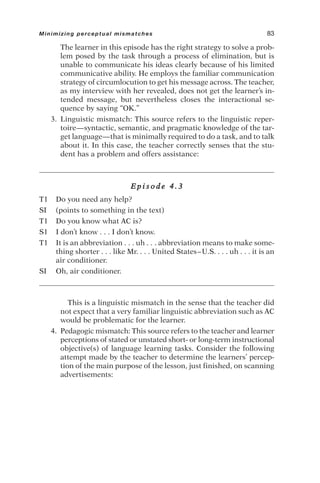
  • 188.
    how you canmake use of their linguistic and cultural knowledge to en- rich class discussion 7.2.10 Design an appropriate take-home writing assignment for your students on any aspect of political apologies. 7.2.11 Finally, reflect on the desirability or the difficulty of dis- cussing topics such as political apology in your class—in other words, what difficulties you anticipate if you do decide to take up such topics for discussion in class. Later, compare your anticipated difficulties with how the students actually reacted to the classroom activity. In Closing An unmistakable lesson we learn from this chapter is that language awareness, general as well as critical, should form an integral part of language education as well as content education. Language aware- ness is essential for the realization of an individual’s full potential and, through that, for the realization of a nation’s democratic ideals. Fostering general and critical language awareness is one way of con- necting the curricular agenda of a teaching program with the learn- ing purpose of an individual learner, and both with contemporary sociopolitical order. While language awareness activities are commonly associated with the development of advanced skills in critical thinking, read- ing, and writing, they are useful for grammar learning and teaching as well. Clearly, language awareness facilitates the process of notic- ing or consciousness-raising on the part of the learners. It is then possible that such a process of noticing could activate the learners’ intuitive heuristics, ultimately enhancing their state of readiness to internalize the grammatical system of their L2. We will explore that possibility in the next chapter. Fostering language awareness 175
  • 189.
    C H AP T E R 8 Activating I n t u i t i v e H e u r i s t i c s . . . give free play to those creative principles that humans bring to the process of language learning . . . (and) create a rich linguistic environment for the intu- itive heuristics that the normal human being automati- cally possesses. —NOAM CHOMSKY, 1970, p. 108 In educational contexts, heuristics refers to the process of self- discovery on the part of the learner. It also refers to a particular method of teaching—“a method of teaching allowing the students to learn by discovering things by themselves and learning from their own experiences rather than by telling them things” (Cam- bridge International Dictionary of English, 1995, p. 666). When ap- plying it to language learning and teaching it means that an impor- tant task facing the language teacher is to create a rich linguistic environment in the classroom so that learners can activate their in- tuitive heuristics and discover the linguistic system by themselves. The concept of language awareness we discussed in the previous chapter is closely linked to intuitive heuristics. That is to say, one can increase one’s language awareness by attempting to discover the rules and patterns of the linguistic system, and, conversely, one can enhance one’s capacity to discover the linguistic system by in- creasing one’s language awareness. It is common knowledge that language is systematic and rule- governed. There are phonological rules that deal with the nature of sound systems in a language. There are syntactic rules that deal with the grammatical construction of morphemes and words into larger units of phrases, clauses, and sentences. There are semantic rules that deal with the way in which meaning in a language is structured. While all the systems and subsystems of a language are rule-governed, the one that teachers and learners readily associate
  • 190.
    rigid rules withis grammar. I shall therefore discuss the macrostrat- egy of activating intuitive heuristics with particular reference to the teaching of L2 grammar. The primacy of grammar in language teaching has been recog- nized from time immemorial. However, an informed consensus on how to teach grammar is yet to be reached. In his analysis of twenty- five centuries of language teaching, Louis Kelly points out that “since the beginning of language teaching the manner of learning the syntax and flexions of language has been disputed. Accepted methods have ranged from the inductive, by which the pupil himself arrives at rules from examples, to the deductive whereby one proceeds from rules to knowledge. At all periods of language teaching both have existed, but never on an equal footing” (Louis Kelly, 1969, p. 34). In spite of the historical truth that both inductive and deductive methods have coexisted for a long time, scholars have reminded the language teaching profession of the virtues of learner self-discovery, and they have done so with remarkable consistency. Long before Chomsky expressed his views in the above quotation, Henry Sweet (1899–1964) had suggested that “the pre-grammatical stage may be utilized to convey a good deal of grammatical information not di- rectly through rules, but indirectly through examples, so that when the learner comes to the rule, he finds that he knows it already, or, at any rate, has advanced half-way towards knowing it” (p. 128). Even stronger views were expressed by Otto Jesperson (1904), who advocated what he called an “Inventional Grammar” created by learners themselves as they gained insights into the underlying pat- terns of grammar based on their discovery process. The refrain of learner self-discovery has continued unabated in recent times as well. William Rutherford (1987), for instance, uses the term grammaticization to focus more on the psycholinguistic processes governing the relationship between grammatical products such as the passive, the relative clauses, etc., than on the grammat- ical products themselves. Through the process of grammaticization “the learner is constantly engaged in reanalysing data, reformulat- ing hypotheses, recasting generalizations, etc.” (Rutherford, 1987, p. 159). Diane Larsen-Freeman (2000) uses an even more elegant term, grammaring, to focus more on reasoning than on rules. Both grammaticization and grammaring seek to help learners discover powerful patterns underlying the linguistic system. The persistent emphasis on a process-oriented approach to grammar teaching has Activating intuitive heuristics 177
  • 191.
    serious consequences tothe learning and teaching of L2 grammar because, as Eric Hawkins (1984, pp. 150–1) concludes: “Grammar, approached as a voyage of discovery into the patterns of the lan- guage rather than the learning of prescriptive rules, is no longer a bogey word.” Reflective task 8.1 Based on your experience as a language learner (and teacher), consider the usefulness of self-discovery in learning/teaching the grammatical system of an L2. Compare your thoughts with those of another person, if possible. The logic of preferring reasoning over rules appears to be fairly simple. What is not so simple is the way such logic can be translated into the practice of everyday teaching. Let us turn to that complex issue. Grammar in Action In the true spirit of heuristics, let us first try to discover what the teachers in the following interactional episodes actually do in the classroom to help their learners understand the pattern underlying certain grammatical rules. The interactional episodes are taken from two different grammar classes taught by two different teachers. The classes consisted of high intermediate to low advanced ESL learners. The teacher in episode 8.1 was focusing on adverbial clauses. The day before the class, she had asked her students to read one unit of a lesson in the prescribed book. The unit presented defini- tions of clause, dependent clause, independent clause, etc., followed by a series of fill-in-the-blank-type questions. The students were sup- posed to have read the lesson and come prepared with the answers. Study the classroom interaction: 178 Activating intuitive heuristics
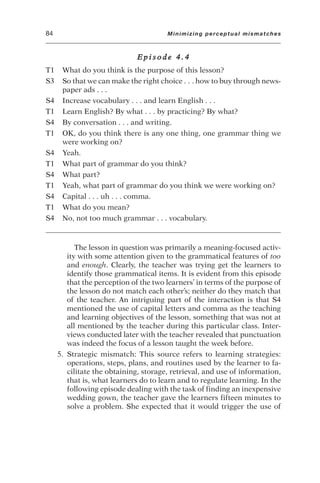
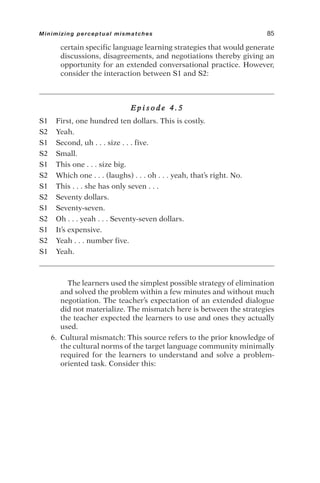
  • 192.
    E p is o d e 8 . 1 1 T: Who wants to try number one? 2 S: (reads from the text) A clause is a group of words containing a subject and a verb. 3 T: All right. Does everybody agree? Is that all right? hmm . . . All right. Look at number two and fill in the blanks. Who wants to try number two? . . . Yes . . . 4 S: (reads from the text) A dependent . . . independent clause is a complete sentence. It contains the main subject and verb of sentence. It is also called a main clause. 5 T: Right, everybody agrees? Let’s try to do number three. 6 S: A dependent clause is not a complete sentence. 7 T: All right. 8 S: The dependent clause? 9 T: The dependent clause . . . right. 10 S: Must be connected to the independent clause. 11 T: All right. Is that clear? . . . OK. eh . . . let’s see now . . . num- ber four. What would be your answer, S1? 12 S1: Yah . . . main clause . . . 13 T: Main clause. Agreed, everybody? OK? 14 Ss: Yah. 15 T: Right. Now, answer this question: does a dependent clause have a subject and a verb? 16 Ss: Yah. 17 T: Yes, fine. Can it stand alone as a sentence? 18 Ss: Yes. 19 T: eh . . . mmm. Now, let’s go to the dependent clause. Same question. Does it have a subject and a verb? 20 S: No. 21 S: Yah. 22 S: Yah. 23 S: No. Activating intuitive heuristics 179
  • 193.
    24 T: (ina very authoritative tone) Who said no? 25 Ss: Yes. 26 T: a . . . ah . . . (showing strong approval) 27 S: Yes. 28 T: Right. Now . . . (Data source: Kumaravadivelu, 1992, p. 46) Reflective task 8.2 Consider the teacher’s instructional method. Is it good enough to foster lan- guage awareness? Is it good enough to activate intuitive heuristics? What would you have done differently? Now consider episode 8.2. The teacher in this class was focusing on complex sentences with cause and effect relationships. She did not use any textbook in this episode. Instead, she distributed a hu- morous cartoon with the caption “a modern way to eat your apple.” It pictured a rat jumping on a piece of cheese, a candle, a rope, a fifty-pound weight, an apple, and a human face with a wide-open mouth. The initial action of the rat jumping on the cheese triggers a series of actions that will ultimately pop the apple into the per- son’s mouth. Here is a part of the interaction: E p i s o d e 8 . 2 1 T: What happens if the rat or the mouse doesn’t jump on the cheese? 2 S1: The man . . . doesn’t eat the apple. 3 T: Doesn’t eat the apple? 4 S2: The man has to use his hands. 5 T: Yes, imagine the man doesn’t want to use his hands. The man . . . 6 S1: Will not eat the apple xxx 180 Activating intuitive heuristics
  • 194.
    7 T: Whathappens if the candle doesn’t burn the rope? 8 S3: The weight . . . the weight will not fall down . . . 9 T: OK, the weight won’t . . . (writes on board) 10 S3: Won’t fall down. 11 T: What happens after the candle burns the rope? 12 S: The weight will . . . 13 T: The weight will fall down. eh . . . use a consequence. Connect one action to another action . . . using a word like . . . eh . . . 14 S4: If . . . 15 T: If . . . that might be good example. S4? 16 S4: If rat does not eat the cheese the candle won’t . . . won’t burn the rope . . . 17 T: OK, the candle won’t burn the rope. Use another word like . . . “when” . . . 18 S3: When the rat eats the cheese, the candle will burn. 19 T: A . . . hmm. Use another word like eh . . . “after.” 20 S5: After the weight fall down, the apple will throw up . . . 21 T: Throw up? S6? Will . . . 22 S6: Will be thrown up. 23 T: Will be thrown up. Right. And use another one like . . . “unless” . . . 24 S: The 50-pound weight won’t fall down unless the rope is burned. 25 T: Good. Yes . . . (writes on the board) You can connect any of these two actions with any of these words. What do you no- tice about this part? 26 S: will xxx 27 T: Yes . . . it is always going to have something to do with “will.” Do you notice over here . . . 28 S: Present xx 29 T: Always present tense. This is our new unit. We will start with complex sentences of this nature using relationships that in- volve cause and effect, OK? (Data source: Kumaravadivelu, 1992, p. 45) Activating intuitive heuristics 181
  • 195.
    Reflective task 8.3 Pausehere for a moment and think about what the teacher in episode 8.2 has been able to achieve that the teacher in 8.1 has not. And, how did she manage to do that? Let us compare the two episodes. The teacher in episode 8.1 is interested mainly in eliciting grammatical descriptions that can be easily lifted from the handout, with either no or partial under- standing on the part of the learner. With her mode of presentation, she has not only minimized the creation of learning opportunity in class but has resisted any attempt on the part of the learner to seek any clarification. For instance, in turn 8 a student has doubts about the answer given by another student (turn 6) and says with a rising intonation: “the dependent clause?” The teacher, instead of clearing the learner’s confusion, merely asserts: “the dependent clause . . . right” (turn 9) and moves on. On another occasion, two learners (turns 20 and 23) say “no” to the question whether a dependent clause has a subject and a verb. Their incorrect response prompts no more than a stern disapproval (turn 24: “Who said no?”) from the teacher, which triggers a choral “yes” from the class. In the end, neither the teacher nor the those two learners seem to understand what each other is trying say. If the teacher had given a few examples and asked the learners to analyze them, they would have had an opportunity to find out more about how dependent and independent clauses are structured in English. The teacher’s preoc- cupation with grammatical description may have even been an ob- stacle to grammar learning. What seems to be clear is that in her en- thusiasm to deal with the grammatical rules governing dependent/ independent clauses in English, the teacher missed an opportunity to create the kind of linguistic environment that is necessary to acti- vate the learners’ intuitive heuristics. In sharp contrast, the teacher in episode 8.2 asks a series of questions for which the answers cannot be lifted from the distrib- uted material. Her method of presentation seems to actively engage the learners’ minds. Like the teacher in the previous episode, she, too, focuses explicitly on grammar (turn 17: “use another word like . . . 182 Activating intuitive heuristics
  • 196.
    ‘when’”; turn 19:“Use another word like eh . . . ‘after’”; turn 23: “use another one like . . . ‘unless’”) and error correction (turn 23: “will be thrown up”). However, she does not even mention the teaching item of grammatical relations involving cause and effect for the first twenty-eight interactional turns. She gradually and logically leads the learners to think and talk about that relationship. She success- fully elicits from them the main grammatical item that she wants to highlight (see turns 26 and 28) before she herself mentions it in turn 29. Even in an explicitly grammar focused class, the teacher in this episode has involved the learners in a meaningful conversational exchange. She appears to have created learning opportunities, pro- moted interaction in class, and fostered general language aware- ness. In the process of doing all this, she also appears to have suc- ceeded in activating the intuitive heuristics of her learners. Evidently, the two teachers have followed two different methods of teaching grammar. The first one has followed a deductive method and the second an inductive method. Let us consider these two meth- ods of grammar teaching in relation to their usefulness for activating intuitive heuristics. Deductive Teaching and Intuitive Heuristics In a typical deductive method of teaching grammar, the teacher pres- ents learners with a set of grammatical rules, offers explicit expla- nations of those rules, and then provides opportunities for learners to practice them. After adequate practice, the learners are expected to use those rules in their speech and writing. Although such a method of grammar teaching is widespread, there are concerns about its feasibility as well as its desirability. The suitability of a deductive method of grammar teaching has been called into question by theoretical as well as applied linguists. The preeminent linguist Chomsky firmly believes that one does not learn the grammatical structure of a second language through “ex- planation and instruction” beyond the most rudimentary elements, for the simple reason that no one has enough explicit knowledge about this structure to provide explanation and instruction (Chom- sky, 1970). What he implies is that the linguistic system of a language, any language, is so complex that even theoretical linguists who Activating intuitive heuristics 183
  • 197.
    spend their livestrying to describe, explain, and understand it have not been able to do so satisfactorily. Therefore, it is too much to ex- pect either the language teacher or the language learner to do so. Of course, it could be argued that, unlike theoretical linguists who are concerned with the principles and parameters of an overall grammatical system in order to derive a comprehensive theory of syntax, language teachers are interested only in what is called ped- agogical grammar that has been selected and simplified to meet the needs of L2 learners. But even that simplification is not as simple as it seems. As Rutherford (1987, p. 17), echoing Chomsky, asks: “The most brilliant linguists can as yet come nowhere near knowing fully what constitute the proper generalizations and the correct for- mulations of the rule of English syntax, then, how can anything of this sort, in whatever ‘simplified’ form, be profitably ‘taught’ by any teacher or ‘learned’ by any learner?” The pedagogical grammar of even a language like English—one of the most analyzed and stud- ied languages in the world—remains unsatisfactory, prompting a prominent pedagogical grammarian to conclude: “Pedagogical grammar is not static: Many problems remain to be understood, and until they are, second language teaching will depend on guess- work” (Terence Odlin, 1994, p. 11). In spite of persistent questions about the feasibility of explicit grammar description and instruction, the deductive method of gram- mar teaching has long been a desired method for many teachers and learners. They see certain advantages to it. For example, many adult L2 learners, particularly those who bring an analytical ap- proach to language learning, would like explicit description and in- struction of grammatical rules so that they can consciously analyze them to understand how the linguistic system works. They can also use the explicit grammar rules for language practice and for error correction. Some learners may even use explicit rules to work out the similarities and differences between their L1 and L2. The deductive approach with its explicit description and expla- nation of grammar rules may have its advantages for teaching gram- mar to adults. However, with regard to the specific purpose of acti- vating learners’ intuitive heuristics, it has only limited use. The reason is simple: it encourages very little teacher-learner interaction and almost no learner-learner interaction that is necessary to create an environment conducive to self-discovery. Once a grammatical rule is explicitly stated, the natural tendency of the learners will be not 184 Activating intuitive heuristics
  • 198.
    to think aboutits underlying rationale—a tendency that might lead to a superficial knowledge rather than a sound understanding of the rule. This might be one reason why we often come across learners who can supply the correct grammar on a class test but cannot use it for communicative purposes outside the class. Reflective task 8.4 With reference to your specific L2 learning and teaching situation, what fea- tures of the deductive method would you keep and what features would you give up or modify? Why? Inductive Teaching and Intuitive Heuristics The inductive approach is based on the premise that the essence of grammar teaching lies in helping learners discover what the gram- matical rules are. Teachers present their learners with contextual- ized oral and written samples of a grammatical element, draw their attention to it in different ways, and guide them to see and hear the underlying pattern. They avoid explicit description and explana- tion, and minimize the use of technical terms, at least at the initial stages of teaching a particular grammatical item. Learners analyze the samples provided to them and try to develop a working hypoth- esis that can later be confirmed or rejected based on additional in- formation and experience. It is easy to see why the inductive method of teaching is well suited to activate the intuitive heuristics of the learner. In inductive teaching, learners have an opportunity to encounter a grammatical structure or a language expression “several times in contexts where its relationship to the design of the language may be observed, and its meaning (structural, lexical, and socio-cultural) inductively ab- sorbed from its use in such varying situations” (Rivers, 1964, p. 152). Such encounters can help them infer the underlying rules and principles governing the communicative use of grammatical structures. It can also help them see grammar “as a comprehensive conglomerate, uniting all the levels of structure or rule complexes of a language, viz. the structure of words and phrases, the structure of sentences, the structure of texts and the structure of interaction” Activating intuitive heuristics 185
  • 199.
    (Dirven, 1990, pp.7–8). Thus, the inductive teaching of grammar has the potential to activate the learners’ intuitive heuristics and stim- ulate their working hypotheses not only about a grammatical sub- system but also about the L2 system as a whole. It is then fair to assume that learning through self-discovery rather than learning from teacher explanation will favorably affect grammar learning in particular and language learning in general. If the teach- ers have the ability to devise creative exercises and if the learners have the ability to derive probable generalizations based on the pre- sented data and classroom interaction, then the inductive method will prove to be highly beneficial. After all, learners will be able to comprehend and retain better if they themselves discover the gram- matical rules. The emphasis on the inductive mode of presentation is not meant to prohibit the use of explicit explanation through form-focused ac- tivities. Instead, what needs to be seriously considered is whether the presentation of definitions and rules should be preceded by the pres- entation of relevant data, promotion of negotiated interaction, and fostering of language awareness; and, whether a judicious combi- nation of the inductive and deductive methods of teaching will be more effective. Developments in research on L2 grammar learning and teaching indicate that with suitable instructional modifications, teachers can strike a balance along the inductive-deductive contin- uum. I shall discuss these developments under the rubric input en- hancement and intuitive heuristics. Reflective task 8.5 What difficulties do you anticipate if you wish to follow the inductive method of grammar teaching? Consider factors such as your own teacher prepara- tion, textbooks, learner attitudes, etc. How would you overcome some of the difficulties you’ve identified? Input Enhancement and Intuitive Heuristics Input enhancement can be considered to encompass two interrelated acts of consciousness-raising and noticing the gap, both of which have a direct bearing on activating learners’ intuitive heuristics. Al- 186 Activating intuitive heuristics
  • 200.
    though the terminput enhancement is originally used in the L2 lit- erature to refer more to consciousness-raising activities than to noticing the gap activities, for reasons that will become clear I use it here as a cover term to refer to both. Consciousness-Raising Put simply, consciousness-raising (C-R) refers to a deliberate attempt to draw the learner’s explicit attention to features of the target lan- guage, particularly to its grammatical features. This may look de- ceptively similar to traditional grammar teaching, but, as Ruther- ford points out, C-R differs from it in fundamental ways. First, C-R “is a means to attainment of grammatical competence . . . whereas ‘grammar teaching’ typically represents an attempt to instill that competence directly” (Rutherford, 1987, p. 24). Second, C-R treats an explicit focus on grammar as necessary but not sufficient for devel- oping grammatical competence whereas traditional grammar teach- ing treats it as necessary and sufficient. Third, C-R acknowledges the learner’s active role in grammar construction; traditional gram- mar teaching considers the learner tabula rasa, a blank slate. Finally, traditional grammar teaching is concerned mainly with syntax, while C-R is concerned with syntax and its relation to semantics, discourse, and pragmatics. Because the term consciousness does not lend itself to a clear-cut definition, Sharwood Smith (1991) suggested input enhancement in the place of consciousness-raising. The new term correctly shifts the attention from an internal process related to what happens in the mind to an external operation related to input and interaction. According to Rutherford and Sharwood Smith, there are simple ways in which input enhancement can be effected. They include color coding or bold-faced type for selected linguistic features in reading texts, pointing out an error in speech or writing, and asking learners to unscramble sentences of a paragraph and provide their reasons for reordering. Classroom interactional episode 8.2 discussed above, for instance, illustrates how input can be enhanced through negotiated interac- tion in class. In that episode, what was made salient was not just the grammatical product of cause-effect relationship but the process of grammaticization, that is, the ability to handle form-meaning re- lationship with particular reference to grammatical clauses in En- Activating intuitive heuristics 187
  • 201.
    glish. The processof grammaticization also involves making the con- nection between propositional content and syntactic forms within a communicative context. The episode also shows that through proper management of classroom interaction, teachers can help learners notice the gap between their current level of knowledge and the target level they wish to achieve. Noticing the Gap Learners’ ability to notice the gap between what they already know and what they need to know is, of course, crucial for making progress in language learning. Schmidt and Frota (1986, p. 311), who pro- posed what is called the “notice the gap principle,” categorically state that “a second language learner will begin to acquire the target-like form if and only if it is present in comprehended input and ‘noticed’ in the normal sense of the word, that is consciously.” In order to notice the gap, learners have to first recognize that there is some- thing to be learned. Susan Gass (1997, p. 4) calls this apperception— “an internal cognitive act in which a linguistic form is related to some bit of existing knowledge (or gap in knowledge).” By making the selected linguistic features noticeable or recognizable, teachers can aid learners in their cognitive act of connecting the known to the new. Both consciousness-raising and noticing the gap activities sen- sitize learners to the way linguistic systems work. The act of con- sciousness-raising is largely external to learners, that is, teachers can create the conditions necessary for raising learners’ conscious- ness about aspects of linguistic properties. They can do that by providing sufficient linguistic data for their learners to formulate their own working hypotheses about a particular grammatical rule. They can also do that by promoting meaningful classroom interac- tion centering on the selected linguistic features. Of course, learners themselves can raise their own consciousness to some extent. The act of noticing the gap, however, is entirely internal to learners, that is, they have to make an effort to notice the gap in their developing linguistic knowledge. Thus, by making learners become aware of the need to pay attention to various aspects of language use, input enhancing activities contribute to the activation of their intuitive heuristics. 188 Activating intuitive heuristics
  • 202.
    Reflective task 8.6 Whattype of classroom activities do you think will help you raise your learn- ers’ consciousness and prompt them to notice language features? Input Enhancement in Action Current literature on L2 grammar learning and teaching presents several types of activities to achieve the goals of input enhance- ment. I shall highlight two of them: grammar tasks advocated by Rod Ellis and his colleagues, and pedagogic tasks advocated by Michael Long and his colleagues. G R A M M A R T A S K S Based on a series of studies, Ellis and his colleagues (see Ellis, 1997, 1999 for comprehensive reviews) suggest the use of what they call grammar tasks or grammar discovery tasks to help learners gain cognitive understanding of grammar. They argue that it does not re- ally matter whether grammar discovery tasks are inductive or de- ductive so long as these tasks are designed to offer a range of data options and a range of learner operations that can be performed on them. The data options include: • Authentic vs. contrived (whether or not the data consist of text prepared by competent speakers for other competent speakers for purposes other than language teaching). • Oral vs. written (whether the data represent spoken language or written language). Spoken language data can be made available to the learner in the form of a recording or, more likely, by means of a transcription. • Discrete sentences vs. continuous text (whether the data consist of a series of disconnected sentences or continuous discourse). • Well-formed vs. deviant (whether the data conform to the norms of the target variety or whether they include deviations from these norms, as, for example, in grammaticality judgment tasks). • Gap vs. non-gap (whether the data are distributed among the learn- Activating intuitive heuristics 189
  • 203.
    ers in sucha way that the information contained in the data has to be shared or whether each learner has access to all data). (Ellis, 1997, p. 161) The learner operations that can be performed on the data in- clude: • Identification (the learners are invited to identify incidents of a specific feature in the data by, for example, underlining it). • Judgment (the learners are invited to judge the correctness or ap- propriateness of features in the data). • Completion (the learners are invited to complete a text, for ex- ample, by filling in blanks as in a cloze passage or by selecting from choices supplied). • Modification (the learners are invited to modify a text in some way, for example, by replacing one item with another, by reorder- ing elements in the text, by inserting some additional item into the text, or by rewriting part of it). • Sorting (the learners are invited to classify specific items present in the data by sorting them into defined categories). • Matching (the learners are invited to match two sets of data ac- cording to some stated principle). • Rule provision (in the case of inductive tasks learners may or may not be asked to give a rule to account for the phenomena they have investigated; the rule can be presented verbally or non- verbally). (Ellis, 1997, p. 161) A close reading of these data options and learner operations clearly indicates that they can be used in teacher-directed classes as well as in pair or group interactive settings. Reproduced in Figure 8.1 is a task designed by Fotos and Ellis taken from Ellis (1999, pp. 207–8), which illustrates how to activate the learners’ intuitive heuristics about an aspect of L2 grammar. It focuses on the use of dative verbs in English. Designed as a pair or small group work, it consists of (1) task cards (Appendix A in the original text) with a list of grammatical and ungrammatical sen- tences illustrating the use of dative verbs, specifying which are cor- rect and which are incorrect; and (2) a task sheet (Appendix B in the original text) with some grammatical information about dative verbs 190 Activating intuitive heuristics
  • 204.
    Appendix A: Taskcards Students in groups of 4—one different card to each member Students in pair—two different cards to each member 1. Correct: I asked my friend a question 1. Incorrect: She asked a question to her mother 2. Correct: Kimiko reviewed the lesson for John 2. Incorrect: Kimiko reviewed John the lesson 3. Correct: The teacher calculated the answers for the students 3. Incorrect: The teacher calculated students’ answer 4. Correct: The secretary reported the problem to her boss 4. Incorrect: The student reported the teacher the matter 5. Correct: I offered her a cup of tea 5. Correct: I offered a cup of tea to the president 6. Correct: The teacher pronounced the difficult word for the class 6. Incorrect: The teacher pronounced the class the difficult word 7. Correct: I bought many presents for my family 7. Correct: I bought my family several presents 8. Correct: She cooked a delicious dinner for us 8. Correct: She cooked us a wonderful meal 9. Correct: She suggested a plan to me 9. Incorrect: She suggested me a good restaurant 10. Correct: The teacher repeated the question for the student 10. Incorrect: The teacher repeated the student the question and a chart to fill in for each of the verbs for which data has been supplied. It also gives directions asking the learners to formulate three rules about the use of dative verbs. Study the task in detail. It can be easily seen that the above task skillfully combines the elements of a purely grammar-focused instruction with possibilities for meaningful interaction. It makes grammar the topic of class- room communication. As Ellis (1999, p. 206) points out, grammar tasks “provide opportunities to communicate in the L2 in groups or pairs, and they encourage an active, discovery-oriented approach on the part of the learners.” Grammar tasks, then, are aimed at rais- ing the learners’ consciousness about the grammatical properties of the L2 thereby facilitating the process of noticing the gap, and ulti- mately activating their intuitive heuristics. Activating intuitive heuristics 191 Figure 8.1
  • 205.
    192 Activating intuitiveheuristics Appendix B: Task Sheets There are verbs in English that can have two objects. One of the objects is called the direct object. The other is called the indirect object. An indirect object names the person for whom the action of the verb is performed. Indirect object direct object She wrote Susan a letter. Different verbs may have the objects in different order, and this is often a problem for students of English. The following exercise will help you understand some confusing verbs. Directions: In groups, you are to study correct and incorrect sentences using different verbs. You all have different sentences. You must read your sentences to the rest of the group. Do not show your sentences to the other members. Read the sentences only as many times as necessary. Work together as a group and decide on the basis of the correct and incorrect sentences where the indirect objects should be located. Fill out the rest of this page. Choose one student to report your results to the rest of the class. Please speak only in English during this exercise. Verbs: Possible correct order of direct and indirect object asked: reviewed: calculated: reported: offered: pronounced: bought: cooked: suggested: repeated: Conclusion: Write 3 rules concerning the possible order of objects. Rule 1: Verbs which follow this rule: Rule 2: Verbs which follow this rule: Rule 3: Verbs which follow this rule: (Data source: Ellis, 1999, p. 207–8) Figure 8.1 (continued)
  • 206.
    Reflective task 8.7 Ifyou believe that grammar tasks are relevant for your learning and teach- ing context, what constraints do you anticipate in designing and using them in your class? Lack of resources? Lack of time? Lack of training? Some other restraint? And, how can you try to overcome some of the constraints? P E D A G O G I C T A S K S Pedagogic tasks, like grammar discovery tasks, aim at input enhance- ment in terms of consciousness-raising and noticing the gap, but seek to achieve that aim in a very different way. Unlike grammar discov- ery tasks, which focus primarily and explicitly on the grammatical form, pedagogic tasks draw the learners’ attention to it if and only if it is absolutely necessary to carry out the communicative activities and negotiation of meaning in class. In this context, Long and his colleagues (see Long, 1991, and Doughty and Williams, ed., 1998) make a distinction between focus on form and focus on formS (plural). The former refers to meaning- focused activities in which an attention to form is secondary and implicit, whereas the latter refers to grammar-focused activities in which an attention to form is primary and explicit. Focus on form “overtly draws students’ attention to linguistic elements as they arise incidentally in lessons whose overriding focus is on meaning or communication” (Long, 1991, pp. 45–6). It entails a prerequisite engagement in meaning before attention to grammatical forms can be expected to be effective, that is, the meaning of an utterance must be evident to learners before their attention is drawn to the gram- matical features embedded in that utterance. It constitutes an occa- sional shift of attention to grammatical forms by teachers or learn- ers when they notice problems with comprehension or production (Long and Robinson, 1998, p. 23). While stressing their preference for activities that focus on form over activities that focus on formS, Long and his colleagues stress that “focus on formS and focus on form are not polar opposites in the way that form and meaning have often been considered to be. Rather, focus on form entails a focus on formal elements of lan- guage; whereas focus on formS is limited to such a focus, and focus Activating intuitive heuristics 193
  • 207.
    on meaning excludesit” (Doughty and Williams, 1998, p. 4, all ital- ics as in original). The basic principles of focus on form can be implemented through any of the communicative activities that make the learners preoccupied with meaning rather than form. These activities in- clude attending a job interview, making an airline reservation, read- ing a journal abstract, writing a lab report, or locating a book in the library. To give a specific activity suggested by Long and Robinson, (1998, pp. 24–5), learners may be asked to work in pairs or in small groups on a problem-solving task that requires them to collect and synthesize information on economic growth in Japan. They may be required to read published reports on economic trends for different sectors of the Japanese economy. Long and Robinson point out that, in doing this task on econ- omy, learners are likely to come across terms such as rose, fell, grew, sank, plummeted, increased, decreased, declined, doubled, deteriorated, and exceeded. The frequent occurrence of these lexi- cal items in the input makes them salient, and so increases the like- lihood of being noticed by learners. A subsequent speaking or writ- ing task may encourage the learners to incorporate them in their speech or writing. Certain grammatical items can be dealt with in an appropriate manner if there is an expressed need for it. Reflective task 8.8 Are pedagogic tasks designable and doable in your specific learning and teaching context? If not, and if you wish to design them and use them, how can you make use of the resources (however limited they are) you may al- ready have at your disposal? To sum up this section, it is fair to assume from the above dis- cussion that grammar tasks and pedagogic tasks offer two comple- mentary types of input enhancement. Together, they can help teach- ers to meet the needs of learners with different learning styles and learning purposes. They carry the potential to assist teachers in their attempt to activate their intuitive heuristics by raising learn- ers’ awareness of linguistic features and language use. Gliding com- fortably along the inductive-deductive continuum, they offer sev- 194 Activating intuitive heuristics
  • 208.
    eral options forteachers to design and implement microstrategies that are appropriate to the needs and wants of their learners. Microstrategies for Activating Intuitive Heuristics The grammar of a language consists of a number of systems such as time and tense, prepositions, articles, interrogatives, etc., and sev- eral subsystems within each. For the purpose of designing micro- strategies for activating the learner’s intuitive heuristics, teachers can select any of the grammatical subsystems suitable to the profi- ciency level of their students. In designing microstrategies, teachers may find it useful to consult a good pedagogic grammar book such as A Communicative Grammar of English (Leech and Svartvik, 1980) or The Grammar Book (Celce-Murcia and Larsen-Freeman, 1983). Also useful are learner resource books such as Grammar Practice Activities (Ur, 1988) and teacher resource books such as About Lan- guage (Thornbury, 1997). The activities and tasks given in these grammar-based books can be easily adapted to suit the needs and wants of a specific group of learners. Given below are two illustra- tive microstrategies on different aspects of the English grammati- cal system. Microstrategy 8.1: Articles of Trouble 8.1.0 The article system in English is one of most troublesome as- pects of English grammar for L2 learners to learn to use satisfactorily. In this microstrategy, I focus on a subset of the article system dealing with basic features of the definite (the) and the indefinite (a, an, and [zero]) articles, and present one way of teaching them. You may wish to modify the suggested steps depending on what your learners already know or do not know. Keep the main objective in mind, i.e., creating conditions for activating learners’ intuitive heuristics (conditions that also promote negotiated interaction and foster language awareness). 8.1.1 Write on the board (or project on the OHP screen) two or three clusters of simple sentences to illustrate singular count nouns with in- definite/definite references. Here’s a sample cluster: There is a table in this classroom. There is a book on the table. The book belongs to me. Activating intuitive heuristics 195
  • 209.
    8.1.2 Ask thelearners in pairs or in small groups to study the sample sentences and suggest possible rules governing the use of a and the in these sentences. Depending on their responses, ask leading questions and/or give more sample sentences till they reach a reasonable degree of understanding. 8.1.3 By way of testing their understanding, give a cluster of sen- tences like John bought——book and——calculator yesterday. He returned——book but kept——calculator. with all the articles deleted. Ask them to supply the missing articles and justify their response. 8.1.4 Write on the board (or project on the OHP screen) clusters of simple sentences like the ones given below: There is an apple on the table. There is also an orange on the table. The apple is fully ripe but the orange is not. 8.1.5 Have your students study the data and generate the rules gov- erning the use of an and the. Ask them to explain their reasoning. Then give clusters of sentences deleting the articles and ask them to supply the missing ones and justify their response. Follow up their work with a class discussion. 8.1.6 Using leading questions and appropriate sample data, help your learners understand that we use the definite article when the speaker(s) and the hearer(s) know what is being talked about, which is not the case when we use the indefinite articles. Turn now to other contexts in which the definite article is used. Give sample data such as The stars; the earth; the moon (where the reference is to only one object or the group of objects that exists or has existed); The press; the media; the parliament (where the reference is to an institution shared by the community); The president; the queen (where the reference is understood to be unique in the context); The tiger is a beautiful animal (where the reference is to what is general or typical of a whole class of objects); and ask the learners in pairs or in small groups to find out and explain the rules governing these usages. Discuss their response suitably. 196 Activating intuitive heuristics
  • 210.
    8.1.7 Now, extendthe focus to include use of the zero article before first mentions of plural countable nouns and uncountable (mass) nouns. Again, provide your learners with a cluster of appropriate examples, such as There are apples on the table; There are books on the table; There is grass in my garden; and ask them in pairs or in small groups to find out and explain the rules governing these usages. 8.1.8 Ask your students to bring a newspaper to class. In pairs, have them select a few headlines, insert suitable articles into the headlines, and then rewrite each of the headlines in complete sentence form. Have them also focus on any variation of meaning if the article usage is varied. 8.1.9 Select a short text that is linguistically and conceptually appro- priate to your learners, one which also has a variety of article usages. Delete each of the articles and insert a blank of equal length (——). Re- member to insert a blank wherever the article occurs. Ask your learners to fill in each blank with a, an, the, or on their own in class. Then they should form pairs, exchange their completed work, and dis- cuss each other’s responses. Then, ask each pair to talk before the class about one item that they were not able to agree on. Ask other students in class to resolve the differences; you should step in only if they are not able to do it by themselves. 8.1.10 Finally, reflect on (a) the degree to which this kind of activity achieves your objective of activating the learners’ intuitive heuristics, and (b) the feasibility and the desirability of designing and imple- menting a microstrategy like this, in terms of your time, effort, and the result. Also think about which part of the activity you will keep, which part you will modify, and why. Microstrategy 8.2: Dictating Grammar 8.2.0 Dictogloss as a grammar task was originally popularized by Ruth Wajnryb (1990). It encourages learners to communicate about grammar and, through the process of communication, makes them “confront their own strengths and weaknesses” (1990, p.10) and find out what they need to know. A dictogloss task has the potential to result in a context-sensitive knowledge of grammatical rules because form, function, and meaning are so intimately linked in the way this task is normally done (Swain, 1995). It basically involves listening to a short Activating intuitive heuristics 197
  • 211.
    text dictated bythe teacher, taking notes, reconstructing the text, and identifying the gap between the reconstructed and the original text in addition to all the negotiated interaction that goes with the process. The following microstrategy reflects the general thrust of a dictogloss task. 8.2.1 Select (or write) a short but dense text (just a short paragraph will do) dealing with any topic that is being discussed in class. It should include grammatical features just introduced or about to be intro- duced. Make sure that the linguistic level of the text is at or slightly above the current level of your students. 8.2.2 In class, give clear directions as to what you expect the learn- ers to do. At this stage of the task, they need to listen to your dictation carefully and take notes as fast, and as much, as they can. Read the text twice at normal speed, which should prevent them from taking down the text verbatim. 8.2.3 Have them work together in small groups and reconstruct the text as accurately as possible, putting together notes from all the mem- bers of the group. Ask them to think aloud and talk about the content as well as the grammatical features of the text they just heard. As a group, they have to arrive at a consensus version of the text. 8.2.4 Write the short text on the board (or project it on the OHP screen). Ask your learners, once again in their groups, to analyze and compare their version with the original version, in terms of content as well as grammar. 8.2.5 Ask each group to report back to class. Let them first focus on the message as well as the grammatical features they got right. 8.2.6 Do 8.2.5 again, this time focusing on the message they missed as well as the grammatical features they did not get right. 8.2.7 In class discussion, first focus on the message of the text and help them understand it. Do it inductively or deductively as you deem appropriate given the response of your students. 8.2.8 Now, focus on the grammatical features. Highlight what you need to highlight, that is, their success or failure in noticing what they are supposed to notice. 8.2.9 Finally, ask the learners what they were able to learn from the process of doing the dictogloss task. By asking leading questions, try to find out whether the task achieved its purpose of raising their language awareness, of helping them notice the gap, etc. 198 Activating intuitive heuristics
  • 212.
    Exploratory Projects With somebasic exploratory research projects, teachers should be able to design microstrategies like the ones illustrated above. I pres- ent below two such projects, one dealing predominantly with focus on formS and the other predominantly with focus on form, but both attempt to activate the learner’s intuitive heuristics. Project 8.1: Focus on FormS 8.1.0 The purpose of this project is to help you explore how to plan for teaching a grammatical subsystem keeping in mind the overall ob- jective of activating the learner’s intuitive heuristics. Luckily, you do not have to reinvent grammar; all you need to do is to consult the re- sources that are already available (see above for a sample list of four books) and make use of them for designing grammar tasks. For the purpose of illustrating a doable project, I focus on a deceptively simple grammatical item in English: present progressive (also called present continuous). You may do this project individually or with another col- league. 8.1.1 A common textbook explanation for present progressive is that it is used to describe an action in progress. Taking this explanation at the face value, write down a couple of sentences to exemplify present progressive. 8.1.2 Study the following six different uses for the present progres- sive and write down at least one example for each. 1. To describe events/situations in progress at the moment of speaking 2. To describe temporary situations in the present, though not nec- essarily at the moment of speaking 3. To describe changing or developing situations in the present 4. To describe repeated events or situations (with always, constantly, forever, etc.) 5. To describe the background to an event in the present 6. To describe a present arrangement for a future event (Data source: Thornbury, 1997, p. 80) 8.1.3 Keeping in mind the proficiency level of your students, select one or a combination of these six uses and think of possible ways of in- troducing them to your students in such a way as to prompt them to guess the general rules governing their use. Activating intuitive heuristics 199
  • 213.
    8.1.4 Having beentold repeatedly that the present progressive is used to describe an action in progress, L2 learners of English, at least at the initial level of grammar learning, wonder why a sentence like I am leaving for Washington tomorrow is considered grammatically cor- rect. Think about ways of helping them reflect on the connection be- tween the present progressive and future time reference. 8.1.5 Read the following: We all know that the present continuous tense is used to describe actions that are taking place now. However, native speakers do not use this tense to describe people’s actions all the time. We don’t spend our time saying “Look. I’m opening the door. I’m drinking a cup of tea . . . etc.” That’s not how we use the present continuous. We actually use it when there is some point, some value in com- menting on people’s actions. So we might ring home and say “Oh, what’s John doing at the moment?” It’s a reasonable question since we can’t see him and don’t know the answer to the question. (Data source: Harmer, 1991, p. 56) Think of a couple of other scenarios in which present progressive can be used in a communicatively appropriate sense. Having told your stu- dents that the present progressive is used to describe an action in progress, how would you help them understand the absurdity of a sen- tence like Look, I’m opening the door? In other words, how would you help them connect communicative appropriateness with grammatical correctness in this particular grammatical context? 8.1.6 A general rule prevents the use of the present progressive in English with stative verbs such as see, love, etc. However, read the fol- lowing: For example, the following verb form would appear to violate a rule in English which says the -ing of the progressive aspect cannot be attached to a stative verb such as love: I am loving every minute of my class. And yet, most English speakers would agree that combining the progressive aspect with a stative verb, as has been done in this ex- ample, accomplishes the special effect of intensifying the emotion expressed by the verb, which makes it at least conversationally ac- ceptable, and meaningful, in English. (Data source: Larsen Freeman, 2000, p. 10) Write down a few more examples of this kind. If, as per the pre- scriptive rules of English grammar, the -ing of the progressive aspect cannot be attached to a stative verb, how would you explain what is 200 Activating intuitive heuristics
  • 214.
    “conversationally acceptable” inEnglish? Would it be necessary to bring up the issue of style and language variety here? Would it be nec- essary to discuss how people are supposed to speak and write and how they actually speak and write? 8.1.7 Think about what kind of out-of-class assignment you can give your students to strengthen their understanding of the use of the pres- ent progressive. For instance, would the running commentary of a sports event broadcast over the radio be a good source of data containing sev- eral instances of the present progressive in a communicative context? If yes, how would you design an assignment based on that? 8.1.8 Go back to what you have done so far and see to what extent your classroom plans and procedures can actually raise your learners’ language awareness, promote meaningful interaction, and, ultimately, activate their intuitive heuristics. 8.1.9 At the earliest opportunity, try to implement your plan (or parts of it) in the classroom and see how it actually works. When the students are working in pairs or in small groups, use the time to jot down your impression of how the activity develops in class. Based on your classroom experience, reflect on what part to keep and what part to change in order to achieve your goals. 8.1.10 Finally, critically reflect on the process of doing this project. Specifically reflect on the usefulness of exploratory projects like this for designing appropriate microstrategies. Project 8.2: Focus on Form 8.2.0 Recall the earlier discussion on pedagogic tasks, which focus on form attempting to draw the learners’ attention to grammar only if it is needed to carry out the tasks. Their main focus then is on com- municating to solve a problem or to perform an activity. One of the ob- jectives of pedagogic tasks, however, remains grammar construction on the part of the learner. This project is aimed at helping you experi- ment with a pedagogic task. Here’s one way of doing it. 8.2.1 Select a communicative activity appropriate to the level and in- terest of your learners. It may deal with social and/or academic com- munication such as getting acquainted with classmates on the first day of class, responding to a newspaper ad, deciding on a birthday gift, tak- ing a stand on a current social or political event, etc. At higher levels of challenge, the activity may require the learners to collect information from different sources (through, for instance, library or the Internet) Activating intuitive heuristics 201
  • 215.
    or gather opinionsfrom different people, synthesize and interpret the information, discuss the information in small groups, make a presen- tation to class, and do an out-of-class writing assignment. The activity can be made more or less difficult by simplifying or complicating the collaborative decision making learners have to do to complete the ac- tivity. 8.2.2 Break down the activity into as many small steps as possible. Identify which of the steps can be done individually, in pairs, or in small groups. Write clear directions to make sure that learners know what they are expected to do every step of the way. 8.2.3 Introduce the activity to the class. Depending on time, focus on as many steps as possible in class. Have them jot down any difficulty they may face in completing the activity. Ask them to be very specific and to be attentive to three possible areas of difficulty: linguistic diffi- culty, that is, they struggle with words and grammatical structures needed to do the activity; or communicative difficulty, that is, they are not able to communicate what they want to communicate; or concep- tual difficulty, that is, they do not fully understand the concepts and ideas involved in the task. Tell them that you will collect their notes at the end of the session. If possible, and if students give you permission, audiotape the learner activity as it unfolds in one particular group. 8.2.4 At a convenient stopping point, ask a select number of groups to share with the class what they have accomplished. Have a detailed discussion, drawing as many students as possible to respond and react. Highlight the multiplicity of routes the learners may have taken to solve the problem and multiplicity of results they may have arrived at. 8.2.5 Then, ask them to consult the notes they have taken about the three types of difficulties and share them with the class. Deal with their conceptual and communicative difficulties first. Let learners themselves resolve some of the difficulties, because what was difficult for one group might not have been difficult for another. 8.2.6 Zero in on their linguistic difficulties. Let your learners talk about the lexical and grammatical difficulties they encountered. As they share their experiences, try to look for any patterns that may emerge, that is, specific vocabulary items or specific grammatical structures that were problematic and needed explicit attention. 8.2.7 To the extent possible, deal with the emerging pattern of lexi- cal and grammatical difficulties then and there. Do it either inductively or deductively, depending on the circumstances. 202 Activating intuitive heuristics
  • 216.
    8.2.8 Collect thenotes that the learners have taken down. At your leisure, but as soon as possible so that you don’t forget the class dis- cussion, read their notes. After reading the notes and listening to the audiotape (if you did tape the conversation in one group), decide what additional classroom instruction is needed to help your learners un- derstand the rules governing some of the linguistic features that came up during the class activity. 8.2.9 As always, reflect on the process of doing this exploratory proj- ect. What did you learn? Is a project like this worth pursing? If yes, with what modifications? If not, why not? In Closing Based on the discussion in this chapter, it is fairly reasonable to con- clude that (a) activating the intuitive heuristics that every learner naturally possesses is a worthy goal to pursue, and (b) there are several options available to those L2 teachers who wish to pursue that worthy goal. It is clear that linguistic input that is carefully structured, accompanied by classroom interaction that is suitably managed, can provide a rich amount of sample data necessary for L2 learners to search for and understand the pattern underlying L2 grammatical systems. In order to help learners with their process of self-discovery, they should be helped to see grammar “as a rational, dynamic system that is comprised of structures characterized by the three dimen- sions of form, meaning and use” (Larsen-Freeman, 2000, p. 10). This chapter provided conceptual arguments, illustrative microstrategies, and exploratory projects to help the teacher treat grammar as a dynamic system with multiple dimensions. Embedded within that multidimensional system is the notion of context. We will see in the next chapter how contextualizing linguistic input and classroom in- teraction can maximize the learning potential in the L2 classroom. Activating intuitive heuristics 203
  • 217.
    C H AP T E R 9 Contextualizing L i n g u i s t i c I n p u t (L)anguage takes place in social contexts and makes con- nections with the realities that make up those contexts. —HALLIDAY AND HASAN, 1976, p. 305 Language communication is inseparable from its communicative context. Taken out of context, language communication makes little sense. What all this means to learning and teaching an L2 is that we must introduce our learners to language as it is used in communica- tive contexts even if it is selected and simplified for them; otherwise, we will be denying an important aspect of its reality. The reality of language is represented in some of the terms used recently to refer to language: language as text (Halliday, 1974), lan- guage as communication (Widdowson, 1978), language as context (Goodwin and Duranti, 1992), and language as discourse (McCarthy and Carter, 1994; Celce-Murcia and Olshtain, 2000). These terms, taken from the fields of theoretical linguistics, applied linguistics, and anthropology, are used interchangeably and have one thing in common: they all treat language as something that invokes context as well as something that provides context (Goodwin and Duranti, 1992, p. 7). In spite of the importance given to context in linguistic and an- thropological circles and in spite of its widespread use, the term context eludes a clear definition. In fact, as anthropologists Charles Goodwin and Alessandro Duranti (1992, p. 2) point out: “It does not seem possible at the present time to give a single, precise, technical definition of context, and eventually we might have to accept that such a definition may not be possible.” They also point out that the term comes from the Latin contextus, which means a joining together. The opening quote from Michael Halliday and Ruqaiya Hasan mentions the joining together of realities that make up a
  • 218.
    context. What arethose realities? For the limited purpose of L2 learning and teaching, we can talk about four realities: linguistic, ex- tralinguistic, situational, and extrasituational. In the following pages, I briefly discuss each of these contexts and then connect the dis- cussion to possible microstrategies and exploratory projects aimed at contextualizing linguistic input. Linguistic Context Linguistic context, as I use the term here, refers to the immediate linguistic environment that contains formal aspects of language re- quired for the process of meaning-making. The formal aspects in- clude pronouns, articles, conjunctions, ellipses, substitutions, and other features of the linguistic code. Such a linguistic environment pertains mainly to the grammatical and lexical levels within a sen- tence or between sentences in a text. At the sentence level, the linguistic environment may contain adequate contextual clues for understanding the meaning of gram- matical or lexical items. For instance, consider the meaning of the word table in the following sentences: 1. There is a large table in the dining area. 2. The table of contents shows what this books is all about. 3. I use a multiplication table to do my math problems. 4. The table reveals our company’s profit and loss. 5. The Prime Minister will table a motion in Parliament today. The common meaning of the word is, of course, what is given in sentence 1, referring to a flat surface usually supported by four legs. However, the linguistic environment surrounding the word table in other sentences (e.g., “multiplication” and “math” in sentence 3) provide adequate clues for determining its meaning in those speci- fic contexts. While it is true that even decontextualized lexis can carry meaning in the sense that a word does have a canonical mean- ing (as in sentence 1), noticing the linguistic environment in which it occurs can ensure a proper understanding of the item in other contexts. At the intersentential level, linguistic context relates mainly to the notion of cohesion. Halliday and Hasan (1976, p. 18) define cohesion “as the set of possibilities that exists in the language for making text Contextualizing linguistic input 205
  • 219.
    hang together.” Itrefers to relations of semantic meaning between sentences in a text (by the way, the term text stands for any passage with more than one sentence). It occurs where the understanding of one element of the text is dependent on that of another. One can- not be decoded without the other. For instance, the exchange A: Have the kids gone to bed? B: No, they haven’t. is cohesive because B’s response is dependent on and is commu- nicatively appropriate to A’s question. In addition, the pronoun they cohesively refers back to the kids. In contrast, the exchange A: Have the kids gone to bed? B: Roses are red. is not cohesive because B’s response is a separate propositional statement not connected to A’s question. When we read a text, gram- matical and lexical cohesive features help us recognize whether it is a unified whole or just a collection of unrelated sentences. Extending the Hallidayan notion of cohesion, Henry Widdow- son (1978, p. 26) points out that cohesion also “refers to the way sentences and parts of sentences combine so as to ensure that there is propositional development.” What he means is that the sentences A: What happened to the crops? B: The crops were destroyed by the rain. A: When were the crops destroyed by the rain? B: The crops were destroyed by the rain last week. may appear to be related, but they are not considered cohesive be- cause they all represent separate and independent statements. The sentences A: What happened to the crops? B: They were destroyed by the rain. A: When? B: Last week. are indeed cohesive because they have been fused together “by re- moving redundancies so that propositional development is carried forward” (ibid., p. 26). As the above examples show, the appropriateness of linguistic 206 Contextualizing linguistic input
  • 220.
    forms is oneof the realities that make up the context of language behavior. Appropriate cohesive features provide the necessary syn- tactic and semantic connections within and between sentences. Reflective task 9.1 What would be a good way of helping L2 learners of lower level proficiency to exploit the linguistic context to understand the meaning of the word spring in the following sentences? The mattress has lost its spring. Their anxieties obviously spring from their past experience. The spring semester starts on January 5th. If Winter comes, can Spring be far behind? Extralinguistic Context Extralinguistic context, as I use the term here, refers to the imme- diate linguistic environment that contains prosodic signals such as stress and intonation. They may also include the relative loudness or duration of syllables, and changes in the pitch of a speaker’s voice. They carry subtle information beyond what is expressed through syntactic and semantic features of the language. In a conversation, they signal, among other things, what information has been or needs to be foregrounded for emphasis or for attention. Using or understanding the use of extralinguistic features such as stress and intonation is not easy even for advanced L2 learners, particularly if their L1 has features that are very different from their L2. Improper use of such features can challenge mutual intelligi- bility. For instance, English is stress-timed in that primary stress is placed on particular words in a sentence for purposes of emphasiz- ing new or important information. In contrast, languages such as Spanish or Chinese are syllable-timed, with each syllable receiving nearly equal length, pitch, and volume. Stress in these languages, therefore, does not play as much a role in conveying meaning as in English. Consider the following examples given in Bean, Kumaravadivelu, and Lowenberg (1995, pp. 109–10). In responding to the questions Contextualizing linguistic input 207
  • 221.
    below, conventions ofEnglish require primary stress on the word or phrase providing the new information requested in the question. 1. Who did you give the tickets to? 1a. I gave the tickets to him. 2. What did you give him? 2a. I gave the tickets to him. 3. Who gave the tickets to him? 3a. I gave the tickets to him. Users of English who are unaware of such a convention might answer the same questions with the following stress pattern: 1. Who did you give the tickets to? 1b. I gave the tickets to him. 2. What did you give him? 2b. I gave the tickets to him. 3. Who gave the tickets to him? 3b. I gave the tickets to him. Such responses could be confusing because they do not adhere to the convention that the most heavily stressed words in the an- swers would signal the information requested. A lack of knowledge of such a convention may easily lead to miscommunication. In addition to emphasizing pieces of information, extralinguis- tic features also show a speaker’s intended or unintended attitudes toward the message or the messenger. Participants in a conversa- tion provide what Gumperz (1982) has called conversational cues through the use of extralinguistic features. The cues in turn help them with their conversational inference “by means of which par- ticipants in an exchange assess others’ intentions, and on which they base their responses” (Gumperz, 1982, p. 153). According to Gum- perz, contextualization cues operate at different levels ranging from prosodic features of stress and intonation to lexical formulations. We saw in the previous chapter how a London bus driver of West Indian origin was perceived to be rude because he put the stress on the wrong word. Providing yet another example, Gumperz (1982, p. 173) showed how Indian and Pakistani women serving in a cafe- teria at a British airport were perceived as “surly and uncoopera- 208 Contextualizing linguistic input
  • 222.
    tive” because theydid not get their intonation right. According to the conventions of English, when customers who had chosen meat were asked whether they wanted gravy, the Asian assistants would say gravy using falling intonation, instead of saying gravy? with ris- ing intonation. Saying the word with a falling intonation is likely to be interpreted as a statement giving a piece of information as if to say, “Hey, this stuff here is called gravy.” The proper way is to say it with a rising intonation that would indicate a polite offer. Reflective task 9.2 Can you recall any instance you may have observed or experienced in which a misplaced stress or wrong intonation led to misunderstanding? And, how did you handle the situation? Linguistic context with its cohesive features and extralinguistic context with its prosodic features are, in a sense, internal constructs built into the system of many languages. The two contexts certainly contribute to the process of meaning-making. However, they play only a limited role in helping us interpret and understand the real or intended meaning of messages that speakers and writers may wish to convey in a communicative event. For that we need to go beyond the language system and consider the situational context in which the communication takes place. Situational Context In an influential essay on the problem of meaning, Bronislaw Mali- nowski (1923) proposed that any linguistic analysis must take into account what he called the context of situation and the context of culture. The two are clearly intertwined, but, for the purpose of dis- cussion, I shall take up the former in this subsection and the latter in the next subsection. In a nutshell, Malinowski argued that lan- guage is embedded within a context of situation and that the situa- tion in which utterances are made cannot be ignored. In other words, words and utterances can have different meanings and func- Contextualizing linguistic input 209
  • 223.
    tions in differentcontexts. Therefore, a true analysis and under- standing of language communication is possible only if one goes beyond the linguistic and extralinguistic contexts in which it occurs and considers the situational context as well. Malinowski’s context of situation has been further expanded by several scholars, including John Austin (1962) and Dell Hymes (1970, 1972). Proposing what he called a speech act theory, Austin pointed out that we use language in order to perform speech acts such as requesting, ordering, complaining, and promising. The intended meaning—to use his phrase, the illocutionary force—of a speech act is entirely dependent on the social conventions attached to it. For instance, a statement like “I now pronounce you man and wife” has its intended communicative value only if it is uttered in a proper context (e.g., a church) and by a proper person (e.g., a priest). Ob- viously, the same statement uttered by a clerk in a department store will not render two customers a married couple. The statement gains its illocutionary force only because of the situational context in which it is uttered and not because of its linguistic properties. The situational context of a communicative event is shaped by a combination of several factors. Hymes (1972) has identified and de- scribed eight of them using the acronym SPEAKING: Setting: the place and time in which the communicative event takes place. Participants: speakers and hearers and their role relationships. Ends: the stated or unstated objectives the participants wish to ac- complish. Act sequence: the form, content, and sequence of utterances. Key: the manner and tone (serious, sarcastic, etc.) of the utterances. Instrumentalities: the channel (oral or written) and the code (for- mal or informal). Norms: conventions of interaction and interpretation based on shared knowledge. Genre: categories of communication such as lecture, report, essay, poem, etc. According to Hymes, these factors, which are essentially nonlin- guistic in nature, constitute a frame of reference for interpreting and understanding a speech event. 210 Contextualizing linguistic input
  • 224.
    Reflective task 9.3 Whatare all the possible situational contexts in which the following brief ex- change could be considered appropriate? A: Not now, darling. B: Then when? Following Austin and Hymes, Widdowson (1978, p. 29) argues that, more than the linguistic and extralinguistic contexts, it is the situa- tional context that makes an interactive exchange communicatively coherent. Consider his oft-quoted example: A: That’s the telephone. B: I’m in the bath. A: O.K. Widdowson explains that the three utterances in this commu- nicative act mark a complete absence of cohesion. But still, given a plausible situational context, we can perceive this as a coherent dis- course. For instance, if we visualize a household consisting of A and B, we can recognize A’s first remark as a request, B’s remark as an excuse for not complying with the request, and A’s second remark as an acceptance of B’s excuse as well as an undertaking to attend to the phone call. The above example shows that embedding a conversational ex- change in an appropriate situational context can make it commu- nicatively coherent even if it lacks linguistic cohesion. The follow- ing example, however, shows that a communicative exchange may be both cohesive and coherent, but still may not be considered con- textually appropriate given the setting in which it takes place and the role relationship between the speaker and the listener. During his first term in office, President Clinton appeared before a live au- dience in a program sponsored by the music channel MTV. Here is an exchange between an unidentified female member of the audi- ence and the president: Question: Mr. President, the world is dying to know. Is it boxers or briefs? Clinton: Usually briefs. Contextualizing linguistic input 211
  • 225.
    Several newspapers inthe United States criticized the woman for asking such a question and the president for responding to it the way he did. They considered this exchange highly inappropriate. Reflective task 9.4 What is or is not appropriate about this exchange? How would you use this or a similar example to teach the concept of appropriateness to L2 learners? Extrasituational Context The problem of what is and what is not appropriate becomes even more acute in an extrasituational context, or the context of culture, to use Malinowski’s term. Communicative appropriateness depends on the social, cultural, political, or ideological contexts that shape meaning in a particular speech event. It depends largely on the norms of interpretation, which varies from culture to culture. Ac- quiring knowledge of how extrasituational factors contribute to the process of meaning-making implies acquiring knowledge of how language features interface with cultural norms. Such a cultural view of language and language use, as McCarthy and Carter (1994, p. 150) point out, explores “the ways in which forms of language, from individual words to complete discourse structures, encode something of the beliefs and values held by the language user.” More than the mastery of linguistic features, it is the mastery of cultural norms of interpretation that poses a severe challenge to L2 learners and users. Margie Berns (1990, p. 34) narrates a typical cross- cultural encounter in which a statement made with good intentions could easily lead to misunderstanding. One day a valued friend of hers from Zambia greeted her with “Hello, Margie. How are you? Oh, I see you’ve put on weight,” an utterance that is linguistically well formed and situationally well framed. But, as an American speaker operating within American cultural values and expectations, Berns considered it inappropriate. She initially interpreted the remark as a rude and thoughtless one. When confronted, her friend explained that his intention was nothing more than to express his pleasure at her apparent good 212 Contextualizing linguistic input
  • 226.
    health and theprosperity it signified. Recalling the incident, Berns says: “In the context of a greeting in Zambia, where a healthy, ro- bust appearance is valued more highly than a lean, slender figure, my friend’s observation would have been recognized as appropriate to the situation by other Zambians. However, when said to an American unfamiliar with Zambian norms of the greeting situation and with the cultural values reflected in these norms, miscommu- nication and a clash of conventional patterns resulted” (Berns, 1990, pp. 35–6). Norms of interpretation vary so much across speech communi- ties that what is considered a compliment in one cultural context can be a cause for complaint in another. A study of extrasituational con- texts governing communication, therefore, can provide a rich source of information. Understanding the role of the extrasituational con- text will help L2 learners use the target language in a manner that is consistent with the conventions of its speech community and thus minimize potential misinterpretation. Reflective task 9.5 The way someone is complimented for his or her good appearance varies from context to context, culture to culture. Conduct a quick, informal survey among people of different backgrounds in terms of language, culture, age, and gender and find out how they would compliment someone for his or her good looks. Think about how you would sensitize your L2 learners to pos- sible variations (and misinterpretations) in the realization of this speech act. To sum up the discussion so far, successful language communi- cation is a matter of realities coming together that make up lin- guistic, extralinguistic, situational, and extrasituational contexts. The above discussion, along with the illustrative examples, show that lin- guistic and extralinguistic features are largely structural devices that signal semantic relationships that are, in turn, governed by situa- tional and extrasituational factors. Using language for effective com- munication integrates contextual factors, and, therefore, teaching it for effective learning must invoke contextualization of linguistic input. Contextualizing linguistic input 213
  • 227.
    Contextualizing Linguistic Input Inspite of the paramount importance of context in language devel- opment, not much work has been done to investigate the precise manner in which various components of language use interact with each other in the acquisition of a language. However, even the lim- ited number of studies that have been conducted show the impor- tance of contextual features in comprehension and production. In a series of studies, Elizabeth Bates and Brian MacWhinney (1982) provided evidence to show that sentence comprehension and pro- duction involve a rapid and simultaneous integration of semantic, pragmatic, and discourse phenomena. In a study to determine how L2 learners resolve the problem of competing factors of syntax, se- mantics, and pragmatics in processing L2 utterances, Gass (1986, p. 35) concluded that “syntax, semantics and pragmatic acquisition cannot be understood as isolated grammatical components with a unidirectional information flow.” While insights from L2 acquisition research has been sparse, ex- periential knowledge has helped language educators realize that linguistic input to learners should be presented in units of text, or what we now call discourse, so that learners can benefit from the interactive effect of various components and contexts. Nearly a century ago, Henry Sweet intuitively argued that “the main foun- dation of the practical study of language should be connected texts” (1899/1964, p. 100). Before Sweet, Wilhelm Vietor (1882, cited in Howatt, 1984) had stated that words should be presented in sen- tences, and sentences should be practiced in meaningful contexts and not be taught as isolated, disconnected elements. Introducing iso- lated sentences will result in pragmatic dissonance, depriving learn- ers of necessary contextual clues, thereby rendering the process of meaning-making harder. The idea of presenting language as text or discourse got a boost during the late 1970s and 1980s with the widespread acceptance of communicative approaches to language teaching. During the early days of communicative language teaching, attempts to contextual- ize linguistic input were directed more toward grammar-oriented, mechanical drills that were embedded within an artificially created text and context than toward fostering authentic communication in class. Teachers were advised to use three classes of drills—mechan- ical, meaningful, and communicative—and proceed sequentially 214 Contextualizing linguistic input
  • 228.
    and systematically (see,for example, Christina Paulston, 1974). Me- chanical drills permitted only a controlled student response with only one way of saying it; meaningful drills permitted a controlled response with more than one way of saying it; and communicative drills permitted an open-ended response with new information. Some of these activities and the strict sequence in which they are sup- posed to be introduced to the learner imposed “a false reality or sit- uations that are contrary to fact, thereby contradicting any notion of authentic communication” (Joel Walz, 1989, p. 164). Starting with the later days of communicative language teaching and continuing into the present are attempts that incorporate some of the linguistic, extralinguistic, situational, and extrasituational features in learning and teaching. These attempts include teaching through proficiency-oriented activities (Omaggio, 1986), interactive scenarios (Di Pietro, 1987), problem-solving tasks (Prabhu, 1987; Nunan, 1989a), simulation games (Crookall and Oxford, 1990), or discourse activities (McCarthy and Carter, 1994; Riggenbach, 1999; Celce-Murcia and Olshtain, 2000). Earlier attempts at contextualiz- ing linguistic input start with grammar moving gradually toward discourse, treating language mostly as atomized products, whereas discourse-based activities start with discourse as “the overall driving force” engaging “language as process and meaning as negotiated and contextual” (McCarthy and Carter, 1994, p. 182, italics as in original). One way of engaging “language as process and meaning as ne- gotiated and contextual” is to present the linguistic input within thematic contexts that reflect the natural use of language. Illustrat- ing such an engagement, Marianne Celce-Murcia and Elite Olshtain (2000, p. 195) suggest that the English past tense, for example, “can be learned and taught most effectively within a real or a ‘fictional’ narrative where the simple past form is central to the development of the main plot and the present tense and progressive aspect typi- cally describes the background. Relative clauses, on the other hand, can best be learned and taught within a context that requires iden- tification and specification of nouns (defining characteristics): the need to single out individuals within a group or to select items with special characteristics.” This kind of discourse engagement, Celce- Murcia and Olshtain rightly point out, relies heavily on contextual analysis “in an attempt to pair up grammatical form with mean- ingful sociocultural context” (p. 195). And, a language curriculum based on this kind of discourse engagement “can be viewed as a re- Contextualizing linguistic input 215
  • 229.
    flection of thepostmethod and postcommunicative era, as a docu- ment where form and function need to be reconciled with commu- nication needs and social contexts” (p. 199). One way of contextualizing linguistic input, therefore, is to rec- oncile form and function with communicative needs and social con- texts. Let us now turn to illustrative microstrategies and exploratory projects that seek to do precisely that. Microstrategies for Contextualizing Linguistic Input Some of the authors cited in the previous two paragraphs offer sev- eral instructional suggestions to create meaningful contexts for lan- guage learning and teaching activities in class. These suggestions can be easily adapted to suit the linguistic and communicative levels of a specific group of learners. Drawing insights from them, I pre- sent below two microstrategies. Microstrategy 9.1: Travel Matters 9.1.0 The following microstrategy is based on language learning sce- narios proposed by Di Pietro. He suggests that we treat the language classroom itself as a kind of speech community that can provide the setting for interactive language use. The idea is to design a series of communicative scenarios in which learners are encouraged to role- play to use and, in using, expand their developing linguistic repertoire. One of the scenarios Di Pietro presents is what might happen to a trav- eler at an airport. Here’s an adapted version. 9.1.1 To begin with, ask your learners about any long-distance travel they may have undertaken by plane, train, or bus to visit other places in or outside their country. Have some of them share their travel expe- riences—any pleasant surprises or unexpected hassles involving, for instance, their tickets, luggage, etc., and how they handled them. 9.1.2 Then, present the following scenario to your students: they are at the airport (or train/bus station) for a return trip home. They are told that, because of a clerical mistake, their flight (or train/bus) has been overbooked. A supervisor is requesting ten of the passengers to take a flight (or train/bus) scheduled for the following day. If they do, they will be suitably compensated, including a free hotel room for the night. Your students are among the passengers and they have to make a quick decision. 216 Contextualizing linguistic input
  • 230.
    9.1.3 Form threegroups. One group plays the role of the supervisor, another the role of passengers willing to accept the offer, and a third the role of those not willing to accept the offer. Ask each group to dis- cuss and prepare a script for arguing its case. They should be able to anticipate the case of the other two groups and be prepared for a counter- argument. Ask each group to designate one member to represent the group in a later role-play. 9.1.4 As the group discussion proceeds, move from group to group, monitoring any communicative or linguistic difficulty the participants may encounter. Look for any pattern of difficulty (in terms of vocabulary or grammar) that may emerge, and take notes. If possible, tape (audio or video) the conversation in one group for later analysis. 9.1.5 At the end of the group discussion, ask the designated mem- bers (one from each group) to role-play their parts for the class. Let the role-play lead where it may. 9.1.6 After the performance, lead a class discussion on how well the decisions were made, how well they were articulated, and how the decision-making process and the presentation could be improved. 9.1.7 At this point, you might wish to offer your comments, both pos- itive and negative. You might highlight some of the communicative and linguistic difficulties you may have noted during the group discussion. 9.1.8 Based on your notes (and on an analysis of the conversation you may have taped), you might decide to treat in detail any grammat- ical and lexical features by designing focused exercises to be done in class later. 9.1.9 Finally, reflect on the usefulness of this kind of an activity for your group of learners, and your readiness to design such micro- strategies. Microstrategy 9.2: Time Traveling 9.2.0 This microstrategy aims at providing an opportunity for L2 learners to combine form and function within a coherent, communica- tive context that puts a premium on their personal life history. More specifically, it deals with the use of time expressions in its past, pres- ent, and future tenses. A time-tested instructional strategy that several teachers and textbook writers have effectively exploited for this pur- pose is the timeline. Here’s one possibility; you may wish to modify it to suit your learning and teaching situation. Contextualizing linguistic input 217
  • 231.
    9.2.1 First, askyour learners whether (and how often) they think about the life they have traveled so far and about the future course of action. 9.2.2 Distribute two copies of a time chart like the one shown in Fig- ure 9.1. Change the years to suit the age group of your learners. Include at least ten years before and after the current year. 218 Contextualizing linguistic input 1990 1992 1994 1996 1998 2000 2002 2004 2006 2008 2010 Figure 9.1 Explain to them how they are supposed to use this chart. Give them some time to think. Ask them to use one copy to take notes about their past, present, and future, focusing on major areas like school, sports, travel, job, family, etc., Ask them to highlight any interesting and sur- prising events in life. 9.2.3 Form pairs. Have each student find out information about his/ her partner and take notes to complete the second copy of the chart. Circulate as they converse, listening to monitor their use of tenses and time expressions. Take notes to help you focus on certain grammatical features later. If possible, tape (audio or video) the conversation in one group for later analysis. 9.2.4 Then, depending on time, ask every student to talk about their partner using the notes they took. Encourage them to talk rather than read. In addition to giving information about their partners, let them highlight any information that was surprising or noteworthy. 9.2.5 After the presentations, ask the students to say what surprised or interested them about their classmates. Allow the class to seek ad- ditional information or more details about any information already shared. 9.2.6 Now it is your turn to comment on what you heard about your students. It may not be a bad idea for you to share your own timeline with your students at this point. 9.2.7 Next, you might wish to focus explicitly on the students’ use of time and tenses, and on any communicative or linguistic difficulties you may have noted during their conversations.
  • 232.
    9.2.8 Based onyour notes (and on an analysis of the conversation you may have taped), you might decide to treat various aspects of tense and time expressions followed by focused exercises to be done in class later. 9.2.9 And, as before, reflect on the usefulness of this kind of an ac- tivity for your group of learners, and on your readiness to design such microstrategies. Exploratory Projects The following exploratory research projects are suggested to help you design your own microstrategies like the ones illustrated above. The first one focuses on linguistic and extralinguistic context and the second on situational and extrasituational context. Project 9.1: Cloze Encounters 9.1.0 Cloze procedures refer to a method of deleting every fifth, sixth, or nth word from a prose selection and evaluating the response learners make as they supply the words deleted. They require “atten- tion to longer stretches of linguistic context. They often require refer- ences about extralinguistic context” (John Oller, 1979, p. 42). They as- sess whether a person has the basic syntactic, semantic, and rhetorical skills necessary to understand a piece of discourse. One type of cloze is constructed deleting every nth word; other types involve deleting spe- cific grammatical items such as articles, prepositions, pronouns, etc. While cloze procedures are generally used for testing purposes, “they must be sensitive to any of the things that teachers are trying to ac- complish in the way of instructional objectives” (Oller, 1979, p. 362). In addition to teaching and testing reading skills, cloze procedures can be used effectively for teaching and testing discourse grammar as well. 9.1.1 First decide which of the discourse grammar items (e.g., articles, prepositions, pronouns, logical connectors, etc.) will be your focus. For illustrative purposes, say you opt for pronouns. Select a passage suit- able to the proficiency and interest level of your students. Make sure the passage has several instances of different types of pronouns. 9.1.2 Keeping a copy of the original for your reference, delete all the pronouns in that passage and replace them with blanks of equal length. You may also number the blanks for easy reference. Write clear direc- tions telling your students what you expect them to do. Here’s a sample: Contextualizing linguistic input 219
  • 233.
    Please read thefollowing passage two or three times and fill in each blank with a suitable noun or pronoun (like he, she, etc.). Do not supply more than one word for each blank. If you think no word is needed for any blank, write a zero (). An attack on the family John, the eight-year-old son of Mary and Larry Prescott, grew very fond of the scorpions in the garden wall. ——(1) found them to be pleasant, unassuming creatures with, on the whole, the most charming habits. One day, ——(2) found a fat female scorpion in the garden wall, wearing what at first glance appeared to be a pale brown fur coat. Closer inspection proved that this strange ——(3) was made up of a mass of tiny babies clinging to the mother’s back. ——(4) liked this family of scorpions, and ——(5) made up his mind to smuggle them into the house and up to his bedroom so that ——(6) might keep them and ——(7) watch them grow up. With infinite care ——(8) moved the mother and family into a match- box, and then ——(9) hurried to the house. It was rather unfortu- nate that just as ——(10) entered the door, his mother and father were already at the dining table. His mother said ——(11) was ready to serve lunch and ——(12) wanted ——(13) to join them immediately. ——(14) placed the matchbox carefully on the shelf in the drawing room, so that the ——(15) could get plenty of air, and ——(16) made his way to the dining room and ——(17) joined the family for the meal. Eating his food slowly and listening to the family arguing, ——(18) completely forgot about his exciting new captures. At last, Larry, his father, having finished his lunch, brought the cigarettes from the drawing room, and slipping back in his chair —— (19) put one in his mouth and —— (20) picked up the match- box ——(21) had brought. Unaware of the coming danger ——(22) watched him interestedly as, still talking happily, ——(23) opened the matchbox. ——(24) maintains to this day that the female ——(25) meant no harm. ——(26) was agitated and annoyed at being shut up in a matchbox for so long, and so ——(27) seized the first opportunity to escape. ——(28) climbed out of the box with great speed, her tiny babies clinging on to her desperately, and ——(29) crawled on to the back of Larry’s hand. There, not quite certain what to do next, ——(30) paused, her sting curved up at the ready. Larry, feeling the movement of her claws, glanced down to see what it was, and from that moment things got increasingly confused. (Authorship of the passage unknown) 220 Contextualizing linguistic input
  • 234.
    9.1.3 Distribute copiesof the passage to your students and ask them to do the exercise in class, individually. 9.1.4 Have the students exchange their completed exercise with the person sitting next to them. You call out the answers for the blanks and have the students put a check mark next to each, if correct, and then have the students return the sheets. 9.1.5 Then, have a discussion on the use of pronouns with particu- lar reference to their occurrence in this passage. This can be done in several ways. One way is to take up the correct answer to each of the blanks, ask one or two students who got it right to explain their choice. Focus also on any wrong answer. Encourage the class to say why the answer is wrong. You step in with your explanation only if necessary. 9.1.6 Depending on the performance of the class, you may wish to take up a few items for detailed treatment. For instance, it is possible that some of the students may have supplied a full noun where a pro- noun is sufficient, or some may have supplied a pronoun where none () is required. Help your learners derive the rule(s) by themselves, wherever appropriate. 9.1.7 In order to make sure they have satisfactorily learned the use of pronouns, you may select another passage, follow the same deletion procedure, and test what they have learned. 9.1.8 Finally, reflect on the practicality of doing this kind of ex- ploratory project in helping you achieve your immediate goal of con- textualizing linguistic input. Project 9.2: Be Patriotic, Have Sex! 9.2.0 As we learned in this chapter, language as discourse is shaped by the linguistic, extralinguistic, situational, and extrasituational real- ities. One way of sensitizing the L2 learner to those realities is to in- troduce to them contextualized input that connects form and function with communicative needs and sociocultural contexts. Newspapers (or the Internet) provide a rich source of contextualized language for de- signing classroom activities. 9.2.1 Select a short news story that is appropriate to the linguistic and communicative level of your students. Make sure that it is inter- esting enough to capture their attention. Consider, for instance, a news story like the following taken from the on-line edition of the New York Times (www.nytimes.com/2001/04/21/world/21SING.html). Contextualizing linguistic input 221
  • 235.
    April 21, 2001 Singapore,Hoping for a Baby Boom, Makes Sex a Civic Duty By Seth Mydans Singapore, April 15—Here in strait-laced Singapore, it’s the new patriotism: have sex. Alarmed by its declining birthrate, this tiny city-state of just four million people is urging its citizens to multiply as fast as they can. “We need more babies!” proclaimed Prime Minister Goh Chok Tong last fall. The world, he said, is in danger of running short of Singaporeans. And, Singapore being Singapore, a campaign has begun that fo- cuses more on people’s financial calculations than on that strange, hard-to-quantify thing called romance. A government office, the Working Committee on Marriage and Procreation, has developed monetary and workplace incentives that go into effect this month. The idea is to persuade people that having children is a better deal than going without. In what it calls the Baby Bonus Scheme, the government is of- fering cash to couples who have second and third children. It is extending maternity leave and adding a brief paternity leave for government workers. It is experimenting with flexible working hours to make child rearing easier. It is offering special deals on apartment rentals to young couples. The local press has enthusiastically gotten with the program, filling its pages with encomiums to the joys not only of parenthood but of sex. “Let’s Get on the Love Wagon,” urged a headline in The Straits Times not long after Mr. Goh’s speech. It meant that literally. The article gave tips for having sex in the back seat of a car complete with directions to “some of the darkest, most secluded and most romantic spots for Romeos and Juliets.” It suggested covering the windows with newspapers for privacy. The problem with this, some Singaporeans pointed out, is birth control. Having sex in the back of a car does not necessarily mean helping the city-state to improve its demographic profile by having babies. Like citizens of other nations with rising living standards, Sin- gaporeans have been choosing for two decades now to have smaller families. The birthrate has fallen to 1.5 children per woman of child- bearing age—far below the 2.5 needed to maintain the population level. (Incomplete). 222 Contextualizing linguistic input
  • 236.
    9.2.2 First, thinkabout how you can help your learners relate the text and the context; more specifically, explore the linguistic, extralinguistic, situational, and extrasituational factors that help them with the process of meaning-making. What kind of questions do you need to raise and address in order to help you design a series of tasks? 9.2.3 How can you set the stage for your task? How best to start them thinking about all the possible contexts in which some of the utter- ances taken from the text such as “We need more babies,” or “Let’s Get on the Love Wagon,” will be considered appropriate? 9.2.4 What might be the social and cultural contexts in which it will be considered appropriate for the prime minister of a country to say what he said? 9.2.5 How can you help your learners make the connection between the title of the story, the prime minister’s statement, the setting up of a Working Committee on Marriage and Procreation, and the social con- text described in the last paragraph? 9.2.6 How can you help them focus on the features of cohesion and coherence in this text? 9.2.7 Once you design your microstrategy, try to implement it in the classroom. Monitor how well the students respond and how well it helps you achieve your instructional goals. 9.2.8 Finally, see whether the feedback you get from class perform- ance indicates any need for revising the content as well as the imple- mentation of your microstrategy. In Closing This chapter on contextualized discourse and its significance in the development of communicative competence can be summed up in the words of Evelyn Hatch (1992, p. 318): “Communicative compe- tence is the ability to manipulate the system, selecting forms that not only make for coherent text but also meet goals and fit the rit- ual constraints of communication. That is, communicative compe- tence is the ability to create coherent text that is appropriate for a given situation within a social setting.” What helps the L2 learner and user is the realization that an appropriate and coherent text— whether spoken or written—can be created only if the realities that make up linguistic, extralinguistic, situational, and extrasituational contexts are taken into serious consideration. Contextualizing linguistic input 223
  • 237.
    Teaching language asdiscourse, therefore, demands contextual- ization of linguistic input. It must, however, be recognized that con- textualization of linguistic input that begins with a focus on discourse challenges the traditional way of language teaching. For teaching can no longer depend on a decontextualized set of linguistic items preselected and presequenced by syllabus designers and textbook writers. It has to be consistent with the chief characteristics of lan- guage communication, which relies on a variety of contextual factors. The emphasis on contextualizing linguistic input has a direct bearing on yet another aspect of language teaching—the teaching of language skills of listening, speaking, reading, and writing—to which we turn next. 224 Contextualizing linguistic input
  • 238.
    C H AP T E R 1 0 Integrating L a n g u a g e S k i l l s “It’s like dividing water; it flows back together again.” —DIRECTOR OF A LANGUAGE INSTITUTE, on separating language skills (Cited in Selinker and Tomlin, 1986, p. 229) In the previous chapter, we learned that there exists a deep and in- separable connection between language use and the context in which it is embedded. A different kind of connectedness exists in the way we use the primary skills of language identified traditionally as lis- tening, speaking, reading, and writing. In the practice of everyday life, we continually integrate these skills. Rare indeed is the day when we only listen, or only speak, or only read, or only write. Just think how artificial and tiresome it would be if, for some peculiar reason, we decide to separate these skills and use only one for a specified period of time. Such an artificial separation of language skills, however, is quite normal in most language schools. In North America, as in several other countries, language institutes in colleges and universities offer classes based on isolated skills and proficiency levels with course ti- tles such as Beginning Reading, Intermediate Listening, or Advanced Writing. Curriculum designers and textbook writers have long been using the separation of skills as a guiding principle for syllabus con- struction and materials production. They even try to narrowly link a particular skill with a particular set of learning strategies. They thus talk about reading strategies, listening strategies, speaking strategies, and writing strategies. Such a linkage is misleading; for, as Oxford (2001, p. 19), who has done extensive research on learning strate- gies, asserts, “Many strategies, such as paying selective attention, self-evaluating, asking questions, analyzing, synthesizing, planning and predicting are applicable across skill areas.” There is, luckily, a clear disjunction between what curriculum designers and textbook writers prescribe, and what teachers and
  • 239.
    learners actually practicein the classroom. If we step into any nor- mal language classroom, we rarely see teachers and learners in a reading class only read, or in a writing class only write, or in a speak- ing class only speak. That, of course, would be impossible. Faced with a set of predetermined curricula and prescribed textbooks, what most teachers do is to place extra emphasis on a specific skill des- ignated for a specific class while helping learners freely use all the skills necessary for successfully carrying out a classroom activity. In other words, even if the class is supposed to focus on one speci- fic skill at a time, teachers and learners do the inevitable, namely, follow an integrated approach. Reflective task 10.1 Think about any recent L2 class you may have taught or observed. Recall how or whether the teacher in that class integrated or segregated language skills and to what effect. A History of Separation Skill separation is, in fact, a remnant of a bygone era and has very little empirical or experiential justification. It is based on a particu- lar belief in language, language learning, and language teaching. During the1950s and ’60s, before the advent of communicative ap- proaches, proponents of audiolingual method believed that language is basically aural-oral. That is, speech is primary and constitutes the very basis of language. They also emphasized the formal properties of grammatical usage more than the functional properties of com- municative use. Given such an emphasis, it appeared reasonable to separate language skills. However, as Widdowson (1998, p. 325) ob- serves, “We can talk of skills in respect to usage, but if we talk about language use, we need a different concept, and perhaps a different term.” Not only did the audiolingualists divide the language into four skill areas but they also recommended a strict sequencing of them: listening, speaking, reading, and writing, in that order. That is, they believed learners should not be allowed to attempt to speak before they learn to listen, or to write before they learn to read. This 226 Integrating language skills
  • 240.
    order was suggestedpartly because that is the order in which chil- dren learn their first language. Clearly, such a suggestion ignores the apparent dissimilarities between children learning their first lan- guage and adults learning their second or third. Yet another point to remember is that audiolingualists divided the four language skills into two categories: active and passive. Speaking and writing were considered active skills, and reading and listening were considered passive skills. Today, such a suggestion “makes us smile” (Sandra Savignon, 1990, p. 207) because we now know that there is nothing passive about reading and listening. Readers and listeners have to actively engage their minds and actively process the information in order to make meaning. Eventually, the terms active and passive were replaced by productive (speaking and writing) and receptive (listening and reading). Although these new terms repre- sent a sort of improvement over the earlier ones, they, too, are prob- lematic because “it is now generally agreed that effective listening and reading require as much attention and mental activity as speak- ing and writing” (Paul Davies and Eric Pearse, 2000, p. 74). Thus, neither set of terms effectively captures the true nature of commu- nication and “lost in this encode/decode, message-sending represen- tation is the collaborative nature of meaning-making” (Savignon, 1990, p. 207). Reflective task 10.2 There are textbooks that combine reading and writing as one unit, and lis- tening and speaking as another. Recall any L2 class you recently taught or observed. What do learners actually do in class: don’t they listen to the teacher attentively and take notes furiously, thereby combining listening and writing? If yes, how does this reality fit in with what popular textbooks profess? Taking an empirical look at the separation of skills, and finding no substantial evidence to support any pedagogic decisions based on such a separation, Larry Selinker and Russ Tomlin (1986) call such decisions a “pedagogical artifact” (p. 230). In another study, Swaffar, Arens, and Morgan (1982) found the separation of skills to Integrating language skills 227

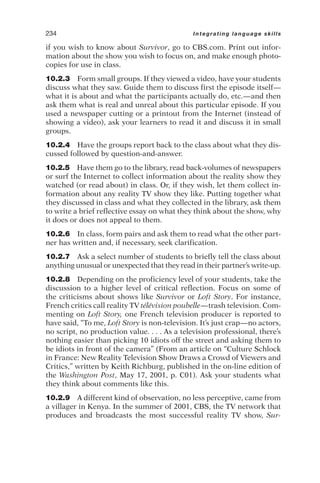
  • 241.
    be inadequate fordeveloping integrated functional skills. Its inade- quacy arises because language skills are essentially interrelated and mutually reinforcing. Fragmenting them into manageable, atom- istic items runs counter to the parallel and interactive nature of lan- guage and language use. It is then fair to say that, in the absence of any empirical sup- port, language skills are being taught in isolation more for logisti- cal than for logical reasons; that is, it is done more out of adminis- trative convenience and availability of time and resources than out of any sound theoretical or experiential knowledge. As was pointed out by Freeman and Freeman (1992, p. 138), a recognition of the tension between what should be rightfully done and what is actu- ally done is clearly brought out by textbook writers who continue to write separate books or separate chapters for each of the skill areas, while at the same time find it necessary, in their editorial comments, to readily acknowledge the importance of the integration of language skills. The Need for Integration Theoretical as well as experiential knowledge overwhelmingly point to the importance of integrating language skills. It is likely that the learning and use of any one skill can trigger cognitive and commu- nicative associations with the others. Several scholars have attested to this likelihood. Emphasizing the connection between reading and other skills, Krashen (1989, p. 90) argues that reading may very well be “the primary means of developing reading comprehension, writ- ing style, and more sophisticated vocabulary and grammar.” Simi- larly, listening activities have been found to help learners make the broader connection between the sociolinguistic concept of form and function and the psycholinguistic processes of interpretation and ex- pression (Rost, 1990). Linking speaking with other skills, Martin Bygate (1998, p. 34) found it “inevitable that the real time processing of listening activi- ties, the exposure to language via reading and listening, and the attention to form-meaning relations in all skills can wash forward to help the development of speaking.” Such a connection is true of writing as well, as observed by Wilga Rivers (1981, pp. 296–7): “Writing is not, then, a skill which can be learned in isolation. . . . 228 Integrating language skills
  • 242.
    the most effectivewriting practice, and the most generally useful, will have a close connection with what is being practiced in relation to other skills.” In addition to these theoretical insights, there is yet another ad- vantage for replicating the natural integration of skills in the class- room. As we saw in the chapter on learner autonomy, various learn- ers bring various learning styles and strategies to class. Integration of language skills has the potential to offer “different opportunities for different types of learners, for example, the extroverts who like to speak a lot, the introverts who prefer to listen or read, and the an- alytically or visually oriented learners who like to see how words are written and sentences constructed” (Paul Davies and Eric Pearse, 2000, p. 75). While, as Selinker and Tomlin (1986) rightly urge, more classroom-oriented research is required to determine the full im- pact of integration and separation of skills, all available theoretical and experiential information stress the need to integrate language skills for effective language learning and teaching. Reflective task 10.3 Pause here for a minute and think about all the ways in which you can inte- grate language skills in your class. If possible, brainstorm with another col- league and make a list. Integrating Language Skills In the last fifteen years or so, several types of classroom activities have entered the field of L2 learning and teaching. There are, as mentioned in the previous chapter, interactive scenarios (Di Pietro, 1987) and problem-solving tasks (Prabhu, 1987; Nunan, 1989; Willis, 1996). In addition, there are content-based activities (Crandall, 1987), project-based activities (Legutke and Thomas, 1991), whole- language activities (Goodman, 1986; Freeman and Freeman, 1992), and experiential activities (Kohonen, et al., 2001). All these classroom activities have one thing in common: they stress interactive lan- guage use that requires a synthesis of various language skills and various language components. Additionally, these integrated activi- Integrating language skills 229
  • 243.
    ties are allrelevant for learners of different levels of proficiency, provided the degree of conceptual, communicative, and linguistic challenge is monitored and maintained. Any of the above types of classroom activities, if properly designed and implemented, can easily lead to the integration of language skills. For instance, in performing a well-planned integrated activ- ity, learners may • try to understand the teacher’s directions, seek clarifications, and take notes (listening, speaking, and writing); • brainstorm, in pairs or in small groups, and decide to use library resources or the Internet to collect additional information (lis- tening, speaking, reading, and writing); • engage in a decision-making process about how to use the col- lected information and proceed with the activity (listening, speak- ing, and reading); • carry out their plan of action (reading, writing, speaking, and lis- tening); • use the notes taken during their group discussion, and present to class what they have accomplished (reading, speaking, and lis- tening); and • finish the activity with a whole class discussion (listening and speaking). The following illustrative microstrategies show how the language skills can be profitably integrated. Microstrategies for Integrating Language Skills As with most other microstrategies illustrated in this book, resources such as newspapers, news magazines, and the Internet (where avail- able) provide excellent materials for designing microstrategies for integrating language skills. Additional resources can be found in TV shows—particularly excerpts from short documentaries—talk shows, and sitcom episodes as well as radio broadcasts. An easier alterna- tive, of course, is textbook activities that can be suitably adapted to cover integrated skills. It should be remembered that a great way of motivating the learners is to involve them in the material selection process by asking them to suggest topics and themes that then can 230 Integrating language skills
  • 244.
    be discussed inclass in order to arrive at a consensus list of topics they would like to address. The following microstrategies, as well as exploratory projects, show how channels of communication such as newspapers, radio, TV, and the Internet can be effectively used for the purpose of inte- grating language skills. Microstrategy 10.1: A Matter of Money and Motherhood 10.1.0 A regular column feature that appears in newspapers or news magazines in many parts of the world is the advice column. Readers who participate in these columns generally describe a personal experi- ence or a social situation and seek advice from experts in the relevant field of activity. These columns can be a good source for generating meaningful discussion in class, since everybody will have an opinion on most of the personal and social issues raised by readers. Most of these are syndicated columns, that is, the same columns appear in sev- eral newspapers. It is fairly easy to use newspaper columns to design a classroom activity involving all four language skills and at different levels of linguistic and communicative challenge. Here’s one way of doing it; you may wish to modify some parts of the microstrategy to suit your learning and teaching situation. 10.1.1 Select a short piece from an advice column that you believe will interest your learners. Make sure the issue raised lends itself to dif- ferent interpretations and solutions based on different beliefs and ex- pectations. The following sample text is taken from an advice column, titled “Miss Manners,” that appeared in the San Jose Mercury News. Dear Miss Manners: While we were expecting our fourth son, my mother offered to come and assist with our family during his birth, using a plane ticket she already had. We were glad to have her here to help with transportation, meal preparation, etc. Because of un- foreseen circumstances, she ended up staying for 13 days. During her stay, she made many trips to the grocery store: some I re- quested, some she did on her own. Whenever she purchased some- thing for our family, I told her I would pay her back. Upon departure, she presented me with a total of over $400! I wrote her a check. Later, I looked at the receipts she had left. She charged us for all the food she ate, numerous magazines and cook- books she purchased for herself, special soap she wanted instead of the brand we use, and gifts for the dog ($10 for the dog bones) and the children! In addition, she bought many expensive items (large bags of macadamia nuts and almonds, brand-name grocery items Integrating language skills 231
  • 245.
    when I usuallypurchase store brands) that I would never have pur- chased. She is not poor and neither are we, but my husband and I are at a loss as to why she would take advantage of us in this way. She didn’t even leave the used magazines for us to see! Should I confront her or just let sleeping dogs eat their $10 bones? (Source: San Jose Mercury News, 3/18/2001) 10.1.2 Make photocopies of the selected text, or copy it onto an OHP transparency. In class, before you distribute it to your learners, read the text aloud in normal speed, pausing at crucial places. For instance, read aloud the first two sentences. Pause. Ask the learners to guess what they would expect the writer to say about her mother. Read the next three sentences. Pause. Ask. Then, read the first sentence of the second paragraph, and so on. At an appropriate point in the reading (e.g., at the end of the first paragraph), ask them what the writer is seeking advice about. 10.1.3 Distribute copies of the text, or project it on the OHP. Ask your learners to read it carefully. Encourage them to seek clarification to help them understand the text. 10.1.4 Form small groups and have them discuss the immediate is- sues raised in the text, zeroing in on the mother’s action and the daugh- ter’s reaction. 10.1.5 Ask each group to prepare a consensus report of what they would have done if they were in the position of the daughter. 10.1.6 Depending on the proficiency level, encourage them to dis- cuss larger issues of cultural and social beliefs involving the concept of family, which individuals are considered to constitute a family, and a mother’s relationship with her daughter’s family and vice versa. 10.1.7 Have a representative from each group present the group’s consensus report to the class, and lead a discussion on what emerges. 10.1.8 After giving adequate time for preparation, ask a couple of active, enterprising students to role-play a possible mother-daughter encounter assuming that the daughter has been advised, and has de- cided, to confront her mother. 10.1.9 Ask them to pretend that they are the experts the writer is turn- ing to for advice. Have them write in class, individually, an appropriate response to the writer, specifically addressing the last question raised by her. If there are learners from different cultural or subcultural back- grounds, encourage them to write about how members of their cultural community would have reacted to the daughter’s complaint about her mother. 232 Integrating language skills
  • 246.
    10.1.10 Finally, alertyour learners (if they do not already know) about advice columns in local newspapers, and ask them to read them regularly and bring a story or two to class if they find them interesting and would like to discuss them in class. Microstrategy 10.2: A Matter of Reality and Falsehood 10.2.0 A recent source of entertainment is what is called reality TV. It has been a phenomenal success in North America and Europe, and is fast spreading to other parts of the world as well. Some successful re- ality shows include Survivor, Big Brother, Temptation Island, and Loft Story—the first three are North American and the last one French. Episodes of Survivor and Loft Story, for instance, have both been the most-watched TV shows in their respective countries. In reality TV shows, participants are not professional actors and ac- tresses but people selected from various walks of life. A small group of adventurous people is selected and taken to exotic places like Aus- tralian coasts or Kenyan villages and are given very few amenities. They have to survive and “outwit, outplay, outlast” each other in order to win a million dollars, as in the case of Survivor. Or, in the case of Loft Story, eleven young couples are housed in a small loft for seventy days, and one loft-dweller is kicked out after each episode. The couple re- maining after everyone else is evicted wins a $400,000 house. In both shows, the cameras are turned on the participants almost twenty-four hours a day, and their every move is recorded and broadcast. Reality TV with its exotic appeal can provide an extraordinary source of materials for L2 teachers if they wish to promote meaningful inter- action in class and integrate language skills. Here’s a suggestion; adapt as necessary: 10.2.1 To set the stage, write “Reality TV” on the board and ask your learners what it means and what they know about it. Ask them if they have seen or heard/read about any such shows. Let them share what they know with the class, including their opinions about why they ap- peal to people of different generations and interests. 10.2.2 Select an episode from any of these shows, videotape it, and play it in your class. You may also pause at crucial moments and ask the students to guess what they expect the participants to do next. If you teach in an area where these shows are not shown or are not avail- able on video, you may give your learners a minilecture on the subject by collecting relevant information from newspapers and the Internet. If you are surfing the Internet, search for “reality TV” on any of the search engines (e.g., Yahoo.com or Google.com), and you will find hun- dreds of Web sites. Or, you may also go to specific shows; for instance, Integrating language skills 233
  • 247.
    if you wishto know about Survivor, go to CBS.com. Print out infor- mation about the show you wish to focus on, and make enough photo- copies for use in class. 10.2.3 Form small groups. If they viewed a video, have your students discuss what they saw. Guide them to discuss first the episode itself— what it is about and what the participants actually do, etc.—and then ask them what is real and unreal about this particular episode. If you used a newspaper cutting or a printout from the Internet (instead of showing a video), ask your learners to read it and discuss it in small groups. 10.2.4 Have the groups report back to the class about what they dis- cussed followed by question-and-answer. 10.2.5 Have them go to the library, read back-volumes of newspapers or surf the Internet to collect information about the reality show they watched (or read about) in class. Or, if they wish, let them collect in- formation about any reality TV show they like. Putting together what they discussed in class and what they collected in the library, ask them to write a brief reflective essay on what they think about the show, why it does or does not appeal to them. 10.2.6 In class, form pairs and ask them to read what the other part- ner has written and, if necessary, seek clarification. 10.2.7 Ask a select number of students to briefly tell the class about anything unusual or unexpected that they read in their partner’s write-up. 10.2.8 Depending on the proficiency level of your students, take the discussion to a higher level of critical reflection. Focus on some of the criticisms about shows like Survivor or Loft Story. For instance, French critics call reality TV télévision poubelle—trash television. Com- menting on Loft Story, one French television producer is reported to have said, “To me, Loft Story is non-television. It’s just crap—no actors, no script, no production value. . . . As a television professional, there’s nothing easier than picking 10 idiots off the street and asking them to be idiots in front of the camera” (From an article on “Culture Schlock in France: New Reality Television Show Draws a Crowd of Viewers and Critics,” written by Keith Richburg, published in the on-line edition of the Washington Post, May 17, 2001, p. C01). Ask your students what they think about comments like this. 10.2.9 A different kind of observation, no less perceptive, came from a villager in Kenya. In the summer of 2001, CBS, the TV network that produces and broadcasts the most successful reality TV show, Sur- 234 Integrating language skills
  • 248.
    vivor, took itscrew and participants to a village in Kenya to film its new Survivor: Africa series. The story line is, of course, the same: the par- ticipants have to live under severe conditions and survive with meager food and other resources while outwitting, outplaying, and outlasting everybody else to win a million dollars. Project the following excerpt from a local newspaper on an OHP: “A million dollars? Just for surviving? . . . I could win that show. I live for several days without eating, just a little water.” Mohammed Leeresh, a bemused Kenyan villager, commenting on “Survivor: Africa,” the latest installment of the “reality TV” series that’s taping in his neighborhood. Local people said they remained puzzled even after the show’s concept was explained to them. (Source: San Jose Mercury News, August 19, 2001, p. C2) Ask your learners to think about Mohammed Leeresh’s comment. Have them discuss why they think Kenyan villagers are “bemused” and “puzzled.” If your learners themselves are not doing it, lead them to consider the above piece of information from the perspective of those Kenyan villagers. Here they are, presumably living under severe condi- tions, facing starvation as part of their everyday existence. They cannot understand why anyone would create an artificial scarcity of food and other resources, and then pay a million dollars for somebody to survive such conditions, while, for those Kenyans, such conditions are part of their everyday reality. And, nobody pays them even a penny to applaud their survival. Alert your students to these perspectives and lead a crit- ical discussion. Exploratory Projects The following exploratory projects are aimed at providing a general plan for designing microstrategies to integrate language skills. You need to decide what to do and how exactly you wish to do it. Project 10.1: Comic Situations 10.1.0 Apart from the newly introduced reality shows, television every- where has traditionally shown and continues to show sitcoms (situation comedies)—brief episodes that humorously bring out the strengths and weaknesses of human beings. These sitcoms are loaded with cul- tural and subcultural beliefs and value systems. Sitcoms produced in North America, for instance, depict, almost exclusively, the lives and Integrating language skills 235
  • 249.
    loves of peopleof different ethnic communities. Any of the episodes of a sitcom can be used as a resource around which to design classroom activities, since each episode is short and self-contained with a beginning and an end. 10.1.1 Select any currently popular sitcom, one that you think is suitable for your class. Videotape an interesting episode. (If you do not have a videorecorder, your school may have one you can borrow. Some schools may do recordings for teachers, if requested.) 10.1.2 Watch the selected episode again, closely. Jot down questions that you might want to ask your learners before showing the video so that they will know what to anticipate. 10.1.3 Divide the episode into three or four segments and, focusing on each segment, think of listening comprehension questions that you can ask to help your students to understand the episode. 10.1.4 Focus on and prepare questions about conversational fea- tures that you want to highlight in class—such as the informal and col- loquial nature of language used, how participants take turns, and how openings are provided for the listener to speak, etc. 10.1.5 Focus on features other than the lexical items that carry mean- ing so that you can direct your learners’ attention to them. These may include: stress, intonation, rhythm, and body language. Think about what your learners already know and what needs to be highlighted. 10.1.6 Focus also on characterization to help learners identify any strong views or mannerisms or behavior patterns that are unique to a particular character in the episode. 10.1.7 In addition to the above, make sure you address the following questions as you design your microstrategy: Do the learners need any assistance with any of the jokes? What kind of linguistic and cultural prior knowledge is assumed here? Does the episode depict a particular set of attitudes and beliefs that you need to highlight? 10.1.8 Think about the kind of a class project that will help them do some reading and writing around this episode. Would it be possible to ask your students, in small groups, to make a transcript of the episode? To rewrite the script from the point of view of a different belief system? And, enact the revised version in class? 10.1.9 Finally, try to implement your microstrategy in class and monitor how it develops. Reflect, revise, and reuse. 236 Integrating language skills
  • 250.
    Project 10.2: RadioDays 10.2.0 In learning/teaching environments where Internet surfing and videotaping are difficult, radio broadcasts can offer unlimited resources for language related activities. Local or international radio broadcasts in certain target languages, particularly English, are readily available in many countries. Generally, radio broadcasts offer a variety of programs including songs, music, news items, speeches, interviews, and sports commentaries. Depending on the interest and proficiency level of your learners, select any of these programs for designing a microstrategy to integrate language skills. Here’s one possibility. 10.2.1 Select an evening news broadcast from a popular radio sta- tion. Audiotape it. Listen to it again, looking for possible segments for classroom use, and jot them down. 10.2.2 Normally, news broadcasts begin with headlines. Think about how you incorporate that aspect by the questions you can ask your learners. How would you help them anticipate the details of the news by merely listening to the headlines? And, how would you help them understand that headlines are to news broadcasts what titles and sub- titles are to a text? 10.2.3 Focusing on each of the main news stories, think of listening comprehension questions that you can ask to help your students under- stand the day’s news. 10.2.4 Think of any prior knowledge of political or social events that is needed for learners to fully understand the day’s news. 10.2.5 Focus also on difficult lexical and grammatical structures so that you can direct your learners’ attention to them. 10.2.6 Let’s say you wish to zero in on one or two stories for detailed analysis and understanding. What preparation do you have to make? How would you encourage an extended discussion on the selected news items? A debate? A group work? 10.2.7 How would you relate the listening and speaking activity to reading and writing? Normally, newspapers have more in-depth cover- age of a particular news story than radio news broadcasts; therefore, would it be advisable to ask the learners to bring a copy of the day’s newspaper to class? How would you relate the radio story to what ap- pears in the newspaper to create an opportunity for learners to read in class? Integrating language skills 237
  • 251.
    10.2.8 Think ofa writing assignment that would be appropriate to help learners connect the radio news broadcast, the same story in the newspaper, and their discussion in class. 10.2.9 If you teach a class consisting of students from different countries, how would you make use of the rich array of political and cultural background knowledge that is available in the class? 10.2.10 Think of a project in which the learners consult the library or surf the Internet to gather more information about any news item discussed in class, write a brief report, and present it in class. In Closing What we learn from the general discussion, the microstrategies, and the project proposals is that integration of language skills is natural to language communication. By designing and using microstrate- gies that integrate language skills, we will be assisting learners to engage in classroom activities that involve a meaningful and simul- taneous engagement with language in use. As Oxford (2000, p. 18) puts it eloquently, for the instructional loom to produce a large, strong, beautiful, colorful tapestry, the strands consisting of the four primary skills of listening, reading, speaking, and writing must be closely interwoven. I have tried to show in this chapter that the best way of interweaving the four strands is to go beyond the limi- tations of commercially available textbooks that are still based on the separation of language skills, and learn to exploit various resources and channels of communication such as newspapers, radio, TV, and the Internet. The emphasis on the integration of language skills is a logical continuation of the emphasis on contextualizing input embedded in linguistic, extralinguistic, situational, and extrasituational con- texts that we discussed in the previous chapter. This logical connec- tion is extended in the next chapter, where we look at the relevance of the social context in which L2 learning and teaching takes place. 238 Integrating language skills
  • 252.
    C H AP T E R 1 1 Ensuring S o c i a l R e l e v a n c e It is simply impossible to isolate classroom life from the school’s institutional dynamics, the ever-present tensions within the community, and the larger social forces. . . . In order to act effectively we have to recognize the influence of the social context. —DANIEL LISTON AND KENNETH ZEICHNER, 1990, p. 612 No classroom is an island unto itself. Every classroom is influenced by and is a reflection of the larger society of which it is a part. The term society itself refers to a very large unit consisting of a commu- nity of communities. In the specific context of language education, it stands for “all of those wider (and overlapping) contexts in which are situated the institutions in which language teaching takes place. These include—but are not limited to—the international, national, community, ethnic, bureaucratic, professional, political, religious, economic and family contexts in which schools and other educa- tional institutions are located and with which they interact” (Hywel Coleman, 1996, p. 1). Within a society, one comes across many forms of accommoda- tion and assistance as well as domination and resistance. These forms are generally based on factors such as class, gender, race, ethnicity, nationality, religion, language, and sexual orientation. The same fac- tors play a role in shaping classroom discourse as well (see Kumar- avadivelu, 1999b, for details). In order to make L2 learning and teaching socially relevant one has to recognize that the broader so- cial, political, historical, and economic conditions that affect the lives of learners and teachers also affect classroom aims and activities. What such a recognition entails is that all those who are con- cerned with language education have to consider several factors before determining the content and character of language policy,
  • 253.
    planning, learning, andteaching. Given the depth and breadth of the subject, I shall restrict my discussion in this chapter to the learn- ing and teaching of English as a national and international language. Within such a setting, I shall briefly focus on issues related to (a) the status of English as a global language, (b) the role of the home lan- guage in the learning and teaching of English, and (c) the use of ap- propriate teaching materials. As we discuss these issues, it will be- come fairly apparent that language pedagogy is closely tied up with power politics. The Status of English as a Global Language “A language achieves a genuinely global status,” observes David Crystal (1997), the author of English as a Global Language, “when it develops a special role that is recognized in every country.” En- glish has developed such a role. In the international arena, it has in- creasingly become the language of war and peace, science and tech- nology, commerce and communication. The advent of the Internet has only accelerated its spread, with more than 80 percent of home pages on the World Wide Web using English. At present, up to 380 million people speak English as their native language, up to 300 mil- lion speak it as their second language, and up to 1 billion speak it as a foreign language (Crystal, 1997). Thus, in its spread and use the English language is unrivaled in human history. It is inevitable that a language of such spread and use will de- velop a large number of local varieties. There are several varieties of English even among those who speak it as native language: Ameri- can English, Australian English, British English, etc. And, within these, there are domestic variations. In the United States alone, for instance, there are regional variations found in areas such as Boston, New York, Texas, and the southern states, and ethnic variations such as African-American Vernacular English. The non-native varieties of English include Indian English, Kenyan English, Nigerian English, Singaporean English, etc. All these varieties are rule-governed, that is, they are conditioned by phonological, syntactic, semantic, and rhetorical rules. They are used for intranational as well as international communication; more for the former than for the latter. Even when used outside their countries, they are used to communicate more with other non- native speakers than with native speakers. Besides, a number of non-native varieties have developed a rich body of literature and 240 Ensuring social relevance
  • 254.
    other creative writingsthat demonstrate the use of English to ex- press local sociocultural nuances. In fact, the number of varieties of English has multiplied to the point of pluralizing it as World Englishes. Given the linguistic spread and the cultural richness of World Englishes, a crucial question arises regarding which standard or variety one should adopt for the purpose of learning and teaching English in various educational settings. Reflective task 11.1 What criteria, do you think, must a language variety meet before it can be considered a “standard” variety? Who or what agency has the authority to declare a variety, a “standard” variety? Do you speak the “standard” variety of your first language? How do you know? The Politics of Standardization The term standard refers to a prestige variety of a language. It is com- monly and vaguely defined as “the variety of a language which has the highest status in a community or nation and which is usually based on the speech and writing of educated native speakers of the language” (Longman Dictionary of Applied Linguistics, 1985, p. 271). A definition like this begs a number of questions including: How does one determine “the highest status”? Who determines it? Who consti- tutes a community for this purpose? How educated is “educated”? A variety does not become “standard” just because educated na- tive speakers speak it. A case in point is the following episode re- ported in a major newspaper during the 1992 U.S. presidential cam- paign involving Bill Clinton, the then-governor of the southern state of Arkansas. Consider this: Gov. Clinton, you attended Oxford University in England and Yale Law School in the Ivy League, two of the finest institutions of learn- ing in the world. So how come you still talk like a hillbilly? (Mike Royko, “Opinion,” Chicago Tribune, October 11, 1992, cited in Lippi-Green 1997, p. 211). Ensuring social relevance 241
  • 255.
    Hillbilly is areference to the fact that Clinton hails from the South and speaks “Southern,” a variety of English that is not considered “standard” in the United States. Realistically, then, a variety is considered “standard” only be- cause it is spoken by those who control the social, political, and cul- tural power centers within a nation. Thus, the standard variety of French is based on educated Parisian French. The standard variety of British-spoken English refers to Received Pronunciation (RP), historically derived from the speech of the Royalty based in south- ern London. Similarly, standard American English refers to the va- riety spoken and written by persons • with no regional accent; • who reside in the Midwest, far west or perhaps some parts of the northeast (but never in the south); • with more than average or superior education; • who are themselves educators or broadcasters; • who pay attention to speech, and are not sloppy in terms of pro- nunciation or grammar; • who are easily understood by all; • who enter into a consensus of other individuals like themselves about what is proper in language. (Rosina Lippi-Green, 1997, p. 53) A standard variety, thus, gets its prestige owing to social, political, and economic factors and not linguistic ones. Linguistically speak- ing, a standard variety is neither superior nor inferior to any other. Given these facts, it is easy to conclude that “the custodians of standard English are self-elected members of a rather exclusive club” (Widdowson, 1994, p. 377). The issue of “standard” becomes even more complicated in the context of several varieties of World Englishes because of colonial history and national identity. Colonialism used language as an in- strument of political, social, and cultural control. Postcolonial the- orists tell us that language “is a fundamental site of struggle for postcolonial discourse because the colonial process itself begins in language. The control over language by the imperial centre— whether achieved by displacing native languages, by installing itself as a ‘standard’ against other variants which are constituted as ‘impurities,’ or by planting the language of empire in a new place— 242 Ensuring social relevance
  • 256.
    remains the mostpotent instrument of cultural control” (Bill Ash- croft, Gareth Griffiths and Helen Tiffin, 1995, p. 283). Connecting this line of thinking specifically to English language teaching (ELT), Alastair Pennycook (1998) offers an in-depth analy- sis of what he calls “the continuity of cultural constructs of colo- nialism” and demonstrates how ELT is deeply interwoven with the discourses of colonialism. ELT, he argues, “is a product of colonial- ism not just because it is colonialism that produced the initial con- ditions for the global spread of English but because it was colonial- ism that produced many of the ways of thinking and behaving that are still part of Western cultures. European/Western culture not only produced colonialism but was also produced by it; ELT not only rode on the back of colonialism to the distant corners of the Empire but was also in turn produced by that voyage” (p. 19). Based on his analy- sis, Pennycook calls for concerted efforts to decolonize English lan- guage education by finding alternative representations and alterna- tive possibilities in English language classes. Consolidating an alternative approach to the issue of standardi- zation, Peter Lowenberg (2000, p. 69–70) observes that “the norms of Standard English in any variety—native-speaker or non-native— are not what any outsider—native speaker or non-native speaker— thinks they should be.” Accordingly, he operationally defines the standard model of a variety of English—native or non-native—as “the linguistic forms of that variety that are normally used in formal speaking and writing by speakers who have received the highest level of education available in that variety.” The assumption that na- tive speakers should determine the norms for teaching and testing Standard English around the world, he rightly asserts, betrays a neo- colonial attitude. Lowenberg’s observations are consistent with the stand other scholars have taken in the field of World Englishes such as Kachru (1982), Krishnaswamy and Burde (1998), and Kandiah (1998). They hold the view that the pluralistic nature and the dy- namic linguistic and creative processes of non-native varieties ex- press the social identity and the cultural values of the speakers of those varieties, thus constituting standard varieties by themselves. Ensuring social relevance 243
  • 257.
    Reflective task 11.2 Focuson three different settings, i.e., (a) immigrants in an English-speaking country like the United States or United Kingdom, (b) learners of English as a second language in countries like India or Singapore, and (c) learners of English as a foreign language in countries like China or Japan. If you were part of the language policy planning team in these countries, what variety (or standard) would you recommend for purposes of learning and teaching in these settings? Why? Raising and answering the question, Who owns English? Widdow- son (1994, p. 384) argues that “the very fact that English is an inter- national language means that no nation can have a custody over it. To grant such custody of the language is necessarily to arrest its development and so undermine its international status.” He further reckons that native speakers of English cannot claim the language to be exclusively their own because it is “not a possession which they lease out to others, while still retaining the freehold. Other people actually own it.” If “other people” actually own a variety of the English language and use it effectively within their speech community, how does such ownership conflict with the politics of standardization? And, how does that conflict affect English language learning and teaching in various educational settings? Let us consider these and other re- lated issues with reference to two different settings: (a) English in the L1 setting, (b) English in the L2 setting. Standardization in the L1 Context Aboriginal English spoken in Australia, Scottish and Irish spoken in the United Kingdom, and African-American Vernacular English spoken in the United States are all examples of English that are in contact with a dominant variety of English. All these varieties are rule-governed with phonological, morphological, syntactic, seman- tic, and rhetorical structures. Speakers of these varieties use them with members of their families or with members of their communi- ties but may switch to a dominant variety for other purposes. While 244 Ensuring social relevance
  • 258.
    the history andstatus of these varieties are very different, they all share similar experiences of coming into conflict with the politics of standardization. A case in point is the cultural politics of Ebonics that flared up recently in the United States. Ebonics, a blend of ebony and phon- ics, is the popular name given to African-American Vernacular En- glish (AAVE). In 1996, authorities in Oakland, California, passed a resolution declaring Ebonics to be the primary language of the African-American students in Oakland’s schools and recommended that students be taught in such a way that they maintain their home language Ebonics as well as learn Standard American English. The move was strongly opposed by the American media and the American public, including some prominent African-American lead- ers. The New York Times wrote that it is a “blunder” to give “black slang” a place of honor in the classroom. It objected that “by label- ing them as linguistic foreigners in their own country, the new policy will actually stigmatize African-American children—while validat- ing habits of speech that bar them from the cultural mainstream and decent jobs” (New York Times, 1996, cited in Dennis Baron, 2000, p. 7). Faced with severe criticism, Oakland quickly retracted its res- olution and replaced it with a milder one stating that the objective of the resolution was to teach teachers about the language their stu- dents brought to school, and to teach Standard American English to students who speak AAVE as home language (see, for instance, Baron, 2000, for more details). The widespread debate that followed the Oakland decision seems to have reinforced the general consensus that knowledge of the “stan- dard” variety is necessary for social and economic uplift. However, serious concerns were expressed about the need for maintaining the linguistic and cultural identity of the speakers of minority vari- eties, and also for linking the variety spoken at home with the vari- ety taught at school. These concerns reflected an earlier assertion by Lisa Delpit (1990, p. 53) that it is the responsibility of teachers to “recognize that the linguistic form a student brings to school is intimately connected with loved ones, community, and personal identity. To suggest that this form is ‘wrong’ or, even worse, igno- rant, is to suggest that something is wrong with the student and his or her family.” There is also evidence suggesting that an understanding of the Ensuring social relevance 245
  • 259.
    norms of interactionin home language and home culture can sig- nificantly help teachers create the conditions necessary for their learners to master the “standard” variety taught at school. In her well-known study on this subject, Shirley Brice Heath (1983) demonstrated how the discontinuity in the patterns of language learning and language use in schools and communities of children from African-American families in the southeastern United States adversely affected their language development. When teachers were made aware of this discontinuity and changed their teaching strate- gies, students were found to be more active and more motivated to participate in classroom events. Summarizing research studies in this area, Geneva Smitherman (1998, p. 142) observes, “When stu- dents’ primary/home language is factored into language planning policy and the teaching-learning process, it is a win-win situation for all.” Standardization in the L2 Context The need to recognize the legitimacy of “nonstandard” varieties be- comes even more acute in the context of the different varieties of World Englishes that are learned and taught in various parts of the world. In most cases, these varieties came about because of colonial history and are retained because of postcolonial economy. As Thiru Kandaiah (1998, p.104) succinctly puts it, the users of these vari- eties “take hold of an originally alien code which, moreover, was imposed on them. But without disregarding entirely the nature of the rule-governed system they received from its original users, they still go on to reconstruct it to make it serve their semantic, actional and interactional purposes. In doing so, they operate in immediate interaction with the social, cultural, historical and other such par- ticularities of their contexts.” At times, the particularities of these varieties conflict with the process of standardization. Consider, for example, the English lan- guage policy of two nations with two different varieties—India and Singapore. As former British colonies, they both share a common colonial heritage. They both are multilingual and multicultural so- cieties, though of very different magnitude in terms of economy, size, and population. In both countries, English functions as a lingua franca, a common language that links people of different languages 246 Ensuring social relevance
  • 260.
    and cultures. Theyhave, however, taken two different paths to the issue of standardization. I N D I A N E N G L I S H A N D S T A N D A R D I Z A T I O N Considered to be “among the most distinctive varieties in the English- speaking world” (Crystal, 1997, p. 41), Indian English represents the extent to which a foreign language can be profitably reconstructed into a vehicle to express sociocultural norms and networks that are typically local. The process of Indianization of English has not left any of the linguistic systems—syntactic, lexical, semantic, or rhetorical—untouched (see Kachru, 1985, for details). Enjoying the constitutionally guaranteed status of an “associate” official lan- guage, English is used within the legal system, administration, secondary and higher education, the armed forces, the media, and industry. Although only a fraction of the population are fluent in English, it has penetrated most layers of the society through Eng- lish words borrowed into Indian languages. In spite of its deep penetration, the English language has not, argue Krishnaswamy and Burde (1998, p. 153), “made any serious inroads into the social customs, ceremonies connected with births, marriages and deaths, religious functions and rituals that go with festivals, worship in temples, intimate interactions in the family and in the peer group—even in urban areas.” Because of this phe- nomenon, they suggest that English in India should be treated as a “modulect.” It is the modular use of English, they assert, “that al- lows some Indians to use English according to their needs, and yet keep it separate from their local ‘identity’ which is deeply rooted in their ancient past and in the several layers of a pluralistic pattern.” It is certainly the emphasis on individual and collective identity that allows Indians to accept the variety spoken by educated Indians as norms for standardization rather than looking up to the norms associated with the British variety. For educational purposes, then, it is the Indian variety that is given prominence. While Indian writing in English—creative, professional, or journalistic—is expected to conform to international grammatical norms, all other forms of lan- guage use is shaped by the local variety. In fact, in schools and col- leges, English is taught by Indian teachers using Indian textbooks written by Indian authors. Neither the policy makers nor the general Ensuring social relevance 247
  • 261.
    public seek nativespeakers from English-speaking countries for pur- poses of English language education. S I N G A P O R E A N E N G L I S H A N D S T A N D A R D I Z A T I O N In Singapore, English is an official language along with three oth- ers: Malay, Mandarin, and Tamil. All Singaporeans are at least bilin- gual, the common language being English. One in five uses English in family settings. In fact, it is stated that “English can be used in all aspects of daily life. There are a few Singaporeans who seldom, if ever, need to use any other language; who perform all their work life, all their emotional life, and all their commercial transactions in English” (Anthea Gupta, 1998, p. 123). The issue of standardization has been made simple and straight- forward by declaring Standard Singapore English (SSE), which is closely modeled on Standard British English, as the norm to follow both for writing and for speech. For purposes of accelerating indus- trialization and modernization, for ensuring effective international communication, and for providing equal opportunities (as well as equal challenges), Singapore decided to opt for British Received Pronunciation (see Foley, et al., 1998, for more details) as a matter of government policy. In order to implement its English-language policy, Singapore has been actively recruiting native speakers from Britain and other English-speaking countries to be teachers and teacher educators. In addition, most of the textbooks used in schools and colleges have been written and produced by native speakers of English. Singa- pore has also sought the expertise and the experience of The British Council, which, along with local institutions such as the Regional Language Centre (RELC), have been making a concerted effort to spread “proper” English. Sustained institutional efforts seem to have yielded good results in that most educated Singaporeans are considered to speak stan- dard English. However, also creeping in has been Colloquial Singa- pore English (CSE), or, more popularly, Singlish, which is a blend of simplified English with words and sentence patterns from local lan- guages. When, during the early 1990s, there was a proliferation of TV shows that used Singlish, the government-run Singapore Broad- casting Corporation (SBC) decided not to allow Singlish on TV. It 248 Ensuring social relevance
  • 262.
    issued guidelines allowingthe use of Standard English only. It de- fined Standard English as “grammatically correct and pronounced in the correct way,” and local English as “grammatically correct but spoken in a recognizably Singaporean accent” (see Wendy Bokhorst- Heng, 1998, p. 305). Bokhorst-Heng goes on to remark that the as- sumption “was that what is ‘correct’ pronunciation is British Re- ceived Pronunciation.” She also finds the SBC definitions “rather curious” because “Singlish is not spoken by only those with a ‘poor command of English.’” It is spoken by highly educated Singaporeans as well. Singlish “is part of the search for a Singaporean identity,” said David Wong, Chair of the Speak Good English Movement (Asso- ciated Press, August 26, 2001). The Speak Good English Movement is a Singapore government initiative to encourage the use of proper English. The Associated Press also reported that Singapore’s Prime Minister Goh Chok Tong warned that Singapore could lose out if vital foreign investors and multinational company executives face a variety of English that they don’t understand. The persistent use of Singlish, even by highly educated Singaporeans, in spite of official discouragement, indicates the dynamic nature and the communica- tive potential of varieties of English that are not considered presti- gious. To sum up this section, standardization is essentially a political act over which teachers may not have any direct control. They may have to deal with students who come to class with a home language and home culture that are different from the ones they will encounter in the classroom. The least teachers can do is to recognize the rich linguistic and cultural heritage the learners bring with them and use them as resources to build bridges between what is known and what is new. Reflective task 11.3 Pause here briefly to consider, either individually or with a peer partner, dif- ferent ways in which L2 teachers can link learners’ home language/culture with target language/culture. What opportunities and limitations do you an- ticipate here? Ensuring social relevance 249
  • 263.
    The Role ofthe First Language First language is perhaps the most useful and the least-used re- source students bring to the L2 classroom. This is partly due to two interrelated factors: the theory and practice of established methods (see Chapter 2 for details) discourage the use of L1 in the L2 class- room, and the political economy of English Language Teaching pro- motes the interests of native speakers of English who do not nor- mally share the language of their learners. There are, however, sound arguments that support the use of L1 in the L2 classroom. I shall discuss these with reference to two different learning and teaching settings: (a) minority learners in Britain and (b) L2 learners in Sri Lanka. Minority Learners in Britain Since the mid-1980s British schools, particularly in multilingual urban areas, have been offering home language support for learn- ers from minority ethnic communities. It has come to be known as bilingual support. The aim is to help learners access the curriculum until they develop sufficient English to move on to monolingual ed- ucation through the medium of English. It is believed that such a practice would offer psychological and social support for minority children and provide a much-needed continuity between the home and school environment. Marilyn Martin-Jones and Mukul Saxena (1996) have studied the effect of home language use in primary classrooms in England, where a majority of learners are speakers of Panjabi and Urdu. In these classes, typically, a bilingual assistant will provide a simple explanation in the learner’s mother tongue. Here’s a sample class- room interactional episode taken from their study, reproduced here as episode 12.1. I have retained the transcription convention given in the original text. Transcription convention: Italics = translation of Urdu/Panjabi into English Normal = transcription for English utterances Bold = transcription for U/P utterances CT = Class Teacher BA = Bilingual Assistant 250 Ensuring social relevance
  • 264.
    L = onelearner LL = several learners E = English P = Punjabi E p i s o d e 1 1 . 1 CT: . . . what did the thin snow man have? L1: I know, glasses BA: no (P) enoo . . . enoo (points to book) e What’s this called? This CT: (E) (not glasses) L: ([Tailifoon]) BA: enoo aaxde ne (E) pipe (P) jeRe (E) [sigrat](P) hunde, This is called a pipe. Do you know cigarettes? Naa? Ik hundaa? . . . e jeRaa lakRii There’s a-this-that’s made of wood. (BA mimes ac- tion of holding a pipe. Filling with tobacco, and smoking pipe) daa banyaa e. ede vic tabako paade naa? Fer onoo They put tobacco in this, then they light this. (E) light (P) karde, naa? Taa fer enoo piinde naa? (E) [sigrat] And then they smoke this like cigarettes (E) pipe (P) aaxde. Kii e? a pipe. What is it? LL: (E) pipe, pipe, pipe BA: [sigrat] (P) piinde? [They/he] smoke cigarettes? L: (E) do you know my cousin BA: he’s got a pipe? L: he not got a pipe he’s got he . . . he (smokes cigarettes) everybody BA: he smoke everyday? CT: shall we give one to this snowman then? Like that, put it in his mouth? Oh he is that alright? LL: yeh CT: OK (Data source: Martin-Jones and Saxena, 1996, p. 117–8) The class teacher (CT) was discussing a story called The Two Snow- men. One was tall and thin and the other was short and fat. The answer she expected to her question “What did the thin snowman have?” was “a pipe.” One learner volunteered “glasses” instead. At Ensuring social relevance 251
  • 265.
    this point, thebilingual assistant (BA) stepped in to explain in Pan- jabi the difference between a pipe and a cigarette. Explaining the episode and referring to the bilingual assistant, Martin-Jones and Saxena observe: “When discussing this event with us later, she said that she had realized that children were not familiar with the prac- tice of putting pipes in the mouths of snowmen and were also un- likely to have seen anyone in their immediate family smoking a pipe” (p. 120). More importantly, the researchers point out that when one learner introduced a point in English about a cousin of hers who smoked cigarettes, the bilingual assistant realized the significance of this point for the child because smoking was frowned upon in her local Muslim community. Not realizing the significance of the child’s point, the class teacher terminated this exchange between the learner and the bilingual assistant, directing everyone’s attention to the board, thus failing to utilize a learning opportunity created by a learner (see Chapter 3). L2 learners in Sri Lanka Consider the following three short interactional episodes from Sri Lankan classrooms consisting of Tamil learners of English. The data and explanation are taken from Canagarajah (1999, p. 132, 136). E p i s o d e 1 1 . 2 S1: (reading) Who owns the red car? S2: (reads) The red car belongs to // (to T) itenna, miss, eppiTi collu- ratu, (spells) e-n-o-s-h-a? What is this, MISS, how do I say this? T: Enosha S2: (reads) The red car belongs to Enosha. In this episode, where two learners role-play a dialogue, the task itself is performed in English while request for help is uttered in Tamil. Additionally, according to Canagarajah, making requests in L1 “has affective value and it conveys sincerity and an appeal for sympathy” (p. 132). 252 Ensuring social relevance
  • 266.
    E p is o d e 1 1 . 3 T: What is the past tense form of swim? // Come on. // enna piL- LayaL,itu teriyaataa? Poona vakupilai connaiinkaL. What, chil- dren, you don’t know this? You told me in the last class. S1: swimmed= S2: =swam In situations like this, where teachers need to encourage hesitant, frightened, or nervous students, they switch to the less formal and more personal Tamil. This results in “putting students at ease, con- veying teacher’s empathy and, in general, creating a less threaten- ing atmosphere” (ibid., p. 132). E p i s o d e 1 1 . 4 T: Trees and vegetation are also used as medicine. Can you mention some trees which are used like that? // Quinine is produced from citronella. What else? S1: tulasi? T: Yes. S2: tuutuvalai? S3: canTi. As the above episode reveals, on occasions, it is easier to use L1 terms instead of attempting a confusing and misleading transla- tion into the closest English equivalent. As observed by Canagara- jah, by encouraging such answers in the L1, the teacher is able to ensure that the lesson relates well to the cultural background of the learners. To sum up this section, the interactional episodes from the British and Sri Lankan classes reveal that there are several advantages to using the L1 as a resource in the L2 classroom. They include, but are not limited to, Ensuring social relevance 253
  • 267.
    • tapping thelinguistic and cultural knowledge that the learners bring to class; • managing linguistic and cultural identity in informal and friendly ways; • giving clear directions in class thereby reducing the chances of mismatch between teacher intention and learner interpretation (cf. Chapter 4); • providing simple explanations so that learners can easily grasp certain concepts that are being addressed; and • personalizing routine classroom talk and topic management (cf. Chapter 5). In short, the use of L1 helps learners make the connection be- tween the home language and the target language, thereby ensuring social relevance to classroom aims and activities. It is therefore pedagogically unsound not to use a rich resource like the home language of the learners whenever possible and ap- propriate. Elsa Auerbach (1993) cites evidence from both research and practice to show that the use of the L1 in early L2 classes is crit- ical not only to later success but also to a smooth transition to the target language. What she points out about the American context is also true of other contexts, that is, the insistence of using English only in the classroom “rests on unexamined assumptions, originates in the political agenda of dominant groups, and serves to reinforce existing relations of power” (p.12). In fact, sometimes learners themselves might resist any dog- matic insistence on the target language only policy in the classroom. Marilyn Martin-Jones and Monica Heller (1996, p. 7) report an in- cident from a French-language minority school in Canada. In one grade 8 classroom, a student approached the teacher and said, “Can I have the stapler, Monsieur?” In an attempt to uphold the official language policy of the school, the teacher replied, “Parlez Français” (Speak French). The student looked at the clock and said, “It’s not nine o’clock yet, Monsieur!”—indicating that the class had not started yet. It appears that by making a structural distinction be- tween class time and “other time,” this learner is actually register- ing her resentment over the French-only policy of the school. Thus, the case for using L1 in the L2 classroom is quite strong. What would, indeed, complement the appropriate use of L1 in the L2 classroom is the design and use of socially relevant teaching materials. 254 Ensuring social relevance
  • 268.
    Reflective task 11.4 Howwould you define or describe “socially relevant teaching materials”? If you are given prescribed textbooks selected by your school authorities or by outside agencies, what are the ways in which you can adapt them to suit your social context? The Use of Appropriate Teaching Materials Textbooks are not a neutral medium. They represent cultural values, beliefs, and attitudes. They reflect “a social construction that may be imposed on teachers and students and that indirectly constructs their view of a culture. This aspect often passes unrecognized” (Mar- tin Cortazzi and Lixian Jin, 1999, p. 200). Critical recognition of the hidden cultural values embedded in centrally produced textbooks is a prerequisite for ensuring social relevance in the L2 classroom. Textbooks, to be relevant, must be sensitive to the aims and ob- jectives, needs and wants of learners from a particular pedagogic setting. However, because of the global spread of English, ELT has become a global industry with high economic stakes, and textbook production has become one of the engines that drives the industry. It is hardly surprising that the world market is flooded with text- books not grounded in local sociocultural milieu. It is very common, as Sandra McKay (2000, p. 9) points out, to see teacher and students coming from the same linguistic and cul- tural background, but use textbooks that draw heavily on a foreign culture, as in the case of classrooms in Thailand or in Korea where local teachers use materials written in the United States or Great Britain. She cites two examples to bring out such a cultural anomaly. A Korean student experienced difficulty in using a U.S.-published textbook when he was teaching in Korea. One of the exercises in- structed students to look at photographs of various events in Amer- ican history and decide the decade in which the picture was taken! In another example, she talks about a lesson on garage sales in the United States. She rightly observes that those from cultures that have garage sales wouldn’t think twice about it, while those from other cultures might be puzzled. She wonders whether students from an- other culture “would be surprised and perhaps offended by the idea of buying used mattresses, sheets, blankets and underwear” (p. 9). Ensuring social relevance 255
  • 269.
    Taking into considerationthat English is a global language, Cor- tazzi and Jin (1999) suggest three types of cultural information that can be used in preparing teaching materials: • target culture materials that use the culture of a country where English is spoken as a first language; • source culture materials that draw on the learners’ own culture as content; and • international target culture materials that use a variety of cul- tures in English and non-English-speaking countries around the world. This suggestion is based on the recognition that both local and global cultures, not just the culture of the target language commu- nity, should inform the preparation of materials for learning and teaching an L2. This is one sure way of ensuring social relevance in the L2 classroom. Expanding Possibilities Ensuring social relevance in the L2 classroom is closely linked to the pedagogy of possibility discussed in chapters 1 and 2. Recall that a pedagogy of possibility demands for us to take seriously the social and historical conditions that create the cultural forms and interested knowledge that give meaning to the lives of teachers and learners. As I have argued elsewhere (Kumaravadivelu, 2001), the experiences participants bring to the classroom are shaped not only by the learning and teaching episodes they have encountered in the past but also by a broader social, economic, and political en- vironment in which they grew up. These experiences have the potential to affect classroom practices in ways unintended and un- expected by policy planners, curriculum designers, or textbook pro- ducers. Two examples, one from Sri Lanka and another from South Africa, demonstrate how life in the street can easily influence les- sons in the classroom. Canagarajah (1999) reports how Tamil stu- dents of English in the civil war–torn Sri Lanka offered resistance to Western representations of English language and culture. He shows how the students, through marginal comments and graphics, actually reframed, reinterpreted, and rewrote the content of their 256 Ensuring social relevance
  • 270.
    ESL textbooks importedfrom the West. Similarly, analyzing L2 class- room data in terms of the ideology and structures of the apartheid South Africa, Keith Chick (1996) demonstrates how the classroom talk represented “styles consistent with norms of interaction which teachers and students constituted as a means of avoiding the op- pressive and demeaning constraints of apartheid educational sys- tems” (p. 37). While the Sri Lankan and South African cases may be considered by some to be extreme cases of classroom life imitating the sociopolitical turmoil outside the class, there are numerous in- stances where race, gender, class, and other variables directly or in- directly influence the content and character of classroom input and interaction. In the process of sensitizing itself to the prevailing sociopolitical reality, a pedagogy of possibility is also concerned with individual as well as social identity. More than any other educational enter- prise, L2 education that brings languages and cultures in contact provides its participants with challenges and opportunities for a continual quest for subjectivity and self-identity. In a sense, then, the classroom behavior of the Sri Lankan and South African stu- dents mentioned above is an unmistakable manifestation of their attempt to preserve and protect their individual and collective iden- tity. At a different level, the same can be said about the persistence of Singlish in Singapore as well. Reflective task 11.5 Considering the overall thrust of this chapter, what challenges do you think L2 teachers face in raising sociopolitical and sociocultural issues in class? And, how to overcome those challenges? In answering this question, reflect on the following episode reported by Douglas Brown (1998, p. 256): “From China I received some very guarded personal comments from a native Chinese who asked not to be identified. I was told that, in fact, treatment of political issues must be covert, lest one lose more than one’s job. He described two approaches that intrigued me. The first he called ‘point at one but accuse another,’ through which he has had students study oppression and suppression of free speech in the for- mer Soviet Union, calling for critical analysis of the roots and remedies of such denial of freedom. In another approach, which he called ‘murder someone with a borrowed knife,’ he had students criticize Western news re- Ensuring social relevance 257
  • 271.
    ports on Chinesepolitics. Without espousing any particular point of view himself, and under the guise of offering criticism of the Western bias, stu- dents were covertly led to comprehend alternative points of view.” What follows from the above discussion is that language teach- ers, if they are serious about ensuring social relevance in the class- room, can ill afford to ignore the sociopolitical and sociocultural reality that influences identity formation in the classroom nor can they afford to separate the linguistic needs of learners from their so- cial needs. In other words, they can hardly satisfy their pedagogic obligations without at the same time satisfying their social obliga- tions. In fulfilling these obligations, they will have to reconcile two apparently opposing tendencies: on the one hand, knowledge of a standard variety, however it is defined in a particular context, is es- sential for personal growth as well as professional opportunities; on the other hand, respect for and recognition of the home languages that learners bring to the class can only enhance their chances of developing linguistic and communicative competence in their L2. Keeping all this in mind, let us now turn to sample microstrategies that might help teachers ensure social relevance in their classroom. See also microstrategies in other chapters (e.g., chapters 7 and 10) that deal with sociopolitical relevance. Microstrategies for Ensuring Social Relevance As always, modify the following microstrategies to suit the profi- ciency level of your students. You might also wish to delete or add to the activities that constitute these microstrategies. Microstrategy 11.1. Una Coca Cola por favor 11.1.0 As an L2 teacher, you might have noticed that learners, at least in private conversations, engage in what is called code mixing, that is, mixing features of L1 and L2, sometimes resulting in humorous sit- uations. Try to pay attention and collect true stories that you can later use for a classroom activity. You can also collect such stories from stu- dents, newspapers, or Internet chat rooms. Here’s one such example: 258 Ensuring social relevance
  • 272.
    11.1.1 The followinghumorous story was contributed by Dominick Egan to ESL Magazine, January/February 1998, p. 26. Copy it onto a transparency and project it on an OHP screen. Ask your learners to read this silently. Linguistic Laughs! Every ESL teacher has his or her favorite class story; these stories usually concern comical linguistic/cultural misunderstandings. My own favorite story occurred many years ago in a small ESL school in Washington, DC. On the first day of school a young Hispanic student joined our beginners’ English class; he had just arrived in the U.S. During break he went to buy a Coke from the soda vending ma- chine. This machine contained a little window with a digital dis- play. The display indicated how much to insert for a soda, e.g., 60¢. The thirsty student inserted a quarter and the machine promptly displayed 35¢. After he inserted another quarter, the machine dis- played the digital letters “d-i-m-e.” To you and me this means ten cents. But he misread it as two separate words “di” “me” which means “tell me” in Spanish. He leaned closer to the vending machine and whispered: “una Coca Cola por favour.” Needless to say, the other students died laughing and the story of the bilingual vending machine spread like wildfire! 11.1.2 First use this text as you normally would for teaching reading comprehension. Help your learners understand the text. In settings where vending machines are not a familiar concept, explain what they are and how they are used. If your class does not consist of Spanish- speaking students, ask them to guess the meaning of “una Coca Cola por favour” from the context. Focus also on phrases like “died laugh- ing” and “spread like wildfire.” 11.1.3 Form groups of three to five students. If yours is a multilingual class, put those who speak the same L1 in the same group(s). Ask each group to come up with at least one story or a joke based on linguistic or cultural misunderstanding. Let them know that the focus is on “lin- guistic jokes,” not on “ethnic jokes,” which could be embarrassing for some members of the class. 11.1.4 Select a few groups that have something to report and ask a representative from each group to share their story with the class. Let them, with your help, explain the linguistic nuances associated with the joke or story. Encourage others to ask questions and seek clarifica- tions. Explain the punch line, if necessary. Ensuring social relevance 259
  • 273.
    11.1.5 Switch gearsand turn to cognate words. Explain to your stu- dents that these are words from two different languages that are simi- lar in form and meaning, because both languages may have the same origin. Give examples such as brother in English and Bruder in Ger- man. In small groups or as a whole class, depending on time, ask them to think of similar examples focusing on their L1 and L2. Discuss these examples. If they cannot come up with any examples in class, ask them to do the task as a take-home assignment, talking to people at home or consulting a dictionary, and bring examples to the next class session. 11.1.6 Then, focus on false cognates (also called false friends). Ex- plain to them that these are words that have the same or very similar form in two languages, with a different meaning in each. Give an ex- ample such as the French word expérience, which means experiment and not experience. Then, follow the same procedure as in 11.1.5. 11.1.7 Turn now to borrowed words. Explain the concept with ex- amples (e.g., kampuni in Swahili is a borrowing from English company). Then, follow the same procedure as in 11.1.5. 11.1.8 Devote a class session in which you allow students to present examples of cognates, false cognates, or borrowings in their home lan- guage and the target language. Encourage them to provide adequate explanations for the benefit of those who may come from a different L1 background. 11.1.9 Finally, pull all the class discussion together and explain how consciously looking for cognates, false cognates, and borrowings is a good learning strategy particularly for building vocabulary or for in- creasing one’s reading comprehension. Microstrategy 11.2: No Spanish, Please 11.2.0 As we discussed earlier in this chapter, language policy and planning have more to do with politics than with linguistics or even education. There are multilingual countries where the political estab- lishment would like to encourage the use of a dominant language and discourage the use of minority ones, often resulting in personal or polit- ical tension. Issues arising out of such a tension can be raised in class not only for focusing on certain lexical or grammatical items but also for raising social consciousness among the learners. Newspapers are a good source of materials that can be used for this purpose. Here’s an example. Adapt this microstrategy to suit your learning and teaching situation. 260 Ensuring social relevance
  • 274.
    11.2.1 An interestingnews item related to the use of first language and the target language at home appeared in New York Times Septem- ber 30, 1995, page A10. It was titled “Mother Scolded by Judge for Speaking Spanish.” I summarize it below. Copy this onto an OHP transparency for use in class, or make multiple copies to distribute to students. In June 1995, in Amarillo, Texas, a district court judge named Samuel C. Kiser delivered a ruling in a child custody case involving a Spanish speaking couple. In his ruling, he accused the defendant, Martha Lau- reano, of child abuse for using Spanish at home to speak to her five- year-old daughter. He ordered the mother to speak only English to the girl, who was about to enter kindergarten that fall. He argued that En- glish was necessary for her daughter to “do good in school.” Otherwise, he warned, the girl would be condemned to a life as a maid. When the news story was published, there was a public outcry against the court decision. Judge Kiser held a press conference and apologized to maids, insisting that he held them in high esteem. But he stuck to his English-only order. Martha Laureano was bilingual in English and Spanish but, as a mother, she wanted to speak Spanish at home so that her child would not forget her native tongue as she learns in English at school. 11.2.2 As a prereading strategy, ask your learners general questions such as what role their native tongue plays in their life, what language they use with their mother, father, and other family members and why, etc. 11.2.3 Continue the prereading strategy with questions that are spe- cific to the reading text, questions such as what constitutes child abuse, under what circumstances, if any, can a mother using her native tongue with her child be considered child abuse, etc. 11.2.4 Project the text onto the OHP screen and have your learners read it silently. Start with reading comprehension questions. Help your learners understand the text. 11.2.5 Depending on the proficiency level of your students, conduct a debate in class, with one group arguing for and another against the judge’s decision. Divide the class into two groups, and ask each group to select a leader. Let them first discuss the pros and cons. 11.2.6 Moderate the debate. First, ask the group leaders to present their case. Then, have members of each group argue and try to con- vince the other. Sum up the debate at the end, remembering to com- mend your learners for their attempt. Ensuring social relevance 261
  • 275.
    11.2.7 Shifting attentionof language use at home to the workplace, ask your learners to read the following “News Brief” (you can either write it on the board or project it onto the OHP screen). It is taken from the Los Angeles Times, September, 24, 2000. Here’s the unedited version. Spanish-Speaking Workers Win English-Only Ruling Thirteen telephone operators who had been hired to field calls from Mexico won a record $709,284 judgment against a Texas company that fired them for refusing to abide by an English-only rule. The plaintiffs included a couple barred from speaking Spanish to each other in the lunchroom. A judge ruled against Premier Operator Services Inc., after a linguist testified that “code switching,” an un- conscious tendency to lapse into a native language, cannot easily be turned off. 11.2.8 First, help the learners comprehend the text. Have them talk about the rationale behind the Texas company’s decision to fire some of the employees—including a married couple—because they were speak- ing in their native tongue during their lunch break. 11.2.9 If the linguistic and communicative levels of your learners permit, ask them to discuss the two court rulings in relation to the dif- ficulties faced by minority communities in maintaining their linguistic and cultural identity. If not, then you should talk about them briefly. 11.2.10 Finally, give the students a take-home assignment in which they write an essay expressing their personal views on the issues raised in class. Exploratory Projects As indicated earlier in this chapter, one of the impediments teach- ers face in their attempt to ensure social relevance is that prescribed textbooks may not adequately deal with socially relevant issues. To overcome such an impediment, you may have to tap into (a) human resources, and (b) electronic resources. The following projects are designed to help you to explore both. Project 11.1. Tapping Human Resources 11.1.0 We learned in this chapter that one way of easing the transi- tion from home language to school language is for teachers to form bridges between the two. It is profitable to involve learners themselves in the task of bridge-building. One area of difficulty for L2 learners is 262 Ensuring social relevance
  • 276.
    the difference betweenmanagement of talk at home and management of talk at school. It is often suggested that L2 learners from certain lin- guistic or cultural backgrounds hesitate to actively participate in class discussion. As Heath (1983) suggested, the reason may have to do with the disjunction between the nature of talk at home and the nature of talk at school. This exploratory project aims at connecting the two. It is based on ideas from Bean, Kumaravadivelu, and Lowenberg (1995). 11.1.1 First you need to find out about the interactive styles and pref- erences that learners bring with them to class. Even a roughly tuned survey questionnaire with open-ended questions will serve the purpose. It is true that open-ended questions yield less precise responses, but they are capable of bringing out more holistic insights into the students’ take on interactional patterns. Think about possible areas of differences between home and classroom modes of interaction. 11.1.2 Make a list of probable questions that you might wish to ask your learners about interactive styles at home. Questions such as: • Who initiates talk at home? • Are turns allotted or taken? • Are there any rules of conversation? • Are there any restrictions about what to talk about and when? • Are there any restrictions about what not to talk about and when? • What variations do they notice in talking to parents, siblings, and friends? • Any other? 11.1.3 Make a list of probable questions that you might wish to ask your learners about what they prefer in classroom interaction. Ques- tions such as: • What kind of interactional style makes them feel comfortable in class? • Do they prefer teachers calling on students individually? • Do they prefer questions addressed to the class as a whole? • Do they prefer teachers correcting their errors? • Do they like to help their friends with homework? • Any other? 11.1.4 Add as many questions as you deem fit, and conduct the sur- vey in class. Ask your students to do it anonymously. If necessary, allow them to complete the first part of the survey at home with the help of other members of the family. Collect and consolidate their responses. Ensuring social relevance 263
  • 277.
    11.1.5 Use theconsolidated response as the basis of a discussion in class. Highlight the differences between management of talk at home and at school, and the need for transition. 11.1.6 Think about strategies and activities that will not only raise their consciousness about talk at home and talk at school, but also lessen their inhibitions to express their fears and discomforts, and to share their preferences and predilections. 11.1.7 Rather than forcing change, think about how you can be sen- sitive to the learners’ interactive styles and expectations and move them gradually to do what is expected of them in the classroom context. 11.1.8 Reflect on other ways of involving your learners in the pro- cess of bridging the gap between home language/culture and school language/culture. 11.1.9 Take any one unit of lesson from the textbook prescribed for your class and see how you can modify some of the exercises or ac- tivities to make them more sensitive to learner preferences and expec- tations. 11.1.10 Finally, think about how you can tap the print media (such as newspapers) and the electronic media (such as the Internet) to col- lect materials that would help you ensure social relevance in class. Project 11.2: Tapping Electronic Resources 11.2.0 As demonstrated in several chapters of this book, electronic media offer unlimited possibilities for teachers to transcend the limi- tations of predetermined curricula and prescribed textbooks. One such possibility is to subscribe (it’s free and flexible!) to a so-called listserv. “Listservs are simply electronic discussion groups which allow ESL/EFL professionals all over the world to share ideas. When you subscribe to a listserv, you receive through your e-mail account, all of the messages posted by subscribers to that group. You will be able to post your own messages as well and participate in any ongoing discussions” (Christine Meloni, 1998, p.19). Here’s how you can use this resource for designing your own microstrategies. I have drawn ideas from Meloni to inform the “technical” part of this exploratory project. 11.2.1 In order to find out what is available and to choose one that most suits your needs, try the Web site called “Liszt” (http://www.liszt 264 Ensuring social relevance
  • 278.
    .com). If youare overwhelmed by the volume of electronic lists you see on your computer screen, try a narrower resource: http://www.tsol.net/ mailing.list.help.html. 11.2.2 According to Meloni (1998, p. 19), the two most popular dis- cussion lists for ESL/EFL professionals are TESL-L and Neteach-L. The former is more suited for ESL teachers and the latter for both ESL and EFL teachers. To subscribe to TESL-L send an e-mail to: Listserv @cunyvm.cuny.edu. The text of the message should be: SUB TESL-L [your first name] [your last name]. Example: SUB TESOL-L Jane Doe. 11.2.3 To subscribe to Neteach-L send an electronic message to: listserv@thecity.sfsu.edu The text of the message should be: subscribe Neteach-L [your first name] [your last name]. Example: subscribe Neteach-L John Doe. 11.2.4 These listservs have branches that focus on several areas of interest. For the specific purpose of designing microstrategies for en- suring social relevance, choose special interest areas such as “Fluency First and Whole Language,” “Literacy and Adult Education,” or “Criti- cal Language Education” (Caution: these sites might change from time to time, or new ones may come up). 11.2.5 If possible, form an informal Internet club consisting of a group of your workplace peers so that each member of the club can focus on special interest areas and gather ideas to be shared with other members of the club. 11.2.6 Within your area of interest, select some relevant messages posted by subscribers. You may wish to create an archive of messages and conversations on specific topics either by printing a hard copy or by saving them on a disk for later use. 11.2.7 When the occasion arises, design a suitable microstrategy on a specific topic using the information from your archive. Adapt the procedure I have outlined for the two microstrategies given above. 11.2.8 Implement the newly designed microstrategy in class and mon- itor its development. 11.2.9 Involve your students by inviting them to assess the relevance as well as the effectiveness of the microstrategy you have designed and implemented. Based on their feedback, revise it for further use. 11.2.10 Finally, reflect on the desirability and doability of this proj- ect. Think also about any additional resources you may need to carry out a project like this either individually or with colleagues. Ensuring social relevance 265
  • 279.
    In Closing The generaldiscussion, sample microstrategies, and exploratory projects in this chapter all highlight the view that language plan- ning and pedagogy are closely linked to power and politics. Teach- ers and teacher educators, therefore, have to seriously consider sev- eral social, political, historical, and economic conditions that shape the lives of their learners and their linguistic and cultural identity. More specifically, any language learning and teaching enterprise, if it aims to be socially relevant, must critically consider, among other things, the process of standardization, the role of the home lan- guage, and the use of appropriate teaching materials. The challenge facing the L2 teacher is how to help learners strike a balance between their desire to maintain their linguistic identity while at the same time prepare them to face the sociopolitical and economic imperatives that point to the need to master and use a dominant language. “I prefer to be honest with my students,” as- serts Lisa Delpit (1995, pp. 39–40), “I tell them that their language and cultural style is unique and wonderful but that there is a polit- ical power game that is also being played, and if they want to be in on that game there are certain games that they too must play.” As the Delpit quote and the general discussion in this chapter suggest, linguistic identity is closely linked to cultural identity. What are the challenges and opportunities that L2 learners face in pre- serving their own cultural identity while at the same time expanding their cultural horizon to survive in a culturally challenging world? We turn to that issue in the next chapter. 266 Ensuring social relevance
  • 280.
    C H AP T E R 1 2 Raising C u l t u r a l C o n s c i o u s n e s s . . . we want to urge teachers to make schooling equally strange for all students and thus to expand the ways of thinking, knowing and expressing knowledge of all stu- dents through incorporating many cultural tendencies. —SHIRLEY BRICE HEATH AND LESLIE MANGIOLA, 1991, p. 37 “Culture is one of the two or three most complicated words in the English language,” says Raymond Williams (1976, p. 87), the au- thor of Keywords: A Vocabulary of Culture and Society. Culture is such a complicated concept that it does not lend itself to a single definition or a simple description. It brings to mind different im- ages to different people. In its broadest sense, it includes a wide va- riety of constructs such as the mental habits, personal prejudices, moral values, social customs, artistic achievements, and aesthetic preferences of particular societies. Recognizing the amorphous na- ture of the concept of culture, anthropologists thought it fit to dis- tinguish between Culture with a capital C and culture with a small c. The former is a relatively societal construct referring to the gen- eral view of culture as creative endeavors such as theater, dance, music, literature, and art. The latter is a relatively personal con- struct referring to the patterns of behavior, values, and beliefs that guide the everyday life of an individual or a group of individuals within a cultural community. Historically, the cultural orientation that informed L2 learning and teaching was confined mostly to Culture with a big C. It is only after World War II, when language communication became the pri- mary goal of language learning and teaching, that learners and teachers alike started emphasizing the importance of everyday as- pects of cultural practices, that is, culture with a small c. Whatever
  • 281.
    its orientation, cultureteaching played a rather subterranean role in most L2 education. It became part of what Micheal Byram (1989) has called “the hidden curriculum,” indirectly seeking to create in the learner an empathy toward and an appreciation for the culture of the target language community. This hidden agenda has been the order of things from time immemorial. In a comprehensive review of twenty-five centuries of language teaching, Louis Kelly (1966, p. 378) has pointed out that “the cultural orientation of language teaching has always been one of its unstated aims” (emphasis added). According to a more recent review by H. H. Stern (1992), culture teaching has generally included a cognitive component, an affective component, and a behavioral component. The cognitive compo- nent relates to various forms of knowledge—geographical knowl- edge, knowledge about the contributions of the target culture to world civilization, and knowledge about differences in the way of life as well as an understanding of values and attitudes in the L2 community. The affective component relates to L2 learners’ curios- ity about and empathy for the target culture. The behavioral com- ponent relates to learners’ ability to interpret culturally relevant be- havior, and to conduct themselves in culturally appropriate ways. A focal point of the cognitive, affective, and behavioral compo- nents of teaching culture has always been the native speaker of the target language. As Stern (1992) reiterates, “One of the most impor- tant aims of culture teaching is to help the learner gain an under- standing of the native speaker’s perspective” (p. 216). It is a matter of the L2 learner “becoming sensitive to the state of mind of indi- viduals and groups within the target language community” (p. 217). The teacher’s task, then, is to help the learner “create a network of mental associations similar to those which the items evoke in the na- tive speaker” (p. 224). The overall objective of culture teaching, then, is to help L2 learners develop the ability to use the target language in culturally appropriate ways for the specific purpose of empathiz- ing and interacting with native speakers of the target language. Such an approach is based on a limited view of culture in at least two important ways. First, it narrowly associates cultural identity with national identity or linguistic identity. That is, it considers all the people belonging to a particular nation (e.g., the United States) speaking a particular language (e.g., English) as belonging to a par- ticular culture. It ignores multicultural and subcultural variations within national or linguistic boundaries. We learn from the works 268 Raising cultural consciousness
  • 282.
    of scholars suchas Deborah Tannen (1992) in the United States, Ben Rampton (1995) in the United Kingdom, Robert Young (1996) in Australia, and Bonny Norton (2000) in Canada that cultural iden- tity is likely to diverge based not only on learners’ national and linguistic background but also on their ethnic heritage, religious beliefs, class, age, gender, and sexual orientation. Given such a per- spective, raising cultural consciousness becomes an issue not only in ESL classes where students from different nationalities come to- gether to learn a common second language, but also in EFL classes where students may share the same national and linguistic back- grounds. Second, the traditional approach to the teaching of culture also ignores the rich diversity of world views that learners bring with them to the language classroom. That is, even if a group of learners, as in most educational contexts, appear to belong to a seemingly homo- geneous national or linguistic entity, their life values, life choices, life-styles, and, therefore, their world view may significantly vary. In that sense, most classes are not monocultural cocoons but rather are multicultural mosaics. With its exclusive emphasis on a homoge- nized target language community and its cultural way of life, the traditional approach to teaching culture has failed to capitalize on the rich linguistic and cultural resources that characterize most L2 classes. Reflective task 12.1 What are the implications—positive as well as negative—of culture teach- ing that is centered on the native speaker’s perspective? To what extent do you think such an approach will help you to raise cultural consciousness in your L2 learners and to promote intercultural understanding? Cultural Understanding Recent explorations by L2 educationists such as Gail Robinson, Claire Kramsch, and Adrian Holliday seek to expand the horizon of culture learning and teaching in the L2 classroom by attempting to go beyond a preoccupation with native speaker perspectives. They emphasize how human beings interpret their cross-cultural experi- Raising cultural consciousness 269
  • 283.
    ences, and howthey construct meaning in cross-cultural encoun- ters. They point out that cultural understanding is more than a se- ries of discrete objects to be gathered; rather, it is a serious effort to come to grips with how people live and express their lives. Robinson was one of the first in the field of L2 education to argue that instead of treating culture as a collection of static products or facts that may be objectified and presented to learners in discrete items, it should be viewed as a process, that is, as a way of perceiv- ing, interpreting, feeling, understanding. This perspective views cul- ture as part of the process of living and being in the world, the part that is necessary for making and understanding meaning. Robinson (1985) talks about what she calls “cultural versatility,” which im- plies “expanding one’s repertoire of experiences and behaviors, not subtracting anything” (1985, p. 101). When people expand their cul- tural repertoire, they “would become a little bit of ‘other,’ and would have a degree of psychological match with more people” (p. 101). In a subsequent work, Robinson (1991) develops a theory of sec- ond culture acquisition as the integration of home and target culture in a synthesis she refers to as the Color Purple. Her Color Purple is a productive, cognitive, perceptual, and affective space that results from meaningful cross-cultural contact. It is created when one be- comes aware of one’s own cultural lens (i.e., blue) and when one rec- ognizes that a person from another culture has a different lens (i.e., red). Neither person can escape his or her own cultural lens, but each can choose to overlap lenses (i.e., purple) in order to under- stand better the other’s perspectives and arrive at shared meaning. The idea of culturally shared meaning has been further elabo- rated by Claire Kramsch (1993). She sees culture both as facts and as meanings, and she sees the L2 classroom as a site of struggle be- tween the learners’ meanings and those of native speakers. Through this struggle, L2 learners create their own personal meanings at the boundaries between the native speaker’s meanings and their own everyday life. She asserts that “from the clash between the familiar meanings of the native culture and the unexpected meanings of the target culture, meanings that were taken for granted are suddenly questioned, challenged, problematized” (p. 238). She also believes that political awareness and social change can occur while leaving the cultural boundaries between people undisturbed and untouched. Without seeking to blur the cultural boundaries between two 270 Raising cultural consciousness
  • 284.
    different cultural communities,Kramsch would like teachers and learners to create what she calls “a third culture” in the L2 class- room. She describes the third culture as a conceptual space that recognizes the L2 classroom as the site of intersection of multiple worlds of discourse. She advises teachers to encourage learners to create this third culture while, at the same time, not allowing either the home culture or the target culture to hold them hostage to its particular values and beliefs. She puts the onus of creating this third culture primarily on L2 learners. It is the responsibility of L2 learners “to define for themselves what this ‘third place’ that they have engaged in seeking will look like, whether they are conscious of it or not. Nobody, least of all the teacher, can tell them where that very personal place is; for each learner it will be differently located, and will make different sense at different times” (p. 257). Reflective task 12.2 Which of the two cultural scenarios—Color Purple or third culture—appeals to you more, and why? What role do you think teachers and learners ought to play in jointly creating and understanding one or both of the scenarios in the L2 classroom? Critical Cultural Consciousness While there are merits in the notions of Color Purple and third cul- ture, it seems to me that a true understanding of the cultural dy- namics of the L2 classroom can emerge only through an under- standing of the individual cultural identity that teachers and learners bring with them. Such an understanding is possible only if teachers and learners develop what I call critical cultural consciousness. As I see it, the development of critical cultural consciousness re- quires the recognition of a simple truth: there is no one culture that embodies all and only the best of human experience; and, there is no one culture that embodies all and only the worst of human ex- perience. Every cultural community has virtues to be proud of, and every cultural community has vices to be ashamed of. Developing critical cultural consciousness enables one to learn and grow, to Raising cultural consciousness 271
  • 285.
    change and evolve,so as to meet the challenges of today’s emerging global reality. What is the global reality today? It primarily manifests itself in the twin processes of economic globalization and cultural global- ization. A 1999 United Nations Report on Human Development points out that globalization is changing the world landscape in three distinct ways: • Shrinking space: People’s lives—their jobs, incomes, and health— are affected by events on the other side of the globe, often by events that they do not even know about, much less control. • Shrinking time: Markets and technologies now change with un- precedented speed, with action at a distance immediately affect- ing people’s lives far away. • Disappearing borders: National borders are breaking down, not only for trade, capital, and information but also for ideas, norms, cultures, and values. In other words, the world has now truly become one big global village affecting economic growth as well cultural change. One of the engines that drives both economic and cultural glob- alization is global electronic communication, the Internet. In fact, without global communication, economic growth and cultural change would not have taken place “with breakneck speed and with amazing reach” (UN Report, 1999, p. 30). The impact of this elec- tronic communicational concept on cultural globalization is as- tounding. “Contacts between people and their cultures—their ideas, their values, their way of life—have been growing and deepening in unprecedented ways” (p. 33). Thus, economic and cultural globalization along with electronic media have vastly increased the opportunities for the people of this planet to know more about each other, and also to shape and re- shape each other’s thoughts and actions. In other words, the infor- mational resource necessary for an individual to construct a mean- ingful cultural identity is only a click away. What the individual needs more than anything else to make proper use of that resource is a critically reflective mind that can tell the difference between in- formation and disinformation, between ideas and ideologies. What guides an individual in such a critical self-reflection is his or her own value system sedimented from his or her own cultural heritage. One’s learned knowledge and experience of other cultural 272 Raising cultural consciousness
  • 286.
    contexts not onlyexpands one’s cultural horizon but also clarifies and solidifies one’s own cultural heritage. This critical self-reflection helps one to identify and understand what is good and bad about one’s own culture, and what is good and bad about other cultures. It eventually leads to a deeper cultural understanding, not just su- perficial cultural knowledge. In understanding other cultures, we understand our own better; in understanding our own, we under- stand other cultures better. Therein lies real and meaningful cul- tural growth. Teachers and Learners as Cultural Informants The above discussion points to one unmistakable conclusion about raising critical cultural consciousness in the L2 classroom: instead of privileging the teacher or the native speaker as the sole cultural informant, as the traditional approach to culture teaching would do, we need to treat the learner as a cultural informant as well. We can privilege our learners by identifying the cultural knowledge they bring to the classroom, and by using it to help them share their own individual perspectives with the teacher as well as other learn- ers whose lives, and hence perspectives, differ from theirs. By treat- ing learners as cultural informants, we can encourage them to en- gage in a process of participation that puts a premium on their own power/knowledge. Raising critical cultural consciousness in its true sense then en- tails going beyond the textbook’s frame of reference and attempting to bring the learner’s home community into the classroom experi- ence. As we saw in the previous chapter, using the learners’ home language and culture to inform classroom activities enables stu- dents to become motivated and empowered. In addition, raising cultural consciousness in the L2 classroom will help learners to critically reflect on their own culture and (re)view it in relation to others, thereby gaining fresh perspectives about their culture and about themselves. Cultural consciousness thus becomes a tool for both self-reflection and self-renewal. Such a process of cultural self- reflection and self-renewal is not confined to learners alone. In re- sponding to their learners’ heightened cultural awareness, teachers are also challenged to reflect on their cultural selves as deeply as they expect their learners to do. In a culturally conscious classroom, teachers are required to Raising cultural consciousness 273
  • 287.
    play the rolenot only of reflective practitioners but also of trans- formative intellectuals (cf. Chapter 1). Teachers have to allow them- selves to bring the full range of appropriate sociocultural issues as topics for discussion in their classroom and use their learners’ var- ied experiences as sources of data for furthering their instructional goals (cf. Chapter 11). More specifically, teachers need to consider the following criteria from a practical pedagogic point of view: • how they can make their learners aware of the complex connec- tion between language use and cultural identity; • how they can sensitize themselves and their learners to the cul- tural richness that surrounds their classroom environment; • how they can create conditions to enable and encourage their learners to participate in the negotiation and articulation of their cultural meanings and values; • how they can treat learners as cultural informants, and recognize and reward their cultural knowledge and individual identities; • how they can design tasks and assignments to dispel stereotypes that create and sustain cultural misunderstandings and miscom- munications; and finally, • how they can help learners to “read” cultural events and activities in ways that resonate with their experience. The set of criteria listed above has the potential to inform teach- ers in their principled attempt to design location-specific, context- sensitive microstrategies aimed at implementing the essence of the macrostrategy of raising cultural consciousness. Reflective task 12.3 Consider the problems and prospects of designing microstrategies that re- flect the essence of critical cultural consciousness in the L2 classroom. In what ways can you actively involve your learners in selecting the cultural topics and activities to be included in the learning and teaching agenda? Microstrategies for Raising Cultural Consciousness Most human activities, ranging from individual beliefs to social cus- toms to national celebrations, can potentially constitute the theme 274 Raising cultural consciousness
  • 288.
    for exploring thenuances of cross-cultural practices. It is worth re- peating what I have said in other chapters: with some effort, teach- ers can individually or in small groups explore imaginative ways of designing their own microstrategies or try to creatively adapt com- mercially available textbooks to suit their specific needs, wants, and situations. A crucial point to remember in designing microstrate- gies for raising cultural consciousness is that teachers should make a serious attempt to access, respond, and build on learners’ vast cultural knowledge in order to help them connect the norms of their own cultural practices with those of the target language com- munity, and of the wider world, and thereby gain a deeper under- standing of all. With that goal in mind, I present below three sample microstrategies with varying degrees of conceptual and linguistic challenge. Microstrategy 12.1: Cultural Profile 12.1.0 Cultural Profile, as a microstrategic activity, is best done at the beginning of a new academic year, or a new semester, when you and your students come together as a class. You may lead them in any getting- to-know activity to familiarize themselves with one another, and then you may do Cultural Profile as a follow-up activity. Depending on your learners’ proficiency level and participatory skills, you can skip parts, modify, or add to the activity. 12.1.1 Find out your learners’ initial knowledge of the concept of culture. Ask simple questions and, as they respond, write down some of their key words on the board, preferably in two columns. The first column should contain items that may later be explained as Culture with a big C, and the second column items related to culture with a small c. Ask the students to guess the rationale behind the categoriza- tion. Then, briefly explain the two cultural constructs, emphasizing that the class will be focusing on culture with a small c. 12.1.2 Ask every learner to select one or two (or however many) fea- tures of home culture from the second column, or, if they wish, select features that are not listed on the board. Most probably, learners will volunteer practices related to their cultural customs: holidays, festi- vals, art, music, etc. 12.1.3 Give students time (a day or a week, depending on how much work is expected of them) to collect relevant information about the cul- tural elements they selected. List potential sources of information: the Raising cultural consciousness 275
  • 289.
    library, encyclopedias, theInternet, elders at home, or a combination of these. 12.1.4 Ask them to use the information they have gathered to draw a cultural profile that includes key words, symbols, or pictures to rep- resent a part of their focus. 12.1.5 Arrange for them to display their cultural profiles. For in- stance, they may display their profiles on a poster board for everybody to see and read. 12.1.6 After giving them time to view the displays, have a few stu- dents (let them self-select) give a brief oral presentation explaining the cultural practice they selected. Depending on their proficiency level, ask them to explain the deeper, metaphorical meaning behind signs and symbols and their historical importance. 12.1.7 Have a discussion on the presentations, focusing on the con- tent as well as the style. Encourage students to ask questions. Step in with your own questions if other students miss something or misun- derstand what was presented. 12.1.8 After the presentations and discussion, ask students to tell the class what they think is the common thread in the different cultural practices presented by students from various cultural and linguistic backgrounds. 12.1.9 Take time to talk about the norms of similar cultural prac- tices from the target language community. Help learners identify the conceptual pattern that connects the practices of the target language community and their own. If necessary, help them perceive the con- nection. 12.1.10 As a final step, have the students write a coherent narrative of not only the cultural practice(s) they chose to talk about but also the new knowledge they gained about the target culture and other cultures represented in class. In this kind of activity, L2 learners get a chance to identify the im- portant elements of their culture that have shaped their lives. In addi- tion, through comparison and contrast, they can share their cultural knowledge in a way that enables them to see the differences and simi- larities between their own cultural practices and those of others. The strength of this kind of microstrategy is that it lets the students select and define the elements of their culture that are important to them, thereby encouraging them to be creative, original, and, above all, make their lived experiences part of their classroom activity. The same goals 276 Raising cultural consciousness
  • 290.
    are shared bythe next two microstrategies as well—at a different level of complexity. Microstrategy 12.2: Thanksgiving 12.2.0 This microstrategy is best introduced during the month or se- mester when some form of thanksgiving or spring festival is celebrated. The United States celebrates its Thanksgiving in the month of Novem- ber. Although the term thanksgiving or its translated equivalent may not be part of the event name itself, the idea of thanksgiving can be found in many cultures around the world. Thanksgiving is observed for different reasons and in different ways. Thanks may be given to God or Nature for such things as a good harvest, the triumph of Good over Evil, overcoming some collective hardship, etc. The celebration may involve religious rituals, social gatherings, feasts, games, or other forms of festivities. An occasion like Thanksgiving offers an excellent oppor- tunity for an L2 teacher to promote cross-cultural understanding among students. There are, of course, several ways of implementing a micro- strategy like this. I present below one version that I have found very useful in my class. 12.2.1 Ask your students to think about the meaning of Thanksgiving and the form it takes in their home culture. More often than not, as fre- quently happens in my class, the initial response from a group of in- ternational students would be something like: “Oh, we don’t celebrate Thanksgiving; it’s an American festival.” Ask leading questions (Is there a spring festival in your home culture? Do people in your home culture thank God or Nature when there is a good harvest of crops? etc.) to cre- ate the grounds for the activity to be understood and pursued. 12.2.2 Explain the primary objective of the activity: to help learners get a cross-cultural perspective of Thanksgiving—its origins and what people actually do on the day of Thanksgiving. Have your students col- lect information about Thanksgiving (a) in the United States, (b) in their home culture, and (c) in a third culture or subculture of their choice, preferably one represented in class. 12.2.3 Give adequate time for your students to research the topic in the library. General and subject-specific encyclopedias are a good place to start. Parents and other elders at home are a friendly source of in- formation about thanksgiving in their home culture. 12.2.4 Ask your students to use the information they have gathered to put together posters containing key words, pictures, and images that Raising cultural consciousness 277
  • 291.
    are associated withThanksgiving in the two or three cultures of their focus. 12.2.5 Ask them to display their work on a poster board for every- body to see and read. 12.2.6 Select some students and ask them to give a brief oral pres- entation explaining the historical origin and practice of Thanksgiving in the cultures they selected. You may ask students at higher levels of proficiency to explain the historical and cultural rationale behind those practices. 12.2.7 Lead a discussion in class, giving time for students to answer questions from the class and the teacher. 12.2.8 After the presentations, ask students who volunteer to tell the class what they think are the common and different threads that run through different origins and practices of Thanksgiving. 12.2.9 Sum up the discussion, bringing out the similarities and dis- similarities in cultural practices, focusing mostly on what the learners may have missed. 12.2.10 Finally, ask the students to write a cross-cultural perspective of Thanksgiving in two or three different cultures, and include new cul- tural knowledge they may have gained by doing this project and from listening to other students in class. Like Cultural Profile, Project Thanksgiving gives L2 learners an op- portunity to compare and contrast popular festivities, thereby promot- ing the construction of cultural meanings. An important aspect of this project is that beneath the apparent differences in the cultural practice there is an underlying commonality in the cultural process that is more universal than one would presume. In fact, the next microstrategy demonstrates this point even more tellingly. Microstrategy 12.3: Hero and Hero-Worship 12.3.0 I would like to begin with some detailed background infor- mation on this microstrategy because it was prompted by a teacher- student conflict I had to resolve (see also Kumaravadivelu, 1999b). A few years ago, I was teaching in the MATESOL program of a univer- sity in the southeastern United States. In addition to courses in TESOL, the program at that time offered classes for advanced international students aimed at improving their reading and writing skills. It was part of my administrative responsibility, as director of the program, to periodically review the teaching effectiveness of instructors teaching those classes. 278 Raising cultural consciousness
  • 292.
    One day, atabout the midpoint in a semester, I observed a class taught by Debbie (pseudonym). The class consisted of students mostly from the Middle East and Southeast Asia. Debbie had put together a course pack of readings under the theme “American Heroes.” It con- sisted of selected texts about outstanding American politicians, scien- tists, artists, and the like. The readings, I thought, were well chosen and well organized. On the day of my observation, Debbie chose to use a text on “Mission to the Moon.” She started with pre-reading questions, which elicited no more than monosyllabic responses from her students. She explained the heroic contribution made by Apollo 11 astronauts to advance the frontiers of knowledge. She then asked several compre- hension questions to which her students, again reluctantly, answered in monosyllables. She continued in the same vein, and ended the class after giving a writing assignment. As prearranged, she then left the classroom to enable me to talk to the students to get their perspective of classroom events. As I was observing that class, it was fairly apparent that (a) this was a teacher-fronted class; (b) the students had not read the text; and (c) they were not able to participate in class discussions, in spite of their advanced level of proficiency in English. Given what I thought was a dismal lack of preparation and participation on the part of the students, I was wondering what Debbie could have done differently to make the class more productive. It was therefore with sympathy and support for her that I started talking to the students. I had barely finished introducing myself when several of the students vociferously started complaining about Debbie. It was as if their silence in class was just a matter of the proverbial calm before the storm. They said that she was not at all helping them improve their reading/writing skills. “She is all the time talking about American culture and Ameri- can heroes and nothing else,” they complained bitterly. It soon became clear to me that the problem between the teacher and her students arose not because of the content of the text, but partly because of Debbie’s method of teaching and partly because of the students’ perception of her being ethnocentric. They felt that their identities were not being recognized and that their voices were not being respected. Their un- willingness to prepare for the class and to participate in class discussion appeared to me to be a form of passive resistance. In my feedback to Debbie, I pointed out that the theme she selected for the course could be well suited for an instructional strategy that not only respected her students’ sociocultural sensibilities and their socio- political awareness, but tapped their experiential knowledge as well. The instructional strategy I suggested to her is given below in the form of a microstrategy. Raising cultural consciousness 279
  • 293.
    Because of theway this microstrategy originated, it appears, as pre- sented here, to be more suitable for a multilingual and multicultural classroom consisting of international students. However, you can adapt this microstrategy by treating cultural variations, as we all should, not just in terms of national variations (as in Japanese culture, American culture, etc.) but in terms of subcultural variations within a nation, such as religion, language, gender, age, or even personal interests. 12.3.1 Ask some of your students to share with the class who their heroes are. Most probably, they will mention some people who are fa- miliar and some who are not familiar to you and the other students. Ask them to explain briefly why they consider these individuals to be their heroes. 12.3.2 Divide the class into small groups. Have members of each group discuss their views about the concept of hero in their cultural or subcultural community, and come away with a consensus definition of hero, with examples. 12.3.3 Have a representative from each group report back to the class, summarizing the group discussion, followed by a brief question- answer session. 12.3.4 Ask them to read about the concept of hero and hero-worship presented in the textbook, or in any reading material you may have se- lected for them. Help them with their reading comprehension. 12.3.5 Ask the students to go back to their small groups again, this time to compare their cultural concept of hero and hero-worship with that of the one presented in the reading material. 12.3.6 Ask a representative from each group to report back to the class once again, this time to talk about perspectives on heroes and hero-worship across cultures or subcultures. 12.3.7 Depending on the proficiency level of the students, you may also direct the students’ attention to, and have an informed dialogue on, the cult of hero-worshipping and its potential harmful effects. 12.3.8 Sum up and complete the discussion, drawing the class’s at- tention to anything they may have missed about the cultural/subcultural concepts of hero and hero-worship, and also try to bring about a class consensus on the subject. 12.3.9 Give a writing task in which they write about which hero or heroes they would like to emulate and why. 12.3.10 Bring the project to a closure by asking a few student vol- unteers to share their thoughts on heroes they want to emulate. 280 Raising cultural consciousness
  • 294.
    Exploratory Projects Here aretwo exploratory research projects intended to prompt you to design your own microstrategies to raise your students’ critical cultural consciousness. Keep in mind that your primary objective is to help your students analyze and understand some aspects of their own culture, those of the target language community, and other cul- tures as much as possible. Try to help them accomplish this in a nonthreatening environment and without them or you making any value judgments of any of the cultures involved. Project 12.1: Happy New Year 12.1.0 The following project focuses on New Year celebrations across cultures. 12.1.1 Study the chart in Figure 12.1 about how different cultural communities usher in their New Year. 12.1.2 Design a step-by-step microstrategy to help your learners un- derstand New Year festivities in different cultural communities. Make a list of possible questions and activities. 12.1.3 Think about possible items or pictures or artifacts that you can ask your learners to bring to class to help other students under- stand some of the culture-specific New Year festivities. If necessary, suggest to your students possible sources of information such as the li- brary, the Internet, and elders in the family. 12.1.4 Make a list of display and referential questions you may have to ask to help them understand the information in Figure 12.1. 12.1.5 Consider suitable individual or group activities to help your learners understand the similarities and differences between various cultural practices. 12.1.6 Think about specific questions that go beyond the superficial cultural information in the chart and reflect on reasons why cultural communities do what they do on New Year’s Day. 12.1.7 Think up homework (reading/writing) assignments that would be appropriate to help your learners synthesize the information and ideas generated during class discussion. 12.1.8 What would be an appropriate sequence to introduce your questions and activities in order to make the entire classroom activity logical and coherent? Raising cultural consciousness 281
  • 295.
    12.1.9 Monitor howthe activity develops in the classroom. Try to get informal feedback from your learners about the effectiveness of this microstrategy. Consider what you need to do to improve it in order to make it work better the next time. 282 Raising cultural consciousness Figure 12.1 What? American New Year Chinese New Year Japanese New Year Korean New Year Vietnamese New Year Any other? When? January 1 On the day of the first moon of the lunar calendar Both January 1 and Lunar New Year Both January 1 and Lunar New Year Lunar New Year (add as appropriate) How? (a) Make New Year resolutions (b) In the morning, watch parade(s) on TV (c) In the afternoon, watch football game(s) (d) In the evening, family and friends meet for a meal, and/or go out to party (a) Family and friends gather (b) Pay respects to ancestors (c) Pay debts and resolve differences (d) Lion dance to ward off evil spirits (e) Lei see (red envelopes with money) given for luck (a) Ring bells at temples 108 times to exorcise 108 passions or evil spirits (b) Family and friends gather for breakfast and eat mochi (rice cakes) (c) Children are given otoshi-dama (“new year treasure”) in the form of money (a) Jishin Balpgi ritual accompanied by gongs and drums to ward off evil spirits (b) Pay respects to elders by kneeling and bowing (c) Children are given lucky money (d) Family and friends gather for breakfast with rice-cake soup (a) Le true, a ceremony with firecrackers (b) Pay debts and resolve differences (c) Families plant a tree, called cay neu, wrapped in red paper for good luck (d) Fortunes are exchanged (add as appropriate)
  • 296.
    12.1.10 Finally, reflecton the usefulness and the limitations of doing an exploratory project like this, given your specific learning and teach- ing environment. If there are limitations, how can you overcome them? Project 12.2: Culture and Airplane Crashes 12.2.0 As has been repeatedly stated in this book (with irritating per- sistence?), newspapers and other communication media offer timely and topical themes that can be exploited for classroom activities. Here’s one that can be used for dispelling cultural stereotypes. 12.2.1 A lead front-page story in the Seattle Times (March 19, 1998, page A1), the largest newspaper in the state of Washington, featured a news analysis about Korean Air Flight 801, which crashed on August 6, 1997, killing 228 passengers. A part of the analysis is reproduced below: Do culture factors cause air crashes? Flight safety may be hurt by deference to authority By Don Phillips The Washington Post The crew of Korean Air Flight 801 grew nervous as the Boeing 747 approached Agana, Guam, on a rainy night in August. Something didn’t feel right. The plane, being flown by auto pilot, was descending steeply. The crew talked about the altitude, and someone said several times that the airport “is not in sight.” But investigative sources said nei- ther the co-pilot nor the flight engineer spoke out boldly, as trained, to alert the captain or even to urge breaking off the landing. Alarms suddenly sounded in the cockpit. After an excruciating pause of several seconds, the captain finally cut off the auto pilot and prepared to pull up. At almost that moment, the crew of another plane perhaps 50 miles away saw the clouds ahead glow bright red. The red glow was the Korean Air jet slamming into the top of Nimitz Hill, killing 228 of the 254 people on board. The moments of hesitation may have made the difference, because the jumbo jet would have cleared the hill if it had been just a few feet higher. The question haunting investigators is why the co-pilot and flight engineer failed to challenge the captain. Specifically, some in- vestigators are wondering whether cultural factors—in this case, a traditional Korean deference to command authority—may have played a role in the crash. Other experts counter that cultural factors play only a minor role in air safety, and some fear that even raising the issue may smack Raising cultural consciousness 283
  • 297.
    of racism. Thequestion of why nobody in the cockpit spoke up force- fully is crucial because this kind of crash—in which a perfectly good plane flies into the ground—happens with alarming frequency worldwide. Such disasters account for as many as eight out of every 10 crashes and more than 9,000 deaths on commercial flights in the jet age. 12.2.2 Consider all the possibilities, if you wish to design a step-by- step microstrategy using this or any other local newspaper story that has a cultural component built into it. 12.2.3 Make a list of pre-reading and post-reading comprehension questions that would help your learners understand the text. 12.2.4 Focus then on the cross-cultural aspect of the story. Defer- ence to authority? Respect for elders? Cultural stereotypes? What else? 12.2.5 Consider possible activities to help your learners research the Korean perspective of this accident. Library search? Internet archives? Korean embassy in your country? 12.2.6 What activities can you design to help your learners respond to this story creatively? For instance, assuming that the cultural aspect of the story is true as reported, would your learners be able to put themselves in the shoes of the co-pilot and then imaginatively write about how they would have reacted when they realized that their cap- tain was making a terrible mistake that could cost the lives of all 254 passengers and crew? 12.2.7 Is it a good idea to raise the issue of cultural stereotypes? What specific activities would you design to bring out the cultural stereotype embedded in this text? 12.2.8 What are other ways in which you can make use of this news- paper story to raise critical cultural consciousness in your learners? 12.2.9 As always, reflect on the possibilities and limitations of doing an exploratory project like this, given your specific learning and teach- ing environment. In Closing I started this chapter with a general discussion on the concept of culture. I pointed out that the traditional pedagogic aim has been primarily to create in the L2 learner an empathy toward and an ap- preciation for the culture of the target language community. Such a view offers only a narrow view of culture because it ignores the rich 284 Raising cultural consciousness
  • 298.
    diversity of worldviews L2 learners bring with them to the class. One possible alternative is to create critical cultural consciousness among our learners. Creating critical cultural consciousness in the L2 classroom of- fers immense possibilities for teachers as well as learners to explore the nuances of cultural and subcultural practices in a meaningful way. It involves constant and continual self-reflection guided by one’s own value system sedimented from one’s own cultural heritage. This critical self-reflection eventually leads to meaningful cultural growth, which has to be constructed consciously and systematically through a meaningful negotiation of differences between the culture individuals inherited by birth and the culture they learned through experience. The inherited culture should be allowed to interact freely with the learned culture so that there is mutual enrichment. The key to this enrichment is the lived experiences of individuals, along with their capacity to develop critical cultural consciousness. In the fast-emerging world of economic, cultural, and commu- nicational globalization, creating critical cultural consciousness in the L2 classroom is not an option but an obligation. Raising cultural consciousness 285
  • 299.
    C H AP T E R 1 3 Monitoring Te a c h i n g A c t s What is most seen does not define what is most lacking. —MICHEL DE CERTEAU, 1997, p. 19 In the previous chapters, I presented a pedagogic framework con- sisting of ten macrostrategies or guiding principles that teachers can use to make informed decisions about classroom processes and practices. Recall one of the basic premises of this framework: L2 learning and teaching needs, wants, and situations are unpre- dictably numerous; therefore, it is a futile exercise to try to prepare teachers in advance to tackle so many unpredictable needs, wants, and situations. What teacher educators can and must do is to help prospective and practicing teachers develop a capacity to generate their own context-specific theories of practice based on their pro- fessional, personal, and experiential knowledge and skill. One of the most important aspects of learning to theorize from practice is knowing how to monitor one’s own teaching acts. Mon- itoring, in this context, entails a close observation of classroom events and activities, a careful analysis of classroom input and interaction, and a critical evaluation of instructional objectives and outcomes. In this chapter, I shall highlight the importance of monitoring teach- ing acts and show how teachers can use the pedagogic framework presented in this book to self-observe, self-analyze, and self-evaluate their teaching acts. Classroom Observation In a formal educational context, the classroom is the crucible where the practice of everyday learning and teaching is concocted. It is there
  • 300.
    the prime elementsof learning and teaching—ideas and ideologies, policies and plans, methods and materials, learners and teachers— all mix together. It is there the effectiveness of innovative thoughts on teaching is tried and tested. What actually happens there largely determines the extent to which learning potential is realized, and desired outcomes are achieved. The task of systematically observing classroom events, therefore, becomes central to the goal of monitor- ing teaching acts. Several models of classroom observation are available in the professional literature on L2 teaching. It is not the purpose of this chapter to discuss them in detail (see Allwright, 1988, for a detailed discussion, and Kumaravadivelu, 1999b, for a recent critique). But, a brief background information is in order. For the purpose of this chapter, it is useful to classify classroom observation models into two types: product-oriented and process-oriented. Product-Oriented Models Product-oriented models of classroom observation (e.g., Jarvis, 1968; Moskowitz, 1971) are based on the assumption that a description of teacher behavior is necessary in order to build a classroom behavior profile of the teacher. These models use a finite set of preselected and predetermined categories for describing certain verbal behav- iors of teachers and learners as they interact in the classroom. The categories mainly include teacher behavior (such as, “Teacher asks questions,” “Teacher gives directions”) and learner behavior (such as, “Learner responds,” “Learner initiates”). They are intended to help observe, describe, classify, and, through quantitative or statis- tical method of analysis, assign certain numerical values (such as the number of times students respond) to verbal behaviors. These models are useful for a partial understanding of classroom activities, particularly in terms of teacher talk and student talk. Nev- ertheless, they all share four crucial limitations: • they focus exclusively on the product of verbal behaviors of teachers and learners and give little or no consideration to class- room learning and teaching processes that prompt those verbal behaviors; • they depend on quantitative measurements, thereby losing the essence of communicative intent that cannot be reduced to nu- merical codification; Monitoring teaching acts 287
  • 301.
    • they areunidirectional, that is, the information flow is generally from the observer to the teacher, the observer being a supervisor in the case of practicing teachers, or a teacher educator in the case of student-teachers; and • they are unidimensional, that is, the basis of observation is largely confined to one single perspective, that of the observer. These models then emphasize observer perceptions of observ- able teacher behavior for the limited purpose of building a teacher profile. By their very nature and scope, they can offer only a narrow view of classroom processes and practices. Process-Oriented Models Process-oriented models of classroom observation (e.g., Allwright, 1980; van Lier, 1988) are based on the assumption that an interpre- tation of classroom activities is necessary in order to understand classroom processes and practices. With that objective, they focus on classroom input as well as interaction, and also on managerial as well as cognitive aspects of classroom activities. They attempt to describe and account for individual behavior, and thus treat class- room participants as individuals rather than as a collective mass. Furthermore, they use qualitative methods of analysis, along with quantitative methods, to interpret classroom data. Like the product-oriented models, most of the process-oriented ones are also intended to observe, describe, classify, and assign cer- tain numerical values to verbal behaviors using a preselected and predetermined set of categorical items. However, they are different from and an improvement over product-oriented models in at least two important ways. First, through a qualitative or ethnographic method of analysis (such as interviews), they seek to interpret class- room events, not just describe them. Second, in order to achieve the goal of interpretation, some of them attempt to go beyond the ob- server perspective of classroom events and attempt to elicit other related perspectives as well. Process-oriented observation models have undoubtedly strength- ened our capacity to understand classroom events. However, they, too, have certain shortcomings: • although they are meant to help teachers, they are designed pri- marily to be used by researchers, supervisors, and teacher edu- cators. 288 Monitoring teaching acts
  • 302.
    • although theyemphasize qualitative or ethnographic techniques, they are dependent to a large extent on quantification of class- room events. • although they emphasize explanation and interpretation, they offer very little guidance about how to explain or interpret the observed phenomena. Most of the classroom observation models, whether they are product- or process-oriented, use coding procedures that are sel- dom user-friendly. Anybody who has used them knows that they are cumbersome, time-consuming, and labor-intensive. Besides, any useful or usable information that can be derived from these obser- vational tools is highly disproportionate to the time and effort that go into applying them. If the ultimate goal of classroom observation is to enable teachers to think systematically and critically about their classroom practices so that what they do in class may turn out to be a principled activity, then these classroom observation models can hardly accomplish that goal. That is perhaps one reason why Allwright (1988, p. 196) rhetorically asked: “Who needs category systems?” Teachers Need a User-Friendly System I believe that, to be relevant for teachers, any classroom observa- tional tool must minimally offer them open-ended possibilities and user-friendly procedures for self-observing, self-analyzing, and self- evaluating their teaching acts. It should help them understand the opportunities and challenges facing them as teachers. It should di- rect them away from knowledge transmission and toward knowl- edge generation; away from pedagogic dependence and toward ped- agogic independence. It should also enable them, where possible, to reflect on educational, institutional, and sociocultural forces that directly or indirectly shape the character and content of classroom discourse. Only such a tool can help teachers transform their tacit under- standing of classroom events into explicit knowledge that can feed directly into the construction of their own theory of practice. More specifically, and in the context of a postmethod pedagogy, an ob- servational tool must help teachers analyze and understand (a) pos- sible multiple perspectives to classroom events, (b) potential mis- matches between teacher intention and learner interpretation, and Monitoring teaching acts 289
  • 303.
    (c) pertinent macrostrategiesthat help the achievement of specific learning and teaching objectives. Such an analysis and understand- ing will help them begin to theorize from practice. Multiple Perspectives to Classroom Events The traditional practice of classroom observation, which empha- sizes observer perception of observable teacher behavior, is a nec- essary but not a sufficient condition for a meaningful understand- ing of classroom events. This tradition has made us focus more on the observation of surface-level teacher performance than on a deeper understanding of teaching processes. Furthermore, it has also driven us to neglect the equally important task of understand- ing the learner perception of classroom events. In the context of meaningful classroom observation what we need, then, is a broader definition of teaching, learning, and observing. As discussed in Chapter 3, the teaching act can be defined as an interactive activity by which learning opportunities are created by the teacher, the learner, or both. By logical extension, the learning act can be defined as a cognitive activity by which learning oppor- tunities are utilized by the learner. Observation, then, becomes an interpretive activity by which the successful, partially successful, or unsuccessful creation and utilization of learning opportunities are observed and analyzed. In such a view, monitoring classroom events entails an understanding of not merely how learning opportunities are created and utilized, but also how they are perceived by the learner, the teacher, and the observer. Only such a multifaceted, stereoscopic view will help teachers get a full picture of the intended and unintended outcomes of classroom events. For a meaningful analysis of teaching acts, teachers, observers, and learners have to function as collaborative partners in the joint exploration of classroom discourse. These partners, by virtue of their prior experience and exposure, bring with them their own percep- tions and prescriptions about what constitutes teaching, what con- stitutes learning, and what constitutes learning outcomes. There- fore, one and the same classroom event can be, and in fact is often, interpreted differently by different participants. A balanced understanding of different, even conflicting, teacher, learner, and observer perspectives of classroom events is not only feasible but also desirable. The emphasis on teacher perspective en- 290 Monitoring teaching acts
  • 304.
    sures self-monitoring andself-evaluation on the part of teachers. They are better placed than anybody to provide descriptions of their work, their thinking behind it, and their interpretations of it. The emphasis on learner perspective envisages an important role for learners in the process of evaluating teaching acts. As interested participants, they are best suited to comment critically on various aspects of classroom discourse. By virtue of the fact that they are the stake-holders of the classroom enterprise, they can bring a unique interpretation of the usefulness of teaching. The emphasis on observer perspective enables collaboration among colleagues. That is, working together, colleagues can create a conducive atmosphere where teamwork is encouraged, and where they help each other improve both the work environment and their own teaching performance. A purposeful and periodical dialogue with an observing—and observant—colleague gives an opportunity for teachers to examine their philosophical orientation and analyze their instructional performance. Such a collegial, collaborative pro- cess can produce valuable and valued insights into pedagogic pro- cesses, greatly facilitating teachers’ attempts to construct their own theory of practice. Reflective task 13.1 Do you agree that several individuals can observe the same classroom event and come out with different perceptions of what happened? Can you think of any specific classroom episode, either while you were teaching or while you were attending a class, that led to multiple, conflicting per- spectives? In the context of classroom learning and teaching, the three per- spectives—those of the teacher, the learner, and the observer—are easily identifiable and analyzable. An understanding of all three perspectives is indispensable if we are serious about a meaningful assessment of teaching effectiveness in the classroom, for, as in the case of the proverbial six blind men and the elephant, each of the participants may touch upon one aspect of the classroom event that forms part of a whole. To be aware of multiple perspectives also means to be aware of potential mismatches between intentions and Monitoring teaching acts 291
  • 305.
    interpretations among classroomparticipants (see Chapter 4). There- fore, combining the ten macrostrategies and the ten sources of mis- match discussed in this book, I present what I call a macrostrategies/ mismatch observational scheme (M M observational scheme, for short) that can be used for monitoring teaching acts. M Ms for the Observing Teacher The M M observational scheme can be used as a frame of refer- ence and a point of departure for providing an initial set of explana- tory and interpretive strategies for teachers to observe, analyze, and evaluate their teaching acts. Using the framework, teachers can ask questions such as, “Did I utilize the learning opportunity created by the learner?” or “Did I promote learner autonomy?” or questions such as, “I sense an element of misunderstanding here. Could this be due to an instructional mismatch or a conceptual mismatch?” etc. Observational Procedures The M M observational scheme consists of a three-stage activity: (a) preobservation, in which the observer and the teacher consult with each other regarding the aims, objectives, and activities of the class(es) to be monitored; (b) observation itself; and (c) post- observation, in which the observer and the teacher select a few episodes for detailed treatment, analyze classroom input and inter- action, interpret their analysis, derive pedagogic implications, and put all this experiential knowledge together to develop a personal theory of practice. These three stages involve ten steps: • Step 1: The interested teacher chooses one of her colleagues and apprises her of her intention to conduct a classroom observa- tional study, and invites her to observe and analyze one class or one unit of her class. A unit may mean two or three consecutive sessions during which the teacher focuses on a closely related se- quence of instructional activities that are designed to achieve a specific teaching objective. • Step 2: The observer elicits from the teacher information about (a) the specific objectives of the class(es) to be observed, (b) how the teacher proposes to achieve those objectives, (c) the students’ general level of preparedness, motivation, and participation, etc. 292 Monitoring teaching acts
  • 306.
    • Step 3:After going over the supplied information and other in- structional material(s) to be used in the class(es) to be observed, the observer may seek necessary clarification from the teacher. • Step 4: The observer attends the teaching of one class or one unit of lessons over several class sessions and videotapes the class(es). The observer also takes notes on certain interactional episodes that, from her personal point of view, sound interesting or intrigu- ing, something that needs to be jointly explored with the teacher. Even short episodes are sufficient. The purpose is intensive, not extensive, analysis. • Step 5: As soon as possible—so as not to lose memory of class- room experience—the teacher watches the video and, like the ob- server, also takes notes on certain interactional episodes that, from her personal point of view, sound interesting or intriguing, something that needs to be jointly explored with the observer. At this crucial stage, the teacher might ask questions such as: Did I initiate all the topics or did my students initiate some? Are most of the questions display questions or referential questions? What is the nature of teacher/student talk—initiating, respond- ing, explaining, modeling, negotiating? Are there learner-learner exchange of ideas? What part of my instruction has been suc- cessful or unsuccessful? What might be the reason(s) for the suc- cess or failure? What macrostrategy could have been used in this or that episode? What mismatch could have been anticipated and avoided? What changes might I like to effect? etc. • Step 6: Based on their notes, the observer and the teacher exchange their initial views and jointly decide to select a few interactional episodes for further exploration and, if necessary, transcribe the data pertaining to those segments of classroom interaction where the episodes occur. • Step 7: The observer and the teacher meet with group(s) of learn- ers who figured in the episodes selected for analysis, and talk about learner-learner, learner-teacher input and interaction in those episodes. This provides the much-needed learner perspec- tive to classroom events. • Step 8: The observer and the teacher meet again for a post- observation analysis to discuss the already analyzed interactional episodes and to exchange their perspectives on what did or did not occur in the class(es) observed. • Step 9: The observer and the teacher pull together all three per- spectives (teacher, learner, observer) and, using the macrostrate- Monitoring teaching acts 293
  • 307.
    gies and themismatches as a general guide, interpret the class- room events. • Step 10: Finally, the teacher makes use of all the interpretive data in order to self-evaluate her teaching acts. Such an evaluation can help her refine her teaching beliefs and classroom practices and eventually lead her to construct her own personal theory of practice. Reflective task 13.2 Before reading further, consider the feasibility of the ten-step procedure. What difficulties do you anticipate in following this procedure? What modi- fications would you suggest and why? Using the M M Scheme By way of illustration, I present one aspect of a project I conducted to assess the extent to which the M M scheme can help teachers reflect on their practice and begin to theorize from their practice (see Kumaravadivelu, 1999a, for details). Two female ESL teachers based in a California community college participated in this part of the project—one as teacher (T) and the other as observer (O). They both have a master’s degree in TESOL. The observer has been teach- ing for nearly eight years. The teacher has been teaching for two and a half years. There were thirty students in the class that was observed, and approximately one-half spoke Spanish as their first language. Others spoke Vietnamese, Korean, or Chinese. Most were recently arrived immigrants. On the day of observation, the teacher was fo- cusing on reading comprehension. Before the actual observation, the observer gathered the follow- ing background information about the teacher and the class: the teacher was going to use a lesson titled “Looking for an apartment” for teaching reading comprehension; she did not subscribe to any particular method, “not even the communicative method.” She be- lieved in doing “whatever works.” She also said, “I don’t teach them grammar; I teach them what they need to know.” She felt that even though hers was a low intermediate class, at least half the students were very active in class participation, and that most of the students 294 Monitoring teaching acts
  • 308.
    were highly motivatedto learn. A transcript of the classroom inter- action is given below. Classroom Interactional Data Read the following classroom transcript, given here as Episode 13.1. The transcription convention is the same as the one I have used in this book. E p i s o d e 1 3 . 1 1. T: How many of you live in an apartment? How many of you live in an apartment? 2. S1: (Raises hand) 3. T: OK, only one? How many of you live in a house? 4. Ss: (Raise hands) 5. T: OK, any other place? 6. S2: Condo. 7. T: A condo? (Laughs). We have an apartment, a house . . . 8. S3: Condo? 9. T: A condo. It’s like a house. Any other place? 10. S4: Mobile home. 11. T: Mobile home, OK. 12. S5: Under the bridge. (Ss laugh) 13. T: Oh, under the bridge! We’ve got some under the bridge. We’ve got four locations. Under the bridge, the mobile home, the apartment, and the house. 14. S2: Condo. 15. T: Oh, yah, condo, that makes it five. 16. S6: What’s a condo? 17. T: Apartment complex. Like an apartment house. 18. S6: Apartment house? 19. S7: In the car (laughs). 20. T: I feel like I live there too sometimes. Carrying everything around, um . . . in this class, one of the things we’ll be talk- ing about is neighborhoods, and what to look for when Monitoring teaching acts 295
  • 309.
    you’re looking fora home. And also . . . last week, we spent time reading ads from the newspaper. So . . . sometimes you may have to go to the newspaper to locate a place to live. So . . . that’s why we spent last week reading ads from the newspaper. And . . . you noticed that the ads in the newspaper were written in abbreviated form, for bedroom, you might find in the newspaper, what? 21. Ss: xxx 22. T: BD? OK . . . 23. S3: DW. 24. S6: What’s DW? 25. T: Well, there were abbreviations for different things. So . . . they don’t write out the words. It’s important that you familiarize yourself with abbreviations. This article on houses . . . OK . . . on houses. I’m going to have someone read it. Read out loud please, S2. 26. S2: (reads introductory questions at the beginning of lesson) 27. T: OK, three questions. Why did you choose, choose your pres- ent apartment and neighborhood? What do you like about it, what don’t you like about it, and how are the schools in your neighborhood? OK, we got through writing yesterday, and I told you about indenting for a paragraph. Do you no- tice any paragraphs on this page? Anybody notice any para- graphs on this page? 28. S8: What is paragraph? 29. T: What is a paragraph? Good question. A paragraph is . . . (addressing students who are writing) no writing, no writ- ing. Yesterday, we focused on writing; now it’s reading . . . OK? . . . A paragraph is the part that is indented. (Address- ing another student) Writing again! You just love to write, don’t you? (Turning to class) She’s just writing away . . . So . . . if you find the words that are indented, that means that they start kind of in a little bit? Which words do you see? 30. S3: There. 31. T: There is one of them. OK, the second word is . . . 32. S9: After. 33. T: After. And the third word is look. Can everyone find those words? There, after, and look. Is there anyone who doesn’t 296 Monitoring teaching acts
  • 310.
    see those threewords? Let us know if you don’t see them . . . So . . . on this page, this story has how many paragraphs? 34. Ss: Three. 35. T: Three paragraphs. So . . . when I told you yesterday to write a paragraph, that’s what I wanted you to do. I wanted you to indent the first line, and continue writing until you got to the end. Do you understand? OK? So . . . that shows you have three paragraphs. Let’s start with the first paragraph. Um . . . S10, read the first para- graph. 36. S10: (Reads the paragraph) 37. T: Can you read the same paragraph, S11? 38. S11: (Reads the paragraph) 39. T: OK, in your . . . in your particular situation, what is most important to you? Of the things listed, which would be the most important? The size of the apartment, the qual- ity of the school system, or, if you were close to work? . . . Those three things . . . S12? 40. S12: Close to work. 41. T: OK, would you be concerned with the school system? 42. S12: (shrugs) 43. T: Would you be concerned with the school system, S12? 44. S12: I don’t understand. 45. T: You picked, you picked the close to work, right? Why didn’t you pick the school system? 46. S12: You mean why I didn’t think of it? 47. T: Well, I guess a really simple question I’m going to ask you, do you have any children? 48. S12: I’m not even married. (Ss laugh) 49. T: So . . . maybe you’re not concerned about the school system, right? 50. S12: xxx (Looks puzzled) 51. T: Because maybe if you had children that might be your first consideration. But since you don’t have any chil- dren, you’re more concerned with whether or not you are close to work . . . for transportation . . . OK, so . . . S13, what is most important to you? Size of the house? The quality of the school system? Monitoring teaching acts 297
  • 311.
    52. S13: Thequality of the school system. 53. S14: Why school system? 54. T: Yah, why did you choose that? 55. S13: My children at home . . . 56. S14: I don’t understand school system. 57. T: OK, he has children that live with him at home. So . . . that’s the most important to him. OK . . . ? 58. S14: I am confused. 59. T: All right, all right. You’re confused. Let’s get unconfused. His children go to school, so he wants to live near a school . . . OK? . . . Now, you tell me . . . what’s the most important to you? 60. S14: (Still looking puzzled) . . . Um . . . close to work. 61. S15: (Turning to S14) You got no work. (Ss laugh) 62. T: That’s funny . . . what about you, S16? 63. S16: Close to school. 64. T: Close to school. So, everybody’s situation is different. What I’m looking for and what you’re looking for, and what they are looking is completely different. But, it is important that you identify what is important. Because you don’t want to, say, live in San Jose and work in San Francisco if you don’t have any transportation. That just might be an impossible situation . . . OK . . . Now . . . (lesson continues). (Data source: Kumaravadivelu, 1999a) Reflective task 13.3 Study the nature of input and interaction in the above classroom episode. If you were teaching this class, what teaching strategies would you retain and what would you change, and why? In what way, do you think, can the M M scheme help you analyze, interpret, and understand the data? Analysis and Interpretation of the Data “A good class”—that was the initial impression of the teacher as well as the observer about this class. They felt that, overall, the par- 298 Monitoring teaching acts
  • 312.
    ticipants maintained afriendly and positive atmosphere conducive to learning. The class was highly interactive without the teacher dominating the conversational turns. They noticed that, out of the sixty-four conversational turns, there were thirty teacher turns and thirty-four student turns, however brief the student turns may have been. They also noted that a substantial number of questions asked by the teacher were referential in nature, that is, they were meant to elicit new information from the learners (e.g., turn 27: “Why did you choose . . . choose your present apartment and neighborhood?”), not just to display teacher knowledge (e.g., turn 29: “What is a para- graph?”). The teacher gave ample opportunities for the learners to participate meaningfully in classroom interaction, thus helping them stretch their still-developing linguistic repertoire. At a more detailed level of analysis, the teacher and the observer tried to engage in a critical interpretation of the episode aimed at a comprehensive understanding of classroom events. I present below a synopsis of the teacher, observer, and learner perspectives in rela- tion to the M M scheme. Consider the first eighteen turns. Several things are happening here. First of all, by asking two different questions, “How many of you live in an apartment? (turn 1), and later, “How many of you live in a house?” (turn 3), the teacher has already created a distinction between an apartment and a house. S2 suggests yet another hous- ing possibility, a condo (turn 6). S3 wants to know what a condo is. The teacher says, “It’s like a house” (turn 9). Another student, S6, is still unclear about the meaning of condo, even after the teacher’s explanation: “What’s a condo?” (turn 16). The teacher replies, “Apart- ment complex. Like an apartment house.” Now, a condo, an apart- ment, and a house have all been synonymously used by the teacher, although she started with a distinction between an apartment and a house. Confusion was confounded. What did the teacher and the observer learn from the analysis? When they talked to the two students (S3 and S6) involved in this exchange, they found out that the students were still not clear about condo, and about the difference between an apartment, a house, and a condo. Reflecting on this episode, the teacher said she wasn’t conscious of the contradictory signals she was sending. “I just didn’t notice,” she said. The observer said she knew something was amiss but could not figure it out until they examined the transcript. They termed this a cognitive mismatch and said teachers should monitor Monitoring teaching acts 299
  • 313.
    themselves and beon the lookout for possible conceptual misunder- standing they may create in the learner. Go back to the same segment, turns 1–18. In turn 10, S4 suggests “mobile home.” The teacher merely acknowledges it and moves on. Prompted by the observer, the teacher later felt that most students, being recent immigrants to the United States, might not have known what a mobile home is. The teacher could have used this op- portunity to explain or at least encourage the student who gave that answer to describe his mobile home or the neighborhood. Again, in turn 12, S5 says, “Under the bridge.” The teacher accepted that as a matter of fact—as if to say, “you know, you live in an apartment, you live in a house, you live in a condo, and you live under the bridge!” As she discovered later, the student was clearly making a reference to the problem of homelessness among the poor in the San Francisco Bay area. The teacher was aware of that, as she told the observer later, but she didn’t pursue the student’s reference to the social problem of homelessness because she thought that it was not relevant to the topic at hand. After further discussion, the teacher and the observer said that the two examples had something in common: in both cases, they hypothesized, the teacher could have utilized the learning opportu- nity created by learners. And, in the case of the bridge example, they both agreed that language teachers should not hesitate to talk about socially relevant issues, particularly as glaring an issue as home- lessness, especially when a student himself brought it up. There are other examples where the teacher overlooked the learning opportu- nities created by learners. For instance, in turn 24, S6 wanted to know the meaning of the abbreviation DW. The teacher ignored the request although she went on to say, “It’s important that you famil- iarize yourself with abbreviations.” Now, consider turns 28 and 29. Only the day before this partic- ular class, the teacher had explained the concept of a paragraph and used the word paragraph several times during that class. Yet, when S8 asked, “What is paragraph?” she took the question in stride, and correctly used the opportunity to explain how to recognize a para- graph. The observer asked her why she picked up on this learning opportunity and ignored several others created by the learners. The teacher replied that this student-initiated learning opportunity was in line with her own agenda. The student offered her an opportunity to clarify and reinforce her earlier lesson, so she recognized it and responded to it. 300 Monitoring teaching acts
  • 314.
    Analyses of extendeddata (not included here) showed that the teacher consistently followed a pattern: she recognized those learner- initiated opportunities that were in support of her lesson plan, and ignored those that were not part of her planned agenda. When the observer, being a more experienced teacher, argued that teachers in an L2 class should make use of all the learning opportunities created by learners even if they go against their planned agenda, the novice teacher seemed skeptical. They agreed, however, that the teacher should have facilitated more meaningful interaction in class. Con- sidering that only the previous day she had spent a lot of time ex- plaining what a paragraph is, she could have asked other students to explain instead of providing a readymade answer. This would have given other students an opportunity to interact. The same segment provides an example of a series of disruptive mismatches. Twice the teacher interrupts her own explanation of what a paragraph is in order to admonish students who were try- ing to take notes. She thought that students shouldn’t write any- thing during a part of the lesson that she considered “reading com- prehension time.” Later on, during her conversation with students, she found out from the offending students that they were trying to write down the definition of paragraph and were perplexed why the teacher was preventing them from taking notes. The teacher had wrongly thought that the students were actually writing a paragraph about renting an apartment, which was the next exercise in the text- book, and therefore wanted them to stop writing and concentrate on reading. The teacher and the observer discussed this misunderstanding at length and thought that this illustrates a combination of mis- matches: instructional, procedural, and attitudinal—instructional mismatch because the teacher’s directions were not clear to the stu- dents; procedural mismatch because the teacher was not aware of the path chosen by the learner to achieve an immediate goal; and attitudinal mismatch because of the teacher’s attitude toward the nature of L2 learning and teaching, i.e., a strong belief on the sepa- ration of skills and a strict adherence to a predetermined lesson plan. They hypothesized that teachers who firmly keep students fo- cused on the lesson can easily lead them to overlook many learning opportunities created by students, and also make them fail to pro- mote negotiated interaction. There is yet another segment (turns 52–62) that is as interesting as it is intriguing. In turn 52, S13 expresses the opinion that the Monitoring teaching acts 301
  • 315.
    quality of theschool system would be his first consideration for deciding on an apartment. S14 asks, without any emphasis on any of the words, “Why school system?” The teacher thought that S14 was actually addressing S13, asking him in effect why the school system was his first consideration. That’s why she reinforced the question to S13: “Yah, why did you choose that?” And S13 replies suitably. He has schoolchildren (turn 55). Now S14 says: “I don’t understand school system.” The teacher tries to explain: “He has children that live with him at home. So, that’s the most important to him.” But, S14 is not giving up. “I am confused,” he says. The teacher, clearly irritated, says sternly, “All right, all right. You’re confused. Let’s get unconfused. His children go to school, so he wants to live near a school . . . OK?” By that time, S14 lost all inter- est and that’s why, when the teacher asked him for his most impor- tant consideration for renting an apartment, he nonchalantly re- sponds, “Close to work,” even though he doesn’t have any part-time work, something that his friend S15 (turn 61) gleefully points out. In class, the observer did not have a clue what was happening. But she teased it out after talking to the teacher and S14, who in- cidentally is one of the brighter students in class. Here’s the de- constructed version: Go back to turn 53. S14 asks: “Why school system?” That was not a question addressed to S13, as the teacher concluded. Rather, that was a question addressed to the teacher herself. S14 wanted to know why the word system is used in rela- tion to school. He wanted to know why it is called a school system, even though he did not use this emphasis. Now, the teacher, know- ing fully well that S14 is a bright student, thought that he was just being mischievous as usual. She didn’t think that he really was con- fused. That’s why she got irritated and said, “Get unconfused.” Later, when the student told her that he didn’t really understand the phrase “school system,” she was very apologetic. She explained that the word system is used to refer to a cluster of schools man- aged and run by a central authority within a county, all having a common curriculum. The teacher and the observer thought that this segment was a very good example of a combination of mismatches: cognitive mismatch because the student didn’t know the concept of a school system, linguistic mismatch because he didn’t understand the particular use of the word system in this context, instructional mis- match because the teacher failed to diagnose the problem and pro- vide proper guidance. This segment also illustrates missed chances 302 Monitoring teaching acts
  • 316.
    to promote interaction,and to utilize learning opportunities created by learners. It is clear from the above analysis and interpretation that the M M scheme with its emphasis on macrostrategies and mismatches, along with its emphasis on multiple perspectives, helped the teacher and the observer understand the complexity of this particular class- room event. Through critical monitoring of their teaching acts, they were able to sensitize themselves to various perspectives of classroom aims and events. Such a systematic monitoring of teaching acts, lead- ing to a sustained process of self-reflection and self-renewal, has the potential to open up new vistas for teachers to construct their own theory of practice. Theory construction, then, “does not move away from the con- crete, only to be returned to it in the form of some sort of practical application. Instead, theory is continually moving toward the com- plexity of the concrete and, in the measure that it is correct in indi- cating the underlying concrete and contradictory tensions in reality, it is capable of guiding the transformation of reality” (Lamb, 1982, pp. 49–50). A crucial aspect of this reality is the creation of oppor- tunities for the construction of meaning that has the potential to shape and reshape the thought processes of participating teachers, resulting in mutual enrichment. Reflective task 13.4 Consider the desirability and the doability of a classroom observation proj- ect like the one described above. Is this something that you as a prospec- tive or practicing teacher can do? What are the institutional resources and constraints that you think can help or hinder your desire to conduct a simi- lar self-observational study? While the of use the M M scheme as a classroom observational tool may not be painless, hands-on experience with the scheme will show that it is less painful and more productive than the process of using traditional observational tools. Some of the built-in advantages of the M M scheme are: Monitoring teaching acts 303
  • 317.
    • it isdesigned to be used by those who matter most: teachers, not just professional researchers, teacher educators, or academic su- pervisors; • it engages prospective and practicing teachers in a continual and dynamic process of reflection, reevaluation, and renewal; • it puts a premium on teachers and their self-observation, self- analysis, and self-evaluation of their own teaching acts; • it is multidimensional and multidirectional, ensuring a three-way information flow between teachers, learners, and observers, and a purposeful interaction among them; • it is relatively user-friendly, not requiring any cumbersome pro- cess of quantification of classroom events using predetermined coding procedures; • it provides simple, nontechnical language necessary for talking about the analysis and interpretation of classroom interactional data; and • it is cost-effective in the sense that, for the time and effort it takes to do an observational study, it has the potential to provide rich insights into classroom events that can be used by teachers for constructing their own theory of practice. A Note of Caution It is important that teachers who would like to be observed take care to choose a concerned and cooperative colleague as an observing partner—someone who has the desired knowledge, skill, and atti- tude to observe and analyze classroom events, someone who is able and willing to give fair, frank, and friendly comments on the teacher’s classroom performance. The primary role of the observer is to ana- lyze and interpret teaching acts, not to judge and evaluate the teacher. In other words, the observing partner should take on the role of a counselor, not that of a supervisor. The actual evaluation should be done by teachers themselves, using the partner’s comments as one source of input for evaluation. If it becomes difficult for teachers to find observing partners as often as they want, they may opt to video- tape their own class(es) periodically. They then can watch the video as participant-observers, and do the analysis, interpretation, and evaluation by themselves. It should also be remembered that systematic classroom obser- vation is not a one-time activity. It can be repeated as often as 304 Monitoring teaching acts
  • 318.
    teachers wish. Theprocedural steps illustrated above require a con- siderable amount of time and effort on the part of teachers at the outset, but, as they get used to it, they may be able to monitor their teaching acts with relative ease and comfort. It is useful for teach- ers to videotape their classes periodically, each time focusing on dif- ferent aspects of teaching, thus collecting a rich source of informa- tion about their teaching. In fact, re-viewing their videos collected over a period of time is sure to give them an idea of the changing profile of themselves as teachers. Keep in mind that, after all, “as in all things, change in teaching behaviours is neither painless nor lin- ear” (Thornbury, 1996, p. 287). Exploratory Research Projects Here are three possible projects in classroom observation for prospective and practicing teachers. Project 13.1 relates to infor- mation-gathering about your classroom performance. Project 13.2 is about the analysis and interpretation of classroom data already provided for you. Project 13.3 is rather challenging and relates to classroom observation including observation, data collection, analy- sis, and interpretation. Project 13.1: Logging to Learn 13.1.0 This project is specifically designed for those who may be un- able to videotape their classes and also for those who may be looking for ways to monitor their teaching acts between videotaping sessions. The primary purpose of the project is to help you gather information about your teaching, so that you can keep track of what you do in your class. It involves keeping a log of how you perform as a teacher, hour by hour, for one full week. 13.1.1 Decide whether you want your log to take the form of a paper- and-pencil note-taking exercise, or an electronic journal in which you make your daily entry on your computer. 13.1.2 Select any one week during which you wish to monitor your teaching in order to keep a log. A possible choice is sometime in the middle of your semester, when beginning- and end-of-semester hassles are not present. Moreover, by the middle of the semester, you would have familiarized yourself with your students. Monitoring teaching acts 305
  • 319.
    13.1.3 Select anyone of the classes you teach. This is the class you are going to focus on for the purpose of monitoring your teaching. 13.1.4 Select a particular time of day when you can spend ten or fifteen minutes writing your log. A good time to do that is at the end of the selected class, or at the end of the day. Whatever time you choose, make sure you do it at the same time each day to make it a habit, and do it before you forget what actually happened in the class. You may find it useful to take notes in class that you may use later to write your log. 13.1.5 The next step is to write. To make daily entries in your log, create a questionnaire template with the items shown in Figure 13.1 (and any other item you may wish to add) and complete the question- naire every day that week. Be as specific as possible in your response. On a general level, you may focus on any pedagogic issue(s) you were forced to confront in the classroom, or anything (or anybody) that forced you, directly or indirectly, to change your way of teaching or your attitude toward teaching. On a more specific level, you may use the M M scheme to focus on aspects of your teaching that you think needed some attention. For instance, you might ask questions such as: Did I initiate all the topics or did my students initiate some? Are most of the questions display questions or referential questions? Are there learner-learner exchange of ideas? What macrostrategy could have been 306 Monitoring teaching acts Class: Date: Time: 1. One good thing about my teaching that I noticed today. 2. One big weakness about my teaching that I noticed today. 3. One thing I really wanted to do in class today but couldn’t do. 4. One reason why I couldn’t do what I wanted to do in class today. 5. One lesson I learned from keeping this log today. Figure 13.1
  • 320.
    used in thisor that episode? What mismatch could have been antici- pated and avoided? 13.1.6 After your week-long period of monitoring and logging, take a close and critical look at all your entries. Without being oversensitive or hypercritical, try to get a clear and coherent picture of your teach- ing acts during the week of your observation. Consider questions such as: What aspect of my teaching would I keep or change and why? What have I learned from this process of keeping a log? Etc. 13.1.7 Repeat the logging exercise at least once a semester for as many semesters as you like, varying the class you wish to observe. Over a period of time, you will have collected a rich body of information about your own growth and development as a teacher. This body of informa- tion may be used to begin to construct your own theory of practice. Project 13.2: Analyzing Input and Interaction 13.2.0 Below are transcripts of two episodes of classroom inter- action. Both episodes occurred in the same intermediate level class (i.e., same group of learners featured in both episodes) in an English Language Institute. Episode 1 is from a speaking class taught by Teacher 1 (T1); episode 2 is from a grammar class taught by Teacher 2 (T2). Both T1 and T2 have an M.A. degree in TESOL. T1, a male, has been teaching for 3.2 years, and T2, a female, has been teaching for 4.1 years. On the day of data collection, fifteen international students were present in class. Since the data were in the midst of an eight-week term, the learn- ers were familiar with their teachers and their teaching style, and also with each other. T1 was fully briefed on the theoretical and pedagogic aspects of macrostrategies and was asked to design classroom microstrategies using as many macrostrategies as possible. T2 was not aware of the macrostrategic framework and was told to use whatever techniques she would have normally used. The classroom activities were videotaped and transcribed. Episode 1 starts with a simulated conversation (not included in the transcript) between a man and a woman. The woman was not inter- ested in the man; she just listens to him without any interest, not even looking in his direction. After the simulated conversation, T1 seeks the students’ response to the conversation. You may do this project individually or in small groups. If you are part of a teacher education program, form small groups of three class- mates. If you are a practicing teacher, try to do the project with one or two other colleagues. Here’s what you have to do to complete the project: Monitoring teaching acts 307
  • 321.
    13.2.1 Read thetranscripts carefully. Transcription conventions are the same as those used in this chapter. 13.2.2 Analyze and interpret the data in terms of the M M scheme. Focus on, among other things, input and interaction. Specifically, for input analysis, focus on teacher talk (i.e., length, comprehensibility, the type of questions [display/referential], etc.), and learner talk (i.e., length, communicative appropriateness, grammatical accuracy, etc.). For in- teraction analysis, focus on turn taking and turn giving techniques, (i.e., do learners initiate interaction, do they merely respond to teacher questions, do they ask questions, etc.), learners’ enthusiasm for partic- ipating in interaction, the degree of success achieved by the teachers (i.e., the teachers’ ability to create learning opportunities and to utilize those created by learners, etc.). Focus also on any other aspect of class- room processes and practices that interests you. 13.2.3 Compare and contrast your (individual/group) analysis and interpretation with those of another individual/group. 13.2.4 Apart from the background details given above, what addi- tional information do you think would have helped you do the project in a more satisfying manner, and why? Interactional data: E p i s o d e 1 3 . 2 : ( I n t e r m e d i a t e — S p e a k i n g ) [The class begins with a role play by T1 and his colleague—not in- cluded in the transcript.] 1 T Now, the purpose of that was to see what you think about conversations. What do you think about the conversations we’ve just had? Were they good conversations? 2 Ss No . . . (laugh) 3 J No, not the acting . . . not the acting . . . we know that. [J is the colleague who participated in the role play.] 4 T Yah, we know we are good actors. (Ss laugh) But what about the situations? Did you notice anything about it? 5 S5 You speak with her but she is not giving you any . . . you know . . . xxx she goes yah . . . I like this you know . . . she must say alright good, I think . . . the University of Georgia is best . . . or something like this . . . 308 Monitoring teaching acts
  • 322.
    6 T Whydoes she need to do that? Does anyone have an idea? Why didn’t she do that? 7 S7 She is not interesting about . . . your conversation. 8 T How do you know that she is not interested? 9 S1 She doesn’t like you. (Ss laugh) 10 T Maybe she doesn’t like me. But what makes you say that? What makes you say she doesn’t like . . . 11 S1 Her face . . . the emotions . . . it seems she is not xx. 12 T Ah . . . ok. So, she doesn’t talk to me. That’s one thing that maybe we could improve. What’s another thing in . . . the other situations that you noticed? 13 S3 mmm . . . she might be Japanese . . . (Ss laugh) 14 T She might be Japanese. What makes you say that? 15 S3 She doesn’t understand . . . 16 T She doesn’t understand. (Ss laugh) Alright. Why do you say she doesn’t understand? . . . Any idea? 17 S3 Maybe she is shy . . . she is afraid to talk to you because her English is no good. 18 T Ok, what about the first situation . . . you remember what I was talking to her . . . 19 S8 You don’t understand what to talk about . . . 20 T Maybe I did understand . . . 21 S8 You don’t care . . . you said . . . you said that’s good. I don’t want to . . . I want to . . . 22 T Was there something wrong with what I said to her? 23 Ss Yah . . . 24 T Why? 25 S8 Oh . . . that’s great. Her car is broken and you said, “Oh that’s great” . . . 26 T So that’s not a good conversation? 27 Ss No . . . 28 T What about the . . . mmm 29 S2 She misunderstood what you said. 30 T She misunderstood what I said? 31 S6 You misunderstood what she said. 32 T Ok. Right. Maybe there’s a misunderstanding. Good. What Monitoring teaching acts 309
  • 323.
    about . .. when I was going to be the editor of the school newspaper . . . 33 S7 She didn’t interest you . . . xxx 34 T She is not interested . . . What makes you say that she wasn’t interested? 35 S7 Because she’s not paying attention to you . . . she’s facing the wrong . . . 36 T Not paying attention . . . what do we know about paying attention . . . when you are paying attention to someone . . . 37 S9 Eye . . . straight . . . xxx 38 T Eye contact . . . very good. So when we had these conversa- tions, have you ever felt like in one of these situations? 39 Ss Yah . . . (Ss laugh) 40 T Ok, that’s what we are hoping to do in this class is to give you some opportunity to interact with each other and . . . ah . . . respond in an appropriate way. You know sometimes there may be situations like Julia’s car is broken and she is worried about this. She needs to, she needs some help from a friend. Can you think of some other situations that might make a person to be worried? What situations can you think about . . . that might make a person to be worried? 41 S Fire in the apartment . . . 42 T Fire in the apartment . . . (writes on BB) good . . . 43 S11 Car accident. 44 T Car accident . . . right . . . 45 S2 Sick . . . 46 T Sick . . . in what way would you be sick . . . can you . . . 47 S xx 48 T You are sick . . . and . . . 49 S xx (Ss laugh) 50 S2 Sick . . . xx . . . mind . . . 51 T (laughs) Maybe a mental sickness . . . but . . . maybe you’re sick and . . . need a doctor fast . . . ok. What else? 52 S12 Your wife . . . baby . . . xx (gestures) 53 T Your wife is having a baby. 54 S She’s having a baby xx (Ss laugh) 55 T Oh . . . yes . . . there’s a movie called She’s Having a Baby. So 310 Monitoring teaching acts
  • 324.
    what else might. . . ah, these are situations that might mean an emergency. What if you are just worried about something? 56 S xx future. 57 T Your future, ok. 58 Ss xxx (laugh) 59 T Future plans. 60 S10 Homework . . . 61 T Worried about your homework . . . Alright . . . 62 S xx (Ss laugh) 63 T You are worried about me? 64 S2 Grade . . . grade . . . 65 T Oh worried about grade . . . ok. That’s good. Now . . . E p i s o d e 1 3 . 3 : ( I n t e r m e d i a t e — G r a m m a r ) 1 T There are different ways of comparing things, you know. We can compare things . . . and one is just as the other. You know what a scale is? A scale: When you weigh things on it. You know I weigh myself . . . (pretends to weigh herself on a scale) I am . . . woo A hundred and fifty pounds. I weigh a hun- dred and fifty pounds. You know what a scale is? . . . Some- times it is easier for you to understand what it is if it’s writ- ten, is that correct? (Writes “scale” on BB). Do you know what a scale is? 2 Ss Yah. 3 T Alright you weigh things . . . ok? You weigh things on a scale. Ok. and . . . s . . . when we have a scale . . . and we put two things on a scale they are the same. It will not go up or down, right? It will be like this, alright? When one is heavier than the other, what happens? (gestures) boop . . . goes down, al- right? Or, the other one goes down, right? And in between the two extremes, there is a variety, right? We can express that in language, right? We can express the idea in language, right? We can say you are as tall as I am, right? You are . . . eh . . . taller than I am. What happens here? We are the same, right? Everybody . . . he is as tall as I am. He is taller than I Monitoring teaching acts 311
  • 325.
    am, right? Youare . . . nothing personal, I am just playing right now . . . you are smaller than I am, right? And, Mr. X [refer- ring to the colleague operating the camera] is the tallest . . . of, all right? eh . . . but then we can also say (writes on BB), ok . . . Mr. X is the tallest . . . of what . . . the tallest. Some- times you don’t have to use all of it because we know what we are talking about, right. In a conversation if we don’t know sometimes we may just have to say yes or no you know and sometimes we have to make give more information, ok? (writes on BB) is the tallest of the class, right? Alright? eh . . . x let’s see . . . Let’s make a sentence with eh the same, ok? I am . . . 4 S5 . . . as tall as you. 5 T You don’t understand what I am what I want. 6 S5 The same? 7 T The same, yah . . . give me a sentence with the same. 8 S3 I am as tall as you are. 9 T Ok, (writes on BB: “I am as tall as you are”) Ok. eh . . . most of the time . . . most of the time . . . or, let me put it this way . . . there are probably more things that are different right than the same. Would you agree with me? Yah? [Break in interactional sequence] 10 T Let’s see if we can talk about the worst . . . the coldest . . . you know the most the most negative . . . Ok. All right, the most negative . . . ok. Alright, the most negative. What’s the worst for you? The worst experience . . . or something, something that you really . . . now we’ve talked about tornado and earth- quakes, right? 11 S9 We xx Tuscaloosa is the worst thing xxx tornado . . . 12 T Tornado? 13 S9 Yes. 14 T The worst thing that they have in . . . ok. What about your country? What is the worst thing in your country? We’ve talked about some good things . . . Let’s see the . . . we have also to talk about bad . . . right? What’s the worst you can think about your country? If you have to say one thing really bad, what would you say? . . . (Long pause) . . . you have to think . . . alright? That’s good. You know . . . think . . . xx one thing about country xx . . . I can tell you one bad thing about 312 Monitoring teaching acts
  • 326.
    the Midwest .. . Midwest has very bad weather . . . It has perhaps the worst weather of all . . . states that I have lived in. It’s not true . . . but it seems . . . It’s very cold. It’s much colder than here . . . much, much colder than here . . . and the sun does not shine very often . . . Ok, the sun doesn’t shine enough. You understand what I mean . . . doesn’t shine enough, alright. Now, what about your country? 15 S7 Japan has a lot of xxx. 16 T A lot of . . . 17 S7 Earthquakes. 18 T Earthquakes . . . earthquakes. 19 S7 Earthquakes. 20 T mmm yah, that sounds . . . eh . . . that sounds scary . . . does it does it interfere with your daily life? 21 Ss mm. 22 T Yes. Everywhere in Japan? Are there earthquake dangers everywhere in Japan? 23 S7 Almost everywhere. 24 T Almost everywhere. hm . . . alright. Ok. What about your country? 25 S1 We have a lot of typhoons. 26 T What is a typhoon? Does everybody know what a typhoon is? Right, if we all know we don’t have to waste our time, right? That’s good. Do you agree? I mean. Yah? 27 S1 I agree. 28 T hmm I would think that . . . what about language? Some of you . . . not Japan . . . but . . . Taiwan . . . is a problem of lan- guage, right because there are so many different dialects . . . right . . . of China . . . Chinese? Isn’t there a problem? When there are . . . communication problems, right? 29 S9 xxx xxx we have the same . . . so many xxx that’s no problem. 30 T But, Chinese language . . . has many different dialects right? 31 S9 Yes. 32 T And that’s a, that is a most serious problem if you want to . . . be able to communicate . . . There is another country that has the same problem. Which is that? Which country? 33 S5 India? Problems of xxx. Monitoring teaching acts 313
  • 327.
    34 T India. . . too many languages . . . the most languages of all countries . . . I don’t know what the number of languages . . . ok . . . Alright. (Data source: Kumaravadivelu, 1993b) Project 13.3: Conducting an Observational Study 13.3.0 You may do this project individually or with a partner. If you are part of a teacher education program, select another class- mate to work with. If you are a practicing teacher, try to do the project with a colleague. Your primary objective is to understand classroom events, and how different participants (the teacher, the learner, and the observer) see and interpret the same event in dif- ferent ways, all of which could be equally valid. Your objective is to learn from your observation and not to pass any value judgment about the class(es) or the teacher(s). Here’s what you have to do to complete the project: 13.3.1 Select an L2 class/teacher you wish to observe. Explain your objective to the teacher and seek his/her permission to observe a unit of his/her class. A unit is defined as a series of (two or more) related les- sons with specific learning and teaching objectives. You may record classroom instruction on an audio- or videotape if the teacher and the students give you permission to do so. If permission is not granted, you may have to take extensive notes. It is better to find a teacher who per- mits video-recording because, obviously, videotaped classes are a rich source of information for analysis and interpretation. 13.3.2 For your observation, focus on three perspectives of classroom events: the teacher perspective, the observer perspective (i.e., your per- spective), and the learner perspective. For the teacher perspective, talk to the teacher you have chosen to observe before and after your obser- vation; ask about what he/she planned to do (specific objectives, class- room techniques, etc.) and what he/she actually did in the classroom (as perceived by him or her). For the observer perspective, take detailed notes on your class observation and your opinions about learning and teaching in the classes you observed. For the learner perspective, talk to three or four students (the more the better) in the class, ask them what they thought the specific objectives of the classes were and what they actually learned in those classes. You may also direct your question(s) toward the learners’ participation in class interaction. It is, of course, useful to select those students who have actively participated in the class. 314 Monitoring teaching acts
  • 328.
    13.3.3 Analyze andinterpret classroom events in terms of the M M scheme. Pull together all three perspectives, consider their similarities and dissimilarities, and identify probable reasons for the differences you might have observed. 13.3.4 You may also reflect on what you have learned (and on the difficulties you have faced) in the process of carrying out this project. 13.3.5 If possible, compare and contrast your learning experience with that of another individual/group. That others may have observed different classes/teachers does not really matter. What matters is the sharing of the observational experience and the lessons learned. In Closing The M M scheme for classroom observation presented in this chapter offers new possibilities of, and procedures for, self-observing, self-analyzing, and self-evaluating teaching acts. It is only by sys- tematically analyzing classroom input and interaction, interpreting their analysis, evaluating their teaching effectiveness, and putting all this developing experiential knowledge together that teachers can make sense of what happens in their classroom. The M M scheme provides the necessary knowledge and skill for teachers to explore their classroom processes and practices. When they engage in such an exploration, and perceive it as a valuable professional activity, they will eventually become teacher-scholars capable of generating their own personal pedagogic knowledge. The challenge facing them is how to integrate such a professional activity with their activity of everyday teaching. The observational scheme, with macrostrategies and mismatches as points of departure, provide a productive way of integrating the twin pedagogic activities so that they can develop the capacity to theorize from practice, and practice what they theorize. Monitoring teaching acts 315
  • 329.
    Afterword The purpose ofthis Afterword is to have a personal word with prospective and practicing teachers. My primary goal in this book has been to provide a postmethod pedagogic framework to enable you to develop the knowledge, skill, attitude, and autonomy necessary to devise for yourself a system- atic, coherent, and relevant personal theory of practice. The postmethod pedagogic framework is founded on the para- meters of particularity, practicality, and possibility. Consistent with that conceptual foundation, I have suggested ten macrostrategies derived from theoretical, empirical, and experiential knowledge. One way you can actualize this framework is by using the suggested macrostrategies to design your own situated microstrategies. Such a strategic activity, if carried out seriously and systematically, has the potential to transform you into strategic thinkers, strategic teachers, and strategic explorers. An Alphabet of Pedagogic Thought What I have attempted to present in this book is no more than an alphabet of pedagogic thought. Just as the alphabet of a language allows various permutations and combinations of letters, words, and sentences, making it possible for you to construct your own text with your own ideas, the alphabet of pedagogic thought, I hope, will enable you to construct your own personal pedagogic knowl- edge to suit your local learning/teaching needs, wants, and situa- tions. Just as the creative aspect of language use enables us to pro- duce sentences never spoken before and to understand sentences
  • 330.
    never heard before,the creative use of the alphabet of pedagogic thought, I hope, will make it possible for you to design micro- strategies that you have never designed before. The possibilities this book opens up are unlimited; they present you with challenges as well as opportunities. Just reading this book, even if you have done some of the reflective tasks and carried out some of the exploratory projects, may not be sufficient to make you a strategic thinker and a strategic teacher. What will make you a strategic thinker and teacher is a conscious, continual, and con- structive engagement that prompts you to reflect, review, and rein- vent what you do in the classroom. The macrostrategic framework, then, is not a body of knowledge to be learned to satisfy your intel- lectual curiosity; rather, it is a set of tools to be used to develop your own theory of practice. Developing your own theory of practice requires patience and perseverance. It does not develop instantly before your eyes, as film develops in a Polaroid camera. It evolves over time, through deter- mined effort. It involves the development of a level of knowledge, skill, attitude, and autonomy that is necessary to give you the con- fidence and the competence to embrace a self-directed pedagogy. Above all, it involves the ability to critically engage your own beliefs and values, understandings and assumptions, and change them if necessary. Paving the Path as You Walk It This book does not represent a final product; rather, it represents a starting point, both for me and for you. For me, it represents my ini- tial attempt to come to grips with the limitations of a method-based pedagogy and with the challenges of a postmethod pedagogy. Much work remains to be done. This book does not give answers to many of the doubts and uncertainties that we all face in the practice of our everyday teaching. However, I would be happy and satisfied if your response to this book goes something like this: “Before I read this book, I had a lot of doubts and uncertainties about language learning and teaching. After reading this book, I still have those doubts and uncertainties, but on a much higher level of cognition!” For you as well, this book is a starting point in the sense that all you have here are raw materials necessary to lay a solid foundation on which you can begin to construct a postmethod pedagogy. But, Afterword 317
  • 331.
    the edifice ofa postmethod pedagogy has to be constructed by you. You can hope to do that only by anchoring yourself in the social, po- litical, economic, and educational particularities that surround you and your learners, and by integrating, in an informed way, what you have read in this book with your ever-evolving and ever-widening professional and personal knowledge base. In other words, the sug- gested macrostrategies and the sample microstrategies are not meant to be transplanted; rather, they are meant to be transformed. As you begin your long journey to transform your postmethod pedagogic thoughts, it is worthwhile to remember Antonio Machado’s poem: Caminante, no hay camino, se hace el camino al andar (Traveler, there are no roads. The road is created as we walk it.) What this book asks you to do is to pave your own pedagogic path as you walk it. 318 Afterword
  • 332.
    References Alexander, R. J.(1986). “Innovation and continuity in the initial teacher ed- ucation curriculum,” in R. J. Alexander, M. Craft, and J. Lynch (eds.). Change in Teacher Education: Context and Provision Since Robbins. Lon- don: Holt, Rinehart and Winston, pp. 103–60. Allwright, R. L. (1980). “Turns, Topics, and Tasks: Patterns of Participation in Language Learning and Teaching,” in D. Larsen-Freeman (ed.). Dis- course Analysis in Second Language Research. Rowley: Newbury House Publishers, Inc. Allwright, R. L. (1981). What do we want teaching materials for? ELT Jour- nal 36:1:5–19. Allwright, R. L. (1984). The importance of interaction in classroom lan- guage learning. Applied Linguistics 5, 156–71. Allwright, R. L. (1986). Making sense of instruction: What’s the problem? Papers in Applied Linguistics-Michigan 1:2:1–10. Allwright, R. L. (1987). “Classroom Observation: Problems and Possibili- ties,” in B. K. Das (ed.). Patterns of Classroom Interaction in Southeast Asia. Singapore: SEAMEO Regional Language Center, pp. 88–102. Allwright, R. L. (1988). Observation in the Language Classroom. London: Longman. Allwright, R. L. (1993). “Integrating ‘research’ and ‘pedagogy’: appropriate criteria and practical problems,” in J. Edge and K. Richards (eds.). Teach- ers Develop Teachers Research. London: Heinemann, pp. 125–35 (1993). Allwright, R. L., and K. M. Bailey (1991). Focus on the Language Class- room. Cambridge: Cambridge University Press. Ashcroft, B., G. Griffiths, and H. Tiffin (eds.) (1995). The Post-Colonial Studies Reader. London: Routledge. Auerbach, E. R. (1993). Reexamining English-only in the ESL classroom. TESOL Quarterly 27:1:9–32. Auerbach, E. R. (1995). The politics of the ESL classroom: Issues of power in pedagogical choices. In J. W. Tellefson (ed.). Power and Inequality in Language Education. Cambridge: Cambridge University Press, pp. 9–33 (1995).
  • 333.
    Barkhuizen, G. P.(1998). Discovering learners’ perceptions of ESL class- room teaching/learning activities in a South African context. TESOL Quarterly 32:1:85–108. Baron, D. (2000). Ebonics and the politics of English. World Englishes 19:1:5–19. Bates, E., and B. MacWhinney (1982). “Functionalist Approaches to Gram- mar,” in L. Gleitman, and E. Wanner (eds.). Language Acquisition: The State of the Art New York: Cambridge University Press, pp. 173–128. Bean, M., B. Kumaravadivelu, and P. Lowenberg (1995). Students as ex- perts: Tapping the cultural and linguistic diversity of the classroom. Journal of Excellence in College Teaching 6:2:99–112. Benesch, S. (2001). Critical English for Academic Purposes: Theory, Poli- tics, and Practice. Mahwah, New Jersey: Lawrence Erlbaum Associ- ates, Inc. Benson, P. (1997). “The philosophy and politics of learner autonomy,” in P. Benson and P. Voller (eds.). Autonomy and Independence in Language Learning. London: Longman (pp. 18–34). Benson, P. (2001). Teaching and Researching Autonomy in Language Learn- ing. London: Longman. Benson, P. and P. Voller (eds.) (1997). Autonomy Independence in Lan- guage Learning. London: Longman. Berns, M. (1990). Contexts of Competence: Social and Cultural Considera- tions in Communicative Language Teaching. New York: Plenum Press. Block, D. (1994). A Day in the life of class: Teachers/Learner perceptions of task purpose in conflict. System 22:4:473–86. Block, D. (1996). “A window on the classroom: classroom events viewed from different angles,” in K. M. Bailey and D. Nunan (eds.). Voices from the Classroom: Qualitative Research in Language Classrooms. Cambridge: Cambridge University Press, pp. 168–93. Blyth, S. C. (1998). Untangling the Web: St. Martin Guide to Language and Culture on the Internet. New York: St. Martin’s Press. Breen, M. P. (1985). The social context for language teaching: A neglected situation? Studies in Second Language Acquisition 7:2:135–58. Broady, E., and M. M. Kenning (1996). Promoting Learner Autonomy in University Language Teaching. London: CILT. Brock, C. (1986). The effects of referential questions on ESL classroom dis- course. TESOL Quarterly 20:1:47–59. Brown, D. H. (1998). “The place of moral and political issues in language pedagogy,” in W. A. Renandya and G. M. Jacobs (eds.). Learners and Lan- guage Learning. Singapore: SEAMEO Regional Language Centre. Brown, K. (1999). Developing Critical Literacy. Sydney: Macquarie Univer- sity Press. Byram, M. (1989). Cultural Studies in Foreign Language Education. Cleve- don, United Kingdom: Multilingual Matters. 320 References
  • 334.
    Cameron, D., E.Frazer, P. Harvey, M. B. H. Rampton, and K. Richardson (1992). Researching Language: Issues of Power and Method. London: Routledge. Canagarajah, A. S. (1997). Safe houses in the contact zone: Coping strate- gies of African-American students in the academy. College Composition and Communication 48:2:173–96. Canagarajah, A. S. (1999). Resisting Linguistic Imperialism in English Teach- ing. Oxford: Oxford University Press. Candlin, C. N. (1997). “Preface,” in P. Benson, P. and P. Voller. Autonomy Independence in Language Learning. London: Longman, pp. x–xiii. Celce-Murcia, M. and D. Larsen-Freeman (1983). The Grammar Book. Boston: Heinle Heinle Publishers. Celce-Murcia, M., and E. Olshtain (2000). Discourse and Context in Lan- guage Teaching: A Guide for Language Teachers. Cambridge: Cambridge University Press. Chamot, A. U., S. Barnhardt, P. B. El-Dinary, and J. Robbins (1999). The Learning Strategies Handbook. London: Longman. Chick, K. J. (1996). “Safe-talk: Collusion in apartheid education,” in H. Cole- man (ed.). Society and the Language Classroom. Cambridge: Cambridge University Press, pp. 21–39. Chomsky, N. (1965). Aspects of the Theory of Syntax. Cambridge: MIT Press. Chomsky, N. (1970). “BBC interviews with Stuart Hampshire. rpt. Noam Chomsky’s view of language,” in M. Lester (ed.). Readings in Applied Transformational Grammar. New York: Holt, Rinehart, pp. 96–113. Clarke, M. A. (1983). “The scope of approach, the importance of method, and the nature of technique,” in J. E. Alatis, H. Stern, and P. Strevens (eds.). Georgetown University Round Table on Languages and Linguis- tics 1983: Applied Linguistics and the Preparation of Second Language Teachers. Washington, D.C.: Georgetown University, pp. 106–15. Coleman, H. (1996). “Autonomy and ideology in the English language classroom,” in H. Coleman (ed.). Society and the Language Classroom Cambridge: Cambridge University Press, pp. 1–15. Corder, S. P. (1967). The significance of learners’ errors. International Re- view of Applied Linguistics 5, 161–70. Cortazzi, M. (1991). Primary Teaching How It Is: A Narrative Account. London: David Foulton. Critical Inquiry 17 (Winter), 336–57. Cortazzi, M. and L. Jin (1999). “Cultural mirrors: Materials and methods in the EFL classroom,” in E. Hinkel (ed.). Culture in Second Language Teaching. Cambridge: Cambridge University Press, pp. 196–219. Crandall, J. (ed.) (1987). ESL Through Content-Area Instruction; Mathe- matics, Science, Social Studies. Englewood Cliffs, New Jersey: Regents/ Prentice Hall. Crookall, D. and R. Oxford (eds.). (1990). Language Learning Through Simulation/Gaming. Rowley: Newbury House. References 321
  • 335.
    Crookes, G., andS. Gass (eds.) (1993). Tasks and Language Learning: Inte- grating Theory and Practice. Clevedon, Avon: Multilingual Matters. Crystal, D. (1997). English as a Global Language. Cambridge: Cambridge University Press. Cuban, L. (1989). The at-risk label and the problems in urban school re- form. A study of two learners. System 17, 249–62. Davies, P. and E. Pearse (2000). Success in English Teaching. Oxford: Ox- ford University Press. de-Certeau, M. (1974). Culture in the Plural. Minneapolis: University of Minnesota Press. Delpit, L. (1995). Other People’s Children: Cultural Conflict in the Classroom. New York: Norton. Dewey, J. (1933). How We Think. Chicago: Henry Regnery. Di Pietro, R. (1987). Strategic Interaction: Learning Languages Through Scenarios. Cambridge: Cambridge University Press. Dickinson, L. (1987). Self-Instruction in Language Learning. Cambridge: Cambridge University Press. Dirven, R. (1990). Pedagogical grammar. Language Teaching 23, 1–18. Doughty, C. and J. Williams (eds.) (1998). Focus on Form in Classroom Sec- ond Language Acquisition. Cambridge: Cambridge University Press. Elliott, J. (1991). Action Research for Educational Change. Buckingham: Open University Press. Ellis, G. and B. Sinclair (1989). Learning to Learn English: A Course in Learner Training. Teacher Handbook. Cambridge: Cambridge Univer- sity Press. Ellis, R. (1992). “The classroom context: An acquisition-rich or an acqui- sition-poor environment?” in C. Kramsch and S. McConnell-Ginet (eds.). Text and Context: Cross-Disciplinary Perspectives on Language Study. Toronto: D.C. Heath and Co., pp. 171–86. Ellis, R. (1995). Uptake as language awareness. Language Awareness 4:3:147–60. Ellis, R. (1997). SLA Research and Language Teaching. Oxford: Oxford Uni- versity Press. Ellis, R. (1999). Learning a Second Language Through Interaction. Phila- delphia: John Benjamins. Fairclough, N. (1995). Critical Discourse Analysis: The Critical Study of Lan- guage. London: Longman. Fairclough, N. (ed.) (1992). Critical Language Awareness. London: Longman. Foley, J. A., T. Kandiah, B. Zhiming, A. F. Gupta, L. Alsagoff, H. C. Lick, L. Wee, I. S. Talib, and W. Bokhorst-Heng (1998). English in New Cultural Contexts: Reflections from Singapore. Singapore: Singapore Institute of Management and Oxford University Press. Freeman, D. (1991). “Mistaken constructs: Re-examining the nature and assumptions of language teacher education,” in J. Alatis (ed.). George- 322 References
  • 336.
    town University RoundTable on Languages and Linguistics 1991: Lin- guistics and Language Pedagogy: The State of the Art. Washington, D.C.: Georgetown University Press, pp. 25–39. Freeman, D. (1998). Doing Teacher Research. Boston: Heinle Heinle Pub- lishers. Freeman, Y. S. and D. E. Freeman (1992). Whole Language for Second Lan- guage Learners. Portsmouth, New Hampshire: Heinemann. Freire, P. (1972). Pedagogy of the Oppressed. Harmondsworth, United King- dom: Penguin Books. Freire, P. (1998). Pedagogy of the Heart. New York: Continuum. Gass, S. M. (1986). An interactionist approach to L2 sentence interpreta- tion. Studies in Second Language Acquisition 8:19–37. Gass, S. M. (1997). Input, Interaction, and the Second Language Learner. Mahwah, New Jersey: Lawrence Erlbaum Associates, Inc. Giddens, A. (1999). Runaway World. New York: Routledge. Giroux, H. A. (1988). Teachers as Intellectuals: Toward a Critical Pedagogy of Learning. South Hadley, Massachusetts: Bergin Garvey. Goodman, K. (1986). What’s Whole in Whole Language? Portsmouth, New Hampshire: Heinemann. Grosse, C. U. (1991). The TESOL methods course. TESOL Quarterly 25:1:29–50. Gumperz, J. J. (1982). Discourse Strategies. Cambridge: Cambridge Uni- versity Press. Halliday, M. A. K., and R. Hasan (1976). Cohesion in English. London: Longman. Hansen, D. T. (1995). The Call to Teach. New York: Teachers College Press. Harmer, J. (1991). The Practice of English Language Teaching. London: Longman. Hatch, E. (1978). “Discourse analysis and second language acquisition,” in E. Hatch (ed.). Second Language Acquisition, Rowley, Mass.: Newbury House, pp. 401–35. Hatch, E. (1992). Discourse and Language Education. Cambridge: Cam- bridge University Press. Hawkins, E. (1984). Awareness of language: An Introduction. Cambridge: Cambridge University Press. Heath, S. B. (1983). Ways with Words: Language, Life, and Work in Com- munities and Classrooms. Cambridge: Cambridge University Press. Heath, S. B. (1993). Inner city life through drama: Imagining the language classroom. TESOL Quarterly 27:2:177–92. Heath, S. B. and L. Mangiola (1991). Children of Promise: Literate Activity in Linguistically and Culturally Diverse Classrooms. Washington, D.C.: National Education Association Publications. Horwitz, E. K., M. B. Horwitz, and J. Cope (1986). Foreign language class- room anxiety. Modern Language Journal 70:125–32. References 323
  • 337.
    Hymes, D. (1970).“On communicative competence,” in J. J. Gumperz and D. Hymes. Directions in Sociolinguistics. Austin, Texas: Holt, Rinehart, and Winston. Illich, I. (1970). Deschooling Society. Harmondsworth, United Kingdom: Penguin Books. International Dictionary of English. (1995). Cambridge: Cambridge Univer- sity Press. Jarvis, G. A. (1968). Behavioral observation system for classroom foreign language skill acquisition activities. Modern Language Journal 52:335–41. Jarvis, G. A. (1991). “Research on teaching methodology: Its evolution and prospects,” in Barbara Freed (ed.). Foreign Language Acquisition Re- search and the Classroom. Lexington, Massachusetts: D.C. Heath and Company, pp. 295–306. Jesperson, J. O. (1904). How to Teach a Foreign Language. London: George Allen and Unwin. Johnson, K. E. (1999). Understanding Language Teaching. Boston: Heinle Heinle Publishers. Kachru, B. B. (1982). The Other Tongue: English Across Cultures. Chicago: University of Illinois Press. Kachru, B. B. (1985). The Alchemy of English: The Spread, Functions and Models of Non-Native Englishes. Oxford: Pergamon. Kachru, B. B. (1990). World Englishes and applied linguistics. World Eng- lishes 9, 3–20. Kandiah, T. (1998). “The emergence of new Englishes,” in J. A. Foley et al. (eds.). English in New Cultural Contexts. Singapore: Singapore Institute of Management and Oxford University Press, pp. 73–105. Kelly, L. G. (1969). 25 Centuries of Language Teaching. Rowley, Massachu- setts: Newbury House Publishers. Kincheloe, J. L. (1993). Toward a Critical Politics of Teacher Thinking. West- port: Bergin Garvey. Kohonen, V., R. Jaatinen, P. Kaikkonen, and J. Lehtovaara (2001). Experi- ential Learning in Foreign Language Education. London: Longman. Kramsch, C. (1993). Context and Culture in Language Teaching. Oxford: Ox- ford University Press. Krashen, S. (1985). The Input Hypothesis: Issues and Implications. London: Longman. Krashen, S. (1989). Language Acquisition and Language Education. Lon- don: Prentice Hall. Krashen, S. (1998). Comprehensible output? System 26, 175–82. Krashen, S. D. and T. D. Terrell (1983). The Natural Approach: Language Ac- quisition in the Classroom. Hayward, California: The Alemany Press. Krishnaswamy, N. and A. S. Burde (1998). The Politics of Indians’ English: Linguistic Colonialism and the Expanding English Empire. Delhi: Ox- ford University Press. 324 References
  • 338.
    Kumaravadivelu, B. (March1989). Task-based learning: Teacher intention and learner interpretation. Paper presented at 23rd Annual National TESOL Convention, San Antonio, March 7–11, 1989. Kumaravadivelu, B. (1991). Language learning tasks: Teacher intention and learner interpretation. ELT Journal 45:2:98–107. Kumaravadivelu, B. (1992). Macrostrategies for the second/foreign lan- guage teacher. Modern Language Journal 76:1:41–49. Kumaravadivelu, B. (1993a). “The name of the task and the task of nam- ing: Methodological aspects of task-based pedagogy,” in G. Crookes and S. Gass (eds.). Tasks in a Pedagogical Context. Clevedon: Multi- lingual Matters, pp. 69–96. Kumaravadivelu, B. (1993b). Maximizing learning potential in the com- municative classroom. ELT Journal 47:1:12–21. Reprinted in T. Hedge and N. Whitney (eds.). Power, Pedagogy Practice. Oxford: Oxford Uni- versity Press, pp. 241–353 (1996). Kumaravadivelu, B. (1994a). The postmethod condition: (E)merging strate- gies for second/foreign language teaching. TESOL Quarterly, 28:1:27–48. Kumaravadivelu, B. (1994b). Intake factors and intake processes in adult language learning. Applied Language Learning 5:1:33–71. Kumaravadivelu, B. (1995). A multidimensional model for peer evaluation of teaching effectiveness. Journal of Excellence in College Teaching 6:3: 95–114. Kumaravadivelu, B. (1999a). “Theorizing practice, practicing theory: Criti- cal classroom observation,” in H. Trappes-Lomax and I. McGrath (eds.). Theory in Language Teacher Education. London: Prentice-Hall, pp. 33–45. Kumaravadivelu, B. (1999b). Critical classroom discourse analysis. TESOL Quarterly 33:3:453–85. Kumaravadivelu, B. (2001). Toward a postmethod pedagogy. TESOL Quar- terly 35:4:537–60. Lamb, M. (1982). Solidarity with Victims. New York: Crossroad. Larsen-Freeman, D. (1986). Techniques and Principles in Language Teach- ing. Oxford: Oxford University Press. Larsen-Freeman, D. (1990). “On the need for a theory of language teach- ing,” in J. E. Alatis (ed.). Georgetown University Round Table on Lan- guages and Linguistics, 1990. Washington, D.C.: Georgetown University Press, pp. 261–70. Larsen-Freeman, D. (2000). Grammar: Rules and reasons working to- gether. ESL Magazine 3:1:10–12. Leech, G. and J. Svartvik (1975). A Communicative Grammar of English. London: Longman. Legutke, M. and H. Thomas (1991). Process and Experience in the Language Classroom. London: Longman. Lippi-Green, R. (1997). English with an accent: Language, ideology, and dis- crimination in the United States. London: Routledge. References 325
  • 339.
    Little, L. (2000).Leading four generations. Academic Leader, March 2000: 4–5. Long, M. (1981). “Input, interaction and second language acquisition,” in H. Winitz (ed.). Native Language and Foreign Language Acquisition (pp. 259–78). New York, Annals of the New York Academy of Sciences, Series No. 379. Long, M. and P. Robinson (1998). “Focus on form: Theory, research, and practice,” in C. Doughty and J. Williams (eds.). Focus on Form in Class- room Second Language Acquisition. Cambridge: Cambridge University Press, pp. 15–41. Long, M. and C. Sato (1983). “Classroom foreigner talk discourse: Forms and functions of teachers’ questions,” in H. Seliger and M. Long (eds.). Classroom-oriented Research in Second Language Acquisition. Rowley, Mass.: Newbury House, pp. 268–285. Lowenberg, P. H. (2000). “Non-native varieties and the sociopolitics of English proficiency assessment,” in J. K. Hall and W. G. Eggington (eds.). The Sociopolitics of English Language Teaching. Clevedon: Multi- lingual Matters Ltd., pp. 67–85. Lutz, W. (1989). Doublespeak: From “Revenue Enhancement” to “Terminal Living”: How Government, Business, Advertisers, and Others Use Lan- guage to Deceive You. New York: Harper Row. Macedo, D. (1994). “Preface,” in P. McLaren and C. Lankshear (eds.). Con- scientization and Resistance. New York: Routledge, pp. 1–8. Mackey, W. F. (1965). Language Teaching Analysis. Bloomington: Indiana University Press. Malinowski, B. (1923). “The problem of meaning in primitive languages,” in C. K. Ogden and I. A. Richards (eds.). The Meaning of Meaning. New York: Harcourt, Brace and World, Inc., pp. 296–336. Martin-Jones, M., and M. Saxena (1996). Turn-taking, power asymmetries, and the positioning of bilingual participants in classroom discourse. Linguistics and Education 8:105–23. Martin-Jones, M., and M. Heller (1996). Introduction to the special issues on education in multilingual settings: discourse, identities, and power. Part I: Constructing legitimacy. Linguistics and Education 8:3–16. McCaleb, S. P. (1994). Building Communities of Learning: A Collaboration Among Teachers, Students, Families, and Community. Mahwah, New Jer- sey: Lawrence Erlbaum Associates. McKay S. L. (2000). Teaching English as an international language: Impli- cations for cultural materials in the classroom. TESOL Journal, Winter 2000: 7–11. McKay, S. L. and S. C. Wong (1996). Multiple discourses, multiple identities: Investment and agency in second language learning among Chinese ado- lescent immigrant students. Harvard Educational Review 3:577–608. 326 References
  • 340.
    McLaren. P. (1995).Critical Pedagogy and Predatory Culture. London: Rout- ledge. Mehan, H. (1979). Learning Lessons: Social Organization in the Classroom. Cambridge: Cambridge University Press. Meloni, C. (1998). The Internet in the Classroom. ESL Magazine, 1:1: 10–16. Morgan, B. (1998). The ESL Classroom: Teaching, Critical Practice, and Com- munity Development. Toronto: University of Toronto Press Inc. Moskowitz, G. (1971). Interaction analysis—A new modern language for supervisors. Foreign Language Annals 5:211–21. Norton, B. (2000). Identity and Language Learning. London: Longman. Nunan, D. (1987). Communicative language teaching: Making it work. ELT Journal 41/2:136–45. Nunan, D. (1989). Designing Tasks for the Communicative Classroom. Cam- bridge: Cambridge University Press. Nunan, D. (1996). “Towards autonomous learning: Some theoretical, em- pirical and practical issues,” in R. Pemberton, E. Li, W. Or, and H. Pier- son (eds.). Taking Control: Autonomy in Language Learning. Hong Kong: Hong Kong University Press. O’Hanlon, C. (1993). “The importance of an articulated personal theory of professional development,” in J. Elliott (ed.). Reconstructing Teacher Education: Teacher Development. London: The Falmer Press, pp. 243–55 (1993). Odlin, T. (1994). Perspectives on Pedagogical Grammar. Cambridge: Cam- bridge University Press. Oller J. W., Jr. (1979). Language Tests at School. London: Longman. Omaggio, A. C. (1986). Teaching Language in Context. Boston: Heinle Heinle Publishers. O’Malley, J. M., and A. U. Chamot (1990). Learning Strategies in Second Language Acquisition. Cambridge: Cambridge University Press. Oxford, R. (1990). Language Learning Strategies: What Every Teacher Should Know. New York: Newbury House/Harper and Row. Oxford, R. (2001). Integrated skills in the ESL/EFL classroom. ESL Maga- zine, January/February: 18–19. Page, B. (1992). Letting Go—Taking Hold: A Guide to Independent Language Learning by Teachers for Teachers. London: CILT. Peirce, B. N. (1995). Social identity, investment, and language learning. TESOL Quarterly 29:9–31. Pennycook, A. (1989). The concept of method, interested knowledge, and the politics of language teaching. TESOL Quarterly 23:4:589–618. Pennycook, A. (1997). “Cultural alternatives and autonomy,” in P. Benson and P. Voller (eds.). Autonomy and Independence in Language Learning. London: Longman, pp. 35–53. References 327
  • 341.
    Pennycook, A. (1998).English and the Discourses of Colonialism. London: Routledge. Pica, T., L. Holliday, N. Lewis, and L. Morgenthaler (1989). Comprehen- sible output as an outcome of linguistic demands on the learner. Studies in Second Language Acquisition, 11:63–10. Pica, T., R. Young, and C. Doughty (1987). The impact of interaction on comprehension. TESOL Quarterly 21:737–58. Pinker, S. (1994). The Language Instinct: How the Mind Creates Language. New York: HarperPerennial. Prabhu, N. S. (1987). Second Language Pedagogy. Oxford: Oxford Univer- sity Press. Prabhu, N. S. (1990). There is no best method—why? TESOL Quarterly 24:2:161–76. Richards, J. C. and C. Lockhart (1994). Reflective Teaching in Second Lan- guage Classrooms. Cambridge: Cambridge University Press. Richards, J. C. and T. Rodgers (1986). Approaches and Methods in Language Teaching. Cambridge: Cambridge University Press. Riggenbach, H. (1999). Discourse Analysis in the Language Classroom: Volume 1. The Spoken Language. Ann Arbor: The University of Michi- gan Press. Rivers, W. M. (1964). The Psychologist and the Foreign Language Teacher. Chicago: University of Chicago Press. Rivers, W. M. (1991). “Psychological validation of methodological ap- proaches and foreign language classroom practices,” in Barbara Freed (ed.). Foreign Language Acquisition Research and the Classroom. Lex- ington, Massachusetts: D.C. Heath Co., pp. 283–94. Rivers, W. M. (1992). “Ten principles of interactive language learning and teaching,” in W. M. Rivers (ed.). Teaching Languages in College: Cur- riculum and Content. Lincolnwood: NTC, pp. 373–92. Robinson, G. L. (1985). Crosscultural Understanding: Processes and Ap- proaches for Foreign Language, English as a Foreign Language and Bi- lingual Educators. New York and Oxford: Pergamon. Robinson, G. L. (1991). “Second culture acquisition,” in J. E. Alatis (ed.). Georgetown University Round Table on Languages and Linguistics, 1991. Washington, D.C.: Georgetown University Press, pp. 114–22. Rost, M. (1990). Listening in Language Learning. London: Longman. Savignon, S. (1990). “Communicative language teaching: definitions and directions,” in J. E. Alatis (ed.). Georgetown University Round Table on Languages and Linguistics, 1990. Washington, D.C.: Georgetown Uni- versity Press. Scharle, A. and A. Szabo (2000). Learner Autonomy: A Guide to Developing Learner Responsibility. Cambridge: Cambridge University Press. 328 References
  • 342.
    Schmidt, R., andS. Frota (1986). “Developing basic conversational ability in a second language: A case study of an adult learner of Portuguese,” in R. Day (ed.). Talking to Learn: Conversation in Second Language Ac- quisition. Rowley, Massachusetts: Newbury House, pp. 237–326. Selinker, L. and R. S. Tomlin (1986). An empirical look at the integration and separation of skills in ELT. ELT Journal 40:3:227–35. Sharwood Smith, M. (1991). Speaking to many minds: On the relevance of different types of language information for the L2 learner. Second Lan- guage Research 7:118–32. Simon, R. I. (1987). Empowerment as a pedagogy of possibility. Language Arts 64:4:379–88. Singleton, D. (1989). Language Acquisition: The Age Factor. Clevedon: Multi- lingual Matters. Slimani, A. (1989). The role of topicalization in classroom language learn- ing. System 17:2:223–34. Slimani, A. (1992). “Evaluation of classroom interaction,” in J. C. Alderson and A. Beretta (eds.). Evaluating Second Language Education. Cam- bridge: Cambridge University Press, pp. 197–221. Smitherman, G. (1998). “Dat teacher be at us”—What is Ebonics? TESOL Quarterly 32:1:139–43. Snow. C. E. and C. A. Ferguson (1977). Talking to Children: Language Input and Acquisition. Cambridge: Cambridge University Press. Stern, H. H. (1992). Issues and Options in Language Teaching. Oxford: Ox- ford University Press. Stevick, E. W. (1982). Teaching and Learning Languages. Cambridge: Cam- bridge University Press. Swaffar, J., K. Arens, and M. Morgan (1982). Teacher classroom practices: Redefining method as task hierarchy. Modern Language Journal 66:24–33. Swain, M. (1985). “Communicative competence: Some roles of compre- hensible input and comprehensible output in its development,” in S. Gass and C. Madden (eds.). Input in Second Language Acquisition. Rowley, Massachusetts: Newbury House, pp. 235–53. Swain, M. (1995). “Three functions of output in second language learning,” in G. Cook and B. Seidlhofer (eds.). Principle and Practice in Applied Linguistics. Oxford: Oxford University Press, pp. 125–44. Swain, M. S. Lapkin (1998). Interaction and second language learning. Two adolescent French immersion students working together. Modern Language Journal 83:320–37. Sweet, H. (1899/1964). The Practical Study of Languages, 1899; rpt. 1964. Oxford: Oxford University Press. Tannen, D. (1992). “Rethinking power and solidarity in gender and domi- References 329
  • 343.
    nance,” in C.Kramsch and S. McConnell-Ginet (eds.). Text and Context: Cross-Disciplinary Perspectives on Language Study. Lexington, Massa- chusetts: D.C. Heath and Company, pp. 135–47. Thornbury, S. (1996). Teachers research teacher talk. ELT Journal, 50: 279–88. Thornbury, S. (1997). About Language: Tasks for Teachers of English. Cam- bridge: Cambridge University Press. van Lier, L. (1988). The Classroom and the Language Learner. London: Longman. van Lier, L. (1996). Introducing Language Awareness. London: Penguin. van Manen, M. (1977). Linking ways of knowing with ways of being prac- tical. Curriculum Inquiry 6:3:205–228. Wallace, C. (1992). “Critical literacy awareness in the EFL classroom,” in N. Fairclough (ed.). Critical Language Awareness. London: Longman. Wallace, M. (1991). Training Foreign Language Teachers. Cambridge: Cam- bridge University Press. Walz, J. (1989). Context and contextualized language practice in foreign language teaching. Modern Language Journal 73:160–68. Weedon, C. (1987). Feminist Practice and Poststructuralist Theory. London: Blackwell. Wenden, A. (1991). Learner Strategies for Learner Autonomy: Planning and Implementing Learner Training for Language Learners. New York: Pren- tice Hall. Widdowson, H. G. (1978). Teaching Language as Communication. Oxford: Oxford University Press. Widdowson, H. G. (1990). Aspects of Language Teaching. Oxford: Oxford University Press. Widdowson, H. G. (1994). The ownership of English. TESOL Quarterly 28:2:377–89. Widdowson, H. G. (1998). Skills, abilities, and contexts of reality. Annual Review of Applied Linguistics 18:3223–333. Williams, R. (1976). Keywords: A Vocabulary of Culture and Society. New York: Oxford University Press. Wills, J. (1996). A Framework for Task-Based Learning. London: Longman. Young, R. (1992). Critical Theory and Classroom Talk. Clevedon: Multi- lingual Matters. Zeichner, K. M. and D. P. Liston (1996). Reflective Teaching: An Introduc- tion. Mahwah, New Jersey: Lawrence Erlbaum. 330 References
  • 344.
    Index AAVE (African-American Vernacular English),240, 245 Alexander, 20 Allwright, R. L., 32, 44–45, 46, 76, 77, 101, 115, 287, 288, 289 Arens, K., 29, 227–28 Ashcroft, B., 243 Attitudinal mismatch, 88–89, 97–99 Audiolingual Method, 24, 25, 226–27 Auerbach, E., 13, 254 Austin, J., 210 Bailey, K. M., 32 Barkhuizen, G., 78, 79 Baron, D., 245 Bates, E., 214 Bean, M., 207–8, 263–64 Benesch, S., 13 Benson, P., 141–42 Berns, M., 212–13 Block, D., 78, 79 Blyth, C., 61 Bokhorst-Heng, W., 249 Breen, M., 113 Broady, E., 131, 133 Brock, C., 50 Brown, D., 257–58 Brown, K., 166 Burde, A. S., 243, 247 Burke, K., 77 Bygate, M., 228 Byram, M., 268 Cameron, D., 17 Canada, 254, 269 Canagarajah, S., 129, 252–53, 256–57 Candlin, C., 144 Carter, 204, 212, 215 Celce-Murcia, M., 204, 215 Chamot, A., 134–35 Chick, K., 257 China and Chinese language, 207, 257–58, 262 Chomsky, N., 44, 176, 177, 183–84 CLA (Critical Language Awareness), 164–68 Clarke, M. A., 29 Clinton, B., 211–12, 241–42 Cloze procedures, 219–21 Code mixing, 258–60 Cognate words, 260 Cognitive mismatch, 81–82 Cohesion, 205–6 Coleman, H., 239 Colonialism, 242–43 Communicative methods, 24, 26, 214–15 Communicative mismatch, 82–83 Communities of learners, 59, 62 Community learning opportunities, 59–71 Comprehensible output hypothesis, 110–11 Contextualizing linguistic input: brief description of, 39; definition of, 204; introduction to, 204–5; cohesion and
  • 345.
    linguistic context, 205–6;and linguistic context, 205–7; and extralinguistic context, 207–9; and conversational cues, 208; and context of culture, 209–10, 212–13; and situational con- text, 209–12; and SPEAKING factors, 210; and speech act theory, 210; and extrasituational context, 212–13; and travel matters, 216–17; microstrategies on, 216–19; and timeline, 217–19; and cloze procedures, 219–21; exploratory projects on, 219–23; and news stories, 221–23; conclusion on, 223–24 Conversational cues, 208 Conversational turn, 51 Corder, P., 47, 78 Cortazzi, M., 255, 256 Crandall, J., 229 Critical cultural consciousness, 271–74, 285 Critical Language Awareness (CLA), 164–68 Critical pedagogists, 13–14, 19, 36 Crookall, D., 215 Crystal, D., 240, 247 Cuban, L., 5 Cultural consciousness: brief description of, 39; and textbooks, 255–56; concept of culture/Culture, 267–68; native speaker perspectives on culture teach- ing, 267–69; and cultural understand- ing, 269–71; and Color Purple theory, 270; and cultural versatility, 270; and culture as process, 270; critical cultural consciousness, 271–74, 285; and third culture, 271; teachers and learners as cultural informants, 273–74; criteria on, 274; microstrategies on, 274–80; Cultural profile, 275–77; exploratory projects on, 281–84; conclusion on, 284–85. See also Social relevance Cultural context, 209–10, 212–13 Cultural mismatch, 85–86 Cultural profile, 275–77 Davies, P., 227, 229 Deductive teaching, 183–85 Delpit, L., 245, 266 Dewey, J., 10 Di Pietro, R., 31, 215, 216–17, 229 Dickinson, L., 132, 133, 140 Dictogloss, 197–98 Dirven, R., 185–86 Display questions, 50, 71–74 Donmall, 157 Doublespeak, 167, 170–71 Doughty, C., 109, 193–94 Duranti, A., 204 Ebonics, 245 Eclecticism, 30–31, 33 Egan, D., 259–60 Ellis, G., 133, 135, 137–38 Ellis, R., 71, 114, 120, 123, 189–92 Evaluation of student performance, 151 Evaluative mismatch, 86–87 Exploratory projects: learning opportuni- ties, 71–75; perceptual mismatches, 94–99; negotiated interaction, 126–30; talk management, 127–28; topic man- agement, 128–30; learner autonomy, 149–54; learner profile, 152–54; per- sonal apologies, 171–72; language awareness, 171–75; political apologies, 172–75; intuitive heuristics, 199–203; cloze procedures, 219–21; contextualiz- ing linguistic input, 219–23; news stories, 221–23, 237–38, 283–84; language skills integration, 235–38; television sitcoms, 235–36; radio broadcasts, 237–38; bridge-building between home language and school language, 262–64; social relevance, 262–65; and Internet, 264–65; cultural consciousness, 281–84; monitoring teaching acts, 305–15 Extralinguistic context, 207–9 Extrasituational context, 212–13 Fairclough, N., 164–65 Ferguson, C. A., 103 Foley, 248 Foreigner-talk, 103 Form versus forms, 193–94, 199–203 332 Index
  • 346.
    Fotos, 190 Freeman, D.,5, 12, 33, 228, 229 Freeman, Y. S., 228, 229 Freire, P., 13, 36, 141 Frota, S., 188 GAME plan, 149–52 Gass, S. M., 101, 105, 107, 188, 214 Gee, J., 165 General language awareness, 156–64 Generational learning preferences, 145–47 Giddens, A., 147–49 Giroux, H., 13–14, 141 Global community, 61–62, 66–71, 240–41, 272 Goodman, K., 158, 159, 229 Goodwin, C., 204 Grammar tasks, 189–92 Grammaring, 177 Grammaticization, 177, 187–88 Griffiths, G., 243 Grosse, C. U., 24 Gumperz, J., 160–61, 208–9 Gupta, A., 248 Halliday, M., 102, 204–6 Hansen, D., 5–6 Harmer, J., 200 Harris, V., 143 Hasan, R., 204–6 Hatch, E., 106, 119, 223 Hawkins, E., 157, 159, 160, 178 Heath, S. B., 59, 246, 263, 267 Heller, M., 254 Hero and hero-worship activity, 278–80 Heuristics, 176. See also Intuitive heuristics Holec, H., 133 Holliday, A., 269 Home language versus school language, 262–64 Hymes, D., 210 Ideational activity of interaction, 102, 113–14, 115 Illich, I., 141 India, 208–9, 246–48 Individualized instruction, 132 Inductive teaching, 185–86 Inferencing, 147–49 Input by teachers, 77–78 Input enhancement, 186–95 Input hypothesis, 104–5 Instructional mismatch, 88 Intake by learners, 77–78 Interaction hypothesis, 106–10 Internet, 61–62, 66–71, 173–75, 221–23, 230, 233–34, 240, 264–65, 272 Interpersonal activity of interaction, 102, 106–12, 114–15 Intonation in English language, 160–61, 208–9 Intuitive heuristics: activation of, 39, 176–203; brief description of, 39; defi- nition of heuristics, 176; introduction to, 176–78; illustrations on, 178–83; and deductive teaching, 183–85; and pedagogical grammar, 184; and induc- tive teaching, 185–86; and noticing the gap, 186–87, 188; and consciousness- raising, 186–88; and input enhance- ment, 186–95; and grammar tasks, 189–92; task cards and task sheets for, 190–92; focus on form versus formS, 193–94, 199–203; and peda- gogic tasks, 193–95; article system in English, 195–97; microstrategies on, 195–98; dictating grammar, 197–98; exploratory projects on, 199–203; con- clusion on, 203 IRF sequence, 116–19, 127, 128 Japan, 262 Jarvis, G. A., 29, 287 Jesperson, O., 177 Jin, L., 255, 256 Johnson, K., 12 Kachru, B. B., 243, 247 Kandaiah, T., 243, 246 Kelly, L., 177, 268 Kenning, M. M., 131, 133 Kenya, 234–35 Kincheloe, J. L., 9, 14–15, 19 Index 333
  • 347.
    Kohonen, V., 229 Korea,255, 262 Kramsch, C., 269, 270–71 Krashen, S., 104–5, 111, 114, 123, 228 Krishnaswamy, N. A., 243, 247 Kumaravadivelu, B., 19, 25, 29, 32, 38, 53, 55, 57, 59, 71, 78, 80–89, 115, 179–81, 207–8, 239, 256, 263–64, 278–80, 294 Language: logic of, 159–60; stress and intonation in, 160–61, 207, 208–9; doublespeak as, 167, 170–71; Orwell on, 167; levels of formality in, 168–69; rules of, 176–77; verbs in, 190–92, 199–201, 215; article system in English, 195–97; as communica- tion, 204; as context, 204; as dis- course, 204–24; as text, 204, 214–15; as syllable-timed, 207; clauses in, 215; status of English as global lan- guage, 240–41; postcolonial theorists on, 242–43; Ebonics, 245; Indian English, 246–48; Singaporean En- glish and standardization, 246–49, 257; role of first language, 250–55. See also Macrostrategies; Microstrate- gies Language awareness: brief description of, 39; fostering of, 39, 156–75; general language awareness, 156–64; introduc- tion to, 156; British movement of gen- eral language awareness, 157, 158–59, 163; definition of, 157; American move- ment of general language awareness, 158–59, 163; in elementary schools, 158; in secondary schools, 158–59; and Whole Language movement, 158; and logic of language, 159–60; illustrations of, 161; of language teachers, 162–64; Critical Language Awareness (CLA), 164–68; and doublespeak, 167, 170–71; language use and levels of formality, 168–69; microstrategies on, 168–71; exploratory projects on, 171–75; per- sonal apologies, 171–72; political apologies, 172–75; and Internet, 173–75; conclusion on, 175 Language Awareness in Teacher Educa- tion (LATE), 162–63 Language-centered methods, 25–26 Language skills integration: brief descrip- tion of, 39; history of language skills separation, 225–28; introduction to, 225–26; need for, 228–29; classroom activities for, 229–30; and learning preferences, 229; microstrategies on, 230–35; and television, 230–31, 233–36; and newspaper advice column, 231–33; exploratory projects on, 235–38; and radio broadcasts, 237–38; conclusion on, 238 Language skills separation, 225–28 Lapkin, 101 Larsen-Freeman, D., 24, 28, 30, 177, 203 LATE (Language Awareness in Teacher Education), 162–63 Learner autonomy: brief description of, 39; promotion of, 39, 131–55; as goal of education, 131; introduction to, 131–33; psychological foundation of, 131; definitions concerning, 132; nar- row view of, as learning to learn, 133–41; learning strategies for, 135–37; learner training for, 137–39; teachers’ role in, 138–39; learners’ role in, 139–41; academic versus liberatory autonomy, 141; broad view of, as learning to liberate, 141–43; and sociopolitical consciousness, 141–42; degrees of, 143–44; generational learn- ing preferences, 145–47; microstrate- gies on, 145–49; inferencing as learning strategy, 147–49; exploratory project on, 149–54; and GAME plan, 149–52; and learner profile, 152–54; conclusion on, 155 Learner-centered methods, 26 Learners: investment of, 48–49; involve- ment of, 48–58, 76; questions by, 49; communities of learning for, 59, 62; intake by, 77–78; attitudes of, 97–99; anxiety of, 123; silence of, 123; profile of, 152–54; as cultural informants, 273–74 Learning-centered methods, 26–27 334 Index
  • 348.
    Learning communities, 59,62 Learning opportunities: described, 39; maximization of, 39, 44–76; introduc- tion to, 44–45; and limitations of teachers’ agenda, 45–46; traditional approach to, 45–47; and limitations of syllabus specifications, 46–47; and lim- itations of teaching materials, 46; and learner involvement, 48–49, 76; inside classroom, 49–58; and teacher ques- tioning, 49–58; outside classroom, 58–71; and participatory research, 58–62; in local community, 59–61, 65–66; in global community, 61–62, 66–71; and Internet, 61–62, 66–71, 173–75, 221–23, 230, 233–34, 264–65; in campus community, 63–65; micro- strategies for maximizing, 63–71; ex- ploratory projects on, 71–75; teacher perceptions of, 71–74; student percep- tions of, 74–75; conclusion on, 75–76 Learning preferences, 145–47, 229 Learning syllabus, 47 Learning-to-learn approach, 133–41 Learning-to-liberate approach, 141–43 Legutke, M., 29, 229 Lewis, N., 111 Liberatory autonomy, 141–43 Linguistic context, 205–7 Linguistic mismatch, 83 Lippi-Green, R., 242 Liston, D., 11, 239 Listservs, 264–65 Little, L., 133, 145–46 Long, M., 50, 106–7, 109, 189, 193–95 Lowenberg, P., 207–8, 243, 263–64 Luke, A., 164, 165 Lutz, W., 167, 170 M M scheme, 292–304, 315 Mackey, W., 23, 24 Macrostrategies: definition of, 38; contex- tualizing linguistic input, 39, 204–24; intuitive heuristics, 39, 176–203; lan- guage awareness, 39, 156–75; language skills integration, 39, 225–38; learner autonomy, 39, 131–55; learning oppor- tunities, 39, 44–76; negotiated interac- tion, 39, 101–30; overview of, 39–40; perceptual mismatches, 39, 77–100; so- cial relevance, 39, 239–66; cultural con- sciousness, 40, 267–85; and pedagogic wheel, 41–42. See also Microstrategies MacWhinney, B., 214 Malinowski, B., 209–10, 212 Mangiola, L., 267 Martin-Jones, M., 250–52, 254 McCaleb, S., 59, 60–61 McCarthy, 204, 212, 215 McIntyre, D., 20–21 McKay, S. L., 49, 255 McLaren, P., 13 Mehan, H., 49 Meloni, C., 264, 265 Metaprocess questions, 49, 50 Microstrategies: campus community learning opportunities, 63–65; learning opportunities, 63–71; local community learning opportunities, 65–66; percep- tual mismatches, 91–94; negotiated interaction, 123–26; topic of the week, 125–26; generational learning prefer- ences, 145–47; learner autonomy, 145–49; inferencing as learning strat- egy, 147–49; language awareness, 168–71; language use and levels of formality, 168–69; doublespeak, 170–71; article system in English, 195–97; intuitive heuristics, 195–98; dictating grammar, 197–98; contextual- izing linguistic input, 216–19; timeline, 217–19; language skills integration, 230–35; social relevance, 258–62; cultural consciousness, 274–80; Cultural profile, 275–77. See also Macrostrategies Monitor Method, 104 Monitoring teaching acts: classroom observation, 286–89; introduction to, 286; process-oriented models of class- room observation, 287–88; product- oriented models of classroom observa- tion, 287–88; user-friendly system of, 289–90; definition of teaching act, 290; multiple perspectives to classroom events, 290–92; M M observational Index 335
  • 349.
    procedures, 292–304, 315;classroom in- teractional data, 295–98; illustration of, 295–98, 308–14; analysis and interpre- tation of data from, 298–304, 307–14; advantages of M M scheme, 303–4; cautions on, 304–5; exploratory research projects on, 305–15; information- gathering without videotaping, 305–7; conducting observational study, 314–15; conclusion on, 315 Morgan, B., 167 Morgan, M., 29, 227–28 Morgenthaler, L., 111 Moskowitz, G., 287 Natural approach, 24, 26 Negotiated interaction: brief description of, 39; facilitation of, 39, 101–30; intro- duction to, 101; as ideational activity, 102, 113–14, 115; as interpersonal ac- tivity, 102, 106–12, 114–15; as textual activity, 102, 103–5, 114–15; types of interactional activity, 102–14; input hy- pothesis of, 104–5; interaction hypoth- esis of, 106–10; illustrations of, 107–8, 116–18, 121–22; comprehensible out- put hypothesis of, 110–11; as socio- cognitive process, 113; Vygotsky’s socio- cultural theory of, 113–14; impact of, on language teaching, 114–23; and talk management, 115–19, 127–28; and IRF sequence, 116–19, 127, 128; and topic management, 119–23, 128–30; microstrategies on, 123–26; topic of the week, 125–26; exploratory projects on, 126–30; conclusion on, 130 Norton, B., 48, 59, 269 Noticing the gap, 186–87, 188 Nunan, D., 29, 31–32, 50, 143, 161–62, 215, 229 O’Brian, 165 Odlin, T., 184 O’Hanlon, C., 18–19 Oller, J., 219 Olshtain, E., 204, 215 Omaggio, A., 31, 215 O’Malley, J. M., 135 Orwell, G., 167 Output, 110–11 Oxford, R., 135–36, 215, 225, 238 Page, B., 131 Pakistan, 208–9 Participatory research, 58–62 Particularity parameter, 34–35, 37–38, 40–43 Paulston, C., 215 Pearse, E., 227, 229 Pedagogic mismatch, 83–84 Pedagogic tasks for grammar, 193–95 Pedagogic wheel, 41–42 Pedagogical grammar, 184 Pedagogy: critical pedagogists, 13–14, 19, 36; postmethod pedagogy, 32–43; defi- nition of, 34; and pedagogic wheel, 41–42; and perceptual mismatches, 90–91; alphabet of pedagogic thought, 316–17. See also Teaching Pennycook, A., 13, 29, 32, 141, 142, 243 Perceptual mismatches: brief description of, 39; minimizing, 39, 77–100; and gap between teacher input and learner in- take, 77–78; introduction to, 77–78; studies on learner perceptions, 78–80; sources of potential mismatches, 80–90; cognitive mismatch, 81–82; communicative mismatch, 82–83; illus- trations of, 82–89; linguistic mismatch, 83; pedagogic mismatch, 83–84; strate- gic mismatch, 84–85; cultural mis- match, 85–86; evaluative mismatch, 86–87; procedural mismatch, 87–88; attitudinal mismatch, 88–89, 97–99; instructional mismatch, 88; pedagogic insights on, 90–91; learner training for minimizing, 91–92; microstrategies for minimizing, 91–94; learners’ per- ceptions of lesson, 92–94; and class- room aims, 94–96; exploratory projects on, 94–99; conclusion on, 99–100 Personal theory, 18–20, 33, 35. See also Theory Pica, T., 109, 111 336 Index
  • 350.
    Pierce, B. N.,48, 59 Pinker, S., 156, 159 Plausibility, sense of, 33–34 Politics: definition of, 141–42; political apologies, 172–75; of standardization, 241–49. See also Social relevance; Sociopolitical consciousness Possibility parameter, 36–38, 40–43, 256–58 Postcolonial theorists, 242–43 Postformal teachers, 14–15. See also Transformative intellectuals Postmethod pedagogy: as alternative to method, 32–33; attributes of, 32–33; and principled pragmatism, 33–34; and sense of plausibility, 33–34; and teacher autonomy, 33; particularity pa- rameter of, 34–35, 37–38, 40–43; prac- ticality parameter of, 35–38, 40–43; possibility parameter of, 36–38, 40–43, 256–58; macrostrategic framework of, 38–43, 316; and pedagogic wheel, 41–42; and goals of strategic teachers, 42–43; alphabet of pedagogic thought, 316–17; challenges of, 317–18. See also Macrostrategies Prabhu, N. S., 33–34, 46, 215, 229 Practicality parameter, 35–38, 40–43 Practice and theory, 17–21, 33 Pragmatism, 33–34 Principled pragmatism, 33–34 Private speech, 113 Procedural mismatch, 87–88 Process-oriented models of classroom ob- servation, 287–88 Process questions, 49, 50 Product-oriented models of classroom ob- servation, 287–88 Product questions, 49 Professional theory, 18–20, 33. See also Theory Questioning: by learners, 49; by teach- ers, 49–58, 71–74, 166 Rampton, B., 269 Referential questions, 50, 71–74 Reflection-in-action, 10 Reflection-on-action, 10 Reflective teaching, 9–13, 15–16, 21 Richards, J., 11–12, 24, 28 Riggenbach, H., 107–8, 215 Rivers, W., 23, 24–25, 185, 228–29 Robinson, 194 Robinson, G., 269, 270 Rodgers, T., 24, 28 Role-plays, 105 Rost, M., 228 Routine versus reflective action, 10 Rutherford, W., 25, 177, 184, 187 Sato, 50 Savignon, S., 227 Saxena, M., 250–52 Scharle, A., 135, 143 Schmidt, R., 188 Schon, D., 10 School language versus home language, 262–64 Self-access learning, 132 Self-direction, 132 Self-instruction, 132 Selinker, L., 227, 229 Sense of plausibility, 33–34 Separation of language skills, 225–28 Shaw, G. B., 160 Simon, R., 13, 141 Sinclair, B., 133, 135, 137–38 Singapore, 246–49, 257 Singlish, 248–49, 257 Situational context, 209–12 Situational role-plays, 105 Slimani, A., 71, 78, 120, 123 Smith, S., 187 Smitherman, G., 59, 246 Snow, C. E., 103 Social relevance: brief description of, 39; introduction to, 239–40; and status of English as global language, 240–41; and politics of standardization, 241–49; and English in L1 context, 244–46; Sin- gaporean English and standardization, 246–49, 257; standardization in L2 context, 246–49; minority learners in Index 337
  • 351.
    Britain, 250–52; androle of first lan- guage, 250–55; illustrations of, 251–53; L2 learners in Sri Lanka, 252–54; and teaching materials, 255–56; and peda- gogy of possibility, 256–58; micro- strategies for, 258–62; bridge-building between home language and school language, 262–64; exploratory projects on, 262–65; and Internet, 264–65; conclusion on, 266. See also Cultural consciousness Sociopolitical consciousness, 32, 141–42, 256–58 South Africa, 79, 257 Spain, 79 Spanish language, 207, 260–62 SPEAKING factors, 210 Speculative theory, 20. See also Theory Speech act theory, 210 Sri Lanka, 252–54, 256–57 Standardization, 241–49 Stern, H. H., 31, 32, 268 Stevick, E., 31 Strategic mismatch, 84–85 Strategic teachers, 42–43 Stress in language, 160–61, 207, 208–9 Stress-timed language, 207 Stubbs, 160 Suggestopedia, 24 Swaffer, J., 29, 227–28 Swain, M., 101, 110–11, 197 Sweet, H., 101, 177, 214 Syllable-timed language, 207 Syllabus, 46–47 Szabo, A., 135, 143 Talk management, 115–19, 127–28 Tannen, D., 269 Taxonomy of learning strategies, 135–36 Teacher education, 24, 28, 31–32, 42, 162–63 Teacher input, 77–78 Teacher-talk, 103–5 Teaching: as art and science, 5; as voca- tion, 5–6; goals of, 6–7, 131; roles of teacher, 7–17, 21; technicist or trans- mission approach to, 8–9, 15–17, 21; reflective teaching, 9–13, 15–17, 21; transformative intellectual role of teachers, 13–17, 21, 274; theory and practice of, 17–21, 33, 35; success in and satisfaction from, 21–22; method as term and concept in, 23–32, 42; dis- satisfaction with method in, 29–32; and eclecticism, 30–31, 33; exploratory teaching, 32; and postmethod peda- gogy, 32–43; autonomy of teachers, 33; and sense of plausibility, 33–34; sense- making by teachers, 36; strategic teach- ers, 42–43; definition of classroom in- struction, 44–45; limitations of teachers’ agenda, 45–46; syllabus for, 47; questioning by teachers, 49–58, 71–74, 166; language awareness of lan- guage teachers, 162–64; deductive teaching and intuitive heuristics, 183–85; inductive teaching and intu- itive heuristics, 185–86; teachers as cultural informants, 273–74; definition of teaching act, 290 Teaching/learning materials: limitations of traditional teaching materials, 46; adaptation and creation of new learn- ing materials, 60; news stories as, 60, 65–66, 167, 173–74, 221–23, 237–38, 260–62, 283–84; for learning to learn, 135; teacher self-assessment on, 151; and Critical Language Awareness (CLA), 166–67; and social relevance, 255–56 Technicist approach to teaching, 8–9, 15–17, 21 Terrell, T. D., 104, 105 Textbooks, 24, 28, 46, 166–67, 228, 247, 255–56 Textual activity of interaction, 102, 103–5, 114–15 Theorizing, 20–21 Theory, 17–21, 27–28, 33, 35, 38 Third culture, 271 Thomas, H., 29, 229 Thornbury, S., 50, 119, 162, 199, 305 Tiffin, H., 243 Tomlin, R., 227, 229 338 Index
  • 352.
    Tong, G. C.,249 Topic management, 119–23, 128–30 Topic of the week, 125–26 Topicalization, 119 Transformative intellectuals, 13–17, 21, 274 Transmission approach to teaching, 8–9, 15–17, 21 United Nations Report on Human De- velopment, 272 Van Lier, L., 115, 119, 157, 162–64, 288 Van Manen, 36 Vietnam, 262 Vietor, W., 214 Virtual communities of learners, 62 Voller, P., 141 Von Humboldt, 44 Vygotsky, L., 113–14 Wajnryb, R., 197 Wallace, C., 166 Wallace, M., 11 Walz, J., 215 Weeden, C., 36 Wenden, A., 133, 138–39, 140 West Indies, 208 Whole Language movement, 158, 229 Widdowson, H., 30, 33, 47, 204, 206, 211, 226, 242, 244 Williams, J., 193–94 Williams, R., 267 Willis, 229 Wong, D., 249 Wong, S. C., 49 Young, R., 109, 269 Zambia, 212–13 Zeichner, K., 239 Zone of proximal development (ZPD), 113–14 Index 339