









Presentation
on
Outside class learning:
an exploration
Md. Arman
&
Md. Jahirul Islam
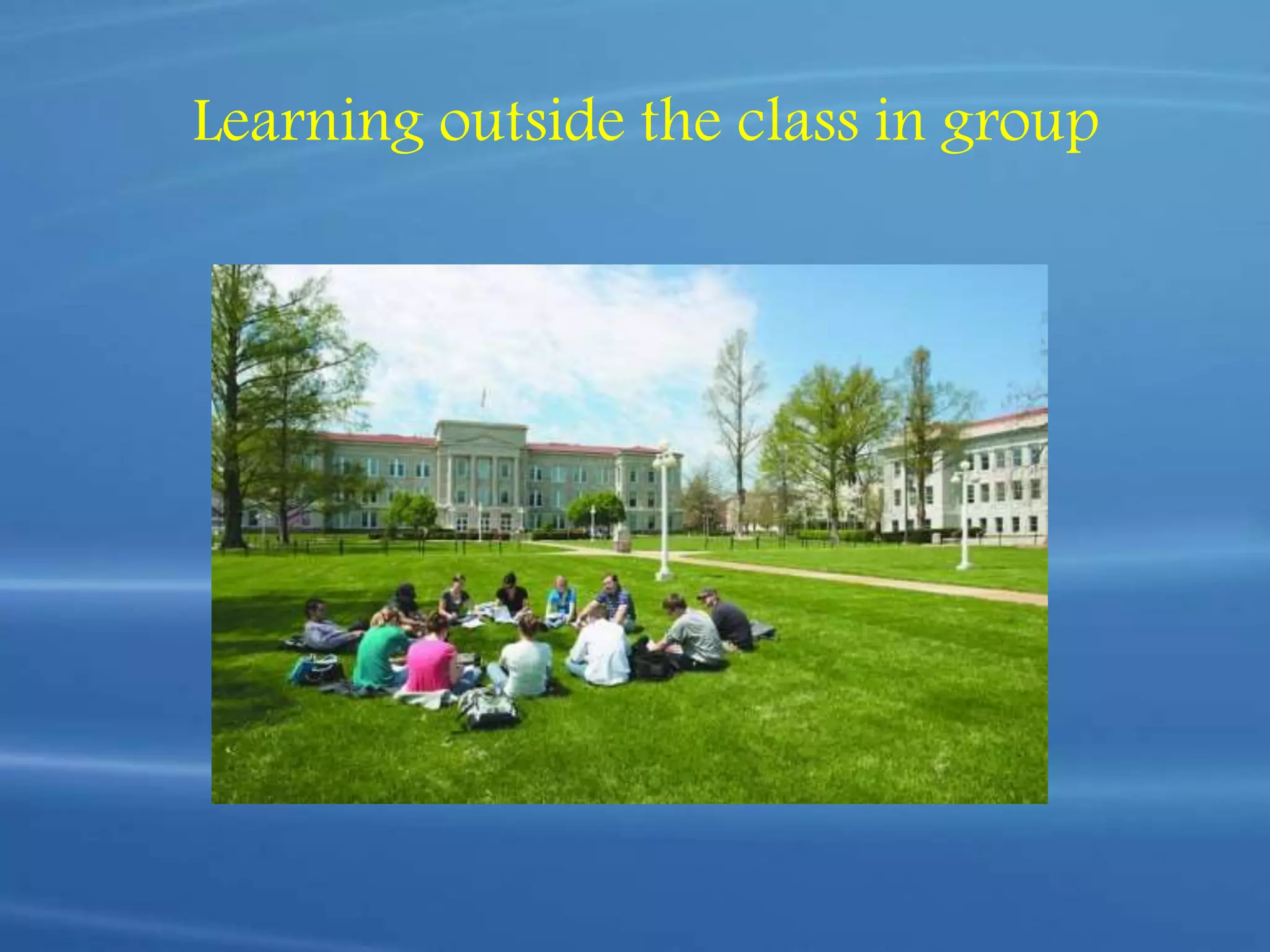
Learning outside the class in group
Introduction
• Objectives: This research will find
out…
1. The nature of OCL among
university students
2. The effectiveness of OCL
3. The challenges of OCL
Research Questions
1. What are the challenges students
face in OCL?
2. What is the impact of OCL in
students’ academic study?
What is outside class learning?
• Learning outside class can be defined
as taking place within an institutional
context, relating to students’
academic endeavors, and
contributing to students’ learning
outcome.
• OCL includes intangible
elements such as the culture of a
campus or faculty and the
hidden curriculum evident in
the values of an institution.
Kerri-Lee Krause: 2007
• At the same time, learners also
have fun and get some mental
refreshment in the fresh air
Manifesto for Education:
Outside the Classroom.
MEOC: 2006
Why outside class learning?
• Help learners to make subjects
–More vivid
–Interesting
–Enhance their understanding
It contributes
personal
Social
Emotional Development
(MEOC:2006)
• Outside class learning, in some
cases, refers to learner
autonomy.
• Learner autonomy is the
ability to take charge of one’s
learning
(Benson & Voller: 1997).
• Autonomy is a capacity for
detachment, critical reflection,
decision making and
independent action.
• It presupposes that the learners
will develop a particular kind of
psychological relation to the
process and content of their
learning.
Little: 1991
• Autonomy is primarily concerned
with learning rather than teaching,
as its development is viewed to be a
cooperative learning process that
can be guided by teacher.
Research Methodology
Sample:
• 20 students of MA (Applied Linguistics
and ELT) from the Department of
English, University of Dhaka (DU)
• Both male & female students were
selected for the purpose
Data collection
Questionnaire includes…
1. Four open ended questions to find out
qualitative data
2. Four close ended questions to find out
quantities data
Some strategies were taken for collecting the
questionnaire…
• There were a set of pre-prepared guiding
questions.
• The researchers were totally neutral during
the participants’ answering questions.
• The participants were given total freedom.
Data analysis
Data was analyzed statistically and
descriptively
The responses of the participants were
calculated into percentage manually
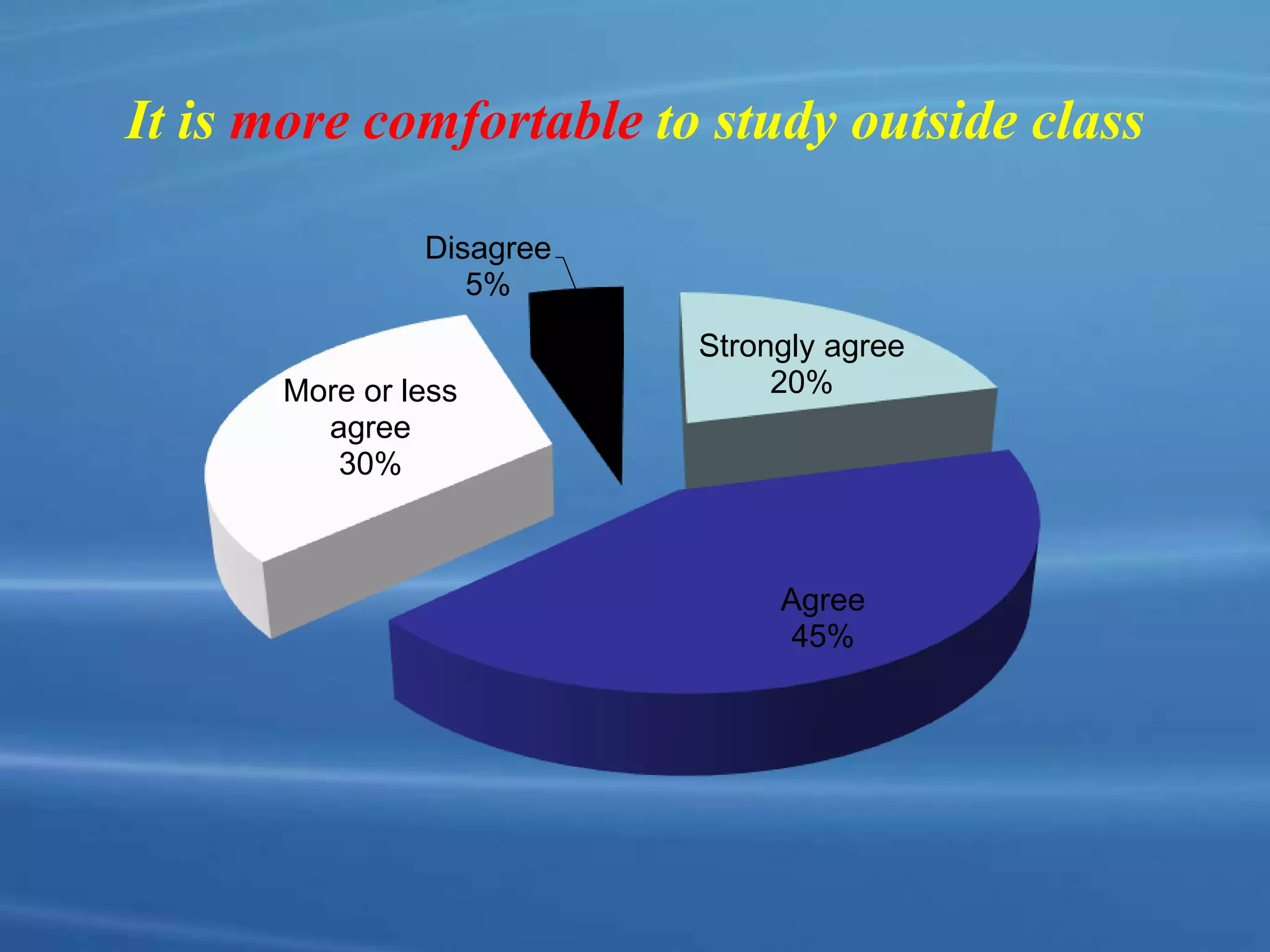
It is more comfortable to study outside class
Strongly agree
20%
Agree
45%
More or less
agree
30%
Disagree
5%
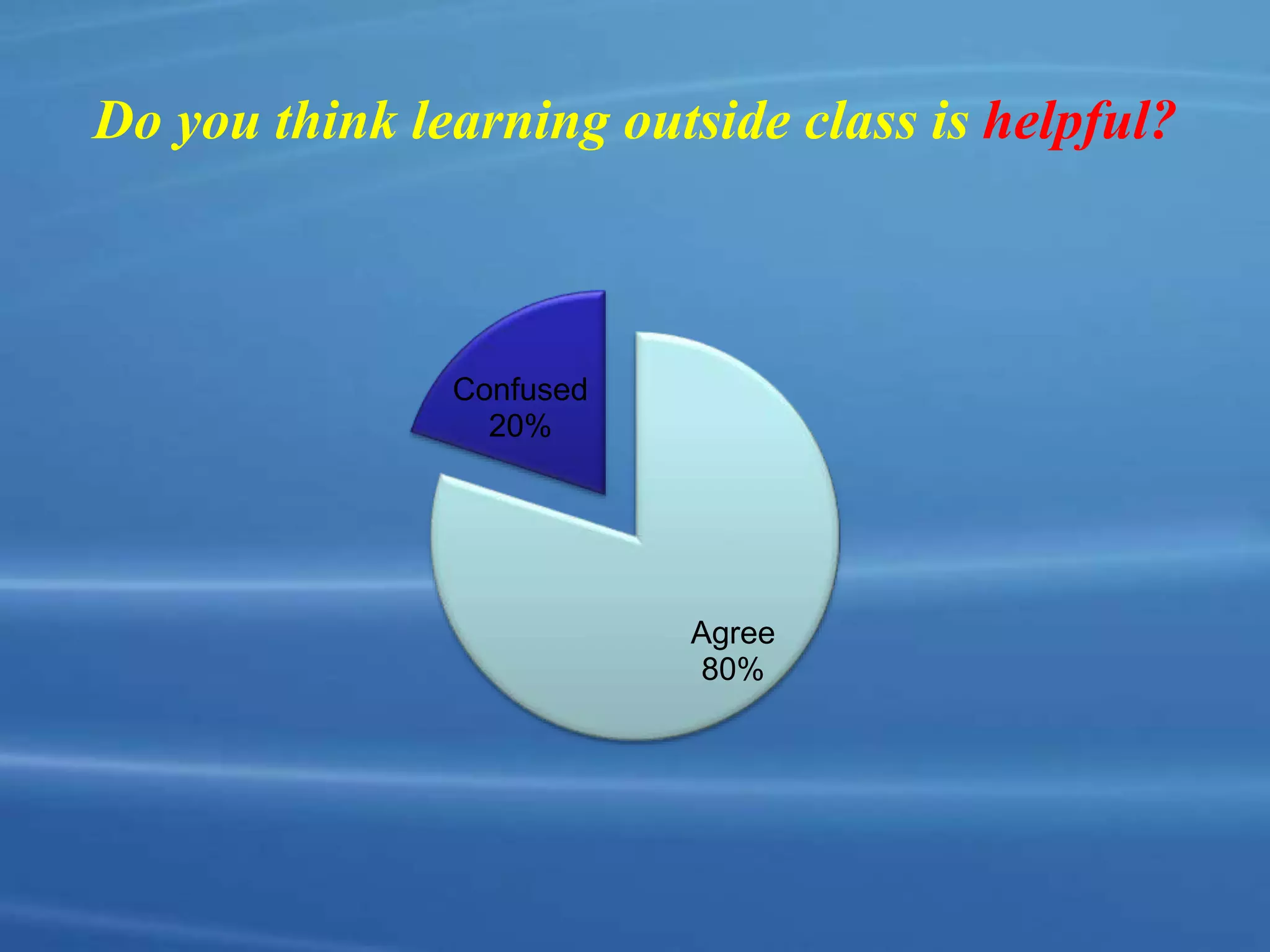
Do you think learning outside class is helpful?
Agree
80%
Confused
20%
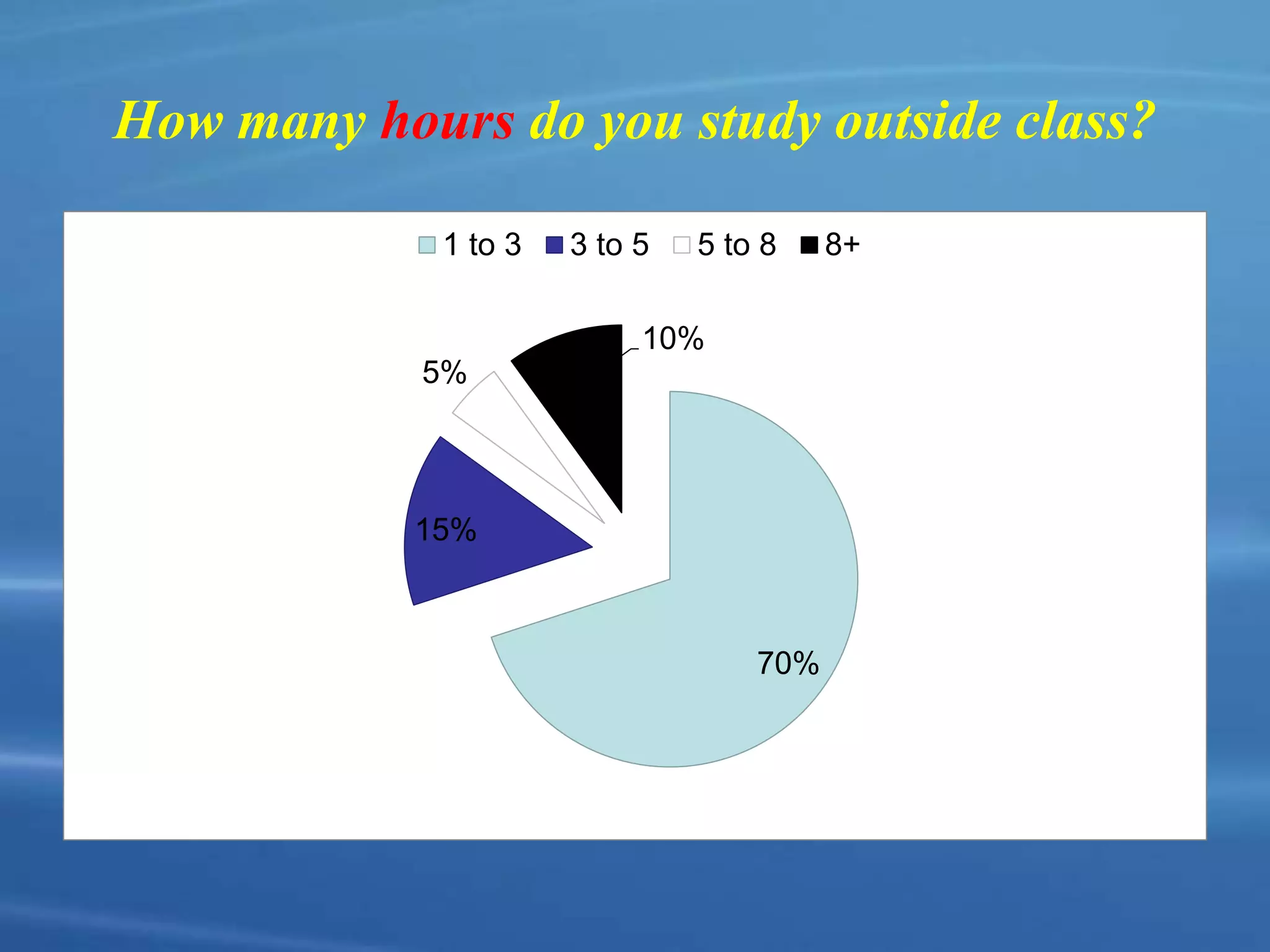
How many hours do you study outside class?
70%
15%
5%
10%
1 to 3 3 to 5 5 to 8 8+
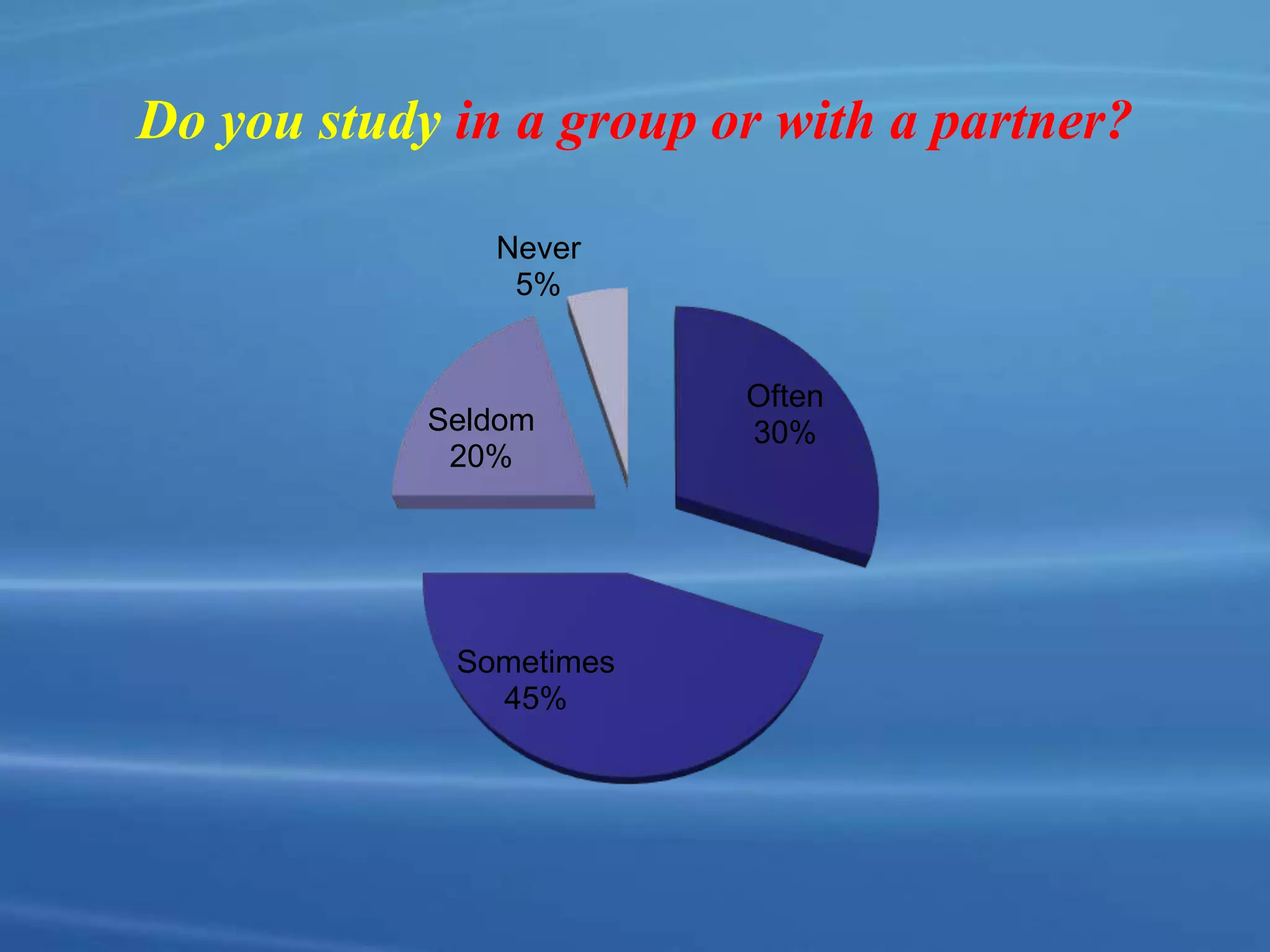
Do you study in a group or with a partner?
Often
30%
Sometimes
45%
Seldom
20%
Never
5%
From open ended questions the
researchers got the opinion of
participants why it is helpful
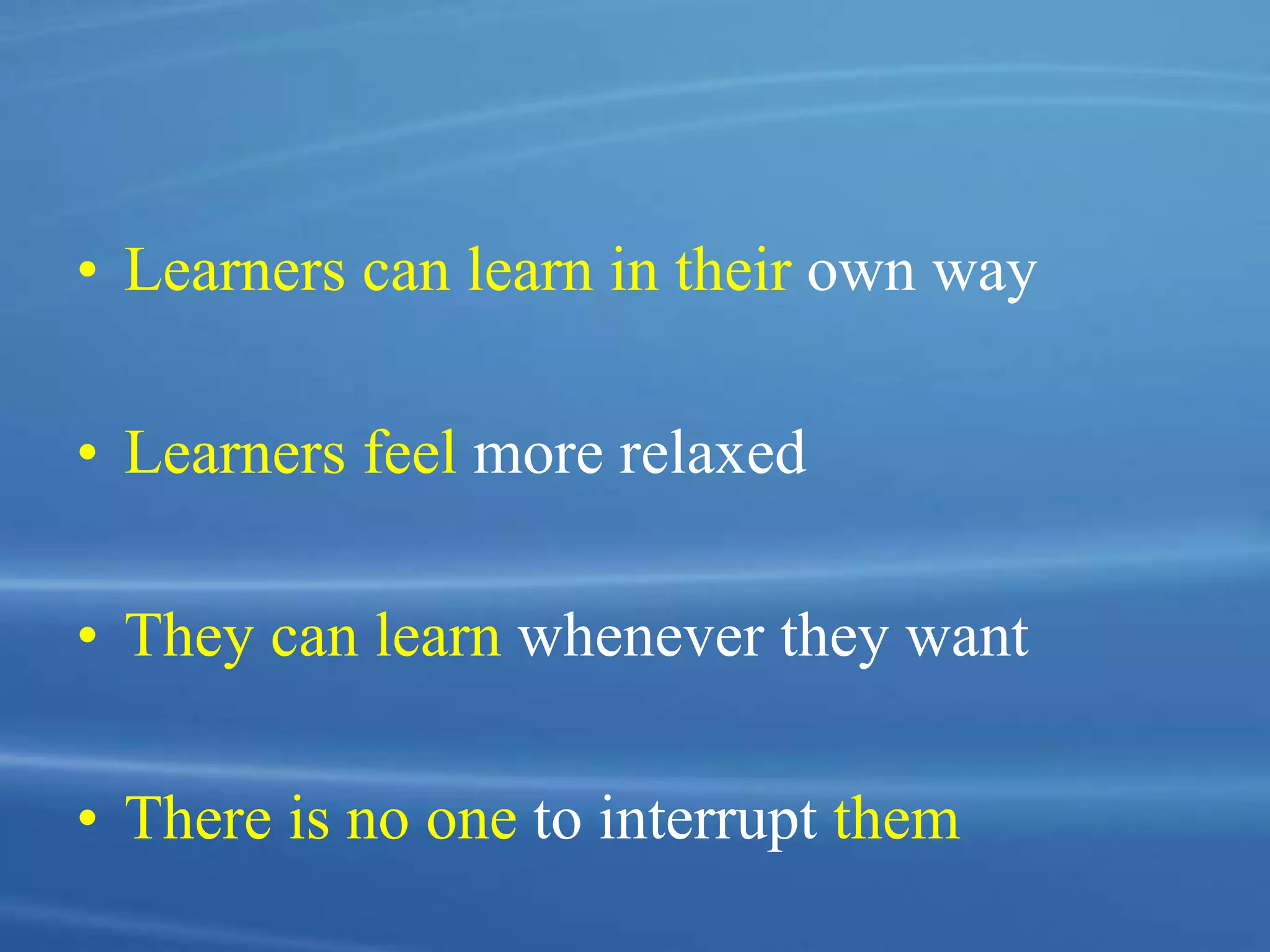
• Learners can learn in their own way
• Learners feel more relaxed
• They can learn whenever they want
• There is no one to interrupt them
• Use whatever materials they want to
• Get help from friends and family
members or others
• Want to learn and take care of their
family at the same time
• No psychological pressure
Nature of outside class learning
• Group learning
• Library working
• Reading in computer/laptop with internet
access
• Discussing with friends
• Reading notes
• Studying lonely in a calm atmosphere
Why outside class learning
• For their examination and tutorial
• Because they like it
• A better option to learn more
• Some people do not even know why
they learn outside the class
Challenges
1. No structural way of learning
2. Informal learning
environment
• Lack of motivation because
–Lack of guidance
–More interruption
–Ambiguous objective
A participant said,
“Since it is self motivated learning
process, sometimes I cannot
continue learning because there
are many other things to divert my
concentration’’.
So participants emphasized on…
• Concentration
• Individuality
• Calm & cool atmosphere
Conclusion
Education is not something to keep in
a box, even when the box is of
Classroom shaped. The Education
and Skills Select Committee in 2005
found that ‘outside class learning can
benefit learners of all ages and can be
successful in a variety of settings.
It allows learners to…
1. become risk aware but not risk averse of
learning
2. undertake meaningful exercise as a means of
staying healthy and learning more about the
topics
3. have fun and enjoyment and achieve
negotiated goals
4. have opportunity to work with others and
share their knowledge and contribute as
active learners in a vast array of activities
5. develop skills and self-confidence that
can be applied later in their formal
learning
Reference
1. Kerri-Lee Krause (2007), Beyond
Classroom Wall: Students Outside Class
Peer Experience and Implications for
Teaching and Learning.
2. Benson, P.(1997), The philosophy and
politics of learner autonomy.
3. Benson & Voller (1997), autonomy and
independence in language learning.
4. Council of Europe, 2001,p.106.
5. Manifesto for Education: Outside the
Classroom, USA (2006).
6. Terenzini, P. & Reason, R(2005), Parsing
The First Year of College: A conceptual
framework of rethinking college Impacts,
Philadelphia, PA.
Outside class learning

Outside class learning

  • 1.
    Presentation on Outside class learning: anexploration Md. Arman & Md. Jahirul Islam
  • 2.
    Learning outside theclass in group
  • 3.
    Introduction • Objectives: Thisresearch will find out… 1. The nature of OCL among university students 2. The effectiveness of OCL 3. The challenges of OCL
  • 4.
    Research Questions 1. Whatare the challenges students face in OCL? 2. What is the impact of OCL in students’ academic study?
  • 5.
    What is outsideclass learning? • Learning outside class can be defined as taking place within an institutional context, relating to students’ academic endeavors, and contributing to students’ learning outcome.
  • 6.
    • OCL includesintangible elements such as the culture of a campus or faculty and the hidden curriculum evident in the values of an institution. Kerri-Lee Krause: 2007
  • 7.
    • At thesame time, learners also have fun and get some mental refreshment in the fresh air Manifesto for Education: Outside the Classroom. MEOC: 2006
  • 8.
    Why outside classlearning? • Help learners to make subjects –More vivid –Interesting –Enhance their understanding
  • 9.
  • 10.
    • Outside classlearning, in some cases, refers to learner autonomy.
  • 11.
    • Learner autonomyis the ability to take charge of one’s learning (Benson & Voller: 1997).
  • 12.
    • Autonomy isa capacity for detachment, critical reflection, decision making and independent action.
  • 13.
    • It presupposesthat the learners will develop a particular kind of psychological relation to the process and content of their learning. Little: 1991
  • 14.
    • Autonomy isprimarily concerned with learning rather than teaching, as its development is viewed to be a cooperative learning process that can be guided by teacher.
  • 15.
    Research Methodology Sample: • 20students of MA (Applied Linguistics and ELT) from the Department of English, University of Dhaka (DU) • Both male & female students were selected for the purpose
  • 16.
    Data collection Questionnaire includes… 1.Four open ended questions to find out qualitative data 2. Four close ended questions to find out quantities data
  • 17.
    Some strategies weretaken for collecting the questionnaire… • There were a set of pre-prepared guiding questions. • The researchers were totally neutral during the participants’ answering questions. • The participants were given total freedom.
  • 18.
    Data analysis Data wasanalyzed statistically and descriptively The responses of the participants were calculated into percentage manually
  • 19.
    It is morecomfortable to study outside class Strongly agree 20% Agree 45% More or less agree 30% Disagree 5%
  • 20.
    Do you thinklearning outside class is helpful? Agree 80% Confused 20%
  • 21.
    How many hoursdo you study outside class? 70% 15% 5% 10% 1 to 3 3 to 5 5 to 8 8+
  • 22.
    Do you studyin a group or with a partner? Often 30% Sometimes 45% Seldom 20% Never 5%
  • 23.
    From open endedquestions the researchers got the opinion of participants why it is helpful
  • 24.
    • Learners canlearn in their own way • Learners feel more relaxed • They can learn whenever they want • There is no one to interrupt them
  • 25.
    • Use whatevermaterials they want to • Get help from friends and family members or others • Want to learn and take care of their family at the same time • No psychological pressure
  • 26.
    Nature of outsideclass learning • Group learning • Library working • Reading in computer/laptop with internet access
  • 27.
    • Discussing withfriends • Reading notes • Studying lonely in a calm atmosphere
  • 28.
    Why outside classlearning • For their examination and tutorial • Because they like it • A better option to learn more • Some people do not even know why they learn outside the class
  • 29.
    Challenges 1. No structuralway of learning 2. Informal learning environment
  • 30.
    • Lack ofmotivation because –Lack of guidance –More interruption –Ambiguous objective
  • 31.
    A participant said, “Sinceit is self motivated learning process, sometimes I cannot continue learning because there are many other things to divert my concentration’’.
  • 32.
    So participants emphasizedon… • Concentration • Individuality • Calm & cool atmosphere
  • 33.
    Conclusion Education is notsomething to keep in a box, even when the box is of Classroom shaped. The Education and Skills Select Committee in 2005 found that ‘outside class learning can benefit learners of all ages and can be successful in a variety of settings.
  • 34.
    It allows learnersto… 1. become risk aware but not risk averse of learning 2. undertake meaningful exercise as a means of staying healthy and learning more about the topics 3. have fun and enjoyment and achieve negotiated goals
  • 35.
    4. have opportunityto work with others and share their knowledge and contribute as active learners in a vast array of activities 5. develop skills and self-confidence that can be applied later in their formal learning
  • 36.
    Reference 1. Kerri-Lee Krause(2007), Beyond Classroom Wall: Students Outside Class Peer Experience and Implications for Teaching and Learning. 2. Benson, P.(1997), The philosophy and politics of learner autonomy. 3. Benson & Voller (1997), autonomy and independence in language learning.
  • 37.
    4. Council ofEurope, 2001,p.106. 5. Manifesto for Education: Outside the Classroom, USA (2006). 6. Terenzini, P. & Reason, R(2005), Parsing The First Year of College: A conceptual framework of rethinking college Impacts, Philadelphia, PA.