
LANGUAGE TEACHING: THEORY, RESEARCH
AND PRACTICE
Presenter :
MUHAMMAD SALEEM
Post-Method Pedagogy
‘To teach is to be full of hope’
(Cuban, 1989)
Post-Method Pedagogy
• Classroom-oriented
• Teachers can construct their own methods.
Act as:
• Evaluators
• Observers
• Critical thinkers
• Theorizers
• Practitioners
Post-Method Pedagogy
• Post-method pedagogy can be regarded as a
good alternative to the deficiencies experienced
by the employment of conventional methods.
• Stern’s Three-dimensional framework
• Kumaravadivelu’s Macro-strategic framework
drawn from “theoretical, empirical and
experiential knowledge”
(Kumaravadivelu, 2006, p. 185).
• The history of language teaching has been
characterized by the search for most effective
way of teaching second and foreign languages.
• The commonest solution was the adoption of
teaching approach or method.
ApproachMethod
Set of beliefs and principles
as a basis for teaching a
language
Specific instructional design
based on particular
theory
No specific set of
prescription for teaching
Detailed specification of
content, teachers role,
learners role, etc ..
FlexibleFixed
Allow for interpretationLittle scope for interpretation
Long-shelf lifeShort-shelf life
Background
Emerged after the gradual dissatisfaction with
conventional Methods.
Kumaravadivelu (2006) termed those ‘designer non-
methods’
Prime success of methods lasted up till late 1980s.
Eclecticism was widespread
Background
Post-method came to light during 1990s.
Aimed to break the ‘cycle’ of methods
Refigures relationship between theorizers and
practitioners.
Signifies teacher autonomy (Self-Government,
independence)
Principled pragmatism (practicallity)
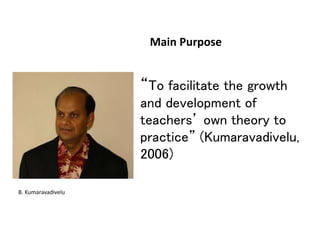
Main Purpose
• “To facilitate the growth
and development of
teachers’ own theory to
practice” (Kumaravadivelu,
2006)
B. Kumaravadivelu
Basic Considerations :
Seeks to transcend (exceed) the limitations of Method.
Facilitate the advancement of context-sensitive language
education based on a true understanding.
Treating Teachers and Learners as Explorers.
Signifies Autonomy.
Reconsiders the relationship between theorizers and
practitioners of methods.
Three pedagogic parameters
Particularity
Practicality
Possibility
Main Focus: Teacher Autonomy
• To be sensitive towards to the parameters of
particularity, practicality and possibility.
• Emphasizes on teacher experience along with
strong theoretical knowledge.
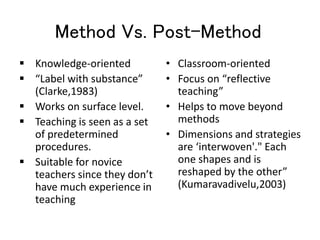
Method Vs. Post-Method
 Knowledge-oriented
 “Label with substance”
(Clarke,1983)
 Works on surface level.
 Teaching is seen as a set
of predetermined
procedures.
 Suitable for novice
teachers since they don’t
have much experience in
teaching
• Classroom-oriented
• Focus on “reflective
teaching”
• Helps to move beyond
methods
• Dimensions and strategies
are ‘interwoven'." Each
one shapes and is
reshaped by the other”
(Kumaravadivelu,2003)
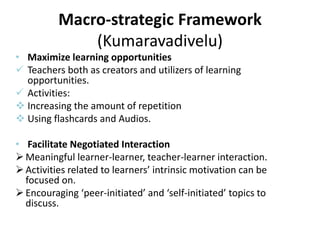
Macro-strategic Framework
(Kumaravadivelu)
• Maximize learning opportunities
 Teachers both as creators and utilizers of learning
opportunities.
 Activities:
 Increasing the amount of repetition
 Using flashcards and Audios.
• Facilitate Negotiated Interaction
Meaningful learner-learner, teacher-learner interaction.
Activities related to learners’ intrinsic motivation can be
focused on.
Encouraging ‘peer-initiated’ and ‘self-initiated’ topics to
discuss.
Macro-strategic Framework
• Help learners ‘self-direct’ and ‘self-monitor’
their own.
• Contextualize linguistic input
• Focus on syntactic, semantic, pragmatic
features of language.
• Bring learners attention to integrated nature
of language.
Macro-strategic Framework
• Intergrate language skills
• Language skills are essentially interrelated
• Isolation of four skills is uncomfortable for
students.
• Language best developed when it is learnt
holistically (Rigg, 1991 cited in
Kumaravadivelu, 1994)
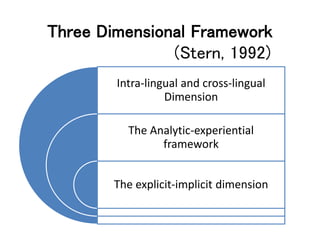
Three Dimensional Framework
(Stern, 1992)
Intra-lingual and cross-lingual
Dimension
The Analytic-experiential
framework
The explicit-implicit dimension
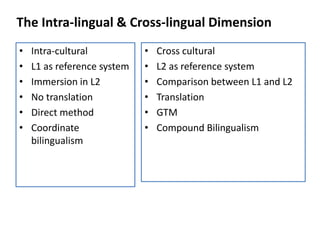
The Intra-lingual & Cross-lingual Dimension
• Cross cultural
• L2 as reference system
• Comparison between L1 and L2
• Translation
• GTM
• Compound Bilingualism
• Intra-cultural
• L1 as reference system
• Immersion in L2
• No translation
• Direct method
• Coordinate
bilingualism
The Analytic-Experiential Dimension
 Focus on code
 Observation
 Focus on language
 Emphasis on accuracy
 Linguistic Interaction
 Language practice
 Focus on
communication
 Participation
 Focus on
topic/purpose
 Emphasis on fluency
 Interpersonal
interaction
 Language use
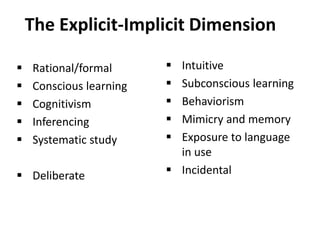
The Explicit-Implicit Dimension
 Rational/formal
 Conscious learning
 Cognitivism
 Inferencing
 Systematic study
 Deliberate
 Intuitive
 Subconscious learning
 Behaviorism
 Mimicry and memory
 Exposure to language
in use
 Incidental
Does Post-method pedagogy mean
total freedom?
• Onus (Burden) is on the teacher.
• Teacher reshapes the outcome of the learning
• Teachers employ their own experience, framework and
knowledge in classrooms.
• B. Kumadavadivelu stresses on teachers’ autonomy.
• Teachers are encouraged to formulate their own methods of
teaching and thus, overcome the limitations of methods.
• Unlike Eclecticism, its not about selecting random techniques
and applying those in classrooms.
• Its interlinked with knowledge and practical understanding.
Eclecticism or post-method?
Which one is more effective?
• Larsen-Freeman (2000) and Mellow (2000)
have used the term principled eclecticism to
describe a desirable, coherent, pluralistic
approach to language teaching.
• However, Stern (1992) considered eclecticism
to be ‘too broad and too vague’.
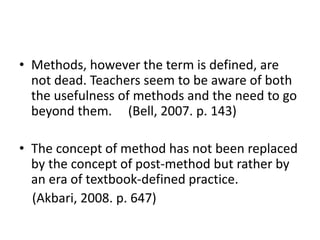
• Methods, however the term is defined, are
not dead. Teachers seem to be aware of both
the usefulness of methods and the need to go
beyond them. (Bell, 2007. p. 143)
• The concept of method has not been replaced
by the concept of post-method but rather by
an era of textbook-defined practice.
(Akbari, 2008. p. 647)
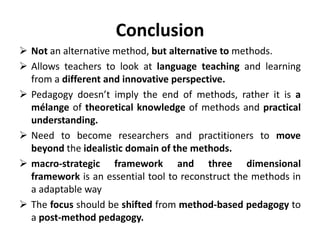
Conclusion
 Not an alternative method, but alternative to methods.
 Allows teachers to look at language teaching and learning
from a different and innovative perspective.
 Pedagogy doesn’t imply the end of methods, rather it is a
mélange of theoretical knowledge of methods and practical
understanding.
 Need to become researchers and practitioners to move
beyond the idealistic domain of the methods.
 macro-strategic framework and three dimensional
framework is an essential tool to reconstruct the methods in
a adaptable way
 The focus should be shifted from method-based pedagogy to
a post-method pedagogy.
Sources
• Toward a Postmethod Pedagogy
(B.kumaravadivelu)
• Post-Method Pedagogy: Teacher Growth
behind Walls (Nilüfer Can)
• Postmethod Pedagogy and ELT Teachers
(Mohammad Khatib & Jalil Fat’hi)
• Postmethod Pedagogy and Its Influence on
EFL Teaching Strategies (Mingyao Chen)
Post methodpedagogy - copy

Post methodpedagogy - copy

  • 1.
    LANGUAGE TEACHING: THEORY,RESEARCH AND PRACTICE Presenter : MUHAMMAD SALEEM
  • 2.
  • 3.
    ‘To teach isto be full of hope’ (Cuban, 1989)
  • 4.
    Post-Method Pedagogy • Classroom-oriented •Teachers can construct their own methods. Act as: • Evaluators • Observers • Critical thinkers • Theorizers • Practitioners
  • 5.
    Post-Method Pedagogy • Post-methodpedagogy can be regarded as a good alternative to the deficiencies experienced by the employment of conventional methods. • Stern’s Three-dimensional framework • Kumaravadivelu’s Macro-strategic framework drawn from “theoretical, empirical and experiential knowledge” (Kumaravadivelu, 2006, p. 185).
  • 6.
    • The historyof language teaching has been characterized by the search for most effective way of teaching second and foreign languages. • The commonest solution was the adoption of teaching approach or method.
  • 7.
    ApproachMethod Set of beliefsand principles as a basis for teaching a language Specific instructional design based on particular theory No specific set of prescription for teaching Detailed specification of content, teachers role, learners role, etc .. FlexibleFixed Allow for interpretationLittle scope for interpretation Long-shelf lifeShort-shelf life
  • 8.
    Background Emerged after thegradual dissatisfaction with conventional Methods. Kumaravadivelu (2006) termed those ‘designer non- methods’ Prime success of methods lasted up till late 1980s. Eclecticism was widespread
  • 9.
    Background Post-method came tolight during 1990s. Aimed to break the ‘cycle’ of methods Refigures relationship between theorizers and practitioners. Signifies teacher autonomy (Self-Government, independence) Principled pragmatism (practicallity)
  • 10.
    Main Purpose • “Tofacilitate the growth and development of teachers’ own theory to practice” (Kumaravadivelu, 2006) B. Kumaravadivelu
  • 11.
    Basic Considerations : Seeksto transcend (exceed) the limitations of Method. Facilitate the advancement of context-sensitive language education based on a true understanding. Treating Teachers and Learners as Explorers. Signifies Autonomy. Reconsiders the relationship between theorizers and practitioners of methods.
  • 12.
  • 13.
    Main Focus: TeacherAutonomy • To be sensitive towards to the parameters of particularity, practicality and possibility. • Emphasizes on teacher experience along with strong theoretical knowledge.
  • 14.
    Method Vs. Post-Method Knowledge-oriented  “Label with substance” (Clarke,1983)  Works on surface level.  Teaching is seen as a set of predetermined procedures.  Suitable for novice teachers since they don’t have much experience in teaching • Classroom-oriented • Focus on “reflective teaching” • Helps to move beyond methods • Dimensions and strategies are ‘interwoven'." Each one shapes and is reshaped by the other” (Kumaravadivelu,2003)
  • 15.
    Macro-strategic Framework (Kumaravadivelu) • Maximizelearning opportunities  Teachers both as creators and utilizers of learning opportunities.  Activities:  Increasing the amount of repetition  Using flashcards and Audios. • Facilitate Negotiated Interaction Meaningful learner-learner, teacher-learner interaction. Activities related to learners’ intrinsic motivation can be focused on. Encouraging ‘peer-initiated’ and ‘self-initiated’ topics to discuss.
  • 16.
    Macro-strategic Framework • Helplearners ‘self-direct’ and ‘self-monitor’ their own. • Contextualize linguistic input • Focus on syntactic, semantic, pragmatic features of language. • Bring learners attention to integrated nature of language.
  • 17.
    Macro-strategic Framework • Intergratelanguage skills • Language skills are essentially interrelated • Isolation of four skills is uncomfortable for students. • Language best developed when it is learnt holistically (Rigg, 1991 cited in Kumaravadivelu, 1994)
  • 18.
    Three Dimensional Framework (Stern,1992) Intra-lingual and cross-lingual Dimension The Analytic-experiential framework The explicit-implicit dimension
  • 19.
    The Intra-lingual &Cross-lingual Dimension • Cross cultural • L2 as reference system • Comparison between L1 and L2 • Translation • GTM • Compound Bilingualism • Intra-cultural • L1 as reference system • Immersion in L2 • No translation • Direct method • Coordinate bilingualism
  • 20.
    The Analytic-Experiential Dimension Focus on code  Observation  Focus on language  Emphasis on accuracy  Linguistic Interaction  Language practice  Focus on communication  Participation  Focus on topic/purpose  Emphasis on fluency  Interpersonal interaction  Language use
  • 21.
    The Explicit-Implicit Dimension Rational/formal  Conscious learning  Cognitivism  Inferencing  Systematic study  Deliberate  Intuitive  Subconscious learning  Behaviorism  Mimicry and memory  Exposure to language in use  Incidental
  • 22.
    Does Post-method pedagogymean total freedom? • Onus (Burden) is on the teacher. • Teacher reshapes the outcome of the learning • Teachers employ their own experience, framework and knowledge in classrooms. • B. Kumadavadivelu stresses on teachers’ autonomy. • Teachers are encouraged to formulate their own methods of teaching and thus, overcome the limitations of methods. • Unlike Eclecticism, its not about selecting random techniques and applying those in classrooms. • Its interlinked with knowledge and practical understanding.
  • 23.
    Eclecticism or post-method? Whichone is more effective? • Larsen-Freeman (2000) and Mellow (2000) have used the term principled eclecticism to describe a desirable, coherent, pluralistic approach to language teaching. • However, Stern (1992) considered eclecticism to be ‘too broad and too vague’.
  • 24.
    • Methods, howeverthe term is defined, are not dead. Teachers seem to be aware of both the usefulness of methods and the need to go beyond them. (Bell, 2007. p. 143) • The concept of method has not been replaced by the concept of post-method but rather by an era of textbook-defined practice. (Akbari, 2008. p. 647)
  • 25.
    Conclusion  Not analternative method, but alternative to methods.  Allows teachers to look at language teaching and learning from a different and innovative perspective.  Pedagogy doesn’t imply the end of methods, rather it is a mélange of theoretical knowledge of methods and practical understanding.  Need to become researchers and practitioners to move beyond the idealistic domain of the methods.  macro-strategic framework and three dimensional framework is an essential tool to reconstruct the methods in a adaptable way  The focus should be shifted from method-based pedagogy to a post-method pedagogy.
  • 26.
    Sources • Toward aPostmethod Pedagogy (B.kumaravadivelu) • Post-Method Pedagogy: Teacher Growth behind Walls (Nilüfer Can) • Postmethod Pedagogy and ELT Teachers (Mohammad Khatib & Jalil Fat’hi) • Postmethod Pedagogy and Its Influence on EFL Teaching Strategies (Mingyao Chen)