MBA, UAP
Md Arman (21206018)
CONTENTS:
Part Ⅰ: Introduction Part Ⅱ : Money Laundering
Part Ⅲ : Features of money laundering Part Ⅳ : Reasons of Money Laundering
Part V: Negative Impact of Money
Laundering
Part VI : Steps of Money
Laundering
Part VII : Digital Money Laundering Part VIII : Anti-Money Laundering
Activities
Part IX : Conclusion
"Money Laundering" USA
Mafia's attempt to "launder"
illegal money
Outside of typical range of
economic data
“Two to five percent of
global GDP”
ML Revenue comes frommax
Drug
Dealing
Illegal
Arms
Sales
Smuggling
Prostitution Organized
Crime
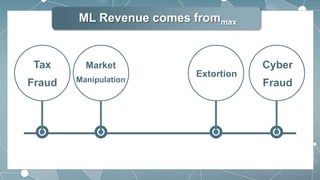
ML Revenue comes frommax
Tax
Fraud
Extortion
Cyber
Fraud
Market
Manipulation
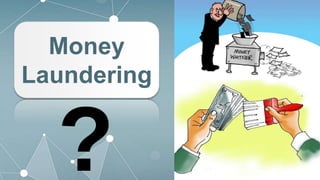
Money
Laundering
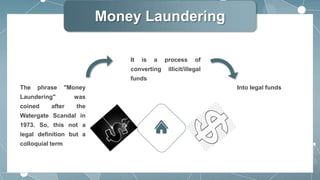
Money Laundering
It is a process of
converting illicit/illegal
funds
Into legal funds
The phrase "Money
Laundering" was
coined after the
Watergate Scandal in
1973. So, this not a
legal definition but a
colloquial term
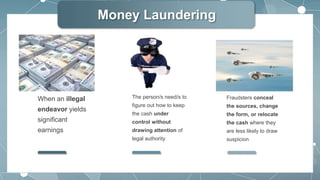
Money Laundering
When an illegal
endeavor yields
significant
earnings
The person/s need/s to
figure out how to keep
the cash under
control without
drawing attention of
legal authority
Fraudsters conceal
the sources, change
the form, or relocate
the cash where they
are less likely to draw
suspicion
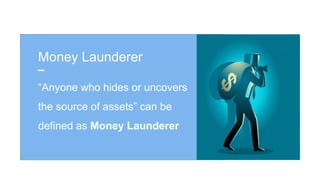
“Anyone who hides or uncovers
the source of assets” can be
defined as Money Launderer
Money Launderer
Money Laundering
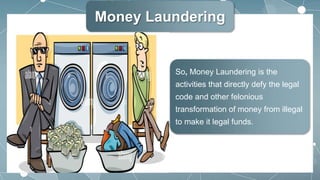
So, Money Laundering is the
activities that directly defy the legal
code and other felonious
transformation of money from illegal
to make it legal funds.
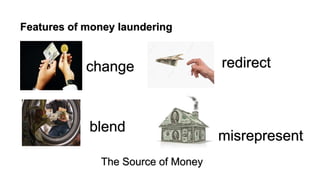
The Source of Money
change
blend
misrepresent
redirect
Features of money laundering
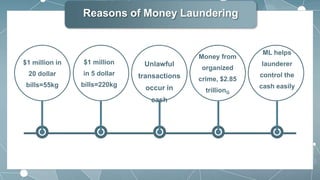
Reasons of Money Laundering
$1 million in
20 dollar
bills=55kg
Unlawful
transactions
occur in
cash
Money from
organized
crime, $2.85
trillionG
$1 million
in 5 dollar
bills=220kg
ML helps
launderer
control the
cash easily
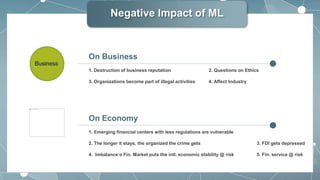
Negative Impact of ML
1. Destruction of business reputation 2. Questions on Ethics
3. Organizations become part of illegal activities 4. Affect Industry
On Business
1. Emerging financial centers with less regulations are vulnerable
2. The longer it stays, the organized the crime gets 3. FDI gets depressed
4. Imbalance’o Fin. Market puts the intl. economic stability @ risk 5. Fin. service @ risk
On Economy
How ML is done
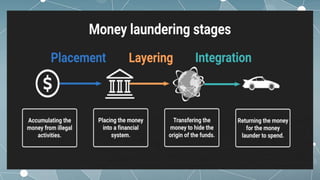
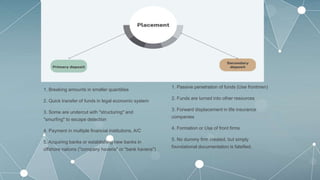
1. Breaking amounts in smaller quantities
2. Quick transfer of funds in legal economic system
3. Some are undercut with "structuring" and
"smurfing" to escape detection
4. Payment in multiple financial institutions, A/C
5. Acquiring banks or establishing new banks in
offshore nations ("company havens" or "bank havens")
1. Passive penetration of funds (Use frontmen)
2. Funds are turned into other resources
3. Forward displacement in life insurance
companies
4. Formation or Use of front firms
5. No dummy firm created, but simply
foundational documentation is falsified.
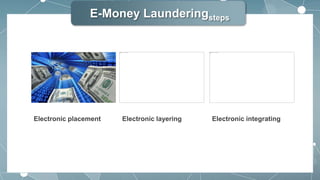
E-Money Launderingsteps
Electronic placement Electronic layering Electronic integrating
Anti-ML initiatives
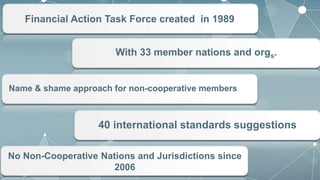
Financial Action Task Force created in 1989
With 33 member nations and orgs.
Name & shame approach for non-cooperative members
No Non-Cooperative Nations and Jurisdictions since
2006
40 international standards suggestions
Money laundering_A three step game.pptx

Money laundering_A three step game.pptx

  • 1.
  • 2.
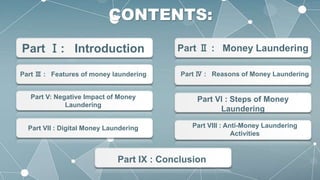
    CONTENTS: Part Ⅰ: IntroductionPart Ⅱ : Money Laundering Part Ⅲ : Features of money laundering Part Ⅳ : Reasons of Money Laundering Part V: Negative Impact of Money Laundering Part VI : Steps of Money Laundering Part VII : Digital Money Laundering Part VIII : Anti-Money Laundering Activities Part IX : Conclusion
  • 3.
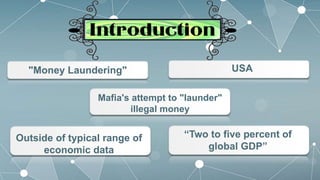
    "Money Laundering" USA Mafia'sattempt to "launder" illegal money Outside of typical range of economic data “Two to five percent of global GDP”
  • 4.
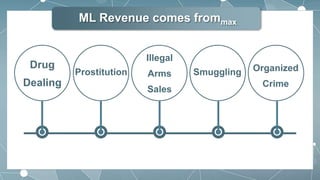
    ML Revenue comesfrommax Drug Dealing Illegal Arms Sales Smuggling Prostitution Organized Crime
  • 5.
    ML Revenue comesfrommax Tax Fraud Extortion Cyber Fraud Market Manipulation
  • 6.
  • 7.
    Money Laundering It isa process of converting illicit/illegal funds Into legal funds The phrase "Money Laundering" was coined after the Watergate Scandal in 1973. So, this not a legal definition but a colloquial term
  • 8.
    Money Laundering When anillegal endeavor yields significant earnings The person/s need/s to figure out how to keep the cash under control without drawing attention of legal authority Fraudsters conceal the sources, change the form, or relocate the cash where they are less likely to draw suspicion
  • 9.
    “Anyone who hidesor uncovers the source of assets” can be defined as Money Launderer Money Launderer
  • 10.
    Money Laundering So, MoneyLaundering is the activities that directly defy the legal code and other felonious transformation of money from illegal to make it legal funds.
  • 11.
    The Source ofMoney change blend misrepresent redirect Features of money laundering
  • 12.
    Reasons of MoneyLaundering $1 million in 20 dollar bills=55kg Unlawful transactions occur in cash Money from organized crime, $2.85 trillionG $1 million in 5 dollar bills=220kg ML helps launderer control the cash easily
  • 13.
    Negative Impact ofML 1. Destruction of business reputation 2. Questions on Ethics 3. Organizations become part of illegal activities 4. Affect Industry On Business 1. Emerging financial centers with less regulations are vulnerable 2. The longer it stays, the organized the crime gets 3. FDI gets depressed 4. Imbalance’o Fin. Market puts the intl. economic stability @ risk 5. Fin. service @ risk On Economy
  • 14.
  • 18.
    1. Breaking amountsin smaller quantities 2. Quick transfer of funds in legal economic system 3. Some are undercut with "structuring" and "smurfing" to escape detection 4. Payment in multiple financial institutions, A/C 5. Acquiring banks or establishing new banks in offshore nations ("company havens" or "bank havens") 1. Passive penetration of funds (Use frontmen) 2. Funds are turned into other resources 3. Forward displacement in life insurance companies 4. Formation or Use of front firms 5. No dummy firm created, but simply foundational documentation is falsified.
  • 19.
    E-Money Launderingsteps Electronic placementElectronic layering Electronic integrating
  • 20.
  • 21.
    Financial Action TaskForce created in 1989 With 33 member nations and orgs. Name & shame approach for non-cooperative members No Non-Cooperative Nations and Jurisdictions since 2006 40 international standards suggestions