Introduction Shifting towards post method condition.
 Define post method condition
 Features of Post Method condition
1. It is alternative to method rather
than alternative method.
2. Teacher autonomy .
3.Principled Pragmatism.
Framework=
Macrostrategies+Microstrategies
 Framework consists of 10 macro strategies
A .Maximize learning opportunities .
B. Facilitate negotiated interaction
C. Minimize perceptual mismatches.
D. Active intuitive heuristics.
E. Foster language awareness
F. Contextualize linguistic input.
G. Integrate language skills.
H. Promote learner autonomy.
I. Raise cultural consciousness.
J. Ensure social relevense.
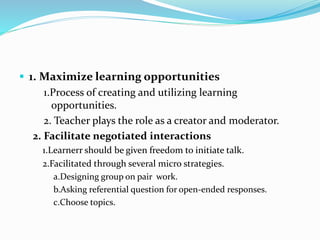
 1. Maximize learning opportunities
1.Process of creating and utilizing learning
opportunities.
2. Teacher plays the role as a creator and moderator.
2. Facilitate negotiated interactions
1.Learnerr should be given freedom to initiate talk.
2.Facilitated through several micro strategies.
a.Designing group on pair work.
b.Asking referential question for open-ended responses.
c.Choose topics.
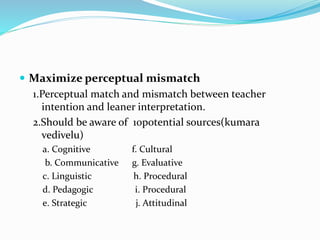
 Maximize perceptual mismatch
1.Perceptual match and mismatch between teacher
intention and leaner interpretation.
2.Should be aware of 10potential sources(kumara
vedivelu)
a. Cognitive f. Cultural
b. Communicative g. Evaluative
c. Linguistic h. Procedural
d. Pedagogic i. Procedural
e. Strategic j. Attitudinal
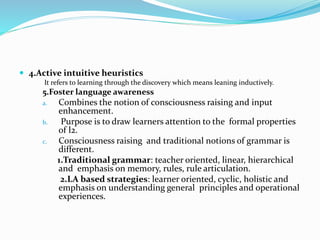
 4.Active intuitive heuristics
It refers to learning through the discovery which means leaning inductively.
5.Foster language awareness
a. Combines the notion of consciousness raising and input
enhancement.
b. Purpose is to draw learners attention to the formal properties
of l2.
c. Consciousness raising and traditional notions of grammar is
different.
1.Traditional grammar: teacher oriented, linear, hierarchical
and emphasis on memory, rules, rule articulation.
2.LA based strategies: learner oriented, cyclic, holistic and
emphasis on understanding general principles and operational
experiences.
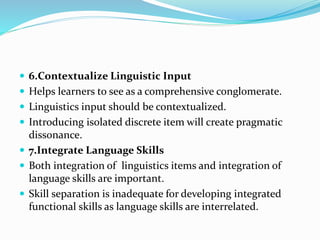
 6.Contextualize Linguistic Input
 Helps learners to see as a comprehensive conglomerate.
 Linguistics input should be contextualized.
 Introducing isolated discrete item will create pragmatic
dissonance.
 7.Integrate Language Skills
 Both integration of linguistics items and integration of
language skills are important.
 Skill separation is inadequate for developing integrated
functional skills as language skills are interrelated.
 8.Prmote learner autonomy
 Focus on language autonomy.
 Strategic investment of learner.
 Different approach of learners
 Relation between psychological preparation and strategic
training.
 9.Raise cultural consciousness
 Understanding native speaker perspective.
 Mental association .
 Leaner as a cultural informant.
10.Ensure social relevance
Essential for teacher
Understanding of social context.
Shapes the teaching and learning issues.
Socio pragmatics .
Intelligibility and acceptability.
Conclusion
Open ended ser of options
Descriptive support strategic relativism.
Transform classroom practitioners into strategic teachers
and strategic researcher.

The postmethod condition

  • 2.
    Introduction Shifting towardspost method condition.  Define post method condition  Features of Post Method condition 1. It is alternative to method rather than alternative method. 2. Teacher autonomy . 3.Principled Pragmatism.
  • 3.
    Framework= Macrostrategies+Microstrategies  Framework consistsof 10 macro strategies A .Maximize learning opportunities . B. Facilitate negotiated interaction C. Minimize perceptual mismatches. D. Active intuitive heuristics. E. Foster language awareness F. Contextualize linguistic input. G. Integrate language skills. H. Promote learner autonomy. I. Raise cultural consciousness. J. Ensure social relevense.
  • 4.
     1. Maximizelearning opportunities 1.Process of creating and utilizing learning opportunities. 2. Teacher plays the role as a creator and moderator. 2. Facilitate negotiated interactions 1.Learnerr should be given freedom to initiate talk. 2.Facilitated through several micro strategies. a.Designing group on pair work. b.Asking referential question for open-ended responses. c.Choose topics.
  • 5.
     Maximize perceptualmismatch 1.Perceptual match and mismatch between teacher intention and leaner interpretation. 2.Should be aware of 10potential sources(kumara vedivelu) a. Cognitive f. Cultural b. Communicative g. Evaluative c. Linguistic h. Procedural d. Pedagogic i. Procedural e. Strategic j. Attitudinal
  • 6.
     4.Active intuitiveheuristics It refers to learning through the discovery which means leaning inductively. 5.Foster language awareness a. Combines the notion of consciousness raising and input enhancement. b. Purpose is to draw learners attention to the formal properties of l2. c. Consciousness raising and traditional notions of grammar is different. 1.Traditional grammar: teacher oriented, linear, hierarchical and emphasis on memory, rules, rule articulation. 2.LA based strategies: learner oriented, cyclic, holistic and emphasis on understanding general principles and operational experiences.
  • 7.
     6.Contextualize LinguisticInput  Helps learners to see as a comprehensive conglomerate.  Linguistics input should be contextualized.  Introducing isolated discrete item will create pragmatic dissonance.  7.Integrate Language Skills  Both integration of linguistics items and integration of language skills are important.  Skill separation is inadequate for developing integrated functional skills as language skills are interrelated.
  • 8.
     8.Prmote learnerautonomy  Focus on language autonomy.  Strategic investment of learner.  Different approach of learners  Relation between psychological preparation and strategic training.  9.Raise cultural consciousness  Understanding native speaker perspective.  Mental association .  Leaner as a cultural informant.
  • 9.
    10.Ensure social relevance Essentialfor teacher Understanding of social context. Shapes the teaching and learning issues. Socio pragmatics . Intelligibility and acceptability. Conclusion Open ended ser of options Descriptive support strategic relativism. Transform classroom practitioners into strategic teachers and strategic researcher.