Post-Methods: Towards
Pedagogy in the new era
Alan Ramírez
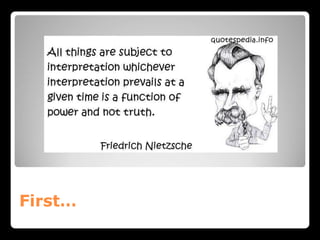
First…
What method is this???
seven principles to improve student
motivation: (a) The teacher should be
lively and interesting, (b) presentations
should be brief, (c) examples should be
concrete, (d) students should always be
active, (e) activities must be useful and
relevant, (f) there should be variety in
every class, and (g) games should be
used.
Definition(s) of
Methodology…again
“…various individual techniques for teaching
of the basic skill areas of reading, writing,
listening, and speaking.” (Cohen, 1990).
“…universal technique for teaching of any
linguistic material in any skill area – e.g.
Presentation, Practice, Production (PPP)”
(Rivers, 1968).
“…comprises learning to put into practice
certain general principles of good language
teaching derived from research or
observation (Brown, 1994ª)
Definition(s) of method (the
one I liked)
Second of three hierarchical elements:
APPROACH, “METHOD” AND TECHNIQUE
“Overall plan for systematic presentation of
language based on a selected approach”
(approach is “a set of assumptions dealing
with the nature of language, learning and
teaching”). (Brown).
Richards & Rodgers disagree with that
definition (and hierarchy).
Define “post-
method”…(please!!!)
 “The shift of attention and orientation from
positivistic views of language towards a process-
oriented constructivist views in which learning is
viewed as an active process where learners reflect
upon their current and past knowledge and
experiences to generate new ideas and concepts”
(Fat’hi, 2011).
 “…a reaction against the perceived failures of
language pedagogies, and…a late embrace of
trends in the humanities and social sciences… a
number of ESL scholars began to turn to critical
pedagogies and to speak of a “post-methods” era”
(Richter, 2014).
Define “post-
method”…(please!!!)
“Critical Pedagogies reject traditional
concepts of teaching, which view the
instructor’s task as the application of theory
to practice, in favor of a perspective in which
teaching is the theorization of practice…”
(Richter, 2014).
“From a critical pedagogy perspective, the
goal of second language teacher education
should be to promote critical awareness,
critical self-reflection, and critical
pedagogical relations” (Richter, 2014).
Stern
“There is a "fundamental weakness" in the concept of
Method.”
"One of the most extraordinary and in some ways
totally unexpected phenomena in the recent history of
language teaching has been the 'method boom' of the
seventies.“
"the prolonged preoccupation with the new methods,
useful as it has been to widen our horizon, is becoming
increasingly unproductive and misguided.”
Not the newest idea?...
“Substitution tables, realia, language
games, dialogues, and many other parts of
the modern scene have been around for
centuries. Kelly (1969) concludes that the
"total corpus of ideas accessible to
language teachers has not changed
basically in 2,000 years” (Pennycook,
2007).
The case of Comenius
“As he wrote in 1651” …(Comenius)…, "In
our school we follow the rule that
everything (one) needs to know about
things should be taught with the help of
the things themselves, that is to say that
as far as possible, the real objects or
pictures of them should be presented so
that they can be seen, touched, heard,
tasted, etc." (Caravolas, 1984, p. 88)
"you learn by doing“ (Caravolas citing
Comenius from 1651).
The case of Comenius
“Classrooms, he suggests” …(Comenius)…,
“should be "workshops full of ardent
activity" (p. 94). He outlines seven
principles to improve student motivation:
(a) The teacher should be lively and
interesting, (b) presentations should be
brief, (c) examples should be concrete, (d)
students should always be active, (e)
activities must be useful and relevant, (f)
there should be variety in every class, and
(g) games should be used.” (Pennycook,
2007).
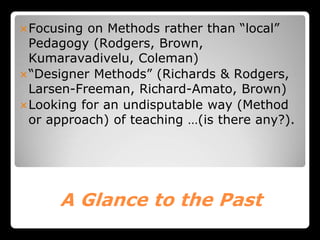
A Glance to the Past
Focusing on Methods rather than “local”
Pedagogy (Rodgers, Brown,
Kumaravadivelu, Coleman)
“Designer Methods” (Richards & Rodgers,
Larsen-Freeman, Richard-Amato, Brown)
Looking for an undisputable way (Method
or approach) of teaching …(is there any?).
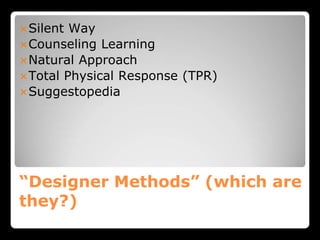
“Designer Methods” (which are
they?)
Silent Way
Counseling Learning
Natural Approach
Total Physical Response (TPR)
Suggestopedia
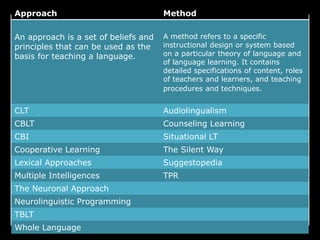
Approach Method
An approach is a set of beliefs and
principles that can be used as the
basis for teaching a language.
A method refers to a specific
instructional design or system based
on a particular theory of language and
of language learning. It contains
detailed specifications of content, roles
of teachers and learners, and teaching
procedures and techniques.
CLT Audiolingualism
CBLT Counseling Learning
CBI Situational LT
Cooperative Learning The Silent Way
Lexical Approaches Suggestopedia
Multiple Intelligences TPR
The Neuronal Approach
Neurolinguistic Programming
TBLT
Whole Language
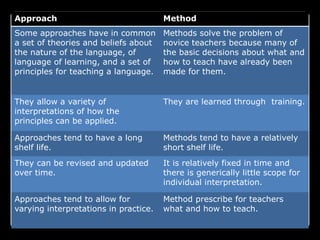
Approach Method
Some approaches have in common
a set of theories and beliefs about
the nature of the language, of
language of learning, and a set of
principles for teaching a language.
Methods solve the problem of
novice teachers because many of
the basic decisions about what and
how to teach have already been
made for them.
They allow a variety of
interpretations of how the
principles can be applied.
They are learned through training.
Approaches tend to have a long
shelf life.
Methods tend to have a relatively
short shelf life.
They can be revised and updated
over time.
It is relatively fixed in time and
there is generically little scope for
individual interpretation.
Approaches tend to allow for
varying interpretations in practice.
Method prescribe for teachers
what and how to teach.
Political, social and cultural
factors
“Second Language Education (SLE) is
involved in a complex nexus of social,
cultural, economic, and political
relationships that involve students,
teachers, and theorists in differential
positions of power”
“First, that all education is political, and
second, that all knowledge is "interested."
(Pennycook, 2007).
Political, social and cultural
factors
 To regard the power of deciding what to teach to
school and to defend the free-market economy?
The economy affects approaches and methods
(Pennycook, citing Giroux, 1988).
 “Cummins suggests that many academics are
involved in a disinformation campaign that helps
to maintain the "covert racism and psychological
violence to which dominated minority students are
still subjected (1989, pp. 127-128) and to
preserve the political status quo that is being
threatened by the changing demographics with
the increasing numbers of Spanish-speaking
people in the U.S.” (Pennycook, 2007).
Contradictions
Does the philosophy of this era goes only
against “methods”? What about
“approaches”?
Check on the “twelve principles” suggested
by Brown for a reliable approach
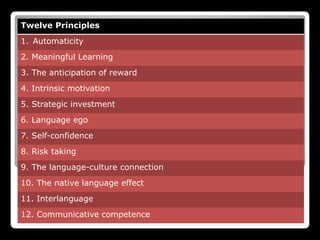
Twelve Principles
1. Automaticity
2. Meaningful Learning
3. The anticipation of reward
4. Intrinsic motivation
5. Strategic investment
6. Language ego
7. Self-confidence
8. Risk taking
9. The language-culture connection
10. The native language effect
11. Interlanguage
12. Communicative competence
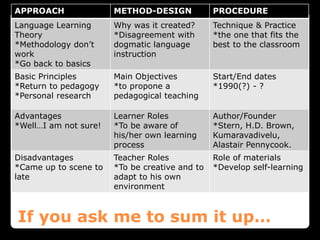
If you ask me to sum it up…
APPROACH METHOD-DESIGN PROCEDURE
Language Learning
Theory
*Methodology don’t
work
*Go back to basics
Why was it created?
*Disagreement with
dogmatic language
instruction
Technique & Practice
*the one that fits the
best to the classroom
Basic Principles
*Return to pedagogy
*Personal research
Main Objectives
*to propone a
pedagogical teaching
Start/End dates
*1990(?) - ?
Advantages
*Well…I am not sure!
Learner Roles
*To be aware of
his/her own learning
process
Author/Founder
*Stern, H.D. Brown,
Kumaravadivelu,
Alastair Pennycook.
Disadvantages
*Came up to scene to
late
Teacher Roles
*To be creative and to
adapt to his own
environment
Role of materials
*Develop self-learning

Post methods post-pedagogy

  • 1.
    Post-Methods: Towards Pedagogy inthe new era Alan Ramírez
  • 2.
  • 3.
    What method isthis??? seven principles to improve student motivation: (a) The teacher should be lively and interesting, (b) presentations should be brief, (c) examples should be concrete, (d) students should always be active, (e) activities must be useful and relevant, (f) there should be variety in every class, and (g) games should be used.
  • 4.
    Definition(s) of Methodology…again “…various individualtechniques for teaching of the basic skill areas of reading, writing, listening, and speaking.” (Cohen, 1990). “…universal technique for teaching of any linguistic material in any skill area – e.g. Presentation, Practice, Production (PPP)” (Rivers, 1968). “…comprises learning to put into practice certain general principles of good language teaching derived from research or observation (Brown, 1994ª)
  • 5.
    Definition(s) of method(the one I liked) Second of three hierarchical elements: APPROACH, “METHOD” AND TECHNIQUE “Overall plan for systematic presentation of language based on a selected approach” (approach is “a set of assumptions dealing with the nature of language, learning and teaching”). (Brown). Richards & Rodgers disagree with that definition (and hierarchy).
  • 6.
    Define “post- method”…(please!!!)  “Theshift of attention and orientation from positivistic views of language towards a process- oriented constructivist views in which learning is viewed as an active process where learners reflect upon their current and past knowledge and experiences to generate new ideas and concepts” (Fat’hi, 2011).  “…a reaction against the perceived failures of language pedagogies, and…a late embrace of trends in the humanities and social sciences… a number of ESL scholars began to turn to critical pedagogies and to speak of a “post-methods” era” (Richter, 2014).
  • 7.
    Define “post- method”…(please!!!) “Critical Pedagogiesreject traditional concepts of teaching, which view the instructor’s task as the application of theory to practice, in favor of a perspective in which teaching is the theorization of practice…” (Richter, 2014). “From a critical pedagogy perspective, the goal of second language teacher education should be to promote critical awareness, critical self-reflection, and critical pedagogical relations” (Richter, 2014).
  • 8.
    Stern “There is a"fundamental weakness" in the concept of Method.” "One of the most extraordinary and in some ways totally unexpected phenomena in the recent history of language teaching has been the 'method boom' of the seventies.“ "the prolonged preoccupation with the new methods, useful as it has been to widen our horizon, is becoming increasingly unproductive and misguided.”
  • 9.
    Not the newestidea?... “Substitution tables, realia, language games, dialogues, and many other parts of the modern scene have been around for centuries. Kelly (1969) concludes that the "total corpus of ideas accessible to language teachers has not changed basically in 2,000 years” (Pennycook, 2007).
  • 10.
    The case ofComenius “As he wrote in 1651” …(Comenius)…, "In our school we follow the rule that everything (one) needs to know about things should be taught with the help of the things themselves, that is to say that as far as possible, the real objects or pictures of them should be presented so that they can be seen, touched, heard, tasted, etc." (Caravolas, 1984, p. 88) "you learn by doing“ (Caravolas citing Comenius from 1651).
  • 11.
    The case ofComenius “Classrooms, he suggests” …(Comenius)…, “should be "workshops full of ardent activity" (p. 94). He outlines seven principles to improve student motivation: (a) The teacher should be lively and interesting, (b) presentations should be brief, (c) examples should be concrete, (d) students should always be active, (e) activities must be useful and relevant, (f) there should be variety in every class, and (g) games should be used.” (Pennycook, 2007).
  • 12.
    A Glance tothe Past Focusing on Methods rather than “local” Pedagogy (Rodgers, Brown, Kumaravadivelu, Coleman) “Designer Methods” (Richards & Rodgers, Larsen-Freeman, Richard-Amato, Brown) Looking for an undisputable way (Method or approach) of teaching …(is there any?).
  • 13.
    “Designer Methods” (whichare they?) Silent Way Counseling Learning Natural Approach Total Physical Response (TPR) Suggestopedia
  • 14.
    Approach Method An approachis a set of beliefs and principles that can be used as the basis for teaching a language. A method refers to a specific instructional design or system based on a particular theory of language and of language learning. It contains detailed specifications of content, roles of teachers and learners, and teaching procedures and techniques. CLT Audiolingualism CBLT Counseling Learning CBI Situational LT Cooperative Learning The Silent Way Lexical Approaches Suggestopedia Multiple Intelligences TPR The Neuronal Approach Neurolinguistic Programming TBLT Whole Language
  • 15.
    Approach Method Some approacheshave in common a set of theories and beliefs about the nature of the language, of language of learning, and a set of principles for teaching a language. Methods solve the problem of novice teachers because many of the basic decisions about what and how to teach have already been made for them. They allow a variety of interpretations of how the principles can be applied. They are learned through training. Approaches tend to have a long shelf life. Methods tend to have a relatively short shelf life. They can be revised and updated over time. It is relatively fixed in time and there is generically little scope for individual interpretation. Approaches tend to allow for varying interpretations in practice. Method prescribe for teachers what and how to teach.
  • 16.
    Political, social andcultural factors “Second Language Education (SLE) is involved in a complex nexus of social, cultural, economic, and political relationships that involve students, teachers, and theorists in differential positions of power” “First, that all education is political, and second, that all knowledge is "interested." (Pennycook, 2007).
  • 17.
    Political, social andcultural factors  To regard the power of deciding what to teach to school and to defend the free-market economy? The economy affects approaches and methods (Pennycook, citing Giroux, 1988).  “Cummins suggests that many academics are involved in a disinformation campaign that helps to maintain the "covert racism and psychological violence to which dominated minority students are still subjected (1989, pp. 127-128) and to preserve the political status quo that is being threatened by the changing demographics with the increasing numbers of Spanish-speaking people in the U.S.” (Pennycook, 2007).
  • 18.
    Contradictions Does the philosophyof this era goes only against “methods”? What about “approaches”? Check on the “twelve principles” suggested by Brown for a reliable approach
  • 19.
    Twelve Principles 1. Automaticity 2.Meaningful Learning 3. The anticipation of reward 4. Intrinsic motivation 5. Strategic investment 6. Language ego 7. Self-confidence 8. Risk taking 9. The language-culture connection 10. The native language effect 11. Interlanguage 12. Communicative competence
  • 20.
    If you askme to sum it up… APPROACH METHOD-DESIGN PROCEDURE Language Learning Theory *Methodology don’t work *Go back to basics Why was it created? *Disagreement with dogmatic language instruction Technique & Practice *the one that fits the best to the classroom Basic Principles *Return to pedagogy *Personal research Main Objectives *to propone a pedagogical teaching Start/End dates *1990(?) - ? Advantages *Well…I am not sure! Learner Roles *To be aware of his/her own learning process Author/Founder *Stern, H.D. Brown, Kumaravadivelu, Alastair Pennycook. Disadvantages *Came up to scene to late Teacher Roles *To be creative and to adapt to his own environment Role of materials *Develop self-learning