SPELLING 101
By: Marie Joy Alvarez
Spelling is the combination of alphabetic letters to
form a written word. It is a linguistic process
of correct writing with the
necessary letters and diacritics present in
a comprehensible, usually standardized order. While
a part of a language's orthography, not all
languages have purely phonemic alphabets.
Standardized spelling is a prescriptive element.
15 Words with More Than One Spelling
1. Acknowledgment/acknowledgement: Acknowledgment, though it looks
awkward because the spelling implies that the g is pronounced hard, rather
than (correctly) soft, is the preferred spelling, at least in American English.
2. Adviser/advisor: Adviser is the preferred spelling, though it is inconsistent
with the spelling of the adjectival form advisory.
3. Aesthetic/esthetic: Aesthetic is the preferred spelling, a rare case of the
digraph retained in American English in favor of a single-vowel spelling. (See
also amoeba/ameba and archaeology/archeology.)
4. Ameba/amoeba: Amoeba is the preferred spelling. It also has variant
plural forms: Amoebas is acceptable in all but the most strictly scientific
contexts, where amoebae is preferred.
5. Among/amongst: The -st extension is, in both American English and British
English, widely considered an unnecessary appendage. (The same
preference applies for amid/amidst and while/whilst; whilst is, at any rate,
rare in American English.)
6.  Analog/analogue: Analog is one of fourteen words in which the original
-ue ending is clipped. Whether one form or the other is preferred varies
depending on not only the word but also, occasionally, on which part of
speech it represents. Most one- and two-syllable words ending in -ue have no
truncated variant; prologue is the exception.
7. Collectable/collectible: Collectible is the preferred variant.
8. Disc/disk: Disc is a variant of disk, though it has valid status in the “phrase
compact disc” and references to similar media.
9. Donut/doughnut: Donut is an informal variant of doughnut.
10. Enquire/inquire: Inquire is the preferred American English spelling, but in
British English, enquire prevails.
11. Flier/flyer: Spelling depends on meaning. 
12. Gray/grey: Gray is the preferred spelling in American English; British English
favors grey.
13. Nite/night: Nite is an informal variant of night.
14. Theater/theatre: The former spelling is preferred in American English,
though the latter form sometimes appears in proper names.
15. Whiskey/whisky: The former spelling is more common in the United States
(as well as in Ireland), though usage in labeling varies.
At its best, English spelling can be perplexing,
especially for non-native speakers and
writers. The following rules and suggestions
are offered as aids. You will always be able to
find exceptions to these rules, but most writers
find them helpful.
SOME SPELLING
RULES
SOME SPELLING RULES
i before e, except after c . . . .
achieve, believe, bier, brief, hygiene, grief, thief, friend,
grieve, chief, fiend, patience, pierce, priest, ceiling,
conceive, deceive, perceive, receipt, receive, deceit,
conceit
. . . and in words that rhyme with hay. . .
neighbor, freight, beige, sleigh, weight, vein, and weigh
. . . and some other exceptions. . . .
either, neither, feint, foreign, forfeit, height, leisure,
weird, seize
SOME SPELLING RULES
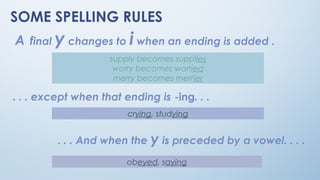
A final y changes to i when an ending is added .
supply becomes supplies
worry becomes worried
merry becomes merrier
. . . except when that ending is -ing. . .
crying, studying
. . . And when the y is preceded by a vowel. . . .
obeyed, saying
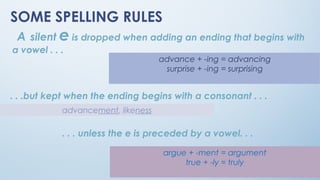
A silent e is dropped when adding an ending that begins with
a vowel . . .
SOME SPELLING RULES
advance + -ing = advancing
surprise + -ing = surprising
. . .but kept when the ending begins with a consonant . . .
advancement, likeness
. . . unless the e is preceded by a vowel. . .
argue + -ment = argument
true + -ly = truly
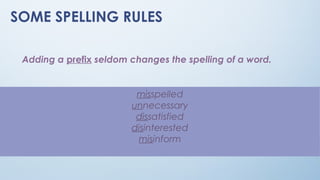
Adding a prefix seldom changes the spelling of a word.
misspelled
unnecessary
dissatisfied
disinterested
misinform
SOME SPELLING RULES
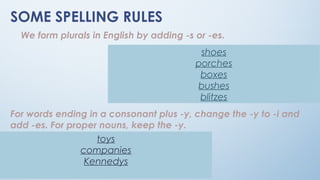
We form plurals in English by adding -s or -es.
shoes
porches
boxes
bushes
blitzes
For words ending in a consonant plus -y, change the -y to -i and
add -es. For proper nouns, keep the -y.
toys
companies
Kennedys
SOME SPELLING RULES
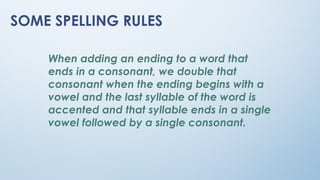
When adding an ending to a word that
ends in a consonant, we double that
consonant when the ending begins with a
vowel and the last syllable of the word is
accented and that syllable ends in a single
vowel followed by a single consonant.
SOME SPELLING RULES
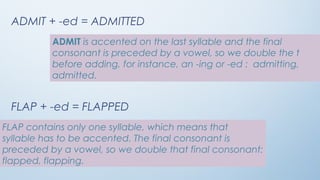
ADMIT + -ed = ADMITTED
ADMIT is accented on the last syllable and the final
consonant is preceded by a vowel, so we double the t
before adding, for instance, an -ing or -ed : admitting,
admitted.
FLAP + -ed = FLAPPED
FLAP contains only one syllable, which means that
syllable has to be accented. The final consonant is
preceded by a vowel, so we double that final consonant:
flapped, flapping.
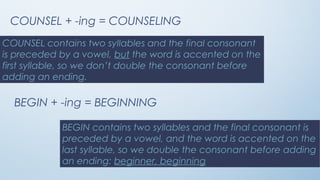
COUNSEL + -ing = COUNSELING
COUNSEL contains two syllables and the final consonant
is preceded by a vowel, but the word is accented on the
first syllable, so we don’t double the consonant before
adding an ending.
BEGIN + -ing = BEGINNING
BEGIN contains two syllables and the final consonant is
preceded by a vowel, and the word is accented on the
last syllable, so we double the consonant before adding
an ending: beginner, beginning
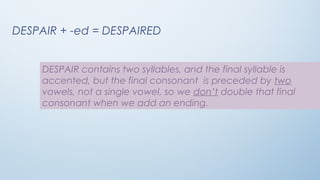
DESPAIR + -ed = DESPAIRED
DESPAIR contains two syllables, and the final syllable is
accented, but the final consonant is preceded by two
vowels, not a single vowel, so we don’t double that final
consonant when we add an ending.
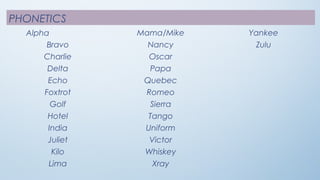
PHONETICS
Alpha Mama/Mike Yankee
Bravo Nancy Zulu
Charlie Oscar
Delta Papa
Echo Quebec
Foxtrot Romeo
Golf Sierra
Hotel Tango
India Uniform
Juliet Victor
Kilo Whiskey
Lima Xray
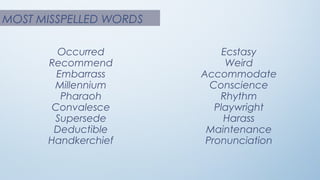
MOST MISSPELLED WORDS
Occurred
Recommend
Embarrass
Millennium
Pharaoh
Convalesce
Supersede
Deductible
Handkerchief
Ecstasy
Weird
Accommodate
Conscience
Rhythm
Playwright
Harass
Maintenance
Pronunciation
Becoming a better speller is a
matter of personal commitment
and finding your own method to
add this important skill to your
writing arsenal.
ASSESSMENT
It’s Spelling bee time!
NUMBER 1
NUMBER 2
NUMBER 3
NUMBER 4
NUMBER 5
NUMBER 6
NUMBER 7
NUMBER 8
NUMBER 9
NUMBER 10
Click here for AN
Thank you for reading!
Hope you’ve learned
something 
ANSWERS:
1. EXHILARATED
2. PRIVILEGE
3. CONNECTICUT
4. ILLINOIS
5. CARIBBEAN
6. ARCTIC
7. ALLEGIANCE
8. APOCRYPHAL
9. BANKRUPTCY
10. PENNSYLVANIA

Spelling 101

  • 1.
  • 2.
    Spelling is the combinationof alphabetic letters to form a written word. It is a linguistic process of correct writing with the necessary letters and diacritics present in a comprehensible, usually standardized order. While a part of a language's orthography, not all languages have purely phonemic alphabets. Standardized spelling is a prescriptive element.
  • 3.
    15 Words withMore Than One Spelling 1. Acknowledgment/acknowledgement: Acknowledgment, though it looks awkward because the spelling implies that the g is pronounced hard, rather than (correctly) soft, is the preferred spelling, at least in American English. 2. Adviser/advisor: Adviser is the preferred spelling, though it is inconsistent with the spelling of the adjectival form advisory. 3. Aesthetic/esthetic: Aesthetic is the preferred spelling, a rare case of the digraph retained in American English in favor of a single-vowel spelling. (See also amoeba/ameba and archaeology/archeology.) 4. Ameba/amoeba: Amoeba is the preferred spelling. It also has variant plural forms: Amoebas is acceptable in all but the most strictly scientific contexts, where amoebae is preferred. 5. Among/amongst: The -st extension is, in both American English and British English, widely considered an unnecessary appendage. (The same preference applies for amid/amidst and while/whilst; whilst is, at any rate, rare in American English.)
  • 4.
    6.  Analog/analogue: Analog is oneof fourteen words in which the original -ue ending is clipped. Whether one form or the other is preferred varies depending on not only the word but also, occasionally, on which part of speech it represents. Most one- and two-syllable words ending in -ue have no truncated variant; prologue is the exception. 7. Collectable/collectible: Collectible is the preferred variant. 8. Disc/disk: Disc is a variant of disk, though it has valid status in the “phrase compact disc” and references to similar media. 9. Donut/doughnut: Donut is an informal variant of doughnut. 10. Enquire/inquire: Inquire is the preferred American English spelling, but in British English, enquire prevails. 11. Flier/flyer: Spelling depends on meaning.  12. Gray/grey: Gray is the preferred spelling in American English; British English favors grey.
  • 5.
    13. Nite/night: Nite is aninformal variant of night. 14. Theater/theatre: The former spelling is preferred in American English, though the latter form sometimes appears in proper names. 15. Whiskey/whisky: The former spelling is more common in the United States (as well as in Ireland), though usage in labeling varies.
  • 6.
    At its best,English spelling can be perplexing, especially for non-native speakers and writers. The following rules and suggestions are offered as aids. You will always be able to find exceptions to these rules, but most writers find them helpful. SOME SPELLING RULES
  • 7.
    SOME SPELLING RULES ibefore e, except after c . . . . achieve, believe, bier, brief, hygiene, grief, thief, friend, grieve, chief, fiend, patience, pierce, priest, ceiling, conceive, deceive, perceive, receipt, receive, deceit, conceit . . . and in words that rhyme with hay. . . neighbor, freight, beige, sleigh, weight, vein, and weigh
  • 8.
    . . .and some other exceptions. . . . either, neither, feint, foreign, forfeit, height, leisure, weird, seize
  • 9.
    SOME SPELLING RULES Afinal y changes to i when an ending is added . supply becomes supplies worry becomes worried merry becomes merrier . . . except when that ending is -ing. . . crying, studying . . . And when the y is preceded by a vowel. . . . obeyed, saying
  • 10.
    A silent eis dropped when adding an ending that begins with a vowel . . . SOME SPELLING RULES advance + -ing = advancing surprise + -ing = surprising . . .but kept when the ending begins with a consonant . . . advancement, likeness . . . unless the e is preceded by a vowel. . . argue + -ment = argument true + -ly = truly
  • 11.
    Adding a prefixseldom changes the spelling of a word. misspelled unnecessary dissatisfied disinterested misinform SOME SPELLING RULES
  • 12.
    We form pluralsin English by adding -s or -es. shoes porches boxes bushes blitzes For words ending in a consonant plus -y, change the -y to -i and add -es. For proper nouns, keep the -y. toys companies Kennedys SOME SPELLING RULES
  • 13.
    When adding anending to a word that ends in a consonant, we double that consonant when the ending begins with a vowel and the last syllable of the word is accented and that syllable ends in a single vowel followed by a single consonant. SOME SPELLING RULES
  • 14.
    ADMIT + -ed= ADMITTED ADMIT is accented on the last syllable and the final consonant is preceded by a vowel, so we double the t before adding, for instance, an -ing or -ed : admitting, admitted. FLAP + -ed = FLAPPED FLAP contains only one syllable, which means that syllable has to be accented. The final consonant is preceded by a vowel, so we double that final consonant: flapped, flapping.
  • 15.
    COUNSEL + -ing= COUNSELING COUNSEL contains two syllables and the final consonant is preceded by a vowel, but the word is accented on the first syllable, so we don’t double the consonant before adding an ending. BEGIN + -ing = BEGINNING BEGIN contains two syllables and the final consonant is preceded by a vowel, and the word is accented on the last syllable, so we double the consonant before adding an ending: beginner, beginning
  • 16.
    DESPAIR + -ed= DESPAIRED DESPAIR contains two syllables, and the final syllable is accented, but the final consonant is preceded by two vowels, not a single vowel, so we don’t double that final consonant when we add an ending.
  • 17.
    PHONETICS Alpha Mama/Mike Yankee BravoNancy Zulu Charlie Oscar Delta Papa Echo Quebec Foxtrot Romeo Golf Sierra Hotel Tango India Uniform Juliet Victor Kilo Whiskey Lima Xray
  • 18.
  • 19.
    Becoming a betterspeller is a matter of personal commitment and finding your own method to add this important skill to your writing arsenal.
  • 20.
  • 21.
  • 22.
  • 23.
  • 24.
  • 25.
  • 26.
  • 27.
  • 28.
  • 29.
  • 30.
  • 31.
    Thank you forreading! Hope you’ve learned something 
  • 32.
    ANSWERS: 1. EXHILARATED 2. PRIVILEGE 3.CONNECTICUT 4. ILLINOIS 5. CARIBBEAN 6. ARCTIC 7. ALLEGIANCE 8. APOCRYPHAL 9. BANKRUPTCY 10. PENNSYLVANIA