Assessing and
Teaching
Spelling
Sheelagh Lucas
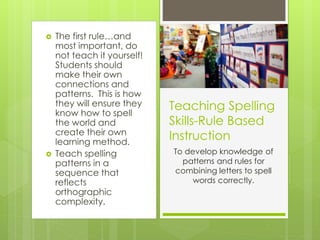
 The first rule…and
most important, do
not teach it yourself!
Students should
make their own
connections and
patterns. This is how
they will ensure they
know how to spell
the world and
create their own
learning method.
 Teach spelling
patterns in a
sequence that
reflects
orthographic
complexity.
Teaching Spelling
Skills-Rule Based
Instruction
To develop knowledge of
patterns and rules for
combining letters to spell
words correctly.
Rule Based
Instruction
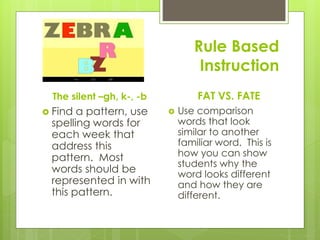
The silent –gh, k-, -b
 Find a pattern, use
spelling words for
each week that
address this
pattern. Most
words should be
represented in with
this pattern.
FAT VS. FATE
 Use comparison
words that look
similar to another
familiar word. This is
how you can show
students why the
word looks different
and how they are
different.
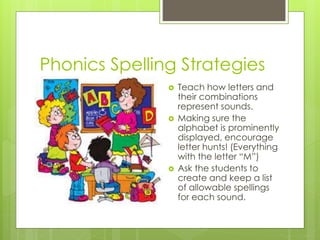
Phonics Spelling Strategies
 Teach how letters and
their combinations
represent sounds.
 Making sure the
alphabet is prominently
displayed, encourage
letter hunts! (Everything
with the letter “M”)
 Ask the students to
create and keep a list
of allowable spellings
for each sound.
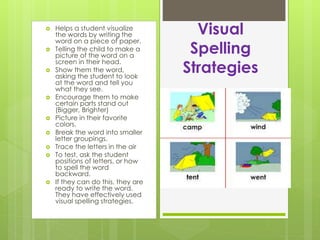
 Helps a student visualize
the words by writing the
word on a piece of paper.
 Telling the child to make a
picture of the word on a
screen in their head.
 Show them the word,
asking the student to look
at the word and tell you
what they see.
 Encourage them to make
certain parts stand out
(Bigger, Brighter)
 Picture in their favorite
colors.
 Break the word into smaller
letter groupings.
 Trace the letters in the air
 To test, ask the student
positions of letters, or how
to spell the word
backward.
 If they can do this, they are
ready to write the word.
They have effectively used
visual spelling strategies.
Visual
Spelling
Strategies
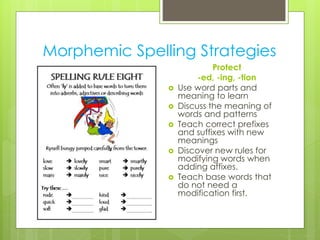
Morphemic Spelling Strategies
Protect
-ed, -ing, -tion
 Use word parts and
meaning to learn
 Discuss the meaning of
words and patterns
 Teach correct prefixes
and suffixes with new
meanings
 Discover new rules for
modifying words when
adding affixes.
 Teach base words that
do not need a
modification first.
Essential Components
of Spelling
Students must learn:
Mastery of Core Vocabulary
Spelling Skills
Experience with Words
Phonological
Awareness
What is this?
 Skills that develop
gradually and sequentially
 Awareness of sounds in
language
 Awareness of mymes
 Understanding that a
sentence can be broken
down
 Ability to talk about, reflect
and manipulate sounds
 Understanding the
relationship between
writing and the spoken
language.
Improving my skills!
 Detecting rhyme and
alliteration (use of similar
consonants)
 Identifying rhymes and words
that start/end with the same
sound
 Segmenting words into smaller
units, such as syllables and
sounds, by counting them
 Blending separated sounds into
words
 Understanding that words are
made up of sounds represented
by symbols or letters
 Manipulating sounds in words by
adding, deleting, or substituting
 The conventional
spelling and use
of a language
 The study of
spelling and
correct word
usage in a
language
 Closer to a
whole grammar
in language than
spelling. Knowledge of
Orthography
Vocabulary
What are all these words?
 Helps with expressive
language
 Helps with
understanding text
 Helps build spelling,
knowledge, and
comprehension
 Creates a more
complex speaking and
writing opportunity
 Allows for more creative
writing and speaking
 An important part of
reading!
Helping Kids with an LD
 Special needs students will need to focus more on
rules based as well as skill building. Their skills
learned from word hunting in a sentence will be of
help in building their vocabulary.
 Many children will mistake spellings (bare, bear)
use visual spelling to help *if you are bare the “e” is
hanging out on the end for all to see; if it is a bear,
the e is in the middle, already eaten up*
 Students may struggle with this, word banks may
help them. Recognizing the words visually may be
the more important skill, rather than recall.

Assessing and teaching spelling

  • 1.
  • 2.
     The firstrule…and most important, do not teach it yourself! Students should make their own connections and patterns. This is how they will ensure they know how to spell the world and create their own learning method.  Teach spelling patterns in a sequence that reflects orthographic complexity. Teaching Spelling Skills-Rule Based Instruction To develop knowledge of patterns and rules for combining letters to spell words correctly.
  • 3.
    Rule Based Instruction The silent–gh, k-, -b  Find a pattern, use spelling words for each week that address this pattern. Most words should be represented in with this pattern. FAT VS. FATE  Use comparison words that look similar to another familiar word. This is how you can show students why the word looks different and how they are different.
  • 4.
    Phonics Spelling Strategies Teach how letters and their combinations represent sounds.  Making sure the alphabet is prominently displayed, encourage letter hunts! (Everything with the letter “M”)  Ask the students to create and keep a list of allowable spellings for each sound.
  • 5.
     Helps astudent visualize the words by writing the word on a piece of paper.  Telling the child to make a picture of the word on a screen in their head.  Show them the word, asking the student to look at the word and tell you what they see.  Encourage them to make certain parts stand out (Bigger, Brighter)  Picture in their favorite colors.  Break the word into smaller letter groupings.  Trace the letters in the air  To test, ask the student positions of letters, or how to spell the word backward.  If they can do this, they are ready to write the word. They have effectively used visual spelling strategies. Visual Spelling Strategies
  • 6.
    Morphemic Spelling Strategies Protect -ed,-ing, -tion  Use word parts and meaning to learn  Discuss the meaning of words and patterns  Teach correct prefixes and suffixes with new meanings  Discover new rules for modifying words when adding affixes.  Teach base words that do not need a modification first.
  • 7.
    Essential Components of Spelling Studentsmust learn: Mastery of Core Vocabulary Spelling Skills Experience with Words
  • 8.
    Phonological Awareness What is this? Skills that develop gradually and sequentially  Awareness of sounds in language  Awareness of mymes  Understanding that a sentence can be broken down  Ability to talk about, reflect and manipulate sounds  Understanding the relationship between writing and the spoken language. Improving my skills!  Detecting rhyme and alliteration (use of similar consonants)  Identifying rhymes and words that start/end with the same sound  Segmenting words into smaller units, such as syllables and sounds, by counting them  Blending separated sounds into words  Understanding that words are made up of sounds represented by symbols or letters  Manipulating sounds in words by adding, deleting, or substituting
  • 9.
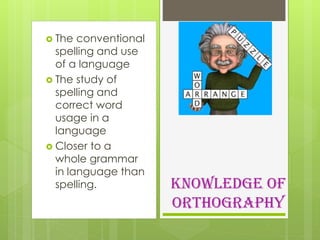
     The conventional spellingand use of a language  The study of spelling and correct word usage in a language  Closer to a whole grammar in language than spelling. Knowledge of Orthography
  • 10.
    Vocabulary What are allthese words?  Helps with expressive language  Helps with understanding text  Helps build spelling, knowledge, and comprehension  Creates a more complex speaking and writing opportunity  Allows for more creative writing and speaking  An important part of reading!
  • 11.
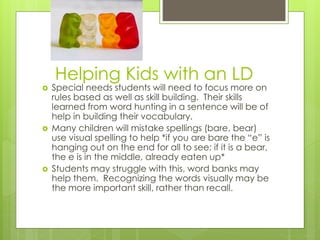
    Helping Kids withan LD  Special needs students will need to focus more on rules based as well as skill building. Their skills learned from word hunting in a sentence will be of help in building their vocabulary.  Many children will mistake spellings (bare, bear) use visual spelling to help *if you are bare the “e” is hanging out on the end for all to see; if it is a bear, the e is in the middle, already eaten up*  Students may struggle with this, word banks may help them. Recognizing the words visually may be the more important skill, rather than recall.