Presented by: Ruth, Rhea & Danielle
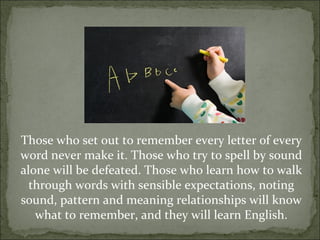
Those who set out to remember every letter of every
word never make it. Those who try to spell by sound
alone will be defeated. Those who learn how to walk
  through words with sensible expectations, noting
sound, pattern and meaning relationships will know
   what to remember, and they will learn English.
 Teacher as a model for students
 Role of spelling in general subjects, integrated into
  every area
 As cited by Templeton and Morris (1999, p. 108),
  ‘accurate, automatized knowledge of basic spelling
  patterns is at the heart of skilled reading and writing’.
 What does it involve in literacy?
   Phonemic awareness
   Graphophonic knowledge
   Morphemic awareness and knowledge
   Etymological awareness and knowledge
   Visual awareness
 What does it influence in literacy?
   Reading
   Writing
 As cited by Carreker, Joshi and Boulware-Gooden
 (2010, p. 149), findings show that increased literacy-
 related content knowledge facilitates teachers’
 interpretation of assessments, selection of appropriate
 words for reading and spelling instruction, analysis of
 reading and spelling errors, and constructive feedback
 to students’ errors.
 In the past, primarily taught through rote learning by
 adhering to certain rules (Templeton & Morris, 1999,
 p. 102).
 Traditional method: studying and learning words in
 lists as presented in commercially published ‘spellers’
 (Wallace, 2006, p. 269).
 Some even believe that explicit spelling instruction is
 not necessary, and immersing students in reading and
 writing is adequate (Winch, 2002, p. 224).
 The spelling system not only represents sound; it
 represents meaning as well (Templeton, 2003).
 Teacher directed: guide students to an understanding
 of how particular spelling features and patterns
 operate (Templeton & Morris, 1999).
 Focus on spelling patterns, not individual words -
 though these may be added if necessary (Templeton &
 Morris, 1999)
Templeton and Morris (1999, p. 108) state that,
    ‘although word knowledge is best developed
   through contextual reading and writing, many
students require careful teacher guidance and much
   practice if they are to internalize foundational
                  spelling patterns’.
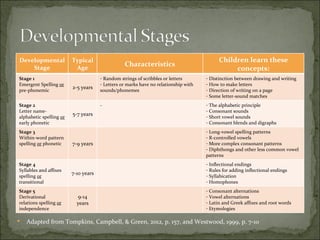
 According to most literacy experts, spelling is a
 developmental process (Tompkins et al., 2012, p. 155;
 Westwood, 1999, p. 7).

 As suggested by Wallace (2006, p. 273), when teachers
 understand that spelling is developmental, they will
 structure their teaching differently, and give students
 word lists that suit their individual need.
Developmental            Typical                                                           Children learn these
    Stage                 Age
                                                 Characteristics
                                                                                                concepts:
Stage 1                               - Random strings of scribbles or letters       - Distinction between drawing and writing
Emergent Spelling or                  - Letters or marks have no relationship with   - How to make letters
                         2-5 years                                                   - Direction of writing on a page
pre-phonemic                          sounds/phonemes
                                                                                     - Some letter-sound matches
Stage 2                               -                                              - The alphabetic principle
Letter name-                                                                         - Consonant sounds
                         5-7 years                                                   - Short vowel sounds
alphabetic spelling or
early phonetic                                                                       - Consonant blends and digraphs
Stage 3                                                                              - Long-vowel spelling patterns
Within-word pattern                                                                  - R-controlled vowels
spelling or phonetic     7-9 years                                                   - More complex consonant patterns
                                                                                     - Diphthongs and other less common vowel
                                                                                     patterns
Stage 4                                                                              - Inflectional endings
Syllables and affixes                                                                - Rules for adding inflectional endings
                         7-10 years                                                  - Syllabication
spelling or
transitional                                                                         - Homophones
Stage 5                                                                              - Consonant alternations
Derivational               9-14                                                      - Vowel alternations
relations spelling or      years                                                     - Latin and Greek affixes and root words
independence                                                                         - Etymologies

   Adapted from Tompkins, Campbell, & Green, 2012, p. 157, and Westwood, 1999, p. 7-10
 It is important for teachers to realise that they may
 have children spelling at various stages in the one
 year level (Templeton, 2003, p. 49; Westwood, 1999,
 p. 7).
 Students must be dealing with words at their
 developmental level, not their ‘frustration’ level
 (Templeton & Morris, 1999, p. 107).
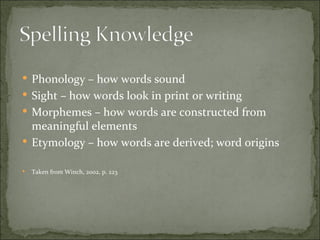
 Phonology – how words sound
 Sight – how words look in print or writing
 Morphemes – how words are constructed from
  meaningful elements
 Etymology – how words are derived; word origins

   Taken from Winch, 2002, p. 223
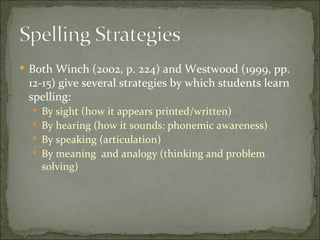
 Both Winch (2002, p. 224) and Westwood (1999, pp.
 12-15) give several strategies by which students learn
 spelling:
   By sight (how it appears printed/written)
   By hearing (how it sounds: phonemic awareness)
   By speaking (articulation)
   By meaning and analogy (thinking and problem
    solving)
 Word sorts
 Board/card games – only effective if focusing on word
  groups that reflect spelling patterns
 Word wheels
 Flip charts


   Templeton & Morris, 1999, p. 109
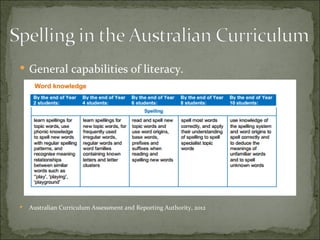
 General capabilities of literacy.


   Australian Curriculum Assessment and Reporting Authority, 2012
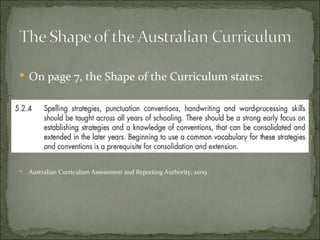
 On page 7, the Shape of the Curriculum states:


   Australian Curriculum Assessment and Reporting Authority, 2009
Year
(Age)
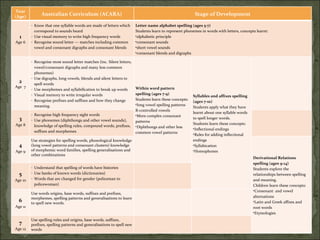
               Australian Curriculum (ACARA)                                                              Stage of Development

         - Know that one syllable words are made of letters which       Letter name alphabet spelling (ages 5-7)
           correspond to sounds heard                                   Students learn to represent phonemes in words with letters, concepts learnt:
  1      - Use visual memory to write high frequency words              •alphabetic principle
Age 6    - Recognise sound letter — matches including common            •consonant sounds
           vowel and consonant digraphs and consonant blends            •short vowel sounds
                                                                        •consonant blends and digraphs

         - Recognise most sound letter matches (inc. Silent letters,
           vowel/consonant digraphs and many less common
           phonemes)
         - Use digraphs, long vowels, blends and silent letters to
  2        spell words
Age 7                                                                   Within word pattern
         - Use morphemes and syllabification to break up words
         - Visual memory to write irregular words                       spelling (ages 7-9)
                                                                                                         Syllables and affixes spelling
         - Recognise prefixes and suffixes and how they change          Students learn these concepts:
                                                                                                         (ages 7-10)
           meaning.                                                     •long vowel spelling patterns
                                                                                                         Students apply what they have
                                                                        R-controlled vowels
         - Recognise high frequency sight words                                                          learnt about one syllable words
                                                                        •More complex consonant
  3      - Use phonemes (diphthongs and other vowel sounds),            patterns
                                                                                                         to spell longer words.
Age 8                                                                                                    Students learn these concepts:
           knowledge of spelling rules, compound words, prefixes,       •Diphthongs and other less
                                                                                                         •Inflectional endings
           suffixes and morphemes                                       common vowel patterns            •Rules for adding inflectional
         Use strategies for spelling words, phonological knowledge                                       endings
  4      (long vowel patterns and consonant clusters) knowledge                                          •Syllabication
Age 9    of morphemic word families, spelling generalisations and                                        •Homophones
         other combinations
                                                                                                                                           Derivational Relations
                                                                                                                                           spelling (ages 9-14)
         - Understand that spelling of words have histories                                                                                Students explore the
  5      - Use banks of known words (dictionaries)                                                                                         relationships between spelling
Age 10   - Words that are changed for gender (policeman to                                                                                 and meaning.
           policewoman)                                                                                                                    Children learn these concepts:
                                                                                                                                           •Consonant and vowel
         Use words origins, base words, suffixes and prefixes,
         morphemes, spelling patterns and generalisations to learn                                                                         alternations
  6      to spell new words.                                                                                                               •Latin and Greek affixes and
Age 11                                                                                                                                     root words
                                                                                                                                           •Etymologies
         Use spelling rules and origins, base words, suffixes,
  7      prefixes, spelling patterns and generalisations to spell new
Age 12   words
Teaching spelling
Teaching spelling

Teaching spelling

  • 1.
    Presented by: Ruth,Rhea & Danielle
  • 2.
    Those who setout to remember every letter of every word never make it. Those who try to spell by sound alone will be defeated. Those who learn how to walk through words with sensible expectations, noting sound, pattern and meaning relationships will know what to remember, and they will learn English.
  • 4.
     Teacher asa model for students  Role of spelling in general subjects, integrated into every area  As cited by Templeton and Morris (1999, p. 108), ‘accurate, automatized knowledge of basic spelling patterns is at the heart of skilled reading and writing’.
  • 5.
     What doesit involve in literacy?  Phonemic awareness  Graphophonic knowledge  Morphemic awareness and knowledge  Etymological awareness and knowledge  Visual awareness  What does it influence in literacy?  Reading  Writing
  • 6.
     As citedby Carreker, Joshi and Boulware-Gooden (2010, p. 149), findings show that increased literacy- related content knowledge facilitates teachers’ interpretation of assessments, selection of appropriate words for reading and spelling instruction, analysis of reading and spelling errors, and constructive feedback to students’ errors.
  • 8.
     In thepast, primarily taught through rote learning by adhering to certain rules (Templeton & Morris, 1999, p. 102).  Traditional method: studying and learning words in lists as presented in commercially published ‘spellers’ (Wallace, 2006, p. 269).  Some even believe that explicit spelling instruction is not necessary, and immersing students in reading and writing is adequate (Winch, 2002, p. 224).
  • 9.
     The spellingsystem not only represents sound; it represents meaning as well (Templeton, 2003).  Teacher directed: guide students to an understanding of how particular spelling features and patterns operate (Templeton & Morris, 1999).  Focus on spelling patterns, not individual words - though these may be added if necessary (Templeton & Morris, 1999)
  • 10.
    Templeton and Morris(1999, p. 108) state that, ‘although word knowledge is best developed through contextual reading and writing, many students require careful teacher guidance and much practice if they are to internalize foundational spelling patterns’.
  • 11.
     According tomost literacy experts, spelling is a developmental process (Tompkins et al., 2012, p. 155; Westwood, 1999, p. 7).  As suggested by Wallace (2006, p. 273), when teachers understand that spelling is developmental, they will structure their teaching differently, and give students word lists that suit their individual need.
  • 12.
    Developmental Typical Children learn these Stage Age Characteristics concepts: Stage 1 - Random strings of scribbles or letters - Distinction between drawing and writing Emergent Spelling or - Letters or marks have no relationship with - How to make letters 2-5 years - Direction of writing on a page pre-phonemic sounds/phonemes - Some letter-sound matches Stage 2 - - The alphabetic principle Letter name- - Consonant sounds 5-7 years - Short vowel sounds alphabetic spelling or early phonetic - Consonant blends and digraphs Stage 3 - Long-vowel spelling patterns Within-word pattern - R-controlled vowels spelling or phonetic 7-9 years - More complex consonant patterns - Diphthongs and other less common vowel patterns Stage 4 - Inflectional endings Syllables and affixes - Rules for adding inflectional endings 7-10 years - Syllabication spelling or transitional - Homophones Stage 5 - Consonant alternations Derivational 9-14 - Vowel alternations relations spelling or years - Latin and Greek affixes and root words independence - Etymologies  Adapted from Tompkins, Campbell, & Green, 2012, p. 157, and Westwood, 1999, p. 7-10
  • 13.
     It isimportant for teachers to realise that they may have children spelling at various stages in the one year level (Templeton, 2003, p. 49; Westwood, 1999, p. 7).  Students must be dealing with words at their developmental level, not their ‘frustration’ level (Templeton & Morris, 1999, p. 107).
  • 14.
     Phonology –how words sound  Sight – how words look in print or writing  Morphemes – how words are constructed from meaningful elements  Etymology – how words are derived; word origins  Taken from Winch, 2002, p. 223
  • 15.
     Both Winch(2002, p. 224) and Westwood (1999, pp. 12-15) give several strategies by which students learn spelling:  By sight (how it appears printed/written)  By hearing (how it sounds: phonemic awareness)  By speaking (articulation)  By meaning and analogy (thinking and problem solving)
  • 16.
     Word sorts Board/card games – only effective if focusing on word groups that reflect spelling patterns  Word wheels  Flip charts  Templeton & Morris, 1999, p. 109
  • 18.
     General capabilitiesof literacy.  Australian Curriculum Assessment and Reporting Authority, 2012
  • 19.
     On page7, the Shape of the Curriculum states:  Australian Curriculum Assessment and Reporting Authority, 2009
  • 21.
    Year (Age) Australian Curriculum (ACARA) Stage of Development - Know that one syllable words are made of letters which Letter name alphabet spelling (ages 5-7) correspond to sounds heard Students learn to represent phonemes in words with letters, concepts learnt: 1 - Use visual memory to write high frequency words •alphabetic principle Age 6 - Recognise sound letter — matches including common •consonant sounds vowel and consonant digraphs and consonant blends •short vowel sounds •consonant blends and digraphs - Recognise most sound letter matches (inc. Silent letters, vowel/consonant digraphs and many less common phonemes) - Use digraphs, long vowels, blends and silent letters to 2 spell words Age 7 Within word pattern - Use morphemes and syllabification to break up words - Visual memory to write irregular words spelling (ages 7-9) Syllables and affixes spelling - Recognise prefixes and suffixes and how they change Students learn these concepts: (ages 7-10) meaning. •long vowel spelling patterns Students apply what they have R-controlled vowels - Recognise high frequency sight words learnt about one syllable words •More complex consonant 3 - Use phonemes (diphthongs and other vowel sounds), patterns to spell longer words. Age 8 Students learn these concepts: knowledge of spelling rules, compound words, prefixes, •Diphthongs and other less •Inflectional endings suffixes and morphemes common vowel patterns •Rules for adding inflectional Use strategies for spelling words, phonological knowledge endings 4 (long vowel patterns and consonant clusters) knowledge •Syllabication Age 9 of morphemic word families, spelling generalisations and •Homophones other combinations Derivational Relations spelling (ages 9-14) - Understand that spelling of words have histories Students explore the 5 - Use banks of known words (dictionaries) relationships between spelling Age 10 - Words that are changed for gender (policeman to and meaning. policewoman) Children learn these concepts: •Consonant and vowel Use words origins, base words, suffixes and prefixes, morphemes, spelling patterns and generalisations to learn alternations 6 to spell new words. •Latin and Greek affixes and Age 11 root words •Etymologies Use spelling rules and origins, base words, suffixes, 7 prefixes, spelling patterns and generalisations to spell new Age 12 words

Editor's Notes

  • #9 For many years, spelling was taught rigorously through the memorisation of word lists, often unrelated to each other. However, while memory does play a role, it does not foster the understanding of words or word patterns, which is a critical skill in successful spelling. Unfortunately, many school spelling programs still operate under the traditional method.
  • #10 Learning to spell requires conceptual understanding of the various elements, and follows the theory of Piaget in going from concrete to abstract. The developmental process which we will explain later, demonstrates this understanding, as it takes students from spelling by sound, to spelling by meaning.
  • #12 While there are variations on the developmental stages, the essential concepts stay the same.
  • #13 Developmental stages are usually determined by spelling inventory tests, which demonstrate to the teacher the knowledge of spelling and word concepts which students understand, and those which yet need to be taught.
  • #14 A child's rate of progress through the stages is influenced by the instruction they receive, and different children will progress differently. It is therefore necessary to differentiate spelling for each student, and compose spelling lists of word patterns that children are having difficultly with. Determining the developmental level of each student is important, because when students examine words that are at their appropriate developmental/instructional level they make more progress than if they attempt words and patterns that are at their frustration level.
  • #17 Word sorts engage students in categorizing words according to sound, spelling pattern, and meaning. Games, word wheels and flip charts are all word building activities that encourage an understanding of patterns in words.
  • #19 Spelling is a major part of the Australian Curriculum ‘Word Knowledge’ stream in the general capabilities of literacy. Students must meet each of these outcomes by the end of the years 2, 4, 6, 8 and 10 and in order to do this, spelling rules and knowledge of words must be built on throughout the years.
  • #20 The Shape of the Curriculum also places a high importance on students learning to spell well placing it together with the importance of knowing about the English language. The Shape of the Curriculum: English (p.9) also states that, “students’ accurate, fluent and confident engagement with texts is based on developing skills of spelling... processes and strategies that support comprehension and expression in reading and writing texts will also underpin more proficient, analytic, and effective uses of english”. So having the knowledge of important literacy skills such as spelling will provide the basis and support of skills which need to be learnt later in life. Students lacking in these skills will find it difficult to engage in texts which will inturn provide difficulties when trying to engage in more proficient and effective uses of English.
  • #21 Basically, the Australian curriculum follows the stages of development as stated in the text quite closely.