Top 10
spelling
rules
S E V I L A Y S H A K I R
"i before e except after c"
rule
1. the "i before e except after c" rule
believe - receive
As a basic rule this is great
but what about ancient, leisure, neighbour/neighbor?
We have a longer version of the rule:
" i before e except after a long c but not when c is a "sh"
sound and not when sounded like 'a' as in neighbour or weigh."
( i before e rule) believe, achieve, (except after c),receive,
ceiling (but not when c is sounded like sh) ancient, proficient
not when sounded like 'a' ) eight, beige
But there are exceptions always exceptions so watch out for
them.
the
I D G E J U N I O R H I G H
Changing "y" to "ies"
When the word ends in a vowel + y just add ‘s’
key → keys
delay → delays
trolley → trolleys
(because we can't have three vowels in a row delaies
x )
If the word has a consonant before the ‘y’:
take off the ‘y’ and add ‘ies’
baby → babies
company → companies
difficulty → difficulties
the
I D G E J U N I O R H I G H
Adding -es to words
ending in -s, -ss, -z -ch
-sh -x
This was added centuries ago to stop the plural 's'
clashing with these letters and it softens the 's'
sound to a 'z' sound
bus→ buses
business → businesses
watch → watches
box → boxes
quiz → quizzes
the
I D G E J U N I O R H I G H
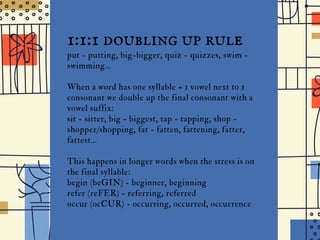
1:1:1 doubling up rule
put - putting, big-bigger, quiz - quizzes, swim -
swimming...
When a word has one syllable + 1 vowel next to 1
consonant we double up the final consonant with a
vowel suffix:
sit - sitter, big - biggest, tap - tapping, shop -
shopper/shopping, fat - fatten, fattening, fatter,
fattest...
This happens in longer words when the stress is on
the final syllable:
begin (beGIN) - beginner, beginning
refer (reFER) - referring, referred
occur (ocCUR) - occurring, occurred, occurrence
the
I D G E J U N I O R H I G H
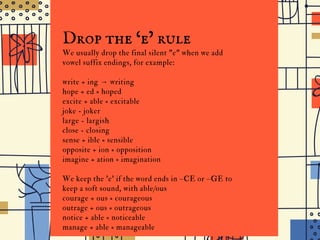
Drop the ‘e’ rule
We usually drop the final silent "e" when we add
vowel suffix endings, for example:
write + ing → writing
hope + ed = hoped
excite + able = excitable
joke - joker
large - largish
close - closing
sense + ible = sensible
opposite + ion = opposition
imagine + ation = imagination
We keep the 'e' if the word ends in –CE or –GE to
keep a soft sound, with able/ous
courage + ous = courageous
outrage + ous = outrageous
notice + able = noticeable
manage + able = manageable
the
I D G E J U N I O R H I G H
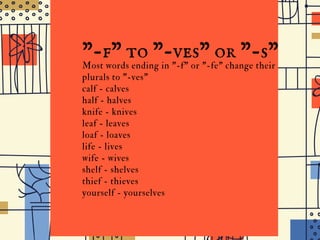
"-f" to "-ves" or "-s"
Most words ending in "-f" or "-fe" change their
plurals to "-ves"
calf - calves
half - halves
knife - knives
leaf - leaves
loaf - loaves
life - lives
wife - wives
shelf - shelves
thief - thieves
yourself - yourselves
the
I D G E J U N I O R H I G H
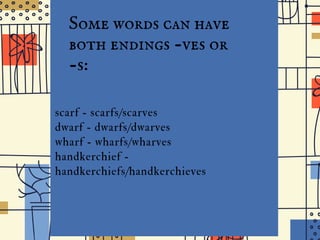
Some words can have
both endings -ves or
-s:
scarf - scarfs/scarves
dwarf - dwarfs/dwarves
wharf - wharfs/wharves
handkerchief -
handkerchiefs/handkerchieves
the
I D G E J U N I O R H I G H
Words ending in -ff
you just add -s to make
the plural.
cliff - cliffs
toff - toffs
scuff - scuffs
sniff - sniffs
the
I D G E J U N I O R H I G H
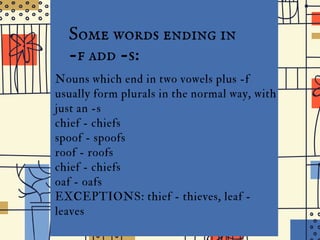
Some words ending in
-f add -s:
Nouns which end in two vowels plus -f
usually form plurals in the normal way, with
just an -s
chief - chiefs
spoof - spoofs
roof - roofs
chief - chiefs
oaf - oafs
EXCEPTIONS: thief - thieves, leaf -
leaves
the
I D G E J U N I O R H I G H
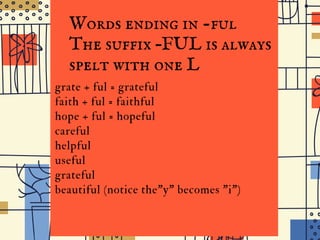
Words ending in -ful
The suffix –FUL is always
spelt with one L
grate + ful = grateful
faith + ful = faithful
hope + ful = hopeful
careful
helpful
useful
grateful
beautiful (notice the"y" becomes "i")
the
I D G E J U N I O R H I G H
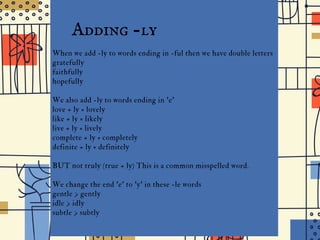
Adding -ly
When we add -ly to words ending in -ful then we have double letters
gratefully
faithfully
hopefully
We also add -ly to words ending in 'e'
love + ly = lovely
like + ly = likely
live + ly = lively
complete + ly = completely
definite + ly = definitely
BUT not truly (true + ly) This is a common misspelled word.
We change the end 'e' to 'y' in these -le words
gentle > gently
idle > idly
subtle > subtly
the
I D G E J U N I O R H I G H
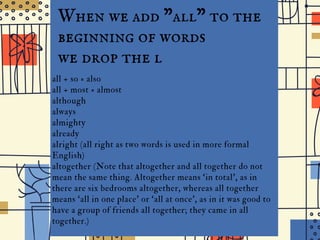
When we add "all" to the
beginning of words
we drop the l
all + so = also
all + most = almost
although
always
almighty
already
alright (all right as two words is used in more formal
English)
altogether (Note that altogether and all together do not
mean the same thing. Altogether means ‘in total’, as in
there are six bedrooms altogether, whereas all together
means ‘all in one place’ or ‘all at once’, as in it was good to
have a group of friends all together; they came in all
together.)

Top 10 spelling rules

  • 1.
    Top 10 spelling rules S EV I L A Y S H A K I R
  • 2.
    "i before eexcept after c" rule 1. the "i before e except after c" rule believe - receive As a basic rule this is great but what about ancient, leisure, neighbour/neighbor?
  • 3.
    We have alonger version of the rule: " i before e except after a long c but not when c is a "sh" sound and not when sounded like 'a' as in neighbour or weigh." ( i before e rule) believe, achieve, (except after c),receive, ceiling (but not when c is sounded like sh) ancient, proficient not when sounded like 'a' ) eight, beige But there are exceptions always exceptions so watch out for them.
  • 4.
    the I D GE J U N I O R H I G H Changing "y" to "ies" When the word ends in a vowel + y just add ‘s’ key → keys delay → delays trolley → trolleys (because we can't have three vowels in a row delaies x ) If the word has a consonant before the ‘y’: take off the ‘y’ and add ‘ies’ baby → babies company → companies difficulty → difficulties
  • 5.
    the I D GE J U N I O R H I G H Adding -es to words ending in -s, -ss, -z -ch -sh -x This was added centuries ago to stop the plural 's' clashing with these letters and it softens the 's' sound to a 'z' sound bus→ buses business → businesses watch → watches box → boxes quiz → quizzes
  • 6.
    the I D GE J U N I O R H I G H 1:1:1 doubling up rule put - putting, big-bigger, quiz - quizzes, swim - swimming... When a word has one syllable + 1 vowel next to 1 consonant we double up the final consonant with a vowel suffix: sit - sitter, big - biggest, tap - tapping, shop - shopper/shopping, fat - fatten, fattening, fatter, fattest... This happens in longer words when the stress is on the final syllable: begin (beGIN) - beginner, beginning refer (reFER) - referring, referred occur (ocCUR) - occurring, occurred, occurrence
  • 7.
    the I D GE J U N I O R H I G H Drop the ‘e’ rule We usually drop the final silent "e" when we add vowel suffix endings, for example: write + ing → writing hope + ed = hoped excite + able = excitable joke - joker large - largish close - closing sense + ible = sensible opposite + ion = opposition imagine + ation = imagination We keep the 'e' if the word ends in –CE or –GE to keep a soft sound, with able/ous courage + ous = courageous outrage + ous = outrageous notice + able = noticeable manage + able = manageable
  • 8.
    the I D GE J U N I O R H I G H "-f" to "-ves" or "-s" Most words ending in "-f" or "-fe" change their plurals to "-ves" calf - calves half - halves knife - knives leaf - leaves loaf - loaves life - lives wife - wives shelf - shelves thief - thieves yourself - yourselves
  • 9.
    the I D GE J U N I O R H I G H Some words can have both endings -ves or -s: scarf - scarfs/scarves dwarf - dwarfs/dwarves wharf - wharfs/wharves handkerchief - handkerchiefs/handkerchieves
  • 10.
    the I D GE J U N I O R H I G H Words ending in -ff you just add -s to make the plural. cliff - cliffs toff - toffs scuff - scuffs sniff - sniffs
  • 11.
    the I D GE J U N I O R H I G H Some words ending in -f add -s: Nouns which end in two vowels plus -f usually form plurals in the normal way, with just an -s chief - chiefs spoof - spoofs roof - roofs chief - chiefs oaf - oafs EXCEPTIONS: thief - thieves, leaf - leaves
  • 12.
    the I D GE J U N I O R H I G H Words ending in -ful The suffix –FUL is always spelt with one L grate + ful = grateful faith + ful = faithful hope + ful = hopeful careful helpful useful grateful beautiful (notice the"y" becomes "i")
  • 13.
    the I D GE J U N I O R H I G H Adding -ly When we add -ly to words ending in -ful then we have double letters gratefully faithfully hopefully We also add -ly to words ending in 'e' love + ly = lovely like + ly = likely live + ly = lively complete + ly = completely definite + ly = definitely BUT not truly (true + ly) This is a common misspelled word. We change the end 'e' to 'y' in these -le words gentle > gently idle > idly subtle > subtly
  • 14.
    the I D GE J U N I O R H I G H When we add "all" to the beginning of words we drop the l all + so = also all + most = almost although always almighty already alright (all right as two words is used in more formal English) altogether (Note that altogether and all together do not mean the same thing. Altogether means ‘in total’, as in there are six bedrooms altogether, whereas all together means ‘all in one place’ or ‘all at once’, as in it was good to have a group of friends all together; they came in all together.)