https://pixabay.com/photos/books-bookstore-book-reading-1204029/shared under CC0
1
English
SpellingRules
CLB3-4
https://pixabay.com/photos/books-bookstore-book-reading-1204029/shared under CC0
2
Welcome to the English Online community!

Our Equity, Diversity, and Inclusion Acknowledgment
This community welcomes, appreciates, and respects everyone – it doesn’t matter
what country you’re from or who you are!
We are here today to become better at English, so let’s focus on learning!
Please remember that English Online has ZERO tolerance for discrimination

(political, religious, nationality, or gender).
If anyone feels uncomfortable attending the class, they are free to leave and email us


at info@myenglishonline.ca
Agenda
1. Welcome
2. English Spelling Rules and Exceptions
3. Practice
3
https://pixabay.com/illustrations/artificial-intelligence-brain-think-4389372/ shared under CC0
English Spelling Rules
There are many spelling rules in
English.
Today, we’ll cover a few of these
rules and their exceptions too.
English Spelling Rules
1. If a noun ends with a consonant
followed by a “y” Change the
“y” to “i” and add “es” in the
plural form.
1. If a noun ends with a
consonant followed by a “y”
Change the “y” to “i” and add “es”
in the plural form.
Examples:
baby babies
country countries
sky skies
1. If a noun ends with a
consonant followed by a “y”
Change the “y” to “i” and add “es”
in the plural form.
What are some examples you
know?
English Spelling Rules
2.
We add “es” to some nouns in the
plural form. Nouns that end in:
“s”
“ss”
“ch”
“sh”
“x”
take the “es” in the plural.
2.
We add “es” to some nouns in the
plural form.
Examples:
bus buses
business businesses
watch watches
bush bushes
fox foxes
2.
We add “es” to some nouns in
the plural form.
What are some examples that
you know?
English Spelling Rules
3.
For words that end in a silent “e”,
we drop the “e” when adding a
suffix that begins with a vowel.
3.
For words that end in a silent “e”,
we drop the “e” when adding a
suffix that begins with a vowel.
Examples:
exciteexcitable
close closing
adoreadorable
prune pruning
3.
For words that end in a silent “e”,
we drop the “e” when adding a
suffix that begins with a vowel.
What are some examples that
you know?
3.
For words that end in a silent “e”,
we drop the “e” when adding a
vowel suffix.
BUT: THERE IS AN EXCEPTION:
We keep the “e” if the word ends in
“ce” or “ge”.
EXAMPLE:
courage courageous
notice noticeable
English Spelling Rules
When we add suffixes to words that end in
“y”, we change the “y” to “i”.
15
4.
4.
When we add suffixes to words that end in
“y”, we change the “y” to “i”.
Example:
beauty beautiful
angry angrier
apply applies
happy happier
16
4.
When we add suffixes to words that end in
“y”, we change the “y” to “i”.
What are some examples that you know?
17
When we add suffixes to words that end in
“y”, we change the “y” to “i”.
BUT: THERE IS AN EXCEPTION:
If the suffix begins with an “i”, the “y”
remains.
EXAMPLE:
defy defying
apply applying
18
4.
English Spelling Rules
. Most words that end in “f” drop the “f”
and add “ves” in the plural.
19
5.
5.
Most words that end in “f” drop the “f” and
add “ves” in the plural.
Example:
A loaf of bread 5 loaves of bread
One thief 7 thieves
1 calf 20 calves
20
5.
Most words that end in “f” drop the “f” and
add “ves” in the plural.
But, there is an Exception:
Some words can end in “s” or “ves”.
Examples:
scarf scarfsscarves
dwarfdwarfs dwarves
21
6.
If you are unsure whether to use “ei” or “ie”
when spelling a word, use this hint:
“use i before e, except after c”
22
6.
If you are unsure whether to use “ei” or “ie”
when spelling a word, use this hint:
“use i before e, except after c”
believe or beleive…?
recieve or receive?
23
6.
If you are unsure whether to use “ei” or “ie”
remember these exceptions:
Keep the “i” before the “e”, if the “c” in the
word sounds like “sh”
Examples: ancient
efficient
24
6.
If you are unsure whether to use “ei” or “ie”
remember these exceptions:
If the pair sounds like “ay”, use e before the
i
Examples: weigh
freight
25
7.
If a one-syllable word ends in a vowel +
consonant, double the final consonant
before a vowel suffix.
Examples: tipping
bigger
thinnest
26
8.
For 2 syllable words, ending in a vowel and
a consonant, where the final syllable is
stressed, use the same rule:
Examples: refer referring
beginbeginner
27
9.
For 2 syllable words, ending in a vowel and
a consonant, where the final syllable is
NOT stressed, do not double the final
consonant:
Examples: offer offering
develop developer
28
English Spelling Rules
How do we make
“difficulty” plural?
29
Now let’s practice:
English Spelling Rules
1. How do we make
“difficulty” plural?
We change the y to an i and add
es.
difficulties
30
Now let’s practice:
English Spelling Rules
How do we make
dress plural?
31
Now let’s practice:
English Spelling Rules
How do we make
dress plural?
Add es: dresses
32
Now let’s practice:
English Spelling Rules
How do we make
story plural?
33
Now let’s practice:
English Spelling Rules
How do we make
story plural?
Change y to an i and add es
stories
34
Now let’s practice:
English Spelling Rules
Which is correct?
receive OR recieve ?
35
Now let’s practice:
English Spelling Rules
Which is correct?
receive is correct!
36
Now let’s practice:
English Spelling Rules
Which is correct?
thieves OR thiefs?
37
Now let’s practice:
English Spelling Rules
Which is correct?
thieves OR thiefs?
38
Now let’s practice:
English Spelling Rules
Which is correct?
thieves is correct!
39
Now let’s practice:
English Spelling Rules
Which is correct?
thieves is correct!
40
Now let’s practice:
English Spelling Rules
Which is correct?
is it beachs or beaches ?
41
Now let’s practice:
English Spelling Rules
Which is correct?
beaches is correct!
42
Now let’s practice:
English Spelling Rules
Which is correct?
is it taxs or taxes ?
43
Now let’s practice:
English Spelling Rules
Which is correct?
taxes is correct!
44
Now let’s practice:
English Spelling Rules
Which is correct?
writeing OR writing?
45
Now let’s practice:
English Spelling Rules
Which is correct?
writing is correct!
46
Now let’s practice:
Questions?
47
https://pixabay.com/photos/cup-of-coffee-laptop-office-macbook-1280537/ shared under CC0
Your Homework is…
48
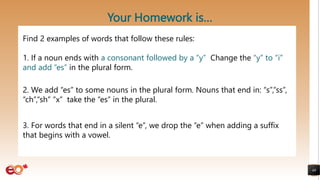
Find 2 examples of words that follow these rules:
1. If a noun ends with a consonant followed by a “y” Change the “y” to “i”
and add “es” in the plural form.
2. We add “es” to some nouns in the plural form. Nouns that end in: “s”,“ss”,
“ch”,“sh” “x” take the “es” in the plural.
3. For words that end in a silent “e”, we drop the “e” when adding a suffix
that begins with a vowel.
Sources
49
https://www.grammar-monster.com/lessons/spelling-rules-in-English.html
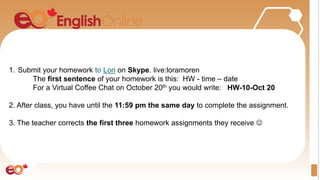
1. Submit your homework to Lori on Skype. live:loramoren
The first sentence of your homework is this: HW - time – date
For a Virtual Coffee Chat on October 20th you would write: HW-10-Oct 20
2. After class, you have until the 11:59 pm the same day to complete the assignment.
3. The teacher corrects the first three homework assignments they receive 
Language Contest
Want to learn more expressions, Canadian cultural
references and idioms?
Check English Online’s Facebook and Instagram
pages and take the challenge
of our Language Contest every
other Thursday!
You can win EO personalized
prizes and improve your English
skills one idiom at a time!
Thankyou!
Lori Morency
Ilive:loramoren
livelearn.ca
Thankyou!
Blaine
broberts@myenglishonline.ca
livelearn.ca
1-204-946-5140
Website:
livelearn.ca
Email:
info@myenglishonline.ca

EnglishSpellingRulesEORev.pptx

  • 1.
  • 2.
    2 Welcome to theEnglish Online community! Our Equity, Diversity, and Inclusion Acknowledgment This community welcomes, appreciates, and respects everyone – it doesn’t matter what country you’re from or who you are! We are here today to become better at English, so let’s focus on learning! Please remember that English Online has ZERO tolerance for discrimination (political, religious, nationality, or gender). If anyone feels uncomfortable attending the class, they are free to leave and email us at info@myenglishonline.ca
  • 3.
    Agenda 1. Welcome 2. EnglishSpelling Rules and Exceptions 3. Practice 3 https://pixabay.com/illustrations/artificial-intelligence-brain-think-4389372/ shared under CC0
  • 4.
    English Spelling Rules Thereare many spelling rules in English. Today, we’ll cover a few of these rules and their exceptions too.
  • 5.
    English Spelling Rules 1.If a noun ends with a consonant followed by a “y” Change the “y” to “i” and add “es” in the plural form.
  • 6.
    1. If anoun ends with a consonant followed by a “y” Change the “y” to “i” and add “es” in the plural form. Examples: baby babies country countries sky skies
  • 7.
    1. If anoun ends with a consonant followed by a “y” Change the “y” to “i” and add “es” in the plural form. What are some examples you know?
  • 8.
    English Spelling Rules 2. Weadd “es” to some nouns in the plural form. Nouns that end in: “s” “ss” “ch” “sh” “x” take the “es” in the plural.
  • 9.
    2. We add “es”to some nouns in the plural form. Examples: bus buses business businesses watch watches bush bushes fox foxes
  • 10.
    2. We add “es”to some nouns in the plural form. What are some examples that you know?
  • 11.
    English Spelling Rules 3. Forwords that end in a silent “e”, we drop the “e” when adding a suffix that begins with a vowel.
  • 12.
    3. For words thatend in a silent “e”, we drop the “e” when adding a suffix that begins with a vowel. Examples: exciteexcitable close closing adoreadorable prune pruning
  • 13.
    3. For words thatend in a silent “e”, we drop the “e” when adding a suffix that begins with a vowel. What are some examples that you know?
  • 14.
    3. For words thatend in a silent “e”, we drop the “e” when adding a vowel suffix. BUT: THERE IS AN EXCEPTION: We keep the “e” if the word ends in “ce” or “ge”. EXAMPLE: courage courageous notice noticeable
  • 15.
    English Spelling Rules Whenwe add suffixes to words that end in “y”, we change the “y” to “i”. 15 4.
  • 16.
    4. When we addsuffixes to words that end in “y”, we change the “y” to “i”. Example: beauty beautiful angry angrier apply applies happy happier 16
  • 17.
    4. When we addsuffixes to words that end in “y”, we change the “y” to “i”. What are some examples that you know? 17
  • 18.
    When we addsuffixes to words that end in “y”, we change the “y” to “i”. BUT: THERE IS AN EXCEPTION: If the suffix begins with an “i”, the “y” remains. EXAMPLE: defy defying apply applying 18 4.
  • 19.
    English Spelling Rules .Most words that end in “f” drop the “f” and add “ves” in the plural. 19 5.
  • 20.
    5. Most words thatend in “f” drop the “f” and add “ves” in the plural. Example: A loaf of bread 5 loaves of bread One thief 7 thieves 1 calf 20 calves 20
  • 21.
    5. Most words thatend in “f” drop the “f” and add “ves” in the plural. But, there is an Exception: Some words can end in “s” or “ves”. Examples: scarf scarfsscarves dwarfdwarfs dwarves 21
  • 22.
    6. If you areunsure whether to use “ei” or “ie” when spelling a word, use this hint: “use i before e, except after c” 22
  • 23.
    6. If you areunsure whether to use “ei” or “ie” when spelling a word, use this hint: “use i before e, except after c” believe or beleive…? recieve or receive? 23
  • 24.
    6. If you areunsure whether to use “ei” or “ie” remember these exceptions: Keep the “i” before the “e”, if the “c” in the word sounds like “sh” Examples: ancient efficient 24
  • 25.
    6. If you areunsure whether to use “ei” or “ie” remember these exceptions: If the pair sounds like “ay”, use e before the i Examples: weigh freight 25
  • 26.
    7. If a one-syllableword ends in a vowel + consonant, double the final consonant before a vowel suffix. Examples: tipping bigger thinnest 26
  • 27.
    8. For 2 syllablewords, ending in a vowel and a consonant, where the final syllable is stressed, use the same rule: Examples: refer referring beginbeginner 27
  • 28.
    9. For 2 syllablewords, ending in a vowel and a consonant, where the final syllable is NOT stressed, do not double the final consonant: Examples: offer offering develop developer 28
  • 29.
    English Spelling Rules Howdo we make “difficulty” plural? 29 Now let’s practice:
  • 30.
    English Spelling Rules 1.How do we make “difficulty” plural? We change the y to an i and add es. difficulties 30 Now let’s practice:
  • 31.
    English Spelling Rules Howdo we make dress plural? 31 Now let’s practice:
  • 32.
    English Spelling Rules Howdo we make dress plural? Add es: dresses 32 Now let’s practice:
  • 33.
    English Spelling Rules Howdo we make story plural? 33 Now let’s practice:
  • 34.
    English Spelling Rules Howdo we make story plural? Change y to an i and add es stories 34 Now let’s practice:
  • 35.
    English Spelling Rules Whichis correct? receive OR recieve ? 35 Now let’s practice:
  • 36.
    English Spelling Rules Whichis correct? receive is correct! 36 Now let’s practice:
  • 37.
    English Spelling Rules Whichis correct? thieves OR thiefs? 37 Now let’s practice:
  • 38.
    English Spelling Rules Whichis correct? thieves OR thiefs? 38 Now let’s practice:
  • 39.
    English Spelling Rules Whichis correct? thieves is correct! 39 Now let’s practice:
  • 40.
    English Spelling Rules Whichis correct? thieves is correct! 40 Now let’s practice:
  • 41.
    English Spelling Rules Whichis correct? is it beachs or beaches ? 41 Now let’s practice:
  • 42.
    English Spelling Rules Whichis correct? beaches is correct! 42 Now let’s practice:
  • 43.
    English Spelling Rules Whichis correct? is it taxs or taxes ? 43 Now let’s practice:
  • 44.
    English Spelling Rules Whichis correct? taxes is correct! 44 Now let’s practice:
  • 45.
    English Spelling Rules Whichis correct? writeing OR writing? 45 Now let’s practice:
  • 46.
    English Spelling Rules Whichis correct? writing is correct! 46 Now let’s practice:
  • 47.
  • 48.
    Your Homework is… 48 Find2 examples of words that follow these rules: 1. If a noun ends with a consonant followed by a “y” Change the “y” to “i” and add “es” in the plural form. 2. We add “es” to some nouns in the plural form. Nouns that end in: “s”,“ss”, “ch”,“sh” “x” take the “es” in the plural. 3. For words that end in a silent “e”, we drop the “e” when adding a suffix that begins with a vowel.
  • 49.
  • 50.
    1. Submit yourhomework to Lori on Skype. live:loramoren The first sentence of your homework is this: HW - time – date For a Virtual Coffee Chat on October 20th you would write: HW-10-Oct 20 2. After class, you have until the 11:59 pm the same day to complete the assignment. 3. The teacher corrects the first three homework assignments they receive 
  • 51.
    Language Contest Want tolearn more expressions, Canadian cultural references and idioms? Check English Online’s Facebook and Instagram pages and take the challenge of our Language Contest every other Thursday! You can win EO personalized prizes and improve your English skills one idiom at a time!
  • 52.
  • 53.