
Training for
BST
18th March, 2014
Agenda
1. Vocabulary building techniques
2. Writing tips
3. Confidence Building
Vocabulary building
1. Indirect/modern inductive/
psychological method
2. Word forms (adj, adv, noun, verb etc)
3. Using the Dictionary
4. Synonyms and Antonyms (Thesaurus)
5. Prefixes and suffixes
6. Stems or Roots
The old-school method
 Memorizing words by rote
 Writing list of words and their meanings
 Slow, difficult, unreliable
 Inaccurate, wrong usage (out of context)
 Helps us understand the meaning of a word in a
contextual manner
 We can remember the meaning, if we understand
the context
Indirect/ modern inductive/
psychological method
Indirect/ modern inductive/
psychological method
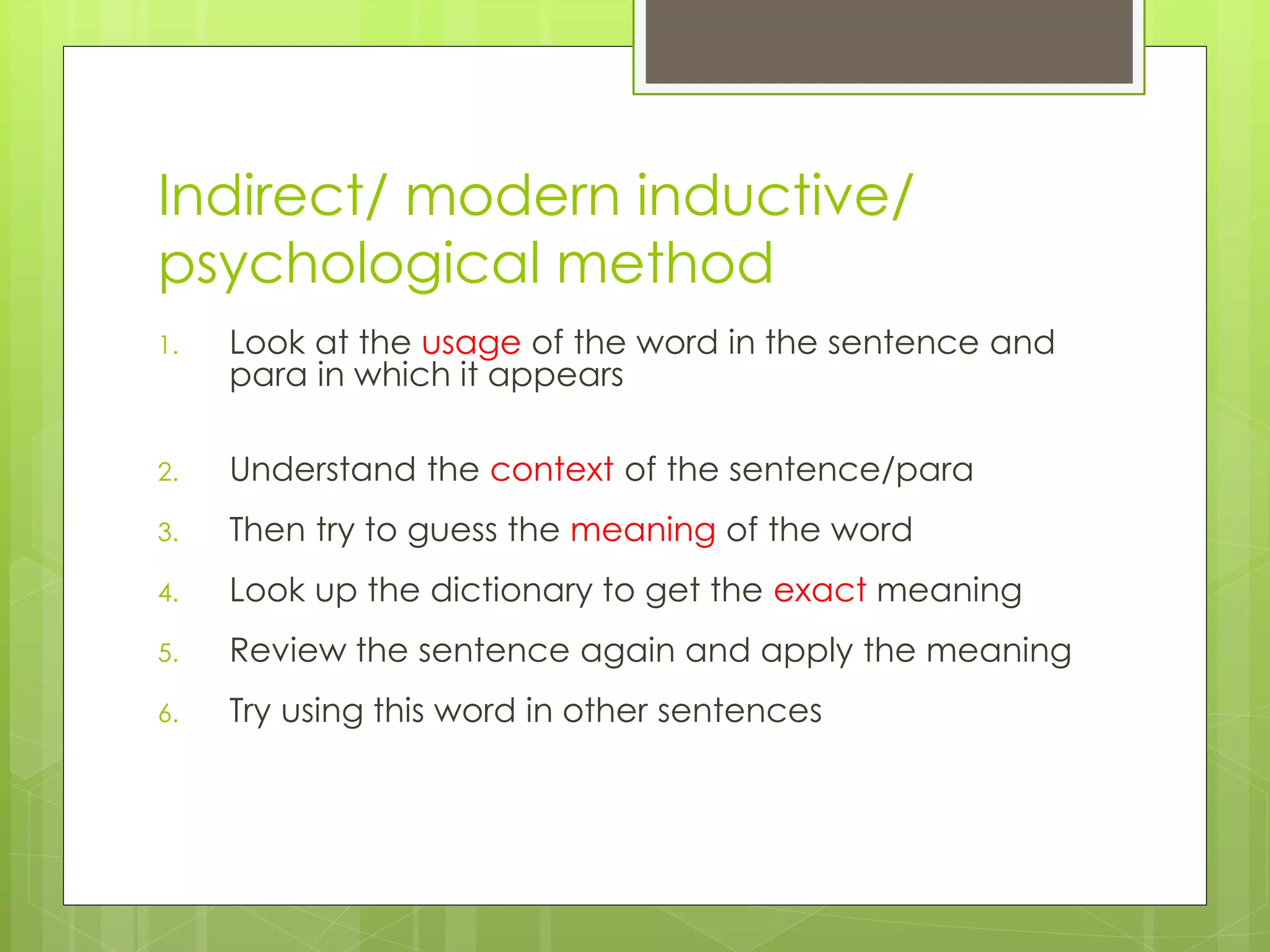
1. Look at the usage of the word in the sentence and
para in which it appears
2. Understand the context of the sentence/para
3. Then try to guess the meaning of the word
4. Look up the dictionary to get the exact meaning
5. Review the sentence again and apply the meaning
6. Try using this word in other sentences
Class Exercise-1
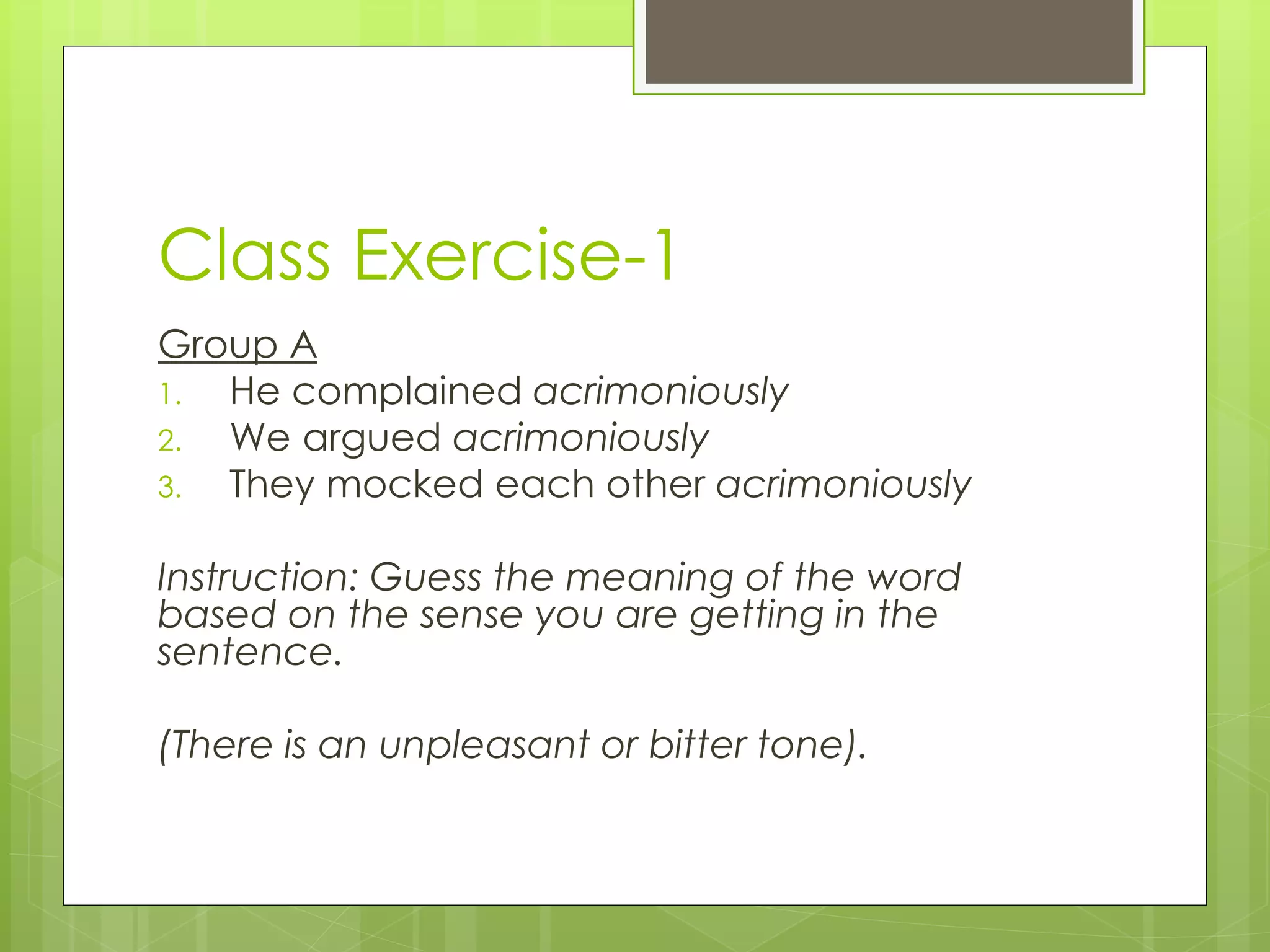
Group A
1. He complained acrimoniously
2. We argued acrimoniously
3. They mocked each other acrimoniously
Instruction: Guess the meaning of the word
based on the sense you are getting in the
sentence.
(There is an unpleasant or bitter tone).
Classroom Exercise-1
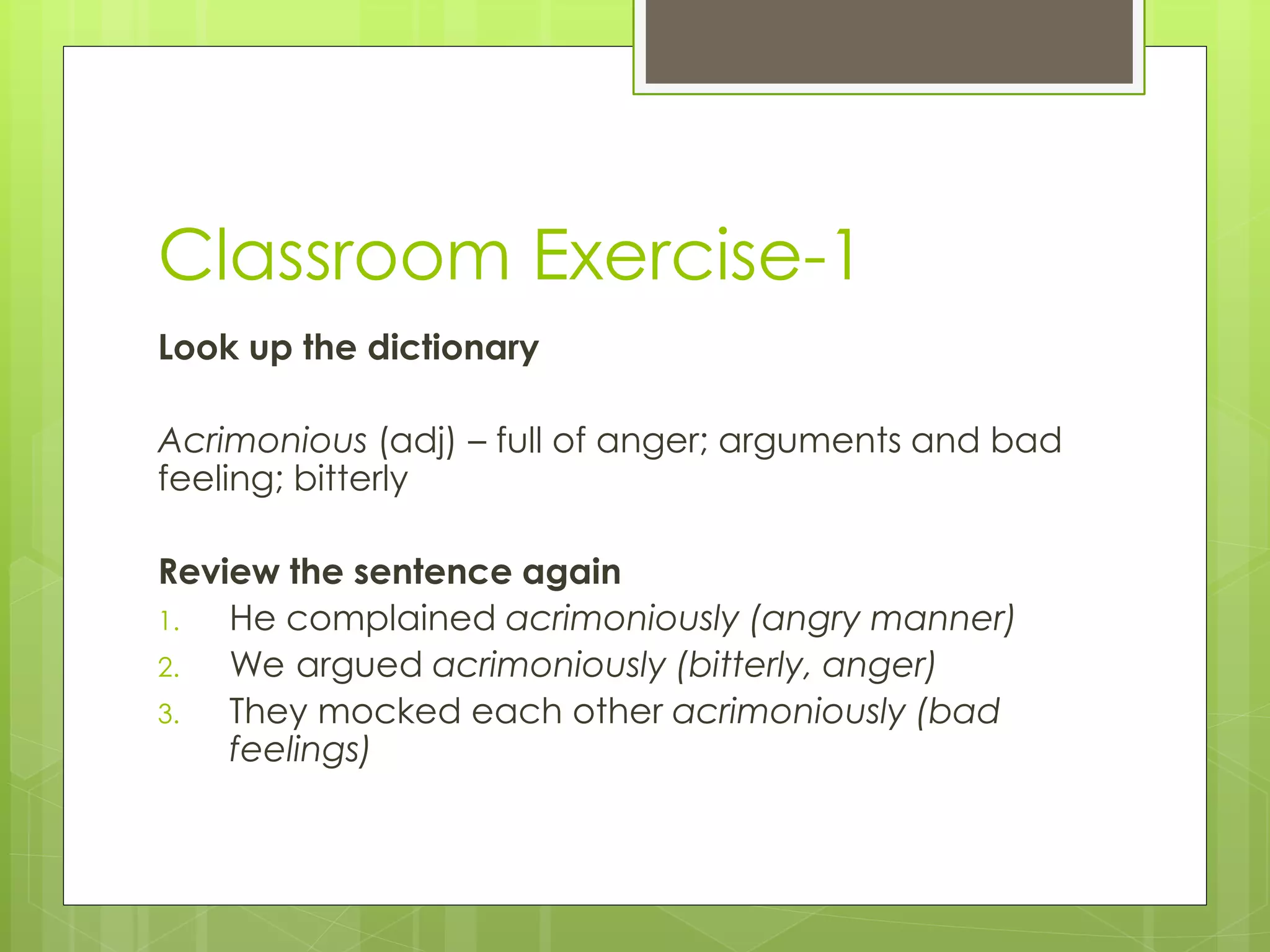
Look up the dictionary
Acrimonious (adj) – full of anger; arguments and bad
feeling; bitterly
Review the sentence again
1. He complained acrimoniously (angry manner)
2. We argued acrimoniously (bitterly, anger)
3. They mocked each other acrimoniously (bad
feelings)
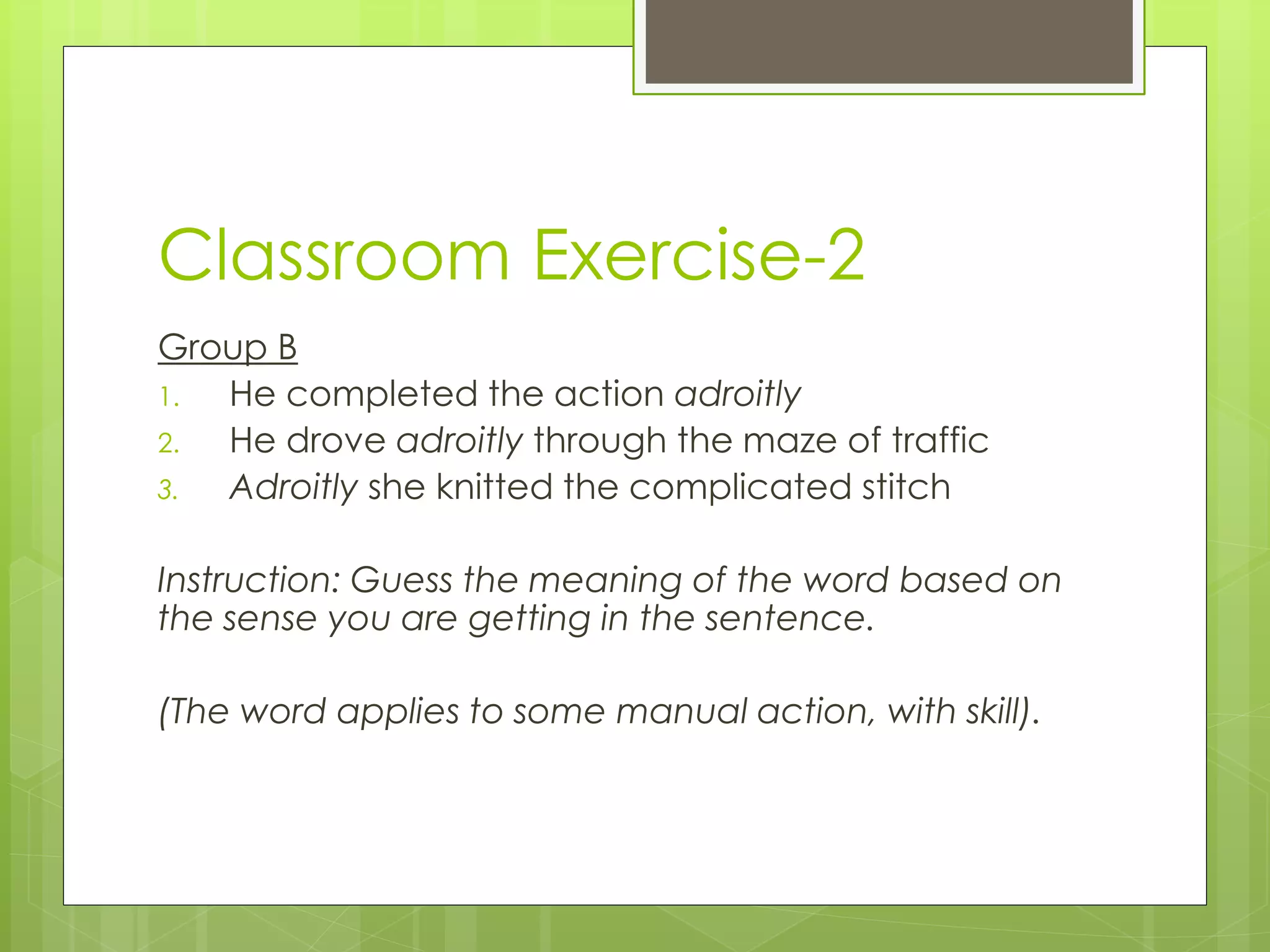
Classroom Exercise-2
Group B
1. He completed the action adroitly
2. He drove adroitly through the maze of traffic
3. Adroitly she knitted the complicated stitch
Instruction: Guess the meaning of the word based on
the sense you are getting in the sentence.
(The word applies to some manual action, with skill).
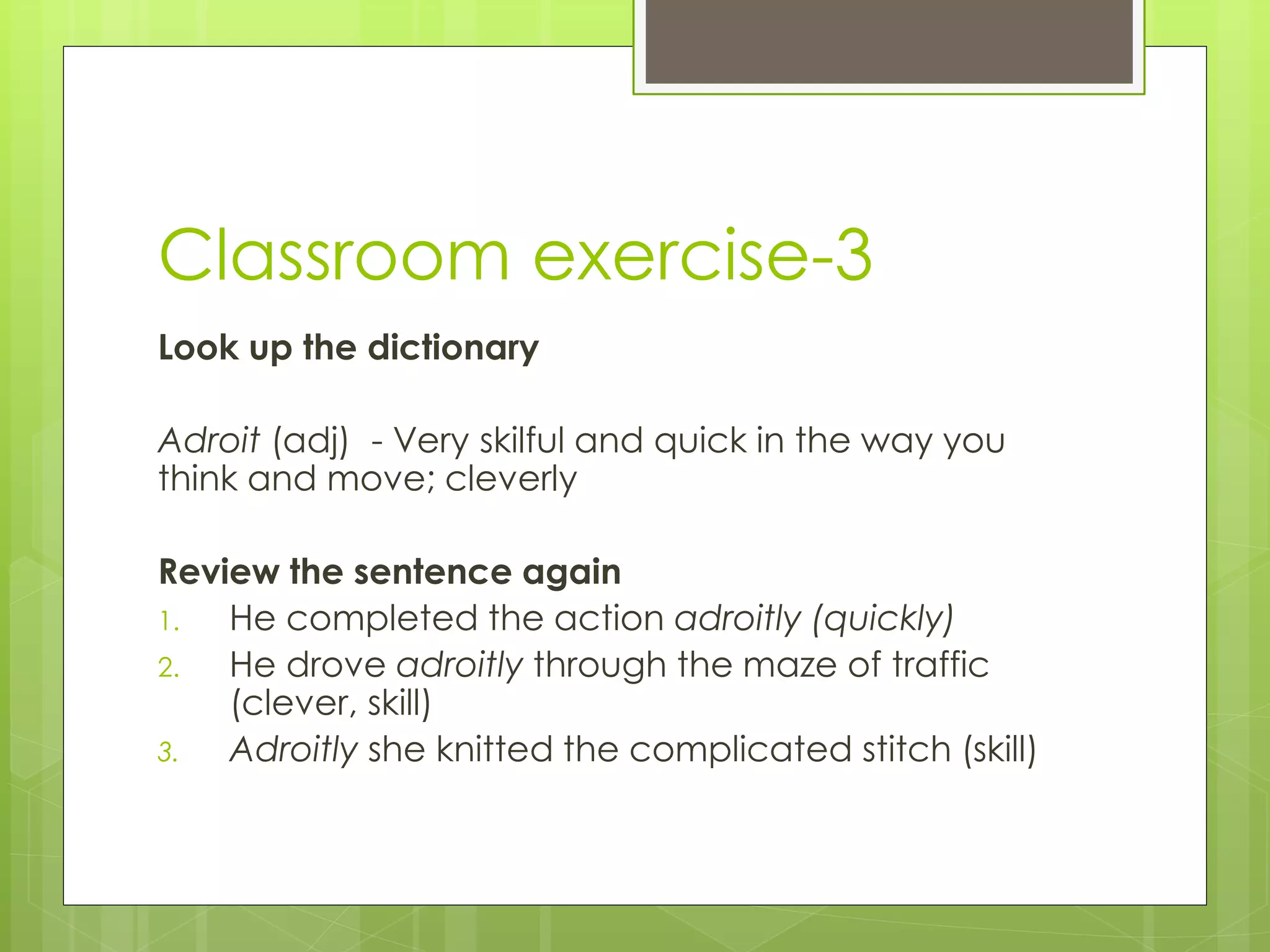
Classroom exercise-3
Look up the dictionary
Adroit (adj) - Very skilful and quick in the way you
think and move; cleverly
Review the sentence again
1. He completed the action adroitly (quickly)
2. He drove adroitly through the maze of traffic
(clever, skill)
3. Adroitly she knitted the complicated stitch (skill)
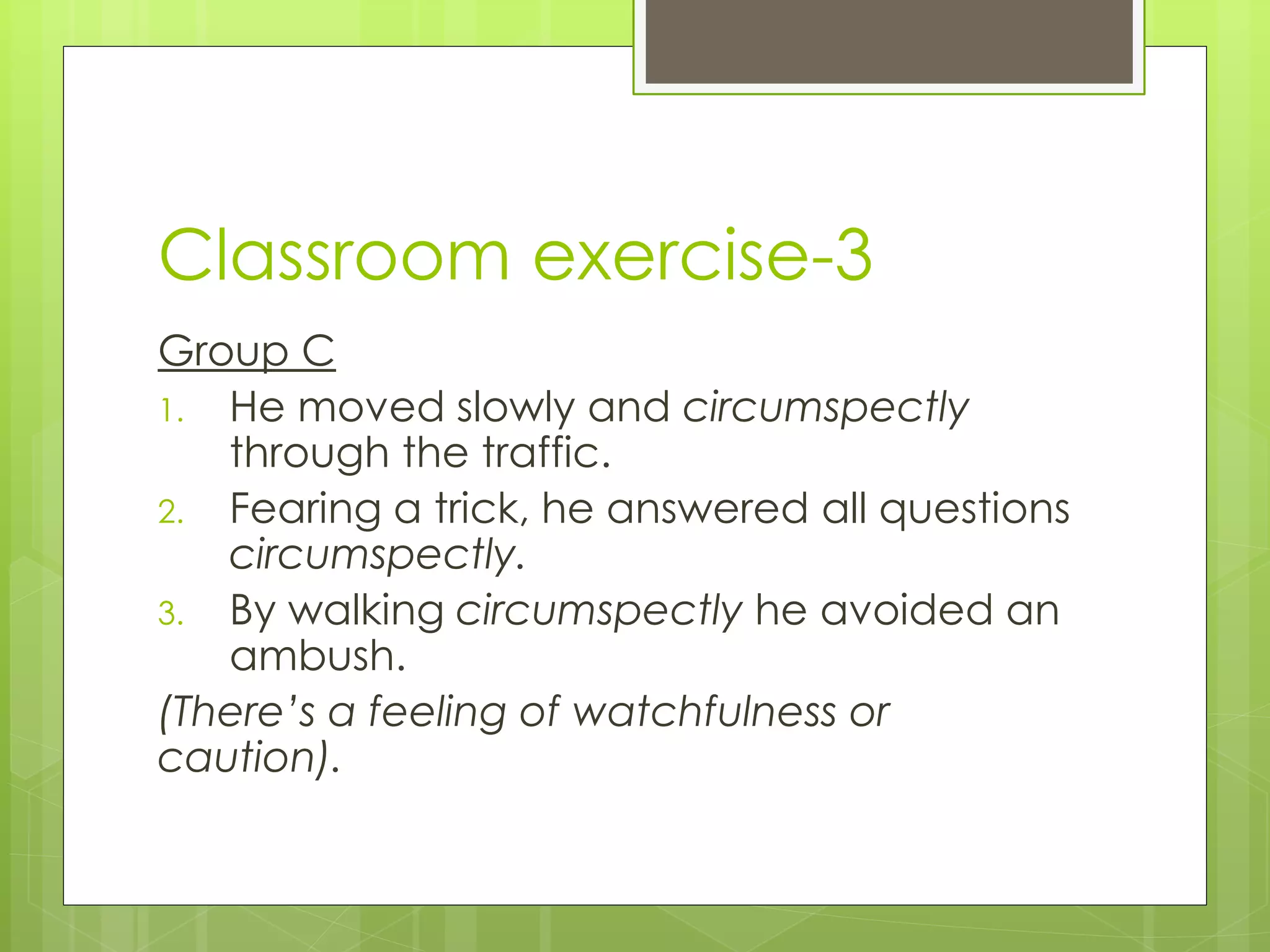
Classroom exercise-3
Group C
1. He moved slowly and circumspectly
through the traffic.
2. Fearing a trick, he answered all questions
circumspectly.
3. By walking circumspectly he avoided an
ambush.
(There’s a feeling of watchfulness or
caution).
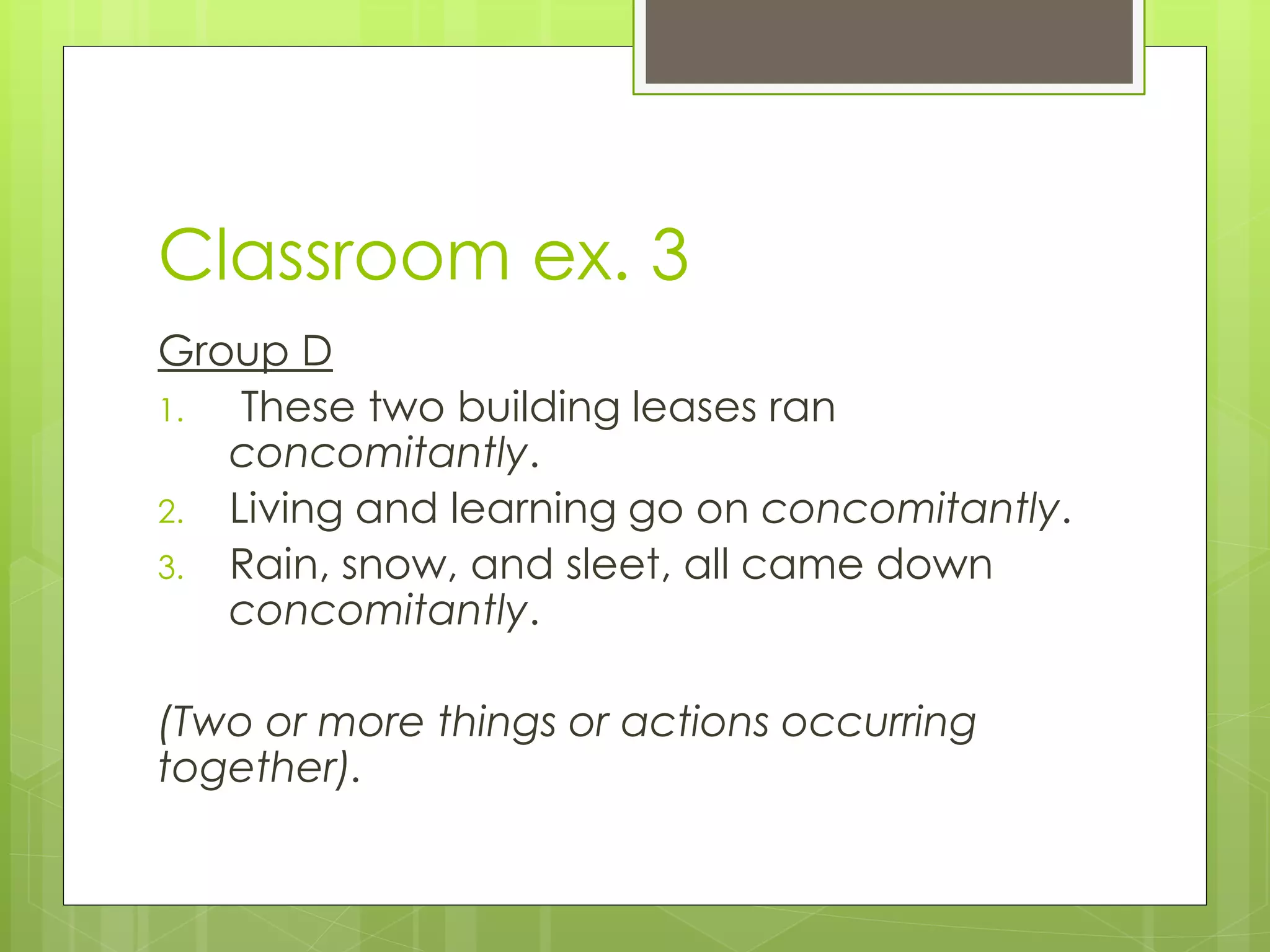
Classroom ex. 3
Group D
1. These two building leases ran
concomitantly.
2. Living and learning go on concomitantly.
3. Rain, snow, and sleet, all came down
concomitantly.
(Two or more things or actions occurring
together).
Classroom ex. 3
Group E
1. He examined the plans cursorily.
2. He ran through the pages cursorily, then
threw the novel down in disgust.
3. He did his homework so cursorily that he
flunked the examination.
(This word suggests great haste or doing
something without care).
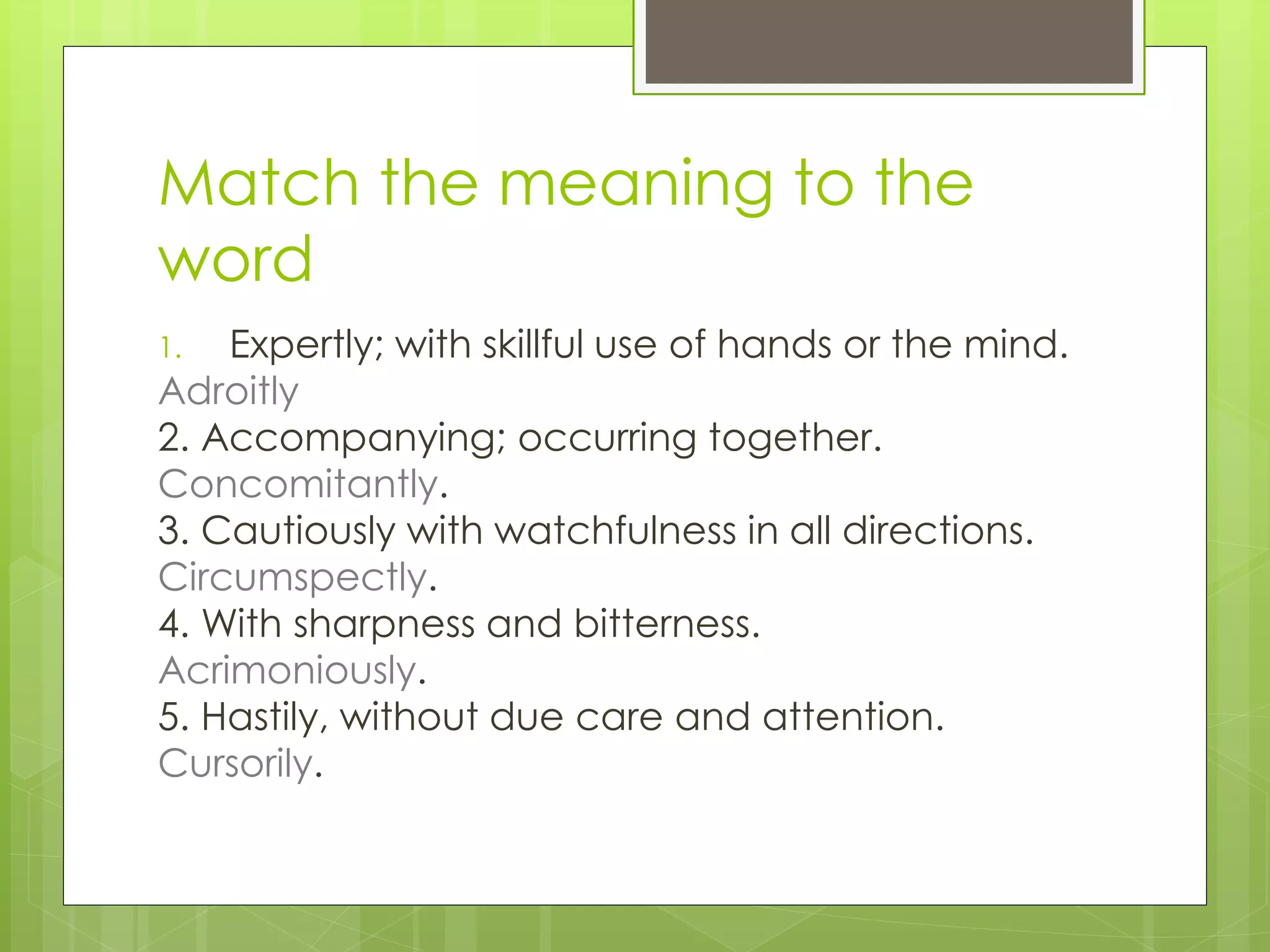
Match the meaning to the
word
1. Expertly; with skillful use of hands or the mind.
Adroitly
2. Accompanying; occurring together.
Concomitantly.
3. Cautiously with watchfulness in all directions.
Circumspectly.
4. With sharpness and bitterness.
Acrimoniously.
5. Hastily, without due care and attention.
Cursorily.
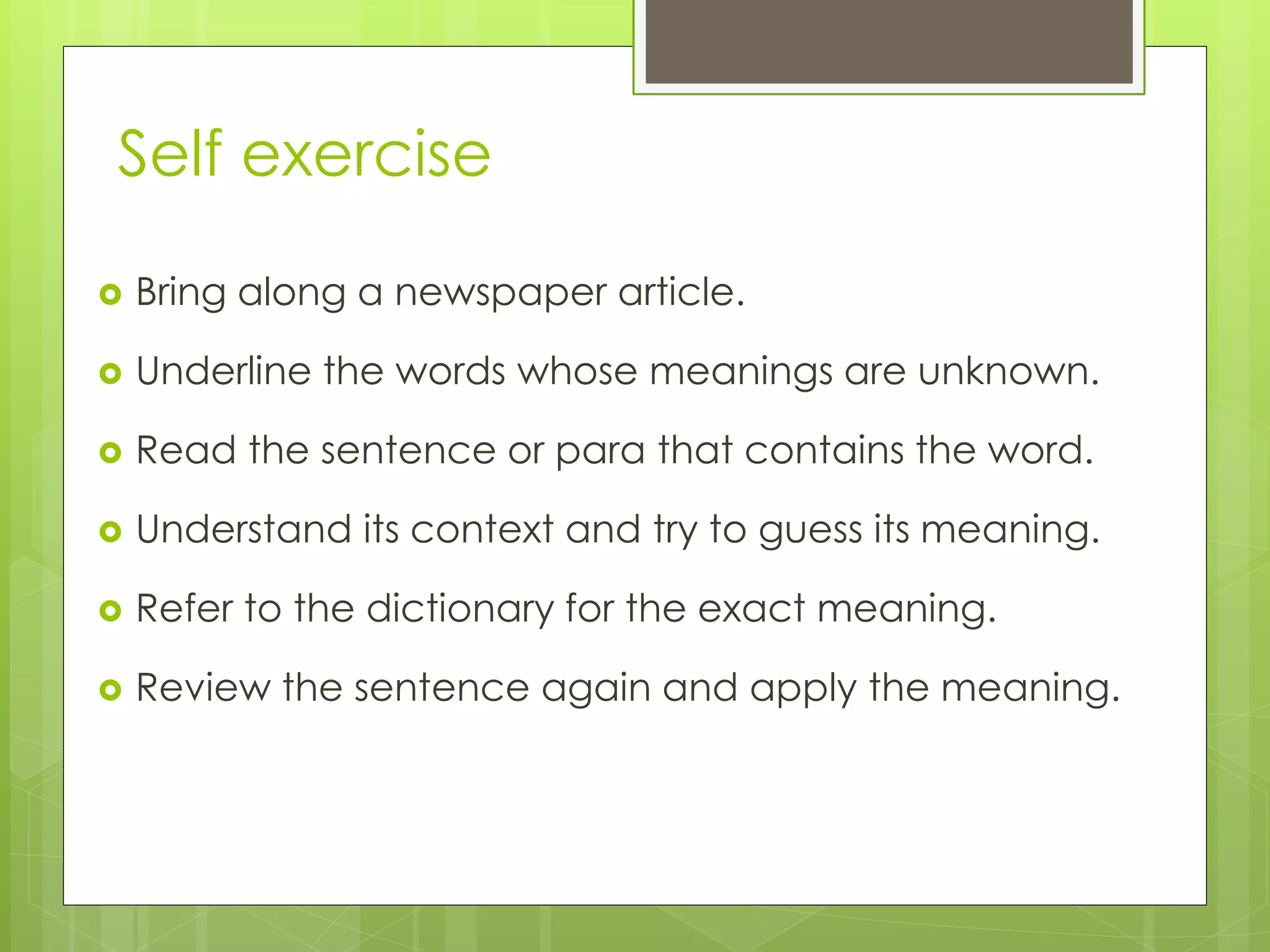
Self exercise
 Bring along a newspaper article.
 Underline the words whose meanings are unknown.
 Read the sentence or para that contains the word.
 Understand its context and try to guess its meaning.
 Refer to the dictionary for the exact meaning.
 Review the sentence again and apply the meaning.
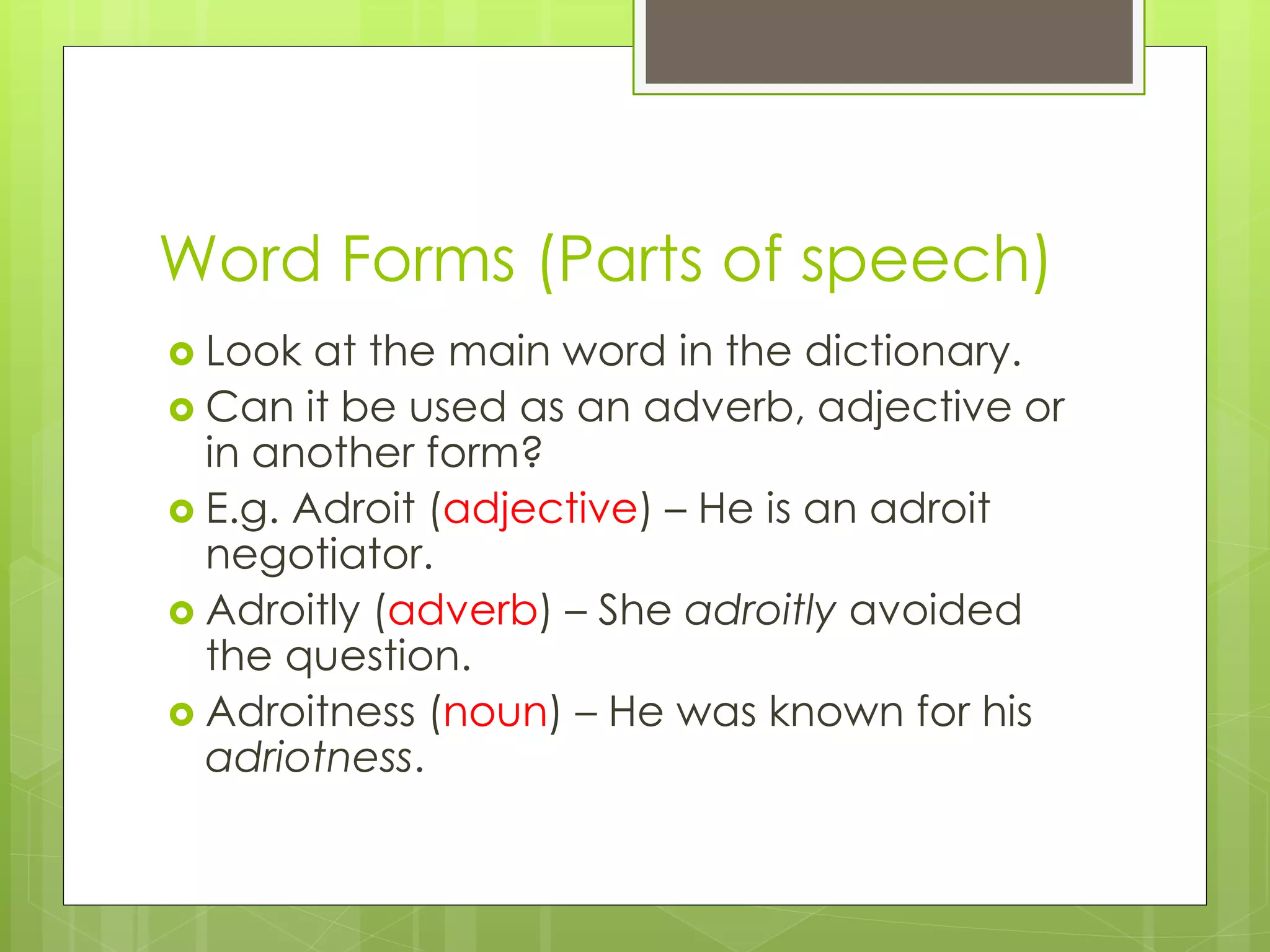
Word Forms (Parts of speech)
 Look at the main word in the dictionary.
 Can it be used as an adverb, adjective or
in another form?
 E.g. Adroit (adjective) – He is an adroit
negotiator.
 Adroitly (adverb) – She adroitly avoided
the question.
 Adroitness (noun) – He was known for his
adriotness.
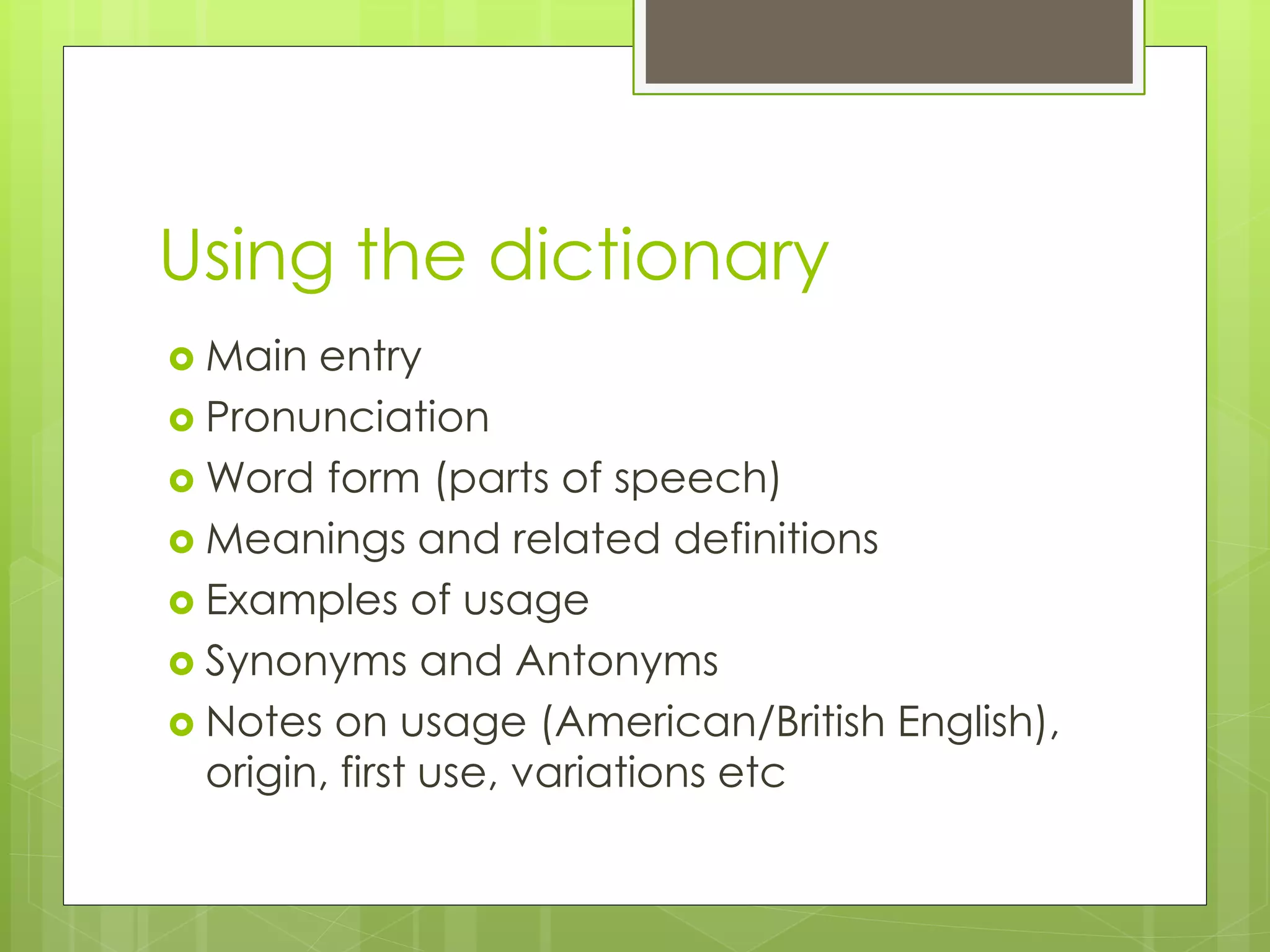
Using the dictionary
 Main entry
 Pronunciation
 Word form (parts of speech)
 Meanings and related definitions
 Examples of usage
 Synonyms and Antonyms
 Notes on usage (American/British English),
origin, first use, variations etc
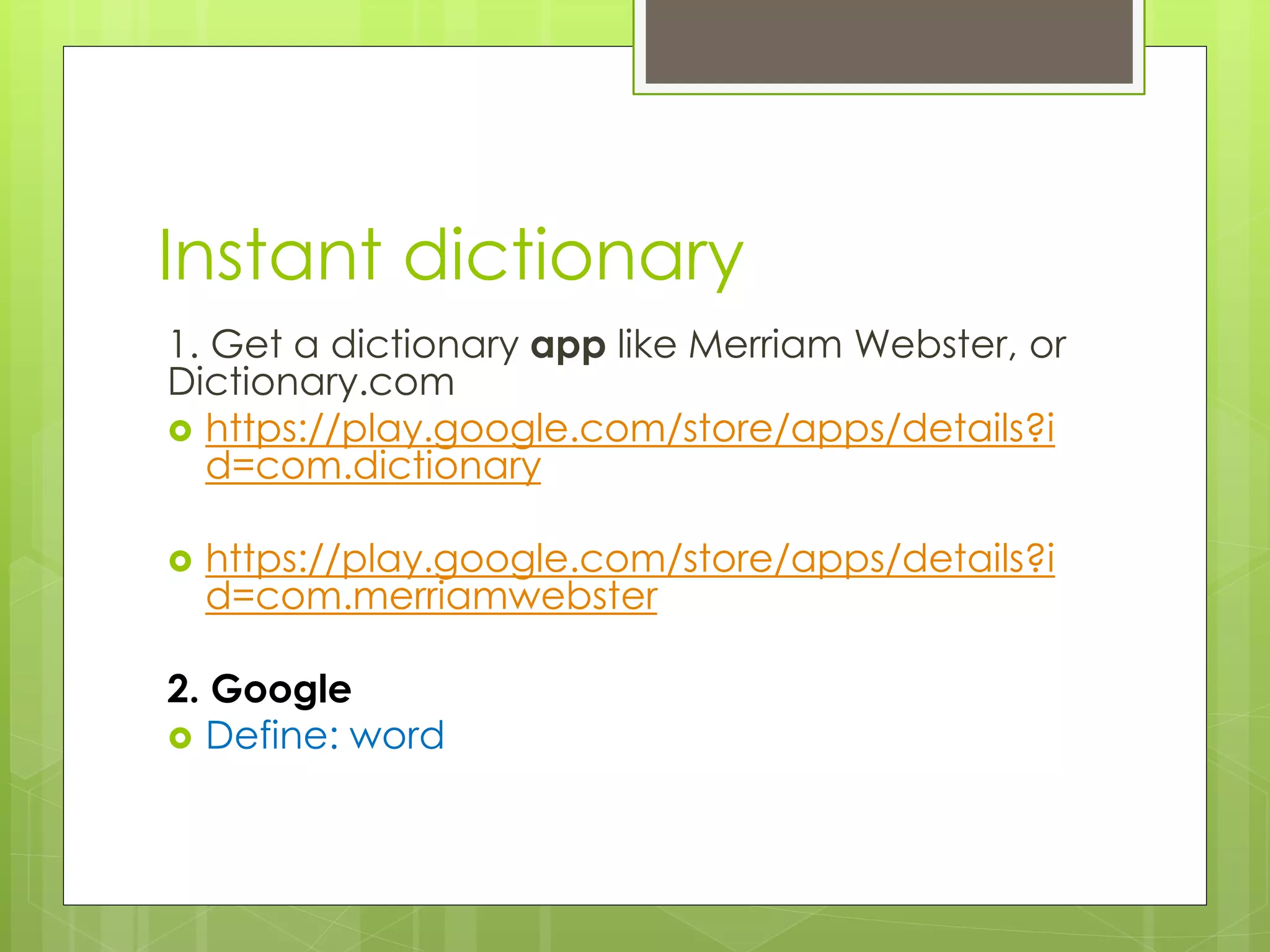
Instant dictionary
1. Get a dictionary app like Merriam Webster, or
Dictionary.com
 https://play.google.com/store/apps/details?i
d=com.dictionary
 https://play.google.com/store/apps/details?i
d=com.merriamwebster
2. Google
 Define: word
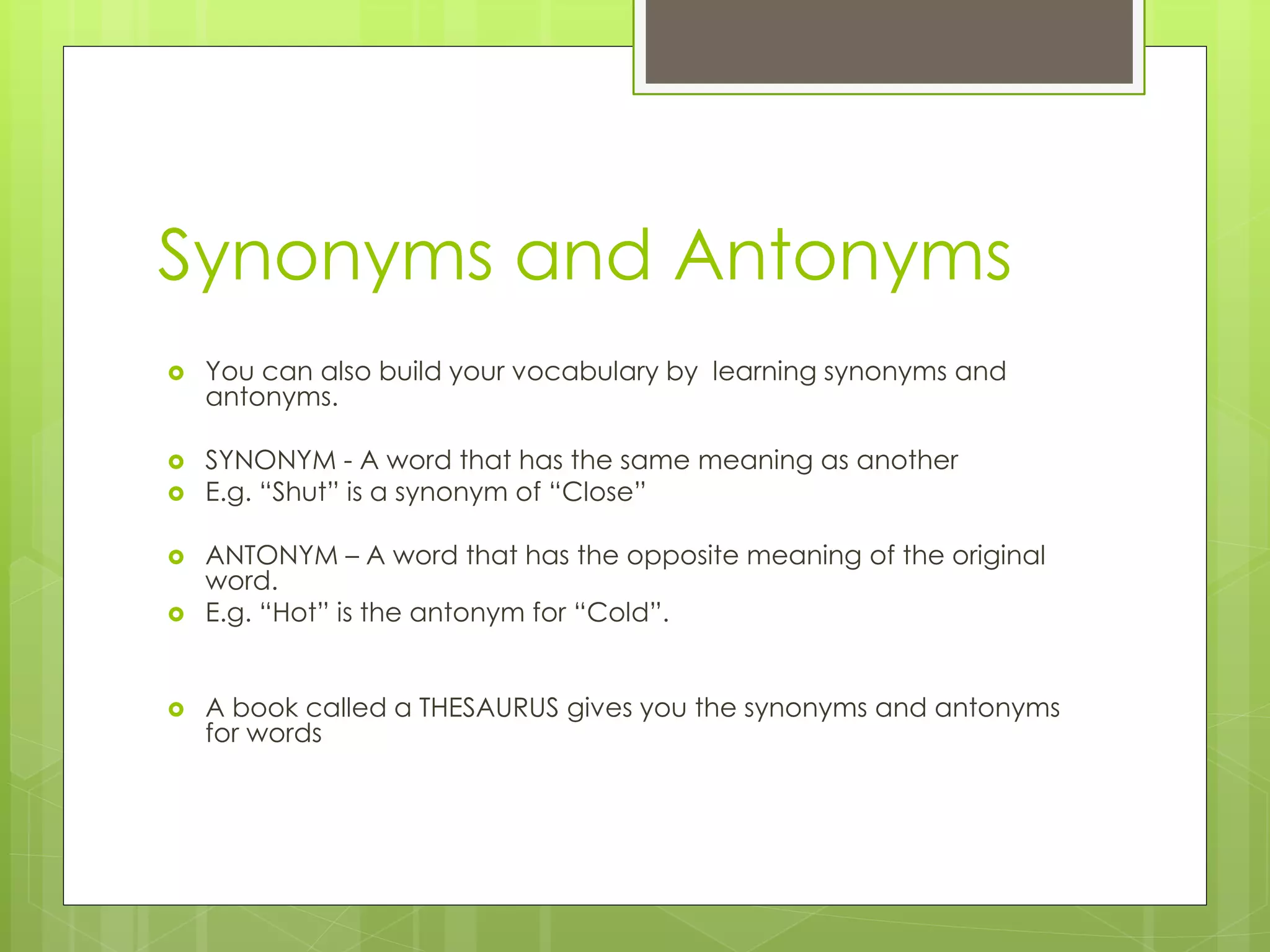
Synonyms and Antonyms
 You can also build your vocabulary by learning synonyms and
antonyms.
 SYNONYM - A word that has the same meaning as another
 E.g. “Shut” is a synonym of “Close”
 ANTONYM – A word that has the opposite meaning of the original
word.
 E.g. “Hot” is the antonym for “Cold”.
 A book called a THESAURUS gives you the synonyms and antonyms
for words
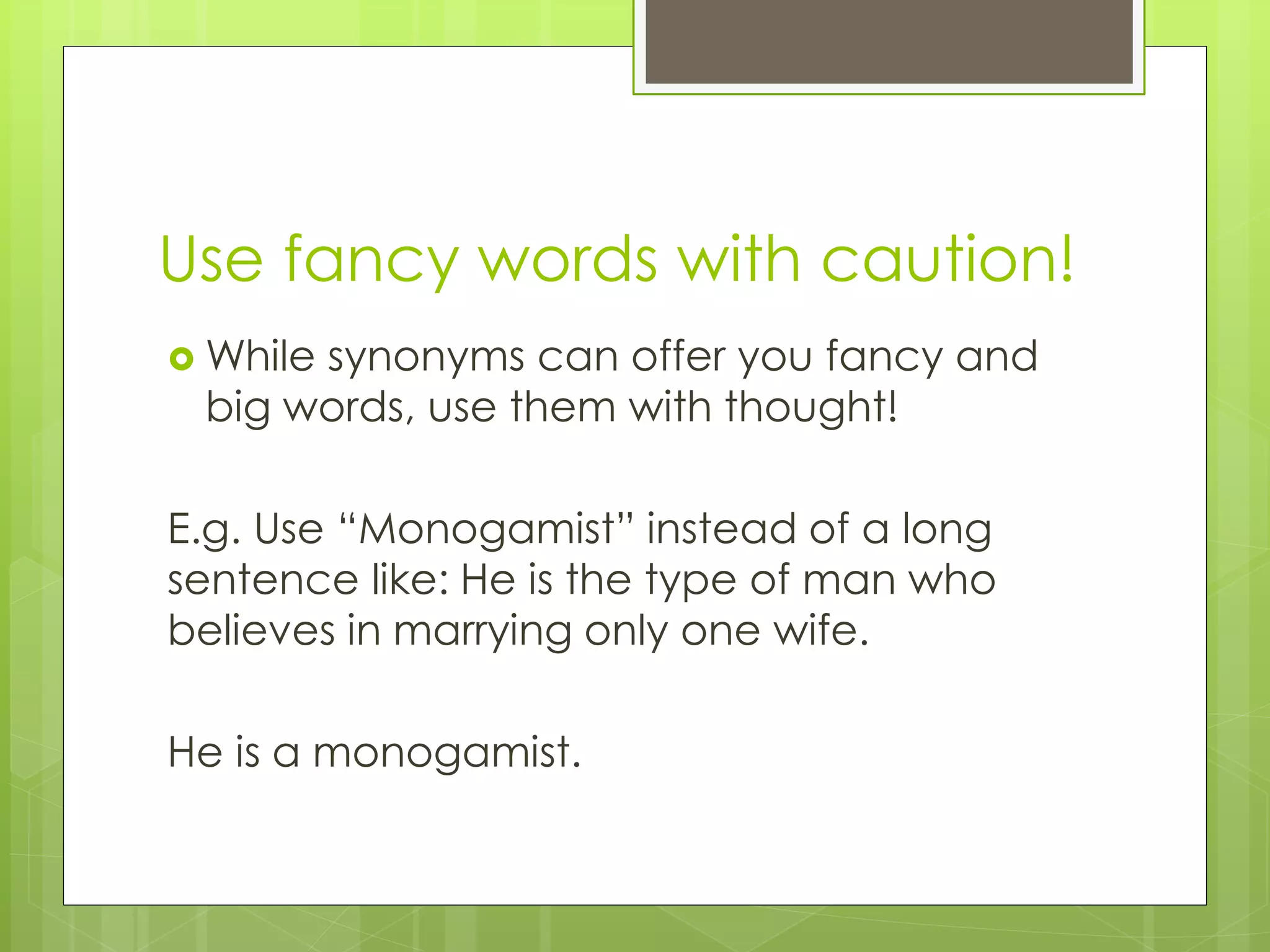
Use fancy words with caution!
 While synonyms can offer you fancy and
big words, use them with thought!
E.g. Use “Monogamist” instead of a long
sentence like: He is the type of man who
believes in marrying only one wife.
He is a monogamist.
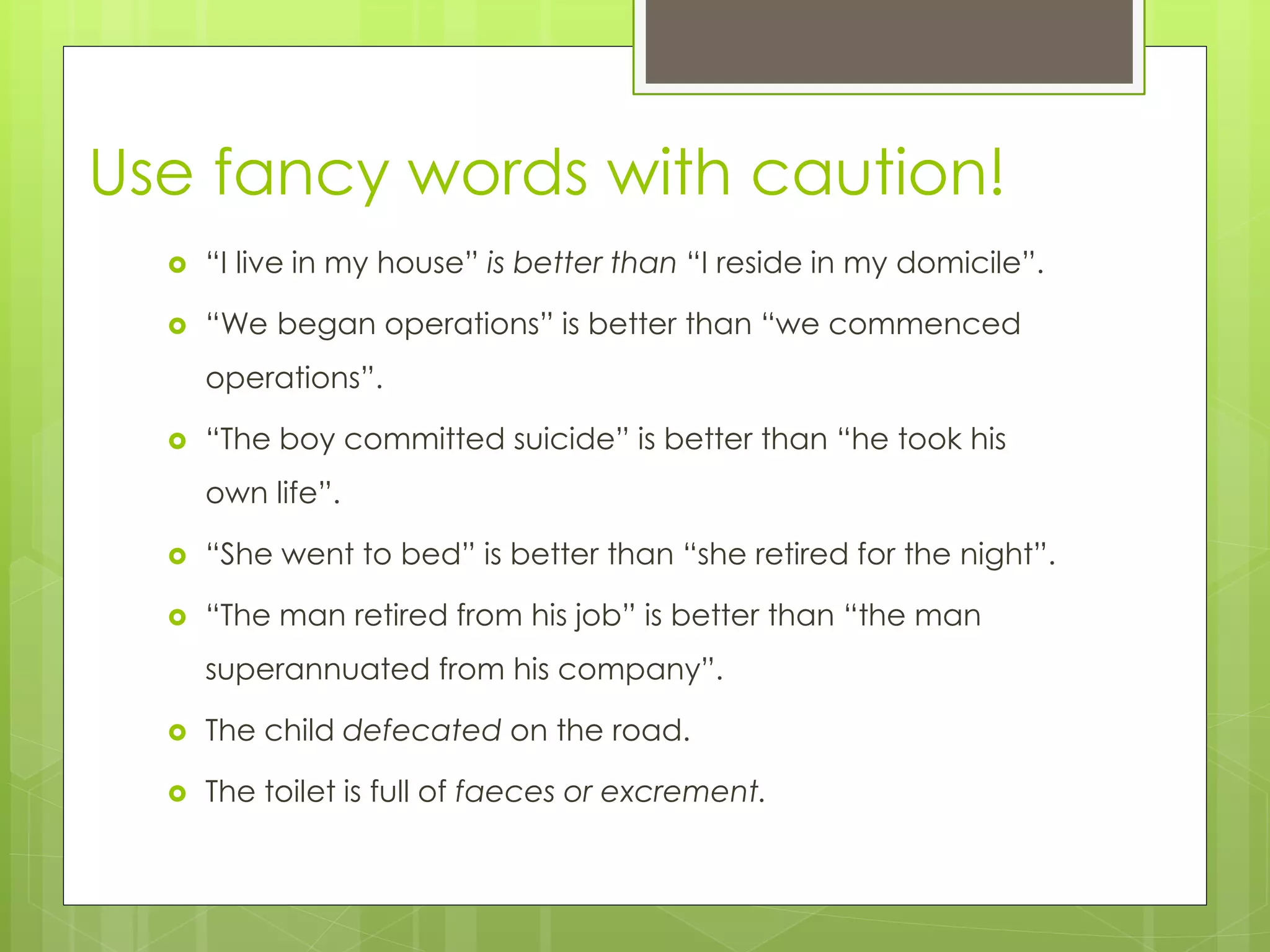
Use fancy words with caution!
 “I live in my house” is better than “I reside in my domicile”.
 “We began operations” is better than “we commenced
operations”.
 “The boy committed suicide” is better than “he took his
own life”.
 “She went to bed” is better than “she retired for the night”.
 “The man retired from his job” is better than “the man
superannuated from his company”.
 The child defecated on the road.
 The toilet is full of faeces or excrement.
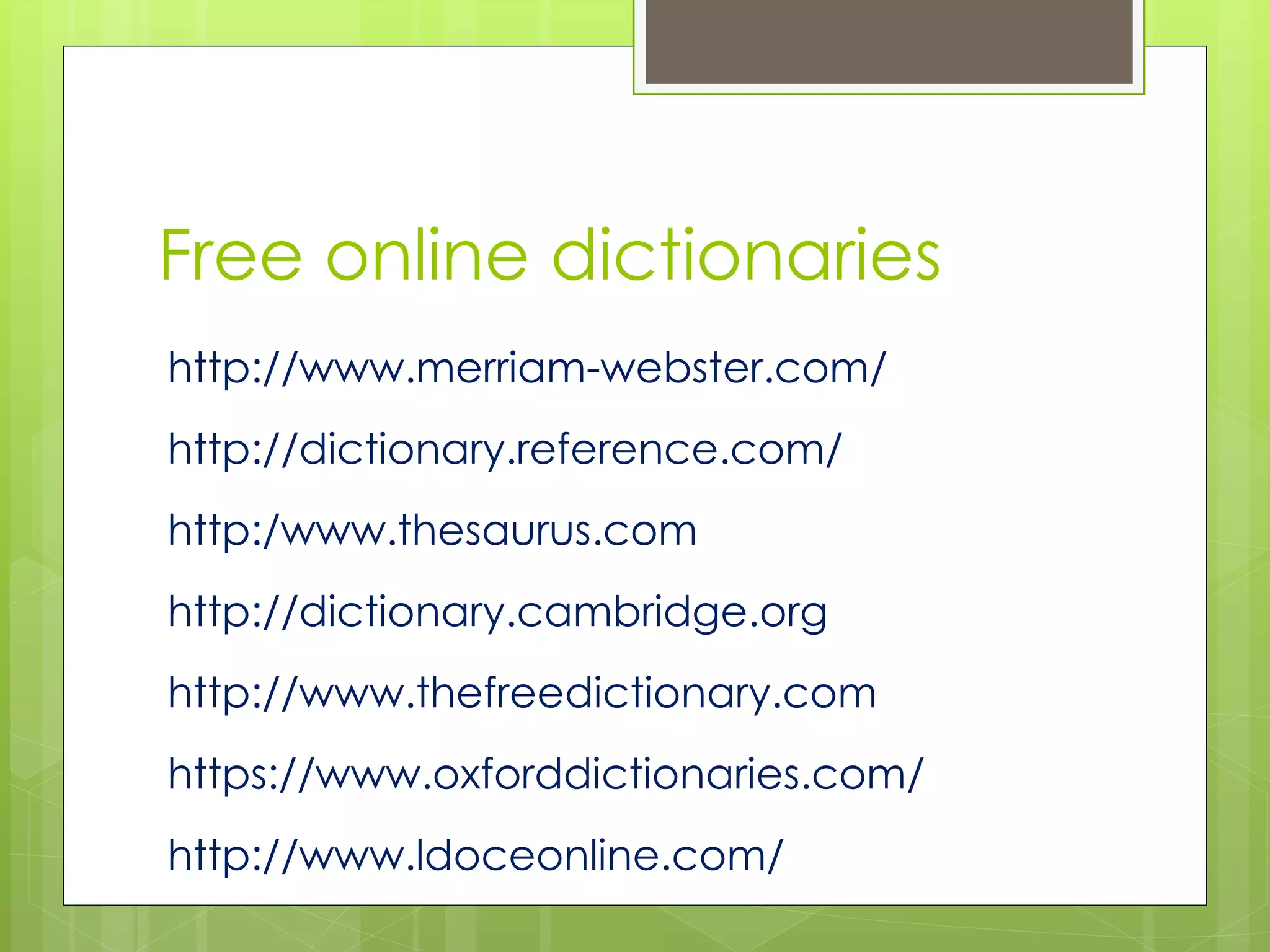
Free online dictionaries
http://www.merriam-webster.com/
http://dictionary.reference.com/
http:/www.thesaurus.com
http://dictionary.cambridge.org
http://www.thefreedictionary.com
https://www.oxforddictionaries.com/
http://www.ldoceonline.com/
On your desk…
 Roget’s Thesaurus
 Oxford dictionary
 Book of Idioms
 Book of quotations
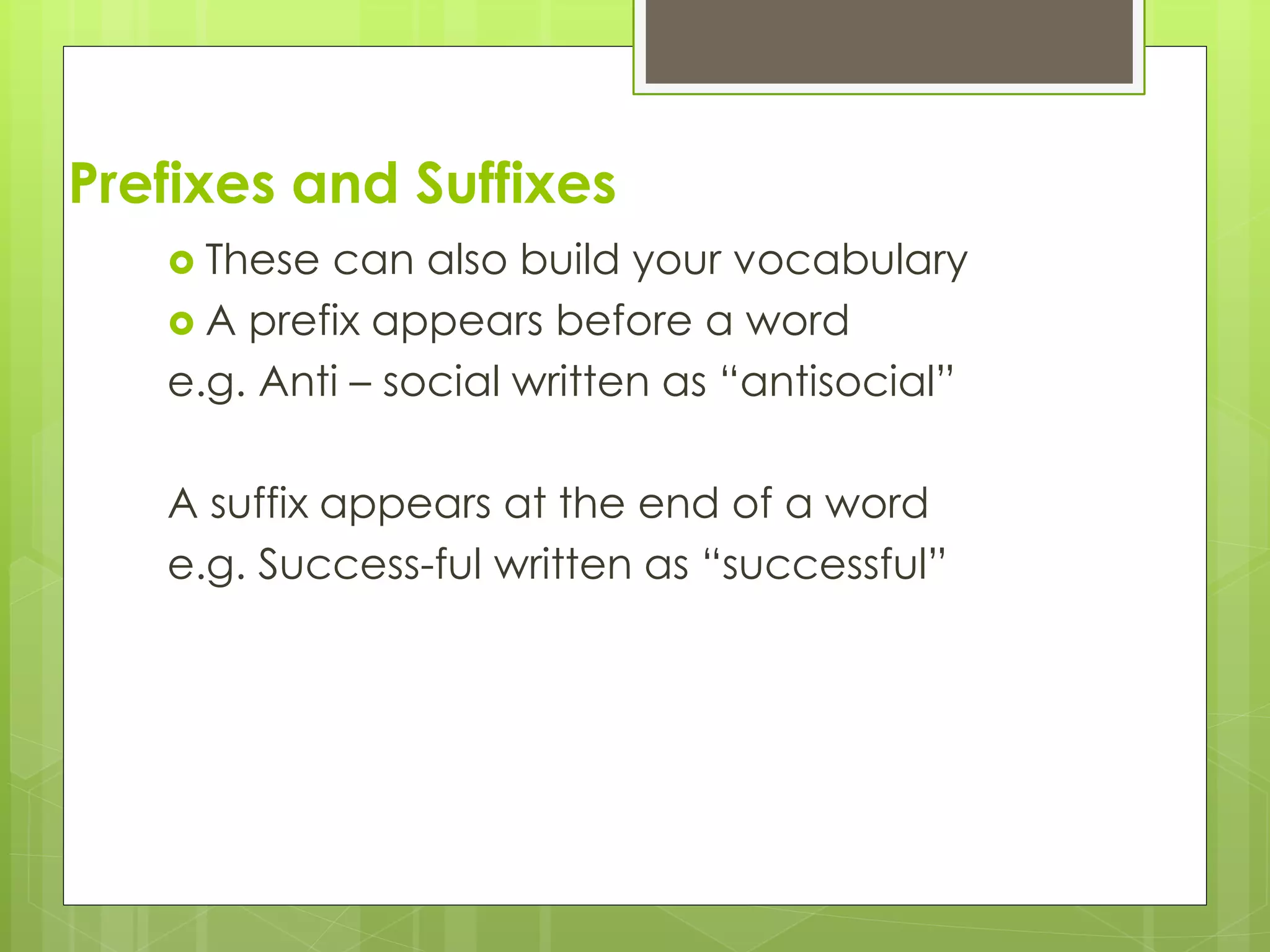
Prefixes and Suffixes
 These can also build your vocabulary
 A prefix appears before a word
e.g. Anti – social written as “antisocial”
A suffix appears at the end of a word
e.g. Success-ful written as “successful”
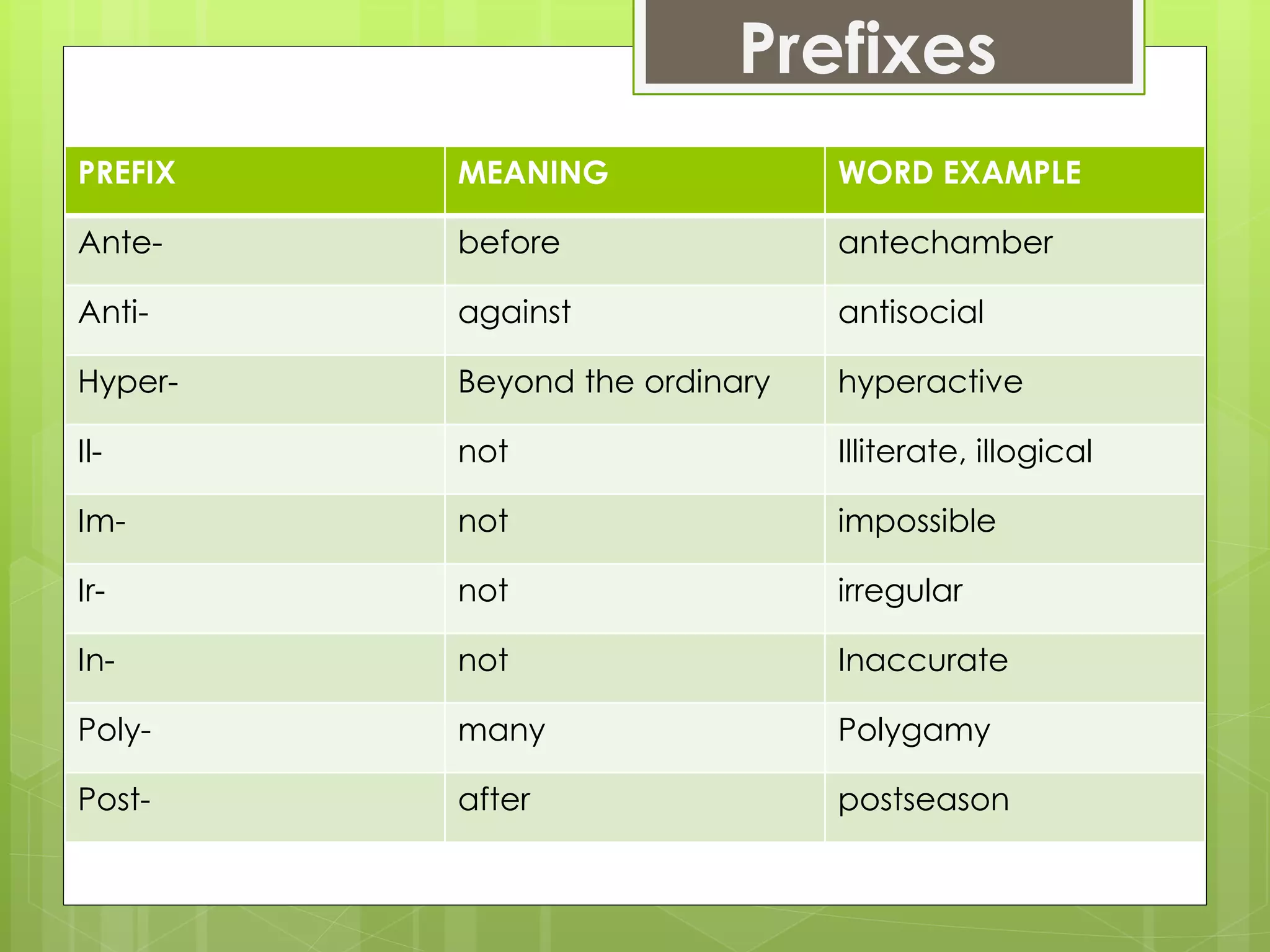
Prefixes
PREFIX MEANING WORD EXAMPLE
Ante- before antechamber
Anti- against antisocial
Hyper- Beyond the ordinary hyperactive
Il- not Illiterate, illogical
Im- not impossible
Ir- not irregular
In- not Inaccurate
Poly- many Polygamy
Post- after postseason
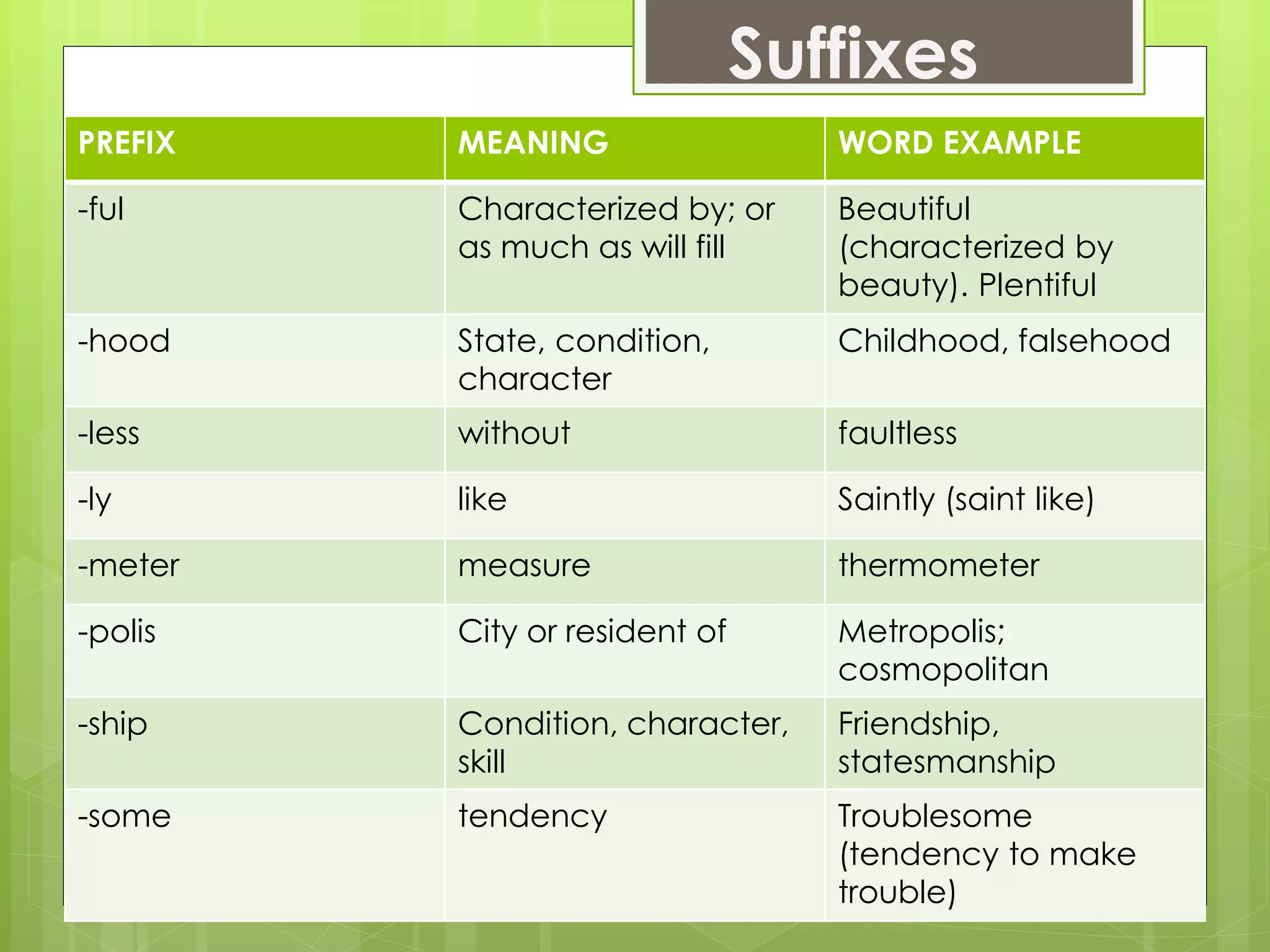
Suffixes
PREFIX MEANING WORD EXAMPLE
-ful Characterized by; or
as much as will fill
Beautiful
(characterized by
beauty). Plentiful
-hood State, condition,
character
Childhood, falsehood
-less without faultless
-ly like Saintly (saint like)
-meter measure thermometer
-polis City or resident of Metropolis;
cosmopolitan
-ship Condition, character,
skill
Friendship,
statesmanship
-some tendency Troublesome
(tendency to make
trouble)
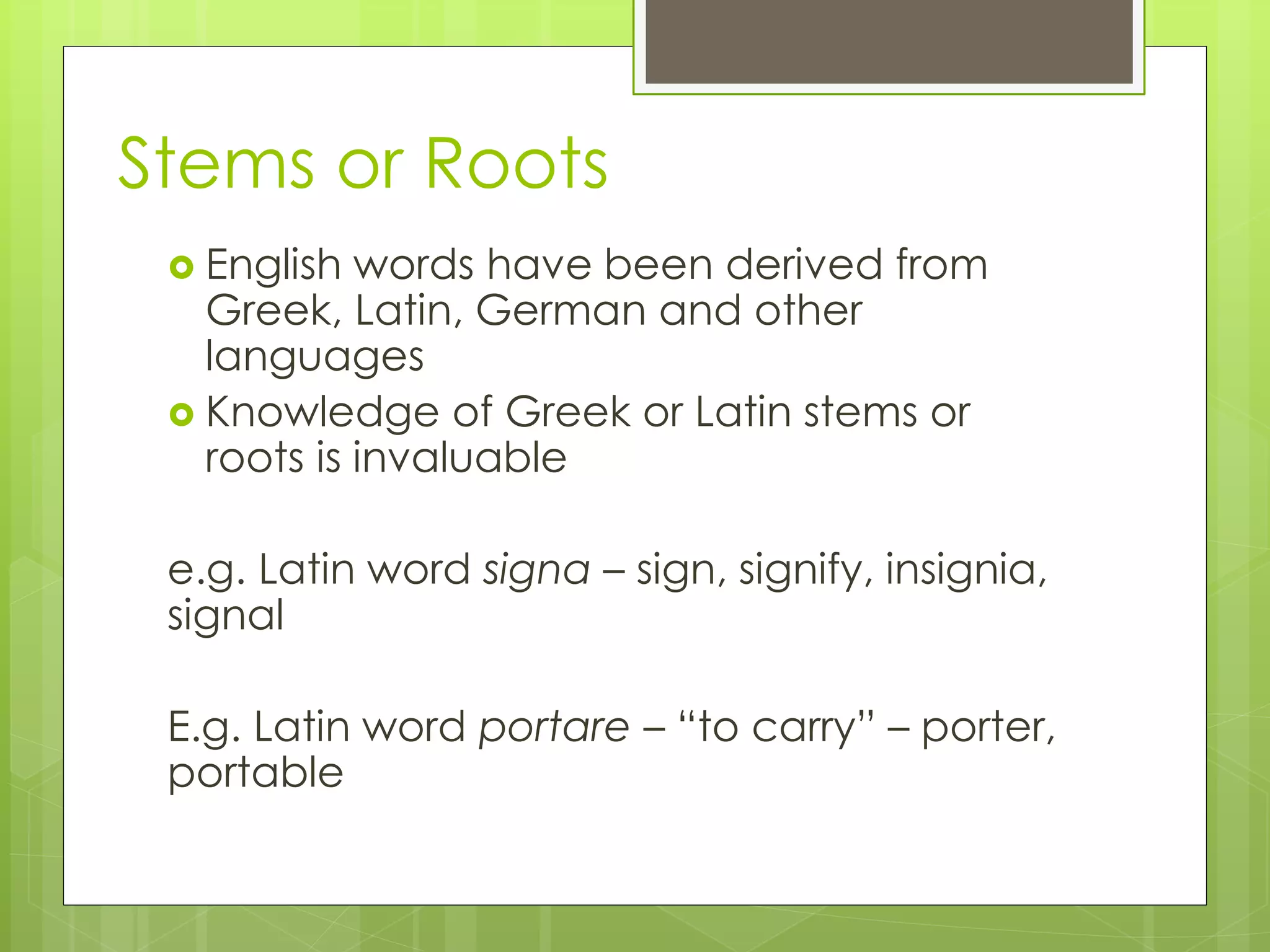
Stems or Roots
 English words have been derived from
Greek, Latin, German and other
languages
 Knowledge of Greek or Latin stems or
roots is invaluable
e.g. Latin word signa – sign, signify, insignia,
signal
E.g. Latin word portare – “to carry” – porter,
portable
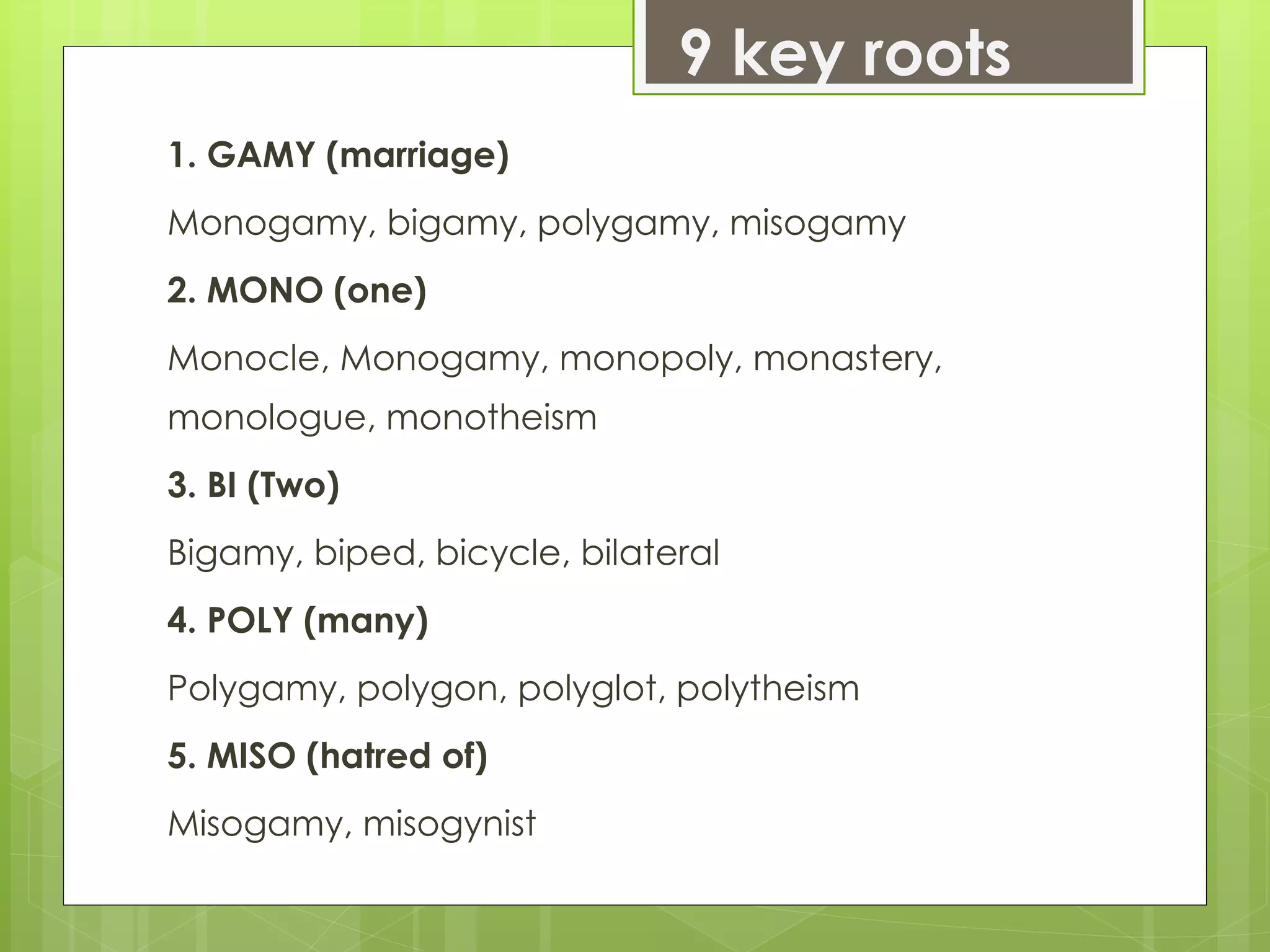
9 key roots
1. GAMY (marriage)
Monogamy, bigamy, polygamy, misogamy
2. MONO (one)
Monocle, Monogamy, monopoly, monastery,
monologue, monotheism
3. BI (Two)
Bigamy, biped, bicycle, bilateral
4. POLY (many)
Polygamy, polygon, polyglot, polytheism
5. MISO (hatred of)
Misogamy, misogynist
9 key roots
6. THEO (God)
Theology, monotheism, apotheosis
7. ANTHROPO (man)
Anthropoid, philanthropy, misanthropy,
anthropology
8. PHILO (love of)
Philology, philanthropy, philatelist
9. LOGY (knowledge, study of)
Biology, theology, philology, anthropology
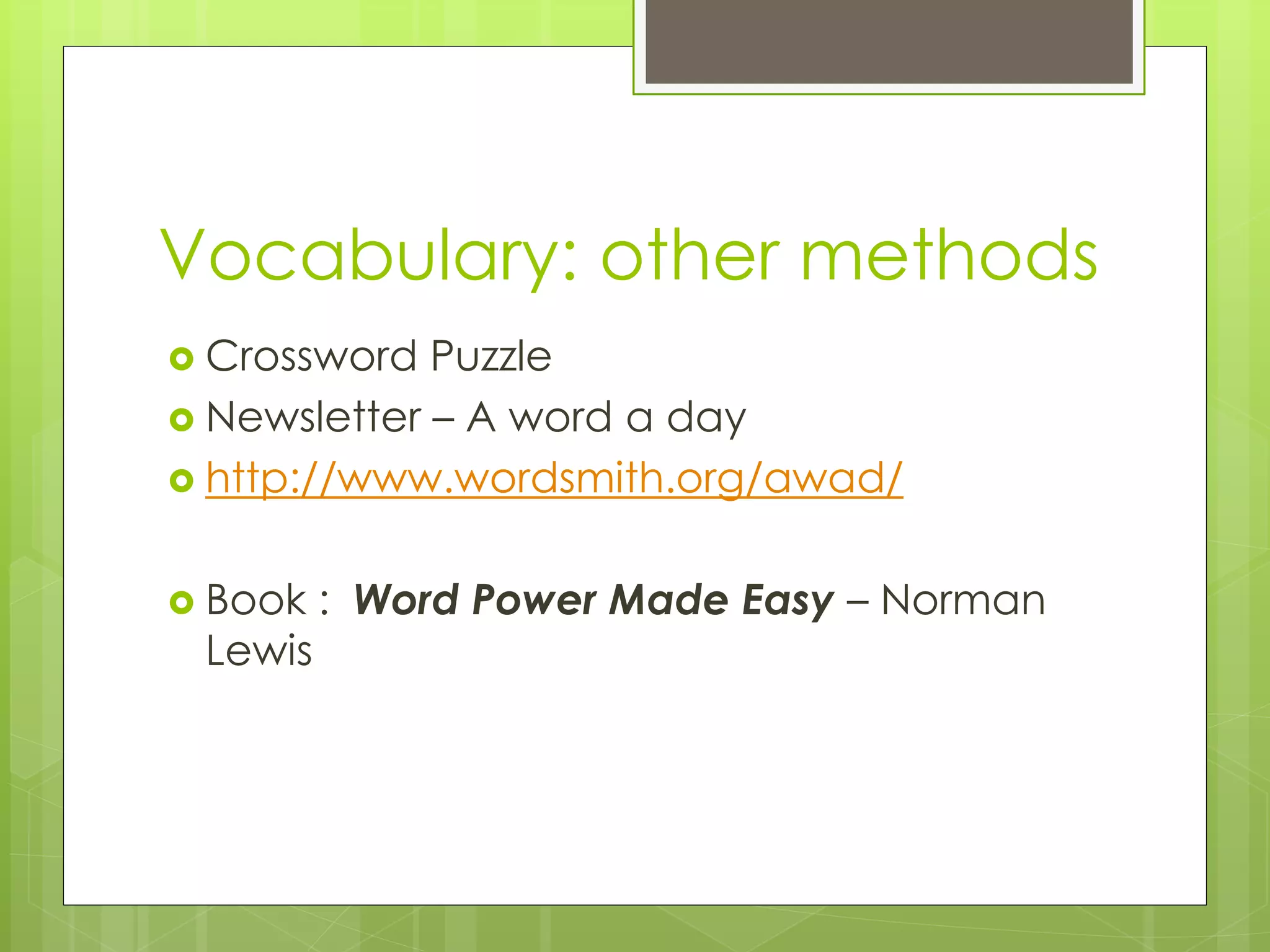
Vocabulary: other methods
 Crossword Puzzle
 Newsletter – A word a day
 http://www.wordsmith.org/awad/
 Book : Word Power Made Easy – Norman
Lewis
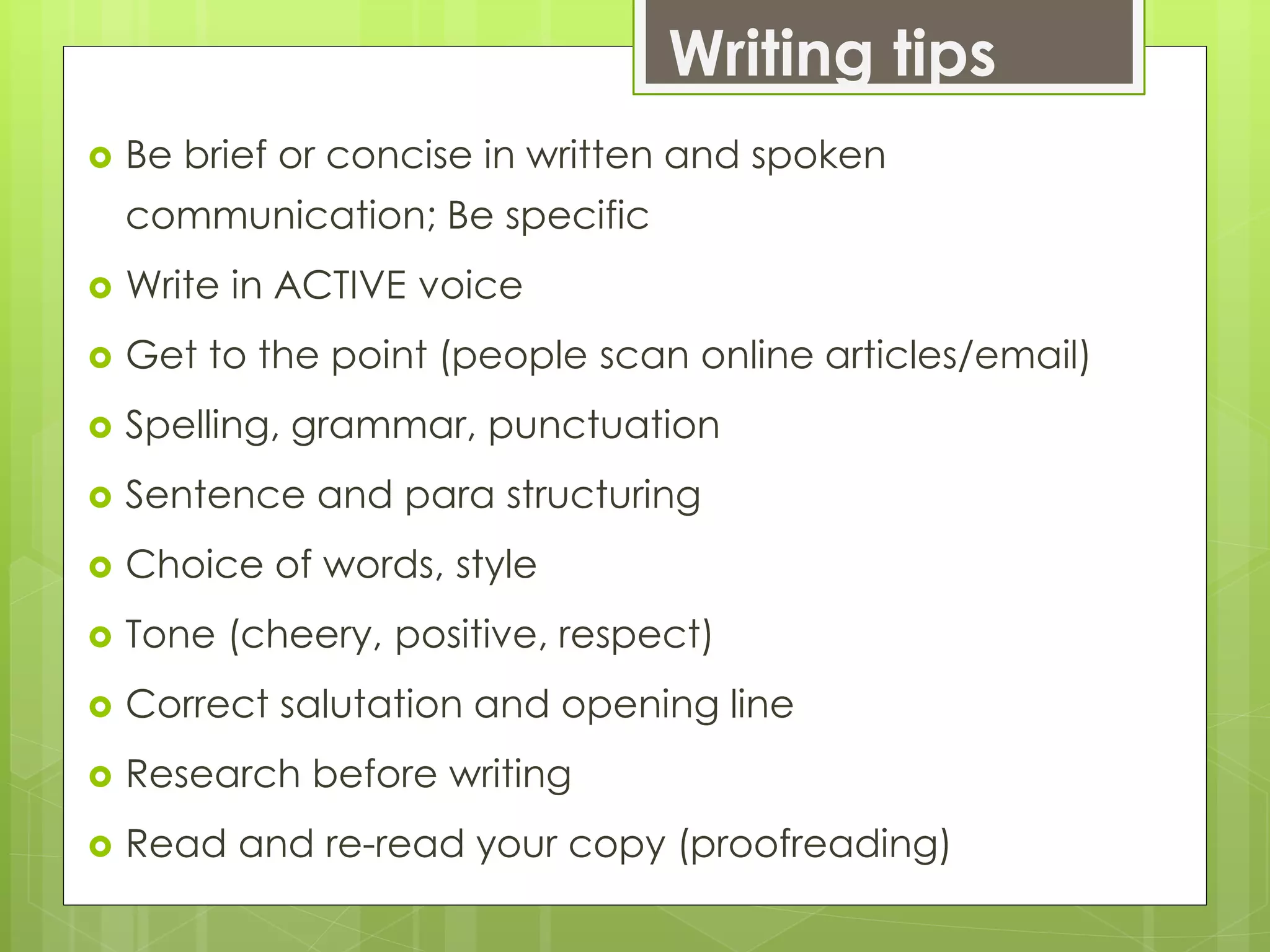
Writing tips
 Be brief or concise in written and spoken
communication; Be specific
 Write in ACTIVE voice
 Get to the point (people scan online articles/email)
 Spelling, grammar, punctuation
 Sentence and para structuring
 Choice of words, style
 Tone (cheery, positive, respect)
 Correct salutation and opening line
 Research before writing
 Read and re-read your copy (proofreading)
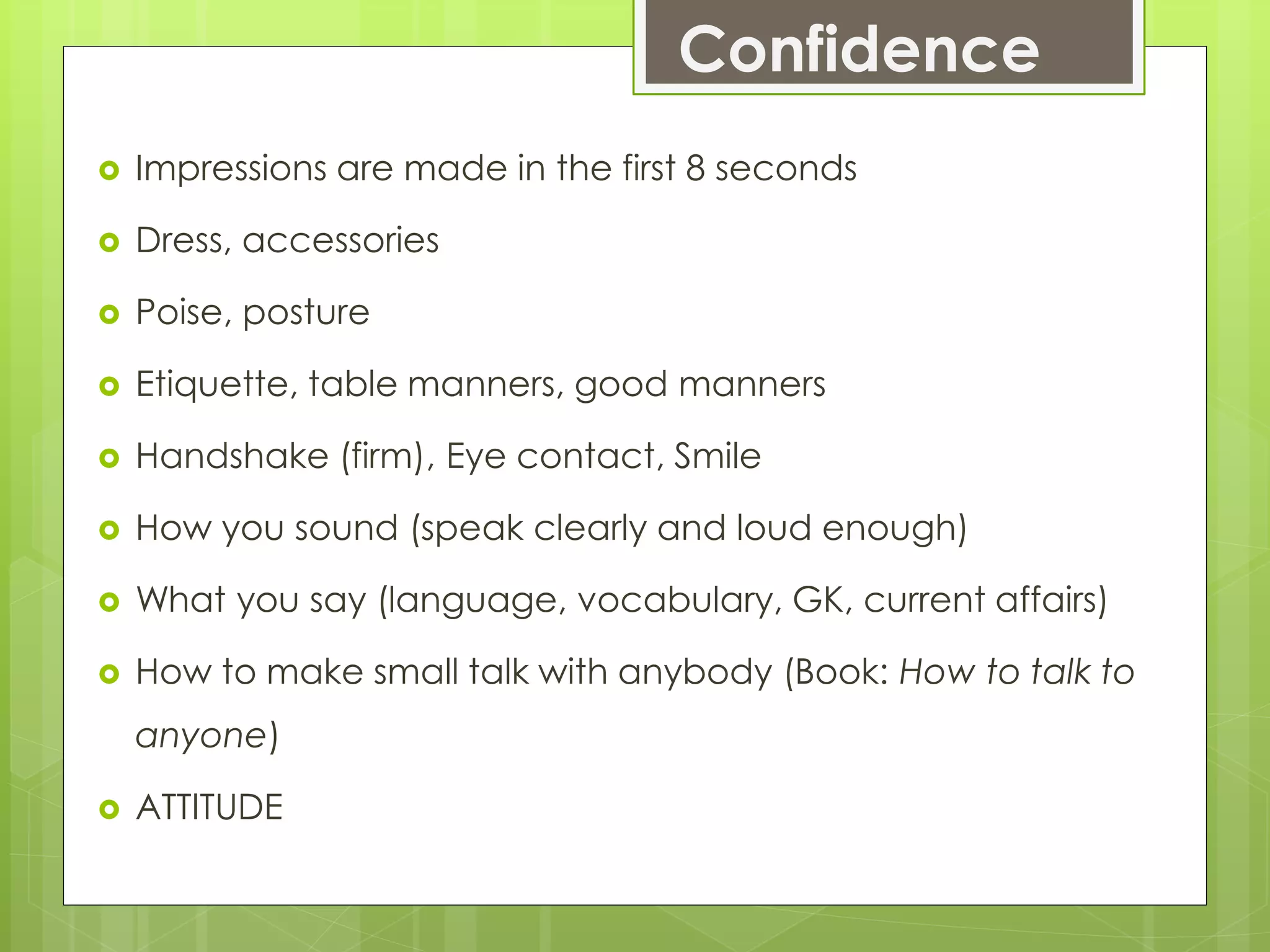
Confidence
 Impressions are made in the first 8 seconds
 Dress, accessories
 Poise, posture
 Etiquette, table manners, good manners
 Handshake (firm), Eye contact, Smile
 How you sound (speak clearly and loud enough)
 What you say (language, vocabulary, GK, current affairs)
 How to make small talk with anybody (Book: How to talk to
anyone)
 ATTITUDE
Thank you!
 Email: brian.pereira@ubm.com
 Email: brian9p@gmail.com
 Career blog:
careerlife.wordpress.com

Vocabulary Building techniques

  • 1.
  • 2.
    Agenda 1. Vocabulary buildingtechniques 2. Writing tips 3. Confidence Building
  • 3.
    Vocabulary building 1. Indirect/moderninductive/ psychological method 2. Word forms (adj, adv, noun, verb etc) 3. Using the Dictionary 4. Synonyms and Antonyms (Thesaurus) 5. Prefixes and suffixes 6. Stems or Roots
  • 4.
    The old-school method Memorizing words by rote  Writing list of words and their meanings  Slow, difficult, unreliable  Inaccurate, wrong usage (out of context)
  • 5.
     Helps usunderstand the meaning of a word in a contextual manner  We can remember the meaning, if we understand the context Indirect/ modern inductive/ psychological method
  • 6.
    Indirect/ modern inductive/ psychologicalmethod 1. Look at the usage of the word in the sentence and para in which it appears 2. Understand the context of the sentence/para 3. Then try to guess the meaning of the word 4. Look up the dictionary to get the exact meaning 5. Review the sentence again and apply the meaning 6. Try using this word in other sentences
  • 7.
    Class Exercise-1 Group A 1.He complained acrimoniously 2. We argued acrimoniously 3. They mocked each other acrimoniously Instruction: Guess the meaning of the word based on the sense you are getting in the sentence. (There is an unpleasant or bitter tone).
  • 8.
    Classroom Exercise-1 Look upthe dictionary Acrimonious (adj) – full of anger; arguments and bad feeling; bitterly Review the sentence again 1. He complained acrimoniously (angry manner) 2. We argued acrimoniously (bitterly, anger) 3. They mocked each other acrimoniously (bad feelings)
  • 9.
    Classroom Exercise-2 Group B 1.He completed the action adroitly 2. He drove adroitly through the maze of traffic 3. Adroitly she knitted the complicated stitch Instruction: Guess the meaning of the word based on the sense you are getting in the sentence. (The word applies to some manual action, with skill).
  • 10.
    Classroom exercise-3 Look upthe dictionary Adroit (adj) - Very skilful and quick in the way you think and move; cleverly Review the sentence again 1. He completed the action adroitly (quickly) 2. He drove adroitly through the maze of traffic (clever, skill) 3. Adroitly she knitted the complicated stitch (skill)
  • 11.
    Classroom exercise-3 Group C 1.He moved slowly and circumspectly through the traffic. 2. Fearing a trick, he answered all questions circumspectly. 3. By walking circumspectly he avoided an ambush. (There’s a feeling of watchfulness or caution).
  • 12.
    Classroom ex. 3 GroupD 1. These two building leases ran concomitantly. 2. Living and learning go on concomitantly. 3. Rain, snow, and sleet, all came down concomitantly. (Two or more things or actions occurring together).
  • 13.
    Classroom ex. 3 GroupE 1. He examined the plans cursorily. 2. He ran through the pages cursorily, then threw the novel down in disgust. 3. He did his homework so cursorily that he flunked the examination. (This word suggests great haste or doing something without care).
  • 14.
    Match the meaningto the word 1. Expertly; with skillful use of hands or the mind. Adroitly 2. Accompanying; occurring together. Concomitantly. 3. Cautiously with watchfulness in all directions. Circumspectly. 4. With sharpness and bitterness. Acrimoniously. 5. Hastily, without due care and attention. Cursorily.
  • 15.
    Self exercise  Bringalong a newspaper article.  Underline the words whose meanings are unknown.  Read the sentence or para that contains the word.  Understand its context and try to guess its meaning.  Refer to the dictionary for the exact meaning.  Review the sentence again and apply the meaning.
  • 16.
    Word Forms (Partsof speech)  Look at the main word in the dictionary.  Can it be used as an adverb, adjective or in another form?  E.g. Adroit (adjective) – He is an adroit negotiator.  Adroitly (adverb) – She adroitly avoided the question.  Adroitness (noun) – He was known for his adriotness.
  • 17.
    Using the dictionary Main entry  Pronunciation  Word form (parts of speech)  Meanings and related definitions  Examples of usage  Synonyms and Antonyms  Notes on usage (American/British English), origin, first use, variations etc
  • 18.
    Instant dictionary 1. Geta dictionary app like Merriam Webster, or Dictionary.com  https://play.google.com/store/apps/details?i d=com.dictionary  https://play.google.com/store/apps/details?i d=com.merriamwebster 2. Google  Define: word
  • 19.
    Synonyms and Antonyms You can also build your vocabulary by learning synonyms and antonyms.  SYNONYM - A word that has the same meaning as another  E.g. “Shut” is a synonym of “Close”  ANTONYM – A word that has the opposite meaning of the original word.  E.g. “Hot” is the antonym for “Cold”.  A book called a THESAURUS gives you the synonyms and antonyms for words
  • 20.
    Use fancy wordswith caution!  While synonyms can offer you fancy and big words, use them with thought! E.g. Use “Monogamist” instead of a long sentence like: He is the type of man who believes in marrying only one wife. He is a monogamist.
  • 21.
    Use fancy wordswith caution!  “I live in my house” is better than “I reside in my domicile”.  “We began operations” is better than “we commenced operations”.  “The boy committed suicide” is better than “he took his own life”.  “She went to bed” is better than “she retired for the night”.  “The man retired from his job” is better than “the man superannuated from his company”.  The child defecated on the road.  The toilet is full of faeces or excrement.
  • 22.
  • 23.
    On your desk… Roget’s Thesaurus  Oxford dictionary  Book of Idioms  Book of quotations
  • 24.
    Prefixes and Suffixes These can also build your vocabulary  A prefix appears before a word e.g. Anti – social written as “antisocial” A suffix appears at the end of a word e.g. Success-ful written as “successful”
  • 25.
    Prefixes PREFIX MEANING WORDEXAMPLE Ante- before antechamber Anti- against antisocial Hyper- Beyond the ordinary hyperactive Il- not Illiterate, illogical Im- not impossible Ir- not irregular In- not Inaccurate Poly- many Polygamy Post- after postseason
  • 26.
    Suffixes PREFIX MEANING WORDEXAMPLE -ful Characterized by; or as much as will fill Beautiful (characterized by beauty). Plentiful -hood State, condition, character Childhood, falsehood -less without faultless -ly like Saintly (saint like) -meter measure thermometer -polis City or resident of Metropolis; cosmopolitan -ship Condition, character, skill Friendship, statesmanship -some tendency Troublesome (tendency to make trouble)
  • 27.
    Stems or Roots English words have been derived from Greek, Latin, German and other languages  Knowledge of Greek or Latin stems or roots is invaluable e.g. Latin word signa – sign, signify, insignia, signal E.g. Latin word portare – “to carry” – porter, portable
  • 28.
    9 key roots 1.GAMY (marriage) Monogamy, bigamy, polygamy, misogamy 2. MONO (one) Monocle, Monogamy, monopoly, monastery, monologue, monotheism 3. BI (Two) Bigamy, biped, bicycle, bilateral 4. POLY (many) Polygamy, polygon, polyglot, polytheism 5. MISO (hatred of) Misogamy, misogynist
  • 29.
    9 key roots 6.THEO (God) Theology, monotheism, apotheosis 7. ANTHROPO (man) Anthropoid, philanthropy, misanthropy, anthropology 8. PHILO (love of) Philology, philanthropy, philatelist 9. LOGY (knowledge, study of) Biology, theology, philology, anthropology
  • 30.
    Vocabulary: other methods Crossword Puzzle  Newsletter – A word a day  http://www.wordsmith.org/awad/  Book : Word Power Made Easy – Norman Lewis
  • 31.
    Writing tips  Bebrief or concise in written and spoken communication; Be specific  Write in ACTIVE voice  Get to the point (people scan online articles/email)  Spelling, grammar, punctuation  Sentence and para structuring  Choice of words, style  Tone (cheery, positive, respect)  Correct salutation and opening line  Research before writing  Read and re-read your copy (proofreading)
  • 32.
    Confidence  Impressions aremade in the first 8 seconds  Dress, accessories  Poise, posture  Etiquette, table manners, good manners  Handshake (firm), Eye contact, Smile  How you sound (speak clearly and loud enough)  What you say (language, vocabulary, GK, current affairs)  How to make small talk with anybody (Book: How to talk to anyone)  ATTITUDE
  • 33.
    Thank you!  Email:brian.pereira@ubm.com  Email: brian9p@gmail.com  Career blog: careerlife.wordpress.com