Digital
image
processing
Name: Parekh Jessica
SYNOPSIS
✓INTRODUCTION
✓WHAT IS DIGITAL IMAGE
✓WHAT IS DIGITAL IMAGE PROCESSING
✓WHY IMAGE PROCESSING
✓TYPES OF DIP
✓APPLICATIONS OF DIP
✓CONCLUSION
 Digital image processing is the use
of computer algorithms to perform
image processing on digital images
 As a subcategory or field of digital signal
processing, digital image processing has
many advantages over analog image
processing.
INTRODUCTION
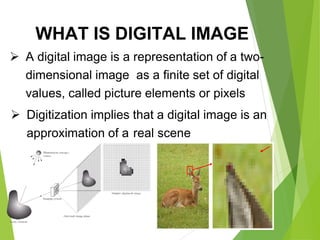
 Digitization implies that a digital image is an
approximation of a real scene
WHAT IS DIGITAL IMAGE
 A digital image is a representation of a two-
dimensional image as a finite set of digital
values, called picture elements or pixels
WHAT IS DIGITAL
IMAGE(cont…)
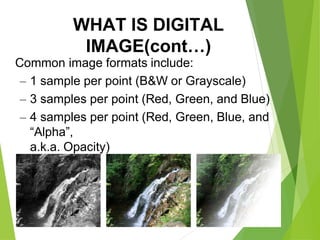
Common image formats include:
– 1 sample per point (B&W or Grayscale)
– 3 samples per point (Red, Green, and Blue)
– 4 samples per point (Red, Green, Blue, and
“Alpha”,
a.k.a. Opacity)
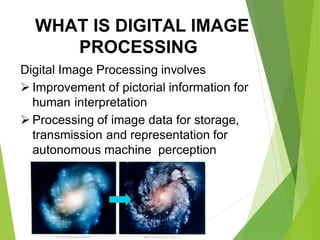
Digital Image Processing involves
 Improvement of pictorial information for
human interpretation
 Processing of image data for storage,
transmission and representation for
autonomous machine perception
WHAT IS DIGITAL IMAGE
PROCESSING
 Since the digital image is “invisible” it
must be prepared for viewing on one or
more output device (laser printer, monitor
etc.)
 The digital image can be optimized for
the application by enhancing or altering
the appearance of structures within it
(based on: body part, diagnostic task,
viewing preferences etc.)
 It has vast range of applications in fields
of Astronomy, Defense, Research
WHY IMAGE PROCESSING
•
•
•
Image-to-image transformations
Image-to-information
transformations Information-to-
image transformations
TYPES OF DIP
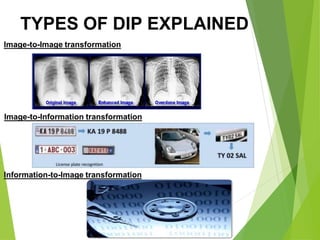
TYPES OF DIP EXPLAINED
Image-to-Image transformation
Image-to-Information transformation
Information-to-Image transformation
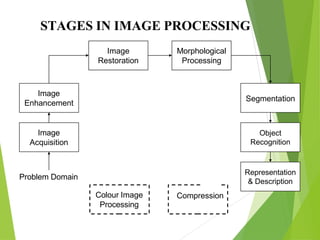
STAGES IN IMAGE PROCESSING
Image
Acquisition
Image
Restoration
Morphological
Processing
Segmentation
Representation
& Description
Image
Enhancement
Object
Recognition
Problem Domain
Colour Image
Processing
Compression
APPLICATIONS OF DIP
o Medicine
o Security Systems
o Document Processing
o Law Enforcement & Forensics
o Photography
o GIS
o Space exploration and Astronomy
o Video and Film Special Effects
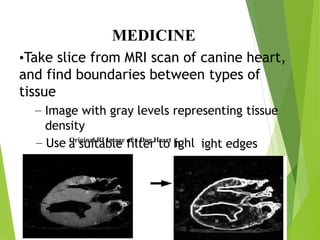
MEDICINE
•Take slice from MRI scan of canine heart,
and find boundaries between types of
tissue
– Image with gray levels representing tissue
density
a suitable filter to h ight edges
– Use Original RI Image of a Dog Heart
ighl
G I S
•Geographic Information Systems
– Digital image processing techniques are used
extensively to manipulate satellite imagery
– Terrain classification
– Meteorology
LAW ENFORCEMENT
•Image processing
techniques are used
extensively by law
enforcers
– Number plate recognition
for speed
cameras/automated toll
systems
– Fingerprint recognition
– Enhancement of CCTV
images
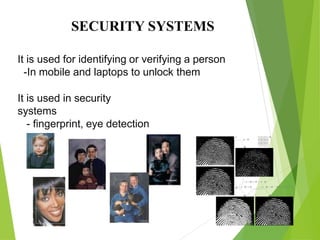
SECURITY SYSTEMS
It is used for identifying or verifying a person
-In mobile and laptops to unlock them
It is used in security
systems
- fingerprint, eye detection
Digital image processing allows the use of much more
complex algorithms.
Hence it offers both
-more sophisticated performance at simple tasks
-the implementation of methods which would be
impossible by analog means.
CONCLUSION
GOOD TO LEARN FROM BOOK
BEETER TO LEARN FROM SOUNDS
BEST TO LEARN FROM IMAGES
FINALLY
ANY QUERIES???
jessica ty  Digital image processing.pptx

jessica ty Digital image processing.pptx

  • 1.
  • 2.
    SYNOPSIS ✓INTRODUCTION ✓WHAT IS DIGITALIMAGE ✓WHAT IS DIGITAL IMAGE PROCESSING ✓WHY IMAGE PROCESSING ✓TYPES OF DIP ✓APPLICATIONS OF DIP ✓CONCLUSION
  • 3.
     Digital imageprocessing is the use of computer algorithms to perform image processing on digital images  As a subcategory or field of digital signal processing, digital image processing has many advantages over analog image processing. INTRODUCTION
  • 4.
     Digitization impliesthat a digital image is an approximation of a real scene WHAT IS DIGITAL IMAGE  A digital image is a representation of a two- dimensional image as a finite set of digital values, called picture elements or pixels
  • 5.
    WHAT IS DIGITAL IMAGE(cont…) Commonimage formats include: – 1 sample per point (B&W or Grayscale) – 3 samples per point (Red, Green, and Blue) – 4 samples per point (Red, Green, Blue, and “Alpha”, a.k.a. Opacity)
  • 6.
    Digital Image Processinginvolves  Improvement of pictorial information for human interpretation  Processing of image data for storage, transmission and representation for autonomous machine perception WHAT IS DIGITAL IMAGE PROCESSING
  • 7.
     Since thedigital image is “invisible” it must be prepared for viewing on one or more output device (laser printer, monitor etc.)  The digital image can be optimized for the application by enhancing or altering the appearance of structures within it (based on: body part, diagnostic task, viewing preferences etc.)  It has vast range of applications in fields of Astronomy, Defense, Research WHY IMAGE PROCESSING
  • 8.
  • 9.
    TYPES OF DIPEXPLAINED Image-to-Image transformation Image-to-Information transformation Information-to-Image transformation
  • 10.
    STAGES IN IMAGEPROCESSING Image Acquisition Image Restoration Morphological Processing Segmentation Representation & Description Image Enhancement Object Recognition Problem Domain Colour Image Processing Compression
  • 11.
    APPLICATIONS OF DIP oMedicine o Security Systems o Document Processing o Law Enforcement & Forensics o Photography o GIS o Space exploration and Astronomy o Video and Film Special Effects
  • 12.
    MEDICINE •Take slice fromMRI scan of canine heart, and find boundaries between types of tissue – Image with gray levels representing tissue density a suitable filter to h ight edges – Use Original RI Image of a Dog Heart ighl
  • 13.
    G I S •GeographicInformation Systems – Digital image processing techniques are used extensively to manipulate satellite imagery – Terrain classification – Meteorology
  • 14.
    LAW ENFORCEMENT •Image processing techniquesare used extensively by law enforcers – Number plate recognition for speed cameras/automated toll systems – Fingerprint recognition – Enhancement of CCTV images
  • 15.
    SECURITY SYSTEMS It isused for identifying or verifying a person -In mobile and laptops to unlock them It is used in security systems - fingerprint, eye detection
  • 16.
    Digital image processingallows the use of much more complex algorithms. Hence it offers both -more sophisticated performance at simple tasks -the implementation of methods which would be impossible by analog means. CONCLUSION
  • 17.
    GOOD TO LEARNFROM BOOK BEETER TO LEARN FROM SOUNDS BEST TO LEARN FROM IMAGES FINALLY
  • 18.