INTRODUCTION
▪ Emerged inthe early 20th century as a response to
introspective methods in psychology
▪It also known as behaviorist theory.
▪Suggests all behaviors are acquired through
conditioning (classical and operant conditioning) and
interaction with the environment.
▪Mainly focuses on observable behaviors and the
external stimuli that trigger them, while disregarding
internal mental processes like thoughts or emotions.
2
3.
HISTORICAL EVOLUTION ANDKEY CONTRIBUTORS OF BEHAVIORISM THEORY
Ivan Pavlov
Classical
Conditioning
3
Edward Thorndike
The Law of Effect
John B. Watson
Birth of
Behaviorism
B.F. Skinner
Operant
Conditioning
4.
4
CORE CONCEPTS OFBEHAVIORIST LEARNING
THEORY
1. Classical Conditioning: A neutral stimulus becomes associated with a
meaningful stimulus to produce a response (e.g., bell + food = salivation). This
process shows how individuals learn by association, especially in habitual or
emotional responses.
5.
5
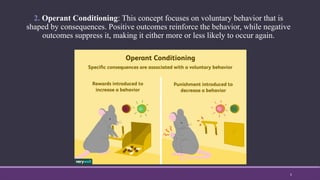
2. Operant Conditioning:This concept focuses on voluntary behavior that is
shaped by consequences. Positive outcomes reinforce the behavior, while negative
outcomes suppress it, making it either more or less likely to occur again.
6.
6
3. Positive Reinforcement:Involves adding a rewarding stimulus to
encourage a behavior.
Eg: a student who scores well may be given a prize, increasing the
chance of future good performance.
7.
7
4. Negative Reinforcement:Involves removing an unpleasant stimulus to
strengthen behavior.
Eg: A child studies to avoid parental scolding; the removal of scolding acts as
reinforcement.
8.
8
5. Punishment: Punishmentdecreases the likelihood of a behavior
by either adding an unpleasant stimulus or removing a pleasant
one.
Eg: A student caught cheating may be suspended (added
punishment) or lose exam marks (removed reward).
9.
9
6. Extinction: Alearned behavior diminishes when it no
longer leads to reinforcement. If a child no longer receives
attention for misbehaving, the behavior may reduce over
time.
10.
10
7. Spontaneous recovery:the reappearance of a previously extinguished
conditioned response after a period of rest, where the conditioned stimulus is
presented again. This phenomenon demonstrates that extinction does not mean the
learned response is unlearned or forgotten entirely but is rather suppressed or
inhibited, with the potential to return after a delay. The original learning remains
dormant but can re-emerge under the right circumstances, such as the return of the
conditioned stimulus or exposure to the original context.
11.
BEHAVIORIST THEORY INLANGUAGE
ACQUISITION
•Behaviorist theory argue that language is not innate but learned behavior, just
like any other skill.
•Language learning takes place when:-
• Children imitate sounds and phrases they hear from adults and get reinforced
when their speech is understood or praised.
• Over time, these repetitions turn into language habits, shaped entirely by
interaction and environment, not by innate mechanisms.
•According to Skinner, grammar and sentence structures are not learned
consciously but develop gradually through frequent positive reinforcement.
Thus, language becomes a result of habitual behavior, not mental rule formation.
11
12.
TEACHING TECHNIQUES BASEDON
BEHAVIORISM
1. Drill Practice: Repetitive exercises help reinforce patterns, especially for grammar, tables, or
vocabulary. It helps learners form strong language or math habits through consistent
exposure.
2. Reward and Praise: Teachers use stars, points, or verbal praise as positive reinforcements
for good behavior. These reinforcements motivate students to continue desirable actions.
3. Modeling and Imitation: Teachers act as role models, demonstrating tasks or behavior for
students to copy. This technique is vital in language pronunciation and classroom etiquette.
4. Immediate Error Correction: Mistakes are corrected instantly to prevent reinforcement of
wrong responses. The emphasis is on “unlearning errors” through negative reinforcement.
5. Shaping: Gradually building complex skills through step-by-step reinforcement. For
example, teaching essay writing by first rewarding sentence formation.
12
#3 Believed that behaviors followed by satisfying consequences are more likely to be repeated-foundation
Proved that learning can occur through association.
Father of Modern Behaviorism; emphasized observable behavior over internal thought processes.
Behaviors are shaped by consequences- reward and punishment