WHAT IS
BEHAVIORISM?
KEY FIGURES
APPLICATION IN
LANGUANGE LEARNING
- Behaviorism focuses on the study of overt
behaviors that can be observed and
measured.
- It views that mind is a “black box” in the
sense that response to stimulus can be
observed quantitatively, ignoring the
possibility of cognitive.
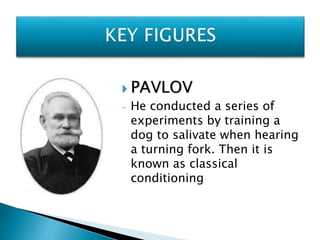
 PAVLOV
- He conducted a series of
experiments by training a
dog to salivate when hearing
a turning fork. Then it is
known as classical
conditioning
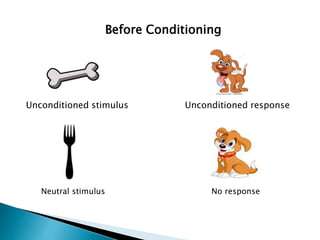
Before Conditioning
Unconditioned stimulus Unconditioned response
Neutral stimulus No response
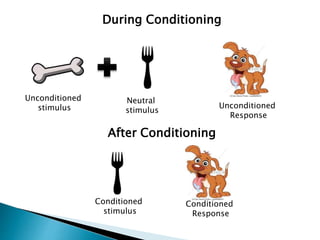
During Conditioning
After Conditioning
Unconditioned
stimulus
Neutral
stimulus
Unconditioned
Response
Conditioned
stimulus
Conditioned
Response
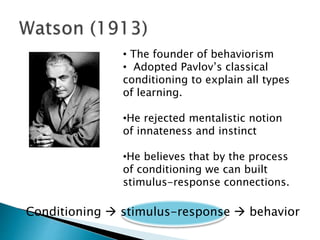
Conditioning  stimulus-response  behavior
• The founder of behaviorism
• Adopted Pavlov’s classical
conditioning to explain all types
of learning.
•He rejected mentalistic notion
of innateness and instinct
•He believes that by the process
of conditioning we can built
stimulus-response connections.
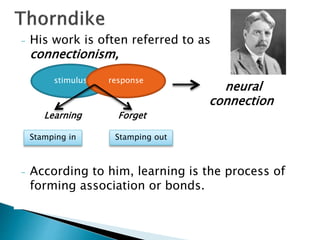
- His work is often referred to as
connectionism,
neural
connection
Learning Forget
- According to him, learning is the process of
forming association or bonds.
stimulus response
Stamping in Stamping out
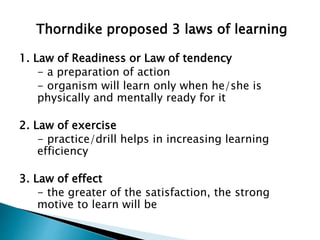
Thorndike proposed 3 laws of learning
1. Law of Readiness or Law of tendency
- a preparation of action
- organism will learn only when he/she is
physically and mentally ready for it
2. Law of exercise
- practice/drill helps in increasing learning
efficiency
3. Law of effect
- the greater of the satisfaction, the strong
motive to learn will be
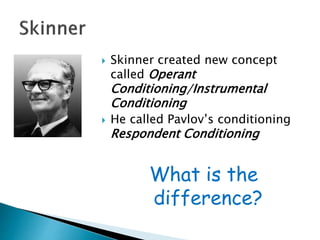
 Skinner created new concept
called Operant
Conditioning/Instrumental
Conditioning
 He called Pavlov’s conditioning
Respondent Conditioning
What is the
difference?
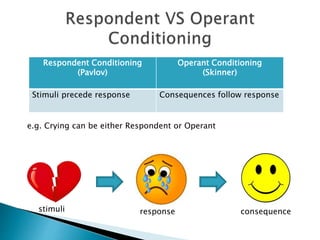
e.g. Crying can be either Respondent or Operant
responsestimuli consequence
Respondent Conditioning
(Pavlov)
Operant Conditioning
(Skinner)
Stimuli precede response Consequences follow response
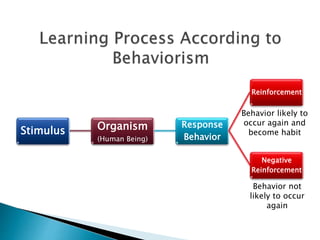
Stimulus Organism
(Human Being)
Response
Behavior
Reinforcement
Negative
Reinforcement
Behavior likely to
occur again and
become habit
Behavior not
likely to occur
again
 In 1950s and 1960s, the learning theory of
Behaviorism underpinned the used of
Audioligual Method (ALM) on language
teaching, with three crucial learning
elements:
1. Stimulus
2. Response
3. Reinforcement
1. Repetition
2. Inflection
3. Replacement
4. Restatement
5. Completion
6. Transposition
7. Expansion
8. Contraction
9. Transformation
10. Integration
11. Rejoinder
12. Restoration
• The classroom environment is arranged with
mimicry, memorization, and pattern drills.
• Brook(1964: 156-61) proposed some various
pattern drills used in ALM, as follows:
 Likewise the Direct Method, Audiolingual
believes that language is primarily speech.
 Brooks as quoted by Richards and Rodgers
(2002) say, “Language is primarily what is
spoken and only secondarily what is written.”
So, how to teach writing by using ALM?
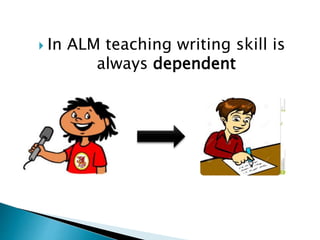
 In ALM teaching writing skill is
always dependent
 At the beginning level, writing is purely imitative
and consists of little more than copying out
sentences that have been practiced.
 At the advanced level, students may develop by
using some variations in using the structures that
have been previously learned.
 Richards and Rodgers (2002) write, “As
proficiency increases, students may write out
variations of structural items they have practiced
or write short compositions on given topics with
the help of framing questions, which will guide
their use of the language.”
According to Behaviorism theory,
“Learning is habit
formation”
Thank you… 

Behaviorism and foreign language learning

  • 2.
  • 3.
    - Behaviorism focuseson the study of overt behaviors that can be observed and measured. - It views that mind is a “black box” in the sense that response to stimulus can be observed quantitatively, ignoring the possibility of cognitive.
  • 4.
     PAVLOV - Heconducted a series of experiments by training a dog to salivate when hearing a turning fork. Then it is known as classical conditioning
  • 5.
    Before Conditioning Unconditioned stimulusUnconditioned response Neutral stimulus No response
  • 6.
  • 7.
    Conditioning  stimulus-response behavior • The founder of behaviorism • Adopted Pavlov’s classical conditioning to explain all types of learning. •He rejected mentalistic notion of innateness and instinct •He believes that by the process of conditioning we can built stimulus-response connections.
  • 8.
    - His workis often referred to as connectionism, neural connection Learning Forget - According to him, learning is the process of forming association or bonds. stimulus response Stamping in Stamping out
  • 9.
    Thorndike proposed 3laws of learning 1. Law of Readiness or Law of tendency - a preparation of action - organism will learn only when he/she is physically and mentally ready for it 2. Law of exercise - practice/drill helps in increasing learning efficiency 3. Law of effect - the greater of the satisfaction, the strong motive to learn will be
  • 10.
     Skinner creatednew concept called Operant Conditioning/Instrumental Conditioning  He called Pavlov’s conditioning Respondent Conditioning What is the difference?
  • 11.
    e.g. Crying canbe either Respondent or Operant responsestimuli consequence Respondent Conditioning (Pavlov) Operant Conditioning (Skinner) Stimuli precede response Consequences follow response
  • 12.
    Stimulus Organism (Human Being) Response Behavior Reinforcement Negative Reinforcement Behaviorlikely to occur again and become habit Behavior not likely to occur again
  • 13.
     In 1950sand 1960s, the learning theory of Behaviorism underpinned the used of Audioligual Method (ALM) on language teaching, with three crucial learning elements: 1. Stimulus 2. Response 3. Reinforcement
  • 14.
    1. Repetition 2. Inflection 3.Replacement 4. Restatement 5. Completion 6. Transposition 7. Expansion 8. Contraction 9. Transformation 10. Integration 11. Rejoinder 12. Restoration • The classroom environment is arranged with mimicry, memorization, and pattern drills. • Brook(1964: 156-61) proposed some various pattern drills used in ALM, as follows:
  • 15.
     Likewise theDirect Method, Audiolingual believes that language is primarily speech.  Brooks as quoted by Richards and Rodgers (2002) say, “Language is primarily what is spoken and only secondarily what is written.” So, how to teach writing by using ALM?
  • 16.
     In ALMteaching writing skill is always dependent
  • 17.
     At thebeginning level, writing is purely imitative and consists of little more than copying out sentences that have been practiced.  At the advanced level, students may develop by using some variations in using the structures that have been previously learned.  Richards and Rodgers (2002) write, “As proficiency increases, students may write out variations of structural items they have practiced or write short compositions on given topics with the help of framing questions, which will guide their use of the language.”
  • 18.
    According to Behaviorismtheory, “Learning is habit formation”
  • 19.