Introduction
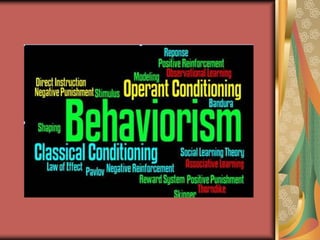
Behaviorists believed that human behavior can be
understood by examining the relationship between
stimuli (events in the environment) and responses
(observable behavior)
Behaviorism is a perspective in psychology that is
based on the premise that it is not possible to
objectively study the mind, and therefore that
psychologists should limit their attention to the
study of behavior itself.
Behaviorists believe that our responses to
environmental stimuli shape our actions.
Cont’d
This new school redefined psychology as
the “science of behavior.”
This school of psychology confines itself to
the study of behavior because behavior is
observable and measurable and, therefore,
objective and scientific.
Cont..
Concepts such as mind, consciousness,
and feelings were regarded as not
appropriate subject of psychology because
they were neither objective nor
measurable.
Behaviorism was the most influential
school of thought in American psychology
until the 1960.
Basic Concepts/Assumptions of
Behaviorism
All behavior is learned from the
environment. We learn new behavior
through classical or operant conditioning.
Psychology should be seen as a science.
Behaviorism is primarily concerned with
observable behavior.
There is little difference between the
learning that takes place in humans and that
in other animals.
Behavior is the result of stimulus-response.
Behaviorist View of Human
Nature
Behaviorist View of Human Nature
The sources of behavior are external (in the
environment), not internal (in the mind, in
the head).
Behavior and personality is the result of
learning, and people affected by external
constraints, people's behavior through
positive or negative add to to create.
Behaviorism originated with the work of
John B. Watson. Watson claimed that
psychology was not concerned with the
mind or with human consciousness. Instead,
psychology would be concerned only with
behavior.
Cont..
In this way, men could be
studied objectively, like rats and
apes.
Man has no soul and no mind,
only a brain that responds to
external stimuli. Behaviorism
teaches that man is nothing
more than a machine that
responds to conditioning.
Personality characteristics also
can shape and change, as long
as to identify the relationship
between the environmental
stimuli and behavior.
Cont..
Under the stimulus response, we can predict and
control the purpose of human behavior, and can
create or change human nature (Graham &
Gerorge; 2017).
Major
Contributors
Ivan Petrovich Pavlov
Ivan Petrovich Pavlov was born
on September 14, 1849 at
Ryazan.
He studied Natural Sciences.
He is famous for his theories of
learning by conditioning, which
were developed as a result of his
acclaimed research on
digestion.
Pavlov studied digestion in
dogs.
Pavlov was awarded with Nobel
Prize in 1904 for his work on
Physiology of digestion.
John Broadus Watson
John B. Watson was born
on January 9, 1878.
He was a pioneering
psychologist who played
an important role in
developing behaviorism.
He is remembered for his
research on the
conditioning process, as
well as the Little Albert
experiment.
B. F. Skinner
B. F. Skinner was born on
March 20, 1904 in
Susquehanna, New York.
Skinner was named the most
influential psychologist of the
twentieth century.
He did research on operant
behavior and operant
conditioning. He worked on
pigeons and rats.
Major
Theories in
Behaviorism
Ivan Pavlov
 In the early part of the 20th century, Russian physiologist Ivan
Pavlov was studying the digestive system of dogs when he
noticed an interesting behavioral phenomenon:
 The dogs began to salivate when the lab technicians who
normally fed them entered the room, even though the dogs
had not yet received any food.
 Pavlov realized that the dogs were salivating because they
knew that they were about to be fed; the dogs had begun to
associate the arrival of the technicians with the food that soon
followed their appearance in the room.
Cont..
 With his team of researchers, Pavlov began
studying this process in more detail.
 After observing that the dogs presented
motor and secretory responses to the
presentation of food, Pavlov decided that he
would ignore motor responses and measure
only salivary reflexes(Goodwin, 2008).
 He then defined conditioned reflexes in
terms of their acquisition and extinction.
 During acquisition, Pavlov first presented the
dogs with meat (the unconditioned stimulus,
UCS), which stimulated the dogs’ salivation
(the unconditioned response, UR).
 Extinction of the conditioned response
consisted of sounding a metronome (the
CS) at 30-second intervals every two
minutes without presenting any food.
John Broadus Watson
J. B Watson
• By assimilating classical conditioning and adopting his
theory of stimulus substitution, Watson connected
behaviorism to the discovery of conditioned emotional
responses and a behavioristic explanation for the
learning of phobic behavior, and established learning as
a central topic for basic research and application in
American psychology (Riiling, 2000).
• Watson studied the emotional responses of infants and
young children and is probably most noted for his
famous “Little Albert” (Watson’s nine-month old son)
experiment in which he demonstrated that fears could
be unlearned.
Cont..
 As the second decade drew to a close, emotional responses
were of central concern in child development, given the
dominance of Freudian theory in psychology. Watson proposed
an alternative:
 human infants had three basic emotional responses.
 The first was fear, caused by loss of support or loud sounds.
 The second was rage, caused by restricting an infant’s
movements. The third was love, caused by stroking the skin,
especially in sensitive erogenous zones.
 Through conditioning, the range of stimuli that called out these
emotional responses expanded throughout one’s life, thereby
accounting for the diversity of human development.
Cont..
 John B. Watson further extended Pavlov’s work and applied it
to human beings (Watson 2013).
 In 1921, Watson studied Albert, an 11-month-old infant child.
 The goal of the study was to condition Albert to become
afraid of a white rat by pairing the white rat with a very loud,
jarring noise (UCS).
 At first, Albert showed no sign of fear when he was presented
with rats, but once the rat was repeatedly paired with the loud
noise (UCS), Albert developed a fear of rats.
 It could be said that the loud noise (UCS) induced fear (UCR).
The implications of Watson’s experiment suggested that
classical conditioning could cause some phobias in humans.
B.F. Skinner theory:
Operant conditioning
B.F. Skinner theory: Operant
conditioning
Operant conditioning is a
method of learning that
occurs through rewards
and punishments for
behavior.
Through operant
conditioning, an
association is made
between a behavior and
a consequence for that
behavior
Reinforcement: Positive,
negative
The goal of reinforcement, whether positive
or negative, is to increase the target
behavior.
Positive reinforcement involves the
addition of something of value to the
individual (such as praise, attention,
money, or food) as a consequence of
certain behavior.
Negative reinforcement involves the
escape from or the avoidance of aversive
(unpleasant) stimuli.
Punishment: Positive,
negative
The goal of punishment is to
decrease target behavior.
In positive punishment an aversive
stimulus is added after the
behavior to decrease the
frequency of a behavior.
In negative punishment a
reinforcing stimulus is removed
following the behavior to decrease
the frequency of a target behavior.
Strengths of Behaviorism Behaviorism is based upon observable behaviors,
so it is easier to quantify and collect data and
information when conducting research.
 Since research and experiment is a very powerful
tool in providing explanations and clear evidences
about a certain phenomenon, early theorist and
proponents of behaviorism took pride in initiating
the studies of observable behaviors rather than
those that cannot be observed and measured (like
unconsciousness and repressed sexual desires as
the bases of psychodynamic theory).
• Effective therapeutic techniques such as
intensive behavioral interventions, behavior
analysis, token economic and discrete trial
training are all rooted in behaviorism.
• These approaches are often very useful in
changing maladaptive or harmful behaviors
in both children and adults.
Critical Evaluation of
Behaviorism
• Behaviorism only provides a partial account of
human behavior, that which can be objectively
viewed. Important factors like emotions,
expectations, higher-level motivation are not
considered or explained.
• Biological psychology criticize it for not
addressing the role of nature. It states that all
behavior has a physical/organic cause. For
example, chromosomes and hormones
influence our behavior too, in addition to the
environment.
• Cognitive psychology states that mediational
processes occur between stimulus and
response, such as memory, thinking, problem-
solving, which behaviorism does no take inti
account (McLeod, 2017).
Therapeutic Techniques
Flooding
This process involves exposing
people to fear-invoking objects
or situations intensely and
rapidly.
It is often used to treat phobia,
anxiety and other stress-related
disorders.
During the process, the
individual is prevented from
escaping or avoiding the
situation.
Aversion
Therapy
This process involves
pairing an undesirable
behavior with an
aversive stimulus in the
hope that the
unwanted behavior will
eventually be reduced.
Systematic
Desensitization
This technique involves
having a client make a list of
fears and then teaching the
individual to relax while
concentrating on these
fears.
The process follows three
basic steps.
First, the client is taught
relaxation techniques.
Next, the individual
creates a ranked list of
fear invoking situations.
Starting with the least
fear inducing item and
working their way up to
the most fear inducing
item, the client confronts
these fears under the
guidance of the therapist
while maintaining a
relaxed state.
Token Economies
Relies
on reinforcement to
modify behavior.
Clients are allowed to
earn tokens that can
be exchanged for
special privileges or
desired items.
Modeling
This technique involves
learning through
observation and
modeling the behavior of
others.
Modeling allows
individuals to learn new
skills or acceptable
behaviors by watching
someone else perform
those desired skills.
What Are Current Applications of
Behaviorism?
Behavior Therapy is one of the most popular applications of
Pavlov’s classical conditioning (used in systematic
desensitization processes to treat phobias),
Watson’s learning theories (via his influence on social
learning theory with its emphasis on observation, modeling,
and imitation).
Skinner’s operant conditioning (involves the use of
reinforcement and/or punishment; used in programmed
learning, self-control, behaviorally-oriented discipline
procedures, and management of clients in institutions by use
of token economies)
Due to recent studies suggesting its effectiveness, there has
also been a rapid increase in behavior-based therapies for
children with diagnoses of autism and other developmental
disabilities (Wakefield, 2007).
Behaviorism and
Research areas
Behaviorism has
major
implications in
educational
institutes.
Pavlov’s classical
conditioning
Reinforcement ad
punishment
Total physical
response (TRP)
Clinical setting
Conclusion
Behaviorism school of thought has diverse
applications in different fields. It has
implications in clinical setting, educational
institutes and community settings.
Clinicians, practitioner and common
people used this model to treat different
disorders or deal with circumstances in
every day life.
References
Watson, J. B. (2013). Behaviorism. Read
Books Ltd.
Corey, G. (2015). Theory and practice of
counseling and psychotherapy. Nelson
Education.
Goodwin, C. J. (2008). A history of modern
psychology (3rd ed.). Hoboken, NJ/ Wiley
& Sons
Behaviorism

Behaviorism

  • 2.
    Introduction Behaviorists believed thathuman behavior can be understood by examining the relationship between stimuli (events in the environment) and responses (observable behavior) Behaviorism is a perspective in psychology that is based on the premise that it is not possible to objectively study the mind, and therefore that psychologists should limit their attention to the study of behavior itself. Behaviorists believe that our responses to environmental stimuli shape our actions.
  • 3.
    Cont’d This new schoolredefined psychology as the “science of behavior.” This school of psychology confines itself to the study of behavior because behavior is observable and measurable and, therefore, objective and scientific.
  • 4.
    Cont.. Concepts such asmind, consciousness, and feelings were regarded as not appropriate subject of psychology because they were neither objective nor measurable. Behaviorism was the most influential school of thought in American psychology until the 1960.
  • 5.
    Basic Concepts/Assumptions of Behaviorism Allbehavior is learned from the environment. We learn new behavior through classical or operant conditioning. Psychology should be seen as a science. Behaviorism is primarily concerned with observable behavior. There is little difference between the learning that takes place in humans and that in other animals. Behavior is the result of stimulus-response.
  • 6.
    Behaviorist View ofHuman Nature
  • 7.
    Behaviorist View ofHuman Nature The sources of behavior are external (in the environment), not internal (in the mind, in the head). Behavior and personality is the result of learning, and people affected by external constraints, people's behavior through positive or negative add to to create. Behaviorism originated with the work of John B. Watson. Watson claimed that psychology was not concerned with the mind or with human consciousness. Instead, psychology would be concerned only with behavior.
  • 8.
    Cont.. In this way,men could be studied objectively, like rats and apes. Man has no soul and no mind, only a brain that responds to external stimuli. Behaviorism teaches that man is nothing more than a machine that responds to conditioning. Personality characteristics also can shape and change, as long as to identify the relationship between the environmental stimuli and behavior.
  • 9.
    Cont.. Under the stimulusresponse, we can predict and control the purpose of human behavior, and can create or change human nature (Graham & Gerorge; 2017).
  • 10.
  • 11.
    Ivan Petrovich Pavlov IvanPetrovich Pavlov was born on September 14, 1849 at Ryazan. He studied Natural Sciences. He is famous for his theories of learning by conditioning, which were developed as a result of his acclaimed research on digestion. Pavlov studied digestion in dogs. Pavlov was awarded with Nobel Prize in 1904 for his work on Physiology of digestion.
  • 12.
    John Broadus Watson JohnB. Watson was born on January 9, 1878. He was a pioneering psychologist who played an important role in developing behaviorism. He is remembered for his research on the conditioning process, as well as the Little Albert experiment.
  • 13.
    B. F. Skinner B.F. Skinner was born on March 20, 1904 in Susquehanna, New York. Skinner was named the most influential psychologist of the twentieth century. He did research on operant behavior and operant conditioning. He worked on pigeons and rats.
  • 14.
  • 15.
  • 16.
     In theearly part of the 20th century, Russian physiologist Ivan Pavlov was studying the digestive system of dogs when he noticed an interesting behavioral phenomenon:  The dogs began to salivate when the lab technicians who normally fed them entered the room, even though the dogs had not yet received any food.  Pavlov realized that the dogs were salivating because they knew that they were about to be fed; the dogs had begun to associate the arrival of the technicians with the food that soon followed their appearance in the room.
  • 18.
    Cont..  With histeam of researchers, Pavlov began studying this process in more detail.  After observing that the dogs presented motor and secretory responses to the presentation of food, Pavlov decided that he would ignore motor responses and measure only salivary reflexes(Goodwin, 2008).  He then defined conditioned reflexes in terms of their acquisition and extinction.
  • 19.
     During acquisition,Pavlov first presented the dogs with meat (the unconditioned stimulus, UCS), which stimulated the dogs’ salivation (the unconditioned response, UR).  Extinction of the conditioned response consisted of sounding a metronome (the CS) at 30-second intervals every two minutes without presenting any food.
  • 25.
  • 26.
    J. B Watson •By assimilating classical conditioning and adopting his theory of stimulus substitution, Watson connected behaviorism to the discovery of conditioned emotional responses and a behavioristic explanation for the learning of phobic behavior, and established learning as a central topic for basic research and application in American psychology (Riiling, 2000). • Watson studied the emotional responses of infants and young children and is probably most noted for his famous “Little Albert” (Watson’s nine-month old son) experiment in which he demonstrated that fears could be unlearned.
  • 27.
    Cont..  As thesecond decade drew to a close, emotional responses were of central concern in child development, given the dominance of Freudian theory in psychology. Watson proposed an alternative:  human infants had three basic emotional responses.  The first was fear, caused by loss of support or loud sounds.  The second was rage, caused by restricting an infant’s movements. The third was love, caused by stroking the skin, especially in sensitive erogenous zones.  Through conditioning, the range of stimuli that called out these emotional responses expanded throughout one’s life, thereby accounting for the diversity of human development.
  • 30.
    Cont..  John B.Watson further extended Pavlov’s work and applied it to human beings (Watson 2013).  In 1921, Watson studied Albert, an 11-month-old infant child.  The goal of the study was to condition Albert to become afraid of a white rat by pairing the white rat with a very loud, jarring noise (UCS).  At first, Albert showed no sign of fear when he was presented with rats, but once the rat was repeatedly paired with the loud noise (UCS), Albert developed a fear of rats.  It could be said that the loud noise (UCS) induced fear (UCR). The implications of Watson’s experiment suggested that classical conditioning could cause some phobias in humans.
  • 33.
  • 34.
    B.F. Skinner theory:Operant conditioning Operant conditioning is a method of learning that occurs through rewards and punishments for behavior. Through operant conditioning, an association is made between a behavior and a consequence for that behavior
  • 35.
    Reinforcement: Positive, negative The goalof reinforcement, whether positive or negative, is to increase the target behavior. Positive reinforcement involves the addition of something of value to the individual (such as praise, attention, money, or food) as a consequence of certain behavior. Negative reinforcement involves the escape from or the avoidance of aversive (unpleasant) stimuli.
  • 37.
    Punishment: Positive, negative The goalof punishment is to decrease target behavior. In positive punishment an aversive stimulus is added after the behavior to decrease the frequency of a behavior. In negative punishment a reinforcing stimulus is removed following the behavior to decrease the frequency of a target behavior.
  • 40.
    Strengths of BehaviorismBehaviorism is based upon observable behaviors, so it is easier to quantify and collect data and information when conducting research.  Since research and experiment is a very powerful tool in providing explanations and clear evidences about a certain phenomenon, early theorist and proponents of behaviorism took pride in initiating the studies of observable behaviors rather than those that cannot be observed and measured (like unconsciousness and repressed sexual desires as the bases of psychodynamic theory).
  • 41.
    • Effective therapeutictechniques such as intensive behavioral interventions, behavior analysis, token economic and discrete trial training are all rooted in behaviorism. • These approaches are often very useful in changing maladaptive or harmful behaviors in both children and adults.
  • 42.
    Critical Evaluation of Behaviorism •Behaviorism only provides a partial account of human behavior, that which can be objectively viewed. Important factors like emotions, expectations, higher-level motivation are not considered or explained. • Biological psychology criticize it for not addressing the role of nature. It states that all behavior has a physical/organic cause. For example, chromosomes and hormones influence our behavior too, in addition to the environment. • Cognitive psychology states that mediational processes occur between stimulus and response, such as memory, thinking, problem- solving, which behaviorism does no take inti account (McLeod, 2017).
  • 43.
  • 44.
    Flooding This process involvesexposing people to fear-invoking objects or situations intensely and rapidly. It is often used to treat phobia, anxiety and other stress-related disorders. During the process, the individual is prevented from escaping or avoiding the situation.
  • 45.
    Aversion Therapy This process involves pairingan undesirable behavior with an aversive stimulus in the hope that the unwanted behavior will eventually be reduced.
  • 46.
    Systematic Desensitization This technique involves havinga client make a list of fears and then teaching the individual to relax while concentrating on these fears. The process follows three basic steps. First, the client is taught relaxation techniques. Next, the individual creates a ranked list of fear invoking situations. Starting with the least fear inducing item and working their way up to the most fear inducing item, the client confronts these fears under the guidance of the therapist while maintaining a relaxed state.
  • 47.
    Token Economies Relies on reinforcementto modify behavior. Clients are allowed to earn tokens that can be exchanged for special privileges or desired items.
  • 48.
    Modeling This technique involves learningthrough observation and modeling the behavior of others. Modeling allows individuals to learn new skills or acceptable behaviors by watching someone else perform those desired skills.
  • 49.
    What Are CurrentApplications of Behaviorism? Behavior Therapy is one of the most popular applications of Pavlov’s classical conditioning (used in systematic desensitization processes to treat phobias), Watson’s learning theories (via his influence on social learning theory with its emphasis on observation, modeling, and imitation). Skinner’s operant conditioning (involves the use of reinforcement and/or punishment; used in programmed learning, self-control, behaviorally-oriented discipline procedures, and management of clients in institutions by use of token economies) Due to recent studies suggesting its effectiveness, there has also been a rapid increase in behavior-based therapies for children with diagnoses of autism and other developmental disabilities (Wakefield, 2007).
  • 50.
    Behaviorism and Research areas Behaviorismhas major implications in educational institutes. Pavlov’s classical conditioning Reinforcement ad punishment Total physical response (TRP) Clinical setting
  • 51.
    Conclusion Behaviorism school ofthought has diverse applications in different fields. It has implications in clinical setting, educational institutes and community settings. Clinicians, practitioner and common people used this model to treat different disorders or deal with circumstances in every day life.
  • 52.
    References Watson, J. B.(2013). Behaviorism. Read Books Ltd. Corey, G. (2015). Theory and practice of counseling and psychotherapy. Nelson Education. Goodwin, C. J. (2008). A history of modern psychology (3rd ed.). Hoboken, NJ/ Wiley & Sons