Learning Theories and
 Instructional Design
       By Christy Case
      Walden University
          EDUC 6115
   Prof. Dr. Shirley Weaver
         April 16, 2011
                          Go to Learning Matrix
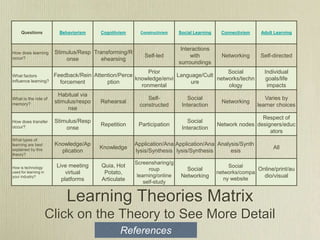
Questions            Behaviorism    Cognitivism     Constructivism   Social Learning    Connectivism    Adult Learning


                                                                           Interactions
How does learning       Stimulus/Resp Transforming/R
occur?                                                     Self-led            with           Networking     Self-directed
                            onse         ehearsing
                                                                          surroundings
                                                           Prior                       Social                 Individual
What factors            Feedback/Rein Attention/Perce                Language/Cult
influence learning?                                   knowledge/envi               networks/techn             goals/life
                          forcement        ption                          ure
                                                        ronmental                      ology                   impacts
                         Habitual via
What is the role of                                         Self-            Social                            Varies by
memory?                 stimulus/respo   Rehearsal                                            Networking
                                                         constructed       Interaction                      learner choices
                             nse
                                                                                                            Respect of
How does transfer       Stimulus/Resp                                         Social
occur?                                   Repetition     Participation                       Network nodes designers/educ
                            onse                                           Interaction
                                                                                                               ators
What types of
learning are best       Knowledge/Ap                   Application/Ana Application/Ana Analysis/Synth
explained by this                        Knowledge                                                                All
                          plication                    lysis/Synthesis lysis/Synthesis      esis
theory?

                                                       Screensharing/g
How is technology        Live meeting    Quia, Hot                                               Social
                                                             roup            Social                        Online/print/au
used for learning in         virtual      Potato,                                           networks/compa
your industry?                                          learning/online    Networking                        dio/visual
                           platforms     Articulate                                            ny website
                                                           self-study


                             Learning Theories Matrix
                       Click on the Theory to See More Detail
                                                 References
Behaviorism - How Does
     Learning Occur?


• Learners relate to physical/visible stimuli and
 responses (Ormrod, 2011)

• Learned habits (Standridge, 2001)
Behaviorism - What Factors
   Influence Learning?


• Sequencing
• Feedback/Reinforcem
 ent (Standridge,
 2001)
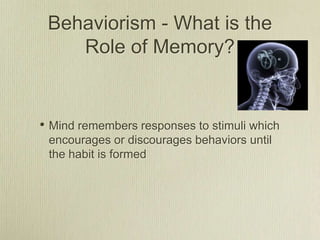
Behaviorism - What is the
    Role of Memory?


• Mind remembers responses to stimuli which
 encourages or discourages behaviors until
 the habit is formed
Behaviorism - How Does
   Transfer Occur?


       • Through stimulus and
        response
Behaviorism - What Types of
    Learning are Best
        Explained?
            • Knowledge and
             application - forming
             habits allows for easy
             recall
             (remembering/knowledg
             e) and for ease of
             application
Behaviorism - How is
Technology Used for Learning in
        My Industry?
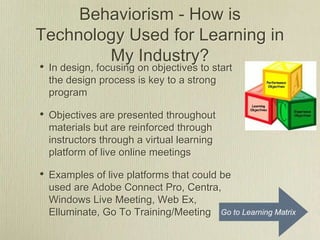
•   In design, focusing on objectives to start
    the design process is key to a strong
    program

•   Objectives are presented throughout
    materials but are reinforced through
    instructors through a virtual learning
    platform of live online meetings

•   Examples of live platforms that could be
    used are Adobe Connect Pro, Centra,
    Windows Live Meeting, Web Ex,
    Elluminate, Go To Training/Meeting Go to Learning Matrix
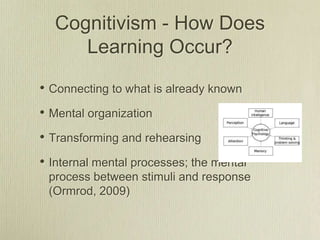
Cognitivism - How Does
     Learning Occur?

• Connecting to what is already known
• Mental organization
• Transforming and rehearsing
• Internal mental processes; the mental
 process between stimuli and response
 (Ormrod, 2009)
Cognitivism - What Factors
   Influence Learning?

      • Attention
      • Perception
      • Mental Processes
Cognitivism - What is the
     Role of Memory?
• Many theories of how memory
 works within cognitivism exist: two-
 store, levels of processing,
 activation level, to name a few

• All theories associated with
 cognitivism agree that rehearsal is
 the key to remembering starting
 with encoding, storage, and then
 retrieval
Cognitivism - How Does
     Transfer Occur?


• Through repetition, knowledge transfers to
 long-term memory and the learner is able to
 recall those memories
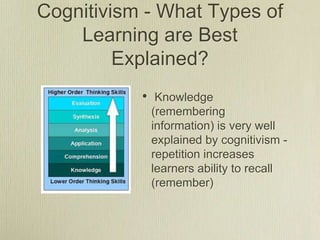
Cognitivism - What Types of
    Learning are Best
         Explained?
           • Knowledge
            (remembering
            information) is very well
            explained by cognitivism -
            repetition increases
            learners ability to recall
            (remember)
Cognitivism - How is Technology
   Used for Learning in My
           Industry?
• Various programs assist with development of
 learning games that help connect prior
 knowledge to current application

• Examples: Quia (online learning game
 program), Hot Potato (creates flash games
 that can be loaded to various virtual learning
 platforms), Articulate (create flash
 presentations with learning games
 embedded)
                                    Go to Learning Matrix
Constructivism- How Does
    Learning Occur?

• Learning is self-led
• Learners construct theories of knowledge
 and know truths only by what they construct
 through their self-led instruction guided by
 their theories (Ormrod, 2009)
Constructivism - What
Factors Influence Learning?

• Exogenous - world influences - exposure to
 various experiences

• Endogenous - previously acquired
 knowledge

• Dialectical - interactions with environment
Constructivism - What is the
     Role of Memory?


• Learners tend to remember more if they
 construct the knowledge themselves

• Memory is produced by mixing prior
 knowledge with current context
Constructivism - How Does
    Transfer Occur?

• The learner strives to acquire knowledge and
 through asking questions of their own
 knowledge, increases knowledge

• Assisted with group and individual projects
 that are not necessarily instructor led
Constructivism - What Types
   of Learning are Best
        Explained?
           • Application, Analysis, and
            Synthesis can be
            explained by
            constructivism

           • Topics that are vague
            and social in nature are
            explained well with
            constructivist theories
Constructivism - How is
Technology Used for Learning in
        My Industry?
• Screensharing capabilities (allow learners to
 control screen to apply instruction)

• Small groups (available in various virtual
 learning platforms)

• Self-study via online courses (various LMS
 systems available for this - Facebook can be
 used as an LMS as well)
                                   Go to Learning Matrix
Social Learning - How Does
     Learning Occur?


• Through interactions with other people,
 cultures, and individual experience per
 Vygotsky (Ormrod, 2009)
Social Learning - What
Factors Influence Learning?


• Language
• Cultural institutions
• Cultural objects
Social Learning - What is the
     Role of Memory?


• Memories are more easily recalled if
 connected to a social interaction
Social Learning - How Does
     Transfer Occur?


• Social interactions with tools, objects,
 people, adult/child, etc.
Social Learning - What Types
    of Learning are Best
         Explained?
            • Like Constructivism:
             Application, Analysis,
             and Synthesis

            • Topics that are vague
             and social in nature are
             explained well with
             constructivist theories
Social Learning - How is
Technology Used for Learning in
        My Industry?

• Social Networking (Ning, Facebook, Twitter)
• Blogging
• LMS forums
• Company forums

                                 Go to Learning Matrix
Connectivism - How Does
    Learning Occur?


• Via networking - receiving and sharing alike
• Technology and visualization
Connectivism - What Factors
   Influence Learning?

• Social networks and diversity of opinions
 without those networks

• Technologies
• Overall learning environment (Siemens,
 2011)
Connectivism - What is the
     Role of Memory?

• Memory is defined by connection of
 nodes - networking

• Patterning
• Memory may be non-human - stored in
 an appliance (Davis, 2008)
Connectivism - How Does
     Transfer Occur?


• Connections to nodes within the learners
 network (Davis, 2008)
Connectivism - What Types
   of Learning are Best
        Explained?
          • Analysis and synthesis
          • More complex topics
          • Topics that are rapidly
           changing like the
           technology that defines
           the theory (Davis, 2008)
Connectivism - How is
Technology Used for Learning in
        My Industry?

• Social Networking (i.e. Facebook, Twitter,
 LinkedIn)

• LMS Forums
• Company website

                                  Go to Learning Matrix
Adult Learning - How Does
     Learning Occur?

•Self-directed
•Through participation starting with determining
topics through final results

•(Lieb, 1991)
Adult Learning - What
Factors Influence Learning?


• Educational goals
• Work goals
• Life impact
Adult Learning - What is the
     Role of Memory?


• Memories are developed using a variety of
 skills based on learners choices
Adult Learning - How Does
     Transfer Occur?


• Via respect from instructors and designers
 regarding learners desire to learn
Adult Learning - What Types
   of Learning are Best
        Explained?


           • All types of learning can
            be associated with adult
            learning.
Adult Learning - How is
Technology Used for Learning in
         My Industry?
• Online LMS
• Social Learning (i.e. Facebook, Twitter,
 blogs, forums)

• Audiobooks
• Videos
• Print (offered online also as PDF)
                                   Go to Learning Matrix
References

•   Davis, C., Edmunds, E., & Kelly-Bateman, V. (2008). Connectivism. In M. Orey (Ed.), Emerging perspectives on learning, teaching,
    and technology. Retrieved on April 16, 2011 from http://projects.coe.uga.edu/epltt/index.php?title=Connectivism


•   Kerr, Bill. (2001). _isms a filter, not a blinker. Bill Kerr Blog. Retrieved on April 16, 2011 from
    http://billkerr2.blogspot.com/2007/01/isms-as-filter-not-blinker.html


•   Lieb, Stephen. (1991). Principles of Adult Learning. VISION. Retrieved on April 16, 2011 from
    http://honolulu.hawaii.edu/intranet/committees/FacDevCom/guidebk/teachtip/adults-2.htm.


•   Ormrod, Jeanne. (2011). Behaviorism and Instructional Design. Video for Walden University.


•   Ormrod, J., Schunk, D., & Gredler, M. (2009). Learning theories and instruction (Laureate custom edition). New York: Pearson.


•   Siemens, George. (2011). Connectivism. Video for Walden University.


•   Standridge, M. (2001). Behaviorism. In M. Orey (Ed.), Emerging perspectives on learning, teaching, and technology. Retrieved on
    April 16, 2011 from http://projects.coe.uga.edu/epltt/index.php?title=Behaviorism

Learningmatrix learning theories

  • 1.
    Learning Theories and Instructional Design By Christy Case Walden University EDUC 6115 Prof. Dr. Shirley Weaver April 16, 2011 Go to Learning Matrix
  • 2.
    Questions Behaviorism Cognitivism Constructivism Social Learning Connectivism Adult Learning Interactions How does learning Stimulus/Resp Transforming/R occur? Self-led with Networking Self-directed onse ehearsing surroundings Prior Social Individual What factors Feedback/Rein Attention/Perce Language/Cult influence learning? knowledge/envi networks/techn goals/life forcement ption ure ronmental ology impacts Habitual via What is the role of Self- Social Varies by memory? stimulus/respo Rehearsal Networking constructed Interaction learner choices nse Respect of How does transfer Stimulus/Resp Social occur? Repetition Participation Network nodes designers/educ onse Interaction ators What types of learning are best Knowledge/Ap Application/Ana Application/Ana Analysis/Synth explained by this Knowledge All plication lysis/Synthesis lysis/Synthesis esis theory? Screensharing/g How is technology Live meeting Quia, Hot Social roup Social Online/print/au used for learning in virtual Potato, networks/compa your industry? learning/online Networking dio/visual platforms Articulate ny website self-study Learning Theories Matrix Click on the Theory to See More Detail References
  • 3.
    Behaviorism - HowDoes Learning Occur? • Learners relate to physical/visible stimuli and responses (Ormrod, 2011) • Learned habits (Standridge, 2001)
  • 4.
    Behaviorism - WhatFactors Influence Learning? • Sequencing • Feedback/Reinforcem ent (Standridge, 2001)
  • 5.
    Behaviorism - Whatis the Role of Memory? • Mind remembers responses to stimuli which encourages or discourages behaviors until the habit is formed
  • 6.
    Behaviorism - HowDoes Transfer Occur? • Through stimulus and response
  • 7.
    Behaviorism - WhatTypes of Learning are Best Explained? • Knowledge and application - forming habits allows for easy recall (remembering/knowledg e) and for ease of application
  • 8.
    Behaviorism - Howis Technology Used for Learning in My Industry? • In design, focusing on objectives to start the design process is key to a strong program • Objectives are presented throughout materials but are reinforced through instructors through a virtual learning platform of live online meetings • Examples of live platforms that could be used are Adobe Connect Pro, Centra, Windows Live Meeting, Web Ex, Elluminate, Go To Training/Meeting Go to Learning Matrix
  • 9.
    Cognitivism - HowDoes Learning Occur? • Connecting to what is already known • Mental organization • Transforming and rehearsing • Internal mental processes; the mental process between stimuli and response (Ormrod, 2009)
  • 10.
    Cognitivism - WhatFactors Influence Learning? • Attention • Perception • Mental Processes
  • 11.
    Cognitivism - Whatis the Role of Memory? • Many theories of how memory works within cognitivism exist: two- store, levels of processing, activation level, to name a few • All theories associated with cognitivism agree that rehearsal is the key to remembering starting with encoding, storage, and then retrieval
  • 12.
    Cognitivism - HowDoes Transfer Occur? • Through repetition, knowledge transfers to long-term memory and the learner is able to recall those memories
  • 13.
    Cognitivism - WhatTypes of Learning are Best Explained? • Knowledge (remembering information) is very well explained by cognitivism - repetition increases learners ability to recall (remember)
  • 14.
    Cognitivism - Howis Technology Used for Learning in My Industry? • Various programs assist with development of learning games that help connect prior knowledge to current application • Examples: Quia (online learning game program), Hot Potato (creates flash games that can be loaded to various virtual learning platforms), Articulate (create flash presentations with learning games embedded) Go to Learning Matrix
  • 15.
    Constructivism- How Does Learning Occur? • Learning is self-led • Learners construct theories of knowledge and know truths only by what they construct through their self-led instruction guided by their theories (Ormrod, 2009)
  • 16.
    Constructivism - What FactorsInfluence Learning? • Exogenous - world influences - exposure to various experiences • Endogenous - previously acquired knowledge • Dialectical - interactions with environment
  • 17.
    Constructivism - Whatis the Role of Memory? • Learners tend to remember more if they construct the knowledge themselves • Memory is produced by mixing prior knowledge with current context
  • 18.
    Constructivism - HowDoes Transfer Occur? • The learner strives to acquire knowledge and through asking questions of their own knowledge, increases knowledge • Assisted with group and individual projects that are not necessarily instructor led
  • 19.
    Constructivism - WhatTypes of Learning are Best Explained? • Application, Analysis, and Synthesis can be explained by constructivism • Topics that are vague and social in nature are explained well with constructivist theories
  • 20.
    Constructivism - Howis Technology Used for Learning in My Industry? • Screensharing capabilities (allow learners to control screen to apply instruction) • Small groups (available in various virtual learning platforms) • Self-study via online courses (various LMS systems available for this - Facebook can be used as an LMS as well) Go to Learning Matrix
  • 21.
    Social Learning -How Does Learning Occur? • Through interactions with other people, cultures, and individual experience per Vygotsky (Ormrod, 2009)
  • 22.
    Social Learning -What Factors Influence Learning? • Language • Cultural institutions • Cultural objects
  • 23.
    Social Learning -What is the Role of Memory? • Memories are more easily recalled if connected to a social interaction
  • 24.
    Social Learning -How Does Transfer Occur? • Social interactions with tools, objects, people, adult/child, etc.
  • 25.
    Social Learning -What Types of Learning are Best Explained? • Like Constructivism: Application, Analysis, and Synthesis • Topics that are vague and social in nature are explained well with constructivist theories
  • 26.
    Social Learning -How is Technology Used for Learning in My Industry? • Social Networking (Ning, Facebook, Twitter) • Blogging • LMS forums • Company forums Go to Learning Matrix
  • 27.
    Connectivism - HowDoes Learning Occur? • Via networking - receiving and sharing alike • Technology and visualization
  • 28.
    Connectivism - WhatFactors Influence Learning? • Social networks and diversity of opinions without those networks • Technologies • Overall learning environment (Siemens, 2011)
  • 29.
    Connectivism - Whatis the Role of Memory? • Memory is defined by connection of nodes - networking • Patterning • Memory may be non-human - stored in an appliance (Davis, 2008)
  • 30.
    Connectivism - HowDoes Transfer Occur? • Connections to nodes within the learners network (Davis, 2008)
  • 31.
    Connectivism - WhatTypes of Learning are Best Explained? • Analysis and synthesis • More complex topics • Topics that are rapidly changing like the technology that defines the theory (Davis, 2008)
  • 32.
    Connectivism - Howis Technology Used for Learning in My Industry? • Social Networking (i.e. Facebook, Twitter, LinkedIn) • LMS Forums • Company website Go to Learning Matrix
  • 33.
    Adult Learning -How Does Learning Occur? •Self-directed •Through participation starting with determining topics through final results •(Lieb, 1991)
  • 34.
    Adult Learning -What Factors Influence Learning? • Educational goals • Work goals • Life impact
  • 35.
    Adult Learning -What is the Role of Memory? • Memories are developed using a variety of skills based on learners choices
  • 36.
    Adult Learning -How Does Transfer Occur? • Via respect from instructors and designers regarding learners desire to learn
  • 37.
    Adult Learning -What Types of Learning are Best Explained? • All types of learning can be associated with adult learning.
  • 38.
    Adult Learning -How is Technology Used for Learning in My Industry? • Online LMS • Social Learning (i.e. Facebook, Twitter, blogs, forums) • Audiobooks • Videos • Print (offered online also as PDF) Go to Learning Matrix
  • 39.
    References • Davis, C., Edmunds, E., & Kelly-Bateman, V. (2008). Connectivism. In M. Orey (Ed.), Emerging perspectives on learning, teaching, and technology. Retrieved on April 16, 2011 from http://projects.coe.uga.edu/epltt/index.php?title=Connectivism • Kerr, Bill. (2001). _isms a filter, not a blinker. Bill Kerr Blog. Retrieved on April 16, 2011 from http://billkerr2.blogspot.com/2007/01/isms-as-filter-not-blinker.html • Lieb, Stephen. (1991). Principles of Adult Learning. VISION. Retrieved on April 16, 2011 from http://honolulu.hawaii.edu/intranet/committees/FacDevCom/guidebk/teachtip/adults-2.htm. • Ormrod, Jeanne. (2011). Behaviorism and Instructional Design. Video for Walden University. • Ormrod, J., Schunk, D., & Gredler, M. (2009). Learning theories and instruction (Laureate custom edition). New York: Pearson. • Siemens, George. (2011). Connectivism. Video for Walden University. • Standridge, M. (2001). Behaviorism. In M. Orey (Ed.), Emerging perspectives on learning, teaching, and technology. Retrieved on April 16, 2011 from http://projects.coe.uga.edu/epltt/index.php?title=Behaviorism