GIANTTEMPLATE.COM
Behaviorism
Group 1
1. Muncar Winarti ( 0203518007)
2. Sari Ramadhani (0203518023)
3. Suci Ramadhani (0203518024)
4. Khilma Nahdia (0203518035)
5. Hajar Munawaroh (0203518036)
GIANTTEMPLATE.COM
Outline
1. Definition of
behaviourism
2. Aspects of behaviourism
3. Behaviorism Theorist
4. Teachers’ and Students’
Role
5. Characteristics of
Behaviourism
6. Application of
instructional design
7. Example of application
8. Pros and Cons
Definition and aspects of behaviorism
GIANTTEMPLATE.COM
What is behaviourism?
Behaviourism is an
approach which attemps
to explain animal and
human behaviour in term
of learning.
GIANTTEMPLATE.COM
Aspect of Behaviorism
• Stimulus is an observable environmental event
that has a potential to exert control over a
behavioral response
• Response is an over behavior by a learner
• Reinforcement is a consequence that increases
the probability that a behavior will occur
• Punishment is a consequence that decrease the
undesired behavior
Classical Conditioning vs. Operant Conditioning
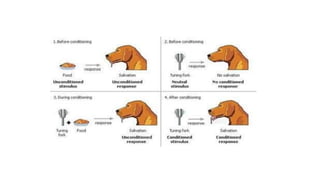
Classical Conditioning
Classical conditioning is a type of learning which based on the association of a
stimulus that does not ordinarily elicit a particular response with another
stimulus that does elicit the response (Papalia, Feldman, & Olde, 2007)
From the definition above, we understand that the key element in classical
conditioning is association. It means that if two stimuli repeatedly experienced
together, they will become associated.
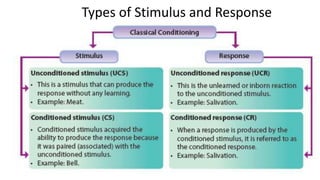
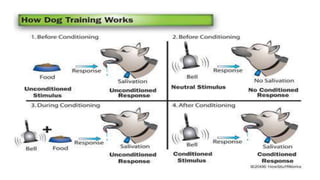
Types of Stimulus and Response
Operant Conditioning
Operant or instrumental conditioning is a form of learning in which the
consequences of behavior lead to changes in the probability that the
behavior will occur.
Thondike was the pioneer in studying this kind of learning. His famous
formulation of Law of Effect lies at the heart of operant conditioning.
The Law of Effect states that behavior that brings a satisfying effect
(reinforcement) is apt to be performed again, whereas behavior that
brings about negative effect (punishment) is apt to be suppressed.”
(Morris & Maisto, 2001)
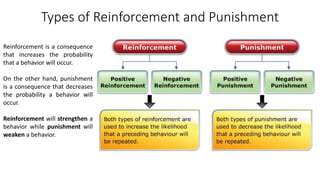
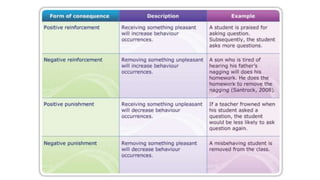
Types of Reinforcement and Punishment
Reinforcement is a consequence
that increases the probability
that a behavior will occur.
On the other hand, punishment
is a consequence that decreases
the probability a behavior will
occur.
Reinforcement will strengthen a
behavior while punishment will
weaken a behavior.
Behaviorism Theorists
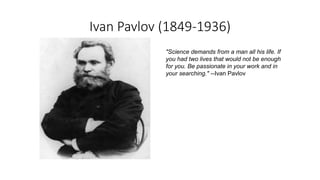
Ivan Pavlov (1849-1936)
"Science demands from a man all his life. If
you had two lives that would not be enough
for you. Be passionate in your work and in
your searching." --Ivan Pavlov
GIANTTEMPLATE.COM
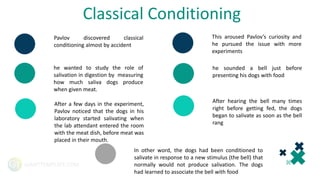
Pavlov discovered classical
conditioning almost by accident
he wanted to study the role of
salivation in digestion by measuring
how much saliva dogs produce
when given meat.
After a few days in the experiment,
Pavlov noticed that the dogs in his
laboratory started salivating when
the lab attendant entered the room
with the meat dish, before meat was
placed in their mouth.
In other word, the dogs had been conditioned to
salivate in response to a new stimulus (the bell) that
normally would not produce salivation. The dogs
had learned to associate the bell with food
Classical Conditioning
This aroused Pavlov’s curiosity and
he pursued the issue with more
experiments
he sounded a bell just before
presenting his dogs with food
After hearing the bell many times
right before getting fed, the dogs
began to salivate as soon as the bell
rang
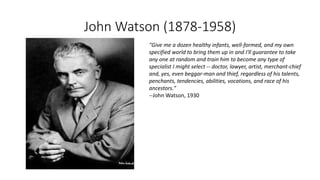
John Watson (1878-1958)
"Give me a dozen healthy infants, well-formed, and my own
specified world to bring them up in and I'll guarantee to take
any one at random and train him to become any type of
specialist I might select -- doctor, lawyer, artist, merchant-chief
and, yes, even beggar-man and thief, regardless of his talents,
penchants, tendencies, abilities, vocations, and race of his
ancestors."
--John Watson, 1930
GIANTTEMPLATE.COM
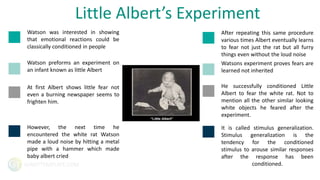
Watson was interested in showing
that emotional reactions could be
classically conditioned in people
Watson preforms an experiment on
an infant known as little Albert
At first Albert shows little fear not
even a burning newspaper seems to
frighten him.
However, the next time he
encountered the white rat Watson
made a loud noise by hitting a metal
pipe with a hammer which made
baby albert cried
Little Albert’s Experiment
After repeating this same procedure
various times Albert eventually learns
to fear not just the rat but all furry
things even without the loud noise
Watsons experiment proves fears are
learned not inherited
He successfully conditioned Little
Albert to fear the white rat. Not to
mention all the other similar looking
white objects he feared after the
experiment.
It is called stimulus generalization.
Stimulus generalization is the
tendency for the conditioned
stimulus to arouse similar responses
after the response has been
conditioned.
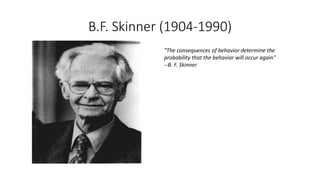
B.F. Skinner (1904-1990)
"The consequences of behavior determine the
probability that the behavior will occur again"
--B. F. Skinner
B. F. Skinner
Operant Conditioning
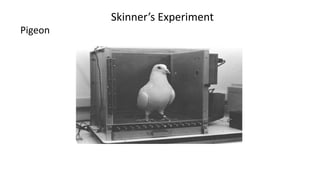
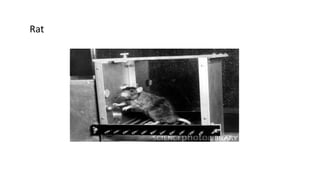
Psychologist B.F Skinner known as one of the leaders of behaviorism
furthered the behaviorist perspective. He was very much influenced by
Pavlov’s experiments and the ideas of Watson. Skinner believed that the
best way to understand behavior is to look at the causes of an action and its
consequences. This was his concept of operant conditioning.
Skinner’s Experiment
Pigeon
Rat
GIANTTEMPLATE.COM
Operant conditioning demonstrated the effect of positive and negative
reinforcement on behavior.
Children can receive rewards like
money for doing chores which
leads them want to keep
repeating that behavior to
receive the rewards, thus
strengthening behavior with
positive reinforcement
You can also use negative
reinforcement to strengthen a
behavior by removing or stopping an
unpleasant experience. For example,
taking away privileges from a child
as punishment for talking back to
their parents it will lead the child to
want to not be disrespectful next
time. As a result, this gets rid of their
undesirable behavior.
Teachers’ and Students’ Role
GIANTTEMPLATE.COM
Give the
learner
immediate
feedback
Break down
the tasks into
small tasks
Repeat the
directions as
many times as
possible
Work from the
most simple to
the most
complex tasks
Teachers’ Role
Give positive
reinforcement
GIANTTEMPLATE.COM
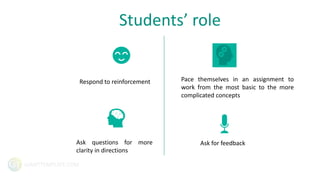
Respond to reinforcement
Ask questions for more
clarity in directions
Pace themselves in an assignment to
work from the most basic to the more
complicated concepts
Ask for feedback
Students’ role
Characteristics of Behaviourism
GIANTTEMPLATE.COM
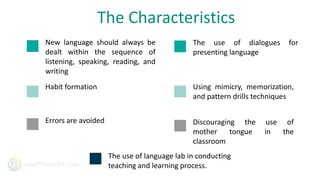
The use of dialogues for
presenting language
Using mimicry, memorization,
and pattern drills techniques
Discouraging the use of
mother tongue in the
classroom
The Characteristics
New language should always be
dealt within the sequence of
listening, speaking, reading, and
writing
Habit formation
Errors are avoided
The use of language lab in conducting
teaching and learning process.
GIANTTEMPLATE.COM
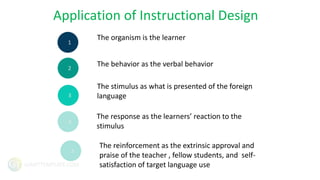
Application of Instructional Design
1
The organism is the learner
2
The behavior as the verbal behavior
3
The stimulus as what is presented of the foreign
language
4
The response as the learners’ reaction to the
stimulus
5
The reinforcement as the extrinsic approval and
praise of the teacher , fellow students, and self-
satisfaction of target language use
GIANTTEMPLATE.COM
Example of Application
A teacher provides a substantial list of practice problems for pupil to
learn new vocabularies about fruit
• Stimulus
• The teacher write the new words about fruit on board
• Response
• students’ follow and memorize the vocabularies.
• Learning
• students’ repeat the material and rewrite the vocabulary in their
books
Behaviorism Pros and Cons
TITTLE HERE
GIANTTEMPLATE.COM
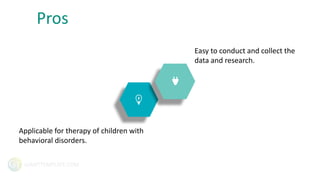
Easy to conduct and collect the
data and research.
Pros
Applicable for therapy of children with
behavioral disorders.
Does not account for other ways of
learning.
One- Dimensial Approach
Cons
People can change their behavior
when presented with new
information.
Thank You!

GROUP 1 BEHAVIORISM.pptx

  • 1.
    GIANTTEMPLATE.COM Behaviorism Group 1 1. MuncarWinarti ( 0203518007) 2. Sari Ramadhani (0203518023) 3. Suci Ramadhani (0203518024) 4. Khilma Nahdia (0203518035) 5. Hajar Munawaroh (0203518036)
  • 2.
    GIANTTEMPLATE.COM Outline 1. Definition of behaviourism 2.Aspects of behaviourism 3. Behaviorism Theorist 4. Teachers’ and Students’ Role 5. Characteristics of Behaviourism 6. Application of instructional design 7. Example of application 8. Pros and Cons
  • 3.
    Definition and aspectsof behaviorism
  • 4.
    GIANTTEMPLATE.COM What is behaviourism? Behaviourismis an approach which attemps to explain animal and human behaviour in term of learning.
  • 5.
    GIANTTEMPLATE.COM Aspect of Behaviorism •Stimulus is an observable environmental event that has a potential to exert control over a behavioral response • Response is an over behavior by a learner • Reinforcement is a consequence that increases the probability that a behavior will occur • Punishment is a consequence that decrease the undesired behavior
  • 6.
    Classical Conditioning vs.Operant Conditioning
  • 7.
    Classical Conditioning Classical conditioningis a type of learning which based on the association of a stimulus that does not ordinarily elicit a particular response with another stimulus that does elicit the response (Papalia, Feldman, & Olde, 2007) From the definition above, we understand that the key element in classical conditioning is association. It means that if two stimuli repeatedly experienced together, they will become associated.
  • 9.
    Types of Stimulusand Response
  • 10.
    Operant Conditioning Operant orinstrumental conditioning is a form of learning in which the consequences of behavior lead to changes in the probability that the behavior will occur. Thondike was the pioneer in studying this kind of learning. His famous formulation of Law of Effect lies at the heart of operant conditioning. The Law of Effect states that behavior that brings a satisfying effect (reinforcement) is apt to be performed again, whereas behavior that brings about negative effect (punishment) is apt to be suppressed.” (Morris & Maisto, 2001)
  • 11.
    Types of Reinforcementand Punishment Reinforcement is a consequence that increases the probability that a behavior will occur. On the other hand, punishment is a consequence that decreases the probability a behavior will occur. Reinforcement will strengthen a behavior while punishment will weaken a behavior.
  • 13.
  • 14.
    Ivan Pavlov (1849-1936) "Sciencedemands from a man all his life. If you had two lives that would not be enough for you. Be passionate in your work and in your searching." --Ivan Pavlov
  • 15.
    GIANTTEMPLATE.COM Pavlov discovered classical conditioningalmost by accident he wanted to study the role of salivation in digestion by measuring how much saliva dogs produce when given meat. After a few days in the experiment, Pavlov noticed that the dogs in his laboratory started salivating when the lab attendant entered the room with the meat dish, before meat was placed in their mouth. In other word, the dogs had been conditioned to salivate in response to a new stimulus (the bell) that normally would not produce salivation. The dogs had learned to associate the bell with food Classical Conditioning This aroused Pavlov’s curiosity and he pursued the issue with more experiments he sounded a bell just before presenting his dogs with food After hearing the bell many times right before getting fed, the dogs began to salivate as soon as the bell rang
  • 17.
    John Watson (1878-1958) "Giveme a dozen healthy infants, well-formed, and my own specified world to bring them up in and I'll guarantee to take any one at random and train him to become any type of specialist I might select -- doctor, lawyer, artist, merchant-chief and, yes, even beggar-man and thief, regardless of his talents, penchants, tendencies, abilities, vocations, and race of his ancestors." --John Watson, 1930
  • 18.
    GIANTTEMPLATE.COM Watson was interestedin showing that emotional reactions could be classically conditioned in people Watson preforms an experiment on an infant known as little Albert At first Albert shows little fear not even a burning newspaper seems to frighten him. However, the next time he encountered the white rat Watson made a loud noise by hitting a metal pipe with a hammer which made baby albert cried Little Albert’s Experiment After repeating this same procedure various times Albert eventually learns to fear not just the rat but all furry things even without the loud noise Watsons experiment proves fears are learned not inherited He successfully conditioned Little Albert to fear the white rat. Not to mention all the other similar looking white objects he feared after the experiment. It is called stimulus generalization. Stimulus generalization is the tendency for the conditioned stimulus to arouse similar responses after the response has been conditioned.

  • 19.
    B.F. Skinner (1904-1990) "Theconsequences of behavior determine the probability that the behavior will occur again" --B. F. Skinner
  • 20.
    B. F. Skinner OperantConditioning Psychologist B.F Skinner known as one of the leaders of behaviorism furthered the behaviorist perspective. He was very much influenced by Pavlov’s experiments and the ideas of Watson. Skinner believed that the best way to understand behavior is to look at the causes of an action and its consequences. This was his concept of operant conditioning.
  • 21.
  • 22.
  • 23.
    GIANTTEMPLATE.COM Operant conditioning demonstratedthe effect of positive and negative reinforcement on behavior. Children can receive rewards like money for doing chores which leads them want to keep repeating that behavior to receive the rewards, thus strengthening behavior with positive reinforcement You can also use negative reinforcement to strengthen a behavior by removing or stopping an unpleasant experience. For example, taking away privileges from a child as punishment for talking back to their parents it will lead the child to want to not be disrespectful next time. As a result, this gets rid of their undesirable behavior.
  • 24.
  • 25.
    GIANTTEMPLATE.COM Give the learner immediate feedback Break down thetasks into small tasks Repeat the directions as many times as possible Work from the most simple to the most complex tasks Teachers’ Role Give positive reinforcement
  • 26.
    GIANTTEMPLATE.COM Respond to reinforcement Askquestions for more clarity in directions Pace themselves in an assignment to work from the most basic to the more complicated concepts Ask for feedback Students’ role
  • 27.
  • 28.
    GIANTTEMPLATE.COM The use ofdialogues for presenting language Using mimicry, memorization, and pattern drills techniques Discouraging the use of mother tongue in the classroom The Characteristics New language should always be dealt within the sequence of listening, speaking, reading, and writing Habit formation Errors are avoided The use of language lab in conducting teaching and learning process.
  • 29.
    GIANTTEMPLATE.COM Application of InstructionalDesign 1 The organism is the learner 2 The behavior as the verbal behavior 3 The stimulus as what is presented of the foreign language 4 The response as the learners’ reaction to the stimulus 5 The reinforcement as the extrinsic approval and praise of the teacher , fellow students, and self- satisfaction of target language use
  • 30.
    GIANTTEMPLATE.COM Example of Application Ateacher provides a substantial list of practice problems for pupil to learn new vocabularies about fruit • Stimulus • The teacher write the new words about fruit on board • Response • students’ follow and memorize the vocabularies. • Learning • students’ repeat the material and rewrite the vocabulary in their books
  • 31.
    Behaviorism Pros andCons TITTLE HERE
  • 32.
    GIANTTEMPLATE.COM Easy to conductand collect the data and research. Pros Applicable for therapy of children with behavioral disorders.
  • 33.
    Does not accountfor other ways of learning. One- Dimensial Approach Cons People can change their behavior when presented with new information.
  • 34.