Motivational
 Feedback
     &
 Coaching
Feedback & Coaching skills

Purpose:
• Maximise alignment between a person’s
  work and requirements
• Conduct more productive work planning
  and development conversations
• Promote intrinsic motivation
Different types of feedback
• Relational feedback
  That’s great! I’m really pleased with your work!
(General positive comments, personal)
• Observational feedback
  I noticed that you are taking notes and providing a
  useful summary at the end of the meeting for the
  group.
(Specific concrete actions, no judgement)
Different types of feedback

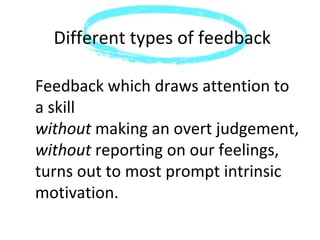
Feedback which draws attention to
a skill
without making an overt judgement,
without reporting on our feelings,
turns out to most prompt intrinsic
motivation.
Motivation

Intrinsic motivation – something is
done because it is inherently
interesting or enjoyable

Extrinsic motivation – something is
done because it leads to some
particular outcome
Observing what annoys you more
       than what pleases you…

       The positivity/negativity ratio (P/N)
      positive feedback : negative feedback.

         Typical high performance teams:
                   P/N ratio of 5.6
Ie members of these teams offer nearly 6 times as
many observations of things done well, against
things that might be done differently
Positive reinforcement feedback

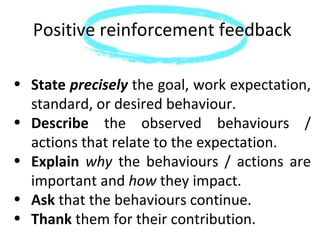
• State precisely the goal, work expectation,
  standard, or desired behaviour.
• Describe the observed behaviours /
  actions that relate to the expectation.
• Explain why the behaviours / actions are
  important and how they impact.
• Ask that the behaviours continue.
• Thank them for their contribution.
Redirective feedback

• State precisely the goal, performance
  expectation, standard, or desired behaviour.
• Describe the observed behaviours / actions
  that relate to the expectation.
• Explain why the demonstrated behaviours are
  not effective and how this affects group goals.
• Ask the employee for their views on the issue.
  They may have facts that you do not.
• Ask what actions the employee will take to
  meet the expectation.
Symptoms of conflict

Judging           …who you are
Characterising …what you do
Attributing       …motives to
              explain why you do it
Dictating         …solutions to
                          perceived
problems
Fundamental attribution error

In    explaining   why    people
behave the way they do,
we tend to place:
 too much emphasis on a
person’s disposition;
 too little emphasis on their
situation.
Sources of difficulty at work

          WANT TO          ABLE TO
         (Motivation)     (Capacity)
           Positive    Skills, strengths
         & negative & weaknesses
Self      emotion        I do/don’t
         I do/don’t       have the
        want to do the skill(s) to do
             job            the job
Sources of difficulty at work

           WANT TO        ABLE TO
          (Motivation)   (Capacity)
         Praise &          Help &
         pressure          hurdles
Other   Others say       Others do
        things that      things that
         support/           help/
      undermine me       hinder me
Sources of difficulty at work

           WANT TO        ABLE TO
          (Motivation)   (Capacity)
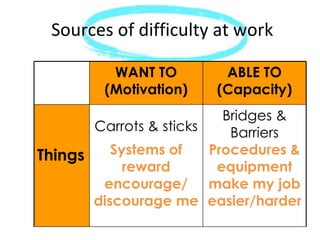
                          Bridges &
       Carrots & sticks    Barriers
Things    Systems of    Procedures &
            reward       equipment
        encourage/ make my job
       discourage me easier/harder
Attachment styles
Attachment styles
Attachment styles
Attachment styles
Attachment styles
The pessimistic explanatory style
A negative event is explained as”
Permanent
 “It will never change"
Personal
 “It's my fault"
Pervasive
 "I can't do anything correctly”
The capacity to work to address an
unpleasant situation despite past
experience correlates highly with an
optimistic explanatory style:

  “This situation is not personal,
    pervasive, or permanent.”

Motivational Feedback

  • 1.
  • 2.
    Feedback & Coachingskills Purpose: • Maximise alignment between a person’s work and requirements • Conduct more productive work planning and development conversations • Promote intrinsic motivation
  • 3.
    Different types offeedback • Relational feedback That’s great! I’m really pleased with your work! (General positive comments, personal) • Observational feedback I noticed that you are taking notes and providing a useful summary at the end of the meeting for the group. (Specific concrete actions, no judgement)
  • 4.
    Different types offeedback Feedback which draws attention to a skill without making an overt judgement, without reporting on our feelings, turns out to most prompt intrinsic motivation.
  • 5.
    Motivation Intrinsic motivation –something is done because it is inherently interesting or enjoyable Extrinsic motivation – something is done because it leads to some particular outcome
  • 6.
    Observing what annoysyou more than what pleases you… The positivity/negativity ratio (P/N) positive feedback : negative feedback. Typical high performance teams: P/N ratio of 5.6 Ie members of these teams offer nearly 6 times as many observations of things done well, against things that might be done differently
  • 7.
    Positive reinforcement feedback •State precisely the goal, work expectation, standard, or desired behaviour. • Describe the observed behaviours / actions that relate to the expectation. • Explain why the behaviours / actions are important and how they impact. • Ask that the behaviours continue. • Thank them for their contribution.
  • 8.
    Redirective feedback • Stateprecisely the goal, performance expectation, standard, or desired behaviour. • Describe the observed behaviours / actions that relate to the expectation. • Explain why the demonstrated behaviours are not effective and how this affects group goals. • Ask the employee for their views on the issue. They may have facts that you do not. • Ask what actions the employee will take to meet the expectation.
  • 9.
    Symptoms of conflict Judging …who you are Characterising …what you do Attributing …motives to explain why you do it Dictating …solutions to perceived problems
  • 10.
    Fundamental attribution error In explaining why people behave the way they do, we tend to place:  too much emphasis on a person’s disposition;  too little emphasis on their situation.
  • 11.
    Sources of difficultyat work   WANT TO ABLE TO (Motivation) (Capacity) Positive Skills, strengths & negative & weaknesses Self emotion I do/don’t I do/don’t have the want to do the skill(s) to do job the job
  • 12.
    Sources of difficultyat work   WANT TO ABLE TO (Motivation) (Capacity) Praise & Help & pressure hurdles Other Others say Others do things that things that support/ help/ undermine me hinder me
  • 13.
    Sources of difficultyat work   WANT TO ABLE TO (Motivation) (Capacity) Bridges & Carrots & sticks Barriers Things Systems of Procedures & reward equipment encourage/ make my job discourage me easier/harder
  • 14.
  • 15.
  • 16.
  • 17.
  • 18.
  • 19.
    The pessimistic explanatorystyle A negative event is explained as” Permanent “It will never change" Personal “It's my fault" Pervasive "I can't do anything correctly”
  • 20.
    The capacity towork to address an unpleasant situation despite past experience correlates highly with an optimistic explanatory style: “This situation is not personal, pervasive, or permanent.”