COACHING
& FEEDBACK
• Coaching assumptions
• Why coaching?
• What is Coaching?
• Coaching structure & skills
• Constructive feedback
Session Outline
Coaching Assumptions
… is a task
… takes time
… is done by my line manager
… is about solving problems
… requires specialist knowledge
… is difficult
… is telling………
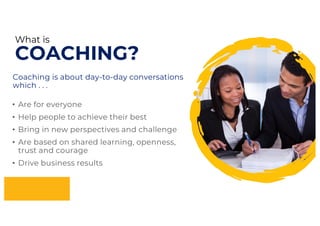
What is
COACHING?
• Are for everyone
• Help people to achieve their best
• Bring in new perspectives and challenge
• Are based on shared learning, openness,
trust and courage
• Drive business results
Coaching is about day-to-day conversations
which . . .
Coaching Mindset
• Coachee has the answers and resources themselves
• Coach’s job is to facilitate self-discovery
• Coach only provides input when coachee lacks
insight or experience to contribute ideas
• The coachee should do most of the talking
• Coach is not a technical expert or a “guru”.
Goal
Reality
Options
Wrap-up
G for Goal
ü The overall purpose of the coaching
ü The specific goal for this coaching
session
R for Reality
Helping to clearly see the current picture
by:
ü Inviting self assessment
ü Giving feedback
ü Challenging assumptions /
misconceptions
ü Helping the coachee to take a different
perspective…….
Reframing
The meaning any event depends on the “frame” in which we perceive it
Change the frame and the meaning changes
If the meaning changes, our response to the event changes also
Reframing is helping the Coachee to see a situation or issue differently in order to take a more
positive approach to the issue.
“I find long-haul flights boring”
• Long haul flights give me a chance to read a good book and watch films I
would otherwise miss
• Six hours with no interruptions – bliss!
“I hate housework – it’s hard work and dull”
• A one-hour workout with a clean house at the end!
“My boss has been in a bad mood since I messed up last week”
• My boss is upset about something. I should ask if he is OK
“That won’t work”
• Is there a way it could be made to work?
Reframing in Coaching
How to lead a coachee to REFRAME a
situation
Good questions to ask:
ü How do you know that?
ü What else could that mean?
ü What are the positives in this?
ü How could this be an opportunity?
ü How do you know that is what he meant?
ü What might be the positive intention in that behaviour?
O for Options
• Explore the full range of options
• Invite suggestions from the other person
• Offer suggestions carefully
• Identify role models.
W for Wrap-up
• Make choices
• Commit to action
• Identify specific steps and define timing
• Agree support.
Core Coaching Skills
• Feedback
• Questioning?
• Active Listening
• Story Telling
. . . supported by establishing and
maintaining rapport
Raise awareness
Generate responsibility
Develop self-motivation…
Goal
Reality
Questioning and GROW
Options
Wrap up
Coaching Secrets……
1. Coaching is a leadership style
2. Coaching can be quick
3. Coaching is done by anyone
4. Coaching is about improving performance
5. Coaching requires some simple skills
6. Coaching is easy
Perception or Truth?
“We are measured
not by what we are, but by the
perception of what we seem to be;
not by what we say, but how we are
heard;
not by what we do, but how we
appear to do it”.
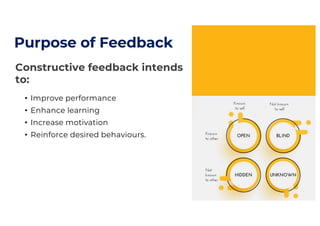
Purpose of Feedback
• Improve performance
• Enhance learning
• Increase motivation
• Reinforce desired behaviours.
Constructive feedback intends
to:
RECEIVING Feedback
• Listen actively
• Avoid explaining/justifying why you did something
• Don’t interrupt
• Ask questions for understanding
• Compare to previous feedback
• Make notes
• Consider ways forward
• Seek it.
Receiving Feedback - S-A-R-A
S … Surprise
A… Anxiety
R… Rejection
A… Acceptance.
GIVING Feedback
• Cover one thing at a time
• Be specific – give
examples of what you
experienced
• Look at the person
• Make the feedback
relevant
• Say what they could do
differently
• Focus on behaviours not
the person
• Describe the impact of
their actions/behaviours
• Make it timely.
Feedback Formula
• I liked –
“the clear way you explained your
rationale”
• I disliked –
“the way you interrupted when I
was speaking”
• What I’d like you to do in future is –
“wait for me to finish before you
speak”.
Best Practices
• No ‘but’ or ‘however’ between liked and
disliked
• Be specific
• Balance positive and negative
• Focus on most important
• Speak directly and unhesitatingly.
Thank you

Coaching & feedback

  • 1.
  • 2.
    • Coaching assumptions •Why coaching? • What is Coaching? • Coaching structure & skills • Constructive feedback Session Outline
  • 3.
    Coaching Assumptions … isa task … takes time … is done by my line manager … is about solving problems … requires specialist knowledge … is difficult … is telling………
  • 4.
    What is COACHING? • Arefor everyone • Help people to achieve their best • Bring in new perspectives and challenge • Are based on shared learning, openness, trust and courage • Drive business results Coaching is about day-to-day conversations which . . .
  • 5.
    Coaching Mindset • Coacheehas the answers and resources themselves • Coach’s job is to facilitate self-discovery • Coach only provides input when coachee lacks insight or experience to contribute ideas • The coachee should do most of the talking • Coach is not a technical expert or a “guru”.
  • 6.
  • 7.
    G for Goal üThe overall purpose of the coaching ü The specific goal for this coaching session
  • 8.
    R for Reality Helpingto clearly see the current picture by: ü Inviting self assessment ü Giving feedback ü Challenging assumptions / misconceptions ü Helping the coachee to take a different perspective…….
  • 9.
    Reframing The meaning anyevent depends on the “frame” in which we perceive it Change the frame and the meaning changes If the meaning changes, our response to the event changes also Reframing is helping the Coachee to see a situation or issue differently in order to take a more positive approach to the issue. “I find long-haul flights boring” • Long haul flights give me a chance to read a good book and watch films I would otherwise miss • Six hours with no interruptions – bliss! “I hate housework – it’s hard work and dull” • A one-hour workout with a clean house at the end! “My boss has been in a bad mood since I messed up last week” • My boss is upset about something. I should ask if he is OK “That won’t work” • Is there a way it could be made to work?
  • 10.
    Reframing in Coaching Howto lead a coachee to REFRAME a situation Good questions to ask: ü How do you know that? ü What else could that mean? ü What are the positives in this? ü How could this be an opportunity? ü How do you know that is what he meant? ü What might be the positive intention in that behaviour?
  • 11.
    O for Options •Explore the full range of options • Invite suggestions from the other person • Offer suggestions carefully • Identify role models.
  • 12.
    W for Wrap-up •Make choices • Commit to action • Identify specific steps and define timing • Agree support.
  • 13.
    Core Coaching Skills •Feedback • Questioning? • Active Listening • Story Telling . . . supported by establishing and maintaining rapport
  • 14.
    Raise awareness Generate responsibility Developself-motivation… Goal Reality Questioning and GROW Options Wrap up
  • 15.
    Coaching Secrets…… 1. Coachingis a leadership style 2. Coaching can be quick 3. Coaching is done by anyone 4. Coaching is about improving performance 5. Coaching requires some simple skills 6. Coaching is easy
  • 17.
    Perception or Truth? “Weare measured not by what we are, but by the perception of what we seem to be; not by what we say, but how we are heard; not by what we do, but how we appear to do it”.
  • 18.
    Purpose of Feedback •Improve performance • Enhance learning • Increase motivation • Reinforce desired behaviours. Constructive feedback intends to:
  • 19.
    RECEIVING Feedback • Listenactively • Avoid explaining/justifying why you did something • Don’t interrupt • Ask questions for understanding • Compare to previous feedback • Make notes • Consider ways forward • Seek it.
  • 20.
    Receiving Feedback -S-A-R-A S … Surprise A… Anxiety R… Rejection A… Acceptance.
  • 21.
    GIVING Feedback • Coverone thing at a time • Be specific – give examples of what you experienced • Look at the person • Make the feedback relevant • Say what they could do differently • Focus on behaviours not the person • Describe the impact of their actions/behaviours • Make it timely.
  • 22.
    Feedback Formula • Iliked – “the clear way you explained your rationale” • I disliked – “the way you interrupted when I was speaking” • What I’d like you to do in future is – “wait for me to finish before you speak”.
  • 23.
    Best Practices • No‘but’ or ‘however’ between liked and disliked • Be specific • Balance positive and negative • Focus on most important • Speak directly and unhesitatingly.
  • 24.