STEALTH PLANE TECHNOLOGY
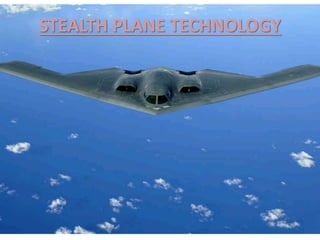
Stealth aircraft are aircraft that use stealth technology to
make it harder to be detected by radar and other means
than conventional aircraft by employing a combination of
features to reduce visibility in the visual, audio, infrared
and radio frequency (RF) spectrum. Well known examples
F-117 Nighthawk, the B-2 Spirit "Stealth Bomber," and
the F-22 Raptor.
While no aircraft is totally invisible to radar, stealth
aircraft Limit current conventional radar's abilities to
detect or track them effectively enough to prevent an
attack. Stealth is accomplished by using a complex design
philosophy to reduce the ability of an opponent's sensors
to detect, track and attack an aircraft.
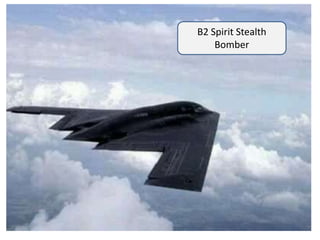
B2 Spirit Stealth
Bomber
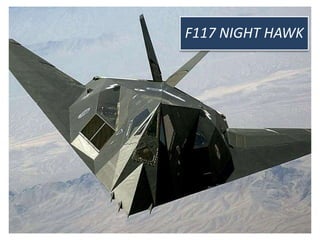
F117 NIGHT HAWK
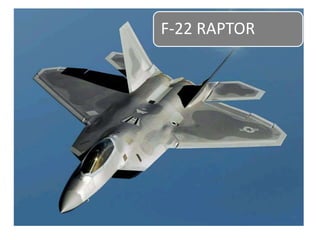
F-22 RAPTOR
RADAR SIGNATURE
Radar Cross Section
Radar Absorbing Material
Radar Absorbing Surface.
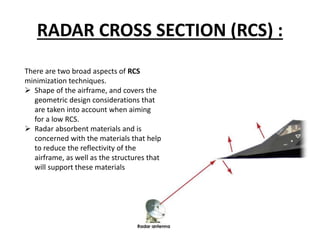
RADAR CROSS SECTION (RCS) :
There are two broad aspects of RCS
minimization techniques.
 Shape of the airframe, and covers the
geometric design considerations that
are taken into account when aiming
for a low RCS.
 Radar absorbent materials and is
concerned with the materials that help
to reduce the reflectivity of the
airframe, as well as the structures that
will support these materials
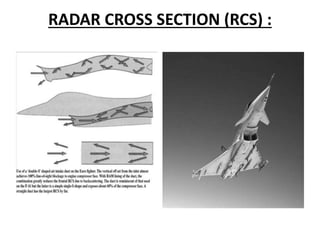
RADAR CROSS SECTION (RCS) :
RADAR ABSORBING SURFACE(RAS) :
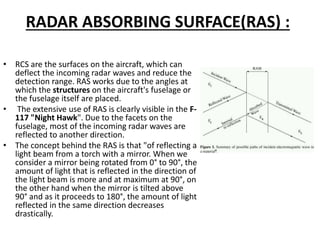
• RCS are the surfaces on the aircraft, which can
deflect the incoming radar waves and reduce the
detection range. RAS works due to the angles at
which the structures on the aircraft's fuselage or
the fuselage itself are placed.
• The extensive use of RAS is clearly visible in the F-
117 "Night Hawk". Due to the facets on the
fuselage, most of the incoming radar waves are
reflected to another direction.
• The concept behind the RAS is that "of reflecting a
light beam from a torch with a mirror. When we
consider a mirror being rotated from 0° to 90°, the
amount of light that is reflected in the direction of
the light beam is more and at maximum at 90°, on
the other hand when the mirror is tilted above
90° and as it proceeds to 180°, the amount of light
reflected in the same direction decreases
drastically.
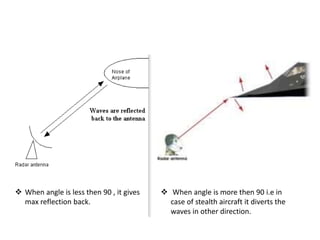
 When angle is less then 90 , it gives
max reflection back.
 When angle is more then 90 i.e in
case of stealth aircraft it diverts the
waves in other direction.
RADAR ABSORBING MATERIALS(RAM)
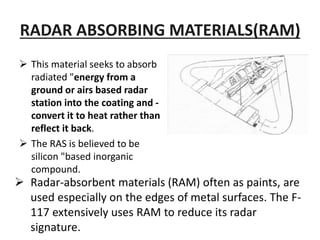
 This material seeks to absorb
radiated "energy from a
ground or airs based radar
station into the coating and -
convert it to heat rather than
reflect it back.
 The RAS is believed to be
silicon "based inorganic
compound.
 Radar-absorbent materials (RAM) often as paints, are
used especially on the edges of metal surfaces. The F-
117 extensively uses RAM to reduce its radar
signature.
Infrared Signature
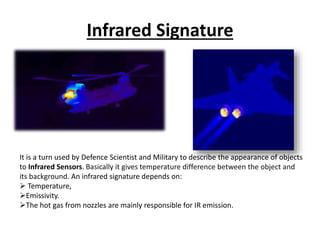
It is a turn used by Defence Scientist and Military to describe the appearance of objects
to Infrared Sensors. Basically it gives temperature difference between the object and
its background. An infrared signature depends on:
 Temperature,
Emissivity.
The hot gas from nozzles are mainly responsible for IR emission.
Infrared Stealth
Stealth technology aims at reducing infrared signature infrared signature. It
reduces susceptibility to infrared guided weapon and infrared sensor.
 It is reduced by having a non circular tail pipe to minimize the exhaust cross
section volume and maximize the mixing of hot exhaust with cool ambient
air.
 IR waves are also suppressed by shielding and cooling the hot metal
structure of engine.
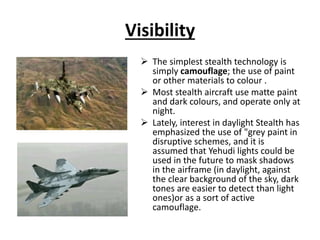
Visibility
 The simplest stealth technology is
simply camouflage; the use of paint
or other materials to colour .
 Most stealth aircraft use matte paint
and dark colours, and operate only at
night.
 Lately, interest in daylight Stealth has
emphasized the use of "grey paint in
disruptive schemes, and it is
assumed that Yehudi lights could be
used in the future to mask shadows
in the airframe (in daylight, against
the clear background of the sky, dark
tones are easier to detect than light
ones)or as a sort of active
camouflage.
ACOUSTIC:
Early Stealth aircrafts used slow turning
Propeller to avoid being heard by enemy
troops below. Stealth Aircrafts that stay
Subsonic avoid being tracked by sonic boom.
The presence of supersonic aircraft like SR-71
Black Bird indicates that acoustic signature is
not always a major driver in aircraft design.
Advantages:
• Reduce loss of war heads.
• Can attack without being visible.
Disadvantage:
• They have to reduce the payload.
• It has high operating cost.
• Stealth aircrafts are highly Unstable.
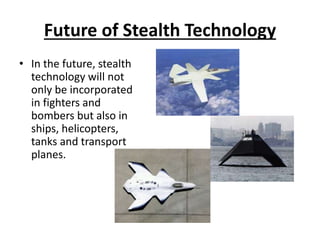
Future of Stealth Technology
• In the future, stealth
technology will not
only be incorporated
in fighters and
bombers but also in
ships, helicopters,
tanks and transport
planes.
CONCLUSION
 The development of stealthy airplanes teaches several important
lessons about technology.
 The first conclusion is that often many different technologies must
be combined to achieve a desired outcome. An advance in one
field, such as materials or aerodynamics, must be accompanied by
advances in other fields, such as computing or electromagnetic
theory.
 The second conclusion is that sometimes trial and error techniques
are insufficient and advances in mathematical theory are necessary
in order to achieve significant advances.
 Finally, stealth teaches the lesson that technology is never static a
stealth breakthrough may only last for a few years before an
adversary finds a means of countering it.

Presentation FINAL

  • 1.
  • 2.
    STEALTH PLANE TECHNOLOGY Stealthaircraft are aircraft that use stealth technology to make it harder to be detected by radar and other means than conventional aircraft by employing a combination of features to reduce visibility in the visual, audio, infrared and radio frequency (RF) spectrum. Well known examples F-117 Nighthawk, the B-2 Spirit "Stealth Bomber," and the F-22 Raptor. While no aircraft is totally invisible to radar, stealth aircraft Limit current conventional radar's abilities to detect or track them effectively enough to prevent an attack. Stealth is accomplished by using a complex design philosophy to reduce the ability of an opponent's sensors to detect, track and attack an aircraft.
  • 3.
  • 4.
  • 5.
  • 6.
    RADAR SIGNATURE Radar CrossSection Radar Absorbing Material Radar Absorbing Surface.
  • 7.
    RADAR CROSS SECTION(RCS) : There are two broad aspects of RCS minimization techniques.  Shape of the airframe, and covers the geometric design considerations that are taken into account when aiming for a low RCS.  Radar absorbent materials and is concerned with the materials that help to reduce the reflectivity of the airframe, as well as the structures that will support these materials
  • 8.
  • 9.
    RADAR ABSORBING SURFACE(RAS): • RCS are the surfaces on the aircraft, which can deflect the incoming radar waves and reduce the detection range. RAS works due to the angles at which the structures on the aircraft's fuselage or the fuselage itself are placed. • The extensive use of RAS is clearly visible in the F- 117 "Night Hawk". Due to the facets on the fuselage, most of the incoming radar waves are reflected to another direction. • The concept behind the RAS is that "of reflecting a light beam from a torch with a mirror. When we consider a mirror being rotated from 0° to 90°, the amount of light that is reflected in the direction of the light beam is more and at maximum at 90°, on the other hand when the mirror is tilted above 90° and as it proceeds to 180°, the amount of light reflected in the same direction decreases drastically.
  • 10.
     When angleis less then 90 , it gives max reflection back.  When angle is more then 90 i.e in case of stealth aircraft it diverts the waves in other direction.
  • 11.
    RADAR ABSORBING MATERIALS(RAM) This material seeks to absorb radiated "energy from a ground or airs based radar station into the coating and - convert it to heat rather than reflect it back.  The RAS is believed to be silicon "based inorganic compound.  Radar-absorbent materials (RAM) often as paints, are used especially on the edges of metal surfaces. The F- 117 extensively uses RAM to reduce its radar signature.
  • 12.
    Infrared Signature It isa turn used by Defence Scientist and Military to describe the appearance of objects to Infrared Sensors. Basically it gives temperature difference between the object and its background. An infrared signature depends on:  Temperature, Emissivity. The hot gas from nozzles are mainly responsible for IR emission.
  • 13.
    Infrared Stealth Stealth technologyaims at reducing infrared signature infrared signature. It reduces susceptibility to infrared guided weapon and infrared sensor.  It is reduced by having a non circular tail pipe to minimize the exhaust cross section volume and maximize the mixing of hot exhaust with cool ambient air.  IR waves are also suppressed by shielding and cooling the hot metal structure of engine.
  • 14.
    Visibility  The simpleststealth technology is simply camouflage; the use of paint or other materials to colour .  Most stealth aircraft use matte paint and dark colours, and operate only at night.  Lately, interest in daylight Stealth has emphasized the use of "grey paint in disruptive schemes, and it is assumed that Yehudi lights could be used in the future to mask shadows in the airframe (in daylight, against the clear background of the sky, dark tones are easier to detect than light ones)or as a sort of active camouflage.
  • 15.
    ACOUSTIC: Early Stealth aircraftsused slow turning Propeller to avoid being heard by enemy troops below. Stealth Aircrafts that stay Subsonic avoid being tracked by sonic boom. The presence of supersonic aircraft like SR-71 Black Bird indicates that acoustic signature is not always a major driver in aircraft design.
  • 16.
    Advantages: • Reduce lossof war heads. • Can attack without being visible.
  • 17.
    Disadvantage: • They haveto reduce the payload. • It has high operating cost. • Stealth aircrafts are highly Unstable.
  • 18.
    Future of StealthTechnology • In the future, stealth technology will not only be incorporated in fighters and bombers but also in ships, helicopters, tanks and transport planes.
  • 19.
    CONCLUSION  The developmentof stealthy airplanes teaches several important lessons about technology.  The first conclusion is that often many different technologies must be combined to achieve a desired outcome. An advance in one field, such as materials or aerodynamics, must be accompanied by advances in other fields, such as computing or electromagnetic theory.  The second conclusion is that sometimes trial and error techniques are insufficient and advances in mathematical theory are necessary in order to achieve significant advances.  Finally, stealth teaches the lesson that technology is never static a stealth breakthrough may only last for a few years before an adversary finds a means of countering it.