STEALTH TECHNOLOGY
Presented by:
ROHITH CHIMMANI
13311A04B3
ECE-C
Outline
 Introduction
 History
 Radar & Its Working
 Types of Detection
 Radar Cross Section (RCS)
 Advantages & Disadvantages
 Conclusion
Introduction
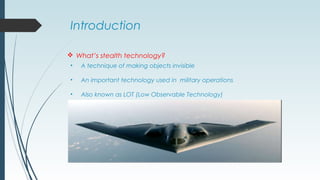
 What’s stealth technology?
• A technique of making objects invisible
• An important technology used in military operations
• Also known as LOT (Low Observable Technology)
• Task of Stealth Technology
HISTORY
 World War II played in important role in stealth technology development.
 Germans were the 1st
developers
 Germans developed the stealth Nano-Paint during the WW-II
What is a Radar system?
 Radar system is a system that help pilot in navigating while fly in space
 It uses a continuous wave and frequency to keep in touch with
 By radar system we could know how far the object is and its velocity
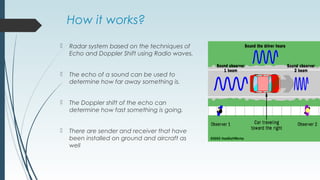
How it works?
 Radar system based on the techniques of
Echo and Doppler Shift using Radio waves.
 The echo of a sound can be used to
determine how far away something is.
 The Doppler shift of the echo can
determine how fast something is going.
 There are sender and receiver that have
been installed on ground and aircraft as
well
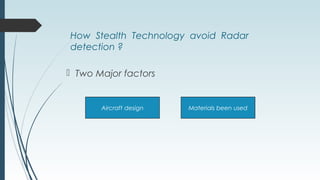
How Stealth Technology avoid Radar
detection ?
 Two Major factors
Aircraft design Materials been used
Types of Detection
 Different radar signatures of vehicles can be catergorized as following:
 Radar Cross Section (RCS)
 Infrared Signature
 Acoustic Signature
 Visible Signature
Radar Cross Section
 Radar mainly work on electromagnetic wave reflection.
 In order to avoid these reflection towards the radar receiver, we
have to reduce the radar cross section of object.
 Radar cross section
(RCS) defines the ability of a vehicle to reflect a radar signal.
RCS Reduction Technique
(Reduction in Radar Detection)
 Purpose shaping :
The shape of the target’s reflecting surfaces is designed such that they
reflect energy away from the source.
 Radar absorbent material :
As an addition to highly reflective surfaces.
 Active Cancellation :
Target generates a radar signal equal in intensity but opposite in phase to
the predicted reflection of an incident radar signal
Vehicle shape
 It should be coated with Radar Absorbing Materials
 Which deflect , absorbed incoming radar waves and reduce the detection
range.
Figure: Radar absorbing materials
Vehicle shape
 It should be coated with Radar Absorbing Materials
 Its tail should be kept Acute angle
 Planes wings has to kept at acute
 Design of the Nose
Shaping
 Normal design  Curved design
F117 A NIGHTHAWK
Active Cancellation
 In this method we have some RF source
on object (plane, ship) which modify
radar signal but in opposite phase that
generate destructive interference.
 Thus by the use of these three methods
we can reduce RCS of our plane and
can make them low observable.
Infra-red stealth
 Method to decrease the IR signature of the engines is to use
exhaust masking.
 Hot zones such as engine exhaust , wing surface [friction due to
air] get heated which rather increases the visibility
 This is accomplished by placing the engines on top of the body
and the wings, by which exhausts cannot be seen from below.
 These part should be kept cool as possible it can be ,
 Option would be mixing of cool air with the hot engine exhaust
Infra-red Stealth
Visual Stealth
 Low visibility is desirable for all military
applications
 Earlier stealth aircraft were painted black
and thus could be used during nights
 Now days an electro chromic polymer is
being developed for daytime stealth
 These polymer sheets sense nature of the
surrounding and change there color
accordingly
Visible Stealth
 Stealth Nano - Carbon Paint
 “Blackest “ known material of the world
 Absorb 99% of the received signal
 Excellent Electrical Conductivity and High Strength
 Plasma will cover the whole body of the aircraft
 Plasma cloud will observe the Radar waves and prevent aircraft detection
Plasma Stealth
Advantages
 Few number of stealth aircrafts = Huge number of conventional aircrafts
[Economical in long term]
Advantages
 Few number of stealth aircrafts = Huge number of conventional aircrafts
[Economical in long term]
 Keeping the enemy in fear of aircraft’s existence. So they will remain in
defence mood
 The natural competition of war will result in economically weakening of the
enemy.
 Diplomatic result: Stealth aircrafts have high military technology and
military secrets
Disadvantages
 Low speed and Maneuverability.
 Low amount of carried payload
Disadvantages
 Low speed and Maneuverability.
 Low amount of carried payload
 High cost:
 B-2 bomber: $2 billion
 F-117A: $70 million
 F-22: $100 million
 Wing shape => Unstable flight, Not enough uplift force for takeoff, Needing
of complex computerized system for stable flight.
Conclusion
 Stealth Technology is the future of military combat technology.
 In near future stealth technology can be used in other facilities like ships,
helicopters, vehicles, etc.
 The main problem of this technology is its high cost.
 Stealth technology due to its high cost, cannot be a proper choice for
developing countries.
 New developments in other fields of technology such as Nanotechnology
can be used instead of stealth technology due to their low cost.
References
http://en.wikipedia.org/wiki/Stealth_technology
http://en.wikipedia.org/wiki/Radar
http://en.wikipedia.org/wiki/Stealth_ship
http://science.howstuffworks.com/question69.htm
http://www.hyperstealth.com/Quantum-Stealth
THANK YOU

Stealth Technology

  • 1.
    STEALTH TECHNOLOGY Presented by: ROHITHCHIMMANI 13311A04B3 ECE-C
  • 2.
    Outline  Introduction  History Radar & Its Working  Types of Detection  Radar Cross Section (RCS)  Advantages & Disadvantages  Conclusion
  • 3.
    Introduction  What’s stealthtechnology? • A technique of making objects invisible • An important technology used in military operations • Also known as LOT (Low Observable Technology)
  • 4.
    • Task ofStealth Technology
  • 5.
    HISTORY  World WarII played in important role in stealth technology development.  Germans were the 1st developers  Germans developed the stealth Nano-Paint during the WW-II
  • 6.
    What is aRadar system?  Radar system is a system that help pilot in navigating while fly in space  It uses a continuous wave and frequency to keep in touch with  By radar system we could know how far the object is and its velocity
  • 7.
    How it works? Radar system based on the techniques of Echo and Doppler Shift using Radio waves.  The echo of a sound can be used to determine how far away something is.  The Doppler shift of the echo can determine how fast something is going.  There are sender and receiver that have been installed on ground and aircraft as well
  • 8.
    How Stealth Technologyavoid Radar detection ?  Two Major factors Aircraft design Materials been used
  • 9.
    Types of Detection Different radar signatures of vehicles can be catergorized as following:  Radar Cross Section (RCS)  Infrared Signature  Acoustic Signature  Visible Signature
  • 10.
    Radar Cross Section Radar mainly work on electromagnetic wave reflection.  In order to avoid these reflection towards the radar receiver, we have to reduce the radar cross section of object.  Radar cross section (RCS) defines the ability of a vehicle to reflect a radar signal.
  • 11.
    RCS Reduction Technique (Reductionin Radar Detection)  Purpose shaping : The shape of the target’s reflecting surfaces is designed such that they reflect energy away from the source.  Radar absorbent material : As an addition to highly reflective surfaces.  Active Cancellation : Target generates a radar signal equal in intensity but opposite in phase to the predicted reflection of an incident radar signal
  • 12.
    Vehicle shape  Itshould be coated with Radar Absorbing Materials  Which deflect , absorbed incoming radar waves and reduce the detection range. Figure: Radar absorbing materials
  • 13.
    Vehicle shape  Itshould be coated with Radar Absorbing Materials  Its tail should be kept Acute angle  Planes wings has to kept at acute  Design of the Nose
  • 14.
    Shaping  Normal design Curved design
  • 15.
  • 16.
    Active Cancellation  Inthis method we have some RF source on object (plane, ship) which modify radar signal but in opposite phase that generate destructive interference.  Thus by the use of these three methods we can reduce RCS of our plane and can make them low observable.
  • 17.
    Infra-red stealth  Methodto decrease the IR signature of the engines is to use exhaust masking.  Hot zones such as engine exhaust , wing surface [friction due to air] get heated which rather increases the visibility  This is accomplished by placing the engines on top of the body and the wings, by which exhausts cannot be seen from below.  These part should be kept cool as possible it can be ,  Option would be mixing of cool air with the hot engine exhaust
  • 18.
  • 19.
    Visual Stealth  Lowvisibility is desirable for all military applications  Earlier stealth aircraft were painted black and thus could be used during nights  Now days an electro chromic polymer is being developed for daytime stealth  These polymer sheets sense nature of the surrounding and change there color accordingly
  • 20.
    Visible Stealth  StealthNano - Carbon Paint  “Blackest “ known material of the world  Absorb 99% of the received signal  Excellent Electrical Conductivity and High Strength
  • 21.
     Plasma willcover the whole body of the aircraft  Plasma cloud will observe the Radar waves and prevent aircraft detection Plasma Stealth
  • 22.
    Advantages  Few numberof stealth aircrafts = Huge number of conventional aircrafts [Economical in long term]
  • 23.
    Advantages  Few numberof stealth aircrafts = Huge number of conventional aircrafts [Economical in long term]  Keeping the enemy in fear of aircraft’s existence. So they will remain in defence mood  The natural competition of war will result in economically weakening of the enemy.  Diplomatic result: Stealth aircrafts have high military technology and military secrets
  • 24.
    Disadvantages  Low speedand Maneuverability.  Low amount of carried payload
  • 25.
    Disadvantages  Low speedand Maneuverability.  Low amount of carried payload  High cost:  B-2 bomber: $2 billion  F-117A: $70 million  F-22: $100 million  Wing shape => Unstable flight, Not enough uplift force for takeoff, Needing of complex computerized system for stable flight.
  • 26.
    Conclusion  Stealth Technologyis the future of military combat technology.  In near future stealth technology can be used in other facilities like ships, helicopters, vehicles, etc.  The main problem of this technology is its high cost.  Stealth technology due to its high cost, cannot be a proper choice for developing countries.  New developments in other fields of technology such as Nanotechnology can be used instead of stealth technology due to their low cost.
  • 27.
  • 28.