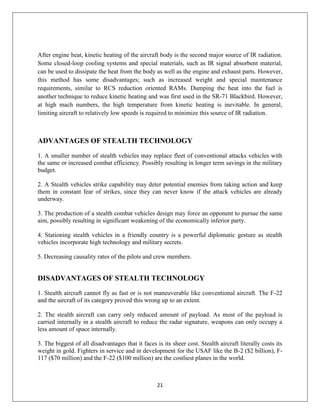
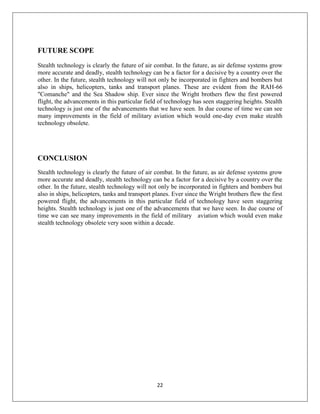
This document discusses stealth technology and radar invisibility in aircraft design. It provides details on:
1) How stealth technology was inspired by camouflage in nature and developed for aircraft during World Wars I and II to reduce detection ranges.
2) The key factors that determine an aircraft's radar cross section (RCS), including its geometry, materials, and aspect relative to radar waves. Lowering the RCS is crucial for stealth.
3) The main methods used to reduce RCS, including shaping the airframe to direct reflections away from radar sources, using radar-absorbent materials, and techniques like plasma cloaking being explored. Careful design is needed to balance stealth and aircraft performance.

![3
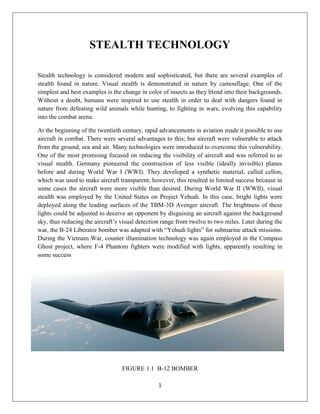
favorable results. If a given radar has a detection range of 100 miles against a target with a RCS
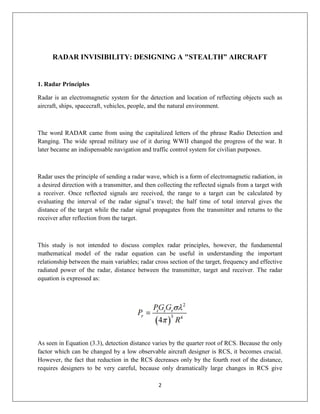
of 10 m2 , its approximate detection range to different RCS values calculated with basic radar
equation are shown in Table 2. This results again show that, only enormous reductions in the
RCS can make significant changes in the detection range, such as 1000 times reduction (RCS
from 1000 m2 to 1 m2 which equals to -30 dB) in RCS brings % 82.22 detection range reduction
(56.23 miles equals to % 17.78 of 316.23 miles, thus total detection range reduction is % 82.22).
Another example from Table 2 is; reducing the RCS from 81 to 5 m2 only changes the 39
detection range by about half (168.70 miles is twice as much to 84.09 miles), despite the fact that
this kind of reduction requires many design changes.
1. Radar Cross Section (RCS) and RCS Reduction Methods
A target is detected by the radar only when the radar’s receiver gets adequate energy back
from the target, furthermore, this energy must be above the electronic noise or signal to
noise threshold to be detected. There are many variables in the transmission scattering-
reflection sequence which determine the maximum detection range. These are transmitter
effective outgoing energy, beam width, RCS of the target, total energy back from the
target, antenna aperture (or size) and the receiver’s processing capability [14]. Among
these variables, RCS is the main concern of this study.
A radar beam is shaped in 3 dimensions like a cone, so as the range increases, the area
seen by this cone increases. However, with this increased range, the reflected target
energy and detected receiver energy diminishes. So, even in the best of circumstances,
only a small portion of the original energy can be used by the radar to process. RCS (m2 )
Approximate Detection Range (miles) Detection Range Reduction Rate (Compared to](https://image.slidesharecdn.com/stealthtechnologyfinalreport-160817180725/85/Report-on-Stealth-technology-3-320.jpg)
![4
1000 m2 RCS) 1000 316.23 ---- 100 177.83 % 43.77 81 168.70 % 46.65 10 100.00 %
68.38 5 84.09 % 73.41 1 56.23 % 82.22 40 Increasing the radar transmitter power, “a
long time Soviet Russian favorite [14]” or deploying bigger antennas with more gain
helps to obtain a longer detection range.. Furthermore, larger antennas and larger energy
generating units are cumbersome, especially for mobile systems. Nevertheless, with a
good understanding of basic electromagnetic principles and radar phenomena,
sophisticated radar designs that have better detection performance and greater precision
are being developed each passing day.
Up to this point, only the radar designer’s concerns are mentioned. For the stealth
designer, the only variable to decrease the detection range is RCS. This is why RCS is the
key term for low observables where reduction in reflected RF signal signature is intended.
Any attempt to make an asset RF low observable focuses on RCS. If a target’s RCS can
be decreased to a level low enough for its echo return to be below the detection threshold
of the radar, then the target is not detected. In this context, RCS reduction is a
countermeasure which has developed against radars and, conversely, new radar
techniques with more sophisticated designs are produced to detect targets with low RCS.
Radar cross section is the size of a target as seen by the radar [15]. In more scientific
words, RCS is a measure of the power that is returned or scattered in a given direction,
normalized with respect to power density of the incident field [15]. The normalization is
made to remove the effect of the range, and so the signature is not dependent on the
distance between the target and the receiver. The RCS helps to measure objects against a
common reference point, which is very useful in the low observable technology world in
determining the performance of design goals. In this context, RCS can also be described
as the size of a reflective sphere that would return the same amount of energy back. The
projected area of the sphere, or the area of a disk of the same diameter, is the RCS
number itself [14]. However, one important thing that should be understood is that this
area is not the geometrical cross section of the body. A proportional definition of RCS
can be made as:](https://image.slidesharecdn.com/stealthtechnologyfinalreport-160817180725/85/Report-on-Stealth-technology-4-320.jpg)
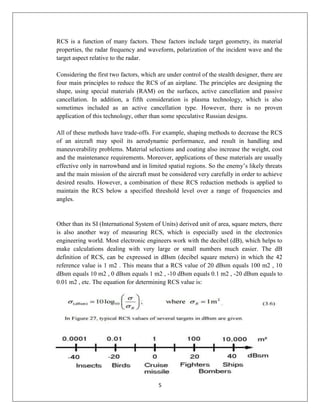
![6
Exact RCS levels of military assets are classified, however, it is hypothesized that today's
true stealth aircraft have an RCS value around -30 dBsm (or 0.001 m2 ) and new
technological improvements promise to achieve values of -40 to -50 dBsm or 0.0001 to
0.00001 m2 . If these reductions are obtained, a radar, which could detect a nominal non
stealthy target with 5 m2 (~7 dBsm) RCS at 80 miles, could detect the target in the -50
dBsm case at a range of three miles, which, from an operational point of view, is too late
[14].
Figure 28 shows several aircraft and their approximate RCS values. Being classified,
these are not exact RCS of the aircraft. However, this figure can give an idea that
physical area is not the main concern and specially designed aircraft have remarkable
RCS reduction. The methods of RCS reduction will be discussed further in the following
sections.
FIGURE 1.2 RCS OF A AIRCRAFT](https://image.slidesharecdn.com/stealthtechnologyfinalreport-160817180725/85/Report-on-Stealth-technology-6-320.jpg)
![7
a. Shaping the Airframe
Before studying the shaping factor, the first RCS reduction principle, analyzing the major RCS
contributors of an aircraft, can be useful in gaining a better understanding of the subject. The
complex shape of an ordinary aircraft reveals many surfaces that can reflect incoming signals
back to the radar, including air inlets, compressor blades, vertical stabilizers, external payloads,
all cockpit instruments, all 44 cavities (discontinuities) and corners. Figure 29 shows these
contributors. All these contributors must be worked on very precisely to get desired reductions in
RCS values.
FIGURE 1.3 RCS OF A AIRCRAFT
Other than these contributors, the angle of the incoming radar signals is also very
important. This is because, as the normal of a surface to a signal changes, total reflected
energy and the RCS also change. For example, an aircraft with a 25 m2 head on RCS,
may have a 400 m2 broadside RCS. Figure 30 illustrates a RCS pattern of a target
reflecting a radar echo that is of relatively low frequency. The amplitude values for the
pattern are relative basis, so don’t represent a real aircraft. The target is located in a plane
where 0 degrees represents the nose on position. To understand RCS value variation of an
aircraft, in level flight, against radars at the same altitude but at different angles, the
target is rotated in the yaw axis. Such patterns are used to analyze the ability of an aircraft
to penetrate air defenses [15].](https://image.slidesharecdn.com/stealthtechnologyfinalreport-160817180725/85/Report-on-Stealth-technology-7-320.jpg)
![8
FIGURE 1.4 RCS PATTERN OF A AIRCRAFT
Some features of an airframe design present dramatically large RCS values. A flat panel,
which is a good reflector, is one of these, since it is normal to the radar beam. If this
surface is rotated, this will result in reflecting the incoming beams to other angles and
will create a smaller RCS for a monostatic receiver. Bill Sweetman, a former editor for
Jane’s, and a well-known Stealth advocate, quotes a stealth designer:
A flat panel is the brightest target, and also the dimmest. If the panel is at right angles to
an incoming beam, it is a perfect reflecting target. Rotate it along one axis and most of
the energy is deflected away from the radar. Rotate it along two axes and the RCS
becomes infinitesimal [15].
Conventional vertical stabilizers are one of these flat reflector panels. Canting them
inwards or outwards, with high-angles, can prevent incoming radiation from returning
back to the radar and also when a rudder-elevator combination is used, the retro reflector
of a dihedral, should be avoided. Here, a retro reflector dihedral is two surfaces that are
positioned at 90° from one another and these surfaces reflect the radar wave front back
along a vector that is parallel to but opposite in direction to the angle of incidence. Thus,
this double bounce maneuver will result in increasing the RCS.](https://image.slidesharecdn.com/stealthtechnologyfinalreport-160817180725/85/Report-on-Stealth-technology-8-320.jpg)
![9
Compressor blades are another large signal reflector. Along with increasing the RCS of a
target, some identification systems, such as radars using non cooperative target
recognition (NCTR) techniques, or one of the measurement and signature intelligence
systems (MASINT) technologies, can be used to collect and process the strong radar
returns from the engine compressor movements or periodic rotation of the blades of a
turbine to discriminate between enemy and friendly assets [15]. Thus, an aircraft engine
(with all possible components) should be kept out of reach of radar signals for low
observable designs.
Using wire mesh (as in the F-117 and RPV Q-2C), specially curved air inlet nacelles that
prevent the direct reach of RF signals to compressor blades (such as the B-1 B) and
carefully chosen engine (inlet) locations will also help to reduce RCS. However, placing
engines at their most optimum location to reduce RCS raises another important problem,
determining the direction of expected RF signals. For example, if a radar threat is
expected from below, putting the engine inlets at the top of the wing or airframe would
be an effective measure. This is the more likely situation for high altitude bombers,
reconnaissance and maritime patrol aircrafts. B-2 and F-117 bomber aircraft are good
examples of this kind of design. However, for an air-superiority fighter, estimating the
threat direction is a much more complex issue and there is no satisfying solution to this
problem. So, the use of serpentine ducts and inlet wire meshes are more effective
solutions to conceal the engines from radar signals.
Cockpits and their interior instruments, such as pilot’s helmet, seat, control components
and displays, reflect RF signals and increase the RCS, as the canopies and windshields
are normally transparent to the radar beams. Some special absorbent (or reflecting) layers
and coatings are used on the canopies of the stealth aircrafts to decrease the RCS of the
cockpit as well as their unique external shapes. Along with the stealth aircrafts, some
other fighters and EW assets such as F-16 Fighting Falcon and EA-6B Prowler also use
such coatings either to reduce RCS or to shield the powerful signal emitted by the
jammers from reaching the cockpit and crew. Controlled cockpit canopy shape, with
“transparent conductor thin film (vapor-deposited gold or indium tin oxide) [14].” on it,
block the incoming radar signals to reach the inner components and diminishes the
amount of reflected radar waves back to the radar. [7], [14].
Other RCS reduction methods concerned with shaping include avoiding gaps and holes in
the design and using covert gun ports, as shown in Figure 32, to hinder discontinuities on
the airframe surface. Performing high precision maintenance also helps to obtain and
sustain these low RCS levels. In one case, a single screw not tightened as required was
discovered to be the reason for an unexpected RCS increase in the F-117 prototype [14].](https://image.slidesharecdn.com/stealthtechnologyfinalreport-160817180725/85/Report-on-Stealth-technology-9-320.jpg)
![10
FIGURE 1.5 F-22 RAPTOR
The biggest effort in reducing the RCS is given to the forward aspects of the aircraft as
illustrated in Figure 33. However, in this case, greater returns for the other aspects or at
least some angles are inevitable. This tradeoff promises some advantage to
countermeasures of stealth such as well-designed bi-static radar networks. Secondly,
though shaping is the first principle in reducing RCS and must be carefully considered in
the design of low observables, long wavelengths are less affected by the shape of the
airframe and its details.
The RCS of the airframe can be reduced by geometrically controlling the incoming
signals’ reflection (directionally) and scattering. The first way to accomplish this is to use
flat surfaces and rectilinear surfaces all around the aircraft fuselage, which are oblique to
the radar signals. The F-117 Nighthawk, shown in Figure 34, is a very good example of
this kind of RCS reduction technique with shaping. F-117 Nighthawk uses careful
faceting technique to reduce RCS by scattering the signals in nearly every direction [14].
FIGURE 1.6 RF RCS](https://image.slidesharecdn.com/stealthtechnologyfinalreport-160817180725/85/Report-on-Stealth-technology-10-320.jpg)
![11
FIGURE 1.7 SCATTERING OF RF SIGNAL
The second reduction method is similar and involves reflecting the incoming signals in a
limited number of directions rather than scattering them in all directions. So a monostatic
receiver never gets the transmitted signal back, unless the radar signal reflects with two
90 degree angles from a surface, which is improbable when extreme look-down angles
are not present. If a bi static system is considered, its receiver can only get the radiated
beam when the spatial geometry is perfect [49]. In this technique, every straight line on
the entire airframe should be designed carefully; shape of the aircraft, from main aircraft
components such as wings, vertical and horizontal stabilizers, engine inlets, rudders, to
all other moving parts such as rudders, elevators, ailerons, weapon bays, landing gear
doors, canopy fasteners, etc., should be aligned in the direction of the few selected spikes
(to reflect the incoming signal towards only these specific directions), as shown in Figure
35. Using serrated (saw tooth shape shown in Figure 36) parts on surfaces may also help
achieve the desired results [14].](https://image.slidesharecdn.com/stealthtechnologyfinalreport-160817180725/85/Report-on-Stealth-technology-11-320.jpg)
![12
FIGURE 1.8 RCS REDUCTION
FIGURE 1.9 SHAPE FOR RCS REDUCTION
The third method is modeling the aircraft with a compact, smoothly blended external geometry
[14] which has changing curves. These curves do not have regular reflection characteristics and
they usually diminish the radar signal’s energy by capturing them inside the curvature. The B-2
Spirit, especially its engine nacelles, was 51 made with this kind of RCS technology. However,
this method requires very precise calculations, thus only the latest (after 1980s) low observable
aircraft have had the chance to use it in their computer based designs.
As mentioned, the main purpose of shaping is reducing or, ideally, eliminating the major RCS
contributors. However, shaping measures for low RCS has some tradeoffs, such as poor
aerodynamic performance, increased costs more maintenance requirements or less ordnance
capacity. Despite these drawbacks, which will be discussed in the following sections, the gains in
RCS reduction compensate for the diminished qualities for the purpose of improving aircraft
survivability during operations.](https://image.slidesharecdn.com/stealthtechnologyfinalreport-160817180725/85/Report-on-Stealth-technology-12-320.jpg)
![13
b. Non-Metallic Airframe, Radar Absorbent Material (RAM) and Radar
Absorbent Structure (RAS)
Stealth aircrafts should have extremely low RCS levels, however achieving such a goal is not
possible by shaping alone. Some material designs, such as radar absorbent material (RAM) and
radar absorbent structure (RAS) applications are also necessary.
Modern aircraft are generally made of composites, which consist of two or more different
materials that have dissimilar physical, chemical or electromagnetic properties. Generally,
composites are not metal and their RF signal reflection properties are very poor, thus non-
metallic airframes are considered to not show up on radar. However, the non-reflected RF signals
penetrate the non-metallic airframe and this time the reflection occurs from inside which results
from the radar images of engines, fuel pumps, electrical wiring and all other components.
Coating or painting the surfaces of airframes with special metallic finishing is the preferred way
to prevent the penetration of RF signals through composites. On the other hand, composites are
still important. Forms of composites, which consist of some poor conductors of electricity, such
as carbon products, and insulators, such as epoxy resin, are used in the airframes to cancel the
forms of creeping and travelling waves, by resisting electrical and magnetic currents which
reradiate [14].
Though RAM’s performance to decrease the RCS has been enhanced by a factor of ten, since the
mid-1980s, an expert still indicates “…shape, shape, shape and materials… [14]” as the most
important factors to design a stealth aircraft. It is clear that RAM is not an alternative for the
airframe design, and it cannot transform a conventional aircraft into a stealthy one, however for
better RCS values, some parts of the asset, especially edge reflections and cavities (such as
inlets), should be healed using RAM, where no other solution is likely [15].
One of the special RAM coatings is made of reinforced carbon carbon (RCC) [7]. For the most
part, RAMs, such as RCC, reduce RCS by absorbing (an amount of) the incoming signal and
converting RF energy into heat or by destructive interference. With their appropriate dielectric or
magnetic properties, different RAMs are used to get desired RCS results over the maximum
possible frequency range. RAM technology is based on the idea of establishing desirable
impedance which poses good matching and absorbing qualities, so that the RAM can accept and
then attenuate the incident wave [60]. Dielectric qualities of RAM can also be explained as
naturally occurring, electromagnetic waves of radar bouncing from conductive objects. However,
the molecular structure of the lossy materials causes RF energy to expend its energy by
producing heat. Then the heat is transferred to the aircraft and dissipated while the residual RF
energy loses its effectiveness, basically with help of friction and inertia or molecular oscillations.
Finally, this results in less reflection back to the radar receiver [14].
Together with absorption, another way of RCS reduction, by using RAM, is destructive
interference. However, there is an important distinction between the phenomenon of absorption](https://image.slidesharecdn.com/stealthtechnologyfinalreport-160817180725/85/Report-on-Stealth-technology-13-320.jpg)
![14
(Figure 37) and destructive interference applications. As mentioned above, the absorption
process, which covers ohmic loss (based on the motion of free charges in an imperfect
conductor), dielectric loss (based on permittivity), and magnetic loss (based on permeability), is
possible by transferring the incident RF wave’s energy to the airframe material as it passes
through. On the other hand, the destructive interference (also known as “resonant RAM” or
“impedance loading”) principal is based on coatings, or the “Salisbury Screen” method, which
are used to reduce RCS by 53 cancellations of multiple reflections [15]. This method is
considered both a RAM and a passive cancellation method. This study will discuss destructive
interference in the passive cancellation technique section.
FIGURE 2.0 RADAR ABSORBING MATERIALS
RAM includes many types of materials. Six RAM examples, low dielectric foam (epoxy);
lightweight lossy foam (urethane); thermoplastic foam (polytherimide); sprayable lightweight
foam (urethane); thin MAGRAM silicone resin sheet; and resistive card (R-card) made of
metalized Kapton, can be seen in Figure 38 in the order of clockwise from upper left [61].
Another example, a ferrite-based paint, which is called “iron ball”, was used on the U-2 and SR-
71 to reduce the RCS.](https://image.slidesharecdn.com/stealthtechnologyfinalreport-160817180725/85/Report-on-Stealth-technology-14-320.jpg)
![15
FIGURE 2.1 RADAR ABSORBING SHEETS
RAM has some limitations. Although the use of RAM is strengthening for low observability, it
never gives perfect results and can never be assumed to decrease an aircraft’s RCS values to a
large extent. It can absorb a portion of the incident energy, with the rest being reflected.
Moreover, certain kinds of RAM can give expected results only for certain frequencies and
angles of the incident radar wave. Using different kinds of RAM to broaden the RF spectral
coverage, along with thicker and heavier amounts, increases the effectiveness. However, the
optimum RAM weight and depth should be evaluated while considering the impact of the
application of bulky coatings, which may demolish other flight and mission characteristics of the
asset. Inconvenient weather conditions, such as rain, may also decrease the performance of most
RAM. Furthermore, aircraft shelters should be constructed with special qualities to provide
required RAM protection and maintenance. This is the reason that early B-2 planes were not
deployed at US bases abroad where these kind of special shelters were not available [14].
Because thick and solid RAM coatings or paintings, which are heavy and bulky, are required but
not feasible to get desired RCS reduction over wider bandwidths, an alternative method of using
such materials at the inner skin of the airframe is 55 preferred. Radar absorbing structures
involve building special materials in special ways, such as honeycomb, as shown in Figure 39, to
attenuate radar waves into load-bearing structure [14].](https://image.slidesharecdn.com/stealthtechnologyfinalreport-160817180725/85/Report-on-Stealth-technology-15-320.jpg)
![16
FIGURE 2.2 RADAR ABSORBING HONEYCOMB STRUCTURE
The honeycomb structures have very important advantages. First of all, their hexagonal passages,
which are bonded together, are physically very strong, flexible and light. From a RCS
perspective, their depth, which does not cause considerable weight, is used to form many
surfaces to reflect, absorb and attenuate the radar signal. One kind of honeycomb is made up of
an outer skin of kevlar/epoxy composite, which is transparent to radar, and an inner skin of
reflective graphite/ epoxy [49]. The nomex core, between them, has absorbent properties and its
increasing density, front to rear of the honeycomb, improves the effectiveness. The small amount
of front-face reflection of the incident radar wave is followed by the radar wave to reach the
thinly spread absorber on the outer edges of the core where another small part of the energy is
absorbed and the remainder is bounced. So, the travelling wave meets more densely loaded core
material as it goes on. Each time, some amount of energy is either absorbed or reflected, and
finally the outermost layer of the absorber once again attenuates it [14] and the radar wave,
which is checked into the structure, never checks out to free space again [14].](https://image.slidesharecdn.com/stealthtechnologyfinalreport-160817180725/85/Report-on-Stealth-technology-16-320.jpg)
![17
Another RAS form is used on the leading and trailing edges of low observables, such as the
wings and fuselage skin strakes of the SR-71 Blackbird, which is depicted in Figure 40. In this
method, gradually increasing absorption is applied to trap the energy, similar to the honeycomb
structure. However, in this case, the physical shape of the structure is a saw-tooth pattern. The
external surface is coated with a high frequency ferrite absorber. The interior begins with a low-
absorption layer and is followed by a more absorbent layer, so; while the deepness increase the
absorbent properties are also augmented. The “V” shaped geometry, shown in Figure 41, causes
the radar signal to bounce towards the opposite side, while the material properties of the structure
absorb and provide the incoming signal to diminish the energy, so each bounce results in the loss
of some amount of the energy [14].
FIGURE 2.3 TRAPPING INCOMING SIGNAL](https://image.slidesharecdn.com/stealthtechnologyfinalreport-160817180725/85/Report-on-Stealth-technology-17-320.jpg)
![18
C. Passive Cancellation System
Special material used for signal cancellation purposes to reduce RCS fall into two categories:
RAM RCS reduction methods (resonant RAM) and passive cancellation. The resonant RAM
method was also introduced as destructive interference or impedance loading in RAM
applications. Here all these terms and so passive cancellation system refers to “RCS reduction by
introducing a secondary scatter to cancel with the reflection of the primary target [60].”
In this method, special coatings, which are also called “resonant absorbers”, are chosen to cancel
the incoming signals by being reflected two times (some times more than two is also possible for
wider frequency covering), one from the front and the other from the back of the layer.
Theoretically, having a back face wave that totally travels one half wavelength more than the one
that is reflected from the first layer is essential. Having the correct thickness causes the second
reflection to have a 180 degree phase difference with the round-trip (first layer) reflection, thus
first and second waves will cancel each other. However, this method strictly relies on layer
thickness or ¼th of the wavelength matching.
This method, is also known as “Salisbury screen”, and illustrated in Figure 43. A resistive
screen, which is placed in front of the reflective back plate, bounces nearly 50 % of the incident
radar beam (blue wave in the Figure 43) back to incoming direction (purple wave in Figure 43),
while the other 50% of the radar wave passes through and reflect from that grey plate (red wave
in Figure 43). When the distance between these two plates are ¼th of radar signal’s wavelength,
red and purple waves cancels each other. Because such a thickness is only effective for specific
frequencies, this cancellation is called as a “narrowband technique.” On the other hand, from a
RAM application techniques perspective, dielectric and magnetic loss mechanisms are
categorized as broadband absorbers, while they can generally be deployed to cover wider
frequency bands than passive cancellation coatings [15].
FIGURE 2.4 SALISBURY SCREEN](https://image.slidesharecdn.com/stealthtechnologyfinalreport-160817180725/85/Report-on-Stealth-technology-18-320.jpg)
![19
d. Plasma Stealth
Plasma is a partially ionized and electrically conductive gas by means of the ability of the
positive and negative charges to move somewhat independently [63]. Its free electrons make
plasma respond strongly to electromagnetic fields. Thus using plasma, which is sometimes
considered an active cancellation technique, has been studied and proposed as a possible method
of RCS reduction. The inspiration for this method emerged in the late 1950s after spacecraft with
a natural plasma layer over their airframes experienced communication interruption incidents
while traveling through the ionosphere. Basically, radar waves (actually all electromagnetic
waves of certain frequencies) traveling through this conductive plasma cause electrons to
exchange their places, ending up with the electromagnetic waves losing their energy and
transforming it to other forms, such as heat. Interaction between plasma and electromagnetic
radiation is strongly dependent on the physical properties and parameters of the plasma [6]. The
most dominating of these properties are the temperature and the density of the plasma. Another
important issue is frequency of the incident radar beam. Radar waves, below a specific frequency,
are reflected by plasma layer. Plasma layer’s physical properties have significant effect on this
process. Long distance communications with HF signals by means of ionosphere scattering and
reflection is a good example of this same phenomena. Thus, RCS reduction plasma devices
should also control and dynamically adjust the plasma properties, such as density, temperature
and composition, for effective radar absorption results.
Plasma stealth technology has some drawbacks from a low observables perspective. Some of
these include, emitting own electromagnetic radiation with a visible glow, existence of a plasma
trail of ionized air behind the aircraft [64] before dissipation by the atmosphere, and difficulty in
producing a radar-absorbent plasma around an entire aircraft traveling at high speed [64].
However, some Russian scientists have declared achieving a hundredfold RCS reduction with
plasma technology and this result (if real) is sufficient enough to focus on this method for further
research and success in the stealth world [64]. 63 Another application of plasma is utilizing this
technology to deploy antenna surfaces to generate low observability characteristics. While metal
antenna poles are reflective parts, a hollow glass tube filled with low pressure plasma can
provide an entirely radar transparent surface when not in use [15].
D. IR SIGNATURE AND IR STEALTH
All substances with a temperature above absolute zero (0° K, or -273.15° C, or - 459.67° F),
emit electromagnetic waves. The heat content of a material produces 67 molecular vibrations
which cause electron oscillations. These oscillations provide electromagnetic coupling that
produces an emission of energy. This emission is called infrared radiation (IR). IR has a
wavelength spectrum of 0.7 to 14 micrometers, and the amount of radiation emitted is primarily
dependent on the physical temperature of the associated object (proportionally). The emissivity](https://image.slidesharecdn.com/stealthtechnologyfinalreport-160817180725/85/Report-on-Stealth-technology-19-320.jpg)
![20
characteristics of an object are related to the material’s molecular structure and the surface
conditions of the object. IR energy that comes from another body is either absorbed or reradiated
by the object according to its emissivity properties [3].
As with visible light, IR energy also travels in a straight line at speed of light. Similarly, IR
energy is either reflected or absorbed and converted to heat when it hits the surface of an object.
These absorption and reflection qualities change with material specifications. For example,
polished surfaces reflect more IR energy but also have a much lower emissivity than matte
surfaces [8].
IR energy considerations are important to stealth designers, because IR detectors, also known as
infrared homing devices, such as passive missile guidance systems, can use IR emissions from a
target to track it. Detector systems, especially missile guiding seekers, which detect the radiated
infrared signals of their target, are often referred to as "heat-seekers". If unaided by IR
countermeasures, aircraft are vulnerable to detection by such systems by means of the strongly
radiated energy from their hot bodies. Some precautions to mitigate such detection include,
reducing or suppressing an aircraft’s IR signature and adding some noise, deploying decoys or
flares, and jamming the sensor by emitting high power signals towards the detector.
Another method to decrease IR signature is the shaping of exhaust geometry. Exhausts that are
shaped flat and wide, as shown in Figure 51, are effective in this regard. This increases the
perimeter of the plum compared to conventional round nozzles, and 70 results in an increased
mixing rate of exhaust gases, cooling them with air. This reduces probability of detection, but
thrust efficiency is decreased with flat and wide designs. High bypass engines also benefit from
the mixing of air with exhaust for exhaust nozzle temperature reduction purposes. Masking the
hot turbine stages with curved jet pipes and concealing the forward emissions of the engine with
curved air intakes are other measures to reduce IR signature.
FIGURE 2.5 F-22 RAPTOR](https://image.slidesharecdn.com/stealthtechnologyfinalreport-160817180725/85/Report-on-Stealth-technology-20-320.jpg)