A Technical Seminar Presentation
on
STEALTH TECHNOLOGY
SRINIVASA INSTITUTE OF TECHNOLOGYAND SCIENCE
DEPARTMENT OF ELECTRONICS AND COMMUNICATION ENGINEERING
Presented by
C SREENIVASULU NAIDU
Reg No: 189H1A0408
Under the Guidance of
Mr. RLBR PRASAD REDDY, M.Tech
Assoc. Professor & HOD
Department Of E.C.E
CONTENTS :
 Introduction To Stealth Technology.
 History
 Need of Stealth.
 About RADAR.
 Difference Between Conventional Aircrafts And Stealth
Aircrafts.
 RCS Reduction & Concepts Of RAS & RAM.
 Design Process.
 How Does Stealth Avoiding Detection.
 Benefits.
 Disadvantages.
 Conclusion .
 References.
• INTRODUCTION
 What is stealth technology?
Stealth is a technique of making an objects
invisible.
 Stealth technology is also known as LOT ( Low
observability technology) is a technologies which
covers a range of techniques used with aircraft,
ships and missiles, in order to make them less
visible (ideally invisible) to radar, infrared and other
detection methods.
 In simple terms, stealth technology allows an
aircraft to be partially invisible to Radar or any other
means of detection.
 Stealth technology cannot make the aircraft
invisible to enemy or friendly radar.
• HISTORY
 The term "stealth", is coined in 1966 by Charles E.
"Chuck" Myers, combat pilot and later an exec at
Lockheed.
 First Stealth Aircraft was developed by Lockheed Martin
in 1983 called the F-117A nicknamed as the
“Nighthawk”.
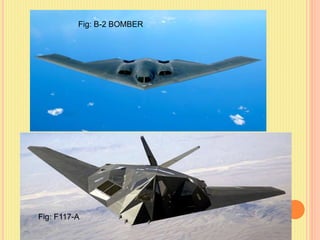
 Examples-B-2 bomber or the F-117A Nighthawk
fighter
 In Second World War allied aircrafts used tin and
aluminum in huge amount to confuse German RADARS.
Fig: B-2 BOMBER
Fig: F117-A
• NEED OF STEALTH
 Main need of this stealth is to reduce the detection of
objects.
 Examples: Fighter jets , missiles …etc.,
 With the increasing development in the field of defense
mechanisms like radar fused shells , IR guided “fire and
forget” missiles etc.
 Thus the development of Stealth Technology provides an
edge over the advancing “Defense Mechanisms”.
RADAR
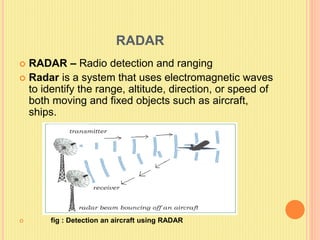
 RADAR – Radio detection and ranging
 Radar is a system that uses electromagnetic waves
to identify the range, altitude, direction, or speed of
both moving and fixed objects such as aircraft,
ships.
 fig : Detection an aircraft using RADAR
•DIFFERENCE BETWEEN CONVENTIONAL
AND STEALTH AIRCRAFT.
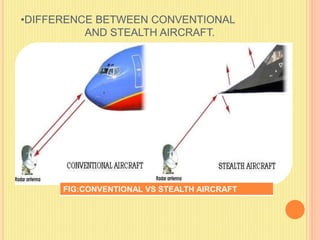
FIG:CONVENTIONAL VS STEALTH AIRCRAFT
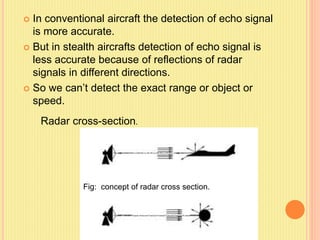
 In conventional aircraft the detection of echo signal
is more accurate.
 But in stealth aircrafts detection of echo signal is
less accurate because of reflections of radar
signals in different directions.
 So we can’t detect the exact range or object or
speed.
Radar cross-section.
Fig: concept of radar cross section.
• CONCEPT OF RAS & RAM
 RAS -Radar absorbent surfaces : are the surfaces
on the aircraft, which can deflect the incoming radar
waves and reduce the detection range.
 (OR) obsorbs the certain amount of radar
incoming signals. Then the outgoing reflections will
be less.
 RAM-Radar absorbent materials: Totally depends
on the surface of the aircraft is made.
 And the composition of this material is a top secret.
 Its helpful to deflect the radar waves.
 A Jaumann absorber or Jaumann layer is a radar
absorbent device.
• DESIGN PROCESS & METHODS
 Design for stealth requires the integration of many
techniques and materials.
 The types of stealth thats a maximally stealthy aircraft
seeks to achieve can be categorized as visual, infrared,
acoustic, and radar.
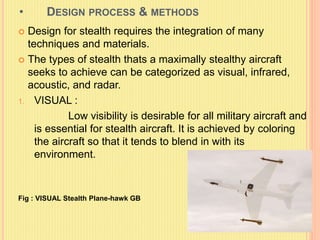
1. VISUAL :
Low visibility is desirable for all military aircraft and
is essential for stealth aircraft. It is achieved by coloring
the aircraft so that it tends to blend in with its
environment.
Fig : VISUAL Stealth Plane-hawk GB
2. INFRARED : Infrared stealth is an area of stealth
technology aimed at reducing infrared signatures.
3. ACOUSTIC : Its a sound related technology .
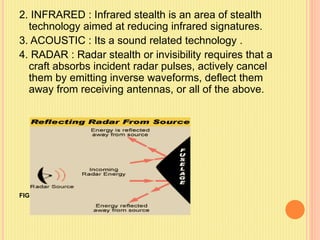
4. RADAR : Radar stealth or invisibility requires that a
craft absorbs incident radar pulses, actively cancel
them by emitting inverse waveforms, deflect them
away from receiving antennas, or all of the above.
FIG : DEFLECTIN OF RADAR
BECAUSE OF THE STEALTH DESIGN
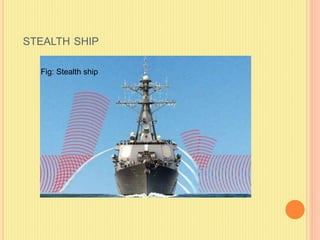
STEALTH SHIP
Fig: Stealth ship
• HOW DOES STEALTH AVOID
DETECTION
 Stealth or Stealth aircrafts are designed to avoid
detection using a variety of technologies that
reduce reflection / emission of radar , infrared,
visible light , radio frequency(RF)spectrum and
audio collectively known as stealth technology.
 Objects can still be detected by a sufficiently
powerful radar or at sufficiently close ranges.
 Stealthy helps to deflects the echoes away from the
radar.
• BENEFITS OF STEALTH TECHNOLOGY
 Efficiency can be increased while in a war zone
when stealth vehicles are used instead of
conventional vehicles, providing long term fiscal
savings.
 Stealth fighter aircrafts prevent from enemies
initiating attacks .
 Providing a low detectable radar in the War-fare.
 Having a High speed as a range of > 930 KMPH.
• DISADVANTAGES OF STEALTH
TECHNOLOGY
 The biggest disadvantage of a stealth fighter or
technology is its high cost.( F 35 fighter – 700 crores
US)
because of using several methods and
technologies.
 Stealth aircrafts have lower payload or carrying capacity
than the conventional aircrafts.
 Compared to conventional aircrafts, stealth aircrafts are
less agile and lack efficient maneuverability.
Agile- means able to move quickly and easily.
Maneuverability- withstand for any stresses.
• CONCLUSION
 Stealth technology developed a lot.
 Investment needed is very high.
 Useful for other projects implementation.
 The detection and stealth technology has improved
significantly more advanced in the last 50 years ..
 Its an arm race in technology.
 “Its a fight between technologies”.
 The need of stealth can be more in future to
prevent from war-fare.
ANY QUERIES ?
THANK Q

STEALTH technology.pptx

  • 1.
    A Technical SeminarPresentation on STEALTH TECHNOLOGY SRINIVASA INSTITUTE OF TECHNOLOGYAND SCIENCE DEPARTMENT OF ELECTRONICS AND COMMUNICATION ENGINEERING Presented by C SREENIVASULU NAIDU Reg No: 189H1A0408 Under the Guidance of Mr. RLBR PRASAD REDDY, M.Tech Assoc. Professor & HOD Department Of E.C.E
  • 2.
    CONTENTS :  IntroductionTo Stealth Technology.  History  Need of Stealth.  About RADAR.  Difference Between Conventional Aircrafts And Stealth Aircrafts.  RCS Reduction & Concepts Of RAS & RAM.  Design Process.  How Does Stealth Avoiding Detection.  Benefits.  Disadvantages.  Conclusion .  References.
  • 3.
    • INTRODUCTION  Whatis stealth technology? Stealth is a technique of making an objects invisible.  Stealth technology is also known as LOT ( Low observability technology) is a technologies which covers a range of techniques used with aircraft, ships and missiles, in order to make them less visible (ideally invisible) to radar, infrared and other detection methods.  In simple terms, stealth technology allows an aircraft to be partially invisible to Radar or any other means of detection.  Stealth technology cannot make the aircraft invisible to enemy or friendly radar.
  • 4.
    • HISTORY  Theterm "stealth", is coined in 1966 by Charles E. "Chuck" Myers, combat pilot and later an exec at Lockheed.  First Stealth Aircraft was developed by Lockheed Martin in 1983 called the F-117A nicknamed as the “Nighthawk”.  Examples-B-2 bomber or the F-117A Nighthawk fighter  In Second World War allied aircrafts used tin and aluminum in huge amount to confuse German RADARS.
  • 5.
  • 6.
    • NEED OFSTEALTH  Main need of this stealth is to reduce the detection of objects.  Examples: Fighter jets , missiles …etc.,  With the increasing development in the field of defense mechanisms like radar fused shells , IR guided “fire and forget” missiles etc.  Thus the development of Stealth Technology provides an edge over the advancing “Defense Mechanisms”.
  • 7.
    RADAR  RADAR –Radio detection and ranging  Radar is a system that uses electromagnetic waves to identify the range, altitude, direction, or speed of both moving and fixed objects such as aircraft, ships.  fig : Detection an aircraft using RADAR
  • 8.
    •DIFFERENCE BETWEEN CONVENTIONAL ANDSTEALTH AIRCRAFT. FIG:CONVENTIONAL VS STEALTH AIRCRAFT
  • 9.
     In conventionalaircraft the detection of echo signal is more accurate.  But in stealth aircrafts detection of echo signal is less accurate because of reflections of radar signals in different directions.  So we can’t detect the exact range or object or speed. Radar cross-section. Fig: concept of radar cross section.
  • 10.
    • CONCEPT OFRAS & RAM  RAS -Radar absorbent surfaces : are the surfaces on the aircraft, which can deflect the incoming radar waves and reduce the detection range.  (OR) obsorbs the certain amount of radar incoming signals. Then the outgoing reflections will be less.  RAM-Radar absorbent materials: Totally depends on the surface of the aircraft is made.  And the composition of this material is a top secret.  Its helpful to deflect the radar waves.  A Jaumann absorber or Jaumann layer is a radar absorbent device.
  • 11.
    • DESIGN PROCESS& METHODS  Design for stealth requires the integration of many techniques and materials.  The types of stealth thats a maximally stealthy aircraft seeks to achieve can be categorized as visual, infrared, acoustic, and radar. 1. VISUAL : Low visibility is desirable for all military aircraft and is essential for stealth aircraft. It is achieved by coloring the aircraft so that it tends to blend in with its environment. Fig : VISUAL Stealth Plane-hawk GB
  • 12.
    2. INFRARED :Infrared stealth is an area of stealth technology aimed at reducing infrared signatures. 3. ACOUSTIC : Its a sound related technology . 4. RADAR : Radar stealth or invisibility requires that a craft absorbs incident radar pulses, actively cancel them by emitting inverse waveforms, deflect them away from receiving antennas, or all of the above. FIG : DEFLECTIN OF RADAR BECAUSE OF THE STEALTH DESIGN
  • 13.
  • 14.
    • HOW DOESSTEALTH AVOID DETECTION  Stealth or Stealth aircrafts are designed to avoid detection using a variety of technologies that reduce reflection / emission of radar , infrared, visible light , radio frequency(RF)spectrum and audio collectively known as stealth technology.  Objects can still be detected by a sufficiently powerful radar or at sufficiently close ranges.  Stealthy helps to deflects the echoes away from the radar.
  • 15.
    • BENEFITS OFSTEALTH TECHNOLOGY  Efficiency can be increased while in a war zone when stealth vehicles are used instead of conventional vehicles, providing long term fiscal savings.  Stealth fighter aircrafts prevent from enemies initiating attacks .  Providing a low detectable radar in the War-fare.  Having a High speed as a range of > 930 KMPH.
  • 16.
    • DISADVANTAGES OFSTEALTH TECHNOLOGY  The biggest disadvantage of a stealth fighter or technology is its high cost.( F 35 fighter – 700 crores US) because of using several methods and technologies.  Stealth aircrafts have lower payload or carrying capacity than the conventional aircrafts.  Compared to conventional aircrafts, stealth aircrafts are less agile and lack efficient maneuverability. Agile- means able to move quickly and easily. Maneuverability- withstand for any stresses.
  • 17.
    • CONCLUSION  Stealthtechnology developed a lot.  Investment needed is very high.  Useful for other projects implementation.  The detection and stealth technology has improved significantly more advanced in the last 50 years ..  Its an arm race in technology.  “Its a fight between technologies”.  The need of stealth can be more in future to prevent from war-fare.
  • 18.
  • 19.