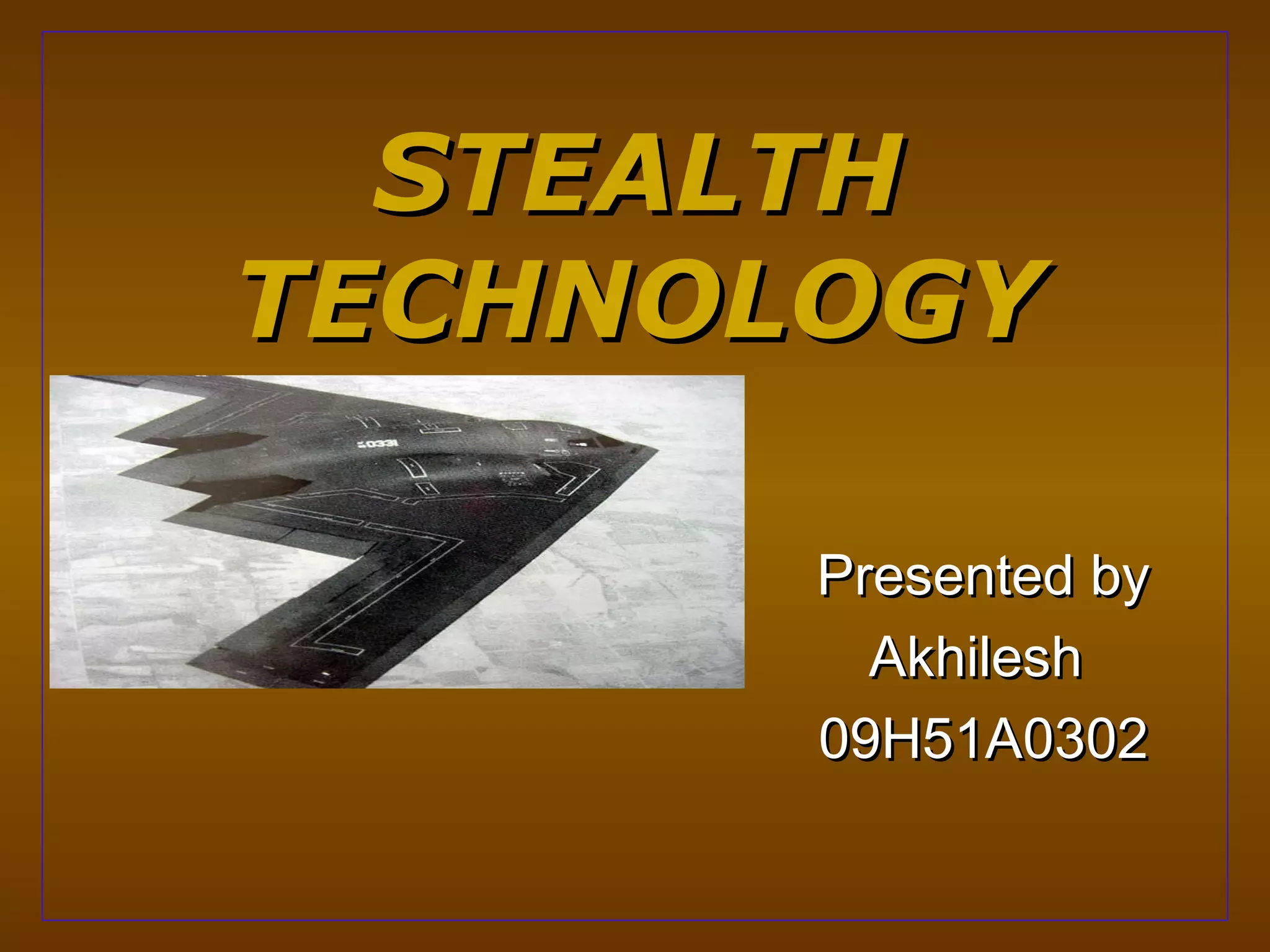
STEALTH
TECHNOLOGY

       Presented by
         Akhilesh
       09H51A0302
What is it?
   Stealth is defined as being secretive or cautious in
    movement and action.
   RADAR is used to detect position of objects.
   Technology avoiding detection and innovating
    deception is known as stealth technology.
   RCS (Radar cross section)reductions, acoustics,
    thermal and other EM emissions
How is it achieved.
   Absorbs radar waves or deflects to other
    directions.
   Minimizes heat and other emissions from engine
    and other spots.
   Makes difficult to detect except closely.
   The size of a target's image on radar is measured
    by RCS (σ )
Vehicle shape and structure
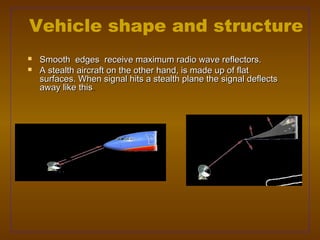
   Smooth edges receive maximum radio wave reflectors.
   A stealth aircraft on the other hand, is made up of flat
    surfaces. When signal hits a stealth plane the signal deflects
    away like this.
Vehicle structure (contd..)

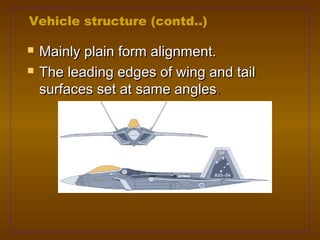
   Mainly plain form alignment.
   The leading edges of wing and tail
    surfaces set at same angles.
Vehicle structure (contd..)
   Use of re-entrant triangles behind skin.

   Distinctive serrations used in external
    airframes.

   Propulsion subsystem shaping.

   Now in research is fluidic nozzles for
    thrust vectoring.
Radar Absorbing Materials (RAM)
   RAMs often as paints used to absorb
    RADAR signals.

   Iron ball paint, ferrite in polymer matrix
    used.

   The cockpit canopy coated with thin layer
    of indium tin oxide .
RAMs (contd..)
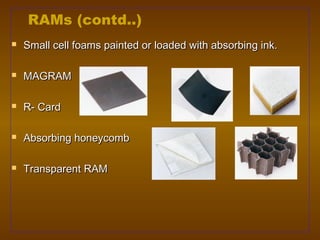
   Small cell foams painted or loaded with absorbing ink.

   MAGRAM

   R- Card

   Absorbing honeycomb

   Transparent RAM
IR Emission
   Major IR emission sources.

    1. Tailpipe region

    2. Turbojets have exhaust gas temperature of 1000oC

    3. Exhaust gas plume

    4. Hot engine parts

    5. Aircraft skin (frictional heating)

    6. Reflected and reemitted sunlight.
IR Reduction

   Using surface paints

   Non circular tail pipe

   Emissions from hot parts screened by airframe.

   The plume mixed with cool air.
Electromagnetic emissions


   The greatest source is RADAR itself.

   Shutting down RADAR a solution having
    negative effects.

   Radio /radar altimeters and Doppler
    navigation systems.
Conclusion.
   Stealth technology developed a lot.

   Investment needed is very high.

   High chance of low cost gain.

   A lot learned about signature reduction and
    absorption.

   Useful for other projects.

   Success yet to be proved extensively.
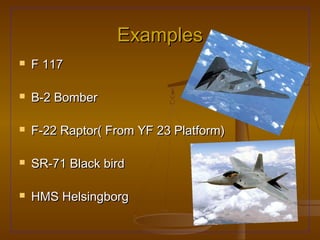
Examples
   F 117

   B-2 Bomber

   F-22 Raptor( From YF 23 Platform)

   SR-71 Black bird

   HMS Helsingborg
Stealth technology

Stealth technology

  • 1.
    STEALTH TECHNOLOGY Presented by Akhilesh 09H51A0302
  • 2.
    What is it?  Stealth is defined as being secretive or cautious in movement and action.  RADAR is used to detect position of objects.  Technology avoiding detection and innovating deception is known as stealth technology.  RCS (Radar cross section)reductions, acoustics, thermal and other EM emissions
  • 3.
    How is itachieved.  Absorbs radar waves or deflects to other directions.  Minimizes heat and other emissions from engine and other spots.  Makes difficult to detect except closely.  The size of a target's image on radar is measured by RCS (σ )
  • 4.
    Vehicle shape andstructure  Smooth edges receive maximum radio wave reflectors.  A stealth aircraft on the other hand, is made up of flat surfaces. When signal hits a stealth plane the signal deflects away like this.
  • 5.
    Vehicle structure (contd..)  Mainly plain form alignment.  The leading edges of wing and tail surfaces set at same angles.
  • 6.
    Vehicle structure (contd..)  Use of re-entrant triangles behind skin.  Distinctive serrations used in external airframes.  Propulsion subsystem shaping.  Now in research is fluidic nozzles for thrust vectoring.
  • 7.
    Radar Absorbing Materials(RAM)  RAMs often as paints used to absorb RADAR signals.  Iron ball paint, ferrite in polymer matrix used.  The cockpit canopy coated with thin layer of indium tin oxide .
  • 8.
    RAMs (contd..)  Small cell foams painted or loaded with absorbing ink.  MAGRAM  R- Card  Absorbing honeycomb  Transparent RAM
  • 9.
    IR Emission  Major IR emission sources. 1. Tailpipe region 2. Turbojets have exhaust gas temperature of 1000oC 3. Exhaust gas plume 4. Hot engine parts 5. Aircraft skin (frictional heating) 6. Reflected and reemitted sunlight.
  • 10.
    IR Reduction  Using surface paints  Non circular tail pipe  Emissions from hot parts screened by airframe.  The plume mixed with cool air.
  • 11.
    Electromagnetic emissions  The greatest source is RADAR itself.  Shutting down RADAR a solution having negative effects.  Radio /radar altimeters and Doppler navigation systems.
  • 12.
    Conclusion.  Stealth technology developed a lot.  Investment needed is very high.  High chance of low cost gain.  A lot learned about signature reduction and absorption.  Useful for other projects.  Success yet to be proved extensively.
  • 13.
    Examples  F 117  B-2 Bomber  F-22 Raptor( From YF 23 Platform)  SR-71 Black bird  HMS Helsingborg