BY
MANISH KUMAR RAJPOOT
(EC-1)
CONTENT
 Introduction to Stealth Technology
 History of Stealth Technology
 What is Signature ?
 Types of Signature
 Adaptive Water Curtain Technology
 Advantages and Disadvantages
 India’s Step Towards Stealth
 Future Scope
 Conclusion
 Refrences
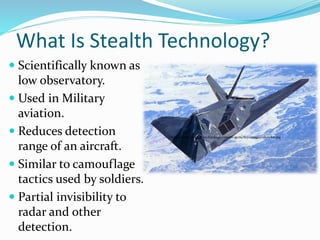
What Is Stealth Technology?
 Scientifically known as
low observatory.
 Used in Military
aviation.
 Reduces detection
range of an aircraft.
 Similar to camouflage
tactics used by soldiers.
 Partial invisibility to
radar and other
detection.
http://www.airforce-technology.com/projects/f117/images/nhawk11.jpg
History
 The first “STEALTH” aircraft have been developed in
Germany during the last years of WWII.
 Later Americans worked on stealth technology and
succeeded by developing U-2 and F-117A Stealth
aircraft.
 F-117A has the ability to evade enemy radar so , it
was given a nick name “NIGHTHAWK”.
 This technique has also been used in ships and
Americans developed a ship named “SEA SHADOW”
which was first unveiled on April 9 ,1993.
What is Signature ?
 Signature can be defined as any activity or
radiation or the characteristic of the body that
helps to revile its presence at a particular point.
 All the detection methods used that be in military
and civil systems are by detecting the signature of
the body.
 signature can be rightly called as observability of
an object and stealth vehicles can be called as low-
observable vehicles or low-signature vehicles.
Types of Signatures
 RADAR Cross Section (RCS)
 LIDAR (Light Detection And Ranging)
 Acoustic Signature
 Visible Signature
 Infrared Signature
 Plasma Stealth
Radar Cross Section
 Radar cross section is the measure of a target's
ability to reflect radar signals in the direction of
the radar receiver
 It is a measure of the ratio of backscatter power per
steradian (unit solid angle) in the direction of the
radar (from the target) to the power density that is
intercepted by the target.
Reduction of RCS
 RCS minimization techniques involves two
methods:
Radar Absorbent Material (RAM)
Radar Absorbent Structures (RAS)
Radar Absorbent Materials
 Radar-absorbing materials (RAMs) are used to
dissipate the energy of the radar wave so to prevent
the reception of a reflected signal by an antenna.
 The dissipation process converts the radio
frequency (RF) energy to a negligible quantity of
heat.
 Other ways of reducing RCS include passive
cancellation, incorporating an echo source which
by design cancels another echo source for a certain
frequency and angle, active cancellation etc.
Types of RAM’s
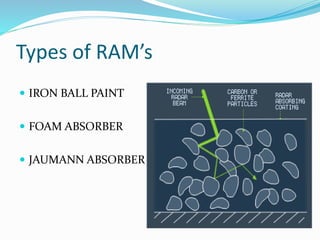
 IRON BALL PAINT
 FOAM ABSORBER
 JAUMANN ABSORBER
Limitations of RAM
 Absorbs only a portion of the incident radiation.
 Effective only at certain frequencies and angle of
incidence.
 Thickness and weight increases with effectiveness
of RAM.
 Sensitive to adverse weather (rain)
Radar Absorbent Structures
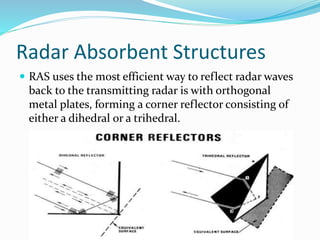
 RAS uses the most efficient way to reflect radar waves
back to the transmitting radar is with orthogonal
metal plates, forming a corner reflector consisting of
either a dihedral or a trihedral.
RAS (continued)
 Behind the skin of some aircraft are structures
known as re-entrant triangles. Radar waves
penetrating the skin of the aircraft get trapped in
these structures, bouncing off the internal faces
and losing energy.
 Stealth aircraft such as the F-117 use a different
arrangement, tilting the tail surfaces to reduce
corner reflections formed between them.
LIDAR
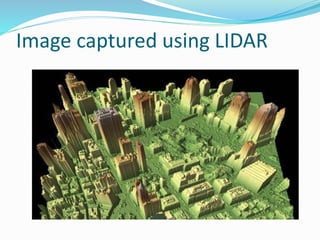
 Laser radar can detect stealth targets effectively
because it has short wavelength, high beam
quality, strong directionality, high measuring
accuracy and it has functions of target identifying,
posture displaying and orbit recording.
 Target and background optical properties on
different wavelengths and atmospheric effects of
different wavelength need to be considered in lidar
detection.
Image captured using LIDAR
Acoustics Signature
 Acoustics means Sound and Acoustic signature is
used to describe a combination of acoustic
emissions of ships and submarines. Although
Acoustic Signature are found in for land and ariel
units acoustic signature turns out to be the key
method of detection for Naval field rather than the
other two.
 It includes SONAR( SOund Navigation And
Ranging) Detectors.
SONAR Detectors
 Sonar detectors are simply devices that detect the
presence of Sonar beams.
 They can be classified as :
 Passive: In this operator listens to sounds emitted by
the object one is trying to locate.
 Active: Active sonar creates a pulse of sound, often
called a "ping", and then listens for reflections of the
pulse.
SONAR Stealth
 Its aim is to reduce sound from a Submarine or
Ship thus remain undetected.
 There are many ways of reducing Acoustic
Signature like reduction of vibration of the
Submarine, reduce sounds due to cavitations etc.
Bathythermograph
 A thermo cline is a layer of water where the
temperature gradient is greater than that of the
warmer layer above and the colder layer below.
 When the temperature gradient is greater, a sound
wave rapidly bends towards the sea bottom. The sound
wave goes to the sea bottom and "stay there". The
sound wave is useless.
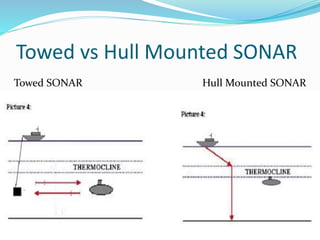
Towed vs Hull Mounted SONAR
Towed SONAR Hull Mounted SONAR
Visual Signature
 Low visibility is desirable for all military
applications.
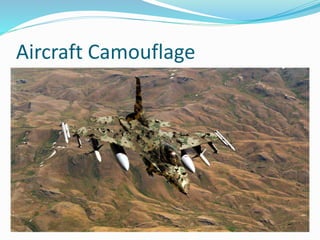
 Earlier stealth aircraft were painted black and thus
could be used during nights.
 Now days an electro chromic polymer is being
developed for daytime stealth.
 These polymer sheets sense nature of the
surrounding and change there color accordingly.
Aircraft Camouflage
Infrared Signature
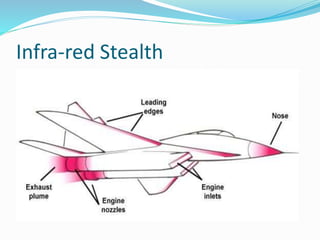
 Infra-red radiation are emitted by all matter above
absolute temperature zero.
 Hot zones such as engine exhaust , wing surface
[friction due to air ] get heated which rather
increases the visibility.
 These part should be kept cool as possible it can
be.
 Option would be mixing of cool air with the hot
engine exhaust .
Infra-red Stealth
Plasma Stealth
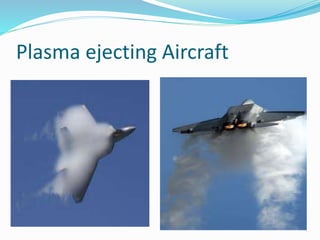
 Aircraft using Plasma Stealth Inject Stream of
Plasma(Ionized gas).
Plasma is generated by “Plasmatron”.
 Plasma Covers entire body of aircraft.
 Absorbs most electromagnetic energy of radar.
 First developed by Russians.
Plasma ejecting Aircraft
Adaptive Water Curtain
Technology
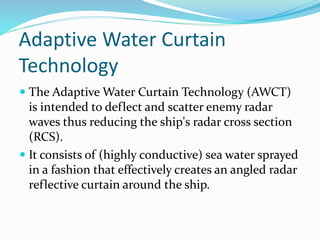
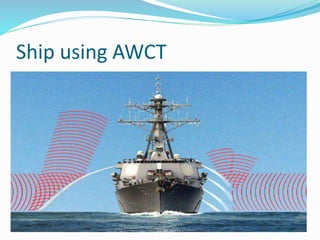
 The Adaptive Water Curtain Technology (AWCT)
is intended to deflect and scatter enemy radar
waves thus reducing the ship's radar cross section
(RCS).
 It consists of (highly conductive) sea water sprayed
in a fashion that effectively creates an angled radar
reflective curtain around the ship.
Ship using AWCT
Advantages of Stealth
Reduces the causality rates during war.
Saving military budget.
Develop the military secretes.
Bluff the anti-detective device.
Stealth aircraft are invisible to radar.
We can perform the Spy Missions.
Can be used in civil aviation.
Disadvantages of Stealth
.
 High cost-B2 Bomber 2 billion USD
-F117-A 70 million USD
-F22 100 million USD
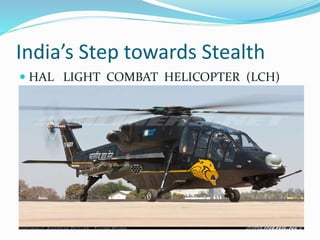
India’s Step towards Stealth
 HAL LIGHT COMBAT HELICOPTER (LCH)
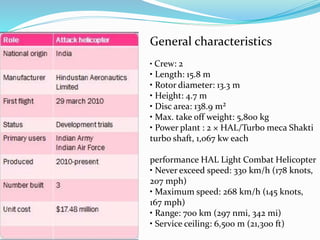
General characteristics
• Crew: 2
• Length: 15.8 m
• Rotor diameter: 13.3 m
• Height: 4.7 m
• Disc area: 138.9 m²
• Max. take off weight: 5,800 kg
• Power plant : 2 × HAL/Turbo meca Shakti
turbo shaft, 1,067 kw each
performance HAL Light Combat Helicopter
• Never exceed speed: 330 km/h (178 knots,
207 mph)
• Maximum speed: 268 km/h (145 knots,
167 mph)
• Range: 700 km (297 nmi, 342 mi)
• Service ceiling: 6,500 m (21,300 ft)
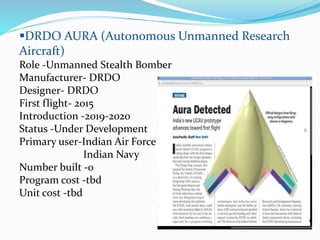
DRDO AURA (Autonomous Unmanned Research
Aircraft)
Role -Unmanned Stealth Bomber
Manufacturer- DRDO
Designer- DRDO
First flight- 2015
Introduction -2019-2020
Status -Under Development
Primary user-Indian Air Force
Indian Navy
Number built -0
Program cost -tbd
Unit cost -tbd
Future Scope of Stealth Technology
 The main objective is to design an aircraft that can
penetrate and reflect the radar waves very well.
 From the research, South Korea has come out with
a new design of stealth aircraft called stealthy
next-gen fighter.
 The KF-X is a twin-engine stealth fighter with a
design goal of achieving maneuverability, speed
and range performance between a Lockheed
Martin F-16 and a Boeing F-15.
Conclusion
 Stealth technology developed a lot.
 Investment needed is very high.
 High chance of low cost gain.
 A lot learned about signature reduction and
absorption.
 Success yet to be proved extensively.
 Useful for other projects.
 Its an arm race except it isn’t between specific
countries .
Refrences
 http://www.totalairdominance.50megs.com/articles/stealt
h.htm
 http://en.wikipedia.org/wiki/Stealth_technology
 http://en.wikipedia.org/wiki/Radar
 http://en.wikipedia.org/wiki/Stealth_ship
 http://www.resonancepub.com/images/stealth_ship.gif
 http://images.google.co.in/images
 http://science.howstuffworks.com/question69.htm
 http://www.espionageinfo.com/Sp-Te/Stealth-
Technology.html
 http://www.airplanedesign.info/51.htm
THANK YOU

Stealth technology

  • 1.
  • 2.
    CONTENT  Introduction toStealth Technology  History of Stealth Technology  What is Signature ?  Types of Signature  Adaptive Water Curtain Technology  Advantages and Disadvantages  India’s Step Towards Stealth  Future Scope  Conclusion  Refrences
  • 3.
    What Is StealthTechnology?  Scientifically known as low observatory.  Used in Military aviation.  Reduces detection range of an aircraft.  Similar to camouflage tactics used by soldiers.  Partial invisibility to radar and other detection. http://www.airforce-technology.com/projects/f117/images/nhawk11.jpg
  • 4.
    History  The first“STEALTH” aircraft have been developed in Germany during the last years of WWII.  Later Americans worked on stealth technology and succeeded by developing U-2 and F-117A Stealth aircraft.  F-117A has the ability to evade enemy radar so , it was given a nick name “NIGHTHAWK”.  This technique has also been used in ships and Americans developed a ship named “SEA SHADOW” which was first unveiled on April 9 ,1993.
  • 5.
    What is Signature?  Signature can be defined as any activity or radiation or the characteristic of the body that helps to revile its presence at a particular point.  All the detection methods used that be in military and civil systems are by detecting the signature of the body.  signature can be rightly called as observability of an object and stealth vehicles can be called as low- observable vehicles or low-signature vehicles.
  • 6.
    Types of Signatures RADAR Cross Section (RCS)  LIDAR (Light Detection And Ranging)  Acoustic Signature  Visible Signature  Infrared Signature  Plasma Stealth
  • 7.
    Radar Cross Section Radar cross section is the measure of a target's ability to reflect radar signals in the direction of the radar receiver  It is a measure of the ratio of backscatter power per steradian (unit solid angle) in the direction of the radar (from the target) to the power density that is intercepted by the target.
  • 8.
    Reduction of RCS RCS minimization techniques involves two methods: Radar Absorbent Material (RAM) Radar Absorbent Structures (RAS)
  • 9.
    Radar Absorbent Materials Radar-absorbing materials (RAMs) are used to dissipate the energy of the radar wave so to prevent the reception of a reflected signal by an antenna.  The dissipation process converts the radio frequency (RF) energy to a negligible quantity of heat.  Other ways of reducing RCS include passive cancellation, incorporating an echo source which by design cancels another echo source for a certain frequency and angle, active cancellation etc.
  • 10.
    Types of RAM’s IRON BALL PAINT  FOAM ABSORBER  JAUMANN ABSORBER
  • 11.
    Limitations of RAM Absorbs only a portion of the incident radiation.  Effective only at certain frequencies and angle of incidence.  Thickness and weight increases with effectiveness of RAM.  Sensitive to adverse weather (rain)
  • 12.
    Radar Absorbent Structures RAS uses the most efficient way to reflect radar waves back to the transmitting radar is with orthogonal metal plates, forming a corner reflector consisting of either a dihedral or a trihedral.
  • 13.
    RAS (continued)  Behindthe skin of some aircraft are structures known as re-entrant triangles. Radar waves penetrating the skin of the aircraft get trapped in these structures, bouncing off the internal faces and losing energy.  Stealth aircraft such as the F-117 use a different arrangement, tilting the tail surfaces to reduce corner reflections formed between them.
  • 14.
    LIDAR  Laser radarcan detect stealth targets effectively because it has short wavelength, high beam quality, strong directionality, high measuring accuracy and it has functions of target identifying, posture displaying and orbit recording.  Target and background optical properties on different wavelengths and atmospheric effects of different wavelength need to be considered in lidar detection.
  • 15.
  • 16.
    Acoustics Signature  Acousticsmeans Sound and Acoustic signature is used to describe a combination of acoustic emissions of ships and submarines. Although Acoustic Signature are found in for land and ariel units acoustic signature turns out to be the key method of detection for Naval field rather than the other two.  It includes SONAR( SOund Navigation And Ranging) Detectors.
  • 17.
    SONAR Detectors  Sonardetectors are simply devices that detect the presence of Sonar beams.  They can be classified as :  Passive: In this operator listens to sounds emitted by the object one is trying to locate.  Active: Active sonar creates a pulse of sound, often called a "ping", and then listens for reflections of the pulse.
  • 18.
    SONAR Stealth  Itsaim is to reduce sound from a Submarine or Ship thus remain undetected.  There are many ways of reducing Acoustic Signature like reduction of vibration of the Submarine, reduce sounds due to cavitations etc.
  • 19.
    Bathythermograph  A thermocline is a layer of water where the temperature gradient is greater than that of the warmer layer above and the colder layer below.  When the temperature gradient is greater, a sound wave rapidly bends towards the sea bottom. The sound wave goes to the sea bottom and "stay there". The sound wave is useless.
  • 20.
    Towed vs HullMounted SONAR Towed SONAR Hull Mounted SONAR
  • 21.
    Visual Signature  Lowvisibility is desirable for all military applications.  Earlier stealth aircraft were painted black and thus could be used during nights.  Now days an electro chromic polymer is being developed for daytime stealth.  These polymer sheets sense nature of the surrounding and change there color accordingly.
  • 22.
  • 23.
    Infrared Signature  Infra-redradiation are emitted by all matter above absolute temperature zero.  Hot zones such as engine exhaust , wing surface [friction due to air ] get heated which rather increases the visibility.  These part should be kept cool as possible it can be.  Option would be mixing of cool air with the hot engine exhaust .
  • 24.
  • 25.
    Plasma Stealth  Aircraftusing Plasma Stealth Inject Stream of Plasma(Ionized gas). Plasma is generated by “Plasmatron”.  Plasma Covers entire body of aircraft.  Absorbs most electromagnetic energy of radar.  First developed by Russians.
  • 26.
  • 27.
    Adaptive Water Curtain Technology The Adaptive Water Curtain Technology (AWCT) is intended to deflect and scatter enemy radar waves thus reducing the ship's radar cross section (RCS).  It consists of (highly conductive) sea water sprayed in a fashion that effectively creates an angled radar reflective curtain around the ship.
  • 28.
  • 29.
    Advantages of Stealth Reducesthe causality rates during war. Saving military budget. Develop the military secretes. Bluff the anti-detective device. Stealth aircraft are invisible to radar. We can perform the Spy Missions. Can be used in civil aviation.
  • 30.
    Disadvantages of Stealth . High cost-B2 Bomber 2 billion USD -F117-A 70 million USD -F22 100 million USD
  • 31.
    India’s Step towardsStealth  HAL LIGHT COMBAT HELICOPTER (LCH)
  • 32.
    General characteristics • Crew:2 • Length: 15.8 m • Rotor diameter: 13.3 m • Height: 4.7 m • Disc area: 138.9 m² • Max. take off weight: 5,800 kg • Power plant : 2 × HAL/Turbo meca Shakti turbo shaft, 1,067 kw each performance HAL Light Combat Helicopter • Never exceed speed: 330 km/h (178 knots, 207 mph) • Maximum speed: 268 km/h (145 knots, 167 mph) • Range: 700 km (297 nmi, 342 mi) • Service ceiling: 6,500 m (21,300 ft)
  • 33.
    DRDO AURA (AutonomousUnmanned Research Aircraft) Role -Unmanned Stealth Bomber Manufacturer- DRDO Designer- DRDO First flight- 2015 Introduction -2019-2020 Status -Under Development Primary user-Indian Air Force Indian Navy Number built -0 Program cost -tbd Unit cost -tbd
  • 34.
    Future Scope ofStealth Technology  The main objective is to design an aircraft that can penetrate and reflect the radar waves very well.  From the research, South Korea has come out with a new design of stealth aircraft called stealthy next-gen fighter.  The KF-X is a twin-engine stealth fighter with a design goal of achieving maneuverability, speed and range performance between a Lockheed Martin F-16 and a Boeing F-15.
  • 35.
    Conclusion  Stealth technologydeveloped a lot.  Investment needed is very high.  High chance of low cost gain.  A lot learned about signature reduction and absorption.  Success yet to be proved extensively.  Useful for other projects.  Its an arm race except it isn’t between specific countries .
  • 36.
    Refrences  http://www.totalairdominance.50megs.com/articles/stealt h.htm  http://en.wikipedia.org/wiki/Stealth_technology http://en.wikipedia.org/wiki/Radar  http://en.wikipedia.org/wiki/Stealth_ship  http://www.resonancepub.com/images/stealth_ship.gif  http://images.google.co.in/images  http://science.howstuffworks.com/question69.htm  http://www.espionageinfo.com/Sp-Te/Stealth- Technology.html  http://www.airplanedesign.info/51.htm
  • 37.

Editor's Notes

  • #4 The scientific name for stealth technology is low observatory, which incorporates several concepts into one technology. Stealth is nothing new, it has been used since caveman years with covering up in leaves, but it is now used in military aviation. Stealth does not always refer to just radar there are other forms of detections such as heat signatures.
  • #5 Stealth is not the complete invisibility to radar, it only becomes partially invisible. It reduces the range of detection as well. Stealth uses the principles or reflection, absorption, and redirection.